Tag: Florida

  • Florida’s Quick Rebound

    Adding nearly 119,000 people in 2011, Florida has capped a decade of steady population increase  to see the state grow 19% since 2000.  Despite 2009, an historic year where more people left than arrived, the overall net growth of Florida has yielded two additional congressional seats, moving the state well on its way towards the becoming third most populous state in the nation.  This ascendancy brings new responsibility to the shoulders of the state’s leaders, and the direction this state takes in the coming years will depend upon how Florida reacts to this influx of new population.  It is time for true leadership to find appropriate voice for our state on the national scene.

    Contrary to the predictions of many within the urbanist intelligentsia, Florida’s farm counties grew the fastest. Osceola County, just south of bustling Orlando, grew by 55%; sleepy Sumter County, northwest of Orlando, grew by 75%; and Flagler County, home to historic St. Augustine, nearly doubled in population. Tampa, Orlando, and Miami have each seen their healthy share of immigration, but Florida’s rural areas have dramatically increased their appeal over a decade ago.

    At first this trend might be puzzling.  Lacking urban amenities such as museums, transit, and Starbucks, parts of rural Florida seem almost timeless.  Wildwood and Leesburg, nestled in the center of Florida, lack both beaches and theme parks.  They have one thing, however, that the urban areas do not have:  affordable housing.  And this is the elusive reality that must be turned around by Florida’s leadership if the state is to grow in a responsible manner.

    The Miami-Dade market has plenty of supply, but the average home lists for $509,000 .  Up in Wildwood, the home lists for $175,000, and you get a lot more house for your money.  People are voting with their feet for affordability.

    It’s not the price alone that seems to be putting people off, however.  Naples, which lists homes even higher than Miami, saw growth over the past ten years at a pace two and a half times that of Miami, and is expected to continue to grow at the same pace through 2015.  Anecdotally, it seems that newcomers have relocated to their vacation homes after selling off their other high-priced property, usually in the north. They sometimes reduced their expectations of what they can receive for their old houses and then permanently located where they prefer to live. If the buyers are older, they still likely made a nice profit over the past few decades.

    In Orange County, meanwhile, relieved realtors are finally starting to say goodbye to distressed properties.  Appraiser Lee Barnes commented that “foreclosures and short sales are 40% fewer, compared to this time last year,” and in an economy fueled by growth, the welcome sight of occupied rooftops means that commercial real estate is beginning to come back.  In fact, Orlando is near the top of the list in expected home price gains for 2012, a dramatic turnaround for the region.

    Florida’s comeback is timed with some key changes in regulating real estate development.  With state oversight all but vanquished by the governor, starving local counties welcome the property tax dollars associated with new growth.  No other revenue, apart from a sales tax, provides much cash to operate government in the Sunshine State. This makes growth a priority.

    But economic activity occurs in two forms:  growth (making more stuff) and development (making stuff better).  Quietly, in the past decade, Florida has added biomedical research clusters to its twin engines of growth and tourism, and this promises to increase greater resilience to the state economy.

    Some signs, however, point to Florida abandoning this strategy and continuing its boom-bust mentality.  The Governor, already warning the legislature of budget cuts in 2012, has expressed disappointment that the job creation return is poor on the State’s venture capital invested in bringing Scripps, Nemours, and other cutting-edge research organizations. He claims that are simply not adding jobs fast enough for his taste.  Abandoning these investments could mean that the organizations reduce their presence or even abandon the state.

    At the same time, Florida’s cities seem to be uncertain about how to tackle the problem of adding density without reducing affordability.  Land prices haven’t wavered much in the recession, with stubborn property owners holding on to assets that won’t sell, and they may benefit from this land-banking strategy in the long run.  Many who escape the Rust Belt and come to Florida express shock at the cost of living in the Sunshine State and are further dismayed over the quality of schools and surprising amount of congestion.  This mismatch between cost of living and quality of life may be part of the reason why Florida’s five largest cities were listed among the nation’s “saddest” in a recent Time poll .

    Casino gambling, a typical 1990s way to boost revenue, is being entertained by the Legislature, but other ideas should be considered as well.  For one thing, investment in the future means a better education system, perhaps a higher priority than ostrich food subsidies (currently exempt from state sales tax ).  Closing tax loopholes and fixing some long-broken parts of Florida’s tax code will help gain some badly-needed revenue.

    Very large infrastructure projects are also important to make Florida competitive.  On the east coast, NASA’s 60-year-old facilities need a major overhaul to continue providing America a spaceport for the 21st century and to pave the way for private space exploration.  This will maintain the deep investment in human capital of which Floridians were once justly proud.  The spaceport has a great deal of synergy with the National Simulation Center, located in Orlando, which is currently the country’s premier provider of military simulation and training.

    In more than one region, the Florida Venture Capital Act has brought world-class biomedical research laboratories, making dramatic advancements in cancer, diabetes, children’s health, and other key areas.  Already surging ahead and competing with area like Boston’s Research Center and the Silicon Valley, Florida must keep its edge in this field by continuing investment in the Venture Capital Fund.

    On the west coast, the Tampa Port Authority is already preparing for the widening of the Panama Canal, working in collaboration with ports of Mobile and Houston to partner with ocean carriers.  Continuing this investment and modernizing the logistics of truck and railroad traffic into the port is critical to make this economic engine prevail in the 21st century.

    Such infrastructure investment will improve Florida’s already existing assets, allowing for prosperity and upward mobility to occur within the state.  Competing with Texas will be difficult, given Florida’s lack of petrochemical resources, but the state’s native industry, tourism, has already made it a world-class destination. Florida’s leadership has already entered the national stage by saying “no” to high speed rail, but it has yet to define what it will say “yes” to.  Without intelligent citizen input, the state will likely fall back on its traditional pattern of being a passive receiver of investment and people, but not a creator of great new enterprises. 

    In contrast to states like California and Texas, Florida has been willing to be eternally passive; Disney World is a classic example.  Florida, a grateful recipient of this California enterprise, has benefitted secondarily, but the real power of this company still resides in Burbank.  This story is played out over and over again, with real estate developers from Dallas and Atlanta continuing to define the face of the state, aided and abetted by Wall Street investors who see Florida primarily as a waterfront real estate asset with some moderate margins available in between coasts.

    It is time for Florida to start doing, instead of being done to.  With investment in real infrastructure, good education and intelligent leadership, Florida can assume its responsibility as one of America’s new high-profile states, capable of exporting science, technology, and culture.  Our population growth contains within it the seeds of a bright future once we fix what is broken about our beautiful state.

    Richard Reep is an Architect and artist living in Winter Park, Florida. His practice has centered around hospitality-driven mixed use, and has contributed in various capacities to urban mixed-use projects, both nationally and internationally, for the last 25 years.

    Photo courtesy of BigStockPhoto.com.

  • Central Florida: On the Cusp of Recovery?

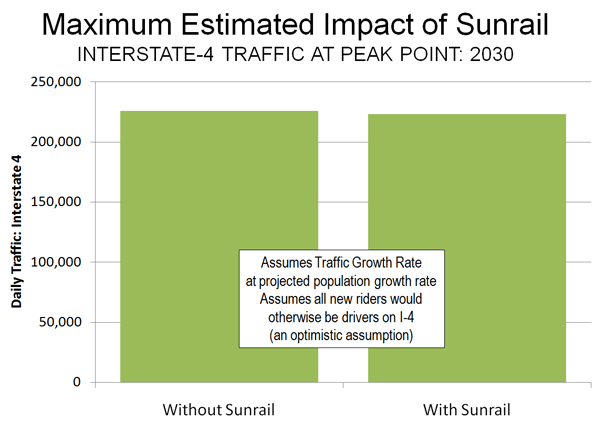
    Central Florida is poised at the cusp of a major turnaround, and its response to this condition will either propel the region forward, or drag it backward.  This cusp condition is brought about by a train and a road; neither of which have begun yet but both of which appear imminent.  Sunrail uses existing 19th century railroad tracks as a commuter spine through Orlando’s disperse, multipolar city.  The Wekiva Parkway completes a beltway around Orlando, placing it with Washington DC, Houston and other ringed cities.  Before either gets built, the region deserves some analysis on their combined effect, and how they can be nudged onto a pathway to make the region better.

    Sunrail brings with it mythology  about how trains affect cities.  In what has now become the standard, tired kabuki dance between developer interests and municipal ones.

    Not surprisingly, heavy regulation has entered the scene, with the avowed goal of creating dense urban pockets along even largely rural  train stops. This has sparked rising property values which may end up  frustrating the dream of transit-oriented development (TOD).  Affordable dwellings and meaningful employment within a half-mile of a train stop must be created in order to make this development work, but unless Central Florida can spark this, the new train will likely suffer from the same fate as the vast majority of its sunbelt counterparts:  low ridership and increasing tax subsidies.

    Inserting TOD into 17 locations in Central Florida is a bold experiment. In order for it to work, the rising costs of housing will need to be addressed, and Central Florida can take advantage of this ambition to succeed.  Orlando home sales are coming back, thanks to the mild climate and desirable lifestyle. That is very different, however, from guaranteeing that the economics of the rail commuter will make it worth discarding the single-family detached American Dream in favor of a relatively new model that has an unproven track record.

    Orlando also seems to be blithely going about the business of creating another ring of traffic around itself, descending into the same level where Atlanta’s Perimeter, the DC Beltway, and other like-kind roads live.  The Wekiva Parkway, long considered unneeded, is now being designed to complete the ring around Orlando, and will cross 25 miles of pristine wetlands that is a vestige of once-vast water resources of the region. 

    The Expressway Authority proposes this ring as an alternative to existing roads to serve the “growth needs of this area,” it conceded recently that this road segment made little economic sense except as a toll road accessing a new suburban single-family home development carved out of the swamps by one of the Governor’s chief fundraisers .  The asset value of this ring road may be more private than in the public interest.

    Traditionally agricultural land interlaced with wetlands, The Wekiva area to the northwest of Orlando has avoided large-scale Florida style bulldozing.  All this will change if the Governor is successful in eliminating water management regulations , freeing up much of Florida, including this corner of Orlando, for speculation.

    The local press, quick to criticize Alaska’s Bridge to Nowhere and always ready to jump on environmental issues, meekly ponders  the need for this $2 billion highway.  Maybe the elevated design, intended to be more ecologically friendly, makes it OK, despite the safety problems and high maintenance associated with this design.  Florida’s history is littered with the drawings of many other elevated highways eventually built on grade to save cost.  Once approved, the Wekiva Parkway may quickly be brought down to earth as well, displacing wetlands and agricultural land.

    The Wekiva Parkway will open up land supply which indeed will allow for more growth.  Done right, the asphalt will make land available that could be useful to the area’s economy.  It will bring traffic to historic, but presently lonely Sanford, potentially infusing the economy of this once-vibrant rail town.  Using principles of scarcity, land values could reflect people’s high desire to live in rural areas with all the services and guarantees that 21st century suburban life offers: fire and police protection, state-of-the-art infrastructure, and free pizza delivery.  It could invigorate neighboring towns that are currently struggling for survival.

    The risk is that such a road will simply allow more investment into Florida real estate without giving Florida much back in exchange.  Florida, already strained to meet its current population needs, should not simply trade another commercial strip for water resources that benefit many species and contribute to the region’s resilience. Rather, development models should emulate the best of America’s conservation development happening in states where water rights are scarce.  Connecting local employers with residential areas will enhance the value of both, and strategically keeping rural agricultural areas intact will preserve the region’s present land use diversity.

    Well managed development that conserves resources and balances broader needs with private interests will elevate the state’s prospects at this critical juncture.  One more bit of the original subtropical wilderness represents an asset for both present and future generations. With the right approach, the Wekiva Parkway can provide an enlightened model of low-density development that respects the value of open space.

    In town, Sunrail presents denser development as an alternative.  The normal pathway, however, seems to pit the profit-seeking real estate developer against ever higher regulatory burdens, which eventually make his product unaffordable to those coming here to escape high costs and regulations in other cities.  Keeping both employment and housing affordable are critical to achieving success with any of these projects.

    Moving product down the value chaindoes not do well current system, which leaves out the very people who Sunrail supposedly will benefit.  Density is one of those characteristics that seems to be about good timing: if you have it today, like San Francisco or New York, this is largely the result of history;  if you do not have it today, like Orlando, it is risky and probably a dubious proposition.

    The road and the train open up land that must be carefully stewarded to create opportunities for meaningful employment and affordable housing, both of which are presently scarce commodities.  The concept of transit-oriented development needs a success story, and Sunrail provides 17 opportunities to find one; meanwhile, the road presents a danger as well as an opportunity for Florida’s wetlands.  As the region slowly recovers from the recession, the two projects together should be carefully considered by the region’s citizens and leadership to truly redefine Central Florida’s identity for the 21st century.

    Richard Reep is an Architect and artist living in Winter Park, Florida. His practice has centered around hospitality-driven mixed use, and has contributed in various capacities to urban mixed-use projects, both nationally and internationally, for the last 25 years.

    Photo courtesy of BigStockPhoto.com.

  • The Sun Belt’s Migration Comeback

    Along with the oft-pronounced, desperately wished for death of the suburbs, no demographic narrative thrills the mainstream news media more than the decline of the Sun Belt, the country’s southern rim extending from the Carolinas to California. Since the housing bubble collapse in 2007, commentators have heralded “the end of the Sun Belt boom.”

    Yet this assertion is largely exaggerated, particularly since the big brass buckle in the middle of the Sun Belt, Texas, has thrived throughout the recession. California, of course, has done far worse, but its slow population growth and harsh regulatory environment align it more with the Northeast than with its sunny neighbors.

    Moreover, the Sun Belt is poised for a recovery, according to the most recent economic and demographic data. Even such hard-hit states as Arizona and most impressively Florida appear to be making an unexpected, and largely unheralded, recovery.

    Take Florida. The Sunshine State may have experienced rapid population loss during 2008 and 2009, but the just-released 2011 Census estimates show a remarkable turnaround, with the state adding 119,000 domestic migrants last year. This may be less than half the gains in 2004 and 2005, when the in-migration reached nearly 250,000, but it is close to levels enjoyed a decade ago.

    The big winners in terms of growth were in the South, with Texas, Florida and North Carolina as the leading in-migration states. Virginia, South Carolina, Georgia, Tennessee and Virginia also ranked in the top 10. Overall, the Southern states reaped 95% of the inter-regional net domestic migration (people moving from one state to another). Arizona, another state widely written off, enjoyed an 11th place finish, with a net gain over 13,000.

    As for the much-cherished notion that people will start flocking to highly urbanized, high-cost littoral states? Well, as they say in my native New York, fuggedaboutit. As has been the case for most of the past few decades, the Empire State has once again been the biggest loser, not of pounds, losing 113,000 people. Following close behind are California and Illinois, all of which are once again losing people in large numbers to other places.

    In contrast, one of the few Sun Belt states to lose migrants is former high-flier Nevada, which lost 11,000 people to other states. The Silver State’s continued decline seems traced to what Phoenix economist Elliot Pollack describes as its “one-trick pony economy.” In Nevada, that economy is tied to gambling, which has been hit by the recession and by increasing competition both domestically and in East Asia. It also suffers from its unhealthy “evil twin” dependency on still-weak California.

    The reasons behind these shifts are complex. For one, there is a slowly improving economic climate in many Sun Belt cities. In terms of year-to-year job growth, Dallas ranks first and Houston third, while  Orlando, Miami and Phoenix all are among the top 10 of the country’s 32 largest metropolitan areas. Among the states Texas ranks fifth and Arizona ranks seventh, while Florida clocks in at 16th. This may not be the gangbuster growth of previous decades, but is far from moribund.

    Looking forward, some of the “bubble states” appear to be taking a lesson from Texas and are reconsidering their former growth formula, which relied far too much on tourism, retirees and housing construction. “We know the business model has to change from just tourism and retirees,” notes Chris McCarty, director of the Bureau of Economic and Business Research at the University of Florida. “We need to make a modification in our approach and now there’s a desire to do something about it.”

    Increasingly, places like Phoenix, Orlando and Tampa are focusing on more broad-based growth in such fields as biomedicine, software and trade, which may produce steadier, if not quite as rapid, growth. Aggressively pro-business governments in almost all Sun Belt states — with the exception of California — will enjoy better economic prospects as companies seek out lower-tax, less regulated environments.

    But ultimately demographic trends may prove more determinative. People moving into a state provides many things — such as new workers, skills and, perhaps most important, capital. An examination of IRS data of income brought in as a result of migration by the Tax Foundation shows that Florida ranked third in terms of overall gains, behind only Montana and South Carolina. Arizona ranked fifth. The biggest losers are all in the frost belt: Michigan, New York, Rhode Island and Illinois.

    If we are, as is likely, returning to something approximating earlier patterns, we should expect these trends to accelerate gradually over the coming years. One critical factor will be our rapidly aging population.  Over the past decade, Phoenix as well as the Florida burgs of Tampa-Saint Petersburg, Orlando and Jacksonville all ranked among the top 10 destinations for aging boomers. This pattern may be reasserting itself.

    Housing prices are a critical factor here. Once-soaring prices in communities such as Orlando and Phoenix have adjusted to the more historic median multiple (median housing price relative to income) of roughly three; in contrast, despite some declines, prices in metropolitan areas like New York, Los Angeles, San Francisco, San Diego and San Jose all remain around six or higher.

    This suggests that many retirees and down-shifting boomers — people still working but able to relocate their jobs — may find cashing out of their more expensive houses in the Northeast, Chicago or coastal California an effective way of supplementing often depleted IRAs. “There’s a lot of older people with equity who can find bargains that weren’t around in 2006,” observed the University of Florida’s McCarty.

    More important still is the movement of younger people from the large millennial generation. Despite the assumption that this group inevitably prefers dense, expensive cities, the 2010  Census showed people 25 to 34 moving primarily to Sun Belt cities such as Orlando, Tampa, Houston and Austin, as well as Raleigh, North Carolina.

    “There are a lot of people who will be getting into their 30s [who] still haven’t created a household or bought a home,” says Phoenix-based economist Elliot Pollack. “They mostly won’t be able to do that in California or the Northeast, but they can do it in places like Arizona.”

    Pollack maintains that the real estate meltdown has actually created opportunities for the emerging generation. Burdened by college debt and what could still be a sluggish economy, they may find, like so many of their parents, that their best options for homeownership lie in these Sun Belt growth markets. In this sense, the millennials, like the generations before them, may not be the ones to kill the Sun Belt  but the demographic which will  propel it into a new period of more steady, and sustainable, growth.

    Net Domestic Migration By State, 2010-2011
    State 2011
    Texas    145,315
    Florida    118,756
    North Carolina      41,033
    Washington      35,166
    Colorado      31,195
    South Carolina      22,013
    Tennessee      20,328
    Georgia      17,726
    Virginia      15,538
    Oregon      13,636
    Arizona      13,150
    Oklahoma        8,933
    District of Columbia        8,334
    Louisiana        7,085
    North Dakota        6,368
    Kentucky        5,761
    Arkansas        5,724
    Montana        3,888
    West Virginia        2,814
    South Dakota        2,610
    Delaware        2,347
    New Mexico        2,202
    Alabama        1,974
    Alaska           740
    Wyoming         (149)
    Idaho         (256)
    Utah         (826)
    Vermont         (841)
    Nebraska         (977)
    Maine      (1,000)
    Pennsylvania      (1,121)
    Iowa      (1,361)
    Hawaii      (2,320)
    Maryland      (2,994)
    New Hampshire      (3,645)
    Rhode Island      (6,273)
    Mississippi      (6,672)
    Kansas      (7,928)
    Minnesota      (8,073)
    Massachusetts    (10,886)
    Wisconsin    (10,990)
    Nevada    (11,113)
    Indiana    (11,412)
    Missouri    (11,831)
    Connecticut    (16,848)
    Ohio    (44,868)
    New Jersey    (54,098)
    Michigan    (57,234)
    California    (65,705)
    Illinois    (79,458)
    New York  (113,757)
    Data from US Bureau of the Census


    This piece first appeared at Forbes.com.

    Joel Kotkin is executive editor of NewGeography.com and is a distinguished presidential fellow in urban futures at Chapman University, and contributing editor to the City Journal in New York. He is author of The City: A Global History. His newest book is The Next Hundred Million: America in 2050, released in February, 2010.

  • New Census Data Reaffirms Dominance of the South

    The 2011 state population estimates released earlier today by the Census Bureau show that the South has retained its dominant position in both population and growth over the last year. Southern states accounted for more than one half of the nation’s population growth between 2011 and 2000, despite having little more than one third of the population. Moreover, the South was the recipient of 95% of the inter-regional net domestic migration (people moving from one state to another), with the West accounting for the other 5%, with the losses split between the Northeast and the Midwest.

    Overall, a net 533,000 people moved from one state to another, somewhat above the low of 503,000 in 2008 and below the 573,000 at the beginning of the previous decade (2001). The figure, however, remained less than one-half that of the mid 2000s peak.

    The state data confirmed the "return to normalcy," that had been indicated by the 2010 American Community Survey data.

    The South Rises Again

    In 2011 (July 2010 to June 2011), seven of the top domestic migration gaining states were in the South. This is a restoration of the same dominance the South achieved in 2001 to 2006. Some of the states have changed, but the overall impact is little different.

    Texas:Texas again led the nation in net domestic migration, adding 145,000 people from other states to its population. This was a slight increase from the 143,000 net domestic migrants in 2009 (Note 1) and was the highest for Texas since the artificially intense exodus from Louisiana in the year (2006) following hurricanes Katrina and Rita. Texas has led the nation in net domestic migration for six years and ranked second in the nation over the 2001 to 2009.

    Florida: Most spectacularly, however, has been the performance of Florida. Florida had been a net domestic migration leader for years, and had been number one from 2001 through 2005. However, when its highly inflated house prices collapsed (New York Federal Reserve Bank research refers to Florida as one of the "four bubble" states, along with California, Arizona and Nevada), Florida lost domestic migrants for the first time in at least six decades, in both 2008 and 2009. That has been radically turned around. In 2011, Florida added 119,000 net domestic migrants, housing prices dropped to normal levels (Note 2). While this is less than one half the gains in 2004 and 2005, it exceeds the annual Texas increase in the previous decade by 20%.

    North Carolina and South Carolina: North Carolina ranked third, adding 41,000 net domestic migrants. This is an improvement from a fourth-place ranking in the previous decade. Neighboring South Carolina added 22,000 net domestic migrants and ranked sixth. This is an improvement from the previous decade’s ranking of seventh. The domestic migrants to North Carolina and South Carolina have been called "halfbacks," as some have suggested that many who had moved to Florida from the Northeast have subsequently moved to North Carolina and South Carolina, essentially one half of the way back to where they moved from originally.

    Tennessee, Georgia and Virginia: Tennessee (7th), Georgia (8th) and Virginia (9th) rounded out the South’s seven of the top 10 states. Tennessee improved from having been 8th in 2001 to 2009, while Georgia dropped from 5th and Virginia was a new entrant, having previously ranked 12th.

    Western Runners-Up

    While the West continued to show net domestic migration gains, this formerly fastest-growing area of the nation has fallen well behind.

    Washington: Washington ranked fourth in 2011, an improvement from ninth between 2001 and 2009. Washington added 35,000 net domestic migrants.

    Colorado: Colorado also improved its position, adding a net 31,000 domestic migrants and ranking fifth in 2011, which is up from its 10th ranking in 2001 through 2009.

    Oregon:Oregon ranked 10th, adding 14,000 net domestic migrants and was a new entrant to the top 10, having placed 11th between 2001 and 2009.

    Things Never Change: The Bottom 10

    A similar restoration of normalcy is evident in the bottom 10 states. From 2001 to 2009, all of the bottom 10 net domestic migration states were in the Northeast or the Midwest, joined by California. This changed somewhat in 2011, with formerly fast-growing Nevada, edging out one of the former bottom 10. There was some movement at the very bottom of the list.

    New York: New York recovered its last place position (51st), which it held overall between 2001 and 2009, but had yielded to California later in the decade. New York lost 114,000 net domestic migrants in 2011, which compares to the 1,650,000 loss between 2000 and 2009.

    Illinois:Illinois had the second-highest net domestic migration loss, sending 79,000 of its residents to other states. Illinois had ranked 49th in net domestic migration in the previous decade, with a 615,000 loss. Unlike the other biggest losers, New York and California, the Illinois rate in the single year of 2011 exceeded its annual rate of net domestic migration loss between 2000 and 2009.

    California:The bad news is that California continues to be among the most hemorrhaging states in net domestic migration. The 2000 to 2009 net domestic migration loss of 1,500,000 was more than the population of the cities (municipalities) of San Francisco and Sacramento combined. Perhaps it is good news that the net domestic migration loss dropped to 66,000 in 2011, less than half the annual rate in the previous decade. California ranked 49th in net domestic migration in 2011, an improvement from its 50th place position in 2001 through 2009.

    Michigan: Michigan continued its heavy losses, losing a net 57,000 domestic migrants in 2011 and ranking 48th. In the previous decade, Michigan had also ranked 48th and had a net loss of more than 535,000 domestic migrants.

    New Jersey, Ohio and Connecticut: New Jersey, Ohio and Connecticut occupied the next three higher positions in the bottom ten. The New Jersey and Ohio ranks of 47th and 46th were the same as in the previous decade. Connecticut ranked 45th in 2011 and had ranked 42nd, at the top of the bottom 10, in the previous decade. Each of these states experienced an acceleration of net domestic outmigration relative to their annual loss in the previous decade. In the previous decade, the New Jersey and Connecticut losses had been driven by the New York metropolitan area, which suffered the preponderance of the net domestic migration losses in the Northeast.

    Missouri and Indiana: The Midwestern states of Missouri and Indiana were new entrants to the bottom 10. Missouri ranked 44th in net domestic migration in 2011, losing 12,000, a substantial deterioration from its 20th ranking in the previous decade when the state added 41,000 residents from other states. Indiana ranked 43rd compared to its 32nd place ranking in the previous decade.

    Nevada: Nevada, which had ranked sixth in net domestic migration in the previous decade, occupied the top position in the bottom 10, at 42nd. Nevada lost 11,000 domestic migrants, compared to a gain of more than 360,000 in the previous decade. Like Florida, house prices had escalated sharply during the housing bubble and prices have since fallen back to normal levels. However, much of Nevada’s economy is tied to that of California, which could be a hindrance to the restoration of its previous growth.

    Other Notes

    The other "bubble state," Arizona ranked 11th in net domestic migration, adding 13,000 new residents from other states. As in Florida, house prices had escalated sharply but have since fallen back to normal levels. However, despite its healthy domestic migration, Arizona’s gain is far less than its annual rate in the previous decade.

    There are nothing but surprises in the balance of the top 15. Oklahoma, which has long exported people, especially to the West, ranked 12th in net domestic migration, an improvement from 19 in the previous decade. The District of Columbia ranked 13th, which is a strong improvement from its previous ranking of 37th. Louisiana continued its recovery, ranking 14th, which is an improvement from 45th in the previous decade. North Dakota, whose 2000 population was less than that of 1920, ranked 15th, which is an improvement from 31th in the previous decade.

    No Matter How Much Things Change They Stay the Same

    Both over the last decade and in 2011, the South accounted for 53% of the nation’s growth, the West 32%, with the Midwest rising from 8% to 9% and the Northeast falling from 7% to 6%. And, as indicated above, net domestic migration results were similar. The conclusion from the new census estimates is consistent with the old adage that "no matter how much things change, they stay the same."

    Net Domestic Migration by State:
    2001-2009 and 2011
    By 2011 Rank
    State 2011 2011 Rank 2001-2009 2001-2009 Rank
    Texas       145,315                   1        838,126                   2
    Florida       118,756                   2     1,154,213                   1
    North Carolina         41,033                   3        663,892                   4
    Washington         35,166                   4        239,037                   9
    Colorado         31,195                   5        202,735                 10
    South Carolina         22,013                   6        306,045                   7
    Tennessee         20,328                   7        259,711                   8
    Georgia         17,726                   8        550,369                   5
    Virginia         15,538                   9        164,930                 12
    Oregon         13,636                 10        177,375                 11
    Arizona         13,150                 11        696,793                   3
    Oklahoma           8,933                 12           42,284                 19
    District of Columbia           8,334                 13         (39,814)                 37
    Louisiana           7,085                 14       (311,368)                 45
    North Dakota           6,368                 15         (18,071)                 31
    Kentucky           5,761                 16           81,711                 15
    Arkansas           5,724                 17           75,163                 16
    Montana           3,888                 18           39,853                 21
    West Virginia           2,814                 19           17,727                 26
    South Dakota           2,610                 20             7,182                 27
    Delaware           2,347                 21           45,424                 18
    New Mexico           2,202                 22           26,383                 24
    Alabama           1,974                 23           87,199                 14
    Alaska               740                 24           (7,360)                 29
    Wyoming             (149)                 25           22,883                 25
    Idaho             (256)                 26        110,279                 13
    Utah             (826)                 27           53,390                 17
    Vermont             (841)                 28           (1,505)                 28
    Nebraska             (977)                 29         (39,275)                 36
    Maine          (1,000)                 30           29,260                 23
    Pennsylvania          (1,121)                 31         (33,119)                 34
    Iowa          (1,361)                 32         (49,589)                 40
    Hawaii          (2,320)                 33         (29,022)                 33
    Maryland          (2,994)                 34         (95,775)                 43
    New Hampshire          (3,645)                 35           32,588                 22
    Rhode Island          (6,273)                 36         (45,159)                 38
    Mississippi          (6,672)                 37         (36,061)                 35
    Kansas          (7,928)                 38         (67,762)                 41
    Minnesota          (8,073)                 39         (46,635)                 39
    Massachusetts       (10,886)                 40       (274,722)                 44
    Wisconsin       (10,990)                 41         (11,981)                 30
    Nevada       (11,113)                 42        361,512                   6
    Indiana       (11,412)                 43         (21,467)                 32
    Missouri       (11,831)                 44           41,278                 20
    Connecticut       (16,848)                 45         (94,376)                 42
    Ohio       (44,868)                 46       (361,038)                 46
    New Jersey       (54,098)                 47       (451,407)                 47
    Michigan       (57,234)                 48       (537,471)                 48
    California       (65,705)                 49   (1,490,105)                 50
    Illinois       (79,458)                 50       (614,616)                 49
    New York     (113,757)                 51   (1,649,644)                 51
    Data from US Bureau of the Census


    —–

    Note 1: The Census Bureau did not produce domestic migration data for 2010 (2009-2010). Any reference to 2010 in this article is based upon an interpolation of the 2010 estimate from 2009 and 2011 Census Bureau estimates.

    Note 2: By 2010, housing affordability in all of Florida’s four major metropolitan areas with the exception of Miami had been returned to a Median Multiple (median house price divided by median household income) of approximately 3.0 or less, which is the historical norm (See: 7th Annual Demographia International Housing Affordability Survey). During the housing bubble of the early to middle 2000s, the Median Multiple had risen to above 5.0 in all of the major metropolitan areas except Jacksonville.

    Wendell Cox is a Visiting Professor, Conservatoire National des Arts et Metiers, Paris and the author of “War on the Dream: How Anti-Sprawl Policy Threatens the Quality of Life

  • Florida Rising

    New Internal Revenue Service migration data, compiled by the Tax Foundation, confirms that more people are again moving to Florida than are moving out. After a loss in the number of 30,000 domestic migrants ("exemptions") in 2008-9 as indicated on tax returns, Florida added 30,000 in 2009-10. This is still a far lower net migration than before the burst of the housing bubble, but is an indication that Florida has returned to growth. Florida’s migration turnaround was recently noted in new American Community Survey data (see Domestic Migration: Returning to Normalcy?). Additionally, in 2009-10, Florida ranked third out of the 50 states and DC in personal income gains from net domestic migration relative to 2009. Only Montana (#1) and South Carolina (#2) did better.

  • Domestic Migration: Returning to Normalcy?

    Even as the troubled economy has continued to hobble along, there may be hints that the domestic migration patterns from before the Great Financial Crisis could be returning at least in some states. This is evident in the recent national interstate migration data from the American Community Survey. This analysis reviews annual interstate migration data from the beginning of the Great Financial Crisis to 2010, with broad comparisons to earlier (2001-2006) data from the Census Bureau population estimates program (Note 1). The big stories are that Florida and Arizona show signs of recovery, the trend has reverted to more negative in California and the steady states are North Carolina (a big gainer of domestic migrants) and Illinois (a big loser of domestic migrants).

    Moreover, none of the states that have been perennial domestic migration losers moved into the top ten between 2007 and 2010, even as fast growing states such as Florida and Arizona were hard hit by the real estate bubble and saw migration rates decline. Notably, however, Pennsylvania, which had sustained modest domestic migration losses, rose to the number 8 position in 2010 (Table 1).

    Table
    Top Domestic Migration States: 2001-2010
      Year and Source
      2001-6 2007-9 2010
    Rank Census Estimates ACS ACS
    1 Florida Texas Texas
    2 Arizona North Carolina North Carolina
    3 Texas Arizona Florida
    4 North Carolina South Carolina Arizona
    5 Georgia Georgia Colorado
    6 Nevada Oklahoma South Carolina
    7 South Carolina Washington Virginia
    8 Tennessee Colorado Pennsylvania
    9 Virginia Virginia Washington
    10 Washington Utah Kentucky


    The Largest Gaining States:Some of the states with the largest gains seem to be returning toward their previous domestic migration volumes.

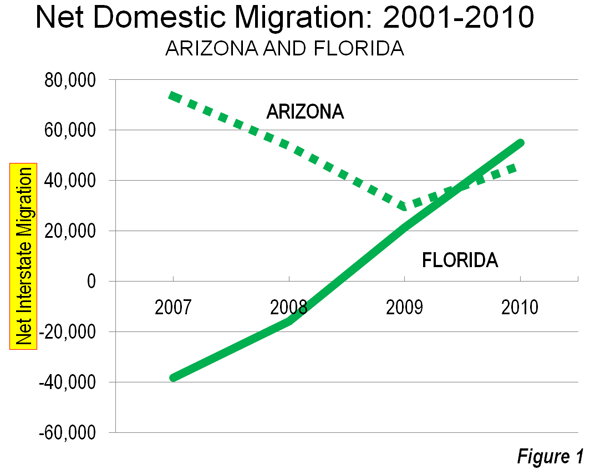
    Florida: For the last few years, the big news in interstate domestic migration has been in Florida. This state, which has grown by more than 5.5 times since 1950, had been the domestic migration leader for some years. However, as one of the four "ground zero" states (along with California, Arizona and Nevada) for its huge house price losses, Florida bottomed out at a loss of 38,000 domestic migrants, falling to 44th in 2007. The state lost another 16,000 interstate migrants in 2008. These were the first domestic migration loss since the 1940s for Florida.

    However, in 2009, Florida returned to growth, adding 21,000 domestic migrants. An even stronger recovery occurred in 2010, with a net 55,000 domestic migrants. This remains well below the peak of 265,000 recorded in Census estimate figures in 2004 and 2005. Nonetheless, Florida ranked third in domestic migration in 2010, trailing North Carolina by only 1000 as well as number one Texas. Part of Florida’s success is likely related to its housing affordability, which has been restored in all of the state’s major metropolitan areas with the exception of Miami. The recent repeal of Florida’s land rationing "smart growth" law should position the state for even more affordable housing and net domestic migration gains.

    Arizona: Arizona is another state that was hit hard by the housing bubble. Much has been written on Arizona’s recent hard times. Yet, unlike Florida, Arizona did not experience domestic migration losses in any year of the past decade. The state has routinely been among the top five in domestic migration, even during the darkest years of the Great Financial Crisis. Like the nation in general, Arizona reached its lowest net domestic migration figure in 2009 at 29,000, but recovered to 46,000 in 2010. Interstate domestic migration remains somewhat below the early 2000s figures, but is trending upwards.

    Texas: Texas took the interstate domestic migration crown away from Florida in 2006 at has been the nation’s leader since that time. According to Census estimates, Texas peaked in 2006 at 233,000 net domestic migrants. This was an artificially high peak, location by the outflow of people from Louisiana who were driven out by Hurricanes Katrina and Rita and the failure of responsible governments to properly maintain flood control infrastructure. From 2007 to 2009, Texas was also aided by its liberal land use policies that helped it avoid the real estate bubble, retaining lower house prices that made it more attractive to domestic migrants. Texas added more than 125,000 domestic migrants annually. However in 2010, net domestic migration dropped to 75,000. Nonetheless, even Texas indicates a return toward normalcy. In the first five years of the decade, Census data placed net domestic migration in Texas at only 40,000, well short of the 2010 figure.

    North Carolina: Through good times and bad, North Carolina was has been a consistent performer among the larger gainers. North Carolina ranked fourth in net domestic migration from 2001 through 2006, according to Census data. Then the state moved up to number two in every year from 2007 to 2010.   In 2010 domestic migration was 56,000, slightly below the 2001 to 2006 Census reported average of approximately 63,000. Like Texas, North Carolina largely escaped the real estate bubble, with house prices rising far less severely than on the West Coast, the Northeast, Florida, Nevada and Arizona, which could be a principal reason for its consistent domestic migration gains.

    The Largest Losing States:There were also indications that people continue to be among the most significant exports of California and New York, which wrestled for the bottom position for the entire decade. While The New York Times characterized the 2008 to 2010 domestic outmigration from California and New York as having slowed to a "relative trickle," the ACS data indicates that the spigot is still on.

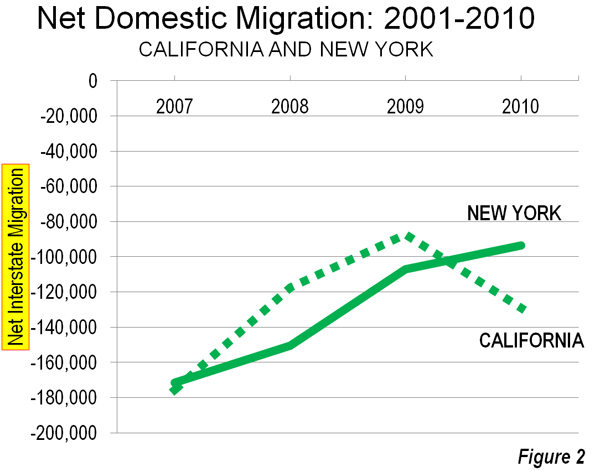
    New York:New York experienced a net loss of 94,000 domestic migrants in 2010, a figure nearly equal to the population of its state capital, Albany. Despite this large loss, New York is doing better than earlier in the decade, when domestic outmigration averaged more than 200,000 from 2001 to 2006.

    California: California, however, may have taken a turn to the south. After having experienced the largest losses in the nation in 2007 (175,000), net domestic outmigration fell to 87,000 in 2009 and California relinquished the bottom position to New York. However, in 2010, California’s net domestic outmigration rose to 129,000 and the state recovered its former bottom ranking.

    Illinois: Illinois has been the most consistent performer among the largest losing states. According to Census data, domestic migration losses averaged 77,000 from 2001 to 2006. ACS data indicates similar losses, averaging 73,000 from 2007 to 2010.

    Normalcy Again? It is premature to suggest any long-term judgments on these early data. However, it would not be surprising to see the states with the highest costs of living (driven by high housing costs) and the least friendly business climates to lose domestic migrants to states with lower costs of living and more friendly business environments. For example, the fact that median house prices today in Phoenix are more affordable compared to the large metropolitan areas of coastal California than they were at the peak of the housing bubble may be part of what drove Arizona’s improved net domestic migration in 2010.

    —-

    Note 1: The Census Bureau provides annual estimates of domestic migration, however does not do so in census years, such as 2010, which is why this analysis uses American Community Survey data. For the purposes of data compatibility, 2007, 2008, 2009 and 2010 data from the American Community Survey (also conducted by the Census Bureau) is the principal source for recent trends. This analysis is different from the one by Kenneth M. Johnson of the University of New Hampshire Carey Institute, which detailed domestic migration results from the three year American Community Survey (2008-2010), and which was covered by The New York Times.

    Note 2: Leith van Onselen has recently described developments in the Phoenix housing market (in How Phoenix Boomed and Busted) during the last decade.

    Wendell Cox is a Visiting Professor, Conservatoire National des Arts et Metiers, Paris and the author of “War on the Dream: How Anti-Sprawl Policy Threatens the Quality of Life

    Photograph: Cape Coral, Florida (by author)

  • Florida Gets Dragged Into the 21st Century

    Righteous cries of outrage and anger dominate Florida these days, as unreasonable assaults upon common sense seem to roll with regularity out of the governor’s office. Recently, Governor Scott   published a list of Florida’s higher education faculty, matching salaries to names.  This act was disingenuously styled as an effort towards transparency, but it was really a good old-fashioned right-wing poke at the eggheads. 

    Sadly, this does the Governor no favors, and reinforces the public’s perception of Scott as a reactionary Neanderthal with no heart or soul, perpetually on the wrong side of every issue.   Perception is important because Scott has done some very useful things:  cutting government, eliminating a bloated bureaucracy, stimulating private development, and questioning the economic benefits of all forms of higher education.  Unfortunately, he seems to cloak these actions in such vindictive, uncivil arrogance that the actions themselves remain mostly unexamined.

    The CEO-turned-Governor drove far-reaching budget cuts and deregulation, putting the state legislature into reactive mode, causing many to long for the days of milquetoast former Governor Charlie Crist.   The end result, however, was a budget that went down, not up, for the first time ever, an accomplishment that eluded Crist and his Republican predecessor, Jeb Bush.

    Along the way Scott also eliminated an entire state agency, the Department of Community Affairs (DCA). Some Floridians reacted badly, seeing their state stripped naked of its only protection against the large, out-of-state developers responsible for much of the economic growth in past decades.  While the governor claimed this move would allow towns and cities to determine their own destiny, no more protection from big brother could also mean that small towns, starved for tax revenue, will quickly cave to development pressure regardless of the broader consequences for property values.

    Taking out the DCA was a bold swipe at a bureaucracy that had seen its day come and go.  Established in 1985 to “manage” growth, the DCA failed to manage its own growth, encountered few real estate deals that it didn’t like, and guaranteed that only the largest, most deep-pocketed developers would prevail.  In this moribund economy, developers have yet to gear up for the next boom.  Instead, smaller, more agile players that meet more specific, localized needs are becoming more active.  Now that this large, lawyer-intensive burden is removed, small businesses may have a chance to compete.  Public outcry at large developments may, in fact, be more effective than an easily co-opted bureaucrat when it comes to land values and protection of sensitive wetlands.

    Scott also made national news by rejecting high speed rail between Orlando and Tampa.  Floridians, who were promised this by Barack Obama, were shocked and surprised.  The loss of this vision, along with the potential jobs that it created, was widely bemoaned.  Scott’s move set off a domino effect that has now come to doom the whole program.

    Federal rail programs, given a bad name by the quaint but inefficient Amtrack, make little practical sense today between Tampa and Orlando.  The distance is so short that the train would not be really high-speed in the true sense of the word; just as it reached its cruising speed, it would have to slow down again for Lakeland and other stops.  Missing some key stops such as Disney and lacking connectivity with other rail systems diminishes ridership, there was a real possibility that it would become a white elephant.

    Typecast as a hatchetman, Scott went against type this summer to fund central Florida commuter rail, and it looks like this 19th century spine running north-south through the region will soon be home to Sunrail.  At the recent panel discussion put on by the Orlando Chapter of the American Institute of Architects , “Sunrail” presented plans for 62 miles of track, complete with dreams of low- to mid-rise density clusters at various stops.   Perhaps figuring that the real costs won’t be known until after he is out of office (Sunrail will be 50% federally funded until 2019), Scott threw the region a bone that will create jobs to build and operate the trains. 

    Symposiums on the best way to develop around train stops are already being held.  Job growth and employment-related cluster development plans at least are being discussed. This is some rare good news for Florida’s development community, whether or not the rail system is capable of supporting itself financially .

    True to his form, however, Scott drew hisses for publicly disparaging anthropology, rhetorically asking the Northwest Business Association if it wanted to spend tax money to “educate more people who can’t get jobs in this field ,” preferring instead to focus tax subsidies on science, engineering, and technology.  The remark reinforces the public’s perception of Scott as a man with no heart or soul who seems bent on alienating – often unnecessarily – many whom he needs for support.

    His words mirror the country’s irrational political rhetoric and serve little purpose other than to inflame emotions.  Intent on making enemies with the media, his abuse of the fourth estate prevents constructive dialogue from taking place.  Fatigue at this rancorous rivalry is so high that Scott has become a big turnoff , and whatever he is associated with could quickly be undone the moment he leaves office.  

    It is important to recognize that Florida, under Scott and previous governors, has made strides in diversifying its economy by adding biomedical research through some shrewd venture capital investment.  The state is badly in need of evolving its education system to support these science, technology, engineering, and manufacturing jobs, in order to keep these employers close to home. Bringing Scripps, Nemours, and other research laboratories to the Sunshine State will mean little unless they are reinforced by curriculums producing graduates that will remain in these fields. 

    Scott can and should promote these ideas with a positive spin, mostly because we don’t want to repeat our 1990s experience with the entertainment industry.   A similar state-sponsored effort to bring the film studios was not coordinated much with education, so when state subsidies vanished, moviemakers quickly relocated elsewhere, leaving little trace of their presence behind.

    Scott’s actions have set changes into motion that will all have long-lasting effects in the state of Florida, if they are allowed to remain in place.  It is important for Floridians to realize these achievements and not be too put off by nasty words, nastily delivered. The important long-term effect may be that Scott, while dividing Floridians often unnecessarily, has begun to position the state for recovery.    When the wounds heal, the Sunshine State will emerge more nimble and less bound to institutions that did not serve it well, and will be better positioned to take advantage of the growth potential of America’s fourth most populous state.

    Richard Reep is an Architect and artist living in Winter Park, Florida. His practice has centered around hospitality-driven mixed use, and has contributed in various capacities to urban mixed-use projects, both nationally and internationally, for the last 25 years.

    Photo: Matthew Ingram

  • Can Florida Escape the Horse Latitudes?

    When it comes to the winds of change, Florida remains in the horse latitudes.  This zone of the Atlantic around 30 degrees latitude was so named by ship captains because their ships, becalmed in the water, seemed to move faster when they lightened their load by throwing off a few horses.  Florida’s governor Rick Scott, who campaigned on a promise to create 700,000 jobs in this state, appears to have adopted the same tactic by throwing overboard the Department of Community Affairs, the state agency that regulated real estate development.  Other bureaucracies may be next in line if the state doesn’t show signs of improvement soon.

    Billy Buzzett, appointed head of this bureaucracy, was in Orlando last week to discuss the new future of Florida growth management.  Growth will now be lightly monitored by the Department of Economic Opportunity , which is in charge of reviewing development plans, and will handle unemployment benefits as well.  Mr. Buzzett stated that the department’s mission will also include items such as weatherization of structures for hurricanes. All of this is good, but it’s a puzzling mix to throw into a single bureaucracy.  Obviously, real estate regulation is not the focus of this governor, who saw regulation as one of the chief obstacles to creating jobs in this state.

    The Department of Community Affairs was created in 1985 to set some standards for quality of life as well as for environmental protection.  Failing at both tasks, the DCA came under fire during the last election cycle as a statewide referendum (Amendment 4) on growth gained support from people tired of seeing forests converted into strip malls.  The referendum, narrowly defeated, would have people vote in Cailfornia-style ballots for such changes.  This may have been a bad idea, based on how California’s growth controls have stifled its once vibrant economy.

    In this era of minimal new building, the reinvention of growth management may be seen as a way to pass the time while we wait for the economy to recover.  In reality, however, there are some very large implications in the future.

    Governor Scott wants the state to be more like Texas, which regulates with a far lighter hand and seems to be navigating through this particularly horrid recession better than other big states.  Texas has growth and does not have an onerous, time-consuming process which weeds out all but the deepest pocketed investors.  Unlike Texas, however, Florida has few natural resources like oil and mineral wealth to fall back on for revenue, and therefore deregulates itself without any diversification of income stream.

    What this means to the local economy will be hard to predict.  Certainly, the DCA was able to negotiate with private developers, and helped to shield cities and counties from a lot of the pressure from out-of-state interests.  Without the DCA, it will be interesting to watch which of Florida’s regions stand up to this pressure and which regions, starved for cash, cave in to the pressures of growth.

    Although defeated, Amendment 4 clearly scared the real estate interests to death.  Legislation now prevents anything like that from happening again.  While real estate development clearly needs to be left in the hands of professionals, it also seems to have risen to the top of citizens’ awareness.  Whether it stays there or not is up to the state’s citizens, most of whom immigrated from elsewhere in search of the good life.  Growth benefitted the lowest economic class by creating cheap housing, construction jobs and access to consumer goods.  Florida, however, by grabbing the bottom tranche of workers, has missed a chance to build a more vertically integrated middle class with higher skilled workers.

    Orlando in particular is in an unfortunate situation, as it has no natural hard boundaries like the sea.  Like Atlanta, Central Florida’s metropolitan area can grow in concentric rings forever and ever, gobbling up more agriculture, wetlands, and forests.  Such a development pattern puts value on the rim, rather than in the center, leaving the older parts of the city devoid of investment, energy, and hope.  With private interests, whose mission is to grab the low hanging fruit, in chargethere will be little redevelopment of these interior districts, despite the sunk costs of infrastructure that could give them an edge. 

    Making more stuff is the business of growth.  Making stuff better is the business of development.  And development is what older neighborhood areas like this sorely need.  Successful in-fill redevelopment, in both suburban and urban locations, can still happen if employment can be added to the mix.

    It is up to our region’s leadership to turn this pattern around, and start valuing our real estate a little differently than in the past.  For example, debasing our wetlands to their mere economic value overlooks their larger value in terms of biodiversity.  Bringing wetlands and agriculture into our growth management policy would be a good first step towards creating a sustainable future for Central Florida.  Florida’s environmental movement need not turn into a shrill anti-growth machine as has happened elsewhere, but should be a partner with the real estate interests to protect the more long-term natural assets that bring so many to the Sunshine State in the first place.

    Recycling also need not be just the job of the utility department.   Recycling land through the EPA’s brownfield program is already underway by many municipalities, and provides a vehicle to reinvent neighborhoods that have failed. 

    As always, clean water will be the limiting factor to growth.  Already a concern of Florida, the state is divided into various water management districts, who regulate how clean water can be removed from the aquifer, and what kind of dirty water can be put into it.  No doubt this regulation will be under assault next.

    Without Secretary Buzzett’s new department, Florida is already showing signs of new employment opportunities and diversity.  Military spending in Florida is up, thanks to the National Center for Simulation, and medical research spending is continuing at a steady pace.  These were added to the mix of growth, tourism, and agriculture upon which Florida has traditionally relied. More jobs that revolve around these two industries will include support technology, computer science, manufacturing, and services. 

    These industries grew despite the regulatory burden of the state.  What is dangerous about Secretary Buzzett’s new department is its blasé treatment of the public’s genuine desire for better environmental management and a better quality of life.  Like many places, Florida has its share of “not in my backyard” sentiment reacting against more development.  The anger voiced in 2010 through Amendment 4, however, represented something new and deeper:  a collective sense that enough is enough.  Speculative development, built during the boom and remaining unoccupied to this day, is in every community, urban and rural.  Few believe that the empty condos, ghost town subdivisions, empty strip shopping centers, and vacant office parks are improvements over what was there before, and fewer still want this kind of insanity to return.

    So the death of the DCA, which allowed speculative development to the point of embarrassment, may have been a good thing.  Employment-based growth, which so far has eluded Florida’s regions, may now have a chance to take place.  With the new industries arriving, job creation is already a reality – no horses had to be thrown overboard to make that happen. What Florida needs now is some leadership at the local level to promote more employment-based growth that is slow, but sure, and that is sustainable for the long haul.   

     Richard Reep is an Architect and artist living in Winter Park, Florida. His practice has centered around hospitality-driven mixed use, and has contributed in various capacities to urban mixed-use projects, both nationally and internationally, for the last 25 years.

    Photo: Desiree N. Williams

  • Enterprising States: Hard choices now, hard work ahead: State Strategies to Renew Growth and Create Jobs

    This is an excerpt from "Enterprising States: Creating Jobs, Economic Development, and Prosperity in Challenging Times" authored by Praxis Strategy Group and Joel Kotkin. The entire report is available at the National Chamber Foundation website, including highlights of top performing states and profiles of each state’s economic development efforts.

    Read the full report.

    Read part one in this series.

    America has the world’s largest economy, the world’s leading universities, the most robust entrepreneurial culture and many of its biggest companies—yet many see this as a diminishing advantage.31 Stagnation, many predict, will extend into the foreseeable future because the economy’s low-hanging fruit has disappeared and so the pace of innovation has slowed; by this argument we are now on a “technological plateau” that will make further growth challenging.32 The United States remains a leader in global innovation, but better-funded, higher-performing hubs of innovation are emerging among determined competitors, notably China.

    In contrast, we believe America’s prospects for competing with other countries are better than commonly assumed, and we are convinced that our strategy for the future is unlikely to be found elsewhere. Unlike our major competitors, we enjoy a huge base of natural resources—such as food and energy—which are likely to become ever more in demand as countries like China and India grow their economies. Most important of all, the United States, particularly in contrast with Europe and East Asia, enjoys relatively youthful demographics, promising an expanding workforce, new consumers and a new flood of entrepreneurs.

    Yet our demographics and resources require intelligent policies that fit our particular situations. As a young country, we will have to find employment for an additional 20 million Americans in this decade. Slow growth, which could be accommodated in rapidly aging Japan or Germany, is not an option for the United States. We will also need to harness all forms of energy, from renewables to fossil fuels. Today, half of our trade deficit consists of energy, and yet we have the oil and gas resources to supply the vast majority of our needs. As we invest in renewables for the long run, the country needs to use the resources that are readily available in order to reduce the deficit and spark job growth.

    Our ability to compete, particularly on the state level, could be compromised by an inability to address our budgetary challenges. According to the Center on Budget and Policy Priorities, states are struggling with budget shortfalls for fiscal 2012 that add up to $112 billion. The most recent Fiscal Survey of the States anticipates considerably more financial stress in the states as the substantial funding made available by the American Recovery and Reinvestment Act of 2009 will no longer be available.

    Most states have already taken actions to streamline and downsize government to meet the new economic realities. This has proven to be challenging given the increased demand for state services during the national recession. Surely, more redesign, streamlining and reform is on the way. To recoup lost revenue, states have taken such actions as eliminating tax exemptions, broadening the tax base, and in some cases increasing rates as well as raising a number of fees. Low tax rates by themselves are not a silver bullet for growth, but it has become clear that outdated state tax systems can undercut economic vitality.

    States are the fulcrum of change in key areas of education, infrastructure, energy, innovation and skills training—something that was confirmed on many fronts in the first Enterprising States study. States and localities are far better positioned than the federal government to foster strategic investment, regulations, taxes and incentives that encourage private sector prosperity. In large part, this is because they are more responsive to local conditions.

    Equally important, a diversified portfolio of opportunity agendas implemented by the individual states will go a long way toward renewing growth and prosperity in the national economy.

    New Era of Leadership by the States?

    As the 2010 Enterprising States study was being completed, the states were implementing sweeping changes to deal with a growing number of challenges. Since then twenty-nine new governors have started their terms. Governors of every state, along with their legislative counterparts, are taking steps to grow their states’ economies, create jobs and compete globally. They want to help businesses prosper, to produce an educated and skilled workforce, and to provide other essential services and infrastructure that foster the entrepreneurship and innovation that will lead to greater productivity and competitiveness.

    The dramatic shortage of job opportunities has driven up the unemployment rate, pushed a large number of workers into part-time jobs, increased underemployment problems, and reduced the number of people who were expected to be active participants in the labor force. There is universal agreement that we need policies and programs that create jobs now, alongside investments to lay the foundations for long-term economic growth. “To keep the American dream of widely shared prosperity alive,” one commentator has argued, “we need to choose entrepreneurship and competition over the vested interests of the status quo.”

    Restoring confidence in the economy by creating a meaningful and compelling plan for moving forward is a top priority for elected officials as well as leaders from business, education, and labor groups throughout the country.

    There is also a stark recognition among the states that solving their fiscal problems is directly connected to creating an economic climate that will foster job creation. Any state with a budget tilting towards insolvency is in a weak position to make and maintain investments in its workforce and economic infrastructure. A state’s fiscal health also has immediate consequences by affecting its credit rating and, thereby, the cost of borrowing money. Unfunded pension obligations, viewed historically as soft debt, are now being considered together with the total value of state bonds to come up with a credit rating.

    Many governors and state legislatures are attempting to strike a balance between budget cuts that could hold back the recovery by putting more people out of work, and spending cuts and government reforms that would create a more business-friendly environment, leading to greater business confidence, private-sector investment and job creation. How this balance is achieved depends on each state’s unique set of circumstances and available assets. Moreover, at their core, these debates reflect the fundamental tensions between the two major visions of American progress, namely: creating equality of condition by boosting wages, improving working conditions, and guaranteeing basic services, and creating equality of opportunity, by creating the conditions whereby individuals can elevate themselves through industry, perseverance, talent, and righteous behavior.

    As noted in The Economist, private capital is mobile and it goes where government works. So while political considerations and ideological rationalizations certainly do influence the mix of austerity measures and public investments, the real opportunity today is for states to redesign government for the 21st century. That means cutting programs that do not spur economic growth and shifting resources, where possible, to those existing or planned programs that will.

    While spending cuts will help control deficient budgets, so will increased revenue brought by economic growth. As states enact budget austerity measures, what job creation initiatives are surviving or receiving increased investment? What are the new priorities for job creation? How are states balancing cuts with critical job-creating initiatives that will stimulate innovation, build infrastructure, provide skills training, and unleash the dynamism of small business?

    Job-Centric States Are Redesigning Government and Investing in Opportunity

    Determining where to cut and where to invest40 is the central challenge of the day. States must carry out short-term strategies to jump-start and/or sustain an as-of-yet lackluster recovery, and cut costs to make state government more efficient and to avoid financial calamity. Simultaneously, though, they must craft and invest in innovations and structural solutions that will foster long-term economic growth while reining in taxes and regulations that stifle job creation.

    In most states, revenues remain stubbornly down from where they were before the recession, and job growth is proving to be more elusive than in most previous recoveries. The strategies now being planned or undertaken by each state are based on their unique sets of interests, resources and capabilities, aligned with the opportunities that they see on the horizon and believe are conceivably within their grasp. Yet all states “will likely need a new network of market-oriented, private-sector-leveraging, performance-driven institutions”41 to restore and revitalize their economies.

    The 2011 Enterprising States study highlights state-driven initiatives to 1) redesign government, including measures to deal with excessive debt levels that inhibit economic growth and job creation, and 2) forward-looking, enterprise-friendly initiatives whose primary goal is to create the conditions for job creation and future prosperity.

    The policy initiatives and programmatic efforts are related to the five policy areas that were included in the original Enterprising States report.

    • Entrepreneurship and Innovation
    • Exports, International Trade and Foreign Direct Investment
    • Workforce Development and Training
    • Infrastructure
    • Taxes and Regulation

What’s different in 2011 and for the foreseeable future is that for many states the imperative for change is real. The choice is simple. To remain a job-creating, fiscally robust economy, states will either change on their own or change will continue to be forced upon them.

Investing In Opportunity

States are taking a hard look at making investments in and implementing initiatives to create and sustain high-growth, higher-wage, 21st century industries.States play a key role in the higher education landscape, so there is considerable support for and investment in programs that educate the future talent pool and foster collaboration between business, education and government on science and technology, technology transfer and entrepreneurial programs. As states evaluate their return on investment, performance-based funding has become a best practice for aligning colleges and universities as partners in workforce preparation and sources of opportunity, growth, and competitive advantage.

High-growth start-ups are the best generators of new jobs, accounting for nearly all net job creation in America in the last twenty-plus years. They are also the firms most likely to raise productivity, a basis for economic growth. They also create jobs that did not previously exist, and solve problems in a way that makes a difference in people’s lives.

States have stepped up their efforts to help companies scale up and grow in order to capture growing domestic and international markets. A number of states have established or expanded seed and growth-stage financing funds. Some have implemented economic gardening programs deliberately designed to focus on expanding existing second-stage companies that have viable growth opportunities. Several states have undertaken initiatives to fix deficiencies in the market that inhibit private-sector investment and entrepreneurial activity. Tax credits for angel investors and state-backed venture capital funds are just two examples.

Companies with a global reach that bring together multiple technologies or complex expertise—such as advanced manufacturing, investment banking, construction and engineering, and natural resources—are likely to drive the nation’s global competitiveness in the next few years, along with more focused technology companies that are part of complex virtual networks.44 For that reason, several states are implementing, and having considerable success with, programs to help companies expand into global markets by assisting in the development of a customized international growth plan. And, some states have made significant headway using focused and purposeful strategies to attract foreign direct investment.

Public-private partnerships and privatization initiatives for economic development and the provision of infrastructure are proliferating throughout the states. Building funds and bonding programs that involve private-sector investors are now widely used to construct specialized facilities for research, demonstration, and technology transfer in key economic sectors. Building on the lessons of the past, states have become considerably more adept at avoiding what Robert Fogel has called “hothouse capitalism,” in which government assumes much of the risk while private contractors and financiers take the profit.

While unemployment remains high, many currently available jobs go unfilled. America faces a shortfall of almost two million technical and analytical workers in the coming years, a situation that stands to thwart economic growth.45 Painfully cognizant of this dilemma, many states are establishing workforce training and development programs that address structural unemployment problems and the mismatch between available jobs and the skills of the existing workforce. The goal is to align training and academic programs with in-demand regional occupations, and to add greater flexibility to workforce training programs that have left some re-trainable individuals slipping through the cracks.

Forward-looking states are modernizing their education and workforce training initiatives by developing people-focused approaches that help and train workers in navigating their careers, provide assistance for entrepreneurs, make lifelong learning loans, and offer wage insurance plans. The goal is to empower people to find better jobs and/or to create new ones. Plainly, making America more globally competitive is vital, but the increasingly obvious gap in our economic discussions is an agenda for making Americans more personally competitive. In this view, forging a new economics for the Individual Age will require rethinking our economy from the bottom up in order to realize future growth and prosperity.

Finally, because energy issues, both current and future, have become such critical factors in business and for economic growth, states are getting serious about policies, initiatives and investments to provide clean, secure, safe and affordable energy tailored to regional, state and local resources. These include renewable energy standards, investments in research, development and commercialization of energy technologies and processes, and the establishment of new financing authorities to build the infrastructure that will extract and transport energy to the places where it will fuel new growth.

Redesigning Government

The fiscal situation of many states has caused them to reconsider the level of services they are providing and, certainly, the way that they deliver them. According to the Government Accountability Office, “Because most state and local governments are required to balance their operating budgets, the declining fiscal conditions shown in our simulations suggest the fiscal pressures the sector faces and foreshadow the extent to which these governments will need to make substantial policy changes to avoid growing fiscal imbalances.”

In The Price of Government: Getting the Results We Need in an Age of Permanent Fiscal Crisis, David Osborne and Peter Hutchinson contend that Industrial Age government is just not up to the tasks and challenges at hand. Centralized bureaucracies, hierarchical management, rules and regulations, standardized services, command-and-control methods, and public monopolies are simply not aligned to Information Age realities. Today, government must be restructured and prepared for rapid change, global competition, the pervasive use of information technologies, and a public that expects quality and has lots of choices.

The keys, according to Osborne and Hutchinson, are to 1) get rid of low-value spending, 2) move money into higher-value, more cost-effective strategies and programs and 3) motivate all managers to find better, cheaper ways to deliver results. In sum, government needs to provide incentives, expect accountability, and allow the freedom to innovate.48
Government redesign efforts that are now underway or in the planning stages often follow the simple guidelines outlined above. Yet various approaches are now being used by state governments, including:

  • Consolidation, reorganization, or elimination of agencies, boards and commissions.
  • Regionalization of governance to decentralize decision-making and to customize and align service delivery with local circumstances.
  • Streamlining and modernizing bureaucratic processes to increase productivity and improve service delivery, often by deploying services online.
  • Experimenting with charter agencies that commit to producing measurable benefits and to saving money—either by reducing expenditures or increasing revenues—in exchange for greater authority and flexibility.

Steps to curb spending and reform taxation in the states have varied widely. States with the most serious fiscal problems are laying off workers, imposing hiring freezes, reducing spending for education and health care and ending or curtailing social services. Aid to local governments has been cut. For many states, current obligations for public pension funds and health insurance costs are unaffordable and future obligations represent a
looming financial disaster. Cuts, concessions and larger contributions from employees are now a necessary part of balancing the state’s checkbook.

Taxes and tax policies vary considerably among the states. To make up for lost revenues, most states have taken such actions as eliminating tax exemptions, broadening tax bases, and in some cases increasing rates as well as raising a number of fees. States have enacted increases in all of the major taxes they levy, including personal income taxes, general sales taxes, business taxes, and excise taxes. However, many states did reduce business taxes with new credits or expanded existing credits to encourage investment and growth in targeted industries.
Uncertainty, above all, is the antagonist of growth, investment, and job creation. States that cannot rid themselves of onerous DURT49 (delays, uncertainty, regulations and taxes) are in peril of putting the heaviest burdens on new and small businesses and on entrepreneurs, the real job creators in a growing economy. In a tight economy these considerations become more stringent for entrepreneurs and companies that are making economic decisions simply because the levels of uncertainty and the stakes are so much higher. Eliminating employment regulations and time-consuming processes that place unreasonable burdens on business can have a significant impact on job creation.

Moreover, the competitive identity of a state today relies increasingly on the degree to which the actions of the private, public and civic sectors are aligned with and corroborate the identity claimed or brand promise. A story must be backed up by actions: to simply proclaim an enterprise-friendly environment is no longer adequate.
States that are doing it right today are responsive and are taking a cooperative, supportive approach to dealing with new and existing companies. Their attitude and operating systems are customer-centric and their emphasis is on streamlining processes for obtaining permits, licenses, and titles.

Many state governments across the country are adopting a fast-track approach to achieving a better balance between the requirements of regulation and the need for new jobs and industry, so that that results have a higher priority than rules. This is the mindset that must guide the interface between government and business.
operating budgets, the declining fiscal conditions shown in our simulations suggest the fiscal pressures the sector faces and foreshadow the extent to which these governments will need to make substantial policy changes to avoid growing fiscal imbalances.”

In The Price of Government: Getting the Results We Need in an Age of Permanent Fiscal Crisis, David Osborne and Peter Hutchinson contend that Industrial Age government is just not up to the tasks and challenges at hand. Centralized bureaucracies, hierarchical management, rules and regulations, standardized services, command-and-control methods, and public monopolies are simply not aligned to Information Age realities. Today, government must be restructured and prepared for rapid change, global competition, the pervasive use of information technologies, and a public that expects quality and has lots of choices.

The keys, according to Osborne and Hutchinson, are to 1) get rid of low-value spending, 2) move money into higher-value, more cost-effective strategies and programs and 3) motivate all managers to find better, cheaper ways to deliver results. In sum, government needs to provide incentives, expect accountability, and allow the freedom to innovate.48

Government redesign efforts that are now underway or in the planning stages often follow the simple guidelines outlined above. Yet various approaches are now being used by state governments, including:

  • Consolidation, reorganization, or elimination of • agencies, boards and commissions.
  • Regionalization of governance to decentralize • decision-making and to customize and align service delivery with local circumstances.
  • Streamlining and modernizing bureaucratic processes • to increase productivity and improve service delivery, often by deploying services online.
  • Experimenting with charter agencies that commit • to producing measurable benefits and to saving money—either by reducing expenditures or increasing revenues—in exchange for greater authority and flexibility.

Steps to curb spending and reform taxation in the states have varied widely. States with the most serious fiscal problems are laying off workers, imposing hiring freezes, reducing spending for education and health care and ending or curtailing social services. Aid to local governments has been cut. For many states, current obligations for public pension funds and health insurance costs are unaffordable and future obligations represent a
looming financial disaster. Cuts, concessions and larger contributions from employees are now a necessary part of balancing the state’s checkbook.

Taxes and tax policies vary considerably among the states. To make up for lost revenues, most states have taken such actions as eliminating tax exemptions, broadening tax bases, and in some cases increasing rates as well as raising a number of fees. States have enacted increases in all of the major taxes they levy, including personal income taxes, general sales taxes, business taxes, and excise taxes. However, many states did reduce business taxes with new credits or expanded existing credits to encourage investment and growth in targeted industries.
Uncertainty, above all, is the antagonist of growth, investment, and job creation. States that cannot rid themselves of onerous DUR (delays, uncertainty, regulations and taxes) are in peril of putting the heaviest burdens on new and small businesses and on entrepreneurs, the real job creators in a growing economy. In a tight economy these considerations become more stringent for entrepreneurs and companies that are making economic decisions simply because the levels of uncertainty and the stakes are so much higher. Eliminating employment regulations and time-consuming processes that place unreasonable burdens on business can have a significant impact on job creation.

Moreover, the competitive identity of a state today relies increasingly on the degree to which the actions of the private, public and civic sectors are aligned with and corroborate the identity

States that are doing it right today are responsive and are taking a cooperative, supportive approach to dealing with new and existing companies. Their attitude and operating systems are customer-centric and their emphasis is on streamlining processes for obtaining permits, licenses, and titles.

Many state governments across the country are adopting a fast-track approach to achieving a better balance between the requirements of regulation and the need for new jobs and industry, so that that results have a higher priority than rules. This is the mindset that must guide the interface between government and business.

Read the full report, including highlights of top performing states and profiles of job creation efforts in all 50 states.

Praxis Strategy Group is an economic research, analysis, and strategic planning firm. Joel Kotkin is executive editor of NewGeography.com and author of The Next Hundred Million: America in 2050
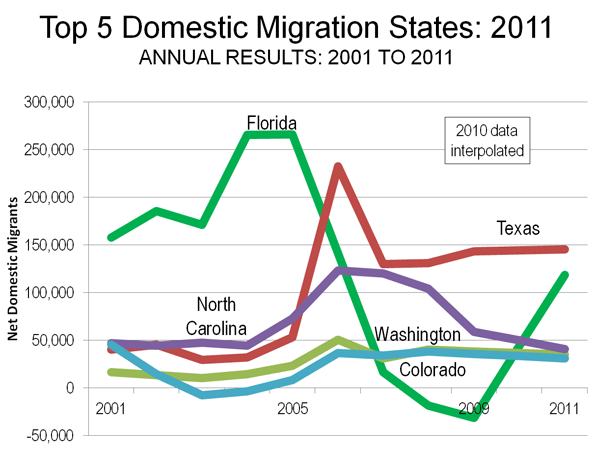
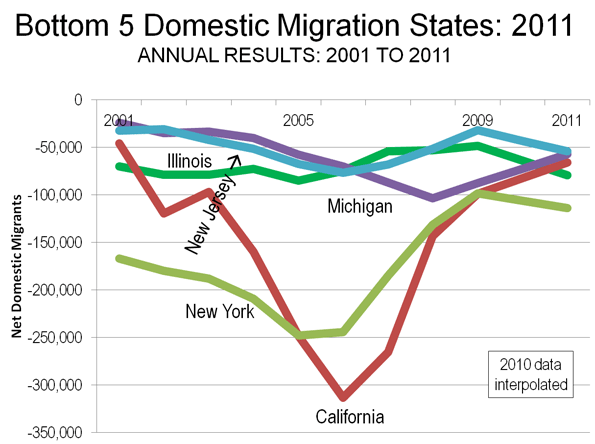
  • Exaggerating in Orlando: Sunrail

    For decades taxpayers have paid billions to finance major transportation project cost overruns far exceeding the routinely low-ball forecasts available at approval time. This has been documented in a wide body of academic literature, the most important of which was conducted by Bent Flyvbjerg of Oxford University, Nils Bruzelius University of Stockholm and Werner Rothengatter of the University of Karlsruhe in Germany (Megaprojects and Risk: An Anatomy of Ambition).

    Major project advocacy, however, has descended to a new low of unprecedented and absurd exaggeration. This is evident in the current public policy debate about the Sunrail commuter rail project in Orlando. Two examples make the point

    Exaggeration #1: Job Creation: The Central Florida Partnership claims that Sunrail will create 10,000  jobs. "almost immediately." This would be quite an accomplishment. The Sunrail project is currently projected to cost approximately $850 million for just the first segment. Every cent of the likely cost overruns will be on a blank check drawn the account of Florida taxpayers.

    At Sunrail’s claimed rate of job creation,  the Obama Administration’s $800 million "shovel ready" stimulus program (enacted in 2009), would have "almost immediately" produced more than nine million jobs. By now, the unemployment rate would have been reduced to little above 2 percent, lower than at any point in the more than 60 years of available data. Of course, and predictably, the stimulus program did no such thing, not least because a job created by public spending is likely to destroy more than one sustainable job in the private sector.

    Exaggeration #2: Sunrail Will Make a Difference: The proponents imply that Sunrail will carry a significant number of trips in the Orlando area, claiming that the line will carry one lane of freeway traffic and that it will give central Florida residents an alternative to high gasoline prices. In fact, even if Sun Rail reaches its ridership projections, it would take a full day of train travel to remove less than an hour’s peak hour freeway volume. Needless to say, no one will notice any fewer cars on the freeway (Figure).

    Further, Sunrail will not provide an alternative to the overwhelming majority of central Floridians, since it will attract only 1,850 new round-trip riders per day by 2030 (Sunrail’s number). Spending $850 million on Sunrail is the same as the taxpayers giving each new rider a gift of $450,000.

    The Need to Set Rational Priorities: All of this is occurring in the face of an national fiscal crisis so severe that even the AARP has expressed its willingness to consider cuts to Social Security. As an AARP spokesperson put it "You have to look at all the tradeoffs." Indeed.