Tag: Florida

  • Orlando’s Sunrail: Blank Checks Induced by Washington

    We are supposedly living in an age of austerity, but many federal programs are leading many states into overspending and potential fiscal insolvency.  Transit spending is a case in point, as is indicated by the proposed Orlando Sunrail commuter rail project.

    How Washington Induces Higher State and Local Spending: For decades, the federal government has encouraged state and local governments to build expensive projects, as is the case in Orlando. Under the Federal Transit Administration (FTA) "New Starts" program, state and local governments can obtain federal funding for such projects, contingent on their taxpayers providing "matching funding." This can be in the form of higher taxes, budget increases or in unplanned subsequent expenditures that are higher than projected. The responsibility for cost overruns and operating subsidies belong exclusively to state or local taxpayers.

    Inaccurate Cost Forecasts: This can prove very expensive. European researchers Bent Flyvbjerg, Nils Bruzelius and Werner Rottengather (Megaprojects and Risk: An Anatomy of Ambition) and others have shown that new rail projects routinely cost more than planned (Note 1).

    Flyvbjerg et al found that the average rail project cost 45 more than projected and that 80 percent cost overruns were not unusual. Cost overruns were found to occur in 9 of 10 projects. Moreover, they found that despite increased attention to these cost blow-outs, final costs continue to be far above the projections presented to public officials and the taxpayers at approval time. Further, they found that ridership and passenger fares also often fell short of projections, increasing the need for operating subsidies.

    Moreover, urban rail systems are of questionable value. Transport economist Clifford Winston of the Brookings Institution has noted that "the cost of building rail systems are notorious for exceeding expectations, while ridership levels tend to be much lower than anticipated" and that "continuing capital investments are swelling the deficit." 

    Federal policies, however, often force state and local taxpayers to guarantee the accuracy of notoriously inaccurate cost projections. The standard FTA "full funding agreement," a prerequisite for federal funding, requires state or local taxpayers to pay for any cost overruns. Further, if the projects are not completed, state and local taxpayers are required to pay back the federal grants (more on Florida’s experience with that later).

    Sunrail: The "Sunrail" commuter rail project is planned to parallel Interstate 4 in the Orlando metropolitan area. From the perspective of Florida taxpayers, the tragedy is that the project has proceeded so far. Project forecasts say that in 2030, Sunrail will add only 1,850 new round trip riders daily to Orlando’s already sparse transit ridership (barely half a percent of travel). Even if all Sunrail trips were for employment, it would not even be a "drop in the bucket" in a metropolitan area likely to add more than 400,000 jobs by 2030. Further, despite inferences to the contrary, this will have less than negligible impact on traffic congestion. It is likely that traffic on Interstate 4 will increase by at least 100,000 cars daily by 2030 (Note 3), many times the cars that Sunrail could possibly remove, even under its probably exaggerated ridership projections.

    Sunrail also will do little to increase job access to jobs in a metropolitan area where less than two percent of employment can be reached by the average commuter in 45 minutes using transit, according to Brookings Institution research. By contrast, at least more than 80 percent of jobs in the Orlando metropolitan area are reached in 45 minutes by car, and more than 55 percent in 30 minutes. Despite the high costs of all this and Sunrail’s negligible effect on regional mobility, politics may preclude cancellation of the project.

    Sunrail’s first phase is projected to cost $350 million (after a half-billion dollar right-of-way purchase). The Federal Transit Administration intends to pay a maximum of $175 million for the project. State taxpayers (through the Florida Department of Transportation) will be required to match that funding with another $175 million, though that amount could grow.

    Florida Taxpayers Already Burnt Once: In addition in paying for likely Sunrail cost overruns, Florida taxpayers would be obligated to fund service levels that satisfy the Federal Transit Administration. Otherwise the federal government can demand that taxpayers send the money back. This is no idle threat. When the Miami commuter rail system (Tri-Rail) provided service levels deemed insufficient, FTA demanded a return of $250 million in federal grants. This repayment was averted only by a state bailout that provided up to $15 million in annual subsidies to increase the service levels (Note 2).

    Essentially then, to obtain federal funding for Sunrail, Florida taxpayers must write a blank check out to a rail construction industry that has repeatedly demonstrated an inability to build rail projects for promised amounts.

    Negotiating a Way Out? Florida taxpayers, however, may have some options to avoid writing the blank check. In March, the US Department of Transportation (USDOT) desperately sought to find governments in Florida willing to provide a blank check to fund the now cancelled Tampa to Orlando high-speed rail line, with costs that were so low that they had "big cost overruns" written all over them.

    In a February 27 letter USDOT told local officials the federal grant repayment provisions were negotiable. Based upon this policy latitude available to USDOT, Florida officials could seek less unreasonable terms with USDOT. For example, a revision might be negotiated to limit Florida’s cost overrun liability to amounts resulting from state actions. Further, Florida should seek agreement that it does not have to operate service levels that are greater than required by demand or can be afforded. This would prevent a repeat of the unhappy Tri-Rail experience.  

    Provisions such as these would provide important protections to Florida taxpayers, who could otherwise be forced to pay hundreds of millions in cost overruns and higher operating subsidies and potentially higher taxes.

    Lessons for Taxpayers: Projects like Orlando’s Sunrail provide important lessons for the nation. The stimulus, now winding down, boosted questionable spending policies well outside the Beltway. Washington needs to stop writing blank checks on taxpayer accounts. It’s time for the feds to stop inducing state and local governments to mimic its fiscal irresponsibility.

    —–

    Notes

    1. Flyvbjerg is a professor at Oxford University in the United Kingdom. Bruzelius is an associate professor at the University of Stockholm. Rothengatter is head of the Institute of Economic Policy and Research at the University of Karlsruhe in Germany and has served as president of the World Conference on Transport Research Society (WCTRS), which is perhaps the largest and most prestigious international association of transport academics and professionals.

    2. The Florida Department of Transportation has made agreements local governments to participate in funding of Sunrail cost overruns. However, in the event that local governments are unable to pay their share, it may be expected that the state will pay, as it did in bailing out Miami’s Tri-Rail (discussed above).  

    3. Assumes that automobile traffic would grow at the projected population growth rate (based upon University of Florida population projections). 

    —–

    Wendell Cox is a Visiting Professor, Conservatoire National des Arts et Metiers, Paris and the author of “War on the Dream: How Anti-Sprawl Policy Threatens the Quality of Life

    Photo: Downtown Orlando (by author)

  • Orlando: Uncle Sam Meets Mickey Mouse

    Hawks and doves disagree on whether World War II ended the Great Depression.  Depending on which species of bird squawks louder, military spending may be the only way out of our current financial malaise.  In many ways it is already happening, although it is a surreptitious and quiet influence felt mostly in the high-tech economic sector.  Defense growth in one of the most unlikely places – Orlando, Florida – has already begun to diversify the region’s income stream, create a new urban corner of Central Florida, and tap into some of the natural allies and partners that already exist here.  Mickey Mouse is now sharing Orlando with Uncle Sam as the militarization of the local economy increases.

    America’s current rough patch, as Dr. Roger Siebert recently wrote about , seems to be deeper than any in recent memory, and recalls the 1930s.  During that time, isolationism was only cured by a slap in the face:  Pearl Harbor.  Today’s isolationism, so vigorously voiced in the calls to depart Afghanistan, seems to echo that period.  Enlistment in the military isn’t exactly vigorous, and intervention in troubled regions is not on the radar screen of even the most ardent hawk.  America seems too self-involved at the moment to care.

    Yet at this very same time, Pentagon spending is quietly rising in the modeling, simulation, and training fields.  Already employing 53,000 Floridians, 9,000 more than the state’s hallowed agriculture industry, this growth sector is hugely dependent upon a high-skilled, high-wage workforce.  The ability to train soldiers, sailors, and pilots without the expense of actual bombs and equipment has clearly demonstrated its benefits to the satisfaction of the military brass, making it inevitable that more is to come.

    Co-located next to Florida’s premier high-tech medical research park, Lake Nona, the National Simulation Center is the most common name used to describe the efforts underway at the Central Florida Research Park on the east side of town.  More importantly, however, the Center is adjacent to the University of Central Florida.  Already the second largest university in the country, UCF is home to much of this Center’s local 18,000 workforce.   With Navy, Air Force, and Marines research and training, the Simulation Center has quietly become the world’s largest military simulator .

    Regionally, it leverages its old Naval Training Center roots and proximity to NASA facilities at Cape Canaveral to capture workers, skill sets, and continuous research and improvement.    While the town struggles with slumping tourism and anemic population growth, the high-tech military industry is rapidly taking over as one of the biggest new economies to hit Florida.

    Spinoffs from military research can only benefit Central Florida’s attractions and rides, as future tourists will be able to experience more and more virtual thrills in addition to more traditional meatspace rides and shows.   In the meantime, it remains a quiet partner in diversifying the economy.

    In the 1990s, the Naval Training Center left Orlando, ostensibly because it duplicated facilities that the Navy had elsewhere.  Its developable land, close to downtown Orlando, became Baldwin Park, and the old barracks, classrooms, and laboratories were quickly bulldozed for lucrative residential real estate.  Few were aware that the functions of the Orlando Naval Training Center were downsized, not eliminated, and were quietly relocated to the east side of town.

    The Training Center evolved into the National Simulation Center. As a research-intensive industry, it capitalized on its new proximity to the University of Central Florida’s campus, and began an interchange with the engineering and computer science programs at that school.  UCF, today with over 50,000 students, has quickly grown to become the nation’s second largest university, just behind Ohio State.  UCF’s own Research Park has grown to rival the fabled Research Triangle in North Carolina, due to the synergy between military and higher education.

    Its new location also moved the Training Center a little bit closer to the Kennedy Space Center as well.  The Navy has always had a presence at Cape Canaveral, and with the employee base around the Space Center available less than an hour’s commute away, the Training Center has already benefitted from the availability of this highly skilled workforce who has suffered from the ebb and flow of NASA’s political fortunes.

    Medical research being conducted by Scripps, Burnham, and Nemours will also benefit from this activity, as they are all building new facilities at Lake Nona.  This medical research campus will employ many with the same skills, education, and training as the Simulation Center, and provide choices for the scientists and engineers living in Lake Nona’s suburbs.  This makes the residential real estate around Lake Nona a bright spot in Central Florida’s otherwise horrendous housing market .

    Surrounding the Simulation Center, small companies have already started feeding creativity and innovation into the giant maw of the military, and spinoffs – commercialization of its technology – have also benefitted larger companies such as Orlando’s game design team at Electronic Arts and the military contractor Lockheed Martin.  This supply chain, once established in Orlando, gives localized sustainability to this industry and suggests that it has achieved a foothold among the tourism, agriculture, and growth industries firmly established in Central Florida.

    Geographically, East Orlando is difficult to develop.  Like the surface of swiss cheese, land above the flood plain, traditionally agricultural, is interlaced with wetlands and lakes, and it has been historically ignored for the broad swaths of low-hanging fruit closer to the theme parks and population centers on the west side of town.  Pressure to develop, however, has suddenly put this area in the spotlight, and controversial proposals by homebuilders and other owners have raised questions about whether Florida should stay on its historic pathway of man vs. nature.   Infrastructure – roads, utilities, and other unglamorous investment – still doesn’t exist in much of East Orlando.  Because development has historically been in small pockets fragmented by the area’s mosaic of wetlands, connectivity and sheer mass will be difficult to achieve without great cost to the environment.

    Yet this does not have to be so.  Dense development can happen with respect to nature, as proven by countries such as Germany and Sweden .  If left to the same old forces that developed the rest of Florida, it is unlikely that East Orlando will experience any innovation regarding development strategy, and Central Florida will host the same old battles of environmentalists vs. developers again and again.  The state’s growth strategy – leaving it up to private interests – may have already guaranteed this outcome.

    If, however, innovation transcends the research mission and influences the style of development to support this research, then the military and medical centers in East Orlando have a chance to provide a true, new pathway to the future.  Like Victor Gruen’s 1963 concept for Valencia, which recognized such modern aspects of society such as the car, East Orlando could be planned as an employment-based community within the context of nature using contemporary science and technology.  Orlando, the ephemeral city home to amusement parks and orange groves, could become a model for development to influence other areas struggling with the same questions.

    Militarization of the economy may become a vehicle for true change.  The cluster of military agencies and private businesses, headed by Lockheed Martin, all revolve around this economy and provide a badly-needed shot in the arm of Orlando’s workforce.  With high-salary, highly educated workers, global connectivity, and a growth engine no less than the Department of Defense, Orlando can be assured of some good times ahead while the tourism and housing sectors recover.  The region’s leadership must think carefully how to embrace this new savior, and what the greater implications are for the future.

    Richard Reep is an Architect and artist living in Winter Park, Florida. His practice has centered around hospitality-driven mixed use, and has contributed in various capacities to urban mixed-use projects, both nationally and internationally, for the last 25 years.

    Photo by Research Development Engineering Command

  • Condo Culture: How Florida Became Floridastan

    Welcome to Griftopia. The Florida housing industry needs a karmic rebalancing. Our recent roar of building new structures is echoed today by the squeaks and pops of a different type of construction industry. Invasive testing – the architectural equivalent of a biopsy – seems to be on the rise. Saws, hammers, and cranes can be heard through the quiet suburban developments and subdivisions around Florida, as shingles and stucco are cut off in small patches to reveal serious problems within.

    Like the hidden defects in mortgage-backed securities and other arcane instruments of finance, these flaws are covered up and papered over, but are no less damaging. They are also just as revealing about our collective haste to accommodate growth.

    Few other places saw as much suburban expansion as Florida did, beginning in the 1990s and lasting right up until the bursting of the 2008 real estate bubble. Old hands in the Florida real estate development game see the cycle as never-ending, stretching all the way back to Ponce de Leon, whose “fountain of youth” was perhaps the state’s first marketing gimmick. The most recent bust, however, provides important lessons, should future cycles include speculators and regulators alike feeding at the trough. Rapid growth breeds errors, compromises, and sloppiness which have dire, lasting consequences.

    Pundits are assigning blame for the Millennial Depression up and down the economic ladder, and certainly the Florida housing boom and bust provides many examples of all that went wrong. The largest developers, driven by stockholders and Wall Street to seek rapid growth and high profits, gambled that Florida’s population boom would last forever. With the good addresses already taken, “B” properties close to interstates, under flight paths and adjacent to sensitive wetlands began to see activity. Low density reduced the developers’ risks and reduced construction costs, as well.

    The Florida condominium – outwardly appearing as an apartment complex — was a home ownership product for the masses. As long as the product lasted 30 years (or however long it took to pay off the mortgage), no one much cared about its quality and stability as an asset. Anonymous, stick-built stucco boxes, baking in the Florida sun, seemed the perfect solution to meet the demands of stockholders and investors, and the regulatory pathway was smoothed over to keep the production line rolling.

    Immigrants from abroad and from other parts of the country bought their own piece of the American Dream: gated entries, warrens of tight garages, patches of St. Augustine grass, buggy-whip sized oak trees and tightly wrapped stucco and glass boxes. Balconies are common, although the tiny decks and the heat preclude much enjoyment of the outdoors. Designed to prevent neighbors from meeting or children to freely play, these contemporary cracker box condos sullenly sweat in the heat. Still, they gave a much-needed step-up for the vast service workforce looking for a way out of the rental market and into an ownership position, and buyers can perhaps be forgiven for overlooking the cheapness of construction in favor of a new way to prosperity and success.

    The demand, however, outstripped the ability to deliver. Design and construction delays simply due to over-commitment and lack of manpower meant that corners were cut, compromises were made, and slop was tolerated. It was as if the investment mania on Wall Street – in journalist Matt Taibbi’s words, “griftopia” – had trickled down to the field superintendents, masons, and framing crews. A collective haste gripped much of the state’s growth industry, haste that is cause for regret today.

    A ten-year-old stucco building may look to be in perfectly good shape from the outside. When entering the bland, beige entry hall, however, the tang of mold immediately invades one’s nose. Once water has been trapped in a building it breeds a most sinister fungus.

    Condominium units that suffer this malady are ascending the legal chain one by one across the girth of the state. First, individual owners collect themselves and confront their homeowner’s association. HOAs bombarded with complaints succumb quickly to “condo chaser” attorneys who promise to split the goodly sums they can rake off the insurance companies that covered the contractors and design professionals involved in the mess. And then, discovery begins.

    It takes about a week to vivisect a low-rise building. Ordinarily, the stucco walls are saw-cut down to the bone, and the plaster comes off in a solid sheet, revealing metal strap ties and sheathing tissue within. The sheathing panels themselves are made of glued together wood chips – so-called “oriented strandboard” – only as strong as the glue itself. Removal of the sheathing layer reveals the deep ligaments and structural bones of the building.

    Buildings designed in Texas, Ohio, Georgia, and elsewhere populate the Florida landscape. These buildings have almost no roof eave at all, as if the fierce Florida sun didn’t matter. The skin-tight stucco may not be Portland cement plaster, because dryvit (an acrylic latex substitute for stucco invented after World War II to quickly rebuild Europe) has become a popular substitute. The windows are set at the outside of the wall, with no shading at all on the glass. The effect is that the building looks as stretched tight as a balloon.

    Unfortunately, such a combination frequently admits water into tiny cracks and crevices, and the water has no way to seep out. Revealing the interior guts of a building is the only way to uncork mold and rust horrors that are otherwise invisible. Insidious ants wind their way into the dark spaces between walls and floors where water and food are available.

    Biopsies on sick buildings reflect our collective errors of judgment, and the healing process will be lengthy and expensive. Designs that do not reflect the harsh realities of Florida’s hot, wet climate are certainly responsible for some of the errors. Designs that did not acknowledge the scarcity of experienced construction crews were also responsible, because construction takes teamwork and skill. And contractors, encouraged to cut costs in order to boost their own bottom lines, cut time or cut labor to get the job done faster.

    Designers and contractors may also legitimately point the finger back at clients who pushed hard. A collective irrationality set in towards the end of the last decade. More work had to be done by fewer people, less experience was available to go around, and in the heat of the moment steps could be skipped in the name of innovation. The consequences are being felt only now.

    A huge, sad pile of lost resources, our vanishing wood and raw materials, must be hauled off to clean these errors out of the system. Sadder to see are the homeowners, as they pack up and move out of their mold-infested units. But saddest of all is the apparent inability of the industry to learn from its own mistakes.

    Let’s hope that this time around it can happen differently. Reject growth for growth’s sake. Florida, hooked on this drug for too long, deluded itself into filling up wetlands and paving more and more space.

    Instead, as the tide rolls in once again, Florida can make a pact with itself to invest in development, rather than growth. Redeveloping older, inner cores of cities where services and employment are already in place can go a longer way towards making the state a sustainable, diverse place to live than paving one more tract of raw land mowed down for home lots can.

    Revamp the state’s development culture. Private developers have written Florida’s growth management code, and gradually increased the requirements so that only the largest and most deep-pocketed developers can compete. Protecting neither the environment nor quality of life very well, the development regulations are in dire need of rewriting, with a different set of requirements that favor smaller-scale development and redevelopment, and encourage affordability.

    In the meantime, discovery continues. More leaky roofs, more fungus-infested units, and more attics seething with ants, testimony to our collective haste and greed. As the nation slowly recovers economically, Florida has paused for breath on the pathway to healthy construction. Before the next boom, its development industry would be wise to use this break in the action to consider the alternatives.

    Richard Reep is an Architect and artist living in Winter Park, Florida. His practice has centered around hospitality-driven mixed use, and has contributed in various capacities to urban mixed-use projects, both nationally and internationally, for the last 25 years.

    Photo by the author.

  • New Roller Coasters for 2011

    The recession has seen many capital budgets at theme parks held back over the last few years, but even still, there are many parks building new and exciting rides all over the world. Here is a round up of some rides to get you foaming at the mouth.

    Cheetah Hunt in Tampa Busch Gardens
    The Cheetah Hunt, as you might expect from its namesake, is a “Linear Synchronous Motor Launch Coaster”, i.e. it uses magnets to launch you off fast then it uses strategically places LSM launch pads two more times on your ride. It is set to open in Spring 2011 and is set to be one of the most exciting rides in the country. The 4.5 thousand feet of track will send you to the top of mountains to twisting through a rocky gorge. Watch the video to whet your appetite.

    The Green Lantern at Magic Mountain
    This new ride looks like unlike anything you may have seen before, unless you have been to Grona Lund where the exact same ride has been featured for a couple of years. Two carts each spin independently, which for me just means you get an inconsistent ride and could, if the weight isn’t distributed correctly, fail to even turn upside down on the ride.

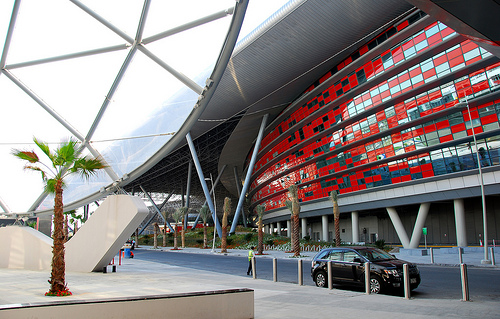
    Formula Rossa in Ferrari World, Abu Dhabi
    Another launched roller coaster, opened in November 2010 and is officially the worlds fastest roller coaster reaching 240 kph in 4.9 seconds, this ride uses a Hydraulic launch system and requires the riders to wear protective eye goggles due to the risk of impact with airborne particulates or insects. That just sounds crazy and the investment made to create it would have matched the investment of the cities in the Arab Emirates have seen.


    Ferrari World Abu Dhabi

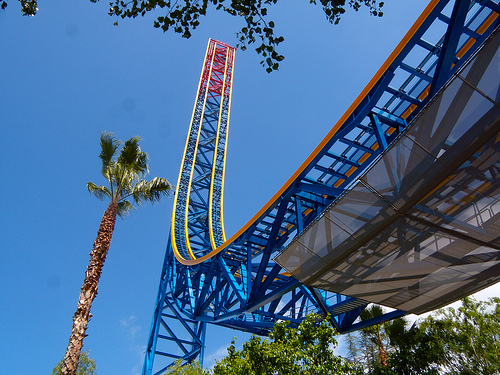
    Superman: Escape from Krypton
    This isn’t in itself a new ride, as much as it is an update to an older slightly dated one. Formally Superman: The Escape, the upgrades are little more than the cars are turned backwards. But despite this less than impressive update the ride experience is jaw dropping. Being launched backwards, you are never too sure when you are about to reach the incline and once you reach the top the sustained weightlessness is amazing, all before you find yourself hurtling ground-wards.  Exhilarating update and the simplicity would have saved a few cents.


    http://www.flickr.com/photos/beaster725/5596829350/sizes/m/in/photostream/

    There are many more rides being planned in the next few years, including two big rides in the UK for Thorpe Park. Busch Gardens Williamsburg has had plans for a new rollercoaster or drop ride approved. So the outlook seems pretty hopeful for thrill seekers and adrenalin junkies looking for new thrills. The recession hasn’t dampened the record breaking spirits of the theme park owners. This is just a short list of new rides but there are many more all over the world. If you find yourself on Holiday in America or on any UAE or Dubai Holidays, try and visit a park with one of these exhilarating rides.

    Andy Don went to University in Brighton and travelled the world shortly after graduating; he is now working as a trip advisor and marketing executive. Follow him on his twitter @andym23.

    Lead Photo by Drew Bennet

  • The End of the Line: Ambitious High-speed Rail Program Hits the Buffer of Fiscal Reality

    A well-intentioned but quixotic presidential vision to make high-speed rail service available to 80 percent of Americans in 25 years is being buffeted by a string of reversals. And, like its British counterpart, the London-to-Birmingham high speed rail line (HS2), it is the subject of an impassioned debate. Called by congressional leaders “an absolute disaster,” and a “poor investment,” the President’s ambitious initiative is unraveling at the hands of a deficit-conscious Congress, fiscally-strapped states, reluctant private railroad companies and a skeptical public.

    The $53 billion initiative was seeded with an $8 billion “stimulus” grant and followed by an additional $2.1 billion appropriation out of the regular federal budget. But instead of focusing the money on improving rail service where it would have made the most sense— in the densely populated, heavily traveled Northeast Corridor between Boston and Washington— the Obama Administration sprinkled the money on 54 projects in 23 states.

    Some of the awards are engineering and construction grants but many more are simply planning funds intended to plant the seeds of future passenger rail service across the country. Only two of the projects could be called truly “high-speed rail” because they would involve construction of dedicated rail lines in their own rights-of-way where trains could attain speeds of 120 mph and higher. The remaining construction money will be used to upgrade existing freight rail facilities owned by private railroad companies (the so-called Class One railroads) to allow “higher speed” passenger trains to run on track shared with freight carriers.

    Many of the proposed improvements will result in only small increases in average speed and in marginal reductions in travel time. For example, a $1.1 billion program of track improvements on Union Pacific track between Chicago and St. Louis is expected to increase average speeds only by 10 miles per hour (from 53 to 63 mph) and to cut the present four-and-a-half hour trip time by 48 minutes. A $460 million program of improvements in North Carolina will cut travel time between Raleigh, NC and Charlotte, NC by only 13 minutes according to critics in the state legislature.

    Shared-track operation has raised many questions in the minds of the intended host freight railroad companies. Railroad executives are concerned about safety and operational difficulties of running higher speed passenger trains on a common track with slower freight trains and they are determined to protect track capacity for future expansion of freight operations. Their first obligation, they assert, is to protect the interests of their customers and stockholders. This has led to protracted negotiations with state rail authorities in which the private railroads are fighting Administration demands for financial penalties in case passenger train operations fail to achieve pre-determined on-time performance standards. In some cases, negotiations have hit an impasse causing the Administration’s implementation timetable to fall behind. In other cases, freight railroad companies have reluctantly given in, not wishing to alienate the White House or fearing its retaliation.

    A serious blow to the presidential initiative was delivered by a group of three determined, fiscally conservative governors who rejected billions of dollars in grant awards because they were concerned that the proposed passenger rail services could require large public subsidies to keep the passenger trains operating. In the U.S. federal system, the governors and state legislatures have the final say concerning construction and operation of public transportation services within state boundaries. The refusal of the governors of Wisconsin, Ohio and Florida to participate in the White House HSR program thus took much wind out of the sails of the Administration initiative.

    Perhaps the most serious blow was delivered by Governor Rick Scott whose state of Florida was supposed to host one of the Administration’s showcase projects: an 86-mile true high-speed rail line, built in its own right-of-way in the median of an interstate highway between the cities of Tampa and Orlando. A score of international rail industry giants converged on Florida in the expectation of participating in a rich bonanza of contract awards and a chance to bid on a future rail extension from Orlando to Miami.

    But they came to be disappointed. A study conducted by the libertarian think tank, the Reason Foundation, convinced Governor Scott that the project could involve serious cost overruns and the risk of continuing operating subsidies. This caused the Governor to decline the federal grant, thus putting an effective end to the project. A last-minute effort by rail supporters to challenge the Governor’s decision was stopped in its tracks when the state supreme court upheld unanimously his right to veto the project.

    This left the Administration with just one true high-speed rail project: California’s proposed 520-mile high-speed rail line connecting Los Angeles with Northern California’s San Francisco Bay area and Sacramento. The origin of this venture dates back to 2008 when voters approved a $9.95 billion bond measure as a down payment on the $43 billion system. Since then the project became mired in multiple controversies. One relates to a lack of a clear financial plan, another to what critics, including the state’s official “peer review” panel, claim to have been overly optimistic forecasts of construction costs, ridership and revenues. Then came a report raising questions about the escalating price tag for the project which now is estimated at $66 billion. This is occurring in a state that is staggering beneath a $26 billion deficit.

    In the face of fierce opposition that developed in the wealthy Bay Area communities lying in the proposed path of the rail line, the sponsoring agency, the California High-Speed Rail Authority, decided to start construction in the sparsely populated and economically depressed Central Valley, where land is relatively cheap, unemployment is high and community opposition was expected to be minimal. The decision was spurred by demands from the Obama Administration that its $3.6 billion grant result in a rail segment that has “operational independence.” The first 123-mile stretch, to be built between Fresno (pop. 909,000) and Bakersfield (pop. 339,000), was quickly derided by critics as a “railroad to nowhere.” Even in the low-density Central Valley, the expected disruption caused by the project to communities, farms and irrigation systems has stirred political opposition. Its future – as indeed the fate of the entire $43-66 billion (take your pick) venture – is shrouded at this point in uncertainty.

    The same can be said of President Obama’s high-speed rail initiative as a whole. Just as the proposed £32 billion high-speed rail link between London and Birmingham has been called an “expensive white elephant” and a “vanity project,” so the White House high-speed rail initiative is being criticized as a “boondoggle” and derided as a monument to President Obama’s ambition to leave behind a lasting legacy à la President Eisenhower’s Interstate Highway System. Editorial opinion of major national newspapers has turned critical as have many influential columnists and other opinion leaders. A number of senior congressional leaders – including the third-ranking Republican in the House, Majority Whip Kevin McCarthy, and the chairman of the influential House Transportation and Infrastructure Committee, John Mica, have likewise openly criticized the initiative as wasteful and poorly executed.

    Even elected representatives from states that would potentially benefit from the government’s largesse have been skeptical about plans for high-speed rail in their states. “Blindly committing huge sums of money to this project will not make it worthwhile, and to do so at this time would be premature and fiscally irresponsible,” wrote one member of the congressional delegation from the state of New York. Members of the North Carolina legislature have introduced a bill to bar the state department of transportation from accepting $460 million in federal high-speed rail funds, pointing to the meager trip time savings resulting from the proposed rail projects and the potential need for operating subsidies.

    As this is written, Capitol Hill observers give the high-speed rail program only a small chance of obtaining additional congressional appropriations in Fiscal Year 2012 and beyond. A March 15 report in which the congressional House Committee on Transportation and Infrastructure discusses its views of the forthcoming Fiscal Year 2012 transportation budget, the Obama Administration’s proposed $53 billion high-speed rail program is not even mentioned. Turning off the spigot of federal dollars next year would effectively starve out the Administration’s rail initiative.

    The President’s proposal came at a most inopportune time, when the nation is recovering from a serious recession and desperately trying to reduce the federal budget deficit and a mountain of debt. In time, however, the recession will end, the economy will start growing again, and the deficit will hopefully come under control. At that distant moment in time, perhaps toward the end of this decade, the nation might be able to resume its tradition of “bold endeavors” — launching ambitious programs of public infrastructure renewal.

    That could be an appropriate time to revive the idea of a high-speed rail network, at least in the densely populated Northeast Corridor where road and air traffic congestion will soon be reaching levels that threaten its continued growth and productivity. For now, however, prudence, good sense and the common welfare dictate that we, as a nation, learn to live within our means.

    Ken Orski has worked professionally in the field of transportation for over 30 years.

  • Pollution: An Off – Road Guide to Environmental Hot Spots

    Not all pollutants are created equal, nor do they necessarily hang out in the same hot spots. Rankings of the most polluted cities — you know who you are — have become depressingly familiar. But those standings almost always represent a statistical stew of assorted toxins in the air and water, averaged together. The list that follows may surprise you: A quick look at a handful of cities, each with the unfortunate distinction of being the worst in the U.S. for a specific environmental health hazard.

    Bakersfield, California
    While the Los Angeles metro area is synonymous with dangerous smog – and LA is, in fact, the leader in ozone pollution – it is actually Bakersfield, California that has the nation’s worst overall air quality, according to the American Lung Association’s State of the Air report. An inland city between LA and Fresno, this “gateway to the Central Valley” defies the stereotype of dirty, urban air; rural Bakersfield is a major agricultural center.

    A combination of factors pushed Bakersfield into the #1 spot. Like LA, it, too, suffers from ozone pollution. Ozone is a necessary component of the Earth’s upper atmosphere, where it shields the planet from the sun’s more harmful rays. However, when ozone collects at ground level, it can interrupt photosynthesis in plants and cause detrimental health effects in humans. When breathed in, ozone and other components of smog irritate the respiratory system, and can cause asthma, bronchitis, heart attacks, and other cardiopulmonary problems that may result in premature death.

    Air pollution has long been a problem in California because of geographical and weather conditions that allow the pollution to hang over the regions, rather than dispersing. The Golden State’s much-renowned sunshine actually exacerbates the problem, reacting with car exhaust and other pollutants to create ozone molecules, helping to make California home to the six worst U.S. cities for ozone pollution.

    Of course, ozone is not the only environmental problem Bakersfield faces. It also ranks second in year-round particle pollution and first in periodic short-term spikes of particle pollution.

    Libby, Montana
    Another pollution frontrunner that is not located in a large city. Libby, Montana, a town of 3,000 residents, is home to the nation’s deadliest environmental dangers and the most expensive Superfund clean-up site monitored by the Environmental Protection Agency. The dangers stem from a nearby vermiculite mine which provided employment for many of the residents. Vermiculite, a component in some types of insulation, is not hazardous in itself, but it is often found in ore deposits along with another mineral – asbestos. Miners who extracted and broke up the rocks containing vermiculite also released tiny asbestos fibers into the air and breathed them into their lungs. Over time, these fibers caused lung scarring, asbestosis, and symptoms of mesothelioma, a deadly cancer that affects the lining of the chest or abdomen.

    More than 400 Libby-area residents have died of asbestos-related illnesses, and another 1,500 show lung scarring, which can be a precursor to other serious diseases. The miners were not the only ones at risk. Those who unwittingly brought fibers home on their clothes exposed their families. Some children even played in the soft piles of mining waste, breathing in asbestos dust as they did. Despite the fact that the mine’s owners, the W.R. Grace corporation, knew of the dangers as early as 1964, the mine remained open until 1990. Because mesothelioma symptoms can take between 20 and 50 years after exposure to surface, the residents of Libby may have yet to see the full impact of the mine on the town. Mesothelioma life expectancy is tragically low, with most patients surviving only 9 to 12 months after diagnosis, making asbestos a serious environmental health threat.

    Pensacola, Florida
    America’s worst drinking water, according to a compilation of results from a five-year Environmental Working Group report. The EWG looked at percentage of chemicals in the water, the total number of contaminants, and the most dangerous average level of a single pollutant. Topping their list was this panhandle city. Analysts found 45 of the 101 chemicals the study tested for in Pensacola’s water, and 21 of those chemicals exceeded health standards. For comparison, the city with the second worst drinking water – Riverside, California – contained 30 chemicals, 15 of them at unhealthy levels.

    Among the worst contaminants in Pensacola’s water were radium-228, trichloroethylene, tetrachloroethylene, alpha particles, benzene, and lead. Radium-228 and alpha particles are both dangerous because of their radioactivity. Trichloroethylene is used as an industrial solvent, and tetrachloroethylene is more commonly known as dry cleaning fluid. In addition to these contaminants, the Pensacola drinking water also contained cyanide and chloroform — obvious health hazards — and lead, which can be a natural contaminant, but more often works its way into drinking water through old pipes. Also problematic for Pensacola: benzene, once a gasoline additive, is now used in the making of plastics, rubber, and dyes, and linked to the development of certain types of leukemia.

    Jeorse Park Beach, Indiana
    The most polluted beach in America in 2010. Few would think of Indiana as a beach state, but where its borders meet Lake Michigan there are several beachfronts that locals take advantage of in the summer. One of these, Jeorse Park Beach I near East Chicago, ranked as #1. Of 78 water quality tests conducted by the National Resource Defense Council, this beach exceeded pollution standards for human and animal waste 76 percent of the time, more often than any other beach. Not surprisingly, it had to be closed several times in 2010 due to bacterial contamination.

    Lake Michigan has long been plagued with pollution problems. Nearby steel mills from several states dump waste in the lake, and a BP oil refinery in Whiting, Indiana, reportedly discharges raw sludge into the lake on a regular basis. Though protesters in 2007 managed to extract a promise from BP that it would not expand and hence dump more waste, as of 2010, expansion was proceeding as originally planned. Though the company still insists it will keep its promise, the pledge is unenforceable, since BP has a permit to increase waste production and get rid of it in the lake.

    Photo of the highly toxic Berkeley Pit, Butte, Montana by grabadonut

    Krista Peterson is a recent graduate of the University of Central Florida and an aspiring writer. As a health and safety advocate, she shares her passion for the wellness of our communities.

  • Florida Metropolitan Areas Disperse; City of Miami Continues to Densify

    Miami: The Miami metropolitan area grew 11 percent between 2000 and 2010 according to the recently released census count. The population growth was from 5,008,000 in 2000 to 5,575,000 in 2010. This growth, only modestly above the national average, caused Miami to slip behind Dallas-Fort Worth and Houston, to become the nation’s 7th largest metropolitan area. The Miami metropolitan area was expanded after the 2000 census to include not only the core county of Miami-Dade, but also Broward (Fort Lauderdale) and Palm Beach (West Palm Beach) counties.

    The historical core municipality, the city of Miami, grew from 362,000 to 399,000 and accounted for 7 percent of the metropolitan area growth. Miami is unique among the nation’s historic core municipalities in having densified in every census period since 1960, despite not annexing new territory and not having substantial greenfield space for development.

    The suburbs captured 93 percent of the growth. Growth was modest in all counties, but was the greatest in the most outlying, Palm Beach, at 17 percent.

    Orlando: The Orlando metropolitan area grew nearly 30 percent between 2000 and 2010 according to the recently released census count. Orlando grew from 1,645,000 in 2000 to 2,134,000 in 2010. The historical core municipality, the city of Orlando, grew from 194,000 to 238,000 and accounted for 9 percent of the metropolitan area growth. The suburbs captured 91 percent of the metropolitan area growth, expanding their population by 31 percent. Outlying (Osceola 55 percent) and Lake (41 percent) counties grew the fastest.

    Tampa-St. Petersburg: The Tampa-St Petersburg metropolitan area grew 16 percent between 2000 and 2010 according to the recently released census count. The population growth was from 2,396,000 in 2000 to 2,448,000 in 2010. The historical core municipality, the city of Tampa grew from 303,000 to 336,000 and accounted for 8 percent of the metropolitan area growth. The suburbs captured 92 percent of the growth. The fastest growing counties were both outlying, Pasco (35 percent) and Hernando (32 percent).

    Jacksonville: The Jacksonville metropolitan area grew nearly 20 percent between 2000 and 2010 according to the recently released census count. Jacksonville grew from 1,123,000 in 2000 to 1,346,000 in 2010. The historical core municipality, the city of Jacksonville, grew from 736,000 to 822,000 and accounted for 39 percent of the metropolitan area growth. The city of Jacksonville is essentially combined with Duval County has a largely suburban form and includes rural areas. The consolidation occurred between the 1960 and 1970 censuses, with the new jurisdiction covering nearly 25 times that of the old (768 square miles as opposed to 32 square miles), while the population of the new jurisdiction was somewhat more than 2.5 times that of the old. Jacksonville covers more than twice the land area than New York City and has approximately one-tenth the population.

    The suburbs captured 61 percent of the growth. The fastest growing counties were both outlying, St. John’s (54 percent) and Clay (36 percent), which captured more than one-half of the metropolitan area growth.

  • USDOT Rail Grants to Obligate Taxpayers

    The US Department of Transportation has announced a competitive grant program to reallocate funding that was refused by Florida for a proposed high speed rail line from Tampa to Orlando. The line was cancelled by Governor Rick Scott because of the prospect for billions of dollars of unplanned obligations that could have become the responsibility of the state’s taxpayers.

    Eligibility: Eligible applicants are states, groups of states, Amtrak or other government agencies that authorized to "provide intercity or high-speed rail service on behalf of states or a group of states. The grant program requires recipients of grants (read "taxpayers") to provide financial support to intercity and high speed rail passenger rail programs in the event that cost and ridership projections are optimistic (a routine occurrence).

    Obligation to Pay for Cost Overruns: As in the program announced in 2009. the state, group of states, government agency will be required to demonstrate its financial capacity (that is, the capacity of their taxpayers) to pay for cost overruns (page 9). This open-ended liability led Governor Chris Christie of New Jersey to cancel a new transit-Hudson River rail tunnel, which had costs that were escalating out of control that would be the obligation of the state’s taxpayers. Governor Christie and Governor Scott were both aware of the disastrous record of major infrastructure cost overruns, such as in the Boston Big Dig project, the Korean high-speed rail program and the overwhelming majority of passenger rail projects in North America and Europe, according to a team led by Oxford University Professor Bent Flyvbjerg.

    Obligation to Pay Operating Costs: Moreover, inaccurate passenger and revenue forecasts have been pervasive in high-speed rail systems, as has been documented by Flybjerg, who found that cost overruns occurred in nine out of ten projects:

    … we conclude that the traffic estimates used in decision making for rail infrastructure development are highly, systematically and significantly misleading.

    This is illustrated by the fact that even a decade and one-half after the Eurostar London to Paris and London service was opened, ridership remains 60 percent below projection. Ridership on the Taiwan and Korea high speed rail systems has been one-half or more below projections. Our analysis of the Tampa to Orlando line revealed exceedingly high ridership projections, which were inexplicably raised even higher in a new report just released. Failure to achieve ridership projections increases the likelihood that a line will need operating subsidies, which would be the ultimate responsibility of taxpayers under the USDOT program.

    Federal Grant Repayment Obligation: Moreover, taxpayers of any grant recipient would be required to repay part or all of the federal grant if a sufficient level of service is not maintained for a period of 20 years (page 41). The operation of this provision is illustrated by recent Florida experience. Tri-Rail, the Miami area’s commuter rail service only narrowly escaped having to repay $250 million when its service level was deemed to not meet requirements of a federal grant by early in the Obama presidency. Tri-Rail was rescued by a state subsidy of nearly $15 million annually, which restored an artificially high level of service.

    Intercity and High Speed Rail Program: The federal intercity and high-speed rail program is largely limited to upgrades of Amtrak-type service. Before Governor Scott’s decision, only two of the programs (Florida and California) would have achieved international standard high speed rail speeds.  

  • Tampa to Orlando High Speed Rail: The Risk to Local Taxpayers

    No sooner had Florida Gov. Rick Scott rejected federal funding for the Tampa to Orlando high-speed rail line, than proponents both in Washington and Tallahassee set about to find ways to circumvent his decision. While an approach has not been finalized, a frequently suggested alternative is to grant the federal money to a local government, such as a city or county or even to a transit agency.

    Eliminating State Taxpayer Risks, Creating Local? In an announcing his decision, Governor Scott cited the substantial risks to Florida taxpayers from cost overruns, the ongoing obligation under the federal grant to subsidize operations and the fact that under certain circumstances Florida might even have to repay the $2.4 billion in federal grants. Any local government accepting the federal money would expose itself to the financial risks from which Florida taxpayers have been exempted by Governor Scott’s action.

    None of these risks is an idle threat.

    (1) Capital Cost Overruns: Based upon the international experience, the eventual construction cost overruns for the Tampa to Orlando high-speed rail line could easily run to $3 billion, more than doubling the price of the project (Note on Extent of Taxpayer Liability, below). In light of the recently reported 50 percent increase in California high-speed rail construction costs, even the $3 billion estimate could turn out to be conservative. The problem is that any local federal grant recipient (city, county or transit district) would be responsible for these cost overruns.

    (2) Ongoing Operating Subsidies: The ridership projections for the Tampa to Orlando high-speed rail line are exceedingly optimistic. This could well lead to a situation in which substantial subsidies are necessary to operate the trains, despite claims of proponents to the contrary. These subsidies would be the responsibility of any city, county or transit district that becomes a grant recipient.

    (3) Federal Pay-Back: If, for any reason, the eventual high-speed rail service levels are not sufficiently high because of lower than projected ridership or if service is canceled, any city, county or transit district could be required to return the $2.4 billion in federal grants. Florida is already paying millions annually for a similar "transgression." In 2009, service reductions on the Tri-Rail Commuter Rail System in the Miami area led the Obama Administration’s Department of Transportation to demand repayment of one quarter billion dollars in grants. Tri-Rail was saved from this obligation only by a multimillion dollar Tallahassee bailout. Proponents have claimed that this rail obligation could be negotiated away for high-speed rail. Why was the Tri-Rail obligation not negotiated away in 2009?

    By rejecting the federal funding, Gov. Scott has inoculated Florida taxpayers against these risks.

    However, there would be no inoculation for any local jurisdiction whose commissioners or city council accepted the expensive "gift" of federal funding for the high speed rail line. Their taxpayers would have to pay. The very financial viability of any such jurisdiction could be at risk.

    The Risk Could Revert to State Taxpayers: Eventually, the risk could be again be visited upon state taxpayers as a local government facing virtual bankruptcy would doubtless seek a bailout in Tallahassee, repeating the Tri-Rail experience, though much more expensively. Moreover, canceling a half built project, which might be tempting as costs escalate above projections, would simply not be viable. The political pressure to complete the project, at whatever cost, could prove to be overwhelming.

    Delusions About Private Responsibility for Cost Overruns: Some proponents claim that these huge obligations can be somehow transferred to the private builder/operator that is selected for the project. Nothing like this has ever happened in public-private partnerships around the world, and for good reason. Companies do not stash away billions of dollars for cost overruns.

    Further, the winning bidder will be a consortium of other companies, established with limited liability by larger companies. The consortium would abandon a project it could not afford sooner rather than later. Any bankruptcy of the builder/operator would be limited to the consortium and would not extend to the parent companies, leaving the local taxpayers to pay.

    There is no escaping the fact that the taxpayers of any city or county accepting the federal money would be providing financial guarantees to an international infrastructure industry that has left a "train" of huge and unanticipated financial obligations around the world in its wake (Note on Cost Escalation, below).

    Believing in Santa Claus? Public officials, and most recently Orlando Mayor Teresa Jacobs, have indicated support for high-speed rail if private and federal funds pay for it, and state and local taxpayers aren’t exposed to liability. This is a wise position, but untenable. Expect Santa Claus to arrive in the midst of a Florida summer before that, with a sleigh full of billions.

    —-

    Note on Extent of Taxpayer Liability: This $3 billion is in addition to the already committed $280 million of taxpayer funding. Proponents of the high-speed rail line have assumed that the $280 million would be the limit of taxpayer obligations. As this article shows, the $280 million could be a "drop in the bucket" compared to the likely eventual taxpayer liability.

    Note on Cost Escalation: An international team of researchers led by Oxford University Professor Bent Flyvbjerg has found in Megaprojects and Risks: An Anatomy of Ambitionthat similar projects routinely cost far more than taxpayers and other funders are told. They also attract fewer riders and generate less revenue (which can require operating subsidies). The Flyvbjerg team implies that these "lowball" (our term) projections are not accidental but all are the result of "strategic misrepresentation," (their term) which project promoters employ to increase the potential that projects will be approved. The researchers also refer to "strategic misrepresentation" as "lying," which is an exceedingly strong term for academic research and is reflective of the strength of the conclusions.

  • Pimp My Stripmall, Please!

    If anything characterizes the face of Florida’s landscape, it is the proliferation of shopping malls of all types. Generation by generation, as population swelled, country roads widened into highways and each intersection seemed to blossom into four parking lots framed by strip centers decorated with small, freestanding stores and restaurants. These malls represented the prosperity of the American middle class. Now that consumerism has slowed and been rechanneled online, new malls aren’t being built and the existing ones are looking a bit dog-eared, with shuttered stores, empty parking lots, and aging facades. Repurposing the American mall is a huge opportunity waiting for the right moment, and represents an opportunity to heal much of Florida’s economic stagnation.

    As the car culture rose after World War II, malls – convenient places that fit our newly prosperous lifestyle — rose as well. Thinkers, sentimental about the hard work that went into an organic, localized Main Street were largely horrified at its replacement by strip shopping centers and regional shopping malls. Yet this growth continued unabated, and while the debate over the mall’s moral stance raged, the building type continued to be a popular investment vehicle. It became codified and regulated into a more and more complex, layered experience, dominated by traffic and parking, manipulated by industrial psychologists, and fine-tuned by mall managers so that the best possible presentation of goods was made to the consumer.

    The consumer was unsentimental about the architectural debris that was left in the wake of the flight to the suburbs. As old village streets saw local businesses shuttered, cries of “Too hard to find parking” and “Why are your prices so high?” echoed on their sidewalks. Purposeless old Main Street: The lucky ones became tourist destinations, filled with chocolate shops and art galleries. Here in Central Florida, the lucky ones include Mount Dora, Sanford, and Ybor City, where parking lots and garages have been surgically inserted into the back alleys, a rigorous code enforces the form, and hand built architectural details from America’s Victorian era still surprise and delight.

    The consumer will continue to be a strong component of the American middle class, and no doubt many malls will continue to thrive. Florida’s oversupply has attracted tremendous attention, and repurposing raw space could become a creative new way that cities will grow. Winter Park Village, a 1960s indoor regional shopping mall, was cut open and now features a mixed-use shopping, dining, entertainment, and residential space barely resembling its former self. Metro Church in Winter Springs occupies a former Belk-Lindsey department store, with church-related functions occupying what was once a general lease area. Full Sail University in Winter Park is largely housed in converted strip centers as well. These conversions are not unique to Central Florida, and will likely continue into the future.

    The biggest opportunity, however, seems untried as of yet in America: manufacturing in a mall. Production, much more than consumption, creates jobs, and the raw open space of old retail sites can be easily converted into industrial uses. Geography is in their favor. Malls were typically built if at least 3,000 surrounding households could be found to support them; today these households could provide labor, instead of cash, to the right investor looking to onshore a product.

    Aligning industry with opportunity seems difficult on the surface. Manufacturing investment abounds in relatively unregulated India, but with the huge sunk costs that American industry already has, startups and expansions seem to be nonexistent. Turning this around would require a fundamental shift in American culture, allowing us to think of ourselves as producers once again. American know-how hasn’t vanished; rather, it lies dormant underneath the heavy regulatory burden, and under the high barriers to entry that our manufacturers created in their quest to be the largest and to shut out competition.

    New products are being created every day… overseas. If investment isn’t coming from within America, perhaps the right NGO sponsoring microloans could be tapped to consider the broken, declining landscape of suburban America to reinvigorate our natural American creativity and give small scale capital access to startups. Selecting the industries that we want to have, re-onshoring them, and producing things people need would once again provide jobs, diversify the local economy, and create the kind of upward mobility we once counted on for the American Dream.

    And the physical plant – one of the biggest investments that a producer makes – is already there. The regulatory burden of redevelopment, shouldered by the initial developer, should be minor at best, depending on the quality of the infrastructure, which would speed a conversion into reality. At a time in Florida when growth is on pause, the redevelopment of existing assets is likely the most favored way to provide economic expansion and pull Florida out of its nosedive.

    Mall redevelopment would please the environmental movement, as well. Huge swaths were cut into the Florida wilderness to make way for retail, with nary a peep from environmentalists in the eighties and nineties. One of the tenets of sustainable development is to confine construction to areas that are already strongly modified by human activities, and repurposing abandoned space fits this mandate to a tee.

    Florida, with its abundance of unused retail space, has an opportunity to become a leader if it can attract the right kind of investor. India, with all its problems including ethnic strife and the lingering caste system, is certainly not waiting for opportunity to create its own future. China, with its authoritarian regime, has surged ahead in terms of entrepreneurial spirit that seems sorely lacking in America at the present moment. Seeing gold in a dead strip mall may seem farfetched, but out of opportunities like this we can reinvent our own future and fuel a renaissance of the American dream, one mall at a time.

    Richard Reep is an Architect and artist living in Winter Park, Florida. His practice has centered around hospitality-driven mixed use, and has contributed in various capacities to urban mixed-use projects, both nationally and internationally, for the last 25 years.

    Photo by Clinton Steeds: Phoenix Village Mall, Ft. Smith – Bench at Back Entrance. The photographer writes that it was the first mall in Arkansas when it opened in 1970, adding, “It has so far failed to live up to the “Phoenix” part of its name”.