Tag: Florida

  • Beyond Neo-Victorianism: A Call for Design Diversity

    By Richard Reep

    Investment in commercial development may be in long hibernation, but eventually the pause will create a pent-up demand. When investment returns, intelligent growth must be informed by practical, organic, time-tested models that work. Here’s one candidate for examination proposed as an alternative to the current model being toyed with by planners and developers nationwide.

    Cities, in the first decade of this millennium, seem to be infected with a sort of self-hatred over their city form, looking backward to an imagined “golden era”. The most common notion is to recapture some of the glory of the last great consumerist period, the Victorians. During this time, from the 1870s to the early 1900s, many American towns and cities were formed around the horse-drawn wagon and the pedestrian. This created cities with enclaves of single-family homes and suburbs that seem quaint and tiny in retrospect to today’s mega-scale subdivisions and eight-lane commercial strips.

    One bible for the neo-Victorians was “Suburban Nation,” a 2000 publication seething with loathing and anger over urban ugliness. In a noble and earnest effort to repair some of the aesthetic damage, the writers proposed a grand solution. Their goal was essentially to swing the development model back to the era of the streetcar and the alleyway, the era when cars were not dominant form-givers and families lived in higher density and closer proximity.

    In the last decade, this movement gained traction with hapless city officials often tired of hearing nothing from their citizens but complaints over traffic and congestion. They embraced the New Urbanist movement which promised to turn the clock back to an era of walkable live/work/play environment of mixed neighborhoods. In the new model, the car would at last be tamed.

    Yet, looking at most of these communities, the past has not created a better future. More often they have created something more like the simulated towns lampooned by “The Truman Show”. These neo-Victorian communities ended up with some of the form of that era, but devoid of employment and sacred space. They also created social schisms of low-wage, in-town employers and high-salary, bedroom community lifestyles marking not the dawn of a new era but the twilight of late capitalism as the service workers commute into New Urbanist villages while the residents commute out.

    Meanwhile, planners who believe that practical design solutions and the vast quantity of remnants from the tailfin era are “almost all right” have remained quietly on the sidelines. This silent retreat, a natural reaction, now puts many good places in jeopardy as the activist planners try to “fix” neighborhoods and districts that were not broken to begin with. We risk losing some of the important postwar building form that well serves the needs of its users and, rather than being blacklisted, should be held up as a valid, comparative model for use by developers seeking to build good city form when the pent-up development demand returns.

    It is time to hit back. Midcentury modern – the era from about 1945 to 1955 – has become a darling style of the interior design world, has yet to be recognized as a valid model for urban development. For too long, neighborhoods built in this era have been treated poorly by the planning community. Yet this period created a critical transition between the archaic beloved streetcar suburbs and the 1980s commercial car-must-win planning. They provide a valuable, forgotten lesson when the middle class’s newfound prosperity was expressed by low-density, car-oriented mixed-use districts that were still walkable and expressed through their form a certain heroic optimism about the future.

    With building fronts set back just enough for parking, yet still close together to give a pleasant pedestrian scale, these little districts remain abundant in the landscape of our towns and cities – nearly forgotten in the fight over form, perhaps because they are doing just fine. They were built when everyone was encouraged to get a car, but before the car became a caveman club pounding our suburban form into big box “power centers” and endless, eight-lane superhighways of ever-receding building facades. These districts were developed before the local hardware store was replaced by Home Depot and many remain intact, thriving, and chock-full of independent business owners. Many of these are true mixed-use districts – with light industrial, second floor apartments, retail and other uses peacefully coexisting.

    In small commercial districts developed in the late 1940s and early 1950s, a balance was struck between the traditional town form and the car, a balance that has been forgotten in the planning war being waged today. This era produced many neighborhoods and districts that are “almost all right”, in the words of noted Philadelphia architect and thinker Robert Venturi, when defending Las Vegas to the prissy academic community.

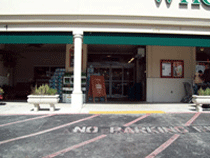
    To go right to a case study, take the Audubon Park Garden District in Orlando, Florida. Adjacent to Baldwin Park, a Pritzker-funded New-Urbanist darling of 2002, this district is a vintage collection of mixed-use commercial, residential, and industrial buildings constructed in the 1950s. Set back from the curb approximately 42 feet, the mostly one-story storefronts allow parking in front yet are visible and accessible to pedestrians. The car is accommodated in the front of the store, making access easy and convenient, yet the pedestrian can walk also from place to place without long, hot trudges. Drivers see the storefronts. Scale is preserved. (See attached file for street elevations).


    View Larger Map

    The architecture, instead of recalling nostalgic, Victorian styles, is influenced by the art deco and populuxe styles of the Truman era, when America was united, self confident, and victorious. And the businesses reflect an organic mix serving neighborhood needs, their storefronts and facades created by themselves, not by some Master Planner, theming consultant, or fussy formgiving designer. Here, one finds customers in dialogue with shopkeepers, blue collar and creative class mixed together, a few apartments over their stores, and a localism that has endured for fifty-odd years, largely forgotten because it works.

    Places like this three-block district, and others like it, need to be championed. Decoding just what works here, and how it elegantly accommodates the car and the pedestrian, is critical to counterbalance the coercive impact of the New Urbanist movement and present a working model to future developers.

    When New Urbanism was a fledgling movement, it represented a necessary alternative to car-dominated planning principles, and offered a choice where there previously was none. Today, the rhetoric of this movement has sadly forced out all other choices and emphasized one form – that of the streetcar era – over all others. This increasingly authoritarian movement shuts out all other choices today, and now threatens places like Audubon Park with its singular vision by sending in planners to “workshop” an ideal, Victorian makeover. Such actions, if implemented, will destroy the healthy, functioning connective tissue that makes up vast portions of our urban environment for the sake of a romantic notion of form over substance.

    Instead of enforced, and often overpriced, nostalgia, we would do better to seek out districts planned after the car and have worked through time, and hold them up as valid choices to implement when planners are considering a development. These districts, whether a single building, a collection, or a whole community, will become important models as the pendulum swings back from the extremes that it reached by 2007 and 2008.

    For too long, planners and developers have chosen to be silent in the face of the often strident rhetoric espoused by “smart growth” and New Urbanist ideologues. Meanwhile, a tough analysis of New Urbanism’s successes has yet to be seriously undertaken, and alternative models presented. Cities across the nation are considering a move to form-based codes which would lock out districts like Audubon Park and doom existing ones to Victorian makeovers. Useful, diverse and workable places will be destroyed to fit a “one size fits all” ideology.

    So before midcentury modern becomes just another furniture style, a window of opportunity exists to fight back. These kinds of districts dot the cities and towns of America and deserve to be held up as alternative models for new development. Instead of a dogmatic slavishness to nostalgia, planners and developers need to stand up to the preachers of preapproved form, and look for multiple solutions for future urban form. Smart growth should not supersede the arrival of a more flexible, diverse approach of intelligent growth.

    Richard Reep is an Architect and artist living in Winter Park, Florida. His practice has centered around hospitality-driven mixed use, and has contributed in various capacities to urban mixed-use projects, both nationally and internationally, for the last 25 years.
  • The Good News in Florida’s Bad Times

    By Richard Reep

    2009 was ugly. A swirl of dispiriting events stalled over much of the world this year, and Florida was no exception: state depopulation and tourism decline hit the state’s only two legitimate growth industries.

    Yet the bad times contain within them some good news. This end of an era meant that economic planners might finally turn to productive industries to generate jobs and revenue, just like the rest of the nation.

    First the bad news. For the first time since Florida became a state in 1845, more people moved out of the state than in, as reported by the University of Florida Bureau of Economic Research in August. In other states, this might not be news, but in Florida this has been viewed as nothing short of catastrophic. Growth is one of the state’s two primary industries, and with the last 163 years, growth was taken for granted (1945 saw depopulation as military personnel went home).

    Florida’s other traditional support, tourism, collapsed in 2009, as jittery tourists stayed close to home or went elsewhere in search of vacation. Since growth and tourism were the state’s only economic activity, this pretty much tanked it for the year; without a state income tax, the government is starved for tax money and is taking a hatchet to basic services in an effort to stay afloat. Meanwhile, it’s easy to get a parking space at the beach, hotel rooms are cheap and plentiful for a change, and the weather is as beautiful as ever.

    With private development dead, government desperate for income, and the professional class seeking jobs elsewhere, it will be easy for outsiders to write off the future prospects for the Sunshine State’s towns and cities. On the ground, however, a slightly different story emerges, a stoic sort of acceptance and the glimmerings of a change or two in the individual outlooks of citizens who stay. A few foreboding trends also cloud the horizon.

    Miami, a city not known to shy away from risks, this year replaced its Euclidean zoning code with a form-based code in a grand experiment with the public process. Voters who had enough of corruption and greed decided to endorse a visually appealing future of their city. Whether or not the outcome produces a better city, the 500+ public meetings did spark a badly needed public/private dialogue that should help Miami reshape itself into its new vision.

    Those who do stay in Florida and stick it out are getting more involved. As the outside world stopped supplying capital and residents, a sense of new localism sprang up almost overnight, with people gravitating away from the big brands and status symbols of a once-proud consumerist lifestyle. Sure, many turned to global brands like Wal-mart, but many more are supporting local food co-ops, farmer’s markets, independent eateries, and home industries in an effort to beat the system.

    If restlessness and discontent are the first necessities of progress (as stated by Thomas Edison), citizens of Florida cities like Tampa, Jacksonville, Orlando and Miami are ripe for progress. Consumer culture took a pause, but people still need to eat. Like the rest of the nation, this rediscovery of local goods and services has flowered, upon which a newfound sense of identity is being built through face-to-face exchange without the invisible army of middlemen that our commercial culture has spawned.

    With earnest public debate about the urban future in one of our nation’s largest cities, we can be assured that Florida citizens do care about the quality of life in their community. With neighborhoods spawning local markets and co-ops, we can be assured that urbanites do care about their local producers – and know a bargain when they see one. Both factors will contribute to a citizenry emerging stronger out of the state’s economic turmoil.

    Left to its own devices, Florida may sort itself out. Agriculture and manufacturing, two key industries faintly alive in Florida, have a chance to come back. Affordability and quality of life could lure the right kind of talent and encourage local entrepreneurs. Florida is poised to develop industries with health research and digital media where our lower costs and attractive climate could prove decisive.

    Yet this localist trend and greater attention to fundamentals could be altered by more meddling from Washington. The state returned Washington’s check for a train set not once, but twice, causing a concerned Secretary Ray LaHood to make a personal visit to see what was wrong. After some gentle persuasion – after all, Obama’s nationwide high speed rail vision could easily bypass this state with jobs and cash – Florida’s elected officials quickly jumped back to the politically correct side of the fence, and passed a bill to bring commuter rail to Central Florida. Now LaHood must deliver on the promise to prioritize Florida’s high speed rail construction.

    For the future, if the past is any guide, the upcoming war with Afghanistan could prove a boon to Florida. World War 2 saw an influx of servicemen and women, and the opening of multiple military bases, supply depots, and runways, partly due to its mild weather and partly due to its political stature. By adding this industry to offset its growth and tourism losses, Florida can benefit from the fulfillment of arguably President Obama’s most dangerous campaign promise.

    Doubts about these guns and trains leave more than a few Floridians worried about the strings attached to big brother’s largesse. It would be far more constructive to place more faith on the citizen’s renewed interest in the public process and the individual’s support of localism, two trends that seem destined to stay and become ingrained in our lifestyles. If Florida must accept Washington’s command economy for now, then at least the state will be left with increased transportation options and more exposure to service personnel who just might want to come back to stay after the war is over.

    But the more important work will, in the end, be done locally. If Floridians can capitalize on genuine public/private dialogue, such as happened in Miami 21, then there is a chance the state can pull from behind and surge ahead as a place where the future can still be sunny.

    Richard Reep is an Architect and artist living in Winter Park, Florida. His practice has centered around hospitality-driven mixed use, and has contributed in various capacities to urban mixed-use projects, both nationally and internationally, for the last 25 years.

    Photo:

  • The Decade of the South: The New State Population Estimates

    Much has been made – particularly in the Northeastern press – of the slowing down of migration to the South and West as a result of the recession. But in many ways this has obfuscated the longer term realities that will continue to drive American demographics for the coming decade.

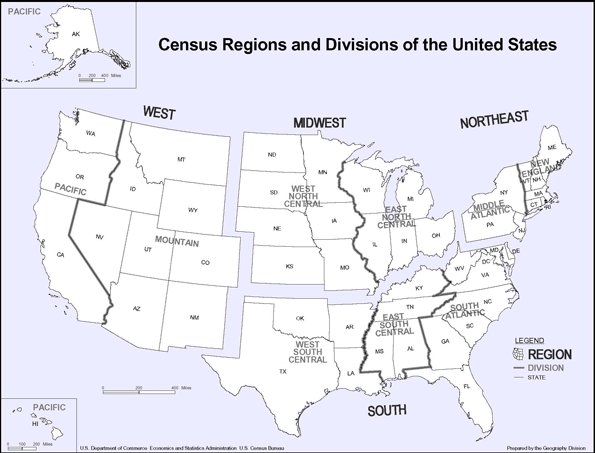
    Americans have been moving from the Northeast and Midwest to the West and South for decades (see US region map). In the first four decades after the Second World War, the warm, dry climates of coastal California were a significant factor. As the nation became more mobile – aided by such things as inexpensive air travel and the interstate highway system and the spread of air conditioning – the larger migration pattern went towards the South. There were, of course, other factors. Business costs, particularly the costs of labor, were often lower in the West and especially the South. Personal taxes in some states were lower than in the Northeast and Midwest. Surely the period from the end of World War II to 2000 could be called the demographic “half-century” of the West and South.

    The New State Census Estimates: The latest (July 1, 2009) Bureau of the Census release of state population estimates indicates a fundamental shift in migration patterns. Yes, even at recession-depressed rates, the Northeast and Midwest continue to export domestic migrants, but they are almost exclusively going to the South now, and not the West (See Table).

    Net Domestic Migration by State
    2009 Rank Net Domestic Migration Rank 2000-2009
    State 2009 2000-2009
    1 Texas    143,423       838,126 2
    2 North Carolina      59,108       663,892 4
    3 Washington      38,201       239,037 9
    4 Colorado      35,591       202,735 10
    5 South Carolina      31,480       306,045 7
    6 Georgia      26,604       550,369 5
    7 Tennessee      20,605       259,711 8
    8 Oklahoma      18,345         42,284 19
    9 Virginia      18,238       164,930 12
    10 Oregon      16,173       177,375 11
    11 Arizona      15,111       696,793 3
    12 Louisiana      14,647      (311,368) 45
    13 Alabama      11,044         87,199 14
    14 Utah        8,623         53,390 17
    15 Wyoming        7,192         22,883 25
    16 Kentucky        6,268         81,711 15
    17 Arkansas        5,298         75,163 16
    18 West Virginia        4,510         17,727 26
    19 District of Columbia        4,454        (39,814) 37
    20 Massachusetts        3,614      (274,722) 44
    21 New Mexico        3,366         26,383 24
    22 Delaware        2,580         45,424 18
    23 Montana        2,410         39,853 21
    24 South Dakota        1,619            7,182 27
    25 Idaho        1,555       110,279 13
    26 North Dakota        1,375        (18,071) 31
    27 Pennsylvania        1,346        (33,119) 34
    28 Alaska           979          (7,360) 29
    29 Missouri          (124)         41,278 20
    30 Nebraska          (956)        (39,275) 36
    31 Vermont          (975)          (1,505) 28
    32 Kansas       (1,242)        (67,762) 41
    33 Iowa       (2,135)        (49,589) 40
    34 New Hampshire       (2,602)         32,588 22
    35 Maine       (2,937)         29,260 23
    36 Nevada       (3,801)       361,512 6
    37 Hawaii       (5,298)        (29,022) 33
    38 Mississippi       (5,529)        (36,061) 35
    39 Wisconsin       (5,672)        (11,981) 30
    40 Rhode Island       (6,172)        (45,159) 38
    41 Indiana       (6,805)        (21,467) 32
    42 Connecticut       (7,824)        (94,376) 42
    43 Minnesota       (8,813)        (46,635) 39
    44 Maryland    (11,163)        (95,775) 43
    45 Florida    (31,179)    1,154,213 1
    46 New Jersey    (31,690)      (451,407) 47
    47 Ohio    (36,278)      (361,038) 46
    48 Illinois    (48,249)      (614,616) 49
    49 Michigan    (87,339)      (537,471) 48
    50 New York    (98,178)  (1,649,644) 51
    51 California    (98,798)  (1,490,105) 50
    Derived from US Bureau of the Census data.

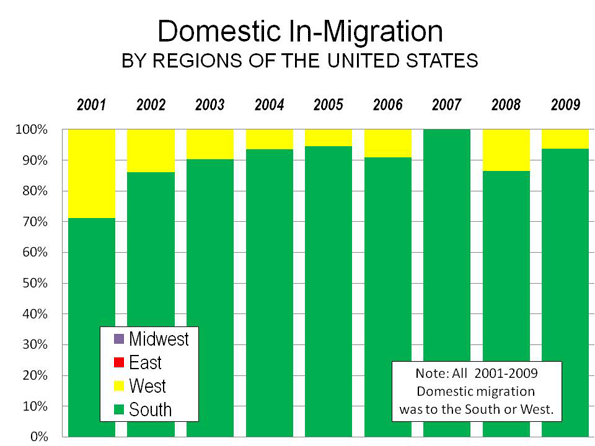
    Moving to the South: Between 2000 and 2009, the South attracted 90% of domestic migrants from other states, with the West accounting for only 10% (see chart below). In 2001, the South attracted 71% of domestic migration but its share rose to 86% in 2002 and accounted for virtually all net migration by 2007. In that year, not only did the Northeast and Midwest lose domestic migrants, but also the West. By 2009, the South’s share of inbound domestic migration fell back to 94%.

    Throughout the decade, the small share of domestic migration that did not go to the South went to the West, while the Northeast and Midwest continued to lose residents. The 2000s are best characterized as the demographic “decade of the South” because the vast majority of Americans moving between states moved South.

    Nearly all states in the South gained domestic migrants during the decade. Only Mississippi, Maryland and Louisiana, along with the District of Columbia, lost domestic migrants. Even before Hurricanes Katrina and Rita, Louisiana was losing domestic migrants. Perhaps the big surprise is Florida, which has led the nation in domestic in-migration for years and has attracted 1.1 million from other states during the 2000s.

    Florida’s peak came in 2004 and 2005, when more than a net 260,000 domestic migrants moved to Florida from other states. Things have changed markedly, however, with Florida rapidly losing domestic migrants in 2008 and 2009, very likely due to the impact of the housing bubble and an overreliance on inbound retirees to drive its economy.

    However, Florida’s recent decline does not weaken the near-monopoly position of the South as the dominant destination of movers. Florida’s rapidly declining domestic migration has been largely replaced by a new domestic migration champion: Texas. In the early 2000s, Texas generally attracted from 30,000 to 50,000 net domestic migrants. Migration from Louisiana from Rita and Katrina propelled Texas to the top in 2006 and the state appears to have consolidated its position as the leader in domestic migration. In 2009, with domestic migration at more modest levels nationally, the Texas gain was more than any year except for 2006 with Hurricanes Katrina and Rita. But it’s not just a Lone Star story. Seven of the top ten states in domestic migration remained in the South in 2009. Throughout the entire decade, 6 of the top 10 states were from the South and 4 from the West. However, most of the gains in the West were simply from moving around (and from California); there was relatively little inter-regional domestic migration.

    Moving Around the West (and Away from California): Most states in the West have also gained domestic migrants in the 2000s, with the exceptions of Alaska, Hawaii and California. California is the real story in the West, having lost nearly 1.5 million domestic migrants, a population greater than that of the city of San Diego. In 2000, California lost nearly 100,000 domestic migrants and for the fourth year in a row led the nation in net domestic out-migration. This includes 2006, when not even Louisiana’s catastrophic hurricanes could drive as many people away as California. During the first year of the decade, California lost only 45,000 net domestic migrants. By 2007, as the center of the worldwide housing bubble, California’s losses were 7 times that amount. In 2009, even with depressed migration rates associated with the recession, out migration more than doubled between 2001 and 2009.

    California is simply not the draw that it used to be. There was a time, in the late 1930s, that the state tried to bar “Okies” from moving to the state, legislation wisely declared unconstitutional by the Supreme Court. Things have certainly changed. The latest Internal Revenue Service data indicates that every year during the 2000s, Oklahoma gained net domestic migrants from California.

    Outside California, there has been healthy domestic in-migration in the West. However, California’s losses cancelled out more than 80% of the West’s gains during the decade. Much of the movement within the region was internal, with Californians shifting to markets where housing was less expensive (but still expensive), such as Arizona, Nevada, Washington and Oregon. More recently the movement to the housing bubble ground zero states of Arizona and Nevada, have all but disappeared, with far smaller gains in Arizona and a small net loss in Nevada in 2009.

    In one year (2007), California lost more domestic migrants than all of the other states of the West gained. Domestic migration in the West remains largely about households moving around within the region: from California to other states, with a far smaller number arriving from elsewhere in the nation.

    Escape from New York (and the Northeast): Domestic migrants continue to leave the Northeast, just as they have for decades. In the Northeast, only New Hampshire and Maine gained domestic migrants in the 2000s. However, it was a bit different in 2009. Both New Hampshire and Maine lost, while Massachusetts and Pennsylvania gained.

    Pennsylvania has been the subject of more than one “what’s wrong with Pennsylvania” report as analysts inside and out decry its competitive position. In fact, by the ultimate measure of competitiveness, where people choose to move to or from, Pennsylvania has done relatively well in the 2000s. Pennsylvania’s modest loss of 33,000 domestic migrants pales by comparison to the net 2.5 million people who have moved away from neighboring New York, New Jersey, Maryland and Ohio. Like Texas, Georgia and many other states, Pennsylvania largely missed the housing bubble, which probably accounts for some of this surprising phenomenon.

    But the relative success of Pennsylvania should not be touted, as the mainstream media would tend to, as a sign of general Northeastern resurgence. New York alone lost 1.65 million over the 2000-2009 period. This is, in absolute numbers, more than California and a larger percentage loss than Louisiana with Katrina and Rita. Critically, data through 2008 shows that most of the domestic migration losses came from New York City and to a lesser extent its suburbs. Upstate New York, which also missed the housing bubble, experienced comparatively modest domestic migration losses, as Ed McMahon and I showed in an Empire Center policy report earlier this year.

    Hollowing out the Heartland: Domestic migrants are also deserting the Midwest, though in somewhat smaller numbers than in the Northeast. Only Missouri and South Dakota gained domestic migrants in the 2000s, although in 2009, Missouri experienced a small loss and was replaced by North Dakota as a gainer. But it is not a region-wide phenomena. Nearly 90% of the loss in the Midwest was in Illinois and the economic basket case states of Michigan and Ohio.

    Slowing Migration: One of the principal stories out of this year’s Census release is that interstate domestic migration declined markedly in 2009. Indeed, domestic migration was lower than in any other year in the decade, but not by that much. In 2009, 500,000 people migrated between the states, compared to between 570,000 and 620,000 annually from 2001 to 2003. Then, from 2003 to 2007, interstate domestic migration was up to 1.25 million and averaged more than 900,000. The anomaly is not so much that domestic migration is down, but rather that domestic migration got so high in the middle part of the decade, at the very same time that house price differences reached unprecedented heights. It’s no wonder people were moving.

    The Future? What comes next after the chaotic decade of the 2000s? As is suggested above, much of the variation in domestic migration is explained by differences housing prices and trends. Indeed, the price of housing may be a surrogate for the cost of living, which varies principally between areas based upon housing cost differences. This is likely to continue. In coastal California, house prices remained above historic norms, even at the largest “bubble burst” losses,” and there are recent indications that unhealthy price escalation has resumed. Much of the West and most of the country is far more affordable. This would suggest that coastal California’s domestic migration losses will continue and rise in the future.

    By contrast, in much of the rest of California and the other “ground zero” states of Florida, Arizona and Nevada house prices have returned to historic norms, which suggests that after the recession, strong domestic in-migration could resume.

    The future looks very bright for Texas and other states in the South that have done so well (such as North Carolina, South Carolina, Georgia, Tennessee, Oklahoma and even Arkansas). Their biggest challenge will be to resist the siren songs to become more like California, with its disastrous policies appreciated only by proponents and a fawning media.

    Wendell Cox is a Visiting Professor, Conservatoire National des Arts et Metiers, Paris. He was born in Los Angeles and was appointed to three terms on the Los Angeles County Transportation Commission by Mayor Tom Bradley. He is the author of “War on the Dream: How Anti-Sprawl Policy Threatens the Quality of Life.

  • Will New Urbanists Deliver A Home-Win With Miami 21?

    By Richard Reep

    “A walkable city, more like… Manhattan, Chicago, or San Francisco,” is how The Miami Herald characterizes the future of Miami under Miami 21, the new form-based code adopted on October 22nd by the Miami City Commission. This seems to be the hot new dream not just of Miami, but of all cities struggling under corruption and greed, codes and regulations, with an imagined underground urbanity, yearning to breathe free. Citizens may now expect to see Miami remodeled after cities that grew before the car came, but the lyrics to The Who’s “Won’t Get Fooled Again” echo in the minds of some: “Meet the new boss…same as the old boss.”

    Miami 21, controversial for nearly four years and over 500 public meetings, met a critical need for citizens who were tired of the corruption and greed that seemed to result in an increasingly ugly, congested quasi-urban nightmare. Planning and zoning regulations, which were originally designed to protect property values, could be reinvented when enough power and money was at stake, and the code enforcers allowed more and more bizarre juxtapositions of high rises among low-scale residential neighborhoods. During the recent condo boom, variances became business as usual for the Miami City Commission and the Mayor. Now that the condo boom is over, it appears that both are rushing in to make amends to voters by passing this new form-based code.

    The code places height limits on neighborhoods similar to the old, Euclidean code, ominously named 11000. But this time around, uses are not segregated; instead, a mix of retail and other uses is intended to encourage increased pedestrian activity and a taking back of some of the city from the car. For citizens, there has been much to like about the arguments in favor of this code. As a result of the change, the pleasant weather that drew so many to the city will now perhaps be enjoyed on the boulevard; fear of shadows from looming high-rises will, according to the plan, now recede a bit. And a more organized, easy-to-understand building pattern should replace the Rube Goldberg-like zoning code full of special exceptions, arcane “bonus” rules, and a process all too easily subverted by tax-hungry politicians.

    With private development comatose, it is a perfect time for many jurisdictions to perform a much-needed overhaul of their development regulations. In the boom-bust atmosphere of Florida, most of the development industry sees this cease-fire as simply a pause to reload, and the Department of Community Affairs – Tallahassee’s growth management gatekeeper – is busy helping developers get ready for the next boom by making the Rural Land Stewardship Areas, a regulation designed to protect rural areas from development, officially optional.

    The American Institute of Architects chapter in Miami proposed to reform the old code, rather than start from scratch, arguing that the new code is complicated, fussy, and inhibiting. Reform of the existing 11000 code never seemed to be an option, and instead the Miami 21 code, written by New Urbanist gurus Andres Duany and Elizabeth Plater-Zyberg of DPZ, replaces the old code. Citizens of Miami, when presented with this new code, seemed ready for a change.

    This was an important home-win for DPZ and for New Urbanism in general. Increasingly associated with greenfield prettyboys like Celebration and Seaside, New Urbanism seemed to be losing ground and losing relevance at solving real-city problems. With the support of a massive public relations campaign, New Urbanism has now been given a chance to deliver on its promises of a “a clear vision for the City that will be supported by specific guidelines and regulations so that future generations will reap the benefits of well-balanced neighborhoods and rich quality of life.”

    Arcane spreadsheets, full of formulae and footnotes, have been replaced by transects. These silhouettes of buildings and streets – a sort of cross-section through the city – begin with the way a natural, un-built environment might look, progress to how a rural road looks, and go all the way up to how high-rise canyons might look. Patterning a city on a consensual, pre-approved notion of order is what New Urbanism is all about. There are no surprises – no high-rises in your backyard – but, as some local architects worry, there’s no spontaneity either.

    Walkability is another promise of the new code. Ideas such as transforming blank walls, promoting urban infill development, and lining parking garages with retailers, are all illustrated with magical dissolve images that change ugly parking garages into charming shopping districts. If it were only that easy.

    Transit-oriented development is a strategic goal of the code, creating density clusters that get people out of their cars and into alternative forms of transportation. Buses, bicycles, vanpools, and Miami’s Metrorail are closely interlinked with Miami 21.

    The marketing website for Miami 21 makes it impossible to be against the code. Opposing Miami 21 would be like opposing lifesaving drugs or opposing the blue sky. New Urbanism won this victory because there weren’t any compelling counter-arguments to their basic argument for urban hygiene. And Miami 21 comes at a time when the city has been egregiously abused at the hands of the free market; its citizens disenfranchised and suffering from an environment of ugliness, traffic and congestion.

    As noble as Miami 21’s goals are, however, they are only as good as the politicians in whose hands they will be used. Making new laws, rather than enforcing the old laws, is a favorite activity of politicians who, backed against the wall by irate voters, seek a grand solution. Much harder work will come when developers try to seek waivers against Miami 21, and if the history of Florida is any guide, it is not likely things will change much. For Miami 21 has some inherent costs that will split the haves and the have-nots of Miami-Dade County even further apart than they are now.

    For the haves, the higher cost of development under Miami 21 is already a concerning factor. The code promises increased regulation, and the density transects favor already high-value districts. At the last minute, for example, City Commissioner Marc Sarnoff switched his support to be in favor of a 35-foot height limit in Miami’s MiMo historic district, to the chagrin of property owners seeking higher buildings. Whether he stays on one side of the fence, or switches back at the behest of a developer, remains to be seen.

    In Miami, the validity of New Urbanism’s principles of how cities are regulated will finally be put to the test. By spelling out the city’s form in detail, through technical images, watercolor perspectives, and mock-historical drawings, Miami 21 is illustrating a preordained vision of itself. The public’s trust in its elected officials has been so broken by the recent capitalistic building frenzy that, by consensus, an agreed-upon “ideal city” has been created on paper. Now it is up to the building officials to deliver this vision when the next building boom hits.

    Instead of exploring how to improve the planning process, as AIA Miami suggested, Miami 21 seems to have avoided confronting the planning and process issues that no one seems to know how to solve. Have our cities become so complex that we are unable to manage their growth through the traditional public planning process? An even bigger question is whether the village-planning model at the core of New Urbanism is a valid model? Will it achieve the lofty goals that have been promised?

    Miami 21 will be a fascinating experiment to watch during the coming years. Miami is already known for taking risks: it built an elevated rail system in a suburban, multipolar city and encouraged an international development binge that resulted in a dozen or two empty skyscrapers. Now it has added formal prototyping to its use regulations. As Miami 21 is implemented and tested, other cities like St. Petersburg, Denver, and Philadelphia are following suit, hoping that the increased regulations will be the quick fix needed to assure the public that the civic realm is being cared for.

    Richard Reep is an Architect and artist living in Winter Park, Florida. His practice has centered around hospitality-driven mixed use, and has contributed in various capacities to urban mixed-use projects, both nationally and internationally, for the last 25 years.

  • Florida Drifts Into the Morass

    By Richard Reep

    Regarding Florida’s new outmigration, “A lot of people are glad the merry-go-round has finally stopped. It was exhausting trying to keep up with 900 new people a day. Really, there is now some breathing room,” stated Carol Westmorland, Executive Director of the Florida Redevelopment Association at the Florida League of Cities. Now that surf and sand are officially unpopular, the urban vs. suburban development debate has caught developers and legislators in a freeze frame of ugly and embarrassing poses at local, regional, and state levels.

    In South Florida, Miami’s city commissioners narrowly defeated a move to institute a form-based code on August 7, which would have increased regulation in the most populous city in the state. This code would have rigidly set Miami’s density levels and regulated building form all the way down to the location of the front door. It constituted a surprising hometown defeat for Andres Duany and Elizabeth Plater-Zyberg, originators of the New Urbanism movement and the prime consultants hired to create the code. Commission Chairman Joe Sanchez, worried about restricting people’s use of property, stated that Miami 21 “exposes us to tens of millions of dollars in lawsuits from loss of property value.” Not ready to throw in the towel, however, the New Urbanists are appealing the vote in two public hearings. “We’re confident that the issues can be resolved,” stated Maria Mercer, who works for DPZ. The commissioners may be worried about lawsuits. The people seem to be even more concerned about Big Brother fussing about their property, judging from the public input on the code’s website.

    Of course, the press has decried this as a vote for “sprawl,” rather than a vote for common sense. By now, the language of growth management has become so riddled with red-baiting words such as “sprawl” posed against lofty ideals such “smart growth” that the public can make no real sense of development proposals anymore. It is easy to see why New Urbanism was so seductive, for it seems to solve every problem once and for all – this goes here, that goes there – and there would be no more debate…unless, of course, the Master Planner made an error somewhere. But, like most consultants, the Master Planner has moved on to the next job and isn’t in charge of living with his plan. If he labels low-cost development “sprawl”, then so be it. And if he deems high-cost development “smart growth,” then so be it. Just like Ramses in The Ten Commandments, “So let it be said – so let it be done.”

    Blackballing suburbs with words such as “sprawl” is dissonant to most voters who, after all, live in these supposedly awful places; likewise words like “walkable urban cores” often conjure up the reality of parking and traffic nightmares. Then there’s something called the marketplace. Florida is becoming less about retirees, and more about families. The much ballyhooed flurry of high-density urban projects doesn’t seem to fit the lifestyle of cars and kids and soccer practice too well.

    Then there’s the other downside of new urbanist growth, which is its cost. Young, single service workers and retirees – a natural market for these urban villages – cannot afford either the pricey real estate or the stiff maintenance fees. On the other hand, Florida’s upwards of about 300,000 empty single-family homes, by the Orlando Sentinel’s count, could provide a natural lure to families, more so than the 65,000 or so condominium units on the market in the state. This so-called “overhang” of 3 to 5 years of unsold inventory only serves to terrify homeowners who remain in the state and have to deal with depreciating property values for some time in the future.

    Clearly more density has been no more successful than the most mindless sprawl. The New Urbanists’ often shrill rhetoric has frightened many planners into pushing density on Florida’s fleeing population. The disaster that is Miami’s downtown and beachfront may be the best known, but throughout the state Florida’s high density developers and landowners are facing foreclosures, fading credit, and loss of business on an unprecedented scale. Those who came late to the party – witness poor Hollywood, Florida, a city which finally got its act together and aggressively redeveloped its downtown – look like empty movie lots. Elsewhere in cities across the state, vast tracts have been razed, rezoned for high density and now lie fallow or unfinished, giving the face of Florida a remarkably post-apocalyptic quality.

    Neil Fritz, Hollywood’s Economic Development Director, is sanguine about the dire straits of his town. “Oh, the urban areas will come back before the suburbs,” he stated recently. But in reality, downtown condominiums are a latecomer to the Florida scene, and are a forced market. They were viable largely because they compared favorably to single family detached dwellings in terms of price and convenience.

    In fact, quite the opposite is likely to occur, with the single family suburb – particularly those located near jobs – rebounding first as people’s natural preference, as it has been for over a hundred years. This might chagrin the New Urbanists, who spent a great deal of effort inventing such earnest fantasies as a “sprawl repair kit”, even though safety, mobility and open space remain deeply ingrained in the American lifestyle. Also, the high-density movement was fed by investors and owners of second homes – rare commodities in this post-crash world.

    Overdevelopment is easy to blame on poor government, which allowed developers to overbuild on credit, but as with the financial crisis in general, there is enough blame to go around. What municipality would not like dense urban cores full of affluent taxpayers enjoying lattes on the boulevard? This dream sadly has turned to the reality of empty storefronts, condos being converted into low-income rentals, or worse yet, empty lots being assessed at their lowest possible taxable value. The fringes of most urban areas continued to be developed at low density, and while they are suffering the same fate as the denser areas now, the effect is less profound since it is more spread out.

    Florida’s government just has no place to turn for more revenue, and relies mostly on property taxes and fees. Its main economic engine is development. Local governments, increasingly unable to pay for services, naturally encouraged density as a way to levy more and more property taxes, largely ignoring the long-term economic viability of specific developments. So-called “smart growth” indeed seemed pretty smart to cities and counties needing the taxes that they believed dense urban cores might someday generate.

    The best hope for Florida lies neither in the God-like precepts of the New Urbanist movement, nor in the hands of the developers, but rather in the hands of intelligent, humanistic conversation revolving around a sense of shared community and deeper values. With the internet as a tool, cities could be encouraging citizen input in advance of a proposal, rather than the old, 20th century tool of public meetings. This conversation is necessary as our legislators and developers dance their kabuki dance around imagined future prosperity. Florida seems to be drifting aimlessly, as no one at the state level seems to be concerned about the loss of population, instead congratulating themselves on creating the next boom.

    The cities and counties of Florida would do well to use this interregnum to retool their public process to give people more access to the right information up front. By allowing internet-based review and participation, people can provide intelligent input into development proposals. Armed with the right information, Americans historically have made excellent decisions, and Florida can become an example in how to better manage its single most important industry. In the meantime, the leadership of Florida would do well to examine the negative connotations of “sprawl” when describing the native habitat of their voters and taxpayers, and examine the consequences of encouraging density for a market that has yet to exist, and may not exist for some time to come.

    Richard Reep is an Architect and artist living in Winter Park, Florida. His practice has centered around hospitality-driven mixed use, and has contributed in various capacities to urban mixed-use projects, both nationally and internationally, for the last 25 years.

  • Live by the Specialty, Die by the Specialty

    By Richard Reep

    Regions have a bad habit of getting into ruts. This is true of any place that focuses exclusively on one industry – with the possible exception of the federal government, which keeps expanding no matter what. This reality is most evident in places like Detroit, but it also applies to one like Orlando, whose tourist-based economy has been held up as a post-industrial model.

    This has not been helped by recent diktats from DC Central Control. As reported in the Wall Street Journal, the Ephemeral City, among others, has now been branded a Sybaris. Private interests continue to book conferences in Central Florida due to its good value, but the closed circle of federal government has prudishly proscribed the family leisure capital of the world in favor of destinations like Chicago. Central Florida’s chagrined congressional delegation, caught in reaction mode, will fight to remove this ban, but the damage has been done. A cold new era has firmly settled into the Sunshine State’s former playground.

    Since welcoming Walt Disney with open arms in 1964, Orlando proudly built its reputation as a family leisure destination. With over 116,000 hotel rooms, Orlando competes with Las Vegas in both the national and global tourism market. Indeed, Europeans, Middle Easterners, Asians, and Latin Americans make Orlando their playground, and if physical evidence is needed, the exquisitely messy honky-tonk of North International Drive testifies to this reality.

    Many couldn’t fault this strategy – at least until until now. Orlando’s mania for tourism, supported by local, regional and state policies, yielded growth beyond the wildest dreams of this once-sleepy agricultural town at a railroad crossing among orange groves and cattle ranches.

    But in the current economy, leisure can be seen as a waste of time and money. “I think Orlando got put on the list of not to go because of the perception that it is a resort and vacation area,” read a July email from a Department of Agriculture employee to an Orlando conference planner. Business in Central Florida has slowed to a trickle, anxiety is increasing and doors are closing. It seems that Orlando’s tourism bubble has popped with visitorship dropping from a high of nearly 50 million in 2005, to a projected high barely above 43 million in 2009, and while civic leaders are huffing and puffing to blow it back up again, Central Florida’s leisure industry is a shadow of its former boisterous self.

    Corporate trainers, state and local government conferences, not-for-profits, trade associations, and incentive groups still find Central Florida a decent place to hold meetings. Airfare is cheap, the vast quantity of hotel rooms makes for competitive rates. The renewed emphasis on bringing the family along makes Orlando a natural fit for many groups seeking a destination, especially in the winter. They may book rooms in more affordable Osceola County rather than pricey Orange County, but are still a few minutes’ drive from Disney’s front door, the beach, and dozens and dozens of food and shopping outlets. Some hotel owners are even contemplating new meeting rooms to keep up with shifting demand.

    The new mood in Washington, however, does not favor Orlando as a destination. Central Florida may be a good value, but this is irrelevant to the equation, for it is the overriding perception of Orlando that seems to worry our national government’s travel planners. And this perception tells us quite a bit about the real thinking that is happening at the federal level.

    If the new policy were to plan trips only to destinations under the median cost, it would send a message that government does not want to waste money. It might also send federal conferences to destinations in overlooked parts of America that could open beltway eyes to the bleak turmoil enveloping so much of the country, despite the steady drumbeat of recovery news.

    Meanwhile, sellers already know that Washington is really the only game in town, as businesses turn towards grant programs, rebates, and other incentives to backfill lost private sector revenue in goods and services. But if one looks closely at the actual investment pattern, Washington seems to favor the financial market, green energy, and possibly its own future health care program – none of which plays to Orlando’s strengths. This extremely narrow set of interests belies a harsh ideology, as harsh as the ideology it replaced, and as bad for the average citizens of America.

    Yet for all this, Central Florida should share some of the blame. Orlando cursed itself by growing around a single specialty, rather than a diverse set of interests. Favoring theme parks over agriculture was certainly an opportunistic decision, but reinforcing tourism and ignoring all other investment has proved a vast miscalculation. The Sunshine State could have been #1 in solar energy research by now, making it Obama’s darling. So Central Florida, without any other true industry, now grovels at the government’s feet to restore itself into good graces and allow a National Park Service meeting to take place at the Ramada Inn again. It is likely that Orlando will be shut out of this closed circle for some time to come.

    Central Florida’s best hope lies in a recovery of the private sector economy, a regained sense of profitability by corporations, and a renewed faith in the future by individuals. Lacking these now, Central Florida hibernates, its giant engines of escapism in low gear, mothballed, or abandoned.

    One almost hopes The Recovery will be delayed long enough to suffer some sense into the politicians and business leaders who can diversify the economy of the region. After all many of things that attract tourists – low costs, good infrastructure, warm weather – should also lure entrepreneurs, skilled workers and capital, foreign and domestic. You wonder why our leaders have not yet thought of this, or put a plan to diversify into action.

    Richard Reep is an Architect and artist living in Winter Park, Florida. His practice has centered around hospitality-driven mixed use, and has contributed in various capacities to urban mixed-use projects, both nationally and internationally, for the last 25 years.

    Photo by Carlos Cruz.

  • Report: Florida Losing Population

    This should be filed with other improbable stories under the subject “beach running out of sand.” The St. Petersburg Times reports that Florida has lost population for the first time since 1946. University of Florida demographers are due to release a report that the state lost 50,000 residents in the year ended April of 2009. This is in stark contrast with the state’s addition of more than 300,000 residents in every year of the decade through 2006

    The article cites housing price increases as driving out families with children and the resulting housing contraction with driving out construction workers. Florida’s housing bubble related price increases were perhaps the highest in the nation, following California.

    There had already been ominous signs, with the United States Bureau of the Census reporting net outward domestic migration in 2008. As late as 2005, there had been a net gain in domestic migration of 267,000.

  • Can Sacred Space Revive the American City?

    By Richard Reep

    During most business downturns, nimble private business owners search for countercyclical industries to which they adapt. During this business downturn, the construction industry finds itself frantically looking for anything countercyclical. Private construction, almost completely driven by the credit market, has stopped, and public construction, driven by tax revenue, has also stalled. Religious institutions, however, seem to be continuing incremental growth and building programs, giving evidence to some people’s answers to spiritual questions being asked today.

    Christian congregations surged in the 1990s, building megachurches in mostly suburban neighborhoods throughout the country. In some cities, mostly in the South, the urban megachurch also became common. Fundraising for these followed patterns that made lending a fairly straightforward risk; many were financed by a combination of patron contributions and lending from local or regional banks. By the early part of this decade, the growth of megachurches was a well-established pattern, and had become a sophisticated niche within the booming development and construction industry, as reported by Forbes Magazine in 2003.

    Churches seem to remain one of the few work sectors for construction firms, architects and planners. This comes at a time when there appears to be very little new development, either private or public in Central Florida. Even small private projects that were funded by cash or private equity have been postponed or cancelled, as the money sits on the sidelines. Yet Christian churches continue to expand, forcing them to accommodate the needs of their worshippers.

    Unlike in the past decade, much of this expansion is taking place in smaller congregations, and is funded mostly by donations, pledges, and bequests. “Our church task force is looking at creative ways to raise money for facility expansion,” commented Scott Fetterhoff, President of Salem Lutheran Church. “We have to have faith however that our congregation, and those looking for spiritual growth in a society with eroding values, will support worthwhile causes.”

    Fetterhoff also displays a very worldly sense of pragmatism. ”Our expansion and outreach program will simply adjust to fit the available budget,” he adds. “On the bright side with a construction industry looking for work, that might allow us to do more for less.”

    This is one example of several recent interviews with local church leaders who are considering a construction project, and all are echoing similar themes. Salem’s expansion includes new classroom space which seems part of a growing interest to provide flexible multi-purpose space for church-based education and community use – largely in lieu of public education. No one in Florida can ignore the continuous stream of news reports of its legislature’s continued reduction of funds for Florida’s public education system, and many in Florida are trying to find alternatives for their children.

    Salem’s decision to expand is emblematic of other stories in the region. This incremental growth may signal a consolidation of sacred space into people’s lives, as we cope with the changes in our secular, consumer-driven culture. Salem Lutheran, and others like it, use the general uncertainty of our economic times to re-focus on faith based relationships. This is a true grass-roots trend.

    On a larger scale, the evangelical movement continues to encourage church construction on a more global, top-led basis, in what is termed “church planting” by its leadership. The surge of interest in nontraditional forms of churches in the Western Hemisphere is well-documented and remarkable, as this Christian movement is supplanting traditional denominations, particularly Catholicism. Religion remains formidable in America, but much of it reflects more of a shift from one form of Christianity to another.

    One organization, Capernaum Ministries, is developing a retreat for Christian pastors and ministers to provide leadership training to church leaders. Its founder, Jim Way, sees his mission as creating “a laboratory for building effective relationships between leaders of various denominations and independent ministries.” Way, a minister and founder of Capernaum Ministries, has affiliations with over 3,000 churches. “I see this as an opportunity to study, and solve, the problem of how the decline of the denominational church influence is affecting American culture”.

    As cities have grown in the past several decades, the well-documented lack of sacred space has been notable as governments meticulously avoid any tangible form of religious expression, and mainstream religions find themselves in retreat. While public space in American cities has always been constitutionally secular, sacred space usually evolved with the development of cities, towns and neighborhoods.

    Sadly, this has been missing from private development for some time. Church growth in the suburbs usually occurs after the fact, not as part of a planned community, for developers are loathe to forfeit profits on a choice parcel of land.

    Church building has historically been a narrow niche market avoided by most design and construction professionals who have preferred more lucrative building types, like hotels or hospitals. If one believes in the organic model of city growth and development, this has been a serious deficiency.

    But now, amidst lower costs for construction and more need for their services, some congregations seem to be taking stock, making plans, and acting. Salem Lutheran, like many, has members who come from the design and construction industries. These congregants know how to efficiently deliver a building, and are offering these skills to their congregations, while their regular businesses sit idle.

    Whether global or grass-roots, the development of sacred space will need to overcome the substantial obstacle of financing, difficult in the best of times, using new means and methods. Nontraditional means including volunteer labor, outright donations, in-kind donations, and bartering will bring costs down to more affordable levels. As projects are realized, alternative practices to achieve affordability could result in interesting innovations.

    If the current economic crisis begs some larger spiritual questions in people, then there may be a countercyclical trend towards investment in sacred space. Faced with lowered expectations and a lost sense of prosperity, people naturally long for some aspect of their lives that transcends the material. Church building, however incremental and small, demonstrates that sacred space is important to enough people to do something about it. Their actions speak loudly in these uncertain economic times.

    Richard Reep is an Architect and artist living in Winter Park, Florida. His practice has centered around hospitality-driven mixed use, and has contributed in various capacities to urban mixed-use projects, both nationally and internationally, for the last 25 years.

  • How the Financial Crisis Threatens Localism

    By Richard Reep

    As in many places, the poor economy is forcing many families in affluent Winter Park, Florida to make some necessary adjustments. One of the most basic adjustments relates to shopping for food and staples. In better times, Winter Park was ruled by two Publix supermarkets and a Whole Foods. Grocery-cart conversation among friends became a common event; now this smooth, middle-class lifestyle pattern has been disrupted.

    Hard times are driving people to less intimate settings, largely to Wal-Mart and other discount stores, whose offerings and management are largely interchangeable between places. In this way hard times could be shifting the pendulum swing away from localism and towards globalism. For now, Wal-Mart’s globalism offers the advantage of low prices, overcoming the disdain that many in Winter Park expressed at this store; for it is the antithesis of Winter Park’s treasured shopping culture epitomized by Park Avenue, a quaint strip of unique boutiques. Even if you did buy those steaks at Wal-Mart, you didn’t exactly advertise the fact at your dinner party.

    Winter Parkers had thought that their basic food needs had been comfortably institutionalized. As neighborhood touchstones go, Publix is Florida’s gold standard. Winn-Dixie, Albertson’s, and other competition paled in comparison to the customer loyalty that Publix brought. Their brands weren’t much different, and neither were their prices. There was just something about that kelly green logo that inspired people to integrate Publix into their own personal culture and lexicon.

    For years, this chain has built a loyal following in Florida. Good customer service, great store brands, convenient and quality stores all contributed to their preeminence in the grocery market, and allowed them to expand in the Southeast. Today, however, Publix is challenged by its own reputation, and has become vulnerable to competition as local shoppers tighten their pocketbooks.

    Winter Parkers had two choices between their Publix: Hollyanna and Lakemont. The brand veneer, both in content and in form, was subtly bent to suit local tastes. People referred to their favorite as “my Publix”, and even when the Baldwin Park Publix opened in 2003 closer to many folks, their loyalty with their particular store kept them from going to the Baldwin Park store. (Its architecture doesn’t help; this storefront might have been designed by Albert Speer).

    Suddenly, however, Publix faces real competition from stores that traditionally do not overlap with its market share. This Lakeland-based company, which boasts an excellent reputation, finds itself now with both emptier parking lots and smaller cash register totals. What’s going on here?

    At the Lakemont Publix, the organic produce area has grown, in direct response to hip, organic Whole Foods up the street. Whole Foods, however, is suffering mightily in this economy – who needs $8.00 strawberries? If you are skeptical about this, a tour of their largely deserted parking lots and front entry areas on Sunday afternoon, when grocery shopping is near-peak, can be quite telling.


    Whole Foods has some great parking spaces right near the front door, and the entry area, usually clogged with shoppers, seemed to be nearly desolate. A few students sat at the bistro tables tapping on laptops; not the usual rich scene for this upscale store.

    Publix at Lakemont also had some great parking spaces right near the front door, and an even more desolate entry area. In fact, where are the Girl Scouts?


    Where have all these people gone? The answer lies up State Road 436 to the left, ladies and gentlemen – Wal-Mart! Parking near the front…forget it. At the entry, a line of people going in and full shopping carts coming out! And the Girl Scouts are smart enough to realize that this is where the local culture is going these days! Is Wal-Mart the new Publix?

    As everyone is frantically re-tooling their own personal economy, Wal-Mart has become the grocer of choice for more and more of Winter Park. Are the prices really lower? A little bit. Will Publix adapt to the new, changing times to meet this challenge? For this 79-year-old Florida-based grocery store chain, and all its loyal (but more loyal to their checkbooks) customers, we certainly hope so.

    The buying power of globalism continues to disrupt and shift local patterns. As Wal-Mart, Costco, and others compete in this New Economy, local and regional chains need to react quickly to gain back their customer base, or they will find themselves in for a difficult struggle to regain lost ground.

    Richard Reep is an Architect and artist living in Winter Park, Florida. His practice has centered around hospitality-driven mixed use, and has contributed in various capacities to urban mixed-use projects, both nationally and internationally, for the last 25 years.

  • Florida’s Tourism Addiction

    Remember those innocent days last summer, when the biggest worry was high gas prices? Florida already felt the pinch as tourism dropped dramatically. Then, as the financial markets collapsed last fall, Florida’s leaders woke up and began talking about diversification. Like deer caught in the crosshairs of a rifle scope, economic boosters darted around looking for new safe places in the knowledge economy, ways to revitalize agriculture, and even exploring private space development to supplement the stuttering NASA program.

    But now, having passed through the last quarter, this talk is once more put aside for reliance on tourism again. It appears that the line for Disney’s Space Mountain could be an inverse indicator of the state’s appetite for healthy diversification. As wait time for the ride shortened in October, space programs, research laboratories, and business incubators fell back in the minds of public officials. Today, with lower gas prices, those who still have jobs are coming back to the theme parks, and the relief that state officials feel is audible: no more silly talk about diversification!

    Once upon a time, before all the turmoil, NASA had a space program. From afar, one may infer there is an exciting base of science and technology centered around the Kennedy Space Center, with engineering plants and satellite factories and science laboratories. A visit to this area reveals nothing of the sort: sleepy Cocoa, a beach town seemingly lost in time, housing a few small offices scattered around the town labeled Grumman, Boeing, or Lockheed Martin. NASA’s space program in Florida, as it turns out, produces spectacular launches but not much else; the winds of politics on Capitol Hill blow so hot or cold that little sustained investment is possible into this local economy. In 2008, NASA quietly eliminated 4,000 jobs in Central Florida, as the space shuttle program is phased out and replaced with a more efficient vehicle.

    Meanwhile, tourism grew and no one noticed.

    Once upon a time, before all the freezes, Central Florida had agriculture specializing in citrus. Remember Anita Bryant and the famous Florida Orange? Groves actually extended into southern Georgia a century ago, but citrus farming retreated further and further south as farmers sought less risk from the weather. By the early 1990s, more freezes caused Central Florida farmers to throw in the towel, carrying out with them orange juice processing plants, bottle manufacturers, and shipping and trucking centers. Replacement crops were neither entertained nor encouraged by the State, and the farmers sold their land to developers, who quickly rezoned the land for single family subdivisions. Population grew, and no one noticed.

    Once upon a time, East Coast businesses were moving their corporate headquarters to Florida. If anybody remembers John Naisbitt’s 1980 book Megatrends, Orlando was named one of the top ten cities of the future. AAA, the automobile travel association, moved its corporate headquarters to Central Florida, joining Tupperware and several others. It appeared that low taxes and great weather inevitably would lure more companies. It escaped most people’s notice that the other corporations moving here, such as Harcourt Brace Jovanovich (now Harcourt), weren’t moving their leadership, but only back offices and computer hardware to Florida, taking state business incentives and returning the favor with service workers, not executives. As these service workers are downsized due to outsourcing and automation, Florida’s economy has been dramatically affected. Meanwhile the corporate headquarters in New York were protected. The top executives may have maintained condos in Florida, but never took the place seriously for business.

    But still tourism was growing, and no one noticed.

    Once upon a time, Florida was known as the state of low taxes. No income tax for us, thank you very much, despite a few weak attempts by the legislature. Rather, Florida depends on sales taxes and property taxes to balance its budget, and growth seemed to guarantee that these would rise. But even as low as taxes were, business leaders two years ago pressured the new Governor and legislature to propose a tax cut referendum, and like sheep, the citizens voted yes. Heck, who would not want their taxes cut? Shortly after property taxes were voted lower, the bottom fell out of Florida’s housing market, producing the perfect storm of lower taxes on properties dropping in value. Then, the wise leaders chose to cut necessities like education, rather than luxuries like the purchase of U.S. Sugar’s abandoned properties.

    But tourism was growing, and no one seemed to care.

    The litany of missed opportunities is longer than the space to list them. To anyone running a business, diversification of sources of income would seem natural to promote the long-term health of your business. But Florida consistently has shown disdain for this sort of behavior, because tourism continues to provide a steady stream of revenue. It is true that historically tourism has risen at the same rate as population growth and there is no reason to doubt that tourism will rebound. So once again, Florida’s reliance on tourism may seem its key to economic survival.

    In Central Florida, the economy is tourism, with worldwide visitorship, and compared to its next closest competitor, Las Vegas, Central Florida has come through smelling like a rose. Hotels within Disney’s property quietly finished 2008 on budget, and other hotels surrounding the theme parks suffered only modest losses. New hotel starts are halted, and owners with cash are not seeking expansion, renovation, nor repositioning while occupancy is down.

    Meanwhile, digital media and medical research remain the two most viable diversification channels for Central Florida. Partnerships between the private sector and the University of Central Florida to create a digital media development center will bear fruit in the coming years, both on campus and in downtown Orlando. Growth in medical research is already happening with the arrival of the Nemours Center for Pediatric Research. Both of these are happening because of internal decisions, windows of opportunity, and with mostly private, not government, help. On the downside, space investment dwindles, agriculture divestiture continues, and the State sits idly by, dreaming dreams of legalized gaming so as to put even more eggs into tourism’s basket.

    These are excellent times for diversifying the state’s economy. Tourism breeds not just an epehemeral city, but an ephemeral state – and the risk of this position is felt every day as jobs get scarcer and scarcer. Florida’s business leaders need to take responsibility for the future of the state, stop their addiction to tourism, and seek higher and safer ground. Only with a diversified economy will the State of Florida have long-term prospects for a prosperous future.

    So come on back, everyone, and get in line for rides at Disney! Those of us living and working in Central Florida thank you for coming. And, while you are here, pat yourselves on the back for helping Florida postpone its inevitable reckoning with economic reality.

    Richard Reep is an Architect and artist living in Winter Park, Florida. His practice has centered around hospitality-driven mixed use, and has contributed in various capacities to urban mixed-use projects, both nationally and internationally, for the last 25 years.