Tag: Geithner

  • Buffett and Paulson: Part of the Problem

    Warren Buffet, CEO of Berkshire Hathaway, and Henry “Hank” Paulson, former Treasury Secretary, were guests of honor at the annual meeting of the Omaha Chamber of Commerce this week.

    That the two of them are together should be no surprise: Paulson orchestrated the largest bailout of financial institutions in the history of the world – and Buffett is an owner of some of the largest financial institutions. To put it bluntly, Paulson helped bailed out Buffett’s financial institutions and now Buffett is helping Paulson tout his book. It’s not a pretty picture.

    Yet, the event sold out well in advance. Granted, Buffett’s contribution to Omaha’s economy cannot be minimized. Warren Buffet keeps Omaha on the global map – travel anywhere in the world, tell them you’re from Omaha and see whose name comes up first. He is also a regular contributor to charitable and social causes throughout the region. Berkshire Hathaway’s (NYSE: BRK) companies employ about 246,000 people – though only 19 of them are at the Omaha headquarters. None of BRK’s companies are among the top 25 employers in greater Omaha. (Nebraska Furniture Mart, with just over 2,700, ranks 32nd and is the only one in the Top 100.)

    We all have 20/20 vision in hindsight, including Senator Chuck Grassley (R-IA). In April 2009, seven months after the Bailout passed, Senator Grassley said of Paulson that Congress “was awed by a person who comes off of Wall Street, making tens of millions of dollars. … You think he knows all the answers and when it’s all said and done you realize he didn’t know anything more about it than you did.”

    The Troubled Asset Relief Program (TARP) was sold to Congress and the American public as an absolute necessity to save the American Dream of homeownership. It was supposed to be used to help homeowners with mortgages bigger than the market value of their homes. As soon as Paulson’s Treasury got the money they decided to bailout big banks instead. Since then, Paulson, along with current Treasury Secretary Timothy Geithner, and Federal Reserve Chairman Ben Bernanke have refused to comply with demands from Congress to produce documents about the TARP recipients’ use of funds. The legislation was passed and the funds were released, and Treasury gave the money to banks with no restrictions on its use – no monitoring, no reporting requirements, no nothing.

    So, why would Warren Buffett look so favorably on Paulson? Warren Buffett – our widely revered Oracle of Omaha – is one of those who built the boom in the capital markets and are benefiting from the bust. No surprise then that Buffett whose primary business vehicle is a financial holding company, supported the bailout of financial institutions. BRK’s businesses include, among others, property and casualty insurance and financial holding companies.

    Of course Buffett was in favor of the bailout – his companies directly benefited as did the investments made by his companies. He put $5 billion into Goldman Sachs preferred stock with a 10 percent dividend – a substantially better rate of return than the US government got on our $10 billion bailout. Berkshire Hathaway was the largest shareholder in American Express Co. when they received $3.4 billion from Uncle Sam. Paulson is now insisting that US taxpayers will profit from the TARP bailout – if we do, which I doubt, I’m sure we won’t profit as much as Buffett did.

    Paulson claims, in his book, that he turned to Buffett for advice about saving Lehman Brothers from demise. This strikes me as a very odd story, considering that Buffett told the press in March 2009 that he couldn’t understand the financial statements of the banks getting the bailout money. Add to this the fact that Senator Ben Nelson (D-NE) told me that he talked with Warren before voting for the first bailout package. (I button-holed him after lunch with the Sarpy County Chamber of Commerce) and you begin to get the real picture – the government was taking advice from financial institutions about the bailing out financial institutions.

    To bring the problem full circle, consider this. In January, a bi-partisan Financial Crisis Inquiry Commission was appointed to find the answers to the causes of the financial crisis. They may not have to look any further than the nearest mirror. USA Today reported earlier this month that the members of the panel “have consulted for legal firms involved in lawsuits over the crisis.” A Commission composed of members who earn their livelihood from financial institutions is unlikely to solve the mystery of the causes of the greatest financial collapse in the history of the world.

    Like the Commission, Hank Paulson and Warren Buffett are part of the problem – not the solution.
  • One Homeowner, Two Mortgage Holders, No Lien!

    I’ve been following this for a while and writing about it on NewGeography.com since March – not all mortgage-backed securities (MBS) are actually backed by mortgages. So when the homeowner goes into bankruptcy, there’s no way for the MBS holder to prove a lien on the house and the judge awards the bondholder bupkus. In April, a bankruptcy judge in California wrote that as many as one-third of all MBS didn’t have mortgages. No “M” in the “BS,” as I like to put it!

    Well, this story just gets better and better. It turns out that even when the MBS has an actual mortgage underneath it, the same mortgage is backing more than one security. Last week I talked to Matt Taibbi, who wrote in Rolling Stone magazine (The Great American Bubble Machine) that 58 percent of an MBS issued by Goldman Sachs had nothing but a list of zip codes where the mortgages should have been. He told me about a lawyer in Florida who has a list of cases where two MBS holders showed up at the bankruptcy proceedings, both claiming that they owned the same mortgage. You can expect to read more on that here as the story develops.

    Then it gets worse! Gretchen Morgenson reported in the New York Times on Sunday that there are about 60 million mortgages registered with the Mortgage Electronic Registration System (MERS) to keep track of who owns which loans and which MBS. Problem was that MERS, created by Fannie Mae, Freddie Mac and the mortgage industry, thought they were too good to have to register liens against land at the county level – real estate 101 for any sober realtor. The Kansas Supreme Court has now ruled that changes in mortgage ownership registered with MERS – and not registered with the local land authority – have no legal standing.

    Don’t forget – MBS are the junk that Treasury Secretary Geithner wants purchase with tax-payer dollars; and Federal Reserve Chairman Ben Bernanke committed $1.25 trillion of freshly-printed dollars to buy up out of the marketplace this year. Here’s the math made easy – the median house costs $177,000, figure an 80% mortgage, times 60 million mortgages: it looks like $8.5 trillion worth of mortgages could have no real estate underneath them! If the repo man comes knocking on your door, remember these four words: Show Me The Paper!

  • Bailout Success!!

    “I guess the bailouts are working…for Goldman Sachs!” The Daily Show With Jon Stewart

    Goldman Sachs reported $3.4 billion second quarter earnings. Mises Economics Blogger Peter Klein says these earnings are the result of political capitalism – earned in the “nebulous world of public-private interactions.” Klein points to an interesting perspective offered by The Streetwise Professor (Craig Pirrong at University of Houston): Moral Hazard. Goldman Sachs’ status as “too big to fail,” conferred on them by the United States Government, has allowed them to increase the money they put at risk of loss in one day’s trading by 33 percent since last May. Goldman received $10 billion in the TARP bailout on October 28, 2008; they returned the money on June 9, 2009. By April 2009, they had paid about $149 million in dividends on the Treasury’s investment – a negligible return. Goldman Sachs also will be receiving transaction fees for managing Treasury programs under contracts awarded to them during the Bailout and beyond. When Goldman Sachs changed its status to “bank” last year they also gained access to the FDIC safety net, which perversely provides incentives for banks to take risks by absorbing the consequences of losses.

    To underscore the importance of cronies in capitalism, Goldman Sachs is on track to dole out bonuses equal to about $700,000 per employee – a 17 percent increase over 2006, when bonuses were sufficient to “immunize 40,000 impoverished children for a year … throw a birthday party for your daughter and one million of her closest friends … and still have enough left over to buy a different color Rolls Royce for each day of the week.”

    Since employees of Goldman Sachs will one day be in charge of the U.S. Treasury, it only makes sense that the company has to keep them happy now – how else can they be assured of future access to capital? The House Oversight and Government Reform Committee seems to think that former Treasury Secretary Hank Paulson – himself a former Goldman Sachs bonus recipient – gave bailout money to his cronies after telling Congress the money was for Main Street homeowners.

    If it isn’t clear by now that the United States Government is picking the winners and losers in this economy, the experience of CIT Group Inc. – a lender to small businesses that is being allowed to fail – should remove any doubts you may have had until now.

    The United States Government passed an additional $12.1 billion to Goldman Sachs through the AIG bailout – money that won’t be returned unless AIG succeeds. To assure their success, AIG is preparing to pay millions of dollars more in bonuses to their executives this year under the premise that a contract is a contract and must be honored (unless it’s a UAW contract, of course.) JP Morgan Chase reported better than expected earnings; even Bank of America, still reeling from the Merrill Lynch merger and extensive mortgage losses in California, earned $3.2 billion in the second quarter of 2009. Citigroup reported $4.28 billion profit in the second quarter.

    With government money and government protection coming at them from all sides, it’s a wonder all the big banks and big bank employees aren’t rolling in dollar bills by now.

  • $12.8 Trillion Committed to Bailout

    Shortly after I told you that Bloomberg.com is reporting a running total of the money the U.S. government has pledged and spent for bailouts and economic stimulus, reporters Mark Pittman and Bob Ivry updated the totals: So far, $12.8 trillion has been pledged – an additional $1.2 trillion over the earlier report. The total disbursed through March 31, 2009 stands at $4.2 trillion. The Federal Reserve is still committed to providing the largest share at $7.8 trillion, followed by the U.S. Treasury $2.7 trillion and FDIC $2.0 trillion.

    The national debt currently stands at $11.3 trillion — versus an authorized limit of $12.1 trillion. Spending, lending and bailouts by the Federal Reserve are not counted toward the limit.

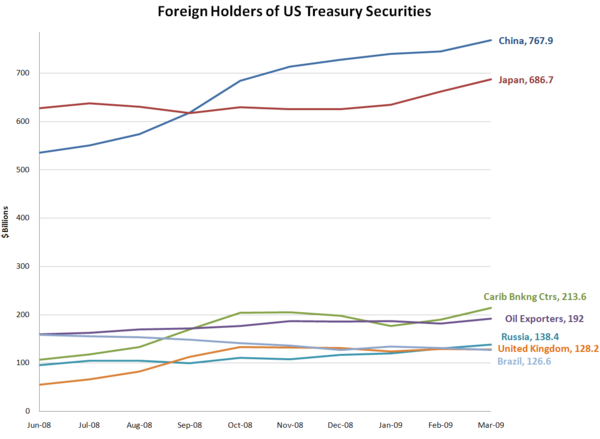
    This week, U.S. Treasury Secretary Timothy Geithner is in China. Mainland China holds $767.9 billion of Treasury securities at the end of March 2009 or about 7 percent of the total national debt. Japan, the second largest major foreign holder, has $686.7 billion.

    Notes: Data from Department of the Treasury. Caribbean Banking Centers (Carib Bnkng Ctrs) include Bahamas, Bermuda, Cayman Islands, Netherlands Antilles, Panama, and British Virgin Islands. Oil exporters include Ecuador, Venezuela, Indonesia, Bahrain, Iran, Iraq, Kuwait, Oman, Qatar, Saudi Arabia, the United Arab Emirates, Algeria, Gabon, Libya, and Nigeria.

    The U.S. bailout commitment of $11.6 trillion equals 89 percent of U.S. 2008 gross domestic product (GDP).

  • Who’s Watching AIG?

    The House Committee on Oversight and Government Reform held a hearing Wednesday – “AIG: Where is the Taxpayer Money Going?” Questions are being raised about whether the bailout better serves the interests of AIG’s customers and trading partners or the interests of U.S. taxpayers.

    The highlight of the Committee’s questioning of Chairman and CEO Edward Liddy came when Chairman Town (D-NY) asked the blunt question: “Why would you give retention bonuses to AIG employees who failed? Plus, the economy is so messed up, where would they go?” On the minds of many committee members were the facts that AIG got $70 billion in TARP money, $50 billion through the Federal Reserve Bank of New York’s Maiden Lane LLC and another $60 billion directly from the Federal Reserve Bank of New York (the FRB-NY’s AIG Credit Facility). When compared to the fact that AIG is currently worth just $5 billion, the repeated question became: “How will taxpayers be repaid?” Mr. Liddy pointed to the value of some subsidiaries and other assets that can be sold off, but he had to admit that the timing and possibility of AIG repaying taxpayers really “depends on the economy and the capital markets.”

    The Trustees of the AIG Credit Facility Trust testified in the second panel. The Trustees were named by the Federal Reserve Bank of New York, under then-President Timothy Geithner, in September 2008. The panel included one non-Trustee – Professor J.W. Verret of George Mason University School of Law. Professor Verret expressed concern over the form of the AIG trust agreement: “I am concerned by the AIG trust because of the precedent it sets. Secretary Geithner has announced his intention to create another trust to manage the Treasury’s investment in Citigroup as well as other TARP participants. If the AIG trust, crafted during the Secretary’s tenure as President of the New York Fed, is used as a model for these new entities, the risk to taxpayers will be multiplied many times over. “ Professor Verret raised three specific problems with the agreement: 1) the agreement specifically expects the Trustees to act in the best interest of the U.S. Treasury, not the U.S. taxpayers; 2) the Trustees cannot be held liable for their actions; and 3) the Trustees can invest on information they gain in the course of their duties.

    At the end of the hearing, the final question went to Representative Norton (D-D.C.). Too many of the AIG Trustees also serve or have served as directors and officers to other TARP recipients. Ms. Norton noted that all of the witnesses are connected to Wall Street and all know each other. Evidently, one of the Trustees, Jill Considine, is involved with a Bermuda company that provides services to hedge funds. Ms. Considine was uncomfortable naming the hedge funds that benefit from her advice because the Bermuda company is private – it is also foreign. Considine took Norton aside when hearing ended, engaging her in an animated conversation – off the record, of course.

    It seems evident that some of the Trustees didn’t recognize the risks AIG was taking when they were in a position to have close contact with not only AIG but their counterparties – those final recipients of the bailout money. If the Trustees missed the AIG risk then, when they were regulators in the self-regulatory industry and serving on Boards at the Federal Reserve Banks, then what can we expect from them now?

  • Geithner’s Collusive Capitalism

    Jo Becker and Gretchen Morgenson (she reported on the lack of mortgages behind mortgage-backed securities) did a long piece on Treasury Secretary Timothy F. Geithner in the New York Times. They paint a stark picture of Secretary Geithner’s brand of “Collusive Capitalism”: lunch at the Four Seasons restaurant with execs from Citigroup, Goldman Sachs and Morgan Stanley; private dinners at home with the head of JPMorgan Chase.

    Most importantly, Becker and Morgenson raise the question of why – with all that frequent contact – Geithner never sounded the alarm about these banks? Indeed, as I’ve pointed out before, Geithner took no steps to prevent $2 trillion in US Treasury bond trades go unsettled for 7 months – until it was over, when he called a meeting of the same bankers that caused the problem to have them do a study, take a survey, make some suggestions, etc. The one action that needed to be taken – to enforce finality of settlement – was never on the table.

    When the banks behaved recklessly in lending, trading, issuing derivatives and generally fueling the Bonfire of their Vanities, according to Becker and Morgenson, Geithner’s idea was to have the federal government “guarantee all the debt in the banking system.” As Martin Weiss asks in his ads for Money and Markets, “Has U.S. Treasury Chief Geithner LOST HIS MIND?”

  • Geithner’s Toxic Recycling Plan Nixed by Big Fund

    The success of Treasury Secretary Geithner’s Public-Private Investment Partnership Program depends on getting private investors interested in buying junk bonds off the banks’ balance sheets. Now it seems that at least one hedge fund is giving the plan “two thumbs-down.”

    The New York Post is reporting that Bridgewater Associates, one of the few that might qualify for Treasury’s program, decided that “the numbers just don’t add up.” Besides being a bad investment, the fund’s founder raised questions about conflicts of interest – something we find surprising. Hedge fund managers are supposed to be those free-wheeling, unregulated, we’ll-buy-anything investors – always willing to take a risk and suffer the consequences of the market outcomes.

    Bridgewater’s concern is that Geithner’s junk bond plan includes hiring asset managers – who will also be investors. There are clear conflicts of interest because these managers will “have both the government and the investors to please and because they will get their fees regardless of how these investments turn out,” wrote Bridgewater founder Ray Dalio. Imagine, a hedge fund worried about collusion among asset managers? Maybe it takes one to know one?

    The real question is why Geithner would set up a program putting US taxpayer money in the hands of unregulated hedge funds and then go to Europe a few days later and blame the global financial crisis (at least in part) on hedge funds and their lack of regulation? Dalio is right: it just doesn’t add up.

  • Junk By Any Other Name Would Smell

    The Treasury this week disclosed details of their plan to pump $1 trillion into the financial system by removing “Legacy Assets” from the balance sheets of banks. Wading through the multitude of documents and documents, I’m reminded of a remark by Michael Milken in a conversation with Charlie Rose on October 27, 2008 “Complexity is not innovation.”

    Since its inception, the plan has been sold to Congress and the media as one with potential positive payoffs for the public coffers. To support this idea, proponents point to the experience of the Resolution Trust Company (RTC) in resolving the Savings and Loan (S&L) Crisis. Back then, RTC took over failing S&Ls – some of which were bankrupted by bad real estate loans made worse when they were forced to sell off below-investment grade bond assets – the by-now-well-known Junk Bonds.

    Selling off today’s junk bonds will, I agree, clean up the balance sheets of the banks and make them more attractive to investors and depositors. But the investment in junk bonds now is not going to turn out like the investment in junk bonds then. For starters, the value of the junk bonds then declined as a result of the forced sell-off – Congress prohibited S&Ls from holding junk bonds on their balance sheets. When this supply was dumped on the market, the prices naturally dropped. Selling assets at depressed prices damaged a lot of S&Ls. RTC stepped in near the bottom of those prices to take control of the assets. When credit markets returned to normal, the prices of the junk bonds rose and the investments had positive returns.

    Then, junk bonds paid extraordinary rates of return – 10 percentage points above Treasuries at the peak. At that time, a 30-year U.S. Treasury bond could be paying more than 18% interest.

    Now, we are talking about junk bonds that we all know are junk – no matter fancy labels like “Legacy.” What rate of return could there be on a mortgage bond – no matter how you “slice-and-dice” it – created when mortgage interest rates were 5-6%? Add to that our knowledge of the problems underlying these assets and it is increasingly unlikely that there will be any positive payoff for taxpayers in this plan.

    On March 25, 2009, Mirek Topolanek, President of the European Union, called the U.S. economic plan “the way to hell.” His concern is that we’ll have to finance these trillion dollar bailouts with borrowing and that will ultimately further undermine global financial markets. He’s right, of course. The public-private partnerships will finance the purchase of the “Legacy Assets” by issuing debt. That debt will be guaranteed by the Federal Deposit Insurance Corporation (FDIC), the same agency that guarantees our savings accounts at the local bank. Our guarantee is backed by the payment of insurance premiums to FDIC. The guarantee on the debt used to purchase Legacy Assets will be secured by the Legacy Assets – which will be rated by the same credit rating agencies that gave us triple-A rated subprime mortgage bonds in the first place. How can this possibly turn out well? I’m sure Treasury, Federal Reserve and FDIC have good intentions, but as EU President Topolanek says, they may all end up as pavement on “the way to hell.” As NYTimes columnist Paul Krugman said of the new plan, “What an awful mess.”

  • Geithner is Wall Street’s Lapdog

    Treasury Secretary Tim Geithner is on the cover of the April 2009 issue of Bloomberg Markets magazine. In the lead article, “Man in the Middle,” the authors refer to his time at the New York Federal Reserve Bank (FRB) as “experience as a consensus builder.” This overlooks the fact that it was easy for him to get everyone to agree, to build group solidarity, when he simply gave the banks and broker-dealers everything they wanted.

    The Primary Dealers, those broker-dealers and banks who have a special arrangement with the FRB for trading in treasury securities, agreed when Geithner let them fail to deliver $2.5 trillion of treasury securities for seven weeks in the fall; they agreed when he let them fail to deliver more than $1 trillion two years earlier; they agreed when he let them fail to deliver treasury securities even after Geithner’s own economists told him it was dangerous. By the way, last year the New York FRB’s public information department prevented those economists from speaking on the record about that research with a Bloomberg reporter.

    Now, at a hearing on March 24, 2009 before the House Financial Services Committee, Secretary Geithner and Federal Reserve Chairman Ben Bernanke lectured us on the awesome responsibilities of Treasury and Federal Reserve in the current crisis – without admitting that they had those same responsibilities while the crisis was being created.

    In a joint statement from the Department of the Treasury and the Federal Reserve they offer no explanation for their failure to fulfill their “central role … in preventing and managing financial crises.” Rather, they use the fact of that role to require that we accept whatever plan they put before us today as the best and wisest course. To convince us that their plan is the right one, they can all point to the fact that the stock markets rallied (gaining nearly 7% across the board) led by the shares of financial institutions (Goldman Sachs’ shares went from $97.48 on Friday night to $111.93 on Monday – a gain of about 15%).

    I criticized the “Public Private Partnership” when it was announced in February 2009. Calling Wall Street’s bad investments “Legacy Assets” doesn’t change the fact that they are “junk.” They could call it “the hair of the dog” because they now want to invest taxpayer money into the same junk investments that started the financial snow ball rolling in the first place.

    Just because the stock market rallied doesn’t make this “consensus building” – I call it being Wall Street’s lapdog.

  • Layout for the Bailout: $3.8 Trillion and Counting

    Bloomberg.com reporters Mark Pittman and Bob Ivry are reporting a running total of the money the U.S. government has pledged and spent for bailouts and economic stimulus payments. The total disbursed through February 24, 2009 stands at $3.8 trillion; the total commitment is $11.6 trillion. The Federal Reserve is providing the largest share at $7.6 billion, followed by the U.S. Treasury $2.2 trillion and FDIC $1.6 trillion. The Department of Housing and Urban Development (HUD) and support for Fannie Mae and Freddie Mac, combined with purchases of student loans – bailout money that comes closest to directly bailing out Main Street – total only $760 billion – less than 7 percent of the total.

    The national debt currently stands at $10.8 trillion — versus an authorized limit of $12.1 trillion.

    Last week, U.S. Treasury Secretary Timothy Geithner got into a tiff with the rest of the world (denied by President Obama) by telling them that they should spend at least 2 percent of their GDP on their own stimulus packages.

    The U.S. commitment of $11.6 trillion equals 81 percent of U.S. 2008 gross domestic product (GDP). The $787 billion fiscal stimulus is 5.4 percent of GDP. Just the two-thirds of the stimulus that represents new spending (one-third is tax cuts) is 3.6 percent of GDP. Here’s what financial institutions in various countries got from U.S. taxpayers by way of the AIG bailout:

    Country

    Bailout Benefit

    US

     $   31.1

    France

     $   19.1

    German

     $   16.7

    UK

     $   12.8

    Switzerland

     $     5.4

    Netherlands

     $     2.3

    Canada

     $     1.1

    Spain

     $     0.3

    Denmark

     $     0.2

    Italy

     $     0.2

    Serbia

     $     0.2