Tag: geography

  • The Evolving Urban Form: Prague

    Prague is the capital of Czechia, a nation most readers have probably never heard of. Last year, the Czech Republic adopted a new name that does not reveal its governance structure (republic). The new name has not enjoyed widespread acclaim. The union of Czechoslovakia, which dates from the end of World War I, split peacefully in 1993, resulting in the creation of Czech Republic and Slovakia.

    Prague, like its central and eastern European cousins, Warsaw, Budapest and Bucharest, has experienced substantial decentralization of its population following the collapse of communism. As economies improved and more housing choices opened up, many residents opted to move to outer parts of the core cities or even beyond to suburban and exurban areas.

    Today, the municipality of Prague has approximately 100,000 more residents than in 1980. Yet, the distribution of the population is quite different than before. Then, the central and inner districts of the city had a population of approximately 980,000, while the outer districts were home to 200,000. The latest Czech Statistical Office estimates (for January 1, 2017) show the center and inner districts have declined to approximately 785,000 residents. The city’s outer districts have experienced all of the population increase, more than doubling to above 460,000.

    Meanwhile, two-thirds of the growth (Graphic 1) has been in the suburbs of the Středočeský region (Central Bohemia), which surrounds Prague (Graphic 2).

    The Historic Inner District

    Prague’s central district (District 1) comprises the pre-transit walking core of the city. It stretches across the Vltava River (Smetana’s “The Moldau”) from Wenceslaus Square across the Charles Bridge to Prague Castle, the site of St. Vitus Cathedral. The district also includes the Old Town Square. The population of District 1 dropped from 53,000 in 1980 to 29,000 in 2017, a decline of 44 percent.

    The most recent historic events have virtually all taken place in District 1. The 1968 revolt against Soviet control occurred in Wenceslaus Square and was put down by Warsaw Pact military action and tanks, with a loss of 500 Czechoslovakian citizens.

    This was the end of Alexander Dubček’s “Prague Spring” attempt to liberalize communism. Dubček rose from head of the Slovak communist party to leader of the Czechoslovakian communist government. Dubček, however, was luckier than Imre Nagy of Hungary, the communist leader who paid for his liberalizing tendencies by being executed after the 1956 rebellion.

    Wenceslaus Square, named after St. Wenceslaus, Duke of Bohemia, was also the center of the “Velvet Revolution”. Led by Václav Havel, he became Czechoslovakia’s first president following the fall of communism. The communist parliament building (Graphic 3) played a major role, as described by prague-stay.com:

    “This Communist eyesore, loathed by many, loved by few was built after the old Exchange building was destroyed from 1966 – 1973. This glass monstrosity with its two giant pillars is still complete with nuclear shelters. The demands of the Velvet Revolution were accepted here in 1989 and the building was once home to Radio Free Europe who rented the location from former president Vaclav Havel for a very small fee per year (rumor has it that the fee was 1 CZK).”

    I watched Dubček, an unsurprising supporter of the Velvet Revolution, from the building’s gallery in his role as chairman of the national parliament in 1991. Soon after, the national parliament relocated from the building, which is now part of the National Museum. The main building is shown in the top photograph (my photo was not used because of the present scaffolding being used in its refurbishment).

    There is a memorial to victims of the 1968 Warsaw Pact action in front of the main building (Graphic 4), with a barbed wire wreath. Graphics 5 to 7 are also of Wenceslaus Square, which some travel guide books point out is more of a boulevard than a square.

    Old Town Square is shown in Graphics 8 to 12. Charles Bridge is illustrated in Graphics 13 to 16. This historic bridge was built between 1357 and 1402. The approach to Prague Castle and related views are in Graphics 17 to 21. Other views of the inner district are in Graphic 22 (the National Theatre) and Graphic 23.

    Inner and Outer Districts of Prague

    The inner districts (2 through 10) were mainly developed during the mass transit area. The outer districts, where all the city’s growth has occurred, have generally lower population densities. There are some detached houses in the outer districts. Besides the historical buildings, Prague, like other European cities, is in many ways spatially dominated by the automobile, with its narrow, crowded streets and parking on sidewalks. (Graphics 24 to 27).

    The Suburbs

    The Středočeský region surrounds Prague and contains both suburban and exurban development (Graphics 28 to 36), including new construction (Graphics 30 to 36). The Středočeský suburbs exhibit a high quality of suburban infrastructure for eastern Europe, including sidewalks in most cases and curbs. However, the quality of the visible suburban infrastructure falls considerably short of that enjoyed by suburban residents of the United States, Canada, Australia, and New Zealand, where for decades nearly all suburban development has included these features, as well as streets wide enough for parking and cars to pass one-another in opposite directions.

    The Prague Area: Dominating Czechia’s Population Growth

    As is occurring in Tokyo-Yokohama and Budapest, the Prague area is capturing nearly all the national growth, at 86 percent. This includes 58 percent in the suburbs and 28 percent in the outer districts. This is a far greater percentage than Prague’s 25 percent of the population in 1980. (Graphic 37).

    Prague’s Popularity

    For nearly three decades, Prague has been the capital of a nation free to set its own course, the longest period since the 1918 establishment of Czechoslovakia. Prague has become particularly popular among foreign tourists. Trip Advisor ranked Prague 5th among the cities of Europe last year, trailing London, Paris, Rome and Barcelona and ninth in the world. It is no minor accomplishment to edge out cities like Vienna, Amsterdam, and Budapest.

    Wendell Cox is principal of Demographia, an international public policy and demographics firm. He is a Senior Fellow of the Center for Opportunity Urbanism (US), Senior Fellow for Housing Affordability and Municipal Policy for the Frontier Centre for Public Policy (Canada), and a member of the Board of Advisors of the Center for Demographics and Policy at Chapman University (California). He is co-author of the “Demographia International Housing Affordability Survey” and author of “Demographia World Urban Areas” and “War on the Dream: How Anti-Sprawl Policy Threatens the Quality of Life.” He was appointed to three terms on the Los Angeles County Transportation Commission, where he served with the leading city and county leadership as the only non-elected member. He served as a visiting professor at the Conservatoire National des Arts et Metiers, a national university in Paris.

    Top photograph: National Museum. Main building. By Jorge Láscar [CC BY-SA 2.0], via Wikimedia Commons

  • The Best Small and Medium-Size Cities For Jobs 2017

    Much of the U.S. media tends to see smaller cities as backwaters, inevitably left behind as the “best and brightest” head to the country’s mega-regions. The new economy, insists the Washington Post, favors large cities for start-ups and new businesses. Richard Florida has posited the emergence of a “winner take all urbanism” that tends to favor the richest cities, such as New York and San Francisco.

    However this paradigm may reflect cosmopolitan attitudes and rivalries between large cities more than reality, with its complications and nuances. Smaller cities have long been disadvantaged in their ability to attract the most elite companies and Americans on the move, but that may well be changing. Following a post-financial crisis period in which many domestic migrants headed to the big cities, the latest Census data suggests that the flow is now going the other way, with the native born moving to smaller places with between 500,000 and a million people. The new trend in migration, notes the Atlantic’s Derek Thompson, a confirmed big city booster, has been a “great hollowing out,” with Americans leaving places like New York, Los Angeles and San Francisco for the suburbs and less costly, usually smaller cities. (Note that at least in New York’s case, foreign immigrants have been taking their places.)

    To be sure, many smaller towns are suffering, and the bottom of our annual survey of employment trends in America’s 421 metro areas is dominated by them, starting with last place Beckley, W.V.; followed by Johnstown, Pa.; Charleston, W.V.; Weirton-Steubenville, Ohio; and Peoria, Illinois. Yet at the same time small city America — which we define as metro areas with less than 150,000 jobs — accounted for seven of the 10 cities where job growth has been the strongest.

    2017 Best Cities Rankings Lists

    Methodology

    Our rankings are based on short-, medium- and long-term job creation, going back to 2005, and factor in momentum — whether growth is slowing or accelerating. We have compiled separate rankings for America’s 70 largest metropolitan statistical areas (those with nonfarm employment over 450,000), as well as medium-size metro areas (between 150,000 and 450,000 nonfarm jobs) and small ones (less than 150,000 nonfarm jobs), the latter two of which are our focus this week, in order to make the comparisons more relevant to each category. (For a detailed description of our methodology, click here).

    The Utah Model

    What makes for successful smaller cities? There’s no simple formula, but several characteristics loom prominently. One is the extent and quality of its amenities: Many of our top cities are in attractive locations near mountains or the ocean, and tend to be home to colleges and universities. And, almost without exception, they are located in less costly, lower-tax states. Finally, it doesn’t hurt to be relatively close to a bigger urban area and a large airport.

    All these characteristics apply to the best metro area for jobs in 2017 — Provo-Orem, Utah. Located an hour south of Salt Lake City and its big airport, the Provo-Orem area has a population of 603,000 and sits alongside the scenic Wasatch Mountains. It’s home to the well-regarded Brigham Young University. Last year the metro area’s job count expanded an impressive 4.4%, and employment is up 29.2% since 2011. As one might suspect in a college-oriented area, the biggest growth has been in fields that tend to hire educated people, such as business and professional services, in which employment grew 5.8% last year, financial services (up 6.7%) and the information sector (plus 5.8%).

    But Provo is not alone in outstanding job growth in the Beehive State. In addition to its largest metro area, Salt Lake City, which ranks 13th, the small city of Saint George ranks third. Also benefiting from a scenic location in the state’s rugged southwestern corner, it’s less of a college town than a retirement and tourism magnet, which explains much of its 5.7% job growth last year. This was driven in large part by big expansions in health and education, with employment in those sectors up 4.6% last year and some 31.8% since 2011.

    Another Utah superstar is 18th-ranked Ogden-Clearfield. Its 2.9% job growth last year was driven in large part by financial services, with employment up 5.7%, and education and health, up 5.9%.

    So what accounts for one relatively small state that’s home to only 3.1% of the U.S. population placing four cities in the top 20? Among the factors: the nation’s fastest population growth, a highly favorable business climate (Gov. Gary Herbert has made cutting red tape a priority of his administration), a burgeoning tech sector and a Mormon-influenced social culture that seems to encourage citizen engagement in local affairs.

    Other Hot Spots

    The other smaller boom towns are a varied lot, although all share locations in low tax, light regulation states. Some bigger cities — San Francisco, Seattle, San Jose — seem to have found a way to keep growing in higher cost environments, but this does not seem to be the case for smaller cities. Virtually all the small communities in our top 20 — with the exception of No. 8 Fort Collins, Colo., — come from such reddish states as the Carolinas, Texas, Idaho and, of course, Utah.

    Most of the fastest-growing metro areas tend to be in what some have called “amenity regions.” This is certainly the case for Ft. Collins, No. 9 Gainesville, Ga., No. 10 The Villages, Fla., and No. 17 Boise, Idaho. Many of these places, notably the Villages, are attractive to retirees and downshifting boomers while others may also lure young families.

    Yet there are some wide differences among our top small cities. Smaller cities often have very distinctive economies dominated by one or two industries. Sixth-ranked Fayetteville-Springdale-Rogers, a metropolitan area that sprawls between Missouri and Arkansas, is dominated by two forces, Bentonville-based Walmart, and a burgeoning retirement/tourism sector tied to its location in the scenic Ozarks. The area which enjoyed 3.3% job growth last year, and 20.4% since 2011, was paced by an expanding professional and business services sector, up a sizzling 8.0% last year; other dynamic sectors include financial services, up 4.5% last year, as well as the education and health, which grew 4.0%.

    Charleston-North Charleston, which ranked 4th on our list with a 3.2% job growth rate last year and 17.6% since 2011, epitomizes the new dynamic small cities. Not only does the area boast a charming ante-bellum urban core, and some of the country’s best food, it has also become attractive to companies seeking to lower costs. The city is home to Boeing’s 787 Dreamliner assembly plant and to Mercedes-Benz’s $500 million Charleston plant, which will add 1,300 jobs over the next few years. It is also about to house Volvo’s first North American manufacturing plant – a $500 million investment that could add up to 4,000 jobs home. Charleston has also emerged as something of a millennial draw as well, with the largest percentage of residents aged 25 to 34 of any midsized city.

    2017 Best Cities Rankings Lists

    The Future of Smaller Cities

    In contrast to the conventional wisdom, smaller cities may have a brighter future than many expect. Of course, it’s hard to see a rapid turnaround in some deindustrialized cities, particularly in the Midwest. Many energy-dependent cities are down sharply in our ranking from a year ago, including Baton Rouge, La., which dropped 97 places to 191st, and Bismarck, N.D., which plummeted 119 places to 221st. The Trump administration certainly has made noise about helping the energy industry, but the cold reality of the current global oversupply of oil suggests these places won’t be rebounding much in the near term.

    Right now, prospects seem best for amenity rich areas, in part because they appeal to both aging boomer and younger families. The scenic Pacific Northwest is home to many gainers this year, including Olympia-Tumwater, Wash., which gained as impressive 64 places from last year to 21st, Wenatchee, which rose seven spots to 22nd, and Bellingham, which jumped 100 places to 63rd.

    In the South, the attractive coastal city Wilmington, N.C., rose 76 places to 54th, and the Florida beach towns Northport-Sarasota-Bradenton, climbed 28 spots to 35th while Punta Gorda gained 26 places to 39th.

    The future of smaller American cities, in some senses, parallels that of their larger counterparts. Some areas seem positioned for further growth, while many others are stagnating or even dropping. The small city is far from obsolete, with a good number of them poised to expand strongly in the years ahead.

    This piece originally appeared on Forbes.

    Joel Kotkin is executive editor of NewGeography.com. He is the Roger Hobbs Distinguished Fellow in Urban Studies at Chapman University and executive director of the Houston-based Center for Opportunity Urbanism. His newest book is The Human City: Urbanism for the rest of us. He is also author of The New Class ConflictThe City: A Global History, and The Next Hundred Million: America in 2050. He lives in Orange County, CA.

    Dr. Michael Shires primary areas of teaching and research include state, regional and local policy; technology and democracy; higher education policy; strategic, political and organizational issues in public policy; and quantitative analysis. He often serves as a consultant to local and state government on issues related to finance, education policy and governance. Dr. Shires has been quoted as an expert in various publications including USA TodayNewsweekThe EconomistThe Sacramento Bee, San Francisco Chronicle, and LA Times. He has also appeared as a guest commentator on CNN, KTLA and KCAL to name a few.

    Photo by City of St. George (City of St. George) [CC0], via Wikimedia Commons

  • Kevin Starr, chronicler of the California dream

    “From the Beginning, California promised much. While yet barely a name on the map, it entered American awareness as a symbol of renewal. It was a final frontier: of geography and of expectation.”

    — Kevin Starr, “Americans and the California Dream, 1850-1915” (1973)

    In a way, now rare and almost archaic, Kevin Starr, who died last week at age 76, believed in the possibilities of California, not just as an economy or a center for innovation, but also as precursor of a new way of life. His life’s work focused on the broadest view of our state — not just the literary lions and industrial moguls but also the farmworkers, the plain “folks” from the Midwest, the grasping suburbanites who did so much to shape and define the state.

    His California was not just movie stars, tech moguls, radical academics, talentless celebrities and equally woeful party hacks who dominate the upper echelons. A native San Franciscan, who grew up in a contentious working-class Irish family and never forgot his roots, Kevin’s California was centered on providing, as he said in a recent interview with Boom California magazine, “a better life for ordinary people.” The diverging fortunes of our people — with many in semi-permanent poverty while others enjoy unprecedented bounty — disturbed him profoundly, and, in his last years, darkened his perspective on the state.

    Over recent years, Kevin was increasingly distraught by what he saw as “the growing divide between the very wealthy and the very poor, as well as the waning of the middle class” that now so characterizes the state. He saw San Francisco changing from the diverse city of his youth, made up of largely ethnic neighborhoods, to a hipster monoculture. With typical humor, he labeled his hometown as essentially “a Disneyland for restaurants,” a playground with little place for raising middle-class families. California has, indeed, changed over the decades, but not always in a good way.

    Kevin Starr’s California

    Kevin Starr represented another, more congenial California, one where people could still disagree on issues, but work for common goods. He was, as his wife Sheila told the New York Times, largely a man of the 1950s, a creature of consensus seekers. He served as state librarian under governors Pete Wilson, Gray Davis and Arnold Schwarzenegger. A conservative-leaning centrist Democrat, he did not fit comfortably in a state that has drifted from a vibrant two-party culture to a dominant progressive monoculture with little more than a Republican rump.

    In today’s hyperpartisan environment, the Golden State must either be a dystopia (the conservative view) or an emerging paradise on earth (the common progressive mantra). Starr, as a fair-minded historian, saw both realities — not only today but through time. In his multipart “California Dream” series, Starr both confronted reaction against ethnic change and celebrated the process of integration, whether for Latinos, Asians or Anglo Okies, whose unique presence, outside of their descendants, is all but lost in contemporary California.

    But what most separated Kevin’s view of California from many others were his humanity and empathy with the aspirations of the state’s middle- and working-class families. Many intellectuals denounce suburbs as racist and exclusionary, as well as environmentally and culturally damaging. Starr saw in them something else — what author D.J. Waldie has described as “Holy Land” — in places like Lakewood, the Bay Area suburbs and Orange County. To him, these were not only places of opportunity, but also landscapes of a reborn “more intimate America,” home to an expanding middle class.

    Read the entire piece at The Orange County Register.

    Joel Kotkin is executive editor of NewGeography.com. He is the Roger Hobbs Distinguished Fellow in Urban Studies at Chapman University and executive director of the Houston-based Center for Opportunity Urbanism. His newest book, The Human City: Urbanism for the rest of us, was published in April by Agate. He is also author of The New Class ConflictThe City: A Global History, and The Next Hundred Million: America in 2050. He lives in Orange County, CA.

    Photo: Institute of Museum and Libraries Service (IMLS website) [Public domain], via Wikimedia Commons

  • The Demographics of Poverty in Santa Clara County

    Tucked away in the bottom corner of the San Francisco Bay, tech royalty make themselves at home in their silicon castles. Santa Clara County is the wealthiest county in California, and 14th in the nation, boasting an average median household income of $96,310. However, where there are kings, there must be subjects. Despite its affluence, Santa Clara remains one of the most unequal counties in the United States. The combined forces of enormous wage gaps, exorbitant housing prices, and shifts in the regional economy have compounded over recent years, resulting in a shrunken middle class and increased poverty levels.

    Santa Clara County contains just over 1.9 million people and is home to much of the Silicon Valley. The relatively recent explosion of growth in the high-wage technology industry has generated a new rank of upper-middle class to fabulously wealthy individuals. But, even in the economic miracle that is Silicon Valley, poverty remains a prevalent force and affects a disturbing number of lives in the region. Although, according to the Census Bureau, only 8.3% of Santa Clara County residents live at or below the Federal Poverty Level (FPL), this number drastically underestimates the true number of people that are experiencing financial hardship in the region. In a study conducted by United Way, it was found that the real cost budget for a family of four residing in Santa Clara County stands at $65,380 per year, or 281% of the FPL.

    High regional housing costs account for much of the discrepancy in poverty levels between the county and the nation. A study out of the California Budget and Policy Center calculated that the poverty rate in Santa Clara County soars to 18% when factoring in housing costs, meaning nearly one in five residents live in poverty.

    It is for this reason that the region has one of the largest homelessness populations in the nation, with around 7,600 homeless individuals residing within Santa Clara County. When local homeless individuals were surveyed regarding obstacles to securing housing, the top four answers were as follows: No job/income, no money for moving costs, bad credit, and lack of available housing. Of course, poverty is cyclical, and these answers affect one another to some extent: a lack of income means no money for moving costs, which may lead to bad credit and which could then lead to an inability to secure permanent housing. Around 56% of survey respondents also reported being homeless for over a year, up significantly from 47% just two years prior, indicating that the homeless in Santa Clara County continue to face significant obstacles to securing housing. High homelessness rates are symptoms of a greater trend: the fact that gross income inequalities in Santa Clara County have created a society of have’s and have not’s, separated by an income gap that shows no sign of closing.

    Housing Trends

    The most significant impediment to financial security in the county is the volatile housing market and the exorbitant cost of owning a home. According to a report conducted by the U.S. Department of Housing and Urban Development on the South Bay Area, the average price of houses sold in 2014 stood at $788,500 for an existing home and $828,000 for a new home. This is over four times the median value of homes nationally, which stands at $178,600. The disparity is even more prevalent in the areas of the region closer to large technology firms, such as Palo Alto, where the average home costs $2.43 million. San Jose also has the 7th largest share of renters in major U.S. cities, 56 percent, a rate that only continues to increase as housing costs do the same. The median gross rent in Santa Clara County stands at $1705 per month, nearly double the national average.

    Current trends indicate that the increasing housing costs show no signs of reversing, which does not bode well for residents that are already struggling financially. A study from the California Budget and Policy Center found that, in 2013, over 50% of households classified as low-income were at risk of moving out of the area due to increased housing costs.

    Net domestic migration in Santa Clara County is overwhelmingly negative.

    The result of high housing costs? Net domestic migration has been negative every year since 1996, except 2011, and appears to be dipping further, despite the fact that the population of Silicon Valley has grown continually in recent years. This can be attributed to a combination of natural births and massive foreign immigration rather than domestic migration. Therefore, negative net domestic migration suggests that a large portion of residents are leaving the area due to a lack of an income that cannot keep up with rising costs of living.

    However, for those who stay, high housing prices lead to a plethora of other disadvantages, creating a cycle of poverty that decreases social mobility in the region. A search for cheaper housing has led many to seek living arrangements in the southern and eastern parts of San Jose, where housing is cheaper, but comes at the cost of higher crime rates and worse school districts. Additionally, job growth has been concentrated in the western parts of the county. The search for cheap housing has led to an increase in overcrowded households, as residents move in with one another in order to share the costs of rent. The Santa Clara County Department of Public Health concluded in 2014 that 14% of residents were living in overcrowded households, with 5% living in severely overcrowded households. Latinos in the region are disproportionately affected, with 31% living in overcrowded households and 12% living in severely overcrowded households.

    The combination of these factors limits social mobility by undermining each individual’s access to economic opportunity. Moving into an overcrowded house in an underfunded public school district limits potential to obtain a quality education that may provide access to high-skilled, high-wage jobs.

    The Income Gap

    Inequality in the region is perpetuated by a growing income gap, and the ardent hunt for afford-able housing may be explained by the gross income disparities among residents. As housing prices have skyrocketed over recent years, incomes simply have not kept up with costs of living, particularly at the lower end of the spectrum.

    Santa Clara County’s income gap has widened considerably since 1989.

    Economic gains in the region have flowed overwhelmingly to the top quintile of income-earners, who have seen their wages increase by over 25% over the past 25 years. In a shocking comparison, income levels have declined for low-income households since 1989, a clear sign of a widening wealth gap in the region. Those at the bottom also find themselves working harder for less money: the average income for those living above the previously described real cost of living in Santa Clara County stands around $27 per hour, whereas the average income for those living below the real cost of living comes in at a bit over $10, around the current California minimum wage.

    To make matters worse, government efforts have proven relatively ineffective in remedying regional inequality. A recent study has shown that even when a family is a recipient of CalWORKS and CalFresh benefits, government-funded initiatives to provide benefits to needy families, an average family of four is still tens of thousands of dollars away from comfortably subsisting in Santa Clara County. Additionally, government benefits are not reaching populations that would benefit from them the most: a United Way study found that less than 19% of single mothers and less than 5% of immigrants statewide subscribe to these programs.

    Shifts in the Regional Economy

    Efforts to increase wages of low-paying jobs may alleviate financial hardship to a certain degree, but these actions fail to consider an underlying trend in Santa Clara County: low-skilled, blue collar jobs are disappearing. Wage increases in industries heavily populated by lower income earners matter little if those jobs do not exist. Historically, Santa Clara County was a manufacturing hub, famous for producing semi-conductors along with other components vital to the burgeoning technology industry. However, recent years have seen manufacturing jobs leaving the area in droves, either to other parts of the country or abroad.

    Sector growth in the region, percentage change, 2000-2014.

    The chart above shows that job growth in Santa Clara County has only been observed in a few sectors of the local economy. Despite this growth, total nonfarm payroll employment has decreased in the past 15 years, and the impact of this job loss may be observed across the economy. The most significant reductions of the workforce have occurred in sectors referred to as “blue-collar,” typically middle income jobs that may or may not require higher education. These types of jobs cover many of those within the goods-producing sectors, comprised here of the mining, logging, construction, and manufacturing industries.

    The rapid decline of “blue collar” jobs in the region may be attributed at least in part to the explosive growth of Silicon Valley. As the region attracts more skilled workers, increases the region’s desirability, and pays workers competitive wages capable of keeping up with costs of living, those very expenses will continue to drive upwards. As a result, workers across all economic sectors have demanded higher wages, a sentiment exemplified in the recent minimum wage hikes. Unfortunately, this drives lower-paying blue-collar industries to relocate, often out of the state, so they can lower their input costs, creating a polarized society of high-wage earners in the information sector along with low-wage earners in a service sector dedicated to the needs of the technocrats.

    Santa Clara County is a place of immense, but heavily-concentrated wealth. Multi-billion-dollar technology campuses dot the landscape like behemoths, yet the wealth and progress that accompanied the growth of the Silicon Valley has also left a significant proportion of its population behind. The environment is increasingly hostile to social mobility, the manufacturing sector has skipped town, and government efforts to mitigate the effects of these changes have proven relatively unsuccessful. Trends have shown that the region’s poor are increasingly confined to specific industries and geographies, and their freedoms restricted as they are subject to a degree of economic violence that shows no immediate signs of relenting. Significant shifts in local policy are needed to reverse the current social and economic trends and ameliorate the situation in an increasingly polarized Santa Clara County.

    Alex Thomas is currently a sophomore at Chapman University pursuing a major in Political Science. He is originally from San Jose, California, and has worked extensively within the city and surrounding areas. He hopes to further his interest in local politics through continued study and community involvement in the upcoming years.

    Photo: Coolcaesar [CC BY-SA 3.0], via Wikimedia Commons

  • How Post-Familialism Will Shape the New Asia

    Surprisingly, the modern focal point for postfamilial urbanism comes from eastern Asia, where family traditionally exercised a powerful, even dominant influence over society. The shift toward post-familialism arose first in Japan, the region’s most economically and technologically advanced country. As early as the 1990s sociologist Muriel Jolivet unearthed a trend of growing hostility toward motherhood in her book Japan: The Childless Society? –a trend that stemmed in part from male reluctance to take responsibility for raising children.

    The trend has only accelerated since then. By 2010 a third of Japanese women entering their 30s were single, as were roughly one in five of those entering their 40s – that is roughly eight times the percentage seen in 1960 and twice that seen in 2000. By 2030, according to sociologist Mika Toyota, almost one in three Japanese males may be unmarried by age 50.

    In Japan, the direct tie between low birth rates and dense urbanization is most expressed in Tokyo, which now has a fertility rate of around one child per family, below the already depressed national average. Some of the lowest rates on earth can be seen elsewhere in eastern Asia, including those in Seoul, Singapore and Hong Kong, which are now roughly the same as the rate in Tokyo.

    As more of Asia becomes highly urbanized like Japan, this kind of ultra-low fertility will spread to other parts of the continent. Most critically, this dynamic has already spread to mainland China, or at least to its larger cities, where fertility rates have dropped well below 1.0. In 2013, Shanghai’s fertility rate of 0.7 was among the lowest ever reported – well below the “one child” mandate removed in 2015 and only one-third the rate required to simply replace the current population. Beijing and Tianjin suffer similarly dismal fertility rates.

    This pattern of low fertility, notes demographer Gavin Jones, suggests that rapid urbanization has already made the notion of the one-child policy antiquated. Now, even with fertility policies being loosened, many Chinese families are opting not to take advantage, largely due to the same reasons cited in other parts of the world: the high cost of living and high housing costs.

    Perhaps no city better reflects Asia’s emerging urban paradigm than Seoul, the densest of the high-income world’s megacities outside of Hong Kong. The Korean capital is more than 2.5 times as crowded as Tokyo, twice as dense as London and 5 times as crowded as New York. No surprise then that self-styled urban pundits love the place, as epitomized by a glowing report in Smithsonian magazine that painted Seoul as “the city of the future.” Architects, naturally, joined the chorus. In 2010 the International Council of Societies of Industrial Design named Seoul the “world design capital.”

    Ultimately, Seoul epitomizes the retro-urbanist fantasy: a city that is dense and dominating, rapidly turning the rest of the country into depopulating backwaters. Seoul has monopolized population growth in Korea, accounting for nearly 90% of total growth since 1970. Seoul also currently holds nearly 50% of the country’s population, up from 20% in 1960.

    Seoul’s development has come at the expense of not just its own hinterlands but also its own humanity. Its formerly human-scaled form of housing, known as a hanok , which was one story tall and featured an interior courtyard, has been largely replaced with tall, often repetitive towers that stretch even into the suburbs. While architects and planners celebrate this shift, they rarely consider whether this form of urbanization creates a good place for people, particularly families.

    When you consider the trends in similar cities, it’s unsurprising that Korean sociologists have noted the shift to high-density housing as being unsuitable for families with children.

    Over time the impact of these housing policies will be profound. By 2040 Korea’s population will join those of Japan and Germany as one of the world’s oldest. This will occur despite determined government efforts to encourage childbearing, efforts that may well be doomed by the government’s similar commitment to a dense, centralized urban form.

    What will happen to societies that are likely to retain extremely low rates of fertility? Japan, notes Canadian demographer Vaclav Smil, represents “an involuntary global pioneer of a new society.” Japan certainly exemplifies one way societies may evolve under diminishing birth rates.

    Projecting population and fertility rates is difficult, but the trajectory for Japan is unprecedented. The UN projects Japan’s 2100 population to be 91 million, down from 2015′s 127 million, but Japan’s own National Institute of Population & Social Security Research projects a population of 48 million, nearly 50% lower than the UN’s projection.

    Japan’s urban centralization both feeds and accelerates this trend. Rather than disperse, Japan’s population is “recentralizing.” A country with a great tradition of regional rivalries, home to an impressive archipelago of venerable cities, is becoming, in effect, a city-nation, with an increased concentration on just one massive urban agglomeration: Tokyo. This has, for the time being, allowed Tokyo to escape the worst of Japan’s demographic decline, drawing heavily on the countryside and smaller cities, both of which are losing population. From 2000 to 2013 the Tokyo metropolitan area added 2.4 million residents, while the rest of the nation declined by 2 million.

    Tokyo is now home to almost one in three Japanese. But its growth is likely to be constrained, as the last reservoir of rural and small-city residents seems certain to dry up dramatically. A projection for the core prefecture of Tokyo indicates a 50% population cut by 2100 to a number smaller than it was at the beginning of World War II; 46% of that reduced population will be over 65.

    This suggests it is time, in high-income countries at least, to shift our focus from concerns about overpopulation to a set of new and quite unique challenges presented by rapid aging and a steadily diminishing workforce. Even birth rates in developing countries are tumbling toward those of wealthy countries. As British environmental journalist Fred Pearce puts it, “the population bomb’ is being defused over the medium and long term.”

    Some, like Pearce, see the Japanese model as an exemplar of a world dominated by seniors – with very slow and even negative population growth – that will be “older, wiser, greener.” Following the adolescent ferment of the 20th century, Pearce looks forward to “the age of the old” that he claims “could be the salvation of the planet.”

    Yet, if the environmental benefits of a smaller, older and less consumptive population may be positive, there may be other negative ramifications of a rapidly aging society. For one thing, there will be increasingly fewer children to take care of elderly parents. This has led to a rising incidence of what the Japanese call kodokushi , or “lonely death,” among the aged, unmarried and childless. In Korea, Kyung-sook Shin’s highly praised bestseller, Please Look After Mom, which sold 2 million copies, focused on “filial guilt” in children who fail to look after their aging parents and hit a particular nerve in the highly competitive eastern Asian society that seems to be drifting from its familial roots.

    Additionally, an aging population will certainly diminish demand for both goods and services and likely would not promote a vibrant entrepreneurial economy.

    China will face its own version of “demographic winter,” although sometime later than Japan or the Asian Tiger states. The U.S. Census Bureau estimates that China’s population will peak in 2026 and then will age faster than any country in the world besides Japan. Its rapid urbanization, expansion of education and rising housing costs all will contribute to this trend. China’s population of children and young workers between 15 and 19 will decline 20% from 2015 to 2050, while that of the world will increase nearly 10%.

    In China the consequences of the rising number of elderly will be profound. Demographer Nicholas Eberstadt, for example, sees the prospect of a fiscal crisis caused by an aging and ultimately diminishing population. China, he notes, faces “this coming tsunami of senior citizens” with a smaller workforce, greater pension obligations and generally slower economic growth.

    It seems likely, as has occurred in Japan already, that rising costs associated with an aging population, and a dearth of new workers and consumers, will hamper wealth creation and income growth. Societies dominated by the old likely will become inherently backward-looking, seeking to preserve the existing wealth of seniors as opposed to creating new opportunities for the increasingly politically marginalized younger population.

    The shift to an aging population also creates, particularly in Asia where urbanization is most rapid, the segregation of generations, with the elderly in rural areas and the younger people in cities. Around the world, the results of this shift are likely to resemble those seen in Japan, with cities becoming home to an ever expanding part of the population, while people in the countryside are destined to grow older and ever more isolated. It is not clear how the expanding senior population, which was traditionally cared for by younger generations, will fare with fewer children to support them and in the absence of a well-developed welfare state.

    Later this century these same challenges will even be felt in many parts of the developing world. In rapidly urbanizing, relatively poor countries such as Vietnam, the fertility rate is already below replacement levels, and it is rapidly declining in other poorer countries such as Myanmar, Indonesia and even Bangladesh. In parts of Latin America, especially Brazil, fertility rates are plunging to below those seen in the United States. Brazil’s birth rate (4.3 in the late 1970s and now 1.9) has dropped not only among the professional classes but also in the countryside and among those living in the favelas. As one account reports, women in Brazil now say, “Afábrica está fechada”–the factory is closed.

    Excerpted from The Human City: Urbanism for the Rest of Us, by Joel Kotkin (B2 Books, 2016)

    This piece first appeared in Forbes.

    Joel Kotkin is executive editor of NewGeography.com. He is the Roger Hobbs Distinguished Fellow in Urban Studies at Chapman University and executive director of the Houston-based Center for Opportunity Urbanism. His newest book, The Human City: Urbanism for the rest of us, was published in April by Agate. He is also author of The New Class ConflictThe City: A Global History, and The Next Hundred Million: America in 2050. He lives in Orange County, CA.

    Photo: John Gillespie, CC License

  • Advancing the Texan City-Building Model

    Reading the recent report “The Texas Way of Urbanism” promptly reminded me of my status – twice a migrant; from small town to big city (Athens) and from big city to another country. These moves were propelled by a singular motivation: seeking opportunity to better my lot. I knew next to nothing about the cities I moved to: their shape and history, their culture, their social divisions and even language were absent from my viewfinder. All that mattered was the chance for a new start. And that’s how Texan metropolises emerge from the report’s pages – gates to opportunity. I carry this typical migrant perspective as a fact-checker to all discussions about cities – magnet-cities.

    It also rekindled an irritation about how warped the conversation about cities often is; as if a group of dilettantes in a pageant give cities points and declare winners. Points are given for: “urban/suburban”, “dense/spacious”, “compact or not”, “grid or not”, “beauty/ugliness” and so on. These arbitrary, spurious abstractions do not register with the migrant – the city’s wealth generator. A professor moves to a post away from home, a multinational corporation executive to another continent, and an oil rig specialist to a small-town with black gold – they are all wealth generators; they move to pursue a goal and, in the process, they build cities unwittingly. They shape them by their actions.

    In admitting that Houston “[….]is not beautiful upon first blush, nor does it offer the charm of pedestrian fancy that denser cities boast”, the report affirms that Texan cities have the right approach: first mind how to generate wealth, then empower citizens to achieve the good life. What follows is a city like no other in history, one that reflects its time, culture and values. It is not Paris, or London, or Tokyo, it is Houston or Austin. The model works. And just as all its predecessors, the new city is never static, not a stage set, it’s a movie in slow motion – it evolves.

    Evolution means adaptation to new pressures. It does not have a destination, a preordained ultimate goal, or shape. In that light, it is a reactive process, constantly responding to emergent conditions.

       The pressure for movement space and its distribution in cities like Barcelona is intense

    From that perspective, the model that builds Texan metropolises is neither final or complete. It inevitably misses unanticipated, emergent factors that today play a role in a functioning city. It has, for sometime, incorporated responses to the pressures of a motorized economy by building infrastructure sufficient to move people and goods to their destinations and it does that better than other U.S. cities. But as the combined effects of automobility are tallied up, a new pressure point has built up. It demands an adaptation to the nature and function of non-motorized mobility and its realm – the foot realm. The pressure is not about more “beauty” or “charm” or a nostalgia for old times, it is about space: redressing the imbalance between space assigned for speeds exceeding 20 miles and space for those below. These two spaces are incompatible. A response to this pressure would add functionality to the Texan model of city making.

       Redistribution of space with controls

    Adaptations to rectify this imbalance need not be invented; they already exist mostly in older cities but also in Texan urban areas. However, they have been mostly sporadic and unsystematic. Nevertheless, all these case-by-case changes nurtured an appreciation for the vast improvement in the quality of the daily city experience, the heightened sociability and the intensified economic activity. In turn, this new appreciation generated greater demand for spaces and places endowed with these qualities.

    Two systematic, universal versions of a layout model – call them “hybrid” grids – have appeared; one in Barcelona, Spain and the second in Calgary, Canada. One for fixing built-up areas and the other for greenfield development.

    That the city of Barcelona would propose a model for transformation might have been expected. It has an expansive, regular grid that is under perilous pressure: extremely dense, congested, mired in emissions and all its surface space taken for motorized movement and parking. The only option was to reallocate the available space. And that reassignment is now underway.

    A team of Barcelona planners have started the implementation of the “superilles” (superblock) model to the classic Barcelona square grid, (see drawing). The principles underpinning the concept are simple and intuitive:

         •  No through motor traffic means that streets at the walking scale (400×400 m) serve as capillaries only; they occupy the lowest rank in the network hierarchy, where circulation essentially stops. They serve the residents of a “quadrant” (or “quartier”) only, are unmistakeably local and, thanks to lighter traffic, can be made narrower, freeing up space for other functions.

         •  Full accessibility for active transport within the quadrant: people circulation is switched “on” while motorized transport is “off” by means of looping cars back to its perimeter. This preferential filtering manages the permeability of the quadrant to its residents advantage. Additional switches, such as card-activated bollards and the scheduling for entry, parking and deliveries, would add accuracy and flexibility of the “on-off” switching and refine the filtering.

         •  Surface space gained from the circulatory function is then assigned to nature and to recreational/social activities thereby strengthening cohesion within each quadrant.

    These typical modular layouts are then applied to the entire grid of the city with appropriate modifications for circumstantial conditions.

    Houston and Austin are two among many U.S. cities that sport square grids just like Barcelona’s. Houston in particular has inherited exceptional 80-foot right-of-ways that offer considerable design flexibility for rearrangement.

    The adaptation that will address the imbalance between vehicular and non-vehicular space in a city is here awaiting adoption. Texan cities can advance their already effective city-building models to a higher state of completion and of responsiveness to current pressures.

    Fanis Grammenos heads Urban Pattern Associates (UPA), a planning consultancy. UPA researches and promotes sustainable planning practices including the implementation of the Fused Grid, a new urban network model. He is a regular columnist for the Canadian Home Builder magazine, and author of Remaking the City Street Grid: A model for urban and suburban development. Reach him at fanis.grammenos at gmail.com.

    Top image: Augustus Koch (1840-?). [Public domain], via Wikimedia Commons

  • The Future of Racial Politics

    From its inception, the American experiment has been dogged by racial issues. Sadly, this was even truer this year. Eight years after electing the first African-American president, not only are race relations getting worse, according to surveys, but the electorate remains as ethnically divided as in any time of recent history.   

    Donald Trump has emerged in most media accounts as the candidate of Anglo voters, with a margin of 21 percentage points over Hillary Clinton among that segment of the electorate. Clinton’s embrace of “identity” politics may have played a role in turning off many of these white non-Hispanic voters, who might otherwise had voted Democratic.

    Many Democrats maintain still, with some justification, that as demographics evolve over the next decade, the increasingly diverse electorate will reward their identification with racial minorities. The country, and the electorate, seem destined to become ever less white in the coming decades.  Between 2000 and 2015, the nation’s population makeup became increasingly minority, from 31 percent to 38 percent. This trend will continue, with the country conceivably becoming 45 percent non-white by 2030 and 53 percent by 2050.

    White Men Can’t Jump, But They Can Still Vote

    It may well be that Democrats this year jumped the demographic gun. Even as the white population diminishes, it retains a dominant influence in elections. One reason: Whites tend to vote more. Most critical, the African-American share of the electorate, which reached record highs with Barack Obama atop the ticket,  actually dropped by a percentage point in 2016. Latino turnout, widely seen as a surge that would elect Clinton, represented  about the same percentage –11 percent — in 2016 as in 2012.  

     Thesedynamics keyed the Trump victory, particularly in heavily white working-class precincts in the Midwest, Pennsylvania and Florida, where he secured his electoral victory. Many of the pivotal states electorates remain very white indeed. In Wisconsin, for example, more than 80 percent of voters are white, and most of them are not residents of liberal college towns like Madison. This is also the case for Pennsylvania, where more than 75 percent of voters are Caucasian. Even Florida – itself a very diverse state — still has a heavily white electorate, accounting for more than 55 percent of voters.  

     These patterns will remain critical past what might be seen as their sell-by date for two critical reasons. One has to do with the concentration of minority voters. Nearly 60 percent of African-Americans live in Southern states where Trump won by dominating a very conservative white electorate. Other minority voters are clustered in big cities in the Northeast, which are not remotely contestable for Republicans.

     Latino voters, and also Asians, are likewise heavily concentrated, particularly in California,   now essentially a non-GOP zone, as well as the similarly politically homogeneous Northeastern cities and Chicago. To be sure, Latinos are also critical in Texas, and Asians too (increasingly so), but for now the Texas white population still outvotes them by a considerable margin.

     Another problem for the much-ballyhooed “emerging Democratic majority” lies in one stubborn fact: The elderly, most of whom are white, are not dying out quickly enough for Democrats to win. Although the extension of life spans may have slowed, or even slightly reversed in some demographic segments, seniors are clearly living longer than before.  

    The Limits of Identity Politics    

    Ignoring the reality of economic decline in the states that swung to Trump, some observers maintain that the increased conservatism among white working-class voters reflects deep-seated racial antagonisms. But this does not explain the considerable movement  of these voters, particularly in the Rust Belt, from support for Obama to support for Trump, as seen in such places as Youngstown, Ohio, Wheeling, W.Va., Macomb County, Mich., and Erie, Pa.

    The Democratic Party made things easier for Trump by adopting identity politics as its mantra. This is particularly maddening when charges of racism are leveled by affluent professionals, academics and bureaucrats, many from elite universities, who are themselves privileged.

    To their credit, some  progressives suggest shifting away — at least in the short run — from identity politics. But racial determinism may now be too central to their ideological core. Bernie Sanders’ campaign spokesperson Symone Sanders, for example, said that when it comes to picking a new leader for the  Democratic National Committee, whites need not apply.    

     Matthew Yglesias, always an excellent window on progressive dogma, insists that “there’s no other kind of politics” but identity politics; Democrats, he asserts, simply need “to do it better.” Progressives seem about as ready to ditch racialist politics  as Southern segregationists were willing to abandon Jim Crow in 1948.

    The Coming GOP Crisis

    For Republicans, identity politics is the gift that keeps giving, but the question is for how long. If you want a nightmare racial scenario for the GOP, just look at California. Since 1994, when the state passed Proposition 187, a measure widely perceived as anti-Hispanic, the Anglo population has dropped by more than 2 million as the state has added 9 million people, including more than 7 million Hispanics. Minorities now account for 62 percent of the population, compared to 43 percent in 1990. The shift in the electorate has been slower but still significant. In 1994, 49 percent of the electorate was Democratic and 37 percent Republican. Due in large part to ethnic change, by 2016 the Democratic margin was 45 percent-26 percent.

    In California this surge in minority voters has accompanied a gradual erosion of the white population, a large portion of which has left for other states. The Golden State  also has gone out of its way to encourage immigration of undocumented aliens by offering them driver’s licenses, subsidized health care and  financial aid for college; 74 percent of all California children under 15 are  now minorities, compared to 66 percent in 2000, and  25 percent of them live below the poverty line. This is 2.5 times the white non-Hispanic rate in California.  

    Despite largely positive results outside the blue coastal states, potentially the biggest long-term problem facing Republicans is in a dominant aspect of geography:  suburbia. Trump lost   some largely affluent suburban areas like Orange County, where 55 percent the population is Latino or Asian, up from 45 percent in 2000.  Perhaps most emblematic of potential GOP problems was Trump’s — and the GOP’s —  loss of Irvine, a prosperous Orange County municipality that is roughly 40 percent Asian.

    Republicans should be even more worried about trends in Texas, where Latinos are already close to a plurality and the Asian population is surging. There are still enough conservative whites to win elections in Texas — Trump won by 10 percentage points — but the margins will continue to shrink. This trend can already be seen in Houston’s sprawling, increasingly multiracial suburbs. Trump, for example, lost solidly middle-class Fort Bend County, by some estimates among the most diverse in the country, which voted Republican in every presidential elections since 1968.

    If this pattern continues, the die may indeed be cast for the GOP. As most minorities now live in the suburbs — a trend that continues to increase — a loss of suburban voters, given the total Democratic lock on inner city electors, would be too much for rural and small-town whites to overcome.  Simply put, by 2030, losses in the multicultural suburbs could make dreams of progressive long-term dominance all but inevitable.

    How Republicans Can Withstand the Racial Shift

    Republicans must reverse these trends if they don’t want to go the way of the dinosaur. They can take some limited satisfaction in knowing that Trump did somewhat  better than Mitt Romney or John McCain among Hispanics and blacks  as well as improving slightly among Asians.

    To expand on these modest gains, Republicans need to focus not on race but economics.  Our recent study for the Center for Opportunity Urbanism demonstrates clearly that minorities generally do far better in red states than in blue ones, based on such factors as income, homeownership, entrepreneurship and migration. Minorities all continue to move in ever larger numbers to red states because their economic climate and regulatory regime work better for them.

    Conservatives can make a case that Barack Obama’s progressive agenda actually favored the highly affluent, who tend to be disproportionately white.  According to a 2016 Urban League study,  African-American levels of economic equality are lower now than in 2009, surely a disappointment for a black middle class so understandably proud of Obama’s elevation.

    The best role model for the GOP could be in Texas. Latinos in the Lone Star State generally do better than their counterparts in California — as measured by homeownership, marriage rates, incomes — and also tend to vote more conservatively. In 2014, for example, Republican Gov. Greg Abbott won 44 percent of Texas Latinos. In contrast, that same year Democratic Gov. Jerry Brown won 73 percent of the Latino vote in California.  

    Other factors, notably upward mobility among  Latinos, African-Americans and Asians, could play a transformative role. As they continue to move to the suburbs, buy houses and start businesses, they may become less likely to support a high-regulation, high-tax and redistributionist agenda. Since 2000, more than 95 percent of the minority growth (black, Asian and Hispanic) in the 52 largest metropolitan areas has been in suburban and exurban areas. Trump did much better among college-educated black males, for example,  than those with no college education — 16 percent vs. 11 percent.

    If more minorities enter the middle class, particularly under Trump, this  could provide an opening for Republicans, just as occurred after the World War II when Italian, Irish, Polish and other eastern European voters moved to the suburbs and assimilated, even intermarried, after years of living apart. A message that targets the middle class aspirations of minorities could be more effective in the long run than appealing merely to xenophobic sentiments shared by an inexorably diminishing population.

    Critically, in the coming  decades, the vast majority of Latinos and Asians will be native-born. They will have spread out increasingly not only within regions but to more conservative parts of the country, notably Texas and the Southeast. At the same time, the population of undocumented workers, the least assimilated and generally the poorest demographic, is already declining, down by 300,000 since 2008. If it continues to decline, which may be likely under Trump, immigration may soon fade away as a primary issue for Latinos.

    Perhaps even more critical, however, may be the growing trend toward intermarriage among minorities. Among second-generation Latinos and Asians, interracial marriage is creating what could become an increasingly fluid racial identity. Intermarriage involving African-Americans is also on the upswing. The new generation of ethnic hybrids, most with one Anglo parent, will no longer be easily pigeon-holed ethnically. Overall, 15 percent of marriages were between partners of different ethnic groups in 2012.

    These are all opportunities to succeed, but the GOP can only prolong itself if it finds a way to reach minority voters based on an appeal of economic mobility. Whether they take this tack, or simply play for time until white voters lose their primacy, may determine whether it is the stupid party that some suggest, and one that, even at its great moment of opportunity, is destined to remain permanently so.

    Ultimately, Republicans could build on Trump’s economic message by demonstrating its efficacy for minority voters. This may be the party’s only hope in the future, given the demographic trends. The competition could also encourage Democrats to focus more on “bread and butter” issues. If future presidential campaigns are waged over key economic issues, rather than pitting ethnicities against one another, the nation will be both unified and stronger.

    This article first appeared on Real Clear Politics.

    Joel Kotkin is executive editor of NewGeography.com. He is the Roger Hobbs Distinguished Fellow in Urban Studies at Chapman University and executive director of the Houston-based Center for Opportunity Urbanism. His newest book, The Human City: Urbanism for the rest of us, was published in April by Agate. He is also author of The New Class ConflictThe City: A Global History, and The Next Hundred Million: America in 2050. He lives in Orange County, CA.

    Wendell Cox is principal of Demographia, an international public policy and demographics firm. He is a Senior Fellow of the Center for Opportunity Urbanism (US), Senior Fellow for Housing Affordability and Municipal Policy for the Frontier Centre for Public Policy (Canada), and a member of the Board of Advisors of the Center for Demographics and Policy at Chapman University (California). He is co-author of the “Demographia International Housing Affordability Survey” and author of “Demographia World Urban Areas” and “War on the Dream: How Anti-Sprawl Policy Threatens the Quality of Life.” He was appointed to three terms on the Los Angeles County Transportation Commission, where he served with the leading city and county leadership as the only non-elected member. He served as a visiting professor at the Conservatoire National des Arts et Metiers, a national university in Paris.

    Photo: Steve White, Creative Commons

  • Houston, City of Opportunity

    This essay is part of a new report from the Center for Opportunity Urbanism titled “The Texas Way of Urbanism“. Download the entire report here.

    Creative friction – unchaperoned and unprescribed – is Houston’s secret sauce.

    At a time when Americans’ confidence in all major U.S. institutions – minus the military and small business – has sunk below the historic average, and only about 20 percent of Americans say they spend time with their neighbors, one would expect pessimism to be universal. But come to the concrete sprawl just north of the Gulf and you’ll find a different vibe, one that other cities would do well to emulate.

    Of course things aren’t perfect in Houston, and the region is taking it a bit on the chin due to the drop in oil prices. But look over the mid- and long-term and the place has consistently lured people from around the country and the world.

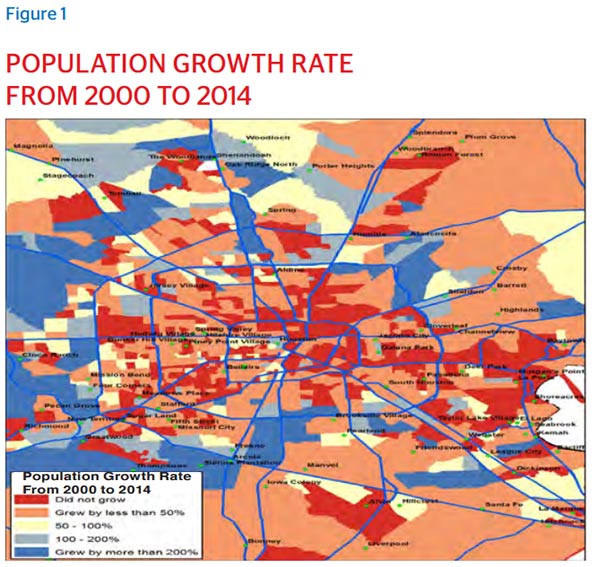
    People continue to move to the flat and humid city in higher numbers than any other metropolis. According to the United States Census Bureau, from 2014-2015 metro Houston attracted 159,083 total and 62,000 net domestic migrants, topping the Census list on new metro area residents. Critically, the newcomers represent those population groups most telling of a metro’s future: millennials, immigrants, and families.
    “The American Dream is still alive here,” say those migrants, one after another. 81 percent of Houston residents rate the city as a good or excellent place to live, according to the 2016 Kinder Houston Area Survey. That’s up from 70 percent a decade ago. And despite the recent economic slowdown, 62 percent of Houston-area residents rated the local economy as “excellent” or “good.”

    Even the most conventional of popular figures have begun to figure this out. “Houston will surprise you,” wrote Katie Couric when she stopped here on a nationwide tour of up-and-coming cities. It was a more iconic statement than perhaps she realized. Outsiders often misperceive Houston as politically conservative and totally dependent upon the energy business, but the city consistently busts internal expectations, too. In Houston, you don’t have to drive far to run into unexpected languages, unexpected restaurants, a huge informal economy and just a pervasive – and bracing – sense of random.

    “It’s a cat city,” says Bill Arning, director of Houston’s celebrated Contemporary Arts Museum. He moved here in 2009 from Boston. “If you arrive without a tour guide, without a friend who knows the city, it’s hard to figure out where things are. There are no landmarks. Whereas Austin is a dog city – you know where the beautiful people are – Houston is a cat city. Its charms are there, but you’ve got to come to it. You’ve got to take a little time.”

    What sets Houston apart? What about the city makes so many residents confident they will find their version of the American dream here? If it is indeed a city of opportunity, what lessons might other cities absorb and weave into their own policies and cultural fabric? Through many interviews, data sleuthing and the everyday experience of living here, I found five traits that define Houston: affordable proximity, multipolarity, social deregulation, an active future orientation, and humility. What follows is a tour of the city that knows no limits.

    Affordable Proximity

    “There’s always been a haphazard nature to the city, from the beginning,” says Sanford Criner, a native Houstonian as well as vice chairman at CBRE, the world’s largest real estate firm. “Where Chicago – which was founded the same year [1836] – had an economic reason for being the day it was founded, Houston was a real estate play. These guys came down from the northeast – New York, Pennsylvania – and they bought some land and sent out flyers.

    “I’ve seen some [of the flyers], and they’re hysterical,” Criner continues. “‘Salubrious environment!’ said one. ‘Well-watered!’ said another. They’d have this picture that looks like a little Swiss valley, with chalets up the hill, and there wasn’t a house here! It was a scam. But that’s how we now date the founding of our city.”

    Where others saw only wilderness along the banks of Buffalo Bayou, Augustus Chapman Allen and John Kirby Allen saw promise, and convinced people to take a gamble and move. This rambunctious “come one, come all” attitude continues to define the city’s development, 180 years later.

    The city of Houston is famous for its no zoning policies, the fruits of which are visible in the hodge-podge of commercial and residential hubs evident on a first drive in from one of the two airports. The apparent haphazardness may dizzy outsiders, but for Houston residents it’s a gift that my colleague Tory Gattis calls “affordable proximity”: the ability to live near one’s place of employment while keeping the cost of living affordable. It’s a challenge that has become onerous in many cities, but one that Houston manages to tackle with surprising efficiency.

    “It’s definitely true that it’s easier to build things here than elsewhere,” says Criner. “We’ve been able to build things relatively inexpensively and rapidly that have generally benefited everybody.”

    Since 2010, Houston has expanded its housing stock to issue construction permits for 189,634 new units, paralleling the population growth. This is in sharp contrast to competitor cities such as New York, Los Angeles, Chicago and the Bay Area, where construction tends to lag behind population.
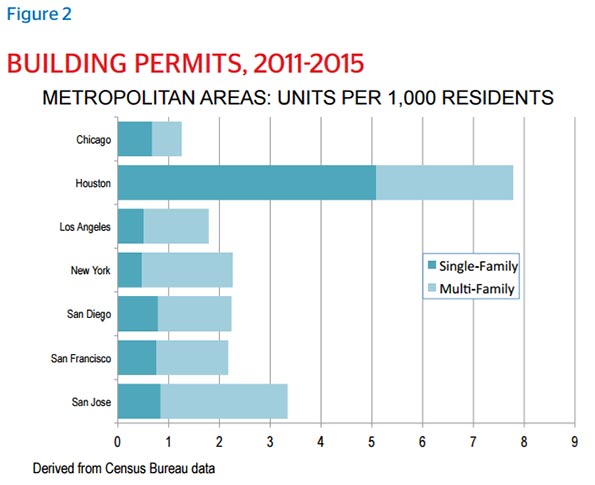
    Houston is uniquely able to create housing to meet demand. The populations in both New York City and Houston have grown significantly in the past six years, but New York, like many big cities, has not come close to meeting demand. A lot of this has to do with sheer land availability and willingness to expand outward, but Houston’s light regulatory touch has crucially allowed developers to be in sync with consumer need and preference, without the red tape that slows other cities’ building and adaptability. A key result has been a greater level of affordability, and of choice.

    In April of 2016, The Wall Street Journal highlighted groundbreaking research by Issi Romem, chief economist at real-estate site BuildZoom, showing that the cities that have expanded geographically have kept their house prices more affordable.
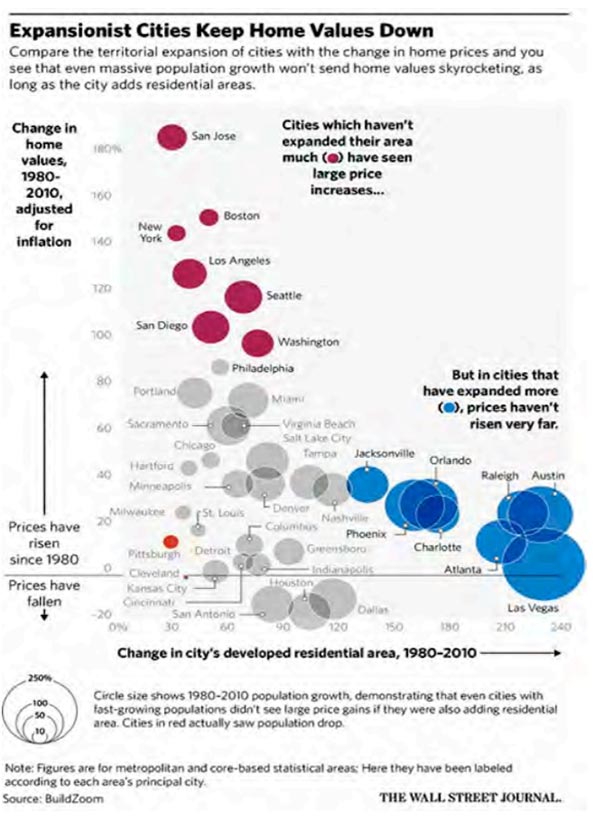
    According to the National Association of Home Builders/Wells Fargo Bank Housing Affordability Index, more than 60 percent of homes in the Houston metro area are now considered affordable for median-income families, compared with only 15 percent in Los Angeles, once ground zero for the dream of homeownership. According to Zillow, renters in New York spent 41.4 percent of their income on housing in 2015, whereas the share for their Houston counterparts was just 31 percent.

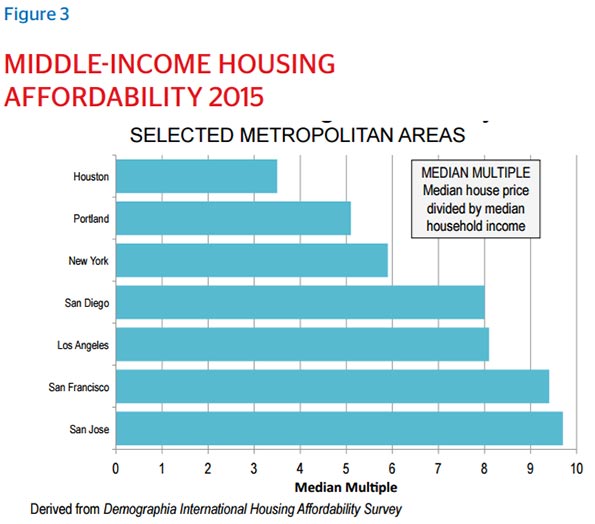
    The Demographia International Housing Affordability Survey provides ratings for all major metropolitan areas in the U.S., and Houston consistently ranks as more affordable than cities like Portland, New York, San Francisco and San Jose, all of which have more restrictive regulations.
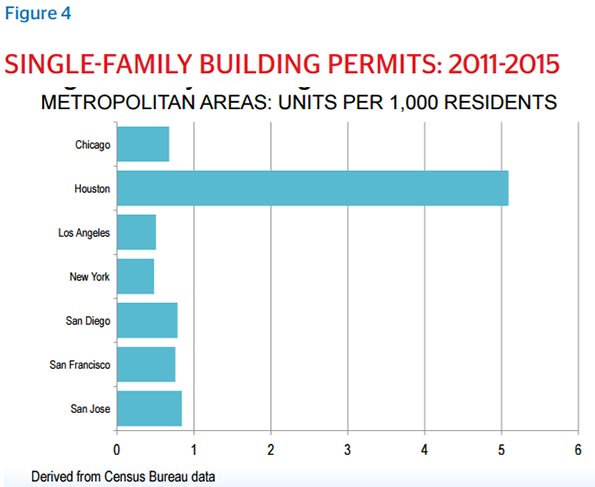
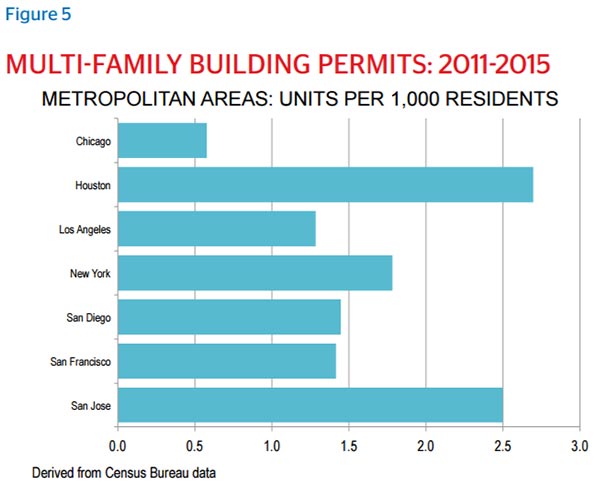
    Houston’s housing is also diverse. Houston has become the national leader in new multifamily units, helping to preserve and expand access to urban living. At the same time, the Houston metro has led the country in new single-family houses.
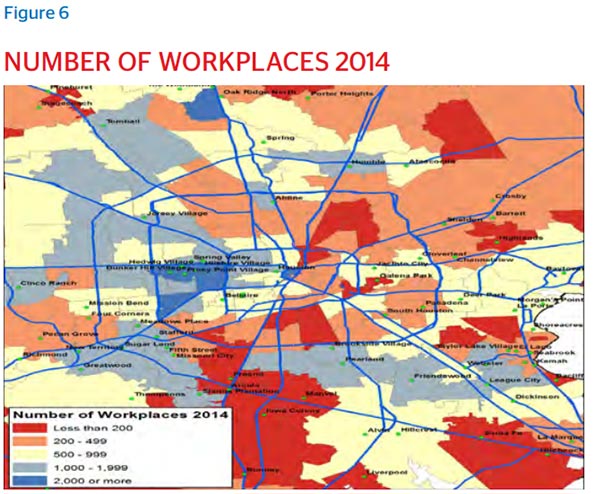
    Availability of affordable land and a lighter regulatory environment allowing for outward expansion has made it possible for many to afford a residence near the city’s dispersed job centers. In addition, as City Observatory recently reported, a series of reforms adopted in 1999 shrunk the required residential lot size from 5,000 square feet to 1,400 square feet, enabling town home development in high demand areas proximate to jobs.

    Proximity to work is especially appealing to millennials, who have moved to Houston in droves. The U.S. Census Bureau showed a 25 percent increase in millennial residents between 2000 and 2013, with millennials currently making up 24 percent of Houston’s total population. Many of these new adults want to reduce their commutes, or even ditch their cars for the sake of enjoying a more seamless transition between professional and personal life. Houston offers this possibility across urban and suburban areas, the multipolarity of business centers providing flexibility to carve a nice triad of work, residence, and play.
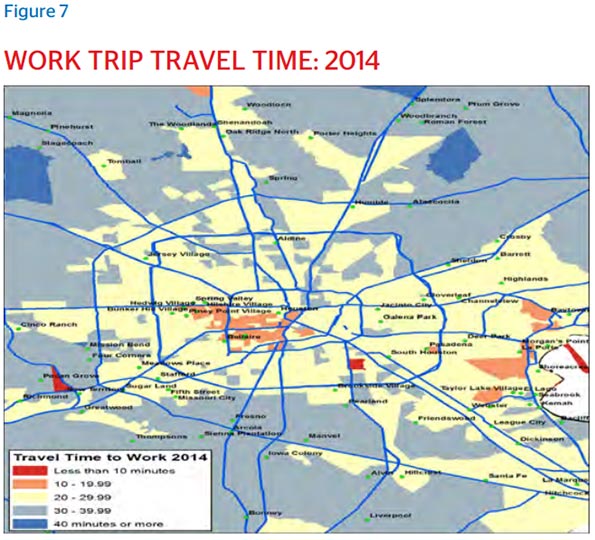
    Despite the impression of endless freeways, Houston’s commute times are better than those in metros of comparable populations. One-way commutes were 28.4 minutes in 2014, according to the American Community Survey, making Houston the fourth best out of nine comparable cities.
    Houston also does very well on an international scale with respect to traffic congestion, according to TomTom in 2015. The region ranked fifth out of the 38 urban areas that have populations over 5 million.
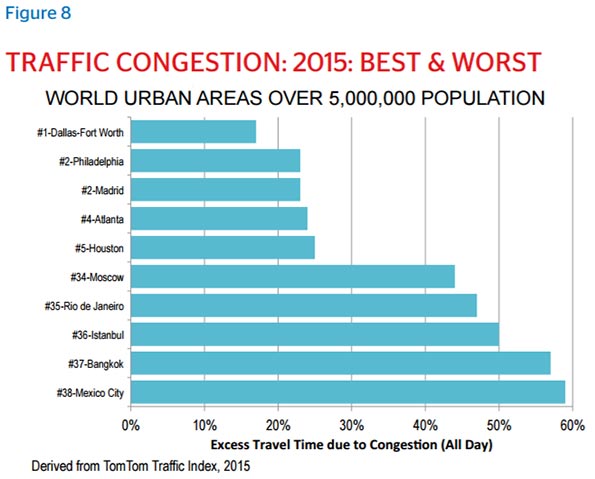
    None of this suggests Houston lacks room for improvement in mobility, but it’s credit to the city’s decision to dramatically increase roadway capacity and arterial streets that it has managed to improve its ranking in traffic congestion while experiencing a huge increase in population. According to the Texas A&M Transportation Institute, in 1984 and 1985 Houston was ranked with the worst congestion in the country, even worse than Los Angeles. Now Houston is ranked 10th, even as it’s nearly doubled its population, from 3.5 million in the mid-1980s to 6.5 million today. Only Atlanta and Dallas can boast similar mobility improvements.

    Multipolarity and Economic Diversity

    Most Americans think of Houston as an oil and gas town. And while energy still undergirds much of the city’s economy, Houston boasts many other assets as well: the world’s largest medical center, one of the world’s busiest ports, the third largest manufacturing hub in the country, a booming technology sector and a wide range of small to medium-sized businesses, including a thriving informal sector of immigrant-run businesses. This has led to demand for labor at all skill and education levels, unique among the top ten largest cities.

    “Best Online Programs in 2016,” said U.S. News & World Report about the University of Houston. “Top Cities for Competitiveness to Attract Investment in Chemicals & Plastics,” said Conway about Houston in 2015. “Best Hospitals for Adult Cancer – University of Texas MD Anderson Cancer Center” said U.S. News & World Report in 2015. “Top Blue-Collar Hot Spots,” said Forbes in 2014. “Most Favorable Metro for STEM Workers [Nationally],” said WalletHub in 2015.

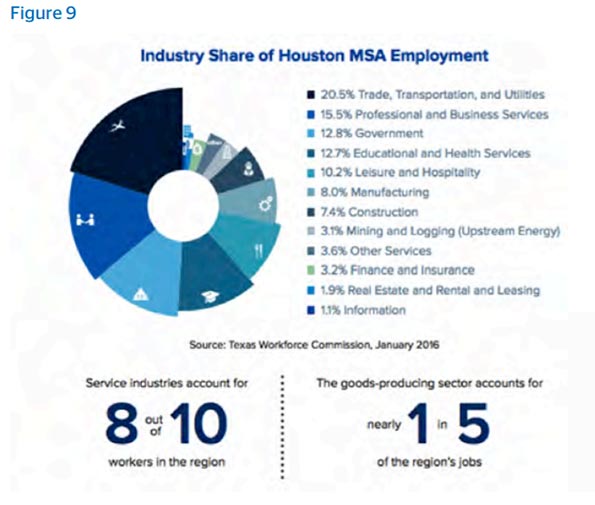
    Houston is no stranger to “Best Of” lists that today’s mayors scour. But what’s notable is the cross-sector nature of the superlatives. According to a June 2016 report from the Texas Workforce Commission, 20.3 percent of Houston’s workers are in Trade, Transportation and Utilities, 15.5 percent are in Professional and Business Services, 12.8 percent in Government, 12.7 percent in Education and Health Services, 10.2 percent in Leisure and Hospitality, 8 percent in Manufacturing and 7.4 percent in Construction.
    The city has learned from its mistakes. The 1980s, which saw a slump in oil prices much greater than that in 2015, bulged in profligate building and overconfidence. According to the Greater Houston Partnership, from 1982 to 1986, developers built more than 100,000 single-family homes, many of them without a signed contract from a purchaser. Even when the region lost more than 200,000 jobs, office developers continued to build, including adding more than 71.7 million square feet of office space while companies were laying off staff and declaring bankruptcy. Today, the office market is tighter, banking is better regulated and better capitalized, and few homes are built without a signed contract. Most importantly, the region is creating jobs that aren’t in energy, including in health care, business and professional services.

    Social Openness: A City for Everyone

    Houston is deregulated economically, but it’s of greater note that it’s deregulated socially. People come here from many walks of life and culture, and the relative youth of the city combined with its scrappy DNA means that there really isn’t a dominant Establishment, certainly not one that wants to block the efforts of ambitious newcomers.

    “If you talk to [old] Houstonians about social mobility,” says Sanford Criner, “they kind of give you this quizzical look. Like, ‘what do you mean?’ Like, ‘Sure, of course.’ It seems obvious.”

    This city’s always been a mixer; you just have to be willing to share what wakes you up in the morning. Marlon Hall is an African American filmmaker and native Houstonian who started Folklore Films, a documentary production company created to “tell better stories to our city about our city.” He and fellow filmmaker Danielle Fanfair have featured former Mayor Annise Parker, arts patron Judy Nyquist, internationally recognized musical artist DJ Sun and other community figures. As the Folklore Films crew has gotten better acquainted with Houston residents from across the social spectrum, Marlon locates the vocational “why” as central to the city’s currency.

    “Houston isn’t driven by who you know,” he says, “but by how you want to be known. It isn’t about what pedigree you have received, but about the possibilities you want to bring to bear.”

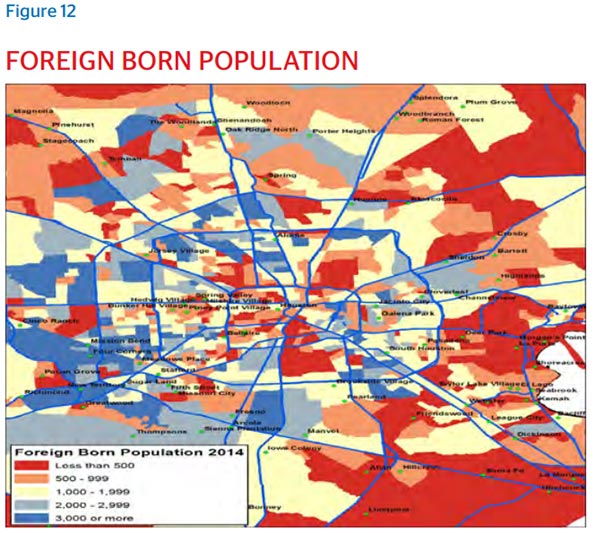
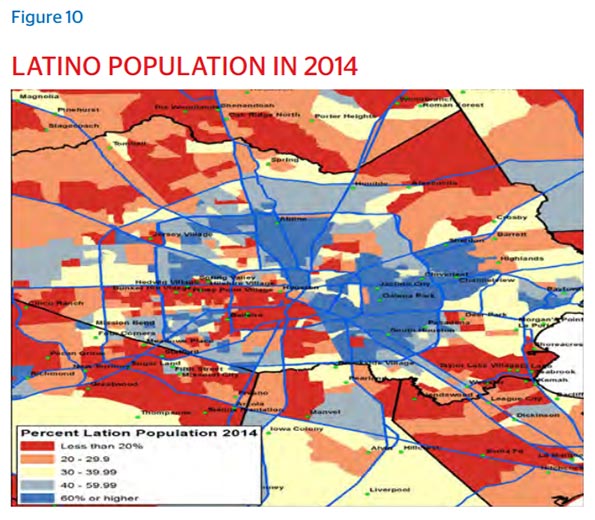
    This kind of invitation has attracted the motivated from all over the world, with the city now pulsating with 145 languages. An international city since the day it was founded, now more than one in five Houstonians are foreign-born, with the 2014 American Community Survey reporting that 63.9 percent of the foreign born population were Latin Americans, 25.2 percent were Asian, 5.1 percent were African and 4.6 percent were European. As of the 2010 Census, Greater Houston does not have a majority racial or ethnic group.
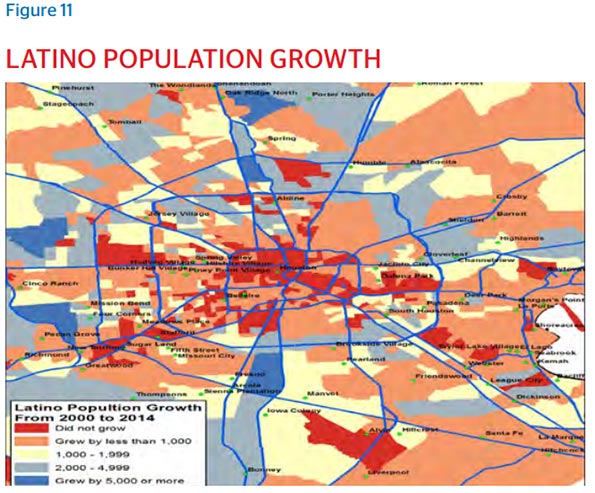
    People come to Houston seeking opportunity, and because they sense in the visible randomness the potential for surprise ingredients to leaven the traditions they’re bringing with them. This is as true for immigrants as well as domestic migrants, with the city’s celebrated restaurant scene born out of the unexpected merging of flavors from cultures that don’t typically mix. Underbelly’s Chris Shepherd, Bistro Menil’s Greg Martin and Lucille’s Chris Williams all cite Houston’s diversity as a major factor behind the city’s flavorful palate, in both story and succulence.

    “This is edible history,” says Chris Williams, the founding chef at Lucille’s, a restaurant that takes a modern approach to Southern classics. “The food that we do here pays homage to my great-grandmother, who was a chef and a pioneer and an American icon.”

    It’s not soul food, but Southern. With a rustic European style, and a multi-generational American story at the heart.

    “Like all chefs in [my great-grandmother’s] time, your style of food was defined by what was available to you. What you could afford to work with. The flavors that I grew up with…married with the techniques and the flair that I picked up working in Europe for four years. Everywhere from London to Lithuania. …I’m influenced by the simple rustic dishes – the ones about the culture, not the flashy ones. The perfect piece of fish fresh caught, served with good potatoes, great olive oil, fresh garlic, and a little bit of parsley.”

    Bistro Menil is another spot that takes a slice from Europe and re-interprets the classic dishes for Houstonians. Its patrons come from Rice University, the Medical Center, the Museum District and beyond, the attraction of the world-renowned Menil Collection standing just across the street. Inspired by the concept of cask wine, which head chef Greg Martin discovered on a trip to Rome, Bistro Menil relies heavily on relationships with cosmopolitan – yet locally centered – Houstonians.

    “I don’t want to compete with that dish that you had in Rome,” Martin says, aware of ingredient limits this side of the Atlantic. “I want to reinterpret it with more of a New American approach, with some fresh eyes on our market, using our ingredients. Our ingredients and produce come from everywhere…I work really closely with a local importer. We’ve been working together for 30 years. He brings in our duck legs from Canada, our jamón Serrano from Spain. He brings all of our cheese in from France, Italy and Spain.”

    It’s not just the food that shows Houstonians willing to work together across silos and lift up the local talent. “We have a very supportive gallery scene,” says Bill Arning, of the Contemporary Arts Museum. “Even the galleries that show a lot of major international and national artists, like the Texas Gallery and McClain Gallery, will not only show local artists, they’ll place them in the top collections in town. That’s unusual.”

    The social egalitarianism combined with a pervasive “show me what you got” curiosity creates something very unique. Hipster cocktail bars seem no more privileged than authentic Vietnamese restaurants than classic barbecue and the iconic Rodeo. The lack of zoning makes thoroughfares like Westheimer Road, which stretches for miles from the city center to the distant suburbs, an avenue of cultural mismatches: The New York Times’-celebrated Underbelly is sandwiched between three tattoo parlors, a Catholic guild clothing store and the latest in coffee-roasted curation. There are so many opportunities to mix with those different from you that only the snobby find themselves bored and excluded. Creative friction – unchaperoned and unprescribed – is Houston’s secret sauce.

    “This is a city that does not believe in censorship,” says Arning.

    Agile, Active, and Future-Orientated

    Houston is not Silicon Valley, but its entrepreneurial DNA is unmistakable, dispersed across many fields. The city emanates a conviction that people should have the freedom to determine their destiny, sometimes to the point of overlooking those that don’t have such clear vision, nor the resources and social networks to make it happen. The city is growth- and future-oriented, embracing change and risk. True to its namesake in Sam Houston – himself a failure before reinventing himself – Houston grants permission to fall hard.

    “Houston is the only town where a person with no prior experience in a particular vocation can get joint venture capital for something they’ve never done before,” says local arts patron Judy Nyquist in one of Marlon’s Folklore Films. “Simply by virtue of their commitment to their idea, and how it can make the city better.”

    This is true across sectors – for-profit, social service, and philanthropic.

    Ella Russell of E-dub-a-licious Treats was an African American single mom working for AT&T when a breakup with her partner caused significant financial hardship. Her two boys, then age 3 and 9, came home from school asking to bring in treats for a holiday party. Russell felt helpless, all disposable income had run dry. But she did find sugar, flour and eggs in her pantry.

    “I scraped up change to buy a bag of chocolate chips,” Russell recalls, “so I could make chocolate chip cookies. The kids took them in, and then I brought the leftovers in to work. My coworkers loved them, saying every future potluck would have to have my cookies.”

    Three years later, her friends urged Russell to turn the sweetness into a business.

    “I had no business experience other than what I knew working in corporate America,” Russell says. “I really winged it; I had no basis but the support of my friends.” In a couple years, she went from serving family and friends to delivering in seven different states.

    In the burgeoning scholarship entrepreneurship of the last decade, the work of Saras D. Sarasvathy of the Darden Business School at the University of Virginia stands out. She’s coined a term called “effectual reasoning” to describe the mindsets of master entrepreneurs, one that pairs well with Houston’s soil:

    Brilliant improvisers, the entrepreneurs don’t start out with concrete goals. Instead, they constantly assess how to use their personal strengths and whatever resources they have at hand to develop goals on the fly, while creatively reacting to contingencies. By contrast, [highly successful] corporate executives use causal reasoning. They set a goal and diligently seek the best ways to achieve it.

    Sarasvathy likes to compare expert entrepreneurs to Iron Chefs: “[They are] at their best when presented with an assortment of motley ingredients and challenged to whip up whatever dish expediency and imagination suggest,” she writes. “Corporate leaders, by contrast, decide they are going to make Swedish meatballs. They then proceed to shop, measure, mix, and cook Swedish meatballs in the most efficient, cost-effective manner possible.”

    If we could take her comparative study and extrapolate from it particular civic traits, you might see Chicago as the sort of personality for corporate leaders, Houston for the entrepreneurial. The city is rife with improvisers, fueled by a deep prioritization of human relationships, an affection for eccentrics and a perennial optimism that loves to build before over-planning. The fact that there are lots of open spaces to create, and fill, encourages new entrants into any kind of market, be it technological, artistic, or consumption-oriented.

    This goes well beyond profit-seeking ventures. The Chronicle of Philanthropy identifies Houston as one of the country’s most generous cities, ranking at #11 for giving as a percentage of adjusted gross income – three stops behind Dallas.

    “As [Dallas-Fort Worth and Houston] have each become centers of gushing economic production, and matured as communities, an energetic competition has grown up in their creation of impressive new parks, museums, hospitals, universities, and arts centers,” wrote Ari Schulman in the Fall 2015 issue of Philanthropy Magazine. “Burgeoning circles of local patriots wielding newly minted fortunes have dramatically changed the quality of life in both cities over the past decade or so.”

    This enhanced quality of life has involved a deeper renaissance in the arts, a proliferation in family-friendly green spaces, advancements in medical facilities and, increasingly, innovative educational ventures. Houston’s acclaimed Museum of Fine Arts is currently undergoing a $450 million redesign, two-thirds of that already raised with the help of giant gifts from pipeline entrepreneur Richard Kinder and money-manager Fayez Sarofim. Kinder and his wife Nancy have also given $30 million to a public-private partnership aimed at reviving a snaking bayou from a stagnant waterway to an attractive waterfront graced by 20 miles of hike-and-bike trails, canoe launches, playgrounds, art installations, and outdoor performance venues.

    “This kind of public-private partnership happens all the time,” says Criner. “In lots of other cities, philanthropic organizations tend to be run by the same group of guys that have been running stuff for a long time, and they treat them like their own turf. You don’t see that here at all. This is way more like, “if you can help, come on! What can you do? We’ll put you to work.”

    “We have a tradition of philanthropy that my colleagues in other cities [envy],” agrees Arning, of the Contemporary Arts Museum. “Privileged young people here feel they need to find their philanthropies early on. That is something uniquely Houston.”

    Humility and Cultural Accessibility

    Long considered the unattractive hothouse of the south, Houston has suffered from a long-running inferiority complex when comparing itself to other cities. Even since rising to the top of dozens of “Best of” lists in the last five years, the residue from generations of modesty remains.

    Before Marlon Hall was running Folklore Films, he and Danielle began something called the Eat Gallery, an incubator for budding chefs around the city that sought to turn food trucks into restaurants. In ramping up for this effort, they went around and asked Houstonians questions about where they found meaning, where they felt they fit, where they felt they made a difference. They discovered that people had low city esteem.

    “They’d go to a great ballet, and they’d be like, wow, this reminds me of Chicago, Hall recalls. “They’d go to a musical performance and be like, oh, this feels like New York. People were telling the worst stories to the city about the city.

    “So we said, what if we told better stories to Houstonians about Houstonians, featuring people that folks know and celebrate? But what if we began their stories with their brokenness, so that people would know that there’s something inherently broken about every beautiful person? So that’s what we did, that’s why we started Folklore Films. To raise the city esteem.”

    Folklore discovered that Houston is a city of new beginnings. When you move here, the past intrigues less than how you intend to exploit the future. Whether you’re an immigrant from overseas or a fellow American that’s left some entrenched failure behind, Houston pulses with a forward-looking frankness grounded in a humility shaped by whatever came before. This drive paired with an individual and corporate self-awareness defines the city’s character – culturally, spiritually and even economically.

    “There’s this at-homeness that people from Houston have,” Hall says. “When I think about people who have left Houston to do other things, like Beyonce, there’s this comfort to be who one is. She walks around with hot sauce in her purse – I mean, who else can say that from where else?”

    “There’s something about Houston that’s like…I’m not afraid to be who I am, even if it’s full of seeming contradictions.”

    “The collective body in Houston is significantly more adventurous than most cities,” Arning of the Contemporary Arts Museum says. “Both in use and collection. In most collection cities, you hear who supported or recommended the collection before going. Houstonians, because of their wildcat nature, [will try anything] they like.”

    Houston’s increasing diversity keeps the city vibrant and ever ready to accept change and innovation. There is no room for insularity because there is no homogeneity. Your ideas are constantly being chiseled and countered by the Other. No one has the luxury of feeling superior because everyone’s in a gem tumbler with folks not like them. It makes the city competitive, but not in a way that produces monopolies.

    “I think that Houston has come to this place where it’s a ‘My Space,’” says Marlon. People want to take ownership of their lives and creations here. “There’s a desire to own who you are in Houston, which is different from owning a business, a house a car.”

    Houston residents tend to be proud of their individual accomplishments, and feel an affection toward the place that allowed those accomplishments to happen. But there’s a recognition that success is the result of many different pieces coming together, usually organically and iteratively. The environment invites people to fulfill their individual destiny, and almost discourages any person or governing body to take credit for Houston’s successes as a whole.

    “I hesitate to say things like ‘I’m proud of Houston,’” Sanford Criner says. “What gives you the right to take pride in a place? Did you build it? Did you do it?”

    Challenges to Sustaining Opportunity

    Houston continues to beat the odds to this day. And while its adventurous impulse is what continues to draw people to Houston and make it the emblem opportunity city for 21st century dynamics and demographics, it must still be said that what you put into the world must survive. Houston is a much better place to live than it was 30 years ago. But will it continue on this trajectory, or even sustain the fruits of its triumphs?

    Houstonians recognize there needs to be a concerted effort to reform and improve Houston’s educational opportunities, its transportation and traffic infrastructure, and a more general care to respect tradition and an intensive effort toward more inclusive mobility. The city’s grown so big, so fast, it could inevitably buckle under its own weight.

    “We are not on track to make headway on a lot of the issues that are facing us,” says James Llamas, of Traffic Engineers, Inc. “We’re growing way faster than we’re adding transportation capacity or options, at the same time there does seem to be recognition that we need to do something and what we’ve been doing isn’t going to continue to work.”

    Despite precedent, massive infrastructure may not be the answer, especially given the shifting preferences of a younger population and the costs of maintenance. New mayor Sylvester Turner is considering expanding to two HOV lanes and providing express bus service. Others advocate for densification of the more traditional gridded neighborhoods that are far from holding their population capacity – but without adding infrastructure, and without pushing anyone out.

    And then there’s the perennial education challenges.

    “We are now in a different economy where education is critical,” says Stephen Klineberg, founding director of the Kinder Institute. “It never used to be critical, especially not in Texas. You made money by land – by exploiting all the natural resources you needed on the land. The great cattle, timber, oil. The source of wealth in the 21st century Houston, is knowledge. …If you don’t have education beyond high school, with the technical skills that allow you to get the jobs of the 21st century, and compete, you’re not going to make it. Texas hasn’t come fully to grips with it.”

    Conclusion

    In the last 20 years, Houston has cultivated a series of signaling mechanisms that continue to draw people into its orbit. It’s a welcoming city, supported by affordability and diversity. Majority opinion says “anything is possible if you’re willing to work hard,” a conviction increasingly on the decline in the rest of the country. And, crucially, it’s cultivated the conditions necessary for entrepreneurs to have a field day. “The assortment of motley ingredients” noted by innovation scholar Sarasvathy describes Houston in a nutshell, and the regulatory instinct has been to stay light, allowing imported imaginations to run experiments without interference.

    The city’s not beautiful upon first blush, nor does it offer the charm of pedestrian fancy that denser cities boast. But in an era of civic unrest, with many up and down the social spectrum feeling disconnected and robbed of agency, Houstonians can still shape their destiny. The city’s the clay; residents the potters. The wide range of home sizes and work-life arrangements makes Houston like the cowboy boot its Rodeo celebrates – adaptable to the needs of each life stage as residents progress through singleness, marriage, family and retirement. Residents are not trapped by the regulatory, financial or even social limits that other cities increasingly impose. The mindset is one of abundance, not scarcity.

    “This is the genius of this place,” wrote Cort McMurray in the Houston Chronicle in January of 2016, in a profile of an Iraqi refugee who had come to Houston with a B.S. in Chemistry, currently cleaning pools. “Houston will always be shambolic and stretched and not quite finished. We will never be the most beautiful city, or the most pedestrian-friendly city, or the most efficiently planned city: The heat and soul-sapping humidity, our adolescent fascination with cars and speed and shiny things, our perpetual craving for something new, all conspire against our best civic aspirations. Houston is a place to start over, and we do starting over better than any other city on the planet.”

    In an age of heightened political frustration, a sclerotic economy and shifting structural tectonics, it could be that the “starting over” ethos that Houston embodies is precisely what the country itself needs, and what other cities should seek to foster in their own policies and cultural climates. Innovation, reinvention and reinterpretation, after all, lie at the heart of the American genius.

    Anne Snyder is a Fellow at the Center for Opportunity Urbanism, a Houston-based think tank that explores how cities can drive opportunity and social mobility for the bulk of their citizens. She is also the Director of The Character Initiative at The Philanthropy Roundtable, a pilot program that seeks to help foundations and wealth creators around the country advance character formation through their giving. She previously worked at The New York Times in Washington, as well as World Affairs Journal and the Ethics and Public Policy Center. She holds a Master’s degree in journalism from Georgetown University and a B.A. in philosophy and international relations from Wheaton College (IL), and has published in The Atlantic MonthlyNational JournalThe Washington PostCity Journal and elsewhere.

    Top photo: Photo by Chris Doelle, Licensed under CC License.

  • The Emergence of Texas Urbanism; The Triangle Takes Off

    This essay is part of a new report from the Center for Opportunity Urbanism titled "The Texas Way of Urbanism". Download the entire report here.
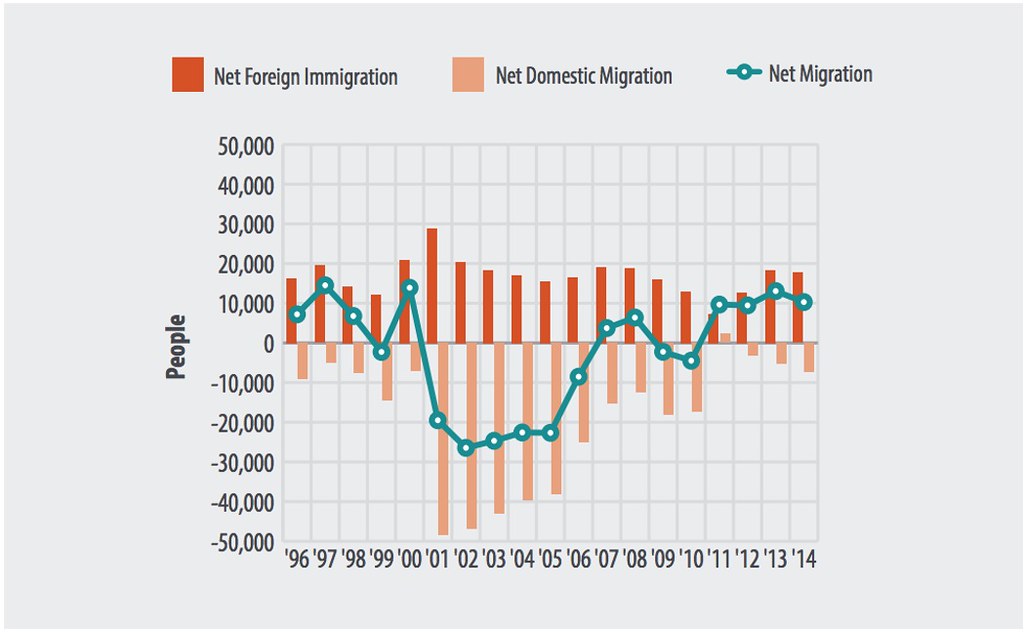
    Throughout the history of the United States, much of the nation’s economic vitality can be traced to specific regions and their mastery of the productive sectors which propelled the country forward. Today we see this most evident in the remarkable emergence of the “Texas Triangle” encompassing Houston, Dallas-Ft. Worth, and Austin-San Antonio.
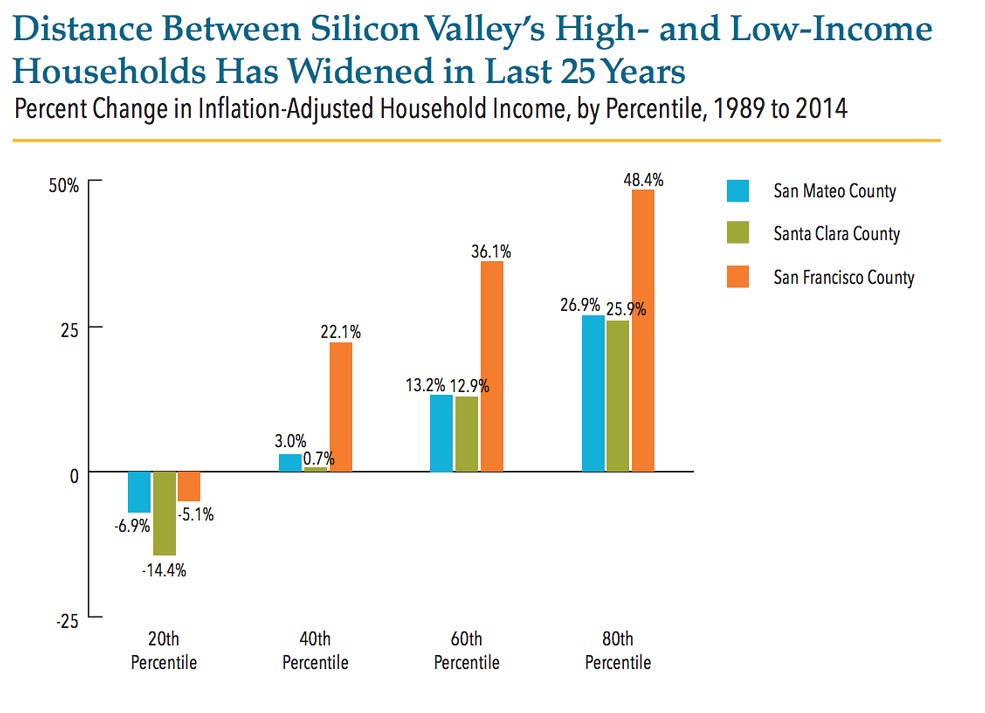
    The role of metropolitan regions reflects a steady theme of shifting economic power throughout American urban history. The early stages of commercial growth and then the first wave of industrial innovation established the economic strength of the New York-Connecticut-Massachusetts region; the global roles of New York City and Boston owe much to this early start, in part due to the talent networks and capital that clustered in these cities.

    Heavy industry, the next phase of industrial growth — autos, steel, and appliances — blossomed in the early Twentieth Century, transforming metros from Cleveland to Chicago into global economic powers. These areas provided the country much of the wherewithal to win the Second World War. Over the last 75 years, technology breakthroughs and Asia-Pacific trade relationships have steadily accelerated the importance of the extended West Coast region from Seattle to San Diego.

    More recent has been the rise of other regions, many which were once backwaters. This includes Miami, with its strong ties to the Caribbean and South America; the Southern belt of cities reaching in an arc from Charlotte and Raleigh to Atlanta and Nashville. Then there’s the rising Intermountain West, centered largely in the metros of Denver, Salt Lake City and Phoenix.

    But no place has seen more dramatic and steady economic and demographic growth than the Texas Triangle, formed by the Dallas-Fort Worth metro at its northern point in North Texas; the Houston metro at its southeastern edge on the Gulf Coast; and Austin-San Antonio at its western tip in Central Texas.

    The growth of these areas has transformed Texas from a largely agricultural and commodities-producing state into a highly urbanized and economically sophisticated place. Together the metropolitan areas of the Texas Triangle have a population of more than 18 million residents. The Texas Triangle metros together account for more than 66% of the population of Texas and 77% of the GDP of the nation’s second largest state.

    This emergence is now globally acknowledged. In terms of economic strength, each of the Texas Triangle metros ranked among the top six strongest urban areas in the nation in a post-recession analysis by the Praxis group and their economic output together would position the Texas Triangle as the fifth strongest regional economy in the U.S. in a framework created by metropolitan scholar Richard Florida. The fact that these measurements use a variety of factors suggests the powerful and pervasive nature of the Texas urban ascendency.

    One way to look at the importance of the Texas Triangle is to examine the vital and often quite unique economic contributions which each metropolitan area contributes to the nation’s well-being.

    • Houston is the acknowledged energy capital of the world with its complex of energy headquarters, financing institutions, research centers, and petroleum processing and transportation facilities. Its medical center houses more clinical institutions and life sciences research facilities than any other medical complex in the world.

    • Dallas-Fort Worth is an established financial center, telecommunications pioneer, and its two airports are the hubs of flights connecting the Southwestern U.S. to the nation and to the world. It has become a favored location for corporate expansions and relocations for both domestic and foreign companies.

    • Austin and San Antonio are connected by 75 miles of continuous urbanization, including the vital region around San Marcos and a string of the fastest growing small cities in the nation. Austin is home to world-class companies, particularly in technology, the University of Texas, and also is home to the government of the nation’s second largest state. San Antonio is home to the nation’s second largest concentration of cybersecurity companies, to three major Armed Forces commands, to an international automotive manufacturing hub centered on Toyota, and to the most visited destinations in the state, the Alamo and the Riverwalk.

    Although not as established as a global center as the metropolitan networks on the East and West coasts, the Texas Triangle now occupies an increasingly important place among the world’s commercial centers. There are now 53 Fortune 500 firms headquartered in the Triangle metros, including American Airlines, AT&T, and Exxon Mobil in Dallas-Fort Worth; USAA and Valero, and Whole Foods in San Antonio and Austin; and Conoco-Phillips and Halliburton in Houston. Global headquarters, such as Occidental Petroleum, and national operational headquarters, such as those of Toyota USA and Mitsubishi Heavy Industries, underscore that the global role of the Texas Triangle is ascendant.

    The Texas Triangle is also home to a concentration of high-quality higher education. Nationally-ranked research institutions such as the University of Texas at Austin and Rice University in Houston are joined by such major public institutions as the University of Houston; the University of Texas campuses at San Antonio, Dallas, and Arlington; and the Texas A&M campus in San Antonio. Excellent private institutions include Southern Methodist University in Dallas, Texas Christian University in Fort Worth, and Trinity University and Incarnate Word University in San Antonio. Within the geographic expense of the Texas Triangle are such powerhouses as Texas A&M University in College Station and Baylor University in Waco.

    The Texas Triangle is connected to the commercial centers of the globe through its impressive transportation assets. The Port of Houston is the second largest port by volume of tonnage in the U.S. The state boosts major airline hubs for American Airlines at DFW Airport, for United Airlines at George Bush Houston International, and for Southwest Airlines at Love Field in Dallas, as well as extensive international airline connections from Austin and San Antonio. Major cargo volumes flow on the state’s highway grid, most notably on the NAFTA Highway, IH-35, which delineates the western spine of the Texas Triangle and expedites the greatest volume of international freight from any inland port to markets across the nation.

    This economic ascendency owes much to pro – business Texas policies, largely embraced by both major political parties, that stress job creation and wage growth as the best strategies for continued and broadened prosperity. Investments in roads, water, power, broadband, ports and essential public facilities, such as higher education campuses, remain priorities in state and municipal budgets.

    But what really makes the Triangle grow is its people, animated by the spirit of new opportunity luring work-ready in-migrants from other states and ambitious immigrants from around the world. Texas attracts investors, entrepreneurs, researchers, inventors, and workers who recognize a state committed to reducing barriers to economic success and to creating the financial, educational, and physical conditions for growth and upward mobility.

    That combination of the policy regime, the physical facilities, and the human energies has created an economic juggernaut now claiming its place among the great commercial networks of the world. The nation can look to the Texas Triangle for future breakthroughs in innovative products and creative services. But beyond that the world can look to the Texas Triangle for examples of cities that combine a passion for growth with a determination to improve the lives of people.

    Henry Cisneros is Chairman of City View companies, which have invested in and built more than 90 urban residential projects since 2000 in 13 states. Mr. Cisneros is also Chairman of the Executive Committee of Siebert Cisneros Shank, one of the nation’s most successful minority-owned public finance and capital markets firms, having participated in more than $2.5 trillion in municipal and public authority issuances and corporate transactions. Mr. Cisneros was Mayor of San Antonio for four terms and was Secretary of the U.S. Department of Housing and Urban Development in President Clinton’s Cabinet from 1993-97. He is a corporate board member of Univision Communications and La Quinta Holdings and is Vice Chairman of Habitat for Humanity International and a board member of the Bipartisan Policy Center in Washington D.C.

    Photo: NASA [Public domain], via Wikimedia Commons

  • Three Steps to Fix America’s Election Process

    Almost everyone agrees that we just finished the most painful election season in anyone’s living memory, an agony made worse by the fact that it was nearly two years long. Fortunately, we aren’t doomed to repeat it, as we know many other countries have shorter and more civil election campaigns. Three changes to our method of electing presidents could reduce costs, save time, and make the process less divisive and more welcoming to voters.

    First, we should replace individual state primaries with a national primary in June. Individual primaries not only stretch out the election season and give a few states an inordinate say in the nominations, they also promote divisiveness because they force presidential candidates to concentrate on local issues that are outside the scope of the office of the president.

    Second, we should abolish the electoral college. Hillary Clinton won at least 200,000 more votes than Donald Trump, the second election in sixteen years where the winner of the popular vote didn’t win the election. Trump himself once wrote that “the electoral college is a disaster for democracy.”

    The traditional argument for the electoral college is that it encourages candidates to campaign throughout the country instead of one region and to pay attention to the small states as well as the large. In fact, it does exactly the opposite, leading candidates to focus on a handful of large battleground states that tend to flip between red and blue.

    This suppresses voter participation because people in other states know their votes won’t count, at least in the presidential race, which for many is the draw that brings them into the polling booth. Less than 56 percent of eligible voters cast ballots on Tuesday, and while some didn’t vote because they didn’t like the candidates, others abstained because they realized their vote wouldn’t affect the outcome in their particular state.

    A close look at the Washington Post‘s election map reveals that the real geographic divide is not between east and west, north and south, or big states and little states, but between urban and rural. Clinton won blocks of states on the West Coast and in the Northeast because those states are heavily urbanized, not because they have any common regional interest. The county map shows that major cities in red states such as Texas and Utah went for Clinton while rural areas in California and New York went for Trump. A strong correlation between the urban/rural split and Trump’s margin of victory/loss reveals that the degree of urbanization accounts for more than half of any state’s electoral result.

    Residents of New York City have more in common with people in San Francisco than they do with those in Plattsburgh, while residents of Portland have more in common with people in Austin than they do with those in Roseburg. In short, the electoral college fails to account for the geographic factors that are truly important. Eliminating the college would force candidates to appeal to a wider range of voters, thus stimulating voter participation and reducing alienation.

    The third change is to have a runoff if neither candidate gets a majority of the votes. A low-cost way to do this is through an instant runoff, where voters rank their choices. The candidate winning the fewest votes is eliminated and a winner is decided from amongst the rest of the votes. Whether a ranked vote or a separate election, a runoff could give third-party candidates more of a chance, especially if applied to state and local offices, because voters wouldn’t feel they are “wasting their votes” when they vote for a third party.

    These proposals might not have changed the winner of Tuesday’s election; Donald Trump clearly tapped into voter anger that many other people missed. On the other hand, if these changes were already in place, that anger might not have existed. Candidates would run very different campaigns: we’d have a shorter, less-costly election season; greater voter confidence that the system isn’t “rigged” by the electoral college; and more opportunities for people to express support for third party candidates.

    While there may be other good ways of fixing our election process, if we do nothing the best we can hope for is that the next election won’t be quite as bad as this one. That’s not a very happy thought, especially since, under the current system, the next presidential election campaign will begin in two years and the next congressional campaign will begin in two months.

    Randal O’Toole is a senior fellow with the Cato Institute specializing in land use and transportation policy. He has written several books demonstrating the futility of government planning. Prior to working for Cato, he taught environmental economics at Yale, UC Berkeley, and Utah State University.

    Photo by: By Tom Arthur from Orange, CA, United States (vote for better tape) [CC BY-SA 2.0], via Wikimedia Commons