Tag: geography

  • The Rise of Urban Riverfronts

    I recently moved from Cincinnati to Providence, Rhode Island, although I still think of the Detroit area as my hometown. All of these cities are based on their access to water. Providence, despite its location at the mouth of an Atlantic bay, is still a river-town at heart. Chicago mayor Rahm Emanuel has plans for a new and improved riverwalk, too. What can these cities learn from each other?

    In the ’80s, downtown Providence was a much less vibrant and destination-worthy place than it is now. Its urban rivers were buried beneath cement, rail-lines, and acres of concrete until a public-private revitalization effort gained enough traction. Today, in its place, the 11-acre Waterplace Park hosts numerous attractions, including the well-loved Waterfire events, and is a long, winding string of paths and bridges that sprawls through Providence’s downtown.

    What’s best about its place-making design is its versatility. The riverfront offers commutable routes between destinations, areas to picnic or socialize during lunch breaks, and event space throughout the seasons. Gondola rides, kayaking, and even viral pop-up installations all thrive here, making it multi-functional and inviting to a range of citizens.

    Chicago, much like Providence, has revealed renderings of parks that show multi-functional, inviting public spaces for rest, socializing, jogging, and enjoying attractive outdoor landscapes. Chicago is also poised to offer kayak rentals, which would allow visitors to interact with the water’s surface, rather than simply admire it. Mayor Emanuel has plans for the riverwalk to stretch “from Lake Michigan to the confluence of the three branches,” or about 1.3 miles.

    That would add a key element: in addition to being multi-functional and inviting, the riverwalk, at least within its blueprints, will be interconnected and able to serve as a pathway between all types of destinations within the city, much like Boston’s incredible Emerald Necklace. The Mayor also recognizes the huge potential for retail expansion along this stretch, something that Providence can certainly attest to.

    Detroit, too, has been actively improving its waterfront. The shores of the Detroit River now include a long, inviting path for walking, jogging, or biking, with parks and features along the way. The transformation from its earlier state is reminiscent of Providence’s overhaul efforts of the ’80s, pushing the space from neglected and utilitarian to a pedestrian-focused destination for anyone in the downtown area. A Great Lakes-themed waterpark has recently been put into place, making the riverfront even more attractive to families and young people. In addition to being a long-time hub for local fishermen, the riverfront is now a destination for joggers, dog-walkers, families, and those on their lunch break in a newly recovering downtown business district.

    What Chicago should strive to institute is a core of riverfront events and attractions. Like Providence’s Waterfire, Detroit hosts events on its riverfront during the summer — even given that it only uses one side of a river it shares with Windsor, Ontario — including the hugely popular River Days concert series and festival.

    Many cities have access to only one side of a major river, including Cincinnati. But Chicago, like Providence, has the full body of its rivers. This asset is huge, considering how big a draw water-based or focused events can clearly be for visitors, and how great a reason for locals to meet up and enjoy their city together. This is part of what Chicago can learn from Detroit and Providence.

    Still, Providence has a great deal of room for improvement. What Chicago and Detroit have realized is that a river’s waterfront isn’t exactly a connector for separate parks. It can be one space where different areas bloom larger than the others. That is, that the entire riverfront can be a destination, even between established attractions.

    Currently, Providence is preparing for the development of what’s being called The Link, an area of open land where I-195 used to cut through the downtown, Jewelry District, and Fox Point neighborhoods. Part of the grassy scar has been designated to become a riverfront park with a pedestrian bridge, and is expected to connect by bike/walk path to the nearby Roger Williams Park and Zoo. This is a big step toward a holistic riverfront that can be accessed from a several neighborhoods.

    Providence also offers the vaguely inviting Promenade, with a bike lanes on each side and a pedestrian bridge/plaza. But the Promenade is cut off from Waterplace Park by the mall and the interstate rumbling overhead. From there, looking west, the river is largely ignored before reemerging as the Woonasquatucket River Greenway, which offers a newly installed boat launch and a winding bike path. Utilizing the riverfront along this entire span, not just at certain hotspots, is a key task and goal for Providence and cities like it.

    During the blossoming years of metropolises, a river waterfront meant shipping and transportation opportunities. Today, with competition for dynamic downtown areas, the riverfront offers something else, too. Locals gain opportunities and reasons to come together as a community, and visitors, find places to enter and connect with a place… as long as riverfront cities use what they’ve got.

    Flickr photo by yuan2003: WaterFire Panorama1; Waterplace Park, Providence, Rhode Island, June, 2014.

    C.J. Opperthauser is a poet and urban thinker who blogs here.

  • The New Extraterrestrial Geography

    This month marks forty-five years since men first left planet earth and set foot on another world. The last man to walk on the moon did so in December, 1972, over four decades ago. It’s a good moment to ponder what we haven’t done since.

    There were six successful landings on the moon, and, almost literally, they barely scratched the surface of that body. The later astronauts had “golf carts” that allowed them to travel short distances, but only a fraction of a percent of the Africa-sized area was directly investigated by humans. To say, as some do, that we shouldn’t go back, and should instead go on to Mars, would be like saying that, having touched shore in a half dozen places in the Americas, we should have then ignored those continents and gone on to Asia.

    It’s a misnomer, of course, to call this a new “geography.” That word is derived from the Greek “ge,” for earth. We probably should use something like ‘selenography’ for the moon, ‘venerography’ for Venus, and for Mars, either ‘areography,’ or my preferred fanciful ‘barsoomography’ (with a nod to Edgar Rice Burroughs). Each of these “ographies” are vastly different from each other and from earth.

    There’s a lot of interesting real estate out there, and all we’ve done so far is to briefly poke around on our own moon a few times, only to abandon the effort after a few years.

    We stopped because we have never, as a nation, made it a serious goal to open up the new lands of the solar system. Apollo wasn’t about exploration or science. It was a soft battle in a cold war; a demonstration of our technological prowess versus that of a brutal adversary. In order to win, we set up a state-socialist enterprise to rival that of our opponent, except our enterprise was democratic, whereas theirs was totalitarian. We had aerospace contractors; they had design bureaus.

    We won even before Apollo 11, with the circumlunar mission of Apollo 8 the previous year, about the same time that the Soviets started to pretend they’d never been racing. The human space program devolved into one of national pride and white-collar welfare in the states and districts of those on the Hill who funded it.

    Had it been our intent to develop and settle these new worlds, we would have gone about it very differently. For instance, we might not have acquiesced to the Outer Space Treaty in 1967. The partial goal there was to end the space race by putting the entire solar system beyond the reach of claims of national sovereignty. This is one reason why the US didn’t claim the moon when we landed. Instead, we came “in peace for all mankind”.

    This had the effect of rendering extraterrestrial private property claims themselves as somewhat problematic, even though it didn’t go as far as the Soviets wanted. Private enterprise in space was permitted. Otherwise, the communications and remote-sensing satellite industries might have been stillborn.

    If we had followed the tradition of free-enterprise America, we wouldn’t have rushed to the moon with an expensive giant rocket. Rather, we would have more methodically developed affordable space transportation, and created a competitive industry to continually drive down costs, as has occurred in other fields of transportation. We’d have developed the infrastructure in space, such as assembly facilities and propellant storage depots — the equivalent of gas stations on the Interstate — that would allow full reusability of vehicles to and from various locations.

    We are only now starting to do so, in the face of strong resistance from Congress, primarily because small, private industry doesn’t allow sufficient opportunities for graft in the way that large, sole-source NASA contracts do. Congress currently seems determined to repeat Apollo, with its giant rocket and capsule, and its missions costing billions per flight. As a result, it is likely to continue to keep us trapped in low earth orbit for the next few decades.

    Fortunately, the government is no longer the only source for the funding of human spaceflight. Several billionaires have expressed interest, including Elon Musk of SpaceX, Jeff Bezos of Amazon, Las Vegas hotelier Bob Bigelow, Microsoft co-founders Paul Allen and Charles Simonyi, and others. Musk has repeatedly stated that the ultimate purpose of his space company is to colonize Mars – he believes it’s important that we become a multi-planet species. He has already disrupted the expensive dinosaurs of the space industry with his low-cost rockets, which will become even lower cost if he succeeds, as seems likely, in developing the ability to reuse them rather than to throw them away.

    Bezos has also declared his interest, ultimately, in space colonization, whether as an insurance policy against having all of humanity’s eggs in a single basket, or perhaps to allow new social experiments like the one our own founders created in their own New World almost two hundred and forty years ago. And Peter Diamandis, author of the book Abundance and co-founder of Planetary Resources, an asteroid-mining venture, notes that the vast majority of resources available to humanity lie not on this tiny planet, but in the rest of the solar system, and ultimately the galaxy and universe beyond.

    These entrepreneurs and visionaries hold these beliefs, despite the obstacles. Planets in our solar system have a wide variety of different atmospheres, including (as with our moon) essentially none. None of them are presently breathable by humans, and won’t become so absent massive terraforming and/or radical genetic engineering (which at some point begs the question of the meaning of the word “human”).

    As for Mars, its atmosphere is far too thin to breathe, even if there were oxygen in it (it’s mostly carbon dioxide). But there is water there, and plants in greenhouses could manufacture oxygen from the atmosphere, using sunlight dimmed by its distance from our star. Rocket fuel could be produced, as well, to make access to and from the planet easier. It is full of iron and other minerals, unfortunately including the very toxic hexavalent chromium.

    Those who are simultaneously competing and conspiring to open up the solar system, with all of its new lands, are doing so not just for a handful of government civil servants, but potentially for thousands or millions of private adventurers and explorers, in a way that government cannot, and likely will not, absent a sudden burst of vision rarely seen in politicians. But with or without the government, the new lands look increasingly likely to be privately explored, settled, developed, and even created, opening up vast new wealth to humanity, and perhaps giving us the first trillionaire.

    Many today lament that they didn’t live in the excitement of the sixties, when “we” went to the moon. But the coming decades of the new “solography” promise to be vastly more exciting — not just vicariously, as Apollo was, but with the participation of the new pioneers.

    Rand Simberg has had many years of experience in aerospace engineering and project management at the Aerospace Corporation and Rockwell International Corporation in Los Angeles, and has been recognized as an expert in space transportation by the Office of Technology Assessment. He is author of the new book, Safe Is Not An Option, on how our risk aversion holds us back in human spaceflight. He blogs at Transterrestrial Musings.

    SpaceX Dragon Cargo Transfer at the SpaceX facility in McGregor, Texas. NASA Administrator Charles Bolden, left, and SpaceX CEO and Chief Designer Elon Musk, view the historic Dragon capsule that returned to Earth following the first successful mission by a private company to carry supplies to the International Space Station. Photo: NASA/Bill Ingalls.

  • A Tale of 273 Cities

    It was the best of times, it was the worst of times; it was the age of wisdom, it was the age of foolishness; it was the epoch of belief, it was the epoch of incredulity; it was the season of light, it was the season of darkness; it was the spring of hope, it was the winter of despair. 

    Charles Dickens, A Tale of Two Cities

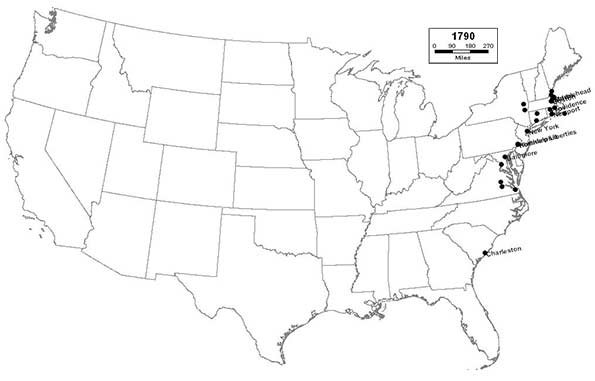
    Since 1790, 273 cities have made an appearance on the list of the nation’s 100 largest places.

    Cities of all shapes and sizes have made the list at one time or another – ranging from New York, which has held the top spot in every single census from the very beginning; to little Chillicothe, Ohio, which appeared once in 1830, at #87, and never made the list again.

    Examining this list decade-by-decade is instructive, for it largely tracks the entire history of the nation’s settlement patterns – from the initial cultural hearths of Yankee New England and Tidewater Virginia; through the river and canal era; the railroad era; the industrial era; the interstate highway and suburban era; to the decline of the Rust Belt, and the triumph (for the time being) of the Sunbelt – and beyond.

    The list tells the story of the relative decline of many cities – places like Providence (1790-1980); Dayton (1830-1990); and Des Moines (1880-2000), which were ranked in the top 100 for decades, have shrunk to one degree or another, and eventually fell off the list, but remain significant-sized urban centers today.

    It also tells the story of the absolute decline of many cities – places like St. Louis, Detroit, Buffalo, Pittsburgh, and Cleveland – formerly huge cities that all once ranked in the top 10, which have now lost over half of their population.  All five of these cities remain in the top 100, but they are all suffering from the seemingly intractable problems that come with massive abandonment and disinvestment – fiscal instability, poverty, inequality, and a frayed civic and social fabric.  Here in 2014, their collective future, especially in their current form, is increasingly uncertain.

    And that – looking toward the future – is why this topic is truly important. Examining this information is about far more than a trivial jaunt down memory lane.  What does it tell us about the future of our cities?

    For one, there is this question: Does any of this even matter?

    Is the size of our central cities even important? Aren’t city boundaries arbitrary and meaningless?  Isn’t it the surrounding metropolitan region that really counts?

    Well, it’s a complicated story.  For years, pundits, prognosticators, and policy wonks have been telling us that the age of the central city is over; that it is the region that is important.  Economies are based on regional job markets, they say, and improvements in transportation and communications are making local places (even large ones) increasingly irrelevant.

    The fact that economies are regional is true – as far as it goes.  But like anything viewed through one lens only, it does not tell the whole story.

    Are regions important? Of course. But so are places.  Like so many other things in the realm of urban public policy, this is not a binary, either/or, choice.

    Indeed, at the same time that we are being told by one set of pundits about the irrelevance of our cities, we have another set of pundits telling us that this is, in fact, a new golden age for our cities.

    Cities entered a long cyclical downturn following World War II, they tell us, but they are now on the rebound, and are experiencing an unparalleled renaissance. Property values are increasing, Millennials are moving to our downtowns, and previously declining neighborhoods are coming back to life, replete with upscale shops, bistros, and pubs. 

    But this doesn’t tell the whole story, either. For every gentrifying formerly shrinking city like New York, Washington, and San Francisco, and for every sprawling boom town like San Jose, Charlotte, or Columbus; there is a St. Louis, a Cleveland, and a Detroit; and there is a Gary, a Flint, and a Youngstown.

    What does the future hold for these cities?  What about the giant places full of the mind-boggling, post-apocalyptic decay and dysfunction that comes with literally losing one million residents, like Detroit?  

    And what about the mid-sized places, like Flint, that may not have the assets or the resources to ever turn the corner.  Will they continue to die a slow, agonizing death, and literally disappear?  Or will they continue on in a shadow-form, serving as a cautionary tale, and inhabiting some type of uniquely American, urban equivalent of purgatory?  

    Or can they be restored – if not, perhaps, to their former glory, to at least something that is stable, equitable, and workable for those that remain?

    This post is full of more questions than answers.  It is an inherently complicated topic.

    Big Questions for the Rust Belt

    While it is true that cities have grown and declined (and sometimes grown again) throughout American history, it is also true that we have never before experienced the unprecedented population decline that some of our largest cities have experienced over the past 60 years, especially those in the Rust Belt.

    Rust Belt cities have experienced the triple whammy of structural economic decline (the outsourcing of manufacturing); continued regional outmigration (to the Sunbelt); and continued suburbanization (in a region with a strong tradition of local government and a deep antipathy toward consolidation).  All three of these things make the shrinkage of its cities unique, from a historic standpoint.

    When a large city loses over half of its population, whether that equates to one million people (Detroit); 500,000 people (Cleveland); or 100,000 people (Youngstown), there are very real consequences for the very real residents that remain.  Even if these particular cities were experiencing widespread regional prosperity and economic growth (they are not), it would not fundamentally change the social and economic reality for city residents living with the consequences of widespread abandonment in these places.

    Regardless of what some advocates of regionalism might say, city boundaries are not arbitrary and meaningless.  Although some may claim that shrinking cities are no big deal as long as the metropolitan region overall is growing, central cities will continue to profoundly matter, especially to the people (often disproportionately poor) that remain.

    Municipal boundaries are not irrelevant, whatever the regionalists may tell you.  Economies may be regional, but in most of the nation’s fastest declining cities, government is not.  Municipal boundaries affect taxation, land use policy, public safety, education, public infrastructure, and the delivery of social services. 

    When a city’s population declines precipitously, the proportional demand for the public services that it provides shrinks less than its population, with the end result that its residents end up paying more in taxes, for less in services.  Even if this were not the case, it is expensive and (politically speaking) exceedingly difficult to scale-back and shrink long-term capital investments in public infrastructure – as “shrinking cities” like Detroit and Youngstown have discovered.  

    What goes on within a given city’s actual municipal boundaries has incredibly important ramifications for its tax base; its employment base; the performance of its schools; the distribution of everyday amenities like grocery stores, shops, and restaurants; the delivery of public services; and less tangible, but equally important things like its sense of place and its sense of itself.  As cities are abandoned, decline, and become hollowed out, access to social and economic opportunities diminishes along with the population:  the jobs disappear, the doctor’s offices disappear, the grocery stores disappear – relocated, often, to a distant and increasingly inaccessible locale.  To pretend as though the economic and social well being of city residents is not directly impacted by population decline is to turn a blind eye to reality itself.

    But it is not just city residents that are affected by decline.  The health of the entire region suffers as a result.  The shrinking tax and resource base of City “A”, is not simply counteracted by economic growth in nearby cities “B” and “C”.  In a region anchored by a declining central city surrounded by dozens of separate municipalities, the redundant duplication and proliferation of local government services (education, public safety, public utilities, transportation infrastructure, social services) ends up costing all taxpayers more. 

    The worst-case scenario is a shrinking central city and a shrinking region with an overall population decline, coupled with continued central city abandonment and continued outward expansion.  In a region like this, there is not only more costly “stuff” (redundant public services and physical infrastructure) than there needs to be, but there is more “stuff” with ever fewer taxpayers to pay for it.

    And while the conventional wisdom may be that regional, not local, economies are what matter, it is important to understand that regions comprised of dozens of separate local jurisdictions do not typically behave very effectively as “regions”.  It is not impossible for them to do so, but it is exceedingly difficult. 

    So why don’t we just go ahead and combine everything?  Problem solved, right?

    Not so fast. 

    It has always been interesting to me that the Sunbelt is the region of the country that tends to have the fewest number of local governments, the most liberal annexation laws, and is home to most of the cities that have undergone major city/county consolidations (such as Jacksonville, Nashville, Augusta, Lexington, and Louisville). 

    This wasn’t always the case.  Philadelphia consolidated with its neighboring suburbs (some of the largest cities in the country at the time) in 1854, and New York City did the same thing (merging with Brooklyn – then the nation’s 4th largest city, and the other three boroughs) in 1898.

    From a public policy standpoint, most of the South and the West is typically regarded as “conservative”; while much of the Northeast and Midwest is viewed as “liberal”.  In this stereotypical telling of the tale, conservatives are supposed to belaissez-faire in terms of urban planning and public policy and are supposed to reflexively favor the local over the regional.

    Yet it is precisely in the “conservative” South and West where the people have been most willing to change the model of government and public service delivery to align with modern social and economic realities.  Effective government and accountability is still viewed as extremely important, but voters have recognized the benefits of having less duplication and more efficient delivery of services, as well as the regional cohesion and political power that annexation and consolidation can bring with them.

    Urban development patterns and public policy decisions on infrastructure are often different in the Sunbelt as well – especially in the West.  New development tends to be denser and more compact than it does in the Rust Belt.  Not many people know that “car crazy” Los Angeles is actually the most densely populated urban area in the United States, or that “sprawling” Las Vegas ranks 10th.  The Los Angeles “suburb” of Santa Ana is twice as densely populated as the “city”of Cleveland.

    Some of this has to do with the fact that scarce water supplies don’t allow for scattershot suburban development, and some of it has to do with an increasingly urban ethos that has evolved, especially in California, over the past 50 years.  Cities and urban residents are not viewed with the same degree of mistrust, suspicion, and disdain that they are viewed with in the Rust Belt.

    So, the Sunbelt is usually posited as an economic success story, especially in comparison with the Rust Belt.

    But the questions remain:  Was it due to less duplication of local government?  Was it in spite of it?  Or did it have nothing to do with it one way or the other?

    No one really knows for sure.

    There is little doubt in my mind that some of the reason for the growth and economic prosperity of Sunbelt cities, and for the corresponding decline of Rust Belt cities, is the failure of most Rust Belt cities to adjust their local government paradigms to reflect modern economic realities. 

    One only need contrast Cleveland with Columbus, or Detroit with Indianapolis to at least get a general sense of the divergent paths that several pairs of Rust Belt cities have taken, and to make some general comparisons between their regional economic outcomes.

    But, these comparisons are not “apples to apples”, either, and it is extremely problematic to claim that the key to Columbus’ economic success (in comparison with, say, Cleveland) has solely been due to its aggressive annexation of nearby communities.

    But, with Columbus sitting as the 15th largest city in the U.S. today, and continuing to attract new residents, and with Cleveland dropping from 5th to 45th, and continuing to lose population, it is probably fair to say that it had something to do with it.

    If Rust Belt cities had annexed or consolidated with surrounding communities earlier, they would be larger and more cohesive today, and it is probably fair to say that they would have more political clout at the state and national level.  They also could have been better positioned to shape how their surrounding regions grew – into something denser, more compact, more cohesive, and less duplicative of public services and infrastructure.

    Could have, would have, should have. That horse has largely left the barn.

    Today, it is a fair question to wonder how effective (never mind politically feasible) it would actually be to retroactively superimpose the Sunbelt model upon Rust Belt cities.  Making Buffalo look and function like Charlotte, on paper, would be very different from making it look or function like Charlotte, in reality. 

    In most Rust Belt cities today, the fact of the matter is that the incoherent and incohesive development patterns have already occurred, the infrastructure has already been duplicated, and the social and economic mismatches and inequities already exist. 

    These problems need to be addressed, but clumsily imposing a model that has appeared to work throughout much of the Sunbelt, without taking the time to understand how it would work here, might not be the answer for our region.  It might just be trying to force a very ineffective square peg into a very politically infeasible round hole.

    So, what will the future hold for our cities?  How can we knit them and their surrounding regions together to create an effective, politically feasible, governing framework that works for all of our residents, rich and poor, black and white, urban and suburban? 

    I don’t know, but I know that it has to do with starting small, working on fundamentals, building trust, inspiring hope, and building authentic relationships between real people. 

    It is the urban policy question of the 21st Century in the Rust Belt, and it is something that urban advocates, political leaders, policy wonks, and everyday citizens will need to grapple with for the rest of my lifetime.

    Now, for the Maps…

    The maps below tell the story of how the 100 largest U.S. cities have changed decade-by-decade since the first census in 1790. Please note that only cities over 2,500 are included, so several of the maps from the earliest census years show less than 100 cities.  The 10 largest cities in each census year are labeled.  

    Due to the scale of these maps, Alaska and Hawaii are not shown (Honolulu and Anchorage both rank in the top 100 today).

    Below each map you will find a short description of some of the historic, demographic, economic, and transportation trends that were in play at the time of each census. I have also included a breakdown of how many cities in each region of the country ranked in the top 100.

    For more detailed information on the 100 largest cities, census-by-census, please click here

    1790 – Northeast (18); Midwest (0); South (6); West (0)

    In the immediate aftermath of the American Revolution, all of the the largest cities are concentrated along the eastern seaboard.  At the time of the first census, New York City ranked as the nation’s largest – a title that it will go on to hold for the next 220 years; and likely – in perpetuity.  Philadelphia, Boston, Charleston, and Baltimore round out the top five.
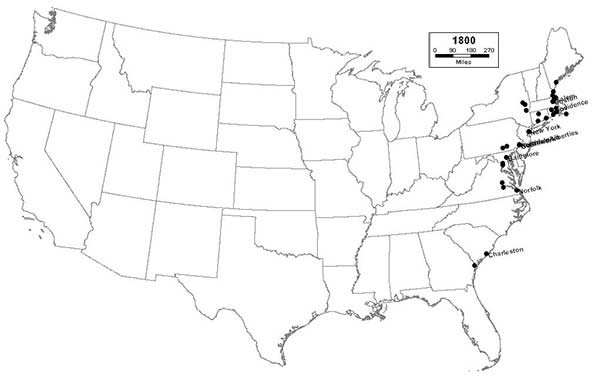
    1800 – Northeast (24); Midwest (0); South (9); West (0)

    As the 19th Century dawns, the largest cities continue to be clustered along the eastern seaboard as the brand-new nation begins to expand slowly inland. The nation’s new capital, Washington, D.C., joins the list, ranking 31st.  
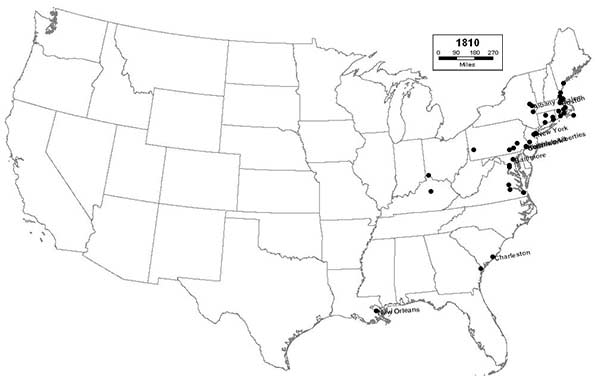
    1810 – Northeast (34); Midwest (1); South (11); West (0)

    This census marks the beginning of the era of ascendance for the great inland river cities, such as New Orleans, Pittsburgh, and Cincinnati.  These cities will serve as key centers of trade and commerce as the interior frontier of the new nation begins to be settled.
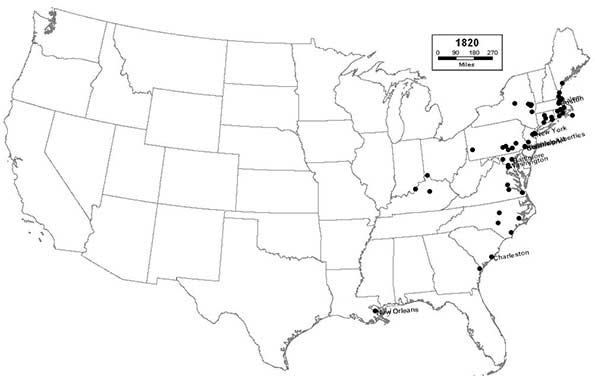
    1820 – Northeast (43); Midwest (1); South (17); West (0)

    The inland river cities, like Louisville, continue to grow and expand.  The importance of waterways increases further as the canal era dawns, literally putting places like Utica on the map.
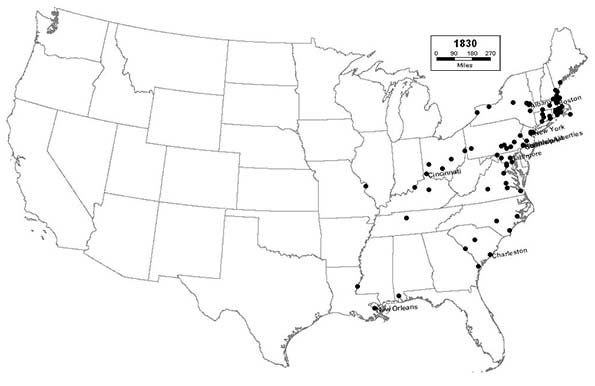
    1830 – Northeast (59); Midwest (6); South (25); West (0)

    Places throughout the industrial northeast, especially in New England, now firmly dominate the list of the nation’s largest cities. The canals throughout New York, Pennsylvania, and Ohio begin to spur new settlement and industry in places like Buffalo, Rochester, and other smaller cities immediately west and east of the Appalachians. The river cities continue to grow rapidly, as Cincinnati enters the top 10, and St. Louis joins the list.
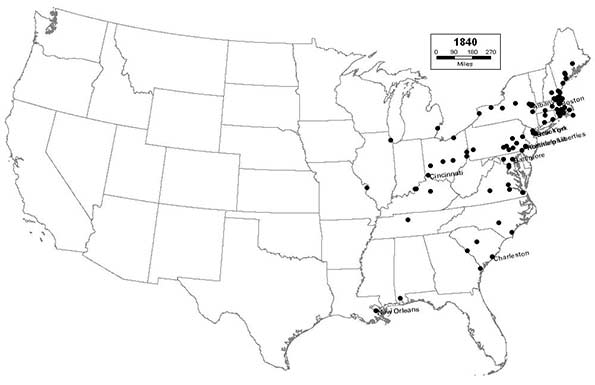
    1840 – Northeast (67); Midwest (10); South (23); West (0)

    The Great Lakes region begins to develop, thanks to the canals, as Detroit, Cleveland, and Chicago join the list. This region will begin to serve as a staging area for the people and goods needed to develop the areas west of the Mississippi.  The Northeast, bolstered by new immigrants from Ireland, remains the urban heart of the nation. 
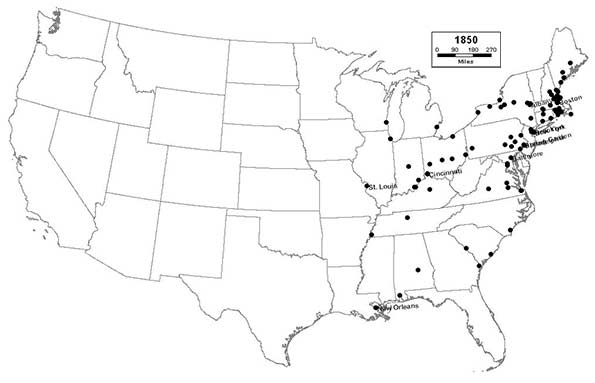
    1850 – Northeast (64); Midwest (12); South (24); West (0)

    The canal system reaches its mature peak, as strategic locations on the Great Lakes and inland rivers and canals, such as Milwaukee, Memphis, and Syracuse flourish. St. Louis enters the top 10.  The relative importance of the eastern seaboard begins to diminish, especially in the South, as the Ohio and Mississippi rivers begin to rival it in importance. Charleston drops out of the top 10 for the first time since 1790.
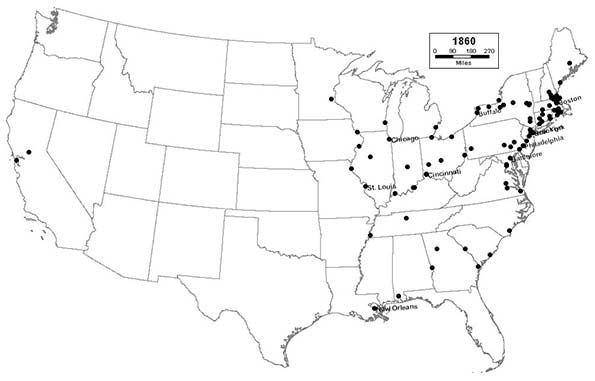
    1860 – Northeast (60); Midwest (17); South (21); West (2)

    As the Civil War dawns, railroads begin to surpass the canals in importance, as new cities like San Francisco, St. Paul, and Atlanta join the list.  The nation’s largest cities will become increasingly dependent upon the railroads for the next 100 years.  For the first time, Midwestern cities begin to rival eastern seaboard cities in importance, as Chicago enters the top 10, joining Cincinnati and St. Louis.  But the Northeast remains the nation’s urban powerhouse, as Philadelphia consolidates with its neighboring suburban towns to become the nation’s second largest city and New York’s closest, but still distant, rival. 
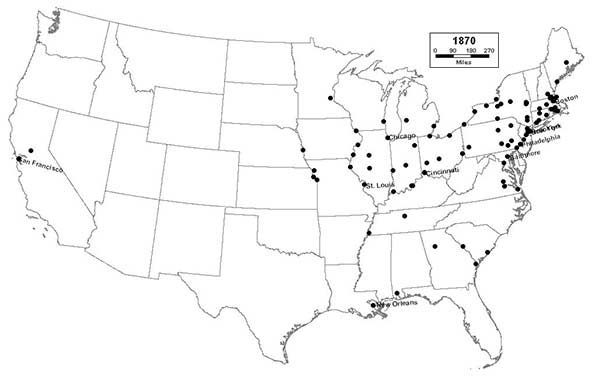
    1870 – Northeast (54); Midwest (26); South (18); West (2)

    New Midwestern cities like Kansas City, St. Joseph, and Omaha flourish as important gateway railroad terminals from which the Great Plains and the remainder of the West will eventually be settled. The South begins a long period of urban and economic decline following its defeat in the Civil War. The cities of the West Coast begin a period of rapid settlement, as San Francisco enters the top 10.
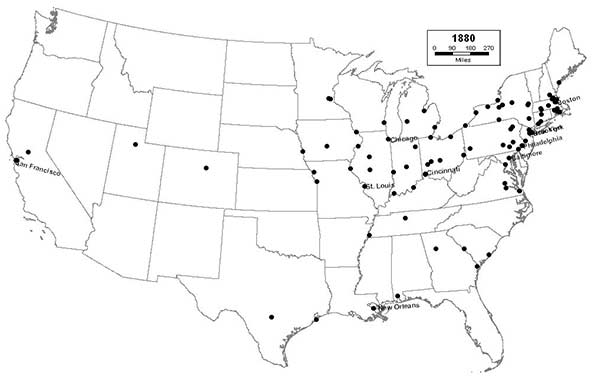
    1880 – Northeast (48); Midwest (27); South (20); West (5)

    Westward settlement spreads rapidly via railroad across the Great Plains, the West, and Texas, as new cities like Minneapolis, Des Moines, Denver, Salt Lake City, and San Antonio join the list.
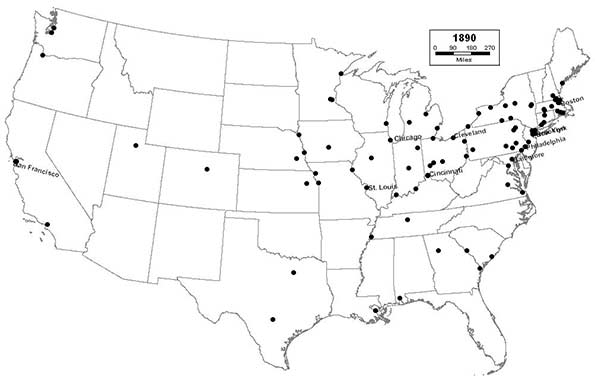
    1890 – Northeast (45); Midwest (29); South (18); West (8)

    The nation’s manufacturing heartland and industrial base begins to shift from New England to the Great Lakes, as Youngstown join the list, Cleveland enters the top 10, and Chicago surpasses Philadelphia as the nation’s second largest city. The West Coast begins to grow rapidly, as Los Angeles, Seattle, and Portland all join the list, along with Dallas; setting the stage for the eventual domination of the nation’s urban landscape by California and Texas.
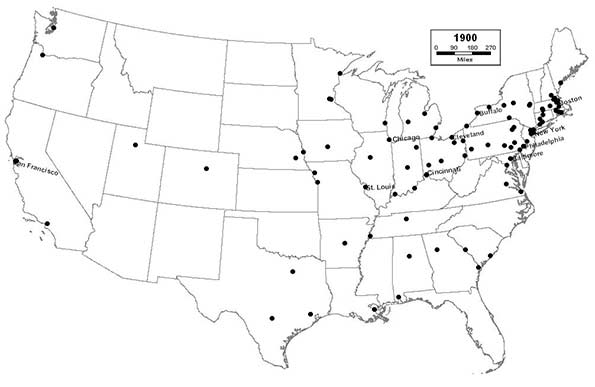
    1900 – Northeast (46); Midwest (26); South (21); West (7)

    As the 20th Century dawns, after nearly four decades of economic decline, the South turns the corner and begins its economic recovery as new industrial cities like Birmingham and Houston join the list.  Mid-sized cities in the Great Lakes region, like Akron, begin to grow rapidly, as a new wave of immigrants from southern and eastern Europe settles throughout this rapidly industrializing part of the country. With railroads now linking the nation from coast-to-coast in several different corridors, the American settlement frontier officially disappears. New York City consolidates with nearby towns and with cross-river rival, Brooklyn, the nation’s 4th largest city, to reach a population of 3.5 million, and achieves unparalleled domination of the nation’s urban hierarchy.
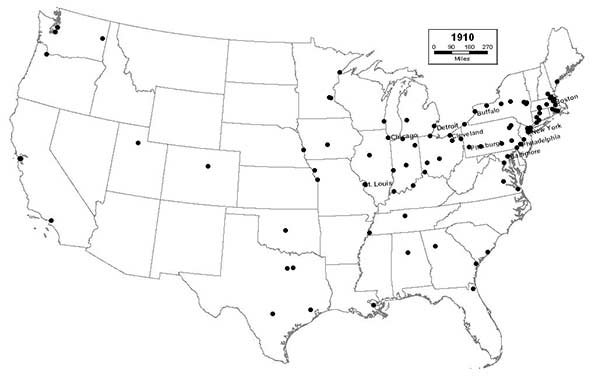
    1910 – Northeast (45); Midwest (27); South (19); West (9)

    The Great Lakes region continues to thrive as its cities grow larger and more prosperous, and Pittsburgh enters the top 10. Cincinnati drops out of the top 10, but remains a vibrant and expanding urban center. Southern cities, like Fort Worth, Oklahoma City, and Jacksonville join the list, giving Florida a top 100 city for the first time.
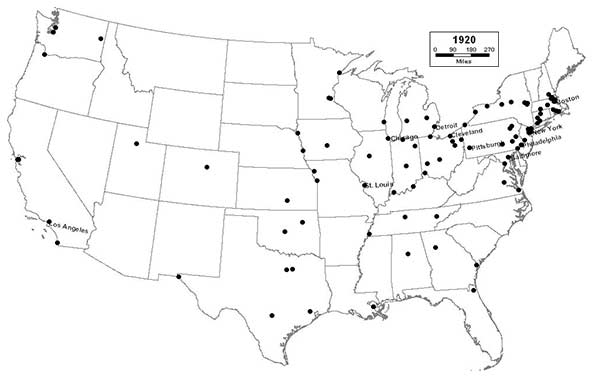
    1920 – Northeast (40); Midwest (29); South (21); West (10)

    Smaller industrial cities in the Great Lakes region, like Canton and Flint, thrive as the steel and automotive industries explode, and Detroit, “The Motor City”, enters the top 10. Charleston drops out of the top 100 for the first time since 1790. Southern California, poised to eventually become the nation’s prototypical urban region, begins its period of automobile-age ascendance as San Diego joins the list, and Los Angeles enters the top 10. 
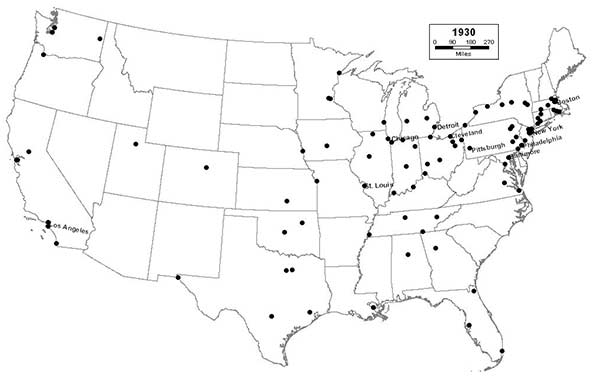
    1930 – Northeast (36); Midwest (29); South (23); West (12)

    Industrialization in the Great Lakes region reaches its apex in overnight boom towns like Gary, as the region becomes the manufacturing center not only of North America, but of the entire world. The Sunbelt’s period of growth begins in earnest, as cities in California and Florida, like Long Beach, Miami, and Tampa expand rapidly.  In contrast, a period of long, steady decline ensues in smaller industrial cities throughout the Northeast, in general, and New England, in particular.
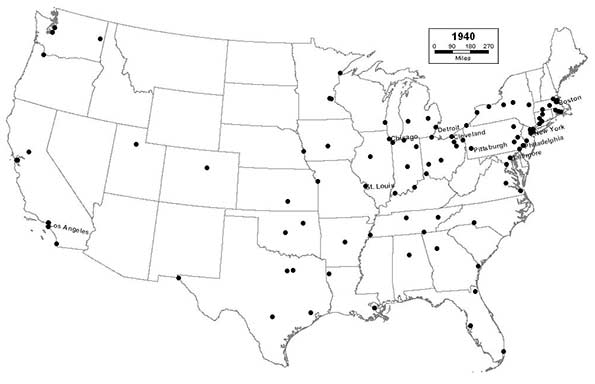
    1940 – Northeast (33); Midwest (28); South (27); West (12)

    The preceding decade is a difficult one for the nation’s cities.  Very few cities grow in the immediate aftermath of the Great Depression. Northern industrial cities are hit particularly hard, but some southern cities, like Charlotte, begin to flourish.
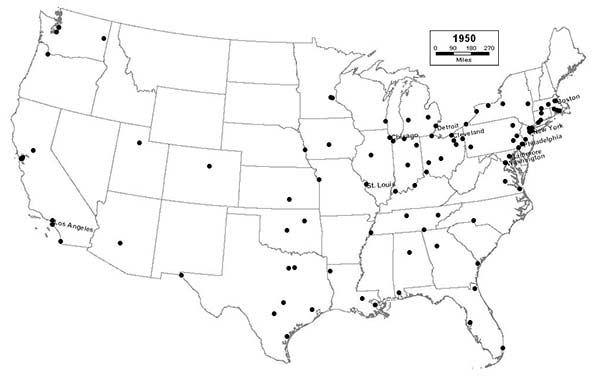
    1950 – Northeast (28); Midwest (27); South (31): West (14)

    For the first time, the South surpasses the Northeast as the region with the most cities in the top 100, as Austin and Baton Rouge join the list. Pittsburgh drops out of the top 10, as industrial decline in the Northeast accelerates after a brief uptick during the war. Washington, D.C. enters the top 10, due in large part to the expansion of the federal government during the Great Depression and World War II.  Phoenix joins the list at #99, presaging the rapid development of the desert Southwest in the coming decades; a small desert crossroads at the beginning of the 20th Century, it will end the century as the nation’s sixth largest city.
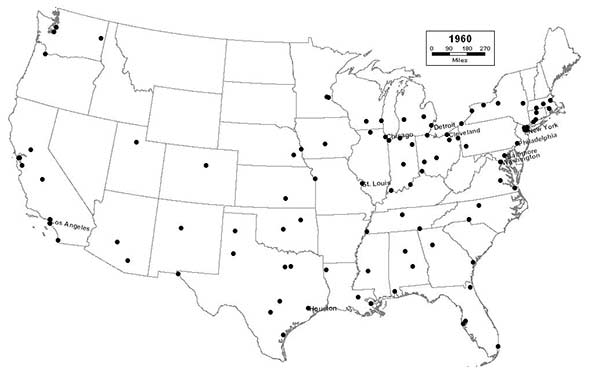
    1960 – Northeast (19); Midwest (28); South (35); West (18)

    Both suburbanization and deindustrialization become major factors in central city decline, especially in the North, where major cities are hemmed in by adjacent cities and towns, and are therefore unable to expand via annexation. The long tradition of town, borough, and township government throughout the entire North stymies efforts to consolidate governments into units that better reflect modern realities. Boston drops out of the top 10 for the first time since 1790. The expansion of the Interstate Highway System takes its toll, especially on mature Northern cities, by opening up outlying areas for suburban development, and by displacing business and residents in the urban core.  Most cities throughout the Midwest have now reached both the peak of their population and their industrial development.  In the coming years, they will increasingly follow the pattern established in the Northeast 30 years earlier, as the region begins to transition from the “Great American Manufacturing Belt” to the “Rust Belt”.  In contrast, the Sunbelt continues to enjoy explosive growth, as Houston enters the top 10, and San Jose, Tucson, Albuquerque, and Honolulu join the list. 
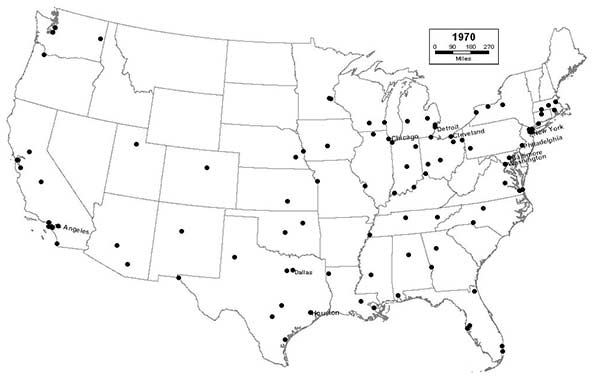
    1970 – Northeast (16); Midwest (28); South (35); West (21)

    Anaheim, Santa Ana, and Riverside join the list, as Southern California continues to attract new immigrants, both foreign and domestic, in record numbers.  The largest Southern and Western cities continue to grow even larger, as Dallas joins the top 10. The industrial Midwest begins to experience a period of rapid decline, as St. Louis drops out of the top 10. 
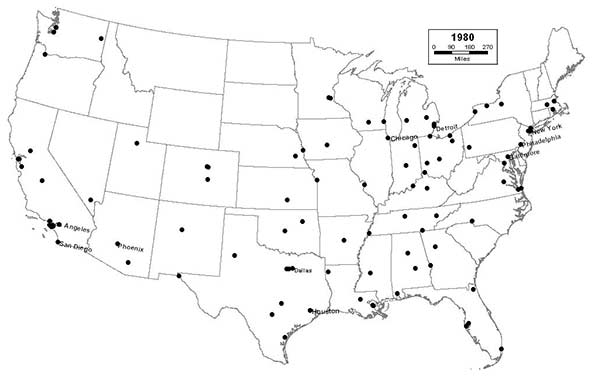
    1980 – Northeast (12); Midwest (24); South (38); West (26)

    Colorado Springs and Las Vegas join the list, as the interior West continues to grow rapidly.  The growth of the West extends to Alaska, as Anchorage makes the list for the first time.  Even the suburbs of sunbelt cities, like Arlington, Texas, and Aurora, Colorado begin to surpass established Northeastern and Midwestern central cities in population. San Diego and Phoenix join the top 10. Midwestern cities continue to deindustrialize rapidly, and begin losing population at a truly alarming rate. Suburbanization, white flight, and the inability to annex or consolidate with outlying areas make the problem of industrial decline even worse, as Cleveland drops out of the top 10. 
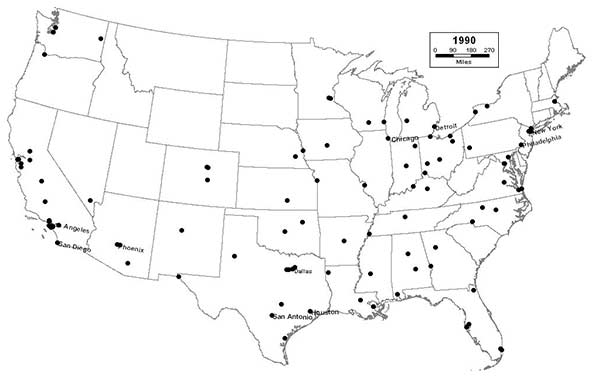
    1990 – Northeast (9); Midwest (21); South (40); West (30)

    Cities throughout the Sunbelt continue to grow in size, prominence, and influence, as Los Angeles surpasses Chicago as the nation’s second largest city.  Three of the nation’s 10 largest cities are now located in Texas, as San Antonio joins the top 10.  Sunbelt “boomburbs” continue to explode as cities like Mesa, Arizona; Garland, Texas; and Fremont, California join the list, displacing older eastern cities like Syracuse, Worcester, and Providence, which drops out the top 100 for the first time since 1790.
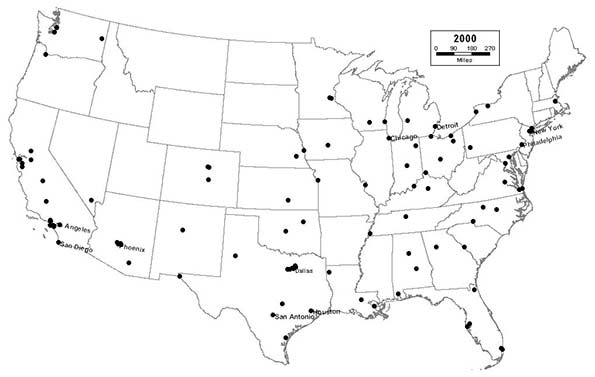
    2000 – Northeast (9); Midwest (20); South (40); West (31)

    The previously established patterns of Rust Belt decline and Sunbelt expansion begin to stabilize, although many Rust Belt cities continue to lose population at an alarming rate.  Dayton drops out of the top 100 for the first time since 1830. Sunbelt boomburbs continue to grow rapidly, as Plano, Texas; Glendale, Arizona; Scottsdale, Arizona; and Irving, Texas all reach the top 100.  
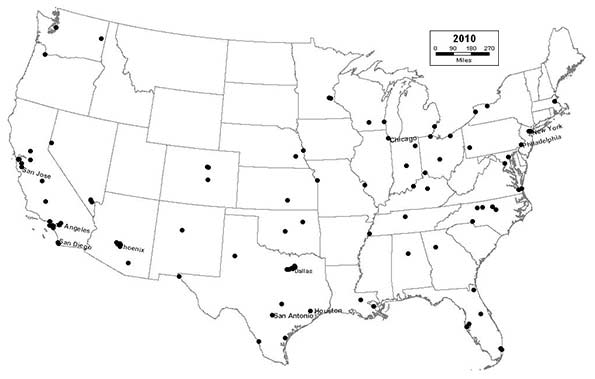
    2010 – Northeast (8); Midwest (17); South (39); West (36)

    The Sunbelt achieves complete dominance of America’s urban landscape, as 6 of the nation’s 10 largest cities are now located in California and Texas. Rust Belt cities like Cleveland, which experienced a slight respite from decline throughout the 1990s, begin a new period of free-fall, as the housing market collapses in the late 2000s.  Detroit drops out of the top 10.  Akron drops out of the top 100.  Sunbelt cities continue to eclipse their Rust Belt counterparts, as Reno, Orlando, Winston-Salem; Henderson, Nevada; Chula Vista, California; and Irvine, California all reach the top 100.

    This post originally appeared in Jason Segedy’s Notes From the Underground on April 14,, 2014.

    Segedy is the Director of the Akron Metropolitan Area Transportation Study, the Metropolitan Planning Organization serving Akron, Ohio.  As a native of Akron, and as an urban planner, he has a strong interest in the future of places throughout the Great Lakes region, and in the people that inhabit them.
  • Large Urban Cores: Products of History

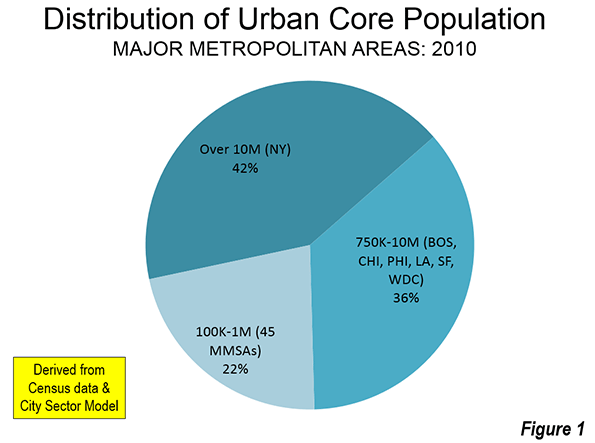
    Urban cores are much celebrated but in reality most of the population living in functional urban cores is strongly concentrated in just a handful of major metropolitan areas in the United States. This conclusion is based on an analysis using the City Sector Model, which uses functional characteristics, rather than municipal jurisdictions, to analyze urban core and suburban components of metropolitan areas.

    Functional Classifications of Metropolitan Areas

    The City Sector Model allows a more representative functional analysis of urban core, suburban and exurban areas, by the use of smaller areas, rather than municipal boundaries.

    The nearly 9,000 zip code tabulation areas of major metropolitan areas are categorized by functional characteristics, including urban form, density, and travel behavior. There are four functional classifications, the urban core, earlier suburban areas, later suburban areas and exurban areas. The urban cores have higher densities, older housing and substantially greater reliance on transit, similar to urban cores that existed before the post-World War II automobile oriented suburbanization. Exurban areas are beyond the built up urban areas. The suburban areas constitute the balance of the major metropolitan areas. Earlier suburbs include areas with a median house construction date before 1980. Later suburban areas have later median house construction dates.

    Concentrating in New York and A Few Other Areas

    As is so often the case on dense urbanization, the statistics are dominated by New York urban core which accounts for 42 percent of the total urban core population for the whole country. The New York metropolitan area, with 19.6 million people represents roughly six percent of the country’s population but its urban core –some 10.2 million strong – is larger than the total population of every metropolitan area in the nation other than Los Angeles (12.8 million).

    New York’s dominance is not surprising, reflecting its unique history and development.  Four of the core city’s five boroughs (Brooklyn, Queens, Manhattan, and the Bronx) have higher population densities than any municipality more than one-one hundredth its size in the United States. Significantly, unlike most major metropolitan areas, New York’s functional urban core stretches well beyond the core city, and includes more than 2,000,000 residents outside New York City.

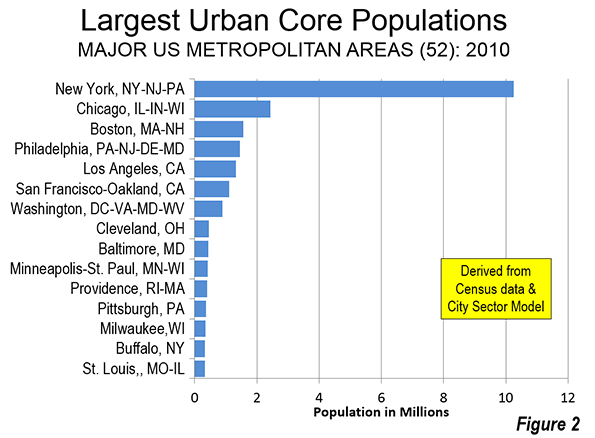
    Another 36 percent of the nation’s urban core population is in six metropolitan areas, though none reaches a population close to that of New York (Figure 1). Chicago is second, with an urban core population of 2.4 million. Four other urban cores exceed 1,000,000 population, including Boston (1.6 million), Philadelphia (1.5 million), Los Angeles (1.3 million) and San Francisco (1.1 million). The seventh largest urban core is in Washington, at 900,000. These seven metropolitan areas include the six transit legacy cities (municipalities), which account for 55 percent of the transit work trip destinations and 99 percent of the increase in urban core transit commuting in the United States over the past 10 years.(Los Angeles is not classified as a transit legacy city).

    After Washington, the size of urban cores drops off markedly with the next 45 largest metropolitan areas accounting for only 22 percent of the urban core population. Cleveland ranks eighth at 460,000, Baltimore is ninth at 440,000, and Minneapolis-St. Paul is 10th with 420,000 urban core residents. Perhaps surprisingly, Providence, which is the nation’s 38th largest metropolitan area, ranks 11th in urban core population, at 410,000 residents. Pittsburgh, Milwaukee, Buffalo, and St. Louis round out the top 15, with between 320,000 and 370,000 urban core residents (Figure 2).

    Another 9 metropolitan areas have urban core populations exceeding 100,000:Detroit, Seattle, Cincinnati, Portland, Hartford, New Orleans, Rochester, Kansas City, and Louisville.

    Urban Cores over 100,000 Population

    Approximately 97 percent of the urban core population lives in the 24 major metropolitan areas with more than 100,000 urban core residents. Between 2000 and 2010, the urban core populations in these areas dropped from 25.3 percent to 24.0 percent of their respective metropolitan populations. The continued decentralization of these metropolitan areas is illustrated by a loss in the earlier suburban areas and gains in the later suburban areas and exurban areas (Figure 3).

    By comparison, only one percent of the population was in the urban cores of the other 28 major metropolitan areas (fewer than 100,000 residents in the urban core).

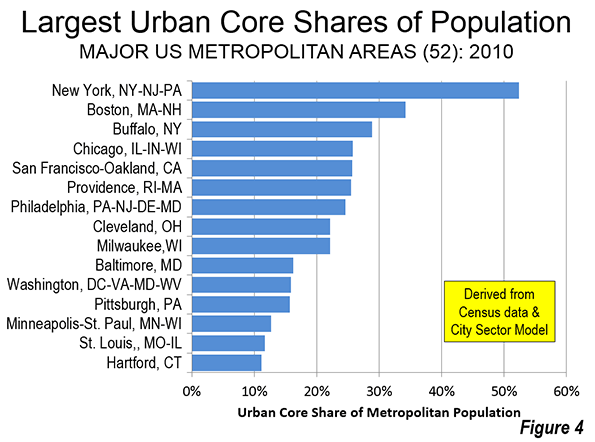
    New York had by far the largest percentage of its total metropolitan population in the urban core, at 52 percent. Boston ranked second, with 34 percent of its population in the urban core. Buffalo, which was ranked only 47th in metropolitan area population, was third in urban core population share (29 percent). Chicago and San Francisco had 26 percent of their population in the urban cores, followed by Providence and Philadelphia at 25 percent (Figure 4).

    Description of the Largest Urban Cores

    There is substantial variation in the geographical extent of the largest urban cores relative to their corresponding historical core municipalities. This is described below and illustrated in the just published Demographia City Sector Model Metropolitan Area Maps.

    As would be expected, New York’s urban core includes nearly all of the city of New York. Virtually all of Brooklyn, Manhattan, the Bronx, and Queens are in the urban core, though only parts of Staten Island are included. The urban core extends into New Jersey, with nearly all of Hudson County (including Jersey City) included, the core of Essex County (including Newark) and the city of Elizabeth (in Union County). The urban core and extends into Long Island’s Nassau County, including Hempstead, Valley Stream, Rockville Center and other areas. To the north, the urban core extends to parts of Westchester County (such as Yonkers, Pelham, Mount Vernon and New Rochelle). Interestingly, many of these areas, such as in western Nassau County, parts of Essex County and southern Westchester County are also suburban in form, but are classified as urban core because of high transit market shares, higher densities or pre-war development.

    Chicago’s urban core, the second largest, extends beyond but also excludes parts of the city of Chicago. The urban core extends into adjacent areas, such as older “suburban” Evanston, Oak Park and Cicero. There is also a significant urban core in northwestern Indiana, centered on East Chicago and Hammond.

    Boston’s urban core extends far outward from the city of Boston, including much of the area inside Route 128 (Interstate 95). This area also includes cities such as Cambridge, Everett, Somerville, Quincy, Medford, Waltham, and Lynn.

    Philadelphia’s urban core is largely confined to the city of Philadelphia, with extensions into Delaware County, Pennsylvania and Camden County, New Jersey.

    The urban core of Los Angeles is principally in the area extending from Hollywood to parts of East Los Angeles and south to the Interstate 105 freeway. However, much more of the city of Los Angeles is not in the urban core. The urban core also includes parts of Beverly Hills, West Los Angeles, Pasadena and Glendale.

    The urban core of San Francisco includes most of the cities of San Francisco and Oakland, as well as much of Berkeley, Albany, and Emeryville.

    Washington’s urban core includes most of Washington (the District of Columbia) and extends into Arlington and Alexandria in Virginia and has a large extension into Montgomery County, Maryland, including areas such as Bethesda and Silver Spring.

    Urban Cores Compared to Historical Core Municipalities

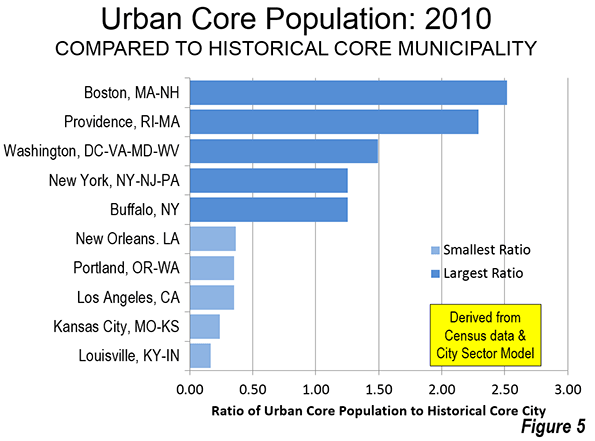
    A comparison of functional urban core populations to the populations of historical core municipalities indicates the problem of relying on jurisdictional (municipal) boundaries for urban core analysis. Functional urban core and historical core municipality populations vary significantly (Figure 5). The greatest differences are in Boston and Louisville. Boston’s functionalurban core population is 2.52 times that of the historical core municipality (Boston). Louisville’s functional urban core population is only one-sixth that of the historical core municipality (Louisville).

    Providence is second to Boston in its ratio of urban core population to that of historical core municipality at 2.29. The city of Providence had only 178,000 residents in 2010. (Among historical core municipalities, only Hartford was smaller at 125,000). Washington has an urban core population 1.49 times that of the historical core municipality, while New York and Buffalo had urban cores 1.25 times the population of their historical core municipalities.

    Among urban cores with more than 100,000 population Kansas City, Los Angeles, Portland, and New Orleans follow Louisville with the lowest ratios to historical core municipality populations (from 24 percent to 37 percent). In each of these cases, the urban core’s low ratio is the result of substantial annexations or large areas or the settling of large rural territories that had been previously included in the municipal limits (such as Los Angeles and New Orleans).

    Urban Cores: Products of History

    Indeed, nothing distinguishes the major metropolitan areas with larger urban core populations from the rest than history, In1940, just before the great mobility and suburbanization revolution, there were 23 metropolitan areas in the United States with wore than 500,000 population. The major metropolitan areas with the 19 largest urban cores in 1940 were all among the 23 with more than 500,000 population in 1940. Out of the 24 major metropolitan areas with more than 100,000 urban core residents in 2010, 21had more than 500,000 population in 1940 (only Hartford, Rochester and Louisville had smaller populations).

    Conversely, only two of the 28 major metropolitan areas in 2010 with fewer than 100,000 functional urban core residents had more than 500,000 residents in 1940, and they were among the smaller (Houston with 528,000 and Atlanta with 518,000).

    Urban cores were not planned, but rather were the result of consumer trendsin a time of much lower household incomes and much more restricted personal mobility. Many of the very centers of urban cores are reviving, but overall core growth continues to lag behind that of metropolitan areas. Moreover, there are no significant new ones.Urban cores, as much as anything, are a product of history.

    ————

    Wendell Cox is principal of Demographia, an international public policy and demographics firm. He is co-author of the "Demographia International Housing Affordability Survey" and author of "Demographia World Urban Areas" and "War on the Dream: How Anti-Sprawl Policy Threatens the Quality of Life." He was appointed to three terms on the Los Angeles County Transportation Commission, where he served with the leading city and county leadership as the only non-elected member. He was appointed to the Amtrak Reform Council to fill the unexpired term of Governor Christine Todd Whitman and has served as a visiting professor at the Conservatoire National des Arts et Metiers, a national university in Paris.

    ————

    Illustration: Core of the New York metropolitan area (City Sector Model map)

  • The California Economy: When Vigor and Frailty Collide

    Part one of a two-part report

    California is a place of extremes. It has beaches, mountains, valleys and deserts. It has glaciers and, just a few miles away, hot, dry deserts. Some years it doesn’t rain. Some years it rains all winter. Those extremes are part of what makes California the attractive place that it is, and, west of the high mountains, California is mostly an extremely comfortable place to live.

    Today, we have some new extremes. Some of our coastal communities are as wealthy as any in the world. At the other extreme, we have some of America’s poorest communities. San Bernardino, for example, has America’s second-highest poverty rate for cities with population over 200,000.

    From the beginning, we’ve had the fabulously wealthy. For the first 140 years after gold was found, California was a place where people could find, or, more correctly, build, success. The new part is the poverty. It used to be that the poor were mostly newcomers, people who hadn’t yet had time to show that they had what it takes. Today, our poverty is dominated by families who have been here a long time. While San Bernardino certainly has some newcomers, it is mostly a city of native Californians.

    The change became visible in the early 1990s. Many analysts will tell you that the change was caused by the collapse of the Soviet Union and the resulting peace dividend, which led to a dramatic downsizing of America’s defense sector, once a major component of California’s economy.

    I believe the way to think about this is that the downsizing of the defense sector exposed the weaknesses in California’s economy, as opposed to causing them. Sure, the downsizing had an economic impact. California lost hundreds of thousands of jobs. But the defense sector eventually bounced back and again became a source of good jobs. The problem is that it bounced back someplace else. It didn’t come back in California. In fact, it continues to decline in California.

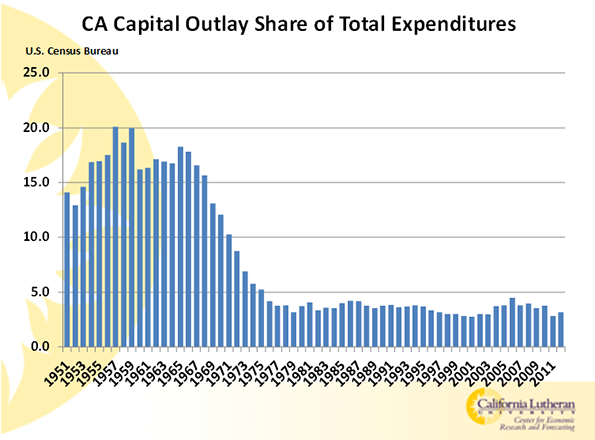
    The decline in California’s economic opportunities began way before the 1990s. As the 1960s progressed, Californians, or at the least the ones making decisions, changed their priorities. California’s spending for infrastructure had once consumed between 15 and 20 percent of the State’s budget. It precipitously fell to five percent or below.

    In the ’50s and early ’60s, governors Goodwin Knight and Pat Brown presided over a fabulous investment boom in universities, highways, water projects and the like. None of their successors has even attempted anything on that scale. The profound prosperity that accompanied and followed California’s investment boom hid the impacts of subsequent policy changes for decades.

    The decline in public capital spending wasn’t the cause of our changed priorities. It was the change in priorities that caused the change in spending. It is as if we decided that we were wealthy enough, and that future spending would be on social and environmental programs. If we weren’t looking for economic growth, why invest?

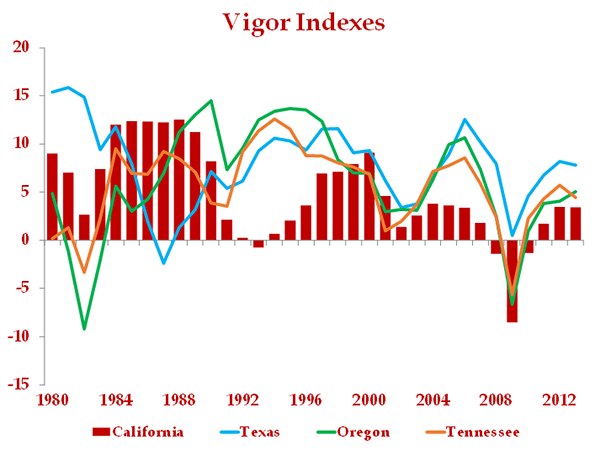
    At California Lutheran University’s Center for Economic Research and Forecasting, we’ve created a vigor index. It’s composed of net in-migration, job creation, and new housing permits, each equally weighted. It is quite sensitive to changes in economic opportunity. For example, in 2000, North Dakota had the nation’s lowest score, 0.9, and Nevada led the nation with a score of 24.1. By 2013, North Dakota led the country with a score of 20.0, while Nevada had seen its index value fall to only 6.4.

    In the following chart, we show California’s index (red bars) compared to that of Texas, Oregon, and Tennessee, from 1980 through 2013.

    California is apparently different than the comparison states. The Tennessee, Oregon, and Texas indexes have behaved more similarly to each other than to California since the late 1980s. Texas’ index behaved uniquely in the early 1980s, because of its dependency on oil and the long-term decline in oil prices that occurred during the 1980s.

    California appears to be different than the other states throughout the period, but the nature of the difference has changed. Prior to the late 1980s, California tended to outperform the others. For example, its score didn’t decline nearly as much as the others during the early 1980s recession. Given California’s resource endowment, we think this is natural.

    Since 1990, though, California’s vigor index has generally remained below those of Texas, Tennessee, and Oregon. Indeed, since 1990, California’s score has rarely exceeded the score of any of the comparison states, and it has never led them all.

    The index also shows that California’s investment in infrastructure during the 1950s and 1960s helped drive economic opportunity for two decades. It took two decades without any investment before we saw the consequences of the decision to not invest.

    Recently, California has seen budget surpluses and faster job growth than the average American state. The forces for the status quo now claim that this confirms the wisdom of their policies. They are wrong.

    California’s budget surpluses are a product of a temporary tax, and an incredible bull market in equities. Our dependence on a highly progressive income tax means that California’s fiscal condition swings on the fortunes of a small group of wealthy individuals.

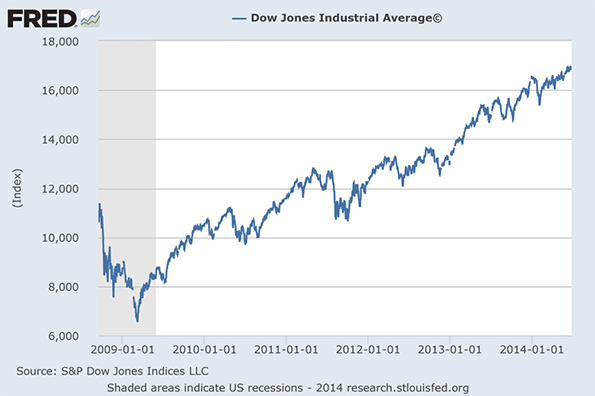
    Equity markets have been amazing over the past few years. The Dow has increased by over 10,000 since it bottomed out on March 9, 2009, and it appears to be divorced from economic activity. It increases on good news and bad, propelled by an unprecedented monetary expansion. Right now, California’s largest taxpayers are reaping huge profits in the stock markets, and California is reaping huge windfalls in its tax revenues.

    Someday, the market gains will cease, or worse reverse. Someday, too, the temporary tax will expire. California’s surpluses will wash away like sand on a beach. The state will face a new crisis, a result of a progressive tax structure where revenues swing on paper profits and losses, not on economic activity.
    As for our job gains being better than the average state’s, California should not be average.

    Employment should be far higher than it is. Even the weak job growth we’ve seen is largely a legacy of a previous age. California has the world’s best venture capital infrastructure, partly because of the investment previous generations of Californians made in the university system. It is also, in part, a result of chance.

    An amazing period of innovation was initiated in Coastal California by a few incredibly talented individuals, who were funded by a few far-sighted capitalists. It was one of those rare coincidences that happen from time to time and change the world. The eventual result was the Silicon Valley and economic powerhouses such as Intel, HP, Apple, Yahoo, Google, Facebook, Twitter, and many more.

    Another result was the creation of a private, capitalist, vibrant infrastructure. It takes time and vast sums of money before a new idea generates profits. Product design is just the first step. An organization needs to be created to produce and sell the product. Factories need to be designed. Marketing plans need to be put in place.

    No inventor or entrepreneur can be expected to have all of the necessary skills or money to turn an idea into a profitable firm. So, an infrastructure appeared. The Silicon Valley’s world-leading venture capital markets and the support structure to enable the fabulous innovation and economic value created there was not the result of any government program or initiative. It was the spontaneous result of lots of people driven to innovate and profit from those innovations. It was capitalism at its very best.

    California’s Silicon Valley became the place for talented young people to turn great ideas into reality. It was also the place to go if you had money and wished to invest in vibrant, risky new technologies, or if you knew how to design factories, how to market products, how to build organizations, or how to finance rapid growth. The infrastructure that arose is supporting California today. This amazing capitalist engine of jobs, innovation and wealth is the source of most of California’s economic vigor. But it is a legacy that will eventually slip away, unless California changes its priorities.

    This is the first part of a two-part report. Bill Watkins is a professor at California Lutheran University and runs the Center for Economic Research and Forecasting, which can be found at clucerf.org.

    Flickr photo by mlhradio. A California extreme: Mountains on The Trona-Wildrose Road, at the edge of the Panamint Valley. One of the most remote deserts in North America, in one of the most remote corners of California; the salt flats of Panamint Valley to the west, and Death Valley to the east.

  • Confessions of a Rust Belt Orphan

    How I Learned to Stop Worrying and Love Northeast Ohio

    Go to sleep, Captain Future, in your lair of art deco
    You were our pioneer of progress, but tomorrow’s been postponed
    Go to sleep, Captain Future, let corrosion close your eyes
    If the board should vote to restore hope, we’ll pass along the lie

    -The Secret Sound of the NSA, Captain Future

    As near as I can tell, the term “Rust Belt” originated sometime in the mid-1980s. That sounds about right.

    I originated slightly earlier, in 1972, at St. Thomas Hospital in Akron, Ohio, Rubber Capital of the World. My very earliest memory is of a day, sometime in the Summer of 1975, that my parents, my baby brother, and I went on a camping trip to Lake Milton, just west of Youngstown. I was three years old. To this day, I have no idea why, of all of the things that I could remember, but don’t, I happen to remember this one. But it is a good place to start.

    image
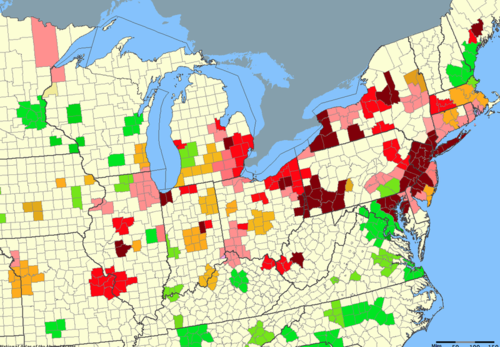
    Image Source: Wikipedia: Change in total number of manufacturing jobs in metropolitan areas, 1954-2002. Dark red is very bad. Akron is dark red.

    The memory is so vivid that I can still remember looking at the green overhead freeway signs along the West Expressway in Akron. Some of the signs were in kilometers, as well as in miles back then, due to an ill-fated attempt to convert Americans to the Metric system in the 1970s. I remember the overpoweringly pungent smell of rubber wafting from the smokestacks of B.F. Goodrich and Firestone. I recall asking my mother about it, and her explaining that those were the factories where the tires, and the rubber, and the chemicals were made. They were made by hard-working, good people – people like my Uncle Jim – but more on that, later.

    When I was a little bit older, I would learn that this was the smell of good jobs; of hard, dangerous work; and of the way of life that built the modern version of this quirky and gritty town. It was the smell that tripled Akron’s population between 1910 and 1920, transforming it from a sleepy former canal-town to the 32nd largest city in America. It is a smell laced with melancholy, ambivalence, and nostalgia – for it was the smell of an era that was quickly coming to an end (although I was far too young to be aware of this fact at the time). It was sometimes the smell of tragedy.

    We stopped by my grandparents’ house, in Firestone Park, on the way to the campground. I can still remember my grandmother giving me a box of Barnum’s Animals crackers for the road. She was always kind and generous like that.

    Who were my grandparents? My grandparents were Akron. It’s as simple as that. Their story was Akron’s story. My grandfather was born in 1916, in Barnesboro, a small coal-mining town in Western Pennsylvania, somewhere between Johnstown, DuBois, and nowhere. His father, a coal miner, had emigrated there from Hungary nine years earlier. My grandmother was born in Barberton, in 1920. Barberton was reportedly the most-industrialized city in the United States, per-capita, at some point around that time.

    They were both factory workers for their entire working lives (I don’t think they called jobs like that “careers” back then). My grandfather worked at the Firestone Tire & Rubber Company. My grandmother worked at Saalfield Publishing, a factory that was one of the largest producers of children’s books, games, and puzzles in the world. Today, both of the plants where they worked form part of a gutted, derelict, post-apocalyptic moonscape in South Akron, located between that same West Expressway and perdition. The City of Akron has plans for revitalizing this former industrial area. It needs to happen, but there are ghosts there…

    My name is Ozymandias, King of Kings, 
    Look on my works, ye Mighty, and despair!
    Nothing beside remains. Round the decay 
    Of that colossal wreck, boundless and bare 
    The lone and level sands stretch far away.

    -Percy Bysshe Shelley, Ozymandias

    My grandparents’ house exemplified what it was to live in working-class Akron in the late 1970s and early 1980s. My stream-of-consciousness memories of that house include: lots of cigarettes and ashtrays; Hee-HawThe Joker’s Wild; fresh tomatoes and peppers; Fred & Lamont Sanford; Archie & Edith Bunker; Herb Score and Indians baseball on the radio on the front porch; hand-knitted afghans; UHF/VHF; 3, 5, 8, and 43; cold cans of Coca-Cola and Pabst Blue Ribbon (back when the pop-tops still came off of the can); the Ohio Lottery; chicken and galuskas (dumplings); a garage floor that you could eat off of; a meticulously maintained 14-year-old Chrysler with 29,000 miles on it; a refrigerator in the dining room because the kitchen was too small; catching fireflies in jars; and all being right with the world.

    I always associate the familiar comfort of that tiny two-bedroom bungalow with the omnipresence of cigarette smoke and television. I remember sitting there on May 18, 1980. It was my eighth birthday. We were sitting in front of the TV, watching coverage of the Mount St. Helens eruption in Washington State. I remember talking about the fact that it was going to be the year 2000 (the Future!) in just twenty years. It was an odd conversation for an eight year old to be having with adults (planning for the future already, and for a life without friends, apparently). I remember thinking about the fact that I would be 28 years old then, and how inconceivably distant it all seemed. Things seem so permanent when you’re eight, and time moves ever-so-slowly.

    More often than not, when we visited my grandparents, my Uncle Jim and Aunt Helen would be there. Uncle Jim was born in 1936, in West Virginia. His family, too, had come to Akron to find work that was better-paying, steadier, and (relatively) less dangerous than the work in the coal mines. Uncle Jim was a rubber worker, first at Mohawk Rubber and then later at B.F. Goodrich. Uncle Jim also cut hair over at the most-appropriately named West Virginia Barbershop, on South Arlington Street in East Akron. He was one of the best, most decent, kindest people that I have ever known.

    I remember asking my mother once why Uncle Jim never washed his hands. She scolded me, explaining that he did wash his hands, but that because he built tires, his hands were stained with carbon-black, which wouldn’t come out no matter how hard you scrubbed. I learned later, that it would take about six months for that stuff to leach out of your pores, once you quit working.

    Uncle Jim died in 1983, killed in an industrial accident on the job at B.F. Goodrich. He was only 47. The plant would close for good about a year later.

    It was an unthinkably tragic event, at a singularly traumatic time for Akron. It was the end of an era.

    Times Change

    My friend Della Rucker recently wrote a great post entitled The Elder Children of the Rust Belt over at her blog, Wise Economy. It dredged up all of these old memories, and it got me thinking about childhood, about this place that I love, and about the experience of growing up just as an economic era (perhaps the most prosperous and anomalous one in modern history) was coming to an end.

    That is what the late 1970s and early 1980s was: the end of one thing, and the beginning of a (still yet-to-be-determined) something else. I didn’t know it at the time, but that’s because I was just a kid.

    In retrospect it was obvious: the decay; the deterioration, the decomposition, the slow-at-first, and then faster-than-you-can-see-it unwinding of an industrial machine that had been wound-up far, far, too-tight. The machine runs until it breaks down; then it is replaced with a new and more efficient one – a perfectly ironic metaphor for an industrial society that killed the goose that laid the golden egg. It was a machine made up of unions, and management, and capitalized sunk costs, and supply chains, and commodity prices, and globalization. Except it wasn’t really a machine at all. It was really just people. And people aren’t machines. When they are treated as such, and then discarded as obsolete, there are consequences.

    You could hear it in the music: from the decadent, desperately-seeking-something (escape) pulse of Disco, to the (first) nihilistic and (then) fatalistic sound of Punk and Post-Punk. It’s not an accident that a band called Devo came from Akron, Ohio. De-evolution: the idea that instead of evolving, mankind has actually regressed, as evidenced by the dysfunction and herd mentality of American society. It sounded a lot like Akron in the late 1970s. It still sounds a little bit like the Rust Belt today.

    As an adult, looking back at the experience of growing up at that time, you realize how much it colors your thinking and outlook on life. It’s all the more poignant when you realize that the “end-of-an-era” is never really an “end” as such, but is really a transition to something else. But to what exactly?

    The end of that era, which was marked by strikes, layoffs, and unemployment, was followed by its echoes and repercussions: economic dislocation, outmigration, poverty, and abandonment; as well as the more intangible psychological detritus – the pains from the phantom limb long after the amputation; the vertiginous sensation of watching someone (or something) die.

    And it came to me then 
    That every plan 
    Is a tiny prayer to Father Time

    As I stared at my shoes
    In the ICU
    That reeked of piss and 409

    It sung like a violent wind
    That our memories depend
    On a faulty camera in our minds

    ‘Cause there’s no comfort in the waiting room
    Just nervous paces bracing for bad news

    Love is watching someone die…

    -Death Cab For Cutie, What Sarah Said

    But it is both our tragedy and our glory that life goes on.

    Della raised a lot of these issues in her post: our generation’s ambivalent relationship with the American Dream (like Della, I feel the same unpleasant taste of rust in my mouth whenever I write or utter that phrase); our distrust of organizations and institutions; and our realization that you have to keep going, fight, and survive, in spite of it all. She talked about how we came of age at a time of loss:

    not loss like a massive destruction, but a loss like something insidious, deep, pervasive.

    It is so true, and it is so misunderstood. One of the people commenting on her blog post said, essentially, that it is dangerous to romanticize about a “golden age”; that all generations struggle; and that life is hard.

    Yes, those things are all true. But they are largely irrelevant to the topic at hand.

    There is a very large middle ground between a “golden age” and an “existential struggle”. The time and place about which we are both writing (the late 1970s through the present, in the Rust Belt) is neither. But it is undoubtedly a time of extreme transition. It is a great economic unraveling, and we are collectively and individually still trying to figure out how to navigate through it, survive it, and ultimately build something better out of it.

    History is cyclical. Regardless of how enamored Americans, in general, may be with the idea, it is not linear. It is neither a long, slow march toward utopia, nor toward oblivion. When I look at history, I see times of relative (and it’s all relative, this side of paradise) peace, prosperity, and stability; and other times of relative strife, economic upheaval, uncertainty, and instability. We really did move from one of those times to the other, beginning in the 1970s, and continuing through the present.

    The point that is easy to miss when uttering phrases like “life is hard for every generation” is that none of this discussion about the Rust Belt – where it’s been, where it is going – has anything to do with a “golden age”. But it has everything to do with the fact that this time of transition was an era (like all eras) that meant a lot (good and bad) to the people that lived through it. It helped make them who they are today, and it helped make where they live what it is today.

    For those that were kids at the time that the great unraveling began (people like me, and people like Della) it is partially about the narrative that we were socialized to believe in at a very young age, and how that narrative went up in a puff of smoke. In 1977, I could smell rubber in the air, and many of my family members and friends’ parents worked in rubber factories. In 1982, the last passenger tire was built in Akron. By 1984, 90% of those jobs were gone, many of those people had moved out of town, and the whole thing was already a fading memory. Just as when a person dies, many people reacted with a mixture of silence, embarrassment, and denial.

    As a kid, especially, you construct your identity based upon the place in which you live. The whole identity that I had built, even as a small child, as a proud Akronite: This is the RUBBER CAPITAL OF THE WORLD; this is where we make lots and lots of Useful Things for people all over the world; this is where Real Americans Do Real Work; this is where people from Europe, the South, and Appalachia come to make a Better Life for themselves; well, that all got yanked away. I couldn’t believe any of those things anymore, because they were no longer true, and I knew it. I could see it with my own two eyes. Maybe some of them were never true to begin with, but kids can’t live a lie the way that adults can. When the place that you thought you lived in turns out not to be the place that you actually live, it can be jarring and disorienting. It can even be heartbreaking.

    We’re the middle children of history, man. No purpose or place. We have no Great War. No Great Depression. Our great war is a spiritual war. Our great depression is our lives.

    Tyler Durden, Fight Club

    I’m fond of the above quote. I was even fonder of it when I was 28 years old. Time, and the realization that life is short, and that you ultimately have to participate and do something with it besides analyze it as an outside observer, has lessened its power considerably. It remains the quintessential Generation X quote, from the quintessential Generation X movie. It certainly fits in quite well with all of this. But, then again, maybe it shouldn’t.

    I use the phrase “Rust Belt Orphan” in the title of this post, because that is what the experience of coming of age at the time of the great economic unraveling feels like at the gut-level. But it’s a dangerous and unproductive combination, when coupled with the whole Gen-X thing.

    In many ways, the Rust Belt is the “Generation X” of regions – the place that just doesn’t seem to fit in; the place that most people would just as soon forget about; the place that would, in fact, just as soon forget about itself; the place that, if it does dare to acknowledge its own existence or needs, barely notices the surprised frowns of displeasure and disdain from those on the outside, because they have already been subsumed by the place’s own self-doubt and self-loathing.

    A fake chinese rubber plant
    In the fake plastic earth
    That she bought from a rubber man
    In a town full of rubber plans
    To get rid of itself

    -Radiohead, Fake Plastic Trees

    The whole Gen-X misfit wandering-in-the-Rust Belt-wilderness meme is a palpably prevalent, but seldom acknowledged part of our regional culture. It is probably just as well. It’s so easy for the whole smoldering heap of negativity to degenerate into a viscous morass of alienation and anomie. Little good can come from going any further down that dead-end road.

    Whither the Future?

    The Greek word for “return” is nostosAlgos means “suffering.” So nostalgia is the suffering caused by an unappeased yearning to return.
    – 
    Milan Kundera, Ignorance

    So where does this all leave us?

    First, as a region, I think we have to get serious about making our peace with the past and moving on. We have begun to do this in Akron, and, if the stories and anecdotal evidence are to be believed, we are probably ahead of the region as a whole.

    But what does “making our peace” and “moving on” really mean? In many ways, I think that our region has been going through a collective period of mourning for the better part of four decades. Nostalgia and angst regarding the things that have been lost (some of our identity, prosperity, and national prominence) is all part of the grieving process. The best way out is always through.

    But we should grieve, not so we can wallow in the experience and refuse to move on, but so we can gain a better understanding of who we are and where we come from. Coming to grips with and acknowledging those things, ultimately enables us to help make these places that we love better.

    We Americans are generally not all that good at, or comfortable with, mourning or grief. There’s a very American idea that grieving is synonymous with “moving on” and (even worse) that “moving on” is synonymous with “getting over it”.

    We’re very comfortable with that neat and tidy straight, upwardly-trending line toward the future (and a more prosperous, progressive, and enlightened future it will always be, world without end, Amen.)

    We’re not so comfortable with that messy and confusing historical cycle of boom-and-bust, of evolution and de-evolution, of creation and destruction and reinvention. But that’s the world as we actually experience it, and it’s the one that we must live in. It is far from perfect. I wish that I had another one to offer you. But there isn’t one on this side of the Great Beyond. For all of its trials and tribulations, the world that we inhabit has one inestimable advantage: it is unambiguously real.

    “Moving on” means refusing to become paralyzed by the past; living up to our present responsibilities; and striving every day to become the type of people that are better able to help others. But “moving on” doesn’t mean that we forget about the past, that we pretend that we didn’t experience what we did, or that we create an alternate reality to avoid playing the hand that we’ve actually been dealt.

    Second, I don’t think we can, or should, “get over” the Rust Belt. The very phrase “get over it” traffics in denial, wishful thinking, and the estrangement of one’s self from one’s roots. Countless attempts to “get over” the Rust Belt have resulted in the innumerable short-sighted, “get rich quick” economic development projects, and public-private pyramid-schemes that many of us have come to find so distasteful, ineffective, and expensive.

    We don’t have to be (and can’t be, even if we want to) something that we are not. But we do have to be the best place that we can be. This might mean that we are a smaller, relatively less-prominent place. But it also means that we can be a much better-connected, more cohesive, coherent, and equitable place. The only people that can stop us from becoming that place are we ourselves.

    For a place that has been burned so badly by the vicissitudes of the global economy, Big Business, and Big Industry, we always seem to be so quick to put our faith in the Next Big Project, the Next Big Organization, and the Next Big Thing. I’m not sure whether this is the cause of our current economic malaise, or the effect, or both. Whatever it is, we need to stop doing it.

    Does this mean that we should never do or dream anything big? No. Absolutely not. But it does mean that we should be prudent and wise, and that we should tend to prefer our economic development and public investment to be hyper-nimble, hyper-scalable, hyper-neighborhood-focused, and ultra-diverse. Fetishizing Daniel Burnham’s famous “Make no little plans…” quote has done us much harm. Sometimes “little plans” are exactly what we need, because they often involve fundamentals, are easier to pull-off, and more readily establish trust, inspire hope, and build relationships.

    Those of us that came of age during the great economic unraveling and (still painful) transition from the Great American Manufacturing Belt to the Rust Belt might just be in a better position to understand our challenges, and to find the creative solutions required to meet them head-on. Those of us that stuck it out and still live here, know where we came from. We’re under no illusions about who we are or where we live. I think Della Rucker was on to something when she listed what we can bring to the table:

    • Determination
    • Long-game focus
    • Understanding the depth of the pit and the long way left to climb out of it
    • Resourcefulness
    • Ability to salvage
    • Expectation that there are no easy answers
    • Disinclination to believe that everything will be all right if only we do this One Big Thing

    When I look at this list, I see pragmatism, resilience, self-knowledge, survival skills, and leadership. It all rings true.

    He wanted to care, and he could not care. For he had gone away and he could never go back any more. The gates were closed, the sun was gone down, and there was no beauty but the gray beauty of steel that withstands all time. Even the grief he could have borne was left behind in the country of illusion, of youth, of the richness of life, where his winter dreams had flourished.

    “Long ago,” he said, “long ago, there was something in me, but now that thing is gone. Now that thing is gone, that thing is gone. I cannot cry. I cannot care. That thing will come back no more.”

    -F. Scott Fitzgerald, Winter Dreams

    So, let’s have our final elegy for the Rust Belt. Then, let’s get to work.

    This post originally appeared in Jason Segedy’s Notes From the Underground on November 2, 2013.

    Segedy is the Director of the Akron Metropolitan Area Transportation Study, the Metropolitan Planning Organization serving Akron, Ohio.  As a native of Akron, and as an urban planner, he has a strong interest in the future of places throughout the Great Lakes region, and in the people that inhabit them.
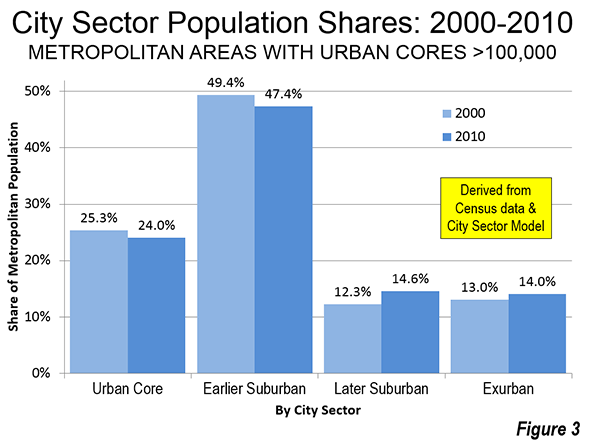
  • Watch 220 Years of U.S. State Population Growth

    Around this time of year, some of us can’t help but think of the history of this great nation. What was life like back in the days of the founding fathers, and how have they changed in the decades since? Using the population data of every Census since the first, which occurred in 1790, at MyLife.com we’ve put together an animation showing the growth of every state’s population from then till now. The states are in order of the date they became admitted, and you may notice that some were being counted prior to statehood. These states were at the time either U.S. territories, or part of another state.

    The graphic shows the interesting pace of change in the United States – California is now the most populous state, but there were some interesting changes in tempo over the years. At one point New York and Pennsylvania were neck and neck for most populous, only to be quickly outpaced by California and later on, Texas. The sheer velocity of California’s growth is also interesting to watch, as the state saw growth of more than 15 million residents in the past 50 years.

    Floridians might be surprised to learn that the during first 80 years of statehood, their population only grew to less than one million, while the next 80 years saw an increase of 15 million! It remains one of the fastest growing states today and may pass New York to become the third most populous state by the next Census.

    You can see the graphic below or at full size here

  • Enterprising States 2014: Re-creating Equality of Opportunity

    This is the executive summary for the U.S. Chamber of Commerce Foundation’s 5th Annual Enterprising States report, authored annually by Praxis Strategy Group. View the interactive map with state-by-state data and download the full report here.

    The growing skills gap is one of the most persistent challenges affecting thriving and lagging state economies—the disparity between the skills companies need to drive growth and innovation versus the skills that actually exist within their organizations and in the labor market. This disconnect, expected to grow substantially as the boomer generation retires, causes workers and companies to miss out on realizing their full potential. A sizable skills gap impacts virtually every aspect of the economy, thereby affecting our national competitiveness and, in turn, causing the economy to fall short of its potential.

    The nature of the skills gap that employers face varies by geography. Each state has its own economic DNA with varying levels of growth and specialization for each industry. The energy-related skills gap in Texas or North Dakota, for example, is different from a manufacturing-driven gap in Michigan, aerospace in Washington, information technology in Utah, or the chemical industry in Louisiana.

    Businesses and the public sector must work side by side to identify where there is a deficit of talent, reskill incumbent workers, and skill new entrants into the workforce to close the gaps within their communities. This is not a problem that can be solved quickly, but it can be solved. Strengthening America’s science, technology, engineering, and mathematics (STEM) and middle-skills pipeline will require public-private partnerships as well as collaborations across federal, state, and local governments.

    States as a Focal Point for Action

    States and their governors play a pivotal role in filling the talent pipeline, providing critical leadership to link businesses with the education, workforce, and economic development systems. Solutions will vary by state of course, but there is an emerging framework built on a foundation of both basic education and an employer-responsive workforce pipeline.

    Economic development starts with strong schools focused on 21st century skills. For the past three decades, efforts by U.S. businesses, government, and educational organizations focused on retooling K–12 science, mathematics, and reading education and on addressing persistently high dropout rates in inner cities. Progress has been slow to remedy the looming skills shortage, but there is a growing sense of optimism that industry sector partnerships, greater attention to career pathways, and the implementation of integrated education and training will help to close the gap.

    An employer-responsive talent pipeline requires aligning education, workforce development, and economic development. Postsecondary education institutions now get a considerably lower percentage of their funding from state sources than just a decade ago, but states continue to make significant financial investments in higher education. Yet, a common refrain is that postsecondary offerings—at both two- and four-year institutions—are not sufficiently aligned with the skills needed in the workforce. For years, knowledge creation, research and development, and technology transfer have dominated higher education’s economic development role. However, higher education’s most important contribution to state economic competitiveness in the future might be teaching and talent production because states with the most high-level talent will have a leg up in the future economy of decentralized global networks.

    Investing in people is perhaps the most effective long-term economic growth strategy. Training and education offer the best chance for workers to find well-paying long-term employment, while providing businesses and employers in every sector with the talent they need to grow.

    Coordinating education, workforce development, and economic development has proven to be challenging among the states because the three fields are historically separate systems, with separate cultures and perspectives. States that are successful in navigating program integration and facilitating collaboration between these traditionally separate institutions will put themselves in the forefront of meeting one of the primary challenges to building a 21st century economy.

    Because of these complexities, a governor serves the issue best by playing a leadership role in forming partnerships – particularly between business and education – and creating the structure to ensure effectiveness and efficiency in a demand-driven education to workforce pipeline. Often this involves a decentralized approach so that more decisions can be made at the local level.

    Enterprising States 2014

    Now in its fifth edition, the Enterprising States study measures state performance overall and across five policy areas important for job growth and economic prosperity. Those five areas include:

    • Talent Pipeline
    • Exports and International Trade
    • Technology and Entrepreneurship
    • Business Climate
    • Infrastructure

    The 2014 report relates these policies and practices to the need for collaboration between education, workforce development, and economic development to positively combat the nation’s growing skills gap.  

    Top Performers

    Utah lands in the top 6 in each of the five policy categories and 3rd in overall economic performance. It is the only state to finish in the top 10 on all six lists.

    Colorado appears on 5 top 10 lists, Texas on 4, and Washington is in the top 15 of five lists.

    North Dakota is another strong performer, leading by a large margin in economic performance and ranking 1st in talent metrics and 9th in business climate.

    Florida and Nevada rank well on many policy measures, a sign that the economies of those states may be ripe for a turnaround.

    Virginia ranks 5th in technology and entrepreneurship, and talent metrics, helping it land just outside the top 10 in economic performance.

    Minnesota ranks 10th in economic performance, partly due to its second place in talent pipeline. 

    See how your state ranks by viewing our interactive map. Or view a PDF of the full report.

    Enterprising States is authored by Praxis Strategy Group along with Joel Kotkin. Praxis Strategy Group is an economic research, analysis, and strategic planning firmJoel Kotkin is executive editor of NewGeography.com and author of the forthcoming The New Class Conflict.

  • The Ugly City Beautiful: A Policy Analysis

    When it comes to the future, Detroit and San Francisco act as poles in the continuum of American consciousness. Detroit is dead and will continue dying. San Francisco is the region sipping heartily from the fountain of youth. Such trajectories, according to experts, will go on indefinitely.

    Harvard economist Ed Glaeser has a grim outlook for the Rust Belt. “[P]eople and firms are leaving Buffalo for the Sunbelt because the Sunbelt is a warmer, more pleasant, and more productive area to live,” he writes in City Journal.

    Glaeser echoes this sentiment in a recent interview with International Business Times, saying “[s]mart people want to be around other smart people”, and the Rust Belt has a long slog ahead given that “post-industrial city migration is dominated by people moving to warmer climes”.

    But is this true? Is there a “brain drain” from the Rust Belt to the Sun Belt and Coasts? In a word: no. But Rust Belt leaders have bought this narrative hook line and sinker, and the subsequent hand-wringing has led to wasteful public investment.

    “Michigan’s cities must retain and attract more people, including young knowledge workers, to its cities by making them attractive, vibrant, and diverse places,” reads a 2003 memo from the National Governor’s Association about Michigan’s “Cool Cities” campaign.

    But the campaign struggled. “Government can’t mandate cool,” reflected Karen Gagnon, the former Cool Cities director. “As soon as government says something is cool, it’s not.”

    What’s worse, “cooling you city” with talent attraction expenditures can exacerbate economic disparities on the ground. Cities, like Chicago, are increasingly becoming bifurcated cities based on faulty assumptions that “trickle down urbanism” works. That said, the challenge of the day—for not only Rust Belt cities, but all cities—is not “brain drain”, but “brain waste”. Those cities who can best rebuild middle class communities tied to emerging markets will be the future of investment, like they were in the past.

    Through Rust-Colored Glasses

    When a people fall from grace, the sentiment of decline tends to stick. The Rust Belt’s demise is cemented. Meanwhile, the future is elsewhere. Like toward the sun. For instance, from 2000 to 2010, the Sun Belt metros of Houston, Dallas, Atlanta, Riverside, Las Vegas, Miami, Orlando, and Phoenix experienced the largest population growth. The biggest losers? It’s a “who’s who” of Rust Belt metros, led by Detroit, Cleveland, Pittsburgh, and Buffalo.

    America is a country governed by growth: big cars, big belt buckles, big houses, and big populations. Shrinkage is weakness. It is a sign of place failure. The problem here is that population growth is an ineffective, broad-brush measure when trying to understand regional underlying dynamics. A new study by Jessie Poon and Wei Yin in the journal Geography Compass called “Human Capital: A Comparison of Rustbelt and Sunbelt Cities” details exactly that.

    In it, the authors compare human capital levels between the Sunbelt metros in California (including San Francisco and L.A.), Nevada, New Mexico, and Arizona with Rust Belt metros in Michigan, Ohio, Indiana, Pennsylvania, and upstate New York. When it comes to share of population with a college degree, the authors find that the Rust Belt is experiencing a brain gain equal to their Sun Belt peers from 1980 to 2010. Poon and Wei also found that skill ratios of immigrants is higher in the Rust Belt than Sunbelt. The authors note that despite population decline, the Rust Belt continues “to be important sites of human capital accumulation”.

    The study coincides with recent work out of the Center for Population Dynamics that shows Greater Cleveland’s number of 25- to 34-year olds with a bachelor’s or higher increased by 23% from 2006 to 2012, as well as Pittsburgh economist Chris Briem’s work that shows the metros of Pittsburgh, Detroit, and Cleveland rank 1st,, 6th, 7th in the country respectively when it comes to the number of young adults in the labor force with a graduate or professional degree.

    Beyond human capital, the Rust Belt continues to produce and export wealth at a massive pace. The “Chi-Pitts” mega-region, which mirrors the Rust Belt boundaries with the addition of Minneapolis, generates $2.3 billion in economic output, second only to the “Bos-Wash” mega-region that makes up the Northeast Corridor.

    Also, using IRS migration data from the 2009-2010 period, a team of researchers led by Michal Migurski showed that Los Angeles County, New York County, and Cook County sent the most people and money to the rest of the United States. Detroit’s Wayne County was fourth. Cleveland’s Cuyahoga County was 9th, one spot ahead of San Francisco County. Speaking to Esquire, which published the work in a visual called “Where Does the Money Go”, Migurski explains the findings:

    "We realized that if you look at the biggest ‘losers,’ essentially what you’re looking at are the biggest cities in the U.S.," Migurski says. One of those losers: New York County, which lost $1,306,548,000 and 15,100 people. "But does that actually mean New York is a big loser?" Migurski asks. "One of our ideas was that, you’re not a loser if you’re losing money. You’re an exporter." The sort of exporter, he says, that boosts the rest of the U.S. economy. Traditional Sun Belt retirement areas comprise the gainers; areas like South Florida and Southern California in particular, create what Migurski calls "money sinks."

    Still, the notion of “loser” for Wayne and Cuyahoga County sticks, despite evidence to the contrary. But why? Why the constant “poor post-industrial people” sentiment, if not a low-grade captivation that comes with “ruin porn” rubbernecking?

    Well, if an ideal exists—you know, the experts beckon: be the “new” city, the “hot” city, the “creative” city—then a study in contrasts is necessary. The Rust Belt, with its connotations of smoke stacks and demographic decline, fits the bill.

    “[Richard] Florida suggests that Rustbelt cities’ high concentration of less creative blue-collar workers also produces unhappy residents,”Poon and Wei conclude in their Rust Belt/Sun Belt study. “We suggest that such a doom and gloom picture of urban and regional development for the uncool industrial Rustbelt needs to be tempered with a trend of brain gain that is growing across cities in the region.”

    But for this tempering to happen a clearer understanding of the importance of accumulating human capital needs to be ascertained. More exactly: Is it to put your city to work, or to “live-work-play”?

    Build it and they will…what?

    In his 1921 work Economy and Society, social scientist Max Weber details a city’s raison d’etre. Cities can be producer cities, wherein importance is derived from industries that demand national and international trade. Think Detroit and cars. Additionally, cities are consumer cities, in which growth is tied to how much is spent consuming goods and services in the local economy. Think eating, drinking, and buying houses.

    The cities that are the most economically robust have wealth generated from global production, which in turn enables local consumption. San Francisco’s tech economy drives it real estate market and artisanal toast scene. That is, if the question was “What came first, the farm-to-table chicken or the egghead?” The answer is “the egghead”, hands down.

    But this logic—i.e., in order to go to a restaurant, you need a job, and your job prospects are tied to the viability of your region’s global industries—is often turned on its head in economic development. Here, the goal is growth, no matter the rhyme or reason.

    “Like in many Sun Belt cities,” writes a Seattle Times columnist and Sun Belt expat, “Phoenix’s economic plan devolved into merely adding people, no matter the enormous long-term costs”. The columnist goes on to note that while the population has boomed, the city lags on most measures, such as per capita income (see Figure 1 below).

    Moreover, the Phoenixes of the world exist partly because of retired Baby Boomers and the disposable income that comes with it. The Sun Belt feeds off the legacy of production in the Northeast and Midwest. Other cities, like Portland, are fed by a not dissimilar dynamic. But it’s not the retired who come, rather the pre-retired.

    “The Portland metro area’s young college-educated white men are slackers when it comes to logging hours on the job,” lead’s a piece in the Oregonian about a study conducted last year, “and that’s one reason people here collectively earn $2.8 billion less a year than the national average.” Figure 1 demonstrates Portland’s sluggish income gains compared to Rust Belt peers Pittsburgh and Cleveland.

    Similarly, in a paper circulated by the Federal Reserve Bank of Atlanta, the author analyzed the top 86 “brain gain” metros in the nation to determine whether or not a region’s increase in human capital was paying off in terms of per capita income, labor force participation, poverty rate, and unemployment. The author found Portland was one of twelve metros that experienced zero economic outcomes. Pittsburgh scored 4 for 4. The authors suggest that talent attraction and retention—when untethered to production capacity—“may be largely inefficient, a kind of traditional economic development ‘buffalo hunting’”.

    Portland is perhaps America’s consummate lifestyle city. No doubt, the city has experienced a significant brain gain over the last decade. Portland is a talent attraction model. But it is not a talent producing or refining model. Rather, Portland is producing a scene that is run by the consumption of the scene’s aesthetic. Writes one young worker who left:

    “I can’t stay too long because I know if I stayed a day too long in Portland, I’d suddenly be happy to embrace the slow pace of the city and stop working… I’d end up getting sleeping real late every day, drink some coffee, maybe write some poetry on my porch (or not), and then find a part time job selling cigars like I had in college.”

    The lesson is that accumulating talent is not enough. There has to be something for the talent to do, or a context that fosters “doing”. It is also a warning for cities investing in the lifestyle game. Spending on creative class amenities ensures nothing. Creating a field of dreams won’t pay the bills. But it will run up the tab.

    The Ugly City Beautiful

    In 1998, the Chicago Sun-Times ran a piece called “Building the City Beautiful”. “The mayor of the city of Chicago, Richard M. Daley, is a big admirer of Martha Stewart,” it begins, before describing Daley’s plans to begin the "Martha Stewart-izing" of Chicago. The article goes on to quote a University of Illinois at Chicago professor who said Chicago is turning from a producer city to a consumer city. "The producer city was the industrial city — the smoke and the noise and the industrial jobs,” noted the professor. “The consumer city is the city of Starbucks, boutiques and so forth.”

    The professor was only partly right. By the 1990s, Chicago was indeed becoming brainier. But its emerging knowledge economy was an outgrowth of its “big shouldered” manufacturing base. Columbia University professor Saskia Sassen recently noted that pundits overlook this when examining the city’s transformation, with the bias being that “Chicago had to overcome its agro-industrial past, [and] that its economic history put it at a disadvantage”. Notes Sassen:

    [I]n my research I found that its past was not a disadvantage. In fact, it was one key source of its competitive advantage. The particular specialized corporate services that had to be developed to handle the needs of its agro-industrial regional economy gave Chicago a key component of its current specialized advantage in the global economy.

    Similar economic transformations from legacy cost to legacy asset are found throughout the whole of the Rust Belt. Pittsburgh, for instance, no longer provides the muscle for steel making, but it does act as the “brain center” for the world’s steel frame. How this came about is detailed in the article “Pittsburgh’s evolving steel legacy and the steel technology cluster”.

    With the arrival of the new economy also came “new economy” tastes. Sassen noted that when she arrived in to study in Chicago in the 90s she was greeted by “old lofts transformed into beautiful restaurants catering to a whole new type of high-income worker—hip, excited, alive.”

    In other words, local consumption patterns began setting up around the emergent worker demand. Going was the Italian Beef and arriving was pickled beets. This demand also impacted housing, with the attraction to urban living setting the stage for gentrification. This, in a nutshell, is the dynamic driving the transformation of urban neighborhoods nationwide: a new economy demands new workers which in turn demand a new kind of lifestyle. The problem, though, is that leaders have the causality backward, or that creating a new lifestyle will incur new worker supply and then poof: new industries. But as we see with Portland, it is not that easy. The industrial DNA and social history of your city matters more than the cosmetics atop the topography.

    Still, from a policy and strategy standpoint, it is easier just to make your city “cool”. And that’s exactly what Chicago has been doing at a significant pace. In a recent piece entitled “Well-healed in the Windy City”, author Aaron Renn details Mayor Rahm Emanuel’s policy of using tax-increment financing (TIF) to create geographic “winners” and “losers” across Chicagoland. “The true purpose of Chicago’s TIF districts—which now take in about $500 million per year,” writes Renn, “appears to be tending to high-end residents, businesses, and tourists, while insulating them from the poorer segments of the city.”

    The strategy was spelled out explicitly by Mayor Emanuel during a recent ribbon cutting for a bike path in Chicago’s Loop. Said Emanuel: “I expect not only to take all of their [Seattle and Portland’s] bikers but I also want all the jobs that come with this, all the economic growth that comes with this, all the opportunities of the future that come with this.”

    Notwithstanding the faulty logic in the strategy—e.g., if Portland lacks the jobs for its residents, how can it supply jobs for Chicagoans—the real problem is the costs associated with such bifurcated investment. In West and South Chicago, the byproducts of the City Beautiful approach are downright ugly. But they are not unexpected. They are the long-documented economic and social effects of concentrated poverty and segregation. Continues Renn:

    Safety levels in Chicago can no longer be plotted on a single bell-shaped curve for the entire city. Today, that curve is split into two—one distribution for the wealthy neighborhoods and one for the poor ones. A lack of resources is part of the problem: the police department is understaffed… While the city budget is tight, failing to increase police strength during a murder epidemic is a profound statement of civic priorities.

    Urban priorities flow from a perception of what is at stake. For long, the push for human capital accumulation has pitted city versus city amidst the backdrop of an urban popularity contest in which the “winner” is assured nothing outside of popularity. But victory in the vanity game is fleeting. The young and the restless are exactly that, and many people who come to New York or San Francisco, or for that matter Portland, leave as they get older and seek out affordable places to raise a family. What remains on the ground is the reality of brain waste. Without the prioritization of equitable, integrated middle-class neighborhoods a city’s progress will be always be disparate, if not illusory. Talent attraction is but part of a redevelopment process. So is talent refinement for those arriving and talent production for those in place. After all, neighborhoods are factories of human capital. Building people, not places, is what a successful city is all about.

    But to know this is to “know thyself”. The Rust Belt has been dying for some time now, so say the experts. The region has absorbed the projections, and given that desperate times call for desperate measures investment has been wasted. “[Creative class theory] is bad because it distracts from what’s important,” says Sean Stafford, author of Why the Garden Club Couldn’t Save Youngstown.

    Regaining focus entails removing the rust-colored glasses. Rust Belt leaders will see there are assets to work with, not to mention feel the freedom that comes with no longer being a study in contrast for those touting a future that really isn’t.

    Richey Piiparinen is Senior Research Associate at the Center for Population Dynamics at the Maxine Goodman Levin College of Urban Affairs at Cleveland State University. The Center for Population Dynamics at Cleveland State University’s Maxine Goodman Levin College of Urban Affairs aims to help partner organizations competitively position the region for economic and community development. It will do so through the lens of migration, applied demography, and culture.

    Lead photo courtesy of bctz Cleveland

  • Ukraine Watch: Kiev in the Media Center Spotlight

    This spring I traveled from St. Petersburg to Kiev, by way of southern Russian and eastern Ukraine. The newspapers were filled with reports of American policymakers gushing over how mobs in Kiev deserved the inalienable rights of freedom fighters and self-determination. Mobs of Russian mercenaries in Eastern Ukraine, who set up automobile tire and sandbag roadblocks, were condemned for threatening world peace.

    I took trains and mini-vans, and crossed the Russian-Ukrainian border between Belgorod (Russia) and Kharkiv (Ukraine), where, at least in the Western press, there are large concentrations of Russian forces getting ready to pounce on Ukrainian independence (I did not see any).

    As I travelled (with my 18-year-old son), I came to view the crisis less in geopolitical terms and more as opportunities for what the Soviets used to call agitprop, from “agitation and propaganda.” Like the agitprop theatricals of the 1920s, this war serves as the extension of public relations by other means.

    Ukraine is tailor-made for show business: it’s a folk opera, one of those performances in native dress you have to endure on package tours around Europe. The storyboards of an evil Vladimir Putin play well, even to an American electorate unsure if Donbas is a region or a dress designer.

    From any microphone in the world, President Obama can threaten “additional sanctions” against the Russian oligarchy. Vice President Biden can jet into Kiev with messages about how “the American people stand with the people of Ukraine, ” while Secretary of State John Kerry intones high moral dudgeon.

    For Putin, saber-rattling over Ukraine is a better media opportunity than even the winter games. It’s a chance to dominate the world stage and be taken seriously without having to put up another Olympic village for $51 billion.

    Day-to-day in the Kremlin, Putin presides over an empire in decline. For Russian men — awash in tobacco and vodka — the average life expectancy is about 64, and Potemkin’s village is now the glitter around Moscow, covering up the grim reality of the provincial cities.

    Economically, Russia’s trade zone with Belarus and Kazakhstan cannot compete with Europe, and China’s economic boom makes Russia, by comparison, look like a collective farm. For that reason, it’s doubtful that Putin needs to annex another coal region with high unemployment, although he’s happy to claim it if local militants drop it in his sphere of influence.

    As the avenger of the 1854 Crimean War, Putin can, at least, lay claim to Empress Catherine-like greatness, although the word on the Moscow street is that he took Yalta and Sebastopol so that Russian oligarchs can cash in on the bourgeois pursuits of gambling and casinos.

    Even the provisional government in Kiev has an interest in using the crisis to promote its competency. It came to power not through elections, but from street demonstrations, which were funded by sources as diverse as local oligarchs, nascent political parties, foreign intelligence agencies, the Catholic church, and neo-fascist elements. Each tent represents a marker in the great game.

    The freedom fighters still encamped around Kiev’s main city square, Maidan, look less like Jeffersonian democrats exchanging copies of Montesquieu’s treatises and more like those second-amendment militias in Montana, to whom all governments are evil.

    Dozens of tents are pitched in the square. The occupants, many dressed in thrift shop army fatigues, have the angry, down-and-out look of the 1890s Coxey’s Army of the unemployed, rather than of delegates to the Continental Congress.

    The Kiev protesters overthrew one government and are standing by—chopping wood, grilling sausages, listening to music, stacking bricks—to see what happens in the May 25 presidential election. To be clear, the February martyrs of the Maidan (about 110 were killed), whose pictures line makeshift altars around the square, were not paid to give their lives in political opposition.

    They took to the streets against the government of Viktor Yanukovych, which they saw as corrupt, dictatorial and ready to consign Ukraine to a Putin revival of the Warsaw Pact and Comecon. But in the chess culture of Ukraine, knights and bishops go forward with different goals than pawns.

    The Kiev government is struggling and divided. About 20 candidates have declared for the presidency, and at least eight parties are represented in the parliament. What could be more uplifting for them than solidarity phone calls from President Obama or pep talks from the US vice-president?

    The problem with the American embrace is that it validates the Russian belief that NATO, the EU, and the United States want Ukraine in their sphere of influence. Otherwise, why would the director of the CIA have come to Kiev during the recent crisis? Imagine the American reaction if an interim government in, say, Quebec welcomed the head of the Russian secret service, the FSB.

    The extent to which the crisis is being waged by the media can be seen in Kiev’s Hotel Ukraine, a dreary Intourist relic of the Soviet era overlooking the Maidan that, during the street demonstrations, allegedly rented out rooms to government snipers. Now that tourists rarely visit Kiev, the hotel is headquarters for something called Ukraine Crisis Media Center, a slick public relations operation where journalists can stop by for a quick coffee and a quote.

    On paper, the group is staffed with patriotic volunteers, there to keep alive the martyrdom of the Maidan and to warn about the evils of Russian aggression. In practice, the “media center” has the look of serious American front money.

    The day I was there it featured short, introductory remarks by the US ambassador to Ukraine and a press conference from the ranking minority member of the Senate Committee on Foreign Relations, Bob Corker (R-Tennessee).

    For these thirty minutes, Ukrainians, like homespun Tennessee constituents, were simple, hardworking folks who needed American support to throw off the Russian yoke. Yes, there was the local problem of corruption, but that was “a remnant of the Soviet-era,” much like the plumbing, I guess.

    Corker explained that he had come to Kiev to “show support for the people of Ukraine” and to applaud their courageous right to “self-determination”. For its aggression, he said, Russia and its president needed to “pay a price.”

    At no point was any mention made of other causes of the current crisis: NATO designs to push its military frontiers to Ukraine and Georgia, despite earlier assurances from President Bush (Sr.) not to advance NATO east of a reunited Germany; the US seeing Ukraine as a fertile market, not just for its intelligence services, but for its gas exports and energy companies; Ukraine’s kleptocracy that has left the post-Soviet economy stillborn since 1991; and elements of the non-elected government having spoken with the same reverence about fascism that earlier citizens accorded their Nazi liberators in 1941.

    In Washington’s press releases, the masked men in the East are Russian proxies in a renewed Cold War. To Moscow, the encampments around the Maidan are the spiritual heirs of the army of the Bay of Pigs.

    My own view is that that the liberators of Eastern and Western Ukraine, despite having different ideological mentors, are the homegrown dissidents of a failing state, one with high employment, cornered markets, governments with Italian-like instabilities, and few profits that have trickled down to ordinary citizens.

    Before leaving Kiev, we thought about visiting the vacated house of the former President Yanukovych, who departed in a hurry for his Russian exile, leaving behind his gilded furniture and private zoo. We were told the house is being transformed into a Museum of Corruption. Admission costs 20 Ukrainian hryvnia, although you can also get in by paying 10 hryvnia to one of the guards.

    Matthew Stevenson, a contributing editor of Harper’s Magazine, is the author of Remembering the Twentieth Century Limited, a collection of historical travel essays. His new book, Whistle-Stopping America, was recently published. He first traveled to the former Soviet Union in 1975, and over the years has been to many of its then-constituent parts.

    Photo by the author: Tents in the Maidan.