Tag: Germany

  • Let Freedom Ring: Democracy and Prosperity are Inextricably Linked

    With autocratic states like China and Russia looking poised for economic recovery, it’s often hard to make the case for ideals such as democracy and rule of law. To some, like Martin Jacques, author of When China Rules, autocrats seem destined to rule the world economy.

    A columnist for the Guardian, Jacques predicted that by 2050 China will easily surpass America economically, militarily and politically. The belief in the power of autocracy even extends to such leading American capitalists as Warren Buffett and Bill Gates, who have nothing but high praise for what Gates enthusiastically describes as a “brand-new form of capitalism.”

    Fortunately a new study released Monday by my colleagues at the Legatum Institute refutes the notion that the road to worldly riches lies in autocracy and repression. In a careful study of everything from economic opportunity, education and health to security, freedom of expression and societal contentment, the Legatum “Prosperity Index” makes a powerful case for the long-term benefits of democracy, free speech and the rule of law.

    Some of this stems from how Legatum measures prosperity. The survey takes into account both wealth and well-being, and finds that the most prosperous nations in the world are not necessarily those that just have a high GDP, but that also have happy, healthy, free citizens.

    The top of the list, which ranks 104 countries, is dominated by flourishing democracies. The only exception in the top 20 is No. 18’s Hong Kong, which ranks first in economic fundamentals and continues to be ruled, if not quite democratically, under a far more permissive system than the rest of mainland China. The next semi-autocratic state on the list is Singapore, at No. 23 – another Confucian-style autocracy with great economic and human capital fundamentals.

    This linking of democracy and prosperity with well-being is by far the most significant aspect of the study. But what else determines the success of nations in the modern world?

    1. Small democracies do best.

    The denizens of the Greek city-states or their Renaissance counterparts would have recognized something of themselves in the small, well-managed countries that dominate the top of the list. The top five, Finland, Switzerland, Sweden, Denmark and Norway – as well as the Netherlands at No. 8 – certainly fit this description. These countries rank highly on the quality of life measurements, and, not surprisingly, their main cities also tend to dominate the most-livable-cities lists. With the exception of Switzerland and the Netherlands, these places do not perform as well in terms of basic economics, scoring between 10th and 18th. Although some might ascribe these rankings to successful social democratic policies, virtually all these mini-states have instated significant market-oriented reforms in recent years.

    Other top players Australia (No. 6) and Canada (No. 7) are far larger than their European rivals. And though their citizens are not as socially coddled as in Scandinavia, they enjoy strong democratic institutions, high levels of social well-being and good governance and education.

    And in purely economic terms Australia and Canada boast better economic fundamentals than the Scandinavian countries. One reason may be their enormous stockpiles of natural resources, now in high demand from countries like China and India. These countries also benefit by a large and often skilled migration from these and other Asian countries.

    2. Among the mega-countries, the U.S. is still way ahead

    Don’t cry for me, America. In terms of the large countries, both in population and size, no one comes close to the No. 9-ranked U.S. Indeed there’s not another country with over 100 million people on the list until you get to Japan at No. 16.

    Like all big countries, America is a complicated place, with distinct areas of strength as well as disturbing weaknesses. The U.S. leads all countries in entrepreneurship and innovation and ranks second in the stability of its democratic institutions – the Swiss are No. 1. Less than optimal health and safety rankings, however, push America from the top. Its economic fundamentals are also sub-prime, ranking only 14th, which isn’t surprising in light of persistent current account and now government deficits.

    Despite its problems, the U.S. still outperforms its other large rivals, not only Japan but also the U.K. (No. 12), Germany (No. 14) and France (No. 17). Yet judged within the ranks, all four of these economies have to be considered successful in terms of delivering prosperity and a reasonably high quality of life to their citizens.

    3. Breaking down the BRICs

    The Index’s most fascinating findings can be found a bit further down. The focus of the world’s economy has been shifting to countries that have been – and in some cases remain – governed by Communist, military or single-party dictatorships.

    Democracy’s efficacy can be seen clearly in success enjoyed by the former European Communist states – the Czech Republic, Poland, Latvia, Estonia, Slovakia and Hungary – all of which land in the first third of the ratings. Similarly, Taiwan (ranked 24th) and South Korea (26th), long ruled by military-dominated dictatorships, show how democratization and rising prosperity can flourish together.

    This pattern can also be seen among the “big boys” of the economic upstarts – the so-called BRIC countries. Here the leaders of the pack are both functioning democracies, Brazil (No. 41) and India (No. 45). These rapidly growing economies are kept out of the top tier by significant shortcomings in vital fields such as education, health and public safety.

    The other two BRIC powers, China and Russia, neither of which can be considered anything close to open societies, lag behind. Russia’s mineral wealth gets it a respectable 39th in economic fundamentals, but a lack of democracy, personal freedom and personal safety – as well as poor governance and corruption – drags it down to a paltry 69th. China, ranked a disappointing No. 75, also performs admirably on economic fundamentals, clocking in at No. 29, but is hammered for glaring shortfalls in democracy, personal freedom and governance as well as health and education.

    4. Autocracy may seem to pay, but not in the long run

    Throughout modern history, autocracy has proved effective in sparking fast growth, but a pervasive democratic deficit, poor governance and lack of personal freedom seem likely to constrain long-term progress. For one thing, the ruling elite in the dictatorship is under no strong compulsion to adjust to the needs of its population. Short of forestalling outright rebellion, nest-feathering tends to gain the upper hand.

    As you get to the bottom of the list, the price of dictatorship rises higher still. In this nether-region, there is nary a democratic state. Some of the low-ranking Third World countries are obvious – like Cameroon (No. 100) or Yemen (No. 101) – but some potentially rich but despotically ruled nations do poorly as well.

    Take, for example, No. 94 Iran, a country with enormous natural resources, a well-educated population and a rich cultural heritage. A reasonably enlightened Iran would likely sit in the top third of the list instead of skipping toward the bottom.

    Even the bottom-ranked country, Zimbabwe, left its colonial period with a thriving agriculture sector and great mineral wealth. Here again despotic rule has shown itself an adept destroyer of economic promise.

    In these times of acute self-doubt not only in America but across the democratic world, the Legatum ratings validate the idea that if democracy is not the inevitable wave of the future it represents by far the most efficient way to manage a society. In the end, democracy and prosperity prove not two distinct elements, but, in fact, inextricably linked to each other.

    This article originally appeared at Forbes.com.

    Joel Kotkin is executive editor of NewGeography.com and is a distinguished presidential fellow in urban futures at Chapman University. He is author of The City: A Global History. His next book, The Next Hundred Million: America in 2050, will be published by Penguin Press early next year.

  • Our Euro President

    Barack Obama’s seemingly inexplicable winning of the Nobel Peace Prize says less about him than about the current mentality of Europe’s leadership class. Lacking any strong, compelling voices of their own, the Europeans are now trying to hijack our president as their spokesman.

    There’s a catch, of course. In their mind, Obama deserves the award because he seems to think, and sound, like a European. In everything from global warming to anti-suburbanism to pacifism, Obama reflects the basic agenda of the continent’s leading citizens–in sharp contrast to former President George W. Bush.

    Indeed it’s likely that if Obama wanted to run for presidency of the E.U., he could mail it in. Unfortunately for him, he presides over a country that faces a very different future from that of Europe.

    This is not to say we cannot learn from Europe in certain areas–namely fuel economy and health care. Republicans dropped the ball on both of these issues, and as a result both our health care system and automobile efficiency pale next to those of the continent.

    Still, the reality is that America and Europe are very different, which would necessitate disparate policy approaches. Our growing divergence with Europe spans everything from demographics to economic needs and basic values. In all these areas, the gap is likely to increase over time.

    This is why the Obama Administration’s Europhilia, now likely to become more pronounced, represents a dangerous temptation. For one thing, Europe’s generally ultra low birth rates–compared with those in the U.S.–imposes structural limits on how their economies can grow and even if they even need growth.

    If our core problems come from over-consumption and irrational financial-sector exuberance, Europe’s sluggishness stems from the lack of an expanding workforce and consumer base. This means Germany–by far the most important E.U. country in terms of population and gross domestic product–must rely on exports to maintain its generally slow growth rate. More important, as the current generation in their 50s retire, the workforce is likely to shrink dramatically in almost all European countries, making even modest growth difficult.

    In a rapidly aging society like Germany’s and those of other E.U. countries you can make a case for slow growth, limited work hours, early retirement and a strict regulatory regime. But for America, with its growing workforce and population, slow economic growth simply is not socially sustainable.

    More broadly, we are talking about two different mindsets. As one writer puts it, Europeans “emphasize quality of life over accumulation” and “play over unrelenting toil.” In contrast, most Americans seem ill-disposed to relax their work ethic, which has been central to the national character from its earliest days.

    Of course, the European approach is celebrated by some Americans, particularly those who already have achieved a high level of affluence. It plays very well in “little Europes” of America, cities like San Francisco, Portland and Boston, places with relatively few children and generally slow-growing populations.

    But most Americans do not seem ready for a lifestyle buffeted by regulations and limitations. Still attached to their aspirations, they seem no less satisfied with their way of life than do Europeans. Even amid the recession, 70% of Americans still embrace the idea that they can get ahead through hard work.

    There are other critical differences. Americans remain more religiously minded. One analyst, David Hart, has spoken of Europe’s “metaphysical boredom.” Half or more of Europeans never attend church, compared with barely 20% in the U.S.

    Among younger Europeans, the loss of traditional Christian identity–with its focus on long-term commitments, sacrifice and responsibility–is virtually complete: According to one Belgian demographer, barely one in 10 young adults in the E.U. maintains any link to an organized religion. In contrast roughly 60% of Americans, according to a Pew Global Attitudes survey, believe religion is “very important,” twice the rate of Canadians, Britons, Koreans or Italians and six times the rate of French or Japanese.

    Some observers, both in America and abroad, see this spiritualism, particularly among evangelical Christians, as reflecting a kind of social retardation. Yet belief in America is remarkably varied, extending beyond groups that are easily classified as liberal or conservative. In America, a broad “spiritual” focus–dating from the earliest founders and continuing through the transcendentalists and Walt Whitman–persists as a vital force. Even President Obama, whose base tends to be secular, has made much of his religious ties.

    In Europe, the only truly rising faith appears to be the secular religion of the environmental zealots. Often almost theocratic in its passion, the green movement tends to be hostile to even modest population growth and economic progress. It’s no coincidence that the last American to win the Nobel Prize was the climate change high priest himself, former Vice President Al Gore.

    To be sure, Americans also care about the planet, but they seem more disposed to see technological innovation, not abstinence, as the best way to confront ecological problems. The kind of highly restrictive regulatory environment common in Europe–and sadly in such places as California—simply is not well-suited for a country that must produce much more wealth and millions more jobs in order to sustain itself.

    Even though they may espouse secular ideals, this more growth oriented mentality also attracts a sizable number of talented and ambitious young Europeans to the U.S., as well as Australia and Canada. Although influential social commentator Richard Florida has claimed that the bright lights and “tolerance” of Europe are luring large numbers of skilled Americans, actual migration trends tell quite the opposite story. By 2004 some 400,000 E.U. science and technology graduates were residing in the U.S. Barely one in seven, according to a recent European Commission poll, intends to return.

    Perhaps the president should speak to these young Europeans. They still buy the notion of America as a country open to innovation and striving for upward mobility. Europe, in contrast, perhaps as the result of two debilitating wars in the last century, understandably craves peacefulness and social stability over all else.

    When he goes to Oslo next month, Obama should remember that America’s future is not to become a bigger version of Norway, a tiny country fat with fossil fuels that can afford its air of moral superiority. We are also not latter day versions of Britain, France, Germany or Russia–all of them worn empires exhausted by history.

    Ultimately America is about hope and aspiration. It is, if you will, a country based on an ideal, not a race or cultural legacy. As the British writer G. K. Chesterton once put it, the U.S. is “the only nation…that is founded on a creed.” That creed is not so much religious as aspirational, and it will become more important as we attempt to cope with our own growing diversity as well as the rising powers from the developing world.

    So even as he enjoys his popularity on the continent, Obama must be careful not to succumb to those who urge him to reshape America in Europe ‘s image. Take this prize, Mr. President, and then shelve it.

    This article originally appeared at Forbes.com.

    Joel Kotkin is executive editor of NewGeography.com and is a distinguished presidential fellow in urban futures at Chapman University. He is author of The City: A Global History. His next book, The Next Hundred Million: America in 2050, will be published by Penguin Press early next year.

    Official White House photo by Pete Souza

  • Germany’s Role in the Green Energy Economy

    Germany likes to brag about its green credentials. It is a source of pride and it is justified to a certain extent. The country, which is located on the same latitude as Canada, had the largest number of installed solar panels as of 2007.

    The key to growth clearly has not been abundant sunshine, but massive subsidies. Germany sponsors its solar industry with generous tax credits that take the form of feed-in tariffs, i.e. payment above the going market rate for energy from renewable sources like solar panels, it can run anywhere from twice to three times the market rate for a conventionally produced kilowatt. These tariffs can run high. They are being lowered slowly but perhaps a bit too slowly. As we have recently seen with the disasters impacting Spain’s renewable energy industry, dependence on subsidies can create a potential catastrophic downturn once the spigot is turned off.

    Would a similar model be appropriate for sponsoring renewable energy in the US? Probably not, in large part the technology is already developed. The Germans and now the Chinese have already subsidized their industries. The legwork has been done and anti-greenhouse legislation will sustain the market without massive subsidization.

    The first factor is that most of the investment in research and development has created the pre-conditions for grid parity within the next few years for southern countries. Even Germany will achieve it by 2012 according to the German business newspaper Handelsblatt. The economies of scale are sinking unit costs dramatically and production technologies like thin film are allowing solar cell manufacturers to produce ever more efficient panels with less and less silicon. Several silicon production plants are set to come on line in China soon.

    The US, whose fiscal situation is parlous compared to China and even Germany, wants to waste years developing already available technologies from scratch. It could try the European approach but would probably be much better off to follow the same path that it followed with the automobile or the motion picture: allow other countries to get the basic technology in place and concentrate its exceptional energy on marketing and scaling up the technologies from abroad.

    China’s entry into the market seems destined to create a dramatic collapse in the price of what was until a few years ago essentially a cost plus industry. China has low labor costs and inflation busting economies of scale. China’s entry into the silicon wafer market already has depressed prices for the once dear raw material. They are also working on a massive power plant with First Solar of the United States.

    Some are predicting that China’s entry into the renewable energy market will have the same effect as its entry into the consumer electronics market, i.e. it will make the expensive affordable and then cheap. German solar cell production companies have suffered much like its chip producers but to the general benefit of the economy. China will drive production costs further down. Germany is still coming to terms with this.

    A recent article in Die Zeit illustrates the growing discrepancy between renewable energy policy and the market potential. The feed-in tariffs have the perverse effect of making solar energy far more expensive than it actually needs to be. The government subsidies are essentially shielding domestic producers from China making the consumers pay the higher rates. Germany needs to focus on its traditional strengths in producing industrial machinery and carve a niche for itself. The US would be better off to maintain trade relations with China and let Adam Smith’s invisible hand work its magic. It would be far cheaper than trying to use protectionist measures to protect domestic manufacturers.

    All this is predicated on the assumption that the price of oil will only increase in price in the coming decades as China and India motorize their masses. This in turn will drive up conventional power costs. Even at its current price of around $70 a barrel, oil is still 7 times more expensive than it was just a decade ago. Some are predicting that that last year’s prices of almost a $150 a barrel represent a taste of what will confront the world when the economy begins to grow again

    This, however, will be a gradual process, based on undulating prices. The hysterical claims of Peak Oil have been delayed again and again by technological improvements. The latest finds off of Brazil and the Gulf of Mexico represent dramatic examples. Massive new gas reserves in North America represent another countervailing force. In the end, fossil fuels will be more expensive, but they will make renewable energy more competitive only at reasonable price points.

    Politics will also play a role. Climate change and the perceived need to combat it has gained enormous currency among world leaders including German Chancellor Angela Merkel. Regardless of what one thinks of the arguments calling for action, we will probably see some sort of carbon tax in the future, whether it be cap and trade or some other means of increasing the costs of carbon emissions. Conventional fuels like coal, oil, and natural gas are only going to get more expensive for political if not economic reasons. The growing consensus, regardless of its veracity, is set to create huge costs for non-renewable sources of energy.

    Over time, this will make renewable energy more attractive and unit costs will shrink as economies of scale start to kick in. The European cheerleaders of climate legislation are not doing it out of the goodness of their heart. They want to see a return on the billions spent on developing renewable technology. The US would be ill-advised to simply try to create technologies that are already up and running. Take the technology, commercialize it and thank the Europeans for footing the bill.

    The US would be well advised to keep their renewable energy markets open. The Europeans will come and are coming. The solar energy trade fairs in Germany focus on the immense potential available in the US market. Several large German producers are expanding aggressively on the American market bringing with them the technologies that they have created. China will also start to flood the market with cheap silicon wafers and further reduce solar panel costs. The US does not need to subsidize this technology lavishly. It simply needs to allow the companies that have it to sell it on their market. The initial support provided by countries like Germany was more than enough to get the technology to the point where it is ready to survive on the free market.

    Kirk Rogers resides in Bubenreuth on the outer edges of Nuremberg and teaches languages and Amercan culture at the University of Erlangen-Nuremberg’s Institut für Fremdsprachen und Auslandskunde. He has been living in Germany for about ten years now due to an inexplicable fascination with German culture.

  • The Edges of the Map

    There be dragons!

    That’s what they used to say at the edges of the map, where the known world became Terra Incognita.

    I find map edges intriguing – I want to turn the page, find out what is on the other side, see what is just over the horizon.

    In 1996 I visited Germany, and my favorite memento from that trip is an ADAC Street Atlas (ADAC is the German equivalent of the AAA). It is 211 pages of Germany, starting in the north where the Danish border meets the North Sea, and ending in the southeast, at Berchtesgaden and the Austrian border. Everything in between is depicted at a scale of 1:200,000 (1 cm = 2 km).

    And not just Germany! Neighboring countries are shown as well, at least as far as necessary to include all of Germany. Thus it includes a sliver of Denmark, a slice of Poland, chunks o’ Czech & Austria, half of Luxemburg, etc.

    A westernmost salient of Germany juts into the Netherlands to within a few kilometers of Nimjegen. Indeed, for a kilometer or two, the main street (literally: Hauptstrasse) of the German hamlet of Wyler constitutes the border. To the west (in Germany) it is called Nimwegerstrasse (loosely: “on the way to Nim”), and to the east it’s titled Oude Kiefsebaan.

    To include this salient on the map, the ADAC atlas also must include the cities of Nimjegen and Arnhem. But the map does not cover Arnhem’s western suburbs. I have no other map of Holland at anything approaching the same scale, so my knowledge of Dutch geography mostly ends at Arnhem. Beyond that, there be dragons!

    The border with Holland is anything but simple. It twists and turns, includes this farm but not the other, this hamlet but not its neighbor, goes to the center of that canal, but only the west bank of another. It seems irrational, but what it lacks in rationality, it keeps in precision. For the names are all Dutch on one side, but German on the other. I have found only one exception: the Dutch border village of Millingen a.d. Rijn. In Holland, the Rhine River is known as the Waal. Millingen sounds German to me, and it is pointedly not Millingen a.d. Waal. There must be some history there.

    I think of Paul Bunyan and his Blue Ox named Babe, who straightened the roads of Michigan. He did so by hitching Babe up to one end of the road, who then pulled mightily untangling all the curves. It’s too bad Mr. Bunyan didn’t travel to Germany to straighten out their borders – it would have saved the world no end of difficulty. (Even if he had thought of it, it probably wouldn’t have worked: borders are imaginary lines on a map, not something tangible like a road that you can hitch a blue ox to.)

    And yet, something has straightened German borders – and that something likely is war. There is a district in Hamburg named Altona. Altona never sounded German to me, so I asked my folks (who live there) where the name came from. They said it was Danish, and that Denmark used to own much of what is now the German state of Schleswig-Holstein. The border has since moved northward, but unlike the Dutch border it is relatively straight. I don’t know the history, but apparently the border has moved back and forth over the centuries, and has now settled on the current truce line at the 55th parallel. Good fences make good neighbors.

    Of course, since 1945 Germany’s eastern frontier has been severely rationalized. The border with Poland is now along the Oder-Neisse line. That line follows the Oder to just south of Frankfurt-Oder. The Oder veers off to the east, but the tributary Neisse goes almost to the border of the Czech Republic. The last few kilometers parallel a road, with said road on the Polish side of the line. Such a boundary has the advantage that it is easily defined, but it also divides communities that were formerly single metro areas. But as everybody on the Polish side is a refugee I guess that doesn’t matter.

    There has been war between Germany and Holland – twice in the last century. So why haven’t the Dutch “rationalized” the border in their favor? The Belgians certainly did: the district of St. Vith is Belgium’s German-speaking area, and it became part of Belgium after WWI – the fruits of Flanders Fields. But while the Germans have occupied all of the Netherlands, the border has apparently never been disputed. The precision shows – and why fix something if it isn’t broken? Good neighbors make good fences?

    Believe it or not, there is one German border that hasn’t seen a war in at least 1000 years: the frontier with Switzerland. And a more embroidered, intricate boundary probably exists no place else on earth (though lines between Indian states must come close). Germany, France and Switzerland meet at Basel in a region known as the Dreiländereck (three-country-corner). The Rhine, which to the north forms the border with France (German place-names on both sides), now veers to the east and “should” form the border with Switzerland. But the city of Basel is on both sides of the river, and there is a salient of Switzerland that looks more like the Caprivi Strip than any rational boundary. Who knows where that comes from?

    The Swiss canton of Schaffhausen sticks up north of the Rhine like a polyp, only 5 km wide at the base, but widens from there. Indeed, it gets so wide that it ultimately surrounds a bit of Germany – and here my two sources disagree. To drive to the German village of Büsingen am Hochrhein you must drive through Switzerland – ADAC helpfully labels it as a Swiss Customs Area. Yahoo maps show the district as a true exclave – a bit of Germany completely surrounded by Switzerland. The ADAC Atlas, however, is different: to the east of Büsingen am Hochrhein, both banks of the Rhine are shown as Swiss territory, but the river itself is part of Germany. By this reading, the area is not an exclave but is accessible from Germany by boat.

    I have no idea what the truth is. Let’s just say that Paul Bunyan would be flummoxed.

    And as for those dragons that be west of Arnhem? I’ve never seen one myself, but I have it on authority that they really are Dutch dragons.

    They wear wooden shoes.

    Daniel Jelski is Dean of Science & Engineering State University of New York at New Paltz.

  • Rating World Metropolitan Areas: When Money is an Object

    American metropolitan areas have been the subject of considerable derision. Often characterized as inferior to those of Australia, Canada, Europe and even of Japan by planners and politicians who travel abroad, there has long been a desire to reshape American cities along the lines of foreign models. Yet, despite this, American metropolitan areas generally provide a standard of living to their residents unmatched anywhere in the world. This is based upon the latest comparative economic data for the world’s most affluent metropolitan areas.

    International Rankings: American metropolitan areas never seem to place near the top of “quality of living” or “livability” indexes, such as those published by The Economist and the Mercer consulting group. On the other hand European, Australian and Canadian metropolitan areas usually grab the honors, frequently led by the likes of Vancouver, Melbourne, Zurich or Vienna.

    The media routinely reports these rankings without serious analytical analysis, which can lead to misunderstanding or even misrepresentation in comparing metropolitan areas on issues of living standards (Note 1). As Owen McShane pointed out on this site before, these ratings serve their purpose, which is to rank metropolitan areas based upon their “attractiveness to expatriate executives”. Not only do these lists fail to consider housing affordability, as McShane indicates, they also do not consider the overall economic performance of metropolitan areas in regard to their residents, which is not an insignificant matter. These highly publicized international listings might be thought of as “money is no object” ratings.

    When Money is an Object: The problem here: money is an object for the great majority of people living in the world’s metropolitan areas. This is true in Kinshasa, Seattle, Vancouver or Vienna.

    When the available measures of affluence or the standard of living are considered, the picture for US cities drastically improves. Here the US metropolitan areas dominate the list. The best available data is gross domestic product (GDP) per capita, adjusted for national level purchasing power (Note 2). Metropolitan area GDP data is now produced by the Bureau of the Census in the United States and regional data generally conforming to most metropolitan areas is available for the European Union by Eurostat (Note 3). Data for other metropolitan areas can be estimated from other national and regional sources.

    In 2005 (the latest available data), The Economist top ten averaged 57th in GDP per capita in the world. Mercer’s top ten did even worse, averaging 62nd. None of The Economist or Mercer top 10 ranked was among the 25 metropolitan areas with the highest GDP per capita. Vienna ranked best, at 27th. Perennial favorites Vancouver and Melbourne ranked 71st and 72nd (Table 1). Zurich, another rating champion, ranks 74th, just ahead of Oklahoma City. In contrast, only 5 of the 51 large metropolitan areas in the United States ranked behind Vancouver, Melbourne and Zurich.

    Table 1
    Top 10 Economist & Mercer "Cities"
    Ranked by Affluence
    (GDP per Capita, Purchasing Power Parity)
    Metropolitan Areas over 1,000,000 Population
    City or Metropolitan Area GDP per Capita: Rank among Top 100 World Metropolitan Areas The Economist Mercer
    Vienna 27 2 1
    Perth 28 5
    Munich 40 7
    Calgary 46 6
    Frankfurt 51 8
    Sydney 62 9 10
    Toronto 67 4
    Vancouver 71 1 4
    Melbourne 72 3
    Zurich 74 10 2
    Helsinki 84 7
    Auckland 84 5
    Dusseldorf 99 6

    100 Most Affluent World Metropolitan Areas: GDP per capita estimates for 2005 are provided for the 100 most affluent metropolitan areas in the world with more than 1,000,000 residents (Table 2).

    Dominance of the United States: It is perhaps not surprising that San Jose, California ranks as the richest major metropolitan area in the world, with a 2005 GDP per capita of $78,700. Number 2, however, is a surprise: Charlotte, NC-SC, which not only pirated away San Francisco’s largest bank some years ago and has now displaced the tony city by the Bay in the runner-up position. San Francisco and Washington, DC rank third and fourth most affluent in the world. Brussels, grown fat on the largesse of its European Union taxpayers, ranks 5th.

    The dominance of the United States is illustrated below.

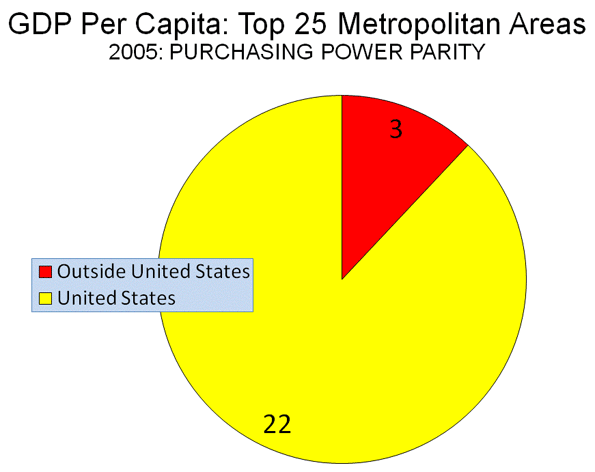
    • The US has 8 of the 10 richest metropolitan areas in the world. Only Stockholm, at number 9, joins Brussels in the top 10 from outside the United States.
    • The US has 22 of the top 25 metropolitan areas (Figure)
    • 37 of the most affluent 50 metropolitan areas are in the United States. By contrast, Mercer ranks only seven US “cities” in the top 50.
    • 46 of the 70 richest metropolitan areas are in the United States

    Only one of the 51 US metropolitan areas with more than 1,000,000 fails to make the top 100 in the world, Riverside-San Bernardino ($25,800), which could just as easily be considered a part of the Los Angeles metropolitan area, just as San Jose could be considered a part of the San Francisco metropolitan area.

    Outside the United States: Outside the United States, the metropolitan areas of Australia and Canada perform best relative to their size. All five of Australia’s largest metropolitan areas placed in the top 100, with one in the top 50. Five of Canada’s six top metropolitan areas made the top 100, with one in the top 50. Europe placed 33 of its metropolitan areas in the top 100, with 11 in the top 50 and 22 in the second 50.

    The top 100 list provides some surprises.

    • One eastern European metropolitan area has already entered the top 100. Prague ranks 48th, with a GDP per capita of $42,400, which is more than Frankfurt or Phoenix.
    • London, arguably the world’s financial capital, ranks 44th, at $42,700. Some listings show London much higher, however such rankings exclude the outer portion of the metropolitan area, which these estimates include.
    • Tokyo-Yokohama ranks 79th, at $35,700. This ranking is lower than others, which either ignore purchasing power or exclude most of the metropolitan area by focusing only on the high income core (the prefecture of Tokyo).
    • The world’s two large “city-states,” Singapore and Hong Kong also make the list. Singapore ties Louisville and Sacramento at 53rd, with a GDP per capita of $41,500. Hong Kong ranks 79th, at $35,700. Moreover, it would not be surprising if other Chinese metropolitan areas begin to break into the top 100 over the next decade.

    Ranking Metropolitan Areas for People: American metropolitan areas provide their residents a superior standard of living. True enough, the mountains and water features of Vancouver or Zurich are superior to those of Oklahoma City or Charlotte. However, the average resident does not have enough money to spend much time boating in Vancouver or Zurich or taking in what may be a better cultural life. The standard of living may well be better for those with money in Vancouver, Vienna, Melbourne or Zurich than it is in an American metropolitan area. However, most people cannot afford to live like financiers and other “jet-setters.” For everyday people, the American metropolitan area remains the best place in the world to live.

    Table 2
    Top 100 World Metropolitan Regions 
    Gross Domestic Product per Capita: 2005 Estimates
    Purchasing Power Parity
    Metropolitan Areas over 1,000,000 Population
           
    Rank Nation Metropolitan Area GDP per Capita
    1 United States San Jose $78,700
    2 United States Charlotte $67,900
    3 United States San Francisco $65,400
    4 United States Washington $65,300
    5 Belgium Brussels $63,700
    6 United States Boston $59,000
    7 United States Seattle $57,600
    8 United States New York $56,200
    9 Sweden Stockholm $55,100
    10 United States Hartford $55,000
    11 United States Denver $54,700
    12 United States Minneapolis-St. Paul $54,600
    13 Germany Hamburg $53,500
    14 United States Dallas-Fort Worth $53,000
    15 United States Houston $51,900
    16 United States Indianapolis $51,800
    17 United States Philadelphia $50,100
    18 United States San Diego $50,000
    19 United States Atlanta $49,600
    20 United States Los Angeles $49,100
    21 United States Chicago $48,400
    22 United States Salt Lake City $48,200
    23 United States Milwaukee $47,800
    24 United States Nashville $47,700
    24 United States Columbus (Ohio) $47,700
    26 United States Las Vegas $47,400
    27 Austria Vienna $47,000
    28 Australia Perth $46,700
    29 United States Portland (Oregon) $46,600
    30 United States Kansas City $46,400
    31 United States Richmond $46,200
    32 United States Orlando $45,900
    32 United States Cleveland $45,900
    34 France Paris $45,700
    35 United States Memphis $45,500
    35 United States Detroit $45,500
    37 United States Austin $45,300
    37 United States Raleigh $45,300
    39 Ireland Dublin $44,300
    40 Germany Munich $43,800
    40 United States Baltimore $43,800
    42 United States Birmingham $43,500
    43 United States Miami $42,900
    44 United Kingdom London $42,700
    44 Denmark Copenhagen $42,700
    46 Canada Calgary $42,600
    46 United States Cincinnati $42,600
    48 Czech Republic Prague $42,400
    48 United States Phoenix $42,400
    50 Netherlands Utrecht $41,900
    51 Germany Frankfurt $41,800
    52 United States New Orleans $41,600
    53 United States Sacramento $41,500
    53 United States Louisville $41,500
    53 Singapore Singapore $41,500
    56 United States Pittsburgh $41,400
    57 Canada Ottawa $41,200
    57 United States Jacksonville $41,200
    59 Netherlands Amsterdam $41,000
    60 United States St. Louis $40,900
    61 France Lyon $40,400
    62 Australia Sydney $40,100
    63 Norway Oslo $40,000
    64 United States Rochester $39,900
    65 Italy Milan  $39,100
    66 United States Virginia Beach $39,000
    67 Canada Toronto $38,200
    68 Belgium Antwerp $37,900
    68 United States Tampa-St. Petersburg $37,900
    68 Australia Brisbane $37,900
    71 Canada Vancouver $37,600
    72 Australia Melbourne $37,100
    73 Japan Nagoya $37,000
    74 Switzerland Zurich $36,900
    75 United States Oklahoma City $36,800
    76 Germany Stuttgart $36,700
    77 United States Providence $36,100
    78 Germany Nuremburg $35,900
    79 Japan Tokyo-Yokohama $35,700
    79 China Hong Kong $35,700
    81 Netherlands Rotterdam-Hague $35,600
    82 Spain Madrid $35,500
    83 Italy Rome $35,400
    84 New Zealand Auckland $35,300
    84 Finland Helsinki $35,300
    86 Canada Edmonton $35,200
    87 Greece Athens $34,700
    88 Spain Bilbao $34,600
    89 France Toulouse $34,500
    90 Italy Turin $34,200
    90 United States San Antonio $34,200
    92 Australia Adelaide $33,500
    93 United States Buffalo $33,400
    94 Japan Shizuoka-Hamamatsu $32,500
    95 Spain Barcelona $32,300
    96 Japan Fukuoka-Kitakyushu $31,300
    97 Germany Cologne $31,000
    98 France Marseille $30,400
    99 Germany Essen-Dusseldorf $30,200
    100 Germany Hannover $29,900
    (1) Purchasing power parity. Metropolitan areas over 1,000,000 population for which data is available. Based upon data from Eurostat, US Bureau of Economic Analysis and Japan Statistics Bureau. 
    (2) US data for metropolitan areas from Bureau of Economic Analysis. Scaled to World Bank 2005 GDP PPP figure.
    (3) European data for metropolitan regions from Eurostat regional data. There is no generally accepted metropolitan area definition in Europe. Scaled to World Bank 2005 GDP PPP figure.
    (4) Japan data from Japan Statistics Bureau Scaled to World Bank 2005 GDP PPP figure.
    (5) London metropolitan area is Greater London plus the historic counties of Berkshire, Buckinghamshire, Essex, Herfordshire, Kent and Sussex (including unitary authorities), which are adjacent to the London green belt. Some London metropolitan region GDP estimates exclude suburban areas outside the Greater London Authority. This analysis includes these suburban areas, using GVA scaling from UK National Statistics to estimate non-metropolitan contribution included in Eurostat data (Bedfordshire, Oxfordshire, East Sussex and West Sussex).
    (6) Estimates for the following metropolitan areas scaled to 2005 from 2002 estimates using the closest available change estimate (metropolitan, state/provincial or nation) of the change in GDP per capita (http://www.demographia.com/db-gdp-metro.pdf): Metropolitan areas in Australia and Italy as well as Essen-Dusseldorf, Lyon, Marseille, Dublin, Auckland, Oslo, Zurich, Vancouver, Toronto and Ottawa.
    (7) Metropolitan area data for Calgary and Edmonton estimated from local sources.

    Note 1: Another problem with these kinds of rankings is that can be misleadingly unrepresentative. For example, Mercer ranks more than 200 “cities,” which sounds like a significant number. By cities, Mercer appears to mean municipalities (the website is unclear and Mercer has not responded to our request for clarification of what they mean by “city”), of which there are many in all first world metropolitan areas. Some have as few as 50,000 to 100,000 residents. Mercer ranks White Plains, New York (population: 57,000), in the New York metropolitan area, but has no ranking for the many larger cities in the metropolitan area, except for New York itself. Considering that the United States alone has nearly 275 municipalities of more than 100,000 population, the Mercer list appears to be far from comprehensive.

    Note 2: The national purchasing power parity conversion factor does not permit comparison of standards of living within nations. For example, anecdotal data would indicate that the cost of living is considerably higher in the San Jose, San Francisco and New York metropolitan areas than in the rest of the country. While not generally available, a purchasing power parity analysis within the United States could show metropolitan areas with lower GDPs per capita to have superior standards of living.

    Note 3: The European Union does not formally delineate metropolitan areas, however provides regional data that in most cases is a rough approximation of metropolitan areas.


    Wendell Cox is a Visiting Professor, Conservatoire National des Arts et Metiers, Paris. He was born in Los Angeles and was appointed to three terms on the Los Angeles County Transportation Commission by Mayor Tom Bradley. He is the author of “War on the Dream: How Anti-Sprawl Policy Threatens the Quality of Life.

  • Germany’s Green Energy Goals Are Potentially Unrealistic

    The world looks to Germany to be a leader in Green Energy. There’s been a great deal of hype surrounding Chancellor Angela Merkel’s very ambitious goals of dramatically reducing the county’s emissions by 2020.

    Yet the German experience should also provide some pause to President Obama and others proposing such changes in the United States. It turns out that goals are potentially unrealistic, perhaps even dangerous, for numerous reasons. One reason that makes them so unrealistic is that they are seriously hamstrung by effectively cutting off the single largest source of CO2-free energy available anywhere in the world right now: Nuclear Power.

    This reflects how much Germany has been influenced by green politics. In the years of the Socialist-Green government stretching from 1998 – 2005, nuclear power was considered an anathema. The Green party has its roots in the anti-nuclear power movement of the seventies. One of the most important items on their agenda when they came into power was to completely eliminate Germany’s use of nuclear power in the now infamous Atomaustieg or Nuclear exit which mandated that Germany no longer use nuclear power by the year 2020.

    When Chancellor Merkel took power under the Grand Coalition of Christian Democrats and Social Democrats, this policy remained in place even as the government pledged it would dramatically lower Greenhouse Gases by 2020 as well. Although the Christian Democratic Union (CDU) has been arguing for a repeal of the ban on nuclear power, the coalition continued to eliminate this most effective means of GHG reduction, placing its bets on conservation and renewable energy.

    Ironically Germany remains one of the leading countries when it comes to nuclear technology. Areva, France’s nuclear leviathan has a large R&D facility here in Germany, where I myself once worked as an English language trainer. The German engineers working here in Erlangen are regularly sent abroad to help with the building and maintenance of nuclear plants throughout Europe and the rest of the world. German engineering is being used in Finland, Bulgaria, and Sweden. Some of the engineers have even helped build a high-pressure reactor in Lynchburg, Virginia. I have worked with these people and they include some of the best minds in the field.

    Germany’s desire to reduce greenhouse gases and live without nuclear power has taken some almost absurd turns over the years. For one thing, Germany appears to be turning to its single cheap and abundant supply of energy, albeit a very dirty one, coal. Germany has both some cleaner anthracite and a lot of very dirty bitumen mines. These mines provide an enormous portion of Germany’s electricity and are also one of the reasons why Germany’s lights won’t go off even if all the nuclear plants are turned off. Coal power plants are being built across the country – even the Greens in the Hamburg government have allowed massive plant to be built in the city with some very strict regulations.

    The single most absurd aspect of the Green’s desire to eliminate Germany’s reliance of nuclear power are massive subsidies that it has provided for both solar and wind power generation. Germany, while not the gloomiest country in Europe, is not exactly sunny. It has huge annual amounts of precipitation and dark, grey winters. Subsidies, as well as its renowned industrial prowess, have turned the country into one of the leading producers of solar power.

    Yet this is not an unalloyed advantage – despite the constant claims made about “green jobs“ here in Europe as well as North America. Solar power is enormously expensive and inefficient here, most notably lacking the reliability needed by all major power suppliers. It only produces power when the sun shines, and it is very tricky to store the energy created, especially with photovoltaic sources making it enormously expensive. Some forms of solar power have been able to store off-peak power production; the parabolic-trough plants in Andalusia or the Mojave deserts use molten salts stored en masse to assure 24-hour supply, but these technologies, though provided by German companies, cannot be implemented in Germany itself due to the lack of intense sunshine about 6 months out of the year.

    And then there’s wind. Wind has all of the drawbacks of solar but the advantage that Germany is at least fairly windy. Wind power has taken off here and the Baltic and North Sea coasts are dotted with enormous wind parks. The costs are still enormous and wind or solar power are still far more expensive than standard sources of power. A May 12, 2008 editorial in the Wall Street Journal stated: “For electricity generation, the EIA concludes that solar energy is subsidized to the tune of $24.34 per megawatt hour, wind $23.37 and ‘clean coal’ $29.81. By contrast, normal coal receives 44 cents, natural gas a mere quarter, hydroelectric about 67 cents and nuclear power $1.59.”

    Costs have come down recently due to the explosive growth in the sector over the last few years. The U.S. Energy Information Administration estimates that wind costs $55.80 per MWh, coal at $53.10/MWh and natural gas at $52.50, and the costs for wind fail to take into consideration the costs of owning and operating a conventional power plant to provide energy when the wind is not blowing. Explosive growth over the last few years has allowed companies to exploit the economies of scale created by large-scale production. German wind-turbine producers have been able to maintain a fairly large presence on the market but have been muscled out recently by American and Indian manufacturers. Wind-power will never be able to provide more than 20% of the power mix by most projections. As with solar, there is insufficient storage technology affecting solar; the appropriate areas have been built out. There have been murmurs about the possibility offered by off-sea wind parks but these are also enormously expensive to build and maintain.

    Germany has shunned nuclear and coal in an attempt to use wind and solar. Renewable sources are not only much more expensive but also cannot begin to provide the amount of energy at economical rates. Germans are also big fans of natural gas but the problem is Germany has very little of it. Germany has had to import its natural gas, some from fairly reliable partners like the Netherlands and the United Kingdom but mostly from an increasingly assertive and authoritarian Russia.

    So rather than promote independence in energy, Germany’s green policies are making it ever more dependent on an autocracy. Even under the Soviets, Germany’s wet winters were made more commodious with the pleasant warmth provided by Russian gas. Schroeder and Putin were the best of friends, aided by the fact that Putin spoke fluent German from his time running the KGB station in Dresden, Germany. When Schroeder was fired by the German people he quickly found employment as a lobbyist for Gazprom, the Russian energy titan.

    This leaves Germany with a series of problems with no pleasant solution. It can either lift the ban on nuclear power or extend the lives of its plants as Sweden has already done. It can build a lot more coal-fired power plants, which Vattenfall is now trying to do in Hamburg, or it can opt for conservation, renewable energy and economic stagnation. The latter seems to be the path that Germany has chosen. Economic stagnation or even moderate economic growth or slight contraction might not be so bad for Germany. It has none of the demographic pressures driving dynamism and growth in America. The green ideologues driving German policy argue that renewable and conservation of energy are Germany’s only hope. To them, green principles are well worth the price in demographic and economic stagnation.

    Kirk Rogers resides in Bubenreuth on the outer edges of Nuremberg and teaches languages and Amercan culture at the University of Erlangen-Nuremberg’s Institut für Fremdsprachen und Auslandskunde. He has been living in Germany for about ten years now due to an inexplicable fascination with German culture.

  • Is Germany the Planners’ Valhalla?

    Urban planners and anti-sprawl advocates point to Germany as a wonderland of appropriate land use. It is true that Germany has been better at preserving open space between former villages; the non-stop development that seems continuous throughout most of the United States cannot be found here.

    However, this triumph of planning has also come at a cost, in terms of affordability, and has kept a large percentage of the population from being able to own their own home. Germany is expensive because of forced scarcity of land and an extremely unproductive building industry, with certain peculiarities of German culture creating additional costs.

    The reasons for the lack of productivity in the German housing industry stretch back to land holding patterns in the Middle Ages, when the southern and western provinces of Germany were divided into countless small duchies and bishoprics. These small holdings stayed in the families for generations and prevented the consolidation of plots. The large plots common in America are all but impossible to find, depriving the building industry of the economies of scale possible in most of America. This in turns negatively affects the cost of housing, pushing home prices higher than they need be.

    There are also the vested interests of those who have bought into the German Dream and do not want to see their homes lose value. The German Statistics Agency issued a report stating that the average home in Germany is worth 6.1 times the average income. According to demographia.com anything above 3.0 is expensive.

    Blame can be placed on two factors. The first is that the productivity of German builders is far lower than that of American builders. KB homes can produce a house for about $400 per square meter and the cheapest German builders charge $1,300 per square meter (both prices do not include the price of land). A recent New York Times article stated that a passive house filled with expensive high-tech gadgetry only costs about 9% more than a standard German house. No wonder, when a standard German house costs 300% more than an average American house. Not all European countries have such high building costs; the Dutch are actually able to build housing stock at American prices; the problem in the Netherlands is the enormous costs associated with clawing a country from the North Sea. Nevertheless, Dutch builders are able to more easily assemble large plots of land on the reclaimed islands.

    Choices in building materials also play a role. Germans tend to prefer heavy and expensive concrete and brick construction over wood and steel-framed houses. A lot of Germans travelling to the US invariably will express their shock at how flimsy many American houses seem. Many Germans want to have a basement as well, even though the winters are more than mild enough here to allow for simple concrete slabs. The preference for basements and solid construction have a lot to do with owning a building that will not burn down in an incendiary bomb attack and a basement for the family to hide out in should the apocalypse come again.

    The collective trauma of the twentieth century lives on in the contemporary German psyche. Germans have learned their lesson from history and many of them are genuinely ashamed of it. The threat of imminent destruction was only recently lifted: up until 1989 the allied defense plans put the first line of real resistance on the Rhine, meaning that the entire country would have probably been flattened before the Allies could stop the forward thrust of the Red Army.

    Another factor is the huge mobility tax that the German government slaps on its citizens. The German government charges a punitively high tax for each liter of gasoline sold, equal to 80% of the price paid for fuel. Germans still drive a lot: the country invented the freeway and the ease and opportunity that an automobile offers still trumps the government billions spent on public transit. The German Sueddeutsche Zeitung, (the German equivalent of the New York Times) wrote a lengthy article, stating essentially that the automobile has survived every dire threat that it has faced over the last hundred years and will probably remain the king of the road. At least, they added, until a transit approaches the convenience and flexibility offered by the car. As it is, most new construction still takes place in the outer suburbs.

    Germans love the woods. German identity since the time of Tacitus is closely linked with the woods. Herman the German was able to use the cover of the forest to wipe out the Roman legions in the Teutoburger Forest. The folklore costumes that one occasionally sees here are almost always hunter green. Many Germans do not necessarily see nature as the unscathed landscape made to order by God. The forest is not wild here; it is an almost entirely man-made affair. German forests are essentially tree farms but Germans love them. They use these forest preserves as well. They are a ritualized part of the landscape, every Sunday they fill with locals walking off their Sauerbraten.

    In Germany, the natural world is something already conquered; it is viewed as something useful, a garden that the Germans themselves are stewards to. It is not the vast pristine wilderness of America. It is more like a vast public garden. German farmers and foresters have to allow pedestrians the right to walk on their land. Open space is also public space. The positive side is that the livability in many of these communities is much higher for those who can afford it. There is always a forest or a bike path/jogging path somewhere nearby.

    Germany is still rather affordable compared to other European countries, especially those that were caught up in the real estate bubble of the last decade. France, The Netherlands, Switzerland and Ireland have all experienced housing booms that have pushed the median multiple for housing affordability well above 6 to 7 or 8 and in places like Ireland and the greater London area to well above 10. Prices are also shrinking in the East, which is losing people every year.

    The East is actually one of the more interesting markets due to its loss of people and resulting housing price slumps. Government infrastructure investments could turn the Leipzig and Jena areas as well as Dresden into potential growth markets. Certain areas like the east and the Ruhr Valley, where cities like Bochum and Monchengladbach are worse off than some parts of the East.

    Germany, along with most of Europe, cannot be transposed to the US. The sundry factors contributing to its present-day appearance are not replicable in the US. Germany is a place of small plots and inefficient builders with prices severely limiting home ownership. It is not all bad, especially for those already in place. However, it limits Germans ability to improve their quality of life. Germans, like the vast majority of citizens in industrialized countries, prefer the speed, convenience and comfort of the automobile. Germans, for better or worse, saw how the conquerors from the US lived and tried to emulate it in their own lifestyles. Many still see America as a role model, even though that will not stop the cognoscenti here from writing sanctimonious articles condemning America and trying to stop cities from “sprawling”.

    Kirk Rogers resides in Bubenreuth on the outer edges of Nuremberg and teaches languages and Amercan culture at the University of Erlangen-Nuremberg’s Institut für Fremdsprachen und Auslandskunde. He has been living in Germany for about ten years now due to an inexplicable fascination with German culture.

  • The Former East Germany: Is It Time for Red Nostalgia?

    2009 marks the 20th anniversary of the reunification of East and West Germany into one country. Germany was divided into two separate nations with competing economic and political ideologies. Now it’s time to reassess the results of this melding of two very different systems and the impact on the urban environment.

    Emerging from the ashes as one of the world’s most powerful economies, Germany may be the quintessential example of the triumph of capitalism over communism. Yet now with Frankfurt’s powerful banking sector reeling from the global economic meltdown, reticent Marxists may well be coming out of the woods to proclaim the death of capitalism.

    The sentiment for a bygone communist dream still exists for a small minority of those living in the former German Democratic Republic (GDR), where the unemployment rate has hovered around 18% since reunification. After a recent trip, it seems clear economic growth has stagnated. Job opportunities remain very limited. Rather than attract people with its lower costs and new opportunities, the region continues to see a strong outflow, particularly among the young.

    Yet all is not hopeless in the area comprising the former GDR. The crumbling of the wall and subsequent mass exodus of East Berliners to the west may remain the most vivid symbol of reunification, but the story remains decidedly mixed in Leipzig – the second largest city in the former GDR after Berlin.

    Leipzig can be considered the birthplace of the anti-communist revolution. On October 9th, 1989, in what is known as the “Monday Demonstrations”, protests in Leipzig (pronounced lipe-tsig) came to a head. In what some feared at the time would become another Tiananmen Square nightmare, 70,000 demonstrators peacefully took to the streets chanting, “We are the people”. The Monday Demonstrations served as a turning point in the quest towards reunification. Having witnessed the courage of the citizens of Leipzig, others trapped in the GDR came out and made their voices heard. One month after the Monday Demonstrations, the Berlin Wall came down.
    With just over 500,000 residents, Leipzig is the largest city in the German state of Saxony. Roughly 90 miles south of Berlin, the city lives in the shadow of the much more “sexy” and culturally apt German capital.

    The city has a considerable history, even prior to the events following World War II. Leipzig residents included such notable individuals as the mathematician Gottfried Leibniz and composers Johann Sebastian Bach, Richard Wagner, and Felix Mendelssohn. The playwright Goethe attended the University of Leipzig and referred to the city as ‘little Paris’ in his seminal work Faust. In 1813, Napoleon Bonaparte and his troops were dealt a strategic defeat there in what became known as ‘The Battle of Nations’. More recently, Carl Friedrich Goerdeler, the Mayor of Leipzig from 1930 to 1937, is remembered as being one of the staunchest opponents of the Nazi regime.

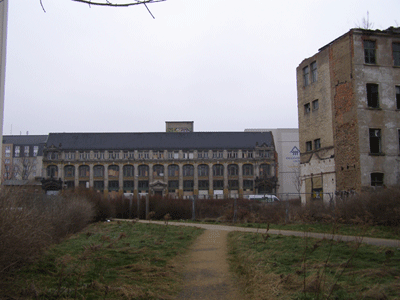
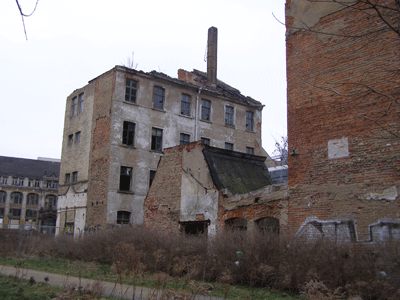
    It is difficult to imagine the breadth of this history while traversing the streets of Leipzig today. The city still certainly has its share of old and beautiful architecture, but much of this is now abandoned, with many structures adjacent to the central core covered in graffiti. In this regard, Leipzig looks like the German equivalent of a decaying American rust-belt city.

    The derelict atmosphere that a new visitor may sense upon arriving in Leipzig is at least partly due to the fact that many long-time residents still live in Soviet-style communist housing blocks at the peripheral edges of the city. Known as Plattenbau, or “plate buildings”, these ubiquitous and dehumanizing structures were communism’s answer to the issue of quickly re-housing East German citizens displaced by the ravages of war. Building these massive housing structures far outside the center also had the advantage of locating workers closer to places of industry.
    Taking into account Leipzig’s urban planning policies under communism, it is no wonder that neighborhoods near the city center appear neglected. Yet, stepping into the pedestrian-only heart of the city also tells a much more encouraging story. Unlike the often failed policies of many American cities to spur a “downtown renaissance”, Leipzig has had considerably more success at revitalizing its once thriving core.

    This is apparent by the number of construction sites around Leipzig’s central core. The city still has the advantage of possessing a significant stock of aesthetically appealing buildings, ranging in style from Baroque to Neoclassical. Furthermore, the University of Leipzig, one of Germany’s oldest, has taken the lead in making the city center a destination by consolidating its operations there. Currently, the University is constructing a new main building off of the city’s main square, Augustusplatz (formerly known as Karl-Marx-platz during the GDR).

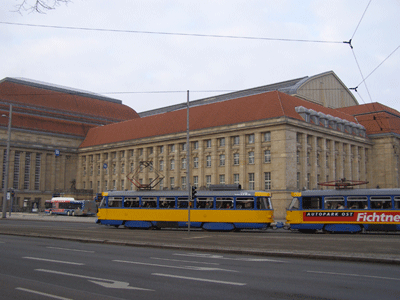
    Public transportation is also a bright spot for Leipzig. Modern streetcars ride above ground to the outer limits of this concentrically laid out city. The efficiency of the streetcar system would turn any American public-transportation proponent green with envy. Moreover, the construction of an ambitious underground metro system is slated to be completed next year, further easing mobility for Leipzigers.

    Leipzig’s location in the central-north portion of continental Europe also has its advantages. As a node for the transport of goods and people through central Europe, the city serves as a bridge between Germany and the once burgeoning but now suffering Eastern European nations. Even so, over time it would be in the city’s best interest to further capitalize on this asset.

    Adding clout to Leipzig’s location as a transportation hub is the city’s central train station – one of Europe’s largest and most historically significant. Grand in scale, Leipzig’s Hauptbahnhof not only sees a great deal of rail traffic from all over Germany, the station doubles as a shopping center for those living in the city. Practically a second “downtown”, the central station boasts everything from a constantly busy grocery store to clothing boutiques, numerous cafes and even two McDonald’s franchises.

    Despite its inspiring history, famous university and state-of-the-art transportation, Leipzig still faces tremendous challenges ahead. The city is not only struggling to attract newcomers but to retain a new generation of Germans born to parents who still remember what it was like to live in the GDR. Economically speaking, Leipzig stands little chance competing with other German cities in the west such as Frankfurt, Cologne or Munich where there are many more job opportunities. Aside from a plant that assembles Porsche’s struggling Cayenne line of SUVs – itself now threatened for both economic and environmental reason – industrial activity in Leipzig is limited. And with the Bohemian behemoth of Berlin not far away, Leipzig would be hard pressed to realize a full renaissance of its status as a prime destination for arts and culture.

    What does this mean for the future? In a sense, Leipzig’s problem is the same problem facing the entire region that comprises the former German Democratic Republic. The issues have been hotly debated in Germany since reunification. Some in the western parts of the country regard cities in the east as a lost cause. Contributing to the contentiousness of the debate is the ‘Solidarity Tax’ instituted to aid in the reunification process. At a rate of 5.5% of annual income tax, many Germans feel their tax dollars are being squandered on frivolous projects in the former GDR – projects that will have little to no impact on those living in the west.

    The renovation of the city center and the construction of the new Leipzig underground metro are examples of projects that benefit from funding from the Solidarity Tax. The key issue now is to see if the eastern cities themselves can use the generous government support and newfound infrastructure to stimulate economic activity and create jobs that will keep people from leaving for good. If this is not addressed immediately, the future of the former GDR looks bleak. The last thing Germany needs, especially in these times of global economic turmoil, is for those living in the east to become nostalgic for the days before the fall of the Iron Curtain.

    Adam Nathaniel Mayer is a native of the San Francisco Bay Area. Raised in the town of Los Gatos, on the edge of Silicon Valley, Adam developed a keen interest in the importance of place within the framework of a highly globalized economy. He currently lives in San Francisco where he works in the architecture profession.

  • Euroburbia: A Personal View

    The image of the European city as a tourist’s paradise of charming inner-city neighborhoods interconnected by high-speed rail networks is not entirely false, but it does not give the full picture of how most Europeans live. Contrary to the mythology embraced by romantics among planners and ‘green’ politicians, urban areas of Europe sprawl just as much as any American or Western city.

    Of course, there are the wealthy and often childless few who live in the renovated urban cores – but at much lower density than at any time in their history. Instead of crowding picturesquely into city, the teeming hordes of the middle class have sought their refuge in the arboreal outskirts. They drive from their single-family homes and townhouse developments to their offices in old city centers, in business parks on the edge of the center and to other villages with massive industrial parks attached to them.

    As a result Germany has long since ceased to be the country that one sees in Grimm’s Fairy Tales or Goethe. Much of it looks like America or Canada. Freeways interconnect exurban villages swelling with housing developments and industrial parks. The German dream is a lot like the American one, only with more rules.

    The most interesting factor is the diversity of these suburbs. They are still predominantly German, but then again so is the country. I live in an exurb of Nuremberg in northern Bavaria. It was the city of Dürer and Hans Sachs as well as the infamous Nazi rallies and post-war trials. It still has castles from the Medieval past, but the need for labor to rebuild destroyed cities – and eventually the resulting prosperity – in the post-war years saw new faces and cultures arrive with immigrants from countries like Turkey.

    Just like in America, many of these newcomers worked until they retired and decided that they wanted to stay. Some of their children are having trouble but not all of them. The children that move out of their neighborhoods to the suburbs integrate better because their parents tend to be more prosperous and thus resent Germany less. The other reason is the fact they are more exposed to the language. Cem Ozdemir was just elected as leader of the Green Party here and he does not speak the pidgin common among a lot of Turkish immigrants. I moved to the suburbs for much the same reason. My wife and I are both non-native speakers but we know that if our children are going to succeed they will need to speak German well and act like Germans. Ideally they will become hyphenated Germans, as in American-Croat-Germans, which is roughly what they would be.

    Of course, some recent newcomers still huddle in their ghettos here, the soulless housing estates built to satisfy Le Corbusier’s destructive urban fantasies. But a lot of them are moving out and up. Their ultimate dream is not a castle or a turn of the century apartment. They want their own house. They want decent schools for their kids, a place to park their cars and easy access to work. That is why they are here and not in their old neighborhoods.

    But diversity is a relatively new benefit of German suburbs. We also moved here for a basic need of space. We had lived in the inner city in a charming apartment but one that simply could not hold kids. It felt cramped just as our offspring popped out.

    There’s also one often-unrecognized advantage to our suburbia: a stronger feeling of neighborhood. Germany is a country of renters. It can be fairly alienating when the residents have little vested interest in where they live. A lot of rental apartments are in buildings that are anything but charming. Here in the suburbs of Germany almost everybody owns their own home. One street is actually named Eigenheimstraße, which translates to Privately-owned-home Street. It is an indication of the pride that Germans have in being able to say that a house belongs to them. They also lovingly tend their yards and fill them with garden gnomes – some harmless, some borderline obscene – and other bric-a-brac that fills countless yards across the urban expanses of America.

    Then there are the schools. The school system here in Germany is fairly uniform with secondary schools more or less standardized. Performance at the elementary school level is vital: children are clearly, quickly and brutally sorted here. At the age of ten, the teachers decide if a child is going to go to college, vocational school or rot in the festering hell of the Hauptschule. The latter is nothing more than a storage facility for tomorrow’s losers.

    We moved to make sure that our neighborhood was mainly German. We wanted to make sure that our children were comfortable with the language and they needed friends who spoke German to feel that way. Most immigrant children fail for the simple reason that they don’t speak German at home, and in pre-school most of their friends speak their parents’ native language as well. This means that they speak Turkish or Russian well but can barely express themselves in German. This then puts them at a disadvantage when working their way through the school system. They have to take remedial language courses. The suburbs allow them to avoid all that.

    The last reason is a place to park our cars. Germans love cars. They love engineering and are very proud of their car industry. They design cars that are the epitome of luxury and performance. Most Germans do not drive cars like this, yet stubbornly continue to own cars despite the government’s multiple efforts to make it too expensive. We pay hefty gas taxes in an effort to fight the “Green House effect,” but most of us feel that it’s just an excuse for the government to steal our money in order to pay for its bloated welfare system.

    Car-ownership in Europe is almost at American levels and Europeans, despite the much-ballyhooed efforts to introduce bikes in Paris, will continue to drive. As in America, the anti-car and anti-suburban ideologues are loud and active, but as long as people prize security, privacy, space and mobility, it’s likely Europe’s version of the suburban American dream will continue to thrive for years ahead.

    Kirk Rogers resides in Bubenreuth on the outer edges of Nuremberg and teaches languages and Amercan culture at the University of Erlangen-Nuremberg’s Institut für Fremdsprachen und Auslandskunde. He has been living in Germany for about ten years now due to an inexplicable fascination with German culture.