Tag: GHG

  • New Climate Report Misses Point on US Cities

    The doubtful claim that low density US cities impose a cost to the economy of $400 billion is countered by their being the most affluent in the world. Nine of the top 10 cities in GDP per capita are in the US and more than 70% of the top 50. The highest GDP per capita city in the world is one of the least compact, Hartford, with an urban population density among the bottom 10 out of more the than 900 urban areas larger than 500,000 (See here and here).

    Mobility is an important driver of economic performance. US cities have less traffic congestion, and shorter work trip travel times than their international peers (Los Angeles has the shortest work trip travel times of any megacity for which there is data). The key to this productivity is more dispersed residential and employment locations (less than 10% of jobs are downtown) and the less intense traffic congestion that is associated with such development. In the US, just as in Western Europe, commuting by car is much faster than by transit. The coming fuel efficiency improvements will narrow or eliminate the gap between personal vehicle and transit GHG emissions per passenger kilometer. US fuel efficiency standards are projected to reduce gross car GHG emissions by more than a quarter by 2040, according to the US Department of Energy. That’s before any de-carbonization.

    The US has some of the best housing affordability in the world (excluding cities like San Francisco and Portland, where politically correct policies raise prices, lowering the standard of living and increasing poverty). The miniscule reductions from favored urban policies are exceedingly expensive per tonne and incapable of making a serious contribution to GHG emission reduction.

    Maintaining the standard of living and reducing poverty requires cities that are mobile and affordable. It is important that GHG emissions reductions be chosen for their cost effectiveness, rather than consistency with expensive academic theories that long predate GHG emissions reduction concerns.

    This piece was posted to comments at The Economist.

  • What Conservatives Can Teach Liberals About Global Warming Policy

    Over the last decade, progressives have successfully painted conservative climate skepticism as the major stumbling block to reducing greenhouse gas emissions. Exxon and the Koch brothers, the story goes, fund conservative think tanks to sow doubt about climate change and block legislative action. As evidence mounts that anthropogenic global warming is underway, conservatives’ flight from reason is putting us all at risk.

    This week’s release of a new United Nations Intergovernmental Panel on Climate Change report opens another front in the climate wars. But beneath the bellowing, name-calling, and cherry-picking of data that have become the hallmark of contemporary climate politics lies a paradox: the energy technologies favored by the climate-skeptical Right are doing far more to reduce greenhouse gas emissions than the ones favored by the climate-apocalyptic Left.

    How much more? Max Luke of Breakthrough Institute ran the numbers and found that, since 1950, natural gas and nuclear prevented 36 times more carbon emissions than wind, solar, and geothermal. Nuclear avoided the creation of 28 billion tons of carbon dioxide, natural gas 26 billion, and geothermal, wind, and solar just 1.5 billion.

    Environmental leaders who blame “global warming deniers” for preventing emissions reductions point to Germany’s move away from nuclear and to renewables. “Germany is the one big country that’s taken this crisis seriously,” wrote Bill McKibben. Other progressive and green leaders, including Al Gore, Bill Clinton, and Bobby Kennedy, Jr., have held up Germany’s “energy turn,” theEnergiewende, as a model for the world. 

    But for the second year in a row, Germany has seen its coal use and carbon emissions rise — a fact that climate skeptical conservatives have been quick to point out, and liberal environmental advocates have attempted to obfuscate. “Last year, Germany’s solar panels produced about 18 terawatt-hours (that’s 18 trillion watt-hours) of electricity,” noted Robert Bryce from the conservative Manhattan Institute. “And yet, [utility] RWE’s new coal plant, which has less than a 10th as much capacity as Germany’s solar sector, will, by itself, produce about 16 terawatt-hours of electricity.

    Reagan historian Steven Hayward, formerly of the American Enterprise Institute, noted in the conservative Weekly Standard earlier this week, “Coal consumption wentup 3.9 percent in Germany last year. Likewise, German greenhouse gas emissions — the chief object of Energiewende — rose in Germany last year, while they fell in the United States.”

    Emissions fell in the United States thanks largely to a technology loathed by the Left:fracking. From 2007 to 2012, electricity from natural gas increased from 21.6 to 30.4 percent, while electricity from coal declined from 50 to 38 percent — that’s light speed in a notoriously slow-changing sector. And yet the Natural Resources Defense Council, Sierra Club, and most other green groups are working to oppose the expansion of natural gas.

    Hayward and Bryce are two of the most respected writers on energy and the environment on the Right. Both are highly skeptical that global warming poses a major threat. Both regularly criticize climate scientists and climate models. Both men are regularly attacked by liberal organizations like Media Matters for working for organizations, the American Enterprise Institute and Manhattan Institute, respectively, that have taken money from both Exxon and the Koch brothers. And yet both men are full-throated advocates for what Bryce calls “N2N” — accelerating the transition from coal to natural gas and then to nuclear.

    Arguably, the climate-energy paradox is a bigger problem for the Left than the Right. One cannot logically claim that carbon emissions pose a catastrophic threat to human civilization and then oppose the only two technologies capable of immediately and significantly reducing them. And yet this is precisely the position of Al Gore, Bill McKibben, the Sierra Club, NRDC, and the bulk of the environmental movement.

    By contrast, there are plenty of good reasons for climate skeptics to support N2N. A diverse portfolio of energy sources that are cheap, abundant, reliable, and increasingly clean is good for the economy and strengthens national security – all the more so in a world where energy demand will likely quadruple by the end of the century.

    Why then is there so much climate skepticism on the Right? One obvious reason is that climate science has long been deployed by liberals and environmentalists to argue not only for their preferred energy technologies but also for sweeping new regulatory powers for the federal government and the United Nations.

    But here as well, the green agenda hasn’t fared well. Those nations that most rapidly reduced the carbon intensity of their economies over the last 40 years did so neither through regulations nor international agreements. Nations like France and Sweden, which President Obama rightly singled out for praise earlier this month, did so by directly deploying nuclear and hydroelectric power. Now the United States is the global climate leader, despite having neither a carbon price nor emissions trading, thanks to 35 years of public-private investment leading to the shale gas revolution. Meanwhile, there is little evidence that caps and carbon taxes have had much impact on emissions anywhere.

    In the end, both Left and Right reject a more pragmatic approach to the climate issue out of fear that doing so might conflict with their idealized visions for the future. Conservatives embrace N2N as a laissez-faire outcome of the free market in the face of overwhelming evidence that neither nuclear nor gas would be viable today had it not been for substantial taxpayer support. Progressives seized on global warming as an existential threat to human civilization because they believed it justified a transition to the energy technologies – decentralized renewables – that they have wanted since the sixties.

    The Left, in these ways, has been every bit as guilty as the Right of engaging in “post-truth” climate politics. Consider New Yorker writer Ryan Lizza’s glowing profile of Tom Steyer, the billionaire bankrolling the anti-Keystone campaign. After Lizza suggested that Steyer and his brother Tom might be the Koch brothers of environmentalism, Steyer objects.  The difference, he insists, is that while the Koch brothers are after profit, he is trying to save the world.

    It is telling that neither Lizza nor his editors felt it necessary to point out that Steyer is a major investor in renewables and stands to profit from his political advocacy as well. Clearly, Steyer is also motivated by green ideology. But it is hard to argue that the Koch brothers haven’t been equally motivated by their libertarian ideology. The two have funded libertarian causes since the 1970s and, notably, were among the minority of major energy interests who opposed cap and trade. Fossil energy interests concerned about protecting their profits, including the country’s two largest coal utilities, mostly chose to game the proposed emissions trading system rather than oppose it as the Koch brothers did.

    As Kathleen Higgins argues in a new essay for Breakthrough Journal, it’s high time for progressives to get back in touch with the liberal tradition of tolerance, and pluralism. “Progressives seeking to govern and change society,” she writes, should attempt to “see the world from the standpoint of their fiercest opponents. Taking multiple perspectives into account might alert us to more sites of possible intervention and prime us for creative formulations of alternative possibilities for concerted responses to our problems.”

    As Left and Right spend the next week slugging it out over what the climate science does or does not tell us, we would do well to remember that science cannot tell us what to do. Making decisions in a democracy requires understanding and tolerating, not attacking and demonizing, values and viewpoints different from our own.

    Conservatives have important things to say when it comes to energy, whether or not they think of it as climate policy. Liberals would do well to start listening. 
  • Congratulations to America: Huge Greenhouse Gas Emission Reduction

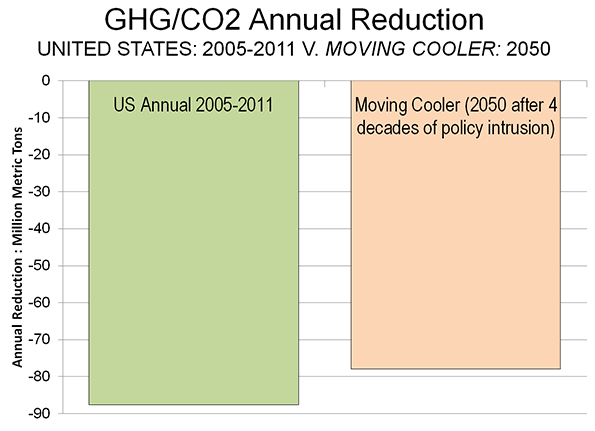
    Congratulations to America. According to the US Department of Energy, Energy Information Administration, carbon dioxide (CO2) emissions were reduced 526 million tons from 2005 to 2011. This is no small amount. It is about the same as all the CO2 emissions in either Canada or the United Kingdom. Only five other nations emit more than that.

    The bigger news is that this was accomplished without any of the intrusive behavioral modification proposed by planners, such as by California’s anti-detached housing restrictions, Plan Maryland, or the state of Washington’s mandatory driving reduction program.

    Of course, part of the national reduction was due to the economic difficulties since 2005. However, even with 1.8 percent gross domestic product growth in 2011, EIA shows that CO2 emissions fell 2.4 percent in 2011.

    The magnitude of the decline over six years is impressive. Actual GHG/CO2 emissions were reduced more annually between 2005 and 2011 than smart growth proponents claim for their strategies after 45 years of draconian policy intrusions.Modeled smart growth forecasts in Moving Cooler’s middle scenario (by Cambridge Systematics and the Urban Land Institute) show the annual GHG/CO2 emission reduction in 2050, calculated from 2005, to be less than the emissions reduction in the average year between 2005 and 2011.

    This is despite what would be four decades of trying to force people to live where they don’t want, in housing they don’t prefer, while trying to drive them out of the cars that required to sustain economic growth in modern metropolitan areas.

    Moving Cooler’s forced densification and anti-automobile strategies were so radical that the Transportation Research Board authors of Driving and the Built Environment, could not agree that a similar approach was feasible, because it would be prevented by public resistance to the personal and political intrusions (Note 1). They would also be hideously expensive, as the Moving Cooler authors ignored the much higher costs of housing associated with smart growth’s behavioral strategies.

    This comparison demonstrates the conclusion of a recent Cambridge University (United Kingdom) led study (see "Questioning the Messianic Conception of Smart Growth", which stated:

    In many cases, the potential socioeconomic consequences of less housing choice, crowding, and congestion may outweigh its very modest CO2 reduction benefits.

    Government policies have had little to do with the reductions, except to the extent that they precipitated the greatest economic downturn since the Great Depression (such as by encouraging loose lending standards and the smart growth housing policies that drove house prices up so much that the housing bust became inevitable).

    Market forces have made a substantial contribution to the reduction. There was a substantial shift to the use of natural gas from coal, a conversion that is really only starting. There was also a modest improvement in automobile fuel efficiency (though much more is to come).

    In 2007, the McKinsey Corporation and The Conference Board published a study (co-sponsored by the Environmental Defense and the Natural Resources Defense Council), which said that sufficient GHG emissions reductions (Note 2) could be achieved without driving less or living in more dense housing. Our more recent Reason Foundation report showed that the potential for GHG emission reduction from more fuel efficient cars and carbon neutral housing far outweighed any potential for reductions from smart growth’s behavior modification.

    ——

    Note 1: Transport consultant Alan E. Pisarski evaluated Moving Cooler in an article entitled ULI Moving Cooler Report: Greenhouse Gases, Exaggerations and Misdirections.

    Note 2: Most of GHG emissions are CO2.

  • Toronto’s Greenbelt: Pushing up Congestion, Local Air Pollution and House Prices

    I had the pleasure of participating on Jerry Agar’s program on Newstalk 1010 in Toronto, with host Tasha Kheiriddin on August 15. The subject was a new report by the David Suzuki Foundation lauding the benefits of Toronto’s greenbelt greenhouse gas (GHG) emission reduction role as a carbon sink.

    Ms. Kheiriddin was interested in the other side of the issue, which I was happy to summarize. First and foremost, for all of their claimed benefits, greenbelts around growing cities have serious consequences. They force population densities up, which makes traffic more congested. This is because as densities rise, traffic volumes increase. There are various estimates of the increase in traffic congestion from a doubling of density, from (for example) 61 percent (Sierra Club) to 96 percent (Ewing and Cervero). The greater congestion produces more intense local air pollution, with the predictable health effects. Beyond that, as any Economics 101 student should know, rationing anything (such as land) tends to be associated with higher prices. It is no wonder that house prices have skyrocketed since the greenbelt was established.

    It is important to understand the dynamics of GHGs. It doesn’t matter whether they occur in the Toronto greenbelt or Patagonia. This means that there is no reason for GHG reduction to emanate from the Toronto greenbelt. It would be far better to forest some of the 7.5 million acres of disused farmland in Ontario (since 1951). This is many times as much land as the Toronto greenbelt. In other words, from a global (or local GHG emission perspective), the Toronto greenbelt is irrelevant (Note).

    The purpose of the city (metropolitan area) should be to facilitate higher discretionary incomes for its residents, while minimizing poverty, all within the constraints of sufficient environmental protection. The greenbelt reduces discretionary incomes by restricting mobility (more traffic congestion) and raising house prices. It increases poverty by raising costs and preventing job creation. The greenbelt’s claimed GHG emission benefits can readily be replaced by strategies elsewhere that do not reduce economic growth.

    Note: Large portions of the farmland in Ontario and Quebec have been taken out of production since 1951, as production has been transferred to the Prairie provinces (Alberta, Saskatchewan and Manitoba). Meanwhile, the real value of agricultural production in Canada increased 160 percent from 1961 to 2005.

  • Why Emissions Are Declining in the U.S. But Not in Europe

    It wasn’t that long ago that the U.S. was cast as the global climate villain, refusing to sign the Kyoto accord while Europe implemented cap and trade. 

    But, as we note below in a new article for Yale360, a funny thing happened: U.S. emissions started going down in 2005 and are expected to decline further over the next decade, while Europe’s cap and trade system has had no measurable impact on emissions. Even the supposedly green Germany is moving back to coal.

    Why? The reason is obvious: the U.S. is benefitting from the 30-year, government-funded technological revolution that massively increased the supply of unconventional natural gas, making it cheap even when compared to coal.   

    The contrast between what is happening in Europe and what is happening in the U.S. challenges anyone who still thinks pricing carbon and emissions trading are more important to emissions reductions than direct and sustained public investment in technology innovation. 

    — Ted and Michael

    Yale 360

    Beyond Cap and Trade: A New Path to Clean Energy

    Putting a price and a binding cap on carbon is not the panacea that many thought it to be. The real road to cutting U.S. emissions, two iconoclastic environmentalists argue, is for the government to help fund the development of cleaner alternatives that are better and cheaper than natural gas.

    by Ted Nordhaus and Michael Shellenberger

    A funny thing happened while environmentalists were trying and failing to cap carbon emissions in the U.S. Congress. U.S. carbon emissions started going down. The decline began in 2005 and accelerated after the financial crisis. The latest estimates from the U.S. Energy Information Administration now suggest that U.S. emissions will continue to decline for the next few years and remain flat for a decade or more after that.

    The proximate cause of the decline in recent years has been the recession and slow economic recovery. But the reason that EIA is projecting a long-term decline over the next decade or more is the glut of cheap natural gas, mostly from unconventional sources like shale, that has profoundly changed America’s energy outlook over the next several decades.

    Gas is no panacea. It still puts a lot of carbon into the atmosphere and has created a range of new pollution problems at the local level. Methane leakage resulting from the extraction and burning of natural gas threatens to undo much of the carbon benefit that gas holds over coal. And even were we to make a full transition from coal to gas, we would then need to transition from gas to renewables and nuclear in order to reduce U.S. emissions deeply enough to achieve the reductions that climate scientists believe will be necessary to avoid dangerous global warming.

    But the shale gas revolution, and its rather significant impact on the U.S. carbon emissions outlook, offers a stark rebuke to what has been the dominant view among policy analysts and environmental advocates as to what it would take in order to begin to bend down the trajectory of U.S. emissions, namely a price on carbon and a binding cap on emissions. The existence of a better and cheaper substitute is today succeeding in reducing U.S. emissions where efforts to raise the cost of fossil fuels through carbon caps or pricing — and thereby drive the transition to renewable energy technologies — have failed.

    In fact, the rapid displacement of coal with gas has required little in the way of regulations at all. Conventional air pollution regulations do represent a very low, implicit price on carbon. And a lot of good grassroots activism at the local and regional level has raised the political costs of keeping old coal plants in service and bringing new ones online.

    But those efforts have become increasingly effective as gas has gotten cheaper. The existence of a better and cheaper substitute has made the transition away from coal much more viable economically, and it has put the wind at the back of political efforts to oppose new coal plants, close existing ones, and put in place stronger EPA air pollution regulations.

    Yet if cheap gas is harnessing market forces to shutter old coal plants, the existence of cheap gas from unconventional places is by no means the product of those same forces, nor of laissez faire energy policies. Our current glut of gas and declining emissions are in no small part the result of 30 years of federal support for research, demonstration, and commercialization of non-conventional gas technologies without which there would be no shale gas revolution today.

    Starting in the mid-seventies, the Ford and Carter administrations funded large-scale demonstration projects that proved that shale was a potentially massive source of gas. In the years that followed, the U.S. Department of Energy continued to fund research and demonstration of new fracking technologies and developed new three-dimensional mapping and horizontal drilling technologies that ultimately allowed firms to recover gas from shale at commercially viable cost and scale. And the federal non-conventional gas tax credit subsidized private firms to continue to experiment with new gas technologies at a time when few people even within the natural gas industry thought that firms would ever succeed in economically recovering gas from shale.

    The gas revolution now unfolding — and its potential impact on the future trajectory of U.S. emissions — suggests that the long-standing emphasis on emissions reduction targets and timetables and on pricing have been misplaced. Even now, carbon pricing remains the sine qua non of climate policy among the academic and think-tank crowds, while much of the national environmental movement seems to view the current period as an interregnum between the failed effort to cap carbon emissions in the last Congressand the next opportunity to take up the cap-and-trade effort in some future Congress.

    And yet, the European Emissions Trading Scheme (ETS), which has been in place for almost a decade now and has established carbon prices well above those that would have been established by the proposed U.S. system, has had no discernible impact on European emissions. The carbon intensity of the European economy has not declined at all since the imposition of the ETS. Meanwhile green paragon Germany has embarked upon a coal-building binge under the auspices of the ETS, one that has accelerated since the Germans shut down their nuclear power plants.

    Even so, proponents of U.S. emissions limits maintain that legally binding carbon caps will provide certainty that emissions will go down in the future, whereas technology development and deployment — along with efforts to regulate conventional air pollutants — do not. Certainly, energy and emissions projections have proven notoriously unreliable in the past — it is entirely possible that future emissions could be well above, or well below, the EIA’s current projections. But the cap-and-trade proposal that failed in the last Congress, like the one that has been in place in Europe, would have provided no such certainty. It was so riddled with loopholes, offset provisions, and various other cost-containment mechanisms that emissions would have been able to rise at business-as-usual levels for decades.

    Arguably, the actual outcome might have been much worse. The price of the environmental movement’s demand for its “legally binding” pound of flesh was a massive handout of free emissions allocations to the coal industry, which might have slowed the transition to gas that is currently underway.

    Continuing to drive down U.S. emissions will ultimately require that we develop low- or no-carbon alternatives that are better and cheaper than gas. That won’t happen overnight. The development of cost-effective technologies to recover gas from shale took more than 30 years. But we’ve already made a huge down payment on the technologies we will need.

    Over the last decade, we have spent upwards of $200 billion to develop and commercialize new renewable energy technologies. China has spent even more. And those investments are beginning to pay off. Wind is now almost as cheap as gas in some areas — in prime locations with good proximity to existing transmission. Solar is also close to achieving grid parity in prime locations as well. And a new generation of nuclear designs that promises to be safer, cheaper, and easier to scale may ultimately provide zero-carbon baseload power.

    All of these technologies have a long way to go before they are able to displace coal or gas at significant scale. But the key to getting there won’t be more talk of caps and carbon prices. It will be to continue along the same path that brought us cheap unconventional gas — developing and deploying the technologies and infrastructure we need from the bottom up.

    When all is said and done, a cap, or a carbon price, may get us the last few yards across the finish line. But a more oblique path, focused on developing better technologies and strengthening conventional air pollution regulations, may work just as well, or even better.

    For one thing should now be clear: The key to decarbonizing our economy will be developing cheap alternatives that can cost-effectively replace fossil fuels. There simply is no substitute for making clean energy cheap.

    © 2010 Yale Environment 360

  • US Leads World in Greenhouse Gas Reduction

    For years, the United States has been portrayed by both international and domestic interests as an environmental outlaw, because of its high rate of greenhouse gas (GHG) emissions. The United States, Canada and Australia have the highest GHG emissions per capita in the world. Further, the United States has historically had the highest overall GHG emissions, until having recently been passed by China.

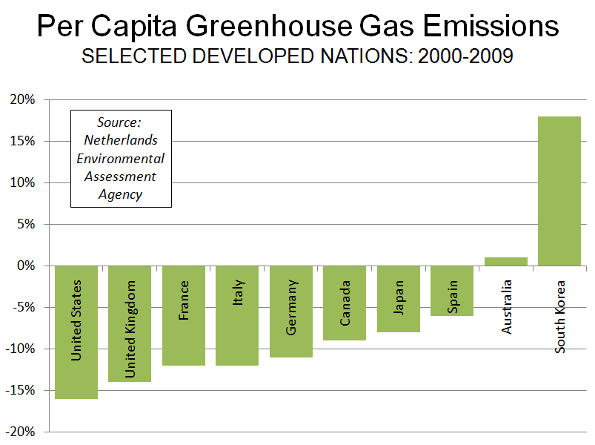
    It is likely to come as a surprise that the US has become a model for its reduction in GHG emissions over the last decade. According to a report by the Netherlands Environmental Assessment Agency, GHG emissions per capita fell more in the United States from 2000 to 2009 than in any other area reviewed. The Agency also reported that there had been no growth in global GHG emissions in 2009.

    Per capita GHG emissions fell 16% in the United States from 2000 to 2009. This is half again as large as the 11% reduction in the highest income portion of the European Union (EU-15). Among EU-15 nations for which data was provided, per capita GHG emissions were down 14% in the United Kingdom, 12% in France and Italy, and 11% in Germany. Spain, where economic reality is forcing a reduction in support for its highly touted “green” energy program, reduced per capita GHG emissions by little more than one-third the US rate, at 6%. The Netherlands achieved a 3% reduction (Figure).

    In both the United States and Europe, the deep recession contributed to a reduction between 2008 and 2009. Between 2000 and 2008 (pre-recession), US GHG emissions per capita declined 9%, while EU-15 emissions declined 7%.

    Canada’s GHG emissions declined 9% from 2009 to 2009, while Japan’s per capita GHG emissions declined at one-half the US rate (8%). Australia’s emissions rose 1%, while emissions per capita rose 18% in South Korea.

    GHG emissions per capita increased in all of the developing nations surveyed except for the Ukraine (-12%) and Brazil (-1%). Such increases are not surprising, as people in developing nations move from the countryside to urban areas and as they seek greater affluence.

    There was more good news for the United States. Biofuel use in road freight transport was more than double that of the European Union (EU-27). This is significant because road transport volumes in the EU-27 are nearly the same as in the United States.

    Photograph: Southern Greenland (by the author)

  • The Harvard $7 Per Gallon Study: Missing the Point Completely

    A new study by researchers at the Belfer Center for Science and International Affairs at Harvard University suggests that President Obama’s greenhouse gas (GHG) reduction goal will require gasoline prices of from $7.15 to $8.71 per gallon by 2030. This is not only untrue, but also represents a “roadmap” to economic and environmental folly.

    The study begins with the assumption that the transportation sector would need to reduce its GHG emissions by the same 14% percentage as the overall goal for the economy, as proposed by President Obama (Note).

    “Across the Board Reductions” are Absurd: The Harvard assumption is flawed from the start. GHG emissions reduction is not about “across the board” reductions of the same percentages applied to economic sectors. Such an approach could result in serious misallocation of resources, as opportunities for less expensive GHG emissions reductions in some sectors are ignored, while more expensive strategies are implemented in other sectors.

    The Appropriate Price for GHG Reduction: The study itself assumes that the present GHG price is $30 and that the price will rise to $60 by 2030. Reports by the Intergovernmental Panel on Climate Change and McKinsey/The Conference Board say that sufficient GHG emission reductions can be achieved at below $50 per ton. It is fair to suggest, therefore, that any strategy costing more than the $50-$60 range must be rejected as being too expensive.

    The Harvard study notes that GHG

    …prices at their projected levels are far too small to create a significant incentive to drive less. Fuel prices above $8/gallon may be needed to significantly reduce U.S. GHG emissions and oil imports.

    This should tell us something. Achieving the proposed reduction is GHG emissions from the transportation sector is just too expensive. If the current market price for GHG emissions cannot significantly reduce gasoline usage, then strategies that can be achieved for the market price should be implemented (in other sectors). Such an approach would by no means interfere with the potential to achieve GHG emissions reductions, rather it would facilitate less disruptive achievement.

    $7 Per Gallon Gasoline: The Harvard study goes on to suggest that gasoline prices of $7.15 to $8.71 per gallon by 2030 might be necessary to achieve the overall GHG reduction goal in the transportation sector. These higher prices would be the result of significantly higher fuel taxes. The resulting cost of GHG emissions reductions could be more than $500 per ton (compared to the Department of Energy 2030 gasoline price projection). While the Harvard report “poo-poos” the economic impact of doubling gasoline prices, a Reason Foundation report (and previous research at the University of Paris by Remy Prud’homme and Chang Wong Lee) has found a strong relationship between mobility (driving more) and economic growth.

    Focusing on Ends, Not Means: No one should believe it will be easy to achieve any eventual GHG emission objective. Success will be greatly enhanced by focusing on “ends” rather than “means.” This means employing the least costly and least disruptive strategies, without regard to how much we drive, where we live, how much power we consume or any other peripheral (and irrelevant) consideration.

    At a price of $500 or more, the Harvard report’s price per ton could be nearly 10 times as much as the $60 GHG price assumed in the very same report. Such an increase in the price of gasoline would be both absurd and unnecessary.

    ——

    Note: There are multiple proposals for economy wide GHG emissions reductions. Congressional have been for 17% to 20% reductions by 2020.

  • World Small Area Map of GHG Emissions

    The European Commission has just made a Google Earth overlay available showing annual greenhouse gas (GHG) emissions by 10 square kilometer quadrants. The overlay can be manipulated to show estimates from every year beginning in 1970. One of the most fascinating features is the GHG emissions on the oceans, from shipping lanes. All are green (fewer GHG tons), but one route stands out as by far the busiest, from Hong Kong and Japan through the Straits of Malacca and the Suez Canal to northern Europe.

    The application is useful for broad reviews of GHG emissions by same-sized areas, though the zoom feature does not provide high resolution enough photography to discern differences at the smallest area level.

  • British Taxpayers Pick Up the Tab for the “Worst. Climate. Campaign. Ever.”

    Climate change threatens popcorn prices, air planes, and outdoor hockey. And, in the latest tax-payer funded advertising from the UK, climate change will tell you bedtime stories of a drowning dog and the coming apocalypse:

    From the Register, Britons spent £6 million in public funds for an ad campaign which Nature simply calls the Worst. Climate. Campaign. Ever. The advertisement depicts a father and daughter sharing in a bedtime story describing “a land where the weather was very, very strange.” It continues with a sophomoric overview of the causes of climate change, and describes the consequences in a cartoonish overture. The Times reports that “the advertisement attempts to make adults feel guilty about their legacy to their children.”

    With all their various predictions of the Earth’s demise – 100 months? 96 months? Four months? – and tons of carbon spent hauling scientists and politicians to climate change conferences all around the world – climate change campaigners still have the time to make us feel guilty for trying to make a modest living – all at the expense of the already deeply in debt UK taxpayers.

    Is this movie about to get played on televisions here in the USA? After all, we have plenty of money to spend on propaganda here as well.

  • American Hobbit Houses

    Soon after President Obama took office, a proposed plan to “develop federal policies to induce states and local communities to embrace ‘smart growth’ land use strategies” was announced.

    This “Livable Communities Program” is intended to save land and clean up the environment. It is seen as encouraging denser housing arrangements to deter automobile use and accommodate the transit industry, according to goals set by the Secretaries of HUD, EPA and Transportation.

    One potential downside to this plan comes from the transit industry’s Moving Cooler study, which argues that the Administration’s greenhouse gas reduction proposals “may result in higher housing prices, and some people might need to live in smaller homes or smaller lots than they would prefer.”

    If you want to see how this might work, look at the U.K., which imposed strict land regulations in the Town and Country Planning Act in 1947. This effectively froze the supply of land for a growing population, leading to soaring house prices, particularly in the area around London.

    With the land available for development frozen, house size decreased as well, leading to new British homes garnering the nickname of “Hobbit houses.” New British homes are a little more than a third as big as new U.S. homes (818 sq. feet compared the U.S.’s 2,303 sq. feet).

    The question is whether or not the Federal government should be granted the ability to limit housing standards. Currently, this responsibility lands in the lap of state and local governments.

    Can President Obama afford to add the President of the (Hobbit) Homeowner’s Association of the United States to his title?