Tag: government

  • Governments’ Oil Windfall

    We are reading a lot about the windfall coming to consumers due to falling gas prices now that oil is under $50/barrel. But cheap energy also represents a windfall for governments, including governments who are hard pressed for cash.

    The US uses nearly 20% of the world’s energy consumption every year. That spending includes households, businesses, industries and governments. Households in the US spend nearly $450 billion on gasoline alone to fuel their 2.28 vehicles. Energy for transportation represents about 50% of US consumer spending on average and climbs to nearly 70% in the summer when there is more driving. Governments spend money on gasoline, too.

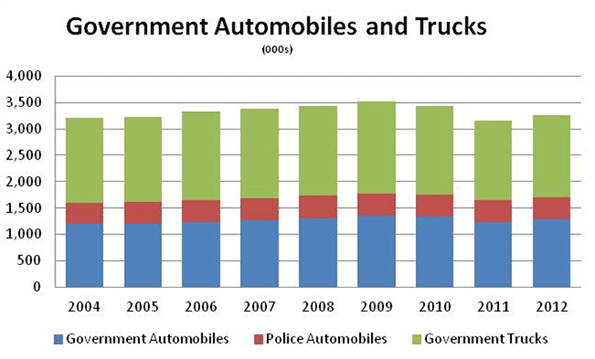
    Not just the federal government, but government at every level – federal, state, county, city – all of which have fleets of cars and trucks that use gasoline.  We could not locate data on fuel spending by state governments for either gasoline or heating/cooling. The Bureau of Economic Analysis tables lump spending at gas stations in with “Other retail” which includes furniture and appliance stores and places like home depot. We did locate the numbers of cars owned by governments and police. Governments in the United States own about 1.5% of all vehicles on the road. That includes military vehicles, cars and trucks owned by the federal, state, county and local government plus police vehicles.


    Data is from www.rita.dot.gov, sourced as www.automotive-fleet.com as of Nov 26, 2013.

    Whether we extrapolate from the number of vehicles and use the “per car” savings estimates or estimate the savings based on the governments’ share of vehicle ownership, we guess that governments across the US will be sharing in at least $1 billion this year. And that is just on gasoline alone.

    They could also be saving on heating bills for real property. The Federal government alone owns almost 400,000 buildings located throughout the country. According to the Consortium for Science, Policy and Outcomes at Arizona State University, the US Federal government spends up to $610 billion annually on energy consumption. Every 1% drop in the prices could mean a $6 billion windfall for Uncle Sam.

    Don’t be surprised if he expands spending instead of using the savings to reduce the national debt or to balance a budget.

  • Building the Responsive City

    The Responsive City: Engaging Communities Through Data Smart Governance
    by Stephen Goldsmith and Susan Crawford

    Technology, and especially the use of data and analytics, has been transforming the way cities manage service delivery. Former Indianapolis mayor New York City deputy mayor Steve Goldsmith, and his colleague at Harvard Susan Crawford, recently wrote a book called “The Responsive City” looking at this technology revolution. I recently read the book and posted some thoughts in a review posted at City Journal. Here’s an excerpt:

    The book chronicles more than just technology’s potential; it also highlights what some local governments have already achieved with innovative approaches. After several fires resulted in the deaths of five people, New York City built a system to identify buildings at high fire risk, using predictive models and integrating data from multiple sources. City inspectors are now aggressively targeting those buildings for upgrades. To fight its rat problem, Chicago is using data analytics to predict where rats will gather, instead of waiting for resident complaints. Boston has developed a civic customer-relationship management system, with mobile-device apps, to link residents more easily with city services. Mimicking the way that Yelp collects restaurant reviews, Washington, D.C. uses a website to solicit ratings of city services. Cities around the country are adopting open-data portals.

    Goldsmith and Crawford are candid about the challenges facing their responsive-city vision. Progressive-era reforms designed to eliminate corruption also curtailed government employees’ discretion, leaving them with narrowly defined roles and limited ability to respond effectively to real-world problems. Rigid job descriptions, such as “temporary full-time permanent intermittent police officer,” are common in cities like New York, which has more than 2,000 such classifications. Procurement rules require that detailed specifications be prepared in advance, unlike in the private sector, where technology and other solutions are often developed iteratively. Government’s rigid contracting processes make it tough to respond to findings during development.

    You can click over to City Journal to read the entire thing

    I also sat down with Steve Goldsmith recently to talk about the book, and some of the challenges and pitfalls of this technology-drive approach. If the audio embed doesn’t display for you, click over to listen on Soundcloud.


    This piece originally appeared at The Urbanophile.

  • Why Pleas to Increase Infrastructure Funding Fall on Deaf Ears

    Letting the nation’s roads and bridges deteriorate may worsen traffic congestion and add to our commuting woes, but when water and sewer systems begin to fail our very civilization is at risk. That is the message of a recent story in The Washington Post drawing attention to the alarming state of the nation’s water and sewer infrastructure. The story looks at the Washington D.C. system as a poster child for neglected and dilapidated municipal utilities. The average age of the District water pipes is 77 years and a great many were laid in the 19th century, notes the Post article. Emergency crews rush from site to site to tackle an average of 450 breaks a year. ("Billions needed to upgrade America’s leaky water infrastructure," by Alfred Halsey III, January 2, 2012).

    Antiquated municipal water and sewer systems are indeed a ticking bomb— all the more so since their deterioration, unlike that of highways and bridges— remains invisible until a break occurs. But maintaining water and sewer infrastructure in a state of good repair is a fairly straightforward challenge. Water supply and sewers are a public utility and as such they can cover their maintenance and replacement costs through user fees. So can many other public services such as electricity, natural gas, broadband and telecommunications. The ability to charge for service (and to raise rates as necessary) assures public utilities a steady and reliable stream of revenue with which to maintain, preserve and grow their assets.

    Finding the resources to keep transportation infrastructure in good order is a more difficult challenge. Unlike traditional utilities, roads and bridges have no rate payers to fall back on. Politicians and the public seem to attach a low priority to fixing aging transportation infrastructure and this translates into a lack of support for raising fuel taxes or imposing tolls.

    Investment in infrastructure did not even make the top ten list of public priorities in the latest Pew Research Center survey of domestic concerns. Calls by two congressionally mandated commissions to vastly increase transportation infrastructure spending have gone ignored. So have repeated pleas by advocacy groups such as Building America’s Future, the U.S. Chamber of Commerce and the University of Virginia’s Miller Center.

    Nor has the need to increase federal spending on infrastructure come up in the numerous policy debates held by the Republican presidential candidates. Even President Obama seems to have lost his former fervor for this issue. In his last State-of-the-Union message he made only a perfunctory reference to "rebuilding roads and bridges." High-speed rail and an infrastructure bank, two of the President’s past favorites, were not even mentioned.

    Why pleas to increase infrastructure funding fall on deaf ears

    There are various theories why appeals to increase infrastructure spending do not resonate with the public. One widely held view is that people simply do not trust the federal government to spend their tax dollars wisely. As proof, evidence is cited that a great majority of state and local transportation ballot measures do get passed, because voters know precisely where their tax money is going. No doubt there is much truth to that. Indeed, thanks to local funding initiatives and the use of tolling, state transportation agencies are becoming increasingly more self-reliant and less dependent on federal funding

    Another explanation, and one that I find highly plausible, has been offered by Charles Lane, editorial writer for the Washington Post. Wrote Lane in an October 31, 2011 Washington Post column, "How come my family and I traveled thousands of miles on both the east and west coast last summer without actually seeing any crumbling roads or airports? On the whole, the highways and byways were clean, safe and did not remind me of the Third World countries. … Should I believe the pundits or my own eyes?" asked Lane ("The U.S. infrastructure argument that crumbles upon examination").

    Along with Lane, I think the American public is skeptical about alarmist claims of "crumbling infrastructure" because they see no evidence of it around them. State DOTs and transit authorities take great pride in maintaining their systems in good condition and, by and large, they succeed in doing a good job of it. Potholes are rare, transit buses and trains seldom break down, and collapsing bridges, happily, are few and far between.

    The oft-cited "D" that the American Society of Civil Engineers has given America’s infrastructure (along with an estimate of $2.2 trillion needed to fix it) is taken with a grain of salt, says Lane, since the engineers’ lobby has a vested interest in increasing infrastructure spending, which means more work for engineers.  Suffering from the same credibility problem are the legions of road and transit builders, rail and road equipment manufacturers, construction firms, planners and consultants that try to make a case for more money.

    This does not mean that the country does not need to invest more resources in preserving and expanding its highways and transit systems. The "infrastructure deficit" is real. It’s just that in making a case for higher spending, the transportation community must do a much better job of explaining why, how and where they propose to spend those funds. Usupported claims that the nation’s infrastructure is "falling apart" will not be taken seriously.

    People want to know where their tax dollars are going and what exactly they’re getting for their money. Infrastructure advocates must learn from state and local ballot measures to justify and document the needs for federal dollars with more precision so that the public regains confidence that their money will be spent wisely and well.

  • The Impact of Federal Cutbacks

    During my college days, I had the opportunity to interview a local government official tasked with conducting various disaster response programs. North Dakota had, at the time, been dealing with severe flood issues for nearly a decade, and the interviewee had vast experience dealing with the ins and outs of working within the system to find mitigation solutions. Asked about the challenges of having to deal with a multitude of state and federal agencies, he informed me that the most vital contacts he had were at the federal level. His reasoning?

    “That’s where the money is.”

    Given the current political winds blowing from D.C., the conditions that spurred that view might be about to change in substantial ways.

    With the recent failure of the “Super Committee” to find a deal on potential budget cuts and tax reforms, states may soon find themselves faced with a set of federal spending cuts to programs and services that undergird large parts of their economy. These automatic cuts, triggered in 2013 by the committee’s failure, will total nearly $1.2 Trillion and be between domestic and defense expenditures. While many may laud such cuts as a way to help bring the federal budget back towards a semblance of order, it is worth noting that the impact on state economies moving forward could be substantial.

    Federal spending, be it on defense, salaries for federal workers, infrastructure, or procurement makes up a sometimes major part of state economic activity. As outlined in a recent piece at stateline.com, some states have far greater exposure than others. In New Mexico, home to several major federal research institutions, over 12% of Gross State Product (GSP) is attributable to federal government spending. Virginia and Maryland, home to so many federal workers and contractors are even more economically dependent on federal spending, with 13.5% (MD) and 18.5% (VA) of their economies being due to federal activity. The spillover of cuts at the federal level can’t help but impact on the overall economic health of such states. The impact will likely be felt throughout the nation as federal agencies find themselves forced to tighten their belts.

    Scholars of federalism often refer to the period since the late 1970’s as the era of “New Federalism.” Beginning under President Carter, and embraced fully by the conservative movement during the 1980’s, New Federalism was marked by increasing devolution of powers and responsibility to state governments and calls for states to be given more control over the reins when spending allotted federal dollars.

    While states continue to play an important role in the system, actions taken over the past few years under the Bush and Obama administrations seemed to hearken back to the earlier, cooperative model of federalism, with the federal government taking on a more assertive role in working with and through state and local governments to provide stimulus, reform healthcare, and implement post 9/11 security initiatives. While state leaders might have chafed at the strings tied to certain lines of funding, the dollars provided offered states a way to backfill budget shortfalls during a time of economic stress.

    With the demise of the Super Committee, continued calls for deeper spending cuts and gridlock over raising revenues are setting the table for a changed federal-state relationship. As federal agencies strike their tents on various programs and initiatives, states will find themselves receiving less direct federal largess and facing lower economic activity as federal dollars working their way through the local economy are reduced. Budget austerity may lead the federal government to increasingly leave the states to their own means- devolution by force, instead of by choice.

  • The Precarious State of the Highway Trust Fund

    On November 18, President Obama signed into law a bundle of appropriation bills for FY 2012  including appropriations  for the U.S. Department of Transportation. The measure had been passed earlier in the House by a vote of 298-121 and in  the Senate by a vote of 70-30. 

    The bill provides $39.14 billion in obligation limitation for the highway program, a reduction of almost $2 billion from FY 2011; however, an additional $1.66 billion is appropriated for highway-related "emergency relief." The transit program is funded at $10.31 billion (incl. $1.95 for New Starts), a $400 million increase from FY 2011, and Amtrak at $1.42 (incl. $466 million for operating expenses). The discretionary TIGER program is retained at $500 million, a slight decrease from FY 2011.

    Conspicuously absent in the new budget is any funding for high-speed rail and the Intercity Passenger Rail Service program — a fact cheered  by fiscal conservatives but mourned by boosters of high-speed rail and supporters of the California bullet train. The California High-Speed Rail Authority relies heavily on further federal funds to complete the project. According to its business plan, it expects $33-36 billion to come from the federal government. Failure by Congress to appropriate money for high-speed rail for a second year in a row makes the prospect of future federal support for the California rail project increasingly doubtful. 

    Also refused any funding in the FY 2012 congressional transportation appropriation are two other Administration priorities:  the Livable Communities Initiative ($10 million requested in the President’s budget); and the National Infrastructure Bank ($5 billion requested).  The conference committee action would seem to put an effective end to any further attempts to create the Bank, at least during the remainder of this session of Congress.      

    Solvency of the Highway Trust Fund in Jeopardy
    The congressional conferees have warned that the bill will deplete almost all resources from the Highway Trust Fund (HTF) by the end of fiscal year 2012.   "Without enactment of a new surface transportation authorization bill with large amounts of additional revenues this year," the report said, "the Highway Trust Fund will be unable to support a highway program in fiscal year 2013. The conferees strongly urge the committees of jurisdiction to enact surface transportation legislation that provides substantial long-term funding to continue the federal-aid highways program."

    As Taxpayers for Common Sense (TCS) pointed out in a commentary, the appropriations committee is willing to acknowledge the problem, but quickly passes the buck to the authorizers to come up with more cash for future years.  But the authorizers aren’t doing any better. The Senate Environment and Public Works (EPW) Committee passed a $109 billion reauthorization bill that would fund two years of transportation spending by essentially drawing the HTF balance down to zero (and still unable to identify the remaining  $12 billion in offsets). To House Transportation and Infrastructure Committee Chairman John Mica (R-FL) the implications of the Senate action are clear.  In a November 14 letter to Senate EPW Committee Chairman Barbara Boxer (D-CA)  he warns that the Senate bill will "essentially bankrupt the Highway Trust Fund and make it impossible to provide any funding for fiscal year 2014."

    To its credit, the Senate Environment and Public Works Committee recognized the precarious state of the Trust Fund and took steps to impose spending controls to prevent the Fund from falling into insolvency.  The Senate bill provides (in section 4001) for mandatory reductions in the obligation limitation should the Trust Fund  balances in the Highway Account, as estimated by the CBO, fall below a certain pre-determined level (for example, in the event gas tax revenues fail to match expectations). The designated triggers are $2 billion at the end of FY 2012 and $1 billion at the end of FY 2013. In other words, the Senate EPW committee has wisely provided for a mechanism to reduce highway expenditures below the authorized  $109 billion level in order to prevent the Trust Fund from going bankrupt.

    The House, for its part, is exploring a different way to fund a longer-term, five-year reauthorization. On November 17, Speaker Boehner announced he will unveil in December a combined transportation and energy bill, dubbed the "American Energy & Infrastructure Jobs Act,"  (HR 7). The bill  would authorize expanded offshore gas and oil exploration and dedicate royalties from such exploration to "infrastructure repair and improvement" focused on roads and bridges. 

    However, many questions have been raised about this approach. Several lawmakers —  notably, Rep. Nick Rahall (D-WV), Ranking Member of the House Transportation and Infrastructure Committee, Sen Barbara Boxer (D-CA) chairman of  of the Senate Environment and Public Works Committee  and Sen. James Inhofe (R-OK) the committee’s ranking member—have criticized the aproach as problematical and potentially miring the bill in controversy. They allege that  the royalties the House is counting upon would fall billions of dollars short of filling the gap in needed revenue  (the gap is estimated at approximately $75-80 billion over five years). They further allege that the revenue stream from the royalties would not be available in time to fund the measure. 

    Other critics have pointed out that states in whose jurisdiction drilling may occur, will assert a claim to a lion portion of the royalties. Also, using oil royalties to pay for transportation would essentially destroy the principle of a trust fund supported by highway user fees.  For all the above reasons, the House proposal is likely to meet with a skeptical reception in the Senate.

    As the TCS memorandum aptly concluded,  in the end it’s a big game of "kick the can." The appropriators kick the can to the authorizers. The authorizers kick the can down the road a couple of years or rely on speculative and uncertain revenue that may or may not materialize. In the meantime, the fate of the Trust Fund continues to hang in a precarious balance, victim of Congressional indecision and new fiscal imperatives.    
     
    ~~~~~~~~~~~~~~~~~~~~
    Note: the NewsBriefs can also be accessed at www.infrastructureUSA.org

    A listing of all recent NewsBriefs can be found at www.innobriefs.com

  • Cities Have Outgrown Their Role as Mere Creatures of the Provinces

    The Martin Prosperity Institute recently released the map below, which compares the GDP of several US metropolitan areas to the size of national economies. For instance, the Boston-Cambridge-Quincy metropolitan statistical area (MSA) has a GDP of $311.3 billion dollars. If it were a country, it would be the 40th biggest national economy on earth, ahead of countries such as Denmark ($310.1) and Greece ($303.4). The Houston-Sugar Land-Baytown MSA has a GDP of $378.9 billion, which would make it the 31st biggest national economy, bigger than Austria ($375.5) and Argentina ($368.9). New York-Long Island-Northern New Jersey ($1.28 trillion) isn’t all that far behind Canada ($1.57 trillion).


    While trotting out such comparisons is an interesting exercise, the comparison also gives us some important perspective.  Despite the fact that these cities, as well as many others, produce as much as large countries, they have nowhere near the same fiscal levers at their disposal. Further, they are subservient to higher levels of government. The same problem exists in Canada. The Greater Toronto Area’s economic output ($233.9) is nearly equivalent to Finland’s total GDP ($270.6). Note that this definition is far less expansive than the US metro areas listed above. If the definition were expanded to include the entire Golden Horseshoe, it would be closer to the Size of Norway ($414.3 billion).  Yet the City of Toronto can’t finance a public transit expansion without the two senior levels of government. Calgary ($62.5 billion), roughly the size of Lithuania, couldn’t decide to create a municipal sales tax. Vancouver ($85.5 billion), slightly bigger than Serbia, can’t even decide how to allocate gas tax dollars without a special deal with the federal government.

    The problem isn’t that we have too little government spending, but that revenue collection and spending decisions often happen at the wrong level. Revenue generation and spending should take place as close as possible to the point of delivery. There is no reason why someone in Moose Jaw should pay federal income taxes so that the Federal Government could partner with the province of New Brunswick to build a highway near Moncton. Similarly, there’s no reason why someone in Edmonton should send property tax dollars to the province so that it can pay for a transit expansion in Calgary. Not only is filtering money through multiple layers of bureaucracy inefficient, but it leads to bad decision making. Decisions both on the revenue, and expenditure side need to be made at the lowest level of government possible.

    In order to ensure that cities can meet their infrastructure requirements, provincial governments should gradually devolve spending responsibilities and revenue generating capacities to the municipalities, and the federal government should end the practice of intervening in infrastructure issues altogether. Some municipalities may choose to raise property taxes, others may increase user fees, and still others may experiment with municipal sales taxes. But regardless of how municipalities decide to raise revenue, they are better placed to determine how much revenue is required, and which projects are really essential. More importantly, devolution gives more direct control over decision making to the people that are actually impacted by the decisions. Devolution means more accountability, and more local input. And if tiny Iceland can fund it’s own infrastructure, there’s no reason why Winnipeg or Edmonton couldn’t do the same.

    This piece originally appeared at the Frontier Centre for Public Policy Blog.

    Steve Lafleur is a public policy analyst with the Frontier Center for Public Policy.

  • Infographic: State Property Tax Data

    Credit Sesame has created an interactive map showing property tax rates for all 50 states. Based on data from the Tax Foundation, the graphic also shows property tax rates as a share of home value and as a share of median income of homeowners. It’s important to note that property taxes can vary regionally within states, and property taxes are only one part of overall state and local tax burden.


    Mortgages – CreditSesame.com

    Here’s the Tax Foundation’s numbers on overall state and local tax burden. For more on overall state business climates, check out our Enterprising States report.

  • Adjusting to Fiscal and Political Realities in Transportation Funding

    As this is written, we do not know the exact level of funding the House Transportation and Infrastructure Committee will propose in its draft legislation, to be unveiled in the first week of July and marked up the following week. Nor do we know what level of funding the Senate Finance Committee will come up with. But we do know that both Houses will be obliged to propose far less funding than is contained in the current (FY 2010) surface transportation budget of $52 billion ($41 billion for highways, $11 billion for transit). What will be the practical consequences of this belt tightening?

    The proposition that the Federal Government "must learn to live within its means" has become the fiscal conservatives’ article of faith and an elliptical way of stating the Republican opposition to deficit financing. This principle has found its way into the House T&I Committee’s "Views and Estimates for Fiscal Year 2012" report and it has been reaffirmed in countless statements and briefings by congressional sources.

    The practical implications of this policy for the federal-aid surface transportation program are unambiguous: federal budget authority in FY 2012 and beyond will be limited to the tax receipts flowing into the Highway Trust Fund. Those revenues (plus interest) will amount to an estimated $36.9 billion in 2011, according to the Congressional Budget Office (CBO)— $31.8 billion to be credited to the Highway Account and $5.1 billion to the Transit Account. Over the next ten years, CBO estimates these revenues will grow at an average rate of a little more than one percent per year, largely reflecting expected growth in motor fuel consumption. ("The Highway Trust Fund and Paying for Highways," testimony of Joseph Kile, Asst. Director of CBO, before the Senate Finance Committee, May 17, 2011).

    Thus, over a six-year period, 2012-2017, tax receipts credited to the Highway Trust Fund (plus interest) could be expected to amount to approximately $230 billion— about the same sum as was authorized in the 5-year SAFETEA-LU authorization ($238.5 billion).

    Limiting future budget authority to tax revenues flowing into the Highway Trust Fund will cause a significant drop from the current funding level. However, current spending has been inflated by a massive injection of stimulus funds from the American Recovery and Reinvestment Act of 2009— a total of $48 billion ($27.5 billion for highways, $6.8 billion for transit and $8 billion for high-speed rail). The stimulus almost doubled the annual amount of funding available  for transportation, making baseline comparisons misleading. A more accurate measure would be to compare the expected FY 2012 funding with pre-stimulus funding levels. In this comparison, the highway program would suffer a drop of 17% — from an average of $38.6 billion/year during SAFETEA-LU (FY 2005-2009) to $32 billion/year in FY 2012.  Adding the uncommitted HTF funds remaining in the Highway Account at the end of Fiscal Year 2011  ($14.8 billion, CBO estimate) would enable the annual highway allocation to be raised to about $34 billion/year — a drop of only 12 percent from the SAFETEA-LU level). (SAFETEA-LU data obtained from www.fhwa.dot.gov/safetealu/safetea-lu_authorizations.pdf,  4/6/2006),

    Such reductions, while not insignificant, would not be catastrophic. The cut in spending  authority could be absorbed by streamlining and narrowing the scope of the federal-aid program. Its primary mission would need to be refocused on traditional "core" highway and transit programs and on keeping existing transportation assets in a state of good repair. Discretionary awards such as the TIGER and high-speed rail grants would have to be eliminated. Proposals for major infrastructure spending (through the proposed Infrastructure Bank) would have to be dropped. So would programs that are deemed of little national significance or that do not serve the national need — such as various "transportation enhancements," set-asides, and "livability" projects that cater to narrow constituencies. Most of these Trust Fund "hitchikers," as Sen. James Inhofe calls them, will have to be handed off to state and local governments.

    Will states and local governments be willing and able to pick up the slack? Some will, others may not. Many states and localities have been willing to approve significant transportation improvement programs– provided the objectives are clearly spelled out. In fact, voters approved 77 percent of local transportation ballot measures in 2010, according to the Center for Transportation Excellence.

    While the above prospect may sound alarming when set against the current inflated spending levels, distorted by the stimulus spike, many fiscal conservatives view the new fiscal environment as an opportunity to return the federal-aid program to its original roots. Greater spending discipline, they hope, will refocus the federal mission on national interests and legitimate federal objectives, restore the program’s lost meaning and sense of purpose and give states and localities more voice and responsibility in managing their transportation future. With more constrained funding, certain hard-to-attain objectives such as greater emphasis on asset preservation, expanded use of highway pricing and tolling and higher levels of  private investment, will become a greater imperative and more achievable.

    Let us also not forget that the federal contribution constitutes only about 25% of the nation’s total surface transportation budget (40% of the capital budget). The rest is provided by state and local governments. The nation would still be spending more than $150 billion/year to preserve and improve our highways, bridges and transit systems— $50 billion short of the level recommended by the National Transportation Policy and Revenue Commission, but still a respectable level of funding.

    What about major new infrastructure investments? Undoubtedly, they will be necessary in the longer run because of the need to replace aging facilities and to accommodate future growth in population. But major capital expenditures can be, and will have to be, deferred until the recession has ended, the economy has started growing again and the federal budget deficit has been brought under control. At that more distant moment in time, perhaps toward the end of this decade, the nation might be able to resume investing in new infrastructure and embark on a new series of "bold endeavors" — major capital additions to the nation’s highways and rail systems. For now, prudence, good judgment and the compelling need to rein in the budget deficit, dictate that government should live within its means. And that means spending no more than what we pay into the Trust Fund.
  • Australian Local Governments Stop Forced Amalgamation

    Local government consolidations are often proposed by a wide range of interests, often out of the belief that they will produce more efficient (less costly) governments. Much of the academic literature supports this view. However, the evidence indicates that material savings routinely fail to occur from such amalgamations. The claimed $300 million annual savings in Toronto’s megacity quickly became higher costs and a larger bureaucracy.

    As in the Canadian provinces of Ontario and Quebec the Australian state governments of New South Wales (Sydney is the capital), Victoria (Melbourne is the capital) and Queensland (Brisbane is the capital) have been aggressive in forcing municipalities to merge over the last two decades. Often these attempts have met with opposition from residents. A forced amalgamation in Montreal was so unpopular that a new provincial government established mechanisms to “demerge.” Despite formidable barriers, 15 cities chose independence.

    Sometimes amalgamations are proposed for much smaller jurisdictions than 2.5 million population Toronto or even the 1990s merger that created the 90,000 population city of Melbourne, which is the core city of the Melbourne metropolitan area.

    In July, the New South Wales government announced intentions to amalgamate three jurisdictions ranging with a total population of 35,000. The city of Armidale-Dumaresque, Uralla Shire and Gyura Shire are located in the “New England” region of New South Wales, one-half way between Sydney and Brisbane. The amalgamation would have replaced the local governments with the New England Regional Council, a mega-jurisdiction of 5,000 square miles (13,000 square kilometers), a land area approximately equal in size to the area of the states of Delaware, Rhode Island and the province of Prince Edward Island (Canada) combined.

    The proposal met with determined opposition, from citizens and from the local governments. For example, the Uralla Shire Council submittal to the state Local Government Boundaries Commission, cited pitfalls of local government consolidations, relying on both Australian and international research. The Armidale Express reported that two former Guyra Shire council members mobilized that community against the amalgamation. There were substantial concerns. One was an interest in preserving historic communities, and the nearly universal aversion to moving city hall farther away. Errors were claimed in state government analyses that led to the amalgamation proposal and fiscal concerns were raised.

    In the end, the Local Government Boundaries Commission recommended against the proposed amalgamation. Minister for Local Government, Barbara Perry made the announcement on November 17. Uralla, Guyra and Armidale-Dumaresque will not be forced to amalgamate.

    The decision brought immediate positive responses from local leaders. Uralla Shire Mayor Kevin Ward said that he couldn’t be happier with the decision. Guyra Shire Mayor Hans Heitbrink said that the decision not to merge the three councils speaks volumes about the spirit of the communities who fought to save their separate local government areas. Armidale-Dumaresq Mayor, Peter Ducat, spoke of the stress that the decision will relieve for council staff and the community.

    They have reason to be pleased. Rarely, if ever, in recent decades have Australian jurisdictions retained their communities and their local democracies in the face of state amalgamation proposals.

  • What Seneca Falls Can Learn from Toronto

    One of the most enduring myths in public policy is that local government consolidations save money. The idea seems to make sense, and most of the academic studies support the proposition. However, rarely, if ever, does the promised reduction in public expenditures or taxes actually take place.

    Residents will vote March 16 on a proposal that would merge the village government of Seneca Falls, New York into the more rural and adjacent town of Seneca Falls. Under state law, this can occur without the consent of the town into which the village would be merged.

    Paltry Savings and the Risks: A consultant report suggests savings that can only be characterized as pitiful. Out of a combined budget of $13 million, less than $400,000 would be saved, and even that figure is by no means sure, according to the consultant.

    Voters may want to consider the following specific risks that could make achievement of the expected savings and tax reductions impossible:

    Proponents expect to receive $500,000 annually in funding from a state program that seeks to encourage municipal consolidations. The state program is slated for cuts. Further, with New York’s serious budget difficulties, such a superfluous program could be a prime candidate for discontinuance. Thus, one of the principal factors expected to lower taxes might not survive in the longer run.

    Presently, the village has a police department, while the town does not. The new town government is not likely to be able to get away with providing a higher level of police protection in the former village than in the merged town. One of two outcomes seems likely: (1) The first is that the present police protection (and budget) would be spread throughout the merged town. This would dilute police protection in the former village area. (2) The second is that the higher level of police protection in the village would be spread throughout the merged town. This would mean larger expenditures that could easily erase the already minimal projected savings.

    The consultant proposes that a new town hall be built. The costs of this building could substantially erode the projected operating cost savings.

    A principal reason that municipal consolidations rarely save money is that the necessary “harmonization” of service levels and employee compensation costs inevitably migrate to the level of the more costly former jurisdiction. The police issue in Seneca Falls is a prime example of the service harmonization cost risk.

    Learning from Toronto: Seneca Falls does not have to look far to see how local government consolidation can lead to more spending and higher taxes. Less than 150 miles away as the crow flies, Toronto residents were glowingly told of the lower taxes and expenditures that would result from consolidating six jurisdictions into a “megacity” in the late 1990s. As we and others predicted at the time, things have not worked out. Toronto’s spending has risen strongly under the consolidated government. Despite its much smaller population, the risks are similar in Seneca Falls.