Tag: healthcare

  • Heart Attack Death Risk Greater on Higher Floors

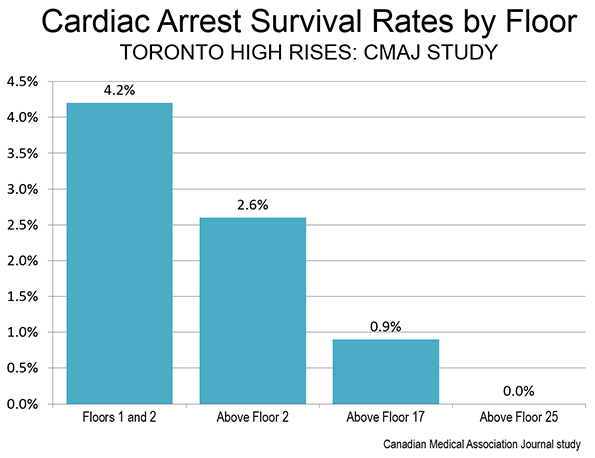
    A study in the Canadian Medical Association Journal (CMAJ) indicates that the survival rates of cardiac arrest (heart attack) is considerably worse at higher floors. Survival rates were compared by residential floor in Toronto. The article implied that the longer time necessary to reach patients after having arrived on the scene was likely a factor. Further, it was suggested that the longer time required to reach the hospital from the higher floors could be a factor, since cardiopulmonary resuscitation (CPR) is suboptimal until the patient is in the hospital.

    The study examined “911” response calls to high rise residential buildings in Toronto and found that the best survival rates were on the first and second floors (4.2 percent). Above the second floor, the survival rate was 40 percent less, at 2.6 percent. Above the 16th floor, the survival rate dropped 80 percent from the first and second floor (0.9 percent). There were no survivors above the 25th floor (Figure).

    The study concluded: “With continuing construction of high-rise buildings, it is important to understand the potential effect of vertical height on patient outcomes after out-of-hospital cardiac arrest.”

  • Will Obamacare Bail Out Cities?

    When Rahm Emanuel was Barack Obama’s Chief of Staff, little did he know he’d be helping craft a law that would help him as the future Mayor of Chicago. Many American cities failed to put away enough money for current and former government workers.  Rahm Emanuel and powerful Democratic Party interest groups would like the federal government to bailout their pensioners. While the unions are less shy about looting federal taxpayers, Emanuel is working hard getting federal help.

    Emanuel needs to cut costs immediately to prevent more downgrades from the bond rating agencies.  One of Emanuel’s creative financial techniques involves the use of Obamacare as way of pushing some financial costs from the city of Chicago budget onto the federal government.  Many retired workers don’t like or want Obamacare.  The Chicago Sun Times reports :

    Chicago’s 30,000 retired city employees are trying to stop Mayor Rahm Emanuel from saving $108.7 million — by phasing out the city’s 55 percent subsidy for retiree health care and foisting Obamacare on them.

    One week after an unprecedented, triple-drop in Chicago’s bond rating, retirees have filed a class-action lawsuit against the city and its four employee pension funds that threatens to make the financial crisis even worse.

    The suit argues that the Illinois Constitution guarantees that municipal pension membership benefits are an “enforceable contractual relationship which may not be diminished or impaired.”

    Chicago’s retired workers aren’t the only individuals unhappy with Obamacare.  IRS workers don’t want Obamacare but likely will find they can’t keep their current health insurance.  All of this is providing massive strains on the Blue Model coalition of government workers and the Democratic Party.  In Chicago, at least retired government workers can know who to blame for their change in health insurance if they lose their lawsuit. Mayor Rahm Emanuel not only was instrumental in getting Obamacare passed but now he’s dumping Obamacare on thousands of workers as Chicago’s Chief Executive.

  • Buffett Favors Health Insurance Bailout

    Warren Buffett, CEO of Berkshire Hathaway (NYSE: BRK), and owner and investor of some very large financial firms including insurance companies, is paying favors backward and forward among the political appointees and politicians that have helped him through the financial crisis. This week, he brought Treasury Secretary Henry “Hank” Paulson to Omaha recently to help tout Paulson’s new book.

    He’s also helping out Senator Ben Nelson (D-NE). A year ago, I button-holed Nelson after lunch with the Sarpy County (NE) Chamber of Commerce. He told us in March 2009 that he had discussed the Troubled Asset Relief Program (TARP) with Buffett before voting “yes” on the bailout. Now we are learning that Nelson is discussing other Congressional matters with Buffett – the health insurance bailout.

    In October 2009, Bill Moyers investigative reporting gave us a complete outline of just how cozy the insurance industry is with Congress. I said it back then: what they are calling “healthcare reform” is really just “health insurance bailout.” President Barack Obama slipped up in July and called it “health insurance reform” which sent tongues wagging. How soon they forget, really. Seven months later, he’s back to talking about “Health Care Reform” only this time in the context of the possible failure of Congress to pass any legislation.

    I doubt it’s necessary to reiterate, but just for the record: Nelson “added a provision (to the legislation) extending federal payment for Nebraska’s new Medicaid enrollees beyond 2017, when the federal share is set to begin to decline” The backlash on the “Kornhusker Kickback” came from a wide array of interests, including. Nebraska Governor Dave Heineman. Heineman appeared on Fox Business setting the record straight: he definitely did not suggest this idea to Nelson and he wanted no special deals for Nebraska.

    So, who came galloping to rescue Nelson from the backlash and fallout? None other than Warren Buffett was quoted defending Nelson to the press. And Nelson didn’t let the effort pass unnoticed. Nelson is running television ads in Nebraska quoting Buffett’s comment that “he would have made the same vote” as Nelson on the health insurance bailout. Buffett called Nelson’s vote “courageous”: How much courage did it take for Nelson to vote in favor of legislation that is supported by his largest donor?

    Did I mention, again, that Buffett’s BRK holds insurance companies – ten of them according to the 2008 annual report. The holdings include not only property and casualty insurance, but also “reinsurance” (which could include the full spectrum of insurance businesses). Buffett calls this “the core business of Berkshire.” His insurance operations, “an economic powerhouse,” provided $58.5 billion in cash “float” on which they earned $2.8 billion.

    Berkshire Hathaway employees and PACS are top contributors to Nelson’s political campaigns. Nelson has a long history with insurance. According the Clean Money Campaign, his pre-politics career was spent as “an insurance executive” and “insurance company lawyer.” His “lifetime campaign contributions from the insurance industry rank him fourth in the Senate,” behind only McCain, Kerry, and Dodd.

    Hank Paulson, Warren Buffett, the Financial Crisis Inquiry Commission and now Senator Ben Nelson: part of the problem – not the solution.
  • Rural-Urban Rift on Healthcare Reform

    While much of the media coverage on the ongoing healthcare reform debate has focused on partisan division, a less mentioned point of conflict exists between rural and urban healthcare interests.

    Rural healthcare providers have long received lower Medicare reimbursement rates than their urban counterparts. Such geographic disparities are set by complex formulas that take into account (among other things) prevailing wage rates and assume higher costs of care provision in urban areas. Rural providers have argued that while wage rates may be lower in their communities, they face challenges in providing care not seen in urban environments, and are less able to take advantage of economies of scale potentially available in higher volume urban settings.

    Rural concern over reimbursement rates has now become a point of contention in the heated healhcare reform debate. At issue is a proposal to have the so-called ‘public option’ “pay health care providers at reimbursement rates used by Medicare”. Rep. Earl Pomeroy (D-North Dakota), a member of the House Ways and Means Committee, voted against what he stated was “a very urban bill.” Another Democrat, Ron Kind of Wisconsin’s 3rd District, also voted against the reform bill in committee, arguing that the proposed reimbursement rates were unfair, and that he didn’t “want to lock our providers into a system where they continue to be penalized”.

    Perhaps sensing a growing threat to their healthcare agenda, the Obama administration appears to be making conciliatory moves to placate rural Democrats. On Tuesday, House “Blue Dog” Democrats, representing the more conservative wing of the Democratic Caucus, met with President Obama to discuss their concerns. On the table were proposed changes to the legislation focused on “protecting rural areas and small businesses.”

    Upon leaving the White House, Rep. Mike Ross (D-Arkansas) expressed hope that the meeting had yielded progress towards creation of an “independent Medicare advisory council”. Such a council would, reports the Wall Street Journal, be empowered to “to make binding recommendations on how Medicare pays doctors and hospitals.” This would appear to be a concrete step towards addressing rural concerns over potential geographic disparities under the public option. However, it remains to be seen if the proposed changes will be acceptable with representatives from more urban districts.