Tag: Heartland

  • Building Sustainable Economies in West Africa – One Farmer at a Time

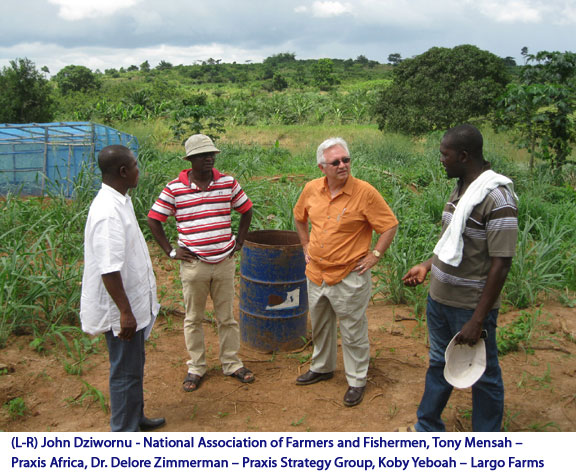
    Among farmers in western Africa, the passion for agriculture runs deep. Kwabena (Koby) Yeboah farms near the village of Gomoa Adumase about 45 minutes outside of Accra, Ghana in West Africa, driven by his focus and intent to succeed.

    Koby started farming five years ago at the age of 22. “I love the outdoors, working with my hands and making things grow,” he says.” I also enjoy hunting too, anything to be outside.” It’s a familiar refrain you’ll hear from almost any farmer you visit in North America. It’s all about the outdoors and a certain respect for the land. (Photo)

    Today he is working on bringing about 200 acres into production on his farm. Over the past five years Koby has built roads, cleared land, accessed water and prepared for production. With a number of full-time villagers who are on the farm every day caring for crops and land, he visits the farm about three days a week, but his mind is on the farm every day. He is anxious for the day when he can bring all of his 850 acres into production and be able to spend seven days a week on the farm. Until then he continues his role as an education consultant recruiting students to schools in Ghana in order to support his family, while spending as much time as he can feeding his passion for farming.

    Koby grows pineapple, maize, peppers, tomatoes and okra. In the near future he plans to add mushrooms, snail production, and has begun work developing a fish pond for Tilapia production. The diversification is impressive. He is also growing several different varieties of specialty potatoes in a custom greenhouse. His plans are to increase potato seed production for planting on his farm and to educate other farmers on growing these potatoes in hopes of expanding acreage around the region. He will seek and secure markets for the potatoes and work to build a reliable and effective means for the region to become a trusted supplier. It is upon the backs of individual farmers and small business operators that economic success will be built.

    Koby’s vision is to turn his farm into a key center of commerce for the village. When he puts out the call for harvest help 40 to 100 people arrive at his farm looking for work, forcing Koby to turn people away. But he has plans to grow and to create a solid source of continued employment for the villagers. His agriculture plan calls for planting dates staggered every six weeks, year round.

    The climate in the region is very steady and stable with consistent temperatures and consistent rainfall year round making it a perfect climate for staggered production. By creating a pattern where harvest and planting activities are happening every month of the year, he could employ farm help every month of the year. The impact of consistent, uninterrupted employment for the village would be an economic boon to the region, and Koby is well aware of this fact. He often speaks of one day being able to provide steady employment to the villagers.

    The villages in rural Ghana are agrarian in nature, mainly for subsistence but also for commercial gain. There is available land, potentially productive but largely untouched in this region. There are also many able hands available in the nearby villages looking for productive work, but too often idled by lack of need for their assistance. Koby Yeboah sees an opportunity to make a difference for the region by setting a strong example for others and helping fellow farmers succeed. It is a sense of honor and commitment not readily found among your average 27 year old, but certainly not lost on this man.

    An example of his commitment to the region, Koby has created a “model farm” just outside the village of Gomoa Adumase. Here on one acre of land he has tilled and prepared the soil and is demonstrating advanced farming practices for raising pineapple. He is teaching other farmers and villagers in the region about the new farming practices so they can learn and produce on their own, and doing it in an entirely hands-on environment. (Photo)

    The sense of community in the area is strong and Koby has grown to become an important part of it. Knowing that the villagers live on tight budgets he says, “I contribute all he can,” often purchasing school uniforms for a number of the children. But, the support doesn’t end there. Just outside the village lies the Gomoa Buduatta Orphanage, home to 16 beautiful young boys and girls who find a safe and secure place to live and go to school. Koby has taken on the incredibly honorable challenge of supporting the orphanage to the best of his ability. Again he says, “I contribute all I can” and you know that it is well appreciated.

    Upon visiting the orphanage the house mother greeted us and invited us in to the quaint accommodations. We visited for a few moments before she invited the children in to say hello. All 16 children came to the door, graciously removed their shoes and stepped inside. Tallest to the back, shortest to the front, nary a word said. As we engaged the children in conversation they were pleasant, extremely polite and often responded as a group in verbal unison. They were just wonderful children.

    We toured the facility to see the sleeping quarters for the 8 boys and the quarters for the 8 girls before stepping into the two small classrooms. It is a humble building, but you can see that to these children it is home and it is safe. Upon our departure all sixteen children in a melodic tone said, “Thank you Mr. Koby.” The whole experience was beyond impressive. (Photo)

    Returning from the tour of the farm, discussion turns to the fragile economy of Ghana and the poor condition of the infrastructure and road system. When asked about it Koby responds, “I live in my own economy. I don’t live in the economy of Ghana,” a stark statement that quiets discussion momentarily. He goes on to explain, “I have a plan and a program. I know what I need to do to succeed and that’s all I am focused on. I cannot worry about what I cannot control.”

    Koby Yeboah has a goal, a plan and is driven to succeed. He says, “I want to be the best farmer in Africa within 10 years.” And you know what? I believe he is just the man to do it.

    Dr. Colin N. Clarke is a senior strategist for AdFarm, a North American agriculture communications firm. AdFarm is a strategic partner of Praxis Strategy Group an economic development consultancy. Follow Dr. Clarke on Twitter @colinnclarke.

  • Greetings From Recoveryland: Ten Places to Watch Coming Out of the Recession

    Like a massive tornado, the Great Recession up-ended the topography of America. But even as vast parts of the country were laid low, some cities withstood the storm and could emerge even stronger and shinier than before. So, where exactly are these Oz-like destinations along the road to recovery? If you said Kansas, you’re not far off. Try Oklahoma. Or Texas. Or Iowa. Not only did the economic twister of the last two years largely spare Tornado Alley, it actually may have helped improve the landscape.

    We have compiled a list of the 10 American cities best situated for the recovery. These are places where the jobs are plentiful, and the pay, given the lower cost of living, buys more than in bigger cities. In other words, places unlike much of the rest of the country. The cities, most of which lie in the red-state territory of America’s heartland, fall into three basic groups. There’s the Texaplex—Austin, Dallas, San Antonio, and Houston—which has become the No. 1 destination for job-seeking Americans, thanks to a hearty energy sector and a strong spirit of entrepreneurism. There are the New Silicon Valleys—Raleigh-Durham, N.C.; Salt Lake City; and urban northern Virginia—which offer high-paying high-tech jobs and housing prices well below those in coastal California. And then there are the Heartland Honeys—Oklahoma City, Indianapolis, and Des Moines, Iowa—which are enjoying a revival thanks to rising agricultural prices and a shift toward high-end industrial jobs.

    Unlike the Sun Belt states and cities along the East and West coasts, these locales not only grew during the boom of the mid-2000s, they suffered least in the Great Recession. The fact that they are mostly in red states should give the newly ascendant GOP comfort as it tries to deliver on its election-year promise to right the economy. That isn’t to say all the blue states will remain weather-beaten. Wall Street, heady with cheap money, has sparked a return to opulence. And the strong demand for high-tech products and services will likely keep places like Boston, San Francisco, and San Diego from devolving into fancy versions of Detroit. Yet given the results of last week’s election and the increasing odds against another bailout of state governments, the near-broke and highly regulated blue states will be hard-pressed to generate much new employment.

    Of course, not everyone living in our Top 10 cities has avoided the heartache. And the continued slow pace of the economic recovery could hamper expansion even in the most-favored cities. If energy tanks as a result of a renewed global slowdown, it could hurt Texas and Oklahoma; dropping agricultural prices would hit some of the Heartland Honeys hard. But relatively—and that is the operative word in this tough economy—our 10 cities should fare better than most anywhere in America. And they could offer us a road map for what the nation’s economy will look like once the dust settles.

    THE TEXAPLEX

    For sheer economic promise, no place beats Texas. Though the Lone Star State’s growth slowed during the recession, it didn’t suffer nearly as dramatically as the rest of the country. Businesses have been flocking to Texas for a generation, and that trend is unlikely to slow soon. Texas now has more Fortune 500 companies—58—than any other state, including longtime corporate powerhouse New York.

    Austin boasted the strongest job growth in our Top 10, both last year and over the decade. Home to the state capital and the ever-expanding University of Texas, the city is arguably the best-positioned of the nation’s emerging tech centers. It enjoys good private-sector growth, both from an expanding roster of homegrown firms and outside companies, including an increasing array of multinationals such as Samsung, Nokia, Siemens, and Fujitsu.

    Yet Austin’s newfound prosperity isn’t simply a product of its university culture or its synergetic collection of technology firms. Its success owes a great deal to simply being in Texas—a state itching to eclipse its historic archrival, the increasingly troubled California. Indeed, Texas is becoming to the Golden State what Arizona, Nevada, and Oregon were in the last decade: a refuge for workers and companies fed up with California’s high unemployment, cost of living, and dysfunctional state government.

    The Texas economy has benefited from widening diversification. Houston has a robust energy business and medical-services industry, and thriving international trade—all long-term growth areas. Dallas enjoys an expanding tech sector and well-developed business-service industries tied to a powerful corporate base. San Antonio has a strong military connection and an expanding manufacturing capacity, and it is a key locale for the growing Latino marketplace. What’s more, Texas offers pro-business policies and relatively low taxes, and the physical infrastructure in the cities is generally as good or better than in many East and West coast metropolitan areas.

    People are voting with their feet. All four Texas cities are enjoying strong immigration from the rest of the country and abroad. Houston and Dallas have higher rates of immigration than Chicago, and if the job picture stays the same, those cities could someday rival New York and Los Angeles in terms of ethnic diversity.

    THE NEW SILICON VALLEYS

    Although Massachusetts and California are lauded as the places “where the brains are,” neither ranked high in the growth of tech jobs over the past decade. More important is where the brains are headed.

    A lot of them are going to North Carolina, Virginia, and Utah. The population of Raleigh-Durham grew faster than any major U.S. metropolitan area during the recession, and the city ranked third on our list in terms of job growth over the last decade. To the north, in Virginia, lies another Silicon Valley wannabe, stretching across Alexandria, Arlington, and Fairfax counties. And then there’s Salt Lake City and its environs, buoyed by the arrival of such big names as Adobe, Twitter, and Electronic Arts. The Greater Salt Lake region, which follows the Wasatch Mountains from Provo to Ogden, has much to attract tech companies: short commutes, decent public schools, spectacular nearby recreation, and, perhaps most important, affordable housing. Roughly 75 percent of households in Salt Lake can afford a median-priced house, as compared with 45 percent in Silicon Valley and roughly half that in New York City and San Francisco. The cost advantages of cities like Salt Lake and the other high-tech hubs are expected to prove especially attractive to millennials—the generation born after 1982—as they begin forming families and buying homes en masse.

    None of these Silicon Valleys may ever reach the critical mass of the real thing in California, but they will become increasingly more effective competitors and take an expanding market share of the nation’s technology business.

    THE HEARTLAND HONEYS

    The oft-ignored center of the country boasts a thriving economy that seems poised for further expansion. The region is well positioned to take advantage of growing markets for agricultural commodities and farm machinery in fast-growing countries such as India and China. The Great Plains and parts of the southern Midwest have also attracted new investments in manufacturing, both from domestic and foreign firms.

    Having largely missed out on the housing bubble, the region also avoided the hangover. As a result, after watching generation after generation move away, several heartland cities are enjoying a noticeable uptick in domestic migration as well as immigration. During the Great Depression, it was Oklahomans who moved to California to escape the Dust Bowl. Now there are considerably more people moving from California to Oklahoma than the other way around.

    Indianapolis, once written off as “Indiana no-place,” is one emerging hotspot. The area’s housing affordability now stands at a remarkable 90-plus percent. Although the recession has hit some of Indiana’s manufacturing-oriented northwest corner, over the past decade Indianapolis’s population grew at a rate 50 percent greater than the national average, notes urban analyst Aaron Renn. Much of this success is due to an aggressively pro-business attitude that promotes growing clusters such as life sciences, motor sports, and Internet marketing.

    Oklahoma City and Des Moines have also enjoyed steady growth in both jobs and net migrants over the past decade. Des Moines was recently rated the No. 1 spot in the country for business and careers by Forbes magazine, thanks to a surging agricultural sector and strength in the business-services segment. And Oklahoma City—which enjoys low unemployment as a result of its steadily growing energy and aerospace sectors—has been ranked among the best job markets for young people, ahead of Dallas, Seattle, and even New York (having Kevin Durant lead the NBA’s Oklahoma City Thunder for the foreseeable future can only improve the buzz).

    Of course, none of the cities in our list competes right now with New York, Chicago, or L.A. in terms of art, culture, and urban amenities, which tend to get noticed by journalists and casual travelers. But once upon a time, all those great cities were also seen as cultural backwaters. And in the coming decades, as more people move in and open restaurants, museums, and sports arenas, who’s to say Oklahoma City can’t be Oz?

    Job Growth
    Net Domestic Migration
    Total 2010
    2009
     
    10yr
    7yr
    2yr
    1yr
    9yr
    6yr
    2yr
    1yr
    Emplymt
    Population
    Northern Virginia 13.8% 11.5% -1.0% 1.2% 12.3 3.2 10.1 8.3 1,309,675 2,558,256
    Raleigh 13.5% 13.7% -4.9% -0.4% 236.7 186.6 47.2 18.4 496,900 1,125,827
    Salt Lake City, Ogden, Provo 7.7% 8.5% -6.7% -1.4% 9.2 15.9 7.4 2.4 961,900 2,227,413
    Austin 14.1% 17.8% -0.9% 1.7% 177.2 136.5 37.3 15.5 768,500 1,705,075
    Dallas-Fort Worth 3.7% 8.1% -3.6% 0.8% 59.3 44.8 14.3 7.2 2,876,925 6,447,615
    Houston 11.7% 10.9% -3.6% -0.5% 51.2 42.9 15.5 8.7 2,518,675 5,867,489
    San Antonio 11.4% 10.8% -2.7% -0.2% 102.1 86.4 21.3 9.3 833,325 2,072,128
    Oklahoma City 4.9% 6.7% -2.2% 1.0% 37.8 32.7 11.6 7.3 561,125 1,227,278
    Des Moines 7.8% 7.4% -3.5% -0.9% 63.6 56.2 14.0 6.1 316,975 562,906
    Indianapolis 1.6% 0.3% -5.5% -0.3% 45.9 34.6 8.0 4.1 870,850 1,743,658
    New York -1.5% 0.3% -4.1% -0.5% -104.7 -82.6 -13.8 -5.8 8,288,300 19,069,796
    Los Angeles -6.2% -5.2% -8.0% -1.0% -107.9 -89.0 -15.7 -6.3 5,118,950 12,874,797
    San Francisco -13.1% -6.0% -8.9% -2.6% -83.1 -57.6 3.4 1.9 1,853,350 4,317,853
    Chicago -8.0% -4.8% -7.4% -1.7% -60.0 -45.8 -8.8 -4.2 4,235,175 9,580,567
    Nation -1.2% 0.4% -4.9% -0.1%   130,690,750  
    Areas are Metroplitan Statistical Areas
    Northern Virginia, Va. includes Arlington, Clarke, Fairfax, Fauquier, Loudoun, Prince William, Spotsylvania, Stafford, and Warren Counties and Alexandria, Fairfax, Falls Church, Fredericksburg, Manassas, and Manassas Park Cities in Virginia.
    Salt Lake City region includes Ogden and Provo Metroplitan Statistical Areas
    Job growth uses May-August average for each year.
    Job data:  U.S. Bureau of Labor Statistics, Current Employment Survey
    Migration data:  U.S. Census Population Estimates.  Migration is cumulative over 10, 7, 2, or 1 yr period.  Number is rate per 1,000 residents in base year.

    —————-

    This article originally appeared in Newsweek.

    Praxis Strategy Group and Zina Klapper provided research for this article.

    Joel Kotkin is executive editor of NewGeography.com and is a distinguished presidential fellow in urban futures at Chapman University and an adjunct fellow with the Legatum Institute in London. He is author of The City: A Global History. His newest book is The Next Hundred Million: America in 2050, released in February, 2010.

    Photo: Jeanette Runyon

  • Corn Crop 2010: Food, Fuel, Feed and Folk Art

    The harvest of this year’s U.S. corn crop is about 90 percent complete, and it is going to be a bin-buster. If it surpasses 2009’s astonishing 13.1 billion bushels, it could become the largest in U.S. history. American farmers are growing more corn today than at any time in the past, and the trend is accelerating. The last five years have brought us five of the largest corn crops ever. Where to store the stuff is becoming an issue: When the bins and elevators are full, the corn is simply piled on the ground. Bankers are saying that we are experiencing the best farming environment in decades.

    Genetically modified seed, powerful fertilizer, and the rich soil of the Central Plains have turned field corn into the most prolific and versatile commodity on earth. It’s used in biofuel, animal feed, fabrics, biodegradable plastics, makeup, fireworks, crayons, shoe polish, batteries, and thousands of other products we consume every day.

    The U.S. Department of Agriculture reports that of the 13 billion bushels of field corn produced last year, 36 percent was used as feed for domestic livestock (beef, pork, poultry), 31 percent was used for ethanol (also resulting in 1.5 billion bushels of distiller grains, a byproduct of ethanol production that is used as livestock feed), 14 percent was exported to other countries (Japan, Mexico, South Korea, Taiwan and Egypt are the top recipients), 9 percent was used for human food, seed and industrial use, and 11 percent was carried over as a surplus.

    According to Nathan Fields, Director of Biotechnology and Economic Analysis for the National Corn Growers Association (yes, that is his real name), today’s farmers are good at growing corn—very good. No other county in the world even comes close.

    Corn was domesticated more than 7,000 years ago, when the early agronomists of the Americas instigated the upward trajectory of what might be described as the world’s first and most successful designer crop. In 1621, Squanto taught the pilgrims how to cultivate corn — maize —that sported only eight rows of kernels and was about one quarter of the length that it is today.

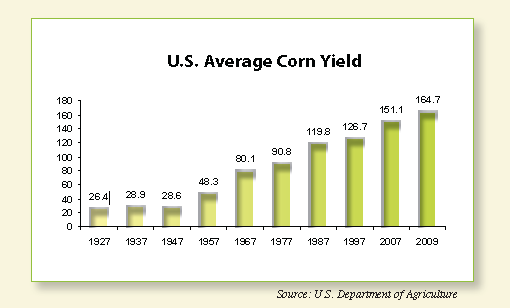
    In 2009, farmers in the Corn Belt — usually defined as Iowa, Illinois, Indiana, Minnesota, South Dakota, North Dakota, Nebraska, Kansas, Missouri, Ohio, Oklahoma, northern Texas, and Colorado— averaged a record yield of 165 bushels per acre. In 1927, when the first official records were kept, yield was only 26 bushels per acre. Fields asserts that the genesis of modern agriculture was in the 1880s, when ingenious farmers began to cross pollinate corn, creating hybrid seeds that produced hardier plants with the ability to outperform their parents. In the 1920s, geneticists developed inbred corn; after that, each decade brought and growth spurt after spurt. In the 1990s, biotech hybrids were developed that better tolerated drought, variances in temperature, and insects. But farmers still battle the weather every year. Indeed, it’s not unheard of for farmers to be fighting snow drifts during the last few weeks of harvest, and no amount of technology can stop a late summer hailstorm from destroying an entire crop in ten minutes or less.


    The winner of the National Corn Yield Contest last year grew 307 bushels per acre. A bushel of corn is 56 pounds and the size of a small laundry basket. A bold prediction is the expectation of 300 bushels per acre as a national average by 2030. It would be an 80 percent increase in just 20 years.

    Nathan Fields emphasizes that developments have led to higher US corn yields, grown on fewer acres with less water, chemicals, fertilizers, and fuel. Dramatic reductions in inputs per acre mean a smaller environmental footprint. There are 316,000 corn farmers in the U.S., and 95 percent of them are family farmers, the vast majority multigenerational. “For family farmers,” Fields asserts, “success is not measured by a single season. Family farmers are determined to leave the land in good shape for the next generation.”

    Enormous combines harvest biotech hybrid crops with the use of sophisticated GPS navigation systems—it’s no longer your grandfather’s farm, a fact reinforced to me recently by my 94-year-old grandpa, Ben Radcliffe. Radcliffe was a South Dakota farmer in the 1940s before he became the president of South Dakota Farmers Union and one of the country’s most revered farm activists. When Radcliffe’s father (my great-grandfather) was farming in the early 1900s, less than 1 percent of planted corn was hybrid; early farmers saved their seed from year to year. By the early 1940s, 78 percent of the corn planted was hybrid.

    Radcliffe notes,“Today, farmers use a weed control chemical so they don’t have to cultivate [plow between the rows]. We had to cultivate twice a year just to get the weeds out of the row. Today, the rows can be closer and the number of plants automatically doubles.”

    Today’s farmers also plant earlier. In the 1940s there was a farmer tradition that planting corn ideally began May 10th and was completed before June 1. Because today’s seed is more resistant to frost, farmers now begin planting in April. Today, most if not all of the corn harvest is sent to grain elevators. In Radcliffe’s day, most of it was fed to livestock right on the same farm. “Almost every farm, including mine,” he says, “had hogs and cows.”

    A new market for corn has recently opened up in China. According to CHS market analyst Kent Beadle, “China has undergone dramatic changes over the last decade. As incomes and lifestyles are changing, there is a demand for better food—specifically, more protein.” Pork, beef, and chicken consumption have caused demand to exceed supply, putting the world’s most populous country in a position to begin to buy U.S. corn.

    The U.S. supplies 62 percent of the world’s corn. Last year, America’s farmers exported $9 billion worth of it, an export surplus that most U.S. industries would envy… all from the ability of a genetically modified kernel of corn that weighs one-hundredth of an ounce to produce a 10 foot tall plant. A”maize”ing.

    Photo by Deborah Dragseth: The World’s Only Corn Palace, located in eastern South Dakota, twelve miles from where the author grew up in the heart of corn country. A folk art wonder, it is redecorated each year with 275,000 ears of corn. The 13 different colors and shades of corn include yellow, red, brown, blue, black, white, orange, calico and (this year for the first time via genetic engineering), green.

    Debora Dragseth, Ph.D. is an associate professor of business at Dickinson State University in Dickinson, North Dakota. She trains and develops leadership curriculum for CHS, Inc. a diversified energy, grains and foods company. The Fortune 100 company is the largest cooperative in the United States. Dragseth’s family owns a farm 8 miles east of the World’s Only Corn Palace.

  • Redefining ‘Niners’: Football on The Great Plains

    At 0.5 people per square mile, Harding County, South Dakota is one of the least populated places in the nation. The county’s only high school, located in Buffalo, is small by even small-town standards, with 85 students in grades 9-12. However, few schools can match its gridiron success. Nicknamed after the primary industry in the region, “The Ranchers” football team has experienced only one losing season in its 44-year history.

    Harding County’s teenage boys suit up every Friday night and dominate 9-man football.

    Nine-man football is a small-town sport. Unique to three upper Great Plains states (South Dakota, North Dakota, and Minnesota), it was designed for rural high schools, where mounting a standard 11-man team simply isn’t feasible.

    The first three games of the 2010 season are already in the books, all three ending early due to the 50-point mercy rule (any time after halftime, a 50-point lead wins the game). The Ranchers have so far outscored their opponents 172 to 14.

    The key to 9-man football, according to Ranchers head coach, Jay Wammen, is speed. “With two less defensive linemen, we have more space to work with. Like most 9-man teams, our kids play both offense and defense, so there is a demand for physicality and the ability to be on the field giving it their all from the first whistle to the last.”

    The Ranchers play on what many regard as the worst football field in South Dakota. “We tried raising grass on the field last year,” laments assistant coach and school principal Josh Page. “We laid some sod, but it died out.” The field is too muddy to use when it rains, and when it’s dry, clouds of thick dust blow across from the adjacent rodeo grounds. It’s not unusual for Friday night Ranchers games, originally scheduled for their home field, to be forced to move to their opponent’s school, due to unsuitable playing conditions. Visiting teams consider this good news — over the years players have come to dread the invasive cockleburs populating the Harding County High School football field.

    Football is a collision sport, and wrestling cattle on the ranch prepares these young men for confronting 250-pound opponents. Getting up at sunrise to feed livestock trains them to be alert, disciplined, and ready to execute. Says Wally Stephens, sports editor of The Nation’s Center News (circulation 1200) about the Ranchers’ style of play, “Our boys play hardnosed, power football. They grind the ball out and they hit hard.”

    Located in the farthest northwest corner of South Dakota, Harding County is known to paleontologists as the T-rex capital of the world — more T-rex fossils have been found here than in any other place on earth. It has a population of 1,353 people, spread out over 2,678 square miles. The region boasts the nation’s coldest winters, punctuated by fierce blizzards that are capable, even today, of immobilizing residents for weeks at a time. When its High School team members are not playing football or going to school, most are working on the family ranch: branding calves, wrestling steers, herding sheep, or moving hay. Many are the third or fourth generation on the land. When they start practice in August, the players are in shape and ready to work hard. Sure, they have a little swagger, notes Coach Wammen, but it’s been earned by their success.

    Whether they win or lose, away games constitute a long ride home over vast stretches of two-lane roads. The conference has nine teams and encompasses an impressive 38,000 square miles, with the farthest regular season game 213 miles away. Yet even with an average round trip of over 250 miles, Harding County fans often outnumber those of the opposing team. “The whole county comes,” according to Nora Boyer, the erudite 78-year-old volunteer curator at the Buffalo Historical Museum. “It gets pretty nippy around November and some people watch the game from their vehicles, but I say, if you sit in your pickup truck, you can’t holler.” Many of the players have fathers and grandfathers in the crowd who, when they were teenagers, played for Harding County High School.

    High school senior Jace Jenson is a standout wide receiver and line backer whose ranch is 40 miles from the high school. Jenson attended hometown games as a grade school student, playing rough-and-tumble football in the field behind the goalposts. “I remember being a little kid and goofing around with the same guys that I play with today.” One of those guys is current teammate and fellow senior Austin Brown who has been the Ranchers’ quarterback and safety since he was a freshman. Brown lives on a ranch that belonged to his grandfather, 25 miles north of the high school in Buffalo. He describes Harding County football as “tradition,” saying, “I have had a football in my hands ever since I can remember.”

    The 6’5” quarterback was one of only three South Dakota football players who were recognized in the renowned Tom Lemming’s Prep Football Report Summer 2010. The report calls Brown “…One of the biggest sleepers in the country . . . he plays way out in western South Dakota so most college coaches are unaware of the potential blue chipper.”

    Both Brown’s and Jenson’s fathers played for the Ranchers in the early 1980s. Jenson says, “My dad played Harding County football when he was in high school. But,” he adds with a sly grin, “I don’t know if he was any good. You could ask him . . . but he’s out moving hay.” The fathers of both the Ranchers’ head coach and assistant coach played football together on the same field that their sons coach on today. Coaches Page and Wammen are too young to have boys of their own on the field, but, most townsfolk believe it’s only a matter of time. People in ranch country are patient.

    Places as isolated as Harding County are sometimes referred to as ‘the middle of nowhere’. But for these exceptional football players, it’s not ‘nowhere’ — it’s ‘now’ and ‘here’– it’s their past, it’s their future, and it’s one of the best places to grow up in America.

    Photo: Friday night in Harding County

    Debora Dragseth, Ph.D. is an associate professor of business at Dickinson State University in Dickinson, North Dakota. She trains and develops leadership curriculum for CHS, Inc. a diversified energy, grains and foods company. The Fortune 100 company is the largest cooperative in the United States. Dragseth’s research interests include Generation Y (Millennials), outmigration and entrepreneurship.

  • Political Decisions Matter in State Economic Performance

    California has pending legislation, AB 2529, to require an economic impact analysis of proposed new regulation. Its opponents correctly point out that AB 2529 will delay and increase the cost of new regulation. There will be lawsuits and arguments over the proper methodology and over assumptions. It is not easy to complete a thorough and unbiased economic impact analysis.

    Should California incur the costs and delays of economic impact studies?

    California should, because political decisions matter and too many California politicians don’t believe it. I’ve had a State Legislator, sitting in her office in the Capital, tell me in essence that decisions made in this building won’t impact California’s economy.

    She’s not alone. It is common to hear politicians or their advisors claim that “California will come back” or something similar. They believe that California’s climate and abundant amenities are enough to guarantee prosperity. They are wrong.

    Consider North Dakota, and its booming economy. As of July 2010, North Dakota’s unemployment rate was 3.6 percent, and in 2008, the most recent year for which we have data, its economy grew at a 7.3 percent rate. California’s unemployment rate was 12.3 percent in July 2010, and its 2008 economic growth rate was an anemic 0.4 percent.

    That’s a very big difference. If California had North Dakota’s unemployment rate, it would have over 1.3 million jobs than it has today. That is almost the entire population of Sacramento County and 30 percent more than the entire population of Northern California’s Contra Costa County.

    Why the big difference? Why is North Dakota booming, as the United States suffers its most devastating economic decline in over 70 years? Why is California’s economy, with almost 30 percent higher unemployment than the United States, performing so poorly?

    Does North Dakota have some naturally endowed advantage over California? If so, nobody has noticed it before. It is not climate. California has a friendly Mediterranean climate, while North Dakota has a Northern Continental climate. North Dakota’s mean minimum temperature is below freezing six months of the year, and it gets as low as -60F! Many Californians, living on the coast, can go decades without witnessing a freezing temperature. I remember when we had a multi-day freeze in my hometown of Ventura, sometime in the 1980s. I was freezing; a North Dakotan would be walking around in a t-shirt.

    California has oil and gas. North Dakota has oil and gas. California has over 2,000 miles of beaches. North Dakota doesn’t have beaches. California has magnificent mountains. North Dakota doesn’t have any mountains and only a few hilly areas. Over 20 species of trees reach their largest size in California. Most of North Dakota doesn’t naturally grow many trees.

    Let’s face it. Most Californian’s consider North Dakota to be a cold, windy, God-forsaken piece of dirt best left to the bison. North Dakota’s natural endowment doesn’t explain why it has been growing with vigor while California has been stagnating.

    Maybe North Dakota has been lucky while California has been unlucky? Luck can play a part in economic performance, and North Dakota has almost surely been luckier than California over the past few years, but that can’t be the only explanation.

    It’s hard to point to a single source of North Dakota’s prosperity. Its taxes aren’t particularly low. It has a reasonable safety net for the unfortunate. It does have a booming oil and gas business. Its agriculture sector is doing well. It has a small, but dynamic, tech sector. Its universities remain well funded since the state is actually running surpluses. It has a hardworking, well educated, Midwestern population. Governments and politicians in both parties tend to be business friendly, willing to support business and enter into occasional partnerships. North Dakotans have done lots of things right, and they’ve probably also been a bit lucky.

    It’s just as hard to point to a single source of California’s dismal performance. California hasn’t maximized the economic potential of its oil and gas resources, but its economy is large, and oil and gas alone can’t explain the differences between California and North Dakota. California hasn’t updated its ports to accommodate the most recent and planned ships, but those ports see lots of activity. Many California communities are not business friendly, but some are, particularly some smaller ones inland. California has lost some military bases, but many remain. California is a relatively expensive place to do business, because of taxes and regulation, but California’s workers are more productive, even after adjustment for industrial composition and capital, and California’s consumers still constitute a huge market.

    California’s economy is dying the death of a thousand cuts: a tax here, a regulation there, an unfriendly city council in Coastal California, a lack of infrastructure investment everywhere. These things add up to a significant net negative for California, its businesses, and its workers.

    Californians have done lots of things wrong, and they’ve been a bit unlucky.

    That’s why AB 2529 is a good idea for California, why it’s worth the costs and delays. The analysis will require regulators to consider the economic costs of regulation, something many green activists and Sacramento politicians simply ignore. Perhaps if this regulation had been in place over the past few years, some of California’s 2.2 million unemployed workers would have jobs and once Golden State would not be on the verge of becoming, as historian Kevin Starr has noted, “a failed state”.

    Bill Watkins is a professor at California Lutheran University and runs the Center for Economic Research and Forecasting, which can be found at clucerf.org.

    Photo by Willem van Bergen

  • Iowa’s Agro-Metro Future

    When Brent Richardson, a field rep for Cadillac, was told he’d been transferred to Des Moines, he assumed he’d be spending the next year in a small town environment. Des Moines turned out to have much more bustle than he expected. The city had a robust insurance sector among its diverse industries. And the lifestyle was very similar to what he was able to live in big city suburbs like Naperville, Illinois or Bellingham, Massachusetts. Steeped in a decade of Farm Aid concerts, he also expected the surrounding rural areas to be populated with hardscrabble homesteaders struggling to hang on. Instead, he discovered that farming was big business – and, these days in particular, reasonably profitable. And some of those Iowa farmers turned out to be Cadillac buyers.

    Richardson’s outsider view of Iowa is typical. Few people give it much thought, and those who do conjure up visions of cornfields and American Gothic. There’s some truth to that, but the real Iowa today is much more than that. A resurgent but industrialized agriculture sector and thriving cities give the state a 1-2 “agro-metro” punch, although large areas of the state still struggle.

    Straddling the Midwest and the Great Plains, Iowa is in a region known for trouble. But the state has managed to pile up impressive statistics. Iowa lost fewer jobs than the nation in the last decade, and has consistently maintained a lower unemployment rate. In 2009, Iowa’s unemployment was only 6.0% compared to a national average of 9.3%, a huge differential. Its agricultural sector is booming. So far this year US farm cash incomes were up 23%. That’s increasingly driven by large farm operations, as 75% of farm output comes from just 12% of farms. Iowa is right in the middle of this.

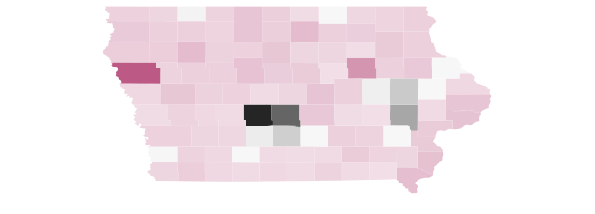
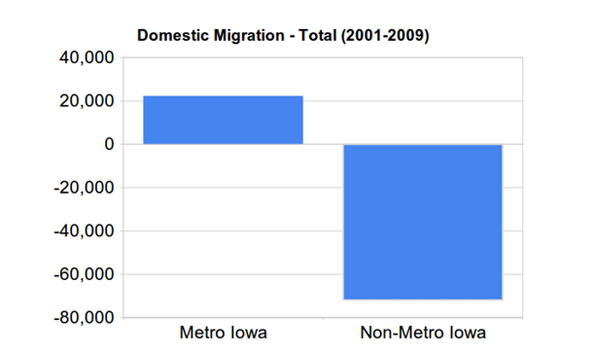
    But if the state as a whole looks reasonably healthy, this obscures its unevenness. Des Moines and big farms are doing well, but many rural and manufacturing communities are not. This is best illustrated by a map of domestic migration over the last decade.

    Net Domestic Migration, 2000-2009, in-migration in gray, out-migration in red. Darker shading denotes intensity.

    This shows net in-migration in grays and net-outmigration in pinks. The darker gray areas are clustered in metro Iowa, which is showing incredible growth, particularly around Des Moines. Des Moines population is actually up 16.5% in the last decade, about double the national average growth rate. In a decade where the US as a whole didn’t add any jobs, Des Moines powered ahead on employment by 9.3%. It’s GDP per capita is actually 12% higher than Chicago’s.

    Many other Iowa metros are likewise doing well. Dubuque recently landed a 1,000 job operation from IBM and grew its employment by over 3% last decade. Dubuque, along with other Iowa metros like Ames and Sioux Falls, grew economic output per capita faster than the average for the rest of America’s cities.

    But for non-metro Iowa, it can be a different story. Some big farmers are doing well, but many places are living up to their Great Plains reputation; they are simply drying up and emptying out. They are too remote, too sparsely populated, too lacking in talent concentrations, and ill prepared for the demands of the global economy.

    As farming transforms, cities thrive, and other areas shrivel, Iowa in changing, splitting into two states as its regions diverge, and becoming increasingly metropolitan in character.

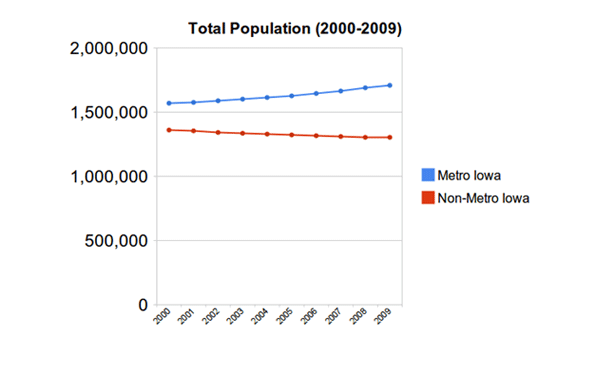
    This divergence is most easily illustrated by a chart of population:

    There are already more people living in metro areas than non-metro areas in Iowa, and the gap is only getting wider. Non-metro Iowa is actually shrinking as people leave and the population re-orders itself in the state:

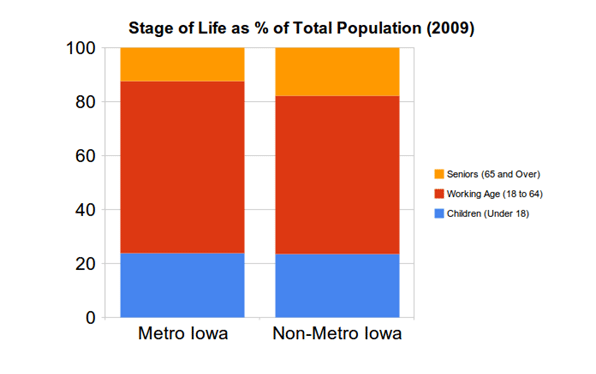
    Non-metro Iowa also has a larger senior population and lower population of working age. Generational turnover will drive even further population declines over time:

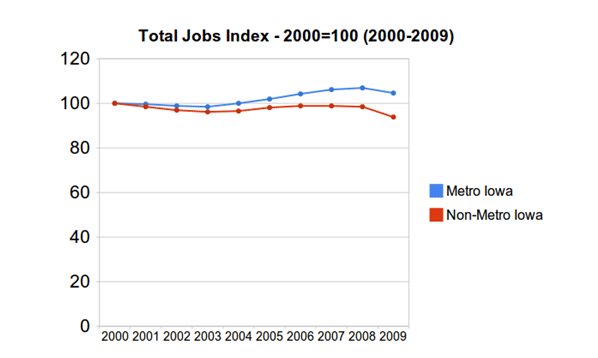
    And of course, these demographic trends are reflected in employment numbers as well, with metro Iowa adding jobs even in the last decade while non-metro Iowa is losing them.

    People’s opinions of Iowa are largely shaped by which of these two states they are looking at. More people tend to think about the struggling parts because that fits the traditional coastal media narrative and those places look big on a map. Iowa’s thriving metro regions are often overlooked because they are smaller and don’t fit the mold espoused by big city urbanists. Des Moines might not look like a Boston or Chicago, but that doesn’t mean it isn’t prosperous – and growing at almost Sunbelt rates.

    Like all of America, Iowa is a state in transition. And while it faces challenges to be sure, it’s managing that change better than most. Iowa’s future is likely to be very different from its small town past. It will be a more urban state, with several thriving metro regions. Farming will remain important, but will increasingly as a big business operation. Iowa’s future will be neither small town nor “hip cool” big city; it will represent the kind of agro-metro future that is emerging across wide swaths of America’s heartland.

    Aaron M. Renn is an independent writer on urban affairs based in the Midwest. His writings appear at The Urbanophile.

    Photo by Pete Zarria

  • Sarah Palin: The GOP’s Poison Pearl

    Sarah Palin has emerged as the right’s sweetheart, a cross between a pin-up girl and Joan of Arc. For some activists, like the American Thinker‘s Lloyd Marcus, she’s “my awesome conservative sister” who the mainstream media wants to “destroy at any cost.”

    On a more serious note, leading right-wing pundit Roger Simon argues Palin’s is now the biggest name in Republicandom, which he admits is not too great an accomplishment. Armed with “something more than intellect,” he praises her unique ability to “connect with the base.” He also believes, citing some polls for 2012, that she could run a close race against President Obama.

    These Republicans may grow to regret their embrace of Sarah Palin: She will likely prove less a gem than a poison pearl for conservatives. Sure, she can stir the base, but her crossover appeal remains limited. Recent Pew surveys show that she’s still toxic for the Independents and moderate Democrats who generally determine national elections.

    Palin keeps building her brand, but she may also be diminishing the GOP’s. She has helped propel several potentially weak, marginal “Tea Party” candidates such as Rand Paul in Kentucky and Sharron Angle in Nevada into the general elections. These could end up losing seats that more earth-bound Republicans could have won.

    But if conservatives really want evidence of Palin’s limitations, they only need to talk to people in her home state of Alaska. “She represents a constituency that is rural, but that’s it,” says Jim Egan, executive director of Commonwealth North, a local think tank. “What she says and does makes little sense in the urban environment that most Americans live in.” If it does not sell across the board in Anchorage, home to almost half of Alaskans, you wonder how well her message will play in Omaha or suburban Houston, much less New York or Los Angeles.

    Conservatives in Washington might also cool their drool, Egan suggests, if they examine Palin’s Alaska record. True, she did initially take on some in-bred corruption, but she left the state as dependent on oil revenues and federal largesse as before. She left no strong legacy, particularly in comparison with the late former Sen. Ted Stevens–known widely as “Uncle Ted”–who brought heaps of federal blubber to the Last Frontier.

    In contrast, Palin is seen by many Alaskans–including business-oriented conservatives–as a hopeless lightweight. “She’s a narcissistic individual,” suggests Republican State Sen. Craig Johnson. “What bothers me is people think we are like Sarah Palin. We’re not.”

    To Johnson and many Alaska political veterans Palin is more self-promoter than serious politician. Even as some are touting her as a serious candidate for president of the United States, it’s important to realize she proved ill-prepared to be governor of Alaska–more interested in powdering her nose than putting it to the grindstone.

    And remember that Alaska, a vast, underpopulated state of 700,000 hard-working individuals, does not require the horsepower needed to rule a disaster zone like Michigan, much less a mega insane asylum like California. For one thing, Alaska, due to its huge mineral wealth, is a comparatively rich state, with the eighth highest per capita income in the nation. Over 80% of the state budget comes through energy-related taxes. Everyone even gets a nifty $1,300 check as well, also paid for by the energy companies.

    Egan and others argue that Palin, who boosted the return to taxpayers from oil revenues, failed to capitalize on these assets. The state’s bulging revenues during the energy price spike of 2007-08 could have been applied to badly needed infrastructure and education, not to buy new snowmobiles and shotguns. “She epitomizes the whole idea of we get a piece and no sense of planning for the future, about thinking about what we need to do,” Egan says.

    In this sense Palin appeals to the grifter spirit of America–opportunistic and self-centered. This was amply evidenced by her decision to quit office mid-way through her first term for the more lucrative job of cashing in on her personality cult. “Sarah Palin was a breath of fresh air,” says one-time supporter Iris Gardner, who with her husband operates a mercantile store in Alaska’s scenic Seward (population 3,000). “But she blew all that when she quit. People have soured on her.”

    This view is widely shared in Alaska. Today, according to Alaskadispatch.com, about half of Alaskans want to be “done with her.” Only 56% of Republicans count themselves as Palin fans. She is widely unpopular among both Democrats and Independents, the state’s largest electoral base, the Dispatch noted.

    So we have to ask why Palin continues to be attractive for so many conservatives? It has more to do with subliminals than the subtleties of public policy. Palin’s power is not that of serious policymaker but rather as someone with a keen understanding of message and branding. Still, Palin’s appeal cannot be easily dismissed. Certainly charisma does not necessarily translate into a lack of gravitas. Prominent conservatives like Norman Podhoretz have pointed out that Ronald Reagan too was considered a lightweight by many in the mainstream media.

    Yet those who knew and covered Reagan–like my old boss Lou Cannon–always argued Reagan was a serious figure, surrounded by a coterie of very smart advisers. He had spent decades in and around politics before ascending to the White House. Palin, in contrast, seems to be making up her politics along the way.

    Reagan also served two terms as governor of California, despite running for the nomination in 1976. Even today he enjoys some considerable respect from longtime opponents, as well as something close to adoration among friends. As those who interviewed him can attest, he also was very sharp: Reagan would have never allowed a Katie Couric to get the better of him. To paraphrase the famous Lloyd Bentsen’s quip about Dan Quayle, Sarah Palin is no Ronald Reagan.

    Still Palin’s populist appeal seems well-suited against a Democratic Party–and a president–burdened with what seems like a congenital inability to connect with most middle- and working-class concerns. Barack Obama has turned intellectualism into a liability.

    There’s also the novelty factor working in Palin’s favor. “It’s a sense of mystery we can’t keep away from,” Jim Egan suggests. In this sense, oddly, she’s a bit like Barack Obama–someone people enthuse over not because they are ready for the job but because they appeal to some emotional need for novelty. But, as Palin herself would say, how’s that working out for ya?

    This article originally appeared at Forbes.com.

    Joel Kotkin is executive editor of NewGeography.com and is a distinguished presidential fellow in urban futures at Chapman University. He is author of The City: A Global History. His newest book is The Next Hundred Million: America in 2050, released in February, 2010.

    Photo: geerlingguy

  • Urban Legends: Why Suburbs, Not Dense Cities, are the Future

    The human world is fast becoming an urban world — and according to many, the faster that happens and the bigger the cities get, the better off we all will be. The old suburban model, with families enjoying their own space in detached houses, is increasingly behind us; we’re heading toward heavier reliance on public transit, greater density, and far less personal space. Global cities, even colossal ones like Mumbai and Mexico City, represent our cosmopolitan future, we’re now told; they will be nerve centers of international commerce and technological innovation just like the great metropolises of the past — only with the Internet and smart phones.

    According to Columbia University’s Saskia Sassen, megacities will inevitably occupy what Vladimir Lenin called the “commanding heights” of the global economy, though instead of making things they’ll apparently be specializing in high-end “producer services” — advertising, law, accounting, and so forth — for worldwide clients. Other scholars, such as Harvard University’s Edward Glaeser, envision universities helping to power the new “skilled city,” where high wages and social amenities attract enough talent to enable even higher-cost urban meccas to compete.

    The theory goes beyond established Western cities. A recent World Bank report on global megacities insists that when it comes to spurring economic growth, denser is better: “To try to spread out economic activity,” the report argues, is to snuff it. Historian Peter Hall seems to be speaking for a whole generation of urbanists when he argues that we are on the cusp of a “coming golden age” of great cities.

    The only problem is, these predictions may not be accurate. Yes, the percentage of people living in cities is clearly growing. In 1975, Tokyo was the largest city in the world, with over 26 million residents, and there were only two other cities worldwide with more than 10 million residents. By 2025, the U.N. projects that there may be 27 cities of that size. The proportion of the world’s population living in cities, which has already shot up from 14 percent in 1900 to about 50 percent in 2008, could be 70 percent by 2050. But here’s what the boosters don’t tell you: It’s far less clear whether the extreme centralization and concentration advocated by these new urban utopians is inevitable — and it’s not at all clear that it’s desirable.

    Not all Global Cities are created equal. We can hope the developing-world metropolises of the future will look a lot like the developed-world cities of today, just much, much larger — but that’s not likely to be the case. Today’s Third World megacities face basic challenges in feeding their people, getting them to and from work, and maintaining a minimum level of health. In some, like Mumbai, life expectancy is now at least seven years less than the country as a whole. And many of the world’s largest advanced cities are nestled in relatively declining economies — London, Los Angeles, New York, Tokyo. All suffer growing income inequality and outward migration of middle-class families. Even in the best of circumstances, the new age of the megacity might well be an era of unparalleled human congestion and gross inequality.

    Perhaps we need to consider another approach. As unfashionable as it might sound, what if we thought less about the benefits of urban density and more about the many possibilities for proliferating more human-scaled urban centers; what if healthy growth turns out to be best achieved through dispersion, not concentration? Instead of overcrowded cities rimmed by hellish new slums, imagine a world filled with vibrant smaller cities, suburbs, and towns: Which do you think is likelier to produce a higher quality of life, a cleaner environment, and a lifestyle conducive to creative thinking?

    So how do we get there? First, we need to dismantle some common urban legends.

    Perhaps the most damaging misconception of all is the idea that concentration by its very nature creates wealth. Many writers, led by popular theorist Richard Florida, argue that centralized urban areas provide broader cultural opportunities and better access to technology, attracting more innovative, plugged-in people (Florida’s “creative class“) who will in the long term produce greater economic vibrancy. The hipper the city, the mantra goes, the richer and more successful it will be — and a number of declining American industrial hubs have tried to rebrand themselves as “creative class” hot spots accordingly.

    But this argument, or at least many applications of it, gets things backward. Arts and culture generally do not fuel economic growth by themselves; rather, economic growth tends to create the preconditions for their development. Ancient Athens and Rome didn’t start out as undiscovered artist neighborhoods. They were metropolises built on imperial wealth — largely collected by force from their colonies — that funded a new class of patrons and consumers of the arts. Renaissance Florence and Amsterdam established themselves as trade centers first and only then began to nurture great artists from their own middle classes and the surrounding regions.

    Even modern Los Angeles owes its initial ascendancy as much to agriculture and oil as to Hollywood. Today, its port and related industries employ far more people than the entertainment business does. (In any case, the men who built Hollywood were hardly cultured aesthetes by middle-class American standards; they were furriers, butchers, and petty traders, mostly from hardscrabble backgrounds in the czarist shtetls and back streets of America’s tough ethnic ghettos.) New York, now arguably the world’s cultural capital, was once dismissed as a boorish, money-obsessed town, much like the contemporary urban critique of Dallas, Houston, or Phoenix.

    Sadly, cities desperate to reverse their slides have been quick to buy into the simplistic idea that by merely branding themselves “creative” they can renew their dying economies; think of Cleveland’s Rock and Roll Hall of Fame, Michigan’s bid to market Detroit as a “cool city,” and similar efforts in the washed-up industrial towns of the British north. Being told you live in a “European Capital of Culture,” as Liverpool was in 2008, means little when your city has no jobs and people are leaving by the busload.

    Even legitimate cultural meccas aren’t insulated from economic turmoil. Berlin — beloved by writers, artists, tourists, and romantic expatriates — has cultural institutions that would put any wannabe European Capital of Culture to shame, as well as a thriving underground art and music scene. Yet for all its bohemian spirit, Berlin is also deeply in debt and suffers from unemployment far higher than Germany’s national average, with rates reaching 14 percent. A full quarter of its workers, many of them living in wretched immigrant ghettos, earn less than 900 euros a month; compare that with Frankfurt, a smaller city more known for its skyscrapers and airport terminals than for any major cultural output, but which boasts one of Germany’s lowest unemployment rates and by some estimates the highest per capita income of any European city. No wonder Berlin Mayor Klaus Wowereit once described his city as “poor but sexy.”

    Culture, media, and other “creative” industries, important as they are for a city’s continued prosperity, simply do not spark an economy on their own. It turns out to be the comparatively boring, old-fashioned industries, such as trade in goods, manufacturing, energy, and agriculture, that drive the world’s fastest-rising cities. In the 1960s and 1970s, the industrial capitals of Seoul and Tokyo developed their economies far faster than Cairo and Jakarta, which never created advanced industrial bases. China’s great coastal urban centers, notably Guangzhou, Shanghai, and Shenzhen, are replicating this pattern with big business in steel, textiles, garments, and electronics, and the country’s vast interior is now poised to repeat it once again. Fossil fuels — not art galleries — have powered the growth of several of the world’s fastest-rising urban areas, including Abu Dhabi, Houston, Moscow, and Perth.

    It’s only after urban centers achieve economic success that they tend to look toward the higher-end amenities the creative-classers love. When Abu Dhabi decided to import its fancy Guggenheim and Louvre satellite museums, it was already, according to Fortune magazine, the world’s richest city. Beijing, Houston, Shanghai, and Singapore are opening or expanding schools for the arts, museums, and gallery districts. But they paid for them the old-fashioned way.

    Nor is the much-vaunted “urban core” the only game in town. Innovators of all kinds seek to avoid the high property prices, overcrowding, and often harsh anti-business climates of the city center. Britain’s recent strides in technology and design-led manufacturing have been concentrated not in London, but along the outer reaches of the Thames Valley and the areas around Cambridge. It’s the same story in continental Europe, from the exurban Grand-Couronne outside of Paris to the “edge cities” that have sprung up around Amsterdam and Rotterdam. In India, the bulk of new tech companies cluster in campus-like developments around — but not necessarily in — Bangalore, Hyderabad, and New Delhi. And let’s not forget that Silicon Valley, the granddaddy of global tech centers and still home to the world’s largest concentration of high-tech workers, remains essentially a vast suburb. Apple, Google, and Intel don’t seem to mind. Those relative few who choose to live in San Francisco can always take the company-provided bus.

    In fact, the suburbs are not as terrible as urban boosters frequently insist.

    Consider the environment. We tend to associate suburbia with carbon dioxide-producing sprawl and urban areas with sustainability and green living. But though it’s true that urban residents use less gas to get to work than their suburban or rural counterparts, when it comes to overall energy use the picture gets more complicated. Studies in Australia and Spain have found that when you factor in apartment common areas, second residences, consumption, and air travel, urban residents can easily use more energy than their less densely packed neighbors. Moreover, studies around the world — from Beijing and Rome to London and Vancouver — have found that packed concentrations of concrete, asphalt, steel, and glass produce what are known as “heat islands,” generating 6 to 10 degrees Celsius more heat than surrounding areas and extending as far as twice a city’s political boundaries.

    When it comes to inequality, cities might even be the problem. In the West, the largest cities today also tend to suffer the most extreme polarization of incomes. In 1980, Manhattan ranked 17th among U.S. counties for income disparity; by 2007 it was first, with the top fifth of wage earners earning 52 times what the bottom fifth earned. In Toronto between 1970 and 2001, according to one recent study, middle-income neighborhoods shrank by half, dropping from two-thirds of the city to one-third, while poor districts more than doubled to 40 percent. By 2020, middle-class neighborhoods could fall to about 10 percent.

    Cities often offer a raw deal for the working class, which ends up squeezed by a lethal combination of chronically high housing costs and chronically low opportunity in economies dominated by finance and other elite industries. Once the cost of living is factored in, more than half the children in inner London live in poverty, the highest level in Britain, according to a Greater London Authority study. More than 1 million Londoners were on public support in 2002, in a city of roughly 8 million.

    The disparities are even starker in Asia. Shenzhen and Hong Kong, for instance, have among the most skewed income distributions in the region. A relatively small number of skilled professionals and investors are doing very well, yet millions are migrating to urban slums in places like Mumbai not because they’ve all suddenly become “knowledge workers,” but because of the changing economics of farming. And by the way, Mumbai’s slums are still expanding as a proportion of the city’s overall population — even as India’s nationwide poverty rate has fallen from one in three Indians to one in five over the last two decades. Forty years ago, slum dwellers accounted for one in six Mumbaikars. Now they are a majority.

    To their credit, talented new urbanists have had moderate success in turning smaller cities like Chattanooga and Hamburg into marginally more pleasant places to live. But grandiose theorists, with their focus on footloose elites and telecommuting technogeniuses, have no practical answers for the real problems that plague places like Mumbai, let alone Cairo, Jakarta, Manila, Nairobi, or any other 21st-century megacity: rampant crime, crushing poverty, choking pollution. It’s time for a completely different approach, one that abandons the long-held assumption that scale and growth go hand in hand.

    Throughout the long history of urban development, the size of a city roughly correlated with its wealth, standard of living, and political strength. The greatest and most powerful cities were almost always the largest in population: Babylon, Rome, Alexandria, Baghdad, Delhi, London, or New York.

    But bigger might no longer mean better. The most advantaged city of the future could well turn out to be a much smaller one. Cities today are expanding at an unparalleled rate when it comes to size, but wealth, power, and general well-being lag behind. With the exception of Los Angeles, New York, and Tokyo, most cities of 10 million or more are relatively poor, with a low standard of living and little strategic influence. The cities that do have influence, modern infrastructure, and relatively high per capita income, by contrast, are often wealthy small cities like Abu Dhabi or hard-charging up-and-comers such as Singapore. Their efficient, agile economies can outpace lumbering megacities financially, while also maintaining a high quality of life. With almost 5 million residents, for example, Singapore isn’t at the top of the list in terms of population. But its GDP is much higher than that of larger cities like Cairo, Lagos, and Manila. Singapore boasts a per capita income of almost $50,000, one of the highest in the world, roughly the same as America’s or Norway’s. With one of the world’s three largest ports, a zippy and safe subway system, and an impressive skyline, Singapore is easily the cleanest, most efficient big city in all of Asia. Other smaller-scaled cities like Austin, Monterrey, and Tel Aviv have enjoyed similar success.

    It turns out that the rise of the megacity is by no means inevitable — and it might not even be happening. Shlomo Angel, an adjunct professor at New York University’s Wagner School, has demonstrated that as the world’s urban population exploded from 1960 to 2000, the percentage living in the 100 largest megacities actually declined from nearly 30 percent to closer to 25 percent. Even the widely cited 2009 World Bank report on megacities, a staunchly pro-urban document, acknowledges that as societies become wealthier, they inevitably begin to deconcentrate, with the middle classes moving to the periphery. Urban population densities have been on the decline since the 19th century, Angel notes, as people have sought out cheaper and more appealing homes beyond city limits. In fact, despite all the “back to the city” hype of the past decade, more than 80 percent of new metropolitan growth in the United States since 2000 has been in suburbs.

    And that’s not such a bad thing. Ultimately, dispersion — both city to suburb and megacity to small city — holds out some intriguing solutions to current urban problems. The idea took hold during the initial golden age of industrial growth — the English 19th century — when suburban “garden cities” were established around London’s borders. The great early 20th-century visionary Ebenezer Howard saw this as a means to create a “new civilization” superior to the crowded, dirty, and congested cities of his day. It was an ideal that attracted a wide range of thinkers, including Friedrich Engels and H.G. Wells.

    More recently, a network of smaller cities in the Netherlands has helped create a smartly distributed national economy. Amsterdam, for example, has low-density areas between its core and its corporate centers. It has kept the great Dutch city both livable and competitive. American urbanists are trying to bring the same thinking to the United States. Delore Zimmerman, of the North Dakota-based Praxis Strategy Group, has helped foster high-tech-oriented development in small towns and cities from the Red River Valley in North Dakota and Minnesota to the Wenatchee region in Washington State. The outcome has been promising: Both areas are reviving from periods of economic and demographic decline.

    But the dispersion model holds out even more hope for the developing world, where an alternative to megacities is an even more urgent necessity. Ashok R. Datar, chairman of the Mumbai Environmental Social Network and a longtime advisor to the Ambani corporate group, suggests that slowing migration to urban slums represents the most practical strategy for relieving Mumbai’s relentless poverty. His plan is similar to Zimmerman’s: By bolstering local industries, you can stanch the flow of job seekers to major city centers, maintaining a greater balance between rural areas and cities and avoiding the severe overcrowding that plagues Mumbai right now.

    Between the 19th century, when Charles Dickens described London as a “sooty spectre” that haunted and deformed its inhabitants, and the present, something has been lost from our discussion of cities: the human element. The goal of urban planners should not be to fulfill their own grandiose visions of megacities on a hill, but to meet the needs of the people living in them, particularly those people suffering from overcrowding, environmental misery, and social inequality. When it comes to exporting our notions to the rest of the globe, we must be aware of our own susceptibility to fashionable theories in urban design — because while the West may be able to live with its mistakes, the developing world doesn’t enjoy that luxury.

    This article originally appeared at Foreign Policy

    Joel Kotkin is executive editor of NewGeography.com and is a distinguished presidential fellow in urban futures at Chapman University. He is author of The City: A Global History. His newest book is The Next Hundred Million: America in 2050, released in February, 2010.

    Photo: Mugley
  • Guys Gone Wild: Sturgis Motorcycle Rally Begins

    Yesterday marked the opening of the outrageous phenomenon known as the Sturgis Motorcycle Rally, a week-long, $987 million party for about 500,000 people. Every year in early August my sleepy hometown, Sturgis, population 6,500, hosts a half million biking enthusiasts who swarm here for a combination carnival, racing event, party, music festival, and shopping mall.

    Tucked into the scenic Black Hills of western South Dakota, for one memorable week each year Sturgis becomes the epicenter of the oldest, biggest, loudest, most authentic and out-of-control motorcycle rally in the world. We become the largest city in the state by a factor of three. That equates to each household in town hosting 183 “guests.” Nearly 500 festival-goers will land in jail; hundreds will be issued tickets for violations such as indecent exposure, open container, or driving on the sidewalk; 350 or so will require hospital emergency room visits; two or three will die of heart attacks; and a half-dozen or more will be killed in traffic accidents. Keeping its guests safe costs the city of Sturgis over $1 million in insurance, increased law enforcement, attorney costs, fire and ambulance services, and the like.

    Our temporary denizens are clad in skull caps, sunglasses, boots, sleeveless shirts, and black leather. Tattoos are required; piercings are optional. Body paint, thongs, and pasties will do for women. For men, cleanliness is not a virtue; grimy grubbiness is fine and chest hair encouraged. Don’t come to Sturgis looking for metrosexuals—you won’t find any.

    The streets are teeming with beautiful, scantily dressed women, but the real beauties are the motorcycles, their chrome sparkling in the sun as though they had just left the showroom floor. Few things you will ever see are as impressive as thousands of custom-painted Harley Davidsons parked four rows deep and lined up for blocks, many of them true works of art. Few things you will encounter can compare to the noise made by an undulating river of 700-pound motorcycles. Hunter S. Thompson described it as “a burst of dirty thunder.”

    The Sturgis Rally is an economic engine that drives state tourism and represents capitalism at its finest. According to a survey funded by the Sturgis Motorcycle Rally itself, $987 million comes into South Dakota annually from the event. Rally-goers will need to pay an inflated $5.50 for a beer at the world’s largest biker bar, but Mt. Rushmore, Custer State Park, and some of the most scenic drives in the country are complimentary. A free pancake breakfast is provided daily by the Son of Light Ministry whose sign proclaims, “Flapjacks along with the word of God. And the best part—they’re both free!” In the same vein, the Christian Motorcycle Association will bless your bike while offering you a free bike wash, coffee and pancakes.

    Tens of thousands of people will be “inked” at the rally. “A decision that will last a lifetime,” warns the tattoo artist doing business out of a small concrete building that just last week was my beauty parlor. Many local businesses have been “repurposed,” in other words, closed down and rented out to vendors for handsome sums. Grocery stores, gas stations, and the local department store remain open for business; items in high demand include sunscreen, pillows, and energy drinks. The city-owned liquor store, creatively named Sturgis Liquor, is the only liquor store in town, a pretty smart move on the part of our founding fathers, given that rally goers drink an estimated three million gallons of beer. On average, visitors stay 5.5 days and spend $180 per day. Says one local, “It’s like a really loud relative comes to your house, stuffs your pockets full of money, and leaves a week later.”

    Demand exceeds the supply of hotel rooms, camping spots, and bathrooms. Hotel rates double and triple, climbing as high as $300 a night for a room and are sold out for a 50-mile radius. It seems as though every square foot in town is rented to someone: Locals rent out their homes for $3,000 to $10,000 a week and rent their yards to campers who pitch tents or park bikes. City law limits homeowners to 19 renters per property.

    Consider this for comparison: New York City: 26,402 persons per square mile. South Dakota: 9.9 persons per square mile. Sturgis, South Dakota (August 9-16, 2010, projected) : 160,427 persons per square mile.

    There are three types of people who come to the Sturgis Rally. First, the casual observers who may ride occasionally, but more than likely not at all. They’re easy to spot — they point a lot and look like kindergarteners on the first day of school. They carry shopping bags filled with t-shirts as proof to the folks back home that they were here to experience the mayhem and rub shoulders with the real thing.

    Next are the recreational riders. Mostly in their late 40s and 50s, they own bikes but don’t belong to biker clubs. They ride their Harleys only on sunny and mild weekends. They trailered their $35,000 bikes to the rally behind 2010 Ford F-series pickups with heated leather captain’s seats. This group offers the best opportunity for venders. They look like walking billboards for the Harley-Davidson brand, and buying the fantasy of the biker subculture does not come cheap.

    Finally, there are the bikers whose leather jackets have a cracked “been there, done that” patina that matches their sunburned faces. (You don’t get to look like that by hauling your bike on a trailer or riding only on weekends.) Their bikes have never seen a trailer, they do their own tune-ups, they sport socially offensive tattoos, and they don’t own rain gear.

    Although it’s impossible to determine the exact number of people at the rally, there are several metrics used by the city to estimate annual attendance, including traffic counts and taxable receipts. Over 700 temporary vendors set up shop in the city, hawking everything from $2 rubber bracelets to $125,000 custom-made motorcycles. A more ingenious method of estimating crowd size is by examining the quantity of artifacts left behind. Six hundred tons of “rally garbage” was hauled away in 2009, and we don’t expect this year’s guests to leave any less.

    The rally has been held every year in Sturgis since 1938 with the exception of two years during WWII when gas rationing rules prevented recreational travel. Nine racers participated in the first rally, competing for $750 in prize money in front of a small crowd of racing enthusiasts who had paid 50 cents each for the experience. By 1960 attendance was 800, by 1970 that number had grown to 2,000, and in 2010, for the rally’s 70th anniversary, projections are for over 600,000 attendees.

    Campgrounds which are empty fields during the rest of the year pound with rock bands from high noon until early the next morning. The largest campground, the 600 acre Buffalo Chip, has been estimated to host 25,000 rowdy revelers, transforming it overnight into the third largest city in the state. Like several local campgrounds it is also a concert venue. This year’s lineup includes Kid Rock, Bob Dylan, ZZ Top, Ozzie Osbourne, and . . . wait for it . . . Pee-wee Herman. The Buffalo Chip also offers “less conventional” entertainment, such as topless beauty contests, redneck games, and a shooting arcade for grownups billed as the ultimate Second Amendment experience. Participants can choose from WWI, WWII, Korean, and Vietnam War era weapons and receive the training required for a 35-state concealed carry permit.

    Events like the Sturgis Motorcycle Rally hearken back to the Roman Empire. The Romans celebrated what anthropologists call rituals of reversal, times in the yearly calendar that allowed patricians, plebeians, and slaves to abandon the constraints of an ordered society. The society enjoyed a “time out” during these festivals. when people could break the rules without fear of recrimination. Reversal rituals included a strong sexual focus, anonymity, costumes, feasting to excess, and some form of intoxicant that reduces inhibitions.

    I asked my friend Tony Bender, an avid biker and former news director and publisher of Sturgis’s local newspaper, what the Sturgis Motorcycle Rally really means. “I think it is one of the great expressions of American freedom,” he told me. “The open road, the sense of rebellion, the pulse of the V-twin motors… and yet, a real sense of brotherhood. Modern day cowboys… Americans being utterly American.”

    Unleash your id. Come to Sturgis for an experience you’ll never forget. My 6,500 neighbors and I are happy to see you come, but to be honest, we’re looking forward to seeing our little town return to normal. Go home, shower and shave, put on your khaki dockers and your loafers, and squeeze back into your cubicle. In other words, get back to work — you are going need to pay off your August credit card bill.

    Photo: The author in Sturgis

    Debora Dragseth, Ph.D. is an associate professor of business at Dickinson State University who lives in Sturgis, South Dakota.

  • Resort Towns Becoming Neo-Company Towns

    Over the past few years resort communities – communities ideal for a ski vacation, a beach week, a hiking excursion or the like – have been hard hit by the downturn in real estate.

    The key question is how these communities can be revived. If the issues involved are successfully addressed head-on, these small towns are able to provide significant amounts of affordable housing, viable and productive public transportation networks, and public functions such as parks, schools, police, and fire, despite limited financial and physical resources.

    Resort towns face growth-related issues not usually associated with such perceived idyllic settings. Many of these involve concerns over sprawl, workforce housing and lack of basic infrastructure. In the wake of the financial fallout that has affected both primary and second homes, there is an opportunity to address a quiver of such issues. Resort communities are still hard pressed to provide adequate housing stock for their workers, despite vacancies and stalled projects throughout their respective regions.

    Most stalled or dead projects were geared to higher-end buyers searching for second, or third or fourth, homes. As the lenders and creditors seize these assets and write down their values after taking heavy losses, perhaps there is an opportunity to reposition them and solve both worker housing demand and over supply of second homes.

    Indeed, post-write down, these places can become profitable through the conversion of costly amenities, like golf courses, in to less capital and maintenance intensive community amenities, such as walking trails or greenbelts. Note, however, that many of these communities can be relatively remote, so assessing transportation systems for workers will be necessary. This, too, can become an opportunity, as concentrated and growing communities provide growth centers for transportation systems.

    There is an added bonus to such an approach, often overlooked by competing sides of the battle over “sustainability” that weighs ever more heavily in regions whose economy is built primarily on the natural environment. The environmental lobby, which likely opposed such communities from the onset, may be too hostile to embrace the conversion to workforce housing. But, whatever their wishes, these communities are not going away; few will become 21st Century ghost towns. They are already built, with their infrastructure laid in. The question will be how to promote “creative destruction” without destroying the physical environment.

    Populating such areas with local workers also addresses the oft-ignored social, political and economic end of the sustainability equation. There is an opportunity to promote the evolution of true communities, with neighbors and stakeholders likely to take up the cause, among other things, of protecting the natural environment in their community and promoting transportation alternatives. Indeed, the “green” movement gains by putting existing buildings to better use than simply being second homes for the affluent. And, in the amenity region, they could grow their constituency. This should be a win-win for environmentalists, families, new purchasers and indeed everyone, except perhaps the original developer.

    Such resort communities may have started as a ski or golf resort, but they can certainly be transformed into something far less ephemeral. These places would remain amenity-based, but not in the same sense that a golf community uses the golf course as a sales and marketing pawn. Instead, they could evolve much like the company towns of the industrial era, with the difference being that a single, centralized corporation is not the hub of the wheel.

    A series of public and private institutions, unique to that particular place and not replicable, will become the anchors. These intstitutions would provide the central “amenities” that provide for the needs of the expanding number of home-based or spin-off businesses and the services they require. In this sense, a new hub of economic development can emerge. The remaining tourists at the resorts, as well as groups such as students and visiting faculty at universities, could bring some dynamism to both local residents and businesses.

    So, what exactly is the market for real estate sales in these communities? College towns and resort towns have inherent advantages. One key consideration will be physical access to larger communities, airports and other key transport facilities. Another will be to make sure that high levels of communications technology – internet, cell phones, laptops, etc. – are installed. Although there is still no substitute for face-to-face contact, technology can enable markets to attract the quality-of-life-seekers who nonetheless want to and need to feel as if they can get where they need to go.

    Thus, these “neo-company” towns need airport access and the ability to easily and quickly connect to large international airports. For example, the mountain communities of the west need air connections to Salt Lake City or Denver. The physical connectedness complements the technological connectedness to overcome the isolation that has made the countryside so difficult for business activities. Those seeking lifestyle-driven locales are the same demographic groups, marketers, merchandisers and trendwatchers often considered major trendsetters, along with Generation Y, or the millennials, and the Baby Boomers. The millennials are getting in to their 30s and many want a better environment than the suburbs for themselves and their kids, but they still want the quality schools and range of housing types often unavailable or unaffordable in major core urban areas such as Washington, New York or Los Angeles. On the other end of the age spectrum are the Baby Boomers, a huge cohort that has been re-writing demographic trends as they age. The Baby Boomers are working in large numbers beyond the traditional retirement age. They are, however, slowing down and cutting back on work hours, focusing increasingly on their own lifestyle. Educated, motivated, active and relatively worldly, a large portion of Baby Boomers should be attracted to the amenities and activities in resort communities for their primary residences.

    Lastly, combining both the millennials and the Baby Boomers allows for greater proximity within family units. Both the millennials and boomers make location choices based not only on lifestyle, but family consideration, as well. As aging parents make lifestyle choices and decide to relocate, their children are increasingly following, concerned about their care and also taking advantage of grandparents able to provide daycare. This is particularly critical for dual income households.

    These locational decisions by two enormous demographic cohorts have the potential to profoundly shape the built environment. The reconfigured resort communities could create new communities, new economic vitality and a powerful constituency to preserve local character and environment. Rather than a legacy of abandoned, foreclosed, slow-selling or otherwise underutilized developments, we can create a harvest of new, sustainable communities for a broad spectrum of generations and incomes.

    Howard Kozloff is Manager of Development Strategies and Director of Operations at Hart Howerton, an international strategy, planning and design firm based in New York, San Francisco and London.

    Photo by caribb