Tag: Heartland

  • Chickens from Wal-Mart?

    As I arrived for a visit, my 90 year old father was perusing ads from his favorite big box store for chicken parts. Seizing the moment that all children savor, I sought to impress him with my declaration: “I buy my chicken parts – albeit at higher prices – at the natural foods store; you know daddy, where the chickens ate naturally off the barn yard floor like they did when you were a boy”? Not missing a beat and dashing my hope for an “at a boy,” he retorted: “I saw what those chickens ate off the barnyard floor and I’ll buy my chickens at Walmart(s)!”

    And so, in his own way, my father just about sums it up – and puts me in my place. For one, he certainly doesn’t long for the good old days that were anything but. He was raised poor in Appalachia Kentucky and likely had to work for his supper, wringing the neck of a chicken that ate whatever it could scrape from the dirt. He prefers the modern conveniences like the big box stores so hated by the urbane crowd. And, so we see the clash of the old versus the new; of culture that is good and culture that is changing to fit the times in which we live.

    How does that translate into the lives we lead and where we are going? Note that the “Walmart chicken man” is the same father who observed that computers were evil because they had put blue collar line workers like him on the street. So, in this the age of “technology as savior” and as the end all be all, we are alas seeing a revival of interest in local culture. We are seeing the dawn of small versions of big box stores and the “re-sizing” of American lifestyles. As The Economist (May 15, 2010) has noted, some really smart people may simply wish to live next door to cows and chickens even if my father does not. There’s a notion that small may appeal to people living in an outrageously outsized world. This can be seen in a renewed interest in coming home or staying home in the smaller towns of America.

    But, that return toward local culture goes only so far. The palpable interest in lifestyles that eschew the “cold flickering computer screen in the middle of the night” in favor of warmer and more nurturing places does not mean we can return to the past. Frankly, as my father reminds me, we might not want to. The new small town lifestyle is anything but complacent and “old fashioned.”

    There are stories abounding of telecommuters working for big east/west coast companies inventing software programs – inspired by the springtime hills alive with rosebud trees. There is even the former advertising executive, who commented upon hearing of friend’s involvement in a controversy: “There is always extraordinary life (in the countryside) beyond controversy … I am farming these days and stifling my leadership urges except for cows, goats and Border Collies.”

    As much as we might like to think that youthful retirees and young millennials will relocate to the mythic “Mayberry,” with its homespun values and slow deliberate quality of life, the successful Mayberry has to offer more than nostalgia. The pleasing camaraderie of neighbors is not enough. You also need educational opportunities, good health care and transportation. People may be seeking warmth and nurturance and bucolic scenes but we are demanding lot, fed by the 21st century to hold such contradictory views as shopping at Starbucks or Wal-mart while marching in the street for more locally-owned shops.

    So in the face of all this, how do we build a rural America that can sustain our small towns and offer an alternative lifestyle of Americans who yearn for one? We are accustomed to turning our “lonely eyes” to technology for all the answers and indeed it is critically important. But, the answer for small town rural America lies in merging the blessings of technology with the culture that makes the small town lifestyle so special.

    To put it bluntly: culture eats technology on any day of the week. Examples range from Afghanistan’s impenetrable and powerful ground level tribal network that thwarts the strongest armies – from the British to the Soviets to the US – to the puzzling rejection of educational attainment in Appalachia due to the reality of fear that “getting smart” will only encourage children to leave home. In the rougher part of the world, “staying close to home” is deeply rooted in ancient cultural ties to land and place.

    So, how do we combine the technology that will lift up economic prosperity and build wealth and while understanding better the role of local culture in creating the resilient rural communities of the future? I call it the ultimate “mash-up”. It will require the combination of the five Ps: PERSPECTIVE and hard-nosed research to know where you stand: who is coming to or staying in your community or region; investment in PEOPLE and their education and health and other documented needs; recognition and promotion of PLACE, PRESERVATION of what is dear in our culture; and finally putting all that together with technology that can bring economic PROSPERITY not only in dollars but in quality of life.

    We certainly need to take what technology offers, with its gift of allowing us to live and work anywhere. But this is a hollow benefit unless we imbue it with the culture that makes our lives special. It won’t be computers that will make our rural places unique. It will be the native music, crafts and stories and how we preserve and adapt them to modern times.

    Sylvia Lovely is an author, commentator and speaker on issues relating to communities and how we must adapt to the new landscape that is the 21st century.

    Photo by pfly.

  • Sponge Cities on the Great Plains

    “Sponge cities” is an apt metaphor to describe urban communities in rural states like North Dakota which grow soaking up the residents of surrounding small towns, farms and ranches. North Dakota’s four largest cities, Fargo, Bismarck, Grand Forks and Minot, are growing in large part due to the young adults who for decades gone elsewhere to other regions. In the process, rural North Dakota is facing a protracted population crisis as significant numbers of its small communities are on a slow slide to extinction. This migration pattern is not new, nor is it unique to North Dakota. Historically, one of the most significant demographic trends in the United States has been the movement of people from rural to urban areas. In 1915 sociologist E.A. Ross declared that small Midwestern towns reminded him of “fished out ponds populated chiefly by bullheads and suckers.”

    Beginning in the 1920s, North Dakota and South Dakota youth stopped wanting to step into their parents’ worlds. According to the Department of Rural Sociology, in 1927 more than 87 percent of farmers encouraged their children to go into farming, but by 1938 less than half of Dakota high schoolers were taking that advice.

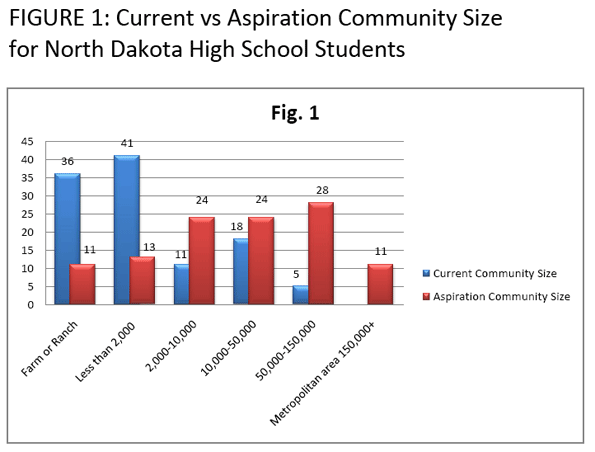
    A June 2010 survey of 111 North Dakota high school juniors and seniors offers a glimpse into the minds of the state’s young adults as they stand on the precipice of adulthood. They were asked to choose the size of community in which they aspire to live and work. Although roughly four in ten were raised in communities of fewer than 2,000 residents, out of the over 100 students surveyed, only six wished to live their adult lives in the a town of fewer than 2,000. Overall, 70 percent aspired to live in larger communities than those of their childhood (see Figure 1).

    Small towns struggle to provide urban amenities that can match the sponge cities’ bustling malls, skateboarding parks, concert venues and Olive Gardens. While the serene, friendly, stable rural communities, farms and ranches reflect the way that “life is supposed to be” in the minds of many outside the region, young adults often view that way of life as dull and sluggish. City life—albiet small scale by national standards—is perceived as fun, fast and fashionable; jobs pay better and there are more of them.

    There has always been a desire among young adults to experience life outside of where they grew up. Experts believe that economics and quality of life are the two dominant motivations people have for moving from rural areas into cities. Mark Stephens, a young college graduate who left his small town of under 400 for Fargo, with a metropolitan population pushing 200,000, the largest city in the state, said “The first thing people throw out as an excuse is increased opportunity, but let’s face it, 18- to 20-something adults are not thinking long term. For the most part, kids in that age group are really pretty shallow. In truth, I think it comes down to one word: Jealousy. They are walking down a gravel road in their tiny town with a link to massive amounts of media right in their back pockets. It’s no different than when they were little kids—they see someone with ice cream and they want some too.”

    Richard Rathke, director of the North Dakota State Dakota Center, notes that aggregate data demonstrate the movement of young adults to larger cities in the Great Plains The young adult population (age 20-30) has been inmigrating to metro areas each decade since 1950 while in the farm dependent rural counties, they are outmigrating in sizeable numbers (see Figure 2).

    A dozen young adults moving from Edgeley, North Dakota (population 637) to Fargo is irrelevant to Fargo as it absorbs the new residents with barely a nod, but to Edgeley, the shift represents significant and chilling loss of young, skilled, educated workers that will have a detrimental impact on the town’s future prosperity or even survival. Some predict that once Fargo has soaked up all the smaller communities, young professionals will then abandon Fargo for the more illustrious Minneapolis. North Dakota is touted in nationwide polls as one of the friendliest states in the nation, but schadenfreude flourishes on the Plains. Mayors of small towns that have lost their young people to growing population hubs have been known to remark, “Just wait until all of their kids move to Minneapolis.”

    Perhaps metropolises like Minneapolis or New York will not be the ultimate sponge cities. Indeed, Minneapolis has experienced a 1.4 percent drop in population since 2000. Demographers are beginning to observe that for many of us there is a point where diseconomy of size becomes real. Traffic, congestion, housing prices, crime and pollution levels may already be curtailing inmigration to the nation’s major metropolitan cities.

    The phenomenon of sponge cities will change the nature of states like North Dakota. At the turn of the twentieth century a mere 7 percent of North Dakotans were urban, by 1980 one out of every three residents was urban and in 2010 the state is projected to be 50 percent urban and 50 percent rural, a loss of nearly 88,000 rural residents in a state whose total population has remained stagnant, hovering between 600,000 to 650,000 for over a century.

    A legitimate reaction to the entrenched loss of people from rural areas of North Dakota might be, “So what?” What does a state or nation have at stake in the health of a small town like Edgeley? After all, one community’s loss is another community’s gain. Migratory patterns are simply indicative of an efficient labor market; employers discover employees and employees find jobs that fit their skills, interests and education. Thus, one might conclude that is does not really matter if a significant percentage of rural Americans move to more urban areas. In fact, what some perceive as a seemingly endless stream of discouraging census data may actually be a positive indicator. Robert E. Lucas, Jr., University of Chicago economist and winner of the 1995 Nobel Prize in Economics, believes that a region’s successful transformation from traditional agriculture to a modern, growing economy depends on talent clustering—an accumulation of human capital that sponge cities are performing. The future may not be rural, but sponge cities could make traditional rural states like North Dakota very viable.

    Wayne Sanstead, North Dakota’s State Superintendent of Public Schools and former lieutenant governor, has for decades watched rural schools close their doors. “We want the small communities to be a part of the state’s economic and social future, but we have to face reality and focus on retaining young adults within the state.” This may be the new reality. In large part due to the state’s booming economy, Sanstead asserts that in his 25 years as a state superintendent he has never seen a better opportunity then today for the state to retain its young people.

    Deb Kantrud, Executive Director of the South Central Regional Council in Jamestown, North Dakota, has spent her entire career as a community developer. She noted that if small town residents stay behind after high school graduation, they aren’t considered as successful as those who relocate. We need to figure out a way to keep some smaller communities viable—turning them into sponge cities—while acknowledging that some smaller communities may not be part of the brighter future that awaits our reviving state.
    Debora Dragseth, Ph.D. is an associate professor of business at Dickinson State University in Dickinson, North Dakota. She trains and develops leadership curriculum for CHS, Inc. a diversified energy, grains and foods company. The Fortune 100 company is the largest cooperative in the United States. Dragseth’s research interests include Generation Y, outmigration and entrepreneurship.

  • Why the Great Plains are Great Once Again

    On a drizzly, warm June night, the bars, galleries, and restaurants along Broadway are packed with young revelers. Traffic moves slowly, as drivers look for parking. The bar at the Donaldson, a boutique hotel, is so packed with stylish patrons that I can’t get a drink. My friend, a local, and I head over to Monte’s, a trendy Italian place down the street. We watch a group of attractive 30-something blondes share a table and gossip. They look like the cast of the latest Housewives series.

    It might sound like an evening in the Big Apple, but this Broadway runs through downtown Fargo, N.D. A decade ago, this same street was just another unremarkable central district in a Midwestern town: bland restaurants, adequate hotels, no decent coffee. After the local stores closed for the day, the street was mostly populated by a few hard-drinking louts.

    That has all changed, part of a transformation that foreshadows the growth of the vast Great Plains region. “I come from a big city, but I like the lifestyle here,” says Marshall Johnson, an African-American who played football for the nearby University of Minnesota, Crookston, and now works for the local Audubon Society. “In a decade this place will be a small Minneapolis. Everyone sees a bright future ahead.”

    Johnson may be an anomaly in this still homogeneous state—the population is more than 90 percent white, and Native Americans constitute the largest minority by far—but he senses something very real. Throughout the good times and, more important, the bad of this new millennium, the cities of the plains—from Dallas in the south through Omaha, Des Moines, and north to Fargo—have enjoyed strong job growth and in-migration from the rest of the country. North Dakota boasts the nation’s lowest unemployment rate—3.6 percent, compared with the national average of 9.7—with South Dakota and Nebraska right behind it.

    The trend has been particularly strong in urban areas. Based on employment growth over the last decade, the North Dakota cities of Bismarck and Fargo rank in the top 10 of nearly 400 metropolitan areas, according to data analyzed by economist Michael Shires for Forbes and NewGeography.com. Much of that growth has come in high-wage jobs. In Bismarck, the number of high-paying energy jobs has increased by 23 percent since 2003, while jobs in professional and business services have shot up 40 percent.

    That’s not bad for a region best known by East Coast pundits for the movie Fargo. It got so bad a decade ago that even local boosters suggested North Dakota jettison the “North” to make the place seem less forbidding. Two Eastern academics, Frank J. Popper and Deborah Popper, predicted that the region would, in a generation, become almost totally depopulated, and proposed that Washington speed things along and create “the ultimate national park.” Their suggestion: restock the buffalo.

    Certainly, many small towns across the plains—such places as Reeder, N.D., which lost its only school, or Mott, N.D., with its struggling downtown—have withered. Others are likely to disappear altogether. But growth has rebounded in larger towns, according to Debora Dragseth, an associate professor of business at Dickinson State University. She describes places like Fargo—with a population approaching 200,000—as “sponge cities,” absorbing population from rural areas. Just a decade ago, those people fled the region entirely.

    The primary drivers of this new growth, says Dragseth, are basic industries like agriculture and energy. Salaries may be low by coastal standards, but so are living costs. And the prices of commodities like beef, soybeans, and grains have generally continued to rise, due in large part to growing demand from China, India, and other developing countries.

    But the biggest play by far is in energy, including coal, natural gas, and oil, which exist in prodigious quantities from Texas to the Canadian border. Besides the vast reserves of oil that have made it the country’s fourth-largest producer, North Dakota possesses significant deposits of natural gas and coal, as well as huge potential for wind power and biofuels. These industries are drawing hundreds of skilled workers from places like California and Michigan, who are moving into Bismarck, the state’s capital, and towns to the west.

    The energy boom has placed states like the Dakotas and Texas in an enviable fiscal situation. Oil and gas revenues are filling up their coffers, allowing them to eschew the painful cutbacks affecting most coastal states. North Dakota has a $500 million surplus, and next year the cash gusher could rise to more than $1 billion, estimates Dragseth. That could go a long way in a state with barely 600,000 people.

    Of course, the people of the plains have seen booms before—commodity prices soared early in the last century, and there was an oil-fired boom back in the 1970s. But growing demand in developing countries could sustain long-term increases of energy and agricultural products. Niles Hushka, CEO of Kadrmas, Lee & Jackson, a growing engineering firm active in Bismarck, sees other factors working for the plains. The public schools are excellent; the Dakotas, Iowa, Minnesota, Nebraska, and Kansas enjoy among the highest graduation rates in the country. North Dakota itself ranks third and Minnesota fourth (after Washington, D.C., and Massachusetts) in the percentage of residents between 25 and 34 with college degrees.

    Nowhere is this potential clearer than in Fargo, which is emerging as a high-tech hub. Doug Burgum, from nearby Arthur, N.D., founded Great Plains Software in the mid-1980s. Burgum says he saw potential in the engineering grads pumped out by North Dakota State University, many of whom worked in Fargo’s large and expanding specialty-farm-equipment industry. “My business strategy is to be close to the source of supply,” says Burgum. “North Dakota gave us access to the raw material of college students.”

    Microsoft bought Great Plains for a reported $1.1 billion in 2001, establishing Fargo as the headquarters for its business-systems division, which now employs more than 1,000 workers. The tech boom started by Burgum has spawned both startups and spin-offs in everything from information technology to biomedicine. Science and engineering employment statewide has grown by 31 percent since 2002, the highest rate of any state.

    These jobs, and the people they attract, shower cash on Broadway’s busy bars and dining establishments. Both Burgum and his ex-wife, Karen, have been driving forces in this restoration. Karen led the effort to convert the once seedy Donaldson into a stylish downtown hotspot, featuring the work of local artists on the walls and bison on the menu. “People thought I should be put in a padded cell for doing this,” she says. Of course, entrepreneurs like the Burgums will continue to face big challenges to lure customers and workers—cold weather, isolation, and competition from more urban places. But for the first time in generations, parts of the Great Plains have a chance to be great again.

    This article originally appeared in Newsweek.

    Joel Kotkin is executive editor of NewGeography.com and is a distinguished presidential fellow in urban futures at Chapman University. He is author of The City: A Global History. His newest book is The Next Hundred Million: America in 2050, released in Febuary, 2010.

    Hotel Donaldson photo By jeffreykreger

  • The G-20’s New Balance of Power: The Productive Economy Still Matters

    As world leaders gather in Canada this weekend, the nations with the most influence won’t be the high-tech mavens. Joel Kotkin on why traditional industries still matter in the post-information age.

    Are we entering the post-information age?

    For much of the last quarter century, conventional wisdom from some of the best minds of our times, like Daniel Bell, Alvin Toffler and Taichi Sakaiya—in both East and West—predicted that power would shift to those countries that dominate the so-called information age. At the time, this was the right call, but it may increasingly be, if you will, old news. Although there’s no question that iPhones and 3-D movies are nifty—and hedge funds generators of massive wealth for investors and operators—we now may actually be entering what might be called the post-information age.

    As the ministers gather in Toronto this weekend for the G-20, we can see how overblown the efficacy of a virtual economy might be. The current star players on the field in terms of economic growth and fiscal strength generally derive their power not from information technology, media, or financial savvy but by the mundane but still important basic underpinnings of economic growth: agriculture, manufacturing and energy production.

    This is true among both the advanced countries as well as the developing ones. The stars of the West are not the brainy Brits or the entrepreneurial “creative” Americans but places like host Canada and Australia, whose place in the world economy relies heavily on the production of raw materials like uranium, iron ore, oil, timber, grains, fish and beef. Sure, they have some cutting-edge companies, nice (often heavily subsidized) film industries, and lots of smart people (after all, my wife is from Montreal!). But it’s the basics that drive their economies.

    So much so that Australia, braced by rising exports to Asia, has been growing well enough to let its interest rates rise, something that is all but unthinkable for the U.S. Fed, at least until the November elections. Due in large part to its commodity-based economy and more enlightened regulation, Canada’s banking system is widely considered the most stable in the advanced industrial world, with a rate of leverage 18 to 1 compared with the U.S.’s 26 to 1 and the EU’s scary 61 to 1. Budget deficits? Hardly an issue. Bank bailouts? Nary one.

    The flip side of the Canada-Australia coin are the high-performers who now excel in the field most of our high-tech pundits—starting with Megatrends’ John Naisbitt 20 years ago—generally disdain: manufacturing. Naisbitt called manufacturing “a declining sport” and was roundly applauded by Wall Street and other sources of economic “wisdom.” The most obvious contrary example is China, the modern equivalent of 19th-century Britain’s “workshop of the world.” But other, faster-growing economies among the G-20—Brazil, Turkey, India and South Korea, for example—also are rising fast largely on the back of manufacturers.

    None of this suggests that high-tech or information are unimportant. But by their nature industries like software are exceedingly mobile. In contrast, the basics in these rapidly growing economies involve large-scale investment and the presence of the right resources. It’s easier to move software development to Bangalore than soybean production or natural gas.

    In any case, it’s not smart to give up the basics—unless perhaps you are Liechtenstein or Monaco—and hope to have enough money left to sustain your drive into high-tech industry. Do you really think that the rising industrial powers have any intention of ceding media, finance, and technology to Americans, Japanese or Europeans? I would not count on it.

    History serves as an excellent guide here. Take the example of Great Britain—home of the Industrial Revolution—which should be considered a cautionary tale. In the 19th century and much of the 20th, even though the country depended on manufactured goods for its livelihood, British elite schools, financial institutions, and media all worked against “the needs of industry” to create what historian Martin Wiener has called “two unequal capitalist elites,” the more powerful of which had little interest in, and even disdain for, industrial activities. The “best” talent, and the most social prestige, favored the financial sector over the industrial. Production was particularly looked down upon: it was “the Cinderella of British industry.”

    There are also more recent examples supporting the notion that hard work and attention to the basics still matter. In the 1980s, Japanese firms that were widely written off as “copycats” eventually became primary innovators, particularly in automobiles, semiconductors, and computer games. Koreans were often then dismissed by both Americans and Japanese as unimaginative imitators; today South Korea’s electronics and car companies are surging not only in America but across the world. Now they have their gaze fixed on biotechnology and videogames.

    In the coming decades Chinese and Indian companies will seek to move from low-wage work to more specialized, and increasingly innovative, kinds of products—in everything from pharmaceuticals to fashion and finance. The enormous profits to be made from less “sexy” activities—ranging from manufacturing to call center and code writing—will provide the funds to invest in both the hard infrastructure and the necessary training to move decisively into ever higher-end activities.

    This contempt for production underpinned the decline of Britain as a great power, and could prove disastrous in mid-21st entury America as well. In the America envisioned by the advocates of the “creative economy,” our productive facilities would serve mainly as tourist attractions, much as we now visit restored pioneer villages. The problem is that it may work for a small, highly educated class and some financial managers, but not for the vast majority of Americans.

    In reality a more prosperous future is possible, but only if the country focuses both on developing the intellectual prowess of its citizenry and on maintaining the physical infrastructure necessary for key basic sectors like agriculture, energy, and manufacturing. A single-minded emphasis on nontangible industries—notably finance—is a dangerous delusion, as is particularly clear in both the Wall Street disaster of 2008 and the current devastation of the even more finance-dependent British economy and its exchequer.

    Fortunately, there is still time for America—still by far the world’s pre-eminent economy—to adjust to the realities of the post-informational economy. We remain the world’s leading agricultural power, and global demand for food, particularly proteins, will soar as the global population expands from six to nine billion by 2050. Many of these people will be more affluent, and provide prime markets for such American exports as soybeans, nuts, fruits, wine, beef, and chicken. Only a small number of Americans may work on farms, but over 10 percent are involved in some way with the marketing, processing, financing and research of agricultural-related activities.

    Similarly America can also enjoy the kind of energy-generated wealth that underpins Canada, Australia, and G-20 members Russia, Brazil, and Saudi Arabia. Our ruinous trade deficit in energy is largely a failure of will, faulty regulation and lack of proper incentives. In the short run, we have ample supplies of relatively clean natural gas—particularly in the Great Plains—as well as significant on-shore oil supplies and a prodigious capacity for renewable energy. In 10 years, with a pragmatic focus on these industries, we might not be an energy exporter but we could be fairly self-sufficient, perhaps only importing from our close Canadian cousins.

    At the same time, there is no compelling reason why America needs to abandon industry. Unlike Europe we will have an expanding workforce and growing domestic market. The manufacture of hard goods, which requires a sophisticated infrastructure and is generally energy-intensive, could turn out to be relatively easy to salvage for American workers. Like agriculture, manufacturing directly may employ a relatively small number of people, but many others benefit from the service industries that depend on it. Manufacturers also boost the tech sector; roughly one in four U.S. scientists and engineers work for industry.

    Although it may not be obvious to our trendy information-age pundits and their admirers among economic journalists, or perhaps some in the current administration, the U.S. is well-positioned to meet the requirements of the emerging post-information age. If we add our natural resource base and industrial capacity to our prodigious ability to innovate, the U.S. could not only compete against, but out-perform every major country in the G-20. The key now is summoning national and political will to exploit our advantages, assets that America sadly now appears to have in short supply.

    This article originally appeared in TheDailyBeast.com.

    Joel Kotkin is executive editor of NewGeography.com and is a distinguished presidential fellow in urban futures at Chapman University. He is author of The City: A Global History. His newest book is The Next Hundred Million: America in 2050, released in Febuary, 2010.

    Photo by rjason13

  • The Declining Human Footprint

    There are few more bankrupt arguments against suburbanization than the claim that it consumes too much agricultural land. The data is so compelling that even the United States Department of Agriculture says that “our Nation’s ability to produce food and fiber is not threatened” by urbanization. There is no doubt that agricultural production takes up less of the country’s land than it did before. But urban “sprawl” is not the primary cause. The real reason lies in the growing productivity of American farms.

    Since 1950, an area the size of Texas plus Oklahoma (or an area almost as large as France plus Great Britain) has been taken out of agricultural production in the United States, not including any agricultural land taken by new urbanization (Note 1). That is enough land to house all of the world’s urban population at the urban density level of the United Kingdom.

    America’s Spectacular Agricultural Productivity

    Even with less land, agriculture’s performance has been stunning. According to US Department of Agriculture data, US farm output rose 160% between 1950 and 2008. Productivity per acre rose 260%. In particular , California’s farms – often cited as victims of sprawl – have done quite well. Between 1960 and 2004 (Note 2), the state’s agricultural productivity rose 2.3% annually and 3.0% per acre. By comparison national agricultural productivity rose less over the same period at 1.7% overall and 2.2% per acre.

    According to the United States Department of Agriculture, from 1990 to 2004 (latest data), California’s agricultural production rose 32% and on less farm land.

    Of course, there has been substantial reduction of farmland close to some metropolitan areas, but overall the impact of urbanization nationally has not been substantial. For example, since 1950:

    In addition, the nation’s agriculture is subsidized to the tune of more than $15 billion annually, which is strong evidence that more land is being farmed than is required. Subsidies increase the supply of virtually anything beyond its underlying demand. This can be illustrated by imagining how much less transit service there would be if it were not 80% subsidized. Suffice it to say, America is not threatened by “disappearing farmland.”

    America has less farmland because it has not needed as much as before to serve its customers. Thus, considerable farmland has been returned to a more natural state. Generally, this has got to be good for the environment. Land that is left to nature does not require fertilization, for example. The same interests that have frequently claimed that farmland has been disappearing also decry the loss of open space. In fact, the withdrawal of redundant farmland has produced considerable open space – call it open space sprawl.

    Repeat it Often Enough….

    None of this has kept “disappearing farmland” from being a rallying cry among those who would construct Berlin Walls around the nation’s urban areas. Yet the extent to which Bonnie Erbe of Politics Daily and National Public Radio embraced the fiction was surprising. Her “Vanishing Farmland: How It’s Destabilizing America’s Food Supply,” was accompanied by “meant to indict” photograph of farm equipment next to new suburban housing.

    Ms. Erbe’s principal source was a web page from the American Farmland Trust, which seeks to conserve farm land. In its California Agricultural Land Loss & Conservation: The Basic Facts, the American Farmland Trust argues for more “efficient” (i.e. denser) urbanization and claims that, “One-sixth…” (17%) “… of the land urbanized since the Gold Rush … has been developed since 1990.” That might be an impressive figure, if it were not that the state has added 7 million urban residents since 1990, which is one-fourth (25%) of all the urban population added since the Gold Rush and equal to the 1990 population of New York City.

    It is worth noting that California has agricultural preservation measures already in place for farm owners and, finally, that no one can compel an unwilling farm owner to sell their land to a developer or anyone else (except perhaps a government agency through eminent domain).

    In California, as elsewhere in the nation, urbanization has not been the principal cause of farm land reduction. According to the US Census of Agriculture, farmland declined in California from 2002 to 2007 by 2.2 million acres. That 5 year reduction in farmland is approximately equal to the expansion of all California urban areas over the 50 years between 1950 and 2000.

    Most Development is Not Urban

    In the same document, the American Farmland Trust indicates support for the radical urban land regulations. Policies such as in Sacramento’s Blueprint that raise significantly inflate the price of land, make housing less affordable. The agricultural, property and urban planning interests who would ration land for people and their houses have missed a larger targets such as ultra-low density “ranchettes” favored by a small wealthy minority who live in the country, but are not farmers.
    According to the US Department of Agriculture, rural, large lot residential development (non-agricultural) covered 40% more land than all of the nation’s urbanization in 2000. These parcels represent “scattered single houses on large parcels, often 10 or more acres in size.” Further, since 1980, the increase in this rural residential development has been one-third greater than the land area occupied by all of the urban areas in the nation with more than 1,000,000 population.

    Finally, if there is a serious threat to agriculture, it is from over-zealous regulation that has put farmers at risk. Water reductions in the San Joaquin Valley – mostly the result of environmental demands – likely have taken more land out of production than any sprawl-happy developer.

    Declining Human Footprint: An International Phenomenon

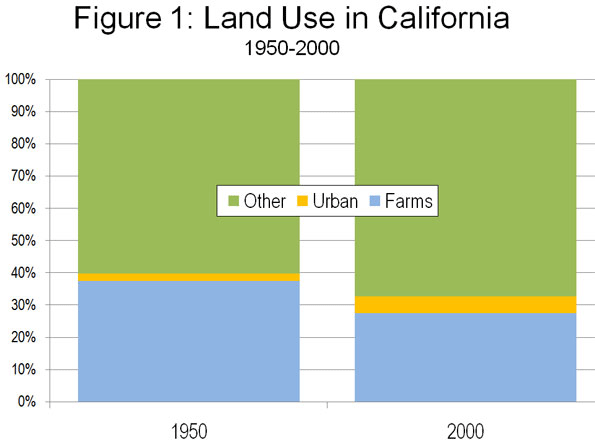
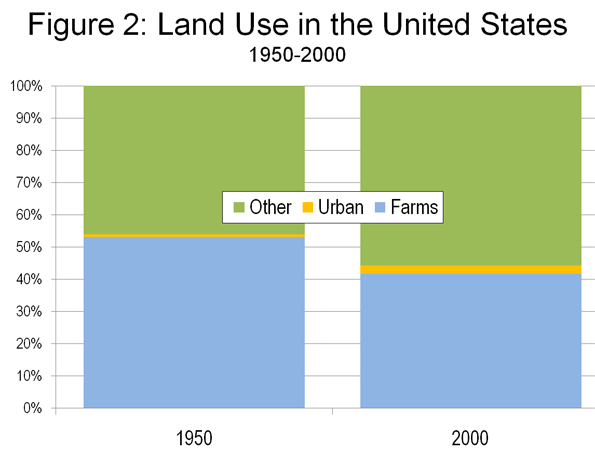
    The human footprint, as measured by the total urban and agricultural land has been declining for decades, both in the nation and California, where the greatest growth has occurred (Figure 1 & 2). The same is also true of Europe (EU-15), Canada and Australia, where all of the urbanization since the beginning of time does not equal the agricultural land recently taken out of production. Even in Japan, the human footprint has been reduced. It may be surprising, but human habitation and food production has returned considerable amounts of land to a more natural state in recent decades, while America’s urban areas were welcoming 99% of all growth since 1950.


    Note 1: This assumption represents the worst case, since not all land on which new urbanization was developed had previously been farmed.

    Note 2: State data is available only between 1960 and 2004.

    Photograph: Metropolitan Chicago, 2007 (Grundy County)

    Wendell Cox is a Visiting Professor, Conservatoire National des Arts et Metiers, Paris. He was born in Los Angeles and was appointed to three terms on the Los Angeles County Transportation Commission by Mayor Tom Bradley. He is the author of “War on the Dream: How Anti-Sprawl Policy Threatens the Quality of Life.

  • Energy’s Other Side

    The BP oil spill disaster likely spells the slowing down, or even curtailing, of offshore oil drilling for the foreseeable future. You can take California, Florida and much of the east coast off the energy-drilling map for years, perhaps decades.

    But if the oil, gas and coal industries are widely detested on the coasts, people in Bismarck, N.D., have little incentive to join an anti-energy jihad. Like other interior energy centers, people in this small Missouri river city of over 100,000 see their rising oil-, gas- and coal-based economy as the key to a far more lucrative future.

    “We have so much work that we don’t know what to do,” explains Niles Hushka, co-founder of Kadrmas, Lee and Jackson, a Bismarck-based engineering firm active in Great Plains energy development. In the next three weeks Hushka’s firm plans to add 70 more people, most of them skilled technicians and engineers.

    The problem in Bismarck is not so much creating jobs but filling positions; the city can be a hard sell due to its relative isolation and harsh climate. Still there’s some virtue to having opportunities. Even at the pit of the recession Bismarck has continued to experience job growth. Today its unemployment rate stands at well under 4%, the lowest rate in the country.

    This economic record is not unique to Bismarck. Other domestic energy centers like Anchorage, Alaska, and Morgantown, W.Va., also rank high among the strongest job markets in the country.

    Many energy towns are not only getting lots of jobs, but they are also becoming richer. One study, done by economist Mike Mandel, finds the highest per capita income growth in regions of Oklahoma, West Texas and Louisiana, where energy growth has driven the economy. Between 2000 and 2008 these areas enjoyed soaring per capita income gains, while many centers of the “creative economy” such as San Jose, Calif., Raleigh-Durham, N.C., and even Austin, Tex., have experienced per capita income declines.

    But few areas are enjoying a greater boom than Bismarck and surrounding parts of western North Dakota. It enjoys a vast array of energy resources, from fossil fuels to biofuels as well as prodigious potential for wind power.

    The real big action now, however, is in oil. New drilling technologies have allowed for the tapping of oil deposits far deeper below the surface. The U.S. Geological Service recently increased its estimate of North Dakota’s economically recoverable oil–much of it in the massive Bakken and Three Forks formations–25-fold to 4.3 billion barrels. These formations also extend to large swaths of northern Montana and southern Saskatchewan, Canada.

    Unlike past oil booms, such as the one that crashed in the 1980s, this one will last a long time. For one thing the voracious demands on energy coming from India, China and other developing countries will keep energy prices high. At the same time resistance to drilling tends to be weaker in remote areas with few residents, notes Debra Dragseth, a professor of business at Dickinson State University.

    The prospect of long-term prosperity tied to oil and gas wealth is already beginning to change the long dismal demographics of the area. A long-term boom could attract a new flow of blue- and white-collar workers to Bismarck and other parts of the plains. This is already starting. Long a net exporter of people–the state’s population is less than it was in 1930–today Bismarck and the state of North Dakota enjoy positive in-migration from the rest of the country.

    Part of the lure is something North Dakota had previously lacked: a plethora of high-paying jobs. Truck drivers in the industry earn as much as $80,000 a year, and wages for skilled professionals tend to go well over $100,000 annually. Meanwhile the cost of living is low, with housing prices a third or less of those on the coasts.

    Of course, work in the oil or gas fields isn’t easy–and it is sometimes dangerous, particularly in the often brutal winters. But opportunities in tough times can prove an irresistible lure to younger people, which is critical for what has been among the country’s most rapidly aging states. “It’s a petroleum land rush,” says 30-year-old Jerry Haas, who now looks for oil sites for the Dallas-based Petro-Hunt interests. “People see it as a great place of opportunity among people my age.”

    Haas, a native of North Dakota, sees more and more out-of-staters coming to Bismarck, in search of generally high-paying, energy-related employment. He has helped organize a 200-member young professionals group to lobby for more youth-oriented amenities in this decidedly conservative Great Plains town.

    The shifts in migration and particularly income–due largely to energy–represent a huge boost to an area that has long suffered from an exodus of young talent and a dearth of high-paying jobs. The key issue now is finding ways to turn the current boom into longer-term prosperity. North Dakota certainly has an unprecedented opportunity to build up its human and physical infrastructure. While other states struggle with huge budget shortages, North Dakota’s government enjoys an oil-driven surplus that is expected to grow in the next year from $500 million to over $1 billion.

    Dragseth believes the energy boom will allow North Dakotans, long ignored or at best dismissed as hopeless rubes, to start dreaming in ways impossible in much of the country. They can envision a future where, for instance, post-secondary education is free and used to lure the top students from around the world. North Dakota could use its good fortunes to gain the human capital it sorely needs. The Gulf disaster may put an ugly face on energy exploration, particularly oil, for many Americans. But in the nation’s oft-ignored interior, the development of new fuels offers the prospect of a previously unimagined prosperity.

    This article originally appeared in Forbes.com.

    Joel Kotkin is executive editor of NewGeography.com and is a distinguished presidential fellow in urban futures at Chapman University. He is author of The City: A Global History. His newest book is The Next Hundred Million: America in 2050, released in Febuary, 2010.

    Photo by k.landerholm

  • It is Time to Plant

    It is springtime in Kentucky – think foals and mares in the pristine meticulously fenced pastures. But, in another part of the state – the Appalachia region of eastern Kentucky – it is time to plant on those rocky hillsides. As my 90 year old father puts it, you plant your corn when tree buds are the size of squirrel ears. I confess to not having given a thought to whether squirrels even have ears or not … but my father knows. He was born and raised in a part of the world where they know things like that, typical of the mostly Scots-Irish who settled there. He knows the land like the back of his hand, he is self-reliant and stubborn to a fault and he knows what it is like to be poor and bereft of opportunity.

    Appalachia Eastern Kentucky – take just one geographic area out of a huge region spread over several states – is negatively depicted in popular imagery and academic literature as a drag on the Kentucky economy. The whole region is enigmatic like the underachieving child in a family of superstars. Until now, that is. With the financial collapse having brought America to her knees, it is a bit like the screaming headline about Toyota’s debacle: “the A student flunked the class.” Perhaps that underachieving C student finally has her chance to shine. After all, who would have given Ford a chance a few years ago?

    But Appalachian eastern Kentucky is after all a land where every manner of program has been tried, books written, studies undertaken, and mournful music sung. It is where the failed War on Poverty was launched in the 1960s. The reason for a “new day dawning” is that there is a stir across the land that signaling an epochol shift in the evolution of the American Dream. Call it by wonky titles like “new localism” or call it “choosing who I want to be and where I want to do it.” But whatever it is, it is impacting on our lives dramatically and will do more so in the future.

    The prestigious Economist Magazine (May 15, 2010) recently reflected that in the future people will have unprecedented choices of living in big vibrant cities or in smaller more nurturing rural settings. And, the stories abound. Take Patty who left the factories of the north to return to her native land. Always known for her shrewd business acumen, she took over and renovated “The Old Schoolhouse” antique gallery located near Cave Run Lake. She scours the region for her “goods” and is visited daily by weary travelers seeking the authenticity of a culture too long locked in the shadow of conventional definitions of success. Likewise, despite the long held belief that they are leaving, young people are finding ways to stay in the region, such as the young man in a recent audience who has taken advantage of “tele-learning” and plying his trade as a graphic artist for a west coast software company.

    There appears to be a convergence of forces at work that could prove transformational for regions like Appalachia. Brought on by the Great Recession, people have to make choices about their priorities and perhaps even to downsize lifestyle appetites. But that’s not all. These forces will impact all places but particularly rural places like Kentucky, places of great beauty and tranquility and appeal waiting for the right moment that may finally be here.

    These converging forces are driven in large part by technology and the realization of its earlier promise that we truly can live and work anywhere. It is about participating in the preservation of a precious culture locked for too long in the closet of neglect and stigmatized with the label of backwardness. It is about an ability to do more than scrape out a meager living in the rocky hillsides. Evidence can be seen in a migration pattern that is, for the first time in decades, giving Kentucky and surrounding states a positive net migration from the rest of the country. We are seeing youthful retirees coming home in some instances and young families putting down roots in places that feel right for their chosen way of life. And there is a growing business culture that knows about the world but sees no paradox in growing itself in Appalachian soil – and using the culture to its advantage.

    Just take note of Kentucky “ham” country if you want to partake of successful business stories. Recently profiled in the New York Times Magazine (May 23, 2010), Kentucky’s home grown hams are making their way onto the world stage. The author marveled at the ham store owner’s chatter about attending a ham conference in Spain and the desire of buyers to travel to a small town to buy nitrate free bacon. Imagining Kentucky hams being worth a wait in noisy New York City restaurants defies explanation except to acknowledge that the song is right that “somethin’s happenin’ here.”

    What must the Appalachian region of eastern Kentucky and the rest of Appalachia do to take advantage of this new opportunity? It must reinvent itself as with many other aspects of the American Dream under the new rules of the 21st century. Reinvention will require answering the question “what is success”? With extreme partisanship and 30,000 foot politics at other levels of government, it is no longer viable to look in the direction of the “higher ups.” We must look to ourselves. Only we can provide the basis for community building and ensure the investments we need to make in health and education.

    Ah, springtime. Nature has taught us well; re-invention is to see the possible and to seize the moment. The moment is now.

    Sylvia Lovely is an author, commentator and speaker on issues relating to communities and how we must adapt to the new landscape that is the 21st century.

    Photo by J. Stephen Conn.

  • Santa Fe-ing of the World

    This is part one of a two-part piece. Read Part two.

    Human settlements are always shaped by whatever is the state of the art transportation device of the time. Shoe-leather and donkeys enabled the Jerusalem known by Jesus. Sixteen centuries later, when critical transportation has become horse-drawn wagons and ocean-going sail, you get places like Boston. Railroads yield Chicago – both the area around the “L” (intraurban rail) and the area that processed wealth from the hinterlands (the stockyards). The automobile results in places with multiple urban cores like Los Angeles. The jet passenger plane allows more places with such “edge cities” to rise in such hitherto inconvenient locations as Dallas, Houston, Seattle and Atlanta and now Sydney, Lagos, Cairo, Bangkok, Djakarta, and Kuala Lumpur.

    The dominant forms of transportation today are the automobile, the jet plane, and the networked computer. What does adding the networked computer get you? I think the answer is “the Santa-Fe-ing of the World.” This means the rise of places where the entire point of which is face-to-face contact. These places are concentrated and walkable, like villages. Some are embedded in the old downtowns – such as Adams Morgan in Washington, or The Left Bank of Paris, or the charming portions of what in London is referred to, somewhat narcissistically, as “The City.” Some are part of what have traditionally been regarded as suburbs or edge cities, such as Reston, Virginia, or Emeryville/Berkeley, California.

    Santa Fe, New Mexico, is a remarkable example of this trend. Home to a world-renowned opera, charming architecture, distinguished restaurants, great places to buy used boots, quirky bookstores, sensational desert and mountain vistas and major diversity, it is also little more than a village of 62,000, far from the nearest major metropolis.

    This “Santa-Fe-ing” means urbane well beyond the current definition of urban. It means aggregation and dispersal. As with all innovation, its impact is first seen among people with enough money to have choices.

    The logic of this hypothesis starts with the question: “In the 21st century, is there any future for cities of any kind?”

    After all, some would have us believe that with enough bandwidth, each of us can wind up on his or her own personal mountaintop in Montana, being lured down into the flatlands only to breed.

    That’s a preposterous view of human nature, of course. There’s a reason solitary confinement is a punishment. We are social animals. But still, many of the historic reasons for human concentration are gone. It’s been a century since you’ve had to live within walking distance of your factory. Today, you often don’t even need be within driving distance of your office – as anyone with a cell phone knows. You certainly don’t need a metropolis to acquire anything a dot-com is willing to sell – which is a very big deal now and growing exponentially.

    Absent a cataclysm of biblical proportions, I think this means the one and only reason for congregation in the near future is face-to-face contact. Period. Full stop. The places that are good at providing this will thrive – think Oxford, England. The ones that are not will die. Cities are not forever. You have not heard much lately from the Babylon chamber of commerce.

    There are nearly 100 classes of real estate out of which you build cities, according to William J. Mitchell, the former head of the architecture and planning department at MIT. They are all being transfigured. The classic example is bookstores. If all you want to do is exchange money for a commodity, the path with least friction is often Amazon. In backwaters where, just ten years ago, buying or even borrowing a non-best-seller was a chore that took weeks, hundreds of thousands of titles are now within one click. Does this mean bookstores have disappeared? Of course not. The half of them that have survived and even grown since the ‘90s, however, have morphed. The critical elements are no longer the shelves. They are the couches, cappuccino machines, and cafes. Bookstores have become places to loiter, face-to-face, among like-minded people.

    What about grocery stores? What happens when it becomes cheaper for the supermarket to deliver your toilet paper to you than it is to heat, light and pay rent and taxes on its store? Under what circumstances would you ever again get in your car to drive to market again? For me, the answer is that I want to have face-to-face contact with my tomatoes – or anything else you might find in a social setting like a farmers’ market. I’m not sure I’d trust the kid at the dot com to pick out my spare ribs. If the grocer wants to ship me my barbecue sauce, however, I won’t mind. Ninety-five percent of everything one finds in a supermarket is flash-frozen, shrink-wrapped, and nationally advertised. We are in the midst of a burgeoning freight revolution, in which the stuff is coming to us, rather than us going to the stuff – as anybody who has Christmas shopped lately may have noted. In fact, I can’t think of anything in an entire Wal-Mart that I would regret having delivered to me in a big brown van. Visiting a Wal-Mart doesn’t give me enough of a psychic boost to justify a drive now. Of course, if big-box retail migrates into the digital ether tomorrow, we’ll have an enormous challenge figuring out the adaptive re-use of their buildings. What will we make of them? Roller skating rinks? Greenhouses? Non-denominational evangelical churches? Artists lofts? Whatever the answer, I doubt their passing will be mourned.

    What about college campuses? Is there any future for those? After all, the University of Phoenix, the online learning establishment, became one of the hottest growth stocks of the early 21st century. Internet MBAs abound from some of the world’s most distinguished schools. Why bother ever getting out of your pajamas to learn?

    Again, the answer is face-to-face contact. After all, distance learning is nothing new. Benjamin Franklin engaged in correspondence classes. The United States military is awash in senior officers with advanced degrees from the University of Maryland, which has pioneered its outreach programs to people in remote locations.

    However, distance learning will always be everyone’s second choice. It works best for people who do not have the time or money for the conventional academic experience. First choice remains the traditional universities. Getting into them has become insanely competitive and expensive. Why are they so desirable? Because sitting in class absorbing information from a lecturer is only a tiny part of the college experience. College is where many people meet their first spouse. It’s where they develop a network of friends that they’ll likely maintain for life. It’s an entertainment center and an athletic center. Oh, and as for learning – most of the stuff that has stuck with me came out of dorm sessions at one in the morning, engaging in face-to-face contact with smart people.

    As we shall see, the impact of face-to-face on urban calculations includes office space, and even home locations. But why is this transformation occurring now?

    It all starts with Moore’s Law, first stated by Intel co-founder Gordon Moore As the core faith of the entire global computer industry, it has come to be stated this way: The power of a dollar’s worth of information technology will double every 18 months, for as far as the eye can see. Sure enough, in 2002, with a billion-transistor chip, the 27th doubling occurred right on schedule. The 30 consecutive doublings of anything man-made that we have achieved at this writing – an increase of well over 500 million times in so short a time — is unprecedented in human history. This is exponential change. It’s a curve that goes straight up.

    For sure, railroads also changed everything they touched. They transformed Europe. North America was converted from being a struggling, backward, rural civilization mostly hugging the East Coast into a continent-spanning, world-challenging, urban behemoth. New York went from a collection of villages to a world capital. Chicago went from a frontier outpost to a brawny goliath. The trip to San Francisco went from four months to six days. Distance was marked in minutes. Suddenly, every farm boy needed a pocket watch. For many of them, catching the train meant riding the crest of a new era that was mobile and national. A voyage to a new life cost 25 cents.

    Of course, as railroad expansion ran out of critical fuel – including money and demand for the services – things leveled off, and society tried to adjust to the astounding changes seen during the rise of this curve. The last transcontinental railroad completed in the United States was the Milwaukee Road in 1909. In part, that was because of the rise of a new transformative technology: The one millionth Model T rolled off the assembly line in 1915.

    In contrast, the curve predicted by Moore’s Law did not stop. The computer industry still regularly beats its clockwork-like 18-month schedule for price-performance doubling.

    The effect of Moore’s Law on the built environment is and will become ever more profound.

    For example, will we ever need offices outside our homes? After all, haven’t we all heard plenty about telecommuting?

    Sure, but how many of us have discovered with some chagrin that the most productive five minutes of our work day has occurred around the shared printer? Somebody asks what we’re working on. Conversations ensue. “Oh really? Did you know that Jane was working on something like that?” “There’s this guy you’ve got to talk to; I’ll send you his phone number as soon as I get back to my desk.” “I was just reading about that very subject; I’ll ship you the name of the book.”

    This kind of casual face-to-face contact is irreplaceable no matter how cheap or immersive video technology gets. Humans always default to the highest available bandwidth that does the job, and face-to-face is the gold standard. Some tasks require maximum connection to all senses. When you’re trying to build trust, or engage in high-stress, high-value negotiation, or determine intent, or fall in love, or even have fun, face-to-face is hard to beat.

    This would seem to argue that some old patterns endure, and that’s true. But think of the twists suggested by this new premium on human basics. Suppose you decided that you could get all the face-to-face you needed two days a week. Would that influence where you lived? Would the mountains or the shore start looking good to you? Suppose you decided that you could get all the face-to-face you needed three days a month. Would the Caribbean start looking good to you?

    Residential real estate is being transformed for these reasons. In the U.S., the explosive growth is in places far beyond any metropolitan area, like the Big Sky Country of Montana, the Gold Country of the California Sierras, the Piedmont of Virginia and the mountains and coasts of New England. For eons, when we’ve visited a nice place on vacation, we’ve asked ourselves, “Why am I going back?” Now, however, we have a new question: “Why am I going back?” Santa Fe is more than 800 miles from Los Angeles, yet it is only semi-jokingly referred to as L.A.’s easternmost suburb. To find out why, check out the nearest airport – in this case Albuquerque – any Monday morning.

    Joel Garreau is Lincoln Professor of Law, Culture and Values at the Sandra Day O’Connor College of Law and the Lincoln Center for Applied Ethics at Arizona State University. He is a fellow at The New America Foundation in Washington, D.C., and author of several best-selling books including Radical Evolution, Edge City and The Nine Nations of North America.

  • The States and Economic Development, Identifying Top Performers

    This is an excerpt from “Enterprising States: Creating Jobs, Economic Development, and Prosperity in Challenging Times” authored by Praxis Strategy Group and Joel Kotkin. The entire report is available at the National Chamber Foundation website, including highlights of top performing states and profiles of each state’s economic development efforts.

    States throughout American history have done everything they can to cultivate, attract, retain, and grow the businesses that comprise the most fundamental building blocks of their economy. Even in today’s volatile global economy states with severe unemployment and budget woes can point to policies, programs, and investments that foster new economic opportunities and create jobs.

    Read the full report.
    Read part one in this series: The Jobs Imperative: Power to the States

    Many state economic development organizations were originally established with business recruitment and attraction as their primary focus. But today’s mix of state approaches to economic development has moved well beyond earlier, sometimes singularly focused attempts to lure footloose businesses with huge financial incentives and/or by offering a business climate based on cheap labor, low taxes, and lenient regulations.

    States, nonetheless, still compete with each other for companies in “traded sectors” and jobs in the global economy, either directly or by virtue of unique assets and resources, and this sometimes involves financial incentives and tax abatements. But there is growing momentum among governors and state legislatures to grow their economies from within by creating a new set of competitive advantages that include building human capital through workforce development and training, harnessing the power of science and technology assets, making strategic investments in infrastructure, reaching out to global markets, developing opportunities related to energy and the environment, and spurring entrepreneurship and innovation.

    Generally, state economic development efforts include an interrelated array of policies, programs and investments, falling into three major categories: (1) an entrepreneurial approach focusing on new business and technology-based development, oftentimes with a focus on bolstering productivity and innovation; (2) recruitment, expansion, and retention strategies emphasizing financial incentives or investments and other programs, including international trade and export promotion; and (3) “fertile soil” policies28 that create the conditions for growth that will benefit almost any type of business by streamlining governmental regulation, optimizing taxes, investing in infrastructure, and/or by providing a better-educated, more highly skilled work force.

    While it is up to state governors and legislators to set the environment for development to flourish, ultimately economic development success is defined by execution at the local and regional level. With well designed state-implemented development tools, effective workforce development and skills training systems, and strong infrastructure, states can give local economic developers the power to assist the growing businesses, to broker the key partnerships, and to lead the key initiatives that create the jobs needed to sustain our growing population.

    Most of all, states must carefully weigh policy to refrain from constructing barriers to private enterprise growth. Many of the most effective economic development initiatives start from grassroots efforts or private sector business leaders, so supporting these efforts from the state level is imperative.

    Measuring the States: A List of the Top Performers
    A primary goal of any state economic development program is not only to increase the number of jobs in the state, but to improve the quality of jobs and the overall prosperity of the state’s residents.

    This study combines metrics for each economic development policy area to measure overall high performers in each policy topic area. States are compared in each metric and top states are determined by a composite comparison of all metrics in overall performance and in each policy area. For a full description of all metrics and results for each state as well as top performers in exports, innovation, workforce development, infrastructure, and tax and regulation, see the full report.

    To establish the overall best performers we combined measures of Job growth rate since 2000 and since 2007; Gross State Product (GSP) measures: real GSP growth since 2000, GSP per job 2008, Growth in GSP per job 2000-2008; and income: per capita personal income growth 2000-2009 and median four person family income adjusted for cost of living, 2009.

    Top Overall Growth Performers

    1. North Dakota – While North Dakota’s low unemployment and recession resistance is often attributed to healthy agriculture and energy sectors, its construction and manufacturing sectors are relatively healthy and the state has seen 42% job growth in professional and technical services and 36% in management of companies since 2002. North Dakota is the top job performer since the 2007 peak and is fifth since 2000. The state also places first in growth in GSP per job (productivity increase), second in GSP growth and third in per capita income growth. Recent investments in research and development (R&D) infrastructure are beginning to pay off as the state is the fastest growing in science, technology, engineering, and mathematics (STEM) job growth.
    2. Virginia – Already a professional and technical services powerhouse in 2002, Virginia added another 135,000 jobs in that sector since that time, fueled by 90,000 new jobs in computer systems design and management and technical consulting services. The state’s high incomes and slightly below average cost of living placed it first on our cost of living adjusted family income measure.
    3. South Dakota – South Dakota is a strong overall performer, doing best in productivity and output measures. Partly due to an enterprise-friendly regulatory structure, the state has 30% more finance industry employment than the national norm and has added 18% growth in finance employment since 2002. The state’s manufacturing sector actually gained jobs since 2002, led by growth in signs, chemicals, communications equipment, and construction equipment, all averaging more than $43,000 in earnings per worker.
    4. Maryland – Maryland landed in the top 20 or better on all seven performance metrics. Maryland saw strong growth in technical consulting and computer systems design, but especially private scientific research and design services, a sector more than 2.5 times as concentrated in Maryland than the nation as a whole and paying nearly $95,000 in earnings per worker.
    5. Wyoming – Wyoming’s growth is powered by a rapidly expanding energy cluster, which added more than 18,000 jobs since 2002 and now holds 30% of all employment in the state. The energy growth has spilled over into business services sectors such as environmental consulting, surveying and mapping, and testing laboratories. Its overall manufacturing supersector also gained jobs, seeing the fabricated metal and electrical equipment clusters begin to emerge.
    6. New York – While New York saw average job growth through the beginning of the decade, it has weathered the recession better than most other states, and its high productivity and productivity gains help place it among our top performers. Accounting for about 8% of all jobs in the state, the professional and technical services sector added more than 115,000 jobs for 15% growth.
    7. Texas – Texas has seen strong job growth this decade and has weathered the recession well, fueled by 20% expansion of a now 1.1 million job energy cluster. Recently machinery manufacturing and transportation equipment manufacturing clusters are emerging, both growing to more than 90,000 jobs. This has helped stimulate a 15% expansion in transportation and logistics including warehousing and storage and many freight and specialized trucking sectors.
    8. Iowa – A solid performer across most of our metrics Iowa’s strength is perhaps in its stability. The state’s largest cluster, agribusiness, food processing and technology, grew at a 1% rate since 2002, significantly better performing than the same group of industries nationally. Iowa’s other most competitive clusters include machinery manufacturing (farm and construction equipment, refrigeration and heating systems, and other commercial equipment) transportation and logistics, and advanced materials (search and navigation equipment and machine shops).
    9. Nebraska – Nebraska has added 15,000 jobs to its business and financial services cluster since 2002, led by management and technical consulting, management of enterprises, and credit intermediation, all adding at least 3,000 jobs and averaging $55,000 to $90,000 in earnings per worker. The state’s railroads and support industries and freight trucking support a strong transportation and warehousing cluster, and the state has seen a boom in marketing consulting and market research sectors.
    10. Montana – While Montana’s energy and mining clusters added a combined 8,400 high-paying jobs to the state since 2002, Montana’s greatest source of national dominance came from the collection of arts, entertainment, recreation, and visitor industries, perhaps a sign that the rest of the nation is beginning to discover the Big Sky country. Montana is also beginning to see the emergence of smaller clusters in chemicals, apparel and textiles, and fabricated metal products.

    Growing Jobs: How Do They Do It?

    A review of which states are high performing shows a diverse group—some big, some small; some rural, some urban; some inland, some coastal—but a closer examination shows a shared pattern of policies by these high performers.

    There is no such thing as single a silver bullet strategy for job creation. Among our top ten performers, all ten have seen at least 4% job growth since 2002 in mid-level jobs requiring at least long term on-the-job training but less than a four-year degree. Five of the ten states increased those jobs more than 10%. At the same time all ten increased science, technology, engineering, and mathematics (STEM) jobs by at least 4% over the same period, with 7 of 10 growing STEM jobs at least 14%.29

    An assessment of top performing states, regardless of by what measure, eventually gets down to a state’s ability to execute successful initiatives. Aside from minding the basics of primary education and supportive infrastructure, success begins with an understanding of a state’s economy and demographics, including its strong points and its gaps. States that can mobilize the relevant partners to put together the strategic networks to build upon those strengths while addressing the weaknesses will be winners in the long run.

    Adequately financing any initiative is paramount to its success. Top performing states have come up with winning formulas often based on combining state funding with federal programs and private sources. As regional workforce skills gaps become more acute, non-governmental agencies and private enterprises more are willing to join new collaborative development projects.

    Programs such as Kentucky’s “Bucks for Brains” which requires universities to match state funds with donations from philanthropists, corporations, foundations, and other non-profit agencies, or Florida’s use of American Recovery and Reinvestment Act (ARRA) funding in combination with existing state funds to tackle major infrastructure programs illustrate unique solutions to sufficiently financing winning initiatives.

    Examples of strong partnerships featuring open communication are especially evident in high performing export states. Export programs are based upon effective communication between the importing country, the exporting manufacturer or business, and the state program helping to facilitate the connection.

    The TexasOne program creates promotional materials to market the state and its manufacturers to importing countries and leads trade missions to importing countries and hosts reverse trade missions to the state. Nevada works with a network of trade representatives in targeted markets throughout Asia, North America and Europe, focused on cultivating distribution channels and facilitating opportunities for foreign direct investment in Nevada enterprises.

    Many high performing states offer an array of corporate, manufacturing, and land tax programs. So too, many states are shying away from direct subsidies for promised job growth in favor of highly targeted tax credit programs that require direct investment by the firm or venture investors wherein the tax benefits are only realized after new jobs are in place. Other credit programs target historically underdeveloped geographical regions.

    Other states such as North Dakota, Florida, and Mississippi have turned to comprehensive tort reform as another key element enterprise-friendliness. Whether these reforms are specific to a particular industry or issue, they ultimately help businesses, large and small, remain competitive and free of excessive burdens from excessive litigation.

    Private sector and academic collaboration is one of the most readily identifiable attributes of high performing states across all measures. Whether it is successful innovation and entrepreneur programs such as Montana’s TechRanch, Oregon’s Innovation Council, Rhode Island’s Center for Innovation and Entrepreneurship, or job creation and economic development initiatives such as Momentum Mississippi, these private and academic partners are providing critical input, oversight, and resources to bolster the effectiveness of state efforts.

    Many states are locating business incubators adjacent to universities in partnership with the schools while others are building laboratory spaces and other specialized infrastructure to offer to growing companies on an a la carte basis. In either case, this business and scientific infrastructure can reduce start-up costs for new enterprises and provide students the chance for experiential learning while earning their degrees.

    While there are obviously other policies or initiatives that high performing states share there are some commonalities: building on momentum; delivering adequate funding for initiatives; developing strong relationships and communication strategies; enterprise-friendly tax and regulation systems; and vigorous collaboration between business, government, and education institutions.

    Read the full report.

    Praxis Strategy Group is an economic development, analysis, and strategic planning firm. Joel Kotkin is executive editor of NewGeography.com and author of The Next Hundred Million: America in 2050

  • Enterprising States: Creating Jobs, Economic Development, and Prosperity in Challenging Times

    This is an excerpt from “Enterprising States: Creating Jobs, Economic Development, and Prosperity in Challenging Times” authored by Praxis Strategy Group and Joel Kotkin. The entire report is available at the National Chamber Foundation website, including highlights of top performing states and profiles of each state’s economic development efforts.

    Read the full report.

    Read part two in this series: The States and Economic Development, Identifying Top Performers

    The Jobs Imperative: Power to the States

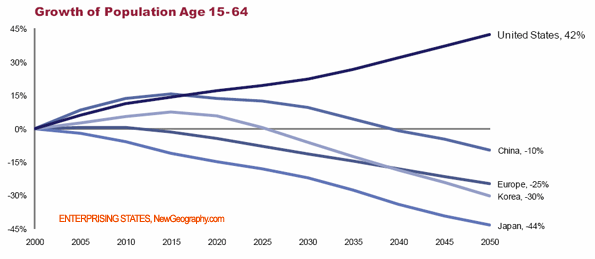
    In the coming decades, the United States will enjoy an enormous demographic advantage over its primary competitors in both Europe and East Asia. As countries such as Germany, France, Japan, South Korea and even China will experience declining workforce growth and rapid aging, by 2050 the pool of people aged 14 to 64 in the United States is expected to grow by more than 40%, compared to what it was in 2000. In contrast, China’s workforce will fall by 15%, Europe’s will decline by 25%, and that of Japan will plunge by 44%.

    This growth represents an unprecedented opportunity for free enterprise in America, but it also poses a tremendous challenge. What the United States does with its “demographic dividend”—that is, its relatively young working-age population—will largely depend on whether or not the private sector can generate growth in jobs and wealth to help meet the needs of a larger aging population.

    Government, too—particularly at the state and local levels—will need to play a role with policies that spur the private sector. Government can facilitate long-term job growth by establishing smart approaches to education, immigration, health care, energy, infrastructure, and tax and regulatory policies.
    A University of Kentucky report prepared for the U.S. Chamber of Commerce has calculated the total number of new jobs needed “to return the economy to our pre-recession level of employment and provide jobs for all the expected new entrants.” It concluded, “The national total is nearly 23 million workers. Almost forty percent of these additional jobs are concentrated in California, Florida, and Texas, three states that comprise 26 percent of the population as of 2008.” Each of the three states that are predicted to need fewer positions since the start of the recession has fewer than 850,000 people. In these states, North Dakota, South Dakota, and Wyoming, the number of workers affected by the recession is more than offset by slower population growth projected by the Census.

    And simply to keep pace with population growth in 2010, the New America Foundation estimates, the country needs to add more than 125,000 jobs a month. The employment imperative is particularly critical today, with over fifteen million unemployed. Even if we reach the administration’s goal of providing 95,000 jobs a month this year, 190,000 monthly next year, and 250,000 in 2012, our overall unemployment rate is expected to remain over 8% by 2012. According to estimates by the Economic Policy Institute, it could take until 2013 or even 2014 to get back to the unemployment levels of before the recession.

    The most critical need is to create jobs for middle and working class people, and for the young, with the teen unemployment rate now over 24% compared to under 15% in 2007.

    These groups have borne the brunt of the recession—particularly in areas such as construction, where employment has contracted by two million jobs since 2006. The nature of the federal stimulus, which focused more on the social safety net than on infrastructure, appears to have largely missed this heavily male, blue collar segment.
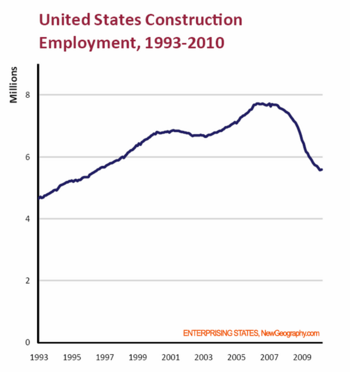
    Many have been out of work for a long time. Nearly 6.3 million Americans have been unemployed for over six months, the largest number since the federal government started keeping track in 1948. The average duration of unemployment—28.5 weeks—is the highest since the end of the Second World War. According to the labor department, right now there are roughly 6.1 unemployed people for every job, four times the rate in December 2007.

    Needed: An American Approach to Job Creation

    More than a year after the passage of the federal stimulus, much more work needs to be done to strengthen of our free enterprise system. Some analysts suggest that we take our lead from the example of European societies, and use tax dollars to stimulate and preserve employment as well as expand social protections. Others argue that adopting European models of shorter hours and more leisure might benefit the economy. Yet these are not rational choices for the United States, since virtually all these societies are aging rapidly, and few have been growing rapidly.

    Indeed, many of these societies still have higher rates of youth unemployment than the United States. By the end of 2009, unemployment for those under the age of 25 stood at 21% in the European Union (EU), with some countries—Sweden (27%) and Spain (44%)—at extraordinarily high levels.

    Overall, the core European countries have not grown as quickly as the United States over the past forty years, and seem to be lagging in the current early stages of the recovery. This is a long term trend. The core EU fifteen countries’ share of the world economy has shrunk considerably, while that of the United States has remained remarkably stable. For EU countries, expansive social protection has not been paired with rapid growth.

    The United States will need to find its own means to address its unique jobs imperative. Clearly, the expansion and preservation of government employment has proven stimulative, but private sector employment continues to be a struggle in most of America.

    One third of the stimulus was directed to local government, and public employment has barely dropped. Even so, there is increasing stress on state and local government, due to the declines in the private sector economy. The limited efficacy of a government-centered approach can be seen in the states—which, after all, cannot print their own money to cover their deficits—with extremely stressed budgets and the inevitability of large cutbacks in public employment.

    Another misplaced approach to job creation is the widely embraced notion—both at the federal and the local levels—that government regulations tied to a “green” economy could create a large new employment source. Various studies in countries that have created massive incentives for such employment—Spain, Germany, Denmark—find that the employment-stimulating impact of such policies can be more than off-set by the negative consequences of resulting high energy prices. When cap and trade mandates raise energy taxes and the cost of doing business, they ultimately inhibit job growth. In the long run new jobs in energy sectors will be created by the creation and production of new technologies.

    Expanding our production of all energy sources could be a major source of jobs. But the experience in some European countries makes clear that green jobs on their own cannot be a fundamental driver of future job creation. Indeed, literature suggests that much of the job growth in green industries has occurred in China and other countries. To date, the actual impact of green jobs seems to be less than expected.

    The one likely way to expand green jobs, notes a series of studies by EMSI, would be through greater economic growth. Most new green jobs depend on the expansion of other key sectors, notably housing, manufacturing, warehousing and agriculture. As these industries expand, they will be the prime markets for new, environmentally responsible technologies and techniques.

    The only sustainable way for the United States to create jobs lies in a rapid expansion of the private sector economy, including in the construction, manufacturing, and energy sectors. A ‘green’ economy cannot be created at the expense of the rest of the economy as a whole. Unreasonable constrictions on manufacturing and construction inhibit job growth. And roadblocks to energy development—including to renewable energy projects—from environmental legislation, as well as from environmentalists and NIMBYs, are also harmful to job growth. Improving the quality of the environment should be a primary concern here, of course, as well. But without robust economic growth, the United States simply will have to accept a massive decline in living standards.

    The growing divergence between advanced countries should not be viewed as a matter of right or wrong, better or worse. Rather, it signifies how societies of different heritages, faced with different prospects, cope with their evolving futures.
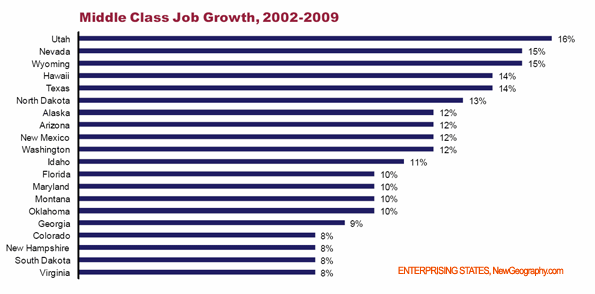
    What Is the Best Role for the Federal Government In Job Creation?

    The best role for the federal government is to fund national priorities like energy, physical infrastructure, and the national defense, and to set basic health and safety regulatory guidelines that are carefully balanced against the need to maintain low barriers to entry into the market. But, for the most part, the primary mission for economic development went to the states, and, more importantly, the private sector economy.

    The mounting federal initiatives to wrest environmental, wage, and benefit concessions from private companies are examples of a centralization of government power over both states and private businesses that could take us in the wrong direction. Although certain times do call for increased federal activity—legitimate threats to national security or economic emergencies, such as the Great Depression or the recent financial crisis—we may be approaching a critical juncture where Washington’s power may be reaching beyond its effectiveness.

    The current impulse to create a high-employment economy by imposing federal restrictions—such as the proposal that private firms that do not raise wages will be bullied into doing so by the manipulation of federal contract awards—marks a departure from our free-market traditions. Similarly, possible federal control over local zoning decisions—through such organizations as the EPA—also mark a crossing of the regulatory Rubicon.

    States and localities are far better positioned than the federal government to foster strategic investment, regulations, taxes and incentives that encourage private sector prosperity. In large part, this is because they are more responsive to local conditions. Many academic planners, policy gurus, and national media have tended to favor large government units as the best way to regulate and plan for the future. But central planners consistently seek to reduce the influence exercised by the plethora of villages, towns, and cities in the United States: well over 65,000 general-purpose governments. With so many “small towns,” the average local jurisdiction population in the United States is 6,200, small enough that nonprofessional politicians can have a serious impact on local issues.

    The American preference for solving problems at the state or local level should be central to the government role in job creation. One size determined in Washington will not fit all. South Dakotans and Californians will prefer to address employment problems in different ways. Within the limits of constitutional rights, we should let them try their hand, and let everyone else learn from their success or improve upon their policies.

    Indeed, many Americans on both the right and left are instinctive decentralists. Our economic evolution mirrors this trend. America’s entrepreneurial urge, in contrast to developments elsewhere, has actually strengthened. In 2008, 28% of Americans said they had considered starting a business—more than twice the rate for French or Germans. Self-employment, particularly among younger workers, has been growing at twice the rate of the mid-1990s.

    For this reason, supporting new businesses—and small and medium-sized firms—by ensuring that they can get the credit they need is an essential piece of the job-creation picture. For jobs to grow, these businesses must thrive.

    Innovation and Entrepreneurship Are the Key to Solving the Jobs Imperative

    America will depend on its emerging population of younger workers to keep expanding its economy. In the 1970s, when the coming-of-age of the boomers began to impact the labor market, labor force growth created a period of higher unemployment. Now, we could see a reoccurrence as the large millennial generation starts to seek employment. Yet now, as then, predictions of a long term labor glut could well change as these workers find and develop new opportunities.

    This happened to the boomers in the late 1980s, when talk of long-term high unemployment was replaced with concerns over a labor shortage. The growth of new industries tied to the use of computers, and later of the internet, created a surge in demand for skilled workers. As boomers integrated into the workforce and were replaced by less numerous generation “X”-ers at the entry level, companies fretted increasingly about a diminishing pool of workers.

    The opportunities for employment created by the rise of new industries, and by the innovative expansion of established businesses, cannot be underestimated. Such innovation has long been the source of new growth for the American economy, although the exact nature of that innovation is impossible to predict. Much of the pioneering will likely come from skilled immigrants, who are
    estimated to have started a quarter of all venture-backed
    public companies between 1990 and 2005.

    This enterprising spirit reflects a broad, long-term American trend. U.S. employment has been shifting not to mega corporations, but to individuals and smaller units; between 1980 and 2000, the number of self-employed individuals expanded tenfold to comprise 16 percent of the workforce.

    The smallest businesses—the so-called microenterprises— have enjoyed the fastest rate of growth. By 2006 there were some twenty million such businesses, one for everysix private-sector worker. Hard economic times could slow this trend, but historically, recessions have served as incubators of innovation and entrepreneurship. Many of the individuals starting new firms will be those who have recently voluntarily left or been laid off by bigger companies.

    The Vital Role of Infrastructure and Basic Industries

    To succeed in the mid-21st century, Americans also will need to pay more attention to the country’s basic industries. Some assume that the American future can be built around high-end “creative” jobs, without ever reviving the industrial economy or rebuilding our physical infrastructure. In the America envisioned by advocates of “the creative economy,” our productive facilities would serve mainly as tourist attractions, much as we now visit restored pioneer villages.

    Such an approach assumes that our rising competitors, notably China and India, will surrender high value activities such as media, finance and engineering. This is a dangerous and historically ill-considered assumption. In the 1980s, Japanese firms that were widely written off as “copycats” became primary innovators, particularly in automobiles, semiconductors, and computer games. In the coming decades, Chinese, Indian, and Brazilian companies—to name a few—will seek to move from low-wage work to more specialized, innovative kinds of products. The enormous revenues generated from the less trumpeted activities will provide the funds to invest in their move into ever higher-end activities.

    Americans can create a more prosperous future, but only if we focus on maintaining the physical infrastructure necessary for basic production and transportation, as well as on developing the intellectual prowess of our citizenry. America’s unique demographics require the country to pay attention not only to high-tech industries or financial services, but also to the basics: construction, manufacturing, agriculture, and energy.

    These critical industries underpin our prosperity and employ our expanding blue-collar workforce. They can provide new opportunities for the majority of workers who do not possess four year or advanced college degrees. In 2005, the National Association of Manufacturers, the Manufacturing Institute, and Deloitte Consulting surveyed eight hundred U.S. manufacturing firms: More than 80% reported that they were “experiencing a shortage of qualified workers overall.” Nine in ten firms stated that they faced a “moderate-to-severe shortfall” of qualified technicians. By 2020 this shortage could grow to 13 million workers. A resurgent manufacturing sector would also boost the country’s technological workforce. By 2007, industry employed about a quarter of the nation’s scientists and related technicians.

    This revived focus on production would help large swaths of the country. The Great Plains area, which is still profiting from industrial and agricultural expansion, would benefit, as would the Great Lakes, which has weathered so many challenges in recent decades. Historically neglected regions such as Appalachia would also profit.

    The Critical Role of States

    America is a vast country made up of hundreds of diverse economies. From early on, very different industries clustered in different places. There has been wide divergence in the skills and abilities of local populations. Although federal intervention is necessary in certain areas—for example, in creating national research institutions or interstate transportation—it is often at the state or local level that the best policies for a particular region can be developed.

    The need to tailor economic development to local needs has been a critical aspect of the success of our federal system. By giving a state wide leeway to develop its own solutions to the jobs imperative, we would be providing the other states with potential role models—as well as a warning system of policies to avoid—in their own strategies. The states are described in the famous opinion issued by Supreme Court Justice Louis Brandeis as places that “serve as a laboratory” where the nation can “try novel social and economic experiments without risk to the rest of the country.”

    States have often been leaders in fashioning progressive approaches to economic development. Private and state-sponsored development created the initial network of roads, canals, and steamboats that knit together regional economies. When President James Madison vetoed federal funding for the Erie Canal in 1817, the New York legislature used its own tax and credit resources to complete the 363 mile system eight years later. Eventually the canal helped assure the Empire State’s national preeminence. Other states, including Pennsylvania, Ohio, Indiana, Illinois, Maryland and Virginia, followed suit with their own canal-building projects.

    In the 1920s and 1930s states—and some municipalities—also invested heavily in wealth-creating infrastructure, including highways and water and power systems. These investments supplemented significant new underwriting of projects from private corporations. States continued to make these investments throughout the 1950s.

    At the time, no state was more successful at developing its economy than California. Under both Republican and Democratic Governors, California developed what has become a widely accepted model of local economic development based on the expansion of traditional infrastructure—roads, bridges, water and energy systems—matched by massive investments in “human capital”, including a master plan for higher education that spanned the elite universities to the community colleges.

    California’s state investment and business promotion policies inspired other states, notably Texas and North Carolina. This state role was also embraced by the young Governor of Arkansas, Bill Clinton. Faced with the issues of a poor, racially divided state, Clinton recognized that, given the deep divisions in Washington, “There is no alternative to continued intense state efforts to deal with our most pressing domestic problems.”

    Although unemployment dropped, there remained problems relating to national competitiveness and declining middle class wages, Clinton argued. But he continued to believe in the exercise of local power. “In a country as complex and diverse as ours, in which most job growth is generated by small business,” he noted, “many of these [economic] issues will almost have to be dealt with at the state level.”

    In David Osborne’s landmark work, Laboratories of Democracy, he described how the late 1980s and early 1990s saw the emergence of a whole host of innovative Governors. The “first agenda” of these Governors, Osborne noted, was “creating economic growth”, a notion Governor Clinton later used effectively in his campaign for the Presidency.

    In today’s federal-level climate, states could potentially play a more significant role than they did in the ‘80s and ‘90s. Chuck McCutcheon, co-editor of Politics in America at CQ-Roll Call Group, suggests that continued DC “political gridlock” makes the states better suited to deal with major policy issues. At the state and local levels, he suggests, politicians are more likely than their highly polarized federal counterparts to “get along” with each other.

    Conclusion: The Power of the States to Lead the Jobs Imperative

    Ultimately, states and localities are best qualified to meet the jobs imperative. As Alexis De Tocqueville observed, it is natural that citizens of a state or locality are more solicitous about “the increasing prosperity of his own district,” and this serves “to stir men more readily than the general interests of the country and the glory of the nation.”

    As our country grows, reaching 400 million people by 2050, the differences between our various states and communities will grow. We will have more diverse regional economies, demographics and cultures. We need to look at these local sources—what Thomas Jefferson called “our little Republics”—to lead the jobs imperative. It is an imperative upon which depends the future success of our entire nation.

    Read the full report.

    Praxis Strategy Group is an economic development, analysis, and strategic planning firm. Joel Kotkin is executive editor of NewGeography.com and author of The Next Hundred Million: America in 2050