Tag: Heartland

  • A Carbon Added Tax, Not Cap and Trade

    Paul Krugman devoted a recent lengthy New York Times Magazine article to the promotion of a disastrous “cap and trade” regime for reducing carbon emissions. Though he doesn’t outright endorse it, he strongly suggests that the Waxman-Markey bill that passed the House would be acceptable to him. Krugman then proceeds to pooh-pooh the carbon tax idea, one that I believe has far more merit.

    Cap and trade would be a debacle for a slew of reasons. The most important is that it won’t even reduce carbon emissions. Two of the EPA’s own San Francisco attorneys dismissed the Waxman-Markey cap and trade regime as a “mirage” that would not reduce carbon because of the ability of polluters to obtain fictitious carbon offsets, among other problems.

    Even if cap and trade would require American producers to reduce carbon emissions, it would do nothing about overseas polluters. An American manufacturer could escape cap and trade simply by moving production to China. Given China’s massive coal-based electricity infrastructure and other notoriously polluting practices, carbon emissions would likely only get worse as a result, in addition to the US jobs lost.

    Krugman suggests this can be fixed with a carbon tariff, but that’s dangerously naïve. There’s no guarantee a carbon tariff would be put in place after cap and trade passed. In effect, it requires two completely separate policy mechanisms be put in place and kept synchronized over time, which seems dubious. Our trading partners would surely chafe at any carbon tariff, which would be vulnerable to challenge under international trade treaties.

    Cap and trade also has huge distortive impacts within the United States. The Brookings Institution crunched the numbers and found that cap and trade costs vary widely across the country. Compliance costs would be minimal in California and rest of the West and Northeast, while the Midwest, Mid-Atlantic, and the South get pummeled. It should come as no surprise that it is California Rep. Henry Waxman who’s pushing the bill. One can’t help but suspect these regional disparities are the real implicit goal of the bill. Indiana Gov. Mitch Daniels denounced cap and trade as “imperialism”.

    Perhaps the most diabolical part of cap and trade is in its very name. The operative word is “trade”. Who do you think will be doing the trading? Why, none other than the very people who got us into the economic mess we’re in today. Cap and trade is a gigantic giveaway to Goldman; it’s yet another instrument for speculation; it’s another way for the profiteers on Wall Street to line their pockets at our expense.

    So in a sense it’s also another way that, perhaps unintentionally, the richest sectors, the upper classes, and the financial centers like New York, Boston and San Francisco are being favored over the poor Main Street rubes who have taken it on the chin during this recession without a bailout. If you think things are bad now, just wait until CDS stands for “carbon default swap”. It’s pouring fuel on the fire of inequality between the haves and have nots.

    Cap and trade is nothing more than another tranche in the never-ending merry-go-round of bailouts for the financiers. And didn’t we learn anything from Enron’s electricity trading shenanigans? When an Iowa farmer opens up in his electric bill that’s suddenly spiked, or has to pay double to fuel his farm equipment, it’s not too much to ask that it be in the service of actual carbon reduction, not houses in the Hamptons, owned by people to whom the added cost is not material given their wealth.

    There is a better way, and that’s the Carbon Added Tax. Similar to a European-style Value Added Tax, a CAT tax would directly tax the quantity of carbon emissions added to the atmosphere in each stage of the production cycle. The tax could be set at a level that would provide certainty of price such that investments in lower carbon technologies are financially feasible right now, not decades from now.

    Also, similar to the US income tax system, the CAT would apply to the carbon emitted globally, not just in the United States. A deduction would be permitted for any bona fide carbon taxes paid in a foreign jurisdiction, up to the level of the US tax. A true-up on the carbon tax due would be paid at the point of import into the United States. That is, an importer would have to pay the CAT on products brought into the country, less any deductions for foreign carbon taxes paid, at the port of entry.

    While this global approach is a widely, and correctly, maligned feature of the US income tax code, it has important benefits from a carbon reduction perspective. First, it is location neutral. Since the tax is the same whether the carbon is emitted in China or the United States, it doesn’t encourage business to move offshore. But it also doesn’t discriminate against foreign producers. (Like any anti-carbon regime, it would raise costs in the US, affecting both domestic consumers and the competitiveness of exports).

    The CAT is also functionally equivalent to a carbon tariff, but is a unitary regime. That is, you don’t have to figure out how to bundle in or pass a separate carbon tariff as part of implementing a domestic cap and trade system. You simply pass a CAT on global carbon emissions and you are done.

    And this system allows each country to decide on its own level of carbon taxation. If countries like China want to have no tax, that’s their choice. Or, European countries could decide to have a higher tax. The complexity would come in figuring out the allowed deductions for emissions in countries that adopted other schemes like cap and trade, but this should be a readily solvable technical issue.

    There will still be divergent regional domestic impacts under a CAT. This is unavoidable in a nation where carbon emissions are unevenly distributed. But by preventing the financiers from skimming off the top, the total burden is reduced, and a CAT is a more location neutral, transparent mechanism for carbon reductions.

    A Carbon Added Tax is a far superior way to reduce carbon emissions than a cap and trade system only a Wall Street trader could love.

    Aaron M. Renn is an independent writer on urban affairs based in the Midwest. His writings appear at The Urbanophile.

    Photo by Gilbert R.

  • Finding the Good in This Bad Time

    This year’s best places rankings held few great surprises. In a nation that shed nearly 6.7 million jobs since 2007, the winners were places that maintained or had limited employment declines. These places typically had high levels of government spending (including major military installation or large blocs of federal jobs) or major educational institutions. Nor was the continued importance of the energy economy surprising in a nation where a gallon of gas is still about $3 a gallon.

    Even including part of 2010, only 13 cities (out of 397) showed growth, reflecting the breadth and depth of the downturn. In an economy where the most promising statistic is a “limited” decline in the number of new job losses from month to month, where is the proverbial silver lining?

    It is found in two places: (1) areas that show some resilience in this dour economy; and (2) a newly retooled American economy positioned to compete more strongly in the future.

    Regions of Current Hope
    With disaster as a backdrop, the early signs of buoyancy in the economies of the Intermountain West, the Great Plains, and even parts of the Midwest are quite impressive. Many predicted these areas would mirror the collapse of their larger, high-growth counterparts in California, Florida, Arizona and Nevada. To the contrary, these relatively rural locations are emerging as beacons of hope.

    In the big cities, there have been across-the-board declines in most sectors led by the collapse of construction and financial services. Thousands of small businesses have disappeared in addition to huge layoffs by large employers. You see many “For lease” signs now at what were once your favorite shops and watering holes.

    In a business climate like this, a lot can be said for slow and steady. Comparatively, slower-growing cities across the middle parts of the country are recovering more easily and more quickly.

    Perhaps the most important lesson is that the economies of the future are not all about the “knowledge class” and that “too-good-to-be-true” high wage jobs may be just that. As seen in the dot-com bubble and in this real estate bubble, those fancy, high-wage finance and tech jobs are highly vulnerable to swings in the economy and high-paying construction jobs are only as good as the housing market.

    This is simply because markets eventually adjust. In the case of overheated stock and real estate markets, the losses are felt by the knowledge class, financiers and construction workers. In the case of manufacturing, as the price is bid up through labor costs, other places become more competitive.

    During volatile times, places with the broad-based growth strategies — like Texas and Utah — do best. Cities that are heavily dependent on a narrow set of industries leave themselves vulnerable, paying back the gains of good years in poor years.

    Part of the success of Texas is not just energy (as the modest performance of Midland and Odessa shows), but rather to the state’s adjustments to a past crisis, the savings and loan crisis of the 1980s. The state instituted new laws that imposed a range of disciplines on financial markets — such as limiting home equity lines — thereby minimizing the damage to the state’s economy as those markets went topsy-turvy.

    Regions of Future Hope
    There remains hope for the future in the story of this recession. One of the defining aspects of this recession was not just that certain sectors were hit hard, but that it was also broadly distributed across the economy. This pervasiveness extended deeply enough to cause every enterprise in America to seriously reconsider their business model and re-engineer how they served their customers.

    Consequently, the American economy is leaner and cleaner than it was three years ago. Businesses are more in touch with what makes them successful. While growth will be slower, it will be focused on areas that will bring about quick increases in productivity across the economy and bring new, real wealth to the local economies.

    Where will this happen most quickly? In those places where businesses survived best. Expect the Intermountain West and smaller manufacturing hubs across the United States to lead the charge (because of their lower costs), but large metros like Los Angeles, Chicago, Houston, Minneapolis, and Dallas, with their deep inventories of manufacturers and large labor pools, should see these returns before too long.

    Similar stories can be told for nearly every sector although the beneficiaries will be different. Much of the growth in information sector, for example, will continue to take place outside Silicon Valley. Business services will grow most rapidly where there is growth in business overall, initially outside the core hubs. Midsized and small communities will lead this recovery, and the big cities will eventually follow.

    Economies open to a wide array of occupations will do better than those that are less diversified. Places like Portland and Atlanta, so deeply focused on attracting high-wage, knowledge-based jobs are likely to miss out on the “basic” job growth that will fuel the first stage of the American recovery. Venture capital is still tight across the nation and capital markets are uncertain, especially with new government regulations up in the air. Consequently, high-end, white collar, and high tech jobs, with their insatiable need for investment capital, will develop more slowly. Even among the high-tech superstars, high profits will not lead to huge surges in hiring.

    Why Government Holds the Key
    Government’s actions over the next six to 12 months will define potential and the pace of this recovery. With an election looming, all sides will be jockeying for electoral advantages in November. They will cater legislation to many competing constituencies, fostering tremendous uncertainty in the private sector.

    One thing is certain, however. The current pace of government spending is unsustainable. Not even the US economy can support ongoing deficits in excess of $1.5 trillion per year. Either government spending must slow or someone must pay a lot more. The only alternative — high inflation — will have its own negative effect. One way or another some combination of the three MUST happen.

    Additionally, current regulatory initiatives will change the dynamics and employment patterns within some important sectors. Whether it is the complete restructuring of the health care industry (part of one of the only bright spots in the current economy), or the prospective new regulation in the financial services sector, potentially destabilizing change is coming.

    And the feds are not the only destabilizing government actors. California’s aggressive climate legislation, for example, and the mixed signals it is sending businesses across the state’s 28 MSAs will certainly shape their near and midterm economic futures.

    So what should the federal and state governments be doing at this time? Most importantly, they need to ensure stability: stable capital and lending markets, a consistent and stable tax code, focusing interventions on broad-based, low-shock actions, and developing a plan for moderating and containing the national deficits and mounting national debt. The key to continued prosperity in these times is a growing private job base, not a growing government sector.

    Moreover, government needs to learn the lessons of the private sector. Even as private firms retrench, governments at all levels need to reduce their cost structures. This is happening in many localities, at least on a temporary basis, as even unionized local employees are accepting wage and benefit reductions to retain jobs. Localities and states must recognize the true cost of the services they provide. They must either find consistent ways of providing funding for them, or eliminate them to preserve more critical services.

    Finally, public and private sectors alike must learn that this has been a transformational recession. Unlike downturns in the past, business and government cannot expect things will return to the way they were. Markets and banks will not be printing imaginary value increases in real property for consumers to spend any time soon and capital markets are cautious about financial good news,,preferring the old tried and true winners to novelties.

    Government and government employees are behind the curve understanding this transformation. Wage and benefit concessions given up during this recession are not likely to reappear. The concepts of furlough and unpaid time off are here to stay. Even as the private sector has been forced to reconsider its baseline practices, so, too, the political pressure now will be on government to retain savings obtained during the recession.

    Michael Shires, Ph.D. is a professor at Pepperdine University School of Public Policy.

  • The Worst Cities For Jobs

    In this least good year in decades, someone has to sit at the bottom. For the most part, the denizens are made up of “usual suspects” from the long-devastated rust belt region around the Great Lakes. But as in last year’s survey, there’s also a fair-sized contingent of former hot spots that now seem to resemble something closer to black holes.

    Two sectors have particularly suffered worst from the recession, according to a recent study by the New America Foundation: construction, where employment has dropped by nearly 25%, and manufacturing, which has suffered a 15% decline. The decline in construction jobs has hit the Sunbelt states hardest; the manufacturing rollback has pummeled industrial areas such as the Great Lakes as well as large swaths of the more recently industrialized parts of the Southeast.

    Then there is California, a state that should be doing much better given its natural advantages and vast human capital but whose regions–with the exception of government-rich Hanford–share various degrees of distress. The bursting of the real estate bubble has hit the Golden State hard, but seeing so many poor performances in my adopted home state is distressing and points to much deeper problems. Rankings author Michael Shires, pointing to the looming prospect of high taxes and expanding regulation, notes that “While California’s economy has come roaring back many times before, a resurgence this time will be slowed by the state’s increasing willingness to aggressively tax and regulate those who will make it happen.”

    Rust Belt Ruins

    The traditional manufacturing heartland long has suffered, and in this recession industrial jobs have declined rapidly and only now seem to be slowly expanding. Ever since we started these surveys back in the early 2000s, cities and towns along the rust belt have inhabited the bottom rungs.

    Starting up from the last place finisher, No. 397 Warren-Troy, Mich., these old industrial cities dominate the nether regions; of the bottom ten finishers overall, six come from the Wolverine State, including long-suffering Detroit, which ranks 394th overall and 65th on the list of large metros (next to its neighbor, Flint, in last place). Other rust belt bottom-dwellers include No. 395 Elkhart and No. 392 Kokomo in nearby Indiana.

    Perhaps more disturbingly, many of those at the bottom come from what used to be called “the new South,” cities that industrialized late and often benefited from the flow of jobs from the old rust belt. Places such as No. 396 Morristown, Tenn., No. 390 Dalton, Ga., and No. 389 Hickory-Lenoir-Morganton, N.C., have suffered from a recession that has either forced companies to shut down or move overseas.

    Sun Belt Busts

    Ever since the collapse of the housing bubble in 2007, we have seen a remarkable turnaround in many Sunbelt regions. Traditionally, these led the list as emerging boomtowns. Now many appear more like bust-towns.

    Take a look at the rapid decline of such hot spots as Las Vegas, which now ranks 57th out of the 66 largest metros in the country; Phoenix, now lurking at No. 51; and No. 61 West Palm Beach, No. 56 Fort Lauderdale, No. 54 Tampa and No. 45 Miami, all in Florida. Many of these cities stood proudly near the top of the list as recently as three years ago. Perhaps nothing illustrates the reversal of fortunes than the fall of Reno, once our fastest-growing mid-size region, now No. 92 in the same category.

    California: The Great Disaster

    No state has suffered a greater reversal of fortunes than California. Five or six years ago California regions generally inhabited the top half or third of our lists. Today they generally have fallen even faster than the other Sunbelt states, even though the state’s economy boasts many assets beyond merely real estate speculation.

    California now accounts for a remarkable 7 of the bottom 20 regions on our big metro list. The diversity of the disaster spans both the urban centers and the exurbs–witness exurban Riverside-San Bernardino at No. 63 and the city of Oakland at No. 62. Historic high-flyers No. 59 Los Angeles and neighboring Santa Ana-Anaheim Irvine, which checks in at an abysmal No. 60, didn’t fare much better.

    Perhaps more shocking is the poor performance handed in by the state capital, Sacramento, a former high-flyer now mired at No. 54, and San Diego, a high-tech haven with a near-perfect climate, that resides at No. 48. Even No. 47 San Jose/Silicon Valley has done poorly, despite all the consistent hype about the world class tech center. The likes of Steve Jobs of Apple and Eric Schmidt at Google may be minting money, but the region, paced by declines in construction, manufacturing and business services, now has 130,000 fewer jobs than a decade ago. San Francisco does not do much better, clocking in No. 42, just ahead of its equally celebrated alter-ego Portland, Ore.

    Prognosis From the Emergency Room

    If this list tells us the current occupants of intensive care, what then are the prognoses for recovery? It seems the story differs for each of our three basic categories. For the rust belt cities, relief will only come when the country decides to reprioritize industry, while allowing for the restructuring of firms and contracts. On the bright side is the recovery of Ford and the potential for a second life for a greatly reduced General Motors and even Chrysler. A modest surge in production of these firms and related industries, such as steel and electronics, could help some selected regions rise up from the bottom.

    The recovery of the Sunbelt economies seems likely to take hold first. Despite the giddy predictions of East Coast pundits that places like Las Vegas, Phoenix, Orlando and Tampa are doomed to what Leon Trotsky allegedly described as the “dustbin of history,” this is not the first time these areas have suffered a setback. They have still not shown much life yet, but I would not count them out for the long term. There is a lot to be said for a sunny climate, greatly enhanced affordability and what many see as a high quality of life.

    Ultimately, notes Rob Lang, director of Brookings Mountain West and professor of sociology at the University of Nevada-Las Vegas, the assets of these regions have either not changed–pro-business administrations and warm weather–or, in the case of housing affordability, have become more attractive. “Phoenix and Las Vegas will be fine,” Lang predicts, noting that Las Vegas is working to reinvent itself beyond gaming to becoming a “convening capital” for the world economy. Similar dynamics could also boost cities in Florida, particularly if they begin focusing beyond tourism and housing.

    And then there is California, which by all rights should be leading, not lagging, the current recovery. Statewide unemployment, already 12.6%, has been rising while most states have experienced a slight drop. Silicon Valley companies, Hollywood and the basic agricultural base of the state remain world-beaters. But the problem lies largely in an extremely complex regulatory regime that leads companies to shift much of their new production and staffing to other states as well as foreign countries. The constant prospect of a state bankruptcy, in large part due to soaring public employee pension obligations, does not do much to inspire confidence among either local entrepreneurs or investors.

    Hopefully this will be the year when Californians decide that it needs an economy that provides opportunities to people other than software billionaires, movie moguls and their servants. It will have to include much more than the endlessly hyped, highly subsidized “green jobs.” More than anything, it will take rolling back some of the draconian regulations–particularly around climate-change legislation–that force companies, and jobs, to go to places that, while not as intrinsically attractive, are friendlier to job-creating businesses.

    This article originally appeared at Forbes.com.

    Joel Kotkin is executive editor of NewGeography.com and is a distinguished presidential fellow in urban futures at Chapman University. He is author of The City: A Global History. His newest book is The Next Hundred Million: America in 2050, released in Febuary, 2010.

    Photo: JSFauxtaugraphy

  • I Heart Des Moines

    Forbes Magazine just released its “Best Places for Business and Careers” list and it’s no surprise to me that Des Moines, Iowa just landed in the top spot. Nearly 5 years ago, I’d have said the same thing you may have just muttered. “Des Moines…that’s fly over country…who’d want to live and work THERE?” I fully appreciate your logic with our cold winters, humid summers, and ag-centric heritage. But weather and corn fields aside, the Des Moines metro, a circle consisting of about half a million people, has captured my heart and I’ve become its most passionate evangelist.

    After a lifetime of Southern California bustle, my wife wasn’t exactly thrilled about my desire to abandon our friends and family infrastructure. But ultimately she wanted me to have more than a view from the windshield of a Honda Civic and to be a stay-at-home mom for our kids. We began to see clearly that reaching goals for entrepreneurship, more family time, and more civic engagement were unattainable in our current location. We were ready to reclaim our time, live with less hassle, and stretch a bit.

    So in 2005, we executed geographic arbitrage landing in Clive, Iowa, a beautiful community on the West side of the Des Moines metro. Soon the memory of my 2.5 hour daily plunge into freeway hell was fading. Views of the beaches and mountains from the window of the 6:20AM flight to DFW became real life experiences on urban bike trails and fishing at the lake blocks from my house. A 20-minute drive from end-to-end, the Des Moines metro area defines easy living and 70 miles equals 60 minutes. (I’m still chronically early to my appointments.)

    During those first months here a local business blogger who’d been reading my copious posts on “Why Des Moines?” reached out to me. After coffee and a few introductions, my personal and business network began to flourish. It was hard to comprehend how quickly anyone who’s willing could reach top level contacts in business, associations, and in government. Before long I was shopping a business plan to investors and prominent business owners in town. I was even introduced to State House representatives who cared about my thoughts on what’s happening in their districts. (I went 33 years never meeting a Congressman in CA.) I realized that within a few phone calls I could reach top decision makers, corporate leaders, and legislators and they were willing to listen to me. My business createWOWmedia is growing rapidly now and I’m reaping the benefits of 2.5 years of head down execution and statewide relationship building. I had the time, the energy, and the start up capital through my CA home sale to stop dreaming and start doing. The Des Moines metro gave me that opportunity and I’m thankful for it.

    I’ve figured out that if you’re willing to endure a couple months spent largely indoors or bundled up that the trade-offs are magical and worth their weight in gold. I wouldn’t trade what I’ve found here for anything. The Des Moines metro and the state of Iowa as a whole offer so much…and ask so little in return. Des Moines is easy living defined.

    Am I worried about a massive influx of new Iowans pouring in from Western states based on this piece and Forbes’s recommendations? No chance. But if you do decide to take the plunge and reclaim your life from the concrete jungle, shoot me an email and I’d be happy to guide you. That’s what good neighbors and Iowans do.

    Doug Mitchell is a Southern California refugee who moved his family to Des Moines, Iowa to build a better life. Doug can be reached at doug@createWOWmedia.com or on twitter @doug_mitchell

  • The Best Cities For Jobs

    This year’s “best places for jobs” list is easily the most depressing since we began compiling our annual rankings almost a decade ago. In the past–even in bad years–there were always stalwart areas creating lots of new jobs. In 2007’s survey 283 out of 393 metros areas showed job growth, and those at the top were often growing employment by at least 5% to 6%. Last year the number dropped to 63. This year’s survey, measuring growth from January 2009 to January 2010, found only 13 metros with any growth.

    Mike Shires at the Pepperdine School of Public Policy, who develops the survey, calls it “an awful year.” Making it even worse, the source of new jobs in almost all areas were either government employment or highly tax payer-funded sectors like education and health. This year’s best-performing regions were those that suffered the smallest losses in the private economy while bulking up on government steroids.

    So far the recovery has favored the government-dominated apparat and those places where public workers congregate.After all, besides Wall Street, public-financed workers have been the big beneficiaries of the stimulus, with state and local governments receiving more than one-third of all funds. Public employment grew by nearly 2% over the past three years, while private employment has dropped by 7%.

    Private sector workers have also seen their wages decline, while those working for the various levels of government have held their own. Federal workers now enjoy an average salary roughly 10% higher than their private sector counterparts, while their health, pension and other benefits are as much as four times higher.

    Not surprisingly government workers, according to a recent survey, are more likely to see the economy improving than those engaged in the private sector. It’s not so pretty a picture on Main Street; personal bankruptcy filings rose 23% in the year ending in March.

    Small Is Still Beautiful

    Despite these differences, some patterns from previous years still persist. The most prominent is the almost total domination of the top overall rankings by smaller communities. With the exception of Austin, Texas, all the top 10 growers–and all the net gainers–were small communities. Americans have been moving to smaller towns and cities for much of the past decade, as well as jobs, and this recession may end up accelerating the trend.

    At the top of the list stands No. 1 Jacksonville, N.C., whose economy grew 1.4%, paced by 3.3% growth in government jobs. Fast growth, however, is not a stranger to this Southern community, whose employment base has grown 22.8% since 1998. The area includes the massive Marine Base at Camp Lejeune, a beehive of activity since the U.S. started waging two wars in Afghanistan and Iraq. Fort Hood-Temple-Fort Hood in Texas came in fourth place overall with Fayetteville, N.C., home to the Army’s Fort Bragg, placing sixth and Lawton, Okla., home of Fort Sill, close behind at No. 7. Similar explanations can apply to war economy hot spots Fort Stewart (No. 20 overall) and Warner Robbins (No. 26), both in Georgia.

    But perhaps nothing captures the current zeitgeist more than the presence, at No. 23, of Hanford-Corcoran, Calif. A large Air Force base and a state prison have bolstered Hanford-Corcoran’s economy, which shows that even in the Golden State–an economic basket case whose unemployment keeps rising–a large concentration of government jobs still guarantees some degree of growth.

    Not all our top-ranked small stars got their stimulus from Uncle Sam. Energy-related growth explains strong performances from Bismarck and ag-rich Fargo, N.D., at Nos. 2 and 8, respectively. You can also credit some energy-related growth to the high standing of Morgantown, W.Va., (No. 17) and Anchorage, Alaska, (No. 18), which have benefited from consistently high prices of oil and other sources of energy.

    Texas at the Top of Big Cities

    Our list of best places among big cities is dominated this year, as last, by Texas, with the Lone Star State producing fully half of our top 10. This year, like last, the No. 1 big city (those with a more than 450,000 non-farm jobs) was Austin, Texas, which enjoys the benefits of being both the state capital and the home to the University of Texas, as well as a large, and growing, tech sector.

    But the Texas story also includes places that do not enjoy Austin’s often overwrought “hip and cool” image. Broad-based economies, partly in energy, have paced the growth of No. 2 San Antonio, No. 3 Houston, No. 5 Dallas and No. 7 Fort Worth. Other consistent big-city Southern performers include No. 8 big metro Raleigh-Cary, N.C., as well as two ascendant Great Plains metropolises, No. 9 Omaha and No. 11 Oklahoma City. None of these places were too hard-hit by the mortgage meltdown, and they all have retained reputations as business-friendly areas.

    The other big winner among the large areas is an obvious one: No. 6 ranked greater Washington, D.C. While most American communities suffer, our putative Moscow on the Potomac has emerged as the big winner under Barack Obama and the congressional centralizers. Remarkably, federal employment in the area has grown at a smart pace throughout the recession. One partial result: Washington office space is now–for the first time ever–more expensive than that in Manhattan. Northern Virginia, home to many beltway bandit companies, ranks No. 4 on our list.

    The Eds and Meds Economy

    With the productive economy outside energy only now getting its footing, the biggest relative winners have been what could be called the “eds and meds” economies. This includes de-industrialized places such as Pittsburgh (ranked a surprising No. 13), Rochester, N.Y., (ranked No. 17) and Buffalo, N.Y. (No. 20). If you have few more factory jobs to lose, little in-migration and a huge collection of institutions relatively immune to the economic turndown, you have a better chance to look good in bad times. The stimulus tilted more toward education and health than to construction and infrastructure, something that has worked to the favor of these cities.

    We can see this in New York City, whose huge and growing concentration of colleges and hospitals helped propel it to No. 10 among the big regions, its best ranking ever, despite losing almost 130,000 jobs. This is all the more remarkable since the Big Apple was the epicenter of the financial collapse, although that also made it the prime beneficiary of the federal bailout and Wall Street’s boom. Soaring salaries for hedge fund managers and new hires at financial firms could be pacing new growth in the city’s elaborate service industry, from toenail painters, restaurateurs and psychologists to dog walkers and yoga instructors.

    The health of the eds and meds economy, however, has even been enough to lift some traditional bottom-dwelling sad sacks, such as No. 14’s Philadelphia, to unfamiliar, if rather relative, heights. With private-sector growth weak everywhere, cities with lots of big hospitals, universities and nonprofit foundations look better for the time being than they have in a generation.

    The Road Ahead

    We expect our list to change next year, but how it will do so will depend as much on politics as economics. The current policy approaches–with healthy increases in government employment and strong support for education–have worked relatively well for taxpayer-financed economies including those with a strong “eds and meds” sectors. State universities, now confronted with the real pain of the recession felt by state taxpayers, are already crying for heavy increases in federal support.

    But if Congress takes a turn to the center, or even right, after November, the advantageous position of the favored government-supported sectors may erode. Particularly vulnerable will be state workers, whose current federally sanctioned reprieve could be terminated if voters force legislators to start addressing concerns over the huge governmental deficits both locally and nationally. Given D.C.’s unique ability to print money, Washington and its environs will likely continue to expand, as they did under the spendthrift Bush regime, but many state and local governments may be forced onto a stringent diet.

    On the other hand, a welcome return to basic growth in overall economy would further boost those relatively low-cost areas–notably in Texas, the Great Plains and the Intermountain West–that have in recent years enjoyed the strongest trajectory in the non-government related sectors, including natural resource-based industries . These places have pro-business regulatory and tax regimes, lots of available land and affordable housing, which will attract new businesses and workers to their areas.

    This change could also benefit some places, such as Silicon Valley, parts of Southern California and the Pacific Northwest, which despite high costs still retain globally competitive, tech-related sectors. A resurgent job market in these areas would erase the current apparent advantage enjoyed by “eds and meds” based economies in favor of those places that will serve as the real incubators for a revived private sector economy. With the resumption growth, hopefully, our economy next year will begin resembling the more capitalist, competitive one we have enjoyed in the past.

    This article originally appeared at Forbes.com.

    Joel Kotkin is executive editor of NewGeography.com and is a distinguished presidential fellow in urban futures at Chapman University. He is author of The City: A Global History. His newest book is The Next Hundred Million: America in 2050, released in Febuary, 2010.

    Photo: kiril106

  • The Heartland Will Play a Huge Role in America’s Future

    One of the least anticipated developments in the nation’s 21st-century geography will be the resurgence of the American Heartland, often dismissed by coastal dwellers as “flyover country.”

    Yet in the coming 40 years, as America’s population reaches 400 million, the American Heartland particularly the vast region between the Rocky Mountains and the Mississippi will gain in importance.

    To fully appreciate this opportunity, Americans need to see the Heartland as far more than a rural or an agricultural zone. Although food production will remain a crucial component of its economy, high-tech services, communications, energy production, manufacturing and warehouses will serve as the critical levers for new employment and wealth creation.

    This contradicts the common media portrayal of the Great Plains as a kind of Mad Max environment a postmodern, desiccated, lost world of emptying towns, meth labs and militant Native Americans about to reclaim a place best left to the forces of nature.

    Some environmentalists and academics even have embraced the idea, popularized by New Jersey academics Frank J. Popper and Deborah Popper, that Washington, D.C., accelerate the depopulation of the Plains and create “the ultimate national park.” Their suggestion is that the government return the land and communities to a “buffalo commons.”

    Yet ironically, the future of the Heartland particularly its cities will be tied, in part, to growing migration from the expensive, crowded coasts. Already, the growth capacity for “mega- cities” like New York, Chicago and Los Angeles may be approaching their limits as the urban megalopolis of cities, suburbs and exurbs become more crowded and expensive.

    As huge urbanized regions become less desirable or unaffordable for many businesses and middle-class families, more and more Americans will find their best future in the wide-open spaces that, even in 2050, will still exist across the continent. The beneficiaries will include places as diverse as Fargo and Sioux Falls in the Dakotas to Des Moines, Oklahoma City, Omaha and Kansas City.

    Many of these areas are now enjoying both population growth and net domestic in-migration even as the nation’s most ballyhooed “hip cool” regions like the Bay Area, Los Angeles, New York City and Chicago experience slower growth. Fargo, N.D., Sioux Falls, S.D., Des Moines and Bismarck, N.D., for example, all grew well faster than the national average throughout the past decade.

    Economics undergirds this trend. Unemployment in the Great Plains has remained relatively low, even during the recession that began in 2007. For much of the decade, the biggest problem facing many businesses has been finding enough workers.

    In the future, some will thrive by the production of energy or specialized manufactured products. Others will serve as magnets for tourists, hunters, bird-watchers, arts festivals and pageants. Small rural college towns may serve as refuges for empty nesters relocating or returning from the congested, expensive coasts.

    The critical sources for the evolving resurgence of the Heartland lie both in new technology and traditional strengths.

    The advent of the Internet, which has broken the traditional isolation of rural communities, has facilitated the movement of technology companies, business services and manufacturing firms to the nation’s interior. This will reinforce not so much a movement to remote hamlets but to the growing number of dynamic small cities and towns throughout the Heartland.

    The other critical element concerns the traditional role of the Heartland as a producer of critical raw materials. As world competition for food and energy supplies intensifies, a critical primary advantage for the United States in contrast with China, India, Japan and the European Union will lie with the vast natural abundance of its Heartland regions.

    New investment will flow back into the Heartland to tap previously difficult-to-access resources such as oil and gas, while new technologies will exploit prodigious natural sources such as wind.

    Equally critical, the Heartland will reconnect America with its own historic strengths as a great, largely open, continental nation, a place of aspiration that can accommodate future growth. The Heartland reinforces our national character, what Frederick Jackson Turner called “that restless, nervous energy; that dominant individualism, working for good or evil … that buoyancy and exuberance which comes with freedom.”

    As the population expands to 400 million people, Americans will need to tap that spirit more than ever.

    This article originally appeared at the Omaha World Herald.

    Joel Kotkin is executive editor of NewGeography.com and is a distinguished presidential fellow in urban futures at Chapman University. He is author of The City: A Global History. His newest book is The Next Hundred Million: America in 2050, released in Febuary, 2010.

    Photo by: Sacred Destinations

  • America in 2050 — Where and How We’ll Live

    The presence of 100 million more Americans by 2050 will reshape the nation’s geography. Scores of new communities will have to be built to accommodate them, creating a massive demand for new housing, as well as industrial and commercial space.

    This growth will include everything from the widespread “infilling” of once-desolate inner cities to the creation of new suburban and exurban towns to the resettling of the American heartland — the vast, still sparsely populated regions that constitute the majority of the U.S. landmass.

    In order to accommodate the next 100 million Americans, new environmentally friendly technologies and infrastructure will be required to reduce commutes by bringing work closer to — or even into — the home and to find more energy-efficient means of transportation.

    Suburbs Rule

    Suburbia — the predominant form of American life — will probably remain the focal point of innovations in development. Despite criticisms that suburbs are culturally barren, energy inefficient or suitable only for young families, 80 percent or more of the total U.S. metropolitan population growth has taken place in suburbia, confounding oft-repeated predictions of its inevitable decline.

    This pattern will continue to the mid-21st century. The reasons are not hard to identify: Suburbs experience faster job and income growth, far lower crime rates (roughly one-third) and much higher rates of home ownership. While cities will always exercise a strong draw for younger people, the appeal often proves to be short-lived; as people enter their 30s and beyond, they generally prefer suburbs. This pattern will become more pronounced as the huge millennial generation — those born after 1983 — enters this age cohort.

    Over the next few decades, however, suburban communities will evolve beyond the conventional 1950s-style “production suburbs” of vast housing tracts constructed far from existing commercial and industrial centers. The suburbs of the 21st century will increasingly incorporate aspects of preindustrial villages. They will be more compact and self-sufficient, providing office space as well as a surging home-based workforce. Well before 2050 as many one in four or five people will work full or part time from home.

    Surveys of housing preferences consistently show that if given the choice, most Americans, particularly families, will still opt for a place with a spot of land and a little breathing room. And despite the coming population growth, most Americans will probably continue to resist being forced into density, and even with 100 million more people, the country will still be only one-sixth as crowded as Germany.

    The Rise of ‘Cities of Aspiration’

    The continuing appeal of suburbia does not mean that America’s urban centers are doomed. On the contrary, the United States will remain a nation of great cities. Throughout the history of civilization, cities have been engines for social, cultural and economic activity. The market for dense urban existence is likely to remain small compared with suburbs, but there will still be massive opportunities to provide for the roughly 15 million to 20 million new urban dwellers by 2050.

    Some urban areas such as San Francisco, Boston, Manhattan and the western edge of Los Angeles will remain highly attractive to the young, the affluent and the highly skilled, as well as some recent immigrants. After all, these cities contain many of the nation’s most vibrant cultural institutions, research centers, colleges and universities, and much of its most attractive architecture.

    These cities will sit atop the urban economic food chain, somewhat aloof from the rest of country, and will experience modest growth. But for most Americans, the focus of urban life will shift to cities that are more spread out and, by some standards, less intrinsically attractive.

    These new “cities of aspiration” — Phoenix, Houston, Dallas, Atlanta and Charlotte, N.C. — will perform many of the functions as centers for upward mobility that New York and other great industrial cities once did.

    Filling America’s Heartland

    Perhaps the least anticipated development in the nation’s 21st century geography will be the resurgence of the American heartland, often dismissed by coastal dwellers as “flyover country.” But as the nation gains 100 million people, population and cost pressures are destined to resurrect the nation’s vast hinterlands.

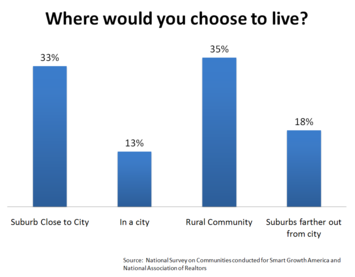
    Americans will head out to the hinterlands because they will find opportunities and perhaps a better quality of life. According to recent surveys, as many as one in three American adults would prefer to live in a rural area — compared with the 20-odd percent who actually do. Most Americans perceive rural America as epitomizing traditional values of family, religion and self-sufficiency and as being more attractive, friendly and safe, particularly for children.

    One critical factor in the heartland’s growing relevance is the advent of the Internet, which has broken the traditional isolation of rural communities. As the technology of mass communications improves, the movement of technology companies, business services and manufacturers into the hinterland is likely to accelerate. This will be not so much a movement to remote hamlets, but to the growing number of dynamic small cities and towns spread throughout the heartland.

    The heartland, consigned to the fringes of American society and economy in the 20th century, is poised to enjoy a significant renaissance in the early 21st. Not since the 19th century, when it was a major source of America’s economic, social and cultural supremacy, has the vast continental expanse been set to play so powerful a role in shaping the nation’s future.

    This article originally appeared at AOLNews.com.

    Joel Kotkin is executive editor of NewGeography.com and is a distinguished presidential fellow in urban futures at Chapman University. He is author of The City: A Global History. His newest book is The Next Hundred Million: America in 2050, released in Febuary, 2010.

    Photo: sparktography

  • America in 2050 — Strength in Diversity

    An ongoing source of strength for the United States over the next 40 years will be its openness to immigration. Indeed, more than most of its chief global rivals, the U.S. will be reshaped and re-energized by an increasing racial and ethnic diversity.

    These demographic changes will affect America’s relations with the rest of the world. The United States likely will remain militarily pre-eminent, but the future United States will function as a unique “multiracial” superpower with deep familial and cultural ties to the rest of the world.

    No Clear Majority

    The United States of 2050 will look very different from the country that existed just a decade ago, at the dawn of the new millennium. Between 2000 and 2050, the vast majority of America’s net population growth will come from racial minorities, particularly Asians and Hispanics, as well as a growing mixed-race population.

    By the middle of the 21st century, America will have no clear “majority” race. Today 30 percent of the U.S. population is nonwhite; in 2050 it may be nearly 50 percent. Latino and Asian populations are expected to triple. Today, because of high Latino birthrates, one in five American children under the age of 5 is Hispanic; increasingly most Hispanic growth will come from the children of those born in America.

    More Multiracial

    At the same time, these varying groups, and particularly their children, will become ever more multiracial in their outlook. The percentage of Americans of mixed race is growing significantly among people under 18; in California and Nevada mixed-marriage rates are at more than 13 percent, and in the rest of the Southwest a heavily Latino population increasingly intermarries with other ethnic groups.

    We will see more of this kind of interracial pairing in the future. According to market research firm Teen Research Unlimited, 60 percent of American teens say they have friends of different ethnic backgrounds. Even more telling, a 2006 Gallup Poll showed that 95 percent of young people (ages 18 to 29) approved of interracial dating — compared with only 45 percent of respondents over the age of 64. Likewise, a USA Today/Gallup Poll conducted in 2008 among teens showed that 57 percent have dated someone of another race or ethnic group, up 40 percent from when Gallup last polled teens on the question back in 1980.

    More Immigrants

    Europe also will continue to be a source of immigrants as many talented young Europeans continue to escape the continental nursing home by heading to the United States. But by far the largest groups of immigrants to the U.S. will come from Latin America, Africa, China and other developing countries. The United Nations estimates that 2 million people will move to developed countries annually until 2050, and more than half will come to the United States.

    Some of best educated and most successful, of course, will then go back home, as has been case throughout most of American history. But many more will stay, often for very mundane reasons, such as the chance to live in a dwelling larger than a shoebox or to have more than one child. Others will cherish the chance to live without worrying about the depredations of some party bureaucrat, caudillo or religious fanatic. These immigrants are not seeking a spot on the Titanic. They realize that, despite its many failings, America is uniquely able to reinvent and re-energize itself.

    Changing Landscape

    This greater diversity will become increasingly evident across an expanding landscape, including many once homogeneous areas like the Great Plains.

    But the new epicenter for diversity will lie in the once overwhelmingly white suburbs, which now increasingly are settled by minorities and immigrants. An absolute majority of our foreign-born population now lives in suburbia, up from 44 percent in 1980.

    Already the best places to find ethnic shopping complexes, Hindu temples and new mosques are not in the teeming cities but in the outer suburbs of places like Los Angeles, New York and Houston. In most immigrant-rich suburbs, you find alongside the temples and mosques churches and synagogues.

    Unique in the World

    In contrast to this growing diversity, the United States’ chief global rivals seem far less able to accommodate this level of interracial mixing. China, Japan and Korea are culturally resistant to diversity and unlikely to welcome large-scale immigration, even if much of their labor force has to go to work in walkers and wheelchairs.

    Given Europe’s current considerable problems integrating its immigrants, particularly Muslims, the continent seems ill disposed to open its doors further; Denmark and the Netherlands are considering measures to sharply restrict immigration.

    Economic Benefits

    The changing ethnic population in the U.S. will no doubt play a leading role in the next economic transition.

    Recent newcomers have already distinguished themselves as entrepreneurs, forming businesses from street-level bodegas to the most sophisticated technology companies. Between 1990 and 2005 immigrants started one-quarter of all venture-backed public companies.

    Large American companies are also increasingly led by people with roots in foreign countries, including 14 of the CEOs of the 2007 Fortune 100. Even corporate America — once the almost-exclusive reserve of native-born Anglo-Saxons — will become as post-ethnic as the larger society.

    The America of 2050 will seem, to some, a very different and even foreign country. Yet our continuing racial evolution confirms the basic dynamism of our society and its ability to adapt. Our experiment with creating what Walt Whitman in 1855 described as “the race of races” will represent one of the great accomplishments of mid-21st century America.

    This article originally appeared at AOLNews.com.

    Joel Kotkin is executive editor of NewGeography.com and is a distinguished presidential fellow in urban futures at Chapman University. He is author of The City: A Global History. His newest book is The Next Hundred Million: America in 2050, released in Febuary, 2010.

    Photo: chrisjfry

  • The 10 Percent Solution to Urban Growth

    What if we achieved the urbanist dream, with people deciding en masse to move back to the city? Well, that would create a big problem, since there would be no place to put them. Many cities hit their peak population in 1950, when the US total was 150 million. Today it is over 300 million, with virtually all the growth taking place in the suburbs.

    So where would these new urbanites reside? With the enormous losses in our urban housing stock, our cities lack the residences to hold even their 1950 population. A recent survey found that one third of all the lots in Detroit are now vacant, for example. And even if all the old housing was rebuilt, declines in household sizes, particularly in urban areas, has reduced the effective carrying capacity of the old urban fabric even at historic densities.

    But there’s an even bigger challenge to wholesale urbanization from future population growth. The Census Bureau estimates that the US will add nearly 100 million more new people by 2050. If you look at the few cities in the country that have large inhabited urban cores, they hold a relatively small percentage of the current population. New York City, Los Angeles, Chicago, Philadelphia, San Francisco, Boston, Seattle and Washington, DC combined barely hold 20 million people. Even if all these cities doubled in population by 2050, they would only be able to hold 20% of the net new growth expected over the next four decades.

    And achieving even that level of urban growth is simply not realistic. Most of the existing highly urbanized cities are already largely full of buildings. Even where land is available, zoning restricts what can be built there, and increasing densities is politically difficult. New York City has been the most aggressive on the growth front, rezoning 20% of the city under the Bloomberg administration, although many sections have actually been downzoned.

    But even this effort could accommodate a projected one million new residents by 2030. Chicago is going the other direction. When it introduced new zoning under the Daley administration, permitted densities were actually reduced in most cases, though Chicago remains perhaps the only truly urban city with large amount of vacant or underutilized land for redevelopment. Ed Glaeser calls for building skyscrapers in California, but San Francisco residents are imbued with a strong anti-development mindset and have long railed against the “Manhattanization” of their city.

    America could not be reshaped from a primarily suburban to a city-centric country without a massive shift in local political mind-sets. Rather than attempting that exercise in futility, urban advocates should adopt much more modest goals that, although limited, could be completely transformational for our cities.

    There’s been much made of the return to the city. Indeed, large tracts of the urban cores of many places have been utterly remade. But most of the cities where this has happened have been America’s largest tier one cities – New York, Chicago, Boston, etc. They have achieved the point of self-sustaining urban growth, and are well positioned to attract more residents, particularly the upscale and childless, young singles and students and recent immigrants.

    In contrast, smaller cities have seen a few hundred downtown condos and such, but not a real urban renaissance. There is still a lot of work to do in those places.

    The way to do this is to adopt the “10 percent solution”. That is, for most cities, they should develop a strategy that tries to capture somewhere between 5 and 15 percent of the net new growth in their metro areas. If a city can get more, great. But for any growing region, even 10 percent would create a dynamic of massive change in the urban core.

    Consider Indianapolis, a region with healthy regional growth that is above average but not among the nation’s leaders. The Indianapolis metro area is adding people at a rate of about 200,000 people per decade. Center Township, which is the urban core of the city, peaked in population in 1950 at 337,000 people. Today it is at 167,000, a decline of 50%, on par with America’s greatest urban collapses

    But what if the urban core managed to capture 10% of that new growth? That’s 20,000 new residents, very easy to physically accommodate within a decade. What would 20,000 new residents do to central Indianapolis? What would it do to the entire dynamic of the city? It could be completely transformational.

    Such a modest capture of new population would catapult central Indianapolis into one of the absolute top growth areas in the region. Only one suburb is on track to add that many or more people during the 2000s. Many other suburbs are considered prosperous and fast growing despite adding only a few thousand people. Even that limited influx creates a pattern of growth vs. stagnation and decline. That’s where urban Indianapolis needs to get.

    One of the great advantages of targeting 10% market share in new growth is that it frees the city to pursue a market segmentation strategy. It doesn’t have to try to convince vast numbers of suburbanites – the vast majority of whom are likely to stay in place – to make a radical lifestyle change. Rather, the core can market to specific segments that it is best positioned to attract, and put together the most compelling and differentiated product to attract them.

    One potential market is those who want an urban environment but can’t afford to live in one of the expensive tier one cities. They could market themselves to people who find themselves priced out of the biggest cities, but would settle in a smaller, but still vibrant urban environment.

    Can Indianapolis do it? As with many cities, there is already some evidence that it could. In the 2000s, decades of population decline came to an end in 2006, and Center Township started adding an estimated 400 people per year. The jury is still out on whether the estimates are confirmed by the census count and whether it can be sustained, but it still amounts to 4,000 people per decade, showing that the city is already starting to make progress.

    Cincinnati provides another example. It is a metro growing a bit less than the national average, but still adding people at a rate of about 150,000 per decade. The city of Cincinnati declined from a peak of 503,998 in 1950 to 333,336 today, a loss of 170,000 people. Again, if the city captured 100% of just regional growth, in little more than a decade it would be back to a record high population. That’s not realistic of course, but 10% of that total, or 15,000 people, would still make a tremendous impact on the city. Like Indianapolis, there’s already some sign of an inflection point, as the city population began growing again in the 2000s.

    Can this 10% solution really happen? The answer is a resounding Yes, because it is already happening in Atlanta. Its reputation as a sprawlburg overshadows the fact that it is experiencing one of America’s most impressive urban core booms. The city of Atlanta has added almost 120,000 new residents since 2000, an increase of 28%. This is a mere 10.5% of the metro area’s growth during that time – but it has totally changed the city. Atlanta lost over 100,000 people from its 1970 peak, but is now at an all time high.

    Viewed in this realistic light, there is huge reason for optimism about rebuilding the urban cores of even our Rust Belt cities. Frankly, with the required market share of growth to get there so low, there’s no excuse for not making it happen. If city leaders can’t figure out how to attract even 10% of the market, they deserve to lose. If they can do better, great. And once they’ve captured that 10% base, and restarted a growth pattern, they can figure out how to get more ambitious and expand market share.

    For regions with population decline, like Detroit and Cleveland, there’s a different and much more challenging dynamic. But for cities with even modest regional population growth, there’s all the opportunity in the world to attract new urban residents and completely change the game for their urban cores.

    Aaron M. Renn is an independent writer on urban affairs based in the Midwest. His writings appear at The Urbanophile.

    Photo: Carl Van Rooy (vanrooy_13)

  • Welcome to Ecotopia

    In this era of tea-partying revolutionary-era dress-ups, one usually associates secessionism with the far right. But if things turn sour for the present majority in Washington, you should expect a whole new wave of separatism to emerge on the greenish left coast.

    In 1975 Ernest Callenbach, an author based in Berkeley, Calif., published a sci-fi novel about enviro-secessionists called Ecotopia; a prequel, Ecotopia Rising, came out in 1981. These two books, which have acquired something of a cult following, chronicle–largely approvingly–the emergence of a future green nation along the country’s northwest coast.

    Aptly described by Callenbach as “an empire apart,” this region is, in real life, among the world’s most scenic and blessed by nature. Many in this part of America have long been more enthusiastic about their ties to Asia than those with the rest of the country. It is also home to many fervent ecological, cultural and political activists, who often feel at odds with the less enlightened country that lies beyond their soaring mountains.

    Until the election of Barack Obama, the Pacific Northwest certainly was separating from the rest of America–at least in attitude. After George W. Bush’s victory the 2004 presidential election, the Seattle weekly The Stranger published an angry editorial about how coastal urbanites needed to reject “heartland values like xenophobia, sexism, racism and homophobia” and places where “people are fatter and dumber and slower.”

    Such a narrow, cynical view of the rest of the country is in line with Callenbach’s Ecotopia novels, in which the bad guys–representatives of American government and corporations–are almost always male, overweight and clueless about everything from technology to tending to the earth.

    Of course, would-be Ecotopians have much of which to be proud. The three great cities of the region–San Francisco, Portland and Seattle–easily rank among the most attractive on the continent. They all boast higher-than-average levels of education and–at least around San Francisco and Seattle–some of the world’s deepest concentrations of high-tech companies.

    Yet for all their promise, the Ecotopian regions cannot claim to have missed the current recession. Downtown Seattle currently suffers a vacancy rate in excess of 20%, the highest in decades; last year apartment rental rates dropped 13.8%, the steepest decline among American metros. Meanwhile vacancies in the Silicon Valley area south of San Francisco have soared to above 20%. By early this year, there was enough unoccupied office space in the Valley to fill 15 Empire State Buildings.

    This may seem a bit counter-intuitive for a region that boasts the headquarters of Microsoft, Costco, Amazon, Intel and Apple. But while such companies provide lots of high-wage employment, they are no longer enough to spark much growth across the region’s economy. The San Francisco area has actually lost jobs over the past decade and shows little sign of recovering its once prodigious growth rates.

    But easily the weakest of the economies has been Portland, which lacks the presence of major anchor firms like those in greater Seattle or the Bay Area. Portland’s unemployment rate has been well over 10% since late last year.

    A wave of youthful migration has made the city a slacker haven for the past decade and, in turn, exacerbated unemployment figures. Homeless kids now crowd the downtown area, which, although far from destitute, does appear pretty grungy in places.

    Yet, like the Ecotopians in the Callenbach novels, Portland residents and politicians seem nonplussed about their anemic economic performance. After all, the city voted heavily–despite solid opposition from the rest of the state–to raise Oregon’s taxes on wealthy individuals and corporations, a move likely to deter new in-bound investment.

    “You don’t have a big focus here on economic development,” observes Stephen B. Braun, dean of the School of Management at Portland’s Concordia University. “There’s much more emphasis on quality of life than on making a living.”

    The proof: Portland may have high unemployment, but the big idea around city hall is not how to promote jobs but about investing an additional $600 million in bike lanes.

    All these places, of course, avidly endorse green jobs even if there’s little prospect they could replace the jobs being lost in the fading blue-collar sectors. A growing green job sector needs a vibrant economy that produces things and builds new buildings, notions that have little currency across much of the region.

    This anti-growth attitude reflects that of Callenbach’s Ecotopia, which favors a “stable state” economy over job or wealth creation. Ecotopian politics explicitly ban both population increases and the private automobile.

    While the mayors of Portland, San Francisco and Seattle are hardly that extreme, they could propose policies that would make driving more burdensome. And they certainly seem to do wonders in chasing would-be baby-makers out of the city. All three cities have among the lowest percentages of children of any in the U.S.

    Perhaps the toughest issue facing the Ecotopian political economy lies with the issue of class. Callenbach’s Ecotopia adopts something of an anarchic socialism; the cities of the real ecotopia have tended toward ever greater class bifurcation.

    San Francisco, for example, boasts one of the highest per capita incomes in the nation and remains a favorite destination for inherited wealth, whether among individuals or nested in nonprofits. Yet according to the Public Policy Institute of California, if the cost of living is applied, San Francisco ranks high among urban counties in terms of its concentration of poverty.

    It doesn’t help that the city’s economy has been hemorrhaging corporate headquarters and mid-range middle-class jobs for decades. High-end workers commute to Google and other Valley companies, and others work in the financial or media sectors, but many mid-range jobs have been lost, many of them to more affordable business-friendly locales in places like Colorado.

    As middle-class jobs disappear, Ecotopia’s cities increasingly resemble restrictive communities that are anything but diverse. As analyst Aaron Renn has pointed out, Portland and Seattle stand as among the whitest big cities in the nation. And San Francisco’s once vibrant African-American population has been dropping for decades.

    In the coming years this pattern will likely become more pronounced in Seattle and Portland as well. These cities continue to attract many well-educated people, particularly from California, who in turn bring with them both significant accumulated wealth and anti-growth attitudes.

    Strict “green” planning regimes are also accelerating the decline of the local middle class by driving housing prices up, greatly diminishing the once wide affordability for the middle class. Seattle’s regulatory environment, according to one recent study, has bolstered housing prices in the region by $200,000 since 1989. The percentage of families who could afford a median price home in the area has fallen by more than half.

    Many observers see a similar outcome from Portland’s widely ballyhooed planning regime. Despite the massive acceptance by planners as something of a model for the restored city, the vast majority of all job and population growth in the region has occurred at the less pricey fringes, including across the river in Vancouver, Wash., which lies outside the fearsome Portland planning regime.

    So what is the future for the region, and particularly the eco-cities? If the country starts moving toward the center, and even the right, you can expect Ecotopian sentiment to rise again, perhaps not to the point of secession but expressed in attitude.

    But this may not be all bad. As America’s population grows and other regions rise, perhaps it’s helpful for the various parts of the country to experiment with different systems. Short of civil war, there’s something to be said for relentless, even if sometimes daft, experimentation at the local level. The rest of country may not follow all their strictures, but our would-be Ecotopians could produce some interesting and even usable ideas.

    This article originally appeared at Forbes.com.

    Joel Kotkin is executive editor of NewGeography.com and is a distinguished presidential fellow in urban futures at Chapman University. He is author of The City: A Global History. His newest book is The Next Hundred Million: America in 2050, released in Febuary, 2010.