Tag: Heartland

  • Reforming Anti-Urban Bias in Transportation Spending

    State governments have to stop treating transportation like yet another welfare program.

    Among urban and rural areas, who subsidizes whom?

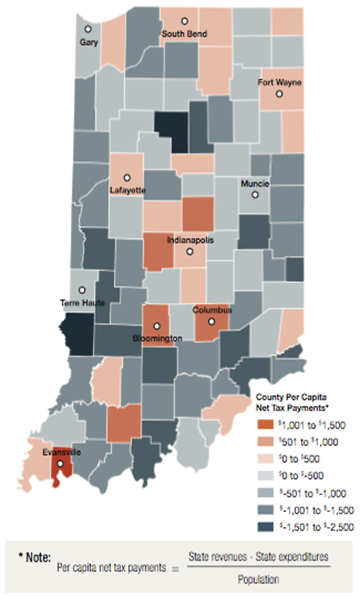
    It’s methodologically difficult to measure net taxation, but the studies that have been done suggest that, contrary to the belief of some, urban areas are big time net tax donors. For example, a recent Indiana Fiscal Policy Institute study found that Indiana’s urban and suburban counties generally subsidize rural ones.

    Just the consolidated city-county of Indianapolis-Marion County sends $420 million more to the state annually than it receives every year. That’s equal to the entire public safety budget of the city. The rest of the metro area sends another $340 million to the state annually.
    Similarly, a 2009 Georgia State University study found that the Atlanta metro area accounted for 61% of state tax collections but only but only 47% of expenditures. A 2004 University of Louisville study found that the state’s three major urban regions – Louisville, Lexington, and Northern Kentucky (south suburban Cincinnati) – generate over half the state’s tax revenues but only receive back about one third in state expenditures, an annual net outflow of $1.4 billion per year.

    The Atlanta and Indianapolis examples are particularly instructive, since both are the capital and by far the largest city of their state. They are sometimes presumed to benefit from disproportionate state spending as a result, but the reality is quite different.

    That’s not to say that this is necessarily bad. The fundamental basis of any government is a commonwealth, a body of citizens who see themselves as fellows, who believe each other’s fates are linked. Thus, generally spreading the burdens on some type of a progressive basis is broadly considered equitable, and assistance to the less fortunate constitutes a core function of government. To the extent that cities generate the most wealth in today’s economy, and have the highest incomes, it is no surprise they pay more in taxes. This doesn’t per se mean there’s an anti-urban bias in policy.

    Indeed, income redistribution is one of the key functions of state government. Actual welfare and safety net programs, including things like health care for the poor, are a major budget item in every state. But it goes beyond that. K-12 education could be treated as a purely local service, but every state spends large amounts on it. One could argue this is strictly to ensure a minimum level of funding equity between rich and poor districts. That is, it’s purely redistributive. Indeed, states sadly spend more time fiddling with funding formulas than in actual education reform and improvement. Even corrections disproportionately and unfortunately affects the poor. We are, in effect, a collection of 50 welfare states.

    The fact that so many of the functions of state government have taken on a redistributive cast also comes with downsides. Most importantly, even functions that should have little to do with welfare or equity have come to be seen through that lens.

    Exhibit A is transportation. Two-thirds of Americans live in large metro areas, yet less than half the federal transportation stimulus funds are going to the top 100 metro areas. Missouri is spending half its stimulus money on 89 small counties that account for only a quarter of the state’s population. In Ohio, the state cancelled plans to spend $100 million in stimulus funds on the crumbling Cleveland Inner Belt bridge in order to divert them to paying for a $150 million bypass around Nelsonville – a town of only 5,000 people. This is part of a plan to construct a four lane divided highway into sparsely populated southeast Ohio as part of a “build it and they will come” economic development plan. Mecklenburg County, NC, the state’s largest and home to Charlotte, received only $7.8 million out of the first $423 million in projects in that state. The Atlantic Monthly described this as a contest between a “mayor’s stimulus” and a “governor’s stimulus” – and the governor won.

    State after state has rural “roads to nowhere.” Without any legitimate economic development strategy on offer for depressed rural areas and small industrial cities, salvation is said to lie in access to four lane highways. The logic is that until every county in America is crisscrossed with these things, somehow residents are deprived of their due. This plays well to rural resentment, allowing people who are by nature proud believers in self-reliance and dismissive of welfare to claim instead that they’ve been cheated out of their “fair share” of transportation money. One suspects at least some deep inside understand the fiscal reality, which accounts for the self-righteous rhetoric designed as much perhaps to convince themselves as others.

    Regardless, a lack of transportation investment is crippling our cities, many of which have congested, crumbling roads and shaky bridges. Earmark reform would help at the federal level. Earmarked projects and “high priority corridors” are too often, as with “strategic” corporate programs, projects for which no traditional justification can be found.

    But beyond this, governance reform at the state level is critical to bring transportation funding allocations in line with real population and economic development measures. That’s not to say that rural areas should get no funding. There are many areas where legitimate state funding is warranted, such as replacing substandard bridges or correcting roads with dangerous geometry. But that doesn’t mean states should spend huge amounts of money on large rural expansion projects of dubious value that rob urban areas of the funds needed for projects with genuine transportation merit and real economic development potential.

    If states won’t act to reform this, then, despite legitimate governance concerns in our system of federalism, the federal government may need to step in to take a more direct role in funding formulas to ensure that a proper share of the money gets sub-allocated to metro areas. The federal government simply can’t allow states to continue diverting critical and limited transport money to boondoggles.

    With metro areas as the economic locus of the 21st century, failing to take action to make sure our cities get the transportation investment they need puts both the state treasury and national economic competitiveness at risk. Cities can only continue to play their role as wealth generators and sources of transfer funds for their states if they themselves are economically healthy, which requires infrastructure investment. As the Indiana, Georgia, and Kentucky examples show, state treasuries and rural funding are dependent on urban economic health. You can’t redistribute money from urban to rural areas if there’s nothing to distribute.

    Aaron M. Renn is an independent writer on urban affairs based in the Midwest. His writings appear at The Urbanophile.

    Photo: Pete Zarria

  • The Fate of Detroit – Revisited Green Shoots? The Changing Landscape of America

    During the first ten days of October 2008, the Dow Jones dropped 2,399.47 points, losing 22.11% of its value and trillions of investor equity. The Federal Government pushed a $700 billion bail-out through Congress to rescue the beleaguered financial institutions. The collapse of the financial system in the fall of 2008 was likened to an earthquake. In reality, what happened was more like a shift of tectonic plates.

    *******************************************************

    By May of last year, when the first of this series appeared, it was clear that the American auto industry was about to fundamentally change. It has been just eight months and the changes have already been monumental. In 2009, China overtook America as the largest market for automobiles in the world. Sadly, America will never see that title again.

    Industry CEOs flew into Washington, DC on their private jets asking for billions in federal hand-outs. They were chastised and embarrassed for their greed and insensitivity by politicians who have mastered that fine art of public outrage. GM’s CEO Rick Wagoner was publicly fired. The next day, GM put all eleven corporate jets on the market causing the resale market for G-5s to collapse overnight.

    Since then, GM has entered and exited bankruptcy and senior debt holders were wiped out so the government could give ownership of GM to the UAW, in contravention of all existing bankruptcy laws. A thousand dealers were summarily terminated without compensation, or a hearing. The Saturn brand was snuffed out and the Saab brand will follow unless a miracle occurs – an unlikely prospect. Pontiac and Hummer have already been terminated.

    Chysler is now owned by Fiat, the government and the UAW. It too wiped out 1,000 loyal dealers without compensation, or a hearing. Chrysler sales, down 36%, were the worst since 1962. The company is on life support. The Italians will attempt to resuscitate the ailing brand with a fuel efficient Fiat 500 and curvaceous Alfa-Romero. Chrylser called on Lee Iacocca to help them recover in the 1980s. This time, they may need Sophia Loren to coax buyers back into the showroom.

    Ford did not take TARP bail out money and the public responded by buying Ford products. While their sales were down 15%, they gained market share because GM and Chrysler sales were down 30% and 36% respectively. Sales in December were actually up 33% from a year ago. Ford dumped loser Volvo to the Chinese automaker, Geely, who coveted the domestic dealer network. Expect to see Chinese cars in an auto mall near you sooner rather than later.

    Clunkers
    Government showed its ignorance of the automible industry by sponsoring a Cash for Clunkers program. They will claim it was a great success, selling 677,842 new cars, but critics will remind that it cost $3 billion dollars. Edmunds.com reports that all but 125,000 sales would have taken place anyway. So taxpayers forked over about $24,000 per car for 125,000 sales. The National Highway Transportation Board reported that 20,000,000 barrels of oil will be saved over 20 years but critics will remind that we import that much in just two days. In addition, the cost to administer a program that lasted just six months was $100,000,000. The government was loathe to mention the top two brands purchased in the Cash for Clunkers progran were Honda and Toyota, not American brands.

    Electrics
    As promised, the government supported the move to electric vehicles. The U.S Department of Energy gave Tesla Motors a loan of $465 million to build the $87,900 electric Karma in California. Tesla claims it has sold 1,000 cars. That means Tesla sales represent a little over one hundredth of one percent of the domestic car business. The financial wisdom of such a loan would be questionable if it were not for the equally stunning announcement that Fisker would receive $529 million from the DOE to build its $100,000 electric car – in Finland. Al Gore is a shareholder of Fisker. Honda, which sells the $20,000 Insight hybrid vehicle and achieved just 25% of forecasted sales. If Honda has trouble selling a $20,000 electric hybrid, one wonders how many $100,000 electrics Fisker and Tesla models must be sold to repay our billion dollar loan.

    Winners
    The surprise winner of the last year was Korean car manufacturer, Hyundai. With a potent combo of great styling, affordable pricing on its Kia brand and new upscale products, Hyundai sales increased a surprising 10%. They project a 17% increase in 2010. Hyundai is doing so well it may spin off its own luxury brand, Genesis, as Toyota did so successfully with Lexus. The new Equus luxury sedan is about the same size as a large Mercedes, BMW or Lexus but $25,000 less. This basic formula worked to establish the Lexus and Infiniti brands in 1989. Expect it to be repeated by Hyundai in the near future.

    Green shoots
    Even though it has relinquished its title as top dog to the Chinese, there are signs of life in the American automobile industry. Buick is the top brand in China and is resurgent in our domestic market. The new Buick Lacrosse and Regal are superb automobiles. Chevy rests its hopes on a trio of new attractive products like an all electric Volt, a retro-styled Camaro and the 40 MPG Cruze. Cadillac released a new fleet of gorgeous CTS and SRX models and announced a new full-size XTS is on the way. Cadillac will get its own stunning version of the Volt called the Converj. And Government Motors (GM) announced it will invest a billion dollars to create the fuel efficient trucks of the future in time for the economic recovery.

    At Ford, they hope the 2011 Ford Focus will be a huge success. This small car is a move upscale for Ford. It has great styling and amenities, a higher price tag and therefore higher profits. Will Ford be able to sell an expensive small car to replace the profitable SUVs like the Explorer and Expedition?

    Chrysler’s future is much murkier. A mini Fiat 500 is coming but the Alfa-Romeros have been delayed. The new Jeep Grand Cherokee and the Chrysler 300 are attractive, but the Chysler Lancia is simply weird. Chrysler revealed a new 200C EV, a surprise all electric concept. Will these models be enough to save Chrysler? We will see.

    The car business is changing. Green Shoots, as our president likes to muse. We hope he is correct.

    ***********************************

    This is the seventh in a series on the Changing Landscape of America.

    Robert J. Cristiano PhD is a successful real estate developer and the Real Estate Professional in Residence at Chapman University in Orange, CA.

    PART ONE – THE AUTOMOBILE INDUSTRY (May 2009)
    PART TWO – THE HOME BUILDING INDUSTRY (June 2009)
    PART THREE – THE ENERGY INDUSTRY (July 2009)
    PART FOUR – THE ROLLER COASTER RECESSION (September 2009)
    PART FIVE – THE STATE OF COMMERCIAL REAL ESTATE (October 2009)
    PART SIX – WHEN GRANNY COMES MARCHING HOME – MULTI-GENERATIONAL HOUSING (November 2009)

  • The Kids Will Be Alright

    America’s population growth makes it a notable outlier among the advanced industrialized countries. The country boasts a fertility rate 50% higher than that of Russia, Germany or Japan and well above that of China, Italy, Singapore, North Korea and virtually all of eastern Europe. Add to that the even greater impact of continued large-scale immigration to America from around the world. By the year 2050, the U.S. population will swell by roughly 100 million, and the country’s demographic vitality will drive its economic resilience in the coming decades.

    This places the U.S. in a radically different position from that of its historic competitors, particularly Europe and Japan, whose populations are stagnant. The contrast between the U.S. and Russia, America’s onetime primary rival for world power, is particularly dramatic. Some 30 years ago, Russia constituted the core of a vast Soviet empire that was considerably more populous than the U.S. Today, even with its energy riches, Russia’s low birth and high mortality rates suggest that its population will drop to less than one-third that of the U.S. by 2050. Russian Prime Minister Vladimir Putin has spoken of “the serious threat of turning into a decaying nation.”

    An equally dramatic and perhaps more critical demographic shift is taking place in East Asia. Over the past few decades a rapid expansion of their work force fueled the rise of the “East Asian tigers,” the great economic success stories of the late-20th and early-21st centuries. Yet that epoch is coming to an end, not only in Japan and Korea but also in China, where the one-child policy has set the stage for a rapidly aging population by mid-century.

    Within the next four decades, most of the developed countries in both Europe and East Asia will become veritable old-age homes: A third or more of their populations will be over 65, compared with only a fifth in America. Like the rest of the developed world, the U.S. will certainly have to cope with an aging population and lower population growth, but in relative terms the county will boast a youthful, dynamic demographic.

    As many other advanced countries become dominated by the elderly, the U.S. will have the benefit of a millennial baby boom as the “echo boomers” start having offspring in large numbers later in this decade. This next surge in growth may be delayed if tough economic times continue, but over time the rise in births will add to the work force, boost consumer spending and allow for new creative inputs.

    The differing demographic trajectories create a diverse set of issues for 21st-century America than those facing its rivals. The key challenges the European Union, Japan and Korea will contend with in the coming decades involve coping with a rapidly aging population, filling labor shortages and finding ways to invest in growing economies. In contrast, the U.S.’s greatest priority will be to create opportunities for its ever-expanding population. The New America Foundation estimates the country needs to add more than 125,000 jobs a month simply to keep pace with population growth in 2010. What the U.S. does with its “demographic dividend”—that is, its relatively young working-age population—will largely depend on whether the private sector can generate the incomes among the young to meet the needs of a larger aging population.

    Entrepreneurialism and America’s flexible business culture—including the harnessing of entrepreneurial skills of aging boomers—will prove critical to meeting this challenge. Many of the individuals starting new firms will be those who have recently left or been laid off by bigger companies, particularly during a severe economic downturn. Whether they form a new bank, energy company or design firm, they will do it more efficiently—with less overhead, more efficient use of the Internet and less emphasis on pretentious office settings.

    “People are watching their companies go under. Therefore you get three vice presidents who get laid off but know their business,” says Texas entrepreneur Charlie Wilson. “They start a new company somewhere cheap that is more efficient and streamlined. These are the new companies that will survive and grow the next economy.”

    It is here—at the grassroots level—that you can best glimpse the essential sources of American resiliency. American society draws most of its adaptive power not from its elite precincts but through the efforts of communities, churches, entrepreneurs and families.

    You can see this in the resurgence of once-declining Great Plains cities like Fargo, N.D., where high-tech now joins agriculture and manufacturing to form one of the country’s strongest local economies. Or you can visit the emerging immigrant hotbeds, such as the San Gabriel Valley east of Los Angeles or the Sugarland area, just west of Houston, with their plethora of new churches, temples, companies and ethnic shopping malls.

    Immigrants represent a critical component of our next wave of new dynamism. Between 1990 and 2005, immigrants started one quarter of all venture-backed public companies. Large American firms are also increasingly led by people with roots in foreign countries, including 14 of the CEOs of the 2007 Fortune 100.

    But much of the energy will come from more obscure enterprises. Recent newcomers have already distinguished themselves as entrepreneurs, forming businesses from street-level bodegas to the most sophisticated technology start-ups.

    What drives immigrants is their optimism in America’s future. California developer Dr. Alethea Hsu, in explaining why she opened a new Asian-oriented shopping center in Orange County, cited the entrepreneurial energy of both affluent and working class immigrants which, she said, will allow them to thrive through the recession and beyond. “We are leased up, and we think the supply of shopping still is not enough,” Ms. Hsu said in early 2009. “We feel great trust in the future.”

    This entrepreneurial urge also extends beyond the immigrant community. In 2008, 28% of Americans said they had considered starting a business, more than twice the rate for French or Germans. Self-employment, particularly among younger workers, has been growing at twice the rate as in the mid-1990s. In the most recent Legatum Prosperity Index, the U.S. ranked at the top among all countries in terms of entrepreneurship and innovation.

    Most important of all will likely be the rise of the millennial generation—a group of Americans who will start reaching their prime earning years late in the next decade. Surveys identify them as strongly family- and community-oriented. The millennials will be America’s new entrepreneurs, workers and consumers in the coming decades. They will provide the kind of resource our major competitors are destined to run short on.

    The millennials also will help shape an increasingly culturally diverse America which by 2050 will be roughly half made up of ethnic minorities. This emerging post-ethnic future contrasts dramatically with the ethnic politics common among the nation’s chief global rivals. Even famously politically correct nations as Sweden, Denmark and the Netherlands have turned against immigration. Switzerland just banned the construction of minarets, while France is considering banning some forms of Islamic garb.

    Our prime Asian rivals—China, Japan, and Korea—remain even more culturally resistant to diversity. Chinese xenophobia, in particular, is deeply entrenched, notes Martin Jacques, author of “When China Rules the World.” A Chinese world superpower would be both racially homogenous and far from tolerant of newcomers. Recently the appearance of a mixed-race Shanghai girl on a national talent show sparked a surge of racist invective.

    The very diversity of the emerging America makes many wonder what will hold the country together. Ultimately, this unique society will find its binding principle in the notions that have long differentiated it from the rest of world: a common belief system, a sense of a shared destiny and an aspirational culture.

    As the British writer G. K. Chesterton once put it, the U.S. is “the only nation…that is founded on a creed.” This faith is not, and was not initially meant to be, explicitly religious; rather, it is a fundamentally spiritual idea of a national raison d’être.

    Of course, this optimistic scenario depends on intelligent and energetic actions by central and local governments, as well as community organizations. But the road to the American future will be primarily laid not by the central state but by families, individuals and communities. During the industrial age Ralph Waldo Emerson once observed, “The age has an engine, but no engineer.” Much the same may be said in the coming decades.

    This article first appeared at The Wall Street Journal.

    Joel Kotkin is executive editor of NewGeography.com and is a distinguished presidential fellow in urban futures at Chapman University. He is author of The City: A Global History. His next book, The Next Hundred Million: America in 2050, will be published by Penguin Press February 4th.

    Photo: jcolman

  • America’s Agricultural Angst

    In this high-tech information age few look to the most basic industries as sources of national economic power. Yet no sector in America is better positioned for the future than agriculture–if we allow it to reach its potential.

    Like manufacturers and homebuilders before them, farmers have found themselves in the crosshairs of urban aesthetes and green activists who hope to impose their own Utopian vision of agriculture. This vision includes shutting down large-scale scientifically run farms and replacing them with small organic homesteads and urban gardens.

    Troublingly, the assault on mainstream farmers is moving into the policy arena. It extends to cut-offs on water, stricter rules on the use of pesticides, prohibitions on the caging of chickens and a growing movement to ban the use of genetic engineering in crops. And it could undermine a sector that has performed well over the past decade and has excellent long-term prospects.

    Over the next 40 years the world will be adding some 3 billion people. These people will not only want to eat, they will want to improve their intake of proteins, grains, fresh vegetables and fruits. The U.S., with the most arable land and developed agricultural production, stands to gain from these growing markets. Last year the U.S.’ export surplus in agriculture grew to nearly $35 billion, compared with roughly $5 billion in 2005.

    The overall impact of agriculture on the economy is much greater than generally assumed, notes my colleague Delore Zimmerman, of Praxis Strategy Group. Roughly 4.1 million people are directly employed in production agriculture as farmers, ranchers and laborers, but the industry directly or indirectly employs approximately one out of six American workers, including those working in food processing, marketing, shipping and supermarkets.

    Yet none of this seems to be slowing the mounting criticisms of “corporate agriculture.” A typical article in Time, called “Getting Real About the High Price of Cheap Food,” assailed the “U.S. agricultural industry” for precipitating an ecological disaster. “With the exhaustion of the soil, the impact of global warming and the inevitably rising price of oil–which will affect everything from fertilizer to supermarket electricity bills–our industrial style of food production,” the article predicts, “will end sooner or later.”

    The romantic model being promoted by Time and agri-intellectuals like Michael Pollan hearkens back to European and Tolstoyan notions of small family farms run by generations of happy peasants. But this really has little to do with the essential ethos of American agriculture.

    Back in the early 19th century Alexis de Tocqueville noted that American farmers viewed their holdings more like capitalists than peasants. They would sell their farms and move on to other businesses or other lands–a practice unheard of in Europe. “Almost all the farmers of the United States,” he wrote, “combine some trade with agriculture; most of them make agriculture itself a trade.”

    Despite the perceptions of a corporatized farm sector, this entrepreneurial spirit remains. Families own almost 96% of the nation’s 2.2 million farms, including the vast majority of the largest spreads. And small-scale agriculture, after decreasing for years, is on the upswing; between 2002 and 2009 the number of farms increased by 4%.

    This trend toward smaller-scale specialized production represents a positive trend, but large-scale, scientifically advanced farming still produces the majority of the average family’s foodstuffs, as well as the bulk of our exports. Overall, organic foods and beverages account for less than 3% of all food sales in the U.S.–hardly enough to feed a nation, much less a growing, hungry planet.

    Then there’s the even more fanciful notion–promoted by Columbia University’s Dickson D. Despommier–of moving food production into massive urban hothouses. In a recent op-ed in the New York Times he argues we are running out of land and need to take agriculture off the farm. According to Despommier, “The traditional soil-based farming model developed over the last 12,000 years will no longer be a sustainable option.”

    Yet Praxis Strategy’s Matthew Lephion, who grew up on a family farm, points out that such projects hardly represent a credible alternative in terms of food production. Urban land is far more expensive–often at least 10 times as much as rural. Energy and other costs of maintaining farms in big cities also are likely to be higher.

    Furthermore the notion that America is running out of land–one justification for subsidizing urban farming–seems fanciful at best. The past 30 years have seen some loss of farmland, but the amount of land that actually grows harvested crops has remained stable. Though some prime farmland close to metropolitan centers should be protected, agriculture has over the past decades returned to nature–forests, wetlands, prairie–millions of acres, far more than the land that has been devoted to housing and other urban needs.

    However ludicrous the arguments, the Obama administration remains influenced by green groups and is the cultural prisoner of the lifestyle left, with its powerful organic foodie contingent. That leaves farmers and the small towns dependent on them with little voice.

    The ability of greens and others to wreak havoc on agriculture can be seen in the disaster now unfolding in California’s fertile Central Valley. Large swaths of this area are being de-developed back to desert–due less to a mild drought than to regulations designed to save obscure fish species in the state’s delta. Over 450,000 acres have already been allowed to go fallow. Nearly 30,000 agriculture jobs–held mostly by Latinos–have been lost, and many farm towns suffer conditions that recall The Grapes of Wrath.

    Not satisfied with these results, the green lobby has prompted the National Marine Fisheries Service to further cut water supplies, in part to improve the conditions for whales and other species out in the ocean. Given these attitudes, farmers, including those I have worked with in Salinas, are fretting about what steps federal and state regulators may take next.

    One particular concern revolves around the movement against genetically modified food. Already there are calls for banning GMOs in Monterey County. Local officials worry this would cripple the area’s nascent agricultural biotech industry as well as the long-term ability of existing farmers to compete with less regulated competitors elsewhere. The fact that a less advanced form of genetic engineering also sparked the “green revolution” that greatly reduced world hunger after 1965 seems, to them at least, irrelevant.

    When viewed globally, the anti-big farm movement seems even more misguided. As Chapman University’s professor of food science Anuradha Prakash observes, India’s own organic farms serve a small portion of the market and cannot possibly meet the nutritional needs of the country’s expanding population. “You just don’t get the yields you need for Africa and Asia from organic methods,” she explains.

    A formula that works for high-end foodies of the Bay Area or Manhattan can’t produce enough affordable food to feed the masses–whether in Minnesota or Mumbai. The emerging war on agriculture threatens not only the livelihoods of millions of American workers; it could undermine our ability to help feed the world.

    This article originally appeared at Forbes.com.

    Joel Kotkin is executive editor of NewGeography.com and is a distinguished presidential fellow in urban futures at Chapman University. He is author of The City: A Global History. His next book, The Next Hundred Million: America in 2050, will be published by Penguin Press February 4th, 2010.

    Photo:

  • The Limits Of Politics

    Reversing the general course of history, economics or demography is never easy, despite even the most dogged efforts of the best-connected political operatives working today.

    Since the 2006 elections – and even more so after 2008 – blue-state politicians have enjoyed a monopoly of power unprecedented in recent history. Hardcore blue staters control virtually every major Congressional committee, as well as the House Speakership and the White House. Yet they still have proved incapable of reversing the demographic and economic decline in the nation’s most “progressive” cities and states.

    Obama and his congressional allies have worked overtime in favor of urban blue-state constituencies in everything from transportation funding and energy policies to the Wall Street bailouts and massive transfers of private wealth to powerful public-employee unions. Yet these areas continue suffering from net outmigration and stubbornly high job losses – as well as from some of the most severe fiscal imbalances in the nation.

    Nowhere is this more evident than in the president’s hometown of Chicago. The Windy City has suffered a very bad recession and may have fallen to its worst relative position since the Daley reconquista in 1989. As Chicago blogger Steve Bartin points out, even the presence of a Daley operative in the White House has failed to prevent the city from falling “in a funk.” He writes that even a reliable booster, columnist Mary Schmich of the Chicago Tribune, has lately described the city “as edgy, a little sullen and scared, verging on depressed.”

    There’s plenty reason for feeling low, well beyond the humiliating loss of the Obama-backed Olympics bid last year. For example, Oprah Winfrey, the city’s one bona fide A-list celebrity, is retiring her talk show in 2011. She is also reportedly shifting much of her media empire to Southern California, which, for all its admitted problems, has gads of celebrities and much better weather.

    Chicago’s most serious concern, however, revolves around the economy. In June, its unemployment rate peaked at 11.3%, far outpacing the national unemployment rate of 10%. Since 2007, the region has lost more jobs than Detroit, and more than twice as many as New York. Chicago’s total loss over the entire decade is greater than any region outside Detroit: about 250,000 positions, which is about the amount its emerging mid-American rival Houston has gained. In hard times businesses tend to look for places with a friendly environment for their enterprise. They avoid high taxes, political payoffs and inflated public employee salaries – all well-known Chicago specialties. These costs are undermining the city’s competitive position in, for example, the convention business, among others.

    Other key sectors are also flailing. Political influence in Washington will not stem the flow of high-wage trading jobs away from the Mercantile Exchange to decentralized electronic exchanges. Nor can it reverse the deteriorating state fiscal crisis caused by weak economies and exacerbated by insanely high pensions and out of control spending policies. Late last month Moody’s and S&P downgraded the debt ranking for the State of Illinois. Of course, such fiscal malaise is not limited to Chicago or Illinois. True blue California has an even worse debt rating. New York, another blue bastion, is also just about out of cash.

    To be sure, the recession has not hurt New York as much as Chicago, but the Big Apple has lost heavily , including 50,000 financial sector jobs since 2007. The outrageous bonuses to a few well-placed financial types will cushion but not deflect the influence of declining high-wage jobs. This can be seen in the striking weakness in the once seemingly unstoppable high-end condominium market. Particularly hard hit have been recent gentrified neighborhoods like Williamsburg in Brooklyn, N.Y., much like the hard-hit, newly developed areas along the Chicago lakefront.

    Other blue bastions have been shedding jobs as well, both during the recession and over the whole decade. Beyond Chicago and Detroit, the biggest losses among the mega-regions have taken place in the San Francisco Bay Area, Los Angeles-Long Beach and Boston. Big money can still be made in Silicon Valley, Hollywood or around the academic economy of Boston, but in terms of overall jobs, the past decade has been dismal for these regions. Meanwhile, the consistent big gainers have been – besides Houston – Dallas and Washington, D.C., the one place money really does seem to grow on trees. Even Miami, Phoenix and San Bernardino-Riverside, in California, boast more jobs today than in 2000, despite significant setbacks in the recent recession.

    These trends coincide with continuing shifts in demographics. The recession may have slowed the pace of net migration, but the essential pattern has remained in place. People continue to leave places like New York, Chicago, San Francisco and Los Angeles for more affordable, economically viable regions like Houston, Dallas, Austin and San Antonio. Overall, the big winners in net migration have been predominately conservative states like Texas – with over 800,000 net new migrants – notes demographer Wendell Cox. In what Cox calls “the decade of the South,” 90% of all net migration went to southern states.

    Utah, Colorado and the Pacific Northwest have also experienced positive flows – but perhaps most striking have been the migration gains, albeit modest, in Great Plains states such as Oklahoma and South Dakota as well as Appalachian Kentucky and West Virginia. Historically these places shipped many of their people to cities of the industrial Midwest, the eastern seaboard and California; that is no longer the case.

    Ultimately these shifts could undermine the true blue political strategy, perhaps as early as the 2010 congressional and state elections, and certainly after reapportionment. By 2012, the census will likely take seats from New York, Michigan, Pennsylvania and Ohio, handing them over to Texas, North Carolina, Georgia and Utah. Perhaps nothing will epitomize the new reality more than the fact that California, now among the most extreme blue states in terms of governance, will not gain a Congressional seat for the first time since the 1860s.

    These trends suggest that the current administration and the majority party in Congress must adjust their strategy. Further attempts to push a radical “progressive” agenda – expansive public employee bailouts, higher taxes and radical measures to combat “climate change” and suburban development – might please their current core constituencies, but they have the perverse effect of driving even more people and jobs out of these regions.

    All these underlying trends appear a boon to Republicans. But Democrats could counter the emerging GOP edge by appealing to the needs of these ascendant regions. By their very nature, growth states have the most urgent need for government investments in basic infrastructure, something traditional Democrats long have espoused. Moreover, such areas tend to become more tolerant as they welcome outsiders, and could be turned off to excessive Republican social conservatism.

    For any of this to work, however, Democrats must first abandon their current narrow, urban-centric blue-state strategy. They must learn to adjust their appeal to regions on the upswing, or things could turn out very badly for them very soon.

    This article originally appeared at Forbes.com.

    Joel Kotkin is executive editor of NewGeography.com and is a distinguished presidential fellow in urban futures at Chapman University. He is author of The City: A Global History. His next book, The Next Hundred Million: America in 2050, will be published by Penguin Press early next year.

  • Road Decay

    These days, you’ll have to get your kicks on Interstate 44.

    US Route 66 – that road of legend and lore – exists mostly as a memory. Only in Oklahoma is the number posted intermittently along a road parallel to the interstate.

    Now I’m not especially sentimental, and I’m a generation too young to have really gotten into the Route 66 shtick. As the older folks pass away, Route 66 will decay entirely.

    There is something evocative about highways in this country. In the original incarnation, highways had names. Terre Haute, IN, for example, sat at the intersection of The National Road and the Dixie Bee Highway – or at least did until the federal government assigned numbers back in the 1920s. Now it’s at the junction of US Routes 40 & 41.

    Still, it doesn’t take much tradition for numbers to be almost as meaningful as names. The words “101” and “Pacific Coast Highway” are interchangeable. Florida’s wonderfully-numbered “A1A” is a fantastic drive. And what truck driver doesn’t know that Interstate 80 goes from the George Washington Bridge to the San Francisco Bay Bridge?

    A great road trip is to pick an appropriate highway and just follow it across the country. I did that with US 2, which runs from Michigan to Washington State along the Canadian border. I started at Duluth and headed west, through North Dakota, Glacier National Park, and into Washington State. I also once drove US 20 from Chicago all the way out to Oregon, via the Grand Tetons. These roads are healthy, being great tourist routes unaffected by interstates.

    A road I would love to drive is US 52 – surely one of the oddest routes in the country. It starts in Charleston, SC, and heads due north(!) into North Carolina and Virginia, and on into West Virginia. There it parallels the Kentucky border to Huntington, where it crosses the Ohio River.

    Then heading west along the river to Cincinnati, and hence to Indianapolis, it becomes the major road to Lafayette. Skirting the southern Chicago suburbs through Joliet, it crosses the Mississippi River at Savanna, IL. Onwards to Dubuque, Rochester, MN and Minneapolis.

    Then it gets boring, sharing I-94 all the way through Fargo, and further west to Jamestown, ND. There it finally leaves the interstate and is the main road northwest to Minot. It continues northwest along the Des Lacs river, and finally ends at the Saskatchewan border at Portal, ND.

    From South Carolina to North Dakota! Did somebody have a sense of humor? Or just a very fertile imagination? US 52 doesn’t follow any logical migration path, trade route, or compass direction. It’s useless for commerce – but it’s a fantastic tourist road. I’ll drive it myself someday (though not along the interstate: Minnesota needs to separate it from I-94).

    A less happy example is US 40, previously known as The National Road that once extended from Washington, DC, to San Francisco. Today it goes from Baltimore to (almost) Salt Lake City, the interstate having displaced it west of there. But that’s not the worst of it. For much of the route in Indiana and Illinois, traffic has mostly been diverted onto I-70. Many Illinois towns – Marshall, Casey, Greenup, and even the former state capital, Vandalia – were once bustling stops along US 40. Today they are nearly ghost towns. US 40 has become a little country road with very little traffic – pretty, but somehow depressing.

    An exception is Effingham, at the junction of US Routes 40 & 45. Of course that’s not important: it is also where I-57 and I-70 meet. For about six miles around town they share the same road. This is Truck Stop Alley, and travelers of a certain age will remember the now defunct Dixie Trucker’s Home. Effingham (when I was last there in 2007) is a thriving little place.

    US 40 – at least in Illinois – exists in name only, which I guess is an improvement over US 66.

    The US highway system has faded in large part because of the interstates. When first built, the interstate highway system seemed very rational. Major N-S routes were 5, 15, 25, 35, 55, 65, 75, and 95. E-W roads were 10, 20, 40, 70, 80, 90, and 94. In those days I could have drawn a free-hand map of all major interstate highways.

    The real I-80 went to San Francisco, but they built a spur from Salt Lake City to Portland, OR, calling it I-80N, and Portland was proud to be on I-80. Of course it made no sense, and at some point the road was renumbered as I-84.

    Then they built a route around New York City, from Scranton to Boston – also I-84. And let’s not forget I-86 that extends for about 50 miles in Idaho. Or I-82 in Washington State. Or I-39 from Bloomington, IL, to Wausau, WI – not to be confused with I-43 from Beloit to Green Bay, WI. And then there’s I-99, a monument to pork in Pennsylvania, and I-88 in Illinois.

    You get the idea: whatever logic lies behind the interstate numbering system has descended into chaos. Nobody can keep track of this anymore. I blame most of this on federal highway rules, more lenient speed limits on roads with interstate designation, and further, federal tax dollars to help build interstate highways. But this has perverse consequences.

    Consider State Route 17. Mostly I mean New York State 17, but the road extended with the same number from near Erie, PA to Kearney, NJ. In New York it is known as the Southern Tier Expressway.

    This is another great tourist route: the wine country along the Lake Erie shore, across Lake Chautauqua near the Chautauqua Institution, around Allegany State Park, through wild Cattaraugus and Allegany counties, past Elmira, birthplace of Mark Twain, the Corning Glass plant, the Woodstock Concert site, the Hudson Highlands, and that beautiful shopping mall: the Garden State Plaza. It’s all been known as Route 17 for generations.

    No more.

    From Erie to Binghamton it’s now designated I-86 – same as that little blip of a road in Idaho.

    Were I Federal Geography Czar, I’d restore Route 17. And more: I’d push it through the Holland Tunnel and the Brooklyn-Battery Tunnel, and then replace current NYS 27 all the way out to Montauk, at the eastern tip of Long Island. Now THAT would be a road worth driving.

    Daniel Jelski is Dean of Science & Engineering State University of New York at New Paltz.

  • Nurturing Employment Recovery

    President Obama’s quick exit from Oslo and late arrival in Copenhagen suggest he’s finally ready to shift focus from Nordic adulation and fighting climate change and diplomacy to fixing the American economy. About time. As former Clinton adviser Bill Galston observed recently, the president needs “to pivot and make 2010 the year of jobs.”

    White House operatives, as well as the Democrats in Congress, know high unemployment could bring big political trouble next year. But in their rush to create new jobs, policy makers would do well to focus on the quality of jobs created over the next year and beyond.

    On this score, the slight improvements in the job picture are far from sufficient. The most recent analysis of employment over the past year by the Web site JobBait shows that almost all the growth has occurred in three fields–government, education and health care.

    The problem: All these fields are financed by taxpayers or through transfer payments. They do little to expand our exports, and they employ few of the blue- collar male workers who have been hardest hit by the “hecession.”

    Unemployment for men is over 2.5% higher than for women, the largest gap in history. In all but a handful of states, male-dominated fields such as transportation, mining and logging, manufacturing and warehousing have declined rapidly over the past year. The only states to experience gains were North Dakota, Montana and West Virginia.

    This reflects the critical weakness in the stimulus package. The stimulus focused on government bailouts and transfers of research funds to universities, while less than 5% went to basic infrastructure. But a greater emphasis on infrastructure would not only have created large numbers of construction jobs, it would have boosted our industrial competitiveness by eliminating bottlenecks in our transportation system.

    The only big regional beneficiary of expanding government employment has been, unsurprisingly, the Washington Beltway. Indeed, the number of federal bureaucrats making $100,000 or more jumped from 14% to 19% since the recession–and that’s $100,000 before overtime and bonuses.

    Elsewhere, the surge of government employment is petering out, particularly on the state and municipal levels. These jurisdictions are running out of money, since they are unable to print their own. Over the past year government jobs contracted in financially strapped states like California, Oregon, Michigan and Florida, as well as throughout the Northeast and New England. There’s little hope for much improvement in 2010.

    The other two sectors to enjoy significant growth have been education and health. Yet these fields do not seem to generate the broad-based economic growth needed to boost the overall economy. The region most often favorably linked with the “eds and meds” economy, Pittsburgh, has produced only modest, below-average job growth over the past generation. In fact, Pittsburgh has looked successful largely because the region has continued to hemorrhage its population to other regions, and it attracts few foreign immigrants.

    Yet the fiscal damage from dependence on public and nonprofit employment has been enormous. The city suffers a billion-dollar unfunded pension liability, among the highest in the nation on a per-capita basis. Due to the heavy local presence of institutions of higher education, nonprofits and hospitals, who keep about 40% of Pittsburgh’s property remains tax-exempt. In a sign of desperation Mayor Luke Ravenstahl recently proposed taxing tuition at local colleges and universities, eliciting outrage from the academic world.

    More important, the Pittsburgh “eds and meds” model can’t really be applied to a country whose workforce will expand by roughly 1 million annually over the next decade. The country now has fewer jobs than it had in March 2000, even though the labor force has grown by 12.1 million workers. There is no way we can produce enough growth depending on sectors that feed off taxpayers and private enterprise.

    This shortfall will be particularly tough on millenials as they enter their 20s and 30s. Already those 18 to 24 now have an unemployment rate over 18%. Not surprisingly, as Morley Winograd and Mike Hais observe, lack of jobs now stands as the No. 1 concern for those under 30.

    Another problem: We are now producing many more educated workers than we can gainfully employ. Information jobs may not be disappearing at the rate of industrial ones, but they have lost nearly 3 million positions since 1999. One likely result has been that returns to education–hyped by academics and “progressive” economists–have been dropping, particularly for younger workers. The unemployment rate for recent college grads is currently 10.6%, a record high.

    So, how to create opportunities that pay well? Some place their hopes in either the “green” or “creative” economies. But the green sector has been notably ineffective in sparking growth across other parts of the economy. A much-hyped report issued by California green-boosters bragged “green jobs”–which included everything from public relations representatives to marketing managers, accountants and brick-layers–account for something like 1% of employment. Even with heavy subsidies by taxpayers, the “green” sector seems unlikely to rescue an economy with 12.5% unemployment.

    Many politicians, particularly California’s increasingly delusional governor, also fail to recognize the cost that the “green agenda” exacts on a struggling economy. A draft report by a state advisory committee estimates California’s new draconian greenhouse gas laws could cost the state economy over $143 billion over the next decade. Efforts to spread this kind of regulation–either through federal legislation or EPA directives–would inflict similar pain to economies beyond the Sierra Nevada.

    As for the much ballyhooed “creative” sector, video producers, financial analysts, architects and other workers in the non-tangible economy are less susceptible to green pressures than factory workers, truckers or farmers. Yet as the JobBait report shows, information, business and professional services haven’t fared well over the past year. So far the only winners in professional and business services are in small states: New Mexico, Utah, South Carolina and, once again, West Virginia.

    Perhaps it’s time to abandon the notion that the U.S. can rely on preferred sectors–“green”, creative or “eds or meds”–to turn around our vast economy. Theorists often forget the essential ties that exist between tangible and intangible sectors. The strongest growth in high-end services are usually propelled by growth in tangible industries, such as energy, agriculture or manufacturing. When those industries tank, as in much of the upper Midwest, high-end services decline with them.

    Green jobs, too, require a strong economy. It is not by mistake that the big cities with the largest numbers of new “green” construction projects are not in Portland, San Francisco or other eco-capitals, but in more robust, if less organically obsessed places like Dallas and Houston. To create green jobs, you need to have growth, particularly in “hard” industries like construction and manufacturing.

    Instead of favoring certain sectors, the administration’s job “pivot” needs to focus across all economic sectors. This can be done in a pragmatic non-ideological manner. It could combine the increase in infrastructure and scientific research spending favored by many on the left with more market-friendly approaches–industrial tax credits and streamlining some regulatory standards–associated with conservatives.

    In the end the goal of policy should not be just to create more jobs, but to nurture employment that will make our economy stronger and more competitive over time. Until that happens, the recovery will create an economy fundamentally unable to sustain itself in an ever more competitive global environment.

    This article originally appeared at Forbes.com.

    Joel Kotkin is executive editor of NewGeography.com and is a distinguished presidential fellow in urban futures at Chapman University. He is author of The City: A Global History. His next book, The Next Hundred Million: America in 2050, will be published by Penguin Press early next year.

  • Is Obama Separating from His Scandinavian Muse?

    Barack Obama may be our first African-American president, but he’s first got to stop finding his muse in Scandinavia. With his speech for the Nobel, perhaps he’s showing some sign of losing his northern obsession.

    On the campaign trail, Obama showed a poet’s sensitivity about both America’s exceptionalism and our desire to improve our country. His mantra about having “a father from Kenya and a mother from Kansas” resonated deeply with tens of millions of Americans.

    Obama’s more recent recasting as a politically correct Nordic seemed out of sync. His speech in Oslo – a surprising defense of American values and role in the world – must have shocked an audience that all but the most passionate courtiers suspect he does not deserve.

    But the bigger challenge will come when he rushes off to Copenhagen to push for his politically dubious climate change agenda. This will take a more serious break from his unfortunate tendency to identify first with the global cognitive elite.

    This is a particularly European, and particularly Scandinavian, affliction. In these countries professors, high-level bureaucrats, and corporate chieftains usually dominate the media, policy making and public perceptions. This constitutes an essential part of what is often called the “Scandinavian consensus” model.

    It works pretty well there. Historically homogeneous, affluent and well-educated Scandinavians generally accept working hard and giving up much for people for the poorer members of societies. These admirable attitudes reflect noble Nordic virtues of thrift, study and social trust.

    These values also work reasonably well in Nordic parts of America, such as in North Dakota. When a local economist told Milton Friedman “In Scandinavia we have no poverty”, he replied: “That’s interesting because in America among Scandinavians, we have no poverty, either.”

    As Obama may finally be learning, America is not Scandinavia, outside a handful of places. It is a big, amazingly diverse country with an expanding population. In a country made up of so many crunched together cultures an expansive welfare state faces many problems. (This is one reason northern Europe is having such a difficult time with its immigrants.)

    In a diverse society, you cannot assume that everyone will play by the rules. Coexisting with very different kinds of people, Americans tend to be less than enthusiastic about paying high taxes to support them.

    Demographics are also a major factor. Our relatively youthful and socially diverse population includes a large component of people, particularly males, with limited skills and education. Yet, at least until they were blindsided by falling poll numbers and stubbornly high unemployment, Obama’s administration treated the recession as if it could be cured Euro-style by simply adding more employment in government, education and medical care.

    Similarly the president’s to date dogmatic embrace of an extreme climate change agenda seems one more saleable to Danes or Swedes than people in the Dakotas or South Carolina. After all, they are well-positioned to absorb the costs. Norway and Sweden enjoy huge reserves of hydropower, the largest sources of renewable fuels. Norway also has lots of oil to boot and fellow traveler Netherlands still boasts strong reserves of natural gas.

    The dense land use policies associated with the climate change agenda fit better into small compact cities like Amsterdam, Copenhagen, Stockholm and Oslo than their sprawling American counterparts. In America, the vast majority lives in sprawling suburbs and small towns. With the exception of the Northwest few parts of the U.S. rely on hydropower, with most of the country reliant on coal, oil and natural gas.

    Then there are political risks to Obama’s dogged embrace of the alarmist “climate change” agenda. Recent Gallup, Pew, and Rasmussen surveys show weakening interest in global warming and increasing levels of skepticism. Today we even have considerable disputes over whether the temperature is even warming. Certainly a series of cold winters and mild summers might make some casual citizens a bit skeptical.

    Even one of the scientists whose email was hacked recently at the UK’s University of East Anglia Climate Research Unit wondered, “Where the heck is global warming?” The revelations, now widely known as Climategate, make clear that some of the science – and the scientists – behind the most apocalyptic predictions are suspect, a view now held by a majority of Americans, according to a recent Rasmussen survey.

    Yet so far, Obama appears blissfully unaffected by the swirling controversy. But the man has a full capacity to surprise. Perhaps he will understand that just because the media and his climate advisors have circled the wagons, this may be a case where the “crowds” may be onto something that the self-proclaimed experts would rather ignore.

    Perhaps if President Obama had studied history, rather than law, he might realize that “smart” (i.e. highly credentialed) types often get things terribly wrong. After all, a century ago eugenics – that some races were intrinsically superior to others – stood as the reigning ideology of the scientific community. Back in the 1970s, the scientific consensus embraced by his science advisor, John Holdren, predicted imminent mass starvation, a catastrophic decline in resource availability, and a bleak future for all developing countries, including China and India. This assessment proved widely off the mark.

    Of course, having committed himself to today’s climate orthodoxy, Obama may find it difficult to reverse course. Not only does he seem ill-disposed to challenging the cognitive elites but he also gains support from the well-funded warming lobby – rent-seeking utilities, “green” venture capitalists, investment bankers and urban land speculators – who hope to wrest huge fortunes from a strict carbon regime.

    If he wants to regain his effectiveness, however, the president needs to realize that these groups and the science establishment are just a small fraction of the country that elected him. His speech in Oslo may be the first sign he may be waking up from his Scandinavian slumber to become the assertive, independent American leader that we need.

    Joel Kotkin is executive editor of NewGeography.com and is a distinguished presidential fellow in urban futures at Chapman University. He is author of The City: A Global History. His next book, The Next Hundred Million: America in 2050, will be published by Penguin Press early next year.

  • Fighting Spirit Lives On In Northern Montana

    On a hot July day in 1923 northern Montana served as the unlikely backdrop for a boxing extravaganza on the international stage. There on the plains right outside the City of Shelby, Jack Dempsey defended his World Heavyweight Boxing Championship against the hard-hitting Tommy Gibbons – the only world championship fight that Jack Dempsey ever fought that went the full fifteen rounds.

    The fight began as a real-estate stunt and a chance to get the recently oil-rich town’s name into the national media. As recounted in a 2004 Chicago Tribune story “The prestige and attention brought by a world-class sporting event could bring more money — perhaps even new residents and investment — into the community, or so thought town leaders at the time. Boomtown mentality had taken over.”

    Local boosters lauded the bustling town near the Canadian border as the Tulsa of the West and built a 40,208-seat stadium to host the match – the biggest outdoor arena in America at the time.

    But there on Champions Field the “gladiatorial battle” between Dempsey and Gibbons was fought amidst ticketing problems reminiscent of the modern day Woodstock Festival.

    Reports throughout the last days leading up to the fight cast doubt on the event. And even though Jack Dempsey stepped in to assure organizers that a bout would take place, the damage had been done. Rail services had been cancelled for special trains, advance reservations cancelled and fight fans stayed home. In the end, only 7,702 paying fans showed up. An estimated 13,000 people got to see the fight free.

    Today a local group of dedicated citizens are working hard to build a park on the original fight sight with a full size ring holding life size bronzes of Jack Dempsey, Tommy Gibbons and the referee. Kiosks throughout the park will depict pictures and audio highlights recounting fight events as well as feature the history of northern Montana homesteading, the oil and gas industry and the railroad.

    The fighting spirit lives on in other ways in Northern Montana as four-term Mayor Larry Bonderud (Shelby, Montana) and other civic leaders step into the ring of economic development on a daily basis.

    Shelby, the County seat of Toole County, is a small community that thinks and acts big. Led by Mayor Bonderud and supported by a strong cast of local and regional civic and business leaders, the city has set in play a diverse, aggressive and successful approach to economic development focusing on attracting young families by bringing new businesses, industries and family wage jobs to the community. This approach is paying off, with the city realizing a 6.31 percent population increase since 2000.

    Capitalizing on long-term vision and an entrepreneurial approach to economic development, Shelby has been successful in attracting and growing business and employment opportunities within the city and county. Going back ten years, in an effort to grow job opportunities in the region, the city worked to attract a private adult correctional center near the city. Fast forward to today, the Crossroads Correctional Facility is the top private employer within the county with over 150 employees.

    Always the promoter, Bonderud suggests that “We’re one of the safest counties anywhere,” noting some 230 correction officers, Border Patrol agents, local police and regional FBI and Montana Highway Patrol officers who work in the county with 5,100 residents.

    The community continues to work on growing its industrial base by expanding its industrial park, capitalizing on its growing wind energy developments and a concerted development effort to put together an innovative 25 million dollar intermodal facility and energy park that capitalizes on existing rail capacity, access to energy and a location adjacent to the Canadian border. The city, county and regional port authority are working and investing together to make this opportunity a reality.

    Working together seems to come naturally in these parts. Shelby and Toole County are part of the 5-county Sweetgrass Development region (Cascade, Glacier, Pondera, Teton and Toole counties) that is working collaboratively to diversify and grow the regional economy and capitalize on its competitive advantages. Nestled together adjacent to the I-15 corridor and along the Rocky Mountain front, the five county region is well positioned to meet growing needs for domestic energy consumption in the western United States. The region’s renewable energy sources including wind and hydro-electric based power, and its significant agricultural capacity (the backbone of the regional economy) have served as a buffer in the recent economic downturn.

    The Sweetgrass Development organization is spearheaded by Cascade County Commissioner Joe Briggs, an affable and effective leader who along with regional partners Corlene Martin, Cynthia Johnson, Cheryl Currie, Bill McCauley, Brett Doney and Mayor Bonderud are working to set aside parochial power plays and find economic development solutions that work for the region. A common refrain is “what is good for one is good for all”. This team spirit is exemplified by regional efforts to retain and expand value-added agriculture opportunities including milling operations and packing plants and assistance in growing the regional capacity for wind energy development and transmission.

    The region is not driven by wind and wheat alone. The area’s numerous high-tech, knowledge-based industries such as D.A. Davidson (financial consultants), Centene (healthcare services), AvMax (aviation support and management services), Intercontinental Truck Body (truck body manufacturing) exemplify the knowledge base and work ethic inherent in the region and speak of the natural appeal of the Sweetgrass region as one component in the race to attract and retain a quality work force.

    A combination of “can do” spirit and strategic investments to support growing local companies and new infrastructure to feed new industries fitting with the region’s strengths place the Shelby, MT region in a strong position to beat the recession.

    Doug McDonald is a Senior Associate with , a development firm specializing in economic development strategies and initiatives for small to medium-sized metropolitan areas and urbanizing rural regions. Delore Zimmerman is president and CEO of Praxis Strategy Group and publisher of Newgeography.com

    Photo by jimmywayne

  • NGVideo: East St. Louis (Part III)

    Part III in the video series on East St. Louis explores ideas put forward for (re)development of the city, including cultural tourism based on the city’s African American heritage and use of vacant land for farming to create a local food source for the St. Louis metropolitan area.

    Part II gives views of downtown today, shows how its history can be seen in the city, and explains why the city could still be a good place for new development.

    Part I discusses the origins and development of East St. Louis as an industrial city.


    Michael R. Allen is an architectural historian currently serving as director of the Preservation Research Office, a technical assistance and preservation consulting firm. Allen also serves on the boards of the St. Louis Building Arts Foundation and Preservation Action.

    Alex Lotz is a graduate of the Film Production program of Chapman University’s Dodge College of Film and Media Arts.