Tag: Heartland

  • Reducing Carbon Should Not Distort Regional Economies

    A pending bill in Congress to reduce carbon emissions via a “cap and trade” regime would have significant distorting effects on America’s regional economies. This is because the cost of compliance varies widely from region to region and metro to metro. This is all the more important since such legislation may do very little to reduce overall carbon emission according to two of the EPA’s own San Francisco lawyers.

    The Brookings Institution recently calculated the projected cost of compliance under the cap and trade plan on a metro by metro basis and produced the map below for The New Republic:
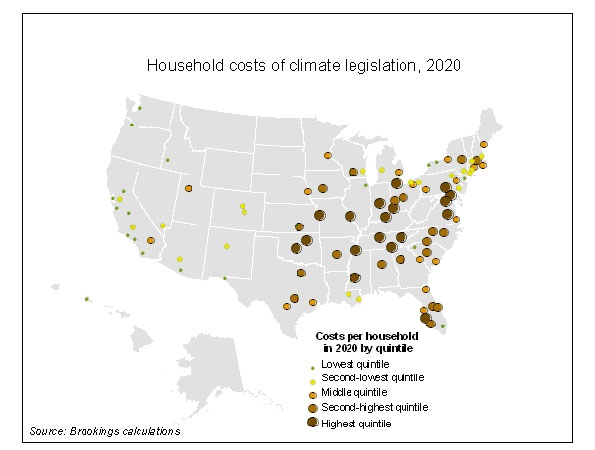
    The costs of compliance are highest in the lower Midwest through to the Mid-Atlantic and in the South. New England, the Upper Midwest, and the West are the winners from a cost standpoint.

    The actual costs vary from a high of $277 per household per year in 2020 in Lexington, KY to a low of $96 in Los Angeles among the 100 largest metros. Other hard hit metros include Washington, DC ($250), Indianapolis ($246) and Kansas City ($228). Among the winners are Portland ($107), San Francisco-Oakland-Fremont ($119) and Chicago ($135).

    In aggregate, this adds up to a significant amount of money. The Cincinnati metro had 815,000 households in 2008. Brookings did not include their household estimates for 2020, but even with no population growth at all, at $244 per household that still adds up to about $200 million per year in compliance costs. To put that in perspective, Cincinnati is proposing to construct a new downtown streetcar system for that same amount of money. It could conceivably build a new streetcar line every single year in perpetuity for the cost of compliance. Portland has 835,000 households, for an annual compliance cost of $90 million. Though they are about the same size regions, Cincinnati will be paying over $100 million more per year compliance costs. This creates a $100 million disincentive to live or locate a business in Cincinnati vs. Portland.

    In short, cap and trade creates disparities between metros. As the New Republic put it, “place matters” on cap and trade. And because the effects are geographically clustered, these disparities aren’t just local, they are regional. This is enough to immediately prompt the question as to whether or not this was an implicit design goal of the system.

    Among the biggest beneficiaries of cap and trade is California. Its large metros are clustered together at the bottom of the list. I noted previously how California is placing a huge bet on the green economy as its engine of economy renewal. In fact, beyond legacy industries such as high tech, agriculture, and entertainment, California’s political leaders are betting their entire future on green. With so much on the line for California, it should come as no surprise that the state would seek to federalize its policies and institutionalize the advantages it has in this arena through its state level climate regulations. One might even better name this bill “The California Economic Recovery and Competitor Hobbling Act of 2009”.

    This reality isn’t lost on Indiana Governor Mitch Daniels. With Indianapolis the fifth hardest hit metro in the country, it is no surprise he denounced the plan in a Wall Street Journal editorial, saying, “Quite simply, it looks like imperialism. This bill would impose enormous taxes and restrictions on free commerce by wealthy but faltering powers – California, Massachusetts and New York – seeking to exploit politically weaker colonies in order to prop up their own decaying economies.”

    It is clear that getting a bill out of Washington is not just a matter of cost, but of states and regions jockeying for position. The significant regional disparities in impact grind the legislative gears and might ultimately imperil getting legislation passed. Reducing regional disparities could help improve the chances of action on carbon.

    But shouldn’t places that implemented what is considered good policy be rewarded? To some extent, yes. Many places actually voted to cause economic pain for themselves for the sake of a better environment. Other places have fought environmental regulation every step of the way. Clearly, we do want to provide incentives for good behavior, and certainly not reward bad.

    On the other hand, not all the differences in current carbon emissions or abilities to reduce them are the result of good policy. Quite a bit of them are the result of simple good luck. Some places have climates that reduce the need for heating and air conditioning. Other places face more extreme weather.

    Plentiful clean energy sources are unequally spread throughout the country. Not every place has access to large amounts of solar, wind, or hydro power sources. Much of the Midwest and South built coal fired power plants due to plentiful coal supplies in the region. Technology and transportation costs made other sources cost prohibitive. Carbon emissions were not on anyone’s radar then. Some places like Chicago were fortunate to build nuclear plants, which were bitterly opposed by environmentalists at the time, but now are praised by some as a source of low carbon power.

    In short, much of the inequality in carbon emissions results from accidents of geography or history, not deliberate bad choices. People shouldn’t be punished for practices that were rational at the times. As Saul Alinksy put it, “Judgment must be made in the context of the times in which the action occurred and not from any other chronological vantage point.” And while one could say perhaps regions whose climates require excessive heating and cooling shouldn’t be favored places to live, one could say the same about much of the West, including California, whose existence depends on a vast edifice of what many consider environmentally destructive water works.

    To actually get action on carbon – the true imperative – we should adopt the following policy guiding principles:

    1. The goal is carbon reduction, full stop. Encumbering it with additional regional economic gamesmanship, or becoming overly enamored with particular means to that end should be avoided.
    2. Reducing carbon emissions will come with an economic cost. It isn’t realistic to expect that we will get away with pain free reductions. Obviously we should seek to get the best blend of costs and benefits, but let’s not pretend we can have our cake and eat it too, holding carbon action hostage to a standard that can never be met.
    3. The carbon reduction regime should not create significant regional cost disparities. As a purely practical matter, this helps ease passage and should be embraced. Complete equality is never realistic, but when some regions will pay twice as much as others, that by itself creates oppositional voting blocs. If a cap and trade scheme is the preferred approach, then perhaps assistance to high compliance cost areas should partially fund the transition away from coal and towards less polluting sources.
    4. The carbon reduction regime should not encourage business to migrate offshore. We should also not take action that reduces the attractiveness of America as a place to do business and especially to manufacture. Regulatory arbitrage already provides an incentive to move to China, where you can largely escape environmental rules, health and safety regulations, and avoid the presence of independent, vigorous unions. An ill chosen carbon regime could simply enhance China’s allure as a “carbon haven”. Again, this skews manufacturing regions and labor interests against action on carbon, while shifting production to areas with only minimal regulatory restraints.

    In short, action on carbon reduction may well be a good policy goal. But we shouldn’t embrace any means to that end uncritically if it creates huge distortions in regional economic advantage or further damages America’s industrial competitiveness.

    Aaron M. Renn is an independent writer on urban affairs based in the Midwest. His writings appear at The Urbanophile.

  • Obama Still Can Save His Presidency

    A good friend of mine, a Democratic mayor here in California, describes the Obama administration as “Moveon.org run by the Chicago machine.” This combination may have been good enough to beat John McCain in 2008, but it is proving a damned poor way to run a country or build a strong, effective political majority. And while the president’s charismatic talent – and the lack of such among his opposition – may keep him in office, it will be largely as a kind of permanent lame duck unable to make any of the transformative changes he promised as a candidate.

    If Obama wants to succeed as president he must grow into something more than movement icon, become more of a national leader. In effect, he needs to hit the reset button. Here are five key changes that Obama can implement to re-energize and save his presidency.

    1. Forget the “Chicago way.” The Windy City is a one-party town with a shrinking middle class and a fully co-opted business elite. The focused democratic centralism of the machine – as the University of Illinois’ Richard Simpson has noted – worked brilliantly in the primaries and even the general election campaign. But it is hardly suited to running a nation that is more culturally and politically diverse.

    The key rule of Chicago politics is delivering the spoils to supporters, and Obama’s stimulus program essentially fills this prescription. The stimulus’s biggest winners are such core backers as public employees, universities and rent-seeking businesses who leverage their access to government largesse, mostly by investing in nominally “green” industries. Roughly half the jobs saved form the ranks of teachers, a highly organized core constituency for the president and a mainstay of the political machine that supports the Democratic Party.

    The other winners: big investment banks and private investment funds. People forget that Obama, even running against a sitting New York senator, emerged as an early favorite among the hedge fund grandees. As The New York Times’ Andrew Sorkin put it back in April, “Mr. Obama might be struggling with the blue-collar vote in Pennsylvania, but he has nailed the hedge fund vote.”

    At best, the president’s policy seems like Karl Rove in reverse, essentially smooching the core and ignoring the rest. This is a formula for more divisiveness, not the advertised “hope” Americans expected last November.

    2. Focus on Real Jobs, Not Favored Constituencies . The Chicago approach works better in a closed political system controlled by a few powerbrokers than in a massive continental economy like the U.S. Health care and education, which depend on government largesse, are surviving. But the critical production side of the economy that generates good blue-collar jobs – like agriculture, manufacturing and construction – is getting the least from the stimulus.

    These industries need more large-scale infrastructure spending, as well as more focused skills training and initiatives to free capital for politically unconnected entrepreneurial businesses. Instead, productive industries face the prospect of more regulation while capital for small businesses continues to dry up.

    Those in post-industrial bastions tied to speculative capital – think Manhattan and the Hamptons – are the ones most benefiting from Obamanomics. College towns like Cambridge, Mass., Madison, Wis., Berkeley, Calif., and Palo Alto, Calif., will also prosper, becoming even richer and more self-important. It seems, then, that Obama has done best for elite graduates of Harvard and Stanford and other members of the “creative class.”

    The rest of America, however, is still waiting for a real sustained recovery. Industrial and office properties remain widely abandoned not only in Detroit but Silicon Valley. The future sustainability of our economy depends mostly on what happens to those who previously staffed these facilities – those who produced actual goods and services – not just on a relative handful of people working at Google or the national laboratories. In other words, we need jobs for machinists, welders and marketers as well as scientists with Ph.D’s.

    3. Step on the Gas. Providence has handed America – and Obama – an enormous gift in the now recoverable deposits of natural gas found across the continent. Proven levels have been soaring and now amount to 90 years’ supply at current demand. More will be found, and across a wide section of the country.

    Natural gas may be a fossil fuel, but it is relatively clean and thus the perfect intermediate solution to our energy problems. The problem: The president’s green advisers will seek to prevent developing these resources.

    Although Obama should support strong environmental controls on gas extraction, the greens should not be allowed to block this unique and historic opportunity to shift economic power back to North America. Along with modest increases in domestic and Canadian oil, natural gas could end our dependence on fossil fuels from outside North America. This would relieve our military from the onerous task of defending other people’s oil supplies. But most important, the new energy sources could expand our industrial and agricultural economies so they can capitalize on the huge potential growth from markets at home and in the developing world.

    The natural gas era could then finance continued research and deployment of renewable fuels. Let’s give it the 10 or 20 years that great transformations require. Quick fixes will lead us to subsidize the purchase of rapidly dated technology from China or Europe; we should aim at the energy equivalent of the moon shot, helping forge a huge technological advantage.

    4. Rediscover America. As a candidate, Obama spoke movingly about his Kansas roots, but lately he seems to have become all big city all the time. This administration offers very little to people who live in places like Kansas, as many of my heartland Democrat friends complain.

    Urbanites often forget that this is an enormous country. Crowded into dense cities themselves, they fail to look down from the window when crossing the country by plane. The vast majority of America is, well, vast – sparsely settled, if settled at all.

    Moreover, Obama’s people need to understand that 80% of America live in suburbs or small towns. They do not want to live in dense cities or realize a move there would mean living in less than idyllic conditions. If Obama wants to shape a green America, he must find ways that work with the majority’s preferences.

    But so far the president’s housing, transport and planning advisers seem to be pushing the death of suburbia and promoting ever more densification. It’s hardly surprising, then, that suburbs and small towns feel left out. After finally starting to inch toward the Democrats, they are now turning again to the right. If Democrats want to retain their majority, they need the strong support of these constituencies – without it the Congressional majority will be gone by the end of the second term, if not the first.

    5. Chuck the Nobel; Embrace Exceptionalism. Many progressives love Obama because they see him as one of them in the struggle with what the immortal Bill Maher calls “a stupid country.” But the president should remind himself that the country may not be quite as dumb as it sometimes looks from Oslo – or from Dupont Circle, Cambridge or Soho.

    Being smart was part of the reason the Republicans lost the majority. The voters understood the country was wasting resources – and young people – on internecine conflicts for energy that we could produce at home. The Bush years also undermined any GOP claim to fiscal responsibility.

    Initially Obama allowed us to redefine American exceptionalism as something more than monomaniacal use of force and overconsumption. He spoke to our traditions of inclusiveness, adaptability and idealism. He offered the perfect vehicle because he and his story are so exceptional. Yet Obama sometimes seems more interested in serving as the apologizer rather than as commander in chief. His vision appears less American than pseudo-European.

    This is not the path to success for American presidents. Whether Ronald Reagan or Franklin Roosevelt, Harry Truman or even Bill Clinton, a president has to be a spokesman for his country. Right now, on the world stage, Obama is looking more and more like Jimmy Carter.

    I suggest these things because, for all his missteps over the past year, Barack Obama is my president and I want him to succeed. But to do so, first he needs to hit his own reset button – and the sooner the better. Unlike some, I do not believe the Obama presidency is already doomed. Presidents often grow in office: Despite his exceptionalism in other areas, let’s hope that Obama proves the norm here.

    This article originally appeared at Forbes.com.

    Joel Kotkin is executive editor of NewGeography.com and is a distinguished presidential fellow in urban futures at Chapman University. He is author of The City: A Global History. His next book, The Next Hundred Million: America in 2050, will be published by Penguin Press early next year.
    Official White House Photo by Pete Souza

  • Stimulate Yourself!

    Beltway politicians and economists can argue themselves silly about the impact of the Obama administration’s stimulus program, but outside the beltway the discussion is largely over. On the local level–particularly outside the heavily politicized big cities–the consensus seems to be that the stimulus has changed little–if anything.

    Recently, I met with a couple of dozen mayors and city officials in Kentucky to discuss economic growth. The mayors spoke of their initiatives and ideas, yet hardly anyone mentioned the stimulus.

    “We didn’t see much of anything,” noted Elaine Walker, mayor of Bowling Green, a relatively prosperous town of 55,000 in the western part of the state. “The money went to the state and was siphoned off by them. We got about zero from it.”

    Ironically, Walker does not seem overly upset about the lack of federal assistance for Bowling Green. Instead, Walker–a self-described supporter of the president in a part of the country largely resistant to Obamamania–seems more disposed to taking matters into her own hands. Rather than waiting for Obama, Bowling Green is looking to stimulate itself–and other communities would do well to emulate this grassroots approach

    Bowling Green’s “self-stimulation” is part of a concentrated effort at diversification for the city, which has long depended on its General Motors plant, which produces the Corvette. Other single-industry-dominated regions, notably Detroit, have made much noise about moving into other fields, but their emphasis has frequently revolved around high-profile, highly subsidized projects such as “green” industries, entertainment or tourism.

    Instead, says Walker, the first step in diversification lies with boosting small local businesses.

    A primary vehicle for this has been the successful Small Business Accelerator located at an abandoned mall. Buddy Steen, who runs the program in conjunction with Western Kentucky University, claims it has fostered some 38 companies and created over 700 jobs. Blu Pharmaceuticals, developed by Small Business Accelerator, for example, currently employs five but expects to add another 40 workers at its new plant in nearby Franklin. The program’s other firms specialize in everything from electronic warfare to robotics.

    Kentucky may seem an unlikely spot for such ventures, admits local entrepreneur Ed Mills, but things are changing in the Bluegrass State. Mills, a former General Motors executive, and his twin sons, Clint and Chris, founded a Web-based software firm, HitCents, in 1995 when the boys were still in high school.

    Today the company, which develops software for retail and other applications, has over 50 employees and customers from across the country, including GM, as well as a host of local companies, unions and public agencies. “We hope to build a $100 million company, and we think we can do it.” Mills says. “You don’t have to be in California. People think you can’t do this in Kentucky but plainly you can.”

    With its strategic location on Interstate 65 connecting the old industrial heartland to the emerging one along the Gulf, Bowling Green enjoys many advantages. It’s slightly over an hour to Nashville and two hours to Louisville, the area’s two major consumer and cultural marketplaces.

    Other small communities in the state have also realized that any green shoots would have to come from local grassroots. Russellville, a rural community of some 7,200 in the southwest part of the state, is looking at a “back to basics” economic development plan that stresses the export of local food products and crafts.

    “You can ride down the highways and smell the hams smoking,” notes one local economic developer. “We are looking on how to export those hams to the rest of country.”

    Mayor Gary Williamson of Mt. Sterling, a town of 6,000 located in Montgomery County, in the generally more impoverished east, has been pushing a different strategy. His region is dotted with industrial plants of varying sizes. The city is also 45 minutes from Georgetown, site of a large Toyota factory.

    These employers require a steady stream of skilled industrial workers, particularly in such fields as machine maintenance. Williamson and other officials in the area see training such workers–starting at the high school level–as a way to not only keep people employed but to attract other firms to the area. “We want to keep people here, and they will do so if they have jobs after school,” he explains.

    It’s significant that such grassroots-based development–geared to unique local conditions–is taking place in Kentucky. For generations, the state and the rest of the surrounding Appalachian region has been the brunt of both jokes and patronizing attention from the nation’s academes, policy circles and media.

    Most Americans, observed Newsweek in 2008, “see Appalachia through the twin stereotypes of tragedy (miners buried alive) and farce (Jed Clampett).” One prime reflection of that approach can be seen in a CNN report last year that painted a decidedly dismal portrait of the region.

    For generations, Appalachia’s seeming backwardness has led to the creation of numerous federal programs aimed at lifting it into the national economic and cultural mainstream, notes University of Kentucky historian Ronald Eller. In his excellent Uneven Ground: Appalachia Since 1945, Eller describes how these efforts reflected the region’s “struggle with modernity.” Progress has been often associated with efforts to undermine what the late Michael Harrington described as a “separate culture, another nation with its own way of life.”

    Yet, this unique culture also could provide some of the basis for a regional recovery. There’s a growing sense, notes longtime Kentucky League of Cities President Sylvia Lovely, that the region’s fundamental assets–its natural beauty, resources and traditions of craftsmanship–could constitute a distinct advantage in the coming decades.

    More important still could be less tangible values, Lovely notes. “Modernity” in its current unadulterated form–with a lack of community, homogeneity and disconnect from the natural world–could be losing its allure for millions of Americans. In terms of what matters, she suggests, Appalachian towns may possess “if not more information, perhaps more wisdom than those who hold themselves out as experts. “

    Looking at the statistics, the news is not all grim. Despite its still glaring problems, particularly in its rural hinterland, Appalachia has been gaining steadily compared to the rest of the country. In 1960 one-third of Appalachia residents lived in poverty, compared with 1 in 5 nationally; by 2000 the poverty rates had fallen to 13.6%, just a tick higher than the national 12.3%. The region’s continued struggle with the gap between rich and poor, Eller notes, now more reflects broader national trends as opposed to something unique to the region.

    Perhaps the most dramatic changes are illustrated by migration patterns. By the end of the 1960s one out of every three industrial workers in Ohio came from Appalachia. Young people studied, notes Eller, “reading, writing and Route 23,” referring to the main highway to the industrial north.

    Since 2000 Kentucky, as well as Tennessee and West Virginia, have enjoyed positive rates of net migration. Although some parts of the region continue to suffer horrendous poverty and continued out-migration, many other communities–such as Bowling Green, Lexington and Louisville, as well some more rural areas–have attracted more newcomers than they have lost. Overall Appalachian states’ migration statistics look a lot healthier than Ohio and Illinois, not to mention New York or California.

    Walker–who moved to Kentucky from Los Angeles shortly after the 1992 race riots–sees this new migration as part of what will sustain a recovery in the region. Like many newcomers, Walker came to Kentucky not for bright lights but for a good place to raise her children. “Everyone still waves and says hi,” she observes. “That makes a lot more difference to people than many think. In the end, people come here because it’s a better place to live and also to raise your kids. It’s all about families.”

    Ultimately, a combination of folksiness and access to the world brought by technology could spark a continued renaissance not only in Bowling Green but across the region. The fact that the resurgence seems to be the product of largely local efforts not only makes it all the sweeter, but could inspire similar approaches among those communities still waiting for Washington to rescue them.

    This article originally appeared at Forbes.com.

    Joel Kotkin is executive editor of NewGeography.com and is a distinguished presidential fellow in urban futures at Chapman University. He is author of The City: A Global History. His next book, The Next Hundred Million: America in 2050, will be published by Penguin Press early next year.
    Downtown Bowling Green photo courtesy of OPMaster

  • American Agriculture’s Cornucopia of Opportunity and Responsibility

    A complex agriculture, along with urban culture, is one of the fundamental pillars of human civilization, and one of the fundamental bulkwarks of American prosperity. For families and communities involved in farming and ranching it’s also a way of life that is cherished, oftentimes passed on through generations, taking on reverential if not religious overtones.

    At the same time in today’s overwhelmingly urban culture, cooking has become prime time entertainment, dining a social event, and what a person eats is increasingly associated with a healthy body and mind – sometimes a sort of spiritual well being. This elevates agriculture to an important issue even among those who have never spent a day on a farm.

    Sadly, recent years have seen mounting efforts to discount the value, in particular, of the industry’s productive core. A just published feature story in Time magazine – Getting Real About the High Price of Cheap Food – makes the following claim. “With the exhaustion of the soil, the impact of global warming and the inevitably rising price of oil — which will affect everything from fertilizer to supermarket electricity bills — our industrial style of food production will end sooner or later.”

    Yet it is industrial, highly commercialized agriculture that first transformed America – and increasingly such countries as Australia, Brazil, Argentina and Canada – major forces in the world economy. The trend towards smaller-scale specialized production is indeed a welcome addition to our agricultural economy, but it is principally large-scale, scientifically advanced farming that produces the vast majority of the average family’s foodstuffs and accounts for all but a tiny percentage of our exports.

    The attack on “industrial” agriculture reflects a growing trend by environmentalists to subordinate all productive industry to their own particular agenda. Some extremists in the local food movement would discourage cold climate inhabitants from the luxury of a midwinter tropical fruit because of the energy used in shipping. Others propose elaborate schemes for urban farming so that land can be left to nature instead of cultivation.

    For others agriculture is guilty of producing a calorie-heavy, protein-rich diet that has made Americans unhealthy. In this lexicon ranchers, corn, and wheat farmers are not far removed from Afghan poppy growers or coca cultivators in South America.

    The assault on agricultural production and the food system as we know it is certainly not limited to the United States. Farmers in Great Britain, where the often well-heeled advocates of bucolic romanticism hold great sway, have faced withering criticism. The National Farmers Union recently stated that the pressures on land use and practices could seriously damage the agricultural economy, with serious global and moral consequences.

    Farming, they argue, depends “crucially on the productive core business remaining profitable. Without this core, British agriculture would “wither on the vine”, reducing both the global supply of food and making the UK ever more dependent on imports.

    When applied to the United States, the world’s largest food exporter, the consequences could be devastating. By 2050 the population of the planet will reach around 9 billion people with more than 85 percent of the world’s population located in developing countries. Roughly half will live in developing-country cities. In the United States the population is expected to grow by another 100-milion people by 2050.

    In this context, taking steps to reduce large-scale efficient production does not seem to be either a practical or humane choice. Certainly, better production and stewardship practices should be implemented and consumers can and could do more to drive these practices by making better nutritional decisions and choosing more responsible lifestyles.

    But these concerns should not obscure the fact that American agriculture stands at the core of meeting the challenge of feeding the world’s expanding population. It does this not only by producing a staggeringly diverse array of crops with amazing efficiency, but also by leading the world in the export of the agricultural technology that helps other countries, notably in the developing world, feed their own people.

    Greater Food Security and a Stronger Economy
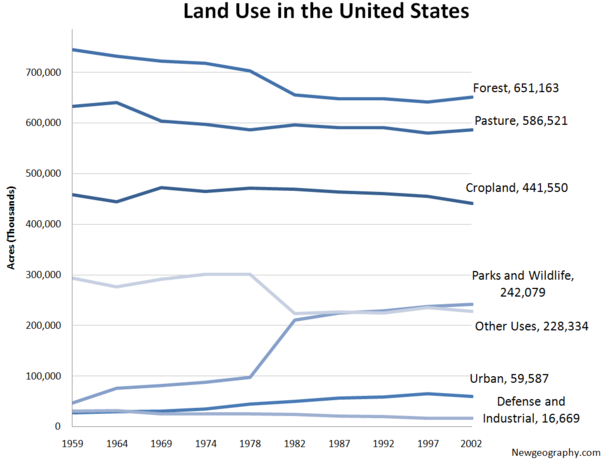
    America’s agricultural producers have never been more productive and efficient than they are today. In 1953, the nation had a total of 5 million farms, working a total of 1.2 billion acres of land – the peak in production at that time. Over fifty years later, the number of farms in America has fallen by two-thirds, and the amount of land in use by producers has dropped by 25 percent, to around 900 million acres. Of the 2.2 million remaining farms, almost 96% are family owned. Even among the largest two percent of farms, 84% are family owned, challenging the commonly held perception of corporate domination.

    The US food industry is now the biggest in the world. In 2006, it was a $1.4 trillion sector, accounting for 12.3 percent of gross domestic product (GDP) and 17 percent of the country’s workforce – the second largest U.S. employer behind government. In some regional economies such as the Midwest and Upper Great Plains the demand by farmers here, and now increasingly abroad, for sophisticated machinery and equipment has spawned entire new industry sectors in electronics, wireless networks, and new material fabrication. The continual demand for new and improved practices in both crop and livestock production and processing has created new opportunities in the life sciences and biotechnology.

    This represents both an economic achievement and a great environmental benefit. Inputs of capital, labor, and materials have remained nearly steady, yet overall output has increased over two and one half fold over the same period of time. At the same time, efficient agriculture has returned to nature – forests, wetlands, prairie – millions of acres, far more than the land that has been devoted to housing and other urban needs.

    Like successful industrialists, American farmers and ranchers have taken advantage of the latest advances in engineering, technology, and science to do more with less, creating “arguably the most productive, efficient, and technologically advanced production agriculture sector in the world”. Indeed as many American manufacturing industries have fallen behind their foreign competitors, agriculture has remained in the forefront, a bastion of American competitiveness.

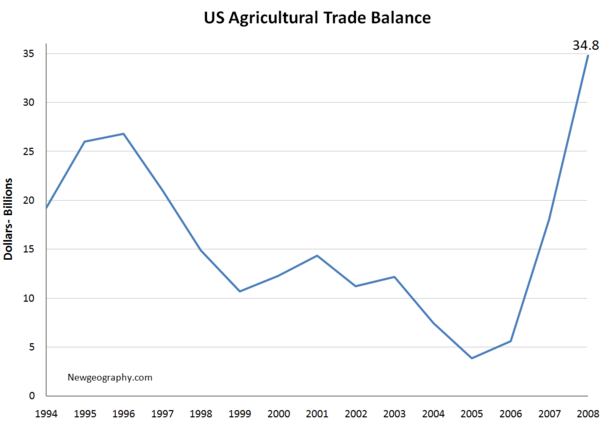
    These increasing levels of productivity have allowed American agriculture to become a powerful player in world agricultural trade. As the nation has seen overall trade deficits mount to record levels in recent years, the agricultural sector has proven a notable exception. American farms, able to “produce far beyond domestic demand for many crops,” have looked to the world market to absorb their output. In 2008, the United States exported over $115 billion worth of agricultural products, a record high.

    For the year, agricultural products made up ten percent of overall American exports, and the nation enjoyed an agricultural trade surplus of 35 billion dollars. While high commodity prices played their part in driving 2008’s export values higher, the agricultural sector has consistently shown export surpluses over the past 15 years, with the nation’s “share of the global market for agricultural goods,” averaging slightly over 20%.

    On the domestic front, production agriculture – and the wider world of agribusiness – provides not only food, fuel, and fiber for Americans, but also a source of employment. Roughly 4.1 million people are directly employed in production agriculture as farmers, ranchers, and laborers; but up to 21 million Americans work in jobs that are tied in some way to agriculture –approximately one out of six participants in the U.S. workforce.

    According to the USDA, the agricultural export industry supported as many as “841,000 full-time civilian jobs,” including “482,000 jobs in the nonfarm sector,” as of 2006. Production of food, fuel, and fiber involves support industries to supply the necessary inputs, and handle the product output, spurring economic activity in associated industries, including the “manufacturing, trade, and transportation sectors.”

    The continual adoption of advanced technologies and methodologies by American farmers and ranchers also creates demand for advanced research and development activity, from both the public and private sectors.These, in turn, spawn educational and entrepreneurial opportunities in a multitude of scientific and engineering fields. USDA research suggests that “each dollar spent on agricultural research returned about $10 worth of benefits to the economy.”

    Scaling Up Sustainable Agriculture

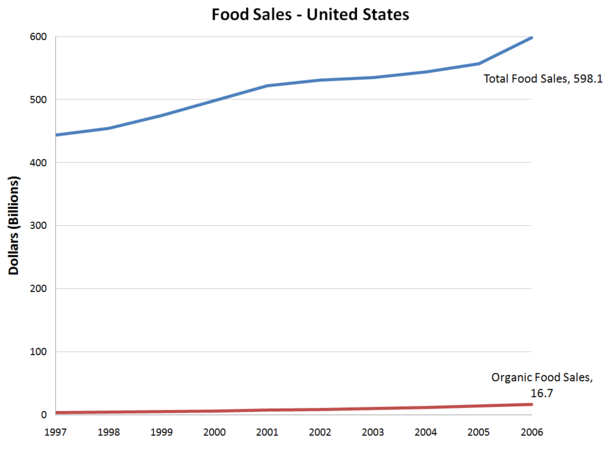
    None of this suggests that there is not room as well for what is known as sustainable, usually smaller scale, agriculture. Organic agriculture, where farmers minimize external inputs and are not permitted to use artificial fertilizers, pesticides or herbicides, is the most widely recognized segment of the sustainable farming industry. U.S. sales of organic food and beverages have grown from $1 billion in 1990 to an estimated $20 billion in 2007, and are projected to reach nearly $23 billion in 2008.

    This is clearly a growing industry, with organic food sales anticipated to increase an average of 18 percent each year from 2007 to 2010, according to an Organic Trade Association Manufacturing Survey. Yet organic foods and beverages account for less than 3 percent of all food sales in the United States – hardly enough supply or demand to feed a nation, much less a growing, hungry planet.

    The same technology that drives commercial, large scale agriculture – and is largely paid for by its profits – could expand the role of this specialized sector. This includes a greater role for what is commonly called precision agriculture. With the aid of technologies such as global positioning (GPS), sensors, satellites or aerial images, and geographic information management tools (GIS), every input can be applied optimally to meet the exact needs of the crop, and can be tracked and tailored with precision. Precision agriculture can be used to reduce energy usage and environmental effects of production agriculture.

    Precision agriculture builds on the strengths of America’s fundamental edge in innovation on the farm and in the factory. In the past, technology has been a major force in driving the shift of agricultural activities of the farm into the agribusiness input industries. Precision agriculture creates new and higher-value opportunities for agribusiness but also enables the farmer to apply the technology right in the field, thereby increasing the competitiveness and viability of farm operations of any size or ownership structure.

    This suggests that there is, in many cases, a false dichotomy between industrial and sustainable agriculture. American agriculture now competes in a truly global marketplace with a cornucopia of opportunities that extend to both systems. Technology and a focus on productivity can help sustainable farming expand, but this should not be at the expense of the larger, commercial sector that not only funds most new research but will continue to play a dominant role in both feeding the world and sustaining that most endangered of species – the American economy.

    Delore Zimmerman is the President of the Praxis Strategy Group an economic research and development strategy consulting company. Matthew Leiphon is a Research Associate with Praxis Strategy Group. Delore grew up in a small farming community in North Dakota, hauling bales and picking rocks for local farmers and ranchers. Matthew is from a North Dakota farm family and spends his fall weekends harvesting small grains and canola.

  • Obama’s Home Town

    Hyde Park, in Chicago, is where President Obama called home before moving to Pennsylvania Avenue.

    I once called 5118 S. Dorchester home.

    Hyde Park is a college town surrounded by – but not really part of – a big city. The University of Chicago, founded in 1890, is the heart of the community. The campus was built of Indiana limestone, fake Gothic, and made to look old from its very inception. Some people like it.

    In 1893, Hyde Park hosted the World’s Columbian Exhibition (a year late). This showcased the new campus, and also what is now the Museum of Science & Industry, at the northern edge of Jackson Park. The Midway Plaisance – as in carnival midway – then a canal traversed by Venetian gondolas, now marks the southern boundary of Hyde Park.

    The tradition continued with Robert Maynard Hutchins and Mortimer Adler – the latter founder of Encyclopedia Britannica, and both authors of the Great Books model of liberal arts education. Subsequent residents have included Muhammad Ali, William Ayers, Saul Bellow, and Barack Obama.

    The community is bordered on the east by Lake Michigan, on the west by Washington Park (as in green grass – where few white residents dare to picnic), on the south by the ghetto community of Woodlawn, and to the north by Kenwood – also mostly a ghetto. The formal northern boundary is Hyde Park Blvd (51st St.), but really the neighborhood extends a couple of blocks north into Kenwood. Including this (say to 49th St.), Hyde Park is less than two square miles, and has about 30,000 people.

    To preserve its integrity as a college town, the area is separated as much as possible from the surrounding ghetto. As a result, public transportation to and from Hyde Park is poor to anyplace besides the Loop. It is difficult to get to Hyde Park from nearby communities. This is what gives it the feel of a separate village. It takes half an hour to get to the rest of Chicago.

    The Illinois Central tracks bisect Hyde Park along Lake Park Ave. East of the tracks is a lakeshore community, traditionally Jewish. Here are high-rise condos such as one would find on the North Side. The famous and impressive Shoreland Hotel has become a college dormitory. Hyde Park Blvd. turns south, east of the tracks, and is a very impressive avenue leading to the Museum of Science & Industry. A pedestrian tunnel leads under Lakeshore Drive to the marvelous Hyde Park Point – a peninsula jutting out into the lake. This offers the very best view of the Chicago skyline from anywhere in the city. Drive to the very end of 55th St. and you’re there.

    The town-gown divide runs right along 55th Street: south is gown (and mostly white), north is town (and majority Black). The entire community is racially integrated – one of the defining features of Hyde Park. Nevertheless, east of Woodlawn and south of 55th Street is mostly faculty and graduate student housing. Conversely, the northwest part of town is predominantly Black.

    55th Street itself is very boring – the victim of urban renewal in the 60’s and 70’s. The only interesting place is the Lutheran School of Theology at Chicago, a modern but very satisfying building. (On my last visit the building looked to be in disrepair).

    The commercial main street is 53rd Street from Woodlawn to Lake Park. I am pleased to say that while individual businesses have come and gone, the character of this street is mostly unchanged over the past 30 years. Half white and half Black, half university and half blue-collar, the street is a great place for people-watching. The center is a small shopping area known as Harper Court. When I last visited, the Valois Cafeteria (53rd and Blackstone) was still there – great place!

    Four blocks south is 57th Street, the main street of the campus neighborhood. This used to be justly famous for fantastic bookstores, and probably still is. Please visit the Seminary Co-op Bookstore at the corner of 58th and Woodlawn. (It’s inside the Chicago Theological Seminary building, in the basement; there are small signs.) A less interesting branch is along 57th Street. A small used bookstore on 57th Street just before the tracks is still there (called Powell’s, but probably unrelated to the Portland store). I’m certain all the other independent bookstores are gone.

    The university proper starts at Woodlawn and extends west. The impressive Rockefeller Chapel is on Woodlawn south of 58th Street. Frank Lloyd Wright’s justly famous Robie House is at 58th and Woodlawn. The main quad of the university extends from 57th and University all the way to 59th and Ellis. It is well worth exploring. If you can, go into the Harper Library. And walk past the Divinity School. The unforgivably ugly Regenstein Library is across 57th Street – classic brutalism.

    West of Ellis is a huge medical complex: the University of Chicago hospitals. This neighborhood is very different still, as neither nurses nor patients live in Hyde Park. The academic core of the university extends west of Ellis as well, and now includes a Science Quad.

    By the time one gets to Cottage Grove – the western boundary of Hyde Park and the eastern limit of Washington Park – one is actually in the ghetto. I never felt safe walking along Cottage Grove. Indeed, except for the university campus, I rarely ventured west of Ellis. Otherwise I walked around town at all hours of the day or night.

    The campus has crossed the Midway Plaisance, and now includes a row of large buildings along 60th Street – notably the law school. This is a wall against impoverished (and increasingly uninhabited) Woodlawn.

    I understand that one additional building needs to be built in Hyde Park: the Obama Presidential Library. Please let the White House know where you think they should put it. The matter is of some urgency.

    I’m hoping they can start construction no later than 2013.

    Daniel Jelski is Dean of Science & Engineering State University of New York at New Paltz.

  • Webinar: The Future of Rural America

    New Geography publisher Delore Zimmerman will host a webinar next week discussing the future of rural america. The webinar is part of the Rural Broadband Initiative organized by Northern Minnesota’s Blandin Foundation.

    From Blandin:

    If you are interested in rural community and economic development trends, this webinar is for you. Delore Zimmerman will provide guidance for rural community leaders about development trends and the steps communities must take to increase their investment attractiveness.

    The role that technology plays in increasing economic vitality will be presented both in theory and practice, and Delore will include information about successful regional economic development strategies.

    Here’s more information and registration for this free webinar.

  • When Thanatos Beat Eros, Mapping Natural Population Decreases

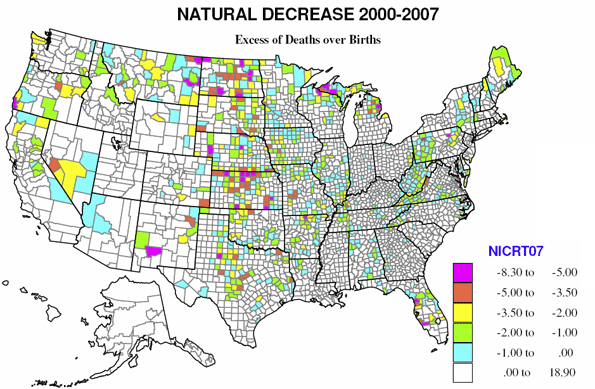
    For an advanced capitalist society, the United States has a quite high birth rate, and substantial natural increase. Yet despite this, almost a third experienced natural decrease, an excess of deaths over births, over the recent 2000-2007 period. Some counties with natural decrease still grow in population because of sufficient in-migration, but more typically, natural decrease is associated with high levels of out-migration and with long term population decline.

    My first map, Figure 1, depicts counties with natural decrease at five levels, with warm colors marking the higher “rates” (actually here, simply the share that natural decrease is of the base population in 2000), and cool colors lower rates, blue being closest to a balance of births and deaths.

    The Great Plains, the part of the country most dependent on agriculture, has led this trend as it has been since probably 1960, with counties from Texas to North Dakota, Montana (and beyond into Canada) experiencing among the highest levels of natural decrease. Others include central Florida, Appalachia, and some interior parts of New England, the upper Michigan to northern Minnesota iron range, and a sizable scatter of counties across the west.

    What causes natural decrease? First is a pattern of long term out-migration of the surplus young, who could not be supported by the limited rural economy and other natural resource based industries. Second is the growth of the elderly population from selective migration to amenity retirement areas. Florida is the “flagship” case, but to a lesser degree it occurs in favored local environments in most of the country. Third would be a situation of natural decrease because of unusually high mortality. Fortunately, there is no example of this in the United States.

    The geography of natural decrease

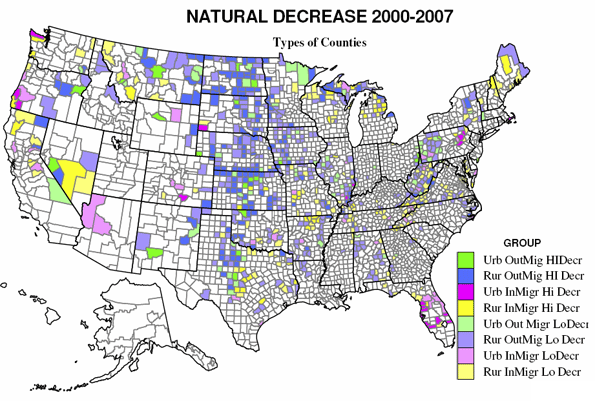
    First there is a small set of counties with natural decrease, more deaths over births, but still net positive growth due largely to net domestic in-migration (magenta and yellow on the county types map, Figure 2). The bulk of these counties are retirement amenity areas, mostly but not entirely in the Sunbelt, and mostly but not entirely in the south and west. Another even smaller group is characterized by long term declining industry and mining based economies, but also offers affordable housing stock for second homes and later retirement. We see this especially in Appalachia.

    The largest cluster of the first type of places covers a swath of central Florida, including such cities as St. Petersburg, Sarasota, Port Charlotte, Melbourne, Daytona Beach, followed by southwestern Oregon, northwestern Arizona (Prescott, Lake Havasu City), central Colorado (west of Colorado Springs), parts of rural Northern California, Wyoming, South Dakota, Montana and Washington state.

    The main cluster of the second type, areas with industrial decline that have become amenity retirement destinations, are in Appalachia, especially the North Carolina – Tennessee border area (Great Smokies), selected counties in northern West Virginia and exurban counties around Pittsburgh. A prominent cluster is the Scranton-Wilkes-Barre, Hazleton area of east central PA. Scattered Midwestern examples include places like Hot Springs, Arkansas, 3 counties in Southeast Illinois, along with areas along Lake Superior, parts of Arkansas as well as on the Texas Gulf coast.

    The more rural natural decrease counties with net in-migration (215 counties, yellow on the map) tend to occur in the same regions. The two main “belts” of such counties are retirement and resort counties extending from the central Texas hill country through Ozark plateau and lakes, and again parts of Appalachia. Virginia has the largest number of such counties, some just beyond the commuter zone of Washington. Similar areas occur across the far north, characterized by recreation and retirement as well as ex-logging or mining. A third area includes areas in western Montana, popular with California retirees, and a fourth is far northern CA.

    Then there are counties losing population from natural decrease and net internal out-migration. Two-thirds (576) of counties with natural decrease experience this expected pattern of long term decline of resource-based economies. Of these 105 have at least a 50 percent urban population (green on the map), but most (471 of all 861) natural decrease counties are predominantly rural (blue on the map).

    The Great Plains, from Texas though Dakotas and eastern Montana to Nebrasla represents the largest region for natural decrease and populatiob loss. represents the largest region for such losses. This is quintessential high plains farm belt, which continues to experience mechanization, loss of local businesses and out migration of the young for at least 80 years now. But although the large majority of rural counties with net out-migration (blue on the map) are in the Great Plains belt, significant numbers also occur in the forest and mining counties in Maine, Michigan, eastern Oregon, northeastern New York, and northern Appalachia.

    This leaves an interesting scattering of counties from Texas, northern Louisiana, Arkansas, Alabama, and the North Carolina-Virginia border region. These are mainly farming areas, often with significant (35 to 60 percent) Black population shares, largely elderly, areas somewhat “left behind” in the growth of industrialization and urbanization of the south. This is where young Blacks have left for city opportunities, just as young whites have from the prairies and the mines.

    What will the future bring?

    I examined maps of counties with 0 to 1% natural increase, or with high shares of the population between 45 and 64, which are plausible candidates for a shift to natural decrease, but also looked at counties with 0 to 1 % natural decrease, which are candidates for a shift to natural increase.

    The most likely future areas for a shift to natural decrease include many in a wider Appalachian belt, within the greater Mississippi valley from Louisiana to Canada. Hundreds of these counties have the potential to shift to natural decrease by 2025, as the vanguard of the Babyboomers reach 80. The likelihood of the shift does depend on the proximity of the county to vigorous urban and metropolitan areas and on counties’ relative success or failure at attracting retirees. Other commentators have talked of the “slowdown” of migration to and growth of Florida, and the spread of retiree settlement to many other parts of the country. This is already evident on the map, but it is premature to write off Florida’s appeal to retirees, particularly as house prices there have plunged.

    There are also forces that may slow, or even reverse, natural decrease. Northward expansion of the Hispanic population will have the contrary effect of raising birth rates and a shift to natural increase. Some areas that have attracted affluent retiree migrants also could experience sufficient investment to foster more general growth.

    At the same time, the retirement geography of the massive Baby Boomer cohort has the potential of redrawing the map. But overall, I believe we will see more counties experiencing natural decrease.

    This process has now reached around 800 counties. But we will see more of this when the nation approaches ZPG, zero population growth, perhaps after 2050, in many counties

    Richard Morrill is Professor Emeritus of Geography and Environmental Studies, University of Washington. His research interests include: political geography (voting behavior, redistricting, local governance), population/demography/settlement/migration, urban geography and planning, urban transportation (i.e., old fashioned generalist)


    References:
    Morrill, Richard, 1993, The spread of natural decrease, FOCUS,43- 30-33
    Morrill, Richard\, 1994, Aging in place, age specific migration and natural decrease, Annals of Regional Science, 28- 1-26
    Cromartie, John and Kandel, William, 2008 Rural population and Migration-Trend 4,Natural decrease on the rise. Economic Research Service,USDA \
    Cromartie, John and Nelson, Peter, 2008, BabyBoomer migration and socioeconomic change in “no growth’ counties. Paper, Rural Sociological Society.
    Frey, William,, 2004, Generational Pull, American Demographics
    Johnson, Kenneth and Beale, Calvin, 1992, Natural population decrease in the United States, Rural Development Perspectives, 8 , pp 8-15
    Johnson, Kenneth
    Hull, Victor, Retirement choices stretch beyond Florida. 2006,

  • Vertical Urban Farming? Pull Your Head from the Clouds

    Dickson D. Desposmmier, in a recent op-ed in the New York Times, argues that the world, faced with increasing billions of mouths to feed, will soon run out of land. According to Mr. Despommier, “the traditional soil-based farming model developed over the last 12,000 years will no longer be a sustainable option.”

    Despommier’s answer to this ‘problem’: “move most farming into cities, and grow crops in tall, specially constructed buildings.” Such vertical farms, argues Despommier, would “revolutionize and improve urban life,” while also addressing issues such as agricultural runoff, air pollution, and carbon emissions.

    To sophisticated urbanites with little or no exposure to agriculture, vertical farming may seem to present a sort of utopian panacea. But first one must look at the underlying problem Mr. Despommier claims to address: land shortages.

    In this case, Despommier fails to show that land shortages will be a debilitating issue, rather than a manageable challenge. Desposmmier presents figures from the UN showing that the amount of arable land per person has dropped from one acre per person in 1970 to about half an acre in 2000, and may drop toward a third of an acre per person by 2050. This simply means that future generations will have less land available per person. But, does this necessarily translate into impending, persistent, worldwide food shortages?

    Even prior to the time of Thomas Malthus, there have been voices warning of disaster lying just around the bend with regards to food production and consumption. Yet, over the past two centuries, those tilling the soil (full disclosure: the author comes from a long line of family farmers, and has, from time to time, taken part in some ‘soil tilling’ of his own) have continued to keep pace with ever-increasing demands for food. True, the equitable distribution of this increased productivity sometimes leaves something to be desired (often for reasons of politics, not of production), but one cannot dispute the fact that farmers worldwide have made massive leaps and bounds in productivity.

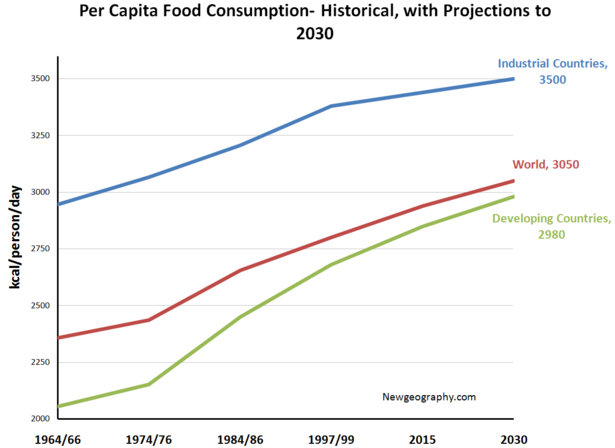
    In the face of less acreage per human, the UN’s Food and Agriculture Organization continues to track increasing output per capita, and projections for the future show production levels able to meet increasing demand. One notable Dutch study showed the world’s farmers, using existing land resources, capable of feeding up to 10 billion people at least a “moderate diet,” if not an affluent one. Such projections have been supported by a “sizable literature,” some of which argues that future production of food will not be an overwhelming challenge, even at populations up to 12 billion. Between 1960 and 2000, the world’s farmers were able to increase food produced per capita, while the world’s population nearly doubled. We have now reached a point where Americans throw away around 14% of the food they buy.
    Making better use of the food we already produce, including gleaning of wasted food, and shifting land away from production of non-food crops, would be common-sense steps towards combating current and future food insecurity. Making better, more efficient use of our existing arable land makes more sense, both now, and in the future.

    High-rise urban farming, however, is not the solution. Even if we assume that the world will, as Despommier fears, face potential shortages of arable land in the future, the solution he proposes is far from the most feasible initial solution. In his piece, Mr. Despommier states that a prototype farm, covering one eighth of a city block and consisting of 5 stories, would cost around 20 to 30 million dollars to construct. A vertical farm of such size might mean around five acres of indoor production space (city blocks vary in size from place to place). Despommier states that one indoor acre might be able to replace 20 acres of outdoor farmland. So, giving the benefit of the doubt on cost to Despommier, for 20 million dollars his vertical farm might be able to match 100 acres of outdoor production: a cost per acre of around 200,000 dollars.

    For that same 20 million dollars, Despommier could purchase nearly 7,500 acres of productive, existing farmland in a state such as Minnesota or North Dakota, (the national average cost for an acre of farmland is about $2,600) and farm it with the latest in sustainable, organic, and/or low or no-till methods, already being implemented by many American farmers. Such practices can minimize or eliminate chemical use, reduce fossil fuel use, and help prevent erosion of valuable soil. In order to match his indoor production, financed at massive cost, Despommier would only need to find a way to increase the outdoor output by very small percentages, using land that is far less costly and readily available. As an added benefit, he’d have the opportunity to protect and preserve the very land he sees as under threat.

    Potentially more valuable still would be aiding farmers worldwide in the use of the most modern, sustainable, and environmentally-friendly practices in areas facing severe underutilization and degradation of valuable arable land resources. Since 1961 farmers in Asia have been able to increase their output by nearly threefold, while yields per acre in Africa have remained stagnant. Investing more resources in agricultural extension services to educate and empower local farmers in soil conservation, land stewardship and sustainable production techniques would be a common sense step towards addressing such challenges that would not require the construction of expensive towers, and would allow farmers to protect and preserve the world’s existing arable land while battling local food insecurity. In fact, according to one prominent soil scientist, protecting and restoring soil, the “most basic of resources,” offers “the chance not only to fight hunger but also to attack problems like water scarcity and even global warming.”

    Unfortunately, investing resources in such plans, using existing, tenable resources, might preclude Mr. Despommier from building a shiny new building in New York City, where “everyone” could see it. The more cynical observer might also point out that it could cut off a potential revenue stream for his new vertical farm business, which he envisions being financed by “venture-capital funds.”

    While vertical farms might be an interesting topic for light-hearted discussion, there is a reason we don’t farm intensively in urban areas: the land is too expensive, with costs that rise even higher building towering structures. That said, encouraging use of local agricultural products, even adjacent to or within urban areas, is a laudable goal. This supports the sort of family farmers that serve as good stewards of the land Despommier sees as under threat. Mr. Despommier need look no farther than his employer’s own Columbia University Greenmarket to find a farmer’s market supplying the very sort of agricultural product he extols and desires. Encouraging urban gardening is also a great idea, allowing people to take an active role in providing some of their own food, while making use of potentially underutilized spaces, at much less cost than “building up.”

    There are, to be sure, challenges to be faced moving forward: recent commodity price spikes (which have since abated) inflicted increased food insecurity on the world’s poor. However, such populations are the least likely to be able to afford the gleaming towers of Despommier’s dreams. Despommier and those interested in sustainable agriculture, including many farmers, will be better off trying to protect our existing farmland from urban sprawl, and supporting the use of the latest in sustainable agricultural practices worldwide, to better use and protect the farmland we already possess.

    On the other hand, promoting wildly expensive, Buckminster Fulleresque “leaps of faith”, while neglecting existing resources, is not the path towards long-term agricultural sustainability. Instead of pouring limited financial resources into building fields in the sky to serve as playthings for the urban elite and venture capitalists, farmers, governments and investors worldwide would be better served by plowing resources into making better, more sustainable use of the land that already exists, for the benefit of all.

    Matthew is a Research and Development Analyst for Praxis Strategy Group, and a native of Crary, ND.

  • The New Industrial City

    Most American urban economic development and revitalization initiatives seek to position communities to attract high wage jobs in the knowledge economy. This usually involves programs to attract and retain the college educated, and efforts to lure corporate headquarters or target industries such as life sciences, high tech, or cutting edge green industries. Almost everything, whether it be recreational trails, public art programs, stadiums and convention centers, or corporate incentives, is justified by reference to this goal, often with phrases like “stopping brain drain” and “luring the creative class”.

    The future vision underpinning this is a decidedly post-industrial one. This city of tomorrow is made up of people living upscale in town condos, riding a light rail line to work at a smartly designed modern office, and spending enormous sums – with the requisite sales tax benefits – entertaining themselves in cafes, restaurants, swanky shops, or artistic events.

    In contrast the factory has no place in this future city. Indeed industry is considered a blight that needs to be eliminated or repurposed. What were once working docks are to be converted to recreational waterfront parkland. Warehouses and small factories become the site for developing lofts, studios, or boutiques. This urban economy is based almost solely around intellectual work and services, not physical production.

    But there is a problem with this equation. In almost any city, the bulk of the people do not have college degrees. According to Brookings, the average adult college degree attainment rate for the top 100 metro areas is only 30.6% In the many years it will take to raise this, what are the rest of the people supposed to do for a living? Younger cohorts are better educated than their grandparents, so this will improve over time. But better educated for what? Not everyone is cut out, or wants to be a stock-trader or media consultant. We have to think about those who would rather work with their hands, or are better suited for that kind of work.

    The vision touted by too many urban boosters is that of an explicitly two-tier society. There are elite, well paid knowledge workers in industries like finance, law, and technology, and then there is everybody else. Programs designed to boost knowledge industries turn out to be subsidies to cater to the most privileged stratum of society. The public is called on to pay for urban amenities for the favored quarter of the intelligentsia, with the benefit to the rest of the people assumed.

    But little thought is given as to how everyone else will get by, other than working in low wage service occupations catering to the privileged. In the Victorian era, they called this going “into service”. Today we might think of them better as globalization’s coolie class.

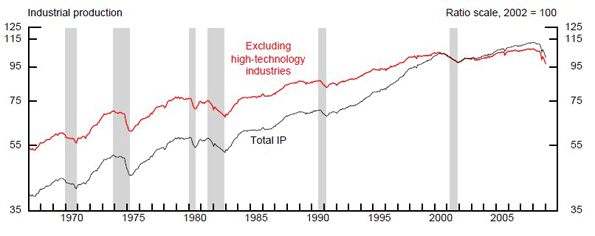
    Beyond this, can we as a country prosper if we don’t actually make things anymore? Some of the fear of manufacturing decline is overblown. Despite large scale job losses in the manufacturing sector, the US has continued to set industrial production records outside of recessions. However, as the chart below from the Federal Reserve shows, industrial production growth flattened significantly in the late 1990s.

    Sadly, manufacturing has been hammered in this Great Recession. There will certainly be a cyclical upturn in output, but restructuring in the automobile industry portends a permanent reduction in domestic output in that sector among others. Unless carefully handled, increasing regulation of carbon emissions, along with the associated energy price rises, will encourage further offshoring to countries with few climate change obligations, such as China, India, Brazil and other developing nations.

    Yet to remain both a prosperous and fair society, the United States must remain a manufacturing power. Manufacturing still provides the traditional route to middle class wages for those without college degrees. It also alone employs 25 percent of scientists and related technicians and 40 percent of engineers and engineering technicians.

    Of course, the next wave of manufacturing will differ greatly from the past. Improvements in productivity and global competition mean a bleak future for large scale, low value-added, routinized production. The era where an assembly plant provided thousands of good jobs at good wages is a thing of the past other than for the lucky few. And where there are new factories, they are often in greenfield locations like the new Honda plant in Greensburg, Indiana – halfway between Indianapolis and Cincinnati – not urban centers. Polluting heavy industry like primary metals and refining really are incompatible with neighborhoods. So what is to be done?

    One answer is to build a new industrial city focusing on small scale craft and specialty manufacturing with high value added. We’re seeing a precursor to this in the rise of organic farming and artisanal products of all kinds. TV shows featuring hip young carpenters renovating homes or gearheads tricking out cars and motorcycles make these professions seem glamorous. Magazines targeted at the global elite like Monocle scour the world in favor of the finest handcrafted products from old school workshops, building demand for these products. The New York Times Magazine recently did an article making the case for working with your hands, and also noted how digitally oriented designers are rediscovering the use of their hands. Perhaps it is no surprise that sociologist Richard Sennett turned his attention to the idea of the craftsman. In short, making things, craftsmanship, and quality are back in fashion.

    The challenge for urban economies is to develop this and put it on a sound industrial and economic footing. One key might be to inspire people to start these craft oriented businesses by tapping into people’s desire to purchase ethical and sustainable products. We increasingly see with foods and other items that people want to understand their provenance, to know who made them, how, with what, and under what conditions. Often today businesses catering to this desire are small scale “Mom and Pop” type operations, but there is no reason they can’t be done at greater scale, or expanded into areas like organic food processing, not just organic farming. American Apparel has done just that by manufacturing low cost, stylish clothing “Made in Downtown Los Angeles. Sweatshop Free.” at scale, for example.

    Beyond craft products, reinvigorating small scale, specialty fabrication and other businesses, to rebuild an American version of Germany’s Mittlesand, creates another, often ignored option for urban economies. Quality, flexibility, responsiveness, and a willingness to do small runs are keys. These businesses can also underpin product companies higher in the value chain. They start building an ecosystem of local companies and expertise that can be useful for related or spin-off businesses. Jane Jacobs, and before her the great French historian Fernand Braudel, noted how cities could incubate many new enterprises because all the diverse products and services they needed were available locally. If you need to scour the globe looking for custom parts and services, it can quickly overwhelm a small business. That’s one reason American Apparel started in Los Angeles, which already had a network of garment producing firms and expertise to draw on. What’s more, these firms might be ideal candidates to take over empty strip mall or other space in decaying inner ring suburbs, helping to solve the “graybox” problem. Even Main St. locations could potentially benefit from businesses beyond traditional boutiques.

    Today these types of specialty firms are often found in America’s largest cities, so they stand to benefit most from this. Smaller cities also need to figure out how to build this ecosystem. The culture needs to change too. Particularly in the Midwest/Rust Belt area, industrial labor has tended towards low skill, repetitive work in larger scale mass production industries. Retraining will be needed for these newer types of businesses, but this is vocational or skill training, not necessarily a college degree. It is a much more tractable problem.

    Not only could this new manufacturing base be a source of urban middle class jobs for the non-college degreed, it would do something arguably more important. It links the fortunes of the new upscale urban residents, the people who are both the customers for many of these products and potentially also the entrepreneurs making them, with that of their less educated neighbors. For many owners, managers, and workers, it might bring into daily contact people who might not otherwise ever interact if one group worked in an office and another in a warehouse. Rebuilding that sense of community and commonwealth, that we are neighbors, fellow citizens, and all in this together, is critical to building a truly sustainable, well-functioning and broadly prosperous society.

    Aaron M. Renn is an independent writer on urban affairs based in the Midwest. His writings appear at The Urbanophile.

  • Farmland Prices: The Cost of Growing A Suburb

    Summer in Minnesota – land of 10,000 lakes — is, for many families, about boating, with the Harley the preferred mode of ground transportation. In winter, snow mobiles are popular. Hunting and fishing replace the corner coffee shops as hangouts. Three car garages are considered a minimum – four even better!

    So how did it come to pass that out-of-control land prices would destroy the economics of housing in this small-town region? And why was the pattern repeated in markets like Las Vegas and Phoenix?

    In the 1980’s the Metropolitan Council in Minneapolis became concerned with sprawl. The MET Council thought Portland, Oregon’s policies to control sprawl by creating an Urban Boundary would be beneficial to the Twin City area, a seven county region. This area is topographically simple: no ocean boundary, and, unlike Portland’s region, no mountain ranges. The MET Council did not anticipate that their attempt to control growth would end up contributing to it.

    Farmers who owned land with sewer capacity outside the boundary knew that its value had just skyrocketed. When a supply — land — is limited, those that control it can name their own price. Within the boundary land was too expensive to develop affordable housing. So cities outside the MET Council’s control began to attract developers. Places that nobody had heard of much: Otsego, Albertville, Elk River, and Hugo are all a very long drive from the Twin City core. These towns had two important components for builders: city sewer and cheap land.

    As the tiny towns outside the Urban Boundary attracted more development, they also attracted the national developers. All of the nation’s Top Ten Home Builders discovered this region. Each year 25,000 or so new homes were built and quickly sold to suburbanites who preferred a 30 to 40 mile commute over living near the city core. (Keep in mind that Minneapolis / St Paul has one of the nicest core areas of a major US city. Even downtrodden sections look pretty nice. And Minneapolis stays alive in the evenings and becomes a social Mecca that is also relatively safe.)

    Much of the escalation in home pricing was due to a bidding war over developable farmland. National builders, using their Wall Street dollars, competed for desirable acreage. If Farmer Fred was able to sell his property for $50,000 an acre, when Roy next door put his farm up, the starting price was $50,000 and the final fee was likely to be $60,000, the starting point of the next site for sale. By 2005 the outer small town land that could have been bought for $12,000 an acre a decade earlier was worth more than 10 times that amount.

    In the past, builders would look at the price of a finished lot, and assume that the house they built on it would cost a maximum of four times the finished lot price; a sort of “one-quarter” rule for land costs. If the lot cost $30,000, they would not build a home that ultimately cost more than $120,000.

    By 2005, if outer suburban land sold for $150,000 an acre and the density (after required park areas, wetlands, buffers, and shoreline zones) was two homes per acre, that meant that $75,000 of a new suburban home was in raw land costs. Add to that $25,000 in construction of roads, utilities, fees, etc, and the lot price skyrocketed to $100,000. Using the one-quarter rule, this meant the builder would need to get $400,000 for the finished home.

    At the 2006 Land Development Today Breakthroughs conference I spoke about our research into the impending market crash and its basis. The market had just begun to show signs of slowdown, and nobody was predicting a big fall.

    Our “study” was based on a comparison of our local housing market in the Minneapolis region with markets where we were working in about 40 States. It involved a simple search of major builders in the top markets. We looked at areas where land prices were escalating much faster than inflation in order to see the common elements. The National Association of Home Builders average national price for a 2,400 square foot average home was $264,000. It should be no surprise that impromptu results indicated the average price of a 2,400 square foot home in Phoenix was $331,000 (20% above average), in Las Vegas $442,000 (40% high), and in the Minneapolis suburbs $349,000 (25% high).

    Weather was not one of the common elements. But all three areas — Las Vegas, Phoenix, and the Twin Cities — had explosive growth for two decades until 2007 (2006 for the Twin Cities), and all three had most, if not all, of the nation’s Top Ten Home Builders selling and building.

    In March of 2005 one of my clients made me an offer. If I convinced a certain farmer to sell, I would receive not just the planning fees, but also 5% of the profits. The land in question was about an hour’s drive from the urban core during rush hour traffic. I looked at the site and took out the slope restriction, the Department of Natural Resources tiers, the wetlands, the buffers, and the land that was otherwise not buildable, including the rolling surface areas that resembled more Moto-Cross course than residential developable land.

    The cost for the remaining buildable area would have been about $300,000 an acre. The numbers simply did not work out. Land prices had reached the breaking point. Since there was no possible way to profit, my 5% of zero would still be zero. I suggested that my client not do the deal, and saved him from financial ruin.

    It’s easy to make Government the scapegoat. Even though the MET Council set in motion policies that likely caused sprawl by trying to curb it, it was not the cause of land prices going out of control. All the major developers with their deep pockets outbidding each other for over a decade was what did the economics in. Today, housing prices in the Twin City market have plummeted to a more realistic point that is about what the national average was in 2005.

    Five years before the crash many actually believed that high land prices were a sign of a great economy. Well guess what? They were wrong.

    Rick Harrison is President of Rick Harrison Site Design Studio and author of Prefurbia: Reinventing The Suburbs From Disdainable To Sustainable. His websites are rhsdplanning and prefurbia.com.