Tag: Heartland

  • Is Your City Safe From The Tech Bust?

    A decade ago, the path to a successful future seemed sure. Secure a foothold in the emerging information economy, and your city or region was destined to boom.

    That belief, as it turned out, was misguided.

    In the decade between 1997 and 2007, the information sector–which includes jobs in fields from media, publishing and broadcasting to computer programming, data processing, telecommunications and Internet publishing–has barely created a single new net job, while some 16,000,000 were created in other fields.

    The biggest losses have been in the telecommunications sub-field, which has shed 400,000 jobs nationwide since its peak in 2000. Not surprisingly the media and publishing industries have also lost ground, while employment in other arenas such as motion pictures, software and data-processing have remained stagnant for much of the decade.

    Equally critical, it seems clear that simply being a high-tech magnet does not make a region a prodigious job creator. The San Jose metropolitan area, better known as the heart of Silicon Valley, boasted over 960,000 jobs in 1997. Last year, even after the ballyhooed Version 2.0 of the dot-com boom, that number had actually declined–to barely 900,000. According to figures from economic-strategy firm Praxis Strategy Group, other traditionally tech-heavy areas, including San Francisco and Boston, also did poorly in terms of growth through the balance of this decade.

    Perhaps most disturbing, many areas are also losing their share of the information industry. For example, the information-sector job count, notes the Public Policy Institute of New York, has actually been stagnant or in decline in places like New Jersey, Connecticut, Illinois, Massachusetts, Minnesota and New York.

    The same pattern also affects so-called “cool” cities that were supposed to be ideal for high-tech jobs, according to a recent study by my colleagues at Praxis. The biggest declines in information jobs since 2000 have occurred in San Francisco (which lost 31,800 jobs), Northern Virginia (35,200) and Washington, D.C. (40,700).

    Silicon Valley dropped 5,400 positions since 2000, which amounts to 11.6% of all its information-sector jobs. The only bright spot for blue states is in Washington, where growth is driven by big employers Microsoft and Boeing. Los Angeles, buoyed by the relatively stable entertainment sector, has also managed to hold its own.
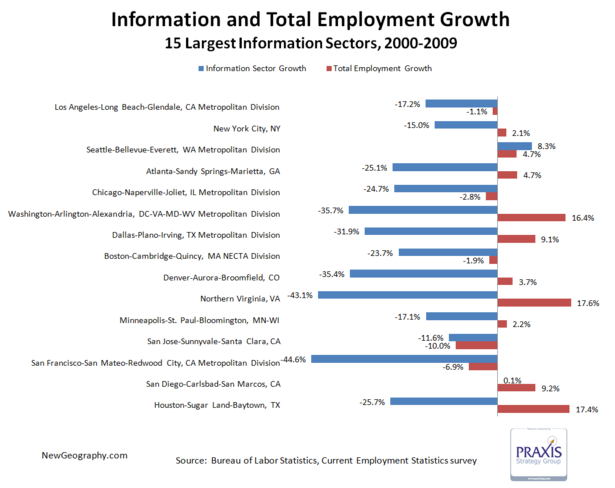
    Faced with all these cities that are merely struggling not to lose any jobs, just where is the tech-sector growth? It’s in less-celebrated areas of the country, like Idaho, New Mexico, North Carolina, Nevada–and in parts of Florida, South Dakota and South Carolina. By region, the fastest gainers turned out to be places like Orlando, Fla. (with 2,176 new information jobs since 2000), Madison, Wis. (2,400), Boise, Idaho (1,500), Wilmington, N.C. (1,267) and Charleston, S.C. (1,033).

    What distinguish most of these places are factors beyond prominent employers. These could include such prosaic things as tax rates (particularly on incomes), the cost of housing and the overall climate toward business. Information-sector jobs, it turns out, follow the basic rules of economic development seen in other industries.

    Of course, this is not to say tech jobs don’t matter. As the Milken Institute’s Ross DeVol argues in his new study of high-tech centers, technology jobs pay better than most, and their presence can boost other parts of local economies. And although they may not be multiplying fast, in some centers, like Silicon Valley, Boston and Southern California, whatever employment already exists has enough inertia to allow them to remain the largest tech centers in the country.

    Yet the problem is that the information economy, by itself, simply doesn’t reliably spur broader economic growth. That may be due to changes within the sector itself. From the 1980s to the mid-1990s, tech firms largely focused on creating productivity-enhancing products. Many of them also used on-shore manufacturing. Aerospace was a smaller industry, but it was still vital.

    These catalysts helped create dynamic companies that both employed large numbers of people directly and used contractors (whose numbers increased). The Silicon Valley I reported on in the mid-1980s housed an essentially industrial economy with many good jobs for middle- and working-class people. It was both a hotbed for pioneering entrepreneurs and a society that offered and encouraged opportunity.

    Today, however, tech has become increasingly software- and media-oriented. New companies tend to emerge from a small pool, and they are financed by a relative handful of local venture capitalists. Once launched, they may conduct some research and development at home, but marketing and customer service are either off-shored or moved to remote locations like the Great Plains or the “Intermountain West,” between the Cascades and the Rockies.

    As a result, even star companies like Google create a far smaller number of jobs than predecessor firms like Hewlett Packard, Intel or IBM. And even newer companies like venture darling San Francisco-based Twitter may go public, valued at $250 million or more, with only 45 employees.

    This, of course, represents very good news for a select few: investors and a handful of highly educated software engineers. But the Bay region’s broader economy and society isn’t as lucky.

    That’s because most segments of the information sector that do create lots of jobs tend to take place elsewhere. For example, when Intel considers opening a new chip plant, which could open up 7,000 new positions, it won’t build it in the Valley of its birth but rather in farther-flung locales like Oregon, Arizona and New Mexico. California has become too expensive; businesses there are heavily regulated and taxed for most industrial activity.

    So maybe it’s time to unlearn some of the assumptions we developed during the first tech boom. In the 1990s and early 2000s, many held that the information revolution would tame the business cycle, guarantee constant high returns and create widespread prosperity. Now we know better.

    The model of Silicon Valley, as DeVol suggests, cannot be easily duplicated. Another well-promoted formula, linking great universities to up-and-coming hip cities for the so-called “creative class,” has proved very limited when it comes to creating new jobs. And, anyway, trends in tech growth suggest that basic economic conditions like general affordability, taxes and the regulatory environment play an important role.

    Just as troubling may be the class divisions on display in places like Silicon Valley. As manufacturing and middle management jobs have fled, its capital, San Jose, has become more of a backwater. As local blogger Adam Mayer has pointed out, San Jose increasingly serves as a dormitory for the bottom-feeders of the Silicon Valley food chain.

    In contrast, tech power and influence is shifting to those areas that have always been well-to-do and are likely to stay that way–academically-oriented places like Cambridge, Palo Alto and San Francisco. They are becoming ever-more-exclusive reserves for the restless young and those with the greatest talent within the media and software industries. Meanwhile, the service class commutes in from the surrounding periphery to tidy up and run restaurants, while high housing costs and an overall lack of opportunities for other kinds of workers drive away much of the middle class, particularly families.

    In geographic terms, the real losers in this brave new tech world may be the communities on the fringes of those high-end tech areas. Take Lowell, Mass. Lowell, a former mill town widely celebrated for its tech-led revival in the 1980s, has seen little job growth since the late 1990s. But why pick Lowell, when it’s far cheaper and easier to expand in Boise or, even better, Bangalore, India?

    The time has come to let go of vintage fantasies about tech that date from the 1990s. Key regions–and the country as a whole–need to understand that the information sector is best seen not as an end in itself but as an industry that derives its value from how it works with other parts of the economy, such as finance and business services, agriculture, energy, manufacturing, warehousing and engineering. (Manufacturing alone employs 25% of the U.S.’s scientists and 40% of its engineers–and their related technicians.) We have to nurture a broad industrial base so that innovations in this sector do not simply end up boosting off-shore industry.

    Techies won’t save us from the folly of deindustrialization; in essence, we can no longer believe that it’s possible to Google our way to prosperity.

    This article originally appeared at Forbes.

    Joel Kotkin is executive editor of NewGeography.com and is a presidential fellow in urban futures at Chapman University. He is author of The City: A Global History and is finishing a book on the American future.
  • The Successful, the Stable, and the Struggling Midwest Cities

    The Midwest has a deserved reputation as a place that has largely failed to adapt to the globalized world. For example, no Midwestern city would qualify as a boomtown but still there remain a diversity of outcomes in how the region’s cities have dealt with their shared heritage and challenges. Some places are faring surprisingly well, outpacing even the national average in many measures, while others bring up the bottom of the league tables in multiple civics measures.

    Let us examine the health of various cities, using population growth as a heuristic proxy for overall civic health. Looking at population change from 2000 to 2008, we will classify a city as “successful” if its metro area population growth exceeded the national average growth rate of 8% during that period, as “stable” if it had a population growth rate between 3% and 8%, and as “struggling” if its growth was less than 3%. Let us also put Chicago into its own category of “global city”. It is simply one of a kind in the Midwest, a colossus of nearly 10 million people, and not easily measured against the other cities. Indeed, it is really three cities in one, a prosperous urban core, an archipelago of successful upscale suburbs and edge based growth to the west and north, with a sea of deteriorating city neighborhoods and stagnant to declining suburbs surrounding them. On our scale, Chicago would be “stable” – its inner core has grown but the city overall has lost population, while the outer ring has grown strongly. As a region, it has grown somewhat below the national average.

    Here are the results of our tiering, including all cities in the Midwest* with metro areas exceeding 500,000 in population:

    Global City
    Chicago (5.2%)

    Successful Cities
    Des Moines (15.6%)
    Indianapolis (12.5%)
    Madison (11.9%)
    Columbus (9.9%)
    Kansas City (9.0%)
    Minneapolis-St. Paul (8.8%)

    Stable Cities
    Cincinnati (7.2%)
    Grand Rapids (4.9%)
    St. Louis (4.4%)
    Milwaukee (3.2%)

    Struggling Cities
    Akron (0.5%)
    Detroit (-0.6%)
    Dayton (-1.4%)
    Toledo (-1.5%)
    Cleveland (-2.8%)
    Youngstown (-6.1%)

    These tiers, based only on a single criterion and arbitrary boundaries, nevertheless basically conform to how these cities are performing both economically and in terms of perceptions.

    A few interesting things emerge:

    1. There are a surprisingly large number of Midwestern cities that are growing faster than the US average population. This indicates pockets of strength, in its larger metros at least, seldom associated with the Midwest.
    2. The clear dominance of the successful list by state capitals. This is so pronounced that I have put forth what I call the “Urbanophile Conjecture”, which is that if you want to be a successful Midwestern city, it helps to be a state capital with a metro area population of over 500,000. The only successful city on the list that is not a state capital is Kansas City.
    3. The 500,000 barrier seems to be important as well. The state capitals below that threshold – Lansing, Springfield, and Jefferson City – would not qualify as successful on this list. Note too that the presence or absence of the major state university does not appear to be a decisive factor. Des Moines and Indianapolis are not home to their states’ flagship universities. The home of the academic powerhouse that is the University of Michigan is the Ann Arbor metro area, which was not included in this list because its population is only about 350,000. Notwithstanding, its growth rate would have put it into the stable category.
    4. In a region in which there is such divergence between the performance of cities, a diversity of city specific policies are required. There is no one size fits all for the Midwest. There may indeed be a base of pan-Midwest policies worth pursuing – improvements in education, attractiveness to migrants, better conditions for innovative entrepreneurship, etc – but successful approaches will be those most tailored to uniquely local conditions. For example, a state capital or University town may have different needs than a place that has neither.

    Some suggested areas to investigate by city tier are:

    • Chicago. How can it ease the gap between the thriving global city of Chicago – largely located around the Loop as well as the northern and western suburbs – and the parts of the region that are falling behind, largely the western city neighborhoods and southern edge of metropolis? How do you do this without sacrificing its overall competitiveness? Can the policies appropriate to each be reconciled?
    • Successful Cities. Their policy focus should be on maintaining favorable demographic and economic conditions, and dealing with decaying areas of their urban cores and the potential for decay in some inner ring suburbs. Should the civic aspiration be desirous of it, tuning the engine to attempt to shift the growth rate into high gear to target a profile closer to the Sunbelt boomtowns would be a further focus area. Each city would need to examine which specific policy levers it could pull to attempt to do this. Clearly modernizing and expanding infrastructure to keep up with growth in these places and maintain their high quality of life is a clear imperative.
    • Stable Cities. Their challenge is to bring growth rates up to average or above average levels. It would be worthwhile for them to study the successful areas, and ask what policies and approaches might be adopted. Kansas City offers the best encouragement here. It has managed to maintain a strong growth rate despite not being a state capital and being part of a bi-state metro region. Kansas City features lows costs, high quality of life, a relatively stable housing marketing, and a pro-business culture. It is clearly a standout and worthy of further study for that reason. It may hold the key for moving the stable cities up into the successful tier. Geographically, it is notable that Kansas City is a border state on the far edge of the Midwest, and could arguably be called a Great Plains city. Is that a factor? Some type of peer city comparison with the successful cities, and especially Kansas City, might be warranted here.
    • Struggling Cities. Unfortunately, there isn’t a magic bullet to solve the long festering problems in these places. All of them were heavily industrialized and have borne the brunt of globalization, particularly in manufacturing. This is especially the case in cities linked to the domestic automobile industry, which is clearly in a state of crisis. Until the automobile industry completes its restructuring, and out migration right sizes some of these areas, there does not seem to be a clear path to restart growth. Youngstown, which brings up the bottom of our league table, perhaps offers the best road forward. It is trying to right-size itself to a permanently smaller, but more sustainable, future population based on an aggressive controlled shrinkage plan that has received extensive national notice. This type of plan is likely something all of these cities need to be actively considering as the large fixed costs support a population base that no longer exists will become increasingly unaffordable as the population further shrinks. These cities likely also will need special state and federal help to back this shrinkage plan.

    * The Midwest is defined as Illinois, Indiana, Iowa, Michigan, Minnesota, Missouri, Ohio, and Wisconsin.

    Aaron M. Renn is an independent writer on urban affairs based in the Midwest. His writings appear at The Urbanophile.

  • Let’s Snooker The TARP Babies

    Snook, Texas, a town of less than 600 souls, is best known for being the home of Sodalak’s Country Inn, the originator of country fried bacon. It may seem an odd place to launch a return to financial health, but that’s exactly what Dean Bass has in mind.

    Bass, a veteran banking entrepreneur from Houston, in November bought the tiny First Bank of Snook as part of his plan to build a new financial powerhouse amid the worst economic downturn in a generation. The old bank, which also had a branch 15 miles away in College Station, home to Texas A&M, provided Bass with his charter, as well as access to a strong market on the far periphery of his home town.

    Since buying into Snook’s bank, now renamed the Spirit of Texas Bank, Bass opened a new branch in the Woodlands, northwest of Houston. Over the past six months, the new bank’s assets have doubled to over $70 million, and by the end of the year he expects to break $100 million. Longer-term plans include expanding as well into Austin, Fort Worth and other major Texas markets.

    Bass’ basic strategy: Take advantage of the stumbling TARP-funded banking giants and steal what he calls their “disenfranchised customers.” This approach has implications well beyond the Lone Star State. Like other successful community bankers across the country, Bass believes that the mega-banks have been hopelessly tarred by TARP taxpayer funds. They have been revealed to be, if too big to fail, also too incompetent and poorly run to trust.

    “This is one of the worst banking markets I have ever seen–but the best for people like me,” said Bass, who sold his last venture, Houston-based Royal Oaks Bank, for $38.6 million in 2007. “When else would you see A+ customers fleeing places like Bank of America, Chase and Citi? People can’t even understand their balance sheets and stress tests. Their customers are ready to move on.”

    Over the next few years, the emergence of banks like Spirit of Texas could prove the silver lining in the largely bungled Bush-Obama bail out of the big financial companies. Ironically, the attempt to shore up the mega-dinosaurs has revealed these mega-banks to be creatures of little brain and even less principle. They now seem more akin, as economist Simon Johnson has pointed out, to Third World crony capitalists than paragons of free enterprise.

    In comparison, independent, non-TARP banks like the Spirit of Texas appear like paragons of traditional capitalist virtue and homespun values. For the time being, their rise will be most notable in “the zone of sanity,” the vast range of territory between south Texas to the Great Plains, which largely resisted the housing and stock asset bubbles of the past decade.

    In this region, most homes are well above water and many businesses–in everything from agriculture and energy to manufacturing and high-end business services–remain on solid footing. Of course, notes Randy Newman, president and CEO of Grand Forks, N.D.-based Alerus Financial, many local companies have been slowed by the recession. However, for the most part, places like the Dakotas and Texas enjoy relatively low unemployment and foreclosure rates, making them relatively good places for cultivating new customers.

    Politics and a sense of propriety also may play a role for resurging community banks. In places like the Great Plains, people prefer old-fashioned shots of banking fundamentals to the exotic financial cocktails concocted by the “genius” financiers on the coast. Politicization of banking is even less popular than elsewhere.

    “For the government to come out and stimulate the economy seems OK, but you think, jeepers, this TARP business makes little sense,” says Newman, whose bank enjoys assets of roughly $750 million. “TARP,” he adds, “is simply prolonging or delaying what has to happen. The walking dead will have to die sometime.”

    Uncertainty about the big banks, Newman believes, is leading customers, particularly smaller firms, to rediscover the merits of old-fashioned relationship banking. At banks like his, each loan is scrutinized not only by formula but also by things such as character, markets and a firm’s record of accomplishment.

    “The big banks will tweak their standards system-wide. There are no individuals in their book,” says Newman.” The big banks are geared to mass markets and big customers. But if you are looking at the $1 to $5 million loan a small business wants, the big bank does not look at you as an individual.”

    This up close and personal approach may seem laughably archaic to the once-celebrated “genius” quant jocks and bonus baby M.B.A.s on Wall Street–and perhaps also the brainy financial types running the Obama economic team. Yet if a sustainable private sector economic recovery is to take hold, the key may well lie with smaller bankers who can help small firms survive the recession

    Of course, the administration’s favoritism of the big boys also creates some real problems to community banks. Some fear the mega-banks will use TARP funds to acquire better-run, local institutions. Newman calls this prospect a “travesty.” Given their awful real balance sheets, Newman believes, banks like Citicorp and Bank of America “really shouldn’t be in a position to grow, much less expand.”

    So here’s a better course. Let these giants shrink or even fail. Let their insured depositors seek out new banking relations; with the stronger, well-run community banks. It’s widely believed that some 500 to 1,000 smaller banks may fail in the next year or so, so why not some big boys, too?

    Many economists, both right and left, including Nobel Prize winner Joseph Stiglitz, have urged this course. It would pave the way for well-run banks to expand at the expense of the incompetent and venal. Competition, after all, is supposed to be the basis of capitalism.

    Right now, the zone of sanity probably offers the best chance for this capitalist revolution. However, the shift to smaller banks may prove even more important in reviving the epicenters of lunacy, such as my adopted home state of California. Here, little banks like the privately held Montecito Bank and Trust are quietly expanding as customers leave the TARP babies for an institution a little more personal and grounded in sound banking principles. “Better boring than broke,” jokes Janet Garufis, Montecito’s president and CEO.

    It also helps to be local, she notes, even in a mega-state like California. Much of the damage to the TARP banks came when they bought into sliced and diced mortgages in locations they didn’t know. It turns out that local knowledge counts–not only in real estate, but in deciding about the right business to back.

    “The differences between a big-box bank and community are the difference of night and day,” suggests Garufis, who spent 35 years with Security Pacific, a onetime L.A. area powerhouse. “People like to see the whites of the eyes of the people they are doing business with. We know the community. We are part of it, and we understand what is going on here.”

    Of course, being local, smart and disciplined may not be enough for all these upstart banks. The failures of the mega-banks have increased the costs of things like FDIC insurance for even well-run institutions–in Montecito’s case, from $400,000 to $1.2 million over the past year. Equally challenging, TARP funds are helping the big boys offer slightly higher rates for mass-market products like CDs.

    Rather than focus on saving their Wall Street friends, the administration needs to allow an upsurge in smarter, smaller and better-run banks. Let us give these grassroots capitalists a chance and see what they can do.

    The road to a financial and economic recovery does not run through Wall Street and K Street, which, after all, are the primary originators of our distress. It lies in places that look more like Snook–even if country fried bacon is not to your taste.

    This article originally appeared at Forbes.

    Joel Kotkin is executive editor of NewGeography.com and is a presidential fellow in urban futures at Chapman University. He is author of The City: A Global History and is finishing a book on the American future.
  • Who will win the Car-wars?

    General Motors, the venerable American auto manufacturer is sitting on the cliff’s edge in North America with a recent 3-month loss of $6 billion. However, GM watched its sales in China skyrocket 50% for the month of April, 2009. Ironically, Toyota, the company many Americans now cheer for, has posted a $7.7 billion loss for the first quarter.

    This now proves, without a doubt, that the auto industry – not just in the US – is going through a massive crisis. But it’s clear that American manufacturing has reached a critical, historical turning point. What was once good for General Motors is no longer good for the rest of the nation. The days are gone where an automobile must be designed in the Detroit region and manufactured in the Great Lakes. We have seen a shift in trade and production location from the north to the south. However, geographic arguments are only a small part of the overall challenge to the industry, especially in North America.

    When the dust settles, what will the American auto industry look like?
    Regardless of what some may say, there is no such thing as an “American” vehicle anymore. We are fast shifting into a global economy that requires the sharing and collaboration of multinational resources from across the globe. Consumers demand quality products at very affordable costs. Corporations have no choice but to comply with consumer demand even if it means off-shoring production and even trimming quality in order to save money. In many ways, this is the Wal-Martization of consumer goods.

    The 21st-century automotive industry will be geographically spread throughout North America. Modern technology allows engineers to work from just about any location regardless of population, climate or infrastructure. However, many engineering outfits have found that locating brainpower in dynamic places improves quality and innovation. A dynamic place is a place where the educated and skilled want to work. These includes places like southern California (where most of the design studios are located), Ann Arbor, Austin, and others.

    In the 1980s the Midwest watched the southern states gear up and recruit non-Detroit manufacturers, in large part due to the lack of unions in the land of Dixie. We have seen the southern United States explode in production and manufacturing capability. The two main reasons for this were lack of unions in the South as well as tax-payer funded incentives. However, the idea of receiving incentives from the public coffer can backfire.

    Just about every state offers some form of tax breaks or incentives to corporations looking to construct new facilities. Every large corporation now looks to the state where they can get the most incentives. Everything else, such as skilled workforce, distribution, infrastructure – that all comes secondary. In many ways, this is just an example of robbing Peter to pay Paul. And it doesn’t work. You cannot simply take tax dollars from one area of the state and pour them into another region with the long-shot hope that an industry will grow in that certain region. This is exactly what Tennessee is doing.

    However, the southern states have struggled and will continue to struggle to attract brainpower and engineering talent. What the American public doesn’t realize is that there is a lot more to the creation of a vehicle unit than mere assembly. Besides production, there is fabrication, engineering, design, testing, marketing, legal, and distribution. Even today, much of the world’s automotive intelligence and engineering is located in Southeast Michigan. This fact irks southern powerbrokers who have been so successful at bringing grunt work to their states.

    We will continue to see massive amounts of automotive-related manufacturing relocate to Mexico due to the extremely low cost of production. Many of the Japanese and German manufacturers are already starting to notice the negative consequences of setting up production facilities in the United States. Nissan, Toyota and Honda have all initiated cuts and hiring freezes in their American manufacturing facilities. These companies have also initiated major contact employee programs rather than hire full-time fully-hired help.

    So what happens now in the old auto belt? Certainly, Ohio as well as Michigan must figure out how they can re-deploy their engineering talent. Each seems to graduate a huge number of students year after year but this tends to benefit other places. States such as Wyoming, Arizona, Washington, and others have held job fairs in Michigan in order to gain talent. If there are no jobs in Michigan, why do they keep graduating so many students?

    Even without George Bush and the GOP in power, Texas seems also to be a big beneficiary of this brain drain. But for how much longer can this continue? Remember Texas went bust in the early 1980s with low energy prices. It could happen again.

    Another natural winner in the car-wars could be the southern states, but only once they consolidate their efforts to bring knowledge and engineering to the South. It is much easier to offer incentives for a production facility than to woo an engineering lab.

    Critically, there still seems to be a lack of emphasis on higher education in the south. Even the best universities in the South cannot fully compete with the universities in the Midwest from a technical standpoint. Institutions such as Michigan, Wisconsin, University of Chicago, Michigan State and Indiana are still levels above the universities found in Kentucky, Tennessee and Georgia. The Midwestern schools built their solid knowledge and research background over a period of decades. This cannot easily be duplicated.

    To be sure, the auto-dominated economies of Michigan and Ohio will be shrinking in the future. These states are shedding their manufacturing sectors while reinforcing their knowledge-based sectors. Over time they may find it much easier to morph into a knowledge-based economy by using previous know-how than to build a knowledge economy from scratch. Michigan, for example, may have been hit hard by this global schism in manufacturing, yet it has been left with the know-how and knowledge left over from industry in the form of a strong university system. In contrast, nowhere in the south can we find that.

    In conclusion, some individual Midwestern cities may come out of this crisis better than many expect. Younger workers in the future will look at specific towns such as Madison and Ann Arbor, which offer an excellent quality of life, rather than head off to the sunbelt. This may be particularly true as they enter their 30s and look for a good place to raise their children, hopefully close to grandparents. The Midwest may be down, but not all of it is out – far from it.

    Amy Fritz was born in Cambridge, England during World War II. Her mother was a seamstress and her father a pilot with the RAF. Her uncles worked in various capacities within the British automobile industry and her father became an engineer and professor.

    After studying engineering at Cambridge, Fritz developed an interest in automobiles and went to work for a now defunct automotive supplier. Her occupation took her to Europe, Asia and North America, where she eventually settled as a technical engineering contractor for various auto-related companies. She is now semi-retired and living in the Denver area.

  • New Towns and New Lives in the Country

    Back in the 1950s when I was growing up, pundits worried a lot about automation and the problem of leisure in a post-industrial society. What were the American people going to do once machinery had relieved them of the daily burden of routine labor? Would they paint pictures and write poetry? Armchair intellectuals found it hard to imagine.

    It was the age of Ozzie and Harriet, when ordinary working and middle-class families could aspire to a house in the suburbs and a full-time Mom who stays at home with the kids. Today, of course, that popular version of the American dream is a thing of the past, especially the part about a full-time Mom who stays at home with the kids.

    Ironically it was washing machines and automatic dishwashers – automation – that brought this idyll to an end. These two labor saving devices made it possible for housewives to go out into the workforce and compete with their husbands. At first they did it because they were bored at home and wanted to earn extra money, if only to help pay for those new household appliances. Gradually, however, it became a matter of necessity as two-paycheck families bid down wages even as they jacked up the price of suburban real estate in areas where the schools were good and the neighborhoods safe. By the time you subtracted the costs of owning a second automobile and using professional child care services, the advantages of that extra paycheck had largely disappeared.

    The biggest surprise – to me as well – was that labor-saving technologies do not automatically redound to the benefit of labor. Other things being equal they reduce the demand for labor and hence its price in the marketplace. We saw this happen in the 19th century when modern agricultural machinery forced three-quarters of the population off their farms and into the cities, where they had to compete with immigrants and each other in the new industrial economy. Not until the Fair Labor Standards Act of 1937, which outlawed child labor and established the 40 hour work week, did the world of Ozzie-and-Harriet become a democratic possibility.

    But of course Modern Marvels never cease. Thanks to a never-ending supply of new labor-saving machinery, today’s industry employs only half as many people as it did in the 1950s when housewives first started entering the job market. Meanwhile medical science has greatly extended the average human lifespan, which has created a much larger pool of able-bodied adults who must either work or be supported by those who do. The Wal-Martization of retail and wholesale trade is yet a third development tending in the same direction.

    Given this trajectory, perhaps it is time to consider a further reduction of the standard work week and the creation of new forms of suburban development. The goal would be for ordinary working families to begin enjoying the fruit of fifty years of economic and technological progress.

    In particular let us consider the advantages of a program to build new towns in the exurban countryside in which people would be employed half-time (18-to-24 hours a week) outside the home, and in their free time would participate in the construction of their own houses, cultivate gardens, cook and eat at home, and look after their own children (and grandchildren) in traditional neighborhood settings close to village greens.

    Once work and leisure are integrated into the fabric of everyday life people will not feel the same need to retire they do today. Instead of retiring in their sixties seniors could take easier jobs as they grow older and continue working for as long as they are able and willing. The Social Security crunch could be relieved without having to raise taxes on the younger generation.

    We might even consider a return to the three-generation form of the family – except under two roofs instead of one, say, at opposite ends of the garden. Grandparents could use their savings to help their children with the initial purchase of their homesteads, while later on their children and grandchildren could help care for them in their old age, providing a more humane (and far more affordable) alternative to nursing homes and assisted-living arrangements.

    And instead of being designed around high-speed automobiles the new towns could be small enough (25,000 to 30,000 inhabitants) and be laid out in such a way that the residents could get around on foot, by bicycle, or in “neighborhood electric vehicles” (souped up golf carts) designed to go 30 mph. In other words, with careful planning the efficiencies of urban density could be realized without forcing people to move back into the dense centers of our cities and surrounding both privacy and space.

    I once hired the Gallup Organization to survey the American public about a lifestyle similar to this. The question asked was the following:

    “As a new way to live in America, it has been suggested that we build our factories in rural areas outside the cities and run them on part-time jobs. Under this arrangement both parents would work six hours a day and three-days a week and in their spare time would build their own houses, cultivate gardens, and pursue other leisure-time activities. How interested would you be in living this way?”

    Forty percent of the population said they would be either “definitely” or “probably” interested in the idea, with another 25 percent expressing possible interest. Included in these figures were two-thirds of those who had attended college, 60 percent of people with incomes in the top quartile, and 80 percent of African Americans.

    Industries might be interested in the idea because part-time workers can work faster and more efficiently than full-time workers, just as in track and field the short-distance runners always run faster than the long-distance runners. When I explained this in a letter to one of America’s leading industrial relocation firms, the executive vice-president flew down to Tennessee the very next day to discuss it with me. He assured me that this was “a doable idea” and not “pie in the sky.”

    Even so building New Towns in the Country is no easy task. It won’t happen spontaneously if for no other reason that people will not move to places where industry does not exist, and industry will not move to places where people do not live. It takes coordination, planning, organization, and investment in infrastructure.

    There is a movement afoot in America for a new nation-wide infrastructure spending program. This proposal could be one part of it. After all, our federal government in the past has done things for the people to create a better way of life: the trans-continental railroad, the Homestead Act, the Interstate Highway System, the Fair Labor Standards Act, and the FHA.

    New Towns in the Country and a much shorter work-week would work well together, even if the two things are impossible to achieve by themselves. We need to reorganize both time and space if we hope to create a healthy, productive way of life for tomorrow’s working families.

    Luke Lea is a retired landscape gardening contractor and one-time professional carpenter. A graduate of Reed College, he lives in the small town of Walden, Tennessee, near Chattanooga where he was born.

  • Main Street Middle America: Don’t Get Mad, Get Ahead

    Like many on Main Street Paul Goodpaster is angry. Paul is my banker friend in Morehead, a retail, medical and education hub on the edge of eastern Kentucky. He observed that his bank was doing quite well – albeit hurt now by rising unemployment and an economy starting to have an impact even on those unglamorous places that had minded their business well.

    “If only some of those ’experts‘ would get out of their inside-the-beltway heads and visit with me here in Morehead, I’d give them ideas on how this October disaster could have been averted. “Too big to fail,” he scoffed. “It should be about too big to have been allowed to do business and thus too big not to fail!”

    So, what can forgotten middle America do about all this mess? Anger won’t get it; and self pity is a waste of time. Only by developing the “swagger” of elbowing our way through the noise can we hope to be heard. We still hear the cacophony of all the blither and blather coming out of the well-connected east coast crowd. Cutting through means learning how we in the “flyover“ zone can position ourselves in the national and global economy.

    The world most assuredly did change – likely in perceptible ways prior to but with an exclamation point in October. In November “we” – with more than a few exceptions in the south and middle country – elected a president that exemplified our hopes and dreams. He was touted as a guy who understands cities and community life better than any in modern history.

    But, all that being said, middle and certainly southern and Appalachian America did not vote for the president. We are a long way – in our economy, our habits and our viewpoints – from Chicago. We are the home of coal and factories and small places far out of the way.

    Our outlook, on the surface, could not be worse. As a community we are out of power and also perhaps out of favor. Yet the world changed for us as well and opportunity abounds for those who are willing and able to fight back. We discovered that (1) we are interdependent with the global community no matter where we are; (2) that the experts don’t all graduate from Harvard and Yale – note the Greenspan bewilderment in October, 2008 and (3) that a new kind of sensibility is emerging.

    As the world grows bewilderingly out of control, people will be seeking places that are affordable and welcome growth. That is where middle America comes in.

    We will have something close to another 100 to 120 million more people in this country by the year 2050. Conventional wisdom would have it that they will all move to glamorous, hip and fast places. But not so fast on that theory. A visit to Owensboro, Kentucky yields a different answer. Set on the Ohio River across from Evansville, Indiana, Owensboro is a town with a unique DNA that has been preserved over the years. With high performing schools and a rich tradition of civic activism, they are planning a major “quality of life” initiative that the Mayor Ron Payne describes as something aimed squarely at children and grandchildren – a statement that bucks the “all about me era.” Owensboro, with a diverse economy that never rode the wave of the “bubble” always minded its Ps and Qs. He is building walking and bike trails and bolstering a downtown that he describes as the living room to the community.

    Owensboro is also home to a world class performing arts center headed up by Zev Buffman, a master producer of over 40 Broadway plays, who made Owensboro his home after visiting the arts center and appreciating its high quality. Zev has convinced Broadway of the wisdom of “staging” plays in Owensboro at a fraction of New York City prices. What is the advantage to Owensboro? Young people can see first hand that life in middle America is not the same as being banished to the boonies. It can also be enriching and connected. As one young man put it: “I can get started earlier in owning a business in a place like Owensboro that would take years or never happen in one of the mega cities where I would just be a cog in the machinery.”

    In middle America, we need to learn that nothing is predictable. But we should have more confidence that we can build expertise at home. People like Mayor Ron Payne and Zev Buffman have taken their entrepreneurial spirit and applied it to an emerging new frontier of America’s battered small- to mid-sized cities in the middle of the country. It’s time for this portion of America to stop getting mad, and start getting ahead.

    Sylvia L. Lovely is the Executive Director/CEO of the Kentucky League of Cities and the founder and president of the NewCities Institute. She currently serves as chair of the Morehead State University Board of Regents. Please send your comments to slovely@klc.org and visit her blog at sylvia.newcities.org.

  • Where are the Best Cities for Job Growth?

    Over the past five years, Michael Shires, associate professor in public policy at Pepperdine University, and I have been compiling a list of the best places to do business. The list, based on job growth in regions across the U.S. over the long, middle and short term, has changed over the years–but the employment landscape has never looked like this.

    In past iterations, we saw many fast-growing economies–some adding jobs at annual rates of 3% to 5%. Meanwhile, some grew more slowly, and others actually lost jobs. This year, however, you can barely find a fast-growing economy anywhere in this vast, diverse country. In 2008, 2% growth made a city a veritable boom town, and anything approaching 1% growth is, oddly, better than merely respectable.

    So this year perhaps we should call the rankings not the “best” places for jobs, but the “least worst.” But the least worst economies in America today largely mirror those that topped the list last year, even if these regions have recently experienced less growth than in prior years. Our No.1-ranked big city, Austin, for example, enjoyed growth of 1% in 2008–less than a third of its average since 2003.

    The study is based on job growth in 333 regions–called Metropolitan Statistical Areas by the Bureau of Labor Statistics, which provided the data–across the U.S. Our analysis looked not only at job growth in the last year but also at how employment figures have changed since 1996. This is because we are wary of overemphasizing recent data and strive to give a more complete picture of the potential a region has for job-seekers. (For the complete methodology, click here.)

    The top of the complete ranking–which, for ease, we have broken down into the two smaller lists, of the best big and small cities for jobs–is dominated by one state: Texas. The Lone Star State may have lost a powerful advocate in Washington, but it’s home to a remarkable eight of the top 20 cities on our list–including No. 1-ranked Odessa, a small city in the state’s northwestern region. Further, the top five large metropolitan areas for job growth–Austin, Houston, San Antonio, Ft. Worth and Dallas–are all in Texas’ “urban triangle.”

    The reasons for the state’s relative success are varied. A healthy energy industry is certainly one cause. Many Texas high-fliers, including Odessa, Longview, Dallas and Houston, are home to energy companies that employ hordes of people–and usually at fairly high salaries for both blue- and white-collar workers. In some places, these spurts represent a huge reversal from the late 1990s. Take Odessa’s remarkable 5.5% job growth in 2008, which followed a period of growth well under 1% from 1998 to 2002.

    Of course, not all the nation’s energy jobs are located in Texas, even if the state does play host to most of our major oil companies. The surge in energy prices in 2007 also boosted the performance of several other top-ranked locales such as Grand Junction, Colo., Houma-Bayou Cane-Thibodoux, La., Tulsa, Okla., Lafayette, La., and Bismarck, N.D.

    Looking at the energy sector’s hotbeds, however, doesn’t tell the whole story. Another major factor behind a city’s job offerings is how severely it experienced the housing crisis. There’s a “zone of sanity” across the middle of the country, including Kansas City, Mo., that largely avoided the real estate bubble and the subsequent foreclosure crisis.

    Still other factors correlating with job growth–as evidenced by Shires‘ and my current and past studies–are lower costs and taxes. For example, the area around Kennewick, Wash., is far less expensive than coastal communities in that same state, and residents and businesses there also enjoy cheap hydroelectric power. Compared with high-tech centers in California and the Northeast, such as San José and Boston, places like Austin offer both tax and housing-cost bargains, as do Fargo, N.D. and Durham-Chapel Hill, N.C.

    College towns also did well on our list, particularly those in states that are both less expensive and outside the Great Lakes. Although universities–and their endowments–are feeling the recession’s pinch, they continue to attract students. In fact, colleges saw a bumper crop of applicants this year, as members of the huge millennial generation, encompassing those born after 1983, reach that stage of life. More recently, college towns have emerged as incubators for new companies and as attractive places for retirees.

    Specifically, the college town winners include not only well-known places like Austin and Chapel Hill, but also less-hyped places like Athens, Ga., home of the University of Georgia; College Station, Texas, where 48,000-student Texas A&M University is located; Morgantown, W.Va., site of the University of West Virginia; and Fargo, the hub of North Dakota State University.

    Democratic states are glaringly absent from the top of the list. You don’t get to a traditionally blue state–in a departure from past years, Obama won North Carolina–until you get to Olympia, Wash., and Seattle, which ranked No. 6 among the large cities.

    But political changes afoot could affect the trajectory of many of our fast-growing communities–and not always in positive ways. It’s possible that the Obama administration’s new energy policies, which may discourage domestic fossil fuel production,could put a considerable damper on the still-robust parts of Texas and elsewhere where coal, oil and natural gas industries are still cornerstones of economic success.

    By contrast, the wind- and solar-power industries seem to be, as of now, relatively small job generators, and with energy prices low, endeavors in these areas are sustainable only with massive subsidies from Washington. But still, if these sectors grow in size and profitability, other locales that have not typically been seen as energy hubs over the past few decades may benefit–notably parts of California, although Texas and the Great Plains also seem positioned to profit from these developments.

    Another critical concern for some communities is the potential for major cutbacks on big-ticket defense spending. This would be of particular interest to communities in places like Texas, Oklahoma and Georgia where new aircraft are currently assembled. Over the years, blue states like California have seen their defense industry shrivel as the once-potent Texas Congressional delegation and the two Bushes tilted toward Lone Star State contractors.

    These days it’s big-city mayors and big blue-state governors who are looking for financial support from Obama. Northeast boosters are convinced more money on mass transit, inter-city rail lines and scientific research will rev up their economies. Boston–No. 16 on the list of large cities and a leading medical and scientific research center–could be a beneficiary of the new federal spending.

    The most obvious winner from the recent power shift should be Washington, D.C. The Obama-led stimulus, including the massive Treasury bailout, has transformed the town from merely the political capital into the de facto center of regular capital as well. Watch for D.C. and its environs to move up our list over the next year or two. Already the area boasts one of the few strong apartment markets among the big metropolitan areas in the country, which will only improve as job-seekers flock to the new Rome.

    Yet Washington is an anomaly, because most of the places that stand to benefit from this unforgiving economy are ones that are affordable and therefore friendly to business, reinforcing a key trend of the last decade. It also helps regions to have ties to core industries like energy and agriculture, a sector that has remained relatively strong and will strengthen again when global demand for food increases.

    Some areas have attracted new residents readily and continue to do so, albeit at a somewhat slower pace. Over time this migration could be good news for a handful of metropolitan areas like Salt Lake City, which ranks seventh among the big cities for job growth, and Raleigh-Cary, N.C., which was No. 1 among large cities last year and No. 8 this year. Over the last few years, these places have consistently appeared at the top of our rankings and are emerging as preferred sites for cutting-edge technology and manufacturing firms.

    Below these winners are a cluster of other promising places that have already managed to withstand the current downturn in decent shape and seem certain to rebound along with the overall economy. These include the largely suburban area around Kansas City, Kan., perennial high-flyer Coeur d’Alene, Idaho, and Greeley, Colo.–in part due to their ability to attract workers and businesses from bigger metropolitan centers nearby–as well as Huntsville, Ala., which has a strong concentration of workers in the government and high-tech sectors.

    In the end, most of the cities at the top of the lists–whether they are small, medium or large–have shown they have what it takes to survive in tough times. Less-stressed local governments will be able to construct needed infrastructure and attract new investors so that job growth can rise to the levels of past years. If better days are in the offing, these areas seem best positioned to be the next drivers of the economic expansion this nation sorely needs.

    This article originally appeared at Forbes.

    Joel Kotkin is executive editor of NewGeography.com and is a presidential fellow in urban futures at Chapman University. He is author of The City: A Global History and is finishing a book on the American future.

  • Borderline Reality

    For years, economic and social observers have taken to redrawing our borders to better define our situation and to attempt to predict the future. Maybe you thought the global financial meltdown has raised anxiety levels in the United States quite enough. But a Russian professor’s decade old prediction of national disintegration suggests much worse on the way.

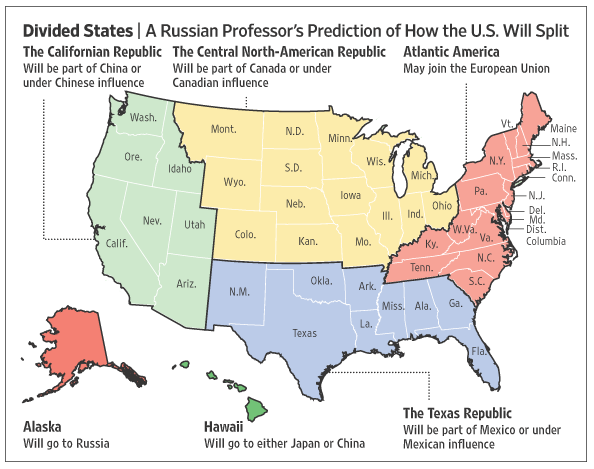
    Prof. Igor Panarin, a 50-year-old former KGB analyst and a dean of the Russian Foreign Ministry’s academy for future diplomats, estimates there’s a 45-55% chance that the United States will disintegrate like the Soviet Union did sometime in 2010. Mass immigration, economic decline and moral degradation will trigger civil war, the collapse of the dollar and massive social unrest. This in turn will lead to the U.S. breaking into six blocs — with Alaska reverting to Russian control – and other foreign powers grabbing other pieces.

    Panarin’s new map of the United States puts the “Californian Republic” under China’s influence, “the Texas region” under Mexico’s. Hawaii will come under Japanese or Chinese rule, East Coast states will join the European Union, while central northern parts of the US will gradually come under Canada’s influence.

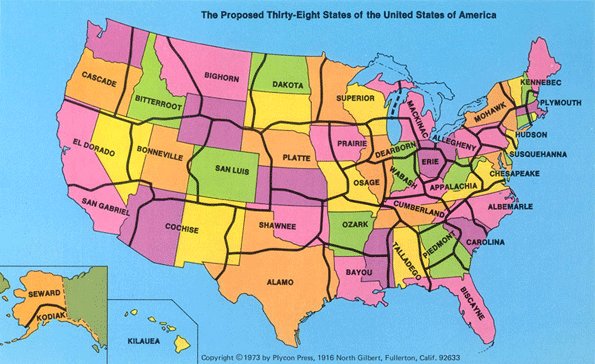
    A less sinister revision of the states that comprise the republic occurred in the 1970s when geography professor C. Etzel Pearcy proposed redrawing the borders of the US states, reducing them from 50 to 38. Pearcy’s framework casts aside the convenience of determining boundaries by using the land’s physical features, such as rivers and mountain ranges, or by the simple usage of latitude and longitude. Instead, his realignment gives high priority to contemporary population density, location of cities, lines of transportation, land relief, and size and shape of individual States.

    In the current fiscal climate some see the new 38 state map as inspired. According to Pearcy, 25% of the expenditures by states can be attributed to the fixed costs associated with the support and maintenance of state governments themselves. For at least some states this kind of savings could be very appealing right now.

    Rethinking, reimagining and then redrawing the borders of maps is by no means a new or even fruitless endeavor. That some if not many borders are where they are for seemingly meaningless or irrational reasons is obvious. Mark Stein’s How the States Got Their Shapes, for example, documents how natural features like rivers come together with the dreams and schemes of people to create today’s jigsaw puzzle of states. Gerrymandering borders for political, economic or religious reasons is both a historical and contemporary reality.

    Any economic planner or strategist worth their salt understands, of course, that borders on a map seldom represent or hold sway over how the real economy operates. Sure there are tangible differences in taxes, regulation and all the things that make up a business environment. But like water, economic activity goes where it wants and finds its own level. This has lead to an increasing amount of policy attention being given to cross-border territories of regions, zones, corridors, clusters, networks and the like.

    North America Re-Imagined
    One of the more reasoned, enduring efforts to make sense of a borderless economic and cultural landscape is Joel Garreau’s landmark work on the The Nine Nations of North America. My 27 year-old copy’s dust jacket asks the reader to forget the traditional map and consider the way North America really works because new realities of power and people are remaking the continent.
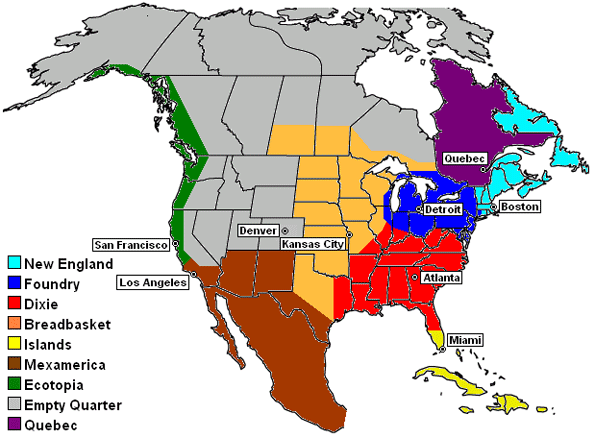
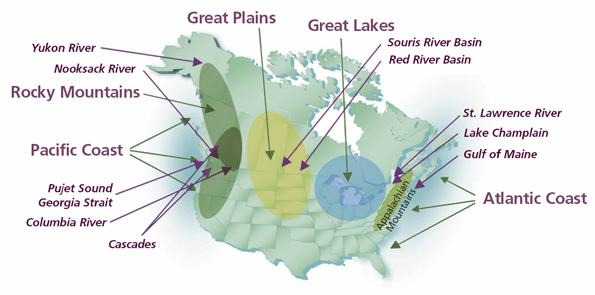
    A recent conference on USA/Canada cross-border economies in the Great Plains confirmed that Garreau’s analysis continues to influence thinking on regionalism. The longevity of his regions lies not only on their basis in actual data but also tied to the distinct “prisms” though which each nation sees the world.

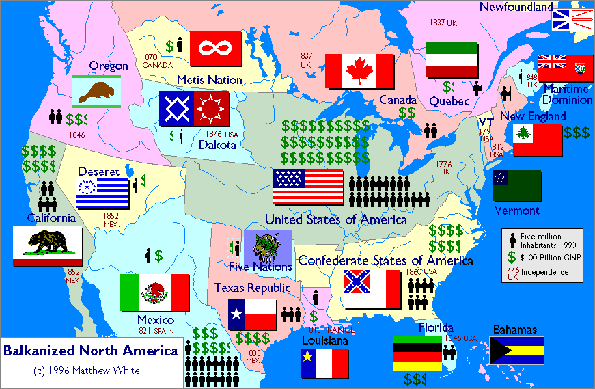
    What could have been in North America, instead of how things really are, is the subject of Matthew White’s 1997 map of a balkanized continent. Here the basic premise is that, in an alternate history beginning in 1787, the westward expansion of the Anglo-American people proceeded pretty much as it did, but the United States government just couldn’t hold the country together against separatists.

    How North America really works and how that is manifested spatially has generated growing interest of late and is reflected in the emergence of cross-border networks and organizations. The government of Canada recently issued an exhaustive report titled The Emergence of Cross-Border Regions Between Canada and the United States: Reaping the Promise and Public Value of Cross-Border Regional Relationships. Here the interest is certainly not on redrawing the borders but on recognizing and building on shared socio-cultural values and furthering relationships between businesses, first and foremost, and universities.

    Mostly a bottom-up phenomenon, these cross-border regional relationships are evidenced by the growth of both informal relationships and formal networks and a rise in cross-border regional co-operative mechanisms. From a policy standpoint the existence of cross-border regions requires new ways of thinking about development, going well beyond our parochial perspective. And this sort of thinking is important because regions – like economic fields of activity – represent the primary theatre in which most activities of international trade and economic integration actually take place.

    Map Forth
    Thematic maps that reconfigure our geography can intrigue and fascinate us. They are really, as some have said, graphic essays that portray spatial variations and interrelationships of geographical distributions. As noted by Norman Joseph William Thrower in Maps and Civilization: Cartography in Culture and Society, thematic maps use the base data of coastlines, boundaries and places, only as point of reference for the phenomenon being explained.
    Sometimes maps can inspire and motivate us by helping to more fully understand the geography of our economic and demographic challenges and opportunities. Perhaps most importantly thematic maps tell a story about places. Some describe the way things really are now while others express a vision of the future. In both cases they can be a graphical point of departure for plans and actions that help us to make the places we inhabit better places to live and work.

    Delore Zimmerman is president and CEO of and publisher of Newgeography.com

  • Kansas City and the Great Plains is a Zone of Sanity

    Over the past year, coverage of the economy appears like a soap opera written by a manic-depressive. Yet once you get away from the coasts – where unemployment is skyrocketing and economies collapsing – you enter what may be best to call the zone of sanity.

    The zone starts somewhere in Texas and goes through much of the Great Plains all the way to the Mexican border. It covers a vast region where unemployment is relatively low, foreclosures still rare and much of the economy centers on the production of basic goods like foodstuffs, specialized equipment and energy.

    People and companies in the zone feel the recession, but they are not, to date, in anything like the tailspin seen in places like the upper Great Lakes auto-manufacturing zone, the Sunbelt boom towns or, increasingly, the finance-dependent Northeast. Last month, for example, New York City’s unemployment experienced the largest jump on record.

    “That whole swath from Texas and North Dakota did not see either the bump or the decline,” notes Dan Whitney, a principal at Landmarketing.com, a real estate research company based in Kansas City, Kan. “People have a more conservative nature here. It’s just saner.”

    The housing market is one indicator of greater sanity. Kansas City housing prices dropped 7% between 2006 and 2008, compared with 10% in Chicago, 15% in San Francisco, 20% in Washington, D.C., and over 30% in Los Angeles. Houston and Dallas, the Southern anchors of the zone, have seen little movement either way in prices.

    One key measurement is affordability. The median multiple for Kansas City housing – that is the number of years of income compared with a median-priced house – has remained remarkably stable at under 3.0. In contrast, notes demographer Wendell Cox, the ratio approached up to 10 in places like Los Angeles and San Francisco, as well as something close to 7 in New York and Miami.

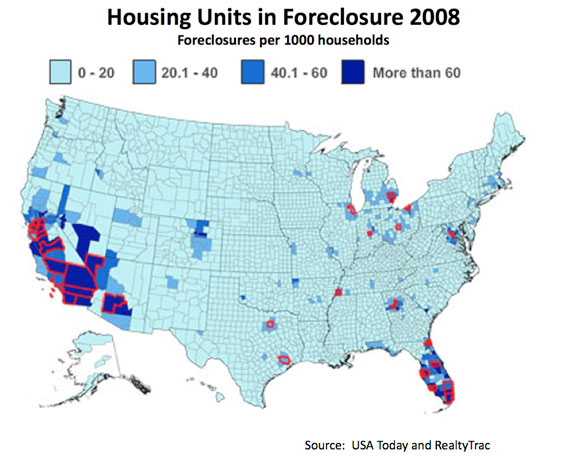
    The result has been that foreclosures – the key driver of many regional economic collapses – have been relatively scarce throughout the zone. This USA Today map reveals how the foreclosures are heavily concentrated in Florida, California, Arizona and Nevada, as well as parts of the old Industrial Belt of the Great Lakes.

    housing_foreclosure_565.jpg

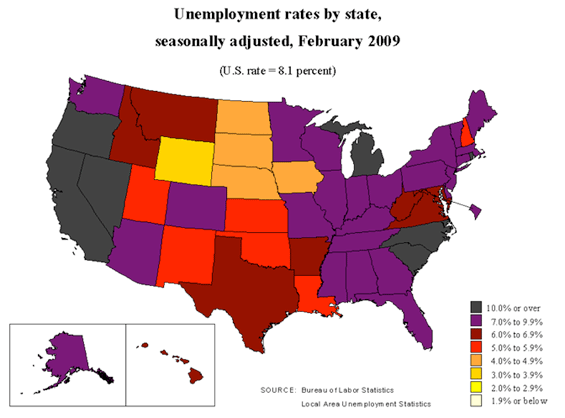
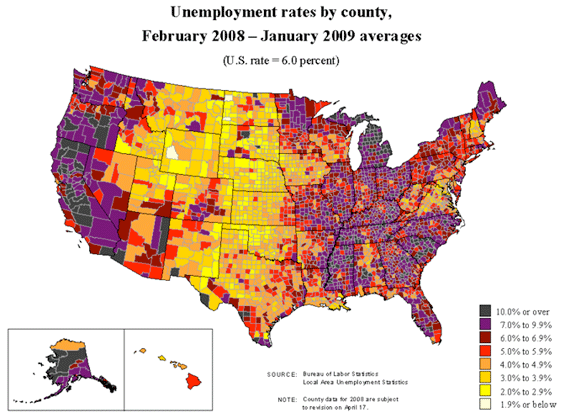
    Analysis by my colleagues at Praxis Strategy Group of the job market’s condition also reveals the divergence between the zone and the rest of the country. Regions from the Northeast, the Great Lakes and the Southeast all have seen significant job losses, and the damage is spreading to the Pacific Northwest, New York and New Jersey. In contrast, the Kansas City area and much of the zone of sanity has experienced only a ratcheting down of its generally steady growth rate. Things are not bustling, but there seem to be few signs of a basic economic collapse.

    unemployment_state_565.gif

    unemployment_country_565.gif

    Sanity, as Whitney put it, may constitute a critical part of the equation. If you discuss why people live in a place like Kansas City, people tend to speak about stability, family-friendliness and the basic ease of everyday life. Many executives, notes Phil DeNicola, who runs Strong Suit Relocation, initially resist a transfer to the region but quickly see the advantages.

    “It is attractive to be here,” notes DeNicola. “You don’t get a lot of highs and lows for years. There is stability instead, particularly for families. It all reduces your stress.”

    Of course, not everyone is satisfied with the status quo. As in many second-tier urban centers, many in Kansas City’s leadership crave being something other than pleasant, affordable and stable. Leaders in the city – home to roughly one in four of the region’s 2 million residents – have been particularly exercised to show that KC can be as hip and cool as New York, L.A. or, at the very least, Chicago.

    “There’s a real kind of self-loathing here,” notes Mary Cyr, a Harvard-trained architect, who works on projects throughout the region. “We feel less than what we are. We do not know what we are as a city. We don’t even realize what we have.”

    Hundreds of millions have been poured and continue to pour into the usual monuments favored by urban policymakers and subsidy-hungry developers – a sparkling new arena, plans for an expanded convention center and a massive entertainment complex called the Power and Light District. Yet at the same time, the city’s budget, like many others, is severely strapped, so much so that City Hall is considering not turning on the city’s iconic fountains this spring.

    Even worse, city and regional issues seem to result in plenty of money for new expressions of wannabe grandiosity. One notable example: plans to build a $700 million-plus light-rail line, the kind of thing that has become the sine qua non for the “monkey see, monkey do” school of urban policymakers across the country.

    This project makes little sense in a region with a well-below-average percentage of jobs in its downtown core – roughly around 7% – with one of the lowest shares of transit-riding residents in the nation. The relative lack of traffic makes a rail system less sensible than could be argued for higher-density urban corridors, where it at least can be imagined that many would give up their cars.

    Ultimately, none of this taxpayer largesse is likely to do much more than replicate the same kind of development that can be found in scores of cities – from St. Louis to Dallas – that have tried it. At best, you get a few blocks of activity but very little in terms of urban dynamism.

    “The growth of downtown is not at all organic – it’s kind of forced,” notes architect Cyr. “They build all those projects in there, and you end up with the huge monumental buildings and the Gap.”

    The problem for the downtown crowd is that Kansas City has remained a quintessential American city, most dynamic in places where private initiative leads the way. Typically the bulk of new growth has taken place in the suburban fringes, but there are several successful nodes within the city, particularly around the lovely, 1920s vintage, privately developed Country Club Plaza area, famous for being the world’s first modern shopping center.

    Similarly, the artist-inspired Crossroads district has also evolved – largely without government help – into a genuine bastion of bohemians, with small companies and locally owned restaurants. With its low-cost commercial and residential space, as opposed to government subsidies, many see the area as precisely the kind of grass-roots urban life with a future in a place like Kansas City.

    Such developments in the city, as well as outside, make it possible to project a very bright future for Kansas City – and across the zone of sanity. Unless there is a massive shift in conditions, the zone should see a return to prosperity earlier than places bogged down with excess foreclosures, shuttering industries, soaring taxes and ever-tightening regulation. Dan Whitney, for example, expects the local housing supply to run out soon – with “tremendous pent-up demand” by the end of the year. If credit conditions improve, new construction should resume within the next 18 months.

    This all reflects the essential attractiveness of cites like Kansas City. Overall, in fact, its rate of domestic in-migration has been higher than much-celebrated Seattle and only slightly below that of Denver. Indeed, since 2000, Kansas City’s regional population has grown 8.6%, more than twice as much as New York, Boston, San Francisco or Los Angeles.

    Unlike the national media, which rarely focus on mundane things that drive most people’s lives, some seem to get the appeal of lower prices, affordable housing options and a generally calm environment. Although never a beacon for newcomers, like Phoenix, Atlanta or Dallas, Kansas City has not suffered the massive out-migration seen in such big metropolitan regions as Los Angeles, San Francisco, Chicago or New York.

    In fact, Kansas City has enjoyed a slow but steady in-migration through the past decade. These newcomers could provide the energy, talent and initiative that a region, known for stability, needs to get to the next level. Attracting more of them – not new prestige projects or subsidized developments – remains the key to the region’s future.

    Instead of trying to duplicate growth patterns that are foundering on the coasts and in countless Rust Belt cities, the denizens of the zone of sanity need to learn how to build on their virtues of stability and affordability. Particularly in hard times, such things count for much more than many – both inside and outside the region – might imagine.

    This article originally appeared at Forbes.

    Joel Kotkin is executive editor of NewGeography.com and is a presidential fellow in urban futures at Chapman University. He is author of The City: A Global History and is finishing a book on the American future.

  • SPECIAL REPORT – Domestic Migration Bubble and Widening Dispersion: New Metropolitan Area Estimates

    Returning to Normalcy

    The Bureau of the Census has just released metropolitan and county population estimates for 2008, with estimates of the components of population change, including domestic migration. Consistent with the “mantra” of a perceived return to cities from the suburbs, some analysts have virtually declared the new data as indicating the trend that has been forecast for more than one-half a century. In fact, the new population and domestic migration data merely indicates the end of a domestic migration bubble, coinciding with the end of the housing bubble.

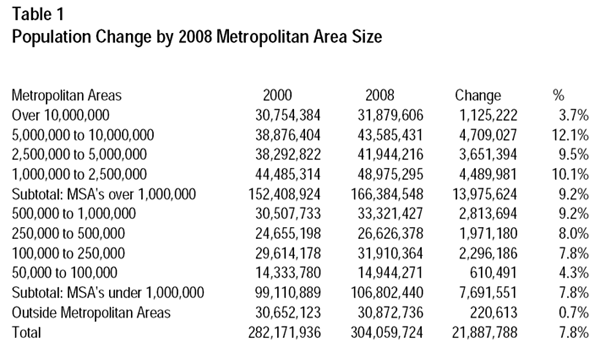
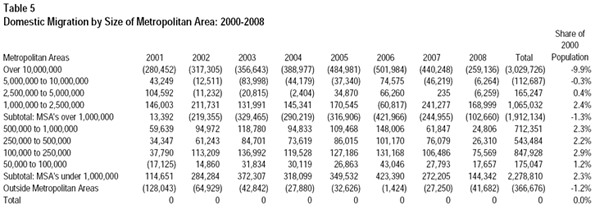
    Metropolitan Area Growth: As usual, the metropolitan areas with more than 1,000,000 population increased above the national rate of 7.8 percent, at 9.2 percent from 2000 to 2008. Smaller metropolitan areas (between 50,000 and 1,000,000 population) grew at the national rate of 7.8 percent. Also continuing a long-standing pattern, areas outside metropolitan areas (including rural areas) grew slower, at only 0.7 percent (Table 1).

    The overall trends, however, mask significant variations. The nation’s two metropolitan areas with more than 10,000,000 population are experiencing growth rates less than one-half the national average. New York grew only 3.6 percent, while Los Angeles – which for decades experienced above average growth, could manage only one-half the national average rate, at 3.8 percent. Indeed, Chicago grew faster, at 5.0 percent. If 2000s growth rates were to continue to 2050, Dallas-Fort Worth, Atlanta and Phoenix would exceed Los Angeles in population, while Houston would pass Los Angeles shortly thereafter. This is not a prediction – population growth in these fast growing areas will likely slow as they get larger – but is merely offered to show how moribund the Los Angeles growth rate has become.

    The strongest growth was among metropolitan areas with between 5,000,000 and 10,000,000 population, which added 12.1 percent to their populations. This was driven by gains of more than 1,000,000 in Dallas-Fort Worth and Atlanta, nearly 1,000,000 in Houston and over 500,000 in Washington (DC). Philadelphia’s growth rate, however, was even less than that of New York or Los Angeles, at 2.7 percent.

    There was also strong growth (9.5%) among the metropolitan areas with between 2,500,000 and 5,000,000 population. This was driven by an increase of more than 1,000,000 in Phoenix and more than 800,000 in Riverside-San Bernardino. San Francisco (3.3 percent) and Boston (2.7 percent) grew at less than one-half the national rate, while Detroit lost population.

    The metropolitan areas with between 1,000,000 and 2,500,000 population also grew more than the national average, at 10.5 percent. The strongest growth was in Las Vegas, which added nearly 475,000 residents. Charlotte, Sacramento and Austin also added more than 300,000. Providence, Milwaukee and Hartford all experienced growth at less than one-half the national rate; while Cleveland, Pittsburgh, Buffalo and Katrina ravaged New Orleans all lost population. Tucson became the nation’s 52nd metropolitan area with more than 1,000,000 population in 2008, having added nearly 20 percent to its population since 2000.

    The largest percentage growth (35.4%) among metropolitan areas over 1,000,000 population was in Raleigh, which added 284,000 new residents (This is not Raleigh-Durham, which the Bureau of the Census calls a combined statistical area, consisting of the Raleigh metropolitan area and the Durham metropolitan area). Raleigh displaced recent perennial growth leader Las Vegas, which experienced slower growth due to the collapse of the housing bubble.

    Domestic Migration

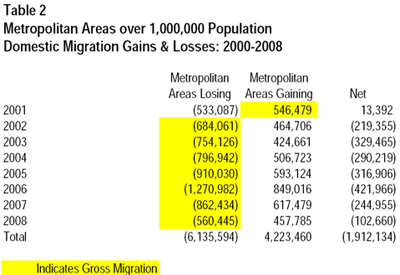
    Much has been made of the apparent recent slow-down in domestic migration (residents moving from one county to another) as indicated in the new data. In fact, however, domestic migration was greater in 2008 than it was in 2001. The slow-down should be more appropriately viewed as a return to more normal conditions.

    This can be illustrated by examining the gross domestic migration between metropolitan areas over 1,000,000 population. In 2008, gross migration in the metropolitan areas of more than 1,000,000 was 560,000. This is slightly more than the 546,000 in 2001. Gross migration increased after 2001, peaking at 1,270,000 in 2006. This fell to 862,000 in 2007 and then to 560,000 in 2008 (Table 2).

    The Domestic Migration Bubble

    The domestic migration bubble that developed from 2000 through 2007 coincided with the domestic housing bubble. This is not surprising, because housing consumes a major part of household expenditures. The differences in housing costs are much greater between metropolitan areas than any other major category of personal expenditure. For example, transportation, clothing and food have similar costs among the nation’s metropolitan areas. During the bubble, however house prices doubled and tripled in some metropolitan areas relative to incomes. The housing bubble appears to have sparked its own domestic migration bubble, as people moved from less affordable areas to more affordable areas.

    This is illustrated by examining domestic migration trends by housing affordability. The more affordable metropolitan areas had Median Multiples at the peak of the housing bubble of 4.0 or less (The “affordable” and “moderately unaffordable” categories from the Demographia International Housing Affordability Survey) and the less affordable metropolitan areas had Median Multiples of 4.1 or above (the “seriously unaffordable” and “severely unaffordable” categories from the Demographia International Housing Affordability Survey).

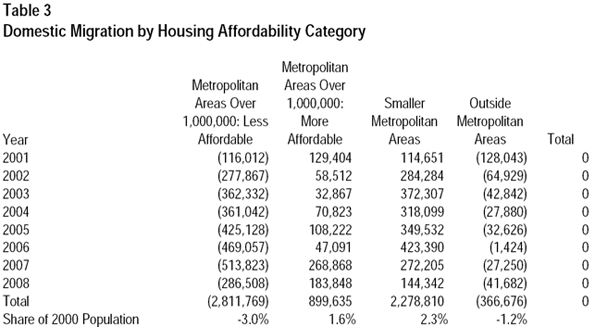
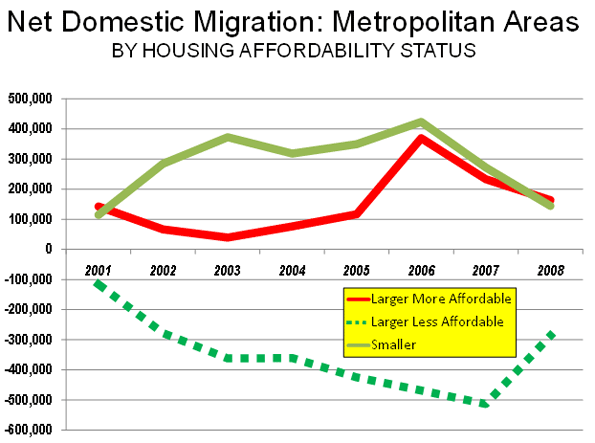
    The less affordable (higher cost) metropolitan areas experienced both the largest house price increases and a spike in net domestic migration losses. Overall, the less affordable metropolitan areas lost 2.8 million domestic migrants from 2000 to 2008 (Table 3 and Figure). This started in 2001 with a modest loss of 116,000, which ballooned to 514,000 by 2007. The loss dropped to 287,000 in 2008, a figure more than 2.5 times the 2001 net domestic migration loss.

    At the same time, the affordable metropolitan areas experienced substantially lower house price escalation, while gaining nearly 900,000 domestic migrants from 2000 to 2008. In 2001, the more affordable metropolitan areas experienced a net domestic migration gain of nearly 129,000. Domestic migration gains peaked in 2007, at 269,000. Domestic migration gains fell to 184,000 in 2008 in the more affordable metropolitan areas. However, this figure was still far higher than the numbers at the beginning of the decade.

    Suburbs Continue to Gain

    The data also shows that people continue to move to the suburbs and move away from core areas. This can be shown from the county data, which is generally the smallest geographic area for which migration data is produced. One caveat: because many core counties contain suburban areas as well as the historic core cities, a county based migration analysis usually understates the extent of both core losses and suburban gains.

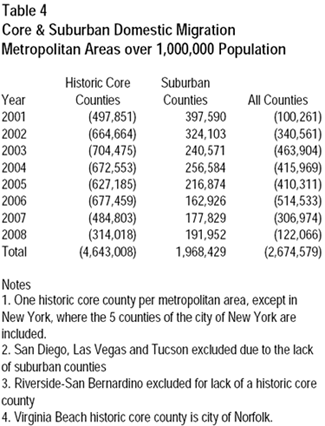
    The core counties improved their domestic migration performance in 2008, but continue to suffer losses. In 2008, the net domestic migration loss in core counties was 314,000, which compares to the 498,000 loss in 2001 and an annual average loss of 580,000 over the decade. Losses of this magnitude can hardly be characterized as a “turnaround.”

    Net domestic migration gains were down to 192,000 in the suburban counties from a 398,000 gain in 2001 and an average gain of 246,000 over the period. However, net suburban migration gains were up in 2008 from 2007 and 2006 (Table 4). Out of the 48 metropolitan areas, suburban counties performed better than core counties in net domestic migration in 42 cases, matching the figure for 2000-2008, the same as in 2007 and up from 38 in 2006. Among the six metropolitan areas where core net migration was greater than in the suburbs, core counties lost fewer domestic migrants than the suburbs (Washington and Virginia Beach), three were areas where the core county typically experiences higher net migration because of its population dominance (Phoenix, Raleigh and San Antonio) and the last was New Orleans, where the core county was much harder hit than the suburban counties by Hurricane Katrina related losses leading to greater gains in domestic migrants as it recovers (Orleans Parish, which is also the city of New Orleans). It is more than “a stretch” to interpret the new data to suggest any move to core areas from suburban areas.

    The 2008 domestic migration data does indicate a slow down or even a reversal in some more distant suburban and exurban areas. This was also to be expected because these areas had experienced a large increase in home ownership and a high volume of high risk sub-prime lending.

    As a result, exurban metropolitan areas like Riverside-San Bernardino, Stockton, Modesto and Merced experienced domestic migration reversals, while distant counties within metropolitan areas (such as Stafford County, Virginia in the Washington area and Pike County, Pennsylvania in the New York area) saw declines in their domestic migration. Much of the growth in such more distant areas occurred because of planning regulations in closer in areas made new development impossible or impossibly expensive. Thus, new housing construction was forced to “leap frog” over developable land, which also imposed higher transportation costs and longer commuting distances on the new home owners.

    At the same time, the better domestic migration performance in some core counties and “closer-in” counties occurred in large part because households no longer had a financial incentive to “cash-out” and move to lower cost areas, since they were often facing negative equity. This removed much of the incentive to move from San Francisco or Los Angeles to Las Vegas, Reno, Phoenix, Tucson or Portland, where prices were considerably lower (though still much higher than before).

    The Real Story: Widening Dispersion

    Not only are people continuing to move from core areas to more suburban areas, but they are also moving from larger metropolitan areas to smaller metropolitan areas (Table 5). Since 2000, approximately 2,275,000 people have moved from large metropolitan areas and non-metropolitan areas to smaller metropolitan areas – those with populations of between 50,000 and 1,000,000. In 2001, the smaller metropolitan areas gained 115,000 domestic migrants. These net migration gains peaked in 2006, at 423,000. Following the national trend, net domestic migration to smaller metropolitan areas fell to 144,000 in 2008, still in excess of the 2001 number. Net domestic migration in the smaller metropolitan areas exceeded that of the larger less affordable metropolitan areas by 5.1 million over the period and exceeded that of the larger more affordable metropolitan areas by 1.4 million.

    Despite these trends, most metropolitan areas continue to add population. The domestic migration losses are more often than not made up by the natural increase in population (births minus deaths) and net international migration gains.

    However, households who already live here continue to exhibit a pattern of dispersion. Both within the same metropolitan area and between metropolitan areas, the latest Bureau of the Census data continues to show a clear trend of wider dispersal – from core counties to suburban counties and from larger metropolitan areas to smaller.

    References:Major Metropolitan Area Population & Domestic Migration 2000-2008: http://www.demographia.com/db-2008met.pdf

    Wendell Cox is a Visiting Professor, Conservatoire National des Arts et Metiers, Paris. He was born in Los Angeles and was appointed to three terms on the Los Angeles County Transportation Commission by Mayor Tom Bradley. He is the author of “War on the Dream: How Anti-Sprawl Policy Threatens the Quality of Life.