Tag: Heartland

  • Why We Need A New Works Progress Administration

    As the financial bailout fiasco worsens, President Obama may want to consider a do-over of his whole approach towards economic stimulus. Instead of lurching haphazardly in search of a “new” New Deal symphony, perhaps he should adapt parts of the original score.

    Nothing makes more sense, for example, than reviving programs like the Works Progress Administration (WPA), started in the 1935, as well as the Civilian Conservation Corps (CCC), begun in 1933. These programs, focused on employing young people whose families were on relief, completed many important projects – many still in use today – while providing practical training to and instilling discipline in an entire generation.

    Unemployment today may not be as extreme as in the 1930s, but for whole segments of the population – notably young workers under 25 – it is on the rise. Already young workers with college educations suffer a 7.7% jobless rate, while employment is nearly twice that among young workers overall. Hardest hit, in fact, are young people without college educations, whose real earnings already have dropped by almost 30% over the past 30 years, according to one study.

    Tapping the energies of this new “millennial” generation – those now entering their teens and early 20s – would make enormous sense both for economic and social reasons.

    Not only do they need work, but also, as their chroniclers, authors Morley Winograd and Mike Hais have demonstrated, many share an interest in community-building in ways reminiscent of the last “civic generation” in the 1930s.

    In contrast, the current stimulus, rather than inspiring a new generation, has focused on bailing out failed corporations, few of which will generate much employment. Many of the “new” jobs will be going to the already entitled: highly paid, big-pension-collecting, unionized government workers and well-educated people working in federal and university laboratories.

    Also getting short shrift has been the kind of construction projects that drive fundamental economic growth and competitive advantage. These include roads, freight rail, electrical transmission lines and water services that boost productivity in agriculture, manufacturing, high-end business services and technology. The Chinese are currently targeting their spending on precisely the steps that would aid these sectors.

    This is where a New Deal revival would help. The WPA and the CCC were all about building useful, tangible things that made the country stronger and more competitive. Overall, these and other New Deal programs amassed an amazing record – finishing over 22,000 roads, 7,488 educational buildings and over 7,000 sewer, water and other projects.

    These efforts put to work over 3 million workers. (Compare that to the mere 250,000 slated to work in the expanded AmeriCorps program.) Their earnings helped support 10 million dependents. The WPA also employed 125,000 engineers, social workers, accountants, superintendents, supervisors and timekeepers scattered in every state and community. Ultimately, notes political economy professor Jason Scott Smith, the New Deal intimately touched the lives of more than 50 million people – out of a total U.S. population, in 1933, of 125 million. Now that’s stimulus!

    Critically, the WPA and CCC also left behind useful things for the next generation. As historian Gary Breichin has pointed out, we unknowingly walk, drive and ride through many structures built by these agencies.

    These projects did not act as “lures” for the elites, cognitive and otherwise – as so many of our current efforts do – but rather served a broader purpose for the public. The University of Washington’s Richard Morrill notes that the WPA bequeathed “an enduring legacy” around Seattle: bridges and retaining walls and drainage systems, parks and playgrounds, roads and trails, sewers, recreational facilities, airports, streetcars, low-income housing, as well as programs for musicians, artists and writers.

    The WPA and CCC left a similar mark even on the most remote parts of rural “red” America. In places such as Wishek, N.D., notes native Delore Zimmerman, few people recognize that it was the New Deal-sponsored WPA that built the still-used local pool and the community center. Nor do farmers, many of them rock-ribbed Republicans, readily acknowledge that the windbreaks and other conservation projects started by the CCC helped preserve the land from devastating erosion.

    A public works agenda today, of course, would include different things, like expansion of broadband Internet access and a greater emphasis on private financing and skills training. Yet a neo-WPA would still focus on upgrading and expanding our basic infrastructure, which, by all estimates, is generally in sad shape.

    If this is such a good idea, why is no one else promoting it? Among Republicans and conservatives, of course, nothing done by Franklin Roosevelt – except, perhaps, winning the Second World War – could ever hold much merit. They certainly can argue, with some justification, that it was the war, and not the New Deal, that finally got us out of the Great Depression.

    But this is narrow thinking. America’s post-war boom owed much to the work of WPA, CCC and other New Deal programs. Our late 20th-century expansion required travel along their roads and bridges; their energy plants and transmission lines powered our industrial growth, extending it to formerly poor regions like the South. Water and conservation projects undertaken in the agricultural heartland precipitated a revolution in productivity that has fed much of the world.

    More troubling may be why Democrats – often professed admirers of FDR and his work – have not been eager to revive these programs. One factor may be the enormous power of unions representing public employees. The power of organized public-sector workers, notes historian Fred Siegel, was a non-issue in the 1930s and 1940s.

    Today, though, these groups are powerful enough to boost the cost of any government initiative – because often they require high salaries, costly work rules and, most important, pension benefits. The last thing these unions would sanction would be the mass employment of young workers on a temporary basis at living, but not union-scale, wages and benefits.

    Secondly, there are political obstacles. This administration often appears, as one Democratic mayor from central California put it, like “moveon.org run by the Chicago machine.” Its first priority seems to be to reward allies in organizations – whether in “grassroots” groups like ACORN or in the academy – who also share their political agenda.

    Take, for example, the federal government’s proposed expenditure of $500 million to $600 million for “climate change research.” These funds are almost certain to end up in the pockets of high-end government workers and university-based zealots; as a scientific enterprise, it is likely to be as valid as asking the College of Cardinals in Rome to determine the existence of God. The ultimate result will be to provide new grist for Al Gore’s – and the administration’s – friends in the “green” investment banking world and Silicon Valley.

    This green agenda itself may also constitute a third cause itself for WPA avoidance. Much of the environmental movement – committed largely to reducing the carbon footprint of 300 million Americans – doesn’t want new bridges, roads, ports or much of anything that uses greenhouse gas-spewing concrete. They’d prefer to scale back agriculture and grow just enough organic produce to keep Alice Waters clucking happily in her kitchen.

    A similar disconnect can be seen in energy policy. A new WPA could help build transmission lines to connect the energy-rich parts of the country to the major metropolitan areas. This would spur both industrial development in places like the Great Plains – rich in everything from fossil fuels to wind power – while keeping energy prices down for U.S. consumers and firms.

    Yet so far, the energy program seems focused almost exclusively on providing rich contracts to Silicon Valley firms that are close to the administration. So don’t expect a massive expansion of new transmission lines or any expansion of new, “clean” hydropower. The administration’s green agenda seems to revolve not predominately around better or even cleaner energy, but less.

    And, sadly, conservation is one place a new WPA would be most effective. One possible function for a modern WPA would be to go to neighborhoods – particularly poor and working class ones – and insulate houses. This would certainly save money over having government workers or contractors do the same work.

    All this suggests a profound disconnect between the new administration and the real world.

    The post-industrial educated class that now dominates Washington appears, if not scornful, profoundly detached from the problems facing productive industry. These officials also seem blissfully unaware that the public – as opposed to the academy and the elite media – cares more about jobs than about being green; by nearly three to one, according to the most recent Pew poll, they are more worried about the economy than climate change.

    In many ways, this disconnect is inevitable. Products of the “information age,” Obama’s academically oriented backers seem to have trouble distinguishing between words and actual things. Virtually no one in the upper reaches of this administration has been tested by running a private company, manufacturing a product or bringing in a crop. This administration of “experts” from academia and government service appears to possess little tactile knowledge of the real world.

    In this way, Obama’s great strengths – he is a brilliant communicator and image-builder – are also proving to be a source of profound weakness. Right now, he is selling a post-racial kumbaya and a vague confection of ‘hope.” Financing for these good intentions is likely to ebb, however, as a result of a stunning redistribution of wealth from taxpayers to an expanded class of tax-takers.

    Indeed, for all his communication skills, the president has failed to create an attainable vision of a stronger, wealthier America with better jobs, more wealth and improved infrastructure. Roosevelt and even Truman provided inspiration, too, but they backed it up with practical changes that promised improvements in the day-to-day lives of most Americans.

    These hard times require tangible solutions to basic economic problems. Rather than worry about the generally clueless Republicans, the administration should focus on building a legacy as real and long-lasting as the one left behind by the WPA and CCC.

    More than a mere matter of building roads and bridges and increasing access to cheap energy, the WPA was about restoring a collective spirit, a shared stake, in constructing the sinews of a more competitive, prosperous country. Unfortunately, amidst the confused priorities of this administration, such bold initiatives remain but distant possibilities.

    This article originally appeared at Forbes.

    Joel Kotkin is executive editor of NewGeography.com and is a presidential fellow in urban futures at Chapman University. He is author of The City: A Global History and is finishing a book on the American future.
  • Cash, Not Pretense: An Entrepreneur’s Guide to the Credit Crisis.

    Compared with most businessmen, 41-year-old Charlie Wilson has some reason to like the economic downturn. President of Salvex, a Houston-based salvage firm he founded in 2002, Wilson has seen huge growth in the bankruptcy business over the past year. It is keeping his 10-person staff, and his 55 agents around the world, busy.

    But the credit crunch still creates headaches for Wilson. With loans hard to secure, many would-be customers cannot bid on the merchandise in his inventory. “We are booming with more deals because people are defaulting,” Wilson notes, “but the buyers are gun-shy because they can’t get the money to pay.”

    So what do you do in these circumstances? Charlie Wilson is taking a back-to-basics approach. Rule No. 1: Stay away from people who rely on credit, not cash. This means private companies – including many outside the U.S. – are often better customers than larger, but now cash-strapped, public ones. “The further away I get from Wall Street, the better I feel,” Wilson says.

    Cheap is the new hip. Focus on cutting costs and streamlining operations. Don’t spend money on unnecessary employees or hard infrastructure; use the Internet wherever possible. It helps, Wilson says, to be located in an affordable building and in a place, like Houston, where taxes, regulatory costs and rents are generally cheap. “I work out of a Class C building,” he says, “and now everyone thinks it’s sexy.”

    Expand your range of customers. Look for new customers who have cash resources and access to markets that are still growing. This has led Wilson to look outside the U.S, to places like India or China, where many companies still have cash and see the current crisis as a great opportunity for bargain hunting.

    These three trends – the growing importance of cash, cost cutting and expanding one’s customer base – are defining entrepreneurial response to the credit crash. All three trends can be seen in the strategies of entrepreneurs who are focusing on burgeoning, often cash-oriented immigrant markets.

    Consider the success of La Gran Plaza, a massive Latino-themed shopping center on the outskirts of Ft. Worth, Texas. Not so long ago, La Gran Plaza was a failing suburban shopping center. Now it’s thriving, but only after being regeared to service the cash economy of the local Latino community. Similar success can be seen elsewhere in the country, even in Southern California, which has been hard-hit by the recession but where ethnic malls and supermarkets continue to thrive.

    Some urbanists, like scholar Richard Florida, maintain that the post-crash environment favors densely populated (and very expensive) cities like New York. But in fact, it may make more sense for entrepreneurs concerned with costs to work out of places like Houston, or even the Great Plains states, where local governments are more business-friendly. And everything, from housing to energy, tends to be less expensive.

    Indeed, over the past few recessions, the basic pattern has been that cities come into the downturns late and stay in them longer. In the last decade, many big cities have become very dependent on Wall Street and asset inflation. In 2006, for instance, financial services accounted for a remarkable 35% of all of New York City’s wages and salaries, compared with less than 20% 30 years earlier.

    So it seems likely that the credit crisis will hit pretty hard in those places most addicted to credit – places like New York, San Francisco and Chicago. This occurred early 1980s, the early 1990s and will occur again now. It might even be worse this time around. The federal takeover of the banks will mean lower salaries and bonuses, which will make such places less attractive to ambitious young people. If you are limited to $250,000 a year, it’s much easier to “get by” in Charlotte or Des Moines than it is in Manhattan.

    The biggest hope for New York, Los Angeles and other big cities lies with immigrants and the fact that lower property prices could keep some talented individuals from migrating elsewhere. But the one expensive big city really well-positioned for the credit crunch may be Washington, D.C., since it “creates” its own credit. As key financial decision making shifts to the capital, we can expect to see some financial-industry titans (and their retainers) spending more time in, or even moving to, the capitol. Washington, it’s time for your close-up.

    Beyond the beltway, the credit crunch will eventually benefit places with lower costs of living – including Houston. High rents, strong regulatory restraints and prestige spending make little sense in a cash-short environment. Now, fancy high-rise offices in elite areas are an albatross for even the strongest business.

    The remade economy may hold some much-needed good news for hard-hit sun-belt markets. Some places, like Phoenix, may be poised for a comeback. “Phoenix is paying for being overbuilt, but [lower] prices will attract people back,” explains local economist Elliot Pollack. “The fundamentals that drove the growth are still here with the return of lower costs – the ease of doing business, lower taxes and the attractiveness of the area.”

    But the real winners may be the people now leaving big companies to start new firms. Unburdened by bad habits developed in the bubble, they will be able to fit their business models in lean times. Many won’t mind being in an un-fancy building or neighborhood. Whether they are forming new banks, energy companies or design firms, they will need to do it more efficiently – with less overhead, smarter use of the Web and less pretension.

    “People are watching their companies go under. You get three vice-presidents who get laid off but know their business,” Wilson says. “They start a new company somewhere cheap that is more efficient and streamlined. These are the companies that will survive and grow the next economy.”

    This article originally appeared at Forbes.

    Joel Kotkin is executive editor of NewGeography.com and is a presidential fellow in urban futures at Chapman University. He is author of The City: A Global History and is finishing a book on the American future.
  • How Elite Environmentalists Impoverish Blue-Collar Americans

    The great Central Valley of California has never been an easy place. Dry and almost uninhabitable by nature, the state’s engineering marvels brought water down from the north and the high Sierra, turning semi-desert into some of the richest farmland in the world.

    Yet today, amid drought conditions, large parcels of the valley – particularly on its west side – are returning to desert; and in the process, an entire economy based on large-scale, high-tech agriculture is being brought to its knees. You can see this reality in the increasingly impoverished rural towns scattered along this region, places like Mendota and Avenal, Coalinga and Lost Hills.

    In some towns, unemployment is now running close to 40%. Overall, the water-related farming cutbacks could affect up to 300,000 acres and could cost up to 80,000 jobs.

    However, the depression conditions in the great valley reflect more than a mere water shortage. They are the direct result of conscious actions by environmental activists to usher in a new era of scarcity.

    To some extent, such efforts reflect some real limits imposed by the growth of population. Constructive long-term changes in the conservation and utilization of all basic resources – energy, water and land – are not only necessary, but also inevitable.

    Yet the new scarcity does not simply advocate humane ways to deal with shortages, but seeks to exacerbate them intentionally. This reflects a doomsday streak in the contemporary environmental ethos – greatly enhanced by the concern over climate change – that believes greater scarcity of all basic commodities, from land and water to energy, might help reduce the much detested “footprint” of our species.

    One key element of this agenda has to do with reducing access to critical resources like water beyond those required to support existing uses. To be sure, two years of below-average precipitation helped create central California’s current water shortage. Planting crops such as cotton, which needs lots of water, may also have contributed to the problem.

    However, this only explains part of the problem, which increasingly has to do not with vicissitudes of nature but conscious political action. In prior dry periods, the state has managed its water resources to supply farmers and other users as effectively as possible. Today, in response to seemingly endless litigation to protect certain fish in the Delta region west of Sacramento or to “revitalize” valley streams, enormous amounts of water have been allowed to flow untapped into San Francisco Bay.

    This distinction was entirely missing in national coverage of the drought. A recent New York Times article, for example, barely acknowledged the role played by environmentalists whose move to block additional water supplies from the Delta have turned a below-average year – moisture content in the Sierra is about 90% of normal – into something of an epochal agricultural and human disaster.

    “This is still a pretty decent drought but nothing unusual,” suggests Tim Quinn, executive director of the Association of California Water Agencies, which represents both urban and agricultural interests. “We were prepared, as usual, for the drought, but they have taken all the tools away from us.”

    Many environmentalists justify their efforts to curtail water availability for California’s farmers and towns by citing various doomsday global warming projections. Energy Secretary Steven Chu, for example, recently opined that as the state’s climate inevitably shifts to a hot-weather, low-precipitation pattern, water scarcity will create “a scenario where there is no more agriculture in California.” If agriculture is doomed anyway, why not kill the industry now and use the water for fish or other pet “green” projects?

    This represents a remarkable reversal in the spirit that only a few decades ago drove the development of California. Anyone who has lived for any period in the state knows that aridity represents our greatest natural challenge. California seems always either at the edge of drought, coming out of one, or about to enter a dry spell. Since 1920, the state has experienced crippling six-year droughts during 1929 to 1934 and 1987 to 1994, as well as severe shortfalls of a lesser span on several occasions.

    Recognizing the need for a reliable water supply despite the certainty of significant dry years, Californians responded by building one of the most highly advanced water delivery systems in the world. The result was a network of federal and state dams, pumps and aqueducts emblematic of the “can-do” spirit motivating old Progressives, like Edmund Brown in Sacramento and New Dealers in the nation’s capitol.

    The state’s water conveyance facilities opened vast new tracts of land to agriculture. Some of the world’s largest expanses of almonds, pistachios, pomegranates, grapes and cotton covered once-arid land. This expansion created steady demand for advanced farming technologies as well as low-paid labor, much of it undocumented. Reflecting this dichotomy, wealth and poverty grew hand in hand throughout the Central Valley.

    Today, environmentalists cite – as yet another reason to dehydrate California farmlands – the prevalence of immigrant labor in the Central Valley. Lloyd Carter, a major state environmental activist, recently suggested that cutting farm production would actually be beneficial since most farm workers are “not even American citizens for starters” and raise children that “turn to lives of crime,” “go on welfare” and “get into drug trafficking and … join gangs.” These comments cost Carter his association with certain environmental groups, but not his day job – deputy attorney general under former governor and supreme green jihadi Jerry Brown.

    Unfortunately, Carter’s comments reflect what many environmentalists will tell you in private. As a Valley resident himself, Carter may have great empathy for his region’s poor and working class, but it’s hardly a priority among the core of the green movement, which is based in places like San Francisco or Santa Monica. This reflects not so much racism as a disconnect with the productive industries – agriculture, energy and manufacturing – that tend to cluster on the other side of the coastal range.

    The growing economic problems in Central Valley cities like Fresno, where unemployment is near 15%, represents little more than an abstraction to a new cadre of wealthy “progressives” who merely pass through the area on their way to Yosemite and other Sierra resorts.

    “We are getting the sense some people want us to die,” notes native son Tim Stearns, a professor of entrepreneurship at California State University at Fresno. “It’s kind of like they like the status quo and what happens in the Central Valley doesn’t matter. These are just a bunch of crummy towns to them.”

    This split has engendered what is likely a quixotic secession campaign led by farmers in the interior counties, but such drives to divide the Golden State have risen and failed many times before. Yet clearly, there exists a growing divide between producer and consumer economies, and this is coming to the fore not only in California, and on issues well beyond water.

    It is critical to understand that anti-growth politics diverges from the old conservationist ethos in radical ways. No longer is it enough to talk about growing intelligently or using technology to meet long-term problems. Instead, scarcity politics seeks to slow and even reverse material progress through what President Obama’s science adviser, John Holdren, calls “de-development.”

    “De-development” – that is, the retreat from economic growth – includes some sensible notions about conservation but takes them to unreasonable, socially devastating and politically unpalatable extremes. The agenda, for example, includes an opposition to population growth, limits on material consumption and a radical redistribution of wealth both nationally and to the developing world.

    In much the same way as seen in California’s water crisis, many of the administration’s “green” energy policies pose a direct threat to blue-collar workers employed in extracting and processing fossil fuels. The resultant high energy prices caused by the proposed “cap and trade” system – essentially a system for creating scarcity – also will cost middle-class consumers, blue-collar workers, truckers and manufacturers. These constituencies could well face the kind of water policy-related decline that is destroying farming communities throughout central California.

    Yet at the same time, such policies make the well-to-do and trustafarians in San Francisco and Malibu – for whom higher energy prices are barely a concern – feel better about themselves. In what passes for progressive politics today, narcissism usually takes priority over reality.

    In the new scarcity politics, access to land also may be sharply limited. New land regulation, ostensibly for climate-change reasons – already in place in California and being discussed as well in Washington state – could force almost all new development to follow a high-density, multi-family pattern. Over time, single-family homes – the preference of a vast majority of Americans – will become once again, as they were in the past, the privilege only of the upper classes in some metropolitan regions.

    By embracing the politics of scarcity, the Obama administration seems committed to imposing a regime that could slow any sustained recovery from the current recession. Although these ideas might appear plausible at a Harvard Law Review bull session, their real consequences for millions of Americans could prove very ugly indeed.

    This article originally appeared at Forbes.

    Joel Kotkin is executive editor of NewGeography.com and is a presidential fellow in urban futures at Chapman University. He is author of The City: A Global History and is finishing a book on the American future.
  • NGVideo: East St. Louis (Part II)

    The second part in the series on East St. Louis gives views of downtown today, shows how its history can be seen in the city, and explains why the city could still be a good place for new development.

    Part I discusses the origins and development of East St. Louis as an industrial city.

    Part III will explore ideas put forward for (re)development of the city, including cultural tourism based on the city’s African American heritage and use of vacant land for farming to create a local food source for the St. Louis metropolitan area.

    Michael R. Allen is the Assistant Director at Landmarks Association of St. Louis. He edits the blog Ecology of Absence, “a voice for historic preservation and a chronicle of architectural change in St. Louis, Missouri and its region”.

    Alex Lotz is an undergraduate film student in his final year at Chapman University.

  • NEW GEOGRAPHY SPECIAL REPORT: America’s Ever Changing Demography

    America’s demography tells not one story, but many. People concerned with looking at long-term trends need to familiarize themselves with these realities – and also consider whether these will continue in the coming decades.

    Losers and Winners

    It’s common to read about rapidly growing places, but what about those that are losing? Perhaps it’s fitting in this time of economic decline first to tell the story of areas of loss of population, of out-migration and of natural decrease, more deaths than births. Such areas are not of course necessarily “losers.” They may be prosperous, with a high quality of life; they are just not “growing.”

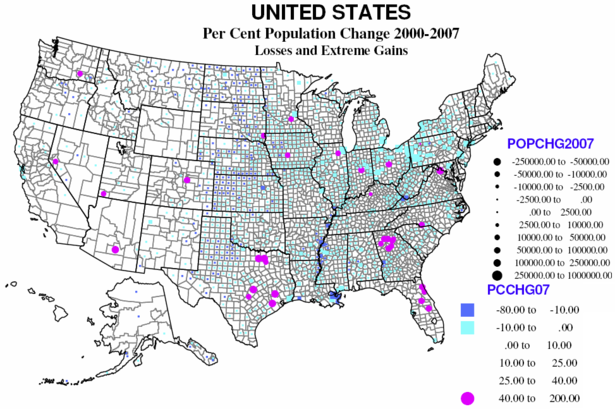
    The map below shows the 40 percent of counties which lost population, 2000-2007. 216 lost more than 10 percent, and 1139 lost up to 10 percent. These contrast the 33 counties which grew more than 40 percent in these seven years. So overall, well over half the territory of the country lost population. The largest population losses, by far, were in and around New Orleans (Katrina), followed by the metropolitan cores of the Rust Belt axis from Pittsburgh, through Cleveland to Detroit, and extending west into Indiana, and east through Pennsylvania and western New York.

    The largest contiguous area of counties with losses remains the same as it was in the 1970s, 1980s and 1990s: the “high plains” from Mexico to Canada (actually continuing in Canada). Probably 90 percent of counties lost population, especially in Kansas, Nebraska and North Dakota, and extending into the Midwest agricultural heartland of Iowa, northern Missouri, southern Minnesota and western Illinois.

    Other traditional areas of losses which continue from the 1970s through 1990s include the coal counties of Appalachia (Kentucky, West Virginia), and the “Black Belt” from Arkansas and Louisiana through the Mississippi Delta and on through parts of Alabama, Georgia, South and North Carolina into Virginia.

    Again repeating past patterns are losses in some of the large core counties of Megalopolis, as Philadelphia and Baltimore, and elsewhere (St. Louis, Chicago, Minneapolis and even San Francisco). The highest rates of loss were again in and around New Orleans, small counties in Mississippi and Nevada, and Montana, North and South Dakota.

    The 33 rapidly growing counties are ALL suburban except for the new metropolitan area of St. George, Utah. Suburban Atlanta dominates, followed by northeastern Florida, and selected suburbs of Columbus, OH, Indianapolis, Charlotte, Chicago, Minneapolis, Washington, DC, Des Moines, Denver, Reno, Houston, Dallas, and Austin. The largest absolute gains (many areas are now hurting economically) were Maricopa (Phoenix), Harris (Houston), Riverside and San Bernardino, Clark (Las Vegas), Los Angeles, and suburbs of Dallas and San Antonio.

    Migration

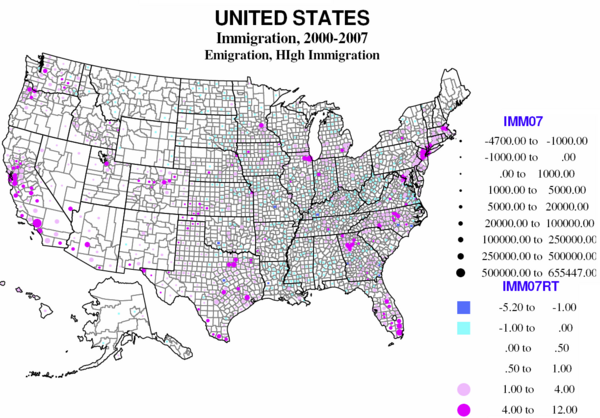
    Immigration dominates the news, but there is also emigration, and the difference between these is ‘net’ international migration. Data on immigration and emigration are not very certain or reliable, as people leaving don’t have to tell anyone, and many entering are equally reticent. Yet there is a clear pattern from the map of the 416 counties. Overall the areas of net loss tend to be the same as for losses in overall population.

    Counties where immigrants greatly exceed emigrants are both the core counties of the largest metropolitan areas and their largest suburban counties, but especially in the west, Texas, Florida, and the Atlantic coast metropolitan cores from Atlanta to Boston, California, Texas, Florida, and metropolitan New York city. Mexican immigration is the largest, but there is significant immigration from the rest of Latin America, from Asia and from Eastern Europe. Most of the immigrant destinations are metropolitan, but include some rural small town areas, typically with food processing, an industry dependent on low wage immigrants (TX, AR, OK, KS, NE, IA).

    Largest absolute gains are to Los Angeles, Cook, New York City, Miami, Houston, Dallas, Orange County, Phoenix and Santa Clara, with a bias to the southwest, Florida and New York City. The highest immigration rates are in part the same, Miami, Queens, Hudson NJ, Santa Clara, but high rates also characterize Washington DC suburbs, two Kansas counties (food processing), and a Colorado county (workers for ski resorts).

    Significant numbers of non-immigrants also move, and as many as a third probably crossed county lines since 2000. In much of America the balance between in and out migration is close, but for many regions, “net” migration is the most important component of change.

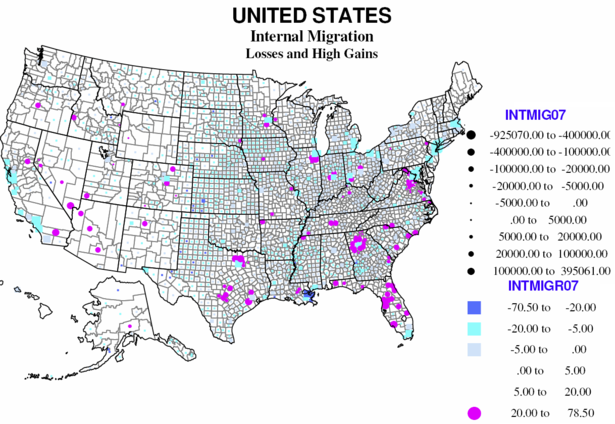
    Overall two thirds of American counties reported a net loss from internal migration, 29 at a level more than 20 percent of the base population. Only 118 have high rates of net in-migration (over 20 percent). Large absolute losses characterize most large metropolitan core counties, including coastal California, Dallas, Miami, New Orleans, megalopolis core counties (from Maryland to Massachusetts), and the Great Lakes and Midwest. Smaller absolute net out-migration prevails over most rural small-town America, especially the Great Plains, and agricultural Midwest and Great Lakes, the Black Belt across the south, and includes much of the southwest.

    Internal domestic migration represents a distinctive geography. In the west many were inland smaller metropolises, as well as many rural small town environmentally attractive counties that received many of the out-migrants from the large coastal metropolises. In the Midwest and northeast gains were strongly suburban (often local flows from the core counties). In the south rapid gains continued to dominate much of Florida, and metropolitan suburbs, especially around Washington DC, Atlanta, Dallas, and Austin-San Antonio, fueled both by continuing in-region rural to urban flows and by migration from the north to the south.

    The losses include the usual suspects, the core counties of the largest metro areas, including Dallas, Miami, and Orange counties, with the native-born displaced to the suburbs and beyond. The largest absolute gains include some central counties, like Maricopa and Clark (but which are also themselves suburban), major suburban counties of Los Angeles, Dallas, Houston, Phoenix, Chicago, and a newcomer, Wake county NC (Raleigh). The highest rates of net in-migration are mostly suburban, Atlanta, Dallas, Washington DC, Denver, Chicago, but also a few smaller counties, as in Pennsylvania and South Dakota.

    The Role of Natural Increase

    One of the indicators of diversity in America is the remarkable variation in the role of natural increase (or decrease) – that is the difference between births and deaths in an area – in the story of population change.

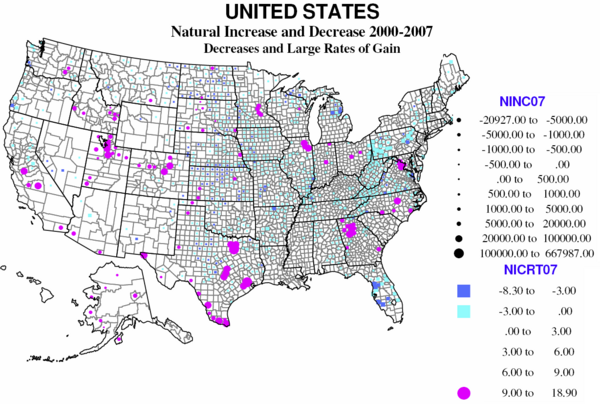
    Almost 30 percent of US counties experience natural decrease, and only a little over 10 percent (337) have high rates of natural increase (6% or more growth in 7 years). Natural decrease is mainly a function of age structure, where the young of child-raising age have left, OR where unusual numbers of the elderly have moved in, dominating the population.

    There are four distinct regions of natural decrease. The largest, absolutely and relatively, is Appalachia, from extreme northern Georgia, through smaller parts of Tennessee and North Carolina, western Virginia, most of West Virginia, and both the greater Pittsburgh and the Scranton-Wilkes Barre region of northeastern Pennsylvania. Much is a historic region of coal (and steel) production, and often poor transport links to the rest of country. The region has suffered loss of the young, often for 40 years or more.

    The second large region of natural decrease is entirely different in character, namely mid-Florida, centered on Tampa-St, Petersburg and Sarasota, as a result of the aging in place of massive numbers of retirees from the north moving to Florida over the last 50 years.

    The third region is much more extensive, covering most of the Great Plains and rural Midwest, from Texas and Arkansas to the Dakotas, Minnesota and Montana, regions again suffering long-term loss of the young population to greater opportunities in the city.

    The last smaller region is the Michigan-Wisconsin upper peninsula, where losses can be traced to the result of declining mining and forestry. Counties in New Mexico, Arizona, and northern California are somewhat like Florida with large numbers of retirees, while those in coastal Oregon and Washington are in part like upper Michigan, but with many retirees as well.

    The 112 counties where births greatly exceed deaths, not surprisingly, reflect a very different geography. They do represent, as is often pointed out, a shift to metropolitan areas but importantly not to the core cities but the suburban hinterlands. Most prominent areas of high natural increase are primarily suburban areas around metropolitan Houston, Dallas, San Antonio, Atlanta, Washington DC, Chicago, Minneapolis and Raleigh, NC. Many of these areas are also affected by in-migration of Hispanic families.

    The other reason for high natural increase is higher fertility – families with above replacement numbers of children, often for reasons of religion or ethnicity, and also reinforced by in-migration of young adults. On the map, Native American Indian reservations stand out, as in North and South Dakota, Wisconsin, Montana, and Alaska, although these numbers are still slow. Mormon Utah and Idaho demonstrate high fertility, family size and shares of births, in rural as well as urban counties. But the dominant area of high natural increase is clearly the extensive southwestern region of Mexican heritage and in-migration over recent decades, in Texas, California, Colorado, New Mexico, Arizona, and eastern Washington, plus selected counties in the high plains, e.g., Kansas and Oklahoma. The final bastions for young families and higher natural increase are military dominated counties, as in Georgia, North Carolina and Kansas.

    In absolute losses, parts of Florida and Pennsylvania and the northern Great Plains stand out. Relative gains are highest in Hispanic, Native American Indian and Mormon counties. These are impressive numbers – the surplus of births over deaths as a share of the total population.

    Why the Differences?

    What makes counties lose or gain people? The US has a diverse and restless population. Counties vary greatly in attractiveness to immigrants from abroad or migrants from other states, broadly because of real or perceived “opportunities,” characteristics of jobs or amenities which may lure migrants from less competitive or attractive areas.

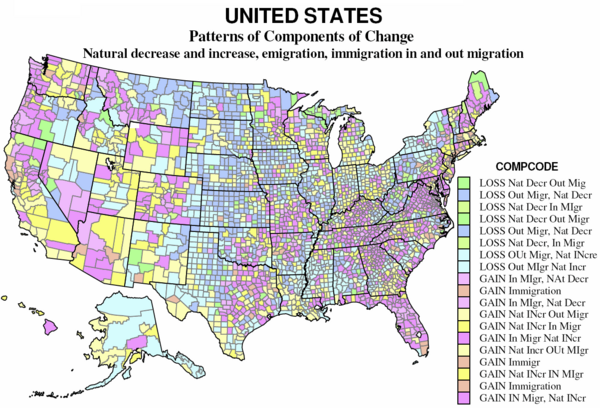
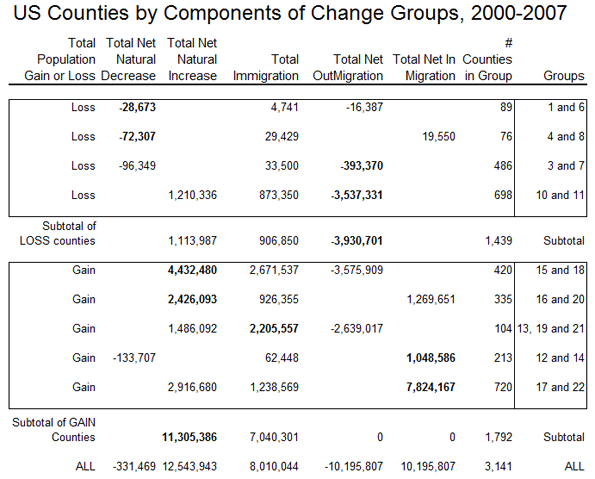
    The map divides the counties into nine sets, based on the relative importance of natural increase or decrease, emigration and immigration and in-migration and out-migration. The 1439 counties which lost population include 165 for which the main reason for loss is from natural decrease; of these one subgroup lost overall despite net immigration, the other’s loss was aggravated by net out-migration as well. The larger set of counties with population losses, 1184, are those for which the loss is mainly attributable to net out-migration, with two subgroups, one with loss despite natural increase, the other with loss magnified by natural decrease.

    On the map the “darker” green counties (89) had a large natural decrease and a smaller net out-migration; the “lighter” green (76) had natural decrease, exceeding a smaller net in-migration. These counties for which natural decrease dominates are scattered across the Great Plains from Texas to Canada, together with clusters from Appalachia (VA, WV, PA, and NY), northern MI-WI, and a few declining natural resource areas in the west.

    The “darker” blue counties (486) are dominated by net out-migration, but also had natural decrease. The “lighter” blue counties (698) had natural increases but these were much exceeded by net out-migration. These counties are often interspersed with the “green” counties, dominated by natural decrease. These 1184 counties – over one-third of counties and of US territory – constitute a large swath of the Plains and Midwest, large parts of New York and Pennsylvania, the coal counties of Kentucky and West Virginia, and the “Black Belt” across the south from Louisiana and Arkansas to southern Virginia. Finally they include sparsely populated resource counties in Alaska and parts of the west. Overall, the counties losing population tend to be non-metropolitan and interior, except for the declining industrial metropolitan counties of the “Rust Belt”.

    Gainers

    The gaining counties consist of three broad groups — 755 for which natural increase is the main contributor to growth, with subsets of 420 growing despite net out-migration, and 335 with net in-migration as well. The second consists of 104 counties for which immigration is the predominant basis for growth. Finally there are 933 counties for which net in-migration is the main contributor to growth, with subsets with natural decrease with natural increase.

    The “yellow” counties (755) gained population mainly because of natural increase; the light yellow counties (420) grew despite often substantial net out-migration; the darker yellow counties (335) also had a smaller net in-migration, and are thus among the more ”successful” more rapidly growing US counties. The former are especially prevalent in cities of the west – e.g. Los Angeles, San Diego, Houston, Dallas – with sizable immigrant populations (see the table) and higher fertility and displacement of the native-born, but yellow counties are also common in non-metropolitan and small metropolitan and suburban areas of the Great Lakes states, the outer Megalopolis, and urban industrializing parts of the south. The “dark” yellow areas are in the same regions, and are very often the areas gaining migrants from the “light” yellow areas, as can be seen in California, Arizona, Utah, Washington and Colorado.

    The “orange” counties, only 104, are those where immigration is the main source of growth. These are somewhat scattered, but especially common in New England and Middle Atlantic states, selected counties of the Plains (often with food processing plant growth) and northern Pacific Coast metropolitan regions, as the San Francisco bay region, Portland and Seattle.

    The “magenta” counties (933) are those for which net in-migration dominates growth. The lighter magenta for those with natural decrease (213), the darker magenta for those with natural increase as well. All these tend to be the most rapidly growing counties in the country, and tend to occur together. The main difference with counties with natural decrease are those with an older age structure, but which are nevertheless attractive to in-migrants. From the map these occur in two main settings: traditional areas of amenity migration, most obviously covering much of Florida, but also widespread in northern New England, northern Michigan, Wisconsin and Minnesota, the Ozarks, parts of the Tennessee valley, and across much of the west, with particular swaths in western Montana, coastal Oregon and Washington and northern California. The second setting is the exurban environs of major metropolitan areas, where new growth is invading formerly rural areas.

    The final, largest set of counties with natural increase as well as high in-migration (720 counties), are the stereotypical winners in the contemporary “growth races” – based on a combination of employment growth and metropolitan or environmental amenities. These tend especially to be southern and western metropolitan areas, small as well as large. The most dominant regions are greater Washington DC, greater Atlanta, Dallas and Houston, Portland, Denver, Phoenix, most of Florida, and – perhaps surprisingly – substantial parts of the north-south borderlands, including Tennessee, Kentucky, Arkansas, Oklahoma, and Missouri.

    What about the recession? It’s hard to judge the relative effects of the current severe recession on likely near- or longer-term growth. Clearly, the collapse of housing markets are slowing the growth of such rapidly growing places as Phoenix and Las Vegas, but this does not mean they won’t regain their general attractiveness and economic viability. The particularly severe job losses in the already hurting western Rust Belt will likely aggravate the recent pattern of decline which predated the recession and could get much worse.

    Richard Morrill is Professor Emeritus of Geography and Environmental Studies, University of Washington. His research interests include: political geography (voting behavior, redistricting, local governance), population/demography/settlement/migration, urban geography and planning, urban transportation (i.e., old fashioned generalist)

  • Sunbelt Indianapolis

    For decades, the overwhelming majority of population and economic growth has occurred in the Sun Belt – the nation’s South and West as defined by the United States Bureau of the Census. This broadly-defined area stretches south from the Washington-Baltimore area to the entire West, including anything but sunny Seattle and Portland. Any list of population growth or employment growth among the major metropolitan areas will tend to show the Sun Belt metropolitan areas bunched at the top and the Frost Belt areas (the Northeast and Midwest regions) bunched at the bottom. Since World War II, no state has experienced the growth that has occurred in California.

    However, the trends in the last decade indicate a shift, certainly away from California, which has experienced a net domestic migration (people moving to other parts of the nation). The overall loss reaches over 1.2 million people; the state’s overall population growth rate is now only little more than average. Some metropolitan areas in the Frost Belt have begun to perform better in population and domestic migration, but most continue to experience growth that is well below that of the Sun Belt.

    The exception to this is Indianapolis, which has developed growth rates that would put it right in the middle of Sun Belt metropolitan areas, if it were not in the Frost Belt.

    Indianapolis is a metropolitan area of 1.7 million population. Indianapolis added nearly 11 percent to its population between 2000 and 2007 (latest data available) and ranks 19th in population growth among the 50 metropolitan areas with more than 1,000,000 population (New Orleans has been excluded from this analysis because of the hurricane related population losses). Indianapolis is growing faster than Washington, DC or Seattle and nearly as fast as Portland or Denver. Its population growth rate has been double that of San Diego, triple that of Los Angeles or San Jose and more than six times that of San Francisco, which has seen its growth slow to a rate no better than that of Italy. Overall Indianapolis would rank 18th out of the 32 largest US Sun Belt metropolitan areas in total population growth. It is the fastest growing of the 18 largest Frost Belt metropolitan areas.

    Between 2000 and 2007, the Indianapolis metropolitan area added 55,000 domestic migrants, equal to 3.6 percent of its 2000 population. No other Frost Belt metropolitan area comes close. Columbus and Kansas City had domestic migration gains, at 1.2 percent of their population. All other Frost Belt metropolitan areas lost domestic migrants. Indianapolis, however, would have ranked 17th out of the 32 largest Sun Belt metropolitan areas trailing Portland, but leading Seattle and Denver.

    The distribution of domestic migration within the Indianapolis metropolitan area is also significant. For one-half century various analysts have predicted the decline of the suburbs. Indianapolis, like most metropolitan areas around the country, shows exactly the opposite: the suburbs continue to attract central city residents and have yet to fall into this seemingly inevitable decline.

    While the Indianapolis metropolitan area gained 55,000 domestic migrants from 2000 to 2007, Marion County, the central county which is nearly co-existent with the central city of Indianapolis, lost 46,500 domestic migrants. All of the domestic migration growth was in the suburbs, which attracted 101,800 new residents from Indianapolis/Marion County and the rest of the nation.

    What is it that has allowed Indianapolis to experience Sun Belt growth despite being in the Frost Belt? This is not the place for a full attempt to identify all of the causes, but some observations can be made.

    Perhaps it is most important to understand what is not the cause of the superior growth in Indianapolis. It is not the city’s “unigov” governance structure. In the early 1970s, to the great fanfare of urban planners, Indianapolis merged with most of Marion County, increasing the city’s population by approximately 50 percent. Proponents of local government consolidations often (and speciously) suggest that these consolidations will make metropolitan areas more attractive (this issue is discussed in detail in our Pennsylvania report on local government consolidation). Yet, Indianapolis, one of the nation’s largest consolidated local governments, is losing residents to the suburbs. It is also worthy of note that state taxpayers provided a $1 billion pension bailout to the city last year.

    One factor that clearly makes Indianapolis attractive is its housing affordability, which is the best among metropolitan areas with more than 1,000,000 residents in six nations. According to our 5th Annual Demographia International Housing Affordability Survey, Indianapolis had a Median Multiple (median house price divided by median household income) of 2.2 in the third quarter of 2008, well below the historic norm of 3.0. Indianapolis has been ranked near the top in each of the preceding four editions as well. In recent years, new suburban starter houses of 1,500 square feet have been advertised at less than $110,000, less than the price of land for a house in many metropolitan areas.

    Superior housing affordability constitutes a critical important attractor. At the height of the housing bubble, a household living in the median priced house in Indianapolis would have saved more than $1,000,000 in down payment and mortgage payments over 30 years, compared to San Diego.

    Indianapolis also has the advantage of a comfortable lifestyle. Commuters spend 2 minutes less per day than the national average getting to work, according to the 2007 United States Bureau of the Census American Community Survey. The Texas Transportation Institute indicates that traffic congestion is less severe in Indianapolis than average and that it has become better in the last 10 years. Indicating its usual irrelevance to traffic congestion, Indianapolis has the smallest transit market share of any urban area over 1,000,000 in the nation, at approximately 0.2 percent. This compares to 11 percent in New York, 5 percent in San Francisco and 2 percent in Los Angeles and Portland.

    Where does Indianapolis go from here? So far, Indianapolis has shown resiliency in the current economic crisis. The December 2009 unemployment rate was 6.7 percent, which is below the 7.2 percent national rate. Other parts of Indiana are not doing nearly as well, especially in smaller metropolitan areas that rely to a greater extent on manufacturing. For example, unemployment has reached 15 percent in Elkhart.

    To some extent, the metropolitan area’s huge advantage in housing affordability has been eroded by the collapse of prices in the most expensive Sun Belt metropolitan areas, such as in California and Florida. Yet, Indianapolis remains far more affordable, even after these losses.

    Indianapolis also has an advantages for business. In the State Business Tax Climate Index, Indiana is ranked highly, at 14th in the nation. With the prospect of higher taxes, both at the federal level and in many states, this should help Indianapolis retain an impressive advantage and continue to perform as if it were a Sun Belt metropolitan area, but without the problems associated with the housing bubble, massive congestions and growing social inequality.

    Wendell Cox is a Visiting Professor, Conservatoire National des Arts et Metiers, Paris. He was born in Los Angeles and was appointed to three terms on the Los Angeles County Transportation Commission by Mayor Tom Bradley. He is the author of “War on the Dream: How Anti-Sprawl Policy Threatens the Quality of Life.

  • Democrats Could Face an Internal Civil War as Gentry and Populist Factions Square Off

    This is the Democratic Party’s moment, its power now greater than any time since the mid-1960s. But do not expect smooth sailing. The party is a fractious group divided by competing interests, factions and constituencies that could explode into a civil war, especially when it comes to energy and the environment.

    Broadly speaking, there is a long-standing conflict inside the Democratic Party between gentry liberals and populists. This division is not the same as in the 1960s, when the major conflicts revolved around culture and race as well as on foreign policy. Today the emerging fault-lines follow mostly regional, geographical and, most importantly, class differences.

    Gentry liberals cluster largely in cities, wealthy suburbs and college towns. They include disproportionately those with graduate educations and people living on the coasts. Populists tend to be located more in middle- and working-class suburbs, the Great Plains and industrial Midwest. They include a wider spectrum of Americans, including many whose political views are somewhat changeable and less subject to ideological rigor.

    In the post-World War II era, the gentry’s model candidate was a man such as Adlai Stevenson, the Democratic presidential nominee who lost twice to Dwight D. Eisenhower. Stevenson was a svelte intellectual who, like Barack Obama, was backed by the brute power of the Chicago machine. After Stevenson, the gentry supported candidates such as John Kennedy – who did appeal to Catholic working class voters – but also men with limited appeal outside the gentry class, including Eugene McCarthy, George McGovern, Gary Hart, Bill Bradley, Paul Tsongas and John Kerry.

    Hubert Humphrey, a populist heir to the lunch-pail liberalism of Harry Truman (and who was despised by gentry intellectuals) missed the presidency by a hair in 1968. But populists in the party later backed lackluster candidates such as Walter Mondale and Dick Gephardt.

    Bill Clinton revived the lunch-pail Democratic tradition; and the final stages of last year’s presidential primaries represented yet another classic gentry versus populist conflict. Hillary Clinton could not match Barack Obama’s appeal to the gentry. Driven to desperation, she ended up running a spirited populist campaign.

    Although peace now reigns between the Clintons and the new president, the broader gentry-populist split seems certain to fester at both the congressional and local levels – and President Obama will be hard-pressed to negotiate this divide. Gentry liberals are very “progressive” when it comes to issues such as affirmative action, gay rights, the environment and energy policy, but are not generally well disposed to protectionism or auto-industry bailouts, which appeal to populists. Populists, meanwhile, hated the initial bailout of Wall Street – despite its endorsement by Mr. Obama and the congressional leadership.

    Geography is clearly a determining factor here. Standout antifinancial bailout senators included Sens. Byron Dorgan of North Dakota, Tim Johnson of South Dakota, and Jon Tester of Montana. On the House side, the antibailout faction came largely from places like the Great Plains and Appalachia, as well as from the suburbs and exurbs, including places like Arizona and interior California.

    Gentry liberals, despite occasional tut-tutting, fell lockstep for the bailout. Not one Northeastern or California Democratic senator opposed it. In the House, “progressives” such as Nancy Pelosi and Barney Frank who supported the financial bailout represent districts with a large concentration of affluent liberals, venture capitalists and other financial interests for whom the bailout was very much a matter of preserving accumulated (and often inherited) wealth.

    Energy and the environment are potentially even more explosive issues. Gentry politicians tend to favor developing only alternative fuels and oppose expanding coal, oil or nuclear energy. Populists represent areas, such as the Great Lakes region, where manufacturing still plays a critical role and remains heavily dependent on coal-based electricity. They also tend to have ties to economies, such as in the Great Plains, Appalachia and the Intermountain West, where smacking down all new fossil-fuel production threatens lots of jobs – and where a single-minded focus on alternative fuels may drive up total energy costs on the farm, make life miserable again for truckers, and put American industrial firms at even greater disadvantage against foreign competitors.

    In the coming years, Mr. Obama’s “green agenda” may be a key fault line. Unlike his notably mainstream appointments in foreign policy and economics, he’s tilted fairly far afield on the environment with individuals such as John Holdren, a longtime acolyte of the discredited neo-Malthusian Paul Ehrlich, and Carol Browner, who was Bill Clinton’s hard-line EPA administrator.

    These appointments could presage an environmental jihad throughout the regulatory apparat. Early examples could mean such things as strict restrictions on greenhouse gases, including bans on new drilling and higher prices through carbon taxes or a cap-and-trade regime.

    Another critical front, not well understood by the public, could develop on land use – with the adoption of policies that favor dense cities over suburbs and small towns. This trend can be observed most obviously in California, but also in states such as Oregon where suburban growth has long been frowned upon. Emboldened greens in government could use their new power to drive infrastructure spending away from badly needed projects such as new roads, bridges and port facilities, and toward projects such as light rail lines. These lines are sometimes useful, but largely impractical outside a few heavily traveled urban corridors. Essentially it means a transfer of subsidies from those who must drive cars to the relative handful for whom mass transit remains a viable alternative.

    Priorities such as these may win plaudits in urban enclaves in New York, Boston and San Francisco – bastions of the gentry class and of under-35, childless professionals – but they might not be so widely appreciated in the car- and truck-driving Great Plains and the vast suburban archipelago, where half the nation’s population lives.

    If he wishes to enhance his power and keep the Democrats together, Mr. Obama will have to figure out how to placate both his gentry base and those Democrats who still see their party’s mission in terms that Harry Truman would have understood.

    This article originally appeared at Wall Street Journal.

    Joel Kotkin is executive editor of NewGeography.com and is a presidential fellow in urban futures at Chapman University. He is author of The City: A Global History and is finishing a book on the American future.
  • What Does “Age of Hope” Mean in the Mississippi Delta?

    It was during the inaugural days that an article appeared in The Washington Post about the predominantly black Mississippi Delta going for Obama – no surprise! But juxtaposed in the same time period there appeared in a Kentucky newspaper the story of predominantly white Menifee County, my birthplace – deep in the heart of Appalachia – defying the red sea of Kentucky all around it and also going for Obama.

    Quite a pairing of places. It caused the logical mind to go quickly to work. What did they have in common? The likely answer was a common thread of hope – in two places very different yet alike. Two places long left behind as programs have come and gone. Did this present them with their chance?

    It is easy to say – as I said to a group of automotive middle managers hit hard both emotionally and in the pocketbook by the feared demise of the U.S. auto industry – buck up and get over it. The world has changed. It is time to read What Would Google Do? and reinvent yourselves and your industry. So, too, the business of moving people from point A to point B will always be with us – just how to do that will be left to inventive minds which should include all of us.

    But the auto industry is not alone. Neither are Menifee County and the Mississippi Delta. We do not yet know how to grow legs under this thing called “Obama hope” for communities like those of the Delta or Menifee County. Maybe it’s easier if you’re a college student in California, Manhattan or Chicago to take pride in the greater articulateness and ‘vision’ of our new President.

    Beyond “hope”, an intrinsically ephemeral thing, what are we doing for places like the Delta and Menifee County? It is clear the world has changed. October taught us that, yes indeed, we are globally interdependent. Expertise doesn’t lie in the likes of Greenspan and CEOs and senators and representatives. Finally, government has a role to play – we humbly acknowledge after years of bashing it.

    So, what makes Obama so different and what can he do to live up to his reputation? He gave hope perhaps because he is so different, with an exotic name and so deliciously diverse ethnically that he appears to be out of central casting. Like Superman or Spiderman, he has an edge because he is not exactly like the rest of us.

    We wait and see. There is a major debate over whether places like the Delta or Menifee County can be saved…or should be saved. President Obama can be counted on to focus on other places – like San Francisco, Manhattan and, of course, Chicago – where his most intense supporters live and where the media clusters.

    The Delta and Menifee may have voted for him, but are they on the Presidential view screen? These places are not on the beaten path of interstate highways. They are not part of so-called “metro” or “hot” spots. They are small places with small towns. They are places of strong religious values. They won’t attract the creative class seeking nightclubs and outdoor cafes.

    Yet these places do have their positive attributes – Menifee lies near a lake and people looking for affordable second homes. The land is of great beauty and there are people there who know – as Wendell Berry speaks in reverence – every nook and cranny of every precious inch. So too it is with the Delta, a place full of history, folklore and the richest American musical traditions.

    There is some palpable evidence that these kinds of places may be more attractive than we may have thought prior to the October financial collapse. If you can’t live well in New York for under $500,000 a year, perhaps smaller, more nurturing places can provide a higher quality of life for far less money.

    Perhaps it will take more than government “programs” and outsiders coming in as saviors. Perhaps it will take the people of those regions coming together in some way to tout their regional rural attributes – perhaps their local culture and microentrepreneurship – with some obviously needed but as yet undefined help from “higher-ups.”

    Will local folks be willing to step up to that challenge? Let’s listen to Mayor Will Cox of Madisonville, Ky. and his “on-the-street reassurance” of his constituents through Facebook and his iPhone during the catastrophic Kentucky ice storm of ‘09. He didn’t fan flames of anger but rather was honest and straightforward and ultimately soothing. At the end of the day he got the power back on. “Obama hope” will not stoke the fire or feed the kids, but perhaps it can inspire us to do more for ourselves.

    I await spring with a little more enthusiasm this year. My father hails from Menifee County. He says to plant your corn when the tree buds are the size of squirrel ears. He is a plain old man and loves that place. We are a patchwork country with many differences, but we’re more alike than we think. Just ask the folks in the Delta and Menifee County, poor whites and blacks who opted for the same President. It’s time to grow legs under hope and act with some new thinking.

    Sylvia L. Lovely is the Executive Director/CEO of the Kentucky League of Cities and the founder and president of the NewCities Institute. She currently serves as chair of the Morehead State University Board of Regents. Please send your comments to slovely@klc.org and visit her blog at sylvia.newcities.org.

    Photo courtesy of Russell and Sydney Poore

  • NGVideo: East St. Louis (Part I)

    The first in a series of videos about the economic, political, and cultural history and future of East St. Louis, Illinois.

    Part II gives views of downtown today, shows how its history can be seen in the city, and explains why the city could still be a good place for new development.

    Michael R. Allen is the Assistant Director at Landmarks Association of St. Louis. He edits the blog Ecology of Absence, “a voice for historic preservation and a chronicle of architectural change in St. Louis, Missouri and its region”.

    Alex Lotz is an undergraduate film student in his final year at Chapman University.

  • Wisconsin Checks Out The Finland Club

    Our Central Wisconsin delegation journeyed to Finland in October, 2008. We definitely learned a few lessons that we’ll apply here at home, with the hope of moving our ability to compete globally to a much higher level.

    “Finland is not a country, it is a club” stated one of the many presenters we heard during our study tour. This perspective of how Finns see themselves says something valuable about what they believe it will take for them to compete in the changing global economy: a whole lot of cooperation, strong relationships and inter-connectedness!

    The notion of a “club” is that a group comes together around a common interest and finds value in the network, which the club provides by further fostering that common interest. This is what we found was happening in Finland. Similar in size to Wisconsin, the country rallies together to be competitive on a global scale. They view themselves as a club, in the context of bringing bright people together as a key to innovation and commercialization. They have developed, and continue to further develop, systems in their “club” to allow this to happen.

    Although Nokia is definitely the poster child in Finland’s quest to become a top performer in global competition, the country’s business community is not resting on its laurels. Instead, there’s a very clear, shared vision of the future of the country, with a focus on the investments that can make this future a reality.

    One example is the Oulu region’s concept of a Triple Helix to foster business development and innovation. The Triple Helix intertwines business, education and government in cooperation and collaboration to deliver a support system that fosters innovation for business development. We heard presentations from about 15 agencies, government departments, educational institutions, and business associations. Each one succinctly communicated the common vision of the Triple Helix and the plan for the region to compete globally and grow its economy. Within this shared vision, everyone understood their particular agency’s role, and knew what role others played.

    Our small, rural Central Wisconsin community has had a Finnish connection since 2000, when Stora Enso Oy purchased the Fortune 500 Wisconsin Rapids-based paper company conglomerate, Consolidated Papers. This sale shook up the century-long paternalistic culture and insulated economy. And the loss of more than 4,000 jobs made the community immediately face the reality of global competition.

    In response to the crisis, the Heart of Wisconsin Business & Economic Alliance, in partnership with the Community Foundation of South Wood County, kicked off the Community Progress Initiative, which incorporates systemic approaches similar to the Triple Helix model, and uses common vision as a compelling inspiration to actively engage the community in moving forward collaboratively, kind of like a “club.” The approach has had some proven success, with opportunities for bigger breakthroughs yet to come. Our Study Tour Team is comprised of representatives from business, government, education (K-12, technical college and university levels), engineering, sustainability, philanthropy, and economic development. We are all focused on implementing the concepts on innovation and project learning gained on the tour.

    Outaniemi Technology Hub, in Espoo, provides another example of a “club” type of approach to fostering innovation to compete globally. It bridges innovation and business, uniting academia, startups, SMEs (Small and Medium Enterprises) and anchor businesses in a meaningful way to market and promote technology business development. Outaniemi comprises the biggest concentration of R&D (research and development) and innovation services, facilities and hi-tech infrastructure in the Nordic Region. It links these entities together to create cooperative productivity that is greater than the sum of its parts. The Outaniemi linkage of 32,000 people – 16,000 students, 16,000 hi-tech professionals – 600 companies, and several world headquarters, together with world class research, has resulted in a highly functioning and successful ”innovation club.”

    How did Finland develop this ”club” culture? In the 1990’s, after suffering a serious recession, Finland applied Michael Porter’s industry cluster theory to look at their industries and areas of potential competitive advantage. In Porter’s book, Competitive Advantage of Nations, he had argued that successful firms are seldom alone. Frequently, a company’s dominant market share and accelerated growth are supported by a unique combination of firms tied together by knowledge and production flows. According to Porter, competitiveness originates from these unique combinations, clusters or development blocks. Their typical features are numerous interconnections between firms, technological spillovers, and externalities.

    While many of the connections are of an economic nature, social and environmental benefits are important as well. Defining formal boundaries for these clusters may be cumbersome and even irrelevant; the main feature of a cluster is interaction and interplay among the participants. The Finnish refer to this as “co-petition.” Through cooperation — working together in industry micro-clusters that interface with other micro-clusters — they become more effective at competing in a global marketplace. The “club” concept cross pollinates the clusters to inspire innovation.

    Here in Wisconsin, our Community Progress Initiative integrated a comprehesive system of community and economic development programs to develop relationships and a synergy across the community. This sparked interest in developing an entrepreneurial and small business support system and in forming industry cluster networks. Spinning out of the industry clusters has been the Ideas Incubator and Innovation Think Tank as vehicles through which to foster innovation for business applications. We are still at the infant stage in this process, although, with the foundation set, we are poised to advance our efforts. Lessons from Finland’s experience are guiding us to results. We’ve learned to grab that low hanging fruit and take steps towards long-term gains and bold innovative wins for our ”club.”

    A successful club has the belief and willingness to invest in making itself better. Finland is doing this, supporting innovation and entrepreneurship in public policy, and investing in R&D to the tune of more than $3200 Euros (that’s over $4,000 USD) per capita in some regions. The government investment arm, TEKES, grants money to private firms exploring innovation with good business model applications. Finland invests in its bread and butter, small business, concentrating on growth sector businesses of 20-100 employees. Some of the firms receiving investment from TEKES are not Finnish owned. For example, a Wisconsin Rapids-area firm could set up a Finnish branch office and apply for TEKES R&D funding. Hmmm, I think this could be worth exploring….

    The business of fostering innovation is long-term work. Finland has been successful at fast-tracking the moves that hold the competitive edge in technology innovation, and at applying the results to build economic prosperity. The country’s innovation system successfully converts R&D and educational capacity into industrial strengths.

    By applying some of these lessons learned in Finland to the impressive foundation we have laid through the Community Progress Initiative in our region, we hope to be as successful as they have been. We, too, are now working to foster innovation that assists our businesses, to work together in co-petition, and to grow our region’s economy.

    Anyone want to come join our club?

    Connie Loden is the Executive Director of the Heart of Wisconsin Business & Economic Alliance that coordinates community economic development projects in Central Wisconsin. An internationally recognized leader in rural development, she holds leadership roles with the Community Development Society and National Rural Development Partnership.