Tag: Heartland

  • Doing What Actually Works

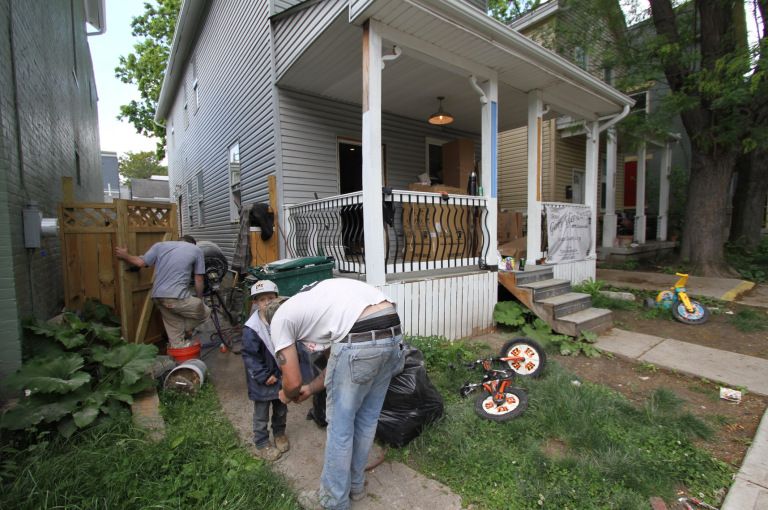
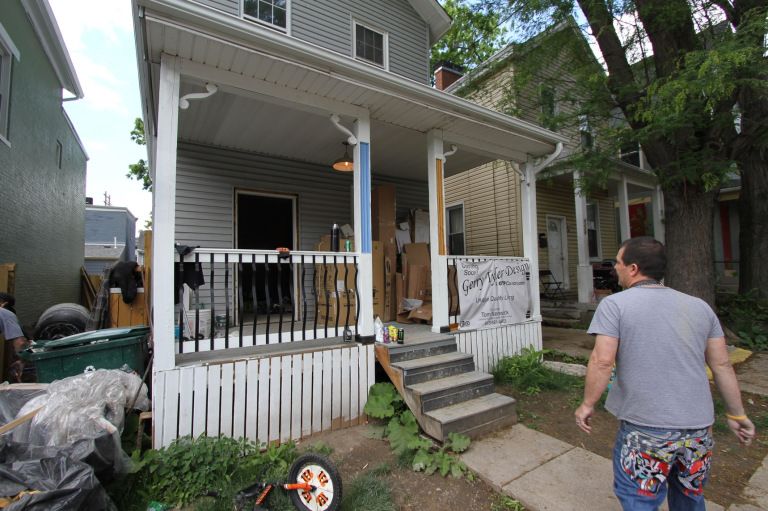
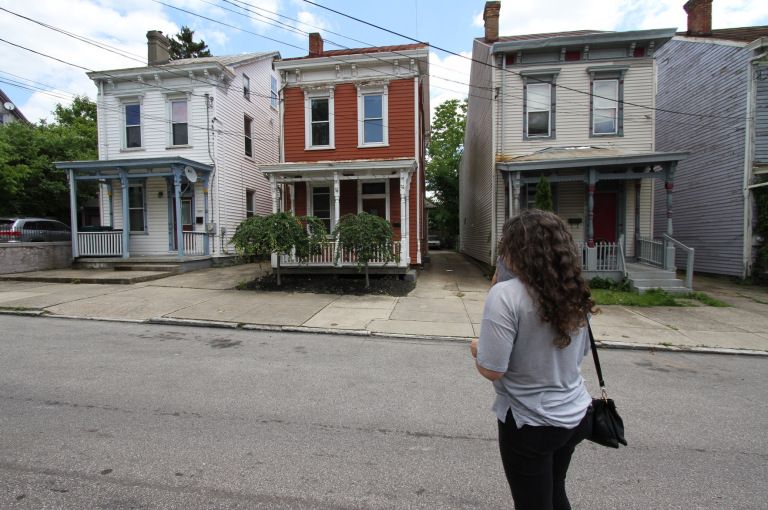
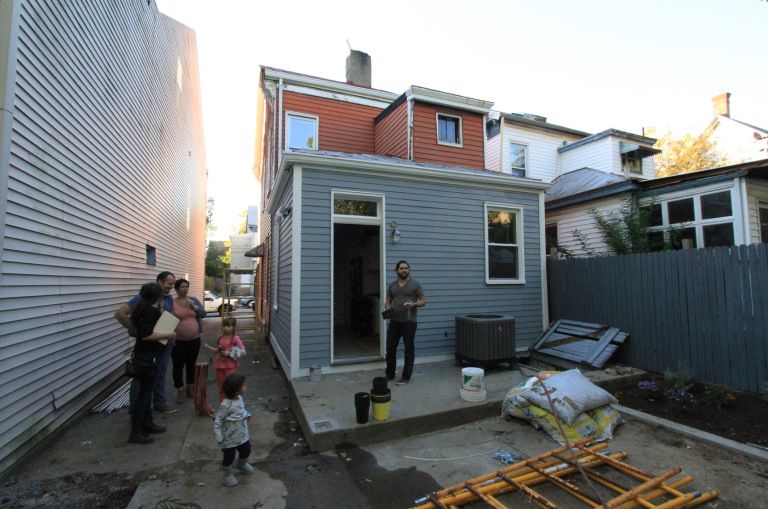
    Last year I engaged in a failed attempt to renovate and expand an old house in an 1890’s era neighborhood in Ohio. It ended badly. So I thought I’d do a follow up on what actually does work given the legal parameters and cultural context.


    I sold the house to a smart young local guy who bought eight similarly run down properties on the same block within a short period of time. He gathered private funds from a group of personal investors to finance the venture. Then he hired a family owned contracting company from across the river in Kentucky to renovate all the homes. He’s selling the properties as they become ready for market and distributing the profits to his investors, keeping a percentage for himself. It’s a really good economic model with a fast lucrative turn around.

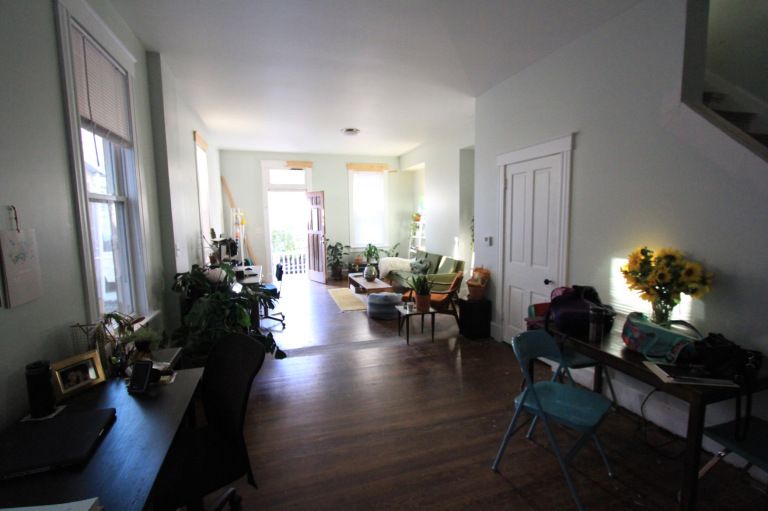
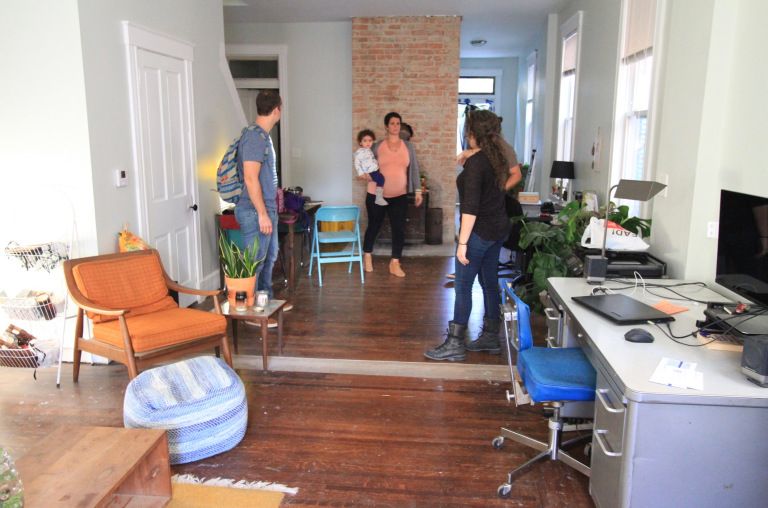
    The new owner and his contractor never dreamed of changing any of these buildings in a way that would have required any kind of special permission or variances from the city authorities. That way lies ruin. This smart team of savvy professionals brought these abused and neglected husks up to respectable middle class standards quickly and efficiently in a way that only marginally involved municipal officials with plain vanilla over-the-counter permits and ho-hum inspections. Once the new kitchen cabinets and fancy appliances go in along with the new windows and flooring these homes have instant market appeal. They’ve been selling very well, particularly because the collective renovations of multiple buildings at the same time in the same concentrated area feeds a palpable sense that the neighborhood is rapidly gaining value.

    It helps that the new owner went to high school in the area. In a provincial town like Cincinnati these things really matter to the locals. And he’s selling single family homes, presumably to future owner/occupants. In contrast, I was reviled in social media as both a carpetbagging gentrifier who was driving out long time working class residents and an absentee slumlord who would dump “the wrong element” on to the neighborhood and degrade property values and the quality of life for nearby homeowners.

    The end result is that the house I paid $15,000 for will ultimate sell for six figures even though it’s still exactly the same size and shape – give or take a nice cosmetic skin job – after it’s flipped at a generous profit. So the folks who worry about gentrification will experience the same resultant condition relative to what I had in mind for the place. And there’s no guarantee that it won’t eventually be purchased by someone who will choose to rent the property rather than live in it themselves. But all that is beside the point. The regulatory environment and cultural perceptions are the defining constraints. The new owner is just a whole lot better at effectively piloting his way around those shoals. I have to respect his business acumen.

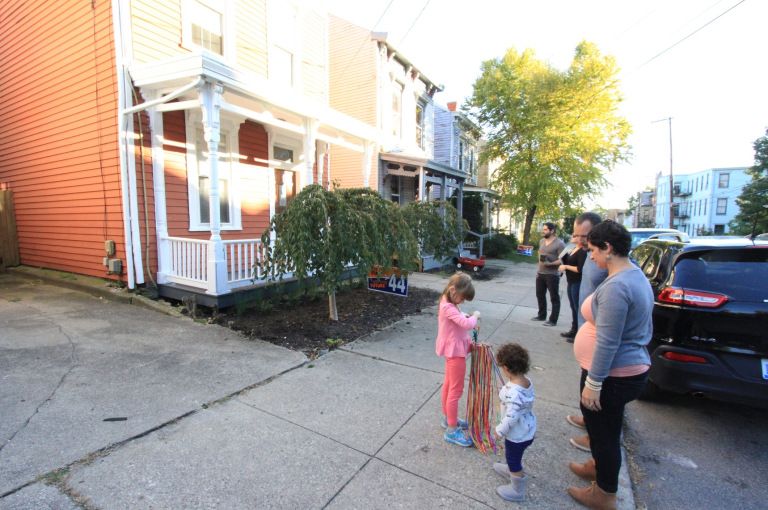
    Over the past five years I’ve followed a variety of young talented industrious people in the neighborhood. One couple has been engaged in another business model that works beautifully. They buy a distressed property at a reasonable price point. They move in and occupy the space themselves for about a year while they renovate it. Then they buy their next property, move in, and rent the one they just completed. Instead of flipping properties they’re steadily building a long term portfolio with positive cash flow and equity. They’re currently managing a dozen units and filling them with good quality people from the community.

    The crucial point is that they never buy a property that requires special permission to upgrade or needs extraordinary amounts of structural work to bring it up to code. They buy a solid shell and clean it up. Full stop. If they encounter an otherwise great building that happens to need fire sprinklers, or an elevator, or a zoning variance they steer well clear of it. Let some other poor bastard kill themselves in the meat grinder of endless bureaucracy and public outrage. (That was me…)

    To do absolutely anything else is technically possible, but hideously time consuming, difficult, and untenably expensive – and your neighbors will call you all sorts of terrible names and project all their fears on to you. For folks who believe in building great new places that mirror the charming old compact mixed use walkable neighborhoods of a century ago… Let it go. We have the dregs we inherited from previous generations and they can be shined up. But that’s it.

    John Sanphillippo lives in San Francisco and blogs about urbanism, adaptation, and resilience at granolashotgun.com. He’s a member of the Congress for New Urbanism, films videos for faircompanies.com, and is a regular contributor to Strongtowns.org. He earns his living by buying, renovating, and renting undervalued properties in places that have good long term prospects. He is a graduate of Rutgers University.

    All photos by Johnny Sanphillippo

  • An Open Letter To The Democratic National Committee From A Rural Democrat

    Dear Democratic National Committee,

    I’m writing you as a recently defeated Democratic State Senator in the “Red State” of North Dakota to talk about rural America. I’ve heard you may be interested in learning about us after the results of the 2016 election. Some of you have taken to the national airwaves to talk about reconnecting with our life styles here in the heartland. I’m glad it seems we finally have your attention.

    Here in the heartland of America, Democrats have been forced to fight against the odds you’ve unwittingly built against us to win elections. Unfortunately after the past couple of election cycles, there are only a handful of rural Democrats left who have been successful at overcoming those odds. One of them I’m proud to call my United States Senator.

    You should know that since the election, many of the North Dakota Democrats I visit with have done a lot of serious soul searching. “Where do we go from here?” “Has the national party shifted in such a way that I no longer identify with it?” “How do we reclaim what it means to be a Democrat in rural America?” All of those questions are complex and will take time to resolve. The answers may come differently for each of those individuals, especially for those who have felt abandoned out here. One thing I know for sure, none of them plan to quit and walk away from their drive to improve the community around them. It is the path to successfully have an impact that is the question.

    We’ve witnessed good, solid, moderate candidates get abandoned here in the Midwest; financial help stripped from promising campaigns and a separation in policy priorities between North Dakota and the coastal states. This only furthers the difficulty of finding great candidates who are willing to put their name on the ballot under your brand. Believe me; there are elected officials from the other side of the ticket whose priorities do not align with the average North Dakotan. Some of them have their eyes set on higher office. And as you know, Senator Heidi Heitkamp is up for reelection in 2018. We are willing to do all we can locally to get her reelected, but we need the assurance we aren’t going it alone.

    It is not just North Dakota Democrats either. A poll done by the Pew Research Center finds Democrats are less optimistic about their party’s future. This is a swift change from the pre-election talk of Trump being the death of the Republican Party as many of your pundits boasted. We also see how party leaders are trying to rationalize this year’s drumming. It was the FBI, it was fake news on Facebook, it was Jill Stein, and the list goes on. Bullshit. All of those likely had an impact, but I fear there is a more fundamental failing in the national Democratic Party.

    You’ve forgotten about who we are in rural America, and how many of us live our lives.

    I’m afraid you may have learned nothing from the November 8th election. While you talked about us in rural America, Congressional Democrats decided to stick with Rep. Nancy Pelosi as their leader over the other option, Rep. Tim Ryan from rural America. Staying the course with the same leadership that has overseen the decimation of the Democratic Party in the Midwest doesn’t bode well for us in the heartland.

    North Dakota Democrats have been in a precarious position for at least a decade. We are an energy-producing state with family and friends in the industry. Some of our towns are built for, and sustained by, energy workers. We understand how vital these resources are to our country while we build new technologies to diversify. We’re also proud farmers who take pride in caring for our land and feeding the world. We hunt, we fish, we own guns, and we have closets full of camouflage, blaze orange, and Carhartts. We’re the crowd at a small town street dance where live music is played on the back of a flatbed trailer. We are community driven individuals who know we all do better when we all do better.

    When you push an agenda where at the top you aim to hamper fossil fuels or add foolish rules on farmland, it boxes local Democrats in, here in North Dakota. It has become easy for the local political opposition to simply say, “Those Democrats are out-of-touch. They’re the party of Pelosi!” and they do it effectively. Here, we know how our homes are heated in the cold winter months, what fuels our trucks to drive down our gravel roads, and where our food comes from. That seems like a stark contrast from the rhetoric we hear from many national Democratic leaders who seemingly want to alter our way of life.

    So after laying that out, this is often where my more liberal friends ask if there is even a difference between a Republican and us rural, moderate Democrats. You’re damn right there is. To understand this, I welcome you to look at the North Dakota Legislature. Democrats pushed for sales tax exemptions on clothing for families. We reasoned for renters’ relief. We fought for family leave. We defended services for senior citizens, veterans, and people with disabilities. Meanwhile, what was passed by the Republican majority was an oil tax cut, a weakening of insurance for injured workers, corporate income tax cuts that go out-of-state, and threatening a reduction in services for senior citizens and children with disabilities. If people think there isn’t a difference between Democratic and Republican priorities in North Dakota, they haven’t been paying attention. It is on the Democratic Party to do a better job of telling that story and remind the average, hard working American that our values and priorities align with theirs.

    While you’ve been focused on the White House and maintaining Congressional seats, you’ve surrendered the fight for us in the heartland. We are now left clinging on to the hope that we can recapture the trust of our local electorate. We hear from the national Democratic Party about how important connecting with rural America is to them now. Here is the problem:

    You keep talking about us, but nobody is talking with us.

    The first step to understanding us is listening to us. The first step to winning is showing up. There is still time. If you’re interested, I know a lot of small town diners, bar counter tops, gas stations, and locally owned businesses that would welcome you if anyone were interested in engaging and talking with us here in the heartland.

    Tyler Axness
    Former North Dakota Democratic State Senator

    This piece first appeared at NDxPlains.com, a site discussiong ND and national politics.

  • Babes In Trumpland: The Coming Rise Of The Heartland Cities

    Contrary to the media notion that Donald Trump’s surprising electoral victory represented merely the actions of unwashed “deplorables,” his winning margin was the outcome of rational thinking in those parts of the country whose economies revolve around the production of tangible goods.

    And their economies stand to gather more steam in the years ahead.

    Trump’s victory was largely minted in the suburbs and smaller cities of the new American Heartland, from Pittsburgh to Omaha to Dallas-Ft. Worth. The heartland regions depend on agriculture, home construction, manufacturing and energy, all of which could benefit from the policies of the new presidential administration and Republican Congress. In contrast, Hillary Clinton favored extending the Obama administration’s policies on fossil fuels and housing that may win support in the dense progressive bastions of the East and West coasts, but were viewed with alarm by many tied to heartland industries, some of which have been under pressure from a global decline in commodity prices.

    Trump’s pro-fossil fuel stance may be anathema in the coastal cities, but will have a very positive effect on the many cities in the “oil patch” that extends from Texas’ Permian Basin to North Dakota, Ohio and western Pennsylvania. This is not just a matter of roughnecks out on the Gulf or West Texas; many of the 100,000 or so jobs lost in the energy industry over the past few years were located in major cities, such as Houston, where many of the employees are both well-educated and dwell close to the urban core.

    Most important of all, manufacturing matters in the heartland in ways that no longer resonate in coastal areas, particularly New York and San Francisco. Since 2000, two of America’s historic centers for manufacturing, Los Angeles and New York together have lost over 600,000 manufacturing positions. Trump’s call for more U.S. industrial jobs could turn out a swan song, but every job that stays in America due to his cajoling is more likely to benefit people in suburban St. Louis or Detroit than Manhattan or Malibu.

    Building on Momentum

    Critically, Trump’s election comes at a time when heartland cities already had economic momentum, including in the Rust Belt.

    The stock, real estate and tech booms on the coasts, as well as increased regulation and taxation there, have made interior cities increasingly attractive to relocating companies and migrants. This is most evident in Texas’ leading metropolitan areas — Dallas-Ft. Worth, Austin, San Antonio and, until recently, Houston — which have consistently led the nation in job and population growth.

    When California companies like Apple look to add middle-class jobs, they don’t often do it in the Golden State, but in more affordable places like Austin. Every big Texas city in recent years can show you a big scalp from my adopted home state: Occidental to Houston, for example, or Toyota America and Jacobs Engineering to Dallas.

    Similar patterns can be seen in the rapid expansion of such smaller cities as Nashville, Charlotte, Columbus, Salt Lake City — all in states that Trump won handily. These cities have developed impressive central cores, but have seen larger scale growth on their periphery. Resilient Great Plains cities like Fargo, Omaha and Sioux Falls have spiffed up and attracted investments in everything from tech and financial services to health care.

    Other industries, such as financial services and business and professional services, are also moving increasingly to heartland cities, and some are building impressive presences in health care.

    Voting With Their Feet

    Perhaps the most underreported, but significant shift towards heartland cities has been a human one. Before, educated people generally clustered in favored blue cities such as San Francisco, New York, Boston, Washington, D.C., and Chicago. This thesis was well documented by urban analyst Richard Florida in his “Rise of the Creative Class.”

    Yet when Richard and I were together in Kansas City last month we were treated to a tour of the region’s ascendant neighborhoods, both in the city and in adjacent parts of Kansas.Cities like Kansas City have seen their downtown residential populations surge, but the vast majority of growth there, as well as in the rest of heartland, tends to be on the periphery.

    As growth in New York and other “hip” cities has slowed, populations are shifting to less expensive ones. Research by demographer Wendell Cox has found that since 2010 over 1.45 million people net have moved from Clinton states to those that favored Trump.

    This increasingly includes young people, according to research conducted at Cleveland State University. There has been a sea change in the migration patterns of educated millennials since 2010, with faster growth in heartland cities than the Bay Area, Washington or New York.

    The biggest drivers for migration to Trumpland tends to be housing prices and rents. Housing prices across the New heartland overall Is 3.4 times the median household income (this is a price-to-income ratio called the “median multiple”). This compares to 7.5 times in California and 4.3 times in the Northeast Corridor (Washington to Boston).Given the choice between more expensive locales on the coasts and less expensive ones in the interior, many people have begun to flock to places like Des Moines, Omaha, Indianapolis and Columbus.

    These trends may become more pronounced when the bulk of millennials enter their 30s and begin to start families and buy homes. Derek Thompson of the Atlantic observes: “The great irony of national migration is that media headquarters overwhelmingly reside in the same dense urban areas that other Americans are desperately trying to escape (or cannot afford).”

    A similar trend may soon take place among immigrants. The Trump campaign may have sought to demonize some of the foreign born, notably the undocumented and Muslims, but many of the cities now growing their immigrant populations most rapidly are in the heartland.

    Houston has been gaining more foreign-born residents than Los Angeles; Dallas now has a higher share of foreign-born residents than Chicago.

    Now the immigrants are expanding to other mid-American outposts such as Nashville, Indianapolis and Columbus. Trumpian politicians may seek to exploit xenophobic sentiments, but metropolitan boosters across the heartland are quick to promote their appeal with foreign-born residents, seeking their entrepreneurial energy and enriching cultural influences. When in Nashville, boosters take you not just to the old country music haunts, but to thriving Kurdish, Somali,  and Mexican enclaves.

    Can Trumpland take success?

    Yet for Trump and his allies in the Republican Party, the resurgence of heartland cities will also bring with it risks. Some of those who now find their future in Kansas City or Houston also bring with them attitudes shaped in blue states, something some progressives are counting on. They may have escaped the worst aspects of ultra-high taxes and abusive regulations, but sometimes this does not stop them from wanting to repeat the old patterns in their new homes.

    the core cities in most of the larger heartland metropolitan areas are either deep blue, as is the case in the Great Lakes, or are turning blue, including Dallas and Houston. The suburbs, particularly the new, further out ones, have remained deeply conservative, but this also could change over time as more young people and immigrants migrate there. Heartland success could undermine some of the very reasons for their resurgence.

    Success also has strange impacts on people’s thinking, and ultimately a resurgent heartland, populated by newcomers and immigrants, could take a very different turn in the decades ahead.

    But this can only happen if Democrats somehow learn to craft their appeal to places outside their current deep-blue bastions. Trump may have won in large part due to the misfortunes heaped on these in the past, but, unless challenged, he ultimately may further consolidate his base by riding on the ascendancy.

    This piece first appeared in Forbes.

    Joel Kotkin is executive editor of NewGeography.com. He is the Roger Hobbs Distinguished Fellow in Urban Studies at Chapman University and executive director of the Houston-based Center for Opportunity Urbanism. His newest book, The Human City: Urbanism for the rest of us, will be published in April by Agate. He is also author of The New Class ConflictThe City: A Global History, and The Next Hundred Million: America in 2050. He lives in Orange County, CA.

    Photo by Max Goldberg from USA (Trump Cedar Rapids) [CC BY 2.0 (http://creativecommons.org/licenses/by/2.0)], via Wikimedia Commons

  • It Wasn’t Rural ‘Hicks’ Who Elected Trump: The Suburbs Were — And Will Remain — The Real Battleground

    Much of the New York and Washington press corps has concluded that Donald Trump’s surprising journey to the Oval Office was powered by country bumpkins expressing their inner racist misogyny. However, the real foundations for his victory lie not in the countryside and small towns, but in key suburban counties.

    The popular notion of “city” and “country,” one progressive and “vibrant,” the other regressive and dying, misses the basic geographic point: the largest metropolitan constituency in the country, far larger than the celebrated, and deeply class-divided core cities, is the increasingly diverse suburbs. Trump won suburbia by a significant five percentage point margin nationally, improving on Romney’s two-point edge, and by more   outside the coastal regions.

    Despite the blue urbanist cant that dense metro areas — inevitably labelled “vibrant” — are the future, in fact, core cities are growing at a slower pace than their more spread out suburbs and exurbs, which will make these edge areas even more important politically and economically in the coming decade. The states that voted for Trump enjoyed net domestic migration of 1.45 million from 2010 to 2015, naturally drawn from the states that were won by Hillary Clinton. Democrat-leaning ethnic groups, like Hispanics, are expanding rapidly, but Americans are moving in every greater numbers to the more conservative geographies of the Sun Belt, the suburbs and exurbs.

    Suburbs Drive Swing States

    The future battles between the parties will have to be waged where the people and jobs are: suburbia. Suburban voters particularly put Trump ahead in the crucial Midwestern states of Michigan, Wisconsin, and came close to winning him supposedly deep blue Minnesota. This is where the Democratic falloff from the Obama years was most evident, notes Mike Barone, falling from  dropping from 54 percent for Obama to 2008 to 45 percent this year.

    Clinton did win some suburban counties, especially in the Philadelphia area, but by lower margins than President Obama had in 2012. Clinton’s margin was also lower in some older rustbelt urban counties: Erie (Buffalo), Onondaga (Syracuse), Monroe (Rochester), Albany, and Hamilton (Cincinnati). A number of college towns and state capitals also invariably voted for Clinton, overwhelmingly.

    Overall, though, most suburban counties in the swing states supported Trump. In Michigan, Trump lost Detroit, and surrounding Wayne County, by better than two to one, but captured four of the five surrounding suburban counties. His margin greatly exceeded that of Romney in these counties, which, combined with his strong support in smaller cities and rural areas outside the major metropolitan areas, put him over the top in this critical state.

    A similar pattern can be seen in Pennsylvania. Clinton, of course, won overwhelmingly in the large urban counties — the city of Philadelphia went for her by 82 to 15. She also won some nearby suburban counties around the city, as was expected. But elsewhere Trump did better. He lost Allegheny County (Pittsburgh) but won all the surrounding suburban countries by piling up 54 percent to 74 percent of the votes; he lost the state capital of Harrisburg but made that up by crushing her in the suburban counties. Particularly striking was his victory in historically Democratic Erie County (population 280.000), west of Buffalo; Obama had won the county by 16 points in 2012.

    Much the same can be said about Wisconsin, where Trump was not expected to be too competitive, as well as Ohio, someplace he was expected to win. Clinton’s edge in Ohio’s smaller, blue collar urban constituencies fell well below the levels enjoyed by President Obama while surrounding suburban counties went, almost without exception, heavily for Trump.

    The Political Geography Of The Future

    Ultimately the road to recovery for Democrats does not lie in expanding the urban core vote. As Mike Lind has suggested, progressives embrace a kind of post-national “open borders” ideology that makes sense in denser, global cities — where the demand for low-end service labor is greater — than in suburban or small town and rural areas that tend to be more egalitarian and, for the most part, whiter.

    There may be growing unanimity of Democratic support in core areas, but urban cores are growing more slowly, or not at all, compared to the suburbs. Indeed the urban vote in the cores, although obviously tilted blue, has dropped in recent years, with the exception of the Obama run in 2008. Nor do attempts to call suburban or “countryside” people “deplorable,” racist and even too fat constitute much of a strategy to appeal to these areas.

    In contrast, Trump’s geographic coalition between the deep red countryside and the suburbs demonstrated an alternative that can work, particularly in key swing states. Despite the wishes of many planners, and their Democratic allies, suburbs and small towns are not about to go away in the near future. Areas outside million-plus metropolitan areas accounted for 100 percent of the vote in Iowa, 61 percent in Wisconsin, 47 percent in Michigan and Pennsylvania, and 44 percent in Ohio. They may not be demographically ascendant, but they still carry considerable heft.

    Nor can blue state advocates continue to claim that millennials will not move to suburbia, because that is clearly happening. Urbanist mythology now holds to a fallback position that millennials move to the suburbs simply because they have been priced out. However, they don’t look at other compelling reasons — notably shaped by life stage — for suburban growth. As most millennials will soon be over 30, its seems likely more will head to the periphery, as did earlier generations to gain more space to raise a family, better schools and safety. Even after the Great Recession people continued to move in large numbers from urban core counties to the less dense suburbs and exurbs. Between 2010 and 2015, suburban counties of major metropolitan areas added 825,000 net domestic migrants, while the urban core counties lost nearly 600,000. The real question is whether millennials will turn these red-trending areas bluer, or will their experience as homeowners and parents make them more traditional and conservatively minded suburbanites?

    The basic geographic and demographic conclusion: the balance of political power lies with suburban and exurban counties, particularly in swing states. Republicans need to build on their success by appealing more the minorities and immigrants who are also moving to the periphery. To return to power, the Democrats should   shift their attention from their urban core base and look more to the periphery. In the end, they need to provide compelling reason why these areas should support a party that, at least for now, seems generally favorable  to their exclusion and even ultimate demise.

    This piece originally appeared in Forbes.

    Joel Kotkin is executive editor of NewGeography.com. He is the Roger Hobbs Distinguished Fellow in Urban Studies at Chapman University and executive director of the Houston-based Center for Opportunity Urbanism. His newest book, The Human City: Urbanism for the rest of us, will be published in April by Agate. He is also author of The New Class ConflictThe City: A Global History, and The Next Hundred Million: America in 2050. He lives in Orange County, CA.

    Wendell Cox is principal of Demographia, an international public policy and demographics firm. He is a Senior Fellow of the Center for Opportunity Urbanism (US), Senior Fellow for Housing Affordability and Municipal Policy for the Frontier Centre for Public Policy (Canada), and a member of the Board of Advisors of the Center for Demographics and Policy at Chapman University (California). He is co-author of the “Demographia International Housing Affordability Survey” and author of “Demographia World Urban Areas” and “War on the Dream: How Anti-Sprawl Policy Threatens the Quality of Life.” He was appointed to three terms on the Los Angeles County Transportation Commission, where he served with the leading city and county leadership as the only non-elected member. He served as a visiting professor at the Conservatoire National des Arts et Metiers, a national university in Paris.

    Electoral map by Ali Zifan (This file was derived from:  USA Counties.svg) [CC BY-SA 4.0], via Wikimedia Commons

  • Five Ideas to Make America Greater

    Donald Trump’s presidential campaign was based on the notion that he could “Make America Great Again.” But beyond the rhetoric — sometimes lurching into demagoguery — the newly elected president comes to office, as one commentator suggests, “the least policy-savvy president in history.”

    To succeed, Trump must adopt innovative policies that transcend traditional right-left divides. He needs to find ways to help his heavily white, working-class base while expanding his appeal to minorities, millennials and educated people who are now largely horrified by his ascendency.

    In the short run, his biggest problem may lie with his own Republican Party establishment, which, rather than “drain the swamp,” would simply like to create one of its own. The looming presence of corporate lobbyists, swarming around the administration like hungry flies, is not encouraging at all, nor are GOP congressional plans to re-establish “earmarks.”

    The key lies not in empowering a different set of K Street parasites, but rather in reversing income stagnation. If he cannot, his triumph may prove to be no more consequential than an absurdist, Latin American-style telenovela.

    A flatter, fairer tax

    The basic instinct among many Republicans tends toward reducing taxes on their richest donors and making life easier for the ultrarich, including some on Trump’s economic team. Trump’s imperative should, instead, be to make the tax system fairer for the middle and working classes. One way would be to make a graduated flat tax that would mean that the rich, who make most of their money from investments, pay the same rate for capital gains as the rest of us do for income.

    Democrats will, no doubt, still charge Trump with being “unfair,” but, as Ronald Reagan proved 20 years ago, Americans support incentives for work if they don’t unfairly tilt conditions to the ultrarich. Main Street business owners, the most hostile constituency to the Obama administration’s policies, pay taxes based on their income and can’t manipulate the system like Apple, Google, Wall Streeters or, for that matter, real estate developers like Trump himself.

    A middle ground for immigration

    Opposition to illegal immigration helped drive the Trump campaign early on, but, outside of the GOP base, there is little support for a mass roundup of the undocumented. The vast majority of Americans, over 70 percent, also oppose “open borders.” After all, even President Obama evicted 2 million people during his two terms in office.

    Trump also can begin reordering our immigration policies toward skilled workers who are interested in becoming citizens. At the same time, Trump could score points by undermining the H1-B visa program, which allows Silicon Valley firms, along with corporations like Disney and Southern California Edison, to lay off American workers and replace them with temporary indentured servants.

    Read the entire piece at The Orange County Register.

    Joel Kotkin is executive editor of NewGeography.com. He is the Roger Hobbs Distinguished Fellow in Urban Studies at Chapman University and executive director of the Houston-based Center for Opportunity Urbanism. His newest book, The Human City: Urbanism for the rest of us, will be published in April by Agate. He is also author of The New Class ConflictThe City: A Global History, and The Next Hundred Million: America in 2050. He lives in Orange County, CA.

    Photo: Gage Skidmore from Peoria, AZ, United States of America (Make America Great Again hat) [CC BY-SA 2.0], via Wikimedia Commons

  • A Window Into the World of Working Class Collapse

    Some time back my brother recommended I watch the documentary film Medora, about a high school basketball team from rural Southern Indiana. I finally got around to doing it.

    Someone described this film as an “inverse Hoosiers“, which is an apt description. Hoosiers is a fictional retelling of the Milan Miracle, the legendary story of how tiny Milan High School (enrollment 161) won the state’s then single-class basketball championship in 1954.

    There’s no such happy ending in prospect in Medora (available on Netflix). The town’s basketball team had gone 0-22 the season before the film. The question is not whether they will win a championship or even the sectional, but if they can win just a single game.

    The basketball team is a proxy for the community as a whole, a once proud town fallen on hard times.  The town of Medora (pop ~700) and its surrounds, locals believe, used to be prosperous, socially cohesive, and have a great basketball team too.

    This history is part mythological. I don’t doubt that these towns once had all the doctors and lawyers and such that people say they did. I’ve heard the same stories about where I grew up (two counties south). But that was a different era and I doubt there was ever real prosperity. Rural and small town life has always been tough in America.

    But the social history certainly has much truth.  Even in my own childhood I remember that people not only didn’t lock their houses, they left their keys in their cars.  City water service, cable TV, garbage pickup, and even private telephone lines may not have been available, but it had its upsides too.

    Today those Mayberry like characteristics are long gone.

    In Medora we see not only poverty, but nearly complete social breakdown. I don’t recall a single player on the team raised in an intact family. Many of them lived in trailer parks. One kid had never even met his father. Others had mothers who themselves were alcoholics or barely functional individuals. They sometimes bounced around from home to home (grandmother, etc.) or dropped out of school to take care of a problematic mother.

    These kids are also remarkably unsophisticated about the world. Once we see someone drive to Louisville – to pick his mother up from a rehab center – and another time one kid visits a seminary, but otherwise there’s no indication that these kids have spent much time or in some cases ever left Medora. One flirts with enlisting in the military. Another with what appears to be a for-profit technical college. But all of these are clearly unable to apply an independent knowledge or critical thought to what the sales reps for these entities are telling them.

    Much of what structure exists in the town and the kids lives appears to be imported. Both the coach and one assistant coach appear to be from Bedford – 30 miles away. Neither really seems equipped to deal with these troubled kids.

    Nothing indicates that these kids have much prospect of success in life.

    Yet we see that there’s also little motivation on the part of the people in the town to actually change that.  They are steeped in nostalgia and cling to a idealized vision of a past community that they surely know can never be reclaimed, yet insist on grasping until it is physically pried from their grip.

    Medora is one of the last unconsolidated small town high schools left in Indiana. (I attended a small school, but one that was already consolidated, with the uninspiring name of South Central High School).  It’s clearly not really viable as an independent school – it’s facing a major budget shortfall during the film – yet they steadfastly refuse to consider consolidation.

    The town residents believe that the loss of the school would be the death knell of their community. They aren’t wrong about that. Merging the school would destroy the locus of identity. But the cold reality is that the modern world doesn’t need towns like Medora anymore. Always changing is the future as they say, but it’s hard to imagine anything that would sustainably restore the town.  America is full of towns like Medoras. Some of them may experience a miracle. Most won’t, and will slowly bleed away to a dysfunctional rump community. (Interesting, Medora’s population grew by 23% during the 2000s, something worthy of further investigation).

    The residents of Medora refuse to surrender their town and resolutely refuse to leave. In that they are not unlike the handful of people hanging on in depopulated Detroit neighborhoods who will accept planned shrinkage only over their dead bodies. It’s irrational to those of us who have no such attachment to a place, but it is clearly a sentiment that animates many such people all over the world.

    The National Review’s Kevin Williamson blames the residents of these towns for their own demise. This is manifestly false. The people in these communities did not change the structure of the economy to render their homes obsolete. They did not invent the technology that destroyed the need for agricultural labor. They did not create the divorce revolution. They did not invent Oxycontin.  These towns have always been belated, sometimes unwilling consumers of what is created elsewhere.

    Yet the fact that outside forces acted on them does not absolve them from taking action now. Williamson is right about that. Much of the rural Midwest was settled by homesteaders who ventured off into the risky unknown, or German immigrants like the Renn family. These places were created by people who embodied different values than those who live there now, people who had no choice but to do something desperate in response to desperate conditions.

    I chose to leave my hometown. Many other chose to stay. I know that many people there think it is God’s country and can’t imagine anyone ever leaving. I don’t want to claim that their attachment to place is less valid than my lack of it. Even in the city, to the extent that no one is attached to the place, to their neighborhood, for anything other than immediate self-interest, that’s not a good sign for the long term. I see today the consequences of viewing places purely as a mechanism for extracting personal or corporate profit in the now.

    Yet the reality is that to the extent that people do choose to stay in the Medoras of this world, their future prospects aren’t good. Nor are those of their children. But if they leave their towns will die, along with a way of life. This isn’t a pleasant choice. They didn’t ask to be faced with it. But it’s the choice they face nevertheless.

    Aaron M. Renn is a senior fellow at the Manhattan Institute, a contributing editor of City Journal, and an economic development columnist for Governing magazine. He focuses on ways to help America’s cities thrive in an ever more complex, competitive, globalized, and diverse twenty-first century. During Renn’s 15-year career in management and technology consulting, he was a partner at Accenture and held several technology strategy roles and directed multimillion-dollar global technology implementations. He has contributed to The Guardian, Forbes.com, and numerous other publications. Renn holds a B.S. from Indiana University, where he coauthored an early social-networking platform in 1991. His personal urban affairs website is Urbanophile, where this piece originally appeared.

  • Population Change, 2015: Not Very Good News for Those Angry White Men

    Data on population growth from 2010 to 2015 show a continuing concentration of people in metropolitan areas, especially in the large areas with over a million people, where presumably traditional values are most challenged.  I show an amazing table, in which I have disaggregated population change by type of settlement, from the million-metro areas to the purely rural counties, comparing growth amounts and rates, plus noting how these areas actually voted in 2012. From the title, the news that growth is greatest in the biggest places seems bad for Republican prospects, but the accompanying maps also show that the greatest growth may well be in more Republican parts of metropolitan America – a story of geography vs. demographics.

    The data from the table are dramatic. Note that 275 million, or 86%, live in census-defined metropolitan areas (with urban agglomerations over 50,000), and 55.5% in just the 58 metro areas of over 1,000,000.  The biggest metro areas (but not the super large New York, Los Angeles, and Chicago) grew by 9.4 million, or 5.5%, the smaller metro areas by 3.4 million, or at 3.3 %, while non-metropolitan America dropped from 46.3 million to 46.1 million, down to 14% of the total population. 

    The final column of the table shows how these areas voted in the 2012 presidential election. Obama won the big metro areas of over one million by taking 57.6 percent of the 2 person vote, which enabled him to get almost 52% of the total US vote while winning the three megacities – New York, Los Angeles and Chicago – by an even wider margin. This meant that despite LOSING all other settlement categories – 48% in smaller metro areas, only 41% in micropolitan areas, and a pathetic 40 percent in rural small town America, the President still won handily.

    Population Change by Settlement Type, 2010 2015
      # Counties 2010 Pop 2015 Pop Change % Chg % of Pop 2015 % Obama, 2012
    Million Metro Center Counties          255   156,143    164,749      8,606 5.5% 51.3%
    Million Metro Outlying Counties          179     13,661      14,416         749 5.5% 4.5%
    Total Million Metros          434   169,804    179,165     9,355 5.5% 55.7% 57.6
    Other Metro Center Counties          473     85,634      89,005      3,371 3.9% 27.7%
    Other Metro Outlying Counties          259       7,025         7,086           61 0.9% 2.2%
    Total Other Metros          732     92,659      96,091     3,432 3.7% 29.9% 48.3
    Micro Center Counties          559     26,422      26,533         111 0.4% 8.3%
    Micro outly            92       1,080         1,070          (10) -0.9% 0.3%
    Total Micropolitan Areas          651     27,502      27,603         101 0.4% 8.6% 41.4
    Rural Sm Town          727     14,058      13,899       (159) -1.1% 4.3%
    Rural Sm Town          598       4,731         4,663          (68) -1.4% 1.5%
    Total Non-metro Counties      1,325     18,789      18,462       (327) -1.7% 5.7% 40
    ALL      3,142   308,774    321,435   12,664 4.1% 100.0% 52


    So the good news for the Democrats is that the greatest population growth occurred in larger cities where Obama did best in and fell in areas he did poorest in.

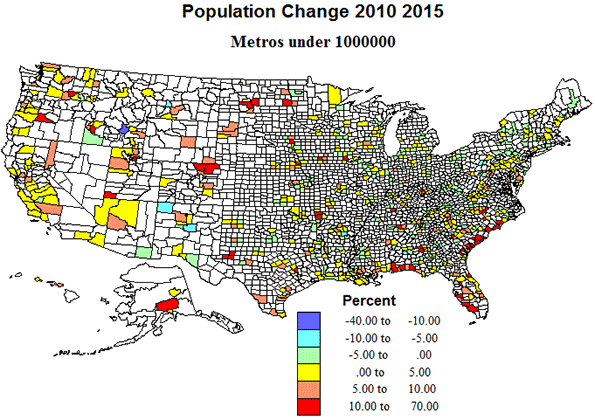
    But the story gets complicated once you get beyond the metro level. I now show maps, first of the pattern of population change by type of settlement, and then show how well Obama did in 2012 by these same settlement types. First we have a general map of population change for all US counties, in which I can display both the absolute change by symbol size and the percent change by color. Most apparent are the dominance of growth in metropolitan areas, especially in suburbs, and notably in the South and West. Note that quite a few of the growing counties appear to be in areas where Obama was not that strong (in maps to follow).

    Population Change by Settlement Type

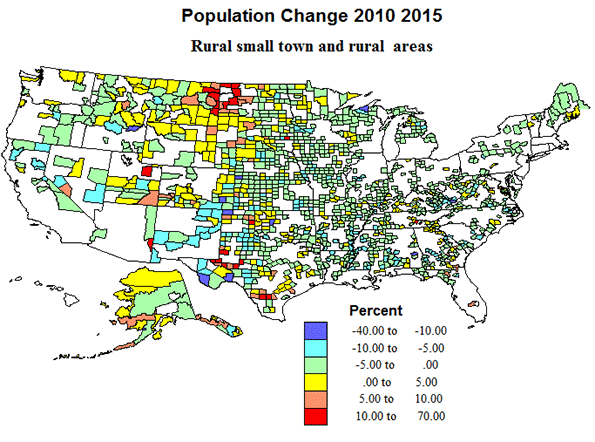
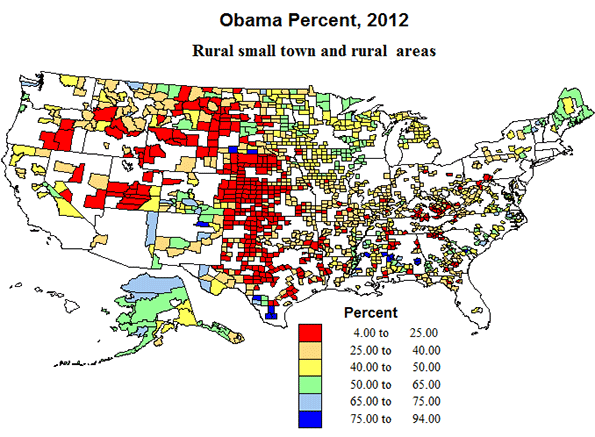
    Rural and rural-small town areas include about 40% of counties and of the territory, but now hold under 6 percent of the population. Modest population loss is most common, especially across the eastern half of the country, while the pattern of change is more complex in the western half, with pockets of gain in areas of energy development, as in ND-MT, and TX-OK, undoubtedly temporary, and scattered areas of growth in environmental amenity areas farther west. The greatest extent of rurality is still from west Texas, north through Oklahoma, Kansas, Nebraska, South and North Dakota  and Montana.

    Politically, Republican Romney swept most rural, small town territory over sizeable contiguous areas in the high plains, as well as the Mormon realm, but Democrats did win in majority Black counties in the south, Latino counties in Texas, and in Native American Indian counties in the far west. In sum, not a story to comfort Republican hopes.

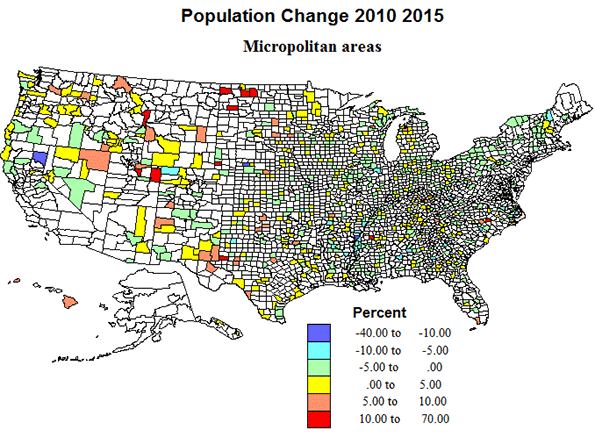
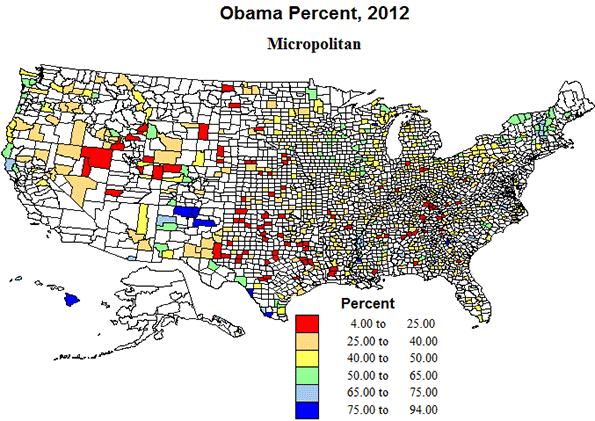
    Micropolitan areas now include about 20 percent of counties and of territory, and house almost nine percent of the population. They experienced only modest population growth from, 2010 to 2015. They are quite widely dispersed across the country, with the exception of most of California.  Just as with rural small-town territory, a pattern of modest loss prevails over the eastern half of the country and a more mixed pattern in the west, echoing the higher growth in areas of energy development, and in parts of the Mountain states and far west, including some environmentally attractive areas.

    Politically, the micropolitan areas, with urban agglomerations between 10 and 50 thousand were almost as supportive of Republican Romney as the more rural areas, and in essentially the same geographic areas, in southern Appalachia, the high plains from Texas to North Dakota and in the Mormon realm, and with the same Democratic outliers in majority minority areas. Again, a pattern not too comforting for Republican prospects.

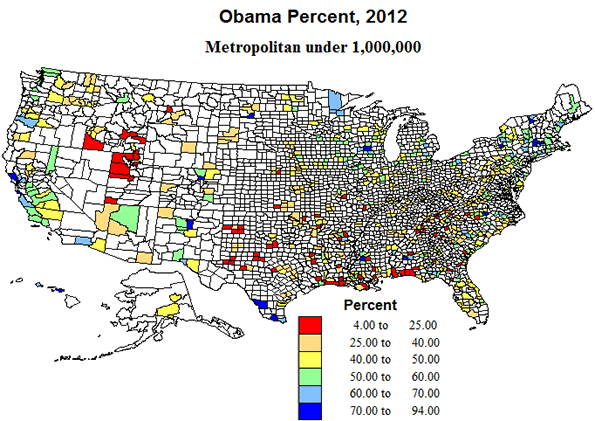
    Metropolitan areas under 1 million  represent what could be called middle, compromise America, with about one-fourth of US counties, and with 30% of the population. Their geographic pattern is one of broad distribution in the interior of the country, but with a marked coastal concentration in the Gulf and South Atlantic.  Similarly, growth was modest or losses occurred in most of the interior eastern US,  but big gains in southeastern coastal areas, and across most of the far west.

    Politically, too, these areas are intermediate, with Obama receiving 48% of the vote in 2012.  The outlying smaller metropolitan counties are indeed often quite rural.  Some of the growing areas were tilted  more  Republican, as on the Gulf coast and especially in the Mormon west, but in the Atlantic coastal states, and Pacific coast states, Obama did much better.  

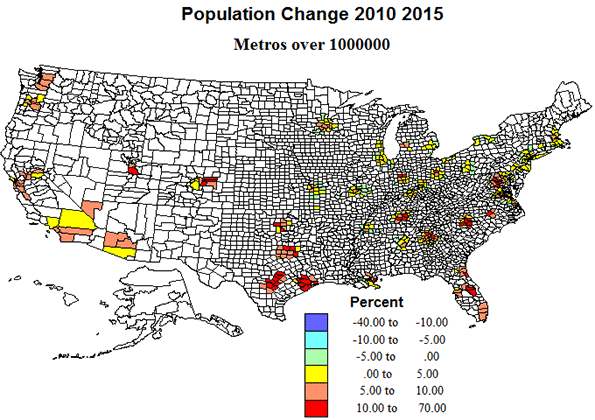
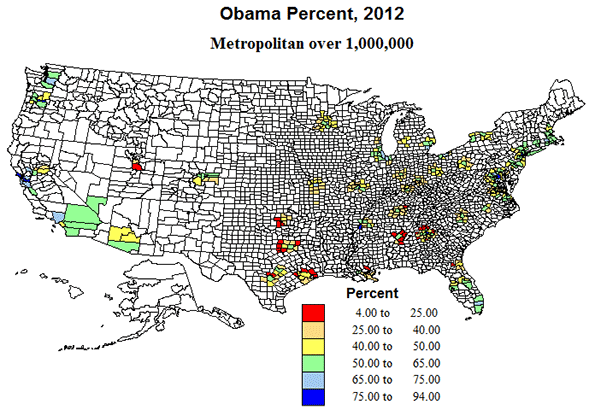
    Metro areas over 1 million.  Okay, these are the behemoths, one-seventh of counties with over half the population, and three-quarters of the growth.  But the fastest growth was across the south and in the west, with moderate growth and even modest losses in the north. The biggest metros – NY, Chicago and LA — grew well below national averages. Also, contrary to the perception of the death of suburbia, the outlying counties of this set experienced very high growth. 

    Politically, these suburban areas around the big metros may prove decisive, with the voting eligibility and inclinations of a diverse population critical to outcomes of the presidency and of Congress. Those suburban counties in the South appear to vote Republican, while those in the north and west became modestly Democratic. Size may benefit Democrats, but growth tilts Republican. Ultimately whichever proves most decisive may determine the election.

    Richard Morrill is Professor Emeritus of Geography and Environmental Studies, University of Washington. His research interests include: political geography (voting behavior, redistricting, local governance), population/demography/settlement/migration, urban geography and planning, urban transportation (i.e., old fashioned generalist).

  • The Energy Election

    Blessed by Pope Francis, the drive to wipe out fossil fuels, notes activist Bill McKibben, now has “the wind in its sails.” Setting aside the bizarre alliance of the Roman Catholic Church with secularists such as McKibben, who favor severe limits of family size as an environmental imperative, this is a potentially transformational moment. 

    Simply put, the cultural and foreign policy issues that have defined U.S. politics for the past have century are increasingly subsumed by a divide over climate and energy policy. Progressive pundits increasinglyenvision the 2016 presidential election as a “last chance,” as one activist phrased it, to stop “climate change catastrophe.” As this agenda gets ever more radical, the prominence of climate change in the election will grow ever more obvious.

    The key here is that the green left increasingly does not want to limit or change the mix of fossil fuels, but eliminate them entirely, the faster the better. The progressive website Common Dreams, for example, proposes eliminating fossil fuels within five or six years in order to assure “reasonable margin of safety for the world.”

    This new militancy is a break from the recent past, when many greens embraced natural gas and nuclear power as practical, medium-term means to slow and even reverse greenhouse gas growth. But the environmental juggernaut, deeply entrenched within the federal bureaucracy and pushed by a president with seemingly limitless authority, is committed increasing to the systematic destruction of one of the country’s most important, and high-paying, industries. One goal is to demonize fossil fuel producers along the lines of the tobacco industry.

    The pope’s intervention has bolstered the tendency within the environmental movement not to allow any challenge to its own version of infallibility. This, despite discrepancies between some models of climate change and what has actually taken place.

    As we have moved from a rational discussion of the issue toward an increasingly dogmatic agenda, we have lost sight of more pragmatic, and less economically painful, ways to reduce greenhouse gases through methods such as conservation, the substitution of natural gas for coal, and a re-embrace of nuclear power. As the Breakthrough Institute has shown, most reductions in greenhouse gases in the United States have not come from subsidized renewable energy sources but instead from improved efficiency and the rise of natural gas at the expense of coal. Overall, solar and wind, the favorites of the greens, account for barely 1.35 percent of the world’s energy.

    The Breakthrough Institute’s pragmatism intends to create a middle ground between the left, which demonizes even the slightest criticism of green policy dogma, and the right, which equally mistakenly dismisses climate change as essentially a fabrication. But with the extremes in control of the debate, we can expect next year to mainly hear divisive discourse instead of solutions.

    The Geography of Energy

    In some parts of the country, most notably the Northeast and the West Coast, the imperatives of climate change demand the destruction of the fossil fuel industry. In others, those that depend the most on low-cost energy, the attack on fossil fuels represents a moral threat to local economies, jobs and well-being. The battleground will be in the Great Lakes, arguably the most critical region for the next election. Contrary to its sad sack image, the economy there has been on the rebound for years. Virtually every Great Lakes state except Illinois now enjoys unemployment rates below the national average. Several, led by the Dakotas, Minnesota, Nebraska, and Iowa, boast job rates that are among the nation’s highest. 

    Three key factors are propelling this comeback: an energy boom, a resulting jump in manufacturing, and relatively low housing costs. Energy firms have been a major source of new work for industrial firms, and lower electricity costs have provided U.S. manufacturers with an energy price advantage over European and Asian firms. German electricity prices, a result of their “green” energy policies, are almost three times the average of those in the United States.

    The administration’s directive to all but ban coal could be problematic for many Midwest states, including several—Iowa, Kansas, Ohio, Illinois, Minnesota and Indiana—that rank among those most reliant on coal for electricity. Not surprisingly, much of the opposition to the EPA’s decrees come from Heartland states such as Oklahoma, Indiana, and Michigan.  

    Politically, the energy-rich states running from Texas, Oklahoma, and Louisiana up to the Dakotas may be all but lost to the Democrats. Before the decline in oil prices, these areas enjoyed a gusher in energy jobs, providing high wage employment (roughly $100,000 annually) that exceeds compensation for information, professional services, or manufacturing. Due largely to energy, they have enjoyed the highest jobs growth since 2007 and were among the first states to gain back the jobs lost in the recession. 

    In contrast, the areas that form the solid base of the progressives—basically the Northeast and the West Coast—have an increasingly small stake in fossil fuel industries. California, which has the fifth largest oil reserves among the states, has basically decided to abandon the industry, gradually pushing the remnants of what was once a thriving sector out of the state.

    For the most part, with the notable exception of Pennsylvania, Northeastern states have little in the way of fossil fuels, and have gradually been eliminating much of their manufacturing base for over a half century. Nor do they have much need for electricity for industry as they continue to deindustrialize. Manufacturing accounts for barely 5 percent of state domestic product in New York and 8 percent in California—but 19 percent in Michigan and 30 percent in Indiana.

    Rise of the Climate-Industrial Complex

    Climate activists such as hedge fund billionaire Tom Steyer increasingly couch their policies on theological grounds, one reason why the pope’s intervention was so timely. Stark self-interest is also at work. Many of the Silicon Valley and Wall Street supporters of green policies have been among those most anxious to capitalize on big oil’s demise. 

    This includes cash-rich firms such as Apple, as well as many high-tech financiers and venture capitalists. Some of the biggest new fortunes, notably that of Elon Musk, are largely the creatures of subsidies. Neither SolarCity nor Tesla would be so attractive—and might even not exist—without generous handouts from taxpayers.

    In contrast to traditional manufacturers, capitalists like Musk have a well-developed interest  in taking advantage of the most draconian energy legislation. Other tech figures, including top executives atGoogle, have benefited from government-subsidized renewable energy schemes, including a remarkably inefficient and expensive solar project that has obliterated a huge part of the Mojave Desert. 

    No surprise, then, that the crony capitalists of Silicon Valley and their Wall Street financiers have emerged as primary funders of the green left. Much like the oil firms that help finance Republicans, particularly those who are climate change skeptics, the new oligarchs have solid business reasons to embrace the pontiff’s environmental dogma, though they seem unlikely to follow his admonitions to eschew corporate greed.

    Ironically, the new militancy among greens is likely to hurt most the poor and working class with whom Pope Francis takes pains to identify. A rapid ban on fossil fuels in the developing world would hurt efforts to increase access to electricity. Today, some 1.3 billion people  are off the grid, and not by choice. In sub-Saharan Africa, where much of the world’s population growth is expected to take place, roughlytwo-thirds of the population lacks regular access to electricity.

    As Bjorn Lomborg has pointed out, whatever the negative effects of climate change on the poor, the impact of no electricity and poor sanitation are infinitely greater. Climate change policies, he notes, are an inefficient way to accomplish such things as reducing malaria; the Kyoto Protocol’s carbon cuts could save 1,400 malaria deaths for about $180 billion a year. More traditional approaches could save 300,000 people for about $500 million year.

    Greens seem to have little idea what the poor want or need. When asked, people in developing countries prioritize such things as education, health care, job opportunities and better food; climate change ranked 16th—dead last on the list—according to a UN survey.

    But the green gentry retain their catechisms. Prince Charles embraces the “intuitive grammar” of ultra-dense slums such as Mumbai’s Dharavi, which, he claims, have perfected more “durable ways of living” than those in the suburbanized West.San Francisco’s Friends of the Earth  similarly applauds slum-dwellers as an “inspiration” for the low-carbon urban future, while Stewart Brand openly endorses the notion, “Save the Slums,” because they will save the planet.

    Needless to say, it’s unlikely these apostles of urban squalor would want their children to live like that and it is absurd to suppose that leaders of such emerging powers as India and China have any intention of giving up on their gains in reducing poverty. We cannot expect they will accommodate the passions of wealthy Westerners at the expense of their own people.

    A War on the Western Working Class?

    Those most likely to pay for the new green agenda will be middle- and working-class populations in what are now rich countries. Germany spends hundreds of billions of dollars on solar panels and wind turbines that provide only an unreliable 15 percent of its electricity and 3 percent of its total energy. German consumers pay three times more for electricity than the average American. It’s so bad that Germans have added a new term to the language: “energy poverty.”

    Perhaps the best test case for the impact of draconian climate policies is in my adopted home state of California. Here, high energy costs brought about by renewable mandates have devastated manufacturing growth and boosted electric bills, particularly in the poorer, and hotter, inland areas. Asone recent study found, the summer electrical bills in rich, liberal Marin come to $250 monthly while in impoverished Madera, the average is twice as high.

    Of course, energy policy is just one of the things raising poverty in a state where many of the world’s greatest fortunes are being minted. But it’s part of a climate change-driven agenda that is also somewhat responsible for the state’s absurdly high housing costs by consciously limiting affordable suburban growth. Overall, nearly a quarter of Californians live in poverty, the highest percentage of any state, including Mississippi, and, according to a recent United Way study, close to one in three are barely able to pay their bills.

    With the blessings of the pope and broad support in the media, few Democrats are likely to stand up against the green policies. Hillary Clinton’s shift against the Keystone XL Pipeline, despite strong union support for the project, shows that she is willing to trade blue-collar workers in the Heartland for the approval of the coastal gentry, among whom climate change has acquired something of a religious aspect. “Whether it’s eating vegetarian or wearing organic eye shadow, we’re all shopping for absolution,” observes Daniel Engber in Slate.

    Ultimately Democrats will embrace the determined attempt by President Obama to secure his “legacy” as the great calmer of the Earth’s climate. Yet there’s some question how effective these policies will prove. Invariably, efforts will follow to silence those skeptical of the current course, particularly regarding the economic impact on working-class voters. In California, Steyer and his allies have worked overtime to suppress any potential dissent from politicians who hail from the largely Latino, blue-collar districts hit most directly by these policies.

    Despite a massive investment in Latino “grassroots” front groups, as well as politicians, this effort is not foolproof. This month a handful of largely Latino and inland Democrats, some of them backed by the state’s residual energy industry, killed Jerry Brown’s attempt to force a 50 percent reduction in fossil fuel use by 2030, a measure that would have allowed the state impose gas rationing.

    To be sure, this rebellion may prove short-lived, as state regulators now seem determined to impose by decree what could not even make it through the state’s Democratic-dominated legislature. Steyer loyalists such as State Senate President Kevin de Leon will continue to mollify his impoverished constituents–nearly half of all households in his district earn less than $34,000 a year—with handouts from “cap and trade funds” and the ever illusive chimera of “green jobs.”

    In truth, if anyone has benefited from green policies and subsidies, it’s been the well-off.

    They are the ones who benefit from subsidized solar, electric vehicles, and fuel-efficient cars; a recent UC Berkeley study found the top fifth of households received 60 percent of these wealth transfers, compared to barely 10 percent of those in the bottom quintile. Generally speaking, barrio residents don’t drive $100,000 Teslas.

    So will climate change be an effective issue for the Democrats next year? There is room for skepticism. In 2014 Steyer and his acolytes spent some $85 million on “green” candidates, only to fail impressively. Geography and class work against their efforts, driving longtime working and middle-class Democrats, driving voters in places like Appalachia, the Gulf Coast and some areas of the Great Lakes increasingly out of the Democratic Party.

    It is not even certain that Millennials, faced with diminishing prospects for good jobs and home ownership, will prove reliable backers of a draconian climate agenda. One recent survey suggested that young voters are actually less likely to identify as “environmentalist” than previous generations. 

    Like extreme social conservatism on the right, climate change thrills the coastal “base” of the Democratic Party, but threatens to lose support from other parts of the electorate. Despite the duet of hosannas of both the hyper-secular media and the Bishop of Rome, a policy that seeks, at base, to reduce living standards may well not prove politically sustainable.

    This piece originally appeared at Real Clear Politics.

    Joel Kotkin is executive editor of NewGeography.com and Roger Hobbs Distinguished Fellow in Urban Studies at Chapman University, and a member of the editorial board of the Orange County Register. He is also executive director of the Houston-based Center for Opportunity Urbanism. His newest book, The New Class Conflict is now available at Amazon and Telos Press. He is also author of The City: A Global History and The Next Hundred Million: America in 2050. He lives in Orange County, CA.

    Midwest drilling rig photo by Bigstock.

  • The Comeback Of The Great Lakes States

    For generations the broad swath of America along the Great Lakes has been regarded as something of a backwater. Educated workers and sophisticated industries have tended to gather in the Northeast and on the West Coast, bringing with them strong economic growth.

    Yet increasingly these perceptions are outdated. The energy hotbeds of Texas, Oklahoma and North Dakota may have posted the strongest employment growth since 2007, and were among the first states to gain back all the jobs lost in the recession. But a group of less heralded places from Minnesota to western Pennsylvania have also enjoyed a considerable revival, as energy, manufacturing, logistics and other basic industries have rebounded.

    Every Great Lakes state except for Illinois now has an unemployment rate below the national average, a stunning reversal from previous decades.

    Ironically the state most popularly associated with long-term economic decline, Michigan, has been lauded in a Pew study as perhaps the ”biggest success story.” From the state’s nadir of household employment in November 2009 through this July, the Wolverine State has added 302,543 jobs, a 7.2% increase.

    An Industrial Comeback

    One clear key to improving conditions in Michigan and elsewhere is the revival of America’s industrial economy. Following a generation of falling employment, the sector has been on something of a rebound since 2010, adding some 855,000 jobs. Although many of these new jobs are in the Southeast and Texas, Great Lakes states have been at the center of the turnaround. The fastest growth in industrial employment over the past five years has been in three Michiganmetro areas — Detroit, Warren and Grand Rapids – and Toledo, Ohio.

    Structural and political factors are behind the Midwestern recovery. Rising wages in China and the North American energy boom have helped make U.S. companies more cost competitive. German electricity prices, for example, are almost three times the average for the United States. Energy production has been a major driver in large swaths of the heartland, notably Pennsylvania, Ohio, and Oklahoma, where fracking has sparked new development.

    This growing competitiveness can be seen in a surge of capital investment. Four of the top 10 statesfor new plant and equipment investment in 2014 are in the Great Lakes region, according to Site Selection Magazine: Ohio, Illinois, Michigan, and Pennsylvania.

    Changing Geography Of Human Capital

    For generations the Great Lakes has been hemorrhaging people to the rest of the country, mainly the South and West. But that outflow has recently slowed, and in some cases reversed. According to demographer Wendell Cox, the rate of outmigration from Cleveland and Detroit has been cut by half or more while some metro areas, including Indianapolis and Columbus, Ohio, are firmly in positive territory. In contrast, Los Angeles, New York and even the Silicon Valley hub of San Jose continue to lose people to other regions.

    More surprising is the movement of younger college-educated people. American Community Survey numbers show some of the fastest growth in the population of educated workers between 2005 and 2013 occurred in places such as Pittsburgh, Columbus, Indianapolis and, yes, Cleveland, which, according to Cleveland State’s Richey Piiparinen, are attractive due to lower costs and a more family-friendly environment.

    Another analysis of the changes in the population of educated workers since 2005, by Mark Schill at the Praxis Strategy Group, reflects this shift. The rate of increase in the population of people 25 to 35 with graduate degrees was slightly higher in Pittsburgh than in San Francisco. Grand Rapids, Buffalo, Indianapolis, Columbus and Louisville did even better (albeit off low bases). These citiesare even considered something of new “hipster havens,” as young people look to these old industrial cities as better bargains for life and work.

    This brain gain parallels another important shift — the growing relevance of the Great Lakes workforce to companies here and around the world. The region already possesses the nation’s largest store of engineers in the country. STEM employment in a host of fields from manufacturing and medicine to business services is surging fast in many of these areas. Between 2004 and 2014, according to an analysis by Schill, several Midwestern states — Iowa, Michigan, Oklahoma, the Dakotas — added STEM jobs at double digit rates, equaling the percentage increases enjoyed by California and easily outpacing New York.

    It turns out that much STEM growth takes place out of the high-profile world of search engines, social media and “disruptive” business service firms. In many cases technical innovations, in the words of the French sociologist Marcel Mauss, constitute “a traditional action made effective,” often in manufacturing, medicine and other fields not always associated with “tech.” The social media and search explosion, so prominent in the Bay Area, home to a remarkable 40% of such jobs, often obscures the serious innovation taking place in the Midwest. For example, much of the earliest advances in self-driving vehicles came not from Google but tractor maker John Deere.

    As it looks to develop auto software for cars, Google looks to, in the words of the autonomous car project’s director, “a lot of amazing companies in the Detroit area and international than know how to make cars.”

    The Great Lakes position as an innovation center is based on a unique combination of engineeringschools and a high concentration of engineers. Dayton and Detroit rank among the top 12 metro areas in the country in terms of engineers per capita, with a higher concentration than Boston, San Francisco, New York, Los Angeles and Chicago.

    One particular hot spot is the area around Warren and Troy, Mich., sometimes referred to “automation alley.” This is where software meets heavy metal, with a plethora of companies focusing on factory software and new computer-controlled systems for automobiles. It is home to engineering software firms like Altair, which has been expanding rapidly, and also where General Motors recently announced plans for a $1 billion tech center, employing 2,600 salaried workers.

    Other tech development has been tied to the health care industry, including such regional standouts as the Cleveland Clinic and Mayo Clinic. Madison, Wisc., has a strong government and education employment base but also is home to growing number of technology firms, with information employment since 2009 up an impressive 36.1%. But much of the growth is related to health care, with the leading local company being medical software maker Epic, which employs 6,800 at its sprawling campus in nearby Verona.

    Qmed ranks California as the best state for medical device makers, but also ranking highly are Minnesota, Indiana, Pennsylvania and Wisconsin.

    In the coming years, more talent should be heading to these area. Housing prices in the San Francisco Bay Area, Los Angeles and New York are at least two to three times higher than most Great Lake metro areas. This is a boon to those who bought far in the past, but a barrier to entry to young aspirational families. To live in San Francisco, particularly for those who hope to raise a family, is increasingly impossible.

    It has also led some companies to locate elsewhere, particularly to the Pacific Northwest. In 2011, 1 in 7 people in the Bay Area searched Redfin.com for homes outside of the Bay Area. Now it’s 1 in 4. Adam Wiener, Redfin’s chief growth officer, announced to other executives last month: “The dam has broken.”

    Potential Threats

    Ultimately the durability of the Great Lakes recovery depends on building off its natural strengths in engineering, its central location along water routes, ample natural resources and low living costs. Pro-business policies have enhanced these advantages and made several Midwestern governors intoserious national political figures, namely Snyder in Michigan, Walker in Wisconsin, and Ohio’s Kasich.

    Yet there are serious clouds on the horizon, perhaps the biggest of which is looming EPA greenhouse gas regulations, which could shut down many coal-fired power plants in the region and raise electric rates. 

    International forces – notably the devaluation of the Chinese yuan – threaten the industrialresurgence. A strong dollar tends to make exports pricier and imports more competitive. Such changes may not matter too much on the coasts, but Midwestern states are far more dependent on manufacturing. According to the U.S. Bureau of Economic Analysis, many of the states with the highest percentage of their GDP tied to manufacturing are in the region, led by Indiana, where 25%of GDP is tied to industry, followed closely by Iowa, Ohio, Wisconsin, and Michigan.

    Ultimately the Great Lakes cannot recover fully unless it continues the revival of its core industries, while expanding in other fields based on the movement of skilled labor coming to the region. If the region can continue its progress, it will be a major boon not only to the people who live there, but to the country that needs an infusion of economic sanity, and down to earth production, to complement the growth of finance, media and communications that dominate so many business headlines.

    This piece first appeared in Forbes.

    Joel Kotkin is executive editor of NewGeography.com and Roger Hobbs Distinguished Fellow in Urban Studies at Chapman University, and a member of the editorial board of the Orange County Register. He is also executive director of the Houston-based Center for Opportunity Urbanism. His newest book, The New Class Conflict is now available at Amazon and Telos Press. He is also author of The City: A Global History and The Next Hundred Million: America in 2050. He lives in Orange County, CA.

    Photo courtesy of BigStockPhoto.com.

  • Not so Unequal America?

    The extreme and rising inequality of income and wealth in the United States has been exhaustively reported and analyzed, including by me. Incomes are strikingly unequal just about everywhere, but not to the same degree. To discover a more egalitarian America, I used US Census American Community Survey data (2007-2011) estimates of the Gini coefficients of all US counties and equivalents. The Gini coefficient is a measure of the percent departure of a line of accumulated population versus accumulated income, from the lowest to the highest and the straight line if everyone had the same equal income. 

    The index would be 0 if all were equal, 1.0 if only 1 person had all the income. The median US counties, dozens of them, have a Gini of .43, which is in fact pretty extreme, far higher than in 1974, when it was .37. But the overall US figure is .47 (.41 in 1975), because larger counties tend to be more unequal than smaller, skewing the average. Examples of a median .43 county are Winnebago, WI (Oshkosh!), Klamath, OR, and Arlington, VA, and a good example of the average US county is Jackson, MO (Kansas City!). The lowest Gini for the US is .33 (Yakutat, AK and Power, ID) and the highest is no surprise at .59, New York county (Manhattan). It is revealing and horrific that our lowest value of .33 is that of Sweden (and most of Scandinavia), Germany is only .35 and the lowest in the world is evidently Switzerland, despite those rich bankers, at .31.  

    Is this a Great Country or What?

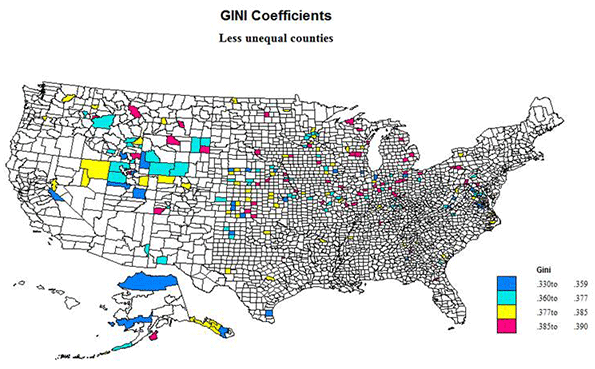
    I mapped only the 208 counties with the lowest Gini indices, those under .39, in two ways, first by the Gini values and then by groups of these counties sorted by median incomes.  Only 10 have values below .35. In 1975, 11 counties had Ginis bellow .27.  States with the highest number or share of less unequal counties include Alaska, 10, Idaho, 11, Indiana, 15, Iowa, 10, Kansas, 18, Minnesota, 11, Nebraska, 17, Utah, 7, Virginia, 13 and Wyoming, 8. Except for Alaska, there is an evident north central bias: band of less unequal counties from Virginia to Idaho-Nevada, with epicenter at the junctions of Utah, Idaho and Wyoming. 

    States without any qualifying as less unequal counties (with Ginis under .39)  are Alabama, Connecticut, Delaware, Hawaii, Louisiana, Maine, Massachusetts, New Hampshire, New Jersey, Rhode Island  and South Carolina. Large California has only one, as does New York, and large Texas only 7.    
    Size of Counties

    A problem with the data is that small population size of many of the counties render the ACS estimates somewhat uncertain.  Thirteen have fewer than 500 households, 25 have fewer than 1000. It is reasonable that smaller rural counties, e.g., in the Plains states, might have less inequality because of the homestead settlement history and the absence of slavery, but there is still uncertainty due to small sample size. Of the counties with under 1000 households, 8 are in NE, 5 in AK, 3 in KS, 2 in CO, MT and TX, and 1 in ID, N and WA.  

    At the other end, 28 counties have more than 25,000 households, and 5 have over 100,000. The largest are an interesting set. All are suburban, or even exurban, and most are fairly high income, essentially homogeneously middle class. The six largest are Williamson, TX, King William, VA, St. Charles, MO, Anoka, MN, Loudoun, VA and Davis, UT. These are also among the richest counties on the list. 

    It might be meaningful that some of these counties, as around Washington, DC, Baltimore and Austin, TX, have high levels of government employees, while their minority levels are quite low.

    Lower inequality, but High in Minorities

    This unlikely combination does occur, although only 7 of the 208 counties have minority shares (percentages) above .5: TX, 3, Kenedy, Moore and Reagan;  KS, 2, Ford and Seward; AZ 1, Greenlee, and AK, Aleutians 1. The TX, KS and AZ counties are all Hispanic, and high in energy development for TX and KS.  The AK county is Asian. No county has a black population majority. Surry county, VA, at 47% black, is highest share of black population, located and exurban between Richmond and Norfolk.  

    The Lowest Ginis, Under .36

    Thirty-one counties have Gini levels under .36 (Still high of course!) Only 10 are under .35. These vary in size from tiny Kenedy, TX (147 households) to Loudon, VA  with 105,000. The distribution by state is
    VA 7:  King William, Prince George, Surry, Craig, Greene, Loudon, King and Queen
    KS 4:   Meade, Wabaunsee, Wichita, Kearny
    AK 3:  Yakutat, Bristol Bay, North Slope
    UT 3: Morgan, Emery, Juab
    NE 3:   Blaine, Stanton, Grant
    TX 2: Kenedy and Carson.
    Several states with one county: CA, Mono,  GA, Chattahoochee,  ID, Power,  IL, Kendall,  IN, Jasper,  IA,  Cedar, KY, Spencer, OH, Putnam, and WY, Lincoln.

    These are distributed in a similar way to the 208 lower Gini counties, with the exception of the much larger number in VA, and not just in the WDC area!  UT and AK stand out, as do neighbor states of KS and NE.  The AK set is high in minorities (Native Americans, Asians), as is Kenedy, TX (Hispanic).  The VA set includes suburban Richmond and Washington DC counties, exurban to rural Chesapeake Bay counties, a tiny Allegheny mountain county and suburban Charlottesville. ID, UT, KY, KS, IL, IN and GA have suburban counties, KS and TX energy growth counties, and NE, WY, UT and CA fairly remote rural counties, the latter three recreational.

    Less unequal counties by income level

    Lower income counties: 27 counties have median household incomes below $40,000. By state these are
    NE 5: Garfield, Hooker, Blaine, Grant. Hayes
    ID 5: Idaho, Lewis, Power, Benewah, Clark
    KS 4: Cloud, Norton, Trego, Rush
    MI 2: Oscoda, Ontonagon        
    WV 2: Grant, Monroe
    WI 2: Adams, Florence
    Several states with one county, including PA, Forest: TX, Kenedy: MT, Golden Valley:  IN, Jay;
    IA, Osceola,;  ND, Griggs; and MO, Monroe,

    The dominance of neighboring KS and NE is noteworthy, as is the large number and share in Idaho. Eight of the counties are small, with under 1000 households, and only 4 have over 40,000. Thus most of the counties are rural and small town, resource oriented, and often with small manufactures. The counties in upper Michigan and Wisconsin are similar in character.
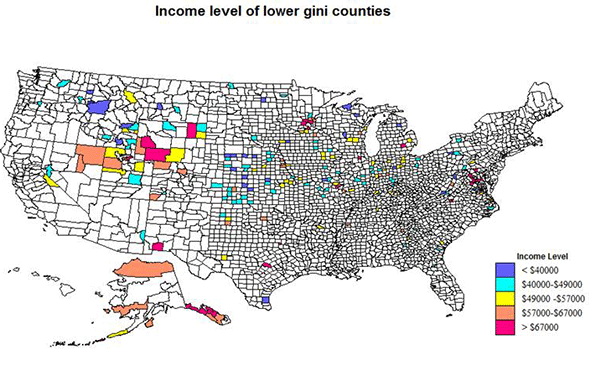
    Higher income counties at the other end comprise 28, with median household incomes above $67,000. By state these are:
    VA 7: Loudoun, Stafford, Prince William, Spotsylvania, Manassas Park, New Kent, King George
    AK 4: Juneau, Denali, Skagway, North Slope
    MN 4: Scott, Sherburne, Anoka, Wright
    MD 3: Calvert, Charles, Carroll 
    WY 3; Campbell, Sublette, Sweetwater
    TX 2; Rockwall,  Williamson
    Several with one county: NM, Los Alamos: UT, Morgan; MO, St Charles; MI, Livingston; IL, Kendall

    The 9 richest counties include 6 suburban or exurban around Washington DC and Baltimore, suggesting the importance of federal employment, and federal oriented Los Alamos, NM, Rockwall is suburban Dallas, Scott suburban Minneapolis.   Other suburban and exurban counties are in UT, MO, and MN (3 more!), VA (4 more), MI, IL, and TX. Higher income rural small town areas are in AK (4) and WY (3).

    Middle Income Less Unequal Counties

    The middle group of 52 counties with median household incomes between $49,000 and $57,000 are more varied and complex.  By state
    IN 6: Jasper, Ohio, Putnam, Spencer, Tipton and Whitley
    IA 5: Iowa, Lyon, Cedar, Mills, Benton                    
    KS 3: Jackson, Wabaunsee, Jefferson
    UT 3: Juab, Duchesne, Box Elder    
    OH 4: Mercer, Henry, Auglaize, Putnam
    WI 2: Kewaunee, Dodge, Columbia     
    MN 2: Le Sueur, Nicollet
    ID 2: Jefferson, Teton
    MO, 2, Clinton, Lincoln
    WY 2: Weston, Carbon,
    KY, 2, Anderson, Bullitt
    TX,  Reagan
    GA 2: Pike, Effingham
    VA 2: Surry, Greene  
    NE 2: Hamilton, Kearny
    AK, Aleutians, AR, Saline, CA, Mono, IL, Washington, MI, Lapeer
    MT Lewis and Clark. OR, Hood River, PA, Perry, TN, Cheatham, NC Currituck
    None have under 1000 households, and 21 have 10,000 or more. The largest, Saline, AR, has 41,000 (suburban Little Rock).

    These tend to prevail across the north central states from OH west to UT, and include many small town and small city regional centers. Several are free-standing small town counties, a few are suburban to larger cities, such as Nashville and Little Rock, but the most are far suburban or exurban to smaller metro areas. 

    The small map inset centered on Indiana illustrates these patterns.
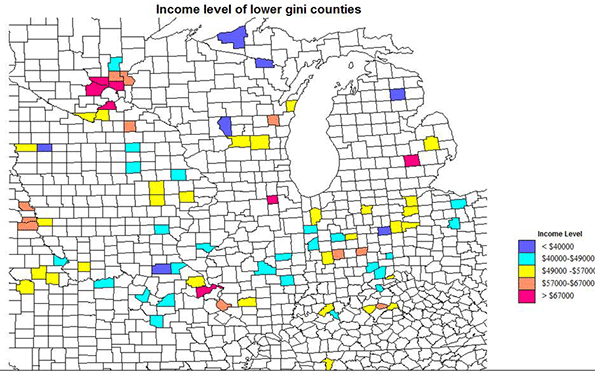
    Conclusions                 

    The geography of these less unequal counties is unusual. Not one is a metropolitan core county, large or small. Not one is a majority black county. While there are many suburban counties, almost all are in a few clusters, VA-MD, ID-UT, or in the upper Midwest, especially MN. A large number are exurban, just beyond the official metro areas, mostly across the north, but with a few in the  south. And, most old-fashioned and reassuring, quite a number are freestanding small city and small town, micropolitan or smaller counties, most notably in the Northern Plains and Rocky Mountain states, and apparently doing well with a resource and small industrial economy.   

    Contrasting the  Most Unequal Counties

    OK, how different is the geography of the most unequal counties?  The US has 30 counties with Gini indices over .53, culminating in New York (Manhattan) at almost .6. These are indeed quite different, as race plays a dominant role, but not a universal one.

    23 of the 30 are in the south, and 17 of these have high black population shares, including core metropolitan counties, the District of Columbia, Fulton (Atlanta). Orleans (New Orleans), and Richmond, VA. Outside the south, 6 of the 8 counties also have a high minority share, New York (Manhattan), Westchester, Essex, NJ (Newark), Sioux, SD (reservation), and Harding, NM (Latino), leaving only tiny Mineral CO (recreation), and  Fairfield CT (super rich suburban-exurban NY).

    Six counties in the south do not have high minority shares,  Decatur, TN (west central on the Tennessee river), Baylor, TX , exurban Wichita Falls, Llano, TX , exurban Austin and tiny Borden, TX, Galax city, VA, far southwest, and Watauga, NC, home of Appalachian State University.

    Race clearly is the most common basis for extreme inequality, but exurban counties close to rich metropolitan centers may also have high class differentials, as do some recreation dependent areas.    

    Richard Morrill is Professor Emeritus of Geography and Environmental Studies, University of Washington. His research interests include: political geography (voting behavior, redistricting, local governance), population/demography/settlement/migration, urban geography and planning, urban transportation (i.e., old fashioned generalist).