Tag: Heartland

  • Right in the Middle: The Midwest’s Growth Lessons for America

    The Midwest’s troubles are well-known. The decline of manufacturing has resulted in job losses and dying industrial towns. The best and brightest have fled the flatlands for more exciting, sunnier, mountainous, or coastal places where the real action is. Even Peyton Manning has left the heartland for the Rockies.

    This narrative is so deeply embedded both in and outside of the Midwest that many people overlook the ways in which parts of the region are bouncing back. The Midwest’s story is important because it serves in significant ways as a regional microcosm of how growth and opportunity should look in America today.

    In a recent study we look at trends that upend the conventional wisdom about the Midwest. We find that it is neither doomed to a slow and dirty demise like an old house on an eroding slope, nor forced to reinvent itself Dubai-style in order to compete with Silicon Valley or Manhattan. The Midwest’s future is rooted very much in its past—but with some important updates.

    What do we mean? For starters, this means capitalizing on Americans’ desire to reside where the cost of living and doing business is favorable. As the last Census showed, Americans move in droves to regions where the cost of living is low, businesses face fewer obstacles, and workers have choices. As Wendell Cox and Joel Kotkin have shown, this goes for 25- to 35-year-olds as well as 55- to 65-year-olds. People want options and a good quality of life at a price they can afford.

    In the Midwest, these trends have favored placed like Columbus, Ohio, and Indianapolis, Indiana. When people hear “Midwest,” they are more likely to think of this kind of picture:
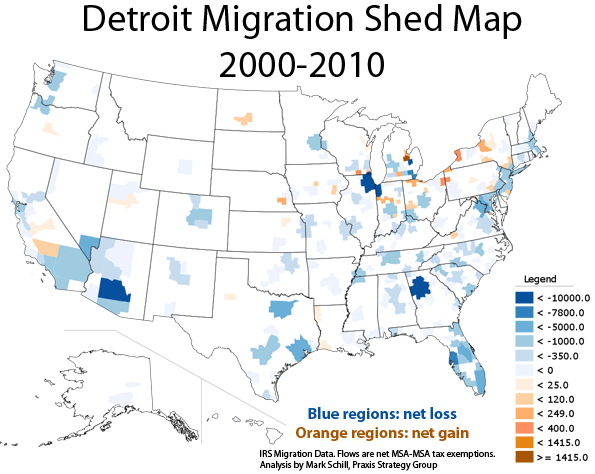
    The blue areas show destinations to which people from Detroit have moved between 2000 and 2010. The brown shades are the areas from which Detroit has drawn people. Given Detroit’s well-publicized decline, all the blue should be no surprise.

    But a respectable portion of the Midwest looks like this:
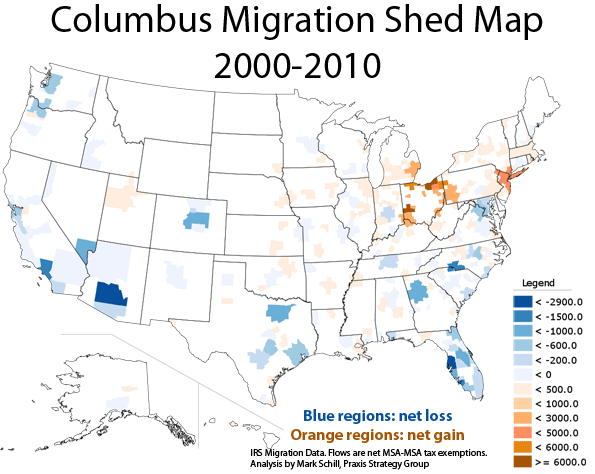
    And this:
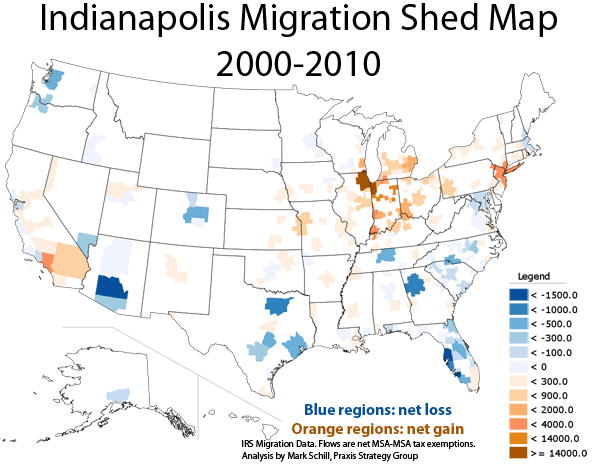
    Like most parts of America, Columbus and Indianapolis have seen a net outmigration southward to Florida and Texas. No surprise there. But note how both cities are stealing population from Chicago, Detroit, New York, and even southern California and Miami in Indianapolis’s case. The maps also show how intense interstate competition within the Midwest is right now.

    One important measure of the cost of living is housing affordability, which is typically set at 3.0 as a measure of median housing price divided by median income. Compared to San Francisco at 7.2, New York at 6.1, Los Angeles at 5.9, and Miami at 4.7, Columbus stands at 2.8 and Indianapolis at 2.4. Charlotte, which has been an exemplary Sun Belt growth magnet for a while, stands at 3.9, a slight click above the Chicago area’s 3.8.

    Affordability and overall quality of life as measured by schools and greater disposable income matter a lot—even to technology entrepreneurs. Some Midwestern areas are outpacing coastal areas on this front. In a recent Forbes ranking of tech growth in the nation’s largest 51 metro areas, the Midwest had three cities within the top 15, with Columbus in third position, followed by Indianapolis and St. Louis.

    But it would be wrong for tech boosters to think the Midwest’s future rests in harnessing the power of this sector alone. Rather, it’s a combination of brains and brawn that signify the Midwest’s core strength. When we look at Midwestern areas that have experienced above-average growth in bachelor’s degrees, there are important overlaps with areas experiencing above-average growth in manufacturing, too.

    In the corridor from Madison to Milwaukee, or the outlying areas around Chicago, or the Indianapolis metro area, or even in the Quad Cities on the Iowa-Illinois border, we see higher educational attainment and manufacturing growth occurring together. Cedar Rapids, Iowa, had the highest GDP growth from 2000 to 2010 of any metro area in the Midwest. A new corridor has grown up between Cedar Rapids and Iowa City, home to the University of Iowa; it takes advantage of the region’s historical manufacturing capacity and blends it with new technology. Peoria, Illinois, is second to Cedar Rapids in GDP growth. Peoria is home to 200 manufacturing firms, and it is also a Midwestern leader in college degree attainment.

    Manufacturing continues to be part of the regional DNA in the Midwest. Trying to move away from it would be a fool’s errand, as this picture shows:
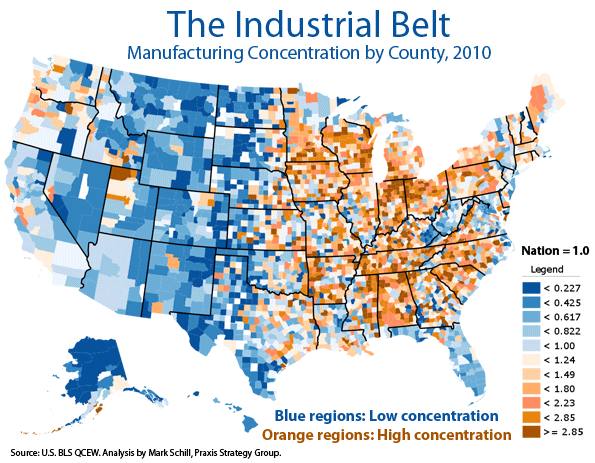
    The concentration of manufacturing in middle America is a real asset, especially when combined with higher levels of educational attainment, as we have seen. The Midwest is still home to much of the nation’s skilled labor force. And contrary to the declinist narrative mentioned at the outset, the region has added 50,000 “heavy metal” manufacturing jobs since 2009.

    The challenge for the region, actually, will perhaps be filling manufacturing jobs rather than creating them. A recent Deloitte survey found that 83 percent of manufacturers nationwide suffered a moderate or severe shortage of skilled production workers. The Midwest is poised to establish what we call a “new industrial paradigm,” characterized by a blend of heavy manufacturing, new technology, a more highly educated industrial labor base, and lighter labor restrictions (Indiana just became a right-to-work state, and the much-publicized debates in Wisconsin and Ohio over labor laws have only served to draw more attention to the need for reform, whatever the near-term effects). When you add to all of this the new energy sources discovered in some parts of the Midwest—such as new finds in Utica shale in Ohio—a new industrial paradigm in the region could end up being a large source of new wealth creation in the coming generation.

    So why might the Midwest be something of a microcosm for how growth and opportunity look in America as a whole, given its idiosyncratic reliance on manufacturing not shared by other regions? The main reason is that middle America is a clear picture of how much the basics matter: Cost of living, job quality, schools, and opportunities to develop the right skills for the best jobs. The areas within the Midwest that have gotten the basics right are poaching people and companies from the areas that haven’t. Any economic development strategy that ignores the basics in favor of a more stylized theory of growth will usually run off the rails before too long. Americans, at the end of the day, want the places they live to get the basics right so they themselves can build their lives, start their businesses, and raise their children as they wish.

    This piece originally appeared at The American.

    This peice was adapted from a recent report: "Clues from the Past: The Midwest as an Aspirational Region." Download the full pdf version of the report, including charts and maps about the Great Lakes Region.

    Joel Kotkin is executive editor of NewGeography.com and is a distinguished presidential fellow in urban futures at Chapman University, and contributing editor to the City Journal in New York. He is author of The City: A Global History. His newest book is The Next Hundred Million: America in 2050, released in February, 2010.

    Mark Schill is Vice President of Research at Praxis Strategy Group, an economic development and research firm working with communities and states to improve their economies.

    Ryan Streeter is Distinguished Fellow for Economic and Fiscal Policy at the Sagamore Institute. You can follow his work at RyanStreeter.com and Sagamoreinstitute.org.

    Great Lakes Freighter photo by BigStockPhoto.com.
  • Small Cities Are Becoming a New Engine Of Economic Growth

    The conventional wisdom is that the world’s largest cities are going to be the primary drivers of economic growth and innovation. Even slums, according to a fawning article in National Geographic, represent “examples of urban vitality, not blight.” In America, it is commonly maintained by pundits that “megaregions” anchored by dense urban cores will dominate the future.

    Such conceits are, not surprisingly, popular among big city developers and the media in places like New York, which command the national debate by blaring the biggest horn. However, a less fevered analysis of recent trends suggests a very different reality: When it comes to growth, economic and demographic, opportunity increasingly is to be found in smaller, and often remote, places.

    Read about how we selected the 2012 Best Cities for Job Growth

    This year’s edition of Forbes’ Best Cities For Jobs survey, compiled with Pepperdine University’s Michael Shires, found that small and midsized metropolitan areas, with populations of 1 million or less, accounted for 27 of the 30 urban regions in the country that are adding jobs at the fastest rate. The three largest metropolitan statistical areas that made the top 30 — Austin, Houston and Salt Lake City — are themselves highly dispersed with sprawling employment sheds.

    Rather than the products of “smart growth” and intense densification, almost all of the fastest-growing metropolitan areas — including larger ones like Silicon Valley and Raleigh — tend to be dominated by suburban-style, single-family homes and utterly dependent on the greatest scourge of the urbanist creed: the private car. But many of the smaller areas also punch above their weight in myriad ways, spanning a host of industries.

    Among the 398 MSAs we ranked for the list, energy towns dominate the top of the table:  Odessa, Texas (100,000), took first place; followed by Midland, Texas (population: 111,000), in second place; Lafayette, La. (fourth, 114,000); Corpus Christi, Texas (sixth, 287,000); San Angelo, Texas (seventh, 92,000); Casper, Wyo. (10th, 54,000); and Bismarck, N.D. (21st, 61,000). These cities’ economies have expanded steadily over the last few years, beneficiaries of a great boom in fossil fuels that, unless derailed by regulators, will continue for the foreseeable future.

    But some of the other best cities for jobs make their livings in different ways, such as No. 12 Glens Falls, N.Y., riding growth in business services and tourism; and No. 15 Columbia, Mo., which is primarily a college and government town. Several smaller communities have bounced back strongly with the recovery of manufacturing, including No. 3 Columbus Ind., No. 11 Williamsport, Pa., and No. 19 Holland-Grand Haven, Mich.

    This shift in opportunity also parallels some compelling demographic trends. In the 1990s, the rate of population growth of areas over 1 million and those below was essentially similar. In contrast, in the subsequent decade, urban areas with fewer than a million people expanded by 15%, compared to barely 9% for larger urban areas, notes demographer Wendell Cox. In those 10 years, areas with fewer than a million people accounted for more than 60% of urban growth. Essentially more Americans are now moving to smaller regions than to larger ones.

    We  see is a very different reality than that often promoted by big city boosters. Large, dense urban regions clearly possess some great advantages: hub airports, big labor markets, concentrations of hospitals, schools, cultural amenities and specific industrial expertise. Yet despite these advantages, they still lag in the job creation race to unheralded, smaller communities.

    Why are the stronger smaller cities growing faster than most larger ones? The keys may lie in many mundane factors that are often too prosaic for urban theorists. They include things such as strong community institutions like churches and shorter commutes than can be had in New York, L.A., Boston or the Bay Area (except for those willing to pay sky-high prices to live in a box near downtown). Young families might be attracted to better schools in some areas — notably the Great Plains — and the access to natural amenities common in many of these smaller communities.

    Perhaps another underappreciated factor is Americans’ overwhelming preference for a single-family home, particularly young families. A recent survey from the National Association of Realtors found that 80 percent preferred a detached, single-family home; only a small sliver, roughly 7 percent, wanted to live in a dense urban area “close to it all.” Some 87 percent expressed a strong desire for greater privacy, something that generally comes with lower-density housing.

    This trend towards smaller communities — unthinkable among big city planners and urban land speculators — is likely to continue for several reasons. For one thing, new telecommunications technology serves to even the playing field for companies in smaller cities. You can now operate a sophisticated global business from Fargo, N.D., or Shreveport, La., in ways inconceivable a decade or two ago.

    Another key element is the predilections of two key expanding demographic groups: boomers and their offspring, the millennials. Aging boomers are not, in large part, hankering for dense city life, as is often asserted. If anything, if they choose to move, they tend toward less dense and even rural areas. Young families and many better-educated workers also seem to be moving generally to less dense and affordable places.

    Perhaps even more surprising, this tendency toward decentralization can be seen around the world: much of the new growth is in smaller cities, with India as a prime example. A recent McKinsey study found that “middle-weight” cities, many of them well under a million, have already started taking a larger percentage of the world’s urban growth.

    McKinsey suggests that the notion that megacities will dominate the urban future constitutes “a common misconception.” Instead surging smaller cities will constitute well over half of the world’s urban growth, gaining ever more share from the megacities over time. This is particularly true in the U.S. which constitutes the epicenter for the new smaller city economy. Of the world’s 600 “middleweight” cities, the U.S. is home to 257. Together they generate 70% of U.S. GDP.

    What does this mean for investors, companies and individuals in the coming decades? For one thing, Wall Street, which tends to obsess over a handful of high-cost, dense, urban markets, may seek out new opportunities in faster-growing smaller cities. Prices tend to be lower and competition for prime space less intense, and the demographic wind is at their backs. Companies looking to expand may find not only a welcome mat from the locals, but also an expanding workforce in these generally more affordable places.

    Finally, particularly for the next generation, the shift to smaller cities provides a whole realm of new options for sinking roots, starting business or a family and owning a home. Smaller city life certainly does not appeal to everyone, or every business, but their growing dynamism provides a welcome option for people who want to get a leg up in the next decade.

    Read about how we selected the 2012 Best Cities for Job Growth

    This piece originally appeared in Forbes.

    Joel Kotkin is executive editor of NewGeography.com and is a distinguished presidential fellow in urban futures at Chapman University, and contributing editor to the City Journal in New York. He is author of The City: A Global History. His newest book is The Next Hundred Million: America in 2050, released in February, 2010.

    Photo: Glens Falls, NY

  • Addressing Workforce Shortages in the Dakotas

    While not immune to the recession, the upper Great Plains is in a different economic situation from the rest of the nation. Growth coupled with low unemployment means more strain on the region’s workforce, making it tougher for employers to find the workers they need. It’s not so much about jobs anymore, but about finding the right workers.

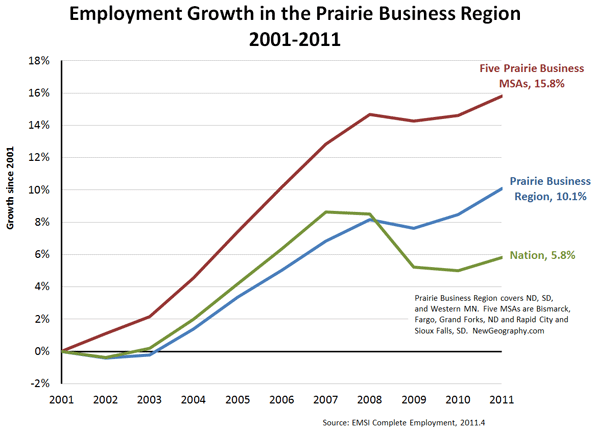
    Since 2008, the region covered by Prairie Business Magazine – North Dakota, South Dakota and western Minnesota – has grown its employment by 1.8 percent, compared to a loss of 2.5 percent across the country. In addition to that growth, North Dakota alone has 21,000 unfilled jobs.

    To determine some of the toughest jobs to fill in the region in the past year we used data compiled by EMSI, Inc., a model that includes a combination of over 90 state and federal sources and includes estimates of independent contractors and others. We looked at a number of metrics, including the number of openings in the region due to growth, retirements, and turnover; the number of openings compared to the total jobs in an occupation; and the regional concentration of a job here compared to the rest of the nation.

    The occupations are separated into five groups: construction, extraction, transportation and material moving; business, finance and office; heath care; science, mathematics, engineering and computer; and manufacturing occupations.

    The construction, resource extraction and transportation category is not surprisingly dominated by the ongoing energy boom in western North Dakota. Roustabouts lead the way with 917 new jobs and 979 total openings in the past year. Other oil-related jobs such as service unit operators (781 openings), derrick operators (511), rotary drill operators (479), extraction helpers (335) and wellhead pumpers (295) all have openings above 40 percent of its 2010 employment level. We read a lot about the stress on the labor force in that region, but the numbers are astounding.

    The overall leader in total job openings across the region is heavy truck drivers, with 1,973 openings from 2010-2011. The need is most acute in oil country, but the entire region has a 70 percent higher concentration of heavy truck drivers than the national average. Of the 152 counties in our analysis, 138 have a higher concentration of heavy truck drivers than the national average.

    The national media has credited the oil boom for the economic growth. The economic benefits of the energy boom have spread across the region, but there is more to the story. While the entire region trailed the nation in job growth until 2007, the region’s five largest metropolitan areas – Bismarck, Grand Forks, Fargo, Sioux Falls and Rapid City – were well ahead of the nation through the entire decade. Now containing 39 percent of the regional jobs, these five metropolitan areas beat the nation in job growth over the decade by 10 points, 15.8 to 5.8 percent.

    It’s not just growth in retail and food service jobs. Over the past decade the five metropolitan areas added 8,000 jobs in professional, technical, and scientific services, nearly 18,000 in health care, and 8,000 in finance, with each sector paying roughly $50,000 per year. The region also added 1,500 jobs at management offices and corporate headquarters making an average of $80,000 per year. It’s time that parents in our region stop telling their kids, “you need to leave the state to find a good job.” We need to improve efforts to help students and displaced workers understand the emerging options available in the region.

    The Prairie Business region has also become a growth center for science, math, engineering and computer occupations, adding nearly 18 percent to its technical workforce in the past decade, compared to just 3.6 percent growth in the rest of the nation. The growth rate in the five metropolitan areas was more than 27 percent. Some of the most in-demand jobs include industrial engineers (91 openings), mechanical engineers (87), geological engineers (52), petroleum engineers (50) and geoscientists (45). A new program for petroleum engineers at the University of North Dakota School of Engineering and Mines may help address the shortages in these fields.

    This strong growth in engineering and technical jobs is tempered somewhat because the region still lags the nation in these occupations. The biggest gaps are in bachelor’s degree level information technology and software fields, where the region trails the nation by 25 to 40 percent in many occupations. While the region’s high growth rates are encouraging, there is still plenty of ground to make up. At the same time the region is highly concentrated in many two year level technical jobs, creating a solid foundation for technical industries to build on.

    The region’s manufacturing economy was hit hardest by the recent recession, but was booming in the six years prior and is now recovering. In demand production occupations include welders (677 openings), assemblers (604), supervisors (194), machinists (156), computer-controlled machine tool operators (107), and engine assemblers (88).

    Across the region, 52 of the 152 counties hold an above average number of production jobs. Hot spots in the region include Jerauld, Yankton and Brookings counties in South Dakota; Roseau, Nobles and Kandiyohi in Minnesota; and Sargent and Richland in North Dakota.

    Workforce and economic development agencies, educators and trainers, and the business community need to continue to actively collaborate to share information and create partnerships across state lines. Private businesses must be open to working with training and placement agencies to communicate their needs, and regional governments must be open to creating more flexible funding sources for specialized training. Educational institutions are beginning to use the ample labor market data available to tailor programs to fit the need of the region’s economy.

    Ultimately, the talent narrative in the region needs to shift away from “retaining our young people” towards recruitment of young families. Demographic data confirms the greatest shortage across the region is those age 35 – 44, and employers are reporting troubles recruiting mid-career professionals. Migration data shows that the net loss from North and South Dakota to the Minneapolis region has stopped in the past two years. The Prairie Business region is showing signs of turning the economic and demographic corner. It is now time to act to sustain the region’s long-term future.

    This piece originally appeared in Prairie Business Magazine.

    Mark Schill is Vice President of Research at Praxis Strategy Group, an economic development and research firm working with communities and states to improve their economies. He is Managing Editor of NewGeography.

    Fargo photo by David Kohlmeyer.

  • Rick Santorum’s Ugly Appeal to Rural Voters

    Not all of them are “clinging to guns and religion,” as Barack Obama famously said in 2008, but Rick Santorum has catapulted to the top of the Republican field by connecting with a bitter streak among rural voters. This is bad news for the Republican party and for rural America, which in fact has some pretty good reasons to be optimistic.

    Urbanites, Santorum told South Carolinians in January, have “a whole different value structure…They’re not going to be participating in small-town life. They’re not going to be connected to mainstream America or to God and his creation.”

    Those voters have returned the contempt, with Mitt Romney consistently winning in larger metropolitan areas. Rick Santorum, by contrast, has from his campaign’s modest beginnings in the small towns of Iowa drawn the bulk of his support from the least-populated counties.

    “I kept saying, you just stick with us, you go out and vote for your values and trust what you know,” Santorum said after his victory in the Kansas caucuses in March. “Because you don’t live in New York City. You don’t live in Los Angeles. You live like most Americans in between those two cities, and you know the values you believe in.”

    Santorum—who last I checked lived in swank, suburban Washington—has become the candidate of rural and small-town inertia, representing the isolated, aging, often modestly educated and overwhelming white residents nostalgic for a fading past. The Santorum worldview, following a tradition that well precedes Sarah Palin, portrays a wholesome, small-town middle America fighting a desperate battle against corrupt coastal big-city “elites.”

    The problem for the party if he somehow emerges as the Republican nominee is that most voters live in metropolitan areas. Just 16 percent of Americans live on farms, small hamlets, and villages. The problem for those rural Americans is that Santorum’s campaign of complaint appeals to and reinforces the worst stereotypes of rural life, while overlooking the brighter future already emerging in much of the hinterland.

    Rural America, particularly the vast region known as the Great Plains, appears to be on the verge of an economic and cultural renaissance. I live in Los Angeles, but have witnessed a remarkable change in both on the ground reality and mood during numerous visits to and studies of rural areas over the past decade. When I first starting going to Fargo, North Dakota, it seemed just a listless prairie town; today it is full of high-tech firms and boasts a downtown bustling with a vibrant, youthful population of attractive, largely Nordic revelers.

    To be sure, many small towns in the Plains and elsewhere are shrinking and some will disappear entirely in the coming decades. But larger towns like Fargo, Bismarck, Sioux Falls, Omaha, as well as many smaller ones, now boast the strongest economies in the country—with low unemployment and strong job and income growth. Most of these cities enjoy positive in-migration not only from the rural hinterland, but from the densely packed coastal areas. The Plains’ population growth is already outpacing the national average, and is even further ahead of the urban core cities so celebrated in the media.

    Santorum seems to have missed something in his travels back in time. He may appeal to an imagined, largely self-contained rural Eden—but he’s mostly ignored the global economics that have fueled the rural resurgence.

    Start with the basics: the production of food and fiber, which is fundamental not only to the Plains but to the Midwest, central California and the cotton-growing regions of the Southeast, Arizona, and west Texas. It’s the global demand for these products that has created good times in small towns. In 2011, the U.S. exported a record $135 billion in food and fiber, with a net positive balance of $47 billion, the highest in nominal dollars since the 1980s. Santorum as a senator opposed NAFTA and now talks about engaging in a trade “war” with China. Yet developing countries constitute rural America’s fastest-growing market. Many nations lack the water and land resources to feed themselves at a higher per-capita level of consumption; Beijing has acknowledged this by effectively dropping the old Maoist goal of self-sufficiency.

    Foreign investment flows have also benefited rural communities, particularly in the Southeast and the Plains. Firms are investing in critical sectors such as manufacturing and energy that benefit rural communities. Industrial investment rose $30 billion just between 2009 and 2010, while investment in the energy sector more than tripled to $20 billion.

    Japanese, German, and Korean manufacturers are primary players laying the foundation for a rural and small-town resurgence across the long-suffering rural Southeast.  Last year, Mercedes, whose largest U.S. plant is in Tuscaloosa, Ala., invested $350 million in the facility. Arch competitor Volkswagen last year announced it will build a new assembly plant in Chattanooga, Tenn. Nissan, Toyota and Kia have all announced major new plant openings or expansions in the region, mostly in small rural towns (and, it’s worth mentioning, in “right-to-work” states that don’t allow closed union shops). When Toyota recently announced plans to establish a plant for the Prius near Tupelo, Mississippi (the birthplace of Elvis), they received 35,000 applications for 1,300 positions.

    At the same time, increased fossil-fuel demand in global markets has sparked energy giants from China, France, and Spain to take up stakes in fields in Ohio, Mississippi, Colorado, and Michigan. A smart, globally minded Republican would be pushing these investments, which are already creating boom from North Dakota to south Texas. President Obama’s urbane academician’s obsession with subsidizing renewable energy and barely disguised disdain for fossil fuels represents a threat to the continued prosperity of many rural communities and small towns.

    Critically, Santorum’s regressive social views—his tone of resentment as much as the particulars—belies the kind of openness needed for a full-scale rural revival. In the real world, rural America is becoming increasing diverse and dependent on immigrant labor.

    Plains towns like Grand Island, Nebraska, are filling up with Mexican or Honduran restaurants. The percentage of foreign-born Nebraskans has more than tripled since 1990. The GOP electorate in the Cornhusker State may be overwhelmingly white, but the demographic trends suggest this won’t always be the case—so long as the party can avoid alienating these new arrivals.

    In many places Hispanics constitute the major counterforce to wholesale depopulation. Every county except one in the western half of Kansas suffered depopulation of non-Hispanic whites during the past decade, while Hispanics have offset or even exceeded the decline in white population—filling schools and opening businesses in the process. Hispanic residents have pushed from hubs like nearby Dodge City, Garden City, and Liberal into ever smaller communities, buying property on the cheap, enticed, many say, by the opportunity to live quiet lives in communities more similar to those in which they were raised. 

    Of course many people—notably some of the older white voters flocking to Santorum—are hostile to these realities.  And in the short run, appealing to anti-immigrant sentiments may pay off in the Republican primary. But over time, if they are to survive, many rural communities will either adjust to diversity or simply disappear.

    But perhaps the worst betrayal of rural America lies in denying the aspirations of these places to shed off the historic isolation and overdependence on natural resources that have long dogged them. Santorum may consider a college education “elitist,” and see public schools as akin to “factories,” but in many parts of the Great Plains and elsewhere excellent public schools are cherished by Republicans and Democrats alike. A core competitive advantage of many rural states lies in their surplus of  highly educated young people. Students in Nebraska, the Dakotas, Montana, and Idaho tend to perform better in school than those in more metropolitan ones (as measured by graduation rates, college attendance, and enrollment in upper-level science and education programs).

    These educational advantages are being bolstered by in-migration now tilted toward younger families seeking opportunity, affordable housing, greater social cohesion and better schools. And with generally stronger fiscal balance sheets, due largely to the booming agriculture and energy sectors fueled by international demand, many rural states are expanding their public university systems even as states like California are cutting theirs.

    By appealing to perceived deficiencies in rural communities, Rick Santorum downplays all these positive forces. Much of rural America is already booming, and, connected by the Internet, investment, and trade, can play an important role in the American future. Appealing to nostalgia about a past fading into history is not the way to get there.

    This piece originally appeared in The Daily Beast.

    Joel Kotkin is executive editor of NewGeography.com and is a distinguished presidential fellow in urban futures at Chapman University, and contributing editor to the City Journal in New York. He is author of The City: A Global History. His newest book is The Next Hundred Million: America in 2050, released in February, 2010.

    Rick Santorum Image by Bigstockphoto.com.

  • The Republican Party’s Fatal Attraction To Rural America

    Rick Santorum’s big wins in Alabama and Mississippi place the Republican Party in ever greater danger of becoming hostage to what has become its predominate geographic base: rural and small town America. This base, not so much conservatives per se, has kept Santorum’s unlikely campaign alive, from his early win in Iowa to triumphs in predominately rural and small-town dominated Kansas, Mississippi, North Dakota and Oklahoma. The small towns and rural communities of states such as Michigan and Ohio also sheltered the former Pennsylvania senator from total wipeouts in races he would otherwise have lost in a blowout.

    If America was an exclusively urban or metropolitan country, Mitt Romney would be already ensconced as the GOP nominee and perhaps on his way towards a real shot at the White House. In virtually every major urban region — which means predominately suburbs — Romney has generally won easily. Mike Barone, arguably America’s most knowledgeable political analyst, observes that the cool, collected, educated Mitt does very well in affluent suburbs, confronting President Obama with a serious challenge in one of his electoral sweet spots.

    Outside the Mormon belt from Arizona to Wyoming, however, sophisticated Mitt has been a consistent loser in the countryside. This divergence between rural and suburban/metro America, poses a fundamental challenge to the modern Republican Party. Rural America constitutes barely 16 percent of the country, down from 72 percent a century ago, but still constitutes the party’s most reliable geographic base. It resembles the small-town America of the 19th century, particularly in the South and West, that propelled Democratic Party of Nebraska’s William Jennings Bryan to three presidential nominations.

    Yet like Bryan, who also lost all three times, what makes Santorum so appealing in the hinterlands may prove disastrous in the metropolitan regions which now dominate the country. Much of this is not so much particular positions beyond abortion, gay rights, women’s issues, now de rigueur in the GOP, but a kind of generalized sanctimoniousness that does not play well with the national electorate.

    We can see this in the extraordinary difference in the religiosity between more rural states, particularly in the South, and the rest of country. Roughly half of all Protestants in Mississippi, Alabama and Oklahoma, according to the Pew Center on Religion and Public Life, are evangelicals, not including historically black churches. In contrast, evangelicals make up a quarter or less of Protestants nationally and less still in key upcoming primary states such as Pennsylvania, New York, California and Connecticut, where the percentages average closer to 10 percent.

    Let me be clear: Urbanity is not the key issue here. Cities have become so lock-step Democratic as to be essentially irrelevant to the Republican Party. Instead it’s the suburbs — home to a record 51 percent of the population and growing overall more than 10 times as fast as urban areas — that matter the most. Much of the recent suburban growth has taken place in exurbs, where many formerly rural counties have been swallowed, essentially metropolitanizing the countryside.

    What accounts for the divergence between the suburban areas and rural areas? A lot may turn on culture. Small towns and villages may be far from the isolated “idiocy of rural life” that Marx referred to, but rural areas still remain someone more isolated and still somewhat less “wired” in terms of broadband use than the rest of the country.

    Despite the popularity of country music, rural residents do not have much influence on mainstream culture. Most Hollywood executives and many in New York still commute from leafy ‘burbs. Few of our cultural shapers and pundits actually live predominately in the countryside, even if they spend time in bucolic retreats such as Napa, Aspen or Jackson Hole.

    Until the recent commodity boom, much of rural America was suffering. And even today, poverty tends to be higher overall in rural areas than in urban and especially suburban countries. Some areas, notably in North Dakota and much of the Plains, are doing very well, but rural poverty remains entrenched in a belt from Appalachia and the deep South to parts of west Texas, New Mexico and California’s Central Valley.

    Rural areas generally do not have strong ties to the high-tech economy now leading much of metro growth. This remains a largely suburban phenomenon, urban only if you allow core cities to include their hinterlands. All the nation’s strongest tech clusters — Silicon Valley, Route 128, Austin, north Dallas, Redmond/Bellevue in Washington, Raleigh-Durham — are primarily suburban in form. High tech tends to nurture a consciousness among conservatives more libertarian than socially conservative and populist. Not surprisingly, libertarian Ron Paul often does best in these areas and among younger Republican voters.

    Another key difference: a lack of ethnic diversity. There are now many Hispanics living in rural areas, but they are largely not citizens and most are recent arrivals, attracted by jobs in the oil fields, slaughterhouses and farms. Many small towns, unlike suburbs, remain more homogeneous than suburbs, emerging as the most heterogeneous of all American geographies. Ethnic cultural cross-pollination occurs regularly in metropolitan suburbs; this is not so common in rural America.

    Equally important, environmental issues spin differently in rural areas than in suburbs. Energy development and agriculture drive many rural economies. In some areas, like Ohio and western Pennsylvania, shale oil and gas is bringing long moribund regions back to life. In the Dakotas, parts of Louisiana, Texas and Wyoming, it is ushering in a potentially long-term boom. In contrast, there aren’t many oil and gas wells located next to malls and big housing tracks.

    This does not mean that suburban voters share the anti-fossil fuel green faith of the urban core. But for them “drill baby drill” represents more a matter of price at the pump than a life and death issue for the local economy. Suburbanites feel the energy issue, but do not live it the way more rural communities do. One of the great ironies of American life is that those who live closest to nature are often less ideologically “green” than those, particularly urbanites, residing in an environment of concrete, glass and steel.

    Rural America, of course, is changing, with many areas, particularly in the Plains, getting richer and better educated. These areas are growing faster than the national average and attracting immigrants from abroad and people from other U.S. regions. Yet the influence of newcomers, new wealth and new technology is still nascent. The political pace in rural America today still is being set by an aging, overwhelmingly white and modestly educated demographic.

    Until the Republican nomination fight is settled, the party’s pandering to the sensibilities of such conservatives in rural areas could prove fatal to its long-term prospects. A Santorum nomination almost guarantees a replay of the Bryan phenomena; no matter how many times he runs, he will prove unlikely to win, even against a vulnerable opponent. Even in losing, his preachy, divisive tone — on contraception, prayer, the separation of church and state — has opened a gap among suburban voters that Obama will no doubt exploit.

    The suburbs, with its preponderance of white, middle income independent voters, gave the 2008 election to Obama, and that’s where the next contest will be decided. The countryside will rally to a GOP standard bearer like Romney, albeit somewhat reluctantly, for both economic and social reasons. The battle will then shift to the suburbs, including those urban areas, common in the vast cities of the South and West, that are predominately suburban in form.

    Most of the urban core, meanwhile, will vote lockstep for Obama. But the president, as thoroughly a creature of urban tastes and prejudice as to ever sit in the White House, could prove vulnerable in the suburbs, if the Republicans can deliver a message that is palatable to that geography’s denizens.

    This piece originally appeared in Forbes.com.

    Joel Kotkin is executive editor of NewGeography.com and is a distinguished presidential fellow in urban futures at Chapman University, and contributing editor to the City Journal in New York. He is author of The City: A Global History. His newest book is The Next Hundred Million: America in 2050, released in February, 2010.

    Rick Santorum Image by Bigstockphoto.com.

  • Is Energy the Last Good Issue for Republicans?

    With gas prices beginning their summer spike to what could be record highs, President Obama in recent days has gone out of his way to sound reassuring on energy, seeming to approve an oil pipeline to Oklahoma this week after earlier approving leases for drilling in Alaska. Yet few in the energy industry trust the administration’s commitment to expanding the nation’s conventional energy supplies given his strong ties to the powerful green movement, which opposes the fossil-fuel industry in a split that’s increasingly dividing the country by region, class, and culture.

    But Republicans, other than the increasingly irrelevant Newt Gingrich, have failed to capitalize on the potent issue, instead lending the president an unwitting assist by focusing the primary fight on vague economic plans and sex-related side issues like abortion, gay marriage, and contraception. The GOP may be winning over the College of Cardinals, but it is squandering its chance of gaining a majority in the Electoral College, holding the House, and taking the Senate.

    No single sector affects more people and industries than energy, and none is more deeply affected by the disposition of government. Energy divides the nation into two camps. On one side there are the regions and industries dependent on the development and use of energy. They include the increasingly expansive energy-producing region stretching from the Gulf Coast and the Great Plains to parts of Ohio, Pennsylvania, and the Appalachian range.

    The centers of energy growth, including areas stretching from the Gulf Coast through the Great Plains to the Canadian border, have generated the highest levels of job and income growth over the past decade (along with parasitic Washington, D.C.).

    Nine of the 11 fastest-growing job categories are related to energy production, according to an analysis by Economic Modeling Systems Inc. Energy jobs pay an average of $100,000 annually, about the same as software engineers earn in Silicon Valley.

    Perhaps more important politically, this bonanza is now spreading to historical battleground states Ohio, Pennsylvania, and Michigan. Long-depressed areas like western Pennsylvania are reversing decades of decline as new finds and advances in natural-gas drilling have opened up vast new stores of domestic energy. The new energy wealth has created new jobs, enriched property owners, and provided states with potential huge new sources of revenue.

    On the other side of the energy divide stand a handful of dense, mostly coastal metropolitan areas with either little in the way of energy resources or, in the case of California’s most affluent urban pockets, little interest in exploiting them. With a shrinking industrial base and less dependence on automobiles, these areas now constitute the political base for the both the Democratic Party and the growing green-industrial complex, which boasts strong ties to Silicon Valley’s well-heeled venture-capital “community” and their less celebrated, but even wealthier, Wall Street allies.

    In these places, the current fossil-energy boom is regarded less as a boon than as an environmental disaster in the making, a view captured in the unrelenting attack on shale development in the news pages of The New York Times and other outlets in broad sympathy with the Obama administration. New production of low-cost, low-emission natural gas also threatens the viability of politically preferred renewables such as solar and wind. But unlike fossil fuels, such “green” initiatives have created very few jobs; overall, the promise of “green jobs,” as even The New York Times has noted, has failed to live up to its hype.

    Given the success in the other energy states, California—with double-digit unemployment—might reconsider its policies, but this is unlikely. “I asked [Gov.] Jerry Brown about why California cannot come to grips with its huge hydrocarbon reserves,” John Hofmeister, a former president of Shell Oil’s American operations and a member of the U.S. Department of Energy’s Hydrogen and Fuel Cell Technical Advisory Committee, told me recently. “After all, this could turn around the state."

    Brown’s answer, according to Hofmeister: “This is not logic, it’s California. This is simply not going to happen here.’”

    But elsewhere in the U.S., new technologies such as hydraulic fracking and vertical drilling have vastly increased estimates of North America’s energy resources, particularly natural gas. By 2020, the United States, according to the consultancy PFC Energy, will surpass Russia and Saudi Arabia as the world’s leading oil and gas producer.

    As President Obama has acknowledged, this surge of production boasts some great economic benefits. American imports of raw petroleum have fallen from a high of 60 percent of the total to less than 46 percent. Overall, according to Rice University’s Amy Myers Jaffe, U.S. oil reserves now stand at more than 2 trillion barrels; Canada has slightly more. She pegs North America’s combined reserves at more than three times the total estimated reserves of the Middle East and North Africa.

    At the same time, energy exploration is sparking something of an industrial revival. The demand for new rigs, pipelines, and a series of new petrochemical facilities has created a burst of industrial production across much of the country. Steel mills, makers of earth-moving equipment, and construction suppliers all have benefited. A recent study by PricewaterhouseCoopers suggests shale gas could lead to the development of 1 million industrial jobs. Not surprisingly, some of the biggest backers of shale-gas exploration are prominent CEOs from industrial firms.

    Energy policy may also be critical for the future of the Great Lakes–based American auto industry. Despite expensive PR ventures like the electric Chevy Volt, the Big Three depend for profits largely on SUVs and trucks. High oil prices will only help their competitors from Japan, South Korea, and Germany, all of which are ramping up in the emerging Southeastern auto corridor. Rising oil prices could also raise the costs of food production, which relies heavily on energy-intensive fertilizers and machinery.

    Aware of the negative consequences for a still-weak recovery, President Obama has started to mount a defense for his energy policies. Last month he launched several preemptive strikes, claiming credit for rising U.S. production while ridiculing Republicans for their “drill, baby, drill” response to rising energy prices.

    Obama is correct in asserting that increases in domestic production will not solve the energy price issue overnight, or even in the near future. But it was disingenuous for him to then take credit for the current energy boom, which resulted largely from policies adopted during the Bush years, while Obama’s policies have, if anything, slowed exploration and development.

    It’s fairly clear that the president and his team—notably Energy Secretary Steven Chu and Interior Secretary Ken Salazar—are at best ambivalent about greater fossil-fuel development. Obama, for example, recently proposed cutting tax breaks and subsidies for the oil industry, which he estimated at $4 billion annually—a new expense for the companies that would in large part be passed on to consumers at the pump.

    This is not necessarily a bad thing in its own right, but along with the effective tax hike, Obama proposed doubling down on the much larger and, to date, far less productive giveaways to the green-industrial complex, which received $80 billion in loans and subsidies in the 2009 stimulus. According to various studies, including the Energy Information Agency, solar firms enjoy rates of subsidization per kilowatt hour at least five times those gained by fossil-fuel firms.

    If all energy subsidies were removed, the fossil-fuel industry likely could shrug off the hit, while the heavily subsidized green-industrial complex would markedly diminish. Yet even if Congress refuses to continue the green subsidies, it’s probable that administration regulators would find ways to slow fossil-fuel expansion in a second Obama term. Responding largely to the Democratic environmental lobby, they have already overruled the State Department to delay the Keystone XL pipeline from Canada. Plans for new multibillion-dollar petrochemical plants on the Gulf will make easy pickings for federal regulators from agencies now controlled by environmental zealots.

    “The energy states feel they are being persecuted for their good deeds,” says Eric Smith, director of the Tulane Energy Institute in New Orleans. “There is a sense there are people in the administration who would like this whole industry to go away.”

    In the short run, Obama’s political exposure in the energy wars is somewhat limited. Most of the big-producing states—Oklahoma, Wyoming, Utah, Texas, Louisiana, Alaska, and North Dakota—are unlikely to vote for him anyway. Nor does he have to worry about too much pressure from inside his party; Democratic ranks in Congress from energy-producing states have thinned considerably in recent years, removing contrary voices inside the party.

    A more dicey issue relates to contestable states like Ohio, Pennsylvania, and Michigan, where many see the energy boom as a source of economic recovery. To make their case in these and other swing states, Republicans first have to make energy the overall revival of the American economy—the key issue for this November’s election. If they insist on campaigning primarily as stolid defenders of rigid social values and election-year promises of painless tax cuts, they will have themselves to blame for their drubbing in November.

    This piece originally appeared in TheDailyBeast.

    Joel Kotkin is executive editor of NewGeography.com and is a distinguished presidential fellow in urban futures at Chapman University, and contributing editor to the City Journal in New York. He is author of The City: A Global History. His newest book is The Next Hundred Million: America in 2050, released in February, 2010.

    Photo courtesy of BigStockPhoto.com.

  • Indianapolis: From Naptown to Super City

    I have long touted the sports strategy that Indianapolis used to revitalize its downtown as a model for cities to follow in terms of strategy led economic and community development. I really think it sets the benchmark in terms of how to do it, and it has been very successful.

    Indy is hosting the Super Bowl on Sunday, something that is locally seen as a sort of crowning achievement of the 40 year sports journey. As part of that, the Indianapolis Star and public TV station WFYI produced an hour long documentary on the journey called “Naptown to Super City.” I think it’s a must watch for anyone who is trying to figure out to revitalize their own downtown. An hour isn’t short, but given the billions of dollars cities pour into this, I think it’s worth doing some homework. It tells the story of how Indy went from a deserted downtown where local Jaycees were licensed to take their shotguns and kill pigeons to one where the Super Bowl is being hosted today.

    I’ll talk more about the Indy strategy in a bit, but first the show. If you are in Google Reader this won’t display for you, so click here to watch.


    One thing this brought home for me is the true magnitude of the change. Perhaps I’m being a bit uncharitable, but Indianapolis almost literally started with nothing. It was never a major, important American city. It had no brand in the market. And it had a downtown that was all but dead. Everything they have today was built almost from scratch.

    Why do I think the Indy sports strategy was such a good one? Two reason: it was a good strategic area to go after, and it was backed up with very intelligent execution.

    First, five reasons this was a good strategic goal to pursue:

    1. It just fits the character of the city. Hoosiers love sports. The Indianapolis 500 and high school basketball were long established. It’s something they could behind in a way that they would never have gotten behind being the “vegetarian capital of the world” or something like there. It was authentic to the city. If you watch the video, you’ll note how locals embraced the events that were held that. That goes a long way towards explaining the success of the strategy. You have to be authentic to a place in your development efforts.
    2. It was a whitespace opportunity where Indy could get first mover advantage. Today every city thinks they can make money off sports, but Indy really pioneered the notion that you could use sports as an economic development tool. There were a lot of firsts along the path, and that’s one reason Indy was able to take out a leadership position. Just as one example, Indy was first to do the “build it and they will come” model of building a stadium before having a team. As a result, they were able to grab the Colts, and do it in an era when you didn’t have to mortgage your whole city to make a team relocation happen.
    3. Being America’s top city for sports events was a realistically achievable goal. I know this because the city achieved it. This is in great contrast to the umpteen cities who all claim they’ll be the “best cycling city in America” or some such.
    4. There were huge collateral benefits to sports beyond the direct economic impact of the events and the jobs they support. They bring people to the city to show it off to people who might not otherwise come. They enliven downtown and create events that locals might actually want to attend. They also have been an amazing brand opportunity. Just think of the Colts. How many times a week during football season does the word “Indianapolis” get said on TV? Probably hundreds if not thousands. Imagine if the city had to pay advertising dollars for that exposure? Yes, sports is expensive, but I think it could be justified just as cost-efficient marketing alone. Think about how much companies pay just to put their name on the stadium. How much more is it worth to put your city’s name on the team or the event? Think about how much advertisers will be paying for a 30 second commercial in the Super Bowl? What’s it worth for all those mentions of your city during the Super Bowl again?
    5. It was an initiative that had the possibility of being truly transformative for the city. Again, I know this is true because it was.

    I’m not going to claim these were actually the thoughts going through people’s minds as the sports strategy developed or that it was this calculated. But all of these things were implicitly true all along, and I think clearly the people pushing sports must have gotten it on that at some level. So sports meets the first test of a great strategy in that it set out after a good strategic goal.

    It was also something where there was a level of execution detail that far exceeded what most cities do. In business, it’s one thing to have an idea. It’s another thing to execute on it and achieve market leadership. It’s still another to generate sustainable competitive advantage that keeps you there over the long haul. Indianapolis has managed to do all of these with sports. I’ll highlight eight examples of how it did this:

    1. It invested in world class facilities. A lot of these have remained top rated even long after they opened, like Conseco Fieldhouse, which is still ranked every year as the best arena in the United States.
    2. Two, it laid out an entire district downtown around events hosting, with everything you need in close proximity – venues, the convention center, hotels, shopping, and entertainment. This is something that’s already been widely commented on by Super Bowl visitors who are amazed you don’t have to get shuttled around all over the place and that you can actually walk directly from the media hotel to the hotels where the teams are staying.
    3. Three, because of this Indy is able to effectively “saturation rebrand” downtown for an event and otherwise cater to events in a way that few other cities can or will. In effect, the city has converted its downtown into a giant sound stage. Take a look at the pictures of the city. The whole downtown as been rebranded after the Super Bowl, including, for example, plastering a huge Lombardi Trophy images on the side of the city’s premier hotel. You can debate the value of this to the city, but there’s no denying its value to the NFL. How many cities are willing to do this to the extent Indianapolis is?
    4. Indy created the Indiana Sports Corp. as the first ever non-profit management company for events. Today, everybody has adopted that model.
    5. The city cultivated a large, experienced volunteer base for putting on events that is much more powerful than what others cities have.
    6. Indy has been willing to take calculated risks in support of the strategy. Building the Hoosier Dome with no team to play in it – big risk.
    7. It not only went after the events, it went after the sanctioning bodies that determined where the events would be held. The most important is of course the NCAA, but there are others too. This has resulted in Indy having a “cluster” of these organizations and direct access to the people making decisions that pays incalculable dividends. This is one area where the “face to face” discussions that occur in Indy gives the city a big leg up. It’s not just better for selling, it gives Indy critical advanced intelligence about how these organizations are conceiving of their future events needs.
    8. Last but certainly not least, this has been a sustained, 35 year commitment. It wasn’t a party politics thing. It was a single project thing. It wasn’t a flash in the pan idea. It was something that has been relentlessly pursued over the long haul.

    Add all this up and it is easy to see why still today, three or four decades after it first started and after pretty much every city decided to go after these types of events, Indianapolis is still the best place in America to host a sports event.

    I hope this gives you a flavor why the Indy sports strategy was so good and so successful. It’s certainly something that’s not without its failures and downsides. The fact that sports has consumed disproportionate civic resources is one of them, and one highlighted by the documentary. But on the whole, most people seem very happy with the results.

    Something the video highlights at the end is one essential attribute for success that you can’t plan for or make happen – luck. They ask questions like, what if the “Save the Pacers” telethon had failed back in the 70’s? What if the seats in the Hoosier Dome had been the originally planned variegated colors instead of the Colts blue and white colors when Bob Irsay walked in to check it out? There were many critical turning points where without a lucky break, who knows if the future of downtown Indy might have been radically different in some way. It should give us some humility about the limits of our ability to simply will things into being. On the other hand, it reminds us that if you aren’t in the game, if you aren’t swinging the bat, you don’t have any chance at all of hitting that home run. You have to play if you want to win.

    This piece originally appeared at The Urbanophile.

    Aaron M. Renn is an independent writer on urban affairs based in the Midwest. His writings appear at The Urbanophile, and operates Telestrian, an online tool for economic and demographic data.

    Photo of Lucas Oil Stadium courtesy of BigStockPhoto.com.

  • Making Room for the Old and the New Economies

    The announcements by Sens. Ben Nelson (D-Neb.) and Kent Conrad (D-N.D.) that they would not run for reelection reflects what may be the last gasps of the Great Plains Democrats, much as California’s 2010 Democratic landslide assured that Republicans are soon to become endangered species in places like Los Angeles and Silicon Valley.

    The conventional explanation for these trends centers on culture or ideology, but the real cause may lie with an evolving conflict between two dueling political economies.

    On one side lies the information or “creative” economy, centered in coastal big cities and university towns. On the other lies the larger “basic” economy, which produces tangible items like food, manufactured goods and fossil-fuel energy.

    In the past, both political parties had liberals as well as conservatives and operated in both of these economies. Republicans thrived not only in the Heartland but also in information hubs like Silicon Valley, Southern California and even parts of Manhattan.

    Similarly, Democrats were influential in large swaths of the resource and agriculture-dependent parts of the country, including the Great Plains.

    However, this is increasingly no longer true. Plains Democrats, like former Sen. Byron Dorgan of North Dakota, struggled to sell the state’s remarkable energy-driven recovery to an administration hostile to fossil fuels. Many in his state, and other energy centers like Texas, view the Obama administration’s resistance to oil and gas development as an assault on economies that, over the past decade, have had the highest rates of job creation and per capita income growth in the nation.

    Dorgan, frustrated with Obama’s economic policy, chose not to run for reelection in 2010. But his House colleague, Earl Pomeroy, as well as Stephanie Herseth Sandlin (D-S.D.) were defeated. Nelson’s decision reflected a reaction to the strong GOP tide in the Plains. Registered Democrats in Nebraska have dropped from 38 percent to 33 percent just since 2008. The Republicans are at 48 percent.

    This is a remarkable fall from grace. As recently as 2006, Democrats held four of the six Senate seats representing the 650 miles of plains from Nebraska north to the Canadian border. If, as expected, Nelson’s seat is taken by the GOP, there will be only one — Sen. Tim Johnson (D-S.D.), who is up for what might a difficult reelection battle in 2014.

    Yet another energy-state Democrat, Sen. John Tester of Montana, is facing a tough reelection contest. If he is defeated, only a handful of Democrats from energy-producing states — Joe Manchin and Jay Rockefeller of West Virginia and Mary Landrieu of Louisiana — will be left in the Senate.

    For the most part, these Democrats are not being chased from office by cultural brawls over issues like gay rights or abortion — particularly in the socially moderate northern Great Plains. More damaging is the perception that Obama Democrats have little regard, even contempt, for the fundamental economics of basic industries.

    The battle over energy extends beyond the major oil-producing states. In places like eastern Ohio and western Pennsylvania, a nascent shale oil and gas boom is helping strengthen resurgence in industrial jobs lost decades ago. To many business people and workers in cities like Fort Wayne, Ind., looming Environmental Protection Agency regulations on mercury as well as carbon emissions could threaten this nascent revival. Reviving the Rust Belt, many believe, requires the cheap, reliable energy that, in the near future, can come only from fossil fuels.

    Instead, the Obama team reflects an urban, information economy bias. In contrast to President Bill Clinton, who supported industrial and agricultural development back when he was governor of Arkansas, Barack Obama represents an odd admixture of faculty lounge and urban bloc machine. He never developed any links to the basic economy; his worldview appears largely divorced from the realities of production. “It’s MoveOn.org run by the Chicago machine,” according to the mayor of a California farming town, a longtime Democrat.

    This tilt can also be seen in the widely touted strategy of conceding working-class white voters in states like Pennsylvania and Ohio in favor of what Democratic strategist Ruy Texeria calls “the mass upper middle class.”

    Today barely half of white union members, says researcher Alan Abramowicz, tilt Democratic compared with nearly two-thirds who supported them in the 1960s, when Democrats still identified strongly with the industrial and energy sectors.

    This trend may be further accelerated by the prospect of deep defense cuts. Many Plains and Southern states are dependent on defense-related expenditures. In the past, Plains Democrats and Southern Democrats, like retiring Sen. Jim Webb (D-Va.), were the product of or identified strongly with the military. But today, the Democratic Party’s hawkish traditions — extending from Harry S. Truman and Sen. Henry M. Jackson to Georgia’s Sam Nunn and Webb — is all but extinct.

    A parallel development can be seen in the information hubs of the Northeast and West Coast. As recently as the 1990s, Republicans could muster considerable numbers both in Silicon Valley and throughout the Los Angeles Basin. Manhattan’s “silk stocking district” regularly sent Republicans to the House.

    These exceptions barely exist today. Los Angeles County, home to nearly 10 million people, has only one Republican congressman. The Bay Area, which includes the district of House Minority Leader Nancy Pelosi (D-Calif.), and Manhattan each has none. The same pattern is evident at the state and local levels — where almost the entire delegation is now “progressive” Democrats.

    As in the Great Plains, this shift parallels changes in the political economy. Over the past decade, the Bay Area experienced the single largest decline in manufacturing in the country, and New York ranked second. Now the information sector — as well as related finance, health and education sectors — dominate these economies. Even business people in these areas share little in common with business people in the manufacturing or energy economies.

    With dense population and far less reliance on cheap energy like coal, greater metropolitan areas like New York or San Francisco find it easier to embrace the administration’s green (read expensive) energy agenda. Indeed, many companies, including Google and several investment banks, have invested in new renewable fuel and electric battery firms that have received large loans and other subsidies from Washington and sympathetic local governments, notably in California.

    The information economy is also dependent on international markets, capital and, most particularly, brainpower. This makes them more sensitive to the nativist pandering that has been de rigueur in GOP national politics. Republican politicians, who now usually cater to their religious right by campaigning against gay marriage and abortion, turn off even libertarian voters in information hotbeds, where such views are anathema.

    Sadly, these two economic visions exacerbate already existing cultural and political divisions. This also threatens the country’s ability to compete globally at a time of great opportunity. To overcome our competitors, particularly China, the United States needs a Washington that embraces both the information economy — where the United States still remains pre-eminent — and the basic economy — where we are seeing signs of a nascent renaissance.

    Only when both economies are appreciated and supported in both parties can we find the common ground necessary to succeed in the coming decade.

    This piece originally appeared in Politico.

    Joel Kotkin is executive editor of NewGeography.com and is a distinguished presidential fellow in urban futures at Chapman University, and contributing editor to the City Journal in New York. He is author of The City: A Global History. His newest book is The Next Hundred Million: America in 2050, released in February, 2010.

    Photo from BigStockPhoto.com.

  • This Is America’s Moment, If Washington Doesn’t Blow It

    The vast majority of Americans believe the country is heading in the wrong direction, and, according to a 2011 Pew Survey, close to a majority feel that China has already surpassed the U.S. as an economic power.

    These views echo those of the punditry, right and left, who see the U.S. on the road to inevitable decline.  Yet the reality is quite different. A confluence of largely unnoticed economic, demographic and political trends has put the U.S. in a far more favorable position than its rivals. Rather than the end of preeminence, America may well be entering  a renaissance.

    Just survey the globe. The European Union’s prolonged crisis will likely end in further decline. Aging Japan has long passed its prime, its market share receding in everything from autos to high tech.  China’s impressive economic juggernaut has slowed down, and the Middle Kingdom faces increased social instability, environmental degradation and a creaky one-party dictatorship.

    While the U.S. has its challenges, it is positioned to achieve a more solid long-term   trajectory than its European and Asian rivals. What it lacks, however, is a strong political leadership capable of seizing this opportunity.

    Resources

    Energy constitutes the biggest ace in the hole for the U.S. For almost half a century, an enormous fossil fuel bill that still accounts for 40% of the nation’s trade deficit has hampered economic growth. Now that situation is changing rapidly.

    Due to vast new finds and improved technology to exploit them, the U.S. is now the world’s largest producer of natural gas and could emerge as the leading oil producer by 2017. Reserves of natural gas — a clean-burning fuel — are estimated at 100 years supply and could generate more than 1.5 million new jobs over the next two decades.

    The U.S. agricultural sector is also booming, with exports reaching a record $135.5 billion in 2011. With global demand increasing, sustained growth  will continue across America’s fertile agricultural regions.

    Manufacturing

    The other big game changer is manufacturing. As President Barack Obama recently acknowledged, this is America’s “moment” to seize the industrial initiative. U.S. manufacturers have expanded their payrolls for two straight years, and they have increased production while Japan, Germany, China and Brazil have scaled back.

    A recent survey of manufacturing CEOs revealed that 85% believed production could shift soon from overseas. Both foreign and domestic manufacturers are alarmed about rising wages and labor unrest in China. Some important Japanese, German and Korean companies also have concerns about China’s policies that favor local firms and abscond with investor’s technology.

    Foreign Investment

    Rising foreign investment reflects the new American competitiveness. Since 2008 foreign direct investment to Germany, France, Japan and Korea has stagnated; in 2009 overall investment in the E.U. dropped 36%.

    In contrast, in 2010 foreign investment in the U.S. rose 49%, mostly coming from Canada, Europe, and Japan. Industrial investment rose $30 billion just between 2009 and 2010, while investment in the energy sector more than tripled to $20 billion.

    The Information Sector

    In the information sector, American domination continues to mount, contrary to predictions of decline over the past two decades. Although high-tech manufacturing has shifted largely to Asia, Americans rule the increasingly strategic software sector.   American-based companies, who constitute more than two-thirds of the world’s 500 largest software companies, including  nine of the top ten.

    Outside the U.S., there are no significant equivalents of Apple, Google, Microsoft, Amazon and Facebook. Hollywood, for its part, rules the entertainment world, producing 40% of world’s audiovisual exports, a dominion that troubles China’s President Hu Jintao, who recently complained  that the “cultural fields” represent “the focal area” for Western “infiltration”.

    Demographics

    The Great Recessionhas slowed population growth everywhere, but the U.S. maintains the   youngest and most vibrant demographic profile of any advanced country. Between 1980 and 2010, the U.S population expanded by 75 million to over 300 million. In contrast many European countries, including Germany, have suffered stagnant growth, while in Russia and Japan populations have already started declining.

    The disastrous fiscal implications of slow or negative population growth are evident in Greece, Spain and Italy, all of which suffer among the world’s lowest fertility rates. Rapid aging also will soon catch up with Germany. By 2030, Germany will have 48 retirees for every 100 workers — that’s barely two workers per retiree. The numbers are even worse in Japan: 53 retirees for every 100 workers by 2030.

    Political Factors

    Given the ineptitude of the last two administrations, enthusiasm about America’s political system is hard to justify. But our constitutional systems of laws and checks on central power remain a critical advantage. Immigration has declined with the recession, but the U.S. can expect to welcome religious and political exiles — such as Middle Eastern Christians displaced by   the “Arab Spring” — as well as Greeks and Irish fleeing Europe’s economic decline.

    Many from Russia and China are seeking to immigrate to the United States, Canada or Australia in order to protect property or just live a freer life. Indeed, among the 20,000 Chinese with incomes over 100 million Yuan ($15 million), 27% have already emigrated and another 47% have said they were considering it, according to a report by China Merchants Bank and U.S. consultants Bain & Co. published in April.

    Needed from Washington: A New American Strategy

    Sadly no leading politician or political party seems ready to   embrace the country’s new strategic advantages.  Many on the left may find the very notion distasteful, having    swallowed declinism with their academic mother’s milk. The president himself dislikes the notion of American “exceptionalism.” Many key Obama backers like SEIU boss Andy Stern and former auto czar Steven Rattner, embrace the superiority of China’s authoritarian system. Others embrace Europe and even Japan as models for an aging superpower.

    Worse still: Some Obama policies work against the well springs of national resurgence.   Threats to raise income taxes on families making over $250,000 directly threatens the aspiring entrepreneurial class more than the real “rich” whose fortunes are protected by low capital gains taxes and family trusts. Most critical: The administration’s hostility to fossil fuel represents a direct threat to the country’s greatest new source of advantage and threatens to strangle America’s recovery in its infancy.

    Not that the Republicans are any less clueless. Many reject the infrastructure needed by an expanding economy — ports, roads, bridges as well as worker training and support for basic research — as mere “pork.” Budget restraint and fiscal discipline are important, but preparing the country for more rapid economic growth requires an active, supportive government.

    Republicans also tend to view immigration as something akin to a hostile invasion. Yet many key industries — notably manufacturing and high tech — rely heavily on immigrant entrepreneurship, intelligence and work values. Running against immigration constitutes an assault on the nation’s increasingly diverse demographics.

    So this is where we now sit.  With all the essential elements for a strong, sustained recovery place, the big question is whether we will find political leaders capable of tapping this country’s phenomenal potential.

    This piece originally appeared at Forbes.com.

    Joel Kotkin is executive editor of NewGeography.com and is a distinguished presidential fellow in urban futures at Chapman University, and contributing editor to the City Journal in New York. He is author of The City: A Global History. His newest book is The Next Hundred Million: America in 2050, released in February, 2010.

    Photo from BigStockPhoto.com.

  • Population Change 2010-2011: Interesting Differences

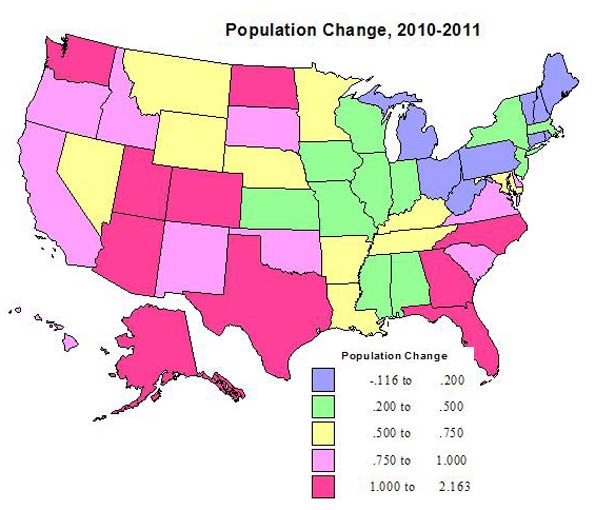
    The recently released estimates of population change and the natural increase and migration components of that change for 2010-2011 contain a few surprises, as well as much what has come to be expected.  What we population freaks have been awaiting are estimates of the components of change for the whole 2000-2010 decade, but these are still being adjusted, in part because of the tremendous complexity of migration and immigration and, yes, estimating  just who is in the country!

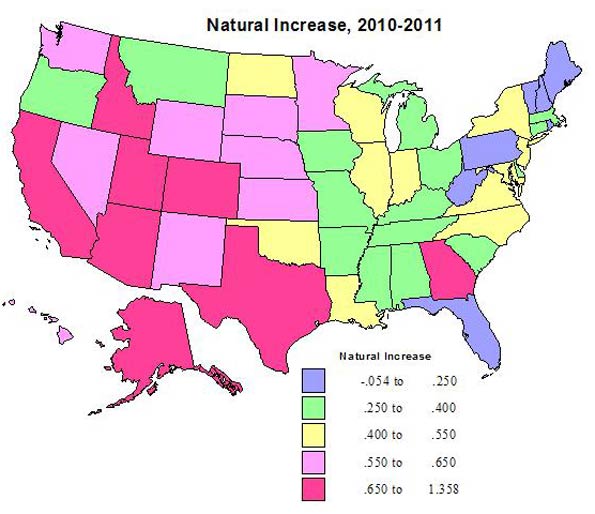
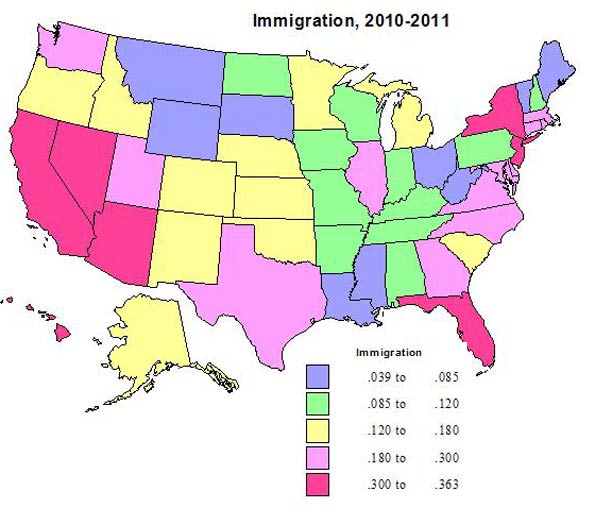
    I provide four simple maps, one of population change, 2010-2011,  one for the portion f that change due to natural increase (births less deaths), one for immigration and one for domestic or internal migration between the states.  Overall the big news is a slowdown of growth, to only .92 %, the lowest since the 1940s. This was due to a fewer  births, and thus of natural increase, because of folks not marrying or marrying later, and or postponing births because of the recession. It also has to do with  a reduction in immigration, again because of the recession, and possibly because of anti-immigrant sentiment and policies.

    The second big news is the somewhat surprising shift of some rapid growth to areas beyond the sunbelt and towards the northern tier.  Still impressive absolutely, the pace of growth has slowed in states such as Florida and Georgia, more so in Arizona and even more in Nevada, from the housing collapse and lower immigration. The South Atlantic region remained strong, but the new locus of faster growth is the “northern tier” from Minnesota through the Dakotas to Oregon and Washington. The Dakotas’ growth, also affecting Montana and Wyoming, is energy related, while that of Washington, now the 6th fastest growing state, is a reflection of a young population, continuing immigration, both high tech and agricultural growth, and a relatively robust economy.

    Natural increase. Natural increase is low in the states with the highest shares of the elderly, most obviously Florida, Pennsylvania, West Virginia and northern New England, in general regions and states from which young people have moved, e.g., MI, OH, KY, MO, AR, LA, MS, AL and IA, across the eastern heartland. But natural increase may have picked up a little in economically stronger states like NY, NJ, IL, IN and WI. Natural increase rates are higher, as might be expected, across the southwest and in Mormon states like Utah and Idaho. The bigger surprise once again is in the the upper Plains, including MN, ND, SD, and NE. Again Washington surprises, behaving like a sunbelt state, due more to an influx of a young population, than high fertility. 

    Immigration. Immigration overall has slowed, but was a relatively significant part of growth for much of the northeast, especially NY, NJ, MA, CT, RI, MD and DE, and remained important in FL, CA, NV, AZ, and WA (and yes Texas, but at a lower rate). The pace of immigration fell most in Nevada and Arizona.

    Domestic migration. This map is the one that most closely reflects the perceived and/or actual attractiveness of the states in the recent past. The states with the highest rates of net out-migration are mainly in the old urban-industrial core, including IL, MI, OH, NY, NJ and even CT, KS in the Plains and now Nevada. Even Alaska, Hawaii and especially California lost through domestic migration. The biggest change is the shift from net out-migration to net gains for the District of Columbia, Louisiana (after years of loss), and especially North Dakota, which made strong gains for the first time in decades. Missouri, New Hampshire, Utah and especially Nevada shifted from net gain to net loss.

    The gains of Texas and Florida, and at a lower rate, North and South Carolina and Tennessee, continue a pattern seen throughout the 2000-2010 decade. But Arizona, Georgia and Virginia have slowed down, and Nevada went from big gains to a loss. The biggest winners are South and especially North Dakota and Montana, in a dramatic turnaround, Colorado, now with the 4th highest rate, and Washington, with the 5th highest. Colorado appears especially popular with retiree migrants, particularly from California. DC and ND, losers for 2000-2009 had the two highest rates of gain for 2010-2011!

    Warning: These trends are fascinating, but we should remember that economic conditions – and even perceived attractiveness of states for cultural or environmental reasons – are volatile and can change again and again.

    Richard Morrill is Professor Emeritus of Geography and Environmental Studies, University of Washington. His research interests include: political geography (voting behavior, redistricting, local governance), population/demography/settlement/migration, urban geography and planning, urban transportation (i.e., old fashioned generalist).