Tag: high speed rail

  • Former Hawaii Democratic Governor Urges Trump to Stop Funds for Honolulu Rail

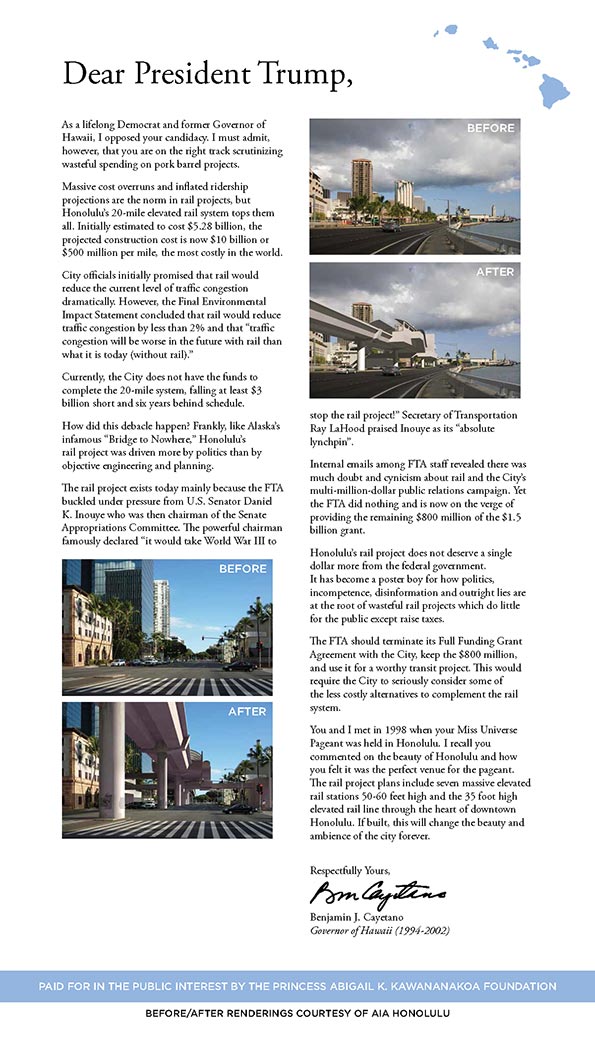
    A full page ad in today’s Washington Post (April 21, 2017) featured former Democratic Governor Benjamin J. Cayetano asking President Trump to stop further funding for the Honolulu rail project. The project has ballooned in cost from $5 billion to $10 billion, with most of the funding coming from local sources. There are serious concerns about the ability of Honolulu or Hawaii to afford completion of the project. Cayetano says that the line will be the most costly in the world. A proof of the ad is below and a pdf is available here.

    Several Newgeography.com articles have followed this issue:
    http://www.newgeography.com/content/005156-live-honolulu-hart-rail-a-megaproject-failure-making
    http://www.newgeography.com/content/002316-honolulu-mega-rail-project-a-micro-city
    http://www.newgeography.com/content/005410-honolulu-rail-from-46-b-86-b-eight-years-now-what
    http://www.newgeography.com/content/005257-honolulu-rail-it-just-keeps-getting-worse
    http://www.newgeography.com/content/002719-honolulu%E2%80%99s-money-train
    http://www.newgeography.com/content/001912-honolulu-rail-costs-balloon-ridership-projections-called-high

  • Caltrain and Blended High Speed Rail Promise Peninsula Traffic Paralysis

    The following notice was issued by the Community Coalition on High Speed Rail in the San Francisco Bay Area.

    A TRANSPORTATION EXPERT CONFIRMS OUR WARNINGS:
    THE SO-CALLED "BLENDED" PROJECT WILL
    PARALYZE TRAFFIC ON THE PENINSULA

    Paul Jones, a mechanical and industrial engineer who was an Associate Professor of Industrial and Systems Engineering at the Georgia Institute of Technology, and who was the principal engineer in charge of the high-speed rail design study for the high-speed train from Madrid to Barcelona, Spain, has analyzed the traffic impacts that can be expected if the High-Speed Rail Authority (partnering with Caltrain) actually constructs its proposed "Blended System" project on the Peninsula.

    What is Mr. Jones’ bottom line conclusion? The following quotation is from the "Abstract" of his November 7, 2016 report, "Potential Traffic Paralysis Throughout the Peninsula: Blended Caltrain/High Speed Rail Impact on Street Traffic."

    (End of notice)

    The report is available at: http://www.cc-hsr.org/news-pdf/Paul-Jones-traffic-delays.pdf.

    Note: The California High Speed Rail project, of which this work is a part, has been evaluated in reports by Joseph Vranich and Wendell Cox, who predicted substantial cost escalation (http://www.reason.org/files/1b544eba6f1d5f9e8012a8c36676ea7e.pdf). This prediction turned out to be low. This was shown in a subsequent report, with an analysis indicating that the system is likely to require substantial subsidies to operate (http://reason.org/studies/show/california-high-speed-rail-report). A later report by Wendell Cox and Adrian Moore found that the high speed rail line that the reductions in greenhouse gas emissions (CO2) from passengers transferring from planes and cars would cost up to nearly $19,000 per metric tonne (http://demographia.com/CalHSRGHGAnalysis.pdf). This is more than 1,000 times the market price.

  • California’s Attack on Rule of Law

    Morris Brown, founder of Derail (a citizen group opposed to California’s high speed rail project) writes over at Fox and Hounds Daily that newly enacted California Assembly Bill 1889 is unconstitutional.

    Brown could not be more on the mark. In 2008, the California legislature had placed a number of protections in a Proposition authorizing bonds for California’s high speed rail line. These were intended as enticements to voters to approve the proposition. The legislature and Governor promised. The people approved. And, now the legislature and Governor have gone back on their promise.

    In short, the legislature and Governor have revised the conditions of the proposition, something that requires a vote of the people. With respect to high speed rail (and perhaps other propositions) California has replaced rule of law with rule of men (and women). That this should have occurred with respect to a voter approved proposition is particularly egregious, since such measures (such as initiative and referendum) were Progressive Era reforms, under Governor Hiram Johnson in 1911, intended to permit the people to take legislative authority from the legislature and governor when they felt it appropriate.

    Meanwhile, the California high speed rail project has become a legendary “white elephant,” with costs going through the roof and little hope for achieving the promised travel time between San Francisco and Los Angeles.

    Brown’s analysis can be accessed here….

  • “Rising Rail Chaos” in Honolulu

    That’s what the Honolulu Star Advertiser calls it in an April 8 editorial entitled "Rising Rail Chaos Bodes Ill for Us All." Honolulu’s urban rail project has experienced a host of problems, which were described by University of Hawaii professor Panos Prevedoros in January, who called the project “the nation’s largest infrastructure fiasco by far” on a per capita basis.

    Things continue to deteriorate, as the Star-Advertiser editorial indicates. The Star Advertiser reported that city Council chairman Ernie Martin called for both Honolulu Authority for Rapid Transportation (HART) Board Chairman Don Horner and chief executive officer Dan Grabauskas.

    In a letter, Martin expressed concern that: “With mounting evidence of mismanagement and out of control costs … it is clear that we need a leadership team capable of moving this multibillion (dollar) project forward.”

    In its editorial, the Star Advertiser noted: “HART officials acknowledged new misgivings that the recently approved extension of the funding mechanism — Oahu’s 0.5 percent general excise tax surcharge — would cover the bills.”

    Martin called it a “stunning about face” that Horner could not promise Council members that there would be enough cash to finish the project. Previously, according to Martin, Horner had said that the tax extension would be sufficient to finish the 20 mile line.

    Martin went on to say that “we need to go in a different direction” to help “stop the bleeding.” He added: “We’re at the tourniquet stage right now,”  “If we don’t apply more intense scrutiny, then we’re likely to lose limbs.”

    Meanwhile, Honolulu is not alone. There has been plenty of bleeding with respect to expensive urban rail projects. In Los Angeles, $16 billion has been spent to build a massive new urban rail system and yet, transit ridership languishes below the levels of three decades ago, despite population growth. In Toronto, the new airport express train has been such a failure in ridership that it is routinely called a “fiasco” by the media.

    Of course, all of this is predictable. Often, urban rail costs more and carries fewer riders than projected. are higher than projected ridership lower than projected, and virtually never high enough to reduce traffic congestion can be characterized as routine, as the international research led by Oxford professor Bent Flyvbjerg has indicated.

    But Honolulu is a special case as well. There may have never been so intense a volunteer campaign to stop what was perceived as a boondoggle is in Honolulu. The Star-Advertiser, usually a cheerleader for the project, concluded by saying: “Reports of this dysfunction just adds to the strain taxpayers feel right now, and it’s the last thing they need. The price tag on the state’s largest public works project is past the $6 billion mark and rising, with the most complicated part of the work still looming.”

  • Taiwan High Speed Rail Near Bankruptcy

    Efforts are underway by the Taiwan government for a government led restructuring to avoid bankruptcy (Plan to stop Taiwan’s high-speed rail going bust set for review). Since opening in 2007, this privately financed and operated system has been plagued with ridership well below projections. The Taiwan experience is consistent with the research showing that ridership on high-speed rail lines has been frequently over-projected.

    Minister of Transportation and Communications (MOTC) Yeh Kuang-shih offered this sobering assessment:

    “This is not the best time to address the financial problems, but it is the last window of opportunity. The Taiwan High Speed Rail Corp will definitely go bankrupt if the problems are not addressed by the end of the year. The only other solution would be a government takeover. If the company files for bankruptcy and the government is forced to take over operation of the system, the banks will probably collect on their loans, but neither large nor small investors will get anything back.”

    Kuomintang Party legislator Lin Kuo-cheng said that the "debt" and "accumulated losses" mean that the Taiwan high speed rail line is "broke."

  • Court Rules Against California High Speed Rail

    California Superior Court Judge Michael Kenny ruled against the California High Speed Rail Authority in two decisions announced on November 25. In the first, Judge Kenny ruled that the Business Plan failed to meet the requirements of the voter approved referendum under California Assembly Bill 3034 (2008), in not identifying sufficient capital funding for the first segment. As a result, the Business Plan needs to be redrafted. In the second decision, Judge Kenny declined to issue a conformity ruling that would have paved the way for $8 billion in bonds that had been approved by voters, which were also subject to same Assembly Bill 3034.

    Judge Kenny declined to stop construction of the project, which is scheduled to start in the Spring. However, the Authority only has federal funds for that segment, and which would require, in the longer run, matching state funds (which were to have been from the bonds).

    According to the San Francisco Chronicle , Kenny’s found that the California High Speed Rail Authority "abused its discretion by approving a funding plan that did not comply with the requirements of law."

  • London Mayor: High Speed Rail Cost £70 Billion Plus?

    In a Daily Telegraph commentary, London Mayor Boris Johnson expects the proposed high-speed rail line from London to Birmingham (HS2) to cost £70 billion (approximately $105 billion). This is two thirds more than the most recent estimate of £42 billion (approximately $63 billion), which includes a recent increase in costs from £32 billion (approximately $48 billion) for the 140 mile long first segment. Johnson wrote:

    “This thing isn’t going to cost £42 billion, my friends. The real cost is going to be way north of that (keep going till you reach £70 billion, and then keep going). 

    He concludes:

    “So there is one really critical question, and that is why on earth do these schemes cost so much?”

    A possible answer comes from Oxford University, 60 miles from London. Oxford professor Bent Flyvbjerg, along with Nils Bruzelius (a Swedish transport consultant) and Werner Rottenberg (University of Karlsruhe and former president of the World Conference on Transport Research) reviewed 80 years of infrastructure projects found and low-balling of cost estimates routine (Megaprojects and Risk: An Anatomy of Ambition). They characterize the process as "strategic misrepresentation," which they shorten to "lying," in unusually frank language.

    It is not just the apparent dishonesty of the process — it is that unreasonably low cost estimates entice governments into approving projects that have been marketed on false pretences. Once committed to such a project, public officials, find it nearly impossible to “jump off the train,” as it were. The loss of face could well be followed by a loss at the next election. Flyvbjerg, et al characterize “strategic misrepresentation” as “lying.”

    There could be other difficulties. The government claims that trains will peak at 225 miles per hour (360 kilometers per hour), considerably higher than the 199 mile per hour (320 kilometer per hour) maximum speed. High speed rail in China, Spain, France and Korea also promised faster operation, but not delivered. Safety may be a reason, as suggested in a Wall Street Journal article:

    “An executive at a non-Chinese high-speed train manufacturer said running trains above speeds of 330 kilometers an hour poses safety concerns and higher costs. At that speed threshold, wheels slip so much that you need bigger motors and significantly more electricity to operate. There is also so much wear on the tracks that costs for daily inspections, maintenance and repairs go up sharply. That’s why in Europe, Japan and Korea no operators run trains above 320 kilometers an hour, the executive said…”

    HS2 seems to be on track to follow California in its unprecedented high speed rail cost escalation. The last cost estimate for the 400 mile plus high-speed line from Los Angeles to San Francisco was three times the cost (inflation adjusted) projected in 1999 (midpoint, see the Reason Foundation’s California High Speed Rail: An Updated Due Diligence Report, by Joseph Vranich and Wendell Cox). Public outcry over the escalating costs forced approval of an alternative “blended” system that would use conventional tracks and non-high speed rail speeds at the northern and southern ends. Even so, the scaled back version is estimated to cost $60 billion, inflation adjusted (£40 billion), 150 percent more than the 1999 projection for a genuine high speed rail line.

    Mayor Johnson may be optimistic in his £70 billion prediction. Procurement expert Stephen Ashcroft, of Brian Farringdon, Ltd. says: “We confidently predict that the final project outturn actual cost will exceed £80 billion” (emphasis in original). There is, of course risk in such projections. Joseph Vranich and I found that out when our maximum cost escalation prediction in The California High Speed Rail Project: A Due Diligence Report, (2008) turned out to be way low. It was exceeded by more than one-half and in just four years.

    Also see: The High Speed Rail Battle of Britain

  • Chinese Cancel Treasure Island Investment as Brown Seeks High Speed Rail Funds

    California’s Governor Jerry Brown and an entourage of public officials and corporate executives has spent much of the last week traveling around China trying to drum up business for the state. One of his principal objectives is to entice Chinese investors to take a stake in the California high-speed rail project. From the Governor’s perspective, this makes all sense in the world.

    California’s high-speed rail program may be the current holder of the largest projected funding deficit of any infrastructure in the world, at approximately $50 billion. (That’s after shaving $30 billion off the project and losing the support of former California High Speed Rail Authority Chairman, former state Senator Quentin Kopp, who charges that the line is no longer "genuine high speed rail").

    As Governor Brown concludes his trip to the Orient, word comes from The San Francisco Chronicle that "A $1.7 billion deal with China Development Corp., the Chinese national railway and Lennar Corp. to construct 12,500 homes on the former Hunters Point Naval Shipyard in San Francisco and a string of high-rises on Treasure Island has collapsed." The project was to be built over up to three decades and would have housed 20,000 people. The deal is said to have fallen apart over not allowing the Chinese investors sufficient control and "unresolved tax issues."

    The now defunct deal may have been the largest serious Chinese investment proposal in California.

    There are important lessons for proponents of the high-speed rail system, who sometimes fantasize about China as the bailout investor of last resort. The Chinese, like the other investors who have found better things to do with their money are not likely to be swayed by the line’s excessively high cost or its modest ridership potential. Nor will the Chinese bear gifts to California.

    These issues are described in detail in the new Reason Foundation Updated Due Diligence report by Joseph Vranich and me.

  • Top GOP Budget Officials Call for Investigation of Xpress West High Speed Train from Victorville to Los Angeles

    Congressman Paul Ryan, chairman of the House of Representatives Budget Committee and Sen. Jeff Sessions, Ranking Member of the Senate Budget Committee have expressed serious reservations on the proposed taxpayer loan to the Xpress West high-speed rail line that would operate two thirds of the way between Los Angeles and Las Vegas (from Victorville).

    A joint letter dated March 7 to United States Secretary of Transportation Ray LaHood called the taxpayer risks untenable. They asked for a Government Accounting Office investigation of the project and asked Secretary LaHood to suspend final determination on the taxpayer loan until the GAO investigation is completed.

  • The Future of Passenger Rail in America

    On October 19, an Amtrak passenger train hit 111 mph in a test run on a 15-mile stretch of track between Dwight and Pontiac, Illinois. It was the first tangible return from a three-year $1.5 billion program of improvements funded under the Administration’s high-speed rail initiative. The program hopes to shave about an hour off the 5 ½ hour rail trip between Chicago and St. Louis. Transportation Secretary Ray LaHood and Illinois Gov. Pat Quinn who were aboard, called it a "historic" event. They were perhaps unaware, as Chicago SunTimes respected columnist Mark Brown pointed out, that "ten years ago, also on the eve of an election, the same Illinois Department of Transportation offered another demonstration along nearly the same stretch of track, also reaching 110 mph."

    Setting this pre-election rhetoric aside, of President Obama’s vaunted HSR initiative that promised to connect 80 percent of Americans with high-speed rail, only two true high-speed rail projects remain.  They are the California SF-to-LA Bullet Train and the "Amtrak Vision for the Northeast Corridor." The future of these two projects is discussed below. A condensed version of this commentary appeared in the Wall Street Journal on September 24, 2012.

    ### 

    High speed trains are hardly new — they have been crisscrossing France and Japan for over 40 years. But building a nationwide high-speed rail network in America is quite a novel idea. It originated with President Obama who, on April 16, 2009, announced a plan "to give 80 percent of Americans access to high-speed rail within the next 25 years." The program was seeded with an $8 billion grant from the American Recovery and Reinvestment Act of 2009 (ARRA), later supplemented with an additional $2.1 billion in general funds.

    But this lofty and extravagant vision soon yielded to practical realities. One such reality is America’s demography. Unlike Western Europe and Japan, the United States, lacks an urban pattern that favors high-speed rail connections. This pattern requires large traffic generating city-pairs that are neither close enough to each other to favor travel by car nor far enough apart to favor travel by air. In Europe and Japan those distances happen to fall in the range of 200-400 miles (Think Paris-Lyon, 290 miles; or Tokyo-Nagoya, 220 miles). The only corridor in the United States that fits this description is the Northeast Corridor. No wonder, the Boston-to-Washington rail line has lately become a focus of high-speed rail planning.

    Another reality is that true high-speed rail service requires a dedicated alignment reserved exclusively for passenger trains. Such is the case with the French TGV, the German ICE and the Japanese Shinkansen trains— as indeed, with any train that runs at top speeds of 150 miles per hour or higher. Having high-speed trains share a common track with lumbering freight trains as the Obama Administration has proposed to do, is to invite serious operational conflicts and safety problems. But dedicated rights-of-way for high speed trains require relatively straight and level alignments with minimal curvature. To assemble such rights-of-way in densely populated corridors where land holdings are highly fragmented, would be extremely costly and disruptive if not totally impossible.

    Yet another reality is the uncertain prospect for further federal support. Such support is deemed essential for the future of the Administration’s HSR program (but not for the future of privately funded ventures such as the proposed Lone Star HSR line between Dallas and Houston). Congress, by denying White House requests for high-speed rail funds three years in a row, has sent a clear bipartisan signal that states should not count on continued congressional appropriations for high-speed rail. The lawmakers reaffirmed this intention by eliminating Title V of the Senate transportation bill (the National Rail System Preservation, Expansion and Development Act of 2012) from the final version of the surface transportation reauthorization (MAP-21). In the meantime, the $10.1 billion earmarked for high-speed rail has been fully committed.

    In sum, high-speed rail advocates, promoters and dreamers need a triple reality check.

    Improving Existing Rail Service

    But this is not to say that nothing should be done to improve and expand existing passenger rail services, especially commuter rail lines serving major metropolitan areas. Even though such improvements will not result in significant travel time savings, they could lead to more efficient, frequent and reliable transportation service benefitting millions of daily commuters. In 2010, commuter rail systems across the country provided service to nearly 460 million riders.

    Improving commuter rail services is indeed, the approach embraced by the California High Speed Rail Authority. Despite its avowed goal to link LA and San Francisco with high-speed trains, almost half of its initial $10 billion first stage of the project will be devoted to upgrading conventional transit and commuter rail services in Los Angeles and the Bay Area, the "bookends" of the high-speed rail line, e.g. through electrification of the SF-to-San Jose Caltrain and "connectivity" improvements in LA’s Metrolink.

    The dollars spent on commuter rail improvements will have "an immediate and dramatic effect" according to the Authority’s chairman, Dan Richard. Will Kempton, chief executive of the Orange County Transportation Authority (OCTA) and chairman of the Independent Peer Review Group advising the High Speed Rail Authority concurs. It will be a good investment, he said, whether or not the overall $68 billion high-speed rail project ever gets completed.

    Similarly, in the Northeast Corridor where Amtrak has proposed a 30-year $151 billion capital investment program to bring true high-speed rail service between Boston and Washington DC, the initial efforts will be focused on "meaningful incremental improvements" in track, catenary and signals in the New York-to-Philadelphia corridor (the "NEC Upgrade Program"). This stretch of the line was chosen for the initial upgrade because it carries a heavy volume of local commuter traffic in addition to serving long distance trains. As in the case of California’s "bookend" improvements, the upgrades of the 90-mile NY-Philadelphia rail line will not only benefit large numbers of travelers – they also will be far more cost-effective in dollars-per-passenger terms than any eventual improvements raising line speeds over the entire Boston-to-Washington corridor.

    Thus, fiscal, economic and political constraints have caused both the California Bullet Train and the Amtrak vision for the Northeast Corridor — the only two projects that have survived on the Obama Administration’s vaunted high-speed rail agenda — to morph largely into a program of modest near-term improvements in existing commuter rail services. Lack of funds may prevent either project from achieving its avowed goal of providing true high-speed rail service— in the case of California, reducing travel time between LA and San Francisco to two hours and forty minutes (see Note below).  To achieve it, the California project will require $68 billion; the NEC program will need $151 billion.

    Is this goal even worth pursuing? Some people think so—in fact they passionately believe in it. They contend that in order to make our cities less auto-dependent we need to invest in high-speed trains. Minor upgrades in existing rail services, they argue, will not make a significant dent in auto use. But many planners beg to differ. They believe that the best chance of persuading current auto users to leave their cars at home is to improve the daily suburban rail commute. Business travelers will continue flying because they look for the fastest way to get to their destination. Families on vacation trips will not abandon their cars in favor of trains because cars offer the least costly and most convenient way to travel to holiday destinations. The only sector of the traveling public that can be influenced to shift to trains in large numbers are suburban commuters.

    What of the argument that a great nation like ours—a nation that built the Erie Canal, the transcontinental railroad, the Panama Canal and the Interstate Highway System — should continue the tradition of visionary grandiose public works.

    Regretfully, both ventures have come at a most inopportune time. The nation is recovering from a serious recession and is trying to rein in the deficit and reduce the 16 trillion dollar national debt. At a more distant moment in time, when the economy is growing again and the deficit has come under control, the nation might be able to resume its tradition of pursuing "bold endeavors"—ambitious programs of federally financed public works that benefit the whole nation. When that time comes, perhaps toward the end of this decade, it might be appropriate to revive the idea of high-speed rail— at least in the context of the densely populated Northeast Corridor where road and air traffic congestion may eventually threaten its continued growth and productivity. For now, prudence, good sense and the nation’s fiscal well-being require that we lower our sights and focus on improving commuter rail connections.

    ###

    Note on the Status of the California HSR Project

    There is a high likelihood that the LA-SF bullet train project will never get completed. Law suits are pending to stop construction of the first stage of the project—the Central Valley segment from Madera to Bakersfield. A motion for a preliminary injunction has been filed by Madera County, the Madera and Merced County farm bureaus and other opponents. The motion seeks to prevent the rail Authority from moving forward on the initial Madera-to-Fresno section until a trial on the lawsuit is completed. Hearing on the preliminary injunction is set for November 16.

    Even if the preliminary injunction is denied, construction on the rail section will not begin until the fall of 2013 according to a legal declaration filed by the Authority in the Sacramento Superior Court. What’s more, the Madera-to-Fresno section will not be electrified before 2022 according to the rail Authority—and then only if more funds become available. Additional legal challenges are expected over the Fresno-to-Bakersfield section of the line. The City of Bakersfield has already announced plans to file a lawsuit contending that the Authority’s environmental impact report doesn’t meet CEQA standards. The cumulative effect of these delays has led to speculations that the Authority may not be able to complete work on the Central Valley segment by September 2017 when the federal $3 billion grant expires. And if the federal money stops flowing, who will step in to fill the gap?