Tag: high speed rail

  • Chicago Tribune Joins the Ranks of High-speed Rail Critics

    Last year, in congressional testimony before the House Transportation and Infrastructure Committee hearing on high speed rail, we cited the Chicago-to-St.Louis "high-speed rail" project as an example of the Administration’s wasteful use of its economic stimulus money. We pointed out that the $1.4 billion program of track upgrades will allow top speed of 110 mph but will raise average speeds of Amtrak trains between Chicago and St. Louis by only 10 miles per hour, from 53 to 63 mph. The four-and-a-half hour trip time will be cut by a mere 48 minutes, to three hours and fourty minutes. In France, TGV trains between Paris and Lyon cover approximately the same ditance (290 miles) in a little under two hours, at an average speed of 150 mph. Yet, federal officials did not hesitate proclaiming the Chicago-St. Louis project as "historic" and hailing it as "one giant step closer to achieving high-speed rail passenger service."

    Now, a Chicago Tribune story, linked here and excerpted below, confirms just how "ridiculously expensive" and "uneconomical"  this project is turning out to be.  As the editorial points out, the project stands to "drain funding from mundane projects that could make a much bigger difference." Something that the California High Speed Rail Authority has belatedly recognized in diverting almost half of the initial $10 billion stage of its bullet train project to upgrading "mundane" commuter rail services in Los Angeles and the Bay Area. 

    In recent years, under the banner of economic stimulus, the federal government has spent a ton of money getting the tracks ready for those speedy locomotives. In the Chicago-St. Louis corridor, for instance, Uncle Sam has poured at least $1.4 billion into crossing improvements and other upgrades. Between Chicago and Detroit, more than $400 million has been spent.

    How would you feel, taxpayer, if we told you that some of the work might need to be torn up and redone?

    Angry? You bet.

    A debate over just how fast high-speed trains should operate could turn very costly very soon.

    The issue comes down to 15 miles per hour.

  • High Speed Rail in Brazil: The Need for Guarantees

    In an article entitled Fourth Time Unlucky, The Economist wonders why Brazil, with "a long list of more worthwhile infrastructure projects", does not dismiss high speed rail "out of hand."

    After three unsuccessful attempts to attract international bidders to build its Rio de Janeiro to Sao Paulo and Campinas line for a bargain basement price, the nation has decided that taxpayers will foot some (probably all) of the bill.

    The Economist continues:

    "Everywhere, new-build rail projects are horribly likely to come in way over budget and to be used much less than expected. A 2009 paper by Bent Flyvbjerg of Oxford’s Saïd Business School, ominously entitled "Survival of the Unfittest: Why the worst infrastructure gets built—and what we can do about it."

    As Flyvbjerg and others have noted, promoters, whether private or public, often seem to have a simple goal: to get the line under construction. That positions the projects for taxpayer bailouts when they run into problems.

    With bidders able to call upon other people’s money (taxpayer’s money) this time, it seems likely there will be takers. And, based upon the experience with major infrastructure projects around the world, that will be just the start of the taking.

    If elsewhere provides any guidance, the winning bidder can be confident that, down the road, the captive customer (the taxpayers) will pay any cost overruns. At the same time, the routine could be repeated in which a government kicks and screams, claiming it had no warning.

    They did. In this day and age, a link to the Economist’s warning is forever. A wise government will obtain the unlimited guarantees any company involved in the winning joint venture. Only then will Brazil’s taxpayers be protected.

  • Texas High Speed Rail: On the Right Track?

    The Central Japan Railway (Note 1), which operates one of only two high-speed rail segments (Tokyo Station to Osaka Station) in the world that has been fully profitable (including the cost of building), proposes to build a line from Dallas to Houston, with top speeds of 205 miles per hour. This is slightly faster than the fastest speeds now operated. This line is radically different from others proposed around the nation and most that have been proposed around the world. The promoters intend to build and operate the route from commercial revenues.

    There is the understandable concern that eventually, the promoters will approach the state or the federal government for support. Not so, say Texas Central High Speed Railway officials. According to President Robert Eckels, not only is there no plan for subsidies, but "investors would likely walk away from a project that couldn’t stand on its own." He also told the Texas Tribune “If we start taking the federal money, it takes twice as long, costs twice as much,” Eckels said. “My guess is we’d end up pulling the plug on it.”

    Eckels is a former Harris County Judge (Houston), a position the equivalent of a county commission or county board of supervisors chair in other parts of the nation. Eckels developed a reputation for fiscal responsibility during his tenure at the county courthouse.

    The Texas project is in considerable contrast the California High Speed Rail project, which if built, is likely to require a 100 percent capital subsidy and perhaps subsidies for operations. It is also different from the Tampa to Orlando high speed rail project, which would have required a 100 percent capital subsidy and was cancelled by Florida Governor Rick Scott. The Texas project can also be contrasted with the Vegas to Victorville, California XpressWest high speed rail line that would require at least a $5.5 billion federal loan and a subsidized interest rate. Our recent Reason Foundation report predicted that XpressWest would not be able to repay its federal loan from commercial revenues and could impose a loss on federal taxpayers of up to 10 times the Solyndra loan guarantee loss (see The Washington Post, "Solyndra Scandal Timeline").

    From the horrific record of private investment in startup high speed rail lines and the huge losses that have been typical, I am certainly skeptical. The Taiwan high speed rail private investors have lost two-thirds of their capital investment and debts are guaranteed by the government. The Channel Tunnel rail line to St. Pancras station has been bailed out by British taxpayers. However, if any company can make money at high speed rail in the United States, it would be the Central Japan Railway.

    So far the Texas Central High Speed Railway seems to be doing it right. Like the other intercity modes, the airlines system and the intercity highway system (Note 2), this project would be paid for by people who use it.

    Without government subsidies or loans, the Texas Central High Speed Railway will certainly have an incentive to get the sums right. If they are not, it sounds like the plug will be pulled. If they are, high speed rail could be on the right track in the United States for the first time. More power to them.

    ——

    Note 1: Central Japan Railway, and other companies purchased the assets of the Japanese National Railway in the late 1980s. The nationalized railway had run up a debt of nearly $300 billion, which was eventually transferred to taxpayers.

    Note 2: There is a small subsidy to the airline system from the Federal Aviation Administration. Intercity highways have been financed by users until contributions from the federal general fund in recent years. However these contributions have been far less than diversions over the past 30 years from highway user fees, principally to mass transit a major transfer of highway trust fund interest to the general fund and now ongoing interest transfers.

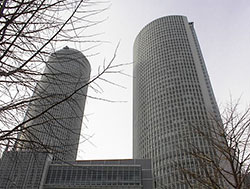
    Photograph: Central Japan Railway corporate headquarters at Nagoya Station (by author)

  • Could a Las Vegas Train Produce Losses 10 Times More Than Solyndra? (Report Announcement)

    The Reason Foundation has released our "Xpress West" (formerly "DesertXpress") analysis. This high speed rail train would run from Victorville (90 miles from downtown Los Angeles) to Las Vegas. Promoters predict high ridership and profits. They are seeking a subsidized federal loan of more than $5.5 billion, which is within the discretionary authority of the US Department of Transportation to fund.

    Our analysis concludes the following:

    1. There is serious question whether there is a market for Las Vegas travel that would require driving one-third of the way and transferring to the train. If there is no such market, as seems likely from the international experience, ridership could be as low as 97 percent below projections. The reality can be known only after the line is running.

    The balance of the report is based upon the assumption that there is a market for driving to Victorville and boarding a train to Las Vegas.

    2. The ridership and revenue projections (by URS Corporation) are based upon data that is more than 7 years old and predates the Great Financial Crisis. There have been significant downward demand trends in the travel market and Las Vegas tourist market since that time, especially in the share of the market from the Los Angeles Basin. It is inappropriate to use such old data in projecting system performance (Certainly no private company would rely on such old data in a due diligence analysis).

    3. Even after adjusting the obsolete data (which our report does), the ridership projections are implausibly high — at four times the Amtrak Acela ridership between Washington, Baltimore, Philadelphia and New York.

    4. Over 24 years (the forecast period in the project document), we project that expenditures will exceed revenues by between $4 billion and $10 billion. This would mean that there would be insufficient revenues to pay the federal loan. This could result in a taxpayer loss approximately 10 times that of the Solyndra federal loan guarantee.

    5. The free use by the private Xpress West project of the Interstate 15 median could preclude cost effective expansion of this roadway. Even assuming the implausible Xpress West assumptions about the diversion of drivers to the train, the overwhelming majority of growth in the corridor would be on the highway, not on the train. This includes not only the heavy truck traffic, but also car traffic.

    Related: The Las Vegas Monorail

    Wendell Cox was also author of  "Analysis of the Proposed Las Vegas LLC Monorail," which indicated that ridership and revenue projections were extremely optimistic and that the project was likely to fail  financially. Subsequently the project filed bankruptcy and defaulted on bonds. The actual ridership on the Monorail was within the range predicted in "Analysis of the proposed Las Vegas LLC Monorail," and far below the level forecast by project consultant URS Greiner Woodward Clyde.

    Also see this letter from other consultants reviewing the project (Thomas A. Rubin, Jon Twichell Associates, Professor Bernard Malamud  and Wendell Cox).

    The Las Vegas Monorail case is described in the Reason Foundation report.

  • More Unwelcome News for the California High Speed Rail Project

    Decidedly, early June has not been the best of times for the California high-speed rail project.

    On June 2, came a new poll showing that fifty-nine percent of voters would now oppose building high-speed rail if the measure were placed on the ballot again. Sixty-nine percent said that they would "never or hardly ever" ride the bullet train if it were built. (USC Dornsife/LA Times survey). The poll made news throughout the state, and indeed nationally. The public was treated to headlines such as "Voters have turned against California bullet train" (LA Times); "California high speed rail losing support" (Bloomberg); "California high speed rail doesn’t have the support of majority of Californians" (Huffington Post); "Voters don’t trust state to build high speed rail" (CalWatchdog) and "Poll finds California voters are experiencing buyers’ remorse" (Associated Press).

    Then, on the heels of the poll, came news that Central Valley farm groups have filed a major environmental lawsuit asking for preliminary injunction to block rail construction slated to begin later this year. Plaintiffs include the Madera and Merced county farm bureaus and Madera County. Still more agricultural interests in the Central Valley are reportedly threatening to sue.

    The Sierra Club, traditionally a loyal supporter of Gov. Brown, announced it was "strongly opposed" to Brown’s proposal to eliminate California environmental (CEQA) requirements for the high speed rail program and its Central Valley construction project. The Brown administration has made its proposal despite a solemn promise to the legislature by the Authority’s Chairman, Dan Richard, that they would never try to bypass CEQA ("We have never and we will never come to you and ask you to mess with the CEQA requirements for the project level").

    The multi-billion dollar HSR program is exactly the sort of large scale public works project that CEQA was designed to address, wrote Kathryn Phillips, Sierra Club’s Director in a June 5 letter to the Governor. "By removing a large-scale project such as high-speed rail from full CEQA coverage, the proposal grants the state a status that suggests it does not have to fully and seriously consider and mitigate environmental impacts. … In the interests of the environment and in the interest of rebuilding public support for rail in this state, we urge you in the strongest possible terms to abandon the proposal to weaken environmental review for the high-speed rail system," the letter concludes.

    Nor was this the end to unwelcome news for the Brown administration. A series of editorials and opinion pieces by some of California’s most influential columnists has reinforced the public’s growing disenchantment with the bullet train project and with the Governor’s stubborn determination to defy public opinion.

    In a June 3 commentary,  the Sacramento Bee columnist Dan Walters, a longtime observer of the legislative scene, refuted the Governor’s attempt to compare the high speed rail project with the iconic Golden Gate Bridge. Both projects, the Governor had said in a ceremony marking the 75th anniversary of the bridge, took much political courage and foresight, and both will go down in history as remarkable gifts to posterity.

    "Nice try, Governor," wrote Walters, but the comparison is misleading. The need for the Golden Gate crossing was clearly demonstrable and the bridge used revenue bonds to be repaid with bridge tolls. The need for a bullet train, on the other hand, "exists only in the minds of its ardent backers" and the Governor assumes that the federal government will finance nearly two-thirds of the project’s cost—an assumption that is nothing more than wishful thinking. Asked Walters, if the train is as financially viable as Brown and the Authority insist it is, why wouldn’t they do what the bridge builders did — float revenue bonds to be repaid from the train’s supposed operating profits. "Public works projects make sense when they fit well-documented needs. When they don’t, they are just political ego trips," Walters concluded.

    Daniel Borenstein, columnist and editorial writer for the Contra Costa Times, came to a similar conclusion. In pushing for the bullet train, he wrote, Gov. Brown is motivated by a quest for a legacy. But, the columnist warned, while the Governor strives to be remembered like his late father for the capital projects he leaves behind, he could derail the November tax measure by his "reckless exuberance for spending billions on high speed rail." "Does he really want to anger [the voters] when he needs them the most?" Borenstein asked.

    Perhaps the most devastating criticism of the Governor’s high speed rail initiative came in a June 8 editorial in the San Jose Mercury News, one of the Bay Area’s most influential newspapers. Entitled "High Speed Rail Plan is Delusional" the editorial has been syndicated in a number of Bay Area and Los Angeles Sunday papers. Follow this link to read it at the Mercury News website.

  • Thoughts on High-speed Rail and Buses

    I’m back from a California trip – beautiful state, beautiful weather, completely dysfunctional government.  For example, even with massive fiscal problems it’s still trying to build a vastly expensive high-speed rail line from San Francisco to San Diego. On a related note, a private group is exploring building a Houston-Dallas HSR line with no subsidies of any kind. I’m totally okay with private efforts.  I’m probably even okay with a little eminent domain to get the right of way at a fair price. I hope they can make it work.

    Here’s a great alternate perspective on HSR: a TED talk on the value of perception and psychology vs. economics and technology.  Go to the 6:12 point to see a great example of the Eurostar train, where they spend a vast amount of money to reduce travel times by 40 mins, when for 90% or 99% less money they could have improved the experience instead and actually gotten higher rider satisfaction.  I believe the absolute same principle applies to bus vs. rail, whether intra- or inter-city: spend 1% or 10% of the same money improving the bus service and get higher customer satisfaction than the rail line would generate.  (hat tip to Karl)

    And Greyhound is doing just that, learning from Megabus and upgrading their service with wifi, power plugs, and nicer seats with more leg room.  With that kind of service option available at say $30 one-way within the Texas Triangle, how many people do you think would pay $150+ to go on HSR?  On second thought, maybe nobody should mention this possibility to the Texas HSR group…  😉

  • California’s Bullet Train — A Fresh Start and a Change in Direction

    A new strategy is beginning to emerge toward California’s embattled high-speed rail venture. The strategy is designed to rescue the project from a possible defeat at the hands of the state legislature, gain friends and supporters among local transportation agencies, win converts among independent analysts and turn around a largely skeptical public.

    The plan combines the existing commitment to proceed with construction of the first rail segment in the Central Valley with near-term actions aimed at upgrading rail facilities at both ends of the proposed LA-to-SF high-speed line. Specifically, the so-called "bookend" strategy will involve "blending" high-speed rail service with commuter rail service in existing Bay Area and Southern California rail corridors.

    At the northern end of the line, between San Francisco and San Jose, bullet trains would share track with Caltrain commuter trains. Both would benefit from new investments in electrification, signaling systems, bridge replacements, passing tracks and grade crossings elimination. Similar type of improvements would be introduced at the Los Angeles/Orange County/San Diego ends of the line, benefitting LA’s Metrolink and other Southern California commuter rail and transit systems.

    Improving the urban "bookends" of the system will make it possible to increase the speed of local commuter trains and thus bring immediate benefits to large segments of California’s urban population. It will be a good investment whether or not the overall $98 billion high-speed rail project ever goes forward, said Will Kempton, chief executive of the Orange County Transportation Authority (OCTA) and Chairman of the independent Peer Review Group advising the High Speed Rail Authority.

    The investments will be funded with a portion of Proposition 1A funds, supplemented by matching funds from local government agencies. Up to $2.3 billion in bond money and its $950 million "interconnectivity" fund would be committed to these near term improvements according to well-informed sources. This would provide approximately $1.4 billion for Southern California and $900 million for the Bay Area, assuming a 60/40 split. Another $2.7 billion has been already set aside for the 130-mile Central Valley segment, leaving roughly $4 billion of Proposition 1A money for future HSR construction.

    The new strategy has evolved from discussions held by the High Speed Rail Authority’s new chairman, Dan Richard with the Governor and his fellow board members. In a conversation we had with Chairman Richard several weeks ago, he was frank to admit that significant changes must be made in the Authority’s way of doing business if the bullet train project is to retain the support of the state legislature, overcome the skepticism of independent critics and turn around public opinion. The Authority must find ways, in the Governor’s words, to do things "better, faster and cheaper."

    While supportive of the Governor’s vision, Richard saw a need to show signs of near-term progress and not have to wait until 2033 to demonstrate the benefits of the investment. The dollars spent on the "bookends" could have "an immediate and dramatic effect," he told us.

    Turning to the Central Valley project, Richard freely admitted the ham-handed way in which the Authority dealt with the affected property owners and local governments. He made plain his resolve to restore trust and rebuild the agency’s credibility with the Valley constituencies. We also were struck by his refreshing willingness to reach out to the program’s critics, in contrast to the Authority’s often arrogant and dismissive posture of the past.

    Richard’s new strategy is beginning to bear fruit. Six Southern California planning and transportation agencies, including the Southern California Regional Rail Authority (Metrolink) voted as a group on March 1 to support the development of high-speed rail "while providing funding for local early investment projects in

    Southern California that will improve rail service immediately." The Authority hopes to stimulate similar expressions of support in Northern California by working closely with the Bay Area’s Caltrain and San Francisco’s Municipal Transportation Agency. The Peer Review Group, which has long supported the "bookends" approach, can be expected to provide an additional boost to Richard’s strategy.

    As for the initial Central Valley segment, its construction, initially planned to begin in September, has been pushed back. The slowdown is due to the need to revisit the environmental report whose initial version has run into a storm of objections concerning the proposed route. The revised draft report will be subject to another round of public hearings before the route through the valley is finalized. Assuming the state legislature authorizes the bond funding, construction in the Central Valley is now expected to begin in early 2013, although court challenges may cause further delays. Critics are expected to continue questioning the value of that investment, fueling continued controversy and increasing the project’s vulnerability.

    A New Perception

    Regardless of what ultimately becomes of the Central Valley project, the new urban "bookends" strategy is bound to profoundly modify the public perception of the bullet train venture. While the Governor and Chairman Richard maintain that the ultimate year 2033 goal of a 2 hour 40 minute train trip from LA to San Francisco has not changed, the practical effect of the new strategy will be to shift the focus from achieving that distant vision to effecting concrete near-term improvements— investments designed to benefit millions of present-day commuters in California’s two largest metropolitan rail corridors.

    Given California’s budget deficit, given the uncertainty of further federal support for high-speed rail in general and for California’s HSR project in particular (see below), and given a lack of any evidence of private investor interest, the"bookend" program of investments may indeed end up as the key accomplishment of the Proposition 1A initiative. While bullet train visionaries will regret this shift in the focus, pragmatists will welcome it as a prudent and realistic response to the growing skepticism. From an economist standpoint, the bookend strategy will be viewed as the best use of scarce financial resources. The public will see it as a victory for common sense: a decision that wisely  places greater value on satisfying present-day needs than on the promise of distant-in-time benefits.

    Could Washington come to the rescue?

    Meanwhile, in Washington, the Administration continues pursuing its fantasy-land rhetoric. "We envision an America in which 80 percent of people have access to high-speed rail," Transportation Secretary Ray LaHood reiterated in a recent blog. "We’re committed to this program… there’s no going back… we will keep the momentum going" he stated at a February 29 high-speed rail conference sponsored by the U.S. High Speed Rail Association.

    Except that this momentum, if there ever was one, has long since vanished. No funds for high-speed rail have been provided two years in a row, including the current (FY 2012) year. Nor are any HSR funds likely to be appropriated  in the next year’s budget. Congressional reaction to the Administration’s $2.5 billion HSR request in its FY 2013 budget submission has ranged from cool to dismissive. The President’s high-speed rail program is "a vision disconnected from reality" members of the Senate Budget Committee told Sec. LaHood at a recent hearing on the Administration’s transportation budget.

    Rep. John Mica (R-FL), chairman of the House Transportation and Infrastructure Committee was even more blunt. "If the president thinks his proposal for high-speed rail is going to fly, he’s pipe-dreaming," he told participants at the February 29 rail conference. In short, all signs point to continued congressional unwillingness to support a federal high-speed rail program. This sentiment seems to cross party lines: neither the Republican-controlled House nor the Democratic-led Senate have included HSR funds in their reauthorization bills. Rep. Jeff Denham’s (R-CA) bill would specifically prohibit new federal funds from going to California’s bullet train project during the entire life of the bill.

    For California, the implications are grave. Without further federal funds, the State of California will be obliged to seek a fresh infusion of public and private funds by 2015 if it is to continue pursuing its $98 billion bullet train vision. Will a new bond initiative or a public-private partnership succeed? Time alone will tell.
  • The Moonbeam Express

    Seldom has public opinion and expert judgment been more unified than in its opposition to  the California high-speed rail project.    The project has been criticized by its own Peer Review Group, the Legislative Analyst’s Office (LAO), the California State Auditor,  the State Treasurer and a group of independent  experts  (Enthoven, Grindley, Warren et al.).  In addition, the bullet train has come under severe criticism by influential state legislators and  by members of the state’s congressional delegation. Equally damaging to the project’s future prospects have been two public opinion surveys showing  that California voters have turned solidly against the project, and the opposition of  virtually all of California’s newspapers, including The Orange County Register, whose latest editorial we reprint below.  

    Editorial: Bullet train becoming "Moonbeam Express" (OC Register, Feb 1, 2012)
    Gov. Jerry Brown wants to use anti-global-warming carbon taxes to fund California’s much-maligned high-speed rail project. 

    In a brazen denial of the obvious, Gov. Jerry Brown now insists the proposed California high-speed rail can be built for much less than its own business plan stipulates, and wants to use anti-global-warming carbon taxes to underwrite the proposal, whose price tag has nearly tripled in the three years since voters approved it.

    The governor seems intent on demonstrating how California’s state government has burdened taxpayers with mounting debt, while overspending to create consecutive years of budget deficits. The rail project has been dubbed "the train to nowhere" because the only portion close to being built would link relatively sparsely populated Central Valley towns and no metropolitan areas. Perhaps with Mr. Brown’s new foolish insistence, it should be christened the Moonbeam Express. 

    Since the rail proposal appeared on the 2008 ballot, it has been widely and legitimately criticized in detailed analyses by the rail project’s own Peer Review Group, the state auditor, treasurer, Legislative Analyst’s Office, local governments including Tulare, Madera and Kings counties and the city of Palo Alto, numerous state and federal lawmakers from both parties and studies by UC Berkeley Institute of Transportation and the Reason Foundation. These highly unfavorable critiques reflect many of the criticisms the Register Editorial Board has raised since the project was proposed.

    In only three years, the train’s estimated cost has increased from $33 billion to $98.5 billion in the latest version of its own ever-changing business plan.

    Voters approved only $9.9 billion in bonds based on the rest coming from Washington and local governments along the route, and private investors. Washington has provided about $3 billion and not another dime has materialized or been pledged. Meanwhile, the estimated completion of the original phase of the project, from San Francisco to Anaheim, has been extended 14 years beyond the original estimate of 2020.

    Ridership estimates are unrealistic, meaning trains can’t operate solely on ticket revenue as required by the initiative. Costs, even at their current highest level, are certain to increase, and the needed additional funding sources are not forthcoming. Given hostility in Congress to the project, more money from Washington, which is grappling with its own massive deficits and debts, won’t be seen in the foreseeable future.

    State Sen. Doug LaMalfa, R-Richvale, introduced a bill Monday to put the high-speed rail proposal back on the November ballot so voters can de-authorize selling the $9.9 billion in bonds.

    The Register has urged this ill-conceived and increasingly untenable project be resubmitted to voters. Thankfully, for the most part, bonds remain unsold. There is no reason taxpayers should assume billions more debt — with annual interest payments of up to $1 billion — when the likelihood is remote the train ever will be built, despite the governor’s strained assurance.

    Moreover, state Sen. Diane Harkey, R-Dana Point, notes that the governor’s proposed new revenue stream — carbon taxes created by the 2006 Global Warming Solutions Act— is another hoped-for, rather than assured, solution. "The state’s cap-and-trade program is not yet in operation, and revenue estimates of $1 billion per year are unreliable and unsubstantiated," Ms. Harkey said. "Relying on projected revenues that fall short is the key reason why our state deficit continues to explode year after year. To rush this project forward, just using up the $3.5 billion of federal funds, with the hope of an additional funding mechanism based on guesswork, is irresponsible."

  • “Jaw-Droppingly Shameless:” Mother Jones on California High Speed Rail Projection

    Kevin Drum of Mother Jones reports on the highly questionable "cost of alternatives" that has been routinely repeated by proponents of the California high speed rail project, in an article entitled "California High Speed Rail Even More Ridiculous than Before."

    The mantra goes something like, "yes high speed rail is expensive, but it would cost even more to not build it." Yes, indeed, it is expensive, starting at the low estimate of $98.5 billion the press and proponents usually cite to the nearly $118 billion that the California High Speed Rail Authority itself indicates. Advocates then cite a $171 billion figure as what Californian’s would have to pay if they didn’t build the line.

    Joseph Vranich and I detailed the flaws in this "alternatives estimate" in a Wall Street Journal commentary on January 10 ("California’s High Speed Rail Fibs"). We noted that the claim "sets a new low for planning projections in a field that has been rife with abuse." This was a reference to "strategic misrepresentation” ("lying") that has characterized rail project forecasts, according to top European academics.

    Drum goes further, calling the claim "jaw-droppingly shameless," an appropriate characterization based upon the method and documentation. He goes on to suggest that "A high school sophomore who turned in work like this would get an F."

    Regardless of the views that officials or the public may have on high speed rail, they are entitled to a standard of professional (and taxpayer financed) analysis above "jaw-droppingly shameless."

  • A Devastating Verdict for California HSR

    Like many other observers, we have found the California High-Speed Rail Peer Review Group to have made a convincing case for a fresh look at the feasibility of the California high-speed rail project. The group’s report was issued as eleven House Democrats – eight from California – joined an earlier request from twelve Republican House members for an independent GAO investigation of the embattled project. 

    That is why we find Governor Brown’s reaction – that the peer reviewers’ report "does not appear to add any arguments that are new or compelling enough to suggest a change of course” – to be incomprehensible. Either the governor issued the statement without the benefit of having read the report, or else he is so ideologically committed to the project that he refuses to look the facts in the face.

    Precisely which conclusions of the report are not compelling enough, the governor’s spokesman has not made clear. Is it the statement that "the Funding Plan fails to identify any long term funding commitments" and therefore "the project as it is currently planned is not financially feasible"?

    Is it the reviewers’ assertion that "the [travel] forecasts have not been subject to external and public review" and, absent such an open examination, “they are simply unverifiable from our point of view"?

    Could it be their statement that "the ICS [Initial Construction Section] has no independent utility other than as a possible temporary re-routing of the Amtrak-operated San Joaquin service…before an IOS [Initial Operating Segment] is opened"?

    Or, is it the Panel’s conclusion that "…moving ahead on the HSR project without credible sources of funding, without a definitive business model, without a strategy to maximize the independent utility and value to the State, and without the appropriate management resources, represents an immense financial risk on the part of the State of California?"

    To us, the findings seem at least deserving of a respectful consideration.

    But the California High-Speed Rail Authority (CHSRA) is not ready to concede anything. Here is the opening paragraph of its response: 

    "While some of the recommendations in the Peer Review Group report merit consideration, by and large this report is deeply flawed, in some areas misleading and its conclusions are unfounded. …Although some high-speed rail experience exists among Peer Review Panel members, this report suffers from a lack of appreciation of how high-speed rail systems have been constructed throughout the world, makes unrealistic and unsubstantiated assumptions about private sector involvement in such systems and ignores or misconstrues the legal requirements that govern construction of the high speed rail program in California."

    It is not our intention to delve in detail into the Authority’s response and judge the soundness of its arguments. No doubt, the CHSRA response will come under a detailed examination by the Authority’s critics in the days ahead. Suffice it to say that, having carefully and with an open mind examined the Authority’s rambling nine-page response, we find that it did not satisfactorily rebut the peer group’s central point: that it is not prudent, nor "financially feasible," to proceed with the $6 billion dollar rail project in the Central Valley (including $2.7 billion in Proposition 1A bonds) in the absence of any identifiable source of funding with which to complete even the Initial Operating Segment. To do so, would be to expose the state to the risk of being stuck, perhaps for many years, with a rail segment unconnected to major urban areas and unable to generate sufficient ridership to operate without a significant state subsidy. 

    The Authority’s lashing out at the peer reviewers and the dismissive tone of its response suggest that it has already made up its mind to stay the course and circle the wagons. That is not a wise posture to assume in the face of an already skeptical state legislature.