Tag: high speed rail

  • What Lies Ahead for Transportation in 2012?

    As befits this time of year, our thoughts turn to the events that await us in the days ahead. Putting aside the major imponderable — the outcome of the presidential and congressional elections that inevitably will impact the federal transportation program —what can the transportation community expect in 2012? Will Congress muster the will to enact a multi-year surface transportation reauthorization? Or will the legislation fall victim to election year paralysis? What other significant transportation-related developments lie ahead in the new year? Here are our speculations as we gaze into our somewhat clouded crystal ball.

    Will Congress enact a multi-year transportation bill?

    In 2011, the Senate Environment and Public Works (EPW) Committee passed a bipartisan two-year surface transportation bill (MAP-21) and the Senate Commerce Committee approved the measure’s safety, freight and research components. But at the end of the year, the bill’s titles dealing with public transportation, intercity passenger rail and financing were still tied up in their respective committees (Banking, Commerce and Finance). What’s more, the Senate bill ended up $12 billion short of meeting the $109 billion mark set by the EPW Committee as necessary to maintain the current level of funding plus inflation.

    Finance Committee Chairman Max Baucus (D-MT) has yet to publicly identify the offsets needed to cover the final $12 billion of the bill’s cost. Repeated assurances by EPW committee chairman Sen. Barbara Boxer (D-CA) that the necessary "pay fors" have been found, has met with widespread skepticism. "I’ll believe it when I see it" has been a typical reaction among congressional watchers. With the Republicans opposed to using "gimmicks" (Sen. Orrin Hatch’s words) to come up with the needed money, it’s not entirely clear that the bill, as approved on the Senate floor, will contain the full $109 billion in funding.

    On the House side, the fate of a multi-year bill remains equally clouded. In November, Speaker Boehner announced that he would soon unveil a combined transportation and energy bill, dubbed the "American Energy & Infrastructure Jobs Act" (HR 7). The bill would authorize expanded offshore gas and oil exploration and dedicate royalties from such exploration to "infrastructure repair and improvement" focused on roads and bridges.

    However, questions have been raised about this approach. Critics, including Sen. Barbara Boxer and Sen. James Inhofe (R-OK) EPW committee’s ranking member, judge the approach as problematical. They allege, along with many other critics, that the royalties the House is counting upon would fall billions of dollars short of filling the gap in the needed revenue (the gap is estimated at approximately $75-80 billion over five years). They further contend that the revenue stream from the royalties would not be available in time to fund the multi-year transportation program. What’s more, using oil royalties to pay for transportation would essentially destroy the principle of a trust fund supported by highway user fees. In sum, the House bill, if unveiled in its currently proposed form, will meet with a highly skeptical reception in the Senate.

    Assuming that both reauthorization bills in some form will gain approval in February, will the two Houses be able to reconcile their widely different versions by March 31 when the current program extension is set to expire? Or will the negotiations bog down in an impasse reminiscent of the current payroll tax stalemate? Given the importance that both sides attach to enacting transportation legislation and given the desire of both sides to avoid the blame of causing an impasse, we think the odds are in favor of reaching an accommodation — probably more along the lines of the Senate two-year bill than the still vague and unfunded House five-year version. If this simply kicks the can down the road a couple of years, that may be OK with Senate Republicans. As one senior Senate Republican confidently told us, by the bill’s expiration date the Senate will be in Republican hands and "the true long-term bill will be ours to shape."

    Will California lawmakers pull the plug on the high-speed train?

    In 2011 Congress effectively put an end to the Administration’s high-speed rail initiative by denying any funds to the program for a second year in a row. Does the same fate await the embattled $98 billion California high-speed rail project at the hands of the state legislature in 2012?

    At a December 15 congressional oversight hearing, witnesses cited a litany of reasons why the projects is a "disaster" (Rep. John Mica’s words). Among them: unrealistic assumptions concerning future funding; quixotic choice of location for the initial line section ("in a cow patch," as several lawmakers remarked); lack of evidence of any private investor interest in the project; eroding public support (nearly two-thirds of Californians would now oppose the project if given the chance, according to a recent poll); a "devastating" impact of the proposed line on local communities and farm land; unrealistic and out-of-date ridership forecasts; and lack of proper management oversight.

    More recently, the project came under additional criticism. The job estimates claimed by the project’s advocates ("over one million good-paying jobs" according to House Minority Leader Nancy Pelosi) have been challenged— and acknowledged by project officials— as grossly inflated. Four local governments in the Central Valley, including the City of Bakersfield, have formally voted to oppose the project, fearing harmful effect on their communities. And agricultural interests are gearing up for a major legal battle, according to the Los Angeles Times.

    But most unsettling for the project’s future is the inability of its sponsors to come up with the needed funding. To complete the "Initial Operating Segment" to San Jose (or the San Fernando Valley) would require an additional $24.7 billion. To finance this construction, the California Rail Authority’s business plan calls for $4.9 billion in Proposition 1A bonds and assumes $19.8 billion in federal contributions – $7.4 billion in federal grants and $12.4 billion in the so-called Qualified Tax Credit Bonds (QTCB). But the latter assumptions came in for sharp congressional criticism as so much wishful thinking, given the bipartisan congressional refusal to appropriate funds for high-speed rail two years in a row.

    Further challenges await the project early in 2012. A group of 12 congressmen led by House Majority Whip Kevin McCarthy (R-CA) has formally requested the Government Accountability Office (GAO) to review the project’s viability and "questionable ridership and cost projections." Also expected early in January are a critique of the Authority’s business plan by the Independent Peer Review Group and a follow-up report by the State Auditor.

    Meanwhile, the governor and state legislature, are being asked by the Rail Authority to approve a $2.7 billion bond issue authorized by Proposition 1A to fund and begin construction  of the initial Central Valley section of the rail line from Fresno to Bakersfield. Will they be swayed by the findings of the three respected reviewing bodies and by the increasingly negative editorial and public opinion? Or will they continue to hold on to the seductive vision of bullet trains zooming from northern to southern California in two and a half hours — however distant and uncertain that vision may be? At this point, we believe the decision could go either way. However, sharply critical reports by the Peer Review Group and the General Accountability Office could tip the scale against funding the Central Valley project.

    Will tolling join the gas tax as a mainstream source of highway revenue?

    With the possibility of a near-term gas tax increase "less than zero," attention has turned to alternative means of raising transportation revenue. The most prominent option appears to be tolling— and 2012 may be the year when tolling becomes accepted as a mainstream source of highway revenue.

    Recent toll increases on the nation’s highways attest to their growing use (if not popularity) as revenue enhancers. In New Jersey, tolls are set to rise by 53% on the New Jersey Turnpike and by 50% on the Garden State Parkway. The Port Authority of New York and New Jersey also has approved substantial toll increases on bridges linking the two states. These moves have provoked Sen. Frank Lautenberg (D-NJ) to sponsor a "commuter protection act" that would transfer toll setting powers to the U.S. Secretary of Transportation. But the Senator’s initiative does not appear to have obtained much support in Congress. IBTTA, the toll industry association, has lodged strong objections, arguing that federalizing toll rate setting would encroach on the states’ jurisdiction and interfere with their ability to use tolls as a tool of infrastructure financing, and Congress appears to be listening.

    A recent Reason Foundation poll has found that people are more willing to pay tolls than increased fuel taxes (by a margin of 58 to 28 percent.) Moreover, the formation of a new "U.S. Tolling Coalition" suggests a growing interest in tolling on the part of the states. Under a pilot program that allows up to three Interstate highways to be reconstructed with tolls, Virginia will add tolls along the I-95 corridor and Missouri will toll its stretch of I-70. Arizona and North Carolina have applied for the remaining slot in the pilot program. Other states are embracing tolling to finance new capacity. Washington State, for example, has begun tolling the SR-520 floating bridge over Lake Washington to help pay for its replacement. Nor is the practice of tolling confined just to a few states. All told, 35 states already depend on toll revenue to some extent.  

    The Tolling Coalition wants to expand the pilot program and give the states the flexibility to toll any portions of their Interstate and other federal highways, "whether for new capacity, system preservation, or reconstruction." So far, neither the Senate nor the House have agreed to relax existing prohibitions, but they are prepared to retain the current pilot program.

    However, the need to reconstruct and modernize the existing Interstates which are reaching the end of their 50-year design life, combined with the necessity to expand capacity of the Interstate highway system to meet the needs of an expanding population, may soften congressional opposition to relaxing the current Interstate tolling restrictions. With the gas tax no longer able to meet the nation’s transportation investment needs, and with the concept of a VMT (vehicle-miles travel) fee still a distant vision, the year 2012 could mark a turning point in the acceptance of tolling as a serious highway revenue enhancer.

    ###

    Note: the NewsBriefs can also be accessed at www.infrastructureUSA.org
    A listing of all recent NewsBriefs can be found at www.innobriefs.com
  • The Troubled Future of the California High-Speed Rail Project

    A congressional oversight hearing, focused on the concerns surrounding the troubled California high-speed rail project, cast new doubts on the likelihood of the project’s political survival.

    The December 15 hearing was the second of two hearings called by the House Transportation and Infrastructure Committee to examine the Administration’s "missteps" in handling the high-speed rail program. Before a largely skeptical groups of committee members — Reps Mica (R-FL), Shuster (R-PA), Denham (R-CA), Miller (R-CA), Napolitano (D-CA), and Harris (R-MD)— two panels of witnesses offered a mixture of support and criticism concerning the project’s impact, financial feasibility and prospects for the future. The first panel comprised six California congressmen — three testifying against the project (Reps. Nunes (R), McCarthy (R) and Rohrabacher (R)), three in support of it (Reps. Cardoza (D), Costa (D) and Sanchez (D).) The second panel consisted of FRA Administrator Joseph Szabo, California Rail Authority CEO, Roelof Van Ark, local elected officials and representatives of citizen groups.

    A Brief Project Overview

    The proposed high-speed line, from Sacramento and San Francisco to Los Angeles and San Diego, was originally estimated to cost $43 billion in 2008 when the state’s voters approved a $9.95 billion bond measure (Proposition 1A) to help finance the project.  Since then, the total cost estimate for the project has more than doubled to $98.5 billion and the completion date has been pushed back by 13 years to 2033.

    The "initial construction section" of 140 miles is proposed to be built in the sparsely populated Central Valley from south of Merced to north of Bakersfield. The $6 billion project is to be financed with a $3.3 billion federal contribution and $2.7 billion worth of state Proposition 1A bonds. Construction is to begin in 2012. However, to qualify as an "Initial Operating Segment" as required by the authorizing bond measure and capable of running high-speed trains, the line has to be extended by another 290 miles to San Jose (or 300 miles to the San Fernando Valley), at an additional cost of $24.7 billion.

    To finance the latter construction, the California Rail Authority’s business plan calls for $4.9 billion in Proposition 1A bonds and assumes a $19.8 billion federal contribution – $7.4 billion in federal grants and $12.4 billion in the yet to be created Qualified Tax Credit Bonds (QTCB). The latter assumption came in for sharp committee criticism as wishful thinking. The bill authorizing QTCB (or TRIP) bonds, proposed by Sen. Wyden (D-OR), is not given much chance of passing in the House. Even if passed, it would only offer $1 billion for the California HSR project rather than $12.4 billion as claimed in the Authority’s business plan. Further federal high-speed rail grants are equally uncertain given the bipartisan congressional refusal to appropriate funds for high-speed rail two years in a row. In other words, the funding for the Initial Operating Segment hinges on highly questionable assumptions as to continuing federal aid.

    Even more conjectural are the Authority’s funding assumptions for the subsequent phases of the project— a line extension from San Jose to the San Fernando Valley and a southern connection, to Los Angeles and Anaheim. That phase of construction according to the Authority’s business plan, would require a further federal contribution of $42.5 billion between 2021 and 2033 (plus $11 billion in private investment).

    Left unstated in the Authority’s business plan, one informed observer speculated, is the secretly entertained hope that by 2015 (when the additional federal funding will be needed), the economic circumstances — and perhaps political circumstances as well — will have changed, allowing a resumption of generous federal support.

    A "Boondoggle" or a "Compelling Opportunity for Our State"?

    Witnesses testifying before the committee aligned along predictable fault lines. Critics of the rail project (mostly, but not all, Republicans) tended to focus on the specific weaknesses of the project: its unrealistic assumptions concerning future funding; the quixotic choice of location for the initial line section ("in a cow patch," as several lawmakers remarked); a lack of evidence of any private investor interest in the project; the eroding public support for the project (nearly two-thirds of Californians would now oppose the project if given the chance, according to a recent poll); the "devastating" impact of the proposed line on local communities and farmers; and the unrealistic and out-of-date ridership forecasts (with more passengers in 2030 predicted to board trains in Merced, a small farming community in Central Valley, than in New York’s Penn Station). Other witnesses asserted that the current project is vastly different from the one Californian voters approved in 2008; and that it is lacking proper management oversight (it is a project "of the consultants, by the consultants and for the consultants" one witness remarked).

    Defenders of the project (mostly, but not all, Democrats) resorted largely to abstract arguments about the merits of building a high-speed rail system in California. They saw the project as a compelling long-term vision, as a travel alternative to congested highways and air lanes, as a way to reduce greenhouse gas emissions, and as a means of creating thousands of jobs. They argued about the difficulty and prohibitive costs of the alternative of building more highways and airports to accommodate future population growth.

    Federal officials are fond of reminding us that construction of the interstate highway system also began "in a cow patch " — in that particular case, a wheat field in the middle of Kansas. But they ignore a fundamental difference between the two decisions: the interstate highway system was backed from the very start by a dedicated source of funds, thus ensuring that construction of the system would continue beyond the initial highway segment "in the middle of nowhere." 

    The California project has no such financial assurance. Should money for the rest of the system never materialize— as is likely to happen— the state will be stuck with a rail segment unconnected to major urban areas and unable to generate sufficient ridership to operate without a significant state subsidy. The Central Valley rail line would literally become a "Train to Nowhere" — a white elephant and a monument to wasteful government spending.
     
    ~~~~~~~~~~~~~~~~~~~~

    Note: the NewsBriefs can also be accessed at www.infrastructureUSA.org

    A listing of all recent NewsBriefs can be found at www.innobriefs.com
  • California’s Bullet Train in the Court of Public Opinion

    A business plan released on November 1 by the the California High-Speed Rail Authority (CHSRA), has placed the price tag for the LA-SF bullet train project at $98 billion— trippling the $33 billion estimate provided in 2008 in the voter-approved Proposition 1A. At the same time, the date of project completion has been pushed back by 13 years — from 2020 to 2033.

    California state legislators who must soon decide whether to proceed with the high-speed rail project are facing an increasingly skeptical climate of opinion.  A growing body of their colleagues who formerly supported the rail authority, including state Senators Alan Lowenthal, Joe Simitian and Mark DeSaulnier, have been shocked by the new estimate and have begun to question the wisdom of proceeding with the project. Other legislators intend to go further. State Sen. Doug LaMalfa said he will sponsor a bill to put the voter-approved rail project back on the ballot. House Majority Whip Kevin McCarthy announced that he will introduce legislation that would freeze federal funding for the project for one year so that congressional auditors can review its viability.

    At the federal level, chances of further funding for the California project are judged to be negligible, with Congress having virtually zeroed out high-speed rail funds in the FY 2012 federal budget.

    At the same time, the bullet train is rapidly losing public support. Nearly two-thirds of California’s likely voters would, if given a chance, stop the project according to a recent opinion survey. Organized opposition within the state is widespread. Public interest groups and watchdog coalitions such as  Californians Advocating Responsible Rail Design (CARRD), the Community Coalition on High-Speed Rail, the California Rail Foundation, and the Planning and Conservation League have repeatedly challenged the Authority’s cost estimates, ridership projections and rail alignments. They have testified against the project in public hearings and taken the Authority to court. Recently, they scored a legal victory when a state judge ruled that the Authority has to reopen and revise its environmental analysis of a controversial alignment.

    A team of respected independent experts, comprising Stanford economist Alain Enthoven, former World Bank analyst William Grindley and financial consultant William Warren, have reinforced the growing feeling of doubt about the project’s viability by challenging the rail authority’s assumptions and pointing out the flaws in its business  plan. 

    Finally, at both the national and state levels, the bullet train project is receiving an increasingly skeptical press scrutiny. Nearly every newspaper in the state (with the exception of the LA Times and SF Chronicle) has turned critical.  News services, notably California Watch (founded by the Center for Investigative Reporting) and investigative reporters, such as SF Examiner’s Kathy Hamilton, Mercury News’ Mike Rosenberg and OC Register’s Steve Greenhut are providing incisive critical analysis to counter the steady flow of publicity generated by the Authority and its supporters. 

    Critical commentaries in mainstream press vastly outnumber favorable stories. Here are three examples:

    The Train to Neverland
    The Wall Street Journal , November 12, 2011

    California’s high-speed rail system is going nowhere fast
    The Washington Post, November 13, 2011

    High-Speed rail depends on $55B in federal funds
    California Watch, November 12, 2011 (by Ron Campbell and Lance Williams)


    Ken Orski has worked professionally in the field of transportation for over 30 years.

    ~~~~~~~~~~~~~~~~~~~~
    Note: the NewsBriefs can also be accessed at www.infrastructureUSA.org
    A listing of all recent NewsBriefs can be found at www.innobriefs.com
  • The Economist: The Great High Speed Train Robbery

    The Economist magazine has called on the British government to cancel plans for the HS-2 high-speed rail line that would run from London to Birmingham and Manchester. The Economist said:

    …these days politicians across the developed world hope new rapid trains, which barrel along at over 250mph (400kph), can do the same. But high-speed rail rarely delivers the widespread economic benefits its boosters predict. The British government—the latest to be beguiled by this vision of modernity—should think again

    The government claims the line will cost £32 billion line, however the international experiences suggests a figure more on the order of  £32  and the experience in this corridor itself suggests costs could rise even more (see The High Speed Rail Battle of Britain).

    A principal purpose for the line is to bridge the economic gap between the economic dynamo of Southeast England (including London) and the Midlands and North of the country. This does not convince The Economist:

    China suspended new projects after a fatal collision of two high-speed trains in July; Brazil delayed plans for a rapid Rio de Janeiro-São Paulo link, after lack of interest from construction firms. Yet governments remain susceptible to the idea that such projects can help to diminish regional inequalities and promote growth.

    The Economist doubts this will happen:

    In fact, in most developed economies high-speed railways fail to bridge regional divides and sometimes exacerbate them. Better connections strengthen the advantages of a rich city at the network’s hub: firms in wealthy regions can reach a bigger area, harming the prospects of poorer places. Even in Japan, home to the most commercially successful line, Tokyo continues to grow faster than Osaka. New Spanish rail lines have swelled Madrid’s business population to Seville’s loss. The trend in France has been for headquarters to move up the line to Paris and for fewer overnight stays elsewhere.

    The Economist reminds the government that:

    Britain still has time to ditch this grand infrastructure project—and should. Other countries should also reconsider plans to expand or introduce such lines. A good infrastructure scheme has a long life. But a bad one can derail both the public finances and a country’s development ambitions.

    Finally, The Economist says that there is better use for the money.

    The £32 billion at its disposal might well yield a higher return if it were spent on less glitzy schemes, such as road improvements and intra-city transport initiatives. If the aim is to regenerate “the north”, the current plan might prove a high-speed route in the wrong direction.

  • Iowa Getting Off Bus Speed Rail?

    Iowa Governor Terry Branstad has refused to pay $15,000 in annual dues to the Midwest High-Speed Rail Association. This comes after the state legislature declined to fund intercity rail programs in the 2012 budget. Various public agencies had offered to pay the $15,000 on behalf of the state, however Branstad declined the money, with a spokesperson saying that the Legislature had "made their will crystal-clear" about funding membership in the organization.

    The Midwest High-Speed Rail Association has been promoting an intercity rail system that would serve Chicago from other major metropolitan areas, operating at substantially below international high-speed rail standards. In the case of the Iowa route, travel to Chicago would be slower than the present bus service, which does not require public subsidy and which provides free high-speed Internet. This issue is described in greater detail in an earlier article.

    The proposed national high-speed rail system has run into considerable difficulty at the state level. In addition to the reluctance of Iowa to participate, the states of Florida, Wisconsin and Ohio have refused federal funding. In the case of Florida, the genuine high-speed rail system was canceled by Governor Scott out of fear that the cost overruns, which have occurred in 90 percent of cases, would be the responsibility of state taxpayers. The California system could be nearly $60 billion short of its funding requirements for the first phase and is running into serious difficulties from citizens along the route. The Missouri legislature declined to include funding for part of the Midwest system earlier this year. Finally, the North Carolina legislature has placed requirements for its own review of any future federal grants for high-speed rail.

  • Report: China to Suspend High Speed Rail Development

    Railway Age reports that Premier Wen of China "has told the state media that the government will suspend approvals of new rail while it conducts safety checks to address concerns rising from the high speed train collision last month that killed 40 people."

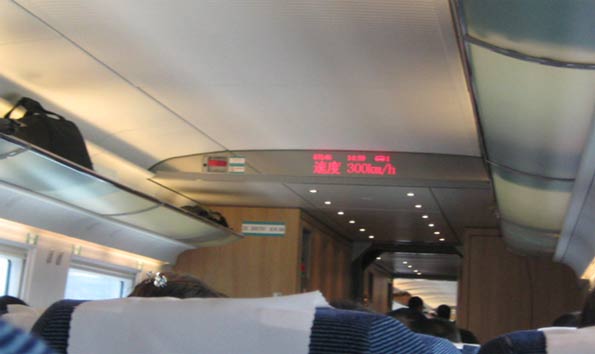
    The Premier also indicated that high speed rail trains should operate at slower speeds "at their earlier stage of operation." Earlier this year, the Ministry of Railways slowed all trains to a maximum speed of 300 kilometers per hour (186 miles per hour) and many trains that were to operate at that speed were slowed to 250 kilometers per hour (155 miles per hour). At the time, reports indicated that the slower speeds were to lower operating costs so that fares could be reduced. Concerns had been raised about the much higher fares on the new trains and the cancellation of many conventional trains, which had much lower fares. Railway Minister In addition, Sheng Guangzu told the press that the slower operating speeds would "offer more safety."

    Photo: Suzhou to Nanjing at 300 kph (by author)

  • Another Congressional Cut for High Speed Rail

    July 15: Today there was another indication that the newly constituted House of Representatives understands the “litmus test” imperative of zeroing out high speed rail appropriations, in light of potentially required cuts in essential programs like Medicare, Social Security and others. $1 billion was switched to Midwest flood relief in an approval today of the Energy and Water Appropriations bill for the 2012 budget.

    The bill may or may not pass the Senate and lobbying is underway to “obligate” the money before the rescission becomes law. Either way, this action and the previous action to reduce high speed rail funding by $2.5 billion in a previous budget deal with the White House indicates a very tough road ahead for the Administration’s high speed rail program, most of which is not genuine high speed rail.

    The rescission would block funding that has been promised by the US Department of Transportation to a number of projects around the nation, such in California, North Carolina, Michigan, Missouri and Illinois.

  • High Speed Rail Subsidies in Iowa: Nothing for Something

    The Federal government is again offering money it does not have to entice a state (Iowa) to spend money that it does not have on something it does not need. The state of Iowa is being asked to provide funds to match federal funding for a so-called "high speed rail" line from Chicago to Iowa City. The new rail line would simply duplicate service that is already available. Luxury intercity bus service is provided between Iowa City and Chicago twice daily. The luxury buses are equipped with plugs for laptop computers and with free wireless high-speed internet service. Perhaps most surprisingly, the luxury buses make the trip faster than the so-called high speed rail line, at 3:50 hours. The trains would take more than an hour longer (5:00 hours). No one would be able to get to Chicago quicker than now. Only in America does anyone call a train that averages 45 miles per hour "high speed rail."

    The state would be required to provide $20 million in subsidies to buy trains and then more to operate the trains, making up the substantial difference between costs and passenger fares. This is despite a fare much higher than the bus fare, likely to be at least $50 (based upon current fares for similar distances). By contrast, the luxury bus service charges a fare of $18.00, and does not require a penny of taxpayer subsidy. Because the luxury bus is commercially viable (read "sustainable"), service can readily be added and funded by passengers. Adding rail service would require even more in subsidies from Iowa. The bus is also more environmentally friendly than the train.

    Further, this funding would be just the first step of a faux-high speed rail plan that envisions new intercity trains from Chicago across Iowa to Omaha. In the long run, this could cost the state hundreds of millions, if not billions of dollars. Already, a similar line from St. Louis to Chicago has escalated in cost nearly 10 times, after adjustment for inflation, from under $400 million to $4 billion.

    Unplanned cost overruns are the rule, rather than the exception in rail projects. European researchers Bent Flyvbjerg, Nils Bruzelius and Werner Rottengather (Megaprojects and Risk: An Anatomy of Ambition) and others have shown that new rail projects routinely cost more than planned (Note 1).

    Flyvbjerg et al found that the average rail project cost 45 percent more than projected and that 80 percent cost overruns were not unusual. Cost overruns were found to occur in 9 of 10 projects. Further, they found that ridership and passenger fares also often fell short of projections, increasing the need for operating subsidies.

    Iowa legislators may well identify ways to spend their scarce tax funding on services that are actually needed.

    ______

    Note: Flyvbjerg is a professor at Oxford University in the United Kingdom. Bruzelius is an associate professor at the University of Stockholm. Rothengatter is head of the Institute of Economic Policy and Research at the University of Karlsruhe in Germany and has served as president of the World Conference on Transport Research Society (WCTRS), which is perhaps the largest and most prestigious international association of transport academics and professionals.

  • Fwd: California’s Bullet Train — On the Road to Bankruptcy

    For California’s high-speed rail boosters including their chief cheerleader, U.S. Transportation Secretary Ray LaHood, the month of May must have felt like a month from hell. First came a scathing report by California legislature’s fiscal watchdog, the non-partisan Legislative Analyst’s Office (LAO), questioning the rail authority’s unrealistic cost estimates and its decision to build the first $5.5 billion segment in the sparsely populated Central Valley between Borden and Corcoran. That segment, the LAO noted, has no chance of operating without a huge public subsidy, yet the terms of the voter-approved Proposition 1A, explicitly prohibit any operating subsidies.

    These concerns were echoed by an eight-member Independent Peer Review Group. “We believe the Authority is increasingly aware of the challenge of accurate cost estimating,” wrote its chairman Will Kempton in a letter to the California High-Speed Rail Authority’s CEO, Roelef van Ark. The Legislative Analyst‘s Office had concluded that if the cost of building the entire Phase I system were to grow as much as the revised HSRA estimate for the Central Valley segment (an increase of 57%), the Phase I system would end up costing not $43 billion as originally estimated, but $67 billion.

    The two reports unleashed a torrent of criticism from the press. In sharply critical editorials, The Wall Street Journal and the Los Angeles Times questioned the project’s fiscal viability and the Authority’s poor decisionmaking. The project is “a monument to the ways poor planning, management and political interference can screw up major public works,” opined the LA Times. (“California’s High Speed Train Wreck,” May 16). “If the state can’t come up with enough money to finish the route, a stand-alone segment in the Central Valley would literally be a train to nowhere and a big drain on taxpayers,” said the Wall Street Journal (“California’s Next Train Wreck,” May 18). “The legislature needs to kill the train now. Once this boondoggle gets out of the station, the state will be writing checks for decades,” added the Journal in its most recent editorial (“Off the California Rails,” May 30). The San Francisco Examiner and The Sacramento Bee also have been critical in their reporting. Governor Brown needs to “squarely address the issues raised by the legislative analyst’s report,” a Sacramento Bee editorial urged.

    Even some of the state’s former legislative supporters, such as state senators Joe Simitian, Alan Lowenthal, Anna Eshoo and Mark DeSaulnier have expressed reservations and urged the Authority to rethink its direction. “I don’t want to see an EIR (Environmental Impact Report) completed for a project that will never be built,” Senator Joe Simitian told Roelef van Ark at a Senate Budget Subcommittee hearing on financing the first rail segment in the Central Valley.

    At the urging of the Legislative Analyst’s Office, the rail authority asked the U.S. DOT for more flexibility about where and when to build the initial “operable” segment. The LAO went as far as recommending that “If the state can’t win a waiver from the federal government to loosen the rules and the timing for using high-speed rail grants, it should consider abandoning the project.” Not only would the Central Valley segment, by itself, have insufficient ridership and revenues to stand on its own, the Legislative Analyst wrote, but “the assumption that construction of the Central Valley segment could move quickly because of a lack of public opposition has already proved to be unfounded.” The LAO suggested several alternative segments that could be more financially viable and economically beneficial than the Central Valley segment. They included Los Angeles-Anaheim, San Francisco-San Jose and San Jose-Merced.

    But in a remarkable exercise of inflexibility and delusion, the U.S. Department of Transportation turned a deaf ear to the request. “Once major construction is underway…the private sector will have compelling reasons to invest in further construction,” the DOT letter stated in an assertion totally unsupported by any evidence.

    “California is a test case for whether high-speed trains can succeed in the U.S. — and so far, the state is failing the test,” the LA Times editorial concluded. The feds’ refusal to reconsider their position has substantially magnified and accelerated the likelihood of that failure.

    LATE-BREAKING NEWS 6/6/2011: In the wake of the LAO report, both houses of the California Legislature have passed legislation that, in effect, is a vote of no confidence in the California High Speed Rail Authority (CHSRA) and its Board. The bills place the Authority within the state’s Business, Transportation and Housing Agency, thus giving the Governor decisionmaking power over the project. The Senate bill would “vacate” the appointments of the current Board members and provide for the appointment of a new advisory Board with special expertise in construction management, infrastructure finance and operation of rail systems. The House bill would retain the current Board but only in an advisory capacity. The two bills will have to be reconciled before they are sent to the Governor for signature. However, with the bills sponsored by three Democrats, the Governor is expected to sign the final bill into law [SB 517 (A. Lowenthal), passed on June 1 by a vote of 26-12; AB 145 (Galgiani and B. Lowenthal) passed on June 3 by a vote of 50-16].

    There is a possibility that a change of leadership at the Authority, coupled with mounting grassroots opposition in the Central Valley, might delay the project past September 2012 — the federal deadline to start construction— and thus disqualify the project from federal grant assistance extended under the stimulus (ARRA) legislation. The deadline was reaffirmed in a letter from U.S. DOT’s Undersecretary for Policy, Roy Kienitz. “U.S. DOT has no administrative authority to change this deadline, and do not believe it is prudent to assume Congress will change it,” Kienitz wrote to Roelof van Ark.

  • The Transportation Politics of Envy: The United States & Europe

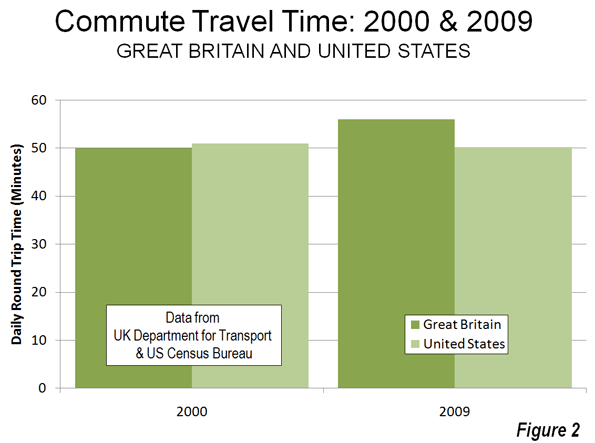
    The Department for Transport of the United Kingdom may be surprised to learn that the average round-trip commute in the nation is up to a quarter hour less than reflected in its reports. This revelation comes from an article in The Economist, ("Life in the Slow Lane") citing a survey indicating that the average commuter in the United Kingdom spends less than 40 minutes daily traveling to and from work in 2000. According to Regional Transport Statistics, published by the Department for Transport, the average commuter spent 50 minutes traveling to and from work in 2000. The UK government further indicates that the average commute time had risen to 56 minutes by 2009. The Economist relies on the much lower figure (and other similarly low estimates from other European nations) in fashioning an article criticizing transportation policy in the United States.

    Shorter US Commute Times: The Economist begins with the contention that the average work trip travel time in the United States is substantially greater than that of the number of European nations. The most reliable data says otherwise.

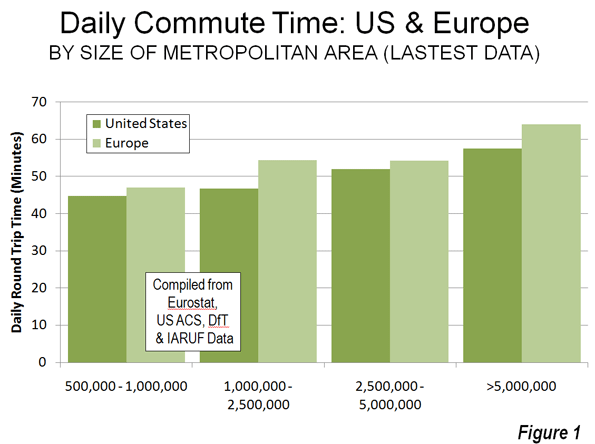
    The most comprehensive work trip data in Europe is maintained by Eurostat, the statistical agency of the European Commission. The Eurostat data indicates that average commute times in Europe are somewhat more than in the United States in metropolitan areas of similar size (Figure 1), when compared to the comprehensive data from the US Census Bureau. For example, among metropolitan areas of more than 5 million population, the daily round-trip average commute is under 58 minutes in the United States, less than the 64 minutes in Europe. European commute times are longer in all population categories (Note).

    Overall, the average round-trip travel time in the US metropolitan areas over 500,000 population is 23.6 minutes and 25.3 minutes in the European metropolitan areas.

    Moreover, there are indications that the US trend is favorable, at least in comparison to the United Kingdom. Between 2000 and 2009, UK government data shows average round trip commute times to have increased six minutes, while US government data indicates a decline of nearly one minute (Figure 2).

    The US: Less Traffic Congestion:  The Economist then asserts that traffic congestion is worse in US metropolitan areas than in Europe. According to The Economist:

    …with few exceptions (London among them) American traffic congestion is worse than western Europe’s. Average delays in America’s largest cities exceed those in cities like Berlin and Copenhagen.

    The reality is the opposite, according to the INRIX Traffic Scorecard and a more correct rendering of the point above would have been:

    … with few exceptions (Los Angeles among them) western Europe’s traffic congestion is worse than America’s. Average delays in some of western Europe’s smallest cities exceed those in cities like Atlanta, Houston and Dallas-Fort Worth.

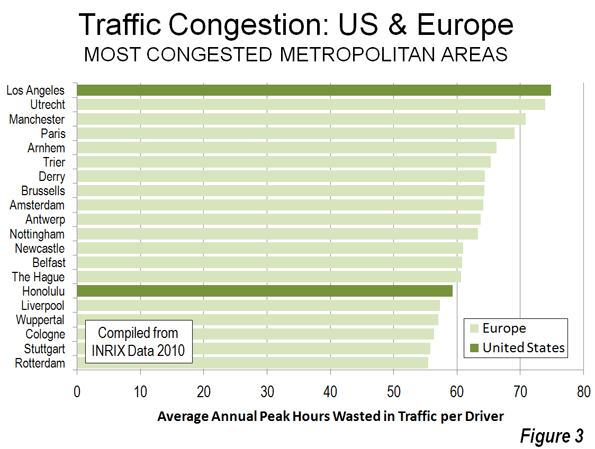
    INRIX compared 2010 peak period traffic delays in metropolitan areas of the United States and Europe. As with commuting time, the average travel delay per driver was greater in Europe than in the United States in every population classification. While Los Angeles has the worst congestion the approximately 200 metropolitan areas (one-half in the US and one-half in Europe), the next 13 worst were in Europe (Honolulu ranks 15th) and 18 of the worst 20 were in Europe (Figure 3). The third worst ranking US metropolitan area was San Francisco, at 28th, while Washington was 29th. Only seven of the 50 most congested metropolitan areas were in the United States. Of course, anyone who has driven extensively in the metropolitan areas of the US and western Europe knows that congestion is generally far worse in Europe, a fact confirmed by the INRIX data.

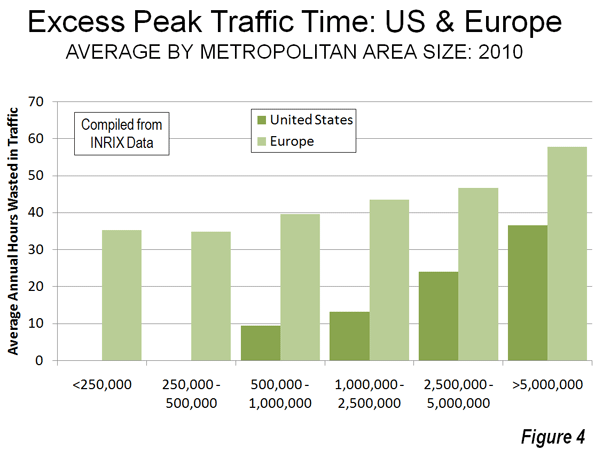
    Indeed, traffic congestion in the smallest European metropolitan areas (under 500,000) was worse than in the largest US metropolitan areas, those with over 5 million (There were no US metropolitan areas with less than 500,000 population in the INRIX data, see Figure 4). Those automobile-oriented, highly suburbanized banes of urban planning, Atlanta, Dallas-Fort Worth and Houston all ranked in the middle, between 90th and 110th. At least 75 European metropolitan areas had worse traffic congestion than all three.

    High-Speed Rail Envy: Finally, The Economist decries the lack of high-speed rail in the United States, noting that:

    The absence of true high-speed rail is a continuing embarrassment to the nation’s rail enthusiasts.

    It is hard to imagine a more pathetic standard for evaluating public policy than "satisfying rail enthusiasts."  It is well known that that governments from Washington to London, Athens and Lisbon are in serious financial difficulty. It is a time for limiting public expenditures to matters of genuine priority. That does not include high speed rail.

    The intercity road and airport systems are principally financed by users, in contrast to the operating subsidies and intense (100 percent) capital subsidies required by high-speed rail. This is evident in California with its now $65 billion first line that has more than doubled in real cost in a decade. It is also evident, closer to home for The Economist, where the controversial HS-2 high-speed rail proposal from London to Manchester and Leeds could easily double in cost (to £65 billion), based upon the best international research. Astoundingly, a doubling of cost would be a bargain for Britain’s taxpayers compared to two previous high-speed rail failures in the same corridor (See: The High Speed Rail Battle of Britain). The recurring environmental justifications ring hallow due to the high costs and the three generations or more it would require in California and the United Kingdom to eliminate the first gram of greenhouse gas.

    Transport policy could be improved in the United States, as well as in Europe. However, the starting point must be facts, not fancy, and certainly not envy.

    ——-

    Note: this analysis includes all data available for metropolitan areas in the United States (metropolitan statistical areas) and Europe (larger urban zones, the closest equivalent to US metropolitan areas). US data is complete, covering all 100 metropolitan areas with more than 500,000 population and is from the United States Census Bureau. European data is principally from Eurostat (94 larger urban zones and three from other sources). Paris data is from IAURIF (Institut d’aménagement et d’urbanisme de la région Île-de-France). Newcastle-upon-Tyne and Leeds data is from the UK Department for Transport.  Data is not available for a number of metropolitan areas with more than 500,000 population in Europe.