Tag: high speed rail

  • A Tough Week for High Speed Rail

    The week ended April 16 was particularly difficult for high speed rail, as the following events illustrate.

    1. High Speed Rail Zeroed Out of US Budget: The US federal budget deal, which cut $38 billion from spending ($76 billion annualized) zeroed out the $2.5 billion 2011 budget allocation for high speed rail and $400 million of prior spending authority from President Obama’s "stimulus" program, that had provided $8 billion for high speed rail in 2009. Approximately $2 billion of that authority remains and applications total $10 billion, mostly for conventional intercity rail services, rather than genuine high speed rail service.

    2.  Missouri Legislators Block High Speed Rail: Members of the Senate Transportation Committee in Missouri refused to place high speed rail in the annual state budget. Governor Jay Nixon is seeking more than $1 billion for intercity out of the remaining $2 billion from the original Obama Administration $8 billion program. Governor Nixon indicates that he will try to get the money placed in the budget should the US Department of Transportation award a grant. Missouri joins Florida, Wisconsin and Ohio in taking actions to block funding for high speed rail projects. This reluctance is principally the result of concerns that high speed rail will incur significant cost overruns and require operating subsidies, all of which would have to be paid for by the states, which generally face serious financial difficulties.

    3. China Slows Down Trains: Safety, energy conservation and fare equity issues led the Ministry of Railways to announce a slow-down of its fastest trains to a maximum speed of 300 kilometers per hour (186 miles per hour). This could add materially to travel times, especially in the longer corridors being developed, which traverse the greatest distance of any in the world (such as Shanghai-Kunming, Shanghai-Beijing and Beijing-Hong Kong).

    4. Opposition to Britain’s HS2 Line Intensifies: Opposition continues to mount against Britain’s HS2 line from London to Manchester and Leeds. Protesters showed up at a Department of Transport event at Northampton Station intended to obtain views on the government’s plans. Lizzy Williams, chair of "Stop HS2" expressed concern that the government’s "consultation" was not objective and told only one side of the story, ignoring the difficulties (A video of Ms. Williams at an anti-HS2 convention is here). Opposition groups also plan a rally on May 8. Finally, it was reported that projected time savings on the line have been exaggerated by the government.

  • China Slowing World’s Fastest High Speed Rail

    The Wall Street Journal reports that China will slow down its world’s fastest high speed rail trains. According to the Journal, Sheng Guangzu, head of China’s Ministry of Railways, told the People’s Daily that the decision will make tickets more affordable and improve energy efficiency on the country’s high-speed railways. The maximum speed will be 300 kilometers per hour (186 miles per hour), which is also the top speed for most high speed rail trains in Japan, France, Korea and Taiwan. The United Press reported that the 300 kph service would be limited to the four north-south (Beijing to Harbin, Beijing to Shanghai, Beijing to Hong Kong and Shanghai to Shenzhen) and east-west lines (Qingdao to Taiyuan, Lanzhou to Xuzhou, Shanghai to Chengdu and Shanghai to Kunming). Both sources were unclear as to whether the new speed limit would apply to the proposed 380 kph Beijing to Shanghai line, however that line is one of the four north-south trunk routes, all of which will operate at the slower speed according to the Ministry of Railways.

    Currently, the world’s fastest high speed rail trains operate on the Guangzhou (South Station) to Wuhan route, which reaches 350 kilometers per hour on its fastest service (which stops in Changsha, the non-stop service having been cancelled), completing the run in 3:16. This lower speed could increase travel time on the route to between 3:30 and 3:45.

    The Journal cited a high-speed rail official (not Chinese) who indicated that there are safety concerns with trains running at above 320 kph. In contrast, the proposed California high speed rail line would operate at top speeds of 355 kph.

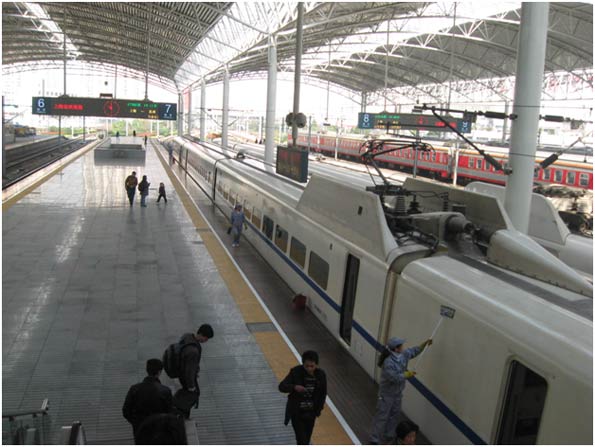
    Photo: Nanjing high speed rail train, Shanghai Station (by author)

  • USDOT Rail Grants to Obligate Taxpayers

    The US Department of Transportation has announced a competitive grant program to reallocate funding that was refused by Florida for a proposed high speed rail line from Tampa to Orlando. The line was cancelled by Governor Rick Scott because of the prospect for billions of dollars of unplanned obligations that could have become the responsibility of the state’s taxpayers.

    Eligibility: Eligible applicants are states, groups of states, Amtrak or other government agencies that authorized to "provide intercity or high-speed rail service on behalf of states or a group of states. The grant program requires recipients of grants (read "taxpayers") to provide financial support to intercity and high speed rail passenger rail programs in the event that cost and ridership projections are optimistic (a routine occurrence).

    Obligation to Pay for Cost Overruns: As in the program announced in 2009. the state, group of states, government agency will be required to demonstrate its financial capacity (that is, the capacity of their taxpayers) to pay for cost overruns (page 9). This open-ended liability led Governor Chris Christie of New Jersey to cancel a new transit-Hudson River rail tunnel, which had costs that were escalating out of control that would be the obligation of the state’s taxpayers. Governor Christie and Governor Scott were both aware of the disastrous record of major infrastructure cost overruns, such as in the Boston Big Dig project, the Korean high-speed rail program and the overwhelming majority of passenger rail projects in North America and Europe, according to a team led by Oxford University Professor Bent Flyvbjerg.

    Obligation to Pay Operating Costs: Moreover, inaccurate passenger and revenue forecasts have been pervasive in high-speed rail systems, as has been documented by Flybjerg, who found that cost overruns occurred in nine out of ten projects:

    … we conclude that the traffic estimates used in decision making for rail infrastructure development are highly, systematically and significantly misleading.

    This is illustrated by the fact that even a decade and one-half after the Eurostar London to Paris and London service was opened, ridership remains 60 percent below projection. Ridership on the Taiwan and Korea high speed rail systems has been one-half or more below projections. Our analysis of the Tampa to Orlando line revealed exceedingly high ridership projections, which were inexplicably raised even higher in a new report just released. Failure to achieve ridership projections increases the likelihood that a line will need operating subsidies, which would be the ultimate responsibility of taxpayers under the USDOT program.

    Federal Grant Repayment Obligation: Moreover, taxpayers of any grant recipient would be required to repay part or all of the federal grant if a sufficient level of service is not maintained for a period of 20 years (page 41). The operation of this provision is illustrated by recent Florida experience. Tri-Rail, the Miami area’s commuter rail service only narrowly escaped having to repay $250 million when its service level was deemed to not meet requirements of a federal grant by early in the Obama presidency. Tri-Rail was rescued by a state subsidy of nearly $15 million annually, which restored an artificially high level of service.

    Intercity and High Speed Rail Program: The federal intercity and high-speed rail program is largely limited to upgrades of Amtrak-type service. Before Governor Scott’s decision, only two of the programs (Florida and California) would have achieved international standard high speed rail speeds.  

  • High-Speed Rail vs. Modal Neutrality

    Isn’t it curious that an Administration devoted to the principle of multi-modalism is so obsessively determined to promote a single mode of its own preference — that of high-speed rail? All three governors who rejected the federal HSR grants — Govs. Walker, Kasich and Scott — told Sec. LaHood that their states could badly use that money for more urgent needs of fixing roads, bridges and transit systems and, in the case of Gov. Scott, rebuilding Florida’s ports in anticipation of the Panama Canal expansion.

    Yet Sec. LaHood turned a deaf ear to those requests, insisting that the stimulus money must be spent on high-speed rail — even though money spent on other modes could have been just as effective in creating jobs. After justly condemning “stove pipe” mentality and modal biases in federal decision making it is ironic to find the Administration ignoring its own principles of modal neutrality in such a blatant manner.

  • Tampa to Orlando High Speed Rail: The Risk to Local Taxpayers

    No sooner had Florida Gov. Rick Scott rejected federal funding for the Tampa to Orlando high-speed rail line, than proponents both in Washington and Tallahassee set about to find ways to circumvent his decision. While an approach has not been finalized, a frequently suggested alternative is to grant the federal money to a local government, such as a city or county or even to a transit agency.

    Eliminating State Taxpayer Risks, Creating Local? In an announcing his decision, Governor Scott cited the substantial risks to Florida taxpayers from cost overruns, the ongoing obligation under the federal grant to subsidize operations and the fact that under certain circumstances Florida might even have to repay the $2.4 billion in federal grants. Any local government accepting the federal money would expose itself to the financial risks from which Florida taxpayers have been exempted by Governor Scott’s action.

    None of these risks is an idle threat.

    (1) Capital Cost Overruns: Based upon the international experience, the eventual construction cost overruns for the Tampa to Orlando high-speed rail line could easily run to $3 billion, more than doubling the price of the project (Note on Extent of Taxpayer Liability, below). In light of the recently reported 50 percent increase in California high-speed rail construction costs, even the $3 billion estimate could turn out to be conservative. The problem is that any local federal grant recipient (city, county or transit district) would be responsible for these cost overruns.

    (2) Ongoing Operating Subsidies: The ridership projections for the Tampa to Orlando high-speed rail line are exceedingly optimistic. This could well lead to a situation in which substantial subsidies are necessary to operate the trains, despite claims of proponents to the contrary. These subsidies would be the responsibility of any city, county or transit district that becomes a grant recipient.

    (3) Federal Pay-Back: If, for any reason, the eventual high-speed rail service levels are not sufficiently high because of lower than projected ridership or if service is canceled, any city, county or transit district could be required to return the $2.4 billion in federal grants. Florida is already paying millions annually for a similar "transgression." In 2009, service reductions on the Tri-Rail Commuter Rail System in the Miami area led the Obama Administration’s Department of Transportation to demand repayment of one quarter billion dollars in grants. Tri-Rail was saved from this obligation only by a multimillion dollar Tallahassee bailout. Proponents have claimed that this rail obligation could be negotiated away for high-speed rail. Why was the Tri-Rail obligation not negotiated away in 2009?

    By rejecting the federal funding, Gov. Scott has inoculated Florida taxpayers against these risks.

    However, there would be no inoculation for any local jurisdiction whose commissioners or city council accepted the expensive "gift" of federal funding for the high speed rail line. Their taxpayers would have to pay. The very financial viability of any such jurisdiction could be at risk.

    The Risk Could Revert to State Taxpayers: Eventually, the risk could be again be visited upon state taxpayers as a local government facing virtual bankruptcy would doubtless seek a bailout in Tallahassee, repeating the Tri-Rail experience, though much more expensively. Moreover, canceling a half built project, which might be tempting as costs escalate above projections, would simply not be viable. The political pressure to complete the project, at whatever cost, could prove to be overwhelming.

    Delusions About Private Responsibility for Cost Overruns: Some proponents claim that these huge obligations can be somehow transferred to the private builder/operator that is selected for the project. Nothing like this has ever happened in public-private partnerships around the world, and for good reason. Companies do not stash away billions of dollars for cost overruns.

    Further, the winning bidder will be a consortium of other companies, established with limited liability by larger companies. The consortium would abandon a project it could not afford sooner rather than later. Any bankruptcy of the builder/operator would be limited to the consortium and would not extend to the parent companies, leaving the local taxpayers to pay.

    There is no escaping the fact that the taxpayers of any city or county accepting the federal money would be providing financial guarantees to an international infrastructure industry that has left a "train" of huge and unanticipated financial obligations around the world in its wake (Note on Cost Escalation, below).

    Believing in Santa Claus? Public officials, and most recently Orlando Mayor Teresa Jacobs, have indicated support for high-speed rail if private and federal funds pay for it, and state and local taxpayers aren’t exposed to liability. This is a wise position, but untenable. Expect Santa Claus to arrive in the midst of a Florida summer before that, with a sleigh full of billions.

    —-

    Note on Extent of Taxpayer Liability: This $3 billion is in addition to the already committed $280 million of taxpayer funding. Proponents of the high-speed rail line have assumed that the $280 million would be the limit of taxpayer obligations. As this article shows, the $280 million could be a "drop in the bucket" compared to the likely eventual taxpayer liability.

    Note on Cost Escalation: An international team of researchers led by Oxford University Professor Bent Flyvbjerg has found in Megaprojects and Risks: An Anatomy of Ambitionthat similar projects routinely cost far more than taxpayers and other funders are told. They also attract fewer riders and generate less revenue (which can require operating subsidies). The Flyvbjerg team implies that these "lowball" (our term) projections are not accidental but all are the result of "strategic misrepresentation," (their term) which project promoters employ to increase the potential that projects will be approved. The researchers also refer to "strategic misrepresentation" as "lying," which is an exceedingly strong term for academic research and is reflective of the strength of the conclusions.
  • “Patchwork” High Speed Rail System Unraveling?

    The widely dispersed opposition to proposals for high speed rail (genuine and faux) led Secretary of Transportation Ray LaHood to say that the Administration would press forward in a patchwork fashion if necessary.

    "Patchwork" may be an overstatement. House Appropriations Committee Chairman Hal Rogers (R., Ky.) has plans to eliminate high speed rail funding in the current fiscal year. Already, holes have appeared in the high-speed rail plans with the cancellation of the Milwaukee to Madison line by Gov. Scott Walker and the cancellation of the Cincinnati to Cleveland line by Gov. John Kasich.

    Should the Republican congressional high speed rail defunding proposal survive, it will could put an end to such proposals as the Miami to Orlando high-speed rail line, which has been advertised as an $8 billion project but which international experience suggests could easily reach $16 billion.

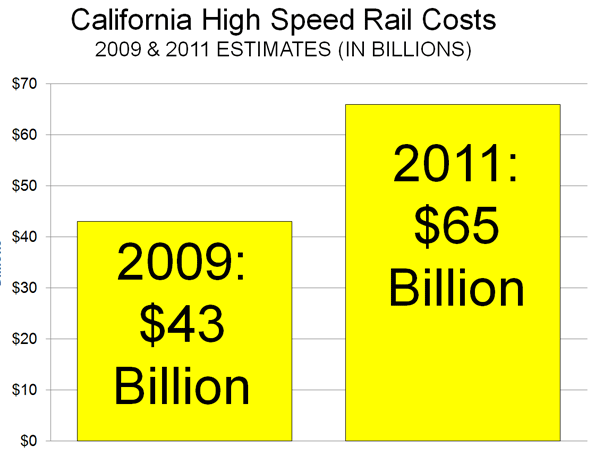
    Further, the proposed defunding could render California’s presently planned San Joaquin Valley "train to nowhere" (Corcoran to Borden, with stops in Hanford and Fresno) as less than patchwork. The California line was already on life support, with the newest estimates indicating a 50 percent cost increase over two years (to $65 billion), bringing overall per mile cost escalation since the initial 1999 estimate to approximately 100 percent (adjusted for inflation). As these difficulties were not enough, the Community Coalition on High Speed Rail reports that agricultural interests are now raising concerns about the impact of construct in the San Joaquin Valley. Strong citizen opposition has already developed on the San Francisco peninsula and in the Los Angeles area, which may have been part of the reason that the California High Speed Rail Authority chose the "train to nowhere" route as its first segment.

    This could also make it unlikely that there will be any new funding for the Chicago to St. Louis high-speed rail line, which requires at least another $2 billion to complete the trip in four hours (at an average speed of 75 miles per hour). In fact, four hour service was promised in the US Department of Transportation documentation that accompanied the previous $1 billion grant.

    It will probably also be the end of the $12 billion (more likely $25 billion) proposal to scrap the 75 mile per hour Chicago to St. Louis system after it is completed and replace it with a completely new, faster line that would travel twice as fast.

    A number of commentators (including this author) have suggested that zeroing out high-speed rail is a litmus test of the resolve of Congress to control spending. The first steps may have been taken.

  • A $53 Billion High-Speed Rail Program to Nowhere

    Vice President Joe Biden announced today a plan to spend $53 billion over the next six years on passenger high-speed rail projects that will help reach the goal of giving 80 percent of Americans access to high-speed rail within 25 years. According to the announcement, the proposal will place high-speed rail "on equal footing with other surface transportation programs." The initiative includes $8 billion in the President’s FY 2012 budget proposal, of which $4 billion will be focused on building new infrastructure and $4 billion will be dedicated to system preservation and renewal. The announcement makes no mention how the plan will be paid for.

    Congressional reaction to the announcement was immediate. House Transportation Committee Chairman John Mica (R-FL) and Railroads Subcommittee Chairman Bill Shuster (R-PA) issued a press release expressing "extreme reservations" regarding the Administration’s plan. Several congressional sources we reached for comment pronounced the Administration initiative "dead on arrival."

    "What the Administration touted as high-speed rail ended up as embarrassing snail-speed trains to nowhere," Mica said. "Rather than focusing on the Northeast Corridor, the most congested corridor in the nation…the Administration continues to squander limited taxpayer dollars on marginal projects," Mica added. "This is like giving Bernie Madoff another chance at handling your investment portfolio."

    Rep. Shuster was equally critical. "The Administration continues to fail in attracting private investment, capital and the experience to properly develop and cost-effectively operate true high-speed rail," he said. "Government won’t develop American high-speed rail. Private investment and a competitive market will." Shuster was also critical of the manner in which the Administration has administered the program. "Selecting routes behind closed doors runs counter to the Administration’s pledges of transparency. … High-speed rail funding could become another political grab bag for the President. …If the Obama Administration is serious about high-speed rail, they should stop throwing money at projects in the same failed manner."

    The strong condemnation by two leading congressional transportation spokesmen poses a serious obstacle for the Administration’s proposal on Capitol Hill. They are not alone. House leadership has called for cancelling the high-speed rail program as part of its deficit reduction plan.

    Opposition from governors and state legislatures adds another hurdle to the Administration’s plan. Without state support high-speed rail projects cannot go forward. But, as we have seen, the governors of Wisconsin and Ohio have declined to participate in the Administration’s HSR programs. Other governors, concerned about potential operating subsidies, open-ended risk of construction overruns or unable to raise the required matching funds, may do likewise.

    Florida’s Gov. Scott, in introducing his budget proposal on February 7, offered a hint about his thinking, that makes HSR boosters uneasy. "Over the last few years,’ the Governor said, "Florida accepted one-time hand-outs from th federal government. Those temporary resources allowed state and local governments to spend beyond their means. There was never any reason to think that Florida taxpayers could afford to continue that higher level of spending once the federal hand-outs are gone. The false expectations created by the federal hand-outs are the reason we hear about a multi-billion dollar deficit." The words "high-speed rail" and  "operating subsidies" were not mentioned, but the implication was clear.

    Several other high-speed rail projects are in danger of collapse because of stringent conditions demanded by the Federal Railroad Administration (FRA)— conditions that the host railroads find unacceptable. As reported by the respected railroad observer Fred Frailey, high-speed rail projects in Washington State, North Carolina and Virginia, totaling $1.4 billion in HSR grants, are in jeopardy because the service agreements negotiated by the states with Class 1 railroads have been rejected by the FRA as not strict enough. At the core in each case is the railroads’ insistence that passenger train operations must not interfere with freight operations and their refusal to accept penalties for potential delays suffered by passenger trains.

    If these projects fall through, there will be little to show for the $10.5 billion HSR program other than a 48-minute reduction in travel time between Chicago and St. Louis as a result of an ongoing project with Union Pacific (see, "The Uncertain Future of the High-Speed Rail Prgram," InnoBrief, January 5, 2001). It is revealing that the only example the White House announcement chose to highlight  was a $38 million program of track improvements between Portland and Brunswick, ME to permit a 30-mile extension of the five Downeaster round trips to and from Boston at slightly increased speeds, as Frailey pointed out.

    Given this meager progress, given more than ample evidence of congressional and state-level opposition, and with so many, much more deserving infrastructure needs awaiting federal support (incl. rail in the Northeast Corridor), one wonders why the Administration has chosen to doggedly pursue its unrealistic vision of a nationwide high-speed rail network. We hope Congressmen Mica and Shuster will try to get some answers.

  • California High Speed Rail Costs Escalate 50 Percent in 2 Years

    The highly respected Californians for Responsible Rail Design (CARRD) has released a new cost estimate for the phase 1 Los Angeles to San Francisco high-speed rail line. Based upon an analysis of California high-speed rail Authority documentation, including stimulus grant applications and other internal sources, CARRD estimates that the line will now cost $65 billion, rather than the current estimate of $43 billion.

    The CARRD release indicated:

    Our analysis, based solely on official and publicly available Authority documents, determines the
    current project costs are approximately $65 billion. The $43 billion figure was inaccurate, even at the time it was made.

    CARRD also pointed out that there has been no recent update to the official cost estimates and that the planned October 1, 2011 update, required by state legislation, may not be released on time because of contract negotiation difficulties with Price Waterhouse Coopers.

    Even as environmental and planning work has advanced, no update to the official capital cost estimate has been made. This is true even when the only alternatives in most segments still being studied are significantly more expensive than those used to calculate the $43 billion number

    However, CARRD cautioned even this 50% increase in just two years may understate the eventual costs:

    …we have received some feedback that these numbers may actually be too conservative since there still is very little engineering information about some of the most technically challenging parts of the project (like the mountain passes).

    The new CARRD cost estimate is consistent with the perennial cost escalation that has been noted in such projects by Oxford University professor Bengt Flyvbjerg and others, who found that passenger rail systems typically have cost overruns of 45 percent.

  • The President’s Unserious Proposal

    "Within 25 years, our goal is to give 80 percent of Americans access to high-speed rail." With this ringing statement in his State of the Union address, President Obama injected new hope into the flagging spirits of high speed rail advocates. Predictably, spokesmen for industry associations, progressive advocacy groups and other stakeholder interests praised the President’s goal as a symbol of his renewed commitment to support investment in infrastructure. But hardly any one we spoke to at the TRB meeting took the President’s ambitious goal seriously.

    "After listening to President Obama’s remarks on high-speed rail, I am left with more questions than answers," observed Rep. Bill Shuster, Chairman of the Subcommittee on Railroads of the House Transportation and Infrastructure Committee, who addressed the TRB Committee on Intercity Passenger Rail. "These promises mean little and the White House knows it," observed a railroad industry consultant attending the meeting, "it’s not within Obama’s power to commit future Administrations and Congresses to this pipe dream." "The President is out of touch with reality; where does he think the money will come from?" was a succinct reaction of a former senior U.S. DOT official.

    Lack of a Financial Plan

    There is good reason for these expressions of skepticism. Although some likened President Obama’s expansive vision to President Eisenhower’s historic call for a 42,000-mile Interstate Highway network, there is a vast difference between the two initiatives. The Interstate Highway proposal was backed by a reliable and steady revenue stream in the form of a federal gas tax. The high speed rail goal lacks a financial plan. It is not supported by a dedicated source of revenue that could maintain the program on a self-sustaining basis over a period of years. Nor can the Administration count on borrowed money or annual appropriations out of general revenue in the current political environment in which deficit reduction rather than new spending is the top congressional priority. Calling expenditures on high-speed rail "investment" does not obscure the reality that we would be spending money that we do not have. As if to underscore this point, the Congressional Budget Office announced on January 25 that this year’s federal budget deficit of $1.5 trillion will be the biggest one in history and the largest as a share of the economy since World War II. "Obama’s proposal is likely to land with a dead thud on Capitol Hill," opined National Journal’s transportation editor Fawn Johnson.

    States’ Ambivalence

    A second reason for skepticism is the ambivalent attitude of the states toward high speed rail. As Federal Railroad Administrator Joseph Szabo, speaking at the TRB meeting, correctly pointed out, the high-speed rail initiative is a state-driven program. Hence, support of governors and state legislatures will be essential if the Obama vision is to succeed. But, as we have seen, several fiscally-strapped states (Wisconsin, Ohio, Iowa) have declined to participate in the Administration’s HSR program while Florida’s Governor Scott still has to be heard from.

    Other governors and state legislatures may well follow their example should they conclude that high-speed rail projects will burden their constituents with massive annual operating subsidies and possibly open-ended risk of construction overruns. The protracted and still inconclusive track-sharing negotiations with the Class 1 railroads suggest that more than one state is having second thoughts about the wisdom of proceeding with these projects (at least on terms demanded by the Administration). About one-half of the dedicated HSR funds still remain unobligated according to the latest Federal Railroad Administration report.

    Fred W. Frailey, a respected writer and commentator on the railroad industry and author of Twilight of the Great Trains thinks that enthusiasm for high-speed trains has peaked and is on the wane. Writing in the current (March) issue of TRAINS, Frailey says the collapse of support is not merely a partisan event. Election results suggest that the public was never really won over. Nor will the Association of American Railroads or its member railroads fight for HSR. "So anyway you cut it, the high-speed show is over," Frailey concludes.

    A Fresh Congressional Posture

    This does not mean that fast trains will have no role to play in America’s future. There is a need to diversify travel alternatives in crowded travel corridors to accommodate future population increases. But, as a congressional hearing in New York City on January 27 made clear, federal efforts should be refocused on places where passenger rail investment is economically justified and where there exists a potential of sufficient ridership to attract private capital. As Congressmen Mica and Shuster correctly concluded, this means concentrating on the densely populated and heavily traveled Northeast Corridor with its serious air traffic congestion and well-developed urban transit distribution networks in major metropolitan areas.

    A majority of the witnesses testifying at the hearing seemed to agree with the two congressmen. They included such influential advocacy groups as Building America’s Future (Gov. Ed Rendell and Mayor Michael Bloomberg), America 2050 (Petra Todorovich) and U.S. High Speed Rail Association (Thomas Hart).

    Thus, the need to involve the private sector and to focus on the Northeast Corridor as a matter of first priority could well emerge as the core elements of a new congressional posture on high-speed rail. Instead of lavishing money on projects in numerous states in an unrealistic and fruitless attempt to make high-speed rail accessible to 80 percent of Americans, Congress would use targeted financial incentives to attract private investment and encourage private sector involvement in a few corridors where high-speed rail service makes economic and transportation sense. The inducements could include long-term operating concession agreements, loan guarantees, tax credits, availability payments and other creative financing arrangements. Whether additional federal funds to bolster such a policy will be forthcoming in the deficit-conscious 112th Congress, remains to be seen.

    Ken Orski is Editor and Publisher of Innovation NewsBriefs, a Washington-based transportation newsletter in its 22nd year of publication.

  • Double Digit Ridership Increase Leaves London-Paris-Brussels High Speed Rail Behind Projections

    The Eurostar, the high speed rail service that links London with Paris and Brussels remains more than 60 percent below its ridership projections as of 2010, according to recently released ridership information. This is despite a double digit (12 percent increase in ridership between 2009 and 2010.

    According to a Parliamentary inquiry, consultants projected that Eurostar ridership would reach nearly 25 million passengers by 2006. As of 2010, ridership still languishes below 10 million, at 9.5 million. Rosy ridership and revenue estimates have often occurred with major infrastructure projects, especially rail projects, as has been documented in research by Flyvbjerg et al.

    In 2009, the government of the United Kingdom has assumed £5.2 billion in debts of the builder/operator of the high-speed rail Channel Tunnel link to St. Pancras Station. This is in addition to the £1.7 billion that had been granted by the government to the builder/operator to extend the line.