Tag: Home ownership

  • Urban Containment: Land Price Up 5 Times Income & Smaller

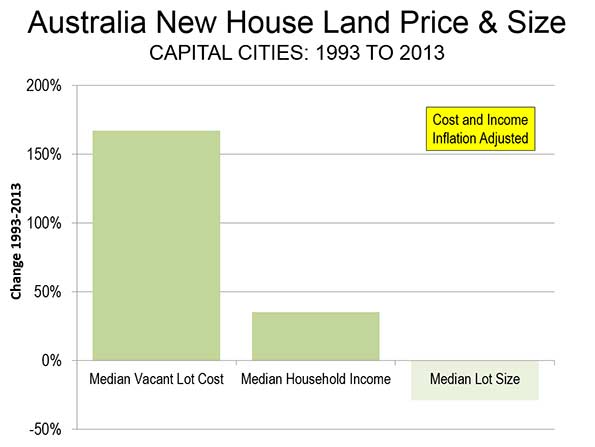
    The shocking extent to which urban containment policy (urban consolidation policy) is associated with higher land (and house) prices is illustrated by a recent press release from RP Data in Australia. The analysis examined the vacant building lot prices for the period of 1993 to 2013.

    During the period, the median price of a vacant lot rose 168 percent after adjustment for inflation. This is nearly 5 times the increase in the median household incomes of the seven largest capital cities (Sydney, Melbourne, Brisbane, Perth, Adelaide, Canberra and Sydney).

    But it gets worse. The median lot size was reduced nearly 30 percent. This should put paid to the myth that urban containment reduces lot prices as it reduces their sizes (Figure). The same dynamic has been indicated in the United States.

    Australia has been plagued by huge house cost increases relative to incomes in association with urban containment policy. Before the adoption of urban containment policy, it was typical for house prices to average three times or less than that of household income. Now, Sydney has the highest median multiple (median house price divided by median household income) of any major metropolitan area in the New World, with the exceptions of Vancouver and San Francisco. Melbourne, the second largest metropolitan area in Australia, has a median multiple of 8.4, making it fifth most costly in the New World, behind San Jose. All of Australia’s major metropolitan areas "severely unaffordable," including slow-growing Adelaide (6.3), as well as most smaller areas.

    For a complete listing of median multiples by major metropolitan area, see the 10th Annual Demographia International Housing Affordability Survey.

    Additional information on the RP Data research is available at Australian Property Through Foreign Eyes

  • 84% of 18-to-34-Year-Olds Want To Own Homes

    A survey by TD Bank indicates that 84 percent of people 18 to 34 years old intend to buy homes in the future. This runs counter to thinking that has been expressed by some, indicating that renting would become more popular in the future. Much of the "home ownership is dead or dying” comes from short sighted trend analysis in which home ownership data begins with the start of the housing bubble in the late 1990s. The latest data from the Bureau of the Census indicates that the home ownership rate in the first quarter was 65.4 percent, the lowest rate since 1997. In fact, however, before the housing bubble, homeownership hovered generally at 65 percent or below, after having increased strongly from 44 percent in 1940 to 61 percent in 1960. The increase in homeownership during the bubble was the result of profligate lending policies that were not sustainable. The decline from the artificially high housing bubble peak in no way diminishes the successful expansion of homeownership in the nation during the decades that reason prevailed in home lending.

  • Home Ownership and the American Dream

    What defines the American Dream? A new poll by Big Builder reveals that one answer to this enduring question may be home ownership. A major portion of the American population (59%) believes that they are living the American Dream. Respondents distinguished owning a home as the second most important factor of the American Dream, just behind raising a family.

    Another statistic in this poll seem to suggest that this trend may be more stifled as the younger generation of Americans (18-29 year olds) come to the crucial decision of buying a home. Still, 49% see home ownership as a “sound investment,” while 49% of this age group call it “too risky.” Perhaps the effect of the weak economy has been especially evident in this age group.

    Some interesting contradictions also arise in these statistics. For instance, 58% of those who believe the housing crisis is a chronic problem also recommend buying a home. Furthermore, 75% of respondents claim to not have benefited from any federal program to assist in ownership (such as mortgage interest deduction), yet 71% confessed to taking the deduction. The pollsters have considered that perhaps the government’s assistance in home ownership may be unclear for many Americans.

    A final statistic worth mentioning is that 58% of Americans believe that fulfilling the American Dream is influenced mostly by their own skills and hard work than by the current state of the economy. The ubiquitous American Dream still runs on hard work and the pressing notion of owning a home, it would seem.

  • Strategic Diminshment at the Heart of New Housing Policy

    Robert Samuelson in the Washington Post takes on the role of homeownership in our society. I’m generally a fan of Samuelson’s writing, a normally sober, cold-eyed analysis of issues without favor to one ideology over another, so imagine my disappointment when reading him say, “The relentless promotion of homeownership as the embodiment of the American dream has outlived its usefulness.”

    Of course, there’s more to his column. He goes on to say:

    Unfortunately, we let a sensible goal become a foolish fetish. Not everyone can become a homeowner. Some are too young and footloose; some are too old and dependent; some are too poor or irresponsible. Some don’t want a home.

    This is different that saying homeownership is not a worthy goal for our nation and is quite distinct from the ideas of Richard Florida, who has previously written that homeownership is overrated and who’s recent “Roadmap” to recovery focuses on de-emphasizing homeownership. Where Florida is right is in acknowledging that this would “blow up” the fundamentals of our economy.

    He’s also engaging in what I call strategic diminishment – that is, consciously pursuing a future that is less than our current state. Many elite progressives think we have it too good and that our lifestyle choices are harmful to ourselves and our planet. It’s not enough that they want to be scolds; they want to use the power of government to change America into a place where our quality of life is diminished.

    And progressives also glorify this reduction with a “less is more” attitude. The Washington Post recently presented the case against air conditioning, and USA Today reported on the banning of drive-throughs in the city that pioneered them sixty years ago. I’ve addressed strategic diminishment as it relates to the mobility and the Obama administration’s “Livable Communities Act,” but this is also true for homeowners and covers not just the percentage of homeowners but even the size of homes. Ron Utt of the Heritage Foundation warns how even the President has adopted a worrisome narrative on homeownership.

    Before we go off the deep end, let’s clear up two points. First, the crisis we’ve gotten ourselves into is not because people own homes. It’s because of the flawed policies promoting homeownership. We know about the role of the Community Reinvestment Act and Fannie Mae and Freddie Mac, but also contributing were various land-use planning schemes collectively known as Smart Growth.

    Second, homeownership has many benefits. Homeownership is more than a lifestyle choice; it’s a source of wealth and stability. And when homeowners take out a second mortgage on their homes, it’s often as a source for financing their own small businesses – another ideal we associate with the American Dream.

    There are countries with equal or greater rates of homeownership that do not have government intervention policies that skew the market. But as we consider housing policy at the local, state, and federal levels, what should be the principles on which it is based?

    • Owning a home is a laudable goal held by millions of Americans.
    • Homeownership is positive good that should never be discouraged by government policy.
    • Everyone should have the right to pursue homeownership, but not everyone is ready to be a homeowner.
    • Government’s role is not to determine who should be a homeowner or when and where they should buy a home.
    • Markets are better than mandates at creating the environment in which people pursue renting or owning homes according to their ability.

    Before we adopt A Nation of Renters as our new creed, let’s fix the broken policies that got us here.

    Ed Braddy is executive director of the American Dream Coalition, a non-profit grassroots and public policy organization that promotes freedom, mobility, and affordable homeownership. The ADC’s annual conference takes place September 23-25 in Orlando, Florida. For more information, visit americandreamcoalition.org or email Ed at ed@americandreamcoalition.org.
  • Aspiring to The Russian Dream

    Bloomberg Business Week reports that the Russian government wants to move urban residents from their “cramped” high rise apartments to new suburban developments. Single family houses would be built in joint ventures with private developers. Present plans are to develop 2.5 million acres of suburban homes. This is a very large program. At Los Angeles densities, this amount of land would be sufficient to house about 28,000,000 people, roughly double the present population of the Moscow urban area.

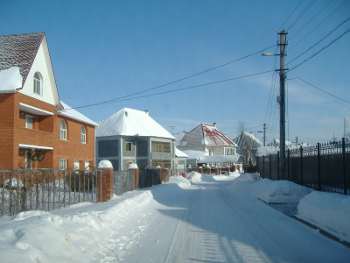
    As occurred before in the United States, expanding suburban home ownership could generate a democratization of prosperity that brings far better living conditions to middle income households. Already, more affluent households have built European and American style detached houses outside Moscow’s 8-lane ring road (see photograph).

    Photograph: New detached housing, northern Moscow suburbs (Veshki).