Tag: housing prices

  • Why Intensification Will Not Solve the Housing Affordability Crisis

    Analyst Phil Hayward of Wellington, New Zealand provides a provocative perspective on why urban intensification (densification in the urban cores) is incapable of compensating for the huge house price increases attributable to urban containment boundaries. Writing on Making New Zealand for Urban Planning that Works, he notes that “planners and advocates and politicians and even economists, are making an assumption that urban intensification is a potential route to housing affordability.”

    The assumption involves changing zoning so that “X number of housing units” can be constructed in existing urban locations “instead of X number of housing units” on pristine ex-urban land. The latter is assumed to be an evil to be avoided, and that the former is a perfect substitute in terms of “sufficient housing supply to enable affordability.

    Hayward continues:

    Common sense tells us that there are quite a few potential problems with this assumption. For example, NIMBYs will obstruct the intensification and reduce the rate of housing supply so the policy will fail. Therefore, what we need is the removal of NIMBY rights of protest and appeal, and the policy will then work.

    Hayward’s analysis suggests that:

    And generally, the data runs in that direction – not only does intensification within a regulatory boundary "not restore affordability", it seems that the more density you “allow”, the higher your average housing unit price gets. The correlation runs the opposite way to the assumption.

    Indeed, “Paul Cheshire and his colleagues at the London School of Economics believe this is due to the ‘bidding war’ at the margins of each income-level cohort of society, for ‘slightly more space,’" according to Hayward. “But when a market is allowing people to consume "as much space as they want", which has only really occurred in the automobile era, the “bidding war” effect is absent.”

    Boston and Atlanta provide powerful examples.

    …(The) difference is that Boston has de facto growth boundaries / green belts while Atlanta does not. The ironic implication is that fringe growth containment pushes median multiples up less, when there are severe restrictions against density – otherwise Boston should be the most expensive city in the data, not Hong Kong. The evidence suggests that this is because there is a total absence of “bidding war for slightly more space” – everyone has "more than they want" already. The median multiple of 6 rather than 3, represents the effect of demand for "living in Boston", period, and they simply don’t provide enough houses to keep the median multiple down like Atlanta does (in the face of staggering population growth in Atlanta, by the way).

    Perhaps the most important conclusion is that “there is no evidence that any city anywhere in the world has ‘freed up intensification processes’ enough to result in floor space being built faster than site values inflate.

    The bottom line is a mistaken impression that high density housing “will remain available as a substitutable option to suburban family housing even if the latter is forced up in price deliberately by central planner’s policies. The lesson that needs to be learned urgently, is that this is impossible; the two things are inter-related.”    

    But when a market is allowing people to consume "as much space as they want", which has only really occurred in the automobile era, the “bidding war” effect is absent. The evidence supports this, with most median-multiple-3 cities being from 600 to 2500 people per square km. Another interesting case study would be Liverpool; it lost approximately 50% of its population from the 1950’s to the 2000’s (similar to Detroit) – yet its median multiple is over 7. And its density is still 4,400 per square km (presumably it would have been double this, or more, in 1950). This is prima facie evidence that 4,400 people per square km within a growth boundary, are still going to be dissatisfied with their living space, to the extent that they will be engaging in an unwitting bidding war against each other for a little more of it. Of course under these conditions, the lowest socio-economic cohort is denied all options other than crowding tighter and tighter in rented accommodation or even illegal “living space”. In UK cities, rental advertisements include options like a ¼ share in 2 rooms, with communal access to kitchen and bathroom shared by even more tenants in further rooms. In median-multiple-3 housing cities, the same real rent would apply to a whole house of reasonable size and standard. 

    There might be other policy mixes by which housing supply within a growth boundary could be made the means of keeping housing affordable, but publicly and politically, the debate is nowhere near tackling the complexities involved.
  • Sydney to Abandon Radical Urban Containment Policy

    The New South Wales government has proposed a new Metropolitan Strategy for the Sydney area which would significantly weaken the urban containment policy (also called urban consolidation, smart growth, livability, growth management, densification, etc.) that has driven if house prices to among the highest in the affluent New World (Australia, Canada, New Zealand and the United States) relative to household incomes.

    According to the Australian Financial Review, the state’s Liberal-National government plans to allow the building of more than 170,000 new homes, with the vast majority being on greenfield sites, largely beyond the current urban footprint. Premier Barry O’Farrell and his party had promised in their electoral campaign in 2011 to liberalize land-use regulation and to moderate the previous Labor government’s quota that required 70% of new houses to be built within the current urban footprint and 30% on greenfield sites. In fact, however, under the Labor government’s administration, new house building had been produced at a well below demand level.

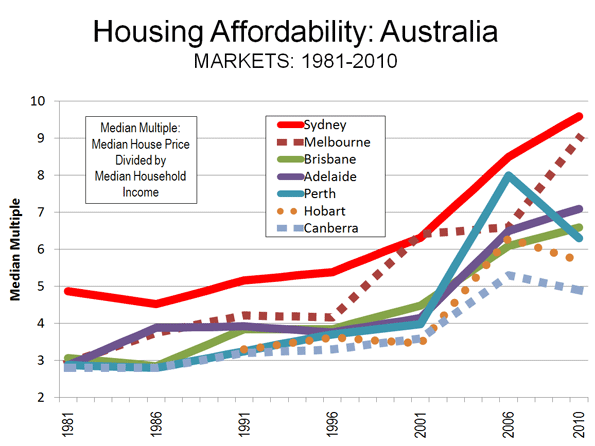
    Among the major New World metropolitan areas rated in annual Demographia International Housing Affordability Surveys, Sydney has been the most unaffordable, along with Vancouver, in recent years. Sydney and Vancouver have had among the most stringent urban containment policies in the New World, and the resulting unaffordable house prices under such circumstances are consistent with economic principle.

    Premier O’Farrell told the Sydney Morning Herald that the government wanted to "make home ownership a reality again." He continued, "The more blocks of land (lots) we can release, the greater downward pressure we can put on housing because it’s been so high for so long." In a press release issued by his office, the Premier recalled that “Before the election, I said I wanted to ensure owning a home wasn’t a fading dream for young families" and noted that the massive housing package "will go a long way to delivering on that commitment."

    In the longer run (by 2031), the government intends to provide for a total of 545,000 new homes, while abandoning the practice of allocating locations based upon planning theory. Planning and Infrastructure Minister Bradley Hazzard told the Sydney Morning Herald that the government intended to “look further afield” than the presently planned greenfield suburban growth centers. He continued: "We’re trying to [be] less constrictive and restrictive and what we’re saying is the marketplace should have far more of a say in what the mix of housing is and where it should be,” adding that ”it doesn’t matter” what percentage was delivered in greenfield and established suburbs. He concluded: ”No one should be preoccupied by particular prescriptive formulas.”

    The government also indicated its intention to encourage one half of employment growth over the next 20 years to be in Western Sydney. Western Sydney is virtually across the urban area from the central business district. This dispersion of employment, along with roadway improvements in the area, is likely to improve the metropolitan balance between jobs and housing.

    The plan for greater job dispersion would, if successful, bring Sydney more into line with urban best practices, which are exhibited by the location of most new jobs in edge cities, as well as throughout the entire urban area. Sydney has among the longest work trip travel times in the New World. The one-way work trip travel time is newly reported in the Metropolitan Strategy to have reached 35 minutes. Work trip travel times are worse only in Melbourne, at 36 minutes. By comparison, Dallas-Fort Worth, with a larger population, a much lower urban area density and a mere fraction of the Melbourne or Sydney transit work trip market share has a far shorter one-way work trip travel time (26 minutes).

    The Sydney developments are the latest in a trend toward liberalizing urban land use in four nations.

    In October, the New Zealand government announced plans to liberalize land-use amid growing concern about the extent to which that nation’s urban containment policies have destroyed housing affordability. In the introduction to the 9th Annual Demographia International Housing Affordability Survey, Deputy Premier Bill English said:

    Land has been made artificially scarce by regulation that locks up land for development. This regulation has made land supply unresponsive to demand. When demand shocks occur, as they did in the mid-2000s in New Zealand and around the world, much of that shock translates to higher prices rather than more houses.

    Recent polling has shown support, by an almost 2 to 1 margin for government action to improve housing affordability, with even higher stronger support in the 18 to 34 age group, where the margin was more than 3 to 1.

    The United Kingdom Cameron government is also embarked on a program to liberalize that nation’s restrictive land use policies, which former Bank of England Monetary Policy Committee member Kate Barker found to be the cause of severe housing unaffordability in a report commissioned by the Blair Labour government. Planning Minister Nick Boles has characterized the unaffordability of housing as "the biggest social justice problem we have."

    In 2011, Florida repealed its statewide smart growth mandate and closed the administrative bureaucracy that had overseen the program. Before that, the government of the Australian state of Victoria substantially expanded the urban growth boundary of the Melbourne urban area.

  • The Economist on the Costs of London’s Green Belt

    The Economist reminds readers of the economics of housing (or for that matter, oil or any other good or service): constraining the supply of a good or service in demand raises its price. In a 14-page feature on London, The Economist decries the high cost of housing in London. And, for good reason, the 8th Annual Demographia International Housing Affordability Survey showed London to have a median multiple (median house price divided by median household income) 6.9 in the fourth quarter of 2011. This figure, which would be more like 3.0 in a normally functioning market, is exceeded by few other major metropolitan areas, though Hong Kong, Vancouver, Sydney are more unaffordable.

    The Economist noted that:

    … perhaps the biggest constraint on development in London is the Green Belt. Established after the war, it runs (with perforations) all around London, to a depth of up to 50 miles, and bans almost all building on half a million hectares of land around the city.

    Not only has this constraint led to higher house prices, but it has resulted in greater urban expansion and imposed greater costs, in time and money on commuters.

    … it has pushed it into the greater south-east, thus spoiling the countryside across a bigger area. It has also raised the cost of housing and forced workers to travel farther. Commuting costs in London are now higher than in any other rich-world capital.

    One alternative is to relax the Green Belt controls. The Economist points out that allowing development one mile into the Green belt would add one-sixth to the developable area of London. The Economist also notes that "far more than would be needed to make a huge difference to housing availability" and that opening the Green Belt "might not be an environmental disaster."

    The Economist calculates that "the average London worker can buy half an average home." Britain would gain if the interests of those with a stake in a poorer middle class and greater poverty were to finally give way to the general welfare.

  • Things Aren’t that Bad in Saginaw

    Our 8th Annual Demographia International Housing Affordability Survey included the Saginaw, Michigan metropolitan area, which we noted had the lowest Median Multiple (median house price divided by median household income) among the included 325 metropolitan areas. This made Saginaw the most affordable metropolitan market, principally due to depressed economic conditions. Saginaw has been ravaged by the loss of manufacturing jobs and a generally declining economy because of its strong industrial ties to the Detroit metropolitan area.

    D. Robertson of Freeman’s Bay (Auckland, New Zealand) must think that things are much worse, as indicated by a letter to the editor in the New Zealand Herald on January 24 (The Herald does not post letters to the editor on its internet site). Robertson says that including and prominently reporting the result of Saginaw Michigan (population 297 in 120-odd dwellings) was inappropriate. Robertson makes a 99.9% error, having apparently confused Saginaw, Missouri (population 297) with Saginaw, Michigan. According to the 2010 US Census, the Saginaw metropolitan area has a population of 200,169. That would be substantial enough to qualify Saginaw as one of New Zealand’s largest metropolitan areas if it were there.

  • Why Housing is So Expensive in Metropolitan Washington

    Anyone familiar with housing affordability in the Washington (DC-VA-MD-WV) metropolitan area is aware that prices have risen strongly relative to incomes in the last decade.

    However, a recent Washington Post commentary by Roger K. Lewis both exaggerates the contribution of higher construction costs and misses the principal factor that has driven up the price of housing: more restrictive land-use regulations.

    Lewis compares construction costs in the early 1970s to current costs and finds that they are approximately 6 times as high. However, when the R. S. Means construction cost index for locations in the metropolitan area are adjusted for inflation, the increase is more like 15% (1970 to 2007).

    Lewis also indicates that construction costs have risen faster than the "relatively flat income curve." In contrast, Census Bureau data indicate that median household incomes in the Washington metropolitan area have increased more than 30% since the early 1970s, after adjustment for inflation. House construction costs are the flatter of the two, not incomes.

    While Lewis’ focus is affordable housing, costs in this low income sector are impacted by many of the same factors that drive overall housing affordability (overall house prices relative to incomes).

    Lewis does not consider the huge cost increase in the non-construction costs of housing. In the Washington metropolitan area, we have estimated that the land and the regulatory costs for a new house have been driven to more than 5.5 times the level that would be expected in a normal regulatory environment (see the Demographia Residential Land & Regulation Cost Index). The problem is that the restrictive land-use policies, such as the Montgomery County agricultural reserve, similar regulations in other metropolitan area counties and the large lot building restrictions in Loudoun County have driven the price of land up substantially, and with it, the price of housing. We estimate that more restrictive land use regulations have driven the price of a new house up approximately $75,000.

    Not surprisingly, Washington’s Median Multiple (median house price divided by median household income) remains more than a third above the 3.0 historic norm, at 4.0, even after the burst of the housing bubble. So long as governments in the Washington, DC area continue to strictly ration land for development, higher than necessary costs will continue to plague both housing affordability and affordable housing.

  • How Phoenix Housing Boomed and Busted

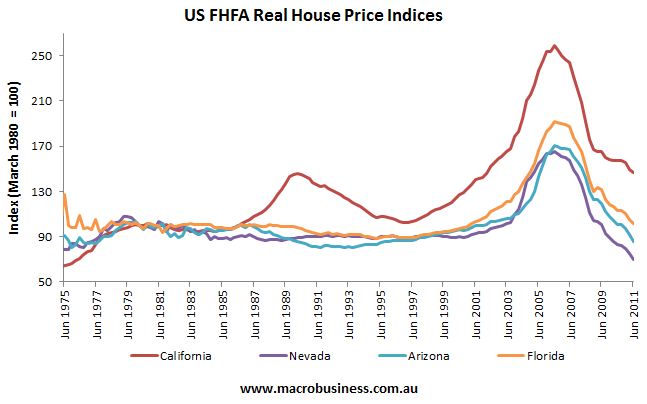
    When analysing the US housing bubble, four states stand-out for the way in which home values rose into the stratosphere before crashing and burning: California, Nevada, Florida and Arizona (see below chart).


    Since I covered three markets were covered in previous posts at Macrobusiness (see above links), I now want to analyse the Arizona housing market – with particular emphasis on its largest city, Phoenix – to determine why prices bubbled and then burst in such a violent manner.

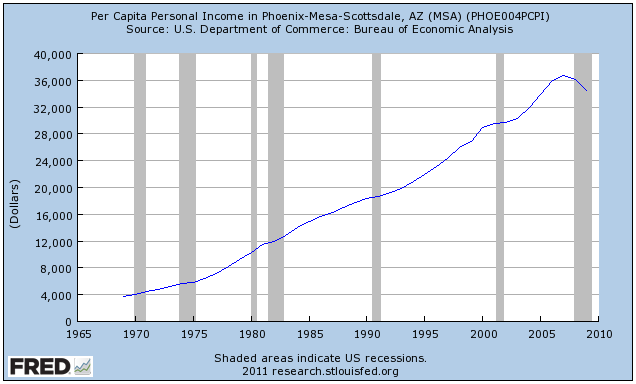
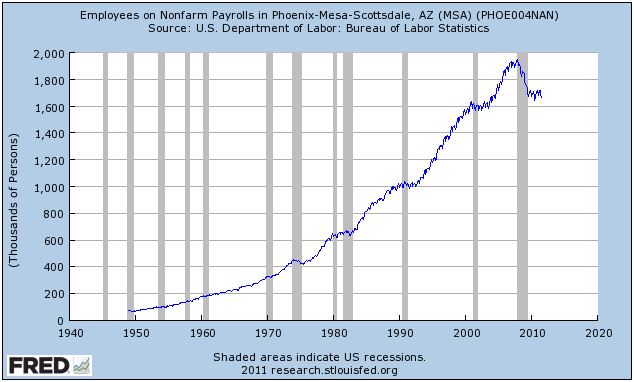
    In the lead-up to the crash, Phoenix’s economy was booming. New jobs were being added at a fast pace and per capita incomes were growing strongly:


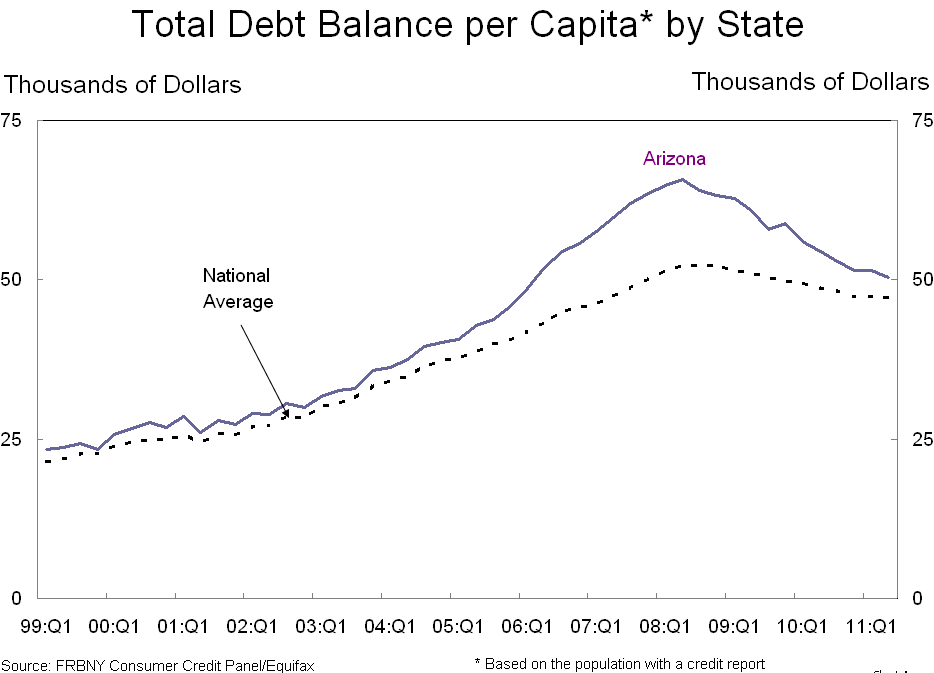
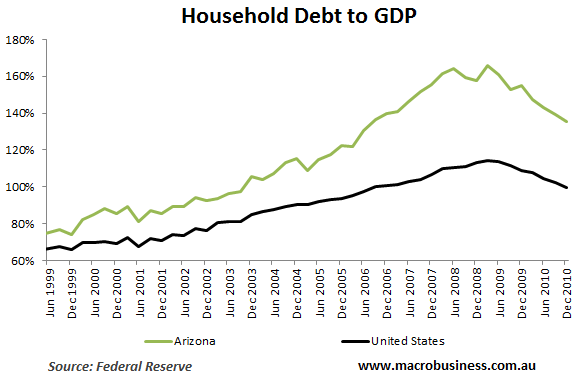
    With confidence riding high on the back of seemingly solid fundamentals and rising asset prices, along with easy access to credit, Arizona households borrowed heavily. Per capita debt accumulation surged in the mid-2000s to levels far in excess of the national average:


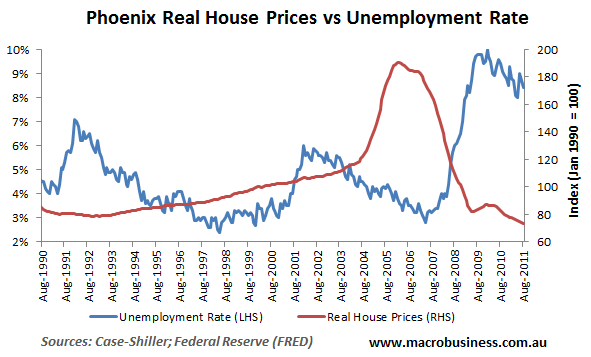
    But Phoenix was living on borrowed time. With the national economy turning south in the wake of the sub-prime crisis and the collapse of Lehman Brothers, Phoenix home prices, which had already been falling gradually, began to slide fast. After home prices peaked in May 2006, it took another 18 months before Phoenix’s unemployment rate began rising:


    The rest is history. Home prices continued falling, unemployment kept rising, and nominal per capita incomes fell for the first time in at least 40 years.

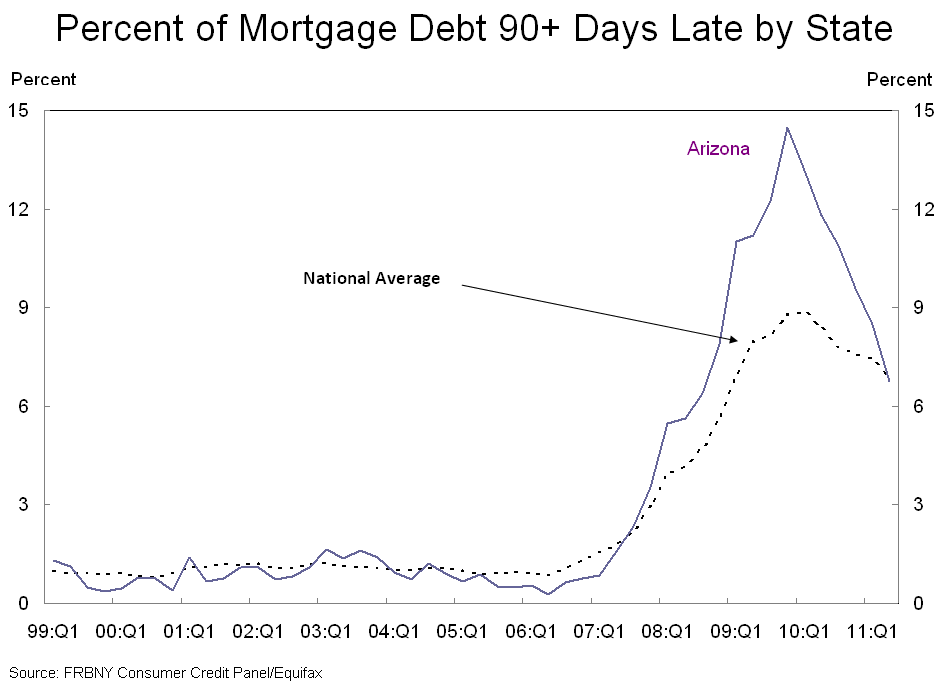
    And the pain is widespread, with around one in seven mortgages 90 days in arrears – well in excess of the national average:


    So what went wrong? Could anything have been done differently to prevent the housing bubble/bust?

    Certainly, if credit was less readily available, households would have been constrained in their ability to bid-up prices. But easy credit was only part of the problem. Another key driver of the rampant price escalation and then collapse was the way in which land was supplied for housing.

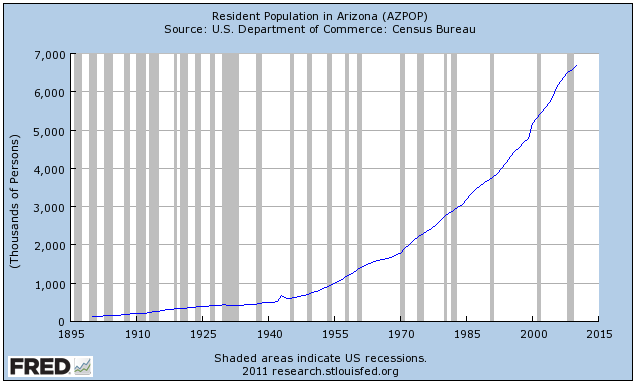
    Throughout the 2000s, Arizona was one of the fastest growing metropolitan area in the United States with more than 1,000,000 population (see below chart).


    However, despite there being ample developable land on the urban fringe to accomodate this population growth, the actual quantity of land available for development was heavily restricted on two counts:

    1. The State of Arizona passed statewide planning laws in 1998 and 2000, which included the implementation of high impact fees on new development and urban containment devices. In a 2006 study of land-use policies in the 50 largest metropolitan areas of the US, the Brookings Institution ranked Phoenix as ‘growth management’, which is the same ranking as Florida and California.
    2. The overwhelming majority of potential developable land in Arizona is either owned by the state and federal governments, preserved for conservation, or otherwise off-limits to development.

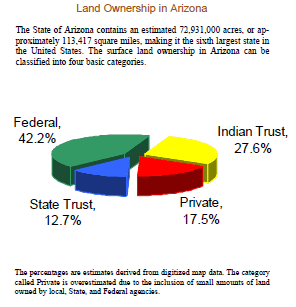
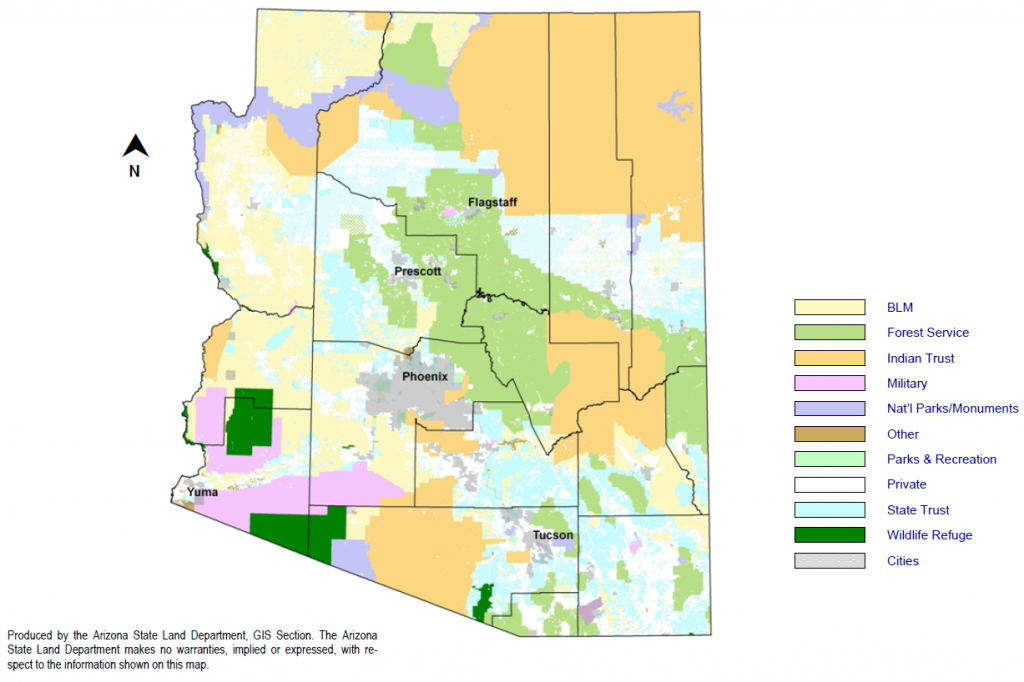
    On the second point – the lack of available land for development – the below graphics highlight the land supply situation in Phoenix.

    First, a pie diagram, extracted from the Arizona State Land Department Annual Report, showing how only 17.5% of land in Arizona is privately owned:


    Second, a map showing the lack of developable land around Phoenix:


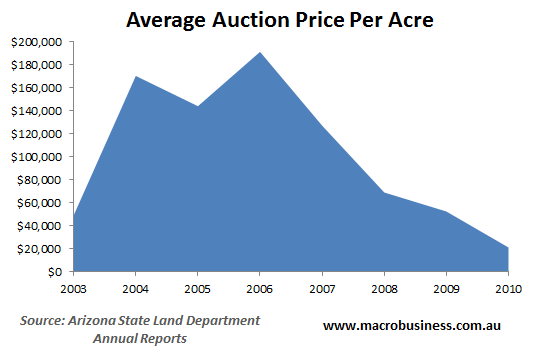
    There is evidence that the Arizona State Land Department, whose mission is to “optimize economic return for the Trust beneficiaries”, heavily restricted sales of land to the market in an effort to maximise revenues, causing builders and developers to bid-up land price in period auctions to ensure their supply of land for construction (called ‘land banking’).

    Whereas the price of land for housing sold for around $40,000 per acre immediately prior to the bubble, at the peak average land prices fetched nearly $200,000 (see below chart).


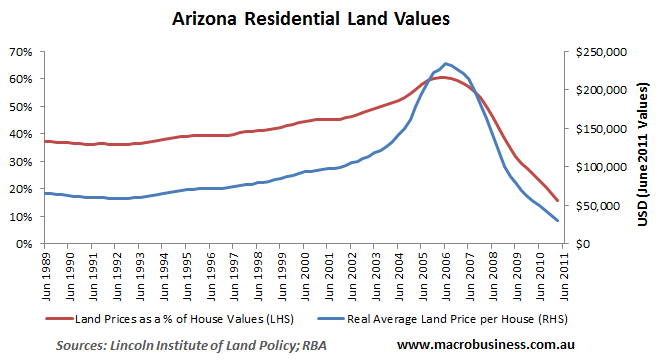
    And with the state rationing the supply of fringe land, average residential land prices rose throughout Arizona:


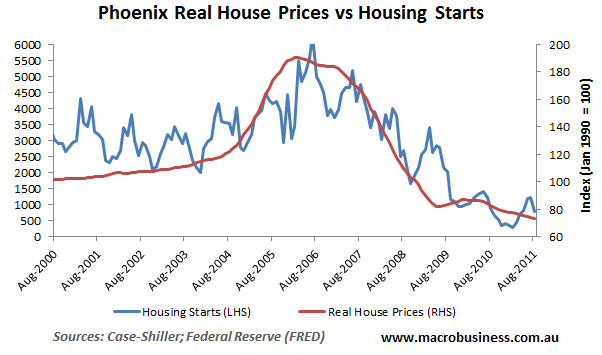
    Obviously, this land price inflation was a principal cause of the house price escalation as well as the delayed supply response to the rapidly growing population and rising house prices (see below chart).


    Had land around Phoenix been freely available for development, developers would likely not have paid such high prices for the land sold by the state government and Phoenix home prices would never have risen to such heights or crashed as violently.

    Phoenix is yet another example of where excessive government interference in the supply of land has combined with easy credit to create a speculative bubble followed by a painful bust.

    This piece originally appeared at Macrobusiness.

    Leith van Onselen writes daily as the Unconventional Economist at MacroBusiness Australia. He has held positions at the Australian Treasury, Victorian Treasury and currently works at a leading financial services company. Follow him @leithVO.

  • Australia Central Banker: Higher House Prices a “Social Problem”

    Glenn Stevens, the Governor of the Reserve Bank of Australia expressed concern about the growing gap in housing affordability in the nation to a parliamentary committee on Friday. Stevens raised questions about the cost and supply of housing, asking:

    "How is it that we can’t add to the dwelling stock for the marginal new entrant more cheaply than we seem to be able to do," he asked.

    According to an article in the Perth Western Australian ("High price of homes ‘stealing future’") Stevens went on to say that key State and local government issues around supply, zoning, transportation and infrastructure seemed to be making a simple block of land more expensive than was necessary.

    Virtually all of Australia large urban areas have implemented urban containment policies (called "urban consolidation" in Australia and "smart growth" in the United States). The result has been to increase house prices from 2 to 3 times the historic norm relative to incomes. These price increases are consistent with the overwhelming economic evidence of a strong association between urban containment policies, especially those that ration land for development through devices such as urban growth boundaries.

    The Chairman of the Reserve Bank of New Zealand has identified a 10-times "across the urban growth boundary value" difference per acre in Auckland, which is similar to findings in Portland, Oregon.

    Stevens concluded his housing comments noting that: "There’s a very big inequality between generations building up and I think that’s a social problem as much as any economic point."

  • New Zealand Leader Focuses on Association between High House Prices and Growth Management

    ACT Party leader Donald Brash, who served from 1988 to 2002 as the Governor of the Reserve Bank of New Zealand (similar in function to the Federal Reserve Board) has noted the poor housing affordability in New Zealand and its connection to growth management policies (called by various names, such as "smart growth," "growth management," "compact cities," "densification" "prescriptive land use regulation" and "urban consolidation").

    In an August 25 speech Brash said:

    "It is impossible to avoid the conclusion that the interaction of the RMA, the Local Government Act and local government staff all over the country has produced a major obstacle to improved living standards.

    One of the ways this has happened is through the way in which this interaction has pushed the price of housing well beyond the reach of far too many New Zealanders – or more accurately, has pushed the price of residential land well beyond the reach of far too many New Zealanders.

    We know, from the annual surveys undertaken by the Demographia organisation, that housing in our major cities is now among the most expensive in the world, relative to household incomes. And why? In large part because too many local governments have quite deliberately limited the supply of residential land.

    Arthur Grimes, now chairman of the Reserve Bank, found that the effect of the Metropolitan Urban Limit imposed by the Auckland Regional Council had increased the price of land just inside that Limit by some 10 times compared with the price of land just outside the Limit.

    This is absolutely nuts, in a situation where New Zealand is one of the most under-populated countries in the world, and where Auckland is one of the most densely populated cities in the world – in terms of people per square kilometre, Auckland is more densely populated than Vancouver, Melbourne, Portland, Adelaide, Perth or Brisbane.

    I’m delighted that one of the first projects of the newly-established Productivity Commission is to look into the affordability of housing."

    The finding of a 10-times "across the urban growth boundary value" difference per acre in Auckland, is similar to findings in Portland, Oregon.

    Dr. Brash had previously written (the "Median Multiple is a measure of housing affordability, with higher number indicating less affordable housing. It is the median house price divided by the median household income):

    "… the one factor which clearly separates all of the urban areas with high Median Multiples from all those with low Median Multiples is the severity of the artificial restraints on the availability of land for residential building"

  • Land Use Regulation Blamed for High Hong Kong House Prices

    The Wall Street Journal  reports that growing concern about Hong Kong’s high house prices has led the special administrative region’s Chief Executive Donald Tsang to promise an overhaul of housing and land use policies in the fall.     

    Chou Hong-Wing, a real estate professor at Hong Kong University told The Wall Street Journal  that "Hong Kong isn’t short of land." Chief Executive Tsang indicated agreement, saying that the only way to solve the problem in the long run is tackling "market demand and land supply."

    A broad array of economic research has documented the higher house prices that occur where there land supply is overly restricted. In a survey of seven nations, Hong Kong was rated as the most unaffordable market in the 7th Annual Demographia Housing Affordability Survey in January, with a Median Multiple of 11.4 (median house price divided by median household income). Sydney and Vancouver, both with stringent land rationing (smart growth) programs ranked second and third, at 9.6 and 9.5 respectively.

  • Adelaide Land Prices Top Sydney

    The median price of serviced (improved) lots for new houses in Adelaide is reported to have risen above that of far larger Sydney by the Housing Industry Association of South Australia. Housing Industry Association of South Australian Executive Director Robert Harding attributed the high price of land to government policies that have limited the supply of land available for building. Nearly all thousands of square miles of land around Adelaide are off-limits to house building due to state government restrictions.

    Adelaide is the slowest growing major metropolitan area of Australia, yet has some of the worst housing affordability among larger metropolitan markets. The 7th Annual Demographia Housing Affordability Survey found median priced Adelaide housing to be 7.1 times median household incomes, ranking the metropolitan area eighth most unaffordable out of 82 with more than 1,000,000 population.

    Before the adoption of its strong smart growth (urban consolidation) land use restrictions, median house prices in Adelaide were one-half or less the present level (Figure). By comparison, new houses can be purchased in much of the United States for less than the median price of an empty lot in Adelaide ($180,000), though not in areas that have adopted smart growth restrictions.