Tag: Houston

  • A Layman’s Guide To Houston After Harvey: Don’t Throw The Opportunity Baby Out With The Stormwater

    In the aftermath of Hurricane Harvey, and the disastrous flooding, Houston has come under extreme scrutiny. Some in the global, national as well as local media assaulted the area’s flood control system and its development model, criticisms that were echoed by some in the local area.

    Much of the current debate starts from a firm misunderstanding of the region’s realities. This could lead to policies that ultimately undermine the keys that have propelled the region’s success. Below is a primer to inform future discussions of Houston’s future trajectory.

    Click here to read more or download the full paper.

    Photo: Michael Coppens, via Flickr, using CC License.

  • Hurricanes Don’t Kill Cities – People Do

    Cities that believe in themselves are hard to kill. In the aftermath of Hurricane Harvey many pundits have urged Houston to abandon many of the traits that have made it a dynamic, growing metropolis, including key elements of its light-handed, pro-business regulatory regime.

    Houston, we are told, should retrench and reduce its sprawl; Slate recommends New Orleans’ post-Katrina shrinkage as a model. This goes against the best of urban tradition. Great cities generally do not shrink themselves.

    Many cities have rebounded and even improved after far more lethal devastation, including London, Berlin, Tokyo and New York. After the Great Chicago Fire of 1871, the city ultimately constructed a downtown that may well be the world’s most beautiful. San Francisco famously rebuilt itself after the 1906 earthquake and fire into “a new and improved city” that has evolved into an integral part of the world’s dominant tech hub.

    In contrast cities that destroy themselves from within, like Detroit after the 1968 riots, and New Orleans before Katrina, can decline for decades.

    Urban resiliency requires two things: an ability to learn from experience and, per Northeastern University’s resiliency expert Daniel Aldrich, a commitment on the part of its residents to improve their city.

    Should Houston downsize?

    Unlike New York or New Orleans, Houston is not celebrated by the mainstream press or intellectuals; its residents have been portrayed as hypocritical religious fanatics and even neo-Nazis, despite living in what may well be America’s most diverse city.

    To many pundits, Houston’s problems are due to a lack of zoning and too much unregulated growth. Days after Hurricane Harvey hit, Quartz opined that “Houston’s flooding shows what happens when you ignore science and let developers run rampant.” The Guardian’s climate columnist George Monbiot even portrayed the event as a kind of payback for being the world capital of planet-destroying climate change.

    Few Houstonians are likely to embrace this interpretation of natural forces, or their own culpability. Longtime residents know that the Bayou City always has been prone to serious hurricanes and flooding due to its location along the Gulf, and Houston has shown an ability to deal with it.

    A 1935 flood caused proportionally much more severe damage on a much smaller city. Tropical storm Allison in 2001 led to significant hardening of infrastructure. Unlike New Orleans at the time of Katrina, many services in Houston, including police and fire, were ready for Harvey. Flood control, although clearly not up to the standards required by such a huge weather event, has been much improved. New developments are required to show how they can make up for the absorption lost, often with sophisticated drainage and storage techniques.

    Much blame for Harvey has been linked to development on the fringe, a major component of the region’s growth. Over an 18-year period, Houston lost about 25,000 acres of wetlands, which took away about 4 billion gallons of storm water detention capacity. In contrast Harvey dumped about 1 trillion gallons, meaning those wetlands could have only absorbed about 0.4% of Harvey’s deluge. Many flooded roads were consciously designed to hold storm water temporarily when there is nowhere for it to drain.

    To succeed, Houston, like any city, must adapt and bolster its defenses, particularly if such events become more common. This does not mean, as many suggest, that the region abandon its development-friendly policies. In contrast to claims of “wild west” regulation, many developments after Allison are required have better systems to handle downpours than older areas closer to the center. One friend notes that his 10 suburban shopping centers employed the most advanced methods for handling excess water and survived.

    Most of his projects’ first line of defense is made up of catch basins and stormwater lines in the parking lot which flow to a retention pond. The second line of defense is the retention pond. In the event the pond reaches capacity, the third line of defense is storm water backing up into storm drainage lines and ultimately ponding in the parking lot. These three defenses are very typical in newer developments, and many withstood the biblical flooding intact.

    Many others, either not up to code or built well before the new regulations, did not do so well. But on the whole, rather than prove the inadequacy of Houston model, as the New York Times Bret Stephens correctly noted, the region managed to survive a crisis with minimal, albeit tragic losses, that in other places would have cost thousands of lives.

    In the coming years, Houston surely will have to find ways to grow with less peril. But as both MIT’s Alan Berger and Houston’s Mayor Sylvester Tuner have noted, Harvey did not “punish” Houston for lax development. Houston has a planning system that is not the “wild west” but simply less bureaucratic and politicized. Its suburbs, notes the planning blog Strong towns, “are largely indistinguishable from the suburbs of any American city.” As Mayor Sylvester rejoined, if Houston had zoning, he would be presiding instead over a “flooded zoned city.”

    The zoning argument is, simply put, bogus. Cities in the area that were heavily zoned, like West University, or intensely planned like Sugarland, got hit as hard as more haphazard areas. Harvey, it turns out, was an equal opportunity devastator. Similarly, Sandy dropped barely one-third the rain from Harvey, yet overwhelmed a dense and very zoned area. New Orleans before Katrina was dense and zoned; a lot of good it did them.

    Nor, as many commentators suggest, can Houston’s supposedly enormous “sprawl” be the prime culprit. As demographer Wendell Cox points out the Houston urban area density at 3,000 per square mile, is 20 percent above metropolitan Boston (2,200), and Philadelphia (2,700) and not much less dense than that mecca of smart growth, Portland. Overall Houston ranks 18th in urban population density among the 53 metropolitan areas with more than a million residents, according to Census date.

    In contrast to its image as a paved over dystopia, Houston has more parkland and green space than most any other large city in America and ranks third overall to San Diego and Dallas in park acreage per capita. Rather than focus on urban form, Berger, himself a landscape architect who is co-director MIT’s Center for Advanced Urbanism, says this region really needs better and stricter building codes, such as the ones that saved my friend’s shopping centers. Others, like Rich Campanella at Tulane, suggests the best strategy for the Gulf cities should be to focus on building barrier islands along the coast, and improving often aged drainage systems.

    In the end, it’s the civic culture

    As we know from experience, storms, violent conquest and, in the case of Hiroshima, even nuclear weapons, cannot kill a city — only residents can do that. I saw this in Los Angeles, which in the early 1990s suffered a Pharaonic series of disasters — riots, fires, floods and a huge earthquake in 1994. The city rebuilt smartly after all of them, but only one, the 1992 riots, left a residual toll on the civic spirit, or led to an exodus of residents. Los Angeles may look spiffier than it did before the riots, but its enterprising spirit, and its allure to newcomers, never recovered fully.

    Internal collapse, the lack of a civic spirit, occurs most often when a city’s elite and its population no longer see a common future. Detroit’s 1967 riots created a morass that devastated the city for the next half century. Earlier on conflict between Boston Brahmins and the Irish under Mayor James Curley ushered in a period of stagnation that went from the 1920s to the late 1950s.

    More recently, Katrina revealed how a collapsed civic culture can make a disaster worse. Corrupt politicians, an ineffective business community and poor emergency services turned a Harvey-like natural disaster into a massive human one, with much greater loss of life. Some blame the city’s entrenched, often multi-generational lower-income population but perhaps more critical to failure was the city’s often elegantly appointed and comfortable upper echelon.

    In the decades before Katrina, as southern cities like Houston and Atlanta were burgeoning, New Orleans stagnated. Joel Garreau in his Nine Nations of North America described the Crescent City as a “marvelous collection of sleaziness and peeling paint.” The aristocracy enjoyed the city’s unparalleled culture while many ambitious people from its neighborhoods migrated elsewhere. Without a strong, engaged business community and middle class, there was little attempt to fix the infrastructure. This weak civic culture has left a city with huge economic challenges that a regenerated local business community is now gamely trying to address.

    Houston performed very differently during Harvey. Mayor Turner and the Harris County Judge, Ed Emmett, epitomized level-headed leadership. Gov. Abbot, unlike Louisiana’s dithering Gov. Kathleen Blanco, swung immediately to action. Local volunteers pitched in, so much so, notes Houston-based analyst Tory Gattis, that many found themselves unable to participate because each Facebook call for help spurred more volunteers than could be accommodated. Houston can also count on something New Orleans lacked: a strong, and philanthropically inclined business establishment who are pouring millions into recovery efforts.

    Houston will come back, albeit with some modifications, not because it’s a charity case, but because its people want to stay and rebuild their neighborhoods. They have been putting their shoulders to the wheel personally, with special emphasis on those most in need; rather than rugged individualists they are, in the words of one prominent Houston businessperson “rugged communitarians.”

    In the coming months, Houstonians will seek aid from Washington, as all hard-hit areas do, but most understand that the challenge is basically for them to solve, whether through mutual self-help, or new infrastructure; their city is an engineering marvel that needs a new upgrade.

    Ultimately, the power of human agency at the grassroots level remains the “secret sauce” overcoming almost any disaster, whether it’s London, New York or Houston. Great cities are not about buildings but great people. By that standard, Houston will likely come back better than before, a testament to the greatness of the urban ideal.

    This piece originally appeared on Forbes.com.

    Joel Kotkin is executive editor of NewGeography.com. He is the Roger Hobbs Distinguished Fellow in Urban Studies at Chapman University and executive director of the Houston-based Center for Opportunity Urbanism. His newest book is The Human City: Urbanism for the rest of us. He is also author of The New Class ConflictThe City: A Global History, and The Next Hundred Million: America in 2050. He lives in Orange County, CA.

    Photo: Jill Carlson (jillcarlson.org) from Roman Forest, Texas, USA (Hurricane Harvey Flooding and Damage) [CC BY 2.0], via Wikimedia Commons

  • Spotlight on Infrastructure After Harvey

    The recent tragic events in Houston and across the Gulf Coast once again demonstrated the woeful inadequacy of our infrastructure. Hopefully, some good will come of Hurricane Harvey. Hopefully, it will jump-start the long-awaited Trump initiative on infrastructure, which may be the one issue that could unite this country.

    Northeastern University’s post-disaster resiliency expert Daniel Aldrich notes the need for better storm water drainage systems and for fortifying existing infrastructure — and not just in Houston. Helping promote such investments represents perhaps the last best chance for creating a significant Trump legacy.

    Once a leader in world infrastructure, the United States now ranks 11th in the overall quality of its infrastructure, according to the latest World Economic Forum Global Competitiveness Index. This decline has consequences. In California, for example, the lack of investment in water storage both worsened the recent drought and reduced the state’s ability to take advantage of heavy rains when they arrived.

    A concerted effort to restore our nation’s bridges, roads, harbors and other critical infrastructure would also mark a significant break from the Obama era stimulus which focused more on propping up renewable energy and often underused mass transit systems. Meanwhile, our overall infrastructure continued to deteriorate during the Great Recession, even with the stimulus, with spending in decline from over $300 billion in 2008 to under $250 billion in 2013.

    Spending Smartly

    “Efficiency is doing things right,” legendary management guru Peter F. Drucker once proclaimed. “Effectiveness is doing the right things.” In the context of infrastructure, being effective means placing our bets on things that are really needed, and could reward our society with greater productivity, wealth and new employment.

    At Newgeography.com, where I serve as executive editor, we recently carried a report from the Houston-based Center for Opportunity Urbanism,Doing the Right Things Right,” which lays out what an infrastructure strategy would look like given current budget constraints. The United States faces a national debt of $20 trillion, while the federal government deficit was projected to reach $693 billion for fiscal year 2017.

    A strong U.S. transportation infrastructure system facilitates economic growth, job creation, a better standard of living and less poverty by minimizing travel times and improving labor market efficiency. Yet, as “Doing the Right Things Right” makes clear, not all investments are the same, or should receive federal subsidies, whether for direct expenditures or to issue infrastructure bonds to support private investment. There have been too many examples of spending on lower priority infrastructure because politicians were more interested in securing pork, or votes, than accelerating economic growth or reducing constituents’ travel times.

    To be sure, America’s infrastructure has performed well enough to provide the highest standard of living for the largest number of people in the world. The legacy of earlier infrastructure decisions, such as the completion of the interstate highway system, is still evident. Overall, the amount of time America’s commuters spend in peak period traffic congestion is generally better than that of international competitors.

    Yet traffic problems are increasing in the nation’s largest metropolitan areas. A recent study found that traffic congestion imposed $132 billion in excess fuel and time costs for automobile drivers and $28 billion in freight costs annually — all ultimately absorbed by consumers.

    The key question is how we meet these challenges. One proposed solution is to increase spending on traditional mass transit. This works well largely in “legacy cities” such as Washington, Chicago, Boston, Philadelphia, San Francisco and New York. The city of New York alone represents a remarkable 36 percent of all U.S. transit commuting, yet has only 3 percent of the jobs. Outside of these cities, the new transit projects, principally rail lines, have done little or nothing, as a recent report on transit from Chapman University demonstrates, to slow congestion or attract significant ridership.

    Among 19 metropolitan areas that added high-capacity transit systems since 1980, both bus and rail, transit’s market share has fallen from 4.7 to 4.6 percent compared to the last data before the systems opened. Transit has not, on balance, reduced solo driving, which increased from an average of 73.0 percent to 76.6 percent.

    The cities with rail systems opening after the 1990 Census experienced a modest decline in transit work trip market share, from 3.8 percent in 1990 to 3.7 percent in 2013.

    Take the absurd example of Los Angeles, which has spent over $15 billion trying to become what some mass transit enthusiasts call the “next great transit city.” Yet, Los Angeles County Metropolitan Transportation Authority system ridership stands at least 15 percent below 1985 levels, when there was only bus service, at a time when the population of Los Angeles County was 20 percent lower. Since 1990, transit’s work trip market share in the Los Angeles metropolitan area has dropped from 5.6 percent to 5.1 percent. No surprise, then, that according to a recent USC study, the new lines have done little or nothing to lessen congestion.

    Doing Your Homework

    The irony is that billions are being spent on these ineffective systems, when the places that depend on transit, like New York and Washington, are seeing their systems become less reliable and even dangerous. We are dumping money in some locations that don’t work all that well, but can’t find funds to fix systems that remain essential to “legacy cities” with large downtowns ideal for transit ridership.

    With the expense and ineffectiveness of new rail systems, it seems that the time has arrived for transit services that focus on less expensive bus systems, including those run by private companies, which can carry so many more riders for so much less in taxpayer subsidies. There are also opportunities to make lightly used but highly subsidized services more cost-effective by adding ride-hailing systems, like Uber and Lyft, cited as a factor in recent ridership declines in Los Angeles and even New York. In suburban San Francisco, a local transit operator has established a pilot program to extend service through ride-hailing and cancelled a lightly patronized bus route, reducing costs while providing quicker door-to-door service.

    One of the most promising alternatives, virtually ignored by transit advocates, is to encourage options for working at home. In many metropolitan areas, more people already telecommute than take transit. Since 1980, the number of people working at home has grown three times that of transit riders. All this, at virtually no cost to taxpayers.

    In the future, rapidly evolving autonomous technologies could make our present transit systems archaic in most cities. Under any circumstance, these advances seem likely to further weaken conventional transit. Given these trends, why base our transit policy on 19th century technologies when we are about to enter the third decade of the 21st?

    Back to the Gulf: Resiliency, not Hysteria

    “Smart growth” advocates have been quick to argue that Hurricane Harvey’s unprecedented damage can be traced to Houston’s freewheeling, free-market approach to real estate development. Sure, the area got 50 inches of rain, but it fell both on communities that eschew strict zoning and those which embrace it. They somehow forget that a lesser storm, Hurricane Sandy, devastated the highly planned communities of greater New York just a few years ago, causing $19 billion in damage in the city alone – and with far less rain.

    Rather than imitate Portland or San Francisco, Houston and other Gulf communities need to maintain policies that have allowed it to avoid the kind of insane price hikes one sees on the West Coast and some Northeastern housing markets. To force Houston to act like San Francisco would kill its economy. If Texas real estate prices approach California’s, people will simply move elsewhere, where prices are lower.

    Some changes may be necessary, including “coastal restoration” efforts that limit the impact of storms like Harvey. Major engineering challenges, like building more water storage facilities and improved drainage, need to be imposed, as well.

    What Houston needs, and would naturally adopt, is a kind of enlightened free market approach. After the devastation of Galveston in 1900 hurricane, Houston famously built a ship channel while Galveston built an elaborate sea wall; Houston is no less a creation of private innovation and government than New York or Los Angeles. Like America itself, Houston thrives by combining good public investment with a maximum of economic flexibility.

    The more these decisions are made locally, by people who are directly impacted, the better. My colleague Tory Gattis, based in Houston, suggests that new developments and older ones “should be required to have adequate rainwater retention, either with ponds, tanks, or permeable surfaces.” There are already examples of some of this kind of planning, particularly in exurban communities such as the Woodlands. This may mitigate the ill effects of such storms, but not likely to prevent disasters like Harvey from inflicting huge damage.

    These policies could mean, over time, that Houston and other Gulf communities might build an infrastructure more reminiscent of Frank Lloyd Wright’s Broadacre City, scattered communities with ample open land around them. But the vision must be a localized one, not drawn from example of generally slower-growing, older regions facing very different natural challenges. The benefits to customizing local infrastructure is go beyond economic reality and even disaster mitigation. With enough focus on local needs, we need not wait for natural disasters to witness the heartwarming sights of multi-cultural first responders – and ordinary citizens – all pulling together. “Social networks and cohesion are an important part of recovery and survival,” professor Aldrich suggests. “Houston should be investing in bringing neighborhoods together.”

    This is the real secret sauce for resiliency, as Houston has been showing throughout this crisis. The more that people who are impacted control the till, whether repairing levees, imposing regulations or planning transit systems, the better. Rather than let Leviathan rule and impose conformity, we should let regions — whether in Texas or elsewhere — figure out how to meet infrastructure challenges that effect every community differently.

    This piece originally appeared on Real Clear Politics.com.

    Joel Kotkin is executive editor of NewGeography.com. He is the Roger Hobbs Distinguished Fellow in Urban Studies at Chapman University and executive director of the Houston-based Center for Opportunity Urbanism. His newest book is The Human City: Urbanism for the rest of us. He is also author of The New Class ConflictThe City: A Global History, and The Next Hundred Million: America in 2050. He lives in Orange County, CA.

    Wendell Cox is principal of Demographia, an international public policy and demographics firm. He is a Senior Fellow of the Center for Opportunity Urbanism (US), Senior Fellow for Housing Affordability and Municipal Policy for the Frontier Centre for Public Policy (Canada), and a member of the Board of Advisors of the Center for Demographics and Policy at Chapman University (California). He is co-author of the “Demographia International Housing Affordability Survey” and author of “Demographia World Urban Areas” and “War on the Dream: How Anti-Sprawl Policy Threatens the Quality of Life.” He was appointed to three terms on the Los Angeles County Transportation Commission, where he served with the leading city and county leadership as the only non-elected member. He served as a visiting professor at the Conservatoire National des Arts et Metiers, a national university in Paris.

    Photo: Hurricane Harvey flooding by Jill Carlson, via Flickr, using CC License.

  • Hurricane Harvey: A View from a Rugged Communitarian

    Narratives are not necessarily built on facts; they’re built on stories, pictures, graphics, and videos. Ideally, we want our narratives to be aligned with the facts; but that doesn’t always happen.

    Here is a synthesis of some of the predictable narratives being spun in the immediate aftermath of Hurricane Harvey from such places as The Washington Post, Slate, The Guardian, Newsweek and NPR:

    Hurricane Harvey was a catastrophe of epic proportions. Floodwater is everywhere; people can only move around the city using boats and helicopters. Local officials failed to order evacuations, so Houstonians have been forced from their homes as flood waters rose, and the death toll is horrific and rising.

    But Houston had it coming. It is a miserably hot swamp where no one really wants to live. It embraced a “wild west” approach to growth, paved over wetlands, and refused to implement zoning, which would have lessened the impact of Harvey by requiring developers to mitigate the impacts of new projects. Moreover, it is the global center of the energy business, which is the biggest driver of climate change – one impact of which is the increased frequency and severity of hurricanes like Harvey.

    Look at these pictures of flooded streets; families in boats, or shopping carts, or floating on inflatable mattresses; bridges that are totally submerged, and littered with abandoned cars. Check out these graphics showing how Houston has paved over much of the land, destroying wetlands and creating impermeable barriers and exacerbating the impact of major rainstorms. Read these interviews with experts who bemoan Houston’s lack of centralized planning, and who implore the city leaders in Houston to use their power to address the many failures that became evident during Hurricane Harvey.

    These narratives, alas, are a combination of ignorance, and arrogance that tells the reader more about the narrative spinners’ flawed view of Houston than about the city itself.

    Let’s start with some facts and perspective:

    • Harvey is the wettest storm ever to hit the continental US. Over 50 inches of rainfall and 1 trillion gallons of water fell during the event. No one builds a church for Easter, or a gated community for the zombie apocalypse. It’s pretty naive to expect people to expect the unexpected.

    • So far, there have been fewer than 50 storm-related deaths. Each of these deaths is tragic, but even if that number creeps higher, it is a stunning low fatality rate for such a major event in such a large city. The Houston region has more than 6.6 million people, and every year more than 40,000 of them die – so Hurricane Harvey increased the annual death tally by about 0.1%. Sad, but not catastrophic.

    • An estimated 30,000 people have been forced from their homes. This is approximately 0.5% of the population of the Houston region. In other words, 99.5% of people in the Houston region have been able to stay in their homes. Unfortunate, but not catastrophic.

    • The Trump Administration has estimated that 100,000 homes were damaged or destroyed. While it is unclear how that estimate was obtained – if 30,000 people were forced from their home, then probably 70-90% of those homes did not sustain enough damage to force an evacuation – the Houston region has more than 1.6 million housing units, so about 6% of homes sustained damage of some kind. Lamentable, but not catastrophic.

    • Economic impact estimates are all over the map at this point; initial estimates were in the $30-40 billion range, but have been rising since then. Let’s say they end up being comparable to Superstorm Sandy, which caused about $70 billions of damage in today’s dollars. The Houston region GDP is about half a trillion dollars a year, so Harvey’s economic cost would be about 14% of our total economic output. Expensive, but not catastrophic.

    A dispassionate weighing of these facts would tell you that while stressful events always help identify areas for improvement, by and large our infrastructure and leadership performed admirably well under extraordinary circumstances.

    It other words, the facts would tell you that Harvey was not a catastrophe for Houston; it was our finest hour.

    But the narrative spinners have an agenda: they want to assert that this event was an utter failure for Houston, and shame our city and county leadership into embracing centralized planning, and ultimately zoning. They believe in a top-down, expert-driven technocracy that rewards current real estate owners by actions that restrict new supply, raise property value (and therefore taxes), stifle opportunity and undermine human agency. As a life-long Houstonian, I would like to politely ask the narrative spinners to please pound sand.

    Peter Drucker once said that culture eats strategy for breakfast, and Houston’s culture is one of opportunity. People come to this city to build a better life for themselves, to start and raise a family, and to do so with the support and encouragement of neighbors. This culture of opportunity means that Houstonians welcome newcomers, in a way that older or more status-conscious cities do not. Houston may not be a nice place to visit during the summer, but it is a great place to create a life all year round.

    This culture really shines through during events like Hurricane Harvey. Despite what the narrative spinners would have you believe, we are not rugged individualists; we are rugged communitarians. We know that when times are tough, you must rely first on family, then friends, then neighbors, and then – and only if you’re one of the few, unfortunate folks who cannot rely on any of those three – on the government. And if we have family, friends, or neighbors who can help, reaching out for government support is actually taking resources away from those who need them more.

    In short, the best governance to rely upon is self- governance.

    When the storm hit, I saw these networks in action. People first took care of family – in my case, my five siblings and I were in regular communication, checking in on how each of us was weathering the storm. Good news: everyone came through pretty much unscathed.

    Once it was clear that my family was OK, my wife and I began to focus on neighbors and friends. Yesterday, I spent several hours with neighbors clearing away trees that had fallen across streets in our neighborhood, making them unpassable. It was hard work – lots of chain sawing and branch hauling – and we were helped by a crew that was distributing power poles in our area. But folks just driving in the area would also stop and help, doing what they could, or just providing fellowship and encouragement. One lady in the neighborhood brought us some chicken meatballs for lunch – no one asked her to do that, she just wanted to help however she could. (The meatballs were delicious – thanks Costco!)

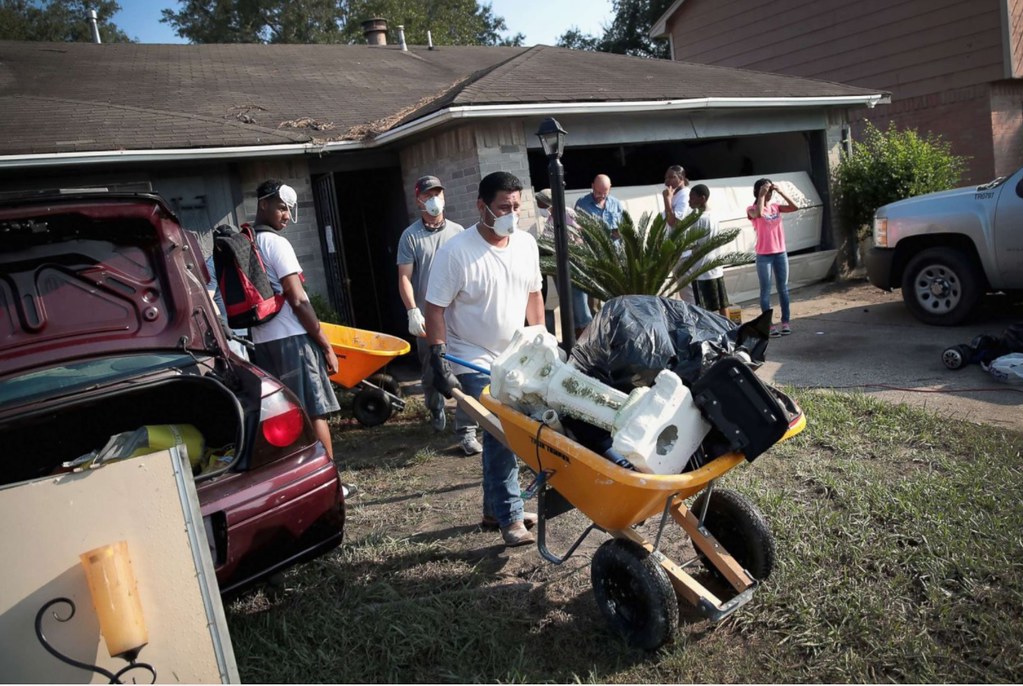
    Also, in our network of friends, there were a couple of families who were forced from their home. We worked together to find them places to stay, and today a group of about 40 men, women, and children went to their house today to box up and move out their valuables, throw away everything else, and tear out the damaged drywall. People brought tools, gloves, and a can-do attitude, and a job that might have taken weeks was finished in about 6 hours. Our friends now have their valuables with them in a rented home (found by another friend in our network), ready for the next step in returning to normalcy.

    These stories are real, and not about heroes doing the unusual. They are commonplace and just the way things get done in Houston. If you have friends in Houston, just ask they will tell you similar stories.
    Of course, leadership is important, and our regional leadership did great. Mayor Sylvester Turner and Judge Ed Emmett were both calm, deliberate, and stayed on task throughout the crisis. Governor Abbott and President Trump did their parts, but make no mistake about it – this was a local challenge that required top-notch response from local officials. And they did their jobs well.

    Houston was able to absorb the wettest storm on record with remarkably little loss of life and property also because of good engineering, informed by the experience of previous storms. A good engineer designs systems that won’t fail when hit with an expected event; a great engineer designs systems that fail gracefully and non-catastrophically when hit with an unexpected event. Hats off to our great engineers.

    However, a focus on Houston’s public officials or public infrastructure will lead you away from the more important truth: our response was driven by thousands of Houstonians who voluntarily stepped up to the challenge, and didn’t wait for some central authority to tell us what to do. The truth is that Houston’s culture was its biggest asset, a culture of mutual support that is extraordinary in a city of this size and diversity.

    And this culture is not an accident; it the consequence of a system that was designed to be driven from the bottom-up, by regular folks, responding to needs on the ground rather than some kind of theoretical plan put together by experts with no stake in our future, or interest in our family, friends, or neighbors.

    Of course, there is always room for improvement. By studying what happened, we will find ways to improve the system for the next storm – and there will always be a next storm. We learned a lot from Ike, Rita, and earlier storms. When I was a child, a couple of inches of rain would flood my neighborhood; today, that same neighborhood absorbed 25 inches of rain and made it through. We have come a long way.

    Harvey was a difficult challenge, but not a catastrophe. However, it would be catastrophic for city leaders to accept the narrative spinners’ version of what happened in Houston. It is demonstrably wrong on all counts:

    Houston is a miserably hot swamp where no one really wants to live.

    It’s hot during the summer, but it is pleasant the rest of the year. As this map shows, Houston actually gets more “pleasant days” than Miami, Raleigh-Durham, Chicago, Portland, or Phoenix. Forget your preconceptions for a moment, and answer a simple question: how could a place get to a population of 6.6 million if no one wanted to live there?

    It embraced a “wild west” approach to growth.

    Houston’s approach is not the “wild west.” We have land use that is managed from the bottom up, through a system of deed restrictions that often include local homeowners’ associations to police those restrictions. What we don’t have is a top-down, expert-driven, bureaucratic system of centralized planning. As a result, it’s easier to develop real estate than most cities, which keeps real estate prices – especially housing prices – low relative to the rest of the country. It is actually a more sophisticated and economically efficient system than the antiquated politically-driven zoning system that generally favors entrenched interests over new entrants.

    Paved over wetlands

    Over an 18 year period, Houston lost about 25,000 acres of wetlands. But this amounts to about 4 billion gallons of storm water detention capacity. As stated above, Harvey dumped about 1 trillion gallons; so the lost capacity represents about of 0.4% of Harvey’s deluge. But it’s also important to understand that the streets – a huge portion of the paved area – are used as detention, places to hold storm water temporarily when there is nowhere for it to drain. Houston’s strategy for many years has been to use streets as detention and runoff channels, the idea being that it is better to flood a street than a house. And the city’s performance under Harvey confirms the wisdom of that strategy.

    Refused to implement zoning, which would have lessened the impact of Harvey by requiring developers to mitigate the impacts of new projects.

    This is the most ridiculous of all the claims made by the narrative spinners. Mayor Turner put it best: “Zoning wouldn’t have changed anything. We would have been a city with zoning that flooded.” Proof positive of this fact: one of the harder hit areas was Sugar Land, just south of Houston. Sugar Land has zoning. Alas, Harvey was unaware of that fact and dropped 30+ inches on them anyway (and they handled it well, just like the City of Houston, evidence that zoning was not correlated with impact).

    Moreover, it is the global center of the energy business, which is the biggest driver of climate change – one impact of which is the increased frequency and severity of hurricanes like Harvey.

    Yes, Houston is the center of the energy business. But Houston’s energy industry is as much about natural gas as crude oil, and the increasing use of gas in power generation has led to a much-improved carbon dioxide picture in the US. If you believe that CO2 is causing climate change, you should be thanking the energy entrepreneurs in Houston for bringing cheap, clean natural gas to the nation. Moreover, the hypothesis that greenhouse gas emissions impact Atlantic hurricane activity is controversial; an official NOAA publication stated that “neither our model…nor our analyses…support the notion that greenhouse gas-induced warming leads to large increases in either tropical storm or overall hurricane numbers in the Atlantic.”

    A final point about who pays for all this.

    The narrative spinners have made a big deal about how federal funds will be needed to rebuild Houston, and therefore Houston must do what they say.

    My take on this is: we are going to rebuild with or without you, so you are not the boss of us.

    Most of the money from previous Texas hurricanes has come from private insurance. And, in some ways, this process of rebuilding restores a balance in the economy. For the past couple of decades, almost all homeowners have paid for insurance but few people make a claim. Most of that money sits on the balance sheet of big insurance companies to pay out future claims, and those companies often invest those dollars on Wall Street and real estate. That’s all fine – good, healthy commerce.

    Now the time has come for the flow to go the other way. Big insurance companies will be paying out money to settle insurance claims, and most of that will go to working class Americans who will rebuild damaged property. Demand for labor will rise, as will wages, as the money starts to flow. The tilting of the economy away from physical labor toward the financial sector will reverse – maybe only temporarily, but it will still reverse.

    Of course, if the federal government decides to give away money, I suppose people will sign up for it. But this madness eventually needs to end. The federal government is broke, and insisting that folks in Kansas or Vermont pay for a hurricane in Houston is silly on the face of it. This is not an invading army we’re talking about here. It’s a really bad storm. The Constitution doesn’t contain the words “storm,” “weather,” or “insurance.” Why are we continuing to twist its meaning to make Congress and the President look like heroes? If they want to help, let them help with their own time, talent, and treasure. Like the rest of us.

    But we also don’t want to be suckers. If Washington DC decides not to help Houston, they should end it for everyone in the future. Which they should, in my opinion.

    Bottom line: I believe we should celebrate the ability of the nation’s fourth largest city to absorb the wettest storm on record and bounce back with gusto. It is a testament to the culture of my hometown and the leadership that supports and nurtures that culture.

    Now, if you will excuse me, I have to get back to work. That wet drywall won’t remove itself.

    Leo Linbeck III is a husband, father of 5, CEO of Aquinas Companies, Executive Chairman of Linbeck Group, a Houston-based institutional construction firm, Founder and Chairman of Fannin Innovation Studio, a biomedical startup studio, and Lecturer at Stanford Graduate School of Business. He was also the Founding Chairman, and is currently the Vice Chairman, of the Center for Opportunity Urbanism, a Houston-based think tank.

    Top Photo: A Dickinson resident hugs a friend who came to help her remove possessions damaged by flooding brought on by Hurricane Harvey, Sept. 1, 2017 in Dickinson, Texas. Source – http://abcnews.go.com/US/hurricane-harvey-victims/story?id=49451305

    Second photo: Volunteers from Performance Contractors help co-worker Cornell Beasley recover from damage to his home after torrential rains caused widespread flooding during Hurricane and Tropical Storm Harvey, Sept. 1, 2017, in Houston, Texas. Source – http://abcnews.go.com/US/hurricane-harvey-victims/story?id=49451305

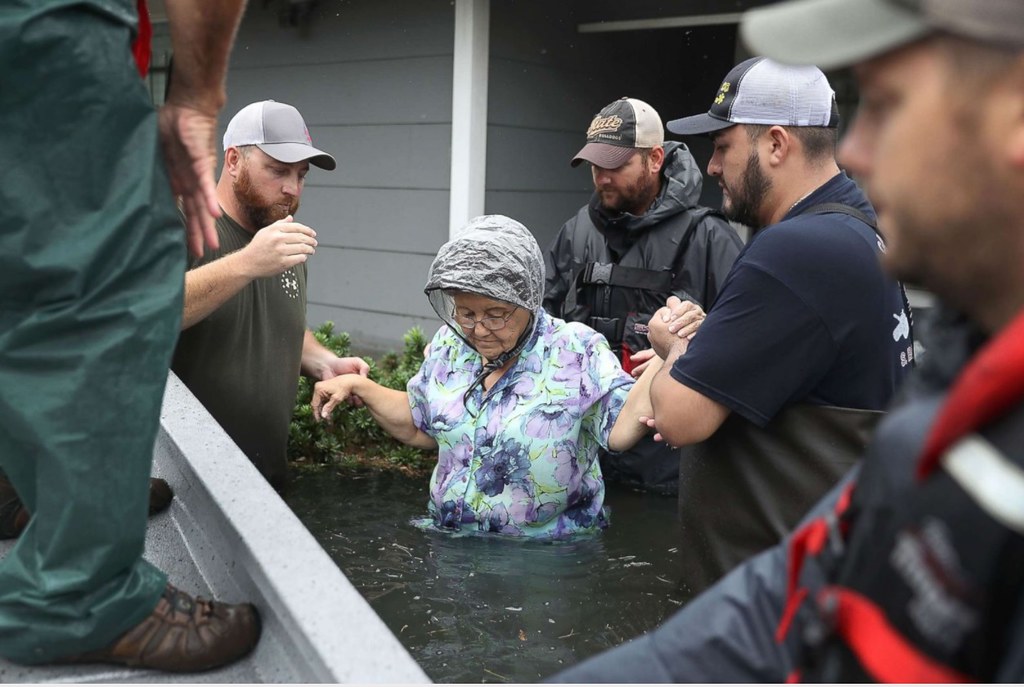
    Third photo: Volunteer rescuer workers help a woman from her home that was inundated with the flooding of Hurricane Harvey, Aug. 30, 2017 in Port Arthur, Texas. Harvey, which made landfall north of Corpus Christi late Friday evening, is expected to dump upwards to 40 inches of rain in Texas over the next couple of days. Source – http://abcnews.go.com/US/hurricane-harvey-victims/story?id=49451305

  • MaX Lanes: A Next Generation Strategy for Affordable Proximity

    This is the introduction to a new report written by Tory Gattis of the Center for Opportunity Urbanism. Download the full report here.

    The core urban challenge of our time is ‘affordable proximity’: how can ever larger numbers of people live and interact economically with each other while keeping the cost of living – especially housing – affordable? In decentralized, post-WW2 Sunbelt cities built around the car, commuter rail solutions don’t work and an alternative is needed, especially as we see autonomous vehicles on the horizon.

    This briefing explores a next-generation mobility strategy for affordable proximity: MaX Lanes (Managed eXpress Lanes) moving the maximum number of people at maximum speed and allowing direct point-to-point single-seat high-speed trips by transit buses and other shared-ride vehicles today, and autonomous vehicles in the future. It includes a case study of Houston with a proposed network as well as profiles of similar lanes around the country.

    Download the full report here.

  • Taxpayers Need Protection from Dallas-Houston High Speed Rail Bailout? New Report

    The proposed privately financed high-speed rail line from Houston to Dallas is projected to have a revenue shortfall of $21.5 billion in its first 40 years of operation. This is the conclusion of a Reason Foundation report by Baruch Feigenbaum, the Foundation’s assistant director of transportation policy (Texas High Speed Rail: Caution Ahead). This and other concerns lead the Reason Foundation to indicate: “… we cannot support Texas Central’s proposed Dallas to Houston project.” This is an important development, since the Reason Foundation has been a strong supporter of privately financed transport infrastructure for decades.

    “Optimism Bias and Demand Exaggeration”

    Feigenbaum explains: “Our analysis indicates that Texas Central is exhibiting the same ‘optimism bias; and ‘demand exaggeration’ that have plagued many public infrastructure projects —and especially high-speed rail projects—for decades. Simply put, Texas Central has exaggerated its ridership projections while underestimating costs.” Feigenbaum adds: “…private sector involvement is not a panacea. A wildly unsuccessful project is not going to become feasible with private financing.”

    To any who follow infrastructure finance, these are familiar terms. The sorry record of major infrastructure forecasts has been documented by Oxford University professor Bent Flyvbjerg, along with Nils Bruzelius (a Swedish transport consultant) and Werner Rottenberg (University of Karlsruhe and former president of the prestigious World Conference on Transport Research). They reviewed 80 years of infrastructure projects and found initial cost estimates to routinely be low and demand (ridership) to have been routinely over-estimated (Megaprojects and Risk: An Anatomy of Ambition). They found passenger rail project cost overruns to be among the worst, averaging 45 percent. They also found ridership projections to be two-thirds too high in two-thirds of cases.

    Reason Foundation and State DOT Estimates

    The Reason Foundation report suggests that the Texas project might perform even more poorly. Feigenbaum estimates that the Dallas to Houston line would carry 1.4 million passengers by 2035. He also cites a Texas Department of Transportation analysis estimating annual riders at between 0.7 and 2.7 million trips, by 2035. The Texas Central estimates a considerably higher five million riders by 2025, 10 years earlier.

    But the difficulties do not stop there. The costs of construction projected by the Texas Central Railway, at a maximum of $12 billion, may be significantly underestimated. Feigenbaum conservatively estimates costs that are nearly 50 percent higher ($17.8 billion) and suggest that the cost could exceed $20 billion. This is similar to a State Department of Transportation estimate of $18.7 billion, according to the report.

    Either of these eventualities, both of which are fairly routine for such projects, would mean that the Texas Central Railway might not have enough money to operate the service, or even to finish construction, unless bailed out. Of course, it is hard to find investors for failed projects, and there would be strong political pressure for government grants and subsidies.

    The California Boondoggle

    California’s high speed rail project, well into the planning stage and about to lay some track, has already exceeded the Oxford research cost overruns with a vengeance. By 2012, construction costs had risen more than 60 percent compared to those publicized to obtain voter approval of bonds for the project in 2008. Worse, that’s after officials scaled back the system from high speed rail to a blend between conventional (commuter rail) and high speed rail.

    As if that were not enough, the first short segment, already under construction, according to a federal report   could have a cost overrun of up to $3.5 billion. The segment is approximately two-thirds the Dallas to Houston route length and is similarly flat, in the largely agricultural San Joaquin Valley. The Wall Street Journal referred specifically to the California high speed rail project in a recent editorial characterizing Sacramento as “America’s western swamp.”

    The International Experience

    Out of all of the high speed rail lines built in the world, only  two have avoided commercial losses (“broken even”) until recently (Tokyo to Osaka and Paris to Lyon). Both had very low construction costs, which made it possible to repay , unlike the highly escalated costs that have developed in subsequent projects. These have depended on taxpayer subsidies for their survival.

    More recently, the Shanghai to Beijing high speed line became profitable, though its superlatives are well beyond replication by any other project (at least of any planet discovered so far). The line is slightly shorter than the distance between New York and Atlanta, but directly serves a market larger than the population of the European Union (more than 520 million residents) and 60 percent more than the United States. The stations on the exclusively high speed rail line itself serve municipalities with more than 160 million people, more people than live in Japan and 2.5 times as many as residents as in France. Another 360 million residents are served by trains that directly access the Shanghai to Beijing line from outside the corridor for part of their journey.

    Whence the Bailout?

    Feigenbaum suggests the likely source of a bailout for the Dallas to Houston high speed rail line: “While Texas Central may not be intending to take any public funding, we believe that if construction starts, the project will inevitably have to be bailed out by the taxpayers of Texas, which is unacceptable” (our emphasis).

    He also notes that the Texas Central Railway plans to seek Railroad Rehabilitation and Improvement Financing (RRIF) program loan from the US Department of Transportation (USDOT). These below market rate loans are guaranteed by federal taxpayers. Of course, taxpayers already know how this works. Just a few years ago, Solyndra defaulted on a $0.5 billion federal loan, leaving taxpayers to “holding the bag.”

    A genuine privately funded project would raise sufficient funds from private investors and from non-subsidized commercial financing sources. It would also attract ridership large enough to produce sufficient to pay the loans and repay the investors. The Reason Foundation and the Texas Department of Transportation findings suggest otherwise

    All of this is disappointing to Feigenbaum, and also to me. After years of warning of taxpayer risks from such projects (Note ), I had hoped this one would be a genuinely commercial project, as this article from more than four years ago indicates (see: “Texas High Speed Rail: On the Right Track). It looks like it’s too good to be true.

    Making it Work?

    However, there may be a way to deliver the Texas Central project, while removing all potential taxpayer risk. According to the Dallas Business Journal Texas Central officials indicated that the Central Japan Railway would be the “primary investor”. There is also a report that Japan’s Government Pension Investment Fund may invest in US infrastructure, including the Texas high speed rail project. These organizations are more than financially capable of ensuring that there is no taxpayer risk.

    The Japanese know high speed rail. They are likely to invest only if they are confident they can recover their money, with a commercial profit. Moreover, any such investment needs to include financial guarantees that ensure there is no potential for either US or Texas taxpayers to be called upon for subsidies to cover cost overruns, operations or anything else. Any other approach could be foolhardy.

    Note: These publications include authoring or co-authoring a number of taxpayer risk reports on proposed high-speed rail lines, such as on Florida high-speed rail proposals between the 1990s and 2010s, the Xpress West Victorville to Las Vegas high-speed rail line, the first and second diligence reports on the California high-speed rail line, and a greenhouse gas emissions analysis of the California high-speed rail line. Sponsors included the Reason Foundation, the Howard Jarvis Taxpayers Association, Citizens Against Government Waste and the James Madison Institute.

    Wendell Cox is principal of Demographia, an international public policy and demographics firm. He is a Senior Fellow of the Center for Opportunity Urbanism (US), Senior Fellow for Housing Affordability and Municipal Policy for the Frontier Centre for Public Policy (Canada), and a member of the Board of Advisors of the Center for Demographics and Policy at Chapman University (California). He is co-author of the "Demographia International Housing Affordability Survey" and author of "Demographia World Urban Areas" and "War on the Dream: How Anti-Sprawl Policy Threatens the Quality of Life." He was appointed to three terms on the Los Angeles County Transportation Commission, where he served with the leading city and county leadership as the only non-elected member. He served as a visiting professor at the Conservatoire National des Arts et Metiers, a national university in Paris.

    Photograph: Texas flag

  • Visualizing Houston’s Population Density

    Population density may sound like the most mundane of metrics, a column heading in a city planner’s spreadsheet, but in cities across the U.S. it’s been a source of cultural controversy, guiding where people move and why.

    To those seeking a more urban lifestyle, “density” implies walkability, car-free transit, and cosmopolitan culture. To others, “density” equates to crowds, cramped quarters, and the inability to find parking. The debate arises around nearly every planning decision under consideration in cities like Charlotte, often devolving into vicious debate.

    Where these debates often breakdown is when it comes to the relative nature of population density: How dense is ‘dense’? Is Houston dense? We should all be able to agree that New York is dense, right? Well, not compared to Paris, let alone Manila.

    In order to put Houston’s density in perspective, we put together a series of visualizations showing how large Houston would be if it were as dense as other cities.

    If Houston’s population lived as close together as New York’s does, how much space would they take up? Compared to cities like Mumbai, or even Los Angeles, Houston is a sprawl, while compared with Jacksonville and Anchorage, Houston is practically Manhattan.

    Note that Houston’s city limits were used for this visualization, not the metro area. While some readers may object to the exclusion of surrounding locales, metro areas are not as well defined as city limits and that is often a matter of debate itself.

    houston-tx-density-sparefoot-houston-storage-units

  • All Houston Does (Economically) is Win

    Like most big cities that get the nod, Houston has spruced itself up for the Super Bowl, planting flowers and concentrating in particular on the rough stretches between Hobby Airport and NRG Stadium. Yet it’s unlikely the city’s reputation will be much enhanced by the traveling media circus that accompanies these games.

    The last time the city hosted the Super Bowl, in 2004, the Washington Post called it “super ugly.” The website Thrillist recently named Houston “the worst designed city” in America, with the usual kind comments about porn shops near offices, lack of walking districts, fat people and awful traffic. For good measure, 24/7 Wall Street named it among the 25 worst cities in America.

    Casting shade on Houston is nothing new. In his best-selling 1946 travelogue Inside U.S.A., the journalist John Gunther described Houston as having “a residential section mostly ugly and barren, without a single good restaurant and hotels with cockroaches.” The only reasons to live in Houston, he claimed, were economic ones; it was a city “where few people think about anything but money.”

    Gunther clearly did not see a great future for the place, predicting that it would have only a million people by now. In fact, the Houston metropolitan area’s population now stands at 6.6 million with the city itself a shade under 2.3 million. At its current rate of growth, Houston could replace Chicago as the nation’s third-largest city by 2030.

    Why would anyone move to Houston? Start with the economic record.

    Since 2000, no major metro region in America except for archrival Dallas-Fort Worth has created more jobs and attracted more people. Houston’s job base has expanded 36.5%; in comparison, New York employment is up 16.6%, the Bay Area 11.8%, and Chicago a measly 5.1%. Since 2010 alone, a half million jobs have been added.

    Some like Paul Krugman have dismissed Texas’ economic expansion, much of it concentrated in its largest cities, as primarily involving low-wage jobs, but employment in the Houston area’s professional and service sector, the largest source of high-wage jobs, has grown 48% since 2000, a rate almost twice that of the San Francisco region, two and half times that of New York or Chicago, and more than four times Los Angeles. In terms of STEM jobs the Bay Area has done slightly better, but Houston, with 22% job growth in STEM fields since 2001, has easily surpassed New York (2%), Los Angeles (flat) and Chicago (-3%).

    More important still, Houston, like other Texas cities, has done well in creating middle-class jobs, those paying between 80% and 200% of the median wage. Since 2001 Houston has boosted its middle-class employment by 26% compared to a 6% expansion nationally, according to the forecasting firm EMSI. This easily surpasses the record for all the cities preferred by our media and financial hegemons, including Washington (11%) and San Francisco (6%), and it’s far ahead of Los Angeles (4%), New York (3%) and Chicago, which lost 3% of its middle-class employment.

    Voting With Their Feet

    Urbanistas may revile Houston but the metro area’s population has grown more than any other U.S. metropolis in the new millennium, up by 1.2 million between 2000 and 2010. The most recent figures show Houston’s population expanded 159,000 between 2014 and 2015, the most of any U.S. metro area.

    Much of this is a result of people moving from elsewhere, roughly 500,000 net since 2000. In comparison, New York, Los Angeles, Chicago and even the Bay Area have suffered considerable migration losses.

    It may be popular to suppose the new Texans are just a bunch of losers looking for cheap rent and low taxes. But the recent rate of increase in the population of educated 25- to 34-year-old educated people in Houston tops that of the San Jose area, and easily exceeds that of competitors like New York, Los Angeles and Boston. Houston has been getting not only bigger but also smarter.

    Like domestic migrants, foreigners like the idea of jobs, particularly decent paying ones. Since 2000 Houston’s foreign-born population has grown 60%, roughly three times the expansion in New York, San Jose and San Francisco, and more than five times that of Los Angeles or Chicago. In the last decennial Census, Houston ranked second, just behind New York, in total numbers of new foreign-born residents.

    So, what’s the appeal? Even the most civically minded Houstonians will admit it’s not the weather — particularly the humid, brutal summers — or the topography, which makes a plate seem mountainous. More critical is housing prices. Per demographer Wendell Cox, housing prices in Houston, adjusted for income, are roughly one-third those of coastal California and half those in places like metropolitan New York, Boston and Seattle.

    Houston simply offers a more congenial setting for upward mobility than its more celebrated rivals. The National Association of Home Builders/Wells Fargo Bank Housing Affordability Index finds more than 60% of homes in the Houston metro area are affordable for median-income families, compared with only 15% in Los Angeles, once ground zero for the dream of aspirational homeownership. Overall, when incomes and costs are weighed, Houston ranks at or near the top of places where paychecks stretch the farthest.

    Life After Oil

    Some have predicted that with the fall in oil prices, Houston would experience a sharp decline, repeating the disastrous experience of the early 1980s. The energy sector has lost some 67,000 jobs but the economy has not collapsed. Patrick Jankowski, chief economist for the Greater Houston Partnership, notes that, unlike the early 1980s, overall employment has not declined. To be sure last year’s gains — some 15,000 net jobs — are meager compared to the remarkable 120,000 increase experienced in 2014. This year Jankowski predicts better, but hardly robust growth of nearly 30,000 jobs.

    Though some sectors of the real estate market are clearly overbuilt, notably luxury housing and high end office space, construction remains buoyant, particularly in the lower end of the single family market. David Wolff, one of the area’s largest land developers and former head of the transit agency, Metro, lived through the 1980s crash and frankly expected a harder landing this time. “It’s like being in the middle of a gun battle, and picking yourself up from the floor and being amazed you don’t have a bullet hole,” Wolff says.

    The change in administrations has also boosted confidence. “It is nice to have a president who doesn’t hate your major industry, “Wolff quips. He and others also point to the port, which is booming, the massive and expanding Texas Medical Center and anti-business practices in blue states, such as New York and California, as contributing to the region’s increasing economic diversity.

    Andrew Segal, head of Boxer Properties, one of the city’s leading owners of Class B real estate, sees little decline in either rents or demand for his buildings. Energy may never regain the prominence it once had, he argues, but other sectors have emerged, and the city itself has greatly enhanced its urban amenities, parks, and educational offerings. “It’s getting more diversified like Dallas and cooler like Austin. The ’80s simply did not come back.”

    The Secret Sauce

    My Center for Opportunity Urbanism colleague Anne Snyder suggests Houston’s resiliency stems largely from its culture of openness. One of the most diverse metro areas in the country, Houston long has been accessible for newcomers of all kinds. In contrast to more hierarchical, the planning-oriented regimes elsewhere, she writes, “ creative friction – unchaperoned and prescribed – is Houston’s secret sauce.”

    Low prices and vast landscapes, she notes, allow space for minorities to set up businesses, buy houses, open a dizzying array of shops and restaurants. Houston’s much-maligned strip malls, notes architect Tim Cisneros, are the “immigrant’s friend,” allowing for small businesses to start with lower rents and easy parking.
    Not all Houstonians like the way the place works. Local intellectuals and some in the media have been pushing for the Bayou City to renounce its no-zoning policies and embrace the top-down “smart growth” approach that dominate places like California, Oregon and many areas of the Northeast.

    And to be certain, there are trade-offs. Although there are some promising walkable districts — both in the city and in some of the planned developments on the periphery — most Houstonians rely on their cars to get around, shop and eat at strip malls. And to be sure, entrenched poverty, inequality and inadequate schools remain all too common, but minorities, at least, are far more likely to own a house there than in more regulated places like New York, Los Angeles or Boston.

    Houstonians also show their optimism by making the ultimate bet on the future: children. Per the American Community Survey’s Houston ranks in the top five cities for elementary-age school children per family among the 53 major metropolitan areas, well ahead of places like Chicago, Los Angeles, New York, and San Francisco, which placed 45th.

    Jobs, housing, diversity, and the movement of families have driven Houston’s success. An upbeat attitude, and openness to outsiders, has made Houston a super city, Super Bowl or not.

    Joel Kotkin is executive editor of NewGeography.com. He is the Roger Hobbs Distinguished Fellow in Urban Studies at Chapman University and executive director of the Houston-based Center for Opportunity Urbanism. His newest book, The Human City: Urbanism for the rest of us, was published in April by Agate. He is also author of The New Class ConflictThe City: A Global History, and The Next Hundred Million: America in 2050. He lives in Orange County, CA.

    Photo: Hequals2henry [CC BY-SA 3.0], via Wikimedia Commons

  • The Evolving Urban Form: Houston

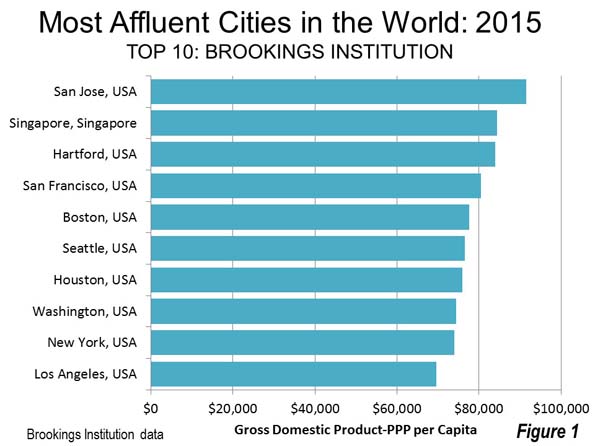
    Houston is a city (metropolitan area) of superlatives. The most recent Brookings Institution data shows that Houston has the seventh strongest per capita economy (gross domestic product) in the world (Figure 1). This places Houston above New York and more surprisingly, perhaps, other cities perceived to have strong economies are far below Houston and outside of the top 10, such as London, Tokyo and Chicago.

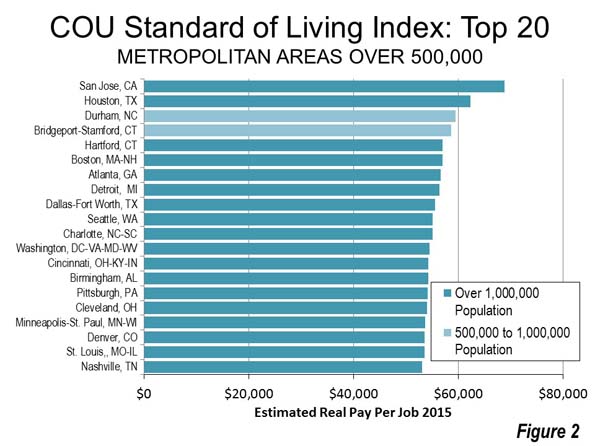
    The recently released COU Standard of Living Index also ranked Houston just behind San Jose in real pay per job for households entering the housing market (Figure 2).

    Distribution of Population Growth

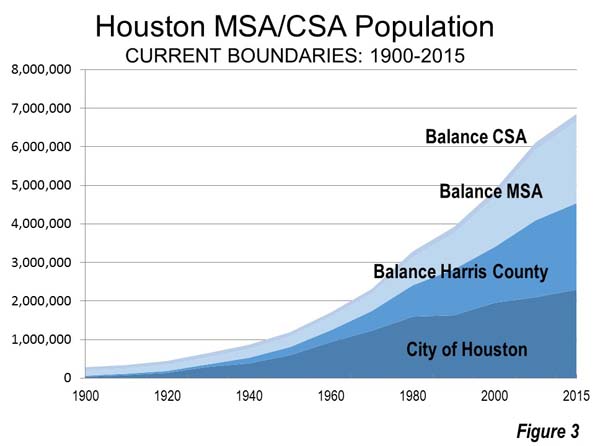
     Houston is among the newer of the world’s great cities. It  has experienced sustained growth in every decade since the turn of the 20th century. The area constituting its metropolitan region (combined statistical area) has grown at more than 1.5 percent in each decade since 1900. In the 1920s and the 1980s, Houston grow at a rate of more than 3.5 percent annually at has grown an average of 2.2 to 2.3 percent annually since 2000. It took until 1950 for Houston to reach 1 million residents. By 1980, the population was 3.3 million and by 2015 had doubled to 6.8 million.

    As is typical for a growing city, the strongest early growth was in the core municipality (Houston) and then gradually shifted to the nearby suburbs and outer suburbs (Figure 3)

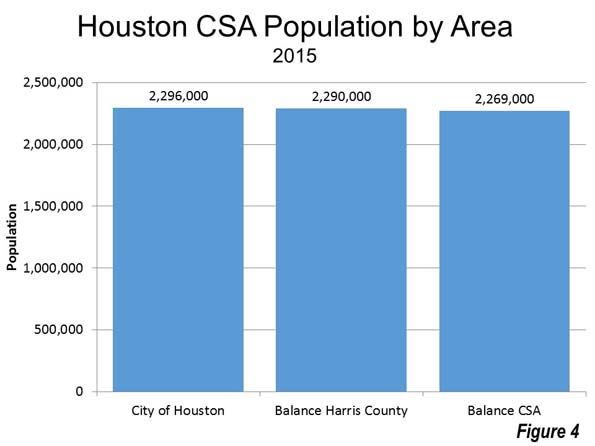
    At this point, near parity has been reached. The municipality of Houston, the suburbs within the core Harris County (the county also home to most of the city) and the outer suburbs, beyond Harris County have nearly equal populations, at approximately 2.3 million each (Figure 4).

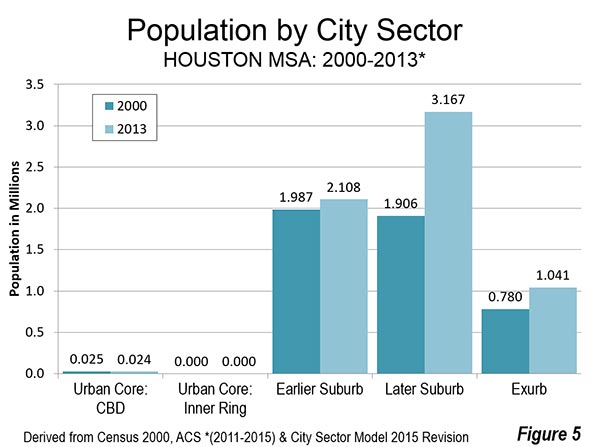
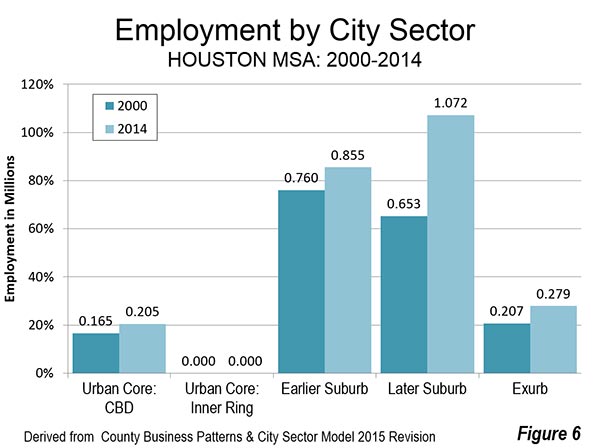
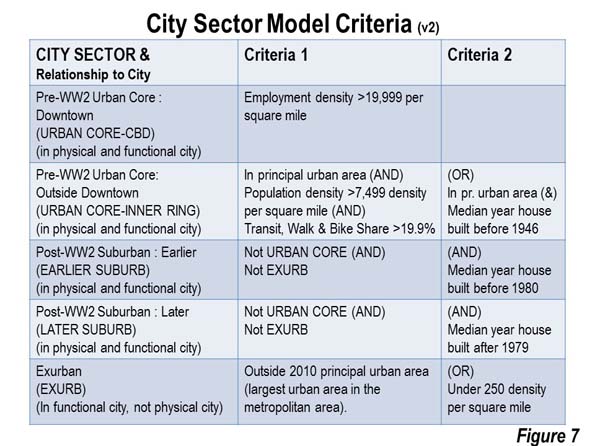
    Like other cities that have experienced most of their growth since World War II, most of Houston is suburban. Between 2000 and 2013, the greatest growth was in the Later Suburbs and Exurbs. There was also growth in the Earlier Suburbs (Figures 5 and 7).

    Large Centers and Decentralization

    There was a similar pattern of growth in employment. The greatest growth was in the Later Suburbs and there was also strong growth in the Exurbs and the Earlier Suburbs (Figures 6 and 7). The central business district (downtown) ranks eighth in total employment in the nation and also experienced growth. The Texas Medical Center is the largest life sciences center in the world. The center is located south downtown and rivals some of the nation’s largest central business districts, larger than Minneapolis and nearly as large as Denver ,, with more than 100,000 employees (see photograph above). There are other large centers, such as the Port of Houston, the Galleria (Uptown) and the Energy Corridor. Houston is one of the best examples of a decentralized city, with major employment centers throughout.

    Higher than Average Urban Density

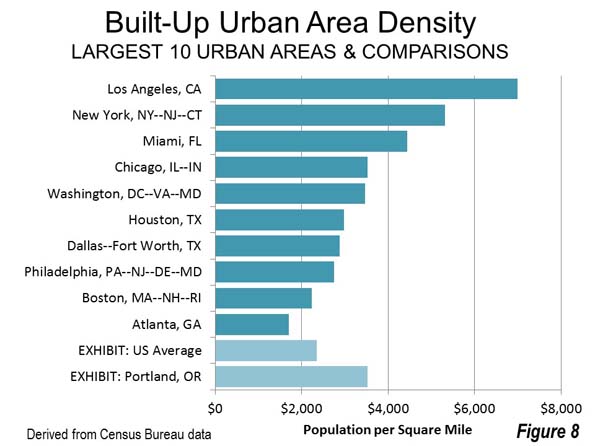
    Houston is often characterized as a “sprawling” urban area. In fact, however, Houston has a higher than average urban density for the United States (by eight percent) and an urban density approximately 75 percent higher than Atlanta and Charlotte and denser than Philadelphia and Boston. Even Portland, with its carefully cultivated international reputation for high density is only 18 percent denser than Houston (Figure 8). Of course, all US urban areas are less dense by international standards than their foreign counterparts.

    Attracting the Most New Residents

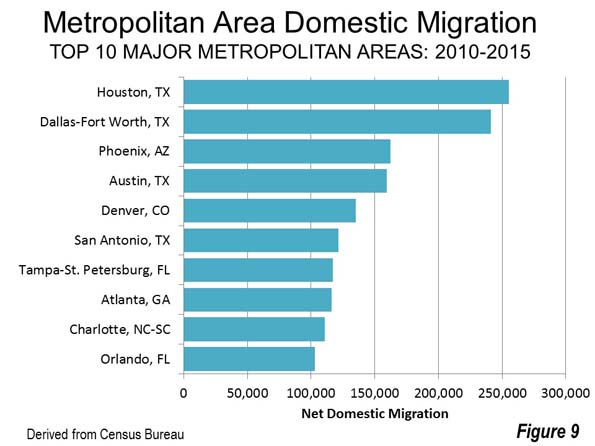
    Since 2010Houston has led the 53 metropolitan areas with more than 1,000,000 population in net domestic migration. In that time Houston has attracted 255,000 new residents from elsewhere in the nation, followed closely by in-state rival Dallas-Fort Worth (241,000). The four largest Texas metropolitan areas with more than 1,000,000 population were among the six attracting the largest net domestic migration, with fourth ranked Austin attracting 159,000 and sixth ranked San Antonio adding 122,000. Only third ranked Phoenix and fifth ranked Denver were from outside Texas. Eight of the top ten were from the South (Figure 9).

    There are at least two important keys to Houston’s attractiveness. Obviously, its strong job-creating economy has opened career opportunities for people from other parts of the country. In addition, Houston’s favorable housing affordability has been an important factor. Seminal recent academic research has pointed to the importance of housing affordability in attracting domestic migrants (such as Ganong and Shoag).

    Enviable Improvement in Relative Traffic Congestion

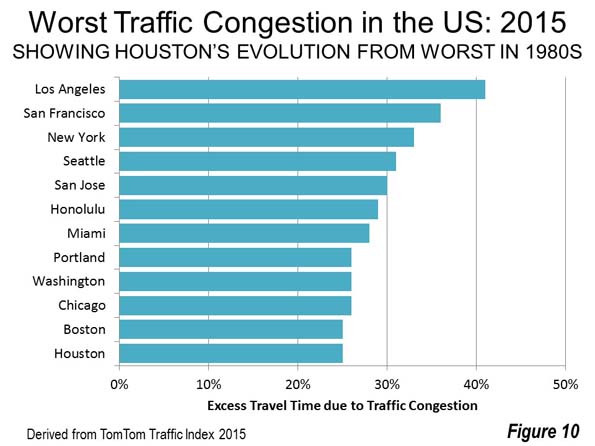
    Houston has been more successful in controlling traffic congestion than many other cities. In 2015, Houston tied with Boston for the 11th worst traffic congestion in the United States, according to the TomTom Traffic Index (Figure 10). This is a far better rating than in the middle 1980s, when the Texas Transportation Institute ranked Houston as having the worst traffic congestion in the nation.

    Since that time, Houston has managed to have spectacular population growth, yet has kept up with it by expanding its freeway and arterial systems, along with traffic management improvements. Los Angeles, San Francisco, Seattle, San Jose, New York, Honolulu, Miami, Portland, Washington and Chicago have seen their traffic congestion become worse than in Houston over the same period. Houston is larger in population than all but three of these nine metropolitan areas (New York, Los Angeles and Chicago), more than twice the size of San Jose and Portland and nearly seven times that of Honolulu. Further, exhibiting the association between greater traffic congestion and higher population density, all cities ranked worse than Houston have higher urban densities.

    World’s Energy Capital Poised for Employment Growth

    Houston is widely acclaimed as the energy capital of the world. Urbanscale.com says that “The only other U.S. city that rivals Houston’s domination of a single industry is New York’s preeminence in the financial sector.” Of course, Houston’s energy industry has faced considerable challenges over the past couple of years as Organization of Petroleum Exporting Countries (OPEC) have driven the price of oil down by producing more oil. However, the “good times” could return soon for Houston, as there are indications that OPEC will reduce its production. Further, and perhaps even more importantly, Houston could benefit from the new Trump administration’s commitment to a more consumer oriented energy policy, appearing likely to generate substantial employment and growth in the newly unleashed sectors.

    Photo: Texas Medical Center (by author)

    Wendell Cox is principal of Demographia, an international public policy and demographics firm. He is a Senior Fellow of the Center for Opportunity Urbanism (US), Senior Fellow for Housing Affordability and Municipal Policy for the Frontier Centre for Public Policy (Canada), and a member of the Board of Advisors of the Center for Demographics and Policy at Chapman University (California). He is co-author of the “Demographia International Housing Affordability Survey” and author of “Demographia World Urban Areas” and “War on the Dream: How Anti-Sprawl Policy Threatens the Quality of Life.” He was appointed to three terms on the Los Angeles County Transportation Commission, where he served with the leading city and county leadership as the only non-elected member. He served as a visiting professor at the Conservatoire National des Arts et Metiers, a national university in Paris.

  • Advancing the Texan City-Building Model

    Reading the recent report “The Texas Way of Urbanism” promptly reminded me of my status – twice a migrant; from small town to big city (Athens) and from big city to another country. These moves were propelled by a singular motivation: seeking opportunity to better my lot. I knew next to nothing about the cities I moved to: their shape and history, their culture, their social divisions and even language were absent from my viewfinder. All that mattered was the chance for a new start. And that’s how Texan metropolises emerge from the report’s pages – gates to opportunity. I carry this typical migrant perspective as a fact-checker to all discussions about cities – magnet-cities.

    It also rekindled an irritation about how warped the conversation about cities often is; as if a group of dilettantes in a pageant give cities points and declare winners. Points are given for: “urban/suburban”, “dense/spacious”, “compact or not”, “grid or not”, “beauty/ugliness” and so on. These arbitrary, spurious abstractions do not register with the migrant – the city’s wealth generator. A professor moves to a post away from home, a multinational corporation executive to another continent, and an oil rig specialist to a small-town with black gold – they are all wealth generators; they move to pursue a goal and, in the process, they build cities unwittingly. They shape them by their actions.

    In admitting that Houston “[….]is not beautiful upon first blush, nor does it offer the charm of pedestrian fancy that denser cities boast”, the report affirms that Texan cities have the right approach: first mind how to generate wealth, then empower citizens to achieve the good life. What follows is a city like no other in history, one that reflects its time, culture and values. It is not Paris, or London, or Tokyo, it is Houston or Austin. The model works. And just as all its predecessors, the new city is never static, not a stage set, it’s a movie in slow motion – it evolves.

    Evolution means adaptation to new pressures. It does not have a destination, a preordained ultimate goal, or shape. In that light, it is a reactive process, constantly responding to emergent conditions.

       The pressure for movement space and its distribution in cities like Barcelona is intense

    From that perspective, the model that builds Texan metropolises is neither final or complete. It inevitably misses unanticipated, emergent factors that today play a role in a functioning city. It has, for sometime, incorporated responses to the pressures of a motorized economy by building infrastructure sufficient to move people and goods to their destinations and it does that better than other U.S. cities. But as the combined effects of automobility are tallied up, a new pressure point has built up. It demands an adaptation to the nature and function of non-motorized mobility and its realm – the foot realm. The pressure is not about more “beauty” or “charm” or a nostalgia for old times, it is about space: redressing the imbalance between space assigned for speeds exceeding 20 miles and space for those below. These two spaces are incompatible. A response to this pressure would add functionality to the Texan model of city making.

       Redistribution of space with controls

    Adaptations to rectify this imbalance need not be invented; they already exist mostly in older cities but also in Texan urban areas. However, they have been mostly sporadic and unsystematic. Nevertheless, all these case-by-case changes nurtured an appreciation for the vast improvement in the quality of the daily city experience, the heightened sociability and the intensified economic activity. In turn, this new appreciation generated greater demand for spaces and places endowed with these qualities.

    Two systematic, universal versions of a layout model – call them “hybrid” grids – have appeared; one in Barcelona, Spain and the second in Calgary, Canada. One for fixing built-up areas and the other for greenfield development.

    That the city of Barcelona would propose a model for transformation might have been expected. It has an expansive, regular grid that is under perilous pressure: extremely dense, congested, mired in emissions and all its surface space taken for motorized movement and parking. The only option was to reallocate the available space. And that reassignment is now underway.

    A team of Barcelona planners have started the implementation of the “superilles” (superblock) model to the classic Barcelona square grid, (see drawing). The principles underpinning the concept are simple and intuitive:

         •  No through motor traffic means that streets at the walking scale (400×400 m) serve as capillaries only; they occupy the lowest rank in the network hierarchy, where circulation essentially stops. They serve the residents of a “quadrant” (or “quartier”) only, are unmistakeably local and, thanks to lighter traffic, can be made narrower, freeing up space for other functions.

         •  Full accessibility for active transport within the quadrant: people circulation is switched “on” while motorized transport is “off” by means of looping cars back to its perimeter. This preferential filtering manages the permeability of the quadrant to its residents advantage. Additional switches, such as card-activated bollards and the scheduling for entry, parking and deliveries, would add accuracy and flexibility of the “on-off” switching and refine the filtering.

         •  Surface space gained from the circulatory function is then assigned to nature and to recreational/social activities thereby strengthening cohesion within each quadrant.

    These typical modular layouts are then applied to the entire grid of the city with appropriate modifications for circumstantial conditions.

    Houston and Austin are two among many U.S. cities that sport square grids just like Barcelona’s. Houston in particular has inherited exceptional 80-foot right-of-ways that offer considerable design flexibility for rearrangement.

    The adaptation that will address the imbalance between vehicular and non-vehicular space in a city is here awaiting adoption. Texan cities can advance their already effective city-building models to a higher state of completion and of responsiveness to current pressures.

    Fanis Grammenos heads Urban Pattern Associates (UPA), a planning consultancy. UPA researches and promotes sustainable planning practices including the implementation of the Fused Grid, a new urban network model. He is a regular columnist for the Canadian Home Builder magazine, and author of Remaking the City Street Grid: A model for urban and suburban development. Reach him at fanis.grammenos at gmail.com.

    Top image: Augustus Koch (1840-?). [Public domain], via Wikimedia Commons