Tag: Houston

  • Houston, City of Opportunity

    This essay is part of a new report from the Center for Opportunity Urbanism titled “The Texas Way of Urbanism“. Download the entire report here.

    Creative friction – unchaperoned and unprescribed – is Houston’s secret sauce.

    At a time when Americans’ confidence in all major U.S. institutions – minus the military and small business – has sunk below the historic average, and only about 20 percent of Americans say they spend time with their neighbors, one would expect pessimism to be universal. But come to the concrete sprawl just north of the Gulf and you’ll find a different vibe, one that other cities would do well to emulate.

    Of course things aren’t perfect in Houston, and the region is taking it a bit on the chin due to the drop in oil prices. But look over the mid- and long-term and the place has consistently lured people from around the country and the world.

    People continue to move to the flat and humid city in higher numbers than any other metropolis. According to the United States Census Bureau, from 2014-2015 metro Houston attracted 159,083 total and 62,000 net domestic migrants, topping the Census list on new metro area residents. Critically, the newcomers represent those population groups most telling of a metro’s future: millennials, immigrants, and families.
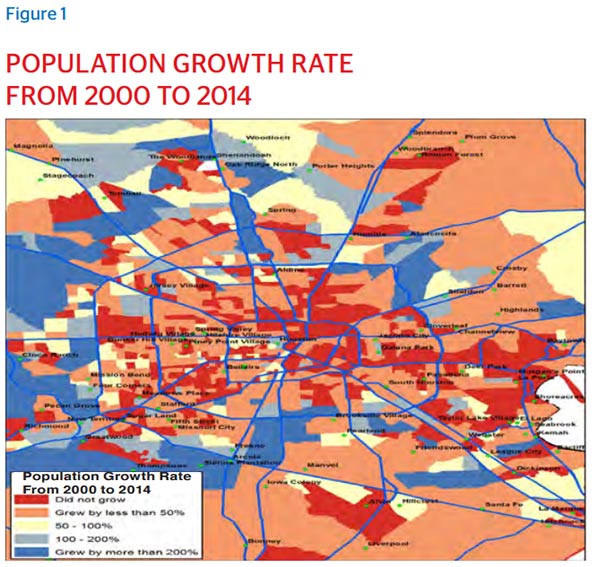
    “The American Dream is still alive here,” say those migrants, one after another. 81 percent of Houston residents rate the city as a good or excellent place to live, according to the 2016 Kinder Houston Area Survey. That’s up from 70 percent a decade ago. And despite the recent economic slowdown, 62 percent of Houston-area residents rated the local economy as “excellent” or “good.”

    Even the most conventional of popular figures have begun to figure this out. “Houston will surprise you,” wrote Katie Couric when she stopped here on a nationwide tour of up-and-coming cities. It was a more iconic statement than perhaps she realized. Outsiders often misperceive Houston as politically conservative and totally dependent upon the energy business, but the city consistently busts internal expectations, too. In Houston, you don’t have to drive far to run into unexpected languages, unexpected restaurants, a huge informal economy and just a pervasive – and bracing – sense of random.

    “It’s a cat city,” says Bill Arning, director of Houston’s celebrated Contemporary Arts Museum. He moved here in 2009 from Boston. “If you arrive without a tour guide, without a friend who knows the city, it’s hard to figure out where things are. There are no landmarks. Whereas Austin is a dog city – you know where the beautiful people are – Houston is a cat city. Its charms are there, but you’ve got to come to it. You’ve got to take a little time.”

    What sets Houston apart? What about the city makes so many residents confident they will find their version of the American dream here? If it is indeed a city of opportunity, what lessons might other cities absorb and weave into their own policies and cultural fabric? Through many interviews, data sleuthing and the everyday experience of living here, I found five traits that define Houston: affordable proximity, multipolarity, social deregulation, an active future orientation, and humility. What follows is a tour of the city that knows no limits.

    Affordable Proximity

    “There’s always been a haphazard nature to the city, from the beginning,” says Sanford Criner, a native Houstonian as well as vice chairman at CBRE, the world’s largest real estate firm. “Where Chicago – which was founded the same year [1836] – had an economic reason for being the day it was founded, Houston was a real estate play. These guys came down from the northeast – New York, Pennsylvania – and they bought some land and sent out flyers.

    “I’ve seen some [of the flyers], and they’re hysterical,” Criner continues. “‘Salubrious environment!’ said one. ‘Well-watered!’ said another. They’d have this picture that looks like a little Swiss valley, with chalets up the hill, and there wasn’t a house here! It was a scam. But that’s how we now date the founding of our city.”

    Where others saw only wilderness along the banks of Buffalo Bayou, Augustus Chapman Allen and John Kirby Allen saw promise, and convinced people to take a gamble and move. This rambunctious “come one, come all” attitude continues to define the city’s development, 180 years later.

    The city of Houston is famous for its no zoning policies, the fruits of which are visible in the hodge-podge of commercial and residential hubs evident on a first drive in from one of the two airports. The apparent haphazardness may dizzy outsiders, but for Houston residents it’s a gift that my colleague Tory Gattis calls “affordable proximity”: the ability to live near one’s place of employment while keeping the cost of living affordable. It’s a challenge that has become onerous in many cities, but one that Houston manages to tackle with surprising efficiency.

    “It’s definitely true that it’s easier to build things here than elsewhere,” says Criner. “We’ve been able to build things relatively inexpensively and rapidly that have generally benefited everybody.”

    Since 2010, Houston has expanded its housing stock to issue construction permits for 189,634 new units, paralleling the population growth. This is in sharp contrast to competitor cities such as New York, Los Angeles, Chicago and the Bay Area, where construction tends to lag behind population.
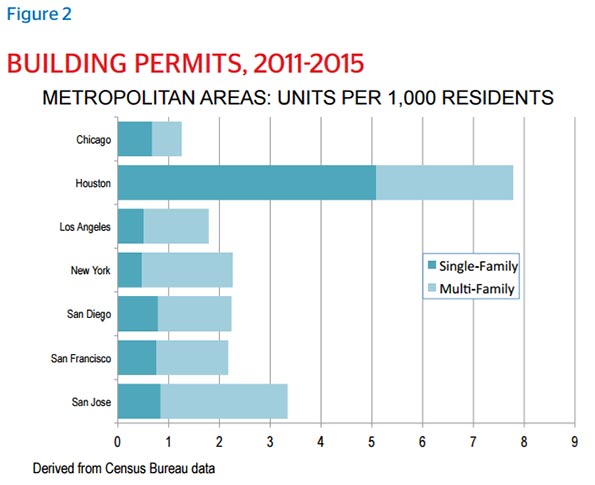
    Houston is uniquely able to create housing to meet demand. The populations in both New York City and Houston have grown significantly in the past six years, but New York, like many big cities, has not come close to meeting demand. A lot of this has to do with sheer land availability and willingness to expand outward, but Houston’s light regulatory touch has crucially allowed developers to be in sync with consumer need and preference, without the red tape that slows other cities’ building and adaptability. A key result has been a greater level of affordability, and of choice.

    In April of 2016, The Wall Street Journal highlighted groundbreaking research by Issi Romem, chief economist at real-estate site BuildZoom, showing that the cities that have expanded geographically have kept their house prices more affordable.
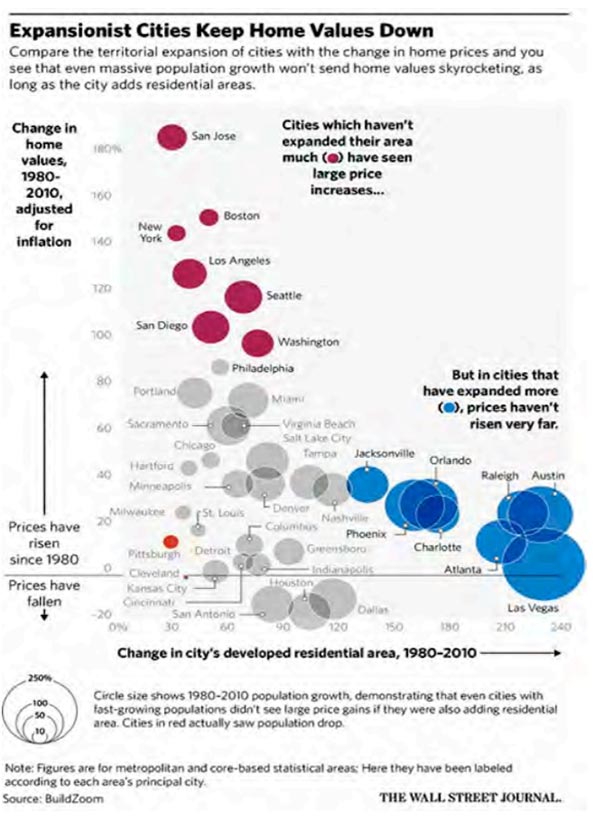
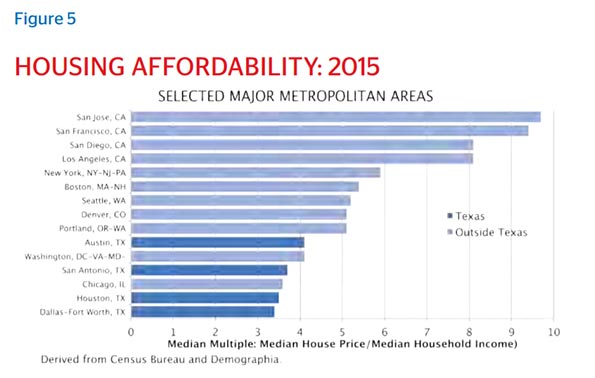
    According to the National Association of Home Builders/Wells Fargo Bank Housing Affordability Index, more than 60 percent of homes in the Houston metro area are now considered affordable for median-income families, compared with only 15 percent in Los Angeles, once ground zero for the dream of homeownership. According to Zillow, renters in New York spent 41.4 percent of their income on housing in 2015, whereas the share for their Houston counterparts was just 31 percent.

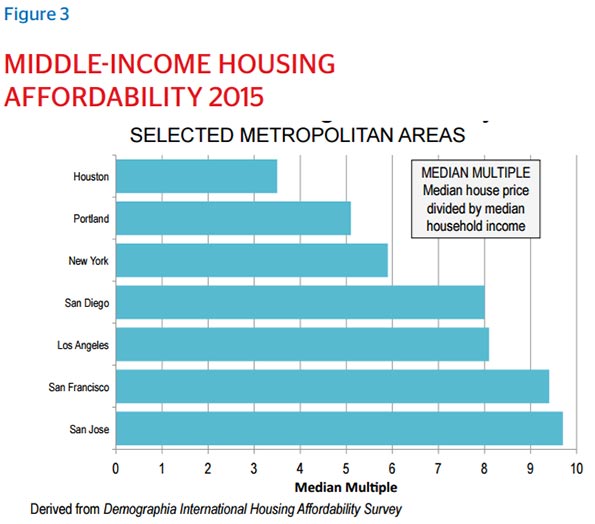
    The Demographia International Housing Affordability Survey provides ratings for all major metropolitan areas in the U.S., and Houston consistently ranks as more affordable than cities like Portland, New York, San Francisco and San Jose, all of which have more restrictive regulations.
    Houston’s housing is also diverse. Houston has become the national leader in new multifamily units, helping to preserve and expand access to urban living. At the same time, the Houston metro has led the country in new single-family houses.
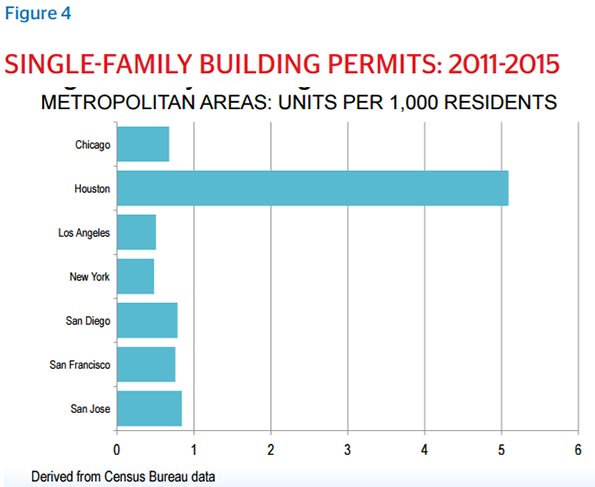
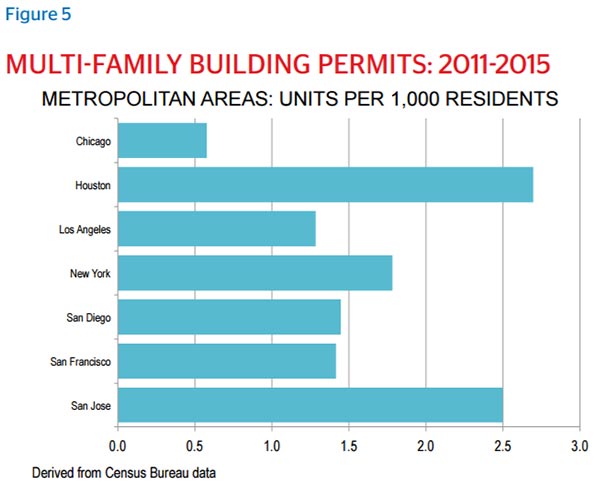
    Availability of affordable land and a lighter regulatory environment allowing for outward expansion has made it possible for many to afford a residence near the city’s dispersed job centers. In addition, as City Observatory recently reported, a series of reforms adopted in 1999 shrunk the required residential lot size from 5,000 square feet to 1,400 square feet, enabling town home development in high demand areas proximate to jobs.

    Proximity to work is especially appealing to millennials, who have moved to Houston in droves. The U.S. Census Bureau showed a 25 percent increase in millennial residents between 2000 and 2013, with millennials currently making up 24 percent of Houston’s total population. Many of these new adults want to reduce their commutes, or even ditch their cars for the sake of enjoying a more seamless transition between professional and personal life. Houston offers this possibility across urban and suburban areas, the multipolarity of business centers providing flexibility to carve a nice triad of work, residence, and play.
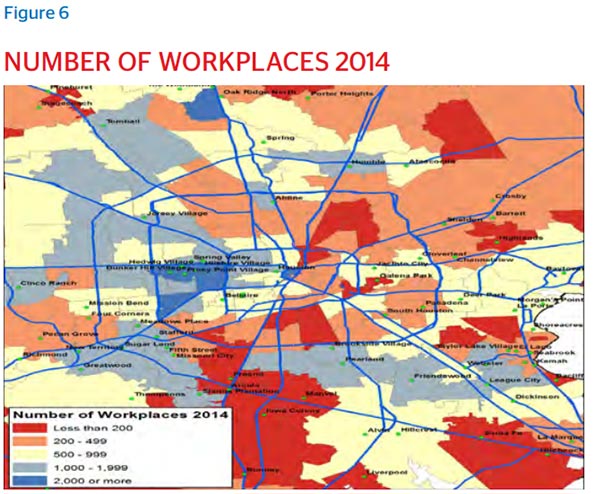
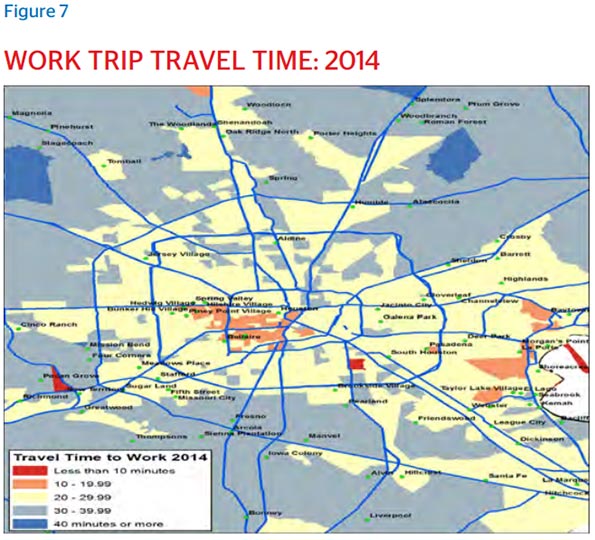
    Despite the impression of endless freeways, Houston’s commute times are better than those in metros of comparable populations. One-way commutes were 28.4 minutes in 2014, according to the American Community Survey, making Houston the fourth best out of nine comparable cities.
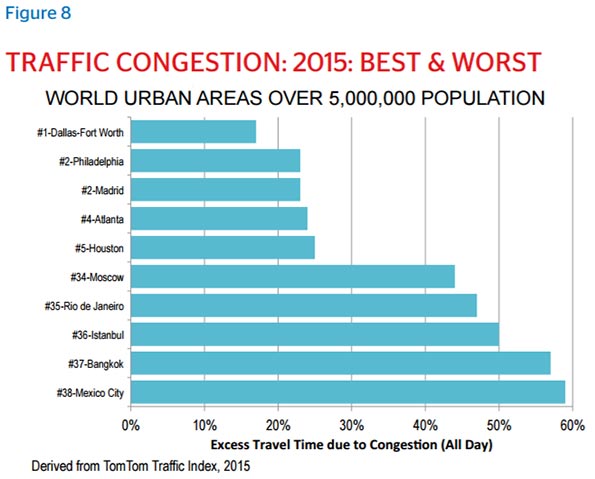
    Houston also does very well on an international scale with respect to traffic congestion, according to TomTom in 2015. The region ranked fifth out of the 38 urban areas that have populations over 5 million.
    None of this suggests Houston lacks room for improvement in mobility, but it’s credit to the city’s decision to dramatically increase roadway capacity and arterial streets that it has managed to improve its ranking in traffic congestion while experiencing a huge increase in population. According to the Texas A&M Transportation Institute, in 1984 and 1985 Houston was ranked with the worst congestion in the country, even worse than Los Angeles. Now Houston is ranked 10th, even as it’s nearly doubled its population, from 3.5 million in the mid-1980s to 6.5 million today. Only Atlanta and Dallas can boast similar mobility improvements.

    Multipolarity and Economic Diversity

    Most Americans think of Houston as an oil and gas town. And while energy still undergirds much of the city’s economy, Houston boasts many other assets as well: the world’s largest medical center, one of the world’s busiest ports, the third largest manufacturing hub in the country, a booming technology sector and a wide range of small to medium-sized businesses, including a thriving informal sector of immigrant-run businesses. This has led to demand for labor at all skill and education levels, unique among the top ten largest cities.

    “Best Online Programs in 2016,” said U.S. News & World Report about the University of Houston. “Top Cities for Competitiveness to Attract Investment in Chemicals & Plastics,” said Conway about Houston in 2015. “Best Hospitals for Adult Cancer – University of Texas MD Anderson Cancer Center” said U.S. News & World Report in 2015. “Top Blue-Collar Hot Spots,” said Forbes in 2014. “Most Favorable Metro for STEM Workers [Nationally],” said WalletHub in 2015.

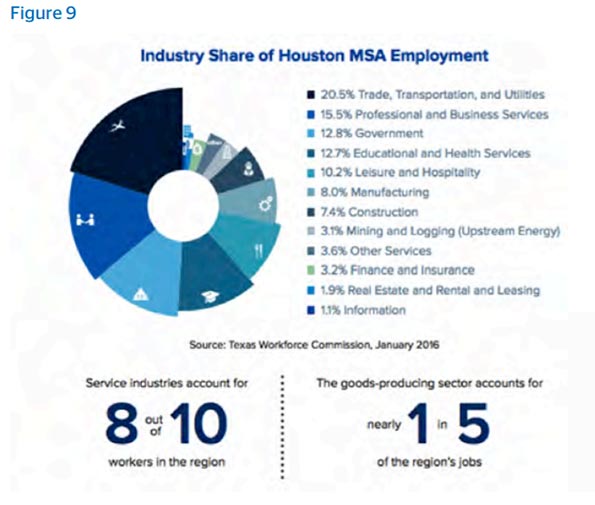
    Houston is no stranger to “Best Of” lists that today’s mayors scour. But what’s notable is the cross-sector nature of the superlatives. According to a June 2016 report from the Texas Workforce Commission, 20.3 percent of Houston’s workers are in Trade, Transportation and Utilities, 15.5 percent are in Professional and Business Services, 12.8 percent in Government, 12.7 percent in Education and Health Services, 10.2 percent in Leisure and Hospitality, 8 percent in Manufacturing and 7.4 percent in Construction.
    The city has learned from its mistakes. The 1980s, which saw a slump in oil prices much greater than that in 2015, bulged in profligate building and overconfidence. According to the Greater Houston Partnership, from 1982 to 1986, developers built more than 100,000 single-family homes, many of them without a signed contract from a purchaser. Even when the region lost more than 200,000 jobs, office developers continued to build, including adding more than 71.7 million square feet of office space while companies were laying off staff and declaring bankruptcy. Today, the office market is tighter, banking is better regulated and better capitalized, and few homes are built without a signed contract. Most importantly, the region is creating jobs that aren’t in energy, including in health care, business and professional services.

    Social Openness: A City for Everyone

    Houston is deregulated economically, but it’s of greater note that it’s deregulated socially. People come here from many walks of life and culture, and the relative youth of the city combined with its scrappy DNA means that there really isn’t a dominant Establishment, certainly not one that wants to block the efforts of ambitious newcomers.

    “If you talk to [old] Houstonians about social mobility,” says Sanford Criner, “they kind of give you this quizzical look. Like, ‘what do you mean?’ Like, ‘Sure, of course.’ It seems obvious.”

    This city’s always been a mixer; you just have to be willing to share what wakes you up in the morning. Marlon Hall is an African American filmmaker and native Houstonian who started Folklore Films, a documentary production company created to “tell better stories to our city about our city.” He and fellow filmmaker Danielle Fanfair have featured former Mayor Annise Parker, arts patron Judy Nyquist, internationally recognized musical artist DJ Sun and other community figures. As the Folklore Films crew has gotten better acquainted with Houston residents from across the social spectrum, Marlon locates the vocational “why” as central to the city’s currency.

    “Houston isn’t driven by who you know,” he says, “but by how you want to be known. It isn’t about what pedigree you have received, but about the possibilities you want to bring to bear.”

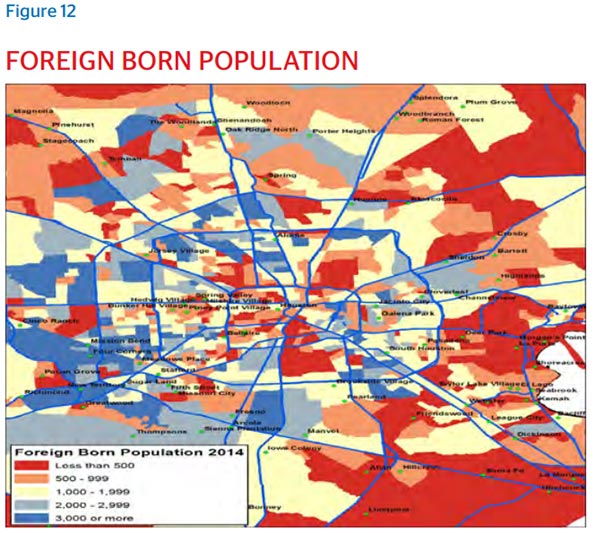
    This kind of invitation has attracted the motivated from all over the world, with the city now pulsating with 145 languages. An international city since the day it was founded, now more than one in five Houstonians are foreign-born, with the 2014 American Community Survey reporting that 63.9 percent of the foreign born population were Latin Americans, 25.2 percent were Asian, 5.1 percent were African and 4.6 percent were European. As of the 2010 Census, Greater Houston does not have a majority racial or ethnic group.
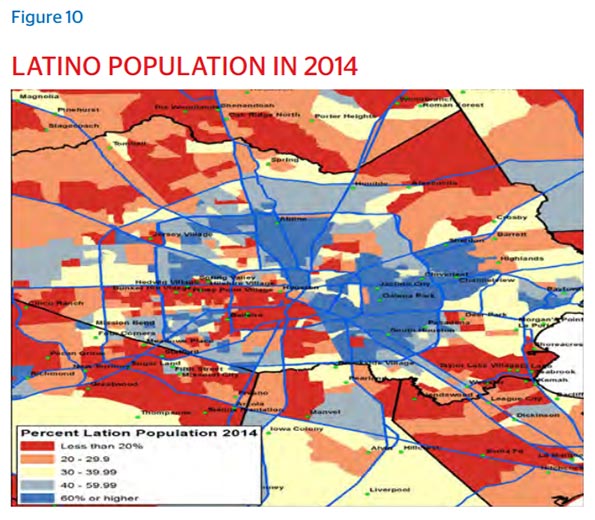
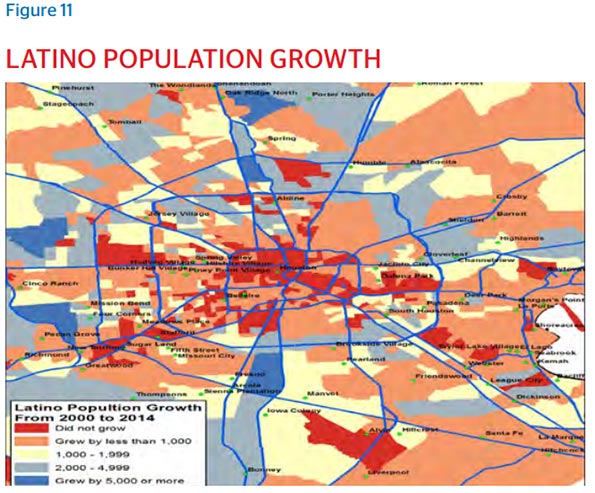
    People come to Houston seeking opportunity, and because they sense in the visible randomness the potential for surprise ingredients to leaven the traditions they’re bringing with them. This is as true for immigrants as well as domestic migrants, with the city’s celebrated restaurant scene born out of the unexpected merging of flavors from cultures that don’t typically mix. Underbelly’s Chris Shepherd, Bistro Menil’s Greg Martin and Lucille’s Chris Williams all cite Houston’s diversity as a major factor behind the city’s flavorful palate, in both story and succulence.

    “This is edible history,” says Chris Williams, the founding chef at Lucille’s, a restaurant that takes a modern approach to Southern classics. “The food that we do here pays homage to my great-grandmother, who was a chef and a pioneer and an American icon.”

    It’s not soul food, but Southern. With a rustic European style, and a multi-generational American story at the heart.

    “Like all chefs in [my great-grandmother’s] time, your style of food was defined by what was available to you. What you could afford to work with. The flavors that I grew up with…married with the techniques and the flair that I picked up working in Europe for four years. Everywhere from London to Lithuania. …I’m influenced by the simple rustic dishes – the ones about the culture, not the flashy ones. The perfect piece of fish fresh caught, served with good potatoes, great olive oil, fresh garlic, and a little bit of parsley.”

    Bistro Menil is another spot that takes a slice from Europe and re-interprets the classic dishes for Houstonians. Its patrons come from Rice University, the Medical Center, the Museum District and beyond, the attraction of the world-renowned Menil Collection standing just across the street. Inspired by the concept of cask wine, which head chef Greg Martin discovered on a trip to Rome, Bistro Menil relies heavily on relationships with cosmopolitan – yet locally centered – Houstonians.

    “I don’t want to compete with that dish that you had in Rome,” Martin says, aware of ingredient limits this side of the Atlantic. “I want to reinterpret it with more of a New American approach, with some fresh eyes on our market, using our ingredients. Our ingredients and produce come from everywhere…I work really closely with a local importer. We’ve been working together for 30 years. He brings in our duck legs from Canada, our jamón Serrano from Spain. He brings all of our cheese in from France, Italy and Spain.”

    It’s not just the food that shows Houstonians willing to work together across silos and lift up the local talent. “We have a very supportive gallery scene,” says Bill Arning, of the Contemporary Arts Museum. “Even the galleries that show a lot of major international and national artists, like the Texas Gallery and McClain Gallery, will not only show local artists, they’ll place them in the top collections in town. That’s unusual.”

    The social egalitarianism combined with a pervasive “show me what you got” curiosity creates something very unique. Hipster cocktail bars seem no more privileged than authentic Vietnamese restaurants than classic barbecue and the iconic Rodeo. The lack of zoning makes thoroughfares like Westheimer Road, which stretches for miles from the city center to the distant suburbs, an avenue of cultural mismatches: The New York Times’-celebrated Underbelly is sandwiched between three tattoo parlors, a Catholic guild clothing store and the latest in coffee-roasted curation. There are so many opportunities to mix with those different from you that only the snobby find themselves bored and excluded. Creative friction – unchaperoned and unprescribed – is Houston’s secret sauce.

    “This is a city that does not believe in censorship,” says Arning.

    Agile, Active, and Future-Orientated

    Houston is not Silicon Valley, but its entrepreneurial DNA is unmistakable, dispersed across many fields. The city emanates a conviction that people should have the freedom to determine their destiny, sometimes to the point of overlooking those that don’t have such clear vision, nor the resources and social networks to make it happen. The city is growth- and future-oriented, embracing change and risk. True to its namesake in Sam Houston – himself a failure before reinventing himself – Houston grants permission to fall hard.

    “Houston is the only town where a person with no prior experience in a particular vocation can get joint venture capital for something they’ve never done before,” says local arts patron Judy Nyquist in one of Marlon’s Folklore Films. “Simply by virtue of their commitment to their idea, and how it can make the city better.”

    This is true across sectors – for-profit, social service, and philanthropic.

    Ella Russell of E-dub-a-licious Treats was an African American single mom working for AT&T when a breakup with her partner caused significant financial hardship. Her two boys, then age 3 and 9, came home from school asking to bring in treats for a holiday party. Russell felt helpless, all disposable income had run dry. But she did find sugar, flour and eggs in her pantry.

    “I scraped up change to buy a bag of chocolate chips,” Russell recalls, “so I could make chocolate chip cookies. The kids took them in, and then I brought the leftovers in to work. My coworkers loved them, saying every future potluck would have to have my cookies.”

    Three years later, her friends urged Russell to turn the sweetness into a business.

    “I had no business experience other than what I knew working in corporate America,” Russell says. “I really winged it; I had no basis but the support of my friends.” In a couple years, she went from serving family and friends to delivering in seven different states.

    In the burgeoning scholarship entrepreneurship of the last decade, the work of Saras D. Sarasvathy of the Darden Business School at the University of Virginia stands out. She’s coined a term called “effectual reasoning” to describe the mindsets of master entrepreneurs, one that pairs well with Houston’s soil:

    Brilliant improvisers, the entrepreneurs don’t start out with concrete goals. Instead, they constantly assess how to use their personal strengths and whatever resources they have at hand to develop goals on the fly, while creatively reacting to contingencies. By contrast, [highly successful] corporate executives use causal reasoning. They set a goal and diligently seek the best ways to achieve it.

    Sarasvathy likes to compare expert entrepreneurs to Iron Chefs: “[They are] at their best when presented with an assortment of motley ingredients and challenged to whip up whatever dish expediency and imagination suggest,” she writes. “Corporate leaders, by contrast, decide they are going to make Swedish meatballs. They then proceed to shop, measure, mix, and cook Swedish meatballs in the most efficient, cost-effective manner possible.”

    If we could take her comparative study and extrapolate from it particular civic traits, you might see Chicago as the sort of personality for corporate leaders, Houston for the entrepreneurial. The city is rife with improvisers, fueled by a deep prioritization of human relationships, an affection for eccentrics and a perennial optimism that loves to build before over-planning. The fact that there are lots of open spaces to create, and fill, encourages new entrants into any kind of market, be it technological, artistic, or consumption-oriented.

    This goes well beyond profit-seeking ventures. The Chronicle of Philanthropy identifies Houston as one of the country’s most generous cities, ranking at #11 for giving as a percentage of adjusted gross income – three stops behind Dallas.

    “As [Dallas-Fort Worth and Houston] have each become centers of gushing economic production, and matured as communities, an energetic competition has grown up in their creation of impressive new parks, museums, hospitals, universities, and arts centers,” wrote Ari Schulman in the Fall 2015 issue of Philanthropy Magazine. “Burgeoning circles of local patriots wielding newly minted fortunes have dramatically changed the quality of life in both cities over the past decade or so.”

    This enhanced quality of life has involved a deeper renaissance in the arts, a proliferation in family-friendly green spaces, advancements in medical facilities and, increasingly, innovative educational ventures. Houston’s acclaimed Museum of Fine Arts is currently undergoing a $450 million redesign, two-thirds of that already raised with the help of giant gifts from pipeline entrepreneur Richard Kinder and money-manager Fayez Sarofim. Kinder and his wife Nancy have also given $30 million to a public-private partnership aimed at reviving a snaking bayou from a stagnant waterway to an attractive waterfront graced by 20 miles of hike-and-bike trails, canoe launches, playgrounds, art installations, and outdoor performance venues.

    “This kind of public-private partnership happens all the time,” says Criner. “In lots of other cities, philanthropic organizations tend to be run by the same group of guys that have been running stuff for a long time, and they treat them like their own turf. You don’t see that here at all. This is way more like, “if you can help, come on! What can you do? We’ll put you to work.”

    “We have a tradition of philanthropy that my colleagues in other cities [envy],” agrees Arning, of the Contemporary Arts Museum. “Privileged young people here feel they need to find their philanthropies early on. That is something uniquely Houston.”

    Humility and Cultural Accessibility

    Long considered the unattractive hothouse of the south, Houston has suffered from a long-running inferiority complex when comparing itself to other cities. Even since rising to the top of dozens of “Best of” lists in the last five years, the residue from generations of modesty remains.

    Before Marlon Hall was running Folklore Films, he and Danielle began something called the Eat Gallery, an incubator for budding chefs around the city that sought to turn food trucks into restaurants. In ramping up for this effort, they went around and asked Houstonians questions about where they found meaning, where they felt they fit, where they felt they made a difference. They discovered that people had low city esteem.

    “They’d go to a great ballet, and they’d be like, wow, this reminds me of Chicago, Hall recalls. “They’d go to a musical performance and be like, oh, this feels like New York. People were telling the worst stories to the city about the city.

    “So we said, what if we told better stories to Houstonians about Houstonians, featuring people that folks know and celebrate? But what if we began their stories with their brokenness, so that people would know that there’s something inherently broken about every beautiful person? So that’s what we did, that’s why we started Folklore Films. To raise the city esteem.”

    Folklore discovered that Houston is a city of new beginnings. When you move here, the past intrigues less than how you intend to exploit the future. Whether you’re an immigrant from overseas or a fellow American that’s left some entrenched failure behind, Houston pulses with a forward-looking frankness grounded in a humility shaped by whatever came before. This drive paired with an individual and corporate self-awareness defines the city’s character – culturally, spiritually and even economically.

    “There’s this at-homeness that people from Houston have,” Hall says. “When I think about people who have left Houston to do other things, like Beyonce, there’s this comfort to be who one is. She walks around with hot sauce in her purse – I mean, who else can say that from where else?”

    “There’s something about Houston that’s like…I’m not afraid to be who I am, even if it’s full of seeming contradictions.”

    “The collective body in Houston is significantly more adventurous than most cities,” Arning of the Contemporary Arts Museum says. “Both in use and collection. In most collection cities, you hear who supported or recommended the collection before going. Houstonians, because of their wildcat nature, [will try anything] they like.”

    Houston’s increasing diversity keeps the city vibrant and ever ready to accept change and innovation. There is no room for insularity because there is no homogeneity. Your ideas are constantly being chiseled and countered by the Other. No one has the luxury of feeling superior because everyone’s in a gem tumbler with folks not like them. It makes the city competitive, but not in a way that produces monopolies.

    “I think that Houston has come to this place where it’s a ‘My Space,’” says Marlon. People want to take ownership of their lives and creations here. “There’s a desire to own who you are in Houston, which is different from owning a business, a house a car.”

    Houston residents tend to be proud of their individual accomplishments, and feel an affection toward the place that allowed those accomplishments to happen. But there’s a recognition that success is the result of many different pieces coming together, usually organically and iteratively. The environment invites people to fulfill their individual destiny, and almost discourages any person or governing body to take credit for Houston’s successes as a whole.

    “I hesitate to say things like ‘I’m proud of Houston,’” Sanford Criner says. “What gives you the right to take pride in a place? Did you build it? Did you do it?”

    Challenges to Sustaining Opportunity

    Houston continues to beat the odds to this day. And while its adventurous impulse is what continues to draw people to Houston and make it the emblem opportunity city for 21st century dynamics and demographics, it must still be said that what you put into the world must survive. Houston is a much better place to live than it was 30 years ago. But will it continue on this trajectory, or even sustain the fruits of its triumphs?

    Houstonians recognize there needs to be a concerted effort to reform and improve Houston’s educational opportunities, its transportation and traffic infrastructure, and a more general care to respect tradition and an intensive effort toward more inclusive mobility. The city’s grown so big, so fast, it could inevitably buckle under its own weight.

    “We are not on track to make headway on a lot of the issues that are facing us,” says James Llamas, of Traffic Engineers, Inc. “We’re growing way faster than we’re adding transportation capacity or options, at the same time there does seem to be recognition that we need to do something and what we’ve been doing isn’t going to continue to work.”

    Despite precedent, massive infrastructure may not be the answer, especially given the shifting preferences of a younger population and the costs of maintenance. New mayor Sylvester Turner is considering expanding to two HOV lanes and providing express bus service. Others advocate for densification of the more traditional gridded neighborhoods that are far from holding their population capacity – but without adding infrastructure, and without pushing anyone out.

    And then there’s the perennial education challenges.

    “We are now in a different economy where education is critical,” says Stephen Klineberg, founding director of the Kinder Institute. “It never used to be critical, especially not in Texas. You made money by land – by exploiting all the natural resources you needed on the land. The great cattle, timber, oil. The source of wealth in the 21st century Houston, is knowledge. …If you don’t have education beyond high school, with the technical skills that allow you to get the jobs of the 21st century, and compete, you’re not going to make it. Texas hasn’t come fully to grips with it.”

    Conclusion

    In the last 20 years, Houston has cultivated a series of signaling mechanisms that continue to draw people into its orbit. It’s a welcoming city, supported by affordability and diversity. Majority opinion says “anything is possible if you’re willing to work hard,” a conviction increasingly on the decline in the rest of the country. And, crucially, it’s cultivated the conditions necessary for entrepreneurs to have a field day. “The assortment of motley ingredients” noted by innovation scholar Sarasvathy describes Houston in a nutshell, and the regulatory instinct has been to stay light, allowing imported imaginations to run experiments without interference.

    The city’s not beautiful upon first blush, nor does it offer the charm of pedestrian fancy that denser cities boast. But in an era of civic unrest, with many up and down the social spectrum feeling disconnected and robbed of agency, Houstonians can still shape their destiny. The city’s the clay; residents the potters. The wide range of home sizes and work-life arrangements makes Houston like the cowboy boot its Rodeo celebrates – adaptable to the needs of each life stage as residents progress through singleness, marriage, family and retirement. Residents are not trapped by the regulatory, financial or even social limits that other cities increasingly impose. The mindset is one of abundance, not scarcity.

    “This is the genius of this place,” wrote Cort McMurray in the Houston Chronicle in January of 2016, in a profile of an Iraqi refugee who had come to Houston with a B.S. in Chemistry, currently cleaning pools. “Houston will always be shambolic and stretched and not quite finished. We will never be the most beautiful city, or the most pedestrian-friendly city, or the most efficiently planned city: The heat and soul-sapping humidity, our adolescent fascination with cars and speed and shiny things, our perpetual craving for something new, all conspire against our best civic aspirations. Houston is a place to start over, and we do starting over better than any other city on the planet.”

    In an age of heightened political frustration, a sclerotic economy and shifting structural tectonics, it could be that the “starting over” ethos that Houston embodies is precisely what the country itself needs, and what other cities should seek to foster in their own policies and cultural climates. Innovation, reinvention and reinterpretation, after all, lie at the heart of the American genius.

    Anne Snyder is a Fellow at the Center for Opportunity Urbanism, a Houston-based think tank that explores how cities can drive opportunity and social mobility for the bulk of their citizens. She is also the Director of The Character Initiative at The Philanthropy Roundtable, a pilot program that seeks to help foundations and wealth creators around the country advance character formation through their giving. She previously worked at The New York Times in Washington, as well as World Affairs Journal and the Ethics and Public Policy Center. She holds a Master’s degree in journalism from Georgetown University and a B.A. in philosophy and international relations from Wheaton College (IL), and has published in The Atlantic MonthlyNational JournalThe Washington PostCity Journal and elsewhere.

    Top photo: Photo by Chris Doelle, Licensed under CC License.
  • The Texas Urban Model

    This essay is part of a new report from the Center for Opportunity Urbanism titled "The Texas Way of Urbanism". Download the entire report here.

    The future of American cities can be summed up in five letters: Texas. The metropolitan areas of the Lone Star state are developing rapidly. These cities are offering residents a broad array of choices — from high density communities to those where the population is spread out — and a wealth of opportunities.

    Historically, Texas was heavily dependent on commodities such as oil, cotton, and cattle, with its cities largely disdained by observers. John Gunther, writing in 1946, described Houston as having “…a residential section mostly ugly and barren, without a single good restaurant and hotels with cockroaches.” The only reasons to live in Houston, he claimed, were economic ones; it was a city “…where few people think about anything but money.” He also predicted that the area would have a million people by now. Actually, the metropolitan area today is well on the way to seven million.

    It would no doubt shock Gunther to learn that Texas now boasts some of the most dynamic urban areas in the high income world. Approximately 80 percent of all population growth since 2000 in the Lone Star state has been in the four largest metropolitan areas. People may wear cowboy boots, drive pickups and attend the big rodeo in Houston, but they are first and foremost part of a great urban experiment.

    The notion of Texas as an urban model still rankles many of those who think of themselves as urbanists. Most urbanists, when thinking of cities of the future, keep an eye on the past, identifying with the already great cities that follow the traditional transit dependent and dense urban form: New York, London, Chicago, Paris, Tokyo. And yet, within these five urban areas, there are large, evolving, dynamic sections that are automobile oriented and have lower density.

    Measuring Employment Success

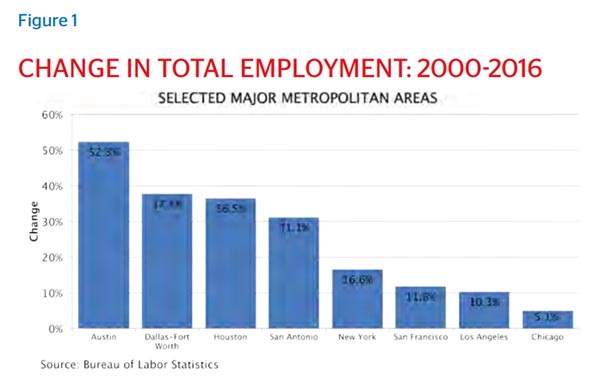
    Since 2000, Dallas and Houston have increased jobs by 31 percent, growing at three times the rate of increase in New York and five times as rapidly as Los Angeles. Texas’ smaller but up-and-coming metropolitan regions are also thriving, with San Antonio and Austin, for example, boasting some of the most rapid job growth in the country.

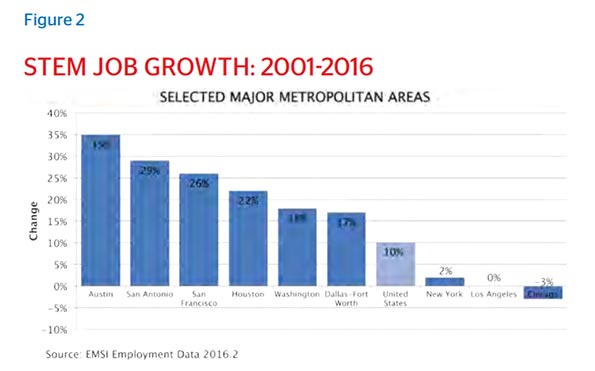
    This growth is not all at the low end of the job market, as some suggest. Over the past fifteen years Texas cities have generally experienced faster STEM (Science, Technology, Engineering and Math-related) job growth than their more celebrated rivals. Austin and San Antonio have grown their STEM related jobs even more quickly than the San Francisco Bay Area has grown theirs, while both Houston and Dallas-Fort Worth have increased STEM employment far more rapidly than New York, Los Angeles or Chicago.

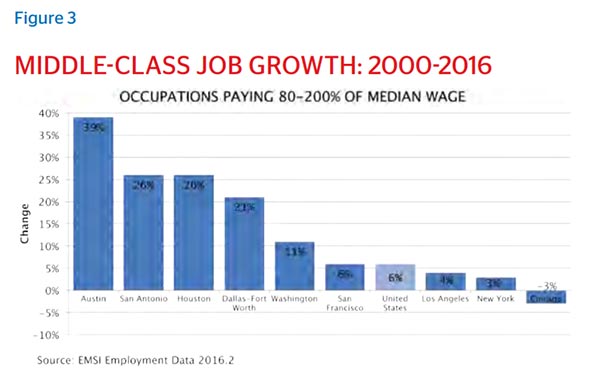
    The Texas cities also have enjoyed faster growth in middle class jobs, those paying between 80 percent and 200 percent of the median wage at the national level. Since 2001, these jobs have grown 39 percent in Austin, 26 percent in Houston, and 21 percent in Dallas-Fort Worth, a much more rapid clip than experienced in San Francisco, New York or Los Angeles, while Chicago has actually seen these kinds of job decrease.

    Recent Pew Research Center data illustrates that between 2000 and 2014, out of the 53 metropolitan areas with populations of more than 1,000,000, San Antonio had the second largest gain in percentage of combined middle-income and upper-income households; the percentage of households in the lower-income segment dropped. Houston ranked 6th and Austin ranked 13th, while Dallas-Fort Worth placed 25th, still in the top half.

    Much of the credit for this growth in jobs goes to the state’s reputation for business friendliness. Texas is consistently ranked by business executives as the first or second leading state. Needless to say, New York, California and Illinois do not fare nearly as well. The Texas tax burden ranks 41st in the country. Compare this to New York, which has the highest total state tax burden, Texas rates are also far lower than those in New York, neighbors Connecticut and New Jersey, or in California.

    The Demographic Equation

    No surprise, then, that people are flocking to the Texas cities. Over the last ten years, Dallas-Ft. Worth and Houston have emerged as the fastest growing big cities of more than five million people in the high-income world, growing more than three times faster in population than New York, Chicago, Los Angeles or Boston. Among the 53 US major metropolitan areas, four of the top seven fastest growing from 2010 to 2015 were in Texas.

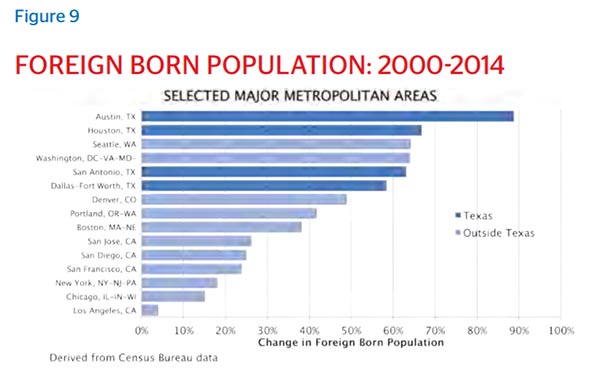
    Foreign immigration, a key indicator of economic opportunity, is now growing much faster in Texas’ cities than in those of its more established rivals. Between 2000 and 2014 alone, Texas absorbed more than 1.6 million foreign born citizens. In numbers, that’s slightly less than California took in, but in proportion to Texas’ population it is 60 percent more.

    During that same time period the Latino population of Austin grew by 90 percent; Dallas-Fort Worth and Houston each grew by about 75 percent. In contrast, the Latino population in Los Angeles grew only 17 percent.

    Houston now has a far higher percentage of foreign born residents than Chicago does. Dallas-Ft. Worth draws even with Chicago in that measurement, with an immigrant population that has grown three times as fast as that of the Windy City since 2000.

    Economic opportunity explains much of the difference. Texas’ vibrant industrial and construction culture has provided many opportunities for Latino business owners. In a recent measurement of best cities for Latino entrepreneurs, Texas accounted for more than one third of the top 50 cities out of 150. In another measurement, San Antonio and Houston boasted far larger shares of Latino-owned businesses than Los Angeles, which also has a strong Latino presence.

    Texas is not a totally successful environment for minorities. Poverty levels for blacks and Hispanics remain high, and education levels lag in Houston, Dallas-Fort Worth and San Antonio. But the key factor is that Texas cities present superior prospects for upward mobility.

    Domestic Migration Trends

    Since 2000, Dallas-Ft. Worth has gained 570,000 net domestic migrants, and Houston has netted 500,000. In contrast, the New York area has had a net loss of over 2.6 million people, while Los Angeles hemorrhaged a net 1.6 million, and Chicago nearly 900,000. Dallas-Fort Worth, Houston, Austin and San Antonio were all among the top eleven in total net domestic migration gains. The smaller Texas cities have also experienced large gains in migrants.

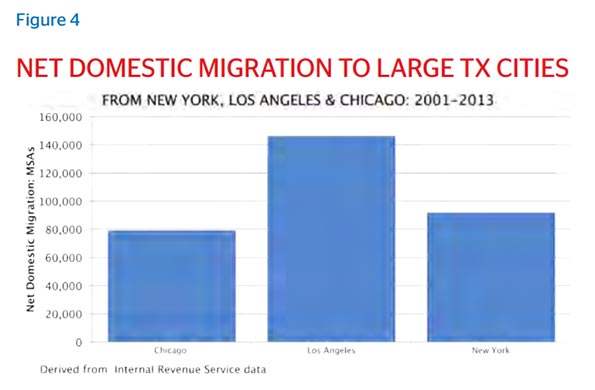
    Many newcomers come from places — notably, California — where many Texans once migrated. Between 2001 and 2013, more than 145,000 people (net) have moved from greater Los Angeles to the Texas cities, while about 80,000 have come from Chicago and 90,000 from New York.

    As Dallas Morning News columnist Mitchell Schnurman says, “If oil prices don’t go up, Texas can always count on California — and New York, Florida, Illinois and New Jersey.”

    Creating the Next Generation of Urbanites

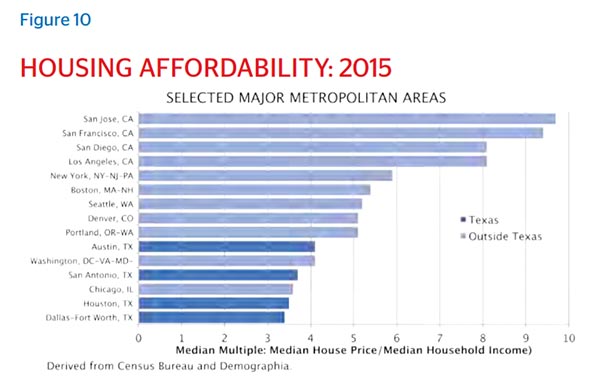
    Texas urban growth has occurred more or less in conjunction with market demand, without the strict controls and grandiose ‘visions’ that dominate planning in New York and California. Overall housing prices in Texas cities remain, on average, one-half or less than those in coastal California cities such as San Francisco, San Jose, San Diego and Los Angeles. They are a third below those in New York, and have not experienced the huge spikes in housing inflation seen elsewhere in the Northeast Corridor, such as in Boston.

    The lower house prices in Texas facilitate greater aspirations to home ownership, particularly among young people. The financial leap from renting to owning is far less daunting in Texas than it is the Northeast, or in some western US cities.

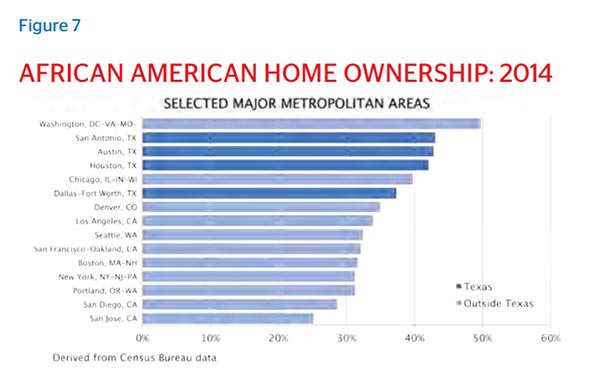
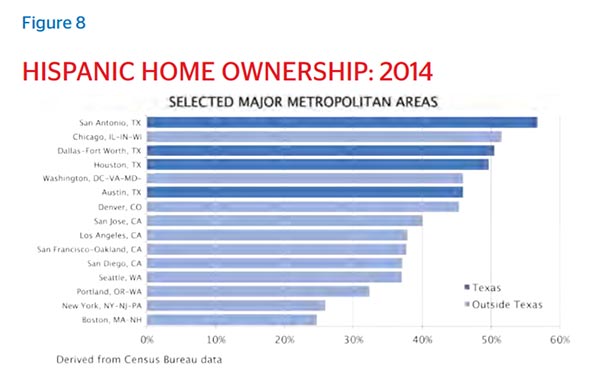
    These lower prices have been a boon to ethnic minorities, who make up an ever-growing percentage of the population in cities nationwide. Latinos and African-Americans are far more likely to be home owners in Texas cities than in New York, Los Angeles, Boston or San Francisco.

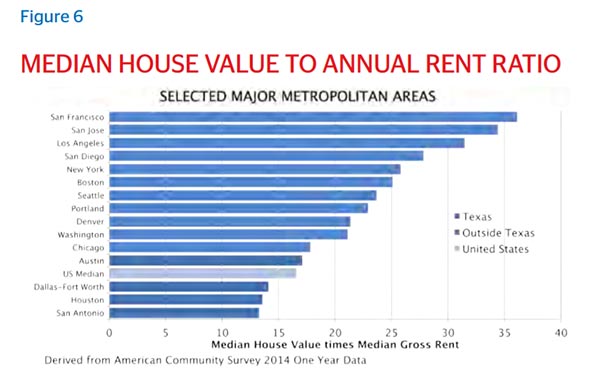
    A review of US Department of Commerce Bureau of Economic Analysis data indicates that housing costs are responsible for virtually all of the cost-of-living differences between the nation’s approximately 380 metropolitan areas. Consequently, it is far cheaper to live in Texas cities — even Austin — than in Boston, New York, Los Angeles, San Diego, Chicago and, most of all, the San Francisco and San Jose metropolitan areas.

    Some observers lament that, due to market forces, the vast majority of Texas metropolitan growth — nearly 100 percent — has taken place in the suburbs and exurbs. Yet the Texas cities mirror nationwide experiences: there is essentially no difference between the share of metropolitan development in the Texas suburbs and the share in most other areas. The average share for all major metropolitan areas is 99.8 percent, including in Portland, Oregon, the much ballyhooed model for densification.

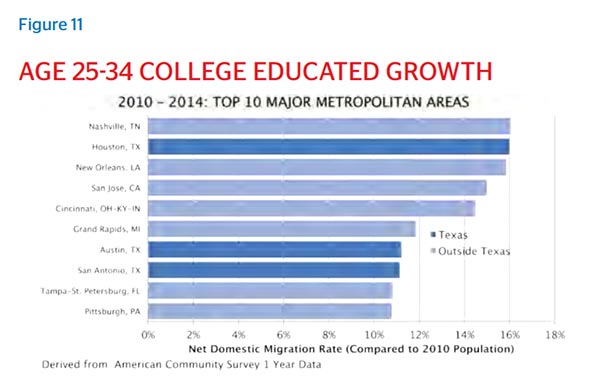
    Ironically, dense housing development has grown more rapidly in Texas cities than it has in California, where the state has tried to mandate dense development. Building permit rates indicate that Texas cities have led the nation in both low density single family housing and in high density multifamily development. Between 2010 and 2015, Texas’ largest cities held three of the top five positions among the 53 major metropolitan areas in the issuance of multifamily building permits. Austin led the nation in these permits, while Houston and Dallas-Fort Worth had higher multifamily building permit rates than San Jose, Denver, Portland, Washington, or Los Angeles. At the same time, these three Texas cities also were in the top 10 in single-family building permits. Who occupies these new residences? Between 2010 and 2014 Texas cities, led by Austin and San Antonio, experienced higher rates of growth among college educated 25 to 34 year olds than did traditional ‘brain centers’ like New York, Boston, Chicago and even San Francisco. During the tech boom of the late 1990s, more people moved from Texas to the Bay Area than vice versa; in the current one, the pattern is reversed. A recent San Jose Mercury poll found that one-third of all Bay Area residents hope to leave the area, primarily citing high housing costs and overall cost of living.

    As young people mature, Texas’ major urban areas provide them with an array of choices. Texas city-dwellers, unlike many New Yorkers or San Franciscans, do not need to choose between living a middle class family lifestyle or staying in a city they love. Texas housing policies that allow organic growth driven by the market are attractive to young people seeking to establish careers or families, and to those who are already newly-established.

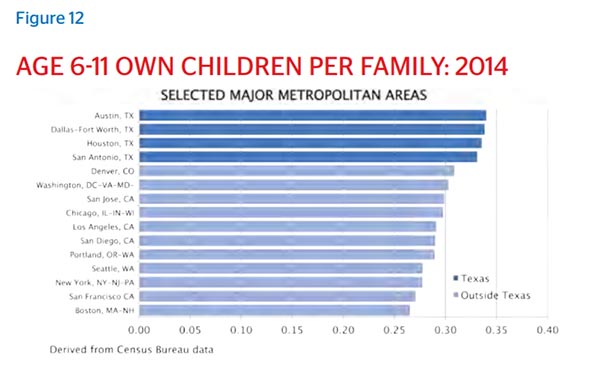
    These trends will have a long-term demographic impact, and suggest a continuing Texan ascendency. According to the American Community Survey’s ranking of elementary-age school children per family, Austin, Dallas-Fort Worth, Houston and San Antonio rank in the top six among the 53 major metropolitan areas. By comparison, Chicago ranks twenty-second, Los Angeles twenty-seventh, New York thirty-sixth, and San Francisco 45th.

    The Lone Star State is already home to two of the nation’s five largest metropolitan areas, the first time in history that any state has so dominated the nation’s large urban centers. At its current rate of growth, Dallas-Ft.Worth, could surpass Chicago in the 2040s, as would Houston a decade later. By 2050 the Lone Star state could dominate America’s big urban centers even more than it does now.

    Joel Kotkin is executive editor of NewGeography.com. He is the Roger Hobbs Distinguished Fellow in Urban Studies at Chapman University and executive director of the Houston-based Center for Opportunity Urbanism. His newest book, The Human City: Urbanism for the rest of us, will be published in April by Agate. He is also author of The New Class ConflictThe City: A Global History, and The Next Hundred Million: America in 2050. He lives in Orange County, CA.

    Wendell Cox is principal of Demographia, an international public policy and demographics firm. He is a Senior Fellow of the Center for Opportunity Urbanism (US), Senior Fellow for Housing Affordability and Municipal Policy for the Frontier Centre for Public Policy (Canada), and a member of the Board of Advisors of the Center for Demographics and Policy at Chapman University (California). He is co-author of the “Demographia International Housing Affordability Survey” and author of “Demographia World Urban Areas” and “War on the Dream: How Anti-Sprawl Policy Threatens the Quality of Life.” He was appointed to three terms on the Los Angeles County Transportation Commission, where he served with the leading city and county leadership as the only non-elected member. He served as a visiting professor at the Conservatoire National des Arts et Metiers, a national university in Paris.

    Welcome To Texas” flickr photo by David Herrera is licensed under CC BY 2.0

  • The Emergence of Texas Urbanism; The Triangle Takes Off

    This essay is part of a new report from the Center for Opportunity Urbanism titled "The Texas Way of Urbanism". Download the entire report here.

    Throughout the history of the United States, much of the nation’s economic vitality can be traced to specific regions and their mastery of the productive sectors which propelled the country forward. Today we see this most evident in the remarkable emergence of the “Texas Triangle” encompassing Houston, Dallas-Ft. Worth, and Austin-San Antonio.

    The role of metropolitan regions reflects a steady theme of shifting economic power throughout American urban history. The early stages of commercial growth and then the first wave of industrial innovation established the economic strength of the New York-Connecticut-Massachusetts region; the global roles of New York City and Boston owe much to this early start, in part due to the talent networks and capital that clustered in these cities.

    Heavy industry, the next phase of industrial growth — autos, steel, and appliances — blossomed in the early Twentieth Century, transforming metros from Cleveland to Chicago into global economic powers. These areas provided the country much of the wherewithal to win the Second World War. Over the last 75 years, technology breakthroughs and Asia-Pacific trade relationships have steadily accelerated the importance of the extended West Coast region from Seattle to San Diego.

    More recent has been the rise of other regions, many which were once backwaters. This includes Miami, with its strong ties to the Caribbean and South America; the Southern belt of cities reaching in an arc from Charlotte and Raleigh to Atlanta and Nashville. Then there’s the rising Intermountain West, centered largely in the metros of Denver, Salt Lake City and Phoenix.

    But no place has seen more dramatic and steady economic and demographic growth than the Texas Triangle, formed by the Dallas-Fort Worth metro at its northern point in North Texas; the Houston metro at its southeastern edge on the Gulf Coast; and Austin-San Antonio at its western tip in Central Texas.

    The growth of these areas has transformed Texas from a largely agricultural and commodities-producing state into a highly urbanized and economically sophisticated place. Together the metropolitan areas of the Texas Triangle have a population of more than 18 million residents. The Texas Triangle metros together account for more than 66% of the population of Texas and 77% of the GDP of the nation’s second largest state.

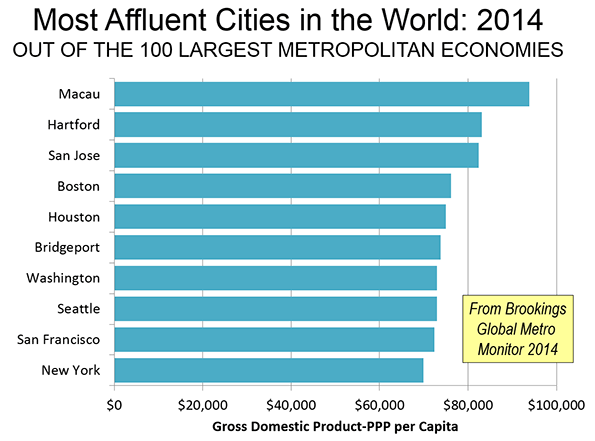
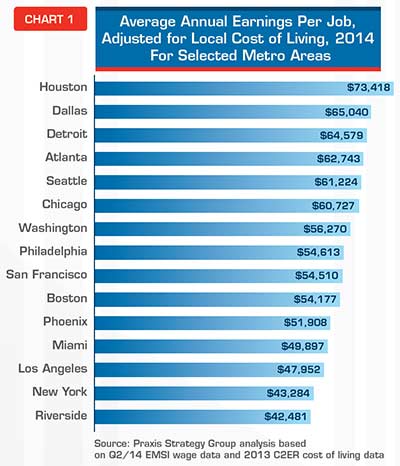
    This emergence is now globally acknowledged. In terms of economic strength, each of the Texas Triangle metros ranked among the top six strongest urban areas in the nation in a post-recession analysis by the Praxis group and their economic output together would position the Texas Triangle as the fifth strongest regional economy in the U.S. in a framework created by metropolitan scholar Richard Florida. The fact that these measurements use a variety of factors suggests the powerful and pervasive nature of the Texas urban ascendency.

    One way to look at the importance of the Texas Triangle is to examine the vital and often quite unique economic contributions which each metropolitan area contributes to the nation’s well-being.

    • Houston is the acknowledged energy capital of the world with its complex of energy headquarters, financing institutions, research centers, and petroleum processing and transportation facilities. Its medical center houses more clinical institutions and life sciences research facilities than any other medical complex in the world.

    • Dallas-Fort Worth is an established financial center, telecommunications pioneer, and its two airports are the hubs of flights connecting the Southwestern U.S. to the nation and to the world. It has become a favored location for corporate expansions and relocations for both domestic and foreign companies.

    • Austin and San Antonio are connected by 75 miles of continuous urbanization, including the vital region around San Marcos and a string of the fastest growing small cities in the nation. Austin is home to world-class companies, particularly in technology, the University of Texas, and also is home to the government of the nation’s second largest state. San Antonio is home to the nation’s second largest concentration of cybersecurity companies, to three major Armed Forces commands, to an international automotive manufacturing hub centered on Toyota, and to the most visited destinations in the state, the Alamo and the Riverwalk.

    Although not as established as a global center as the metropolitan networks on the East and West coasts, the Texas Triangle now occupies an increasingly important place among the world’s commercial centers. There are now 53 Fortune 500 firms headquartered in the Triangle metros, including American Airlines, AT&T, and Exxon Mobil in Dallas-Fort Worth; USAA and Valero, and Whole Foods in San Antonio and Austin; and Conoco-Phillips and Halliburton in Houston. Global headquarters, such as Occidental Petroleum, and national operational headquarters, such as those of Toyota USA and Mitsubishi Heavy Industries, underscore that the global role of the Texas Triangle is ascendant.

    The Texas Triangle is also home to a concentration of high-quality higher education. Nationally-ranked research institutions such as the University of Texas at Austin and Rice University in Houston are joined by such major public institutions as the University of Houston; the University of Texas campuses at San Antonio, Dallas, and Arlington; and the Texas A&M campus in San Antonio. Excellent private institutions include Southern Methodist University in Dallas, Texas Christian University in Fort Worth, and Trinity University and Incarnate Word University in San Antonio. Within the geographic expense of the Texas Triangle are such powerhouses as Texas A&M University in College Station and Baylor University in Waco.

    The Texas Triangle is connected to the commercial centers of the globe through its impressive transportation assets. The Port of Houston is the second largest port by volume of tonnage in the U.S. The state boosts major airline hubs for American Airlines at DFW Airport, for United Airlines at George Bush Houston International, and for Southwest Airlines at Love Field in Dallas, as well as extensive international airline connections from Austin and San Antonio. Major cargo volumes flow on the state’s highway grid, most notably on the NAFTA Highway, IH-35, which delineates the western spine of the Texas Triangle and expedites the greatest volume of international freight from any inland port to markets across the nation.

    This economic ascendency owes much to pro – business Texas policies, largely embraced by both major political parties, that stress job creation and wage growth as the best strategies for continued and broadened prosperity. Investments in roads, water, power, broadband, ports and essential public facilities, such as higher education campuses, remain priorities in state and municipal budgets.

    But what really makes the Triangle grow is its people, animated by the spirit of new opportunity luring work-ready in-migrants from other states and ambitious immigrants from around the world. Texas attracts investors, entrepreneurs, researchers, inventors, and workers who recognize a state committed to reducing barriers to economic success and to creating the financial, educational, and physical conditions for growth and upward mobility.

    That combination of the policy regime, the physical facilities, and the human energies has created an economic juggernaut now claiming its place among the great commercial networks of the world. The nation can look to the Texas Triangle for future breakthroughs in innovative products and creative services. But beyond that the world can look to the Texas Triangle for examples of cities that combine a passion for growth with a determination to improve the lives of people.

    Henry Cisneros is Chairman of City View companies, which have invested in and built more than 90 urban residential projects since 2000 in 13 states. Mr. Cisneros is also Chairman of the Executive Committee of Siebert Cisneros Shank, one of the nation’s most successful minority-owned public finance and capital markets firms, having participated in more than $2.5 trillion in municipal and public authority issuances and corporate transactions. Mr. Cisneros was Mayor of San Antonio for four terms and was Secretary of the U.S. Department of Housing and Urban Development in President Clinton’s Cabinet from 1993-97. He is a corporate board member of Univision Communications and La Quinta Holdings and is Vice Chairman of Habitat for Humanity International and a board member of the Bipartisan Policy Center in Washington D.C.

    Photo: NASA [Public domain], via Wikimedia Commons

  • Urbanism, Texas-Style

    Cities, noted René Descartes, should provide “an inventory of the possible,” a transformative experience—and a better life—for those who migrate to them. This was certainly true of seventeenth-century Amsterdam, about which the French philosopher was speaking. And it’s increasingly true of Texas’s fast-growing metropolises—Houston, Dallas–Fort Worth, Austin, and San Antonio. In the last decade, these booming cities have created jobs and attracted new residents—especially young families and immigrants—at rates unmatched by coastal metropolitan areas. Approximately 80 percent of all population growth in the Lone Star State has been in the four large metropolitan areas since 2000. Texas now boasts two of the nation’s five largest metros, the first time any state has enjoyed that distinction. At its current rate of growth, Houston could replace Chicago as the nation’s third-largest city by 2030, and the Dallas–Fort Worth region could surpass Chicagoland as the nation’s third-largest metropolitan area by the 2040s.

    Historically, those who think and write about urban living have regarded Texas cities with disdain. The midcentury journalist John Gunther dismissed Houston, now the state’s largest city, as a place “where few people think about anything but money.” Gunther predicted that the area’s population would eventually grow to a measly 1 million people. He was off by a bit: close to 7 million people now call the Houston metropolitan area home. Houston and the other flourishing Texas metros are neither downtown-focused like New York nor highly regulated and densely packed like Los Angeles. They aren’t disproportionately brain-intensive or tech-oriented; and they aren’t dominated by green politics and, generally speaking, strict planning. Though booming, they have kept living costs down. In all this, they differ from San Francisco, Seattle, Portland, Los Angeles, and Boston—places that may continue to thrive in the future but that show little interest in creating the economic opportunity and affordability that attracts aspirational middle- and working-class families. In short, Texas’s cities are reshaping urbanism in America, albeit in ways few scholars or planners seem to appreciate.

    Though some east/west coastal cities—notably, San Francisco—have enjoyed vigorous growth of late, none has been nearly as proficient in creating jobs in the new millennium as Texas’s four leading metros. Overall, Dallas–Fort Worth and Houston have emerged as the nation’s fastest-expanding big-city economies. Between 2000 and 2015, Dallas–Fort Worth boosted its net job numbers by 22.7 percent, and Houston expanded them by an even better 31.2 percent. Smaller Austin (38.2 percent job-base increase) and once-sleepy San Antonio (31.4 percent) have done just as well. New York, by way of comparison, increased its number of jobs in those years by just 10 percent, Los Angeles by 6.5 percent, and San Francisco by 5.2 percent, while Chicago actually lost net employment. And the Texas jobs are not just low-wage employment. Middle-class positions—those paying between 80 percent and 200 percent of the national median wage—have expanded 39 percent in Austin, 26 percent in Houston, and 21 percent in Dallas since 2001. These percentages far outpace the rate of middle-class job creation in San Francisco (6 percent), New York and Los Angeles (little progress), and Chicago (down 3 percent) over the same period.

    The energy industry can take some credit for Texas’s impressive numbers, but only some. In fact, despite assertions that dense coastal cities are the natural incubators of innovative tech firms, an analysis of the last decade and a half shows that Texas’s sprawling metropoles are growing Science, Technology, Engineering, and Math (STEM) jobs more rapidly than the Bay Area—and far faster than New York, Los Angeles, and Chicago. Since 2001, STEM employment in Austin is up 35 percent, while Houston has increased these desirable positions by 22 percent and Dallas by 17 percent. STEM jobs have increased 6 percent in San Jose and 2 percent in New York over this same period. L.A. has seen no STEM growth; Chicago has lost 3 percent of such positions.

    Recent Pew Research Center data give further evidence of the Texas urban boom. Among 52 American metropolitan areas with more than 1 million residents, San Antonio had the largest gain in its share of middle- and upper-income households—that is, the percentage of households in the lower-income category in the city actually dropped—from 2000 to 2014. Houston ranked sixth, Austin 13th, and Dallas–Fort Worth 25th in the Pew survey. The performance is even more impressive, given Texas’s absorption of 1.6 million foreign-born residents since 2000, a 60 percent larger intake than California’s, proportionate to the two states’ populations.

    All this dynamism reflects Texas urbanism’s remarkable culture of opportunity. These are business-friendly cities. According to Site Selection magazine, executives consistently rank Texas as the best or second-best locale to do business in the United States. Taxes are among the lowest in the country. (New York has the heaviest tax burden; California isn’t far behind and seems determined to catch up.) Regulations are light. Coastal urban areas often impose draconian climate-change rules or favor high density, thus discouraging industries like manufacturing, logistics, and home construction—all thriving under Texas urbanism’s market-friendly reign.

    “The consensus in San Antonio,” observes former mayor and longtime Democrat Henry Cisneros, “is all about jobs. Everything is driven by that.” One can say the same about the other big Texas metros. The jobs focus can be seen in the many corporate relocations and expansions in Texas, which are often large-scale, employing many middle managers—unlike highly publicized relocations of “executive headquarters” in cities such as Chicago, which frequently employ, at most, several hundred people. The recent movement of Occidental Petroleum from Los Angeles to Houston as well as transfers of jobs from Chevron—still headquartered in the San Francisco Bay Area, at least for now—alone represented some 2,000 jobs.

    A key part of this opportunity culture rests on housing affordability. Property inflation plagues east/west coastal cities, largely because of restrictive planning policies that slow development, making the cost of living exorbitant. Texas cities are instead pro-development—“self-organizing,” in the words of Rice University’s Lars Lerup—and, as they happily expand their peripheries, they encourage a healthy supply of housing at all income levels. The inexpensive housing, a major draw for those relocating firms, has helped shift a long-standing migration pattern of jobs and people. In the last tech boom, more people moved from Texas to the Bay Area; in this one, it’s the other way around. Last year, at least three dozen companies either expanded away from or moved out of Santa Clara, San Francisco, and San Mateo Counties—ten of them to Texas, according to a recent report by Spectrum Location Solutions, an Irvine business-consulting firm that tracks corporate “divestment” from California. When Toyota recently moved its headquarters from Los Angeles County to the Dallas area, for example, executives said that the L.A. area’s rising housing prices—roughly three times what they are in Dallas–Fort Worth, adjusted for income—had much to do with it.

    Dallas–Fort Worth might be the big metro that benefits most from this movement. The typical corporate expansions in the Dallas area—not just Toyota but also State Farm, Liberty Mutual, and Amazon—have included headquarters and back-office centers in the area’s northern suburbs, creating thousands of jobs. As Southern Methodist University scholars Klaus Desmet and Cullum Clark found in a soon-to-be-published study, jobs are shifting from Chicago and surrounding areas to Dallas–Fort Worth in such numbers that the Texas city is increasingly poised to replace the Windy City as the business center of the mid-U.S.

    People are coming in droves. “Gone to Texas” or “GTT”: the phrase became famous during the nineteenth century as Americans fleeing debts (especially after the Panic of 1837) headed to the Lone Star State to escape impoverishment or even prison. Texas also attracted the ambitious, the desperate, and, in some cases, the downright dishonest. The phrase may become popular again. Over the last decade and a half, Texas’s four major cities ranked among the nation’s ten fastest-growing large metropolitan areas. Since 2000, Dallas–Fort Worth has boosted its population by 33.6 percent; Houston did even better, expanding 38 percent. Boston, Chicago, Los Angeles, and New York, by comparison, grew less than 10 percent over that period. Last year, Houston and Dallas–Fort Worth each gained more people than New York or L.A.

    The domestic migration numbers are truly striking. Over the past 15 years, Houston and Dallas–Fort Worth have gained an estimated 1 million domestic migrants, even as New York lost more than 2.4 million net migrants, L.A. bled 1.5 million, and Chicago 800,000. As a percentage of the population, the Texas cities averaged a 1 percent net migration gain annually; Chicago, L.A., New York, and San Francisco have seen strong net losses annually. San Antonio and Austin have also been gaining migrants at a rapid rate. In fact, Austin has attracted more newcomers as a percentage of its population than any major metropolitan area in the country since 2000. Texas Monthly calls it “the city of the eternal boom.”

    Many of the new Texas urbanites are arriving from places—above all, California—to which Texans had once migrated. Between 2001 and 2013, more than 145,000 people, net, have moved from the greater Los Angeles area to Texas cities, while more than 90,000 have come from New York and nearly 80,000 from Chicago. The newcomers are better educated than the average Texan, and they elevate the quality of the workforce, observes Dallas Morning News columnist Mitchell Schnurman. “If oil prices don’t go up, Texas can always count on California—and New York, Florida, Illinois, and New Jersey.”

    The domestic migrants’ numbers include many blue-collar workers seeking a better future, so the migrants’ average education level falls slightly below that of people moving, say, to Boston or San Francisco. But the Texas metropoles are increasingly attractive to the young, educated workers who often flock to those coastal cities. According to a recent Cleveland Foundation study, three of the four major Texas cities ranked among the top-ten regions nationally in the growth in educated residents aged 25 to 34. The migrants’ imprint is evident in the expanding urban amenities of Texas cities, including a vibrant restaurant scene and innovation in the arts.

    Affordability is a major draw for these younger newcomers. The ten regions losing the most millennials last year, according to Trulia, include Chicago, New York, Washington, and the area along California’s coast—all much pricier than the Lone Star State. More than 30 percent of millennials still live at home in Los Angeles and New York City, according to Zillow data, more than one-third higher than the rate in Dallas and Houston.

    Texas is also drawing massive migration from overseas. Like the young migrants crowding the clubs and hip eateries of the Texas boomtowns, the foreign-born are, in their own ways, transforming the economy and culture of the state. Asian immigrants, barely present before 2000, have been the fastest-growing group. Over the last decade, Houston and Dallas–Fort Worth had a larger increase in their Asian populations (including Chinese, Indians, Vietnamese, and Koreans) than all but three American cities—New York, Los Angeles, and San Francisco. Houston now has the fifth-largest Asian population among the nation’s major metropolitan areas.

    Much of this growth isn’t taking place in traditional “Chinatowns” or even in core cities but instead in the less expensive suburban and even exurban areas. More than 95 percent of the expansion of Dallas–Fort Worth’s Asian population and 85 percent of Houston’s, for instance, has occurred in the suburbs. A Rice University study found Fort Bend County, southwest of Houston, the most ethnically diverse county in the nation: 36 percent white, 24 percent Latino, and more than one-fifth black, Asian, or other ethnicity. The county is home to one of the largest Hindu temples in America.

    In fast-growing Cinco Ranch, a suburb built on an expanse of Texas prairie 31 miles west of Houston, one in five residents is foreign-born, well above the Texas average. “We have lived in other places since we came to America ten years ago,” says Indian immigrant Pria Kothari, who moved to Cinco with her husband and two children in 2013. “We lived in apartments elsewhere in big cities, but here we found a place where we could put our roots down. It has a community feel. You walk around and see all the families. There’s room for bikes—that’s great for the kids.”

    Over the last two decades, Texas’s big cities have also received a huge infusion of immigrants from Latin America. Between 2000 and 2014, the Latino population of Dallas–Fort Worth grew 39 percent, while Houston’s expanded 42 percent, Austin’s 60 percent, and San Antonio’s 39 percent. Texas’s population is already nearly 40 percent Latino, a percentage likely to increase in the years ahead.

    Much of this rapid demographic shift stems from, again, Texas’s opportunity urbanism. Though many of the newcomers—along with “Tejanos,” native Texas Latinos—are poor and often not well educated, they’re much better off economically than their counterparts in New York, Los Angeles, or Miami. Texas’s vibrant industrial and construction sectors, in particular, have provided abundant jobs for Latinos. In 2015, unemployment among Texas’s Hispanic population reached just 4.9 percent, the lowest for Latinos in the country—California’s rate tops 7 percent—and below the national average of 5.3 percent.

    Texas Latinos show an entrepreneurial streak. In a recent survey of the 150 best cities for Latino business owners, Texas accounted for 17 of the top 50 locations; Boston, New York, L.A., and San Francisco were all in the bottom third of the ranking. In a census measurement, San Antonio and Houston boasted far larger shares of Latino-owned firms than did heavily Hispanic L.A.

    In Texas, Hispanics are becoming homeowners, a traditional means of entering the middle class. In New York, barely a quarter of Latino households own their own homes, while in Los Angeles, 38 percent do. In Houston, by contrast, 52 percent of Hispanic households own homes, and in San Antonio, it’s 57 percent—matching the Latino homeownership rate for Texas as a whole. That’s well above the 46 percent national rate for Hispanics—and above the rate for allCalifornia households. (The same encouraging pattern exists for Texas’s African-Americans.)

    California and Texas, the nation’s most populous states, are often compared. Both have large Latino populations, for instance, but make no mistake: Texas’s, especially in large urban areas, is doing much better, and not just economically. Texas public schools could certainly be improved, but according to the 2015 National Assessment of Educational Progress—a high-quality assessment—Texas fourth- and eighth-graders scored equal to or better than California kids, including Hispanics, in math and reading. In Texas, the educational gap between Hispanics and white non-Hispanics was equal to or lower than it was in California in all cases.

    Though California, with 12 percent of the American population, has more than 35 percent of the nation’s Temporary Assistance for Needy Families welfare caseload—with Latinos constituting nearly half the adult rolls in the state—Texas, with under 9 percent of the country’s population, has less than 1 percent of the national welfare caseload. Further, according to the 2014 American Community Survey, Texas Hispanics had a significantly lower rate of out-of-wedlock births and a higher marriage rate than California Hispanics.

    In California, Latino politics increasingly revolves around ethnic identity and lobbying for government subsidies and benefits. In Texas, the goal is upward mobility through work. “There is more of an accommodationist spirit here,” says Rodrigo Saenz, an expert on Latino demographics and politics at the University of Texas at San Antonio, where the student body is 50 percent Hispanic. It’s obvious which model best encourages economic opportunity.

    Texas urbanism is also producing the next generation of urbanites. Increasingly, the dense urban cores of America’s favored cities—New York, San Francisco, Seattle, Los Angeles, and so on—are becoming child-free, or child-scarce, zones. (See “The Childless City,” Summer 2013.) The trend is powerfully visible in San Francisco, a city with reportedly 80,000 more dogs than kids.

    In Texas cities, the situation is strikingly different. According to American Community Survey data, the four big Texas cities all rank above the national average and in the top 15 of the 50 major American metropolitan areas in children per household. Houston ranks third, Dallas–Fort Worth fourth, San Antonio fifth, and Austin sixth. New York is 31st and San Francisco 45th. Like cities throughout history—think of the Chicago described in Saul Bellow’sAdventures of Augie March—Texas cities appeal to people at every stage of their lives, not just when they’re young and unencumbered.

    By allowing the market to work, these expanding urban areas offer vibrant inner cities, where young singles and couples can congregate, as well as affordable nearby neighborhoods for families and the middle-aged and elderly. A Texas urbanite doesn’t have to contemplate the choice of staying in the city that he or she loves or having a family. How many San Franciscans or New Yorkers can say the same?

    In part because of their rapid growth, Texas’s cities face numerous challenges. One is worn-out infrastructure, as seen in recent Houston flooding. Poverty levels for Hispanics and blacks are still high in the Texas boomtowns. Urban schools in Texas require major redress. Municipal debt, particularly in the core cities, is mounting.

    The biggest threat, however, is that Texans will decide—particularly as more residents arrive from the liberal coastal cities—to abandon the culture of opportunity behind their cities’ remarkable success. Market-oriented zoning policies and pro-business regulatory and tax environments are part of what has made Texas’s urban areas private-sector dynamos and magnets for the aspirational. If Texas stays true to what has made it great, Lone Star cities will continue to shine as the new exemplars of American urbanism.

    This piece is part of The City Journal’s special Texas issue. Check it out here.

    Joel Kotkin is executive editor of NewGeography.com. He is the Roger Hobbs Distinguished Fellow in Urban Studies at Chapman University and executive director of the Houston-based Center for Opportunity Urbanism. His newest book, The Human City: Urbanism for the rest of us, will be published in April by Agate. He is also author of The New Class ConflictThe City: A Global History, and The Next Hundred Million: America in 2050. He lives in Orange County, CA.

    Wendell Cox is principal of Demographia, an international pubilc policy and demographics firm. He is a Senior Fellow of the Center for Opportunity Urbanism (US), Senior Fellow for Housing Affordability and Municipal Policy for the Frontier Centre for Public Policy (Canada), and a member of the Board of Advisors of the Center for Demographics and Policy at Chapman University (California). He is co-author of the “Demographia International Housing Affordability Survey” and author of “Demographia World Urban Areas” and “War on the Dream: How Anti-Sprawl Policy Threatens the Quality of Life.” He was appointed to three terms on the Los Angeles County Transportation Commission, where he served with the leading city and county leadership as the only non-elected member. He served as a visiting professor at the Conservatoire National des Arts et Metiers, a national university in Paris.

    Dallas photo by Bigstock.

  • Lone Star Quartet

    Texas’s spectacular growth is largely a story of its cities—especially of Austin, Dallas–Fort Worth, Houston, and San Antonio. These Big Four metropolitan areas, arranged in a layout known as the “Texas Triangle,” contain two-thirds of the state’s population and an even higher share of its jobs. Nationally, the four metros, which combined make up less than 6 percent of the American population, posted job growth equivalent to 30 percent of the United States’ total since the financial crash in 2007. Within Texas, they’ve accounted for almost 80 percent of the state’s population growth since 2000 and over 75 percent of its job growth. Meantime, a third of Texas counties, mostly rural, have actually been losing population.

    Texas is sometimes described as the new California, an apt parallel in terms of the states’ respective urban geographies. Neither state is dominated by a single large city; each has four urban areas of more than 1 million people, with two of these among the largest regions in the United States. In both states, these major regions are demographically and economically distinct.

    But unlike California, whose cities have refocused on elite priorities at the expense of middle-class occupations, Texas offers a complete spectrum of economic activities in its metros. Another key difference is that Texas cities have mostly embraced pro-development policies that have kept them affordable by allowing housing supply to expand with population, while California’s housing prices blasted into the stratosphere due to severe development restrictions. Texas cities also benefit from favorable state policies, such as the absence of a state income tax and a reasonable regulatory and litigation environment. These factors make Texas cities today what California’s used to be: places to go in search of the American dream.

    In Texas, the major metros also have the advantage of being in a fairly compact region. San Antonio and Austin are separated by an 80-mile drive, almost entirely filled in with development along the I-35 corridor, with significant future opportunities in towns near enough to serve both markets, such as San Marcos. The other regions are all within a three- to three-and-a-half-hour drive of one another—not much different from the Acela train connections linking New York, Boston, and Washington.

    This proximity makes the Texas Triangle one of the premier emerging American mega-regions. All four cities rank in the top ten for percentage population growth since 2000 among major metro areas (those with more than 1 million people). Three of the four rank in the top ten for percentage job growth during that time. (Dallas just misses, with a rank of 11th.) Houston, San Antonio, and Austin are in the top ten metro areas for growth in residents with college degrees and in the top five for growth in millennials (ages 25–34) with degrees since 2000. But while these successful cities have much in common, they’ve each done it their own way.

    Dallas–Fort Worth doesn’t usually come to mind when one thinks about America’s largest cities. But with a population topping 7 million, Dallas is now the fourth-largest metropolitan area in the country. If current growth rates continue, Dallas would pass Chicago and move into third place in regional population before 2050.

    Chicago and Dallas have much in common. Both lie within the central time zone, with large airports that serve as ideal hubs for air travel around the United States. Both cities boast large, diversified corporate centers not reliant on a single industry, with deep talent pools and thick labor markets. Both are key national logistics hubs. Both are home to diverse populations, with Dallas now exceeding Chicago in its share of foreign-born residents. Chicago retains some advantages: the Loop remains America’s second-largest business district and is currently booming. And the Windy City’s downtown beat out Dallas in a competition to lure Boeing’s headquarters back in 2001.

    But while Chicago remains dominant in urbanity and global-city functions, Dallas increasingly prevails in everything else. If Chicago is downtown-dominated, Dallas is perhaps the most multipolar urban region in America, with two distinct cities in Dallas and Fort Worth, as well as premier suburban business centers in Plano and Richardson. Firms can choose from a range of environments. While America’s elite urban centers increasingly attract niche, if high-value, employers, Dallas remains a place where companies can afford to hire thousands of people—or relocate them, as Toyota decided to do in 2014, when it announced that it would move 5,000 employees and contractors from Southern California to the Dallas area, settling them into a new campus in Plano. The Japanese automaker joins other large-scale employers in the area, including American Airlines (25,000 employees), Lockheed Martin (13,700), and Texas Instruments (13,000).

    Dallas strives to be not only a welcoming place for commerce but also a high-quality place to live. The city is spending big to fulfill that goal. Fort Worth’s cultural district was already home to the renowned Kimbell Art Museum and the Modern Art Museum. Dallas, which has seen a boom in its urban core, particularly its Uptown district, recently invested in a $1 billion downtown performing-arts district that includes a concert hall, opera house, and other buildings designed by prominent architects.

    Generous philanthropic communities are Texas’s secret weapon. Donations—including 134 separate donations of $1 million or more—provided almost all the performing-arts center’s financing and also helped pay for the new Klyde Warren Park, built on a deck over a freeway, and a signature bridge design by Santiago Calatrava. Like northern capitalists of the great industrial age, wealthy Texans are willing to spend big to put their hometowns on the map. High-quality urban amenities cost money, and a robust Texas private sector made these kinds of investments possible. But it was the philanthropic culture of the Texas money men that led them to put their cash to work to expand the area’s cultural offerings.

    Not all the money has been well spent. Dallas built the longest light-rail system in the United States, at 90 miles, but the DART rail system carries only about 100,000 passengers per day, a drop in the bucket for the region. DART cost billions to build and requires about $75 million per year in subsidies to operate, and unlike the cost of the performing-arts center, these costs are financed by tax dollars.

    With a population of 6.5 million, Houston is the fifth-largest metro area in the United States, giving Texas two of the five largest regions in the country. Unlike diversified Dallas, Houston is known for being the global center of the energy industry.

    Houston is such an energy magnet that even companies with headquarters elsewhere have a huge presence there. Headquartered in Dallas, ExxonMobil is building a new Houston campus that will employ 10,000. Chevron is based in the Bay Area but has more employees (8,000) in Houston and has been shifting more jobs there. International energy firms with a Houston presence include Total, BP, Shell, Repsol, and Petrobras. Houston dominates oil services, with firms like Schlumberger and Halliburton.

    Powered by the energy sector, Houston has added more than 700,000 jobs since 2000, despite two recessions. Recent declines in oil prices will no doubt be a drag on Houston’s economy in the near term, just as federal retrenchment has affected Washington, D.C. But like Washington’s, Houston’s long-term fundamentals remain strong. Economically, the city is not a one-horse town. It boasts one of America’s largest ports. It has the nation’s largest petrochemical manufacturing complex (which benefits from low oil prices). Houston is home to NASA’s Johnson Space Center and the Texas Medical Center, the world’s largest, serving thousands of international patients each year. Philanthropy has played a substantial role in supporting the medical center.

    Houston famously has no zoning inside city limits, though the city’s building code imposes some zoning-like restrictions, and many private developments utilize deed restrictions that mimic zoning. Houston’s physical development pattern is not unlike that of most other sprawling American cities. But the lack of use-based zoning illustrates the city’s pro-development and pro-business mind-set. For example, the city of Houston issued permits for more apartment construction in the year ending May 2015 than anywhere else except New York City.

    Coastal dwellers portray Texas as culturally retrograde, but Houston, where one of America’s best opera companies performs, was the first of America’s biggest cities to elect an openly homosexual mayor, pro-market Democrat Annise Parker. The area is 23.1 percent foreign-born, ranking seventh in the country among major metros in its share of such residents; and 91 consulates, trade offices, or other foreign missions operate there. The Houston area’s Asian population, half a million strong, has more than doubled since 2000. The city also famously opened its doors to thousands of mostly black New Orleans residents displaced by Hurricane Katrina. Many chose to stay in Houston, attracted by its economic opportunities.

    Like Dallas, Houston built a dubious light-rail system. More astutely, it recently reengineered its bus service to focus on high-frequency routes, without adding costs. It’s also investing substantially in parks, such as the ten-mile-long Buffalo Bayou Park. So Houston, too, is focusing on getting better, not just bigger.

    The oldest major city in Texas, San Antonio was for decades its largest city. Demographically, it is a Latino stronghold. It has the highest share of its population of Hispanic origin of any region over 1 million people in the U.S.—even more than Miami—and it’s the only one where over half the population is Hispanic. San Antonio’s Hispanics have long-standing roots in the community, however: only 12 percent of the metro area is foreign-born, simultaneously the smallest foreign-born and smallest Anglo population among major Texas cities.

    With its long history, San Antonio enjoys a thriving tourism industry. More than 30 million visitors each year come to see the city’s historic sites, such as old Spanish missions, including the famed Alamo. San Antonio’s Riverwalk is widely known around the country, with many cities trying to replicate it.

    The real engine driving the city’s economy, though, is a strong military presence, including such installations as Fort Sam Houston and Lackland Air Force Base. Though the military has downsized, San Antonio has benefited from consolidation. Much of its military presence is high-value, such as its Medical Education and Training Campus. Home to the Air Force’s Cyber Command and a National Security Agency cryptography center, among other related operations, San Antonio has also become an unlikely center for cyber-security, with the city’s University of Texas campus offering the nation’s top-rated program in that discipline. The military presence has also spawned related private-sector businesses, such as financial-services giant USAA, which serves military members, veterans, and their families.

    Military life has lured many permanent residents to the area. Every year, 4,200 people get discharged from the service in San Antonio, and many decide to stay in the city. This high-quality, reasonably priced labor force has attracted firms like Accenture, which employs 1,200 at a service center in the region.

    The military has also served as a vehicle for integrating Hispanics into the city’s middle class. City leaders boast of excellent relations between ethnic groups. For example, though not known as a black population center, San Antonio has one of the nation’s largest Martin Luther King Day parades. These ethnic connections go back a long way. A stronghold of Latinos and German immigrants, San Antonio was a pro-Union city during the Civil War.

    While San Antonio excels in middle- and working-class job growth—Toyota recently built a truck plant there—its educational attainment rates rank third from the bottom among major metros. Only 26.3 percent of its adults hold college degrees. Unlike elite coastal cities, San Antonio continues to attract the less educated, though the region is growing its number of people with degrees at one of the fastest rates in the country.

    If one Texas city can boast “street cred” among coastal elites, it’s Austin, the state capital and home to the flagship campus of the University of Texas, giving it many attributes of a college town. This includes its live music scene, nationally known thanks to PBS’s Austin City Limits, the longest-running music program in television history, which has developed into one of the country’s largest annual music festivals and a permanent music venue in downtown Austin. The city also hosts the global SXSW festival, originally a music event and now arguably the hippest technology conference in the country, drawing talent from around the globe.

    Austin is a city of distinct neighborhoods and districts. A campaign to preserve local small businesses spawned the slogan “Keep Austin Weird,” now copied by cities like Portland and Louisville. Austin ranks as the sixth-most educated region in the country, with 41.5 percent of its adults having college degrees. It’s regularly listed as among America’s most physically fit cities.

    Austin’s technology industry has roots in the city going back to the 1960s, when IBM and Texas Instruments opened up shop. Motorola arrived in the 1970s, while the 1980s saw the arrival of chip-industry consortium Sematech and the founding of Dell Computer. Today, Austin has one of the country’s fastest-growing tech sectors, with a flurry of start-ups as well as offices from a who’s who of Silicon Valley firms, including Apple (approaching 7,000 local employees), Oracle, Facebook, Google (which is bringing its Google Fiber product to the city), and Intel.

    With its big-government and university heritage, Austin unsurprisingly has the blue politics amenable to coastal dwellers and its many public employees—and it shows some signs of emulating the negatives of California and Silicon

    Valley. Its median home-price multiple—the price of the median home divided by the regional median income—has crept up to 4.0, the highest of the Texas urban quartet. The city of Austin’s share of children is declining. Already the least diverse major Texas metro, Austin is seeing its share of blacks decrease. And the city has failed to invest in infrastructure to keep up with its rapid growth. As Ryan Streeter at the University of Texas put it: “Austin thought that if the city didn’t build it, they wouldn’t come—but they came anyway.”

    While all four Texas metro areas rank among the most booming cities in America, they face threats to future prosperity. When their growth cycles inevitably come to an end, they will have to prove themselves again, as Chicago, Detroit, Los Angeles, and New York once did. Time will tell whether they can renew themselves across economic cycles, as New York has done—or fall, like Detroit. The Texas metros also must demonstrate that they can grow their per-capita incomes over time, not just add lots of jobs. Their record here is mixed, with only the Houston region significantly outperforming the national average. Austin and Dallas have lost ground versus the country as a whole since 2000. San Antonio did better but still trails the U.S. average.

    The cities face short-term risks, too, especially poor municipal balance sheets. The Hoover Institution ranked Dallas and Houston among the worst cities for their unfunded pension liabilities as a percent of government revenues. Houston’s unfunded pension liability, including pension obligation bonds, stands at $5.9 billion, and the city faces a budget crunch. Dallas’s estimated pension shortfall is between $3 billion and $5 billion, depending on how one calculates it. Last fall, S&P and Moody’s downgraded the city’s credit rating. Other risks include failing to expand infrastructure in line with growth—as may have happened in Austin already—and potentially unsustainable development patterns in Dallas and Houston.

    But perhaps the most serious near-term concern is that these cities might forget what made them successful. Dallas passed a plastic-bag fee (since repealed), and Austin banned plastic bags altogether. Denton, in north suburban Dallas, banned fracking within city limits, though the state overturned the ban. Texas already faces an external threat from environmental activists who would destroy its energy business and suburban-oriented development model if they could. As the fracking ban shows, a regulatory mind-set has begun to creep in, one that could eventually undermine the Texas economy.

    Antidevelopment advocates have also targeted highway construction. Houston’s new mayor, Sylvester Turner, has said, “We need a paradigm shift [away from roads and single-occupancy vehicles] in order to achieve the kind of mobility outcomes we desire. . . . We need greater focus on intercity rail, regional rail, High Occupancy Vehicle facilities, Park and Rides, Transit Centers, and robust local transit.” But in regions adding more than 1 million new residents per decade, roadway expansion is critical. If Los Angeles can’t increase transit ridership with billions of dollars’ worth of new rail lines, there’s no prospect that Texas cities can do so. Investment in buses, cycling, and sidewalks is important but no substitute for core highway infrastructure. Yes, the urban cores of these cities should become more dense and walkable, but that shouldn’t mean becoming hostile to suburbs.

    Texas isn’t California. Many people are willing to pay a lot to live in gorgeous, transit-friendly San Francisco or Southern California’s perfect climate. But no one will pay a premium to live in flat, sweltering Texas. To continue succeeding, Texas cities need to become the best possible version of what they already are—not a poor man’s substitute for something that they can never be.

    This piece is part of The City Journal’s special Texas issue. Check it out here. Top graphic courtesy of The City Journal.

    Aaron M. Renn is a senior fellow at the Manhattan Institute, a contributing editor of City Journal, and an economic development columnist for Governing magazine. He focuses on ways to help America’s cities thrive in an ever more complex, competitive, globalized, and diverse twenty-first century. During Renn’s 15-year career in management and technology consulting, he was a partner at Accenture and held several technology strategy roles and directed multimillion-dollar global technology implementations. He has contributed to The Guardian, Forbes.com, and numerous other publications. Renn holds a B.S. from Indiana University, where he coauthored an early social-networking platform in 1991.

  • Serfs Up with California’s New Feudalism

    Is California the most conservative state?

    Now that I have your attention, just how would California qualify as a beacon of conservatism? It depends how you define the term.

    Since the rise of Ronald Reagan, most conservatives have defined themselves by pledging loyalty to market capitalism, supporting national defense and defending sometimes vague “traditional” social values. Yet in the Middle Ages, and throughout much of Europe, conservatism meant something very different: a focus primarily on maintaining comfortable places for the gentry, built around a strong commitment to hierarchy, authority and a singular moral order.

    Until recently, modern California has not embraced this static form of conservatism. The biggest difference between a Pat Brown or a Reagan was not their goals – greater upward mobility and technical progress – but how they might be best advanced, whether through the state, the private sector or something in-between. Under both leaders, California evolved into a remarkable geography of opportunity.

    In contrast, California’s new conservatism, often misleadingly called progressivism, seeks to prevent change by discouraging everything – from the construction of new job-generating infrastructure to virtually any kind of family-friendly housing. The resulting ill-effects on the state’s enormous population of poor and near-poor – roughly-one third of households – have been profound, although widely celebrated by the state’s gentry class.

    Read the entire piece at The Orange County Register.

    Joel Kotkin is executive editor of NewGeography.com and Roger Hobbs Distinguished Fellow in Urban Studies at Chapman University, and a member of the editorial board of the Orange County Register. He is also executive director of the Houston-based Center for Opportunity Urbanism. His newest book, The New Class Conflict is now available at Amazon and Telos Press. He is also author of The City: A Global History and The Next Hundred Million: America in 2050. He lives in Orange County, CA.

    Photograph: Great Seal of the State of California by Zscout370 at en.wikipedia [CC BY-SA 3.0],from Wikimedia Commons

  • Light Rail in the Sun Belt is a Poor Fit

    There is an effective lobby for building light rail, including in cities such as Houston. But why build light rail? To reduce car use? To improve mobility for low-income citizens? This certainly seems a worthwhile objective, with the thousands of core-city, low-income residents whose transit service cannot get them to most jobs in a reasonable period of time.

    ut rather than accept the flackery that accompanies these projects, maybe we should focus on effectiveness, judged by ridership, and the impact of such expensive projects on the transportation of the transit-dependent.

    Take the Dallas light rail system, which serves growing Dallas and Collin counties. The DART light rail system expanded its lines by approximately three quarters between 2000 and 2013, yet the number of transit commuters declined, and transit’s commuting market share dropped by one-quarter. More than twice as many Dallas workers are employed at home than ride transit, and do not require the massive capital and operating subsidies of light rail.

    Even the widely praised Denver system has barely moved the needle for transit ridership; before opening its massive light rail system in 1990, 4.3 percent of Denver commuters used transit to get to work.

    The share did rise – by a total of 0.1 percent to 4.4 percent. Even Portland, considered the Mecca of the “smart growth” strategy, actually has seen a decrease in its transit market share, from 7.9 percent before light rail to 6.4 percent in 2013. San Diego, arguably one of the more successful light rail systems, has seen its transit market share stagnate, from 3.3 percent in 1980 before light rail to 3.2 percent in 2013.

    And then there is Los Angeles, a city that was essentially built around the Pacific Electric “Red Car” system in the early 20th Century, and is the densest in the United States, more than twice as dense as Houston. Yet despite this, the regional MTA, which operates its large bus and rail system, as well as a subway, still struggles to reach its ridership record reached in 1985, when transit consisted of only buses. Despite spending over $10 billion in public funds, Los Angeles has seen ridership decline while the once-more thriving bus system has deteriorated. Nearly three quarters of all Angelenos still drive to work.

    No surprise then that Houston, where the light rail system opened in 2004, has not been notably successful.

    Between 2003 and 2014, Harris County’s population grew 23 percent, but transit ridership decreased 12 percent, according to American Public Transportation Association data. This means that the average Houstonian took 30 percent fewer trips on the combined bus and light rail system in 2014 than on the bus only system in 2003.

    Finally, in each of these cities, driving alone has increased and, with the exception of Los Angeles, more people now work at home than ride transit to work.

    These results reflect stubborn historical facts. Transit works well generally in older cities with historically large downtowns built largely before the ascendency of the car. These “legacy” cities, notably New York, are hard-wired for transit and have the largest downtowns; in New York the Manhattan business districts accounts for about 20 percent of the workforce. Together these legacy cities – New York, Boston, Chicago, Philadelphia, San Francisco and Washington – account for 55 percent of all transit work trip destinations in the nation.

    In contrast, most Sun Belt cities have far fewer downtown jobs. In Los Angeles, downtown amount for less than 3 percent of employment and Dallas’ downtown accounts for only 2 percent of metropolitan employment. In Houston the number is only 6.4 percent.

    With population and jobs concentrating in the periphery, light rail service ends up serving a geography to which relatively few commute. They have not materially increased transit’s share of travel, or reduced car travel. Worse still, their intense expense on single lines (routes) has precluded greater and less costly bus expansions that could have provided neglected communities – the young, the poor, the disabled, immigrants and minorities – with access to more jobs. The performance of light rail simply has not justified the expense.

    Houston and other metropolitan areas need to take advantage instead of an incipient transportation revolution. Working at home is likely to increase substantially and automated vehicles promise to increase mobility while reducing traffic congestion. Companies like Uber could offer other private-sector based solutions. Houstonians should address the needs of the 21st century city not as some wish it to be but based how things really work.

    This piece first appeared in the Houston Chronicle.

    Joel Kotkin is executive editor of NewGeography.com and Roger Hobbs Distinguished Fellow in Urban Studies at Chapman University, and a member of the editorial board of the Orange County Register. He is also executive director of the Houston-based Center for Opportunity Urbanism. His newest book, The New Class Conflict is now available at Amazon and Telos Press. He is also author of The City: A Global History and The Next Hundred Million: America in 2050. He lives in Orange County, CA.

    Wendell Cox is Chair, Housing Affordability and Municipal Policy for the Frontier Centre for Public Policy (Canada), is a Senior Fellow of the Center for Opportunity Urbanism (US), a member of the Board of Advisors of the Center for Demographics and Policy at Chapman University (California) and principal of Demographia, an international public policy and demographics firm.He is co-author of the “Demographia International Housing Affordability Survey” and author of “Demographia World Urban Areas” and “War on the Dream: How Anti-Sprawl Policy Threatens the Quality of Life.” He was appointed to three terms on the Los Angeles County Transportation Commission, where he served with the leading city and county leadership as the only non-elected member. He served as a visiting professor at the Conservatoire National des Arts et Metiers, a national university in Paris.

  • 10 Most Affluent Cities in the World: Macau and Hartford Top the List

    The United States and Europe continue to dominate the list of strongest metropolitan areas (city) economies in the world, according to the Brookings Institution’s recently released Global Metro Monitor 2014. This is measured by gross domestic product per capita, adjusted for purchasing power parity (GDP-PPP). Brookings points out that this does not indicate personal income, but "proxies the average standard of living in an area."

    The Global Metro Monitor 2014 provides detailed ratings for the 300 largest metropolitan economies in the world, measured by gross domestic product adjusted for purchasing power parity. The list is defined by total size of the economy, with some cities with very high GDP-PPPs per capita, but small populations are excluded. For example, Midland, Texas, with the highest GDP-PPP per capita metropolitan area according to the United States by the Department of Commerce Bureau of Economic Analysis, is excluded.  Other cities, with large populations and low GDP-PPP s per capita were included, such as megacity Kolkata, with a GDP-PPP of $4,000, a fraction of the top 10 average of $77,000. Megacities such as Lagos, Dhaka and Kinshasa were excluded from the top 300, owing to their low GDP-PPPs per capita

    According to data in the Global Metro Monitor website and report, 90 of the top 100 cities were in the United States or Europe in 2014, 68 in the United States and 20 in Europe. The US figure matches that of the previous Global Metro Monitor (2012), while Europe has fallen from 22 to 20 cities.

    Macau: The Most Affluent City

    Last year’s most affluent city, Hartford, was replaced by Macau, which, with Hong Kong is one of China’s two special economic regions. Brookings estimates Macau’s GDP-PPP per capita at $93,849, opening a substantial lead on Hartford of more than $10,000.

    Macau’s economy has expanded rapidly the last decade, principally due to legalized gaming industry and related tourism. Macau displaced Las Vegas as the largest gaming center in 2006. According to the Las Vegas Review Journal, Macau’s gaming revenues had exploded to nearly seven times that of the Las Vegas Strip ($44.1 billion compared to $6.4 billion). Revenue declined, however, in 2014, partly due to China’s anti-corruption drive and competition from other growing East Asian centers, such as Singapore and the Philippines.

    Macau is the one of the smallest cities in the Brookings 300, with a population of only 575,000. Only three other richest cities have populations less than 600,000 including Durham, North Carolina the smallest, ranked 12th, Pennsylvania’s capital, Harrisburg (with a core city that filed for bankruptcy), ranked 25th and Scotland’s capital, Edinburgh, at ranked 37th.

    Balance of the Top 10 Cities

    As was the case last year, nine of the 10 largest GDP-PPP’s per capita were in the United States (Figure). Like Macau, the second and third ranking cities were also smaller than the average, a population of 4.7 million. Second ranked Hartford, with a GDP-PPP per capita of $83,100 has 1.1 million residents. Hartford’s economy strong in finance, especially insurance and benefits and is an important government center, as the capital of Connecticut.

    San Jose, with 1.9 million residents, ranked third, with a GDP-PPP per capita of $82,400. San Jose is home to the larger part of the world’s leading technology center, suburban Silicon Valley. Tech and University hub Boston ranked fourth.

    Leading energy hub Houston ranked as the fifth most affluent city, with a GDP-PPP per capita of nearly $75,000 (Note 1). With 6.4 million residents, Houston is the largest city among the top five. Among the top ten, only New York is larger.

    Bridgeport, Connecticut, a metropolitan area adjacent to New York that includes suburban business centers such as Stamford, Westport and Greenwich is ranked 6th.

    The balance of the top 10 also includes cities specializing in technology, finance and government. Number seven Washington has probably the world’s largest government complex   and has nurtured a huge technology center centered in the Virginia and Maryland suburbs. Seattle ranks eighth, continuing its historic leadership in the technology driven aerospace industry besides its emergence as one of leading information technology centers in the world.

    San Francisco which includes part of the Silicon Valley in its suburbs (sharing with San Jose) and has a strong social media industry in its urban core, ranks 9th. The top 10 was rounded out by New York, perennially ranked as one of the two top global cities, along with London (see: Size is not the Answer: The Changing Face of the Global City, referred to as the Global Cities Report, described further in Note 2)

    Additional Highlights

    Europe:Unlike the United States, which placed 37 of its most affluent cities in the top 50 and 31 in the second 50, Europe’s 20 most affluent economies were concentrated in the second 50, with only six in the top 50. Comparatively small Edinburgh, cited above, was the most affluent, at 37th. Paris was ranked 40th most affluent by Brookings and 3rd in the Global Cites report, just ahead of London at 42nd, the perennial global city co-leader (which was ranked number one in the Global Cities Report).

    Hong Kong:Along with Macau, China’s other special economic region, Hong Kong continued to be among the world’s most affluent, at 39th. The Global Cities Report ranked Hong Kong as the sixth Global City, with a GDP-PPP PPP higher than that of former its former imperial capital   London.

    China: Perhaps most significantly, mainland China has begun to enter the top 100. Suzhou, partly exurban to Shanghai (Kunshan), now ranks 68th. Suzhou has been the recipient of considerable business park investment, including cooperative ventures with Singapore. China’s economic prosperity may be shifting toward the Yangtze Delta (which extends from Ningbo and Hangzhou, through Shanghai to Nanjing). Along with Suzhou, Wuxi, Changzhou and Nanjing now have GDP-PPP’s per capita exceeding $30,000. By contrast, among the large manufacturing centers of the Pearl River Delta, only Shenzhen exceeds a GDP-PPP of $30,000, while Guangzhou, Dongguan and Foshan are below that level (Note 2). According to a new Economist Intelligence Unit report, Jiangsu (which includes the urban corridor from Suzhou to Nanjing) now accounts for more manufacturing employment than any other province.

    Surprisingly Low Rankings: Some cities that might have been expected to be among the world’s most affluent, ranked comparatively low. For example Tokyo, the world’s largest city, ranked fourth in the Global Cities Report, made it only to the third 50 in affluence. Seoul-Incheon, a burgeoning corporate and tech center, remained outside the top 100.

    Canada’s largest city, Toronto managed only a ranking of 100, well below the Prairie behemoths of Calgary (11th) and Edmonton (23rd). Australia’s largest city, Sydney also barely made the top 100, at 95th, far below energy and commodities capital Perth (17th).

    European cities with reputations for unusual prosperity also ranked lower than expected. Financial center Zurich was ranked 45th. Scandinavia’s most affluent city  was Stockholm (48th), followed by energy leader Oslo (62nd), Helsinki (87th) and Copenhagen, which failed to make the top 100 and ranked in the third 50. Singapore,which the Global Cities Report ranks fourth, is ranked 14th most affluent.  

    Evaluating City Performance

    Cities grow as migrants are attracted by hope for better lives. This is as true in Africa and India as it is in Europe or the United States. Cities achieve their primary purpose when they produce a higher standard of living for their residents. Some cities do very well at this, as the Brookings data indicates, and some do less well. The Global Metro Monitor provides crucial information that can be used by national, regional and local officials to measure how well their policies are performing in improving living conditions in relation to both their own past and other cities.

    Note 1: Purchasing power can vary greatly even within nations. Because of this, the United States Department of Commerce, Bureau of Economic Analysis has developed a regional price parities (RPP) program to adjust for metropolitan area costs of living. For example, in 2012, the unadjusted per capita income in San Jose was 30 percent above that of Houston. In the same year, the per capita income-RPP (or in international terms, the per capita income-PPP) in San Jose was just six percent above that of Houston, indicating cost of living at least 20 percent higher in San Jose. 

    Note 2:  Joel Kotkin was principal author of Size is not the Answer: The Changing Face of the Global City, which included contributing authors Ali Modarres, Aaron M. Renn and me. The report was jointly published by the Civil Service College of Singapore and Chapman University. The report is available here.

    Note 3: The 2012 Global Metro Monitor ranked some cities of China higher, though Note 19 expressed concerns about population data for some cities, which might have excluded migrant populations (the "floating population"). There are no such difficulties in the 2014 Global Metro Monitor.

    Wendell Cox is principal of Demographia, an international public policy and demographics firm. He is co-author of the "Demographia International Housing Affordability Survey" and author of "Demographia World Urban Areas" and "War on the Dream: How Anti-Sprawl Policy Threatens the Quality of Life." He was appointed to three terms on the Los Angeles County Transportation Commission, where he served with the leading city and county leadership as the only non-elected member. He was appointed to the Amtrak Reform Council to fill the unexpired term of Governor Christine Todd Whitman and has served as a visiting professor at the Conservatoire National des Arts et Metiers, a national university in Paris.

    Photo: St. Paul’s Church (Facade), Macau, photo by authors

  • America Needs The Texas Economy To Keep On Rolling

    In the last decade, Texas emerged as America’s new land of opportunity — if you will, America’s America. Since the start of the recession, the Lone Star State has been responsible for the majority of employment growth in the country. Between November  2007 and November 2014, the United States gained  a net 2.1 million jobs, with 1.2 million alone in Texas.

    Yet with the recent steep drop in oil prices, the Texas economy faces extreme headwinds that could even spark something of a downturn. A repeat of the 1980s oil bust isn’t likely, says Comerica Bank economist Robert Dye, but he expects much slower growth, particularly for formerly red-hot Houston, an easing of home prices and, likely, a slowdown of in-migration.

    Some blue state commentators might view Texas’ prospective decline as good news. Some, like Paul Krugman, have spent years arguing that the state’s success has little to do with its much-touted business-friendly climate of light regulation and low taxes, but rather, simply mass in-migration by people seeking cheaper housingSchadenfreude is palpable in the writings of progressive journalists like the Los Angeles Times’ Michael Hiltzik, who recently crowed that falling energy prices may finally “snuff out” the detested “Texas miracle.”

    Such attitudes are short-sighted. It is unlikely that the American economy can sustain a healthy rate of growth without the kind of production-based strength that has powered Texas, as well as Ohio, North Dakota and Louisiana. De-industrializing states like California or New York may enjoy asset bubbles that benefit the wealthy and generate “knowledge workers” jobs for the well-educated (nationwide, professional and business services employment rose by 196,000 from October 2007 through October 2014), but they cannot do much to provide opportunities for the majority of the population.

    By their nature, industries like manufacturing, energy, and housing have been primary creators of opportunities for the middle and working classes. Up until now, energy  has been a consistent job-gainer since the recession, adding  199,000 positions from October 2007 through October 2014, says Dan Hamilton, an economist at California Lutheran University. Manufacturing has not recovered all the jobs lost in the recession, but last year it added 170,000 new positions through October. Construction, another sector that was hard-hit in the recession, grew by 213,000 jobs last year through October. The recovery of these industries has been critical to reducing unemployment and bringing the first glimmer of hope to many, particularly in the long suffering Great Lakes.

    Reducing the price of gas will not change the structure of the long-stagnant economies of the coastal states; job growth rates in these places have been meager for decades. Lower oil prices may help many families pay their bills in the short run. But there’s also pain in low prices for a country that was rapidly becoming an energy superpower, largely due to the efforts of Texans.

    Already the decline in the energy economy, which supports almost 1.3 million manufacturing jobs, is hurting manufacturers of steel, construction materials and drilling equipment, such as Caterpillar. Separately, the strengthening of the dollar promises harder times ahead for exporters  in the industrial sector, and greater price competition from abroad, amid weakening overseas demand. Factory activity is slowing, though key indicators like the ISM PMI are still signaling that output is expanding.

    Right now in Texas, of course, the pain is mounting in the energy sector. Growth seems certain to slow in places such as Houston, which Comerica’s Dye says is “ground zero in the down-draft.” Also vulnerable will be San Antonio, the major beneficiary of the nearby Eagle Ford shale. The impacts may be worst in West Texas oil patch towns like Midland, where energy is essentially the economy.

    Yet there remain reasons for optimism. Cheaper energy prices will be a boon for the petrochemical and refining industries, which are thick on the ground around Houston and other parts of the Gulf Coast. The Houston area is not seeing anything like the madcap office and housing construction that occurred during the oil boom of the 1980s. Between 1982 and 1986 the metro area added 71 million square feet of office space; including what is now being built, the area has added just 28 million square feet since 2010. Compared to the 1980s, the residential market is also relatively tight, with relatively little speculative building.

    The local and state economies have also become far more diversified. Houston is now the nation’s largest export hub. The city also is home to the Texas Medical Center, often described as the world’s largest. Dallas has become a major corporate hub and Austin is developing into a serious rival to Northern California’s tech sector.

    Texas needs to increase this diversification given that oil prices could remain low for quite a while, and even drop further after their recent recovery.

    This is not to deny that the state is facing hard times. Energy accounts for 411,372 jobs in Texas, about 3.2% of the statewide total, according to figures from Austin economist Brian Kelsey quoted in the Austin American-Statesman. If oil and gas industry earnings in Texas fall 20%, Kelsey estimates the state could lose half of those jobs and $13.5 billion in total earnings.

    Low prices also could also devastate the state budget, which is heavily reliant on energy industry revenues. A reduction in state spending could have damaging consequences in a place that has tended to prefer low taxes to investing in critical infrastructure, and is already struggling to accommodate break-neck growth. The only good news here is that slower population growth might mitigate some of the turndown in spending, if it indeed occurs.

    But in my mind, the biggest asset of Texas is Texans. Having spent a great deal a time there, the contrasts with my adopted home state of California are remarkable. No businessperson I spoke to in Houston or Dallas is even remotely contemplating a move elsewhere; Houstonians often brag about how they survived the ‘80s bust, wearing those hard times as a badge of honor.

    To be sure, Texans can be obnoxiously arrogant about their state, and have a peculiar talent for a kind of braggadocio that drives other Americans a bit crazy. But they are also our greatest regional asset, the one big state where America remains America, if only more so.

    This piece first appeared at Forbes.

    Joel Kotkin is executive editor of NewGeography.com and Roger Hobbs Distinguished Fellow in Urban Studies at Chapman University, and a member of the editorial board of the Orange County Register. He is also executive director of the Houston-based Center for Opportunity Urbanism. His newest book, The New Class Conflict is now available at Amazon and Telos Press. He is also author of The City: A Global History and The Next Hundred Million: America in 2050.  He lives in Los Angeles, CA.

    Photo:
    West Texas Pumpjack” by Eric Kounce TexasRaiser – Located south of Midland, Texas. Licensed under Public Domain via Wikimedia Commons.

  • Opportunity Urbanism: Creating Cities for Upward Mobility

    This is the introduction to a new report commissioned by the Greater Houston Parnership and HRG and authored by Joel Kotkin with help from Tory Gattis, Wendell Cox, and Mark Schill. Download the full report (pdf) here.

    Over the past decade, we have witnessed the emergence of a new urban paradigm that both maximizes growth and provides greater upward mobility. We call this opportunity urbanism, an approach that focuses largely on providing the best policy environment for both businesses and individuals to pursue their aspirations.

    Although contrary to much of the conventional wisdom about cities and regions, this is not a break with traditional urbanism, but instead a reinforcement of old traditions. Long ago, Aristotle reminded us that the city was a place where people came to live, and they remained there in order to live better. “A city comes into being for the sake of life, but exists for the sake of living well.”  In the end, opportunity urbanism rests on the notion that cities serve, first and foremost, as engines to create better lives for its residents.

    The Houston and Luxury Models

    We have focused on the Houston metropolitan area because in many ways it reflects the idea of opportunity urbanism more closely than any major metropolitan area. Across a broad spectrum—income growth, new jobs, housing starts, population growth and migration—no other major metropolitan region in the country has performed as well over the past decade. This was among the first major metropolitan regions to replace the jobs lost in the recession, and has experienced by far the largest percentage job growth since, with Dallas-Ft. Worth second.

    In many ways, opportunity urbanism contrasts with the prevailing urban planning paradigm—variously called new urbanism or smart growth—which seeks to replicate the dense, highly concentrated mono-centric city of the past. At the core of this approach is the notion that policies of forced density, through regulatory mandates and often subsidies, are critical to attracting both young, educated people and the global business elite.4 This approach describes the successful city, in the words of former New York Mayor Michael Bloomberg, as “a luxury product.”

    This notion of the “luxury city” can be seen to have worked, at least for some, in well-appointed older cities such as New York, San Francisco and Boston. Unlike most American cities, these boast long-established dense cores and transit-oriented commuter sheds. They possess great amenities tied to their past, from world class art museums and universities, to charming historic districts, parks and public structures.

    But this model of urbanism does not fit the profile of most American metropolitan regions, which tend to be far more recent in their development, more dispersed and overwhelmingly auto-dominated in terms of commuting. Indeed, most of the fastest growing regions in this country—Houston, Dallas-Ft. Worth, Oklahoma City or Atlanta—function in a highly multi-polar model, that contrasts sharply with that of cities like New York, Boston or Chicago.

    Prospects for Upward Mobility

    The luxury paradigm has worked for some in some cities, but has failed, to a large extent, in providing ample opportunities for the middle and working classes, much less the poor. Indeed, many of the cities most closely identified with luxury urbanism tend to suffer the most extreme disparities of both class and race.

    If Manhattan were a country, it would rank sixth highest in income inequality in the world out of more than 130 countries for which the World Bank reports data. New York’s wealthiest one percent earn a third of the entire municipality’s personal income-almost twice the proportion for the rest of the country.

    Indeed, increasingly, New York, as well as San Francisco, London, Paris and other cities where cost of living has skyrocketed—are no longer places of opportunity for those who lack financial resources. Instead they thrive largely by attracting people who are already successful or living on inherited largesse.

    They are becoming, as journalist Simon Kuper puts it, “the vast gated communities where the one percent reproduces itself.”  

    Not surprisingly, the middle class is shrinking rapidly in most luxury cities. A recent analysis of 2010 Census data by the Brookings Institution found that the percentage of middle incomes in metropolitan regions such as New York, Los Angeles and Chicago has been in a precipitous decline for the last thirty years, due in part to high housing and business costs. A more recent 2014 Brookings study found that these generally high-cost luxury cities—with the exception of Atlanta—tend to suffer the most pronounced inequality: San Francisco, Miami, Boston, Washington DC, New York, Chicago and Los Angeles. Income inequality has risen most rapidly in the very mecca of luxury progressivism, San Francisco, where the wages of the poorest 20 percent of all households have actually declined amid the dot com billions.

    Like other large cities, Houston also suffers a high level of inequality, but its lower costs have helped its middle and working class populations to enjoy a higher standard of living than their luxury city counterparts. The promise of the opportunity urbanism model also can be demonstrated by lower income disparities between racial groups, higher GDP growth, less expansion of poverty and the greater production of high-paying mid-skilled jobs. In these aspects, opportunity cities like Houston greatly out-performed their often more celebrated rivals.

    How to Measure “Living Well”

    We leave this introduction with one statistic that most encompasses the success of the Houston opportunity model and exposes the weakness of smart growth: the cost-of-living adjusted average paycheck.

    Despite the assertions of Paul Krugman, among others, that the Texas urban economy is based on low wages, the fact is Harris County’s average household income is above the national average; close to that of Boston. But once the cost of living is factored in, Houston does far better for its citizens compared to any of the legacy cities. Houston, with Dallas-Ft. Worth a strong second, is able to provide its citizens the highest standard of living, as measured by average annual adjusted wages, of any major metro in America. This is different than subjective “quality of life,” but includes such basics as jobs, housing and overall cost of living.

    Download the full report (pdf) here.

    Joel Kotkin is executive editor of NewGeography.com and Roger Hobbs Distinguished Fellow in Urban Studies at Chapman University, and a member of the editorial board of the Orange County Register. His newest book, The New Class Conflict is now available at Amazon and Telos Press. He is author of The City: A Global History and The Next Hundred Million: America in 2050. His most recent study, The Rise of Postfamilialism, has been widely discussed and distributed internationally. He lives in Los Angeles, CA.