Tag: Houston

  • Applying the Urbanophile’s Beliefs About Cities to Houston

    Last month The Urbanophile posted his statement of beliefs about cities, and a lot of them resonated with me about Houston.  Here are some favorite excerpts along with my own thoughts.

    * Great cities, like great wines, have to express their terroir. There is no one-size-fits-all model of urban success. Our cities are as diverse as their citizenry. To succeed, they need to express their own essential and unique character.  

     This is why you always have to be skeptical when somebody says something like "For Houston to be world class we have to do X like city Y."  I believe that especially applies to heavy rail commuter transit in our decentralized, car-based city, but it also applies to recent questions like "Why can’t Houston have downtown retail like Chicago’s Magnificent Mile or New York’s Fifth Avenue?"  Because we’re not like them, and we already have our pedestrian-oriented upscale shopping district: it’s called The Galleria, one of the largest malls in the country, and with plenty of parking and climate control to boot!

    * Don’t try to beat other cities at their game. Instead, make them beat you at yours. Cities are unique – yours included. Instead of fretting about measuring up to the planet’s elite metropoli or trying to emulate them, cities should figure out their unique strengths that other places can’t match.

    Hear, hear! To quote an old post of mine: "Houston starts the 21st-century with a set of amenities 99% of the planet’s cities would kill for: a vibrant core with several hundred thousand jobs; a profitable and growing set of major industry clusters (Energy, the Texas Medical Center, the Port); the second-most Fortune 500 headquarters in the country (26); top-notch museums, festivals, theater, arts and cultural organizations; major league sports and stadiums; a revitalized downtown; astonishing affordability (especially housing); a culture of openness, friendliness, opportunity, and charity (reinforced by Katrina); global diversity; a young and growing population; progressiveness; entrepreneurial energy and optimism; efficient and business-friendly local government; regional unity; a smorgasbord of tasty and inexpensive international restaurants; and tremendous mobility infrastructure (including the freeway and transit networks, railroads, the port, and a set of truly world-class hub airports)."

    * It says something powerful about a city when people vote with their feet to move there, to plant their flag, to seek their fortune. There is no more telling statistic about a place than in-migration. It’s important to know if people are moving into or out of a city–and why.

    The most ignored statistic of the creative class city boosters, because their idols – NYC, Boston, Chicago, SF, LA – fail horribly on it.

    * Moreover, new blood isn’t just nice to have, it’s essential. In an ever-more globalized, rapidly changing, competitive world, a city’s best interests are not served by being populated with people who’ve never lived anywhere else.

     Points for our global diversity.

    * But it isn’t just about the best and brightest, either. Attracting the educated is important, but cities are also where the poor come to become middle class, where immigrants come to build a better future for themselves and their families. Their needs must be taken up, too–and equally.

    Hallelujah for Opportunity Urbanism (and more here).

    * A great city needs great suburbs. To pull our cities up, there’s no need to tear our suburbs down. To be successful in the modern era, its important for every part of a metropolitan region to thrive and bring its “A game”. 

    * “Building on assets” is a trap. The only reason we have any man-made assets in the first place is that previous generations of leaders didn’t follow that strategy. Only building on assets is a strategy about defending the past, not embracing the future. It is the spending down of our urban inheritance. Yes, leverage assets, but also add totally new things to the pot for future generations.

    Absolutely.

    * We need to look forward, not backward. There is no more corrosive force than nostalgia. We should know where we’ve come from and what we stand for. But we can’t become imprisoned by a yearning for an imagined past that never really was.

    * We need to embrace a 21st century vision of urbanism. Urbanism – Yes, but trying to copy Greenwich Village 1950 is not the answer. To find it, we must boldly re-imagine the possibilities of what a city can be and bravely identify what works today-and what doesn’t.

    Yep – time to rethink Jane Jacobs.

    * We don’t know where this ride is taking us. We’re at a pivotal time in America’s urban history. So much is changing, and more change is yet to come. For our own sake, we should not assume that we’ve arrived where we’re headed, or that we have the answers. If there’s one thing we should take away from the urban planning failures of the past, it is a strong dose of humility.

    "Planning for utopia" doesn’t work.  Cities need the freedom to evolve organically.

    This piece first appeared at Houston Strategies.

  • Where Americans Are Moving

    The red states may have lost the presidential election, but they are winning new residents, largely at the expense of their politically successful blue counterparts. For all the talk of how the Great Recession has driven people — particularly the “footloose young” — toward dense urban centers, Census data reveal that Americans are still drawn to the same sprawling Sun Belt regions as before.

    An analysis of domestic migration for the nation’s 51 largest metropolitan statistical areas by demographer Wendell Cox shows that the 10 metropolises with the largest net gains from 2000 through 2009 are in the Sun Belt, led by Phoenix, and followed by Riverside-San Bernardino, Calif.; Atlanta; Dallas-Ft. Worth; and Las Vegas.

    Migration has slowed from a high of nearly 2 million annually in 2006 to less than 800,000 last year, but the most recent numbers show that the Sun Belt states, though chastened by the recession, are far from dead, as often alleged. This part of America, widely consigned to what the Bolshevik firebrand Leon Trotsky called the “dustbin of history” by Eastern pundits, somehow manages to continue to draw Americans seeking opportunities, in particular from the large coastal metropolitan regions.

    Migration data for the most recent one-year period available, July 2010 t0 July 2011, show the Great Recession has shaken the rankings up quite a bit within the circle of fast-growth regions. The biggest winner has been Texas. The Lone Star state boasts four of the 10 metro areas with the largest net migration gains for the past two years.  Dallas ranks first, followed by Austin in third place, Houston in fifth and San Antonio in eighth. In contrast, some of the growth leaders over the 2000-09 period, notably Las Vegas, and to a lesser extent Phoenix, have tumbled considerably in the rankings. The lesson here: a strong economy has to be based on something more than gaming, tourism and home construction. Energy, technology, manufacturing and trade are far preferable as an economic base.

    Also posting strong net migration gains for 2010-11 were Miami (second place), Washington, D.C. (sixth), and Seattle (ninth). In each of these areas, economic conditions appear to have improved. The once disastrous condo glut in the Miami area, which includes Dade, Broward and Palm Beach counties, has begun to clear up as foreign buyers pour into the region. Taxpayer-funded Washington is surging with new jobs and the highest incomes in the land. Seattle continues a long-term evolution toward the healthiest of the blue-state private economies. San Francisco, a consistent big loser for the last decade, jumped to 19th, presumably as a result of the current dot.com bubble.

    Another huge turnaround can be seen in New Orleans, which ranked a dismal 43rd for 2000-09 as residents fled not only Katrina but a stagnant, low-wage, corruption-plagued economy. But in our 2010-11 ranking, the Crescent City surged to a respectable 16th, one of the biggest migration turnarounds in the country.

    How about the biggest losers? From 2000-09, the metropolitan areas that suffered the biggest net domestic migration losses resemble something of an urbanist dream team: New York, which saw a net outflow of a whopping 1.9 million citizens, followed by the Los Angeles metro area (-1,337,522), Chicago, Detroit, and, despite recent improvements, San Francisco-Oakland. The raw numbers make it clear that California has lost its appeal for migrants from other parts of the U.S., and has become an exporter of people and talent (and income).

    And despite the cheap money Bernanke-Geithner policies of the past few years that have benefited giant banks centered in the bluest big cities, people continue to leave these areas.  The 2010-11 numbers show the deck chairs on the migratory titanic have stayed remarkably similar, with New York still ranking first among the 51 biggest metro areas for net migration losses, followed by Chicago, Los Angeles, Detroit and Philadelphia. In most of these cases only immigration from abroad, and children of immigrants, have prevented a wholesale demographic decline.

    What can we expect now? It seems clear that the urban-centric policies of the Obama administration have not changed Americans’ migration patterns. The weak recovery has slowed migration, but expensive, overregulated and dense metropolitan areas continue to lose population to lower-cost, less regulated and generally less dense regions. This may speed up as recent tax hikes squeeze the hard-pressed middle class and if, as appears likely, the social media bubble continues to deflate.

    If the economy somehow gains strength, it may only serve to further accelerate these trends. The incipient recovery in housing prices seems likely, at least in places like California and the Northeast, to create yet another bubble. This will give people more incentive to move to less expensive areas, particularly those who can cash in by selling a house in a pricier city and moving to a less expensive one. The differential in housing costs between New York and Tampa-St. Petersburg now stands at historic highs, and near peak bubble highs between Los Angeles and Phoenix; the traditional growth states are looking more attractive all the time for people looking to make quick money in an economy with shrinking opportunities elsewhere. This includes the massive wave of aging boomers, many of whom may see selling a house in California or the Northeast as a way to make up for less than adequate IRAs. The combination of low prices and warmer weather in the past has proven an irresistible one for those retiring or simply down-shifting their careers. This appeal is likely to grow as the senior population expands.

    Other demographic factors could further drive this trend. As the millennial generation ages and starts looking for places to buy homes and raise families, many will seek out places that are both affordable and offer better economic opportunities. These will tend to be in the South and Southwest, particularly Texas, and Plains States metro areas such as Oklahoma City.

    Finally we can expect immigrants, particularly from Asia, to continue to seek out housing bargains and new opportunities primarily in the Sun Belt states, as our recent study of changing Asian settlement patterns revealed. More will be shifting from the high-priced, low-growth big metros for opportunity cities such as Houston, Dallas-Fort Worth, Raleigh and Charlotte.

    Overall we can  expect domestic migration to pick up, and to follow the well-trodden path from the great cities of the Northeast and California to the Sun Belt’s  resurgent boom towns. This may be bad news to many urban pundits and big city speculators, but it also should create new opportunities for more perceptive, and less jaded, investors.

    2010-2011 Net Domestic Migration for the Nation’s 51 Largest Regions
    Rank by Net Flow Metropolitan Area Net Flow Rate Per 1,000 Residents Rank by Rate
    1 Dallas-Fort Worth-Arlington, TX 39,021 6.04 10
    2 Miami-Fort Lauderdale-Pompano Beach, FL 36,191 6.43 9
    3 Austin-Round Rock-San Marcos, TX 30,669 17.47 1
    4 Tampa-St. Petersburg-Clearwater, FL 27,157 9.68 3
    5 Houston-Sugar Land-Baytown, TX 21,580 3.58 16
    6 Washington-Arlington-Alexandria, DC-VA-MD-WV 21,517 3.80 15
    7 Denver-Aurora-Broomfield, CO 19,565 7.59 7
    8 San Antonio-New Braunfels, TX 19,515 8.97 4
    9 Seattle-Tacoma-Bellevue, WA 17,598 5.07 13
    10 Riverside-San Bernardino-Ontario, CA 15,131 3.54 17
    11 Charlotte-Gastonia-Rock Hill, NC-SC 13,778 7.74 6
    12 Raleigh-Cary, NC 13,262 11.53 2
    13 Atlanta-Sandy Springs-Marietta, GA 12,419 2.33 18
    14 Portland-Vancouver-Hillsboro, OR-WA 11,388 5.07 12
    15 Orlando-Kissimmee-Sanford, FL 10,394 4.82 14
    16 New Orleans-Metairie-Kenner, LA 10,153 8.59 5
    17 Nashville-Davidson–Murfreesboro–Franklin, TN 9,323 5.81 11
    18 Oklahoma City, OK 8,746 6.90 8
    19 San Francisco-Oakland-Fremont, CA 5,880 1.35 22
    20 Phoenix-Mesa-Glendale, AZ 5,585 1.32 24
    21 Pittsburgh, PA 3,740 1.59 20
    22 Jacksonville, FL 2,911 2.15 19
    23 Sacramento–Arden-Arcade–Roseville, CA 2,856 1.32 23
    24 Columbus, OH 2,219 1.20 26
    25 Indianapolis-Carmel, IN 1,940 1.10 27
    26 Louisville/Jefferson County, KY-IN 1,886 1.46 21
    27 Richmond, VA 1,546 1.22 25
    28 Salt Lake City, UT 915 0.80 28
    29 San Diego-Carlsbad-San Marcos, CA 816 0.26 29
    30 Minneapolis-St. Paul-Bloomington, MN-WI 536 0.16 30
    31 Baltimore-Towson, MD -1,341 -0.49 32
    32 Boston-Cambridge-Quincy, MA-NH -1,627 -0.36 31
    33 Birmingham-Hoover, AL -2,452 -2.17 35
    34 Buffalo-Niagara Falls, NY -2,558 -2.25 38
    35 San Jose-Sunnyvale-Santa Clara, CA -2,704 -1.46 34
    36 Kansas City, MO-KS -2,820 -1.38 33
    37 Memphis, TN-MS-AR -2,933 -2.22 37
    38 Rochester, NY -3,320 -3.15 40
    39 Hartford-West Hartford-East Hartford, CT -4,749 -3.92 45
    40 Milwaukee-Waukesha-West Allis, WI -4,862 -3.12 39
    41 Providence-New Bedford-Fall River, RI-MA -6,254 -3.91 44
    42 Las Vegas-Paradise, NV -6,353 -3.24 41
    43 Virginia Beach-Norfolk-Newport News, VA-NC -7,086 -4.22 47
    44 Cincinnati-Middletown, OH-KY-IN -7,149 -3.35 42
    45 St. Louis, MO-IL -10,260 -3.64 43
    46 Cleveland-Elyria-Mentor, OH -12,521 -6.04 51
    47 Philadelphia-Camden-Wilmington, PA-NJ-DE-MD -13,133 -2.20 36
    48 Detroit-Warren-Livonia, MI -24,170 -5.64 49
    49 Los Angeles-Long Beach-Santa Ana, CA -50,549 -3.92 46
    50 Chicago-Joliet-Naperville, IL-IN-WI -53,908 -5.68 50
    51 New York-Northern New Jersey-Long Island, NY-NJ-PA -98,975 -5.22 48


    Joel Kotkin is executive editor of NewGeography.com and is a distinguished presidential fellow in urban futures at Chapman University, and contributing editor to the City Journal in New York. He is author of The City: A Global History. His newest book is The Next Hundred Million: America in 2050, released in February, 2010.

    This piece originally appeared at Forbes.

    Dallas photo by Bigstock.

  • The Rise of the Third Coast

    In the wilds of Louisiana’s St. James Parish, amid the alligators and sugar plantations, Lester Hart is building the $750 million steel plant of his dreams. Over the past decade, Hart has constructed plants for steel producer Nucor everywhere from Trinidad to North Carolina. Today, he says, Nucor sees its big opportunities here, along the banks of the Mississippi River, roughly an hour west of New Orleans by car.

    “The political climate here is conducive to growth,” Hart explains as he steers his truck up to the edge of a steep levee. “We are here because so much is going on in this state and this region. With the growth of the petrochemical and industrial sectors, this is the place to be.” Already, some 500 people are working on the project. When completed in 2013, the plant—which is expected to process more than 3.75 million tons of iron ore a year—will create about 150 permanent jobs immediately. Another 150 are expected after a second development phase.

    Nucor isn’t alone in coming to Louisiana, or to the vast, emerging region along the Gulf Coast. The American economy, long dominated by the East and West Coasts, is undergoing a dramatic geographic shift toward this area. The country’s next great megacity, Houston, is here; so is a resurgent New Orleans, as well as other growing port cities that serve as gateways to Latin America and beyond. While the other two coasts struggle with economic stagnation and dysfunctional politics, the Third Coast—the urbanized, broadly coastal region spanning the Gulf from Brownsville, Texas, to greater Tampa—is emerging as a center of industry, innovation, and economic growth.

    The Gulf area long lacked industry. Even when the Spaniards and the French ruled it, the Gulf was a planters’ region, and its economy was largely dependent on exports of indigo, sugar, and cotton. The economy also relied on the slave labor that made such exports possible, a state of affairs that continued until the Civil War. After the war, the region therefore lost much of its economic influence as growth shifted to the rail-dominated east-west axis, though the construction of the Panama Canal eventually helped New Orleans and Mobile, Alabama, again become busy ports. Developing slowly, the Third Coast’s agricultural economy was dominated largely by tenant farmers, who in 1930 constituted more than 60 percent of the agricultural producers in an arc from Texas to Georgia.

    The Gulf region also suffered from vulnerability to natural disasters. In 1900, more than a century before Katrina, the deadliest hurricane in American history all but destroyed Galveston, Texas. In 1927, the Great Mississippi Flood inundated a 27,000-square-mile area, much of it in Texas, Mississippi, and Louisiana. And then there was the hot and humid climate, especially miserable in those pre-air-conditioning days.

    What Joel Garreau, in his landmark book The Nine Nations of North America, writes about the South as a whole—that it became a “region identified with stagnation—backward, rural, poor and racist, a colony of the industrialized north, enamored of an allegedly glorious past of dubious authenticity”—applied with particular force to the Gulf Coast, whose major cities, especially New Orleans, were seen as hopelessly corrupt and decadent. It’s no surprise that for much of the last century, the region exported people, particularly those with skills, to other parts of the United States.

    So it’s particularly striking that the region’s steady economic growth is now attracting so many people. Over the past decade, Texas and Florida have ranked first and second among the states in net domestic immigration, combining for a gain of roughly 2 million people. Together, Houston and Tampa have gained more than 1.5 million people over the course of the decade; in fact, in 2008 and 2009, net domestic migration to Houston was the highest of any major metropolitan area. An examination of migration flows to Houston, New Orleans, and Tampa by Praxis Strategy Group, where I work as a senior consultant, shows that many of their new citizens are coming from the East and West Coasts, especially New York and California. Also over the past decade, Houston has attracted as many foreign immigrants, relative to its population, as New York has—a considerably higher rate than in such historical immigration hubs as Chicago, Seattle, and Boston, though still lower than in San Francisco, Los Angeles, and Miami.

    What’s more, the Third Coast is winning the battle of the brains. Over the past decade, according to the Census Bureau, 300,000 people with bachelor’s degrees have relocated to Houston. Between 2007 and 2009, as demographer Wendell Cox has chronicled, New Orleans—which had hemorrhaged educated people for the previous few decades—enjoyed the largest-percentage gain of educated people of any metropolitan area with a population of over 1 million. The New York Times reported in 2010 that Tulane University, the city’s premier higher-education establishment, had received nearly 44,000 applications, more than any other private school in the country. The largest group of applicants came not from Louisiana but from California, with New York and Texas not far behind.

    Thanks to all this immigration, the population of the Third Coast has grown 14 percent over the past decade, more than twice the national average. The growth continued even when the Great Recession struck in 2008. Between 2008 and 2011, Houston grew by 6.7 percent, according to census estimates, while New Orleans expanded by 6.9 percent; over the same period, the nation’s population increased by only 2.5 percent. New Orleans, the biggest population loser in the first half of the last decade, is now the fastest-growing U.S. metropolitan region. Many smaller cities in the region—Brownsville, Gulfport, Lafayette, and Baton Rouge, for example—have also grown faster than the national average. Overall, the Gulf region is expected to be home to 61.4 million people by 2025, according to the Census Bureau.

    Many of the region’s new arrivals are attracted by the low cost of living. The median home-price-to-income ratio in Houston, Tampa, and New Orleans is roughly one-half that of New York, Los Angeles, San Francisco, or San Jose. Over the last decade, Houston boasted the highest growth in personal income of any of the country’s 75 largest metropolitan areas.

    The region’s most dramatic appeal, however, is its remarkable employment growth. Between 2001 and 2012, the number of jobs along the Third Coast, according to Economic Modeling Specialists International (EMSI), increased by 7.6 percent, well over three times the national growth rate. The vitality of the Third Coast persisted even during a brutal recession, with four metropolitan areas—Houston, Corpus Christi, Brownsville, and New Orleans—gaining jobs between 2008 and 2012, even as the nation’s job rolls shrank by 3.6 percent. Of the three states that have recovered all the jobs lost during the recession, two—Texas and Louisiana—are on the Third Coast.

    The region’s job-creation engine is powered by the growth of basic industries: manufacturing, energy, and agricultural commodities. The region from south Texas to Florida now bristles with scores of new steel plants, petrochemical facilities, and factories producing everything from airplanes to canned food. Along with the Great Plains and the Intermountain West, the Gulf Coast has enjoyed a huge boost from energy and other commodity growth. Over the past decade, Texas alone has added nearly 200,000 oil- and gas-sector jobs, with an average salary of about $75,000. Thanks largely to expansion in energy, manufacturing, and engineering services, Houston now boasts a considerably higher per-capita concentration of STEM jobs—those relating to science, technology, engineering, or mathematics—than Chicago, Los Angeles, or New York, according to an analysis by EMSI.

    The magazine Site Selection says that four of the Gulf states are among the nation’s 12 most attractive states to investors: Texas topped the list, with Louisiana ranking seventh, Florida tenth, and Alabama 12th. Texas and Louisiana also ranked first and third among the 50 states in terms of new plants built or being constructed. “There’s been a drastic change in the business climate here,” says Chris McCarty, director of the University of Florida’s Bureau of Economic and Business Research. “A lot of regulations have been moved aside, and there’s a big push by the state to get out of the way.”

    Energy is the key driver. The Third Coast already accounts for roughly 28 percent of the nation’s oil and gas employment, despite the federal crackdown on offshore drilling after the 2010 Deepwater Horizon disaster. The region boasts new shale plays, such as those now being developed in northern Louisiana, and massive crude reserves, which follow the arc of the Gulf Coast from Brownsville to New Orleans.

    The future for American energy is bright. According to the consultancy PFC Energy, the United States is on course to surpass Russia and Saudi Arabia as the world’s leading oil and gas producer sometime during this decade. With the Atlantic and Pacific coasts either banning or sharply curtailing energy production, the Gulf’s pro-business, right-to-work states have emerged as the likely staging ground for this energy resurgence. Here, unlike in California or New York, support for energy development tends to be highly bipartisan. Third Coast Democrats—such as Louisiana U.S. senator Mary Landrieu, New Orleans mayor Mitch Landrieu (her brother), and Houston mayor Annise Parker—can be as ferocious in their defense of the industry as any Republican. “Texas and Louisiana understand the oil business,” says Ralph Phillip, vice president of a Valero oil refinery located just a few miles from the rising Nucor steel plant. “They understand what this industry is all about and expect you to manage the risks. If you want to do a permit in California, they won’t return your call. But here they want everything to work.”

    Not only does the energy industry employ people and pay them well; the effect works in reverse, too, with a growing pool of skilled workers offering companies like Nucor and Valero a compelling reason to expand into the Third Coast. “When you are building a petrochemical facility, you have a great need for skills in such things as maintenance and construction,” Phillip points out. “If you open up in another part of the country, you have to bring in people to run things. Here, the skills are all over the Gulf.”

    Another important part of the region’s economy is exports, since trade patterns are shifting away from the Atlantic and Pacific coasts and toward the Gulf. Since 2003, the Third Coast’s total exports have tripled in value, and its share of total American exports has grown from roughly 10 percent to nearly 16 percent. Last year, trade reached record levels at the Port of New Orleans, says Donald van de Werken, director of the U.S. Export Assistance Center in that city. Louisiana has become a dominant player in the agricultural-export industry, with half of the nation’s grain exports going through the state’s ports. Houston now ranks as the top port in the United States in terms of total value of exports; New Orleans ranks fifth.

    The trends favoring the Third Coast will accelerate further once the $5.25 billion Panama Canal expansion is completed in 2014, as I pointed out in Forbes last year. The wider canal will be able to accommodate Asian megaships, which are currently forced to dock in California. That will open the Gulf to more Pacific trade, since most northeastern and West Coast ports have been reluctant to make the necessary capital investments to capture it. China’s abandonment of the Maoist ideal of self-sufficiency and its growing willingness to rely on imports of food and other items represent a huge opportunity for the region.

    When Garreau published Nine Nations 30-some years ago, he predicted that as growth kicked in, the Gulf region would “clot” into an archipelago of cities similar to the Boston–New York–Washington megalopolis, or to the band stretching from San Diego through Los Angeles and San Francisco to Portland and Seattle. If he proves right, Houston will be the hub of this new system, much as New York anchors the East Coast and Los Angeles the West.

    The greater Houston metropolitan area is one of the fastest-growing in the country; its population, now 6 million, is expected to double over the next 20 years. Houston is also the nation’s third-largest manufacturing city, behind New York and Chicago. Over the past decade, the city and its surrounding communities have added almost 20,000 heavy-manufacturing jobs, the most of any metropolitan area in the United States. Further, Houston has the third-largest representation of consular offices, after Los Angeles and New York, and it hosts more Fortune 500 companies—22, as of 2011—than any city other than Gotham. Over the past half-century, says Federal Reserve economist Bill Gilmer, Houston has consolidated its position as the center of the global fossil-fuel industry. In 1960, Houston was home to just one of the nation’s large energy firms, ranking well behind New York, Los Angeles, and even Tulsa; by 2007, 16 such companies were headquartered in Houston, more than in those three cities combined.

    The burgeoning health-care industry is also finding a home in Houston, especially at the Texas Medical Center—“the largest medical complex in the world,” its website boasts. Like so many things in Houston, this cluster of 48 nonprofit hospitals, colleges, and universities owes its existence largely to the energy industry. According to its chief executive, Richard Wainerdi, the center benefits from “probably the biggest confluence of philanthropy in the world, and a lot of it is oil money.” Every day, 160,000 people enter the vast campus, equal in size to Chicago’s downtown Loop; its office space, now over 28.3 million square feet, exceeds not only that of downtown Houston but also that of downtown Los Angeles. The figure is expected to surpass 41 million square feet by the end of 2014, making the center the seventh-largest business district in the nation.

    Houston’s solid business climate empowers entrepreneurs. Between 2008 and 2011, according to a study by EMSI, the number of self-employed workers grew more quickly in Houston than in any other large metropolitan area. Greater numbers of educated workers are coming, too: Houston’s total increase in people with bachelor’s degrees over the past decade bested Philadelphia’s, was three times that of San Jose, and was twice that of San Diego. “I don’t get the pushback I used to get” from potential recruits, says Chris Schoettelkotte, who founded Manhattan Resources, a Houston-based executive-recruiting firm, 13 years ago. “You try to find a city with a better economy and better job prospects than us!”

    Though Houston has always been a good place to do business, it continues to suffer from a bad cultural image. In 1946, journalist John Gunther described Houston as a place “where few people think about anything but money.” It was, he added, “the noisiest city” in the nation, “with a residential section mostly ugly and barren, a city without a single good restaurant and of hotels with cockroaches.” The miserable city that Gunther described no longer exists, but residents on the other two coasts have been slow to acknowledge that development, despite Houston’s first-class museums and lively restaurant scene. “Let’s face it, we have a bad reputation,” says L. E. Simmons, a legendary Houston energy investor. “But the good news is, it keeps the stylish opportunists out. It makes us kind of an urban secret.”

    Houston’s cultural weakness—more perceived than real these days—has long been New Orleans’s strong suit. Yet the Big Easy’s long-standing appeal to artists, musicians, and writers did little to dispel the city’s image as merely a tourist haven, and a poor one at that. The problem, as Hurricane Katrina made all too plain, was a corrupt city plagued by enormous class and racial divisions and one of the lowest average wages in the country. The city’s urban core continues to endure one of the highest violent-crime rates in the nation.

    Though energy is responsible for much of New Orleans’s recent economic growth, the city has also begun attracting the information industry. Since 2005, New Orleans’s tech employment has surged by 19 percent, more than six times the national average. And at a time when movie production has dropped nationally, Louisiana has nearly tripled its production of motion pictures, from 33 per year in 2002–07 to 92 per year in 2008–10.

    East of New Orleans, Mobile has a different strength: manufacturing. Nearly 1.5 million cars and trucks are made within four hours of the city. In fact, the Third Coast, together with the adjacent southeastern manufacturing belt, is now competing with the Great Lakes as the center of the automotive industry. And Tampa, with robust population growth and Florida’s largest port—including a container terminal expanding from 40 acres to 160 acres—is poised perfectly to take advantage of any opening of Cuba, a country with which the city has had a long economic relationship.

    The region’s ascendancy, however, faces significant impediments. Gilmer says that the greatest risk to growth comes from Washington, especially if a second-term Obama administration cracks down even more aggressively on offshore oil development. Federal regulators’ reluctance to let drilling resume in the wake of the BP oil spill ruined hundreds of New Orleans–area businesses. Potentially strict new controls on extracting gas by means of hydraulic fracturing could slow the energy boom further, which in turn would derail the expansion of petrochemical and other manufacturing facilities.

    Perhaps more troubling are social problems, some the legacy of centuries of underdevelopment. Despite the influx of skilled and college-educated workers, Third Coast states continue to lag in college graduation rates and the percentage of their adult populations with college degrees. Of the 18 metropolitan areas across the Third Coast, only two—Tallahassee and Houston—have a higher percentage of college grads than the national average of 30 percent. When you rank states by their students’ proficiency in math and science, only one Third Coast state—Texas—sits near the middle of the list. Efforts to reform public education—notably, Louisiana’s new statewide voucher program and aggressive expansion of charter schools—offer some hope of addressing these weaknesses. In a new report, government efficiency expert David Osborne describes New Orleans’s reforms as a “breakthrough.” The results, he says, are “spectacular: test scores, graduation rates, college-going rates, and public approval have more than doubled in five years.” He adds, “I believe this is the single most important experiment in American education today.”

    And the obstacles facing the Third Coast today aren’t so different from those that once confronted other American economic dynamos. In the nineteenth century, New York was seen as a hopelessly corrupt sewer. In the early twentieth century, Los Angeles was dismissed as superficial and equally corrupt, with only one industry: fantasy. Few would make those claims today.

    It is much the same with the Third Coast. Weather, education, and, in some places, a legacy of corruption still present considerable challenges to its ascendancy. But if the region can surmount these challenges—and it appears to be succeeding at this—the Third Coast could become one of the major forces in twenty-first-century America.

    Joel Kotkin is executive editor of NewGeography.com and is a distinguished presidential fellow in urban futures at Chapman University, and contributing editor to the City Journal in New York. He is author of The City: A Global History. His newest book is The Next Hundred Million: America in 2050, released in February, 2010.

    This piece originally appeared at The City Journal.

    New Orleans photo by Bigstock.

    Joel Kotkin is a City Journal contributing editor and the Distinguished Presidential Fellow in Urban Futures at Chapman University.
  • Why it’s All About Ohio: The Five Nations of American Politics

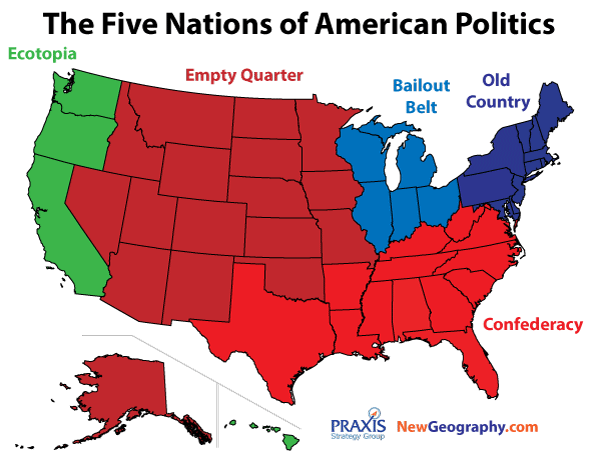
    Looking at Tuesday’s election results, it’s clear the United States has morphed into five distinct political nations. This marks a sharp consolidation of the nine cultural and economic regions that sociologist Joel Garreau laid out 30 years ago in his landmark book “The Nine Nations of North America.”

    In political terms there are two solid blue nations, perched on opposite coasts, that have formed a large and powerful bloc. Opposing them are two almost equally red countries, which include the historic Confederacy as well as the vast open reaches between the Texas panhandle and the Canadian border.

    Between these two largely immovable blocs stands the fifth nation – essentially the Great Lakes industrial heartland. By winning this territory – which could be called “Bailout Nation” – President Barack Obama built a winning coalition. Though this part of the country has suffered economic decline and demographic stagnation for decades, it is now emerging, as former President George W. Bush would put it, as “the decider” of America’s political fate.

    It’s no surprise that the coastal nations voted totally blue, reelecting the president, usually by margins of 10 points or more. The first of these nations can be dubbed “the Old Country,” the most European part of America.

    It stretches along the coast, from Maine to Maryland, and is essentially the Democratic Party’s base. It’s where the intellectual heirs to the traditions of Progressivism, the New Deal and New Frontier are most entrenched.

    Republican presidential nominee Mitt Romney lost by five percentage points or more in every state from this nation. In New York and Massachusetts, Obama won with 60 percent; in Washington, D.C., he received an astronomical 91 percent. Talk about home court advantage.

    This area is heavily urbanized and its economy – except for parts of western Pennsylvania – has become largely de-industrialized. Good jobs here are in the professions and financial services. Unemployment is high in some states, particularly New York and Rhode Island, but low – below 7 percent – in Maryland and Massachusetts.

    In the Old Country, natural resource extraction industries represent a small part of the economy and populations are concentrated in large metropolitan areas, with strong minority communities. It’s ideal territory for today’s Democratic Party, which is devotedly multicultural, strongly supportive of green energy and hostile to fossil fuels, large-scale agriculture and suburban sprawl.

    The region is essentially solid blue – as even the appealing Senator Scott Brown (R-Mass.) found out Tuesday. In the Old Country, things remain more of the same. The election numbers were nearly identical to 2008. States like Rhode Island, for example, didn’t even shift a point, despite lower national polling for Obama and the Dems.

    The Old Country’s coalition partner is Ecotopia, named after the science-fiction best-seller by Ernest Callenbach. “Ecotopia” tells the story of a successful breakaway “green” republic, which embraced most of the totems of West Coast progressivism, everything from renewable energy to militant feminism. This nation includes the states of California, Washington and Oregon. To these you can add Obama’s green-oriented, multicultural home state of Hawaii.

    In political terms, coastal Ecotopians share their states with less progressive regions on the other side of the mountains. Eastern Washington, Oregon and California all tend to be conservative – but are usually outnumbered, as they were this year, by the more densely populated coastal areas.

    Together, these two nations represent 186 electoral votes, almost equal to Romney’s total. They overwhelmingly send Democrats to Congress. And they have outsized influence. Ecotopia is home to Silicon Valley, while the Old Country, along with Hollywood, has turned the culture industry into an adjunct of the Democratic Party.

    For their part, the Republicans increasingly control two nations. One is the former Confederacy, which supported the former Massachusetts governor – only Virginia and possibly Florida slipped over to the Obama. This region has some of the nation’s strongest population growth and a strong allegiance to the military, one key GOP voting bloc.

    Energy defines much of the southern rim of the Confederacy. Texas and Louisiana have seen strong growth from oil and gas. Even the remaining Democrats in this region fear federal energy regulation under Obama will slow their economic growth. President Bill Clinton won Louisiana in 1996; this year the state went for Romney by an astounding 20 points.

    The other nation in the GOP camp is the Empty Quarter, the vast region stretching from the Great Plains and the Inter-mountain West to Alaska. This is where much of America’s food is grown and minerals extracted. Like the Gulf Coast, many in these states feel they have much to lose from a Democratic victory.

    Despite losing Nevada and Colorado and possibly Florida to Obama on Tuesday, these regions have seen expanding shares of Republican vote. Across these two nations, Romney’s margin was considerably better than Senator John McCain’s in 2008. In some states, his margins expanded by 10 points or more. From 2008 to 2012, Obama lost by 10 percentage points in Utah; 7 points in North Dakota and 5 points in Montana, South Dakota, Wyoming and Idaho.

    Yet these Republican nations may not be as stable as their Democratic counterparts. Conservative politics is almost extinct in places like California and New York. But Great Plains voters, however unhappy with Obama, still send some Democrats to the Senate, particularly when the GOP nominates extreme-right candidates.

    Ultimately, the decision comes down to the Great Lakes industrial region – which we can call the Bailout Belt. For these areas, which have high concentrations of manufacturing, the auto bailout was a godsend. And the region is now even more prosperous by the discovery of vast amounts of oil and gas.

    The benefits of the bailouts in this election – communities revived, families uplifted – outweighed those from fossil fuel producers, which now operate under threat of a possible Environmental Protection Agency-ordered shutdown. These states, outside of Indiana, stayed with Obama – by a handsome seven-point margin in Michigan. In virtually all these states, however, Romney did better than McCain.

    The president was quiet about fracking during the election. Now eyes turn to the EPA, since the House of Representatives would likely oppose a ban of any kind. The Bailout Belt may have to decide its energy future before it sides with either party.

    And where this region decides to go, so goes the nation – the entire nation.

    Joel Kotkin is executive editor of NewGeography.com and is a distinguished presidential fellow in urban futures at Chapman University, and contributing editor to the City Journal in New York. He is author of The City: A Global History. His newest book is The Next Hundred Million: America in 2050, released in February, 2010.

    This piece originally appeared at Reuters.

    Barack Obama photo by Bigstock.

  • Deep in the Heart of Texas: Private Donors Build a Medical Complex the Size of a Small City

    When Americans think of oil executives, they tend to conjure up the image of J. R. Ewing: slick smile, sharp suits, cowboy boots, and a 10-gallon hat packed with bluster, vanity, and greed. According to Gallup, no industry is more widely reviled than oil and gas—not even banking, real estate, or heath care. The poll found that 64 percent of Americans disapprove of its activities. Only the federal government fared worse.

    The image is unfair in many ways. It’s true that the energy sector can be brutal; the business of pulling hydrocarbons from the earth seems to attract more than its share of ruthless personalities. But there’s a more nuanced character to the oil and gas industry. At heart—and yes, it has a heart—it’s an industry with a surprisingly charitable nature. And nowhere is the pulsing heart of the industry more evident than in Houston, where the fortunes generated by profits from energy companies have fueled some of the most impressive personal giving in the world.

    Take, for instance, the massive Texas Medical Center (TMC). Based in Houston, it is by far the world’s largest center for healing the sick. Among its 52 member institutions are world-famous research and treatment facilities like the M. D. Anderson Cancer Clinic, Methodist Hospital, St. Luke’s Episcopal Hospital, and the Texas Children’s Hospital. Every year, the TMC serves as a campus where some 34,000 full-time students work toward degrees in the healthcare professions. It’s also home to smaller nonprofits like a Ronald McDonald House (a comfort home for families of children getting treatment), a Fisher House (a comfort home for families of hospitalized service members and veterans), the Institute for Spirituality and Health, and St. Dominic Village (a Catholic retirement community). All in all, it represents “probably the biggest confluence of philanthropy in the world,” says TMC chief executive officer Richard Wainerdi, “and a lot of it is oil money.”


    West Campus of the Texas Medical Center

    All of that oil money has fueled a massive experiment in private, voluntary initiative—a major healthcare system that is more private than public, more charitable than profitable. Its scale can only be described as Texan. The campus is equal in size to the Inner Loop of Chicago. It currently has over 28.3 million square feet of office space—more than downtown Houston, even more than all of downtown Los Angeles. (By the end of 2014, its square footage is expected to exceed 41 million square feet, which would make the medical campus the nation’s seventh-largest business district of any sort.) Every day, 160,000 people enter the area, which has grown into Houston’s largest employer. Every year, TMC hosts about 7.1 million patient visits, including 350,000 surgeries and 28,000 newborns delivered.

    Houston’s real philanthropic achievement, however, is not just the scale of the TMC. It’s the extraordinary quality of its institutions. In the 2013 U.S. News & World Report hospital rankings, TMC-affiliated institutions topped the charts. Methodist Hospital was a nationally ranked leader in 13 of 16 adult specialties. (Of the 4,793 hospitals included in the rankings, only 148 facilities—roughly 3 percent of the total—were considered a nationally ranked leader in even one of the 16 specialties.) St. Luke’s Episcopal Hospital, likewise on the TMC campus, earned national ranking in 10 adult specialties. The Texas Children’s Hospital was ranked fourth among all U.S. children’s hospitals. M. D. Anderson has been named the best cancer center in America for 9 of the past 11 years, including 2012.

    None of it would be possible without private philanthropy. M. D. Anderson, for instance, began a capital campaign in September 2006, with a goal of raising $1 billion within six years. Donations poured in from across the Lone Star state. From San Antonio, Clear Channel co-founder Lowry Mays and his wife, Peggy, donated $20 million. From Dallas, H. Ross Perot kicked in another $20 million. T. Boone Pickens contributed $50 million, with one condition. Before putting the funds to use, M. D. Anderson was required to turn the gift into a $500 million corpus within 25 years. Anderson hit the target within three years, and used the funds to establish the Pickens Research Endowment. Two years ahead of schedule, the capital campaign passed the $1.2 billion mark. There were more than 630,000 individual gifts, and a staggering 127 donors gave at least $1 million.

    It’s testimony to an extraordinarily generous culture—one that’s driven by energy profits. Of the top 10 corporate foundations in the region, for instance, eight are directly tied to the energy industry. As Federal Reserve Bank economist Bill Gilmer notes, Houston’s economy rests on the energy sector—not only drilling and exploration, but also downstream industries like refining, finance, and petrochemical production. It is there that much of Houston’s wealth has been generated, and from which much of the funding for good works like the TMC is likely to continue coming.

    “The people who founded the Texas Medical Center believed that for Houston to thrive, the city had to have a great medical establishment,” explains Ann Stern, president of the $1.5 billion Houston Endowment, the charitable legacy of Houston patriarch Jesse Jones and his wife, Mary Gibbs Jones. “There’s a long history of generosity and a healthy peer pressure among people in the energy business—and other civic leaders—to contribute. They may have not gone to college, they may have made their money in the oil fields, but the Texas Medical Center has become in large part their legacy.”

    Deep in the Heart of Texas

    To be sure, the extraction of sweet, light crude from deep in the earth is hardly animated by sweetness and light on the business side. The energy business is capital-intensive and very competitive. It requires leaders who can adapt and make things happen.

    Anthony Petrello fits that bill. Petrello is the chief executive officer of Nabors Industries, the world’s largest land-based drilling contractor. Nabors is hired by oil companies to drill oil and gas wells. Like many other leaders in the energy industry, Petrello is competitive and looking for ways to differentiate his company. His pedigree is perhaps a bit unusual for the industry: it includes bachelor’s and master’s degrees in mathematics from Yale—and a law degree from Harvard.

    Petrello is a Newark native. He left his job in New York as managing partner of Baker & McKenzie, arriving in Houston in 1991 to become president of Nabors. “The first five years I was in Houston,” Petrello recalls, “I worked six or seven days every week, and with my wife’s work schedule, we did not have much time to socialize.” He and his wife, Cynthia, a former New York actress, focused on their careers and kept mainly to a small group of close personal friends.


    Anthony and Cynthia Petrello (Photo courtesy of Longines)

    Then in 1997, Anthony and Cynthia had a baby girl at Houston Women’s Hospital. Carena Francesca was born at 24 weeks, weighing only 20 ounces, and experienced PVL (periventricular leukomalacia), a disorder in premature infants caused by a lack of oxygen to the brain. First came a rash of operations to save her sight and heart. Then it became clear Carena would suffer from cerebral palsy. Despite having financially successful parents, she was entering life with enormous challenges. “It changed everything,” Petrello says. “It was the turning point in our lives.”

    As Carena matured, she started to lose abilities. She gained language, but lost it at age five. Today, she cannot get around without a wheelchair. She can’t speak or feed herself. “It caused a major change in our perceptions,” Petrello recalls. “My wife thought we’d have a dancer. I thought we’d have a mathematician. Instead, we had to adjust our expectations.”

    Carena’s difficult circumstances impelled the Petrellos to rethink their priorities. “You realize that your time here on earth is short and you want to make a difference,” Petrello says. “You don’t have time to feel sorry for yourself.” By instinct and training a problem-solving mathematician, Petrello wanted to understand what caused Carena’s condition—and find out if there were better ways to treat it. In 2000, he consulted with a team of specialists at a prestigious eastern hospital; they held out little hope and less understanding. “The doctor told us he couldn’t do anything for her,” Petrello says, his voice showing clear disappointment. “He just said we needed to get a good estate planner for her.”

    Petrello looked for serious research into childhood neurological diseases. He was shocked to find how little of it actually was taking place. Particularly troubling was the lack of research into what he calls the “DNA arithmetic” of these disorders, which range from mild forms like ADHD to cerebral palsy and Down syndrome. “The lack of knowledge about this problem is astounding,” says Petrello. “And the lack of resources is sinful.”

    He found kindred spirits at the Texas Children’s Hospital. He conceived of an institute dedicated to exploring the causes of neurological afflictions for children. In 2006, he made a commitment of $7 million. “I had lunches with friends—many, when judged by my weight gain—and they were eager to hear more,” says Petrello. “My wife and I were overwhelmed by the support of friends and energy industry colleagues who came on board to help.”

    And in the process he found some impressive allies, like Dan Duncan, the now-deceased chairman and director of Houston-based Enterprise Products, a leading North American provider of midstream energy services. A self-made man who grew up in rural east Texas, Duncan turned a small business with one truck, two partners, and $10,000 in cash into a multi-billion dollar energy company that today ranks among the nation’s most successful.

    Duncan and his wife, Jan, were among Houston’s most generous healthcare philanthropists. In 2006, they donated $100 million to Baylor College of Medicine to establish the Dan L. Duncan Cancer Center; two years later, they gave M. D. Anderson $35 million to create the Duncan Family Institute for Cancer Prevention and Risk Assessment, which addresses the risks—genetic, lifestyle—that can lead to cancer. In 2007, the Duncans made news with a $50 million gift, earmarked to create a collaborative institute that would research and treat pediatric neurological disorders. The Jan and Dan Duncan Neurological Research Institute opened in 2010. Today, it occupies 300,000 square feet at Texas Children’s Hospital. The center has more than 130 researchers led by Huda Zoghbi, a renowned Lebanese neurogeneticist.

    Petrello sees the center as a leading-edge institution that can change the odds for millions of children with neurological disorders. “Everyone needs a dream to keep them motivated,” he explains. “It may not help our daughter, but we cannot accept her fate for so many others. We have to do something.”

    The Great Equalizer

    Ever since he left his small hometown of Wharton, Texas, Lester Smith has lived, from a strictly economic point of view, a rather charmed life. At age seven, he knew he wanted to be a wildcatter; to his nose, oil “just smelled like perfume.” Today, he heads up Smith Energy, a Houston-based firm that specializes in the exploration and production of oil and gas reserves.

    In Smith’s social circles, nobody looks down on making money and living well—even lavishly. But it’s not all big cars, big houses, and big hair. Like Petrello, Smith was brought down by disease, and has chosen to dedicate much of his fortune to fighting it. Smith struggled for 17 years with prostate and bladder cancer. He has undergone some 40 surgeries at the Baylor College of Medicine—“no fun,” he recalls—until 2001, when both organs were removed. “I’m a bladder and prostate cancer survivor,” he reflects. “My wife’s sister died at 50 from breast cancer. My former wife was diagnosed with breast cancer eight years ago, but she is doing well because of what they did at Baylor. This sticks with you.”


    Lester and Sue Smith with Gloria Gaynor (AP photo / Dave Rossman)

    These personal tragedies have driven much of his philanthropy, $40 million of which has gone to Baylor’s medical school, where it supports research into and treatment for breast cancer, urology, and oncology. Smith also serves on the board of M. D. Anderson and Baylor College, and has donated an additional $20 million to the cancer center at Texas Children’s Hospital. “I never considered giving away so much,” he admits, “until cancer affected me and my loved ones personally.”

    Cancer, adds Smith, is “a great equalizer,” one that doesn’t respect class or wealth. For that reason, he has donated $15 million to the Harris County hospital district to set up a clinic to treat poor families, like many of those that he grew up around in rural Texas. It now treats some 160,000 underserved people annually. “Illegal aliens, the indigent—they should get the same care that my wife gets,” he insists.

    Smith also raises money for cancer causes by hosting social events—most notably, ballroom dancing. The galas that he and his wife put on have become highlights of Houston’s social season. In February, the Smiths hosted 1,100 guests at the Legends Event for Texas Children’s Cancer Center, featuring Gloria Gaynor, the Pointer Sisters, and Nile Rodgers. The evening raised $32 million. It was again heavily underwritten by Houston’s oil-and-gas philanthropists.

    “It’s the oil guys who give the most money to things that matter in people’s lives,” he suggests. “They may be tough people to deal with, but they are very philanthropic.”

    A Culture of Leadership

    David Wolff is not one of Houston’s oilmen, but he has made his fortune selling land to the energy corporations and developers who serve them. He left Philadelphia in 1970. Once he landed in Houston, he started his own company—at age 29. “This was not considered crazy in Houston,” he recalls, “but back in Philadelphia it would have been. What I liked about Houston is people didn’t just think about doing things. They really did them.”

    Over the next three decades, Wolff did quite a lot of things. His real estate firm has office parks all around Houston and led the development of what is widely known as the “energy corridor” along Interstate 10 in the western part of town—now home to a working population of 80,000 people. “It was all cows and rice fields back then,” he recalls. All the while, he was involved in the city’s philanthropic community, serving as chairman of the Houston Parks board, as well as Metro, the regional transit agency, and on the board of the Houston Grand Opera.

    But these days Wolff’s great passion is medical philanthropy. He donated 10 acres of prime land for the new TMC West Campus, which now includes Texas Children’s Hospital, Texas Methodist, and others. He is now working, largely through additional land he has acquired, to aid the expansion of the TMC toward Beltway 8 (Houston’s outer-loop freeway) and the surrounding suburban communities.


    David and Mary Wolff

    The idea, Wolff explains, is to bring the hospitals closer “to where the patients are.” For generations, Houstonians—particularly those with children—have been moving to the city’s periphery. As the TMC’s main campus has expanded, traffic and parking have become more difficult for people coming from the communities surrounding Houston. The market is certainly there: Texas Children’s CEO Mark Wallace estimates there are 400,000 children within a 10-minute drive of the new campus. In 20 years, says Wallace, the west-side hospital will be as large as the original site.

    “We are making it easier for the medical center to serve people,” Wolff says, beaming with pride in the bright new lobby of Texas Children’s Hospital–West Houston. “For those coming from the suburbs, or for the folks coming from the smaller towns in central and southeast Texas, this is an easier place to get to, and one where they can still find the same quality health care you would get in the city.”

    That sense of service reflects the spirit that made the Texas Medical Center possible in the first place. In a state where the proportion of uninsured is higher than the national average, the TMC provides critical services for the poor—and is sufficiently well funded to deliver them at the highest level. “Like other cities, Houston has its challenges,” observes Houston Endowment’s Ann Stern. “But Houston is exceptional in that philanthropy makes up for a lot of it. It’s kind of a calling here. It’s a culture of leadership—of getting things done.” And it has made Houston perhaps the most philanthropic city in America today.

    This piece first appeared at The Philanthropy Roundtable.

    Joel Kotkin is executive editor of NewGeography.com and is a distinguished presidential fellow in urban futures at Chapman University, and contributing editor to the City Journal in New York. He is author of The City: A Global History. His newest book is The Next Hundred Million: America in 2050, released in February, 2010.

    Houston skyline photo by Bigstock.

  • Flocking Elsewhere: The Downtown Growth Story

    The United States Census Bureau has released a report (Patterns of Metropolitan and Micropolitan Population Change: 2000 to 2010.) on metropolitan area growth between 2000 and 2010. The Census Bureau’s the news release highlighted population growth in downtown areas, which it defines as within two miles of the city hall of the largest municipality in each metropolitan area. Predictably, media sources that interpret any improvement in core city fortunes as evidence of people returning to the cities (from which they never came), referred to people "flocking" back to the "city" (See here and here, for example).

    Downtown Population Trends: Make no mistake about it, the central cores of the nation’s largest cities are doing better than at any time in recent history. Much of the credit has to go to successful efforts to make crime infested urban cores suitable for habitation, which started with the strong law enforcement policies of former New York Mayor Rudy Giuliani.

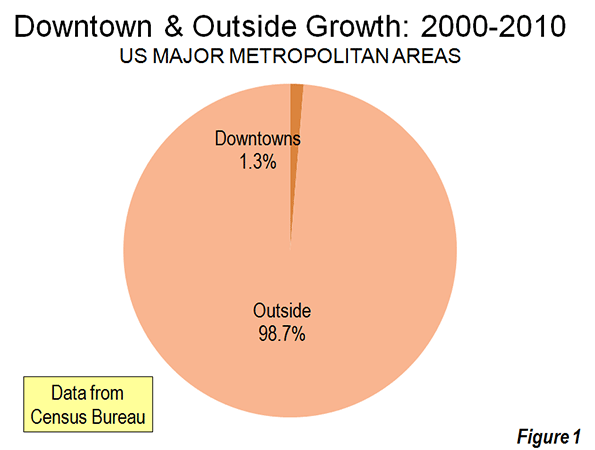
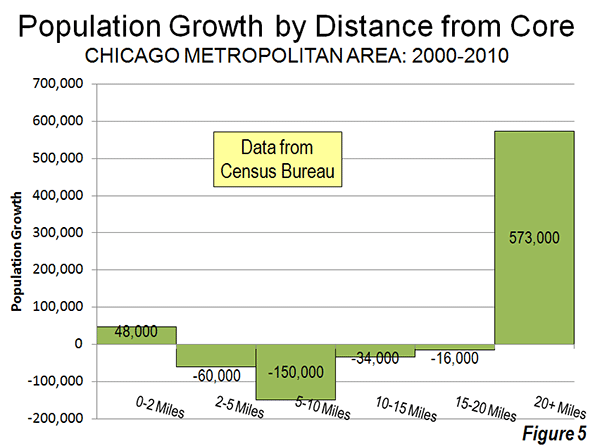
    However, to characterize the trend since 2000 as reflective of any "flocking" to the cities is to exaggerate the trend of downtown improvement beyond recognition. Among the 51 major metropolitan areas (those with more than 1 million population), nearly 99 percent of all population growth between 2000 and 2010 was outside the downtown areas (Figure 1).

    There was population growth in 33 downtown areas out of the 51 major metropolitan areas. As is typical for core urban measures, nearly 80 percent of this population growth was concentrated in the six most vibrant downtown areas, New York, Chicago, Philadelphia, Washington, Boston and San Francisco.

    If the next six fastest-growing downtown areas are added to the list (Dallas-Fort Worth, Houston, Los Angeles, Portland, San Diego and Seattle), downtown growth exceeds the national total of 205,000 people, because the other 39 downtown areas had a net population loss. Overall, the average downtown area in the major metropolitan areas grew by 4000 people between 2000 and 2010. That may be a lot of people for a college lacrosse game, but not for a city. While in some cases these increases were substantial in percentage terms, the population base was generally small, which was the result of huge population losses in previous decades as well as the conversion of old disused office buildings, warehouses and factories into residential units.

    Trends in the Larger Urban Cores: The downtown population gains, however, were not sufficient to stem the continuing decline in urban core populations. Among the 51 major metropolitan areas, the aggregate data indicates a loss of population within six miles of city hall. In essence, the oasis of modest downtown growth was more than negated by losses surrounding the downtown areas. Virtually all the population growth in the major metropolitan areas lay outside the six mile radius core, as areas within the historical urban core, including downtown, lost 0.4 percent.

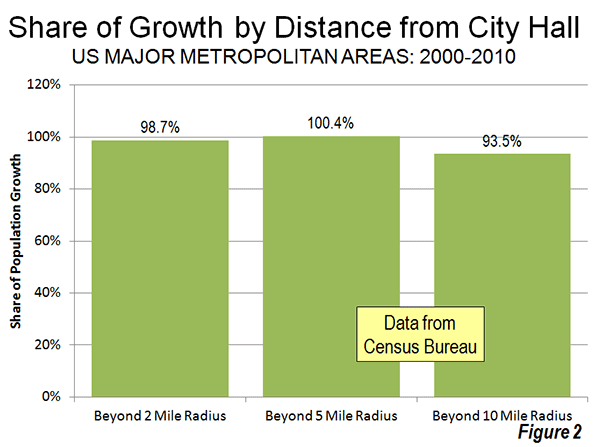
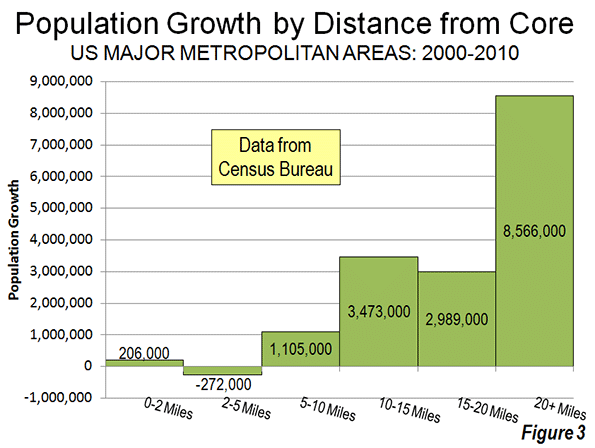
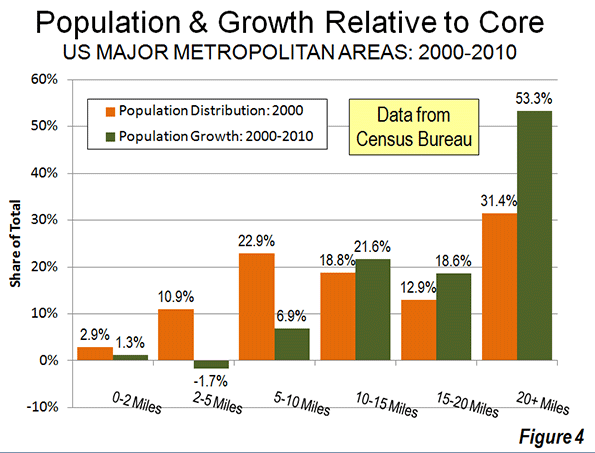
    Even when the radius is expanded to 10 miles, the overwhelming majority of growth remains outside. Approximately 94 percent of the aggregate population growth of the major metropolitan areas occurred more than 10 miles from downtown (Figure 2). Figure 3 shows that more than one-half of the growth occurred 20 miles and further from city hall. Further, the population growth beyond 10 miles (10-15 mile radius, 15-20 miles radius and 20 mile and greater radius) from the core exceeded the (2000) share of population, showing the continuing dispersal of American metropolitan areas (Figure 4).

    Chicago: The Champion? The Census Bureau press release highlights the fact that downtown Chicago experienced the largest gain in the nation. Downtown Chicago accounted for 13 percent of the metropolitan area’s growth with an impressive 48,000 new residents. However, while downtown Chicago was prospering, people were flocking away from the rest of the city. Within a five mile radius of the Loop, there was a net population loss of 12,000 and a net loss of more than 200,000 within 20 miles (Figure 5). Only within the 36th mile radius from city hall is there a net population gain.

    Cleveland: Comeback City and Always Will Be? In view of Cleveland’s demographic decline (down from 915,000 in 1950 to 397,000 in 2010), any progress in downtown Cleveland is welcome. But despite the frequently recurring reports, downtown Cleveland’s population growth was barely 3,000. Despite this gain, the loss within a 6 mile radius was 70,000 and 125,000 within a 12 mile radius. Beyond the 12- mile radius, there was a population increase of nearly 55,000, which insufficient to avoid a metropolitan area population loss.

    Other Metropolitan Areas: A total of 30 major metropolitan areas suffered core population losses, despite the fact that many had downtown population increases.

    • Five major metropolitan areas suffered overall population losses (Buffalo, Cleveland, Detroit, Pittsburgh and Katrina ravaged New Orleans).
    • St. Louis, with a core city that holds the modern international record for population loss (from 857,000 in 1950 to 319,000 in 2010), experienced a population decline within a 27 mile radius of city hall. Approximately 150 percent of the growth in the St. Louis metropolitan area was outside the 27 mile radius. Even so, there was an increase of nearly 6,000 in the population of downtown St. Louis.
    • There were population losses all the way out to a considerable distance from city halls in Memphis (16 mile radius), Cincinnati (15 mile radius) and Birmingham (14 mile radius). The three corresponding downtown areas also lost population.
    • Despite having one of the strongest downtown population increases (12,000), population declined within a 10 mile radius of the Dallas city hall. This contrasts with nearby Houston, which also experienced a strong downtown increase (10,000) but no losses at any radius of the urban core.
    • Milwaukee experienced a small downtown population increase (2,000), but had a population loss within an11 mile radius.

    The other 21 major metropolitan areas experienced population gains throughout. Even so, most of the growth (77 percent) was outside the 10 mile radius. San Jose had the most concentrated growth, with only 24 percent outside a 10 miles radius from city hall. All of the other metropolitan areas had 60 percent or more of their growth outside a 10 mile radius from city hall.

    As we have observed before, 2000 to 2010 was, unlike the 1970s and other decades, more friendly to the nation’s core cities, although less so than the previous decade. Due to the repurposing of old offices and other structures, sometimes aided by subsidies, small downtown slivers may have done better than at any time since before World War II. But the data is clear. Suburban growth was stronger in the 2000s than in the 1990s. The one percent flocked to downtown and the 99 percent flocked to outside downtown.

    Population Loss Radius: Major Metropolitan Areas
    Miles from City Hall of Historical Core Municipality*
    Major Metropolitan Areas (Over 1,000,000 Population Share of Metropolitan Growth Population Loss Radius (Miles)
    "Outside Downtown" (2- Mile Radius) Outside 5-Mile Radius Outside 10-Mile Radius
    MAJOR METROPOLITAN AREAS: TOTAL 98.7% 100.4% 93.5% 6
    Atlanta, GA 99.6% 101.1% 99.9% 9
    Austin, TX 98.1% 96.7% 81.9% 0
    Baltimore, MD 106.5% 118.7% 99.5% 9
    Birmingham, AL 104.2% 132.5% 124.9% 14
    Boston, MA-NH 90.8% 76.9% 67.3% 0
    Buffalo, NY Entire Metropolitan Area Loss
    Charlotte, NC-SC 99.1% 97.4% 75.0% 3
    Chicago, IL-IN-WI 86.7% 103.3% 144.6% 35
    Cincinnati, OH-KY-IN 105.1% 126.8% 135.2% 15
    Cleveland, OH Entire Metropolitan Area Loss
    Columbus, OH 100.5% 104.3% 86.9% 7
    Dallas-Fort Worth, TX 99.0% 101.0% 100.7% 10
    Denver, CO 98.0% 100.3% 89.8% 5
    Detroit,  MI Entire Metropolitan Area Loss
    Hartford, CT 99.2% 92.7% 67.2% 0
    Houston, TX 99.2% 99.5% 98.0% 0
    Indianapolis. IN 102.1% 112.1% 89.6% 8
    Jacksonville, FL 100.2% 106.3% 85.3% 8
    Kansas City, MO-KS 99.5% 109.0% 113.3% 12
    Las Vegas, NV 101.4% 98.0% 63.6% 4
    Los Angeles, CA 97.3% 102.2% 97.6% 8
    Louisville, KY-IN 102.5% 108.5% 90.9% 8
    Memphis, TN-MS-AR 101.2% 118.5% 143.5% 16
    Miami, FL 99.4% 93.0% 91.3% 0
    Milwaukee,WI 95.9% 109.0% 107.5% 11
    Minneapolis-St. Paul, MN-WI 97.4% 99.2% 100.1% 7
    Nashville, TN 100.0% 101.4% 92.4% 7
    New Orleans. LA Entire Metropolitan Area Loss
    New York, NY-NJ-PA 93.5% 81.7% 68.9% 0
    Oklahoma City, OK 100.1% 96.8% 83.5% 2
    Orlando, FL 99.7% 99.4% 84.2% 0
    Philadelphia, PA-NJ-DE-MD 92.6% 98.8% 96.3% 7
    Phoenix, AZ 100.7% 101.8% 93.6% 6
    Pittsburgh, PA Entire Metropolitan Area Loss
    Portland, OR-WA 95.0% 91.5% 62.7% 0
    Providence, RI-MA 96.2% 91.7% 70.1% 0
    Raleigh, NC 99.6% 93.0% 67.7% 0
    Richmond, VA 95.7% 91.7% 70.2% 0
    Riverside-San Bernardino, CA 99.5% 97.2% 85.8% 0
    Rochester, NY 146.9% 149.3% 82.5% 9
    Sacramento, CA 99.9% 94.4% 79.5% 0
    Salt Lake City, UT 98.9% 95.1% 84.1% 0
    San Antonio, TX 101.1% 102.5% 86.7% 7
    San Diego, CA 96.3% 94.1% 90.1% 0
    San Francisco-Oakland, CA 90.7% 87.6% 82.2% 0
    San Jose, CA 95.1% 79.1% 24.3% 0
    Seattle, WA 96.5% 91.9% 81.4% 0
    St. Louis,, MO-IL 94.8% 119.7% 148.9% 27
    Tampa-St. Petersburg, FL 98.6% 97.8% 83.7% 0
    Virginia Beach-Norfolk, VA-NC 93.1% 90.1% 82.3% 0
    Washington, DC-VA-MD-WV 97.5% 94.5% 87.9% 0
    Calculated from Census Bureau data
    *Except in Virginia Beach-Norfolk, Where Virginia Beach is used


    ——-

    Notes:

    Population Weighted Density: In its report, the Census Bureau uses "population-weighted density," rather than average population density to compare metropolitan areas. The Census Bureau justified this use as follows:

    "Overall densities of CBSAs can be heavily affected by the size of the geographic units for which they are calculated. Metropolitan and micropolitan statistical areas are delimited using counties as their basic building blocks, and counties vary greatly across the country in terms of their geographic size. With this in mind, one way of measuring actual residential density is to examine the ratio of population to land area at the scale of the census tract, which—of all the geographic units for which decennial census data are tabulated—is typi­cally the closest in scale to urban and subur­ban neighborhoods".

    The Census Bureau rightly points out the problem with comparing metropolitan area density. However, it is a problem of the federal government’s making, by virtue of using metropolitan area building blocks (counties) that are sometimes too large for designation of genuine metropolitan areas. These difficulties have been overcome by the national census authorities in Japan in Canada, for example, where smaller building blocks are used (such as municipalities or local government authorities).

    Further, the Census Bureau already has a means for measuring population density at the census tract level, which is "the closest in scale to urban and suburban neighborhoods." This is the urban area.

    "Population-weighted density" is an interesting concept that can provide an impression of the density that is perceived by the average resident of the metropolitan area. Unfortunately, in its report, the Census Bureau is less than precise with its terminology and repeatedly fails to modify the term density with the important "population-weighted" qualification. This could lead to considerable misunderstanding.

    The Census Bureau did not provide average population densities based for the mileage radii. Because of large bodies of water (such as Lake Michigan in Chicago can reduce land areas, it was not possible to estimate population densities by radius.

    Census Bureau Revision of Incorrect Report: We notified the Census Bureau of errors in its press release and report on September 27. The problems included substitution of San Francisco population data for Salt Lake City as well as metropolitan population in the supporting spreadsheet file. On September 28, the Census Bureau issued a revised press release and report to rectify the errors. Later the erroneous spreadsheet was withdrawn and had not been re-posted as of October 1. We have made corrections to the spreadsheet for this analysis.

    Note: Larger "Downtown" Populations in Smaller Metropolitan Areas: Because of the broad 2-mile radius measure used by the Census Bureau, most of the population increase characterized as relating to downtown occurred outside the major metropolitan areas. This is simply because in smaller metropolitan areas, such an area (12.6 square miles) will necessarily contain a larger share of the metropolitan area. Further, many smaller metropolitan areas are virtually all suburban and had experienced little or no core population losses over the decades that have been so devastating to many large core municipalities. On average, 2.7 percent of the population of major metropolitan areas was within a two-mile radius of city hall in 2010. By comparison, in smaller metropolitan areas, approximately 12.7 percent of the population was within a two mile radius.

    Photograph: Chicago Suburbs: (where nearly all the growth occurred), by author

  • A New Brand for Houston

    "We’ve probably spent in excess of $75 million in the past 30 years on image campaigns, and we keep coming back and saying, ‘Well, that didn’t work.’"

     – Former GHCVB CEO Jordy Tollett in the Houston Business Journal

    A list of many of those can be found here, including the old standbys "Bayou City", "Space City", and "Energy Capital of the World" (Wikipedia has more here).  And despite many of my own previous attempts on this blog, inspiration has struck me again, especially after reading this recent article at Salon.com on why every city needs a brand (and more on that here).

    A good city brand works on four different levels:

    1. It attracts tourists.
    2. It attracts new residents, especially highly talented and educated ones.
    3. It attracts expanding businesses.
    4. It inspires the citizens and creates a local identity.

    But it’s very hard to come up with a single brand that does all four.  Even some of the most successful brands don’t necessarily hit them all.  Two of the most famous city brands are New York’s "I {heart} NY" and Las Vegas’ "What happens in Vegas stays in Vegas."  And in Texas we’re all familiar with "Keep Austin Weird."  In this case, I think I’ve stumbled upon something that can work across all four.

    Before I reveal it, I need everybody to drop their cynicism shields.  I don’t think the most successful city brand in history, "I {heart} NY" could get off the ground today with our snarky cynical culture.  Just like new songs, sometimes ideas need time to grow on you.  So open up your mind, hold back judgment, and let me  reveal some context-setting definitions and the brand first followed by the supporting reasons.

    Hospitality 

    Noun: The friendly and generous reception and entertainment of guests, visitors, or strangers.

    Hospitable 

    Adjective: 1) Friendly and welcoming to strangers or guests.  2) (of an environment) Pleasant and favorable for living in.

    It started with me thinking of "Houston Hospitality", but then the symmetry jumped out at me it became

    Houspitality

    What the "Aloha Spirit" is to Hawaii, the "Houspitality Spirit" can be to Houston.

    Here are some of the key words and phrases people often use when describing Houston and how they fit:

    • Houspitality for visitors and newcomers: welcoming culture to outsiders, friendliness, hospitality (duh), openness to people from all over the world (diversity), amazing restaurants, museums, arts, and other amenities
    • Houspitality for businesses: business-friendly taxes and regulation (including no zoning), culture supportive of  entrepreneurship, open business culture
    • Houspitality for residents: friendliness, openness, affordability, ease of living, high standard of living, social mobility, opportunity, open-minded, charitable (especially after Hurricane Katrina), "big small town"

    Some additional supporting reasons:

    • Short and sweet, and people "get it" pretty easily.
    • Fits well with the Texas Medical Center helping people from all over the world (and the word "hospital" is right there).  It also fits well with the airports, port, GHCVB, GHP, and others.
    • It differentiates us from other big cities (ever heard anybody talk about the friendly reputations of NYC, DC, Chicago, SF, or LA? I didn’t think so) as well as tourist destination cities (which tend to become jaded towards visitors).
    • UH’s Hilton College of Hotel and Restaurant Management uses the motto "We are hospitality", and is one of the top ranked schools in the country for that specialty.
    • Sounds like "vitality", which is another good brand association.
    • I found a cool, somewhat similar concept here, transforming Humanitarian to Houmanitarian.
    • I think more and more people today are hungry for real community, which is harder and harder to find.  Houspitality is a great brand to convey our real sense of community in Houston.

    Finally, I’d like to end with some supportive excerpts from Ken Hoffman’s recent excellent column on what Forbes got right and wrong about Houston being America’s Coolest City.  I think you’ll easily see the Houspitality Spirit running through them…

    I remember thinking, am I going to have to change? Am I going to have to learn how to write Texan?
    I didn’t change anything. That’s part of what makes Houston cool. You can come here and stay yourself and fit right in.

    Houston is cool because whoever or whatever you are, you’re welcome here. The first two years I lived here, I was burning out the copy machine at Kinko’s applying for jobs anywhere else. Now I wouldn’t leave here for anything. …

    Where better to get better?
    When a congresswoman got her head half blown off, she came to Houston to get better. When Middle East oil sheiks need surgery, they come to Houston. We have the best medical facilities in the world. I didn’t think that was cool until I was run over by a lunatic in a van and was taken to the hospital in an ambulance.
    I still have no idea what hospital I was taken to. But they fixed me up. That was cool.

    We’re in this together
    And please stop talking about Houston’s "diversity." The only thing the word "diversity" does is separate people. Sure, we have ethnic neighborhoods; those are good for a city. It helps in picking a restaurant.
    I’ve never seen a city where people blend more gracefully than Houston.

    Houston is cool
    I thought it was pretty cool when Houston welcomed Hurricane Katrina victims to ride out the storm’s aftermath here. I spent a couple of days in the Astrodome, handing out supplies and clothes to Katrina refugees. I learned a lot about Houston after Katrina. The experience changed me, too.

    Being cool is a city that makes you feel like you belong. 

    This piece originally appeared at Houston Strategies.

  • Density is Not the Issue: The Urban Scaling Research

    The "urban scaling" research of Geoffrey West, Luis Bettencourt, Jose Lobo, Deborah Strumsky, Dirk Helbing and Christian Kuhnert on cities has attracted considerable attention (references below). They have provided strong quantitative evidence, based upon voluminous econometric analysis that cities tend to become more efficient as they grow in population.

    Specifically, West, a theoretical physicist, and his team show that measures such as gross domestic product per capita and income per capita rise, on average, 15 percent with each doubling of city population. They draw parallels with the animal kingdom, noting that larger animals tend to be more efficient than smaller ones, and comparing elephants, efficient because of their size, to cities.

    This is all very attractive, especially the elephant analogy, which appropriately suggests that cities are organisms.

    The Urban Organism

    Yet the research has been widely reported to suggest that density as opposed to size is the key to urban productivity. West et al look at cities as "integrated economic and social units," at the "level of metropolitan statistical areas (MSAs); in the European Union, larger urban zones (LUZs); and in China, urban administrative units." This is the economic, or functional manifestation of the urban organism (the urban area, the area of continuous urbanization, is the physical manifestation). In so doing, West, et al demonstrate a familiarity with urban geography that is all too rare, even among analysts who have studied cities for far longer.

    The key issue here is what constitutes a “city”.  New York is a good, example, as headquarters to the national media, a world class city and as urban as it gets in the United States. But the New York metropolitan area, the "integrated economic and social unit" is not Manhattan or even five boroughs. It stretches from a bit west of Blooming Grove Township, in Pike County 25 miles west of Port Jervis, a city 90 miles from Manhattan located in western Orange County, NY, to Montauk Point in Suffolk County and from north of West Point, in Putnam County to Egg Harbor Township, in Ocean County, New Jersey (that’s nearly 30 miles south of Toms River). Suffice it to say most of this vast region is not dense at all.

    Divining Density

    Yet, some analysts have characterized the West, et al research as being about higher densities, Richard Florida wrote in The Wall Street Journal:

    Researchers at the Santa Fe Institute have been able to demonstrate that bigger, denser cities literally speed up the metabolism of daily life.

    That’s only half right. The research was about city size, not density, as the authors indicate (below).

    All too typical of the way that suburbanized America is disparaged by the media, Jonah Lehrer, of The New York Times sputtered that:

    In recent decades, though, many of the fastest-growing cities in America, like Phoenix and Riverside, Calif., have given us a very different urban model. These places have traded away public spaces for affordable single-family homes, attracting working-class families who want their own white picket fences.

    In reality, the kind of suburbs found in Phoenix and Riverside-San Bernardino will be found surrounding every one of the nation’s core cities, including New York, an urban area that covers  more land area than any urban area in the world at 3,450 square miles (8,935 square kilometers), according to the Census Bureau. That’s twice the expanse of the Los Angeles urban area. Granted, New York’s Hudson Valley suburbs are greener and more affluent than most in Phoenix, but their population density is nearly the same. Moreover, neither Phoenix nor New York (think Staten Island or much of Long Island) should be ashamed of attracting "working class families who want their own white picket fences." Why demean aspiration?

    Urban blogger James Withow refers to their "remarkable findings" that "raise interesting policy issues on density." Another analyst wrote "West offers data that shows cities create economies of scale that suburbs and small towns cannot match." This is patently absurd since, as noted above, West did not study any part of the urban organism below the metropolitan area. There was no attempt to make a distinction between the productivity of say, Manhattan or Brooklyn, to White Plains or even Blooming Spring Township. No core city or suburb is an "integrated economic and social unit."

    West et al on Density

    Indeed, West et al make it very clear that their findings have nothing to do with urban population density. They tested for correlations population growth and income, patents and violent crimes, and found "no significant trend exists between residuals for income, patents and violent crime and population growth or density." They further note their equations showed an "R2 consistent with zero" (in every day English, that means they found no relationship between density and the other variables).

    This conclusion was correct, though comparing metropolitan area densities is less than ideal. Just to check, we reran the equations with urban density data and found that this approach too produced an "R2 consistent with zero," not only for income, patents and violent crimes, but also gross metropolitan product.

    West et al pointed out that:

    The shape of the city in space, including for example its residential density, matter much less than (and are mostly accounted for by) population size in predicting indicators of urban performance. Said more explicitly, whether a city looks more like New York or Boston or instead like Los Angeles or Atlanta has a vanishing effect in predicting its socio-economic performance. (emphasis by author)

    In other words, the same improvement in urban performance would be predicted from doubling the population of Atlanta, with an urban density of 1,700 per square mile (700 per square kilometer) as in New York, with more than three times Atlanta’s density or Los Angeles’ with more than four (Los Angeles is highest density large urban area in the United States).

     It turns out – counter the misunderstandings of some urbanists – that higher or lower density simply does not matter according to the West, et al research.

    It’s About Density Thresholds and Efficient Labor Markets

    Cities (integrated economic and social units) are created by reaching urban density thresholds. They tend to become more productive as they grow, so long as they are not too large to function as a labor market. Density doesn’t matter particularly. Indeed, the general tendency is for cities to become more dispersed (less dense) as they grow, as indicated by longer term data in the US, Canada and around the world.

    For example, the Seattle and Houston urban areas have population densities much lower than those of Paris, London, Hong Kong and even Los Angeles – yet they still rank higher among the most productive metropolitan areas in the world, according to the Brookings Institution Global Metropolitan Monitor 2011. Brookings rates Hartford as the most productive metropolitan area in the world, yet its urban population density is nearly as low as Atlanta’s.

    Finally, the Brookings list excludes the world’s most dense major city, Dhaka. That’s because the economic output of its 15 million people is insufficient to make a list that includes cities one-tenth its size. Dhaka combines the highest population density in the world with perhaps the lowest per capita economic output of any megacity in the world.

    Allowing Organisms to Grow

    As West et al suggests, cities, like elephants, are organisms. Both expand (dare we say "sprawl") as they grow. This should be cause for concern, given planning dictates that would restrain urban organism, such as urban growth boundaries. These restraints are akin to depriving a large mammal of sufficient space to roam and feed. That’s no way to treat a productive organism, or a great city.

    ——-

    Reference Materials:
    Growth, innovation, scaling, and the pace of life in cities
    Urban Scaling and Its Deviations: Revealing the Structure of Wealth, Innovation and Crime across Cities
    2010 US Urban Area Data

    ——-

    African Bush Elephant photo by flickr user nickandmel2006.

    Wendell Cox is a Visiting Professor, Conservatoire National des Arts et Metiers, Paris and the author of “War on the Dream: How Anti-Sprawl Policy Threatens the Quality of Life.”

  • Houston’s Walled Garden

    My friend Neal and I were in a tall building recently looking out over the city, and noted that there is an interesting phenomenon in Houston.  There are now enough tall buildings to almost outline a new zone.  If you go from the Medical Center up to Downtown, west along Allen Parkway/Memorial, south along 610/Post Oak, back east to Greenway Plaza, and then southeast to return to the Medical Center (here’s a satellite map of the area – sorry I’m not skilled enough to overlay an outline) there is an almost continuous – well not continuous – but a substantial line of skyscrapers.  And it’s pretty green within that zone, as least from an elevated viewpoint.  And we named it "The Walled Garden".  Somewhat similar aesthetically to New York’s Central Park or Chicago’s Millennium Park, but much larger and, of course, not a public park.  It does, in my stretched definition, contain the key parks of central Houston: Hermann, Discovery Green, Eleanor Tinsley/Buffalo Bayou, and Memorial (my concept, my boundaries ;).  It also contains such key areas as the Galleria, Highland Village, River Oaks, Upper Kirby, Montrose/Neartown, Midtown, the Museum District, Rice University and the Rice Village.

    "Inside the Loop" is a very common phrase you’ll hear in Houston.  I’d like to think "The Walled Garden" could be a similar such phrase describing a narrower zone where young singles want to live (as evidenced by the explosion in apartment construction within it) vs. more family-oriented areas like West U, Bellaire, The Heights, or the various neighborhoods of the east side.  It could also be used for branding and attracting young talent to Houston, like the way people talk about the Near North Side/Lincoln Park in Chicago or Santa Monica in LA or Manhattan in NYC.  By having a unifying label over the area, it’s easier to promote it.  And I think "Houston’s Walled Garden" has a pretty appealing ring to it.

    Now if only they could only fill in the gaps a bit, maybe with a tower somewhere near Ashby and Bissonnet?… 😉

    I’ll end with a few small misc items to close out the post:

    Finally, I completely agree with the recent op-ed in the Chronicle advocating to keep the Battleship Texas at the San Jacinto battlefield (WSJ story).  They attract far more visitors as a combination than separate.  Trying to get kids to go see an empty battlefield?  Boring.  Oh, there’s a real battleship there too.  Cool!

    This piece first appeared at Houston Strategies blog.

  • The Cities Where A Paycheck Stretches The Furthest

    When we think of places with high salaries, big metro areas like New York, Los Angeles or San Francisco are usually the first to spring to mind. Or cities with the biggest concentrations of educated workers, such as Boston.

    But wages are just one part of the equation — high prices in those East and West Coast cities mean the fat paychecks aren’t necessarily getting the locals ahead. When cost of living is factored in, most of the places that boast the highest effective pay turn out to be in the less celebrated and less expensive middle part of the country. My colleague Mark Schill of Praxis Strategy Group and I looked at the average annual wages in the nation’s 51 largest metropolitan statistical areas and adjusted incomes by the cost of living. The results were surprising and revealing.

    In first place is Houston, where the average annual wage in 2011 was $59,838, eighth highest in the nation. What puts Houston at the top of the list is the region’s relatively low cost of living, which includes such things as consumer prices and services, utilities and transportation costs and, most importantly, housing prices: The ratio of the median home price to median annual household income in Houston is only 2.9, remarkably low for such a dynamic urban region; in San Francisco a house goes for 6.7 times the median local household income. Adjusted for cost of living, the average Houston wage of $59,838 is worth $66,933, tops in the nation.

    Most of the rest of the top 10 are relatively buoyant economies with relatively low costs of living. These include Dallas-Fort Worth (fifth), Charlotte, N.C. (sixth), Cincinnati (seventh), Austin, Texas (eighth), and Columbus, Ohio (10th). These areas all also have housing affordability rates below 3.0 except for Austin, which clocks in at 3.5. Similar  situations down the list include such mid-sized cities as  Nashville, (11th), St.Louis (12th), Pittsburgh, (13th), Denver (15th) and New Orleans (16th).

    One major surprise is the metro area in third place: Detroit-Warren-Livonia, Mich. This can be explained by the relatively high wages paid in the resurgent auto industry and, as we have reported earlier, a huge surge in well-paying STEM (science, technology, engineering and math-related) jobs. Combine this with some of the most affordable housing in the nation and sizable reductions in unemployment — down 5% in Michigan over the past two years, the largest such drop in the nation. This longtime sad sack region has reason to feel hopeful.

    Only two expensive metro areas made our top 10 list. One is Silicon Valley (San Jose-Sunnyvale-Santa Clara), where the average annual wage last year of $92,556, the highest in the nation, makes up for its high costs, which includes the worst housing affordability among the 51 metro areas we considered: housing prices are nearly 7 times the local median income. Adjusted for cost of living, that $92,556 paycheck is worth $61,581, placing the Valley second on our list.

    In ninth place is Seattle, which placed first on our lists of the cities leading the way in manufacturing and STEM employment growth. Housing costs, while high, are far less than in most coastal California or northeast metropolitan areas.

    What about the places we usually associate with high wages and success? The high pay is offset by exceedingly high costs. Brain-rich Boston has the fifth-highest income of America’s largest metro areas but its high housing and other costs drive it down to 32nd on our list. San Francisco ranks third in average pay at just under $70,000, some $20,000 below San Jose, but has equally high costs. As a result, the metro area ranks a meager 39th on our list.

    Much the same can be said about New York which, like San Francisco, is home to many of the richest Americans and best-paying jobs. The average paycheck clocks in at $69,029, fourth-highest in the country, but high costs, particularly for housing, eat up much of the locals’ pay: adjusted for cost of living, the average salary is worth $44,605. As a result, the Big Apple and its environs rank only 41st on our list.

    Long associated with glitz and glitter, Los Angeles does particularly poorly, coming in 46th on our list. The L.A. metro area may include Beverly Hills, Hollywood and Malibu, but it also is home to South-Central Los Angeles, East L.A. and small, struggling industrial cities surrounding downtown. The relatively modest average paycheck of $55,000 annually, 12th on our list, is eaten up by a cost of living that is well above the national average. This creates an unpleasant reality for many non-celebrity Angelenos.

    Many of the metro areas that rank highly on our list have enjoyed rapid population growth and strong domestic in-migration. Houston, Dallas-Fort Worth, and Austin all have been among the leaders the nation in both domestic migration and overall growth both in the last decade and so far in this one. In the past year, for example, Dallas led the nation with 40,000 net migrants while Austin’s population growth, 4 percent, was the highest rate among the large metropolitan areas.

    In contrast, many of the cities toward the bottom of our list — notably the Los Angeles and New York areas — have led the country in domestic outmigration. Between 2000 and 2009, the nation’s cultural capitals lost a total of over 3 million people to other parts of the country. Although migration has slowed in the recession, the pattern has continued since 2010.

    And how about the future? Income and salary growth has been so tepid recently that few large cities can claim to have made big gains over the past five years; there has been continued volatility as some regions that did worst in the past decade — for example San Francisco — pick up steam. Unfortunately any growth in such highly regulated areas also tends to increase costs rapidly, particularly for housing. In California, this is made much worse by both soaring taxes and a regulatory regime that drives up costs faster than income games.

    Similarly these high prices seem to have the effect of driving out middle-class workers; places like New York, Los Angeles and San Francisco have extraordinary concentrations of both rich and poor workers but fewer in the middle. As we pointed out in our annual job and STEM rankings, many technology, manufacturing and business service jobs are heading not to the hotspots but more to the central part of the country.

    Over time, it seems clear that, for the most part, the best prospects for the future lie in places that both experience income and employment gains but remain relatively affordable. These include some cities that didn’t crack the top 10 of our list but appear to be gaining ground, such as Nashville, Pittsburgh, St. Louis, San Antonio and New Orleans, a once beleaguered city that has experienced the nation’s fastest per capita personal income growth since 2005.

    Maintaining affordability and a wide range of high-paying jobs many not be as glamorous a metric for success as the number of hip web startups or the concentration of educated people. But over time it is likely to be about as good a guide to future prospects as we have.

    Joel Kotkin is executive editor of NewGeography.com and is a distinguished presidential fellow in urban futures at Chapman University, and contributing editor to the City Journal in New York. He is author of The City: A Global History. His newest book is The Next Hundred Million: America in 2050, released in February, 2010.

    This piece originally appeared in Forbes.

    Houston photo by BigStockPhoto.com.


    Note: The table below was updated with 2012 data, so it may not match the narrative above discussing 2011 data. Contact Mark Schill at mark@praxissg.com.

    Metropolitan Pay per Job 2012 – Adjusted for Cost of Living
    MSA Name 2012 Avg. Annual Wage Unadj. Rank 2012 Adj Annual Wage Adj. Rank Rank Change
    Houston-Sugar Land-Baytown, TX $67,279 7 $75,256 1 6
    San Jose-Sunnyvale-Santa Clara, CA $107,515 1 $71,534 2 (1)
    Detroit-Warren-Livonia, MI $60,503 16 $64,571 3 13
    Dallas-Fort Worth-Arlington, TX $60,478 17 $62,867 4 13
    Austin-Round Rock-San Marcos, TX $58,103 19 $62,679 5 14
    Memphis, TN-MS-AR $53,069 36 $61,780 6 30
    Charlotte-Gastonia-Rock Hill, NC-SC $57,506 20 $61,636 7 13
    Atlanta-Sandy Springs-Marietta, GA $58,836 18 $60,844 8 10
    Seattle-Tacoma-Bellevue, WA $67,225 8 $60,237 9 (1)
    Cincinnati-Middletown, OH-KY-IN $54,683 26 $59,828 10 16
    Nashville-Davidson–Murfreesboro–Franklin, TN $53,928 30 $59,787 11 19
    Birmingham-Hoover, AL $52,773 37 $59,563 12 25
    St. Louis, MO-IL $54,112 29 $59,398 13 16
    Columbus, OH $53,634 33 $59,395 14 19
    Denver-Aurora-Broomfield, CO $62,021 11 $59,068 15 (4)
    Washington-Arlington-Alexandria, DC-VA-MD-WV $79,852 2 $58,672 16 (14)
    Chicago-Joliet-Naperville, IL-IN-WI $62,746 10 $58,477 17 (7)
    Pittsburgh, PA $55,004 24 $58,021 18 6
    New Orleans-Metairie-Kenner, LA $54,636 27 $57,151 19 8
    Salt Lake City, UT $53,901 31 $56,978 20 11
    Raleigh-Cary, NC $53,243 34 $56,762 21 13
    Milwaukee-Waukesha-West Allis, WI $55,434 22 $55,825 22 0
    Phoenix-Mesa-Glendale, AZ $53,835 32 $55,788 23 9
    Minneapolis-St. Paul-Bloomington, MN-WI $61,515 14 $55,645 24 (10)
    Oklahoma City, OK $50,641 42 $55,345 25 17
    Jacksonville, FL $51,763 40 $55,126 26 14
    Richmond, VA $55,065 23 $55,010 27 (4)
    Tampa-St. Petersburg-Clearwater, FL $50,462 43 $54,969 28 15
    Louisville/Jefferson County, KY-IN $50,385 44 $54,945 29 15
    Hartford-West Hartford-East Hartford, CT $67,826 6 $54,787 30 (24)
    Kansas City, MO-KS $54,378 28 $54,706 31 (3)
    Philadelphia-Camden-Wilmington, PA-NJ-DE-MD $63,615 9 $54,372 32 (23)
    Cleveland-Elyria-Mentor, OH $54,701 25 $53,946 33 (8)
    Boston-Cambridge-Quincy, MA-NH $73,267 5 $53,363 34 (29)
    San Francisco-Oakland-Fremont, CA $79,137 3 $52,988 35 (32)
    San Antonio-New Braunfels, TX $49,219 47 $52,867 36 11
    Rochester, NY $51,798 39 $52,533 37 2
    Baltimore-Towson, MD $61,542 13 $51,759 38 (25)
    Buffalo-Niagara Falls, NY $50,013 46 $50,723 39 7
    Las Vegas-Paradise, NV $50,378 45 $50,328 40 5
    New York-Northern New Jersey-Long Island, NY-NJ-PA $77,640 4 $50,169 41 (37)
    Portland-Vancouver-Hillsboro, OR-WA $56,134 21 $49,414 42 (21)
    Virginia Beach-Norfolk-Newport News, VA-NC $51,693 41 $49,091 43 (2)
    Miami-Fort Lauderdale-Pompano Beach, FL $52,357 38 $48,012 44 (6)
    Orlando-Kissimmee-Sanford, FL $46,481 48 $47,771 45 3
    San Diego-Carlsbad-San Marcos, CA $61,149 15 $46,822 46 (31)
    Los Angeles-Long Beach-Santa Ana, CA $61,634 12 $46,411 47 (35)
    Providence-New Bedford-Fall River, RI-MA $53,071 35 $42,254 48 (13)
    Riverside-San Bernardino-Ontario, CA $46,084 49 $41,000 49 0
    Indianapolis-Carmel, IN $53,839 No data
    Sacramento–Arden-Arcade–Roseville, CA $59,200 No data
    2012 wage data: EMSI Class of Worker, 2012.3
    Cost of living data: C2ER