Tag: hsr

  • Chicago Tribune Joins the Ranks of High-speed Rail Critics

    Last year, in congressional testimony before the House Transportation and Infrastructure Committee hearing on high speed rail, we cited the Chicago-to-St.Louis "high-speed rail" project as an example of the Administration’s wasteful use of its economic stimulus money. We pointed out that the $1.4 billion program of track upgrades will allow top speed of 110 mph but will raise average speeds of Amtrak trains between Chicago and St. Louis by only 10 miles per hour, from 53 to 63 mph. The four-and-a-half hour trip time will be cut by a mere 48 minutes, to three hours and fourty minutes. In France, TGV trains between Paris and Lyon cover approximately the same ditance (290 miles) in a little under two hours, at an average speed of 150 mph. Yet, federal officials did not hesitate proclaiming the Chicago-St. Louis project as "historic" and hailing it as "one giant step closer to achieving high-speed rail passenger service."

    Now, a Chicago Tribune story, linked here and excerpted below, confirms just how "ridiculously expensive" and "uneconomical"  this project is turning out to be.  As the editorial points out, the project stands to "drain funding from mundane projects that could make a much bigger difference." Something that the California High Speed Rail Authority has belatedly recognized in diverting almost half of the initial $10 billion stage of its bullet train project to upgrading "mundane" commuter rail services in Los Angeles and the Bay Area. 

    In recent years, under the banner of economic stimulus, the federal government has spent a ton of money getting the tracks ready for those speedy locomotives. In the Chicago-St. Louis corridor, for instance, Uncle Sam has poured at least $1.4 billion into crossing improvements and other upgrades. Between Chicago and Detroit, more than $400 million has been spent.

    How would you feel, taxpayer, if we told you that some of the work might need to be torn up and redone?

    Angry? You bet.

    A debate over just how fast high-speed trains should operate could turn very costly very soon.

    The issue comes down to 15 miles per hour.

  • Texas High Speed Rail: On the Right Track?

    The Central Japan Railway (Note 1), which operates one of only two high-speed rail segments (Tokyo Station to Osaka Station) in the world that has been fully profitable (including the cost of building), proposes to build a line from Dallas to Houston, with top speeds of 205 miles per hour. This is slightly faster than the fastest speeds now operated. This line is radically different from others proposed around the nation and most that have been proposed around the world. The promoters intend to build and operate the route from commercial revenues.

    There is the understandable concern that eventually, the promoters will approach the state or the federal government for support. Not so, say Texas Central High Speed Railway officials. According to President Robert Eckels, not only is there no plan for subsidies, but "investors would likely walk away from a project that couldn’t stand on its own." He also told the Texas Tribune “If we start taking the federal money, it takes twice as long, costs twice as much,” Eckels said. “My guess is we’d end up pulling the plug on it.”

    Eckels is a former Harris County Judge (Houston), a position the equivalent of a county commission or county board of supervisors chair in other parts of the nation. Eckels developed a reputation for fiscal responsibility during his tenure at the county courthouse.

    The Texas project is in considerable contrast the California High Speed Rail project, which if built, is likely to require a 100 percent capital subsidy and perhaps subsidies for operations. It is also different from the Tampa to Orlando high speed rail project, which would have required a 100 percent capital subsidy and was cancelled by Florida Governor Rick Scott. The Texas project can also be contrasted with the Vegas to Victorville, California XpressWest high speed rail line that would require at least a $5.5 billion federal loan and a subsidized interest rate. Our recent Reason Foundation report predicted that XpressWest would not be able to repay its federal loan from commercial revenues and could impose a loss on federal taxpayers of up to 10 times the Solyndra loan guarantee loss (see The Washington Post, "Solyndra Scandal Timeline").

    From the horrific record of private investment in startup high speed rail lines and the huge losses that have been typical, I am certainly skeptical. The Taiwan high speed rail private investors have lost two-thirds of their capital investment and debts are guaranteed by the government. The Channel Tunnel rail line to St. Pancras station has been bailed out by British taxpayers. However, if any company can make money at high speed rail in the United States, it would be the Central Japan Railway.

    So far the Texas Central High Speed Railway seems to be doing it right. Like the other intercity modes, the airlines system and the intercity highway system (Note 2), this project would be paid for by people who use it.

    Without government subsidies or loans, the Texas Central High Speed Railway will certainly have an incentive to get the sums right. If they are not, it sounds like the plug will be pulled. If they are, high speed rail could be on the right track in the United States for the first time. More power to them.

    ——

    Note 1: Central Japan Railway, and other companies purchased the assets of the Japanese National Railway in the late 1980s. The nationalized railway had run up a debt of nearly $300 billion, which was eventually transferred to taxpayers.

    Note 2: There is a small subsidy to the airline system from the Federal Aviation Administration. Intercity highways have been financed by users until contributions from the federal general fund in recent years. However these contributions have been far less than diversions over the past 30 years from highway user fees, principally to mass transit a major transfer of highway trust fund interest to the general fund and now ongoing interest transfers.

    Photograph: Central Japan Railway corporate headquarters at Nagoya Station (by author)

  • Could a Las Vegas Train Produce Losses 10 Times More Than Solyndra? (Report Announcement)

    The Reason Foundation has released our "Xpress West" (formerly "DesertXpress") analysis. This high speed rail train would run from Victorville (90 miles from downtown Los Angeles) to Las Vegas. Promoters predict high ridership and profits. They are seeking a subsidized federal loan of more than $5.5 billion, which is within the discretionary authority of the US Department of Transportation to fund.

    Our analysis concludes the following:

    1. There is serious question whether there is a market for Las Vegas travel that would require driving one-third of the way and transferring to the train. If there is no such market, as seems likely from the international experience, ridership could be as low as 97 percent below projections. The reality can be known only after the line is running.

    The balance of the report is based upon the assumption that there is a market for driving to Victorville and boarding a train to Las Vegas.

    2. The ridership and revenue projections (by URS Corporation) are based upon data that is more than 7 years old and predates the Great Financial Crisis. There have been significant downward demand trends in the travel market and Las Vegas tourist market since that time, especially in the share of the market from the Los Angeles Basin. It is inappropriate to use such old data in projecting system performance (Certainly no private company would rely on such old data in a due diligence analysis).

    3. Even after adjusting the obsolete data (which our report does), the ridership projections are implausibly high — at four times the Amtrak Acela ridership between Washington, Baltimore, Philadelphia and New York.

    4. Over 24 years (the forecast period in the project document), we project that expenditures will exceed revenues by between $4 billion and $10 billion. This would mean that there would be insufficient revenues to pay the federal loan. This could result in a taxpayer loss approximately 10 times that of the Solyndra federal loan guarantee.

    5. The free use by the private Xpress West project of the Interstate 15 median could preclude cost effective expansion of this roadway. Even assuming the implausible Xpress West assumptions about the diversion of drivers to the train, the overwhelming majority of growth in the corridor would be on the highway, not on the train. This includes not only the heavy truck traffic, but also car traffic.

    Related: The Las Vegas Monorail

    Wendell Cox was also author of  "Analysis of the Proposed Las Vegas LLC Monorail," which indicated that ridership and revenue projections were extremely optimistic and that the project was likely to fail  financially. Subsequently the project filed bankruptcy and defaulted on bonds. The actual ridership on the Monorail was within the range predicted in "Analysis of the proposed Las Vegas LLC Monorail," and far below the level forecast by project consultant URS Greiner Woodward Clyde.

    Also see this letter from other consultants reviewing the project (Thomas A. Rubin, Jon Twichell Associates, Professor Bernard Malamud  and Wendell Cox).

    The Las Vegas Monorail case is described in the Reason Foundation report.

  • More Unwelcome News for the California High Speed Rail Project

    Decidedly, early June has not been the best of times for the California high-speed rail project.

    On June 2, came a new poll showing that fifty-nine percent of voters would now oppose building high-speed rail if the measure were placed on the ballot again. Sixty-nine percent said that they would "never or hardly ever" ride the bullet train if it were built. (USC Dornsife/LA Times survey). The poll made news throughout the state, and indeed nationally. The public was treated to headlines such as "Voters have turned against California bullet train" (LA Times); "California high speed rail losing support" (Bloomberg); "California high speed rail doesn’t have the support of majority of Californians" (Huffington Post); "Voters don’t trust state to build high speed rail" (CalWatchdog) and "Poll finds California voters are experiencing buyers’ remorse" (Associated Press).

    Then, on the heels of the poll, came news that Central Valley farm groups have filed a major environmental lawsuit asking for preliminary injunction to block rail construction slated to begin later this year. Plaintiffs include the Madera and Merced county farm bureaus and Madera County. Still more agricultural interests in the Central Valley are reportedly threatening to sue.

    The Sierra Club, traditionally a loyal supporter of Gov. Brown, announced it was "strongly opposed" to Brown’s proposal to eliminate California environmental (CEQA) requirements for the high speed rail program and its Central Valley construction project. The Brown administration has made its proposal despite a solemn promise to the legislature by the Authority’s Chairman, Dan Richard, that they would never try to bypass CEQA ("We have never and we will never come to you and ask you to mess with the CEQA requirements for the project level").

    The multi-billion dollar HSR program is exactly the sort of large scale public works project that CEQA was designed to address, wrote Kathryn Phillips, Sierra Club’s Director in a June 5 letter to the Governor. "By removing a large-scale project such as high-speed rail from full CEQA coverage, the proposal grants the state a status that suggests it does not have to fully and seriously consider and mitigate environmental impacts. … In the interests of the environment and in the interest of rebuilding public support for rail in this state, we urge you in the strongest possible terms to abandon the proposal to weaken environmental review for the high-speed rail system," the letter concludes.

    Nor was this the end to unwelcome news for the Brown administration. A series of editorials and opinion pieces by some of California’s most influential columnists has reinforced the public’s growing disenchantment with the bullet train project and with the Governor’s stubborn determination to defy public opinion.

    In a June 3 commentary,  the Sacramento Bee columnist Dan Walters, a longtime observer of the legislative scene, refuted the Governor’s attempt to compare the high speed rail project with the iconic Golden Gate Bridge. Both projects, the Governor had said in a ceremony marking the 75th anniversary of the bridge, took much political courage and foresight, and both will go down in history as remarkable gifts to posterity.

    "Nice try, Governor," wrote Walters, but the comparison is misleading. The need for the Golden Gate crossing was clearly demonstrable and the bridge used revenue bonds to be repaid with bridge tolls. The need for a bullet train, on the other hand, "exists only in the minds of its ardent backers" and the Governor assumes that the federal government will finance nearly two-thirds of the project’s cost—an assumption that is nothing more than wishful thinking. Asked Walters, if the train is as financially viable as Brown and the Authority insist it is, why wouldn’t they do what the bridge builders did — float revenue bonds to be repaid from the train’s supposed operating profits. "Public works projects make sense when they fit well-documented needs. When they don’t, they are just political ego trips," Walters concluded.

    Daniel Borenstein, columnist and editorial writer for the Contra Costa Times, came to a similar conclusion. In pushing for the bullet train, he wrote, Gov. Brown is motivated by a quest for a legacy. But, the columnist warned, while the Governor strives to be remembered like his late father for the capital projects he leaves behind, he could derail the November tax measure by his "reckless exuberance for spending billions on high speed rail." "Does he really want to anger [the voters] when he needs them the most?" Borenstein asked.

    Perhaps the most devastating criticism of the Governor’s high speed rail initiative came in a June 8 editorial in the San Jose Mercury News, one of the Bay Area’s most influential newspapers. Entitled "High Speed Rail Plan is Delusional" the editorial has been syndicated in a number of Bay Area and Los Angeles Sunday papers. Follow this link to read it at the Mercury News website.

  • Thoughts on High-speed Rail and Buses

    I’m back from a California trip – beautiful state, beautiful weather, completely dysfunctional government.  For example, even with massive fiscal problems it’s still trying to build a vastly expensive high-speed rail line from San Francisco to San Diego. On a related note, a private group is exploring building a Houston-Dallas HSR line with no subsidies of any kind. I’m totally okay with private efforts.  I’m probably even okay with a little eminent domain to get the right of way at a fair price. I hope they can make it work.

    Here’s a great alternate perspective on HSR: a TED talk on the value of perception and psychology vs. economics and technology.  Go to the 6:12 point to see a great example of the Eurostar train, where they spend a vast amount of money to reduce travel times by 40 mins, when for 90% or 99% less money they could have improved the experience instead and actually gotten higher rider satisfaction.  I believe the absolute same principle applies to bus vs. rail, whether intra- or inter-city: spend 1% or 10% of the same money improving the bus service and get higher customer satisfaction than the rail line would generate.  (hat tip to Karl)

    And Greyhound is doing just that, learning from Megabus and upgrading their service with wifi, power plugs, and nicer seats with more leg room.  With that kind of service option available at say $30 one-way within the Texas Triangle, how many people do you think would pay $150+ to go on HSR?  On second thought, maybe nobody should mention this possibility to the Texas HSR group…  😉

  • “Jaw-Droppingly Shameless:” Mother Jones on California High Speed Rail Projection

    Kevin Drum of Mother Jones reports on the highly questionable "cost of alternatives" that has been routinely repeated by proponents of the California high speed rail project, in an article entitled "California High Speed Rail Even More Ridiculous than Before."

    The mantra goes something like, "yes high speed rail is expensive, but it would cost even more to not build it." Yes, indeed, it is expensive, starting at the low estimate of $98.5 billion the press and proponents usually cite to the nearly $118 billion that the California High Speed Rail Authority itself indicates. Advocates then cite a $171 billion figure as what Californian’s would have to pay if they didn’t build the line.

    Joseph Vranich and I detailed the flaws in this "alternatives estimate" in a Wall Street Journal commentary on January 10 ("California’s High Speed Rail Fibs"). We noted that the claim "sets a new low for planning projections in a field that has been rife with abuse." This was a reference to "strategic misrepresentation” ("lying") that has characterized rail project forecasts, according to top European academics.

    Drum goes further, calling the claim "jaw-droppingly shameless," an appropriate characterization based upon the method and documentation. He goes on to suggest that "A high school sophomore who turned in work like this would get an F."

    Regardless of the views that officials or the public may have on high speed rail, they are entitled to a standard of professional (and taxpayer financed) analysis above "jaw-droppingly shameless."

  • The Economist: The Great High Speed Train Robbery

    The Economist magazine has called on the British government to cancel plans for the HS-2 high-speed rail line that would run from London to Birmingham and Manchester. The Economist said:

    …these days politicians across the developed world hope new rapid trains, which barrel along at over 250mph (400kph), can do the same. But high-speed rail rarely delivers the widespread economic benefits its boosters predict. The British government—the latest to be beguiled by this vision of modernity—should think again

    The government claims the line will cost £32 billion line, however the international experiences suggests a figure more on the order of  £32  and the experience in this corridor itself suggests costs could rise even more (see The High Speed Rail Battle of Britain).

    A principal purpose for the line is to bridge the economic gap between the economic dynamo of Southeast England (including London) and the Midlands and North of the country. This does not convince The Economist:

    China suspended new projects after a fatal collision of two high-speed trains in July; Brazil delayed plans for a rapid Rio de Janeiro-São Paulo link, after lack of interest from construction firms. Yet governments remain susceptible to the idea that such projects can help to diminish regional inequalities and promote growth.

    The Economist doubts this will happen:

    In fact, in most developed economies high-speed railways fail to bridge regional divides and sometimes exacerbate them. Better connections strengthen the advantages of a rich city at the network’s hub: firms in wealthy regions can reach a bigger area, harming the prospects of poorer places. Even in Japan, home to the most commercially successful line, Tokyo continues to grow faster than Osaka. New Spanish rail lines have swelled Madrid’s business population to Seville’s loss. The trend in France has been for headquarters to move up the line to Paris and for fewer overnight stays elsewhere.

    The Economist reminds the government that:

    Britain still has time to ditch this grand infrastructure project—and should. Other countries should also reconsider plans to expand or introduce such lines. A good infrastructure scheme has a long life. But a bad one can derail both the public finances and a country’s development ambitions.

    Finally, The Economist says that there is better use for the money.

    The £32 billion at its disposal might well yield a higher return if it were spent on less glitzy schemes, such as road improvements and intra-city transport initiatives. If the aim is to regenerate “the north”, the current plan might prove a high-speed route in the wrong direction.

  • Iowa Getting Off Bus Speed Rail?

    Iowa Governor Terry Branstad has refused to pay $15,000 in annual dues to the Midwest High-Speed Rail Association. This comes after the state legislature declined to fund intercity rail programs in the 2012 budget. Various public agencies had offered to pay the $15,000 on behalf of the state, however Branstad declined the money, with a spokesperson saying that the Legislature had "made their will crystal-clear" about funding membership in the organization.

    The Midwest High-Speed Rail Association has been promoting an intercity rail system that would serve Chicago from other major metropolitan areas, operating at substantially below international high-speed rail standards. In the case of the Iowa route, travel to Chicago would be slower than the present bus service, which does not require public subsidy and which provides free high-speed Internet. This issue is described in greater detail in an earlier article.

    The proposed national high-speed rail system has run into considerable difficulty at the state level. In addition to the reluctance of Iowa to participate, the states of Florida, Wisconsin and Ohio have refused federal funding. In the case of Florida, the genuine high-speed rail system was canceled by Governor Scott out of fear that the cost overruns, which have occurred in 90 percent of cases, would be the responsibility of state taxpayers. The California system could be nearly $60 billion short of its funding requirements for the first phase and is running into serious difficulties from citizens along the route. The Missouri legislature declined to include funding for part of the Midwest system earlier this year. Finally, the North Carolina legislature has placed requirements for its own review of any future federal grants for high-speed rail.

  • A Tough Week for High Speed Rail

    The week ended April 16 was particularly difficult for high speed rail, as the following events illustrate.

    1. High Speed Rail Zeroed Out of US Budget: The US federal budget deal, which cut $38 billion from spending ($76 billion annualized) zeroed out the $2.5 billion 2011 budget allocation for high speed rail and $400 million of prior spending authority from President Obama’s "stimulus" program, that had provided $8 billion for high speed rail in 2009. Approximately $2 billion of that authority remains and applications total $10 billion, mostly for conventional intercity rail services, rather than genuine high speed rail service.

    2.  Missouri Legislators Block High Speed Rail: Members of the Senate Transportation Committee in Missouri refused to place high speed rail in the annual state budget. Governor Jay Nixon is seeking more than $1 billion for intercity out of the remaining $2 billion from the original Obama Administration $8 billion program. Governor Nixon indicates that he will try to get the money placed in the budget should the US Department of Transportation award a grant. Missouri joins Florida, Wisconsin and Ohio in taking actions to block funding for high speed rail projects. This reluctance is principally the result of concerns that high speed rail will incur significant cost overruns and require operating subsidies, all of which would have to be paid for by the states, which generally face serious financial difficulties.

    3. China Slows Down Trains: Safety, energy conservation and fare equity issues led the Ministry of Railways to announce a slow-down of its fastest trains to a maximum speed of 300 kilometers per hour (186 miles per hour). This could add materially to travel times, especially in the longer corridors being developed, which traverse the greatest distance of any in the world (such as Shanghai-Kunming, Shanghai-Beijing and Beijing-Hong Kong).

    4. Opposition to Britain’s HS2 Line Intensifies: Opposition continues to mount against Britain’s HS2 line from London to Manchester and Leeds. Protesters showed up at a Department of Transport event at Northampton Station intended to obtain views on the government’s plans. Lizzy Williams, chair of "Stop HS2" expressed concern that the government’s "consultation" was not objective and told only one side of the story, ignoring the difficulties (A video of Ms. Williams at an anti-HS2 convention is here). Opposition groups also plan a rally on May 8. Finally, it was reported that projected time savings on the line have been exaggerated by the government.

  • China Slowing World’s Fastest High Speed Rail

    The Wall Street Journal reports that China will slow down its world’s fastest high speed rail trains. According to the Journal, Sheng Guangzu, head of China’s Ministry of Railways, told the People’s Daily that the decision will make tickets more affordable and improve energy efficiency on the country’s high-speed railways. The maximum speed will be 300 kilometers per hour (186 miles per hour), which is also the top speed for most high speed rail trains in Japan, France, Korea and Taiwan. The United Press reported that the 300 kph service would be limited to the four north-south (Beijing to Harbin, Beijing to Shanghai, Beijing to Hong Kong and Shanghai to Shenzhen) and east-west lines (Qingdao to Taiyuan, Lanzhou to Xuzhou, Shanghai to Chengdu and Shanghai to Kunming). Both sources were unclear as to whether the new speed limit would apply to the proposed 380 kph Beijing to Shanghai line, however that line is one of the four north-south trunk routes, all of which will operate at the slower speed according to the Ministry of Railways.

    Currently, the world’s fastest high speed rail trains operate on the Guangzhou (South Station) to Wuhan route, which reaches 350 kilometers per hour on its fastest service (which stops in Changsha, the non-stop service having been cancelled), completing the run in 3:16. This lower speed could increase travel time on the route to between 3:30 and 3:45.

    The Journal cited a high-speed rail official (not Chinese) who indicated that there are safety concerns with trains running at above 320 kph. In contrast, the proposed California high speed rail line would operate at top speeds of 355 kph.

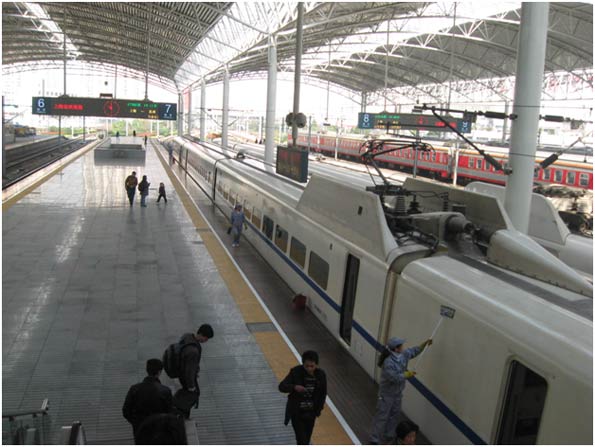
    Photo: Nanjing high speed rail train, Shanghai Station (by author)