Tag: Indianapolis

  • Ten Things You Need to Know About Indianapolis City Culture

    What makes one city different from another? Some of it is the geography, the economy, or the buildings. But a big chunk of it is culture.

    Every city has its own culture. A journalist recently interviewed me about Indianapolis and asked about some of the things that make that city’s culture distinct. I’m reposting ten of my observations here. Keep in mind that many of these points are relative, not absolute. They are comparisons versus what I see in other cities.

    1. Indianapolis has a very open social structure. Many cities have very insular cultures that are difficult to penetrate. The Midwest river cities like Cincinnati, Louisville, and St. Louis are like this. If you weren’t born there, in a sense you’re always something of an outsider. I’ve also heard reports of similar things about Cleveland, where people who come there have trouble making new friends and connections. The stereotype of some Southern cities is that who your daddy was, etc. matters a lot.

    In Indy, outsiders can move to the city and rapidly make friends and contacts, and to get integrated into civic networks. Columbus, Ohio is similar I’m told. I speculate that these cities have a more open orientation because they are state capitals. They frequently have new players circulating in and out, and this opens up the social networks considerably.

    A newcomer is likely to have a much better time of it in Indianapolis than most other Midwest cities.

    2. The social life of Indianapolis happens in back yards. This was an observation made some time ago by local cultural commentator David Hoppe. It’s dead on. In a city like New York or Chicago, there’s a palpable sense of bustling street life. This is largely absent in Indianapolis. If you operate on the assumption that this is the One True Way cities should function, Indy looks bad. But in reality the history and even built environment of Indy simply created different forms of social life. Different doesn’t mean worse.

    People in NYC have tiny apartments, so of course they want to be out and meet people out. People in Indy mostly have single family homes, and so people can gather inside and in back yards. This produces things like Sunday night dinners and porch parties. In my experience, this produces many more useful “collisions” than the merely physical ones you’re likely to have on the street in Chicago.
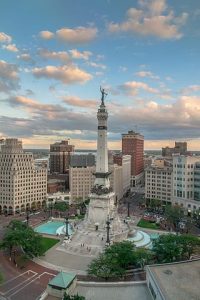
    3. A bimodal distribution of quality. Indianapolis has a “barbell” shaped quality curve. There’s a lot of stuff that’s pretty bad, but some things that are truly excellent. So, for example, the design of the average street in Indianapolis is terrible, but Monument Circle is one of the world’s great urban spaces. This contrasts with say Columbus, Ohio, where the vast majority of things are solid but relatively few stand out as terrible or exceptional. Interestingly, Nassim Taleb recommends barbell strategies. This may be one reason why Indy has the best small city tech scene in the Midwest.

    4. An excessive preference for the pragmatic. This is a common Midwest trait. Again, I’m writing a future magazine column about this and its downsides. But for now note that the Midwest tends to actively discourage ambitious undertakings and the pursuit of excellence. This can produce a stifling environment for people who want to dream big and care about doing things right. Indy is certainly far better than the rest of Indiana on this, but it’s still present.

    Looking at Indy’s barbell quality distribution, it’s clear the community gives itself permission to do A+ level work in certain areas: sports hosting, Monument Circle, etc. But I’ve yet to crack the code on what the characteristics of these are that made them acceptable while so many others were not.

    5. A weak sense of neighborhood identity. Cities like Chicago and Cincinnati are deeply steeped in a sense of neighborhood. They have strongly delineated, long-standing neighborhood areas people strongly feel themselves to be part of. Like Detroit, Indy has always been more about what side of town you live on than what neighborhood you live in. There were some exceptions to this, but the norm has been a weak sense of neighborhood identity. Unigov, where the city took in a lot of suburban and rural areas in a city-county merger, doubtlessly contributed to this, but I suspect it far predates that.

    One reason some friends and I started the Naplab Indianapolis Neighborhood Map project was to start strengthening a sense of neighborhood identity.

    6. Low cultural differentiation vs. the state. People who live in Indianapolis are Hoosiers and think of themselves that way. There’s historically been little sense of urban identity apart from the state. Chicago is like a different planet from Illinois. People in Chicago think of themselves as Chicagoans first, and Illinoisans secondarily if at all. By contrast, in Indy people are Hoosiers first, residents of the city second. It’s telling that there isn’t even a commonly used word to refer to residents of Indianapolis. Indianapolitans anyone?

    Also, the city is mostly a draw from the rest of the state, so it has a very Hoosier feel. In Chicago, there’s a Midwest feel because it draws from a regional catchment area. In Dallas, you meet people from everywhere.

    This is one the urban progressives would probably like to dispute, but they are a relatively small tribe in the city.

    7. Low institutional differentiation vs. the state. As the only big city in the state, the city’s major institutions are frequently pressed into double duty as statewide ones. There’s an Indiana Historical Society but no Indianapolis Historical Society. (Is Indianapolis the biggest city in the country without its own historical society?) The major state economic development groups like TechPoint are basically Indianapolis organizations that serve a statewide audience.

    People in the rest of the state people feel the state and major institutions give too much focus to Indy. But again, in many cases these are de facto Indianapolis institutions doing double duty for the state. In many (most?) states there would be separate organizations for the major urban region and for the state. In Indiana, that’s not the case. (I’m not familiar with how others states with one major city like Georgia and Minnesota are set up. Are they similar?)

    8. A strong civic but weak political culture. Indianapolis is known for having three top notch mayors in a row: Richard Lugar, Bill Hudnut, and Stephen Goldsmith. But in general mayoral leadership and city government have not been the drivers of change. I don’t know how Lugar operated as I was not around. Goldsmith seemed to have a strong mayoral agenda (e.g., outsourcing). But others relied more on a broader civic grouping of people – business, foundations, etc. to get things done.

    I suspect most cities would claim their civic sector is strong. Chicago likes to boast of its corporate involvement, for example. But it’s also clear that Chicago likes to get things done through a powerful mayor in City Hall. In Chicago, if the mayor says Yes to you, you are probably golden. In Indy, however, that’s not the case.

    It’s hard to describe how this works because frankly it’s very opaque. Civic initiatives are largely cooked up in the back room behind the scenes. There seems to be a big focus on consensus. Disputes are generally not aired in public. And there’s a very “go along to get along” civic ethic.

    This has had a lot of benefits. First, while it generally takes longer for Indy to decide to do something than other cities, once the decision is made to go forward, it almost always happens. You don’t see things like Louisville arguing for 40 years over whether and where to build a bridge (which only got built because Mitch Daniels stepped in). You don’t see repeated failures to pass a light rail program, like in Kansas City. When Indy decides to do something, it has a very high success rate. (A critic might say some of these things should have failed and that success at doing something you never should have done in the first place is a Pyrrhic victory).

    Secondly, there is long term continuity in civic initiatives. Rarely do things die when mayors change. The sports hosting strategy has gone back over 30 years, for example. While the current mayor didn’t strongly support the transit initiative developed under his predecessor of a different party, he didn’t stand in its way either. Contrast with how a new mayor came into Cincinnati and tried to pull the plug on a streetcar project. Or at the state level Chris Christie in New Jersey taking office and cancelling a rail tunnel project.

    The downside is a very enfeebled and low capacity city bureaucracy. Also, some changes need to come from the political sector in order to have democratic legitimacy. This makes the Indianapolis system bad at solving certain kinds of civic challenges. It should be no surprise that the mayor-driven (i.e., politically driven) system of suburban Carmel, Indiana was better able to redesign infrastructure, for example.

    Another downside is that it’s an extremely difficult environment for a civic entrepreneur to try to get things done. That’s where cultural fit comes in. If you don’t know how to navigate an opaque civic structure, accumulate political capital in that environment, etc. then you are going to fail to accomplish anything. This tends to reward insiders vs. outsiders. Though because of point #1, outsiders can become insiders fairly easily in Indianapolis, if they know how to play the game. Due to the nature of the civic structure, playing the game is likely to involve significant dilution of their ideas and compromises many people might find unpalatable.

    9. A strong preference for local hires. Indianapolis might be the biggest city in the country that’s basically never hired a global starchitect to design a major civic structure. Now there are many negative things one might say about the starchitect trend, but this is still revealing of the local culture. There’s a strong preference to hire locally in most places, but it’s very high in Indianapolis and often very clearly trumps quality. In fact, an out of towner with high flying ideas is exactly the kind of person who is going to be resented by a significant faction of the local power structure, and probably not be long for this world.

    10. You need to a guide to find the good stuff. Similar to point #2, you’re not just going to stumble into some famous place randomly, like you can in many cities. It’s a city where you need a guide to point you at the good stuff. For example, PRINTtEXT at 52nd and College is one of the best magazine stores in the entire world. I’m not exaggerating. But you’d never find it unless you were looking for it. There are all sorts of great things and great people in Indy, but they take time to find and get to know. In some cities the greatness is on the surface. In Indy, it’s in layers you need to dig up over time.

    Aaron M. Renn is a senior fellow at the Manhattan Institute, a contributing editor of City Journal, and an economic development columnist for Governing magazine. He focuses on ways to help America’s cities thrive in an ever more complex, competitive, globalized, and diverse twenty-first century. During Renn’s 15-year career in management and technology consulting, he was a partner at Accenture and held several technology strategy roles and directed multimillion-dollar global technology implementations. He has contributed to The Guardian, Forbes.com, and numerous other publications. Renn holds a B.S. from Indiana University, where he coauthored an early social-networking platform in 1991.

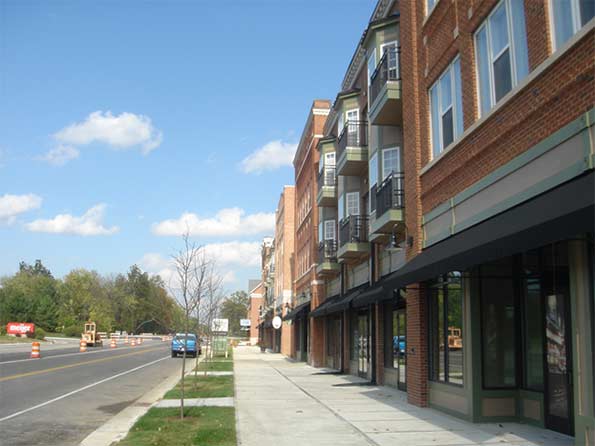
    Top photo: Daniel Schwen, CC BY-SA 4.0

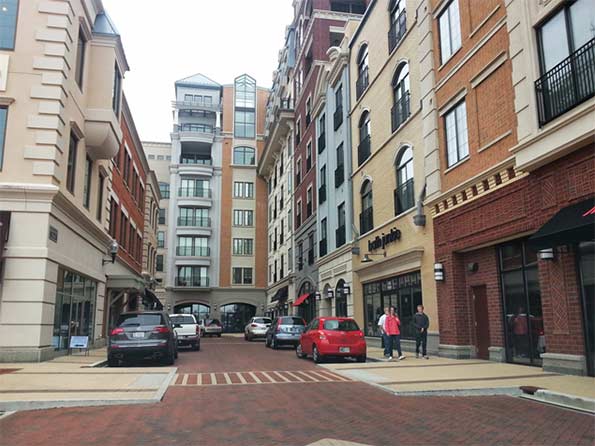
    Second photo: Monument Circle. Photo Credit: alexeatswhales, CC BY 2.0

    Fourth photo: Indianapolis hosting the Super Bowl. Image via Shutterstock.

    Fifth photo: Image via PRINTtEXT Instagram
  • “There Can’t Be a Successful Indianapolis Without a Successful Indiana”

    Back in 2008 or 2009 I gave a Pecha Kucha presentation in Indianapolis in which I said:

    “Cities can’t survive on gentrification alone. The broad community has to be a participant in its success. That’s why I’m somewhat down on the notion of the creative class. It’s good as far as it goes, but it’s a self-consciously elitist vision. Where’s the working class in that?

    Arguing among ourselves [city vs. suburbs] is like beggars fighting over table scraps. We need to build the city up without tearing the suburbs down.

    There can’t be a successful Indianapolis without a successful Indiana….While [metro] Indy has 25% of the states’ population, it has 60% of the state’s population growth and 80% of its economic growth. That’s not healthy. Like it or not, we’re dependent on the state for critical infrastructure funds and other things. So our challenge is how to bring the rest of the state along with us.”

    I’ve long been an advocate for the restoration what I call the commonwealth, the idea that we rise and fall together as a people and all have skin the game. This idea has gone by the wayside to say the least.

    It may well be that American society has become irredeemably tribalized. I hope not. At a minimum, there are significant sized groups with fundamentally incompatible ideas of the public good. There’s a lot to unpack in that statement, but not today.

    Richard Florida has talked about a “great reset” of the economy. Clearly we need some sort of institutional reset to contain or resolve these differences. We’ve done this before in creating the original Constitution to replace the Articles of Confederation, fighting a Civil War and redefining the federalism of that constitution, the New Deal era changes, and perhaps others.

    What that looks like, I don’t know. But if we are to reach it without even more severe upheavals, it’s likely to involve some renewed form of federalism, agree to disagree, live and let live, etc – and on durable basis, not just an opportunistic and self-interested one.

    This will involve painful change and difficult decisions. One of them is that we must be willing to give others the freedom to make choices for themselves and their communities that we fundamentally disagree with.

    To the extent that we believe all of the big decisions of our society are morally determined, and thus not properly the subject of political debate, this means we are in a winner take all world. If you want that world, you’d better be really sure you are right and sure you are going to win – because you face ruination if you’re wrong on either count.

    It also means that we need to figure out how to have both love and accountability towards all of our citizens. Right now that means that rural white Republicans in victory cannot ignore the continued urgent need to integrate urban black America into full participation in middle class success and to address other aspects of what Richard Florida has labeled the “new urban crisis.”

    It also means that working class whites must be challenged to change. I have made no secret in these pages that these communities too often have sabotaging traits that really aren’t necessary to cling to – such as the disparagement of ambition for better.

    But urban and left leaning populations, including minority groups, need to likewise address travails of the white working class, and be willing to make painful changes of their own.

    To be honest, I’m not optimistic. But I am hopeful. The future hold possibilities for ill that we cannot know – but it likewise holds the possibility for good things we can’t yet imagine.

    Aaron M. Renn is a senior fellow at the Manhattan Institute, a contributing editor of City Journal, and an economic development columnist for Governing magazine. He focuses on ways to help America’s cities thrive in an ever more complex, competitive, globalized, and diverse twenty-first century. During Renn’s 15-year career in management and technology consulting, he was a partner at Accenture and held several technology strategy roles and directed multimillion-dollar global technology implementations. He has contributed to The Guardian, Forbes.com, and numerous other publications. Renn holds a B.S. from Indiana University, where he coauthored an early social-networking platform in 1991.

    Photo: By Daniel Schwen (Own work) [CC BY-SA 4.0], via Wikimedia Commons

  • Were Urban Freeways a Good Idea?

    It’s almost a truism in urbanist circles that construction of urban freeways was a bad idea.

    Indianapolis Monthly magazine takes a somewhat more charitable view in its retrospective on the 40th anniversary of the completion of the downtown “inner loop” freeway.

    “But even before its grand opening, the inner loop—31 miles of interstate within I-465, built at a cost of nearly $300 million—had begun paying downtown dividends. Real estate values around the superhighway increased in the early 1970s, reversing a 35-year decline, and Mayor Hudnut also credited the road with stimulating such projects as the Hilton Hotel, the Indiana National Bank building, and the $150 million expansion of Eli Lilly & Co.

    Hudnut predicted the new freeway would spur 20,000 new jobs, and state legislators embraced the spirit: In 1973, when a federal reimbursement slowdown threatened to add 10 years to its completion date, they fronted the money for the last leg of I-65/I-70.”

    The conventional wisdom is that downtown freeways were unmitigated disasters. It says they destroyed vast tracts of urban neighborhoods, with a racist targeting of black ones, then remained as huge barriers to redevelopment.

    The Indy Monthly article acknowledges the downsides of the construction:

    “But little relief awaited the neighborhoods that were carved up for the inner loop. The project displaced a total of 17,000 residents, including 6,000 from Fountain Square (one-fourth of the population).

    Linda Osborne, owner of Arthur’s Music Store, remembers Fountain Square as a vibrant full-service community during the 1950s and early ’60s. “There were theaters, grocery stores, shoe stores—all the things you have in a small town,” says Osborne, whose family business opened in 1952. Interstate construction, however, dug a wide channel that isolated Fountain Square from downtown. Then as now, a Virginia Avenue bridge carried traffic over the chasm, but the commercial district soon tanked, Osborne says.”

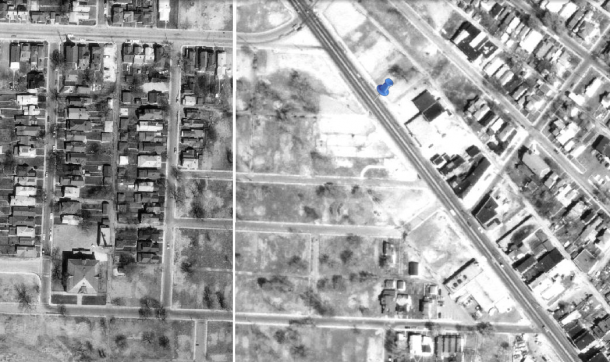
    I previously posted an article documenting the destruction in Fountain Square. It features pictures from Historic Indianapolis, including this one showing the scale of the destruction.

    historic indianpolis

    I don’t have Fountain Square’s demographics at the time, but what evidence I do have suggests it was a largely white community, which it remains to this day. So in this case the place with the most destruction wasn’t a minority area.

    Indy Monthly also points out the example of downtown Ft. Wayne. That city decided to go with a bypass option rather than a downtown alignment. The result was that they did indeed prevent neighborhoods from being destroyed, but those neighborhoods and the city’s downtown severely declined anyway. While there are some interesting things going on downtown Ft. Wayne to be sure, it’s unarguable that Indy’s downtown is on a completely different plane of development, though to be sure Indy is a much larger city.

    In fact, this is the pattern we see. Urban decline happened pretty much everywhere, urban freeway or no. When there’s a downtown freeway to blame, people do that. Where there’s not, people blame the bypass. Hence most attributing of blame for decline to urban freeways is simply incorrect.

    Indy Monthly argues that the freeway system provided for convenient access to downtown. Without that access. businesses would have fled, it would be impossible to host large events, etc.

    There is something to this, I think. If there were no freeway access to downtown Indianapolis, it seems likely it would be a much diminished urban center. Keep in mind, there was limited transit access and no real prospect of creating it.

    But we should separate two things, the freeways that provide access to downtown and the ones that run through it. It’s certainly possible that freeway spurs could have been built into the center of the city without building them as through-routes. This is the idea behind much of the boulevarding advocacy movement.

    Twice within the last decade, the state implemented multi-month closures of the Indianapolis inner loop to through traffic. This was a good real world test of whether it was needed at all.

    I wasn’t living there at the time but did do some driving around rush hour during one of the closures. The best alternate route for through traffic is to use I-465 to the south. This did get heavily congested, suggesting that this road would need to be widened prior to removing the inner loop. Some folks did say some surface routes near downtown were more congested during rush hour. But there didn’t seem to be any show-stoppers to permanent closure.

    In my view, removal of the inner loop is feasible, though highly unlikely to ever occur. But it goes to show that the benefits of freeway access to downtown could have been implemented in ways that were less invasive, using freeway spurs and boulevard distributors. In this scenario, the inner loop itself would no longer be a barrier, and the demolition associated with its construction could have been largely avoided. The freeway spurs could have been build with lower capacity, since no through traffic need be designed for. Some interchange complexes would have been eliminated.

    Removing or never building the inner loop would indeed likely add to peak of the peak congestion. The extent to which this dominates local thinking is hard to overstate. It’s revealing that the biggest source Indy Monthly used for quotes was Bill Benner, a sports columnist, and sports and events loom large.

    “To fully appreciate Indy’s middle-aged expressway, imagine 65,000-plus NFL fans spilling out of Lucas Oil Stadium and heading home on the stoplight-laden likes of Meridian Street, Washington Street, Kentucky Avenue, and other prime thoroughfares of yesteryear. Or don’t imagine it—because without this key piece of infrastructure, there might never have been a Lucas Oil Stadium.

    “It was a series of dominoes,” Benner recalls. “Without the interstate, it would have really held back downtown development. So maybe you don’t have the Hoosier Dome, or the Indianapolis Colts, or the Super Bowl. And maybe you don’t have Circle Centre or Victory Field.”

    Designing a transport system around sports event peaks, particularly low-frequency ones like NFL home games, illustrates the Faustian bargain Indianapolis made to revive its downtown.

    Indianapolis made its downtown America’s most friendly to major events. So you can get people to and from the Super Bowl the one time the city hosts it. (I would suspect getting people to and from the Indianapolis Motor Speedway for so many decades powerfully shaped this mode of thinking).

    But the design of the transport system is very hostile to almost everything else, whether that be residential uses or pedestrian access. This has changed somewhat with the Cultural Trail, Georgia St. and others. But to truly change the game would require a major change in psychological orientation to be able to care less about peak of the peak congestion after Colts games and more about the average ordinary experience of the city. I suspect a similar dynamic is at play in many other places.

    Aaron M. Renn is a senior fellow at the Manhattan Institute, a contributing editor of City Journal, and an economic development columnist for Governing magazine. He focuses on ways to help America’s cities thrive in an ever more complex, competitive, globalized, and diverse twenty-first century. During Renn’s 15-year career in management and technology consulting, he was a partner at Accenture and held several technology strategy roles and directed multimillion-dollar global technology implementations. He has contributed to The Guardian, Forbes.com, and numerous other publications. Renn holds a B.S. from Indiana University, where he coauthored an early social-networking platform in 1991.

    Photo: By reddit user MikeSanborn. Cf. https://www.reddit.com/r/indianapolis/comments/3jx7n5/my_favorite_view_of_indianapolis/cut6n4k?context=3 (https://imgur.com/oJLlvTS) [CC BY 4.0], via Wikimedia Commons

  • What Happens When There’s Nobody Left to Move to the City?

    Following up on the Pew study that found many states will face declining work age populations in the future, I want to highlight a recent Atlantic article called “The Graying of Rural America.” It’s a profile of the small Oregon town of Fossil, which is slowly dying as the young people leave and a rump population of older people – median age 56 – begin to pass on.

    Like the Pew study, this one has implications that weren’t fully traced out.

    There’s a lot of urban triumphalism these days, as cities crow about Millennials wanting to live downtown and such.

    But the dirty little secret is that a lot of these places have been growing their youth populations by hoovering up the children of their hinterlands. To the extent that urban population growth is dependent on intrastate migration in these states with declining working age populations, at some point there are just plain going to be a lot fewer youngster to move to the big city. That will start to crimp urban population dynamics.

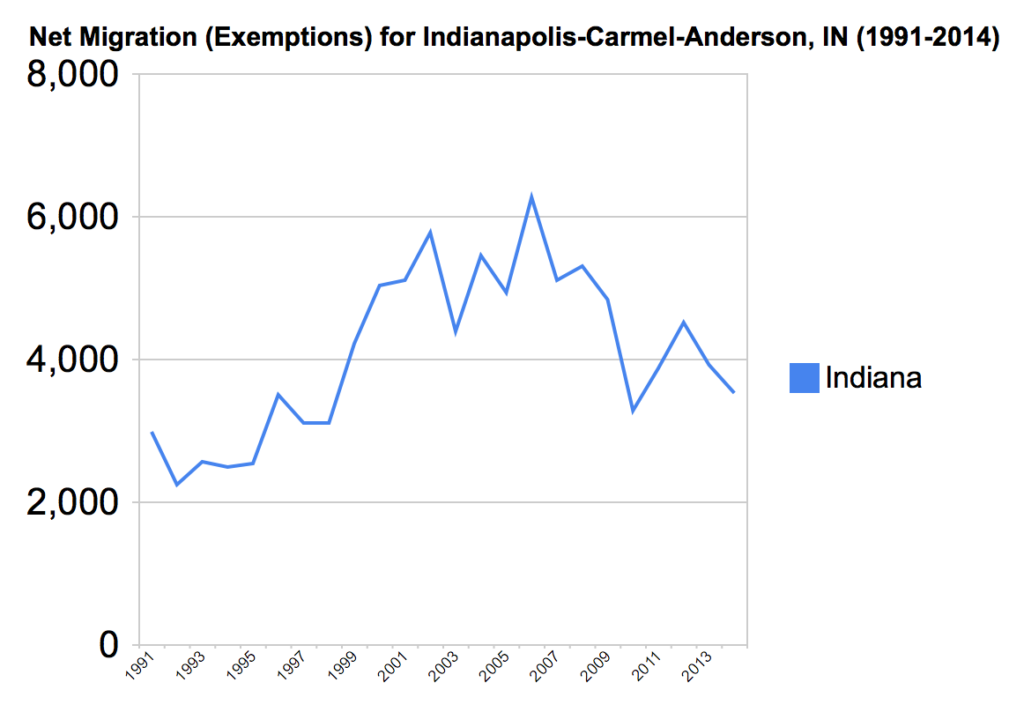
    Indianapolis is a poster-child for this.  About 95% of the metro area’s net migration has come from elsewhere in the state of Indiana since 2000, according to IRS tax return data.

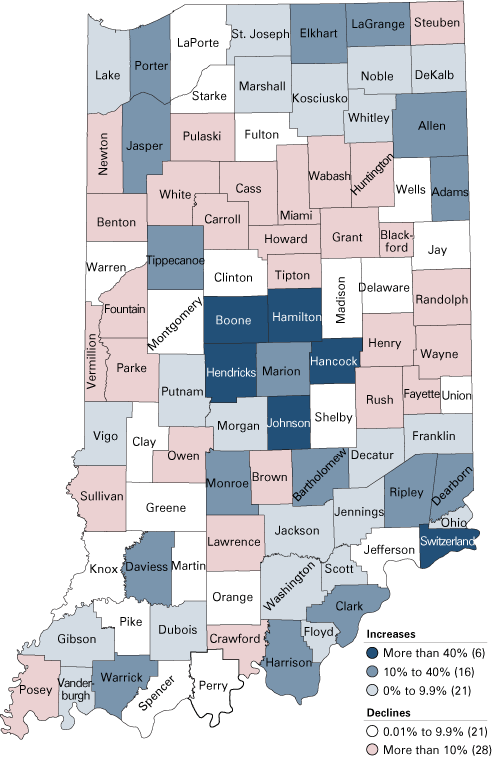
    Looking at the future, about half of the states counties (49 out of 92) are projected to actually lose population by 2050. Here’s the map from the Indiana Business Research Center.


    Projected population change in Indiana counties, 2010-2050. Source: Indiana Business Research Center

    The entire state is only projected to add 100,000 15-44 year olds by 2050. Even if 100% of them, or even more than 100% of them, are in Indianapolis, this still implies a fairly modest growth rate.

    Given the projected demographics of its migration shed, we should expect Indianapolis to start seeing a falloff in migration. In fact, we are already seeing it. Indy was previously the Midwest champ in net domestic in-migration, but recent Census Bureau estimates show a fall-off.

    Here’s what the IRS migration data says about net migration into Indy metro from the rest of the state.

    Net migration into metro Indianapolis from the rest of the state, 1991-2014. Source: Aaron Renn analysis of IRS county to county migration data

    There was a spike up starting around 1997, the dawn of the dotcom era. This more or less corresponded with the rise of the city talk. (Richard Florida’s Rise of the Creative Class came out in 2002).

    During the 2000s, Indianapolis was the Midwest growth champ, and killed it on net domestic migration. This graph helps explain why.

    But starting around 2010, inbound migration from the rest of the state has fallen off. I don’t want to claim this is entirely demographic related. Migration declined nationally during the Great Recession. And there were some methodology tweaks in this data during that time. But we can see already in the numbers what happens to metro growth if migration from the rest of the state slows down.

    At some point, the decline of rural and small manufacturing counties is going to have to show up in the migration numbers to cities like Indy. Other cities that draw primarily from a national base – like Nashville or Dallas – will be less affected.

    But cities that are dependent on a regional migration shed need to start doing the math on how the decline of their hinterlands will affect them.

    The collapse of rural and small manufacturing economies may have been good for cities in the short term, but those cities might discover down the road that they ended up eating their seed corn.

    Aaron M. Renn is a senior fellow at the Manhattan Institute, a contributing editor of City Journal, and an economic development columnist for Governing magazine. He focuses on ways to help America’s cities thrive in an ever more complex, competitive, globalized, and diverse twenty-first century. During Renn’s 15-year career in management and technology consulting, he was a partner at Accenture and held several technology strategy roles and directed multimillion-dollar global technology implementations. He has contributed to The Guardian, Forbes.com, and numerous other publications. Renn holds a B.S. from Indiana University, where he coauthored an early social-networking platform in 1991.

  • Is This Hell or Indianapolis?

    I’ve observed many times that cities outside of the very top tier almost always come across as generic, cheesy, and trying too hard in their marketing efforts. They highlight everything about their city that is pretty much a variant on things everybody else already has (beer, beards, bicycles, etc) while downplaying the things that truly reflect their community. Call it “aspirational genericism.”

    Most places are extremely desperate to be part of the cool kids club, and so they buy the right preppy clothes, etc. and treat the things that are authentic and true about themselves as something to be ashamed of instead of celebrated.

    Today lots of cities produce videos to showcase themselves. But a while back it was cities commissioning songs, hoping for something like Frank Sinatra’s standards about New York and Chicago. These were for the most part embarrassingly cringe worthy.

    Indianapolis did the same a while back, in an effort I won’t given specifics on to protect the guilty, who were, after all, operating with the utmost sincerity.

    What I do want to highlight is though is that Indianapolis has one of the greatest songs ever recorded about a city, the Bottle Rockets’ “Indianapolis.” I have not, however, ever heard anyone in the city actually bring it up.

    And it’s easy to understand why. The song is an extremely negative take on the city in every respect. The refrain is:

    Can’t go west
    can’t go east
    I’m stuck in Indianapolis
    with a fuel pump that’s deceased

    Ten days on the road
    Now I’m four hours from my hometown
    Is this Hell or Indianapolis
    with no way to get around?

    He proceeds to regale us with a series of humorous but negative observations about the city, such as:

    Who knows what this repair will cost
    Scared to spend a dime
    I’ll puke if that jukebox
    Plays John Cougar one more time.

    Having seen the Bottle Rockets in concert many times, I can tell you that songwriter and lead singer Brian Henneman really does seem to dislike Indianapolis, where he apparently had an actual bad experience. (His hometown is somewhere near St. Louis, and he spent a lot of time with the Uncle Tupelo crew in Southern Illinois – and environment one would not expect to encounter someone looking down on Indy).

    Nevertheless, this is an amazingly great song. Here’s a 1991 acoustic demo version recorded with Jeff Tweedy and Jay Farrar. If the video doesn’t display, click over to listen on You Tube.

    While it’s probably a bridge too far to suggest that the city should embrace this song as a branding anthem, I’d like to point out that many nicknames and branding aspects of cities started out as digs. And let’s be honest, the idea of being trapped in Indy without a car isn’t that far from the truth. I might also observe that gangster rap became a phenom precisely because it did not deny the reality of life in the inner city.

    Here’s another, though not a song but a TV commercial. This one is a local legend. You’ll have to watch it to believe it. It’s a TV ad for local institution “Don’s Guns.” The eponymous Don was famous for his slogan, “I don’t want to make any money, folks. I just love to sell guns.” If the video doesn’t display for you, click over to watch on You Tube.

    If you search “Don’s Guns” on You Tube you can watch a variety of other colorful ads.

    Again, this is not likely to be something that will be used in the chamber of commerce’s marketing materials anytime soon. But if you don’t live in Indy, wouldn’t you find the idea of a bunch of people there who love guns believable? Of course you would, because it’s true. Indiana is a state that explicitly includes a right to bear arms for self defense in its constitution. Now, many people locally may not like guns, but at some point people are going to discover the actual reality of the place, even if you don’t tell them about it. And believe it or not there’s a large market of people who have an interest in guns. If you want to try to market to the gun-free crowd, are they likely to put Indy at the top of their list anyway? You’re probably fighting an uphill battle.

    Then lastly back to music. If there’s one thing that people around the world know about Indianapolis, its the Indianapolis 500. So it’s no surprise that the city and race were featured in the 1983 song “Indianapolis” by Puerto Rican boy band Menudo. There’s even a music video for it. You should click over to watch on You Tube as this copyrighted music has playback restrictions.

    This one, it’s true, is a cultural relic that has not stood the test of time, other than for retro flourish purposes (though it’s not a bad song). But it seems to be little known locally. I didn’t know about it until a message board commenter linked some years back. And I haven’t seen a marketing campaign around the city focused on auto racing in a long time.

    The struggles of working class life in a car dependent town, guns, and auto racing. Not the makings of glamour, but certainly authentic. Jim Russell and others have written a lot about rembracing the industrial heritage of the Midwest as “Rust Belt chic.” Indy is not really Rust Belt in the same sense as Cleveland or Pittsburgh. But these items are part of its own unique take on the formula. What could potentially be done with them?

    Certainly Texas has done well by being Texas. And Nashville has succeeded by being unapologetic about country music. And I’ll point out again that the Midwest repudiated its own heritage of agriculture, workwear, and blue collar lagers only to have them picked up by Brooklyn hipsters and made cool again. The Midwest threw its culture away and Brooklyn bought it out of the thrift store. Now the region is reimporting is own birthright after it has been made “safe” by the embrace of the cool kids. Midwest cities should have owned local and urban agriculture. But of course, in a region of places like Columbus that are deeply ashamed of being seen as “cow towns”, that was simply impossible. If Brooklynites ever start buying up old Chevy Vans, expect that only then will a place like Indy embrace the reality of that culture as well.

    Aaron M. Renn is a senior fellow at the Manhattan Institute and a Contributing Editor at City Journal. He writes at The Urbanophile, where this piece first appeared.

  • The Emerging New Aspirational Suburb

    Urban form in American cities is in a constant state of evolution. Until recent years, American suburbia was often built without an appreciation for future evolution. This has left many older suburbs in a deteriorated state, and has accelerated claims of a more generalized suburban decline.

    The Indianapolis suburb of Carmel represents a response to this historic pattern. While responding to today’s market demands with a new aspiration level designed to make it nationally competitive, it’s also trying to position itself for success tomorrow and over the longer term.

    This is a critical issue for many suburbs. Like big cities before them, many older suburbs have now aged, and no longer necessarily meet the requirements of the marketplace.  

    There are many reasons for this.  The early, usually small-scale Cape Cod-style housing common to many 50s vintage suburbs is not what today’s market is demanding. It’s the same for older enclosed malls – today “lifestyle centers” and other formats are preferred – many of which are now vacant, their grim remains featured on web sites such as DeadMalls.com. Many suburban areas were also built out with “infrastructure light” without upgraded streets, sidewalks, etc. leaving a big backlog of infrastructure need.

    Across the country many of these older districts have fallen into decay and become increasingly poor, taking on many of the characteristics of the inner city. As the Brookings Institution noted  over a decade ago, they “are experiencing some signs of distress—aging infrastructure, deteriorating schools and commercial corridors, and inadequate housing stock.”1 Today, the public is more aware of the trend, and events in Ferguson, MO recently gave a wakeup call to newer and still-thriving suburbs that they too may be troubled at some point.

    Like other American cities, Indianapolis has many of these older, struggling suburban areas. In its case, many of them are within the core city limits due to a 1970 city-county merger. As regional growth continues to expand outside the central urban county, newer generation suburbs have a chance to learn from the struggles of many of their predecessors.

    Carmel – pronounced like the Biblical Carmel – is the first suburb directly north of the city of Indianapolis. It is an upscale residential and business suburb similar to many others around the country such as Dublin, OH; Naperville, IL; and the Cool Springs, TN area.  Its 2013 population of 83,573 made it the 5th largest municipality in the state. While not monolithically wealthy, its 2013 median household income of $100,358 is the 14th highest in the United States among communities of 65,000 people or more.2 It’s a preferred area for the estate homes of wealthy Indianapolis area residents, such as Indianapolis Colts owner Jim Irsay. But it’s not just a bedroom suburb; real estate brokerage Cassidy Turley reports that the Carmel submarket has over six million square feet of office space.3

    Being located in the center of the favored quarter of the Indianapolis region, Carmel grew as an upscale area. This gives it a leg up in long term sustainability out of the gate.  

    Yet Carmel has not relied just on its wealth to insure against decline. Rather, it has embarked on a transformation program now nearly 20 years old from which three major themes emerge:

    1. Responding to current market forces to build a “state of the art” community that is competitive globally, not just within the Indianapolis region.

    2. Building a full spectrum of amenities and infrastructure to create a “complete city” with a high quality of life and intrinsic appeal that is a) not based solely on newness or low costs, and b) which has broad demographic appeal.

    3. Attempting to create unique cultural and regional attractions  to turn Carmel into a destination in its own right, as much city as suburb.

    The primary driver of this transformation has been Mayor Jim Brainard, a Republican currently in his fifth term.  Carmel long had top performing schools – it’s the top rated district in the state   – houses with generous yards, low taxes, and other standard attractors of suburbia. Previous administrations had put in place key policies such as reserving the Meridian St. corridor for high end office space and banning billboards. But Brainard brought numerous changes in Carmel during his tenure including:

    Annexation. Carmel has undertaken a series of annexations – nearly 20,000 acres since 2001 alone.4 With over 47 square miles of territory, Carmel has now largely achieved its desired geographic scale.

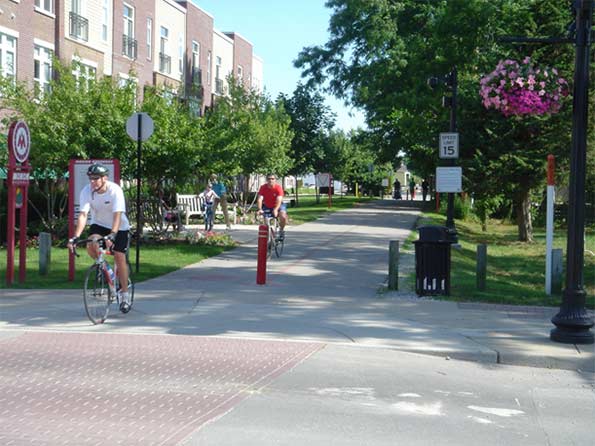
    Parks. Carmel’s park acreage increased from 50 to 1000 acres and it has spent heavily on building out its parks. This includes building a $55 million Central Park, which includes a showplace community and fitness facility called the Monon Center.5 And the popular Monon Trail, a rail-trail through the length of the city that extended a previous project built by the City of Indianapolis.


    Monon Trail at Main St.

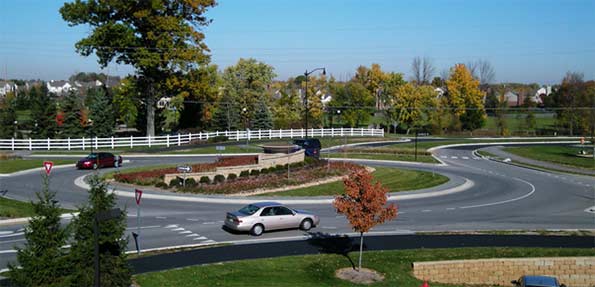
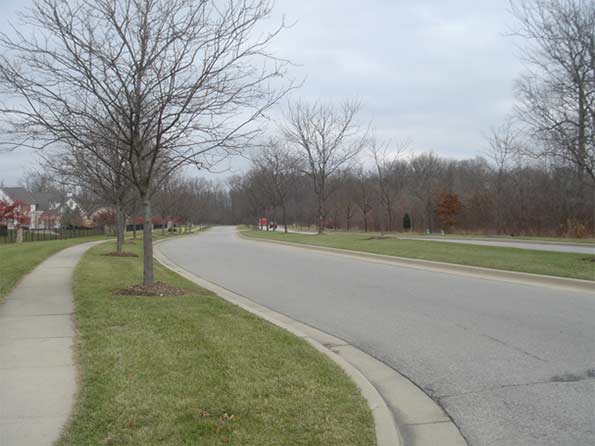
    Road Infrastructure. Carmel has invested heavily in upgrading the legacy network of county roads that it overgrew. This includes an aggressive deployment of modern roundabouts. Carmel now has over 80 of these, more than any community in the United States.6 It has upgraded miles of collector roads to urban standards with enclosed drainage, curbs, extra-wide travel lanes, landscaped medians, eight foot multi-use side paths on both sides of the street protected by a landscaped buffer zone, and decorative street signs and other detailing.

    Roundabout at Main St. and Illinois St. in the fall


    An upgraded segment of River Rd. in early winter

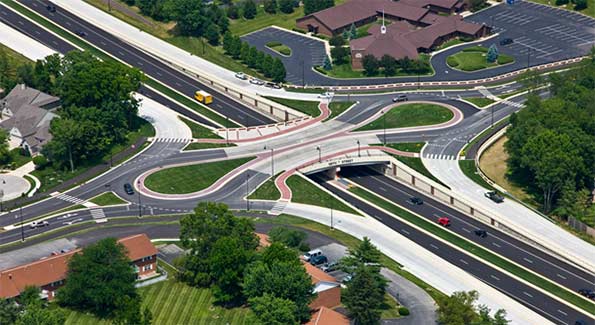
    Two major state highways passed through the town, Meridian St. (US 31) and Keystone Ave. (SR 431). These were designed as rural style divided surface highways as is common in Indiana. Carmel convinced the state to relinquish Keystone Ave. to the city and give it $90 million for upgrades and future maintenance. Carmel converted this into a mostly free flowing parkway by spending $108 million to replace stoplight intersections with roundabout interchanges. These not only dramatically improved traffic flow, the bridges over the busy highway provided a high quality, safe connection – especially for pedestrians and bicyclists – connecting eastern and central Carmel, which had previously been separated by this “great wall” of a road. The state is currently performing a similar freeway upgrade on Meridian St., the principal office corridor.


    Roundabout interchange at 126th St. and Keystone Parkway.

    Water and Sewer Upgrades. Part of Carmel previously received water from the Indianapolis water utility. The City of Indianapolis had privatized this utility but sought to repurchase it. Carmel intervened in the process to pressure Indianapolis into selling it the water lines inside Carmel. Carmel has since undertaken significant infrastructure upgrades such as new wells and pumping stations. During a recent summer drought, Carmel, unlike Indianapolis, did not put in place a mandatory restriction on lawn watering.7

    New Urbanism. Beyond core infrastructure, Carmel under Brainard has sought to change its style of development to embrace some of the more positive aspects of New Urbanism such as creating more urban nodes and walkability.

    Unlike some traditional railroad suburbs or county seats, the historic center of Carmel was very tiny, and its Main Street populated mostly with one story buildings and empty lots. This was the first focus area, and started with fixing the physical infrastructure.  

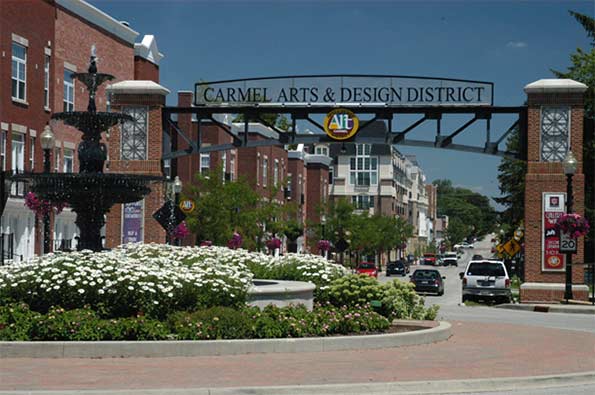
    The city rebranded the area as the “Arts and Design District” and utilized Tax Increment Financing to promote multi-story, mixed use development. The result is a mostly occupied and often well-patronized Main Street district. The surrounding historic residential blocks have seen significant redevelopment activity as well.


    Main St. at western fountain and gateway arch entryway to rebranded “Arts and Design Distrct.”

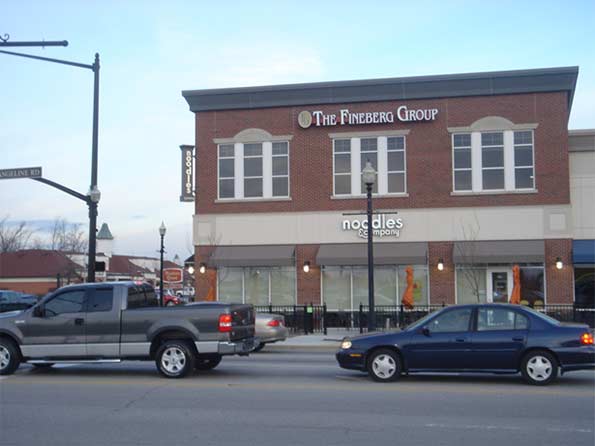
    Beyond the historic downtown, Carmel has also implemented multiple New Urbanist style zoning overlays, including on Old Meridian St. and Range Line Rd. (the city’s original suburban commercial strip). These promote mixed use development, buildings that front the street, and multi-story structures. Infrastructure improvements and TIF have been used in these areas as well. There’s also a major New Urbanist type subdivision in western Carmel called the Village of West Clay.

    Strip mall and traditional suburban development along Range Line Rd.


    New Urbanist style development along Range Line Rd.


    New Urbanist development and street improvements under construction on Old Meridian St.

    The historic downtown was deemed too small to function effectively as the downtown of a city the size of Carmel today. The city thus decided to create a new downtown area called City Center. The location for this is an area south of the historic downtown area in an older suburban industrial zone that had fallen into a blight pattern. Much of it was vacant and what’s now the principal City Center development was built on the site of a failed strip mall. TIF was aggressively used here as well to redevelop the area.

    The City Center development is only partially complete. A veterans memorial and other civic spaces are complete, as are several small office buildings, apartments, and a large mixed use complex. The anchor is a publicly funded $175 million concert hall called the Palladium and an associated theater complex with three stages.8 While these are complete, significant development remains to complete the City Center vision. The city also wants to redevelop the area between City Center and the old downtown, which they now label Midtown, but very little has been done to date.


    Interior street of City Center development.

    The goal of all this development is not the full urbanization of Carmel; this city does not aspire to be dense metropolis, or even Indianapolis. It’s rather about creating more town center type districts with the walkable feel that’s increasingly in favor, but without compromising the fundamental suburban character of the city. It’s also designed to create a city with options. Having a diversity of development styles within the city is part of a strategy of appealing to a more diverse demographic base, including singles and retirees, not just the stereotypical younger family with kids. Traffic flow has been improved, but short trips are now easier to undertake by foot or bicycle, not just by car.

    Retro Architecture. Carmel has de facto mandated traditional architectural styles. There’s no one consistent style. Major buildings have been done in Georgian, Second Empire, and Neoclassical type designs. But modernism has been rejected, further differentiating suburban Carmel from urban areas that frequently elect for starchitecture that is unapologetically “of the now.”

    The city has also attempted to prevent large corporations from building their standard architectural templates. Brick is effectively mandated, even for big box retailers like Lowes. Retailers like CVS and Kentucky Fried Chicken were forced to build second stories on their structures to locate in certain areas. Another Carmel CVS has an art deco façade.

    The city wants high quality aesthetics and a unique sense of place. They also want “timeless” design, though like much New Urbanism architecture it can sometimes come across as pastiche.

    Arts and Culture. As part of the attempt to appeal to more arts minded middle aged consumers, as well as members of the  so-called “Creative Class,” Carmel has heavily invested in the arts. The City Center performing arts center was paid for almost entirely with public funds (TIF), an investment in the arts dwarfing even that of Indianapolis. The city has also paid for an extensive public art program, mostly statues by Seward Johnson. And it makes operating grants to local arts organizations such as the Carmel Symphony Orchestra.


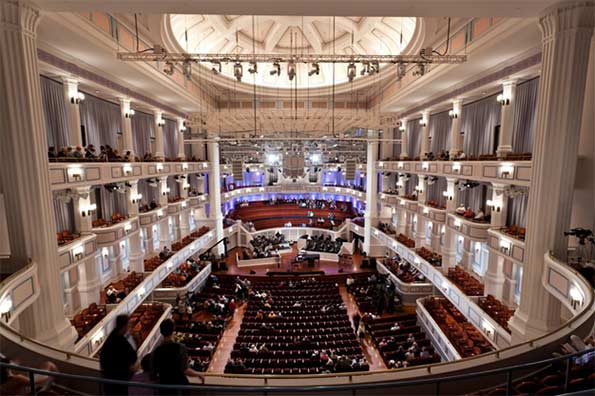
    Interior of the Palladium concert hall. Photo by Zach Dobson.

    Seward Johnson is not a favorite of urban sophisticates. His statutes illustrate the type of play it safe art generally featured by Carmel. More sophisticated or cutting edge fare is not as prevalent. And there have even been some complaints by a limited number of citizens about items such as the classical nudes featured on the door handles of the Evan Lurie Gallery.

    Brainard is thinking about the long term when Carmel is no longer the shiny new thing. As he put it, “Because we are designing a new city that will be in place for hundreds of years, the responsibility of doing it right falls to this generation…Carmel is a young city – we are still building our parks, trails, roads and sanitary sewer and water systems that will be here for centuries.”9

    He’s also keenly aware of global economic competition and the fact that Indiana lacks the type of geographic and weather amenities of other places. He frequently uses slides to illustrate this point. In one talk he said, “Now this picture, guess what, that’s not Carmel; but this picture is the picture of some of our competition. Mountains – that’s San Diego of course, mountains, beautiful weather, you know I think they have sunshine what, 362 days out of the 365…. What we’ve tried to do is to design a city that can compete with the most beautiful places on earth. We’ve tried to do it through the built environment because we don’t have the natural amenities.”10  While the claims to want to equal the most beautiful places in the world may be grandiose, the key is that mayor believes Carmel’s undistinguished natural setting and climate requires a focus on creating aesthetics through the built environment.

    What have the results been to date?  Economically and demographically, the city has performed well. It has managed to create an environment that is proving competitive for business opportunities that might have previously bypassed Indiana. For example, American Specialty Health relocated its headquarters to Carmel from San Diego, with the CEO of the company personally making the move from La Jolla to Carmel.11 Geico also recently expanded. Numerous other corporations are either based in Carmel or have major white collar facilities there. The income levels are very strong, as noted above.

    The city’s demographics have also expanded to become much more diverse. The minority population grew 295% between 2000 and 2010, adding 9,630 people and growing minority population share from 8.7% to 16.3%.12 12% of the city’s households speak a language other than English at home.13 Many of these are highly skilled Chinese and Indian immigrants working for companies like pharmaceutical giant Lilly. Even black professionals are increasingly moving to Carmel, with the black population growing 324% in the 2000s and black population share doubling to 3%.14 Carmel is not a polyglot city today, but it’s far more diverse than in the past.

    Carmel has also attracted both national press and national awards. Money magazine ranked Carmel as the #1 best small city to live in 201215, and it’s scored highly in other surveys as well. Drew Klacik of the Indiana University Public Policy Institute notes that in an echo of the transformation of the city of Indianapolis since the 1970s, “Carmel has transformed itself from a desirable community within Indiana to a desirable and competitive community nationally.”16

    However, it’s hard to argue that Carmel’s results materially outperform peer cities in other regions. Places like Dublin, OH and Cool Springs, TN have significantly more office space, for example. Many of those places are, however, implementing policies similar to those in Carmel . Most Carmel New Urbanist development continues to require TIF subsidies and is not yet sustainable at market rates. The city has obtained better financial terms in some recent deals, however.  And despite major public investment and construction in the central city, many central area census tracts lost population during the 2000s.

    The changes have also attracted significant criticism and opposition in some quarters.  While the public remains largely positive on the results, there have been many critiques of the way they were done, some of them legitimate.  A number of the projects had significant cost overruns. The mayor originally said that the Keystone project could be completed for the $90 million the state gave it. The actual cost was nearly $20 million higher.17 The Palladium was originally sold as an $80 million facility, but ended up costing $175 million. The city also said it planned to pay for ongoing operations by raising a $40 million endowment, but was unable to raise the funds, leaving it on the hook for $2 million in annual operating costs. These are not small misses.

    Critics also pointed to state figures showing Carmel with nearly $900 million in total debt.18 While it is a wealthy community that can afford the payments, in a conservative state like Indiana, a suburb accumulating nearly a billion dollars in debt raises eyebrows. Carmel’s tax rates remain among the lowest the state, however.

    The way the debt was accumulated has been criticized as well. The Palladium was paid for with TIF funds. Rather than bonds, the Carmel Redevelopment Commission – the authority that manages the TIF program and which was controlled by mayoral appointees – structured the Palladium debt as Certificates of Participation to circumvented the need for city council approval, incurring higher interest rates in the process. The city council later refinanced the debt at a lower rate using a general taxing power guarantee in what some called a bailout. In return for the refinancing, the council obtained more oversight over TIF activity.19

    Though some controversy is inevitable and some criticisms are legitimate, ultimately the change program in Carmel has proven popular with the public and the city is booming, a boom that’s lending an increasingly bitter tone to the longstanding hostility Carmel has enjoyed from the region due to its status as the highest profile “rich suburb” in the region.

    Yet for all the controversy, many regional suburbs are copying some aspects of Carmel’s approach, with roundabouts now a regular feature in area communities and major park programs and New Urbanist style town center developments as well. This includes the massive sports-oriented Grand Park in Westfield and the Nickel Plate District in next door Fishers’ town center.20

    It’s also clear that peer type suburbs around the country are adopting similar strategies, such as Dubin, OH’s Bridge Street Corridor proposal21 or Sugar Land, TX’s $84 million performing arts center.22 Imitation, they say, is the sincerest form of flattery. Carmel represents the leading edge of the emergence of a new type of post-Edge City aspirational suburb. It’s something we may be seeing a lot more of in the future.

    Aaron M. Renn is a senior fellow at the Manhattan Institute and a Contributing Editor at City Journal. He writes at The Urbanophile.

    ————————————-

    1 Robert Puentes and Myron Orfield. “Valuing America’s First Suburbs: A Policy Agenda For Older Suburbs in the Midwest,” Brookings Institution, 2002.

    2 U.S. Census Bureau, “American Community Survey 2013 1-yr”, Table B19013.

    3 Cassidy Turley, Indianapolis Office Market Snapshot (Third Quarter 2014), 3.

    4 Ellen Cutter. “Explaining the annexation process,” Greater Fort Wayne Business Weekly, June 12, 2014. Accessed January 8, 2015. http://www.fwbusiness.com/opinions/columnist/businessweekly/article_f42da036-6182-575a-8445-274cd82ca296.html

    5 Matthew VanTryon. “Carmel then and now: World’s Apart,” IndianapolisNewsBeat.com, December 16, 2014. Accessed January 8, 2015. http://blogs.butler.edu/multimedia-journalism/2014/12/16/carmel-worlds/

    6 James Brainard, transcript of speech at 2014 International Making Cities Livable Conference, June 23-27, 2013.

    7 “Why no watering ban in Carmel,” WISH-TV News, July 12, 2012. Accessed January 8, 2015. https://www.youtube.com/watch?v=y51BJYM4Fgc

    8 David Hoppe. “The Palladium’s boffo budget,” Nuvo Newsweekly, June 20, 2011. Accessed on January 8, 2015. http://www.nuvo.net/indianapolis/the-palladiums-boffo-budget/Content?oid=2275080

    9 James Brainard, notes for 2014 State of the City Address.

    10 James Brainard, transcript of speech at 2014 International Making Cities Livable Conference, June 23-27, 2013.

    11 Andrea Muirragui Davis. “Wellness provider beefing up new Carmel office,” Indianapolis Business Journal, October 29, 2014. Accessed on January 8, 2015. http://www.ibj.com/blogs/11-north-of-96th/post/50241-wellness-provider-beefing-up-new-carmel-office?id=11-north-of-96th

    12 U.S. Census Bureau, calculations by author from Census 2000 and Census 2010.

    13 U.S. Census Bureau, “American Community Survey 2013 1-yr”, Table B05007.

    14 U.S. Census Bureau, calculations by author from Census 2000 and Census 2010.

    15 “CNNMoney Ranks Americas Best Places to Live,” Daily Finance, August 20, 2012. Accessed January 8, 2015. http://www.dailyfinance.com/2012/08/20/cnn-money-ranks-americas-20-best-places-to-live/

    16 Drew Klacik, telephone interview with author, December 29, 2014.

    17 “Brainard seeks bonds to finish Keystone,” The Indianapolis Star, October 18, 2009. Accessed January 8, 2015. http://archive.indystar.com/article/20091018/LOCAL/910180409/Brainard-seeks-bond-finish-Keystone

    18 Indiana Department of Local Government Finance. “Local Government Debt Report,” September 21, 2012, 15.

    19 Kathleen McLaughlin. “Brainard seeks deal on maxed-out TIF,” Indianapolis Business Journal, March 31, 2012. Accessed January 8, 2015. http://www.ibj.com/articles/33569-brainard-seeks-deal-on-maxed-out-tif

    20 Cara Anthony. “New look for the Nickel Plate District in Fishers,” The Indianapolis Star, June 28, 2014. Accessed January 16, 2015. http://www.indystar.com/story/news/local/hamilton-county/fishers/2014/06/27/new-look-nickel-plate-district-fishers/11537251/

    21 Brent Warren. “Dublin Moves Ahead With Bridge Street Corridor Plans, Connecting Across River,” Columbus Underground, March 23, 2013. Accessed January 8, 2015. http://www.columbusunderground.com/dublin-moves-ahead-with-bridge-street-corridor-plans-looks-to-connect-across-river-bw1

    22 Rebecca Elliott. “Sugar Land breaks ground on $84 million performing arts center,” Houston Chronicle, December 9, 2014. Accessed January 12, 2015. http://www.houstonchronicle.com/neighborhood/fortbend/news/article/Sugar-Land-breaks-ground-on-84M-performing-arts-5946247.php

  • Are States an Anachronism?

    Obviously states aren’t going anywhere anytime soon, but a number of folks have suggested that state’s aren’t just obsolete, they are downright pernicious in their effects on local economies.

    One principal exponent of this point of view is Richard Longworth, who has written about it extensively in his book “Caught in the Middle” and elsewhere. Here’s what he has to say on the topic:

    In the global era, states are simply too weak and too divided to provide for the welfare of their citizens…The reason is a deep, intractable problem. Midwestern states make no sense as units of government. Most Midwestern states don’t really hang together – politically, economically, or socially. In truth, these states and their governments are incompetent to deal with twenty-first century problems because of their history, rooted in the eighteenth and nineteenth centuries.

    Longworth expounds upon this to identify a series of specific issues, which I’ll put into my own terms.

    1. States do not represent communities of interest. With some exceptions, states consist of cities, rural areas, and regions that have very distinct histories, geographies, economies, and and event cultures. As a result, it is incredibly difficult for legislators and leaders from various parts of the state to find common cause.

    Here’s how Longworth describes Illinois:

    Illinois, like Indiana, is three states, and for the same reasons. The southern third, again south of I-70, is a satellite of the South – more give to conservative religions, gun racks in pickup trucks, and a deeply conservative Republicanism….Most of the rest of the state is called Downstate to differentiate it from Chicago, even though some of it, such as Rockford, is actually north of the city. It is an unfocused place…what unites this heterogeneous region is a dislike of the third region, Chicago. Chicago dominates Illinois – politically and economically…If the rest of Illinois obsesses about Chicago, Chicago gives the impression – an accurate one, in fact – of never thinking about the rest of Illinois.

    Additionally, I might add my observation that this creates a situation where the policies which are right for one area may be wrong for another. Since it is the nature of governments to promote uniform rules, this often leaves one or even all regions of a state with suboptimal rules. In fairness, there are are often some types of flexibility, such as that provided by different classes of cities. But important macro policies remain one size fits all.

    Consider Illinois. It’s a combination of a global city core in Chicago, a Rust Belt hinterland, and a southern fringe region. State policy is set by the Chicago elite as a general rule, and predictably it follows a big city, global city favorable model: strong home rule powers for large municipalities, a high tax/high service type model, strong public sector unions, etc. This pretty much works for Chicago, but for downstate it puts their communities in a major economic vice since they don’t benefit from global city friendly policies and are competing against other places that have optimized in other ways.

    Indiana being one example. It is pretty much the opposite. Its largest city region is only about 25% of the state’s population, meaning Indiana is dominated by rural and small city constituencies. As a result, Indiana has optimized for a “Wal-Mart” strategy such as through its low-service/low-tax approach, weak environmental rules, and very weak (I’d argue nearly non-existent) home rule powers for even its largest municipalities. This is great if you are a small manufacturing city trying to beat out Ohio, Michigan, and Illinois for low wage manufacturing and distribution jobs (which sounds bad but is realistically the best short term play these places have). But it’s pretty terrible if you are Indianapolis and trying to fight to have a place in the global economy, attract choice talent, build biotech and high tech business clusters, etc.

    2. Arbitrary state lines encourage senseless border wars. With limited exceptions, the major cities of the Midwest (and often elsewhere around the country) were founded on major bodies of water like rivers, lakes, or an ocean. These were often boundaries of states, thus major cities are frequently at the edge, not the center of states. This means not infrequently you find multi-state metro areas, which creates structural conflicts of interest. The logical economic unit is the metro area, but it matters from a local fiscal point of view (i.e., the ability to collect income, sales, and property taxes) where particular businesses locate. Thus we frequently see the case where localities spend tons of money on incentives simply to get businesses to relocate within the same metro area. You can have bidding wars without multiple states (such as neighboring suburbs competing over a Wal-Mart), but these seldom involve major state level incentives.

    Longworth again summed this up masterfully in a recent blog post called “The Wars Between the States” where he documents the incentives being doled out to convince companies to move back and forth across the state border in the Kansas City metro area:

    It would seem impossible for Midwestern states to get any sillier and more irrelevant, but they’re trying. In a time of continuing recession and joblessness, with crunching budget problems, failing schools, crumbling infrastructure and no real future in sight, these states have decided to solve their problems by stealing jobs from each other.

    The most recent example is the so-called “border war” between Kansas and Missouri, as the two states compete to see how much money they can throw at businesses to move from one state to the other. The focus of this war is Kansas City — both the Kansas one and the Missouri one, basically a single urban area divided not only by an invisible line down the middle of a street but by a mindless hostility that keeps its two parts from working together.

    Competition with “Europe, India, China and the rest of the world” has nothing to do with this juvenile job-raiding. In fact, this “border war” keeps Missouri and Kansas from competing globally — indeed, robs them of the tools they need to compete globally. Some rational thought shows why. It’s precisely these states’ inability to compete globally that causes them to declare war on the folks next door. In a global economy, Kansas and Missouri aren’t competing with each other, any more than Illinois, Indiana and Wisconsin are competing with each other. The real competition is 10,000 miles away and all Midwesterners know that we’re losing it.

    [ Update 5/5/2014: It looks like Missouri and Kansas may be about to declare a truce in their border war ]

    3. Many state capitals are small, isolated, and cut off from knowledge about the global 21st century economy. In some states the state capital is a large city that is well-connected to the global economy – Atlanta, Indianapolis, St. Paul, and Nashville come to mind. But often state capitals were selected because they were in the geographic center of the state, not because they were major centers in their own right. Some, like Indianapolis, managed to grow into major cities. But many others did not. Think Springfield, Jefferson City, Frankfort, etc. This means that the state capital of many states is not very large, and often not very plugged into the global conversation. Longworth again captures the implications of this:

    There is another reason why state governments are botching the economic needs of their states. Some 150 to 200 years ago, state capitals were picked not for economic reasons, but for geographic ones. Many of them remain in this isolated irrelevance today, far from the real action of any of the territories they are meant to govern…In this era of globalization, with overnight shipping and instant communications, this shouldn’t make any difference. In fact, it does. Global cities such as Chicago depend on face-to-face contact, and isolated state capitals live out of earshot of this conversation. The winds of globalization are transforming state economies and generating new thinking about state futures, but the news takes a long time to get to the state houses and legislatures.

    4. Metro areas are the engines of the modern economy, but the rules for municipal and regional governance are set by states, and often in a manner that is directly contrary to urban interests. In this Longworth channels the Brookings Institution, which has tirelessly documented the importance of metro area economies to the nation as well as all the ways states, frequently controlled by non-urban legislators who are actively fearful of cities, have often imposed enormous burdens on those metro areas by tying them down with a morass of Lilliputian rules. Again Longworth:

    States set the boundaries of urban jurisdictions and decide whether or how they can merge. They tell cities who they can tax and how, whether this helps cities or not. State governments help finance local infrastructure and dictate, from miles away, how that money is spent. State priorities on education and workforce programs leave city residents incompetent to deal with the global job market. Highway funds go to rural areas, not to cities that need them more; job creation money goes to wealthy areas, not to the core of battered cities.

    Some urban regions have more or less given up any hope that their state will ever change or be a positive partner, such as Kansas City, as Longworth notes:

    When the Greater Kansas City Community Foundation issued a report on the city’s future, it pretty much told the state to get out of the way. “Nations and states still matter,” it said. “They particularly can do their cities harm. But cities have to take the lead. San Diego did not become San Diego by looking to Sacramento, not Seattle to Olympia.” When the authors talked about Sacramento and Olympia, one felt their really meant Jefferson City.

    I’d probably go even further than Longworth. I think that historically states imposed rules on cities deliberately designed to hobble their growth. For example, the laws that restricted branch banking in most states until recently had the effect of keeping big city banks from buying up rural and small town banks around the state. The end game of course is that when deregulation occurred, the banks in most big cities were so small because of these rules, they were easy prey to out of state acquirers. Thus most states saw basically their entire indigenous banking industry swallowed up.

    Also, states seem to more or less treat their urban regions like ATM machines. Every study I’ve seen documents how, contrary to popular belief, cities actually are net exporters of tax dollars to their state government. Marion County, Indiana for example (Indianapolis), sends a net of about $400 million a year to the state – enough to cover the entire public safety budget of the city.

    I actually don’t have a problem with some redistribution as cities are generally economic engines and more efficient to boot, so they should be expected to be donors at some level. On the other hand, when states proceed to starve those cities of the critical funds they need stay healthy and strip them of the powers they need to manage their own affairs, this is like sticking a knife in the golden goose.

    Again I can use Indianapolis as an example. As part of a tax reform package the state took over all operating educational funding for K-12. So far so good. But they also imposed a funding formula that severely disadvantaged growing suburban districts by denying them equal per pupil funding. The net result was a major funding problem for the best suburban Indianapolis districts like Carmel, Fishers, etc. Many of these districts had to go to referendums to raise local taxes to make up the difference (which was no doubt the state’s plan all along – it simply outsourced the unpleasantries of a tax increase to localities). Here is a state that claims it wants to be in the biotech business, the high tech business, etc, yet it singles out the school districts where the labor force you are trying to attract for those industries is likely to live for outsized cuts. That hardly seems like a winning strategy.

    Indiana also keeps its cities on a tight leash, with some of the weakest home rule powers around. Indianapolis basically can’t do much without legislative approval (a transit referendum, for example, will require specific legislative authorization). And the legislature seems to like it that way. Indiana’s property tax caps, which I support generally from a percentage of assessment perspective, include a lot of poorly advertised gotchas. For example, regardless of assessed value, the total tax levy can only grow at a rate equal to the average personal income growth over the last six years. I’ll caveat this by saying I haven’t studied this in detail and thus may be a bit off base, but the levy cap appears to be a de facto spending cap at current levels regardless in growth of tax base. This may be ok for some, but not others that are growing say their commercial office space base at a rapid clip and need to expand infrastructure and services to support it.

    Clearly many of these policies have no real benefit to the Indianapolis region, which is more or less being asked to be the economic engine of the state and finance state government without being given the tools to do that job property.

    The list goes on but that should give you a flavor. Similar things occur around the country.

    To this list I’ll add one of my own, which has also been richly illustrated by Jim Russell. Namely,

    5. States can’t to much to help, but they can do a lot to hurt. A lot of the national debate seems to center on whether the “red state” or “blue state” model makes the most sense. But to a great extent, policy almost doesn’t matter. In Ohio, with one set of state policies, Columbus thrives while Cleveland struggles. Tennessee is a right to work state with no income tax, but Nashville booms while Memphis stagnates. Texas is doing great with its red state model, but Mississippi and Alabama not so much. And even within Texas, there are plenty of places that are hurting badly.

    While good policy can set the stage for growth, it can’t guarantee local economies will prosper. But bad policies can hurt regions that otherwise would thrive. Extremes of either the blue or red model seem to lead to problems. Witness California, for example, which seems to be holding up a sign to business saying, “Get lost.”

    This puts states in the difficult position of being almost being able to aspire at best to being a neutral influence on their own economy. But it’s easy for them to screw things up.

    This piece first appeared at The Urbanopihle on July 11, 2011.

    Aaron M. Renn is an independent writer on urban affairs and the founder of Telestrian, a data analysis and mapping tool. He writes at The Urbanophile, where this piece originally appeared.

    States map image by Bigstock.

  • Sunday Night Dinner in Indianapolis

    Urban culture varies radically from city to city. Yet to a great extent the culture of the usual suspects type of places tends to get portrayed as normative. In New York, for example, with its tiny apartments, the social life is often in public, in many cases literally on the streets of the city, which pulse with energy. As the ne plus ultra of cities, the street life of New York is often seen as what every place should aspire to. There’s a body of literature which attributes all sorts of positive effects to this New York style urbanism, such as the notion of “collisions” and “serendipitous encounters”. But while New York’s street life and social scene may indeed be engaging, how often does one actually strike up a conversation with someone random on the street or in a coffee shop there that turns into something meaningful? The only collisions I’ve ever had there were literal.

    New York is the most well known and championed style of interaction, though hardly the only one. Think of San Francisco and something clearly distinct will come to mind, albeit with some similarities. LA has its own mythos. The TV show Portlandia does a great job of capturing our idea of the quirky urban life of that city.

    Cities that lack the cachet of an NYC, SF, or Portland can often find their own urban culture lacking in comparison. To be taken seriously, the logic goes, they must measure up to the yardstick defined by others. But while I do not subscribe to the idea of value free cultural comparisons, I do believe cities need not judge themselves as wanting just because they don’t function like New York City. Rather, they should seek to be the best they can be on their own terms. Since few cities are anything like New York, aspiring to that kind of urbanism would only be a case study in frustration anyway.

    Indianapolis cultural commentator David Hoppe once said something to the effect that “the social life of Indianapolis happens in back yards.” And this is true. Unlike a New York City, Indianapolis does not wow you just by walking down the street. While I believe in trying to contextualize the facts on the ground in the most positive way possible for moving forward, that doesn’t mean reclassifying genuine defects as virtues. In the case of Indianapolis, the generally poor impression left by its built environment and lack of street life can’t be denied. There are plenty of great places to go, but you generally need someone to point you in the right direction.

    But there are countervailing virtues as well, ones generally under appreciated. Unlike New York, Indy has a far more robust social life in private spaces like houses and back yards. This produces a qualitatively different type of social capital, one with its own unique set of strengths.

    One example of this is the emergence of community based Sunday dinners. This was an organic movement and as a result lacks a fancy name, but in keeping with the generally low key and unpretentious character of the city, let’s just call it Sunday Night Dinner.

    Sunday night dinners are a type of intentional community in which 6-8 families in a neighborhood decide to get together for dinner every Sunday night on a rotating basis. This originated in 2006 on Pleasant St. in the Fountain Square neighborhood when a group of neighbors decided to start getting together regularly for dinner. Here’s how Tonya Beeler, one of the founding members, describes it:

    When most of us talk about it, we just call it Sunday Night Dinner. It’s unassuming, I know – but that’s what Sunday Dinner is to us. We’ve had it consistently for almost 8 years – having only cancelled dinner a handful of times. The majority of the families on the original list are still regular participants and we’ve added and lost a few through the years.

    What is Sunday Night Dinner to us? In this stage in our lives, its sometimes difficult to physically connect to your neighbors, but we know that each Sunday we’re going to see our friends. It’s also a good time to have newcomers to the neighborhood connect with some of us old timers. We’ve also had visits from Mayor Ballard (before he was elected) and Melina Kennedy (when she was running) and I still have a fond memory of John Day sitting down to sup with us. But what is it mostly? Just a day in the week where we meet to take a breath, sit down, and eat together. It’s my favorite day of the week.

    I used to be part of a quarterly dinner club in Chicago. Given the frequency, our idea was to make each dinner “special” in the sense that we went all out with super high-quality food, etc. In Indy, while good food is certainly part of the equation, the regular weekly cadence means it’s as much about friends and neighbors as it is special ambiance. It’s about regular life lived in the city. In the picture at the top it’s paper plates and plastic cups all the way – and that’s just fine. Can’t stay for some reason? No worries, bring some tupperware, grab some food, and run. In a sense, it’s the Kinfolk Magazine ethic (motto: doing things simple sure is complicated – and expensive) in genuine form, shorn of Portland pretense.


    Sunday night dinner in the Beeler’s backyard in Fountain Square, Indianapolis, Easter 2012. Photo: Cindy Ragsdale

    Oh, and typically with children, which actually exist in abundance in Indianapolis.

    The idea spread and now there are Sunday night dinner groups all over the city. I’m told there are three in Herron-Morton Place alone, which I can’t quite wrap my head around given how small the area is.

    I can’t help but notice the similarity of these dinner groups to religious small group gathering. In the last couple decades, Evangelical churches have moved away from mid-week services in favor of small group gathering during the week (sometimes called home groups or other names). The idea is to promote more actual community than is possible in a larger assembly format. These dinner groups are in effect secular small groups, ones that help provide the sense of connectedness, regularity, and rootedness that’s so often missing from our contemporary world.


    Outdoor fun on Sunday night isn’t just for summer in Herron-Morton Place, Indianapolis. Photo by Amanda Reynolds.

    These groups aren’t just walled garden cliques, however. The host generally invites guests to attend. So there’s a type of brokered introduction which in my experience is the real source of “serendipitous” encounters of genuine value. An arranged guest invite is one way to get people connected in their neighborhood, or even to help people who are deciding whether or not to take the plunge into city living to get a feel for what life lived in a particular neighborhood is actually like.

    In fact, if you are visiting Indianapolis on a Sunday night, or live there and want to check it out, email the City Gallery at the Harrison Center For the Arts and they will set you up. The email address is citygallery@harrisoncenter.org

    I don’t want to suggest that Indianapolis invented the concept of the dinner club or is the only place such events occur. For all I know, lots of places do this. (Heck, as big as it is, odds are that includes New York City). And as with all traditions, this particular instantiation will likely die off at some point (though it’s still growing eight years after starting on Pleasant St). Yet the prevalence of this type of cultural phenomenon is part of the explanation for why Indianapolis has consistently managed to punch above its weight class in so many areas. Although the type of obvious assets and strength evidenced by super-cool buildings or crowds on the street may be lacking in Indianapolis vis-a-vis some other places, the city contains deep reservoirs of cultural capital that aren’t as visible and may never be fully understood or mapped, but nevertheless are of profound importance. This is the real secret sauce of the city.

    Copying this idea, locally or anywhere, is definitely welcomed. Should you be interested, here are the “Indianapolis Rules” for Sunday night dinners, courtesy of Tonya Beeler:

    1. Dinner is every Sunday night, with six to eight families, each hosting on a rotating basis.

    2. The host is responsible for preparing all of the food for everyone. (Work? Yes, but it also means seven weeks of not having to do anything but show up).

    3. The host is responsible for inviting all guests. Do not invite guests without checking with the host first.

    4. If you’re not coming, tell the host as far in advance as possible.

    5. At the very beginning of the dinner, the host makes sure all the guests know of any rules for the house (no one allowed upstairs, kids can’t eat in the living room, toilet handle needs to be held down for 3 seconds, whatever).

    6. If your family will not be coming for dinner, but you still want food, there’s no need to let the host know, just stop by early in the meal (so you don’t miss anything, food goes fast!!!) with some tupperware and fill it to go.


    Sunday night dinner in Fountain Square, Indianapolis. Painting by Kyle Ragsdale.

    Aaron M. Renn is an independent writer on urban affairs and the founder of Telestrian, a data analysis and mapping tool. He writes at The Urbanophile, where this piece originally appeared.

    Lead photo: Sunday night dinner in Herron-Morton Place, Indianapolis. This is one of three dinner groups in that neighborhood. Photo by Amanda Reynolds (check out the mirror!)

  • Commuter tax on Suburbanites Working in Indianapolis?

    According to the Indianapolis Star, Mayor Greg Ballard of Indianapolis is poised to improve the slowing growing city’s competitive position relative to the suburbs.  The Star  noted:

    "Indianapolis may be a bigger draw than surrounding areas in attracting young residents, but it’s got a problem."

    "Right as they begin raising families, many in their 30s split for the suburbs — taking their growing incomes, and the local taxes they pay, to bedroom communities in Hamilton, Johnson, Hendricks and other counties."

    Mayoral Chief of Staff Ryan Vaughn told The Star that initiatives would include a focus on improving schools, and public safety, both of which had much to do with the decades long declines of US central cities. Vaughn told the newspaper that "Ballard wants to focus on strategies to compete more fiercely with suburban counties that draw — and keep — middle- and higher-income residents."

    Certainly, the fact that central cities are far safer today than they were when New York’s Mayor Rudolph Giuliani implemented his much copied policy of intolerance toward crime in the early 1990s. Even so, Mayor Ballard has it right. Long term, sustainable recovery of cities as livable environments within the metropolitan economy requires both good public schools and an environment in which parents feel that they and their children are safe.

    There is a cautionary note however. While the Mayor’s office is on the right track in wanting to solve the endemic problems that have so weakened core cities such as Indianapolis, he has yet to take a position on a proposed commuter tax that would be levied against employees who live in suburban counties and work in the city. This would make the suburbs more attractive for employers who are presently located in the city. Further, it would make the suburbs more competitive to businesses that choose the Indianapolis area for relocation. Trying to attract and keep middle income households, while repelling business makes little sense.

  • Why State Economic Development Strategies Should Be Metro-Centric

    Globalization, technology, productivity improvements, and the resulting restructuring of the world economy have led to fundamental changes that have destroyed the old paradigms of doing business. Whether these changes are on the whole good or bad, or who or what is responsible for bringing them into being, they simply are. Most cities, regions, and US states have extremely limited leverage in this marketplace and thus to a great extent are market takers more than market makers. They have to adapt to new realities, but a lack of willingness to face up to the truth, combined with geo-political conditions, mean this has seldom been done.

    Three of those new realities are:

    1. The primacy of metropolitan regions as economic units, and the associated requirement of minimum competitive scale. It is mostly major metropolitan areas, those with 1-1.5 million or more people, that have best adapted to the new economy. Outside of the sparsely populated Great Plains, smaller areas have tended to struggle unless they have a unique asset such as a major state university. Even the worst performing large metros like Detroit and Cleveland have a lot of economic strength and assets behind them (e.g., the Cleveland Clinic) while smaller places like Youngstown and Flint have also gotten pounded yet have far fewer reasons for optimism. Many new economy industries require more skills than the old. People with these skills are most attracted to bigger cities where there are dense labor markets and enough scale to support items ranging from a major airport to amenities that are needed to compete.

    2. States are not singular economic units. This follows straightforwardly from the first point. As a mix of various sized urban and rural areas, regions of states have widely varying degrees of economic success and potential for the future. Their policy needs are radically different so the one size fit all nature of government rules make state policy a difficult instrument to get right. Additionally, many major metropolitan areas that are economic units cross state borders.

    3. Many communities may never come back, and many laid-off workers may never be employed again. Realistically, many smaller post-industrial cities are unlikely to ever again by economically dynamic no matter what we do. And lost in the debate over the n-th extension of emergency unemployment benefits is the painful reality that for some workers, especially older workers laid off from manufacturing jobs, there’s no realistic prospect of employment at more than near minimum wage if that. As Richard Longworth put it in Caught in the Middle, “The dirty little secret of Midwest manufacturing is that many workers are high school dropouts, uneducated, some virtually illiterate. They could build refrigerators, sure. But they are totally unqualified for any job other than the ones they just lost.” This doesn’t even get to the big drug problems in many of these places. This isn’t everybody, but there are too many people who fall into that bucket.

    I want to explore these truths and potential state policy responses using the case study of Indiana. An article in last week’s Indianapolis Business Journal sets the stage. Called “State lags city with science, tech jobs” it notes how metropolitan Indianapolis has been booming when it comes to so-called STEM jobs (Science, Technology, Engineering, Math). Its growth rate ranked 9th in the country in study of large metro areas. However, the rest of Indiana has lagged badly:

    Indiana for more than a decade has blown away the national average when it comes to adding high-tech jobs. But outside the Indianapolis metro area, there isn’t much cause for celebration.

    Careers in science, technology, engineering and math—typically referred to as STEM fields—have surged in growth compared to other careers in Marion and Hamilton counties. It’s a boon for economic development, considering the workers earn average wages almost twice as high as all others, and employers sorely need the skills. Dozens of initiatives focus on building STEM jobs in the state.

    A recent report ranked the Indianapolis-Carmel metro area ninth in the country in STEM jobs growth since the tech bubble burst in 2001. But while the metro area has grown, the rest of Indiana has barely budged from the early 2000s, an IBJ analysis of U.S. Bureau of Labor Statistics found.

    Indianapolis grew its STEM job base by 39% since 2001 while the rest of the state grew by only 10% (only 6% if you exclude healthcare jobs). Much of the state actually lost STEM jobs.

    This divergence between metropolitan Indianapolis (along with those smaller regions blessed with a unique asset like Bloomington (Indiana University), Lafayette (Purdue University) and Columbus (Cummins Engine)) and the rest of the state is a well-worn story by now. Here are a few baseline statistics that tell the tale.


    Item Metro Indianapolis Rest of Indiana
    Population Growth (2000-2012) 15.9% 4.1%
    Job Growth (2000-2012) 5.9% -7.2%
    GDP Per Capita (2012) $50,981 $34,076
    College Degree Attainment (2012) 32.1% 20.1%

    Additionally, there does appear to be something of a brain drain phenomenon, only it’s not brains leaving the state, it’s people with degrees moving from outstate Indiana to Indianapolis. From 2000-2010 a net of about 51,000 moved from elsewhere in Indiana to metro Indianapolis. As Mark Schill put it in the IBJ:

    “Indianapolis is somewhat of a sponge city for the whole region,” said Mark Schill, vice president of research at Praxis Strategy Group, an economic development consultant in North Dakota.

    The situation in Indiana, Schill said, is common throughout the United States: States with one large city typically see their engineers, scientists and other high-tech workers flock to the urban areas from smaller towns.

    Even I find it very surprising that of my high school classmates with college degrees, half of them live in Indianapolis – this from a tiny rural school along the Ohio River in far Southern Indiana near Louisville, KY.

    What has Indiana’s policy response been to this to date? I would suggest that the response has been to a) adjust statewide policy levers to do everything possible to reflate the economy of the “rest of Indiana” while b) making subtle tweaks attempt to rebalance economic growth away from Indianapolis.

    On the statewide policy levers, the state government has moved to imposed a one size fits all, least common denominator approach to services. The state centralized many functions in a recent tax reform. It also has aggressively downsized government, which now has the fewest employees since the 1970s. Tax caps, a comparative lack of home rule powers, and an aggressive state Department of Local Government Finance have combined to severely curtail local spending as well. Gov. Pence took office seeking to cut the state’s income tax rate by 10% (he got 5%), and now wants to eliminate the personal property tax on business. Indiana also passed right to work legislation.

    I call this “the best house on a bad block strategy.” I think Mitch Daniels looked around at Illinois, Ohio, and Michigan and said, “I know how to beat these guys.” Indiana is not as business friendly as places like Texas or Tennessee, but the idea was to position itself to capture a disproportionate share of inbound Midwest investment by being the cheapest. (I’ll get to Pence later).

    The subtle tweaks have been income redistribution from metro Indianapolis (documented by the Indiana Fiscal Policy Institute) and using the above techniques and others to apply the brakes to efforts by metro Indy to further improve its quality of life advantage over many other parts of the state (see my column in Governing magazine for more). One obvious example is a recent move by the Indiana University School of Medicine to build full four year regional medical school campuses and residency programs around the state with the explicit aim of keeping students local instead of having them come to Indianapolis for medical training.

    What there’s been next to nothing of is any sense of metropolitan level or even regional thinking. The state does administer programs on a regional level, but the strategy is not regionally oriented and the administrative borders don’t even line up. Here are the boundaries of the various workforce development boards:


    There’s a semi-metropolitan overlay, but as I’ve long noted places like Region 6 are economic decline regions, not economic growth regions. Here’s how the Indiana Economic Development Corp. sees the world:


    These are not just agglomerations of the workforce districts, there are numerous differences between them. The point is that clearly the organization is driven by administrative convenience and the political need for field offices, not a metro-centric view of the world or strategy.

    Add it all up and it appears that Indiana has decided to fight against all three new realities above rather than adapting to them. It rejects metro-centricity, imposes a uniform policy set, and is oriented towards trying to reflate the most struggling communities. I don’t think this was necessarily a conscious decision, but ultimately that’s what it amounts to.

    When you fight the tape, you shouldn’t expect great results and clearly they haven’t been stellar. Since 2000, Indiana comfortably outperformed perennial losers Michigan and Ohio on job growth (well, less job declines), but trailed Kentucky, Wisconsin, Minnesota, Iowa, and Missouri. But notably, Indiana only outpaced Illinois by a couple percentage points. That’s a state with higher income taxes (and that actually raised them) that’s nearly bankrupt and where the previous two governors ended up in prison. Yet Indiana’s job performance is very similar. What’s more, Hoosier per capita incomes have been in free fall versus the national average, likely because it has only become more attractive to low wage employers.

    Fiscal discipline, low taxes, and business friendly regulations are important. But they aren’t the only pages in the book. Workforce quality counts for a lot, and this has been Indiana’s Achilles heel. (My dad, who used to run an Indiana stone quarry, had trouble finding workers with a high school diploma who could pass a drug test and would show up on time every day – hardly tough requirements one would think). Also aligning with, not against market forces is key.

    I will sketch out a somewhat different approach. Firstly, regarding the chronically unemployed, clearly they cannot be written off or ignored. However, I see this as largely a federal issue. We need to come to terms with the reality that America now has a population of some million who will have extreme difficulty finding employment in the new economy (see: latest jobs report). We’ve shifted about two million into disability rolls, but clearly we’ve to date mostly been pretending that things are going to re-normalize.

    For Indiana, the temptation can be to reorient the entire economy to attract ultra low-wage employers, then cut benefits so that people are forced to take the jobs. I’ve personally heard Indiana businessmen bemoaning the state’s unemployment benefits that mean workers won’t take the jobs their company has open – jobs paying $9/hr. Possibly the 250,000 or so chronically unemployed Hoosiers may be technically put back to work through such a scheme – eventually. But it would come at the cost of impoverishing the entire state. Creating a state of $9/hr jobs is not making a home for human flourishing, it’s building a plantation.

    Instead of creating a subsistence economy, the focus should instead be on creating the best wage economy possible, one that offers upward mobility, for the most people possible, and using redistribution for the chronically unemployed. You may say this is welfare – and you’re right. But I would submit to you that the state is already in effect a gigantic welfare engine. In addition to direct benefits, the taxation and education systems are redistributionist, and the state’s entire economic policy, transport policy, etc. are targeted at left-behind areas (i.e., welfare). Even corrections is in a sense warehousing the mostly poor at ruinous expense. So Indiana is already a massive welfare state; we are just arguing about what the best form is. I think sending checks is much better than distorting the entire economy in order to employ a small minority at $9/hr jobs – but that’s just me. Again, we are in uncharted territory as a country and this is ultimately going to require a national response, even if it’s just swelling the disability rolls even more. I do believe people deserve the dignity of a job, but we have to deal with the unfortunate realities of our new world order.

    With that in mind, the right strategy would be metro-centric, focusing on building on the competitively advantaged areas of the state – what Drew Klacik has called place-based cluster – and competitively advantaged middle class or better paying industries.

    Contrary to some of the stats above, this is not purely an Indianapolis story. Indiana has a number of areas that are well-positioned to compete. Here’s a map with key metro regions highlighted:


    This may look superficially like the maps above, but it is explicitly oriented around metro-centric thinking. Metro Indy has been doing reasonably well as noted. But Bloomington, Lafayette, and Columbus (sort of small satellite metros to Indy) have also done very well. In fact, all three actually outperformed Indy on STEM job growth.

    Additionally, three other large, competitively advantaged metro areas take in Indiana territory: Chicago, Cincinnati, and Louisville. These are all, like Indy, places with the scale and talent concentrations to win. True, none of the Indiana counties that are part of those metros is in the favored quarter. But they still have plenty of opportunities. I’ve written about Northwest Indiana before, for example, which should do well if it gets its act together.

    This covers a broad swath of the state from the Northwest to the Southeast. It comes as no surprise to me that Honda chose to locate its plant half way between Indianapolis and Cincinnati, for example.

    The state should align its resources, policies, and investments to enable these metro regions to thrive. This doesn’t mean jacking up tax rates. Indiana should retain its competitively advantaged tax structure. But it should mean no further erosion in Indiana’s already parsimonious services. The state is already well-positioned fiscally, and in a situation with diminishing marginal returns to further contraction.

    Next, empower localities and regions to better themselves in accordance with their own strategies. This means an end to one size fits all, least common denominator thinking. These regions need to be let out from under the thumb of the General Assembly. That means more, not less flexibility for localities. Places like Indianapolis, Bloomington, and Lafayette would dearly love to undertake further self-improvement initiatives, but the state thinks that’s a bad idea. (I believe this is part of the subtle re-balancing attempt I mentioned).

    It also means using the state’s power to encourage metro and extended region thinking. For example, last year within a few months of each other the mayors of Indianapolis, Anderson, and Muncie all made overseas trade trips – separately and to different places. That’s nuts. The state should be encouraging them to do more joint development.

    This also means recognizing the symbiotic relationship that exists between the core and periphery in the extended Central Indiana region, clearly the state’s most important. The outlying smaller cities, towns, and rural areas watch Indianapolis TV stations, largely cheer for its sports teams, get taken to its hospitals for trauma or specialist care, fly out of its airport, etc. Metro Indianapolis and its leadership have also basically created and funded much of the state’s economic development efforts (e.g., Biocrossroads) and many community development initiatives (the Lilly Endowment). Many statewide organizations are in effect Indianapolis ones that do double duty in serving the state. For example, the Indiana Historical Society. (There is no Indianapolis Historical Society).

    On the other side of the equation, Indianapolis would not have the Colts and a lot of other things without the heft added from the outer rings out counties that are customers for these amenities. It benefits massively from that, particularly since it’s a marginal scale city. One of the biggest differences between Indy and Louisville is that Indy was fortunate enough to have a highly populated ring of counties within an hour’s drive.

    So in addition to aligning economic development strategies around metros, and freeing localities to pursue differentiated strategies, the state should encourage the next ring or two of counties that are in the sphere of influence of major metros to align with their nearest larger neighbor.

    Contrary to popular belief, this is a win-win. When I was in Warsaw, Indiana, people were concerned that many highly paid employees of the local orthopedics companies lived in Ft. Wayne. From a local perspective, that’s understandable and obviously they want to be competitive for that talent and should be all means go for it. On the other hand, what if Ft. Wayne wasn’t there for those people to live in? Would those orthopedics companies be able to recruit the talent they need to stay located in small town Indiana?

    It’s similar for other places. Michael Hicks, and economist at Ball State in Muncie, said, “Almost all our local economic policies target business investment and masquerade as job creation efforts. We abate taxes, apply TIFs and woo businesses all over the state, but then the employees who receive middle-class wages (say $18 an hour or more) choose the nicest place to live within a 40-mile radius. So, we bring a nice factory to Muncie, and the employees all commute from Noblesville.” Maybe Muncie isn’t completely happy about this, understandably. But would they have been able to recruit those plants at all (and the associated taxes they pay and the jobs for anybody who does stay local) if higher paid workers didn’t have the option to live in suburban Noblesville? Would the labor force be there?

    I saw a similar dynamic in Columbus. Younger workers recruited by Cummins Engine chose to live in Greenwood (near south suburban Indy). Columbus wants to keep upgrading itself to be more attractive – a good idea. But the ability to reverse commute from Indy is an advantage for them.

    Louisville, Kentucky has one of the highest rates of exurban commuting the country because so many Hoosiers in rural communities drive in for good paying work.

    This is the sort of thinking and planning that needs to be going on. Realistically, most of these small industrial cities and rural areas are not positioned to go it alone and they shouldn’t be supported by the state in attempting to do so. They need to a align with a winning team.

    There are two groups of places that require special attention. One is the mid-sized metro regions of Ft. Wayne, Evansville, and South Bend-Elkhart. These places are too far from larger metros and aren’t large enough themselves to have fully competitive economies. No surprise two of the three lost STEM jobs. Evansville has done better recently on the backs of Toyota, but has a vast rural hinterland it cannot carry with its small size. The region has done ok of late, but it has also received gigantic subsidies in the form of multiple massive highway investments, and now a massive coal gasification plant subsidy. I don’t believe this is sustainable. These places need special assistance from the state to devise and implement strategies.

    The other grouping consists of rural and small industrial areas that are too far outside the orbit of a major metro to effectively align with it. This would includes places like Richmond or Blackford County. They might get lucky and land a major plant, but realistically they are going to require state aid for some time to maintain critical services.

    For the last two groups especially, there also needs to be a commitment by the state’s top brain hubs – Indy and the two university towns – to applying their intellectual and other resources to the difficult problem at hand. Part of that involves helping them be the best place of their genre that they can. While cities are competitively advantaged today, not everybody wants to live in one. So there is still an addressable market, if not as large, for other places.

    Put it together and here’s the map that needs to be changed. It’s percentage change in jobs, 2000-2012:


    Pretty depressing. Urban core counties had some losses, but suburban Indy, Chicago, and Cincy did decently (Louisville’s less well), plus Bloomington area, Lafayette, and Columbus. You see also the strong performance of Southwest Indiana which is fantastic, but the sustainability of which I think is in question. Wages are higher in metro areas too, by the way. Here’s the average weekly wage in 2012, which shows most of the state’s metros doing comparatively well:


    In short, I suggest:

    – Retain lean fiscal structure but limit further contractions
    – Goal is to build middle class or better economy, not bottom feeding
    – Align economic development efforts to metro areas, particularly larger, competitively advantages locations. Align capital investment in this direction as well.
    – Greater local autonomy to pursue differentiated strategies for the variegated areas of the state
    – Special attention/help to strategically disadvantaged communities, but not entire state policy directed to servicing their needs.
    – Utilization of transfers for the chronically unemployed pending a federal answer, but again, not redirection of state policy to attract $9/hr jobs.

    This requires a lot of fleshing out to be sure, but I think is broadly the direction.

    Back to Gov. Mike Pence, would he be on board with this? He’s Tea Party friendly to be sure and interested in fiscal contraction. But he’s not a one-trick pony. He’s actually taken some interesting steps in this regard. He is subsidizing non-stop flights from Indianapolis to San Francisco for the benefit of the local tech community. He also wants to establish another life sciences research institute in Indy. And he’s talked about more regionally focused economic development efforts. It’s a welcome start. I think he groks the situation more than people might credit him for. Keep in mind that he did not establish the state’s current approach, which arguably even pre-dated Mitch Daniels, and he has to deal with political realities. And if as they say only Nixon could go to China, then although a reorienting of strategy is not about writing big checks, still perhaps only someone with conservative bona fides like Pence can push the state towards a metro-centric rethink.

    Aaron M. Renn is an independent writer on urban affairs and the founder of Telestrian, a data analysis and mapping tool. He writes at The Urbanophile, where this piece originally appeared.