Tag: Indianapolis

  • Are Special Service Districts a Boon or a Bane?

    America’s cities have been under fiscal pressure for an extended period of time. To cope with this, and better manage assets, they’ve increasingly turned to various forms of special purpose districts or entities for service delivery. Traditional independent service districts such as sewer districts or transit districts were often designed to circumvent bonding limits or to deliver services regionally, so were larger in scale. These newer service districts are much smaller in scope. They consist of two basic components:

    1. A private sector, usually non-profit management agency that operates a public asset or delivers services under contract to the city in a form of public-private partnership.
    2. Special purpose funding sources to finance this entity’s activities. These funds can include private donations, proceeds raised from Tax Increment Financing (usually for capital purposes), and taxes raised from so-called Business Improvement Districts (or BIDs, with special property taxes collected from businesses in a given area on a semi-voluntary basis, generally after a super-majority of property owners vote to agree to impose the tax).

    Examples of these special service districts abound. One of the most famous is the Central Park Conservancy, which manages Central Park in New York under contract to the city.  The conservancy was founded in 1980 to raise funds to restore Central Park.  It received funds from the city budget, but also does significant private fundraising as well, for both capital and operating purposes.

    Another well-known example in New York is the Bryant Park Corporation, which runs Bryant Park in Manhattan.  Once known as “Needle Park” because it was taken over by drug users and deals, today Bryant Park is a lavish showplace right down to fresh cut flowers in its marble restrooms.  Bryant Park is only 9.6 acres, but has an annual budget of $7 million. As Bryant Park Corporation CEO Dan Biederman once noted, that is more than the entire $4.3 million parks budget of the city of Pittsburgh.  This cash is raised from a BID, sponsorships, and commercial concessions in the district.

    A different type of entity is the Chicago Loop Alliance.  As with similar groups in many cities, Chicago uses the Alliance as a downtown management agency, responsible for marketing, beautification, public art, events, etc. in downtown Chicago. It’s backed by local businesses, especially retailers, but also receives funding from a BID (known as a Special Service Area (SSA) in Chicago).

    As a final example, when the city of Indianapolis built the eight mile downtown Indy Cultural Trail, a non-profit called Indianapolis Cultural Trail, Inc. was created maintain and promote it. The trail was the brainchild of Central Indiana Community Foundation President Brian Payne. To ensure that the trail would be well maintained over the long term in an era of tight budgets, he included a maintenance endowment in the original private fundraising to build it.  Additionally, ICT, Inc. raises private funding to supplement this.

    These four examples are different in various ways, but something they obviously all have in common is that they serve prosperous areas or are focused on showplace type amenities. While not all such districts around the country are quite so upscale, in general they tend to be most prominent and effective in central business districts or wealthier neighborhoods.

    These special service districts are part of a trend towards privatized government in America. Given the state of Central and Bryant Parks when their respective organizations where formed, obviously those two have been a success. Many of these districts are very well run because they depend at least in part on private sector cash raising and because as private entities they are free from many cumbersome government rules.

    On the other hand, it’s not hard to see these as perpetuating the move towards two-tier municipal services, in which wealthier areas receive higher services levels than elsewhere. In effect, techniques like BIDs enable relatively thriving areas to purchase better levels of service for themselves without having to help finance similar services elsewhere.  That’s not necessarily a good thing.  For example, New York City has been criticized in some quarters for a lack of investment in outer borough parks.  State Senator Daniel Squadron of Brooklyn said in AM New York, “Large conservancies get millions every year from private donors. But the parks that find it hardest to get that support are the ones that need it the most.” He wants to force the Central Park Conservancy to pass long 20% of its donations to smaller parks.

    However, it isn’t always bad if a central business district, clearly a unique area in a city, has different services delivered there. Its dense concentration of employment and visitors almost necessitates it.  The same is true for special regional attractions. Central Park truly is unique.

    In fact, the move towards privatized services in wealthier areas could be a good thing for the rest of the city if it is used to free up funds for use where there isn’t as much private capital available.  In this case a city could look to move parks, street cleaning, and other items “off the books” via special service districts in areas that can afford to fund such services largely by themselves. The city would then concentrate public funds in poorer or middle class areas. The tradeoff would be that the wealthier areas might be allowed to purchase higher quality services for themselves, but that would be structured in a way that let service quality be raised for others.

    On the other hand, it’s not hard to see how this could evolve as a mechanism for “strategic abandonment” as well.  In this case the city would cut general service levels then allowing wealthier areas to buy them back.  Critics have charged that special service districts are exactly the legal mechanism that will be used to implement planned shrinkage in Detroit.

    In short, how this plays out will depend greatly on the strategic intent (or neglect) of city leaders. But regardless, in an era of financial extremis for cities, the trend towards more privatized government and special service districts is sure to continue.  The key is for the public to demand that these deals be structured as win-wins that don’t just benefit the already thriving areas of the city, but enable investments in struggling areas that are often overlooked.

    Aaron M. Renn is an independent writer on urban affairs and the founder of Telestrian, a data analysis and mapping tool. He writes at The Urbanophile.

    Bryant Park photo by Jean-Christophe BENOIST

  • To Rebuild, the Midwest Must Face Its Real and Severe Problems

    Despite well-publicized problems that earned it the nickname of the “Rust Belt”, on paper the Midwest possesses some formidable strengths. These include the largest concentration of engineers in America, world class educational institutions, a plethora of headquarters of global champions ranging from Proctor and Gamble to Caterpillar to the Chicago Mercantile Exchange, the world’s greatest reserves of fresh water, and an expanding immigrant population.

    Yet with limited exceptions, these have been around for a while, but haven’t produced much growth across the region. Instead, outside of an archipelago of successful outliers (mostly select parts of major metros or college towns), the region has seen its population, job, and income growth badly trail the nation.  During the 2000s US population grew by 9.7%, the Midwest* 3.8%. For jobs, the US lost 1.5% but the Midwest 7.8%.

    Reversing this requires not just leveraging strengths and building on assets, but facing the very real and severe structural challenges that plague the region. However, most of the strategies out there remain outside the region’s essential DNA:

    • Economic clusters like high tech startups or water industries are in effect attempts to build new success enclaves outside the system.
    • Rebuilding downtowns into urban playgrounds for the upscale often takes place against a backdrop of vacant lots, abandoned structures, and depopulation – in other words, empty space.
    • The Rust Belt Chic movement suggests that many of the problems are actually the solution.  But while there are intriguing and important elements to this, it bypasses core issues.

    These are all good as far as they go, but they require little broad-based reform (as opposed to district or enclave based solutions) to structural problems and thus are limited in what they can achieve.

    What are these structural problems? Among the key ones are:

    1. Racism. The modern history of Midwest cities is enmeshed in the history of race relations, particularly between black and white. Places like Chicago and Milwaukee remain among the absolutely most segregated in America. Race riots have been defining feature of cities ranging from Detroit to Cincinnati (which had a race-influenced riot as recently as 2001). In all of these places, a large population of black residents live in segregated neighborhoods plagued with problems ranging from poor schools to low quality housing to a lack of jobs.  Significant social distress has resulted. 

    There are signs the Great Migration that brought blacks north in search of factory work is reversing, with black residents actually seeing more welcoming environments and better economic opportunities in Southern metro areas like Atlanta, Houston, and Charlotte. As well, historically it’s been the more ambitious who leave, not such a good thing for the people and places left behind.

    2. Corruption.  Midwest cities ranging from Chicago to Detroit to Cleveland are famous as cesspools of corruption and cronyism. Systems like Chicago’s “aldermanic privilege” tradition that gives city council members almost dictatorial control over their districts produce environments of almost required tacit corruption even if no laws are violated. In other cities, it’s well known that your approvals will go much faster if you hire the right wired-up subcontractors, lawyers, or lobbyists. While this type of environment exists at some level everywhere, it’s very bad in many Midwest cities and badly degrades an already challenged business climate.

    3. Closed Societies. Contrary to the assertions of Robert Putnam and Bowling Alone, a lot of Midwest places suffer from an excess of social capital. As Sean Safford noted in Why the Garden Club Couldn’t Save Youngstown, excessively dense social networks can create a hermetically sealed environment into which new ideas can’t penetrate or get a hearing.  There are many reports of newcomers to Midwest cities saying that they have difficult making friends and penetrating the social networks in places as diverse as Minneapolis and Cleveland. In Cincinnati and St. Louis expect that the first question you’ll be asked is “Where did you go to high school?” which tells you everything you need to know about those cities.  Immigration has ticked up in recent years, but overall the Midwest has done a poor job of attracting outsiders.

    4. Two-Tier Environment and Resulting Paralysis.  Despite the plethora of high end companies, educated workers, and top quality universities, the Midwest economy was traditionally based on moderately skilled labor in agriculture and industry. This forged a work force that places too low value on education and which can even be suspicious of people with too much of it. Today’s agriculture and manufacturing concerns, at least the ones with jobs that pay more than subsistence wages, require much higher levels of skills and education than in the past. What’s more, with the global macro-economy favorable to larger cities and talent based industries, larger metros have comparatively done well while most smaller towns have struggled. As a result, their quality of life and services have so badly degraded they are no longer attractive to “discretionary residents” (those with the means and opportunity to leave), which perpetuates a downward spiral as the educated flock to bigger cities. That’s why manufacturers complain they can’t find workers with skills, even if those skills are just passing and drug test and showing up to work everyday. This produces massive inequities, resentment, and policy confusion. What’s more, realistically many very poorly performing communities may never recover.

    Beyond these core issues, many places have aging infrastructure, massive blight issues, a regulatory environment not suited to the 21st century, and severe fiscal problems. All of these are extremely difficult problems to resolve, but that does not mean they don’t need to be faced, and overcome.

    Unsurprisingly, the Midwest has not been a particularly competitive region.  There will continue to be bright spots ranging Des Moines to Madison to the greater Chicago Loop to the fracking fields of western Pennsylvania, but until the region faces up to its problems don’t expect a major turnaround anytime soon.

    Aaron M. Renn is an independent writer on urban affairs and the founder of Telestrian, a data analysis and mapping tool. He writes at The Urbanophile.

  • Cities of Aspiration

    Drew Klacik’s recent post on how he ended up in Indianapolis got me thinking about the unique status of what I’d describe as “cities of aspiration.” Pretty much all cities seem to be reasonably good at attracting people in the following cases:

    1. Recruiting someone to a specific career or other opportunity. In this case, the value of the opportunity is really the question at stake. The attractiveness of the community itself is generally a secondary consideration though may have an impact pro or con.

    2. Luring residents based on a family connection. This would often be the case for “boomerang migration” – people who left and came back, ordinarily after marriage and children. More broadly we could think of this as retaining or attracting those with a historic connection to a place, such as being born there.

    3. Drawing people from a city’s natural catchment area. The size of this area depends on a variety of factors, but pretty much every city has some natural hinterland from which it draws people.

    I call this the “normal model” of attraction. Clearly, a place like Indianapolis does well on all of these types of attraction, as do most similar sized cities I’d argue. That’s how Drew ended up in Indy.

    However, there’s another basis of attraction. This is what I call “aspirational attraction” – it’s people deciding to move or desiring to move to a city from outside of its natural catchment area despite a lack of a job offer or historical connection. I see this as based in one of three primary motivations:

    1. Desire to work in a particular industry that is centered in a particular location. Want to be a country musician? Moving to Nashville helps. Similarly, if you want to be an actor, New York, LA, or Chicago are basically your only options.

    2. Desire to live in a particular city for lifestyle reasons. Portland would be the paradigmatic example here. People sure don’t move there for its job market.

    3. Desire to live in a city because of its reputation for a rapidly growing economy or superior job market. Many of the Sun Belt boomtowns might fall into this category. They’ve got similar quality of life to many other places, but their robust job markets (and perhaps a bit of nicer weather) draw people in.

    Clearly, there are comparatively few places that function as a aspirational cities in a meaningful sense.

    Back to Drew’s piece, I don’t want to put words into his mouth, but my impression was that he sees Indianapolis having a strong “normal model” of attraction but not functioning as an aspirational city. I agree. More than 80% of Indy’s net domestic in-migration comes from elsewhere in Indiana, the city’s natural catchment area, and it isn’t hard to believe that specific opportunities and boomeranging account for almost all the rest. Perhaps the implication of his notion of tradeoffs is that if a city like Indy isn’t aspirationally attractive, you have the luxury of compromise since you probably already have a lock on the market you’re currently capturing. That’s a perfectly valid conclusion to reach, IMO.

    A very serious question cities that function nearly exclusively as normal attractors need to ask themselves is whether they desire to become aspirationally attractive. If so, then some exploration of the basis of that, and a realistic assessment of whether or not it is possible is important to undertake. Included in this would be the implications of not becoming aspirationally attractive. It seems to me that not having some type of aspirational component to your city’s attractiveness ultimately puts a ceiling on what it can achieve. On the other hand, it is far from clear that it’s easy to consciously create an aspirational value proposition where none currently exists.

    Aaron M. Renn is an independent writer on urban affairs and the founder of Telestrian, a data analysis and mapping tool. He writes at The Urbanophile, where this piece originally appeared.

    Photo: sparktography

  • Why I Do Live in Indianapolis

    When a friend constantly tells you how much he or she likes you and then one day says, “But I’d never live with you,” the predictable reaction is to feel hurt and angry. That’s how I felt when The Urbanophile posted “Why I Don’t Live in Indianapolis.”

    But last night, while riding my bike on one of Indianapolis’ many bike trails (yes, we have them), I started thinking about why I do live in Indianapolis. The answer surprised me.

    While I honestly buy into the quality-of-life, amenity-based strategies that are all the rage these days, that’s not how I arrived here. I live in Indianapolis because I grew up in the Indiana part of Chicago and my late wife grew up near Fort Wayne. We chose Indianapolis because it was close to our families and we had job offers – simple as that. This decision is even more stunning because just a few years earlier, I’d visited Indianapolis for the first time and went home convinced that I would never live in a city that only had one tall building and appeared to be virtually empty at night.

    When I moved to Indianapolis, I had no idea that the new mayor had a vision that Indianapolis could rebuild its downtown, obtain an NFL team and one day host a Super Bowl. I had no idea whether the city wanted to be great or accepted mediocrity. And I certainly didn’t base my decision on the architectural design of a parking garage.

    I also didn’t grow up dreaming of life in a specific city. When I asked some friends (admittedly not a big or random sample), I found only one who dreamt of living in a specific place. That place: New York City. That friend’s current residence: Nashville, Tenn. Turns out my friend lives in Nashville because it’s reasonably close to family and he had a job offer. Most everyone I talked with told me the same story. Maybe this is because we grew up Midwesterners—and as ESRI’s human tapestry data tells us, we are more likely than those who live elsewhere to value family, tradition and stability. But the key point is our choices weren’t predicated on urban amenities or ambitions. They were all about location and employment. I’d wager that most of us – yes, even us pro-amenity types – are less idealistic in our choices than we profess to be.

    This is not to argue that high-quality amenities and bold visions are unimportant. But for those who initially decide where to live based on more practical and personal considerations, it may mean that urban amenities and ambitions are more important to retention than they are to attraction. If so, then a key issue is what residents – rather than potential residents – value in a community. Prior to reading The Urbanophile post about Indianapolis, I wouldn’t have thought that.

    Cities, in a way, are like households: What’s our priority? For most of us mortals (maybe not global cities or the “one percenters,”), the answer involves compromise. I might choose to buy a great TV and a nice driver for my golf game. A neighbor might choose a fast car. Another might choose to travel. What we choose doesn’t determine whether we’re striving. We might all be striving, yet we can’t have it all. The same holds true for a community.

    So how did Indianapolis advance from that city with one tall building to a city able to dazzle and delight as Super Bowl host? Choices. Compromises. We chose to focus our ambitions and our resources on a sports-based, downtown-festival-marketplace strategy. It’s worked – repeatedly – with the Super Bowl being the latest and greatest sign of success.

    Now it’s time to build on what’s working, and to turn our sights to what’s next. Part of moving on likely will be to sustain, enhance and further capitalize on a great downtown – one that’s more appealing to current and prospective urban dwellers. That’s where the new parking garage comes into play – the one the Urbanophile and others so dislike.

    The garage, as best I understand, is being developed to rid us of three large asphalt surface lots in the heart of downtown. Good riddance! That, in turn, will clear space for an additional downtown grocery store and more downtown housing. Good additions!

    I’m all for quality design. But given a choice – the kind of compromise required of cities and households – the developers of these three blocks chose to focus on the grocery store and the housing without stressing a world-class garage.

    In a world of limited means and compromise, does the design or lack of design in a parking garage indicate an entire city’s failure to strive? Or does it reflect a practical desire to balance ambition, cost, and progress? Put another way: If the choice was a nicer garage and a less-grand grocery and housing development, would that be better? If some think the garage should have first-floor retail space, but there is already a glut of unused retail space nearby, should one include it in the design for design’s sake, knowing it likely would sit empty?

    While most responses to The Urbanophile article were about design, another key point was urban aspiration. On that point, Indianapolis and many other Midwestern cities have reached a critical moment as they seek to balance the notion of striving with the realities of living within their means. As they choose and compromise, it doesn’t mean that Indianapolis and its counterparts are lacking in ambition any more than a family balancing the cost of a Caribbean cruise vs. sending the kids to college.

    Sure, some in Indianapolis would let the lack of resources limit ambition. Others would have us aspire without considering cost. Still others will realize that finding the money – even in the toughest economies – is a measure of our city’s commitment to aspire.

    In all likelihood, though, compromise will be necessary. While many look down on the notion of compromise, I think of it as the key component of incremental progress and the failure to compromise as the enabler of inaction. When choices must be made, it’s critical that incremental progress be viewed from two perspectives: How far have we come and how our progress compares with that of other communities.

    In the final analysis, each city is likely to make different compromises. Ideally, those compromises reflect the current demands and long-term aspirations of their citizens and institutions. Some may choose well-designed parking garages. Others will focus on neighborhoods, parks, schools or some combination of services and amenities. Those with internal perspectives will view progress as change over time. Those who think more globally will choose to measure progress relative to other cities.

    Is Indianapolis perfect? Nope. Could and should it try harder? Yes. Should it seek to get more people and, thus, more perspectives involved? Of course. Should, it keep in mind that it is competing globally for human capital and private investment? Yes again.

    But like many, non-global Midwestern cities, Indianapolis will have to make choices and compromises. In so doing, it will pursue a strategy that’s different from other places, and those differences won’t appeal to all.

    Ricky Nelson once sang, “You can’t please everyone, so you got to please yourself.” I’m pleased to look at it this way: For some, Moby Dick was just a whale; for me, the parking garage is just a parking garage, but a new urban grocery and more downtown housing that is incremental progress.

    Drew Klacik is a Senior Policy Analyst at the Indiana University Public Policy Institute.

    This piece originally appeared at The Urbanophile. It is a response to “Why I Don’t Live in Indianapolis” by Aaron M. Renn.

  • Why I Don’t Live In Indianapolis

    It’s no secret that Indianapolis has been a huge focus of my blog over the years. One of the biggest criticisms I get here, especially when I ding some other city, is that I’m nothing more than a mindless booster for Indy. While I like to think I’ve given the city a lot of tough love over the years, it’s definitely true that I’ve had many, many good things to say, and I have no problem saying that I’m a big fan of the city overall.

    Why then, might one ask, don’t I actually live in Indianapolis?

    The answer is multifaceted, but without a doubt one key reason is that I simply can’t sign up to what the city is doing in its urban environment. Indy is going one direction, I’m going another. It’s as simple as that.

    Let me give you an example of what I’m talking about. The city recently announced a plan to subsidize a mixed used development on a parcel in the core of downtown, a project called “Block 400.” It would include apartments, retail, etc – all good. While the concept is great, the design is another matter. I could go into depth on the monotony of the structure and other matters, but what I want to show you instead is a parking garage that will house employees from One America insurance. Here was an initial rendering of the garage:

    It’s about as boring a garage as can be imagined. It’s on a prime block just steps from Monument Circle, but has no street level retail or other interest. It’s just a dead parking garage.

    Various folks took umbrage at this, so the developer decided to tack on some awnings, which got them approved by the city’s hearing examiner. Here’s their updated design:

    Let’s be honest: this isn’t a garage, it’s urban design garbage. And guess what? The city of Indianapolis itself is paying to build it.

    I don’t want to let the perfect be the enemy of the good. I can certainly understand that there are economic constraints, tradeoffs to be made, etc. And not every project can be a home run.

    But this isn’t unusual at all – this is standard operating procedure for Indianapolis. This is par for the course. This is just what Indianapolis builds. I cannot name another major city in the United States where the city’s own developer community (including Flaherty and Collins, the developer of this property), own architectural firms (including CSO Architects, who designed this) and own city government so consistently produce subpar development.

    I’m not exaggerating at all. And this isn’t even the worst offender. For example, here’s another downtown development that not only sucks out loud, but the state fire marshal condemned it and forced residents to move out:

    While I’ve named the names of the folks involved in the parking garage and they certainly deserve it, let’s not focus overly on them. This trend goes back a really long way, and is pervasive. The previous city administration, which was of a different political party, behaved no differently. Partially it’s a result of a lack of good urban history of the type that exists in other places. So there isn’t a good template ingrained in the city to follow.

    But ultimately, as I’ve written before, it’s a crisis of values.

    Indianapolis is the place where, as a rule, not good enough is more than good enough for most people, even community leadership.

    That’s why I don’t live there. Because that’s not good enough for me. I may not be perfect, but I aspire to more than mediocrity. I don’t expect any city to be perfect or all the way there yet. You can inspire people, including me, to join your army to take hamburger hill or to get behind the rock and push, if you provide a vision of what can be. That’s one reason people are planting their flag in Detroit. It’s the hope of the possible.

    But when it’s clear that the city itself – and I mean that in the broadest sense – has decided it wants to go march off in a different direction, it’s a lot harder to enlist in that army, no matter how much you might want to.

    Alas, it seems lots of people agree with me – on the actions if not the reasons – as Center Township (the urban core) lost another 24,000 people in the 2000s. They voted with their feet – just like tens of thousands of others have been continuously voting with their feet since 1950 – to go build a better life for themselves somewhere else.

    And in a decade where downtowns made strong residential comebacks, with young people streaming in to live in them, Indianapolis was an exception. Its downtown* added less than a 1000 residents, and their distribution suggests that almost all of that might be a result of jail population expansion. Even downtown Cleveland did better.

    I’m sure Indy’s boosters will be happy to talk about world class parts of downtown like Monument Circle, the Cultural Trail, Georgia St., etc. And these are legitimately first rate. Actually, that makes it worse. It shows that Indianapolis can compete with the best if it wants to, but most of the time it just doesn’t care to. It’s not ignorance. The city knows that to do, it just doesn’t want to do it.

    For some reason locals seem to think that doing it right should be reserved for a handful of special places and occasions. But the mark of at great city isn’t how it treats its special places – everybody does that right – but how it treats its ordinary ones. Indy is like the guy who thinks he can get away with wearing the same old dirty clothes fives days in a row and not taking showers, as long he slaps on a little top shelf cologne before he leaves the house. I’ve got news for you, people are going to notice.

    Indianapolis retains a very compelling regional story to tell. There are tons of reasons for people to come to or build a business in, metropolitan Indianapolis. But the real story there is mostly in the suburbs.

    Yet I believe even the urban core of this not very historically urban city could be compelling as well – if it wanted to be. Indianapolis has all the potential in the world. Indy is like the up and coming star at a company whose boss pulls him aside one day and says, “You’ve got all the potential in the world, but if you want to get that big promotion, you need to stop doing/start doing X, Y, or Z.” Anybody who has made it to the top was fortunately enough to have somebody give them one or more of those good kicks in the pants along the way.

    Indy, unfortunately, has heard the message many times before from many different people, and has elected not to do anything about it.

    Locals love to make excuses for why things can’t be better. F&C’s development director for the project said of the garage, “Some things aren’t achievable.” What is so different about Indianapolis that makes that true there but no where else? What miracle of economics allowed similar cities like Nashville or Cincinnati or Columbus to build many urbanistically correct new developments in those places while somehow it is impossible in Indianapolis? Maybe it’s time to recruit some out of town developers and architectural firms who have a different attitude towards the possible.

    I would encourage Indy’s leaders to take a short hour and a half drive to downtown Cincinnati and take a look around what’s there. Not the old buildings, but the new ones. Most of them are candidly quite bland architecturally, but from an urbanism perspective – and be sure to take someone with you know what’s what they are talking about on this so that they can point it all out – even the bottom quartile of new buildings in downtown Cincinnati beat most of the top 5% of what’s been build in downtown Indy.

    I’ve listened to various civic leaders of late talk about how rebuilding the urban core is now a big priority of the city. If that’s true, and business as usual has been leading to a catastrophic population collapse for some time, wouldn’t you think that you might, you know, try something different? Apparently not.

    When people in Indy want to do something, they can. That’s why they built an amazing franchise in events hosting, particularly sports. They understand what world class is there, they understand the competitive marketplace, and they do what it takes to succeed – including building world class venues, districts, and capabilities to make it happen. So why hasn’t it happened elsewhere?

    I was involved in a discussion about building a high tech industry in Indianapolis a few years ago. Someone boldly said that since Indy had been able to pull off building the sports cluster, it should be very capable of equally pulling off a high tech cluster to rival top hubs in the country. A friend of mine was very dubious about this, and said insightfully, “Sports succeeded because sports is consistent with the state of mind (i.e, the culture, values, and patterns of life) of Indiana. But high tech is more consistent with the state of mind of other places and not so much with Indiana.” Indianapolis is #1 in sports. And while it’s done well in some parts of tech, I don’t see how you could really rate it as more than the middle of the pack nationally on that.

    “State of mind” makes a big difference. That’s ultimately a question people ask themselves these days, whether it is a company and a prospective employee sizing each other up, a consultant and client, or a city and a prospective resident or business. The most important question is always, “Is there a cultural fit?”

    In an era where an ability to attract talent is perhaps the defining characteristic of urban success over the long term, Indy needs to ask itself the hard questions. How competitive is it? I’d have to say right now that it does a great job for people who want to live in a suburban environment like Carmel or Fishers. That’s very, very important and not to be minimized.

    But there are people out there that want more, who prefer different types of environments. Right now Indy is simply not very competitive in that market. And if it keeps on its current path, it never will be. Convince yourself otherwise by finding the exceptions to the rule and getting them to gush about how great things are. But the numbers don’t lie.

    Like that young up and coming employee who’s got the goods but has a few problem areas that will, if not fixed, hold him back, Indy needs to take a serious gut check about the things that hold it back – and an embrace of mediocrity and lack of seriousness in its approach to urban core development are chief among them.

    Ultimately as I said it’s a question a values. There’s nothing wrong with being happy about where you are. Most people don’t have that burning ambition to make it higher, nor a passion for excellence. In this competitive world a lax attitude will probably undermine your performance in the end, but if that’s what you want be, go for it. I won’t judge a place for that. Just don’t expect those who want better for themselves to sign up for it.

    In any choice a city makes, somebody is going to be unhappy. Any branding choice is, in a sense, a choice to exclude by focusing on something rather than something else. There’s nothing wrong with setting down a marker of what you’re going after – and being comfortable with fall out from that.

    Ultimately it’s not about me or any other specific individual. I’m under no illusion that I’m someone who is personally important to future of any city I might find myself. But it about people generally, and being able to attract enough of them – particular of those that are critical to the 21st century economy – to make the city successful and indeed sustainable over the long term.

    Just remember, talented, ambitious people – those with big dreams and hopes for themselves and their societies – want to live in a place where the civic aspiration matches their personal aspiration.

    What do you aspire to, Indianapolis?

    * Downtown defined as the area inside the inner freeway loop and the White River.

    Aaron M. Renn is an independent writer on urban affairs and the founder of Telestrian, a data analysis and mapping tool. He writes at The Urbanophile, where this piece originally appeared.

  • Right in the Middle: The Midwest’s Growth Lessons for America

    The Midwest’s troubles are well-known. The decline of manufacturing has resulted in job losses and dying industrial towns. The best and brightest have fled the flatlands for more exciting, sunnier, mountainous, or coastal places where the real action is. Even Peyton Manning has left the heartland for the Rockies.

    This narrative is so deeply embedded both in and outside of the Midwest that many people overlook the ways in which parts of the region are bouncing back. The Midwest’s story is important because it serves in significant ways as a regional microcosm of how growth and opportunity should look in America today.

    In a recent study we look at trends that upend the conventional wisdom about the Midwest. We find that it is neither doomed to a slow and dirty demise like an old house on an eroding slope, nor forced to reinvent itself Dubai-style in order to compete with Silicon Valley or Manhattan. The Midwest’s future is rooted very much in its past—but with some important updates.

    What do we mean? For starters, this means capitalizing on Americans’ desire to reside where the cost of living and doing business is favorable. As the last Census showed, Americans move in droves to regions where the cost of living is low, businesses face fewer obstacles, and workers have choices. As Wendell Cox and Joel Kotkin have shown, this goes for 25- to 35-year-olds as well as 55- to 65-year-olds. People want options and a good quality of life at a price they can afford.

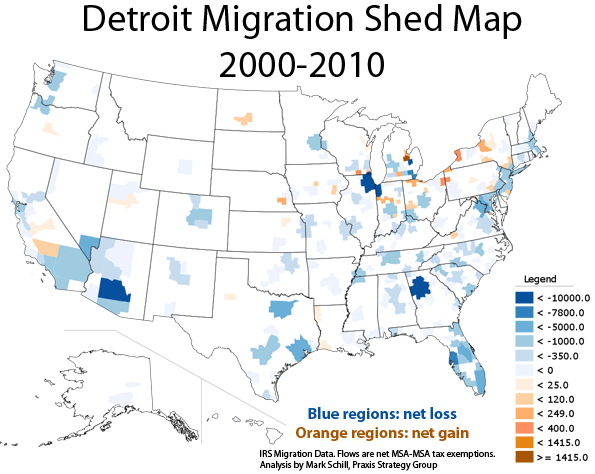
    In the Midwest, these trends have favored placed like Columbus, Ohio, and Indianapolis, Indiana. When people hear “Midwest,” they are more likely to think of this kind of picture:

    The blue areas show destinations to which people from Detroit have moved between 2000 and 2010. The brown shades are the areas from which Detroit has drawn people. Given Detroit’s well-publicized decline, all the blue should be no surprise.

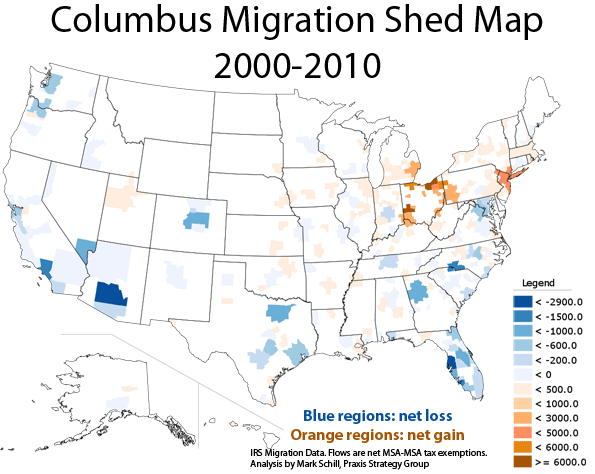
    But a respectable portion of the Midwest looks like this:

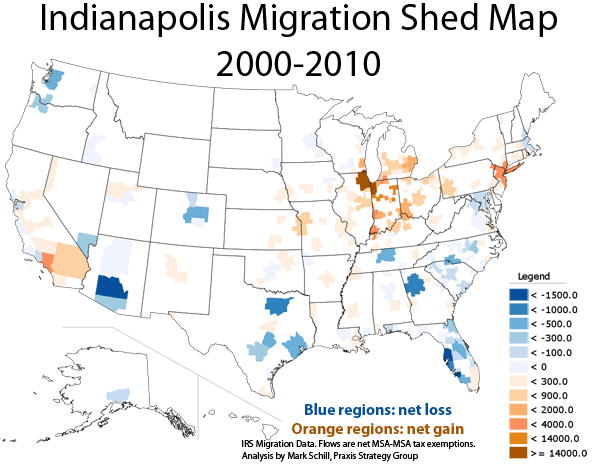
    And this:

    Like most parts of America, Columbus and Indianapolis have seen a net outmigration southward to Florida and Texas. No surprise there. But note how both cities are stealing population from Chicago, Detroit, New York, and even southern California and Miami in Indianapolis’s case. The maps also show how intense interstate competition within the Midwest is right now.

    One important measure of the cost of living is housing affordability, which is typically set at 3.0 as a measure of median housing price divided by median income. Compared to San Francisco at 7.2, New York at 6.1, Los Angeles at 5.9, and Miami at 4.7, Columbus stands at 2.8 and Indianapolis at 2.4. Charlotte, which has been an exemplary Sun Belt growth magnet for a while, stands at 3.9, a slight click above the Chicago area’s 3.8.

    Affordability and overall quality of life as measured by schools and greater disposable income matter a lot—even to technology entrepreneurs. Some Midwestern areas are outpacing coastal areas on this front. In a recent Forbes ranking of tech growth in the nation’s largest 51 metro areas, the Midwest had three cities within the top 15, with Columbus in third position, followed by Indianapolis and St. Louis.

    But it would be wrong for tech boosters to think the Midwest’s future rests in harnessing the power of this sector alone. Rather, it’s a combination of brains and brawn that signify the Midwest’s core strength. When we look at Midwestern areas that have experienced above-average growth in bachelor’s degrees, there are important overlaps with areas experiencing above-average growth in manufacturing, too.

    In the corridor from Madison to Milwaukee, or the outlying areas around Chicago, or the Indianapolis metro area, or even in the Quad Cities on the Iowa-Illinois border, we see higher educational attainment and manufacturing growth occurring together. Cedar Rapids, Iowa, had the highest GDP growth from 2000 to 2010 of any metro area in the Midwest. A new corridor has grown up between Cedar Rapids and Iowa City, home to the University of Iowa; it takes advantage of the region’s historical manufacturing capacity and blends it with new technology. Peoria, Illinois, is second to Cedar Rapids in GDP growth. Peoria is home to 200 manufacturing firms, and it is also a Midwestern leader in college degree attainment.

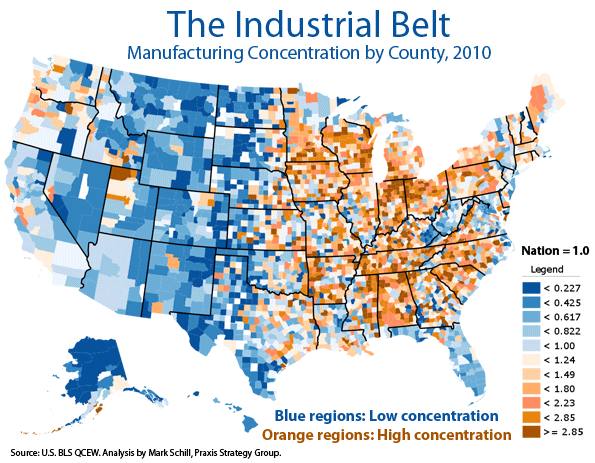
    Manufacturing continues to be part of the regional DNA in the Midwest. Trying to move away from it would be a fool’s errand, as this picture shows:

    The concentration of manufacturing in middle America is a real asset, especially when combined with higher levels of educational attainment, as we have seen. The Midwest is still home to much of the nation’s skilled labor force. And contrary to the declinist narrative mentioned at the outset, the region has added 50,000 “heavy metal” manufacturing jobs since 2009.

    The challenge for the region, actually, will perhaps be filling manufacturing jobs rather than creating them. A recent Deloitte survey found that 83 percent of manufacturers nationwide suffered a moderate or severe shortage of skilled production workers. The Midwest is poised to establish what we call a “new industrial paradigm,” characterized by a blend of heavy manufacturing, new technology, a more highly educated industrial labor base, and lighter labor restrictions (Indiana just became a right-to-work state, and the much-publicized debates in Wisconsin and Ohio over labor laws have only served to draw more attention to the need for reform, whatever the near-term effects). When you add to all of this the new energy sources discovered in some parts of the Midwest—such as new finds in Utica shale in Ohio—a new industrial paradigm in the region could end up being a large source of new wealth creation in the coming generation.

    So why might the Midwest be something of a microcosm for how growth and opportunity look in America as a whole, given its idiosyncratic reliance on manufacturing not shared by other regions? The main reason is that middle America is a clear picture of how much the basics matter: Cost of living, job quality, schools, and opportunities to develop the right skills for the best jobs. The areas within the Midwest that have gotten the basics right are poaching people and companies from the areas that haven’t. Any economic development strategy that ignores the basics in favor of a more stylized theory of growth will usually run off the rails before too long. Americans, at the end of the day, want the places they live to get the basics right so they themselves can build their lives, start their businesses, and raise their children as they wish.

    This piece originally appeared at The American.

    This peice was adapted from a recent report: "Clues from the Past: The Midwest as an Aspirational Region." Download the full pdf version of the report, including charts and maps about the Great Lakes Region.

    Joel Kotkin is executive editor of NewGeography.com and is a distinguished presidential fellow in urban futures at Chapman University, and contributing editor to the City Journal in New York. He is author of The City: A Global History. His newest book is The Next Hundred Million: America in 2050, released in February, 2010.

    Mark Schill is Vice President of Research at Praxis Strategy Group, an economic development and research firm working with communities and states to improve their economies.

    Ryan Streeter is Distinguished Fellow for Economic and Fiscal Policy at the Sagamore Institute. You can follow his work at RyanStreeter.com and Sagamoreinstitute.org.

    Great Lakes Freighter photo by BigStockPhoto.com.

  • Clues from the Past: The Midwest as an Aspirational Region

    This piece is an except from a new report on the Great Lakes Region for the Sagamore Institue. Download the pdf version for the full report including charts and maps on the region.

    The American Great Lakes region has long been a region defined by the forces of production, both agricultural and industrial. From the 1840s on, the region forged a legacy of productive power, easily surpassing the old northeast as the primary center of American industrial and agricultural might.

    The Rise of the Great Lakes

    Natural forces shaped the region, from its waterways and mineral resources, which made it ideal for industrial development. The lakes themselves are the largest sources of freshwater on the planet; the five lakes together are twice the size of England. This “fresh water Mediterranean” provided an essential pathway for transport between the various regions of the Great Lakes, as well as a connection to the northeast and, through the Saint Lawrence and the Erie Canal, to New York and the Atlantic.

    But more than anything, it has been the people of the Great Lakes that proved its greatest resource. In the early 19th Century, the region’s development was paced by migrants from New England, who brought with them their values of thrift, hard work and a passion for education and self-improvement. Later others, notably Germans and Scandinavians, injected a similar culture of self-improvement to the area.

    Like New England, the Great Lakes, noted author John Gunther, was possessed with a “gadget mind” that sparked the innovations that gave America command of the industrial revolution. Much of the brawn for this came from the poorer parts of Europe — Russia, Italy, and most particularly Poland, which led one observer to call Chicago “a mushroom and a suburb of Warsaw.” By 1920 one third of third of the population of Chicago, Cleveland and Detroit was foreign born.

    Initially based largely on agricultural exports, by 1860 the region had blossomed into an urbanized industrial powerhouse. “All over the Middle West,” wrote historians Charles and Mary Beard, “crossroads hamlets grew into trading towns, villages spread into cities, cities became railway and industrial centers.” The area’s rapid growth sparked great optimism; in 1841 journalist and land speculator predicted that by 1940 Cincinnati would be the largest city in North America and by 2000 “the greatest city in the world.” Cleveland, Cincinnati, Toledo, Milwaukee and most of all Chicago stood at the center of a “web of steel” that marked the region as the world’s preeminent industrial center. It also sparked other innovations, from the auto assembly line and the high-rise building to the mail order catalog.

    This growth cascaded in the early years of the last century. It became the nation’s primary growth engine. Between 1900 and 1920 Chicago added a million people while Cleveland doubled its population and Detroit, epicenter of the emerging “automobile revolution”, grew three fold. In everything from architecture and city planning to literature, the Great Lakes stood at the national, even global, cutting edge.

    A Half Century of Decline

    By the 1970s, the Great Lakes region, including Ontario, accounted for two-thirds of the North America’s automobile production, 70 percent of pig iron and three quarters of its steel. Yet by that time, this close tie to industry was seen not as an advantage but as a curse, driving the region towards precipitous decline.

    By then America was widely seen as entering a “post-industrial era,” and the Great Lakes, the former bastion of the manufacturing economy, seemed the odd region out. Defined as the “foundry” in Joel Garreau’s Nine Nations of North America, it was the only one he identified as in decline. He described the region’s inner cities as “North America’s Gulag Archipelago.”

    Once a magnet for newcomers, the region now took a back seat as a place that attracted domestic or foreign migrants.10 With the exception of Chicago, the Lakes region have continues to lag both in domestic migration and foreign immigrants. Newcomers were reinventing places like Los Angeles, Houston, Miami and New York, but relatively few were coming to Cleveland, Detroit or Cincinnati.

    The Great Lakes cities, also with the sometimes exception of Chicago, also found themselves increasingly regarded as cultural backwaters. Occasional stories of restoration and renaissance made the rounds in the media, but the trend was to greater obsolescence, to becoming permanently “a cultural colony” of the coasts. “To a Californian or a New Yorker,” noted Indiana-based historian Jon Teaford, “Cleveland, Detroit, Indianapolis and Saint Louis were down-at-the-heel, doughty matrons, sporting last year’s cultural fashions.”

    Until recently there has been ample reason to believe this decline would continue. Only nine of the Midwest’s 40 largest metropolitan areas have a higher per capita GDP than the national average. This reflected a deep seated loss of jobs paced by industrial decline but not made up for by gains in other fields.

    During this period the region not only lost many of its industrial jobs but, more pointedly, failed to replace them with the technology and service jobs that grew rapidly elsewhere. As a result, the region’s percentage of the national workforce dropped steadily over the past half century. In 1966, the Great Lakes region possessed one in four jobs in the country; by 2010 that percentage had fallen to less than one in five.

    As a response to the perception of industry-led decline, some Great Lakes leaders sought out other sources of employment and growth. In Detroit, for example, much emphasis was placed on casino development. Michigan’s former Governor Jennifer Granholm, sought to reverse decline by targeting the so-called “creative class” by turning its hard-hit towns into “cool cities.” Across the region, others focused on convention centers, arts attractions such as museums and other entertainment venues as the way to improve their sagging fortunes.

    Seeds of Resurgence
    None of these efforts – although much heralded throughout the 1980s and 1990s – did much to reverse the region’s decline. Notes Jim Russell, author of the widely read Burgh Diaspora website:

    Should Akron start putting more money in skateparks or global warming?

    There are huge problems in spending money in order to attract the geographically fickle. Fads fade and the mobile – largely people under 30 – will move again…Tying up the urban budget with projects aimed at retaining the creative class has its own perils. There is little, if any, evidence indicating that this policy will decrease the geographic mobility of the well-educated. Many cities stuffed with cultural amenities also sport high rates of out-migration. Furthermore, tastes change. “Best places to live” lists change quite a bit from one year to the next.

    Instead, the region’s current rebound is occurring in surprising fashion. The real lure of the Great Lakes lies in its own fundamental advantages: lower housing prices, business climate and perhaps, more importantly, a nascent industrial rebound.

    This can be seen, most importantly, in employment numbers. Starting in the last few years, the area’s share of jobs has remained steady. The highest unemployment rates in the country are no longer concentrated in the Great Lakes region, but in states such as California and Nevada. In many Great Lakes states, unemployment rates have been dropping more rapidly than the national average.

    Critically this resurgence has not resulted in a shift away from industrial growth. Instead, we are witnessing the early stages of what could be a profound increase in both the economic heft and job creation tied to the industrial sector. But the Great Lakes rebound is not merely a cyclical, one dimensional rise; it also includes growth in a host of other sectors, including in the information area and, perhaps even more remarkably, in energy, particularly shale gas.

    At the same time the rise in non-industrial jobs also should testify to the growing attractiveness of the region, particularly for young families. After decades of mass outmigration, the region has begun to achieve a more favorable balance with the rest of country. Outmigration rates for states in the region are at or below national levels.

    Migration in the Midwest, as Russell and others have pointed out, should be regarded more from the vantage point of recruitment, not retention. By promoting its affordability and improving economy, the region could improve its trailing inmigration rates. As people vote with their feet for the region, they are laying down the foundation for the area’s resurgence in the coming decades.

    The Rise of New Growth Nodes

    The Great Lakes demographic and economic turnaround does not mean that growth has occurred in the pattern of the early 20th Century. Instead we see the emergence of a new set of leadership cities. If Akron, Detroit, Cleveland and Chicago paced the region’s early 20th century ascendency, the new “winners” appear to include affordable, attractive cities, many of whom are home to major universities, state capitals and key research institutions.

    These areas have done well in attracting many people from the less successful metropolitan areas of the region. Columbus, for example, evidenced strong growth from the rest of Ohio and other parts of the Midwest, notably Michigan and Illinois. But perhaps more importantly, the area enjoys strong in-migration from those parts of country — notably the Northeast and California — that have traditionally dominated knowledge-intensive industries.

    A similar pattern can be seen in Indianapolis. In recent years, as urban analyst Aaron Renn notes, the Indiana capital has enjoyed “a profile closer to the Sun Belt than the Rust Belt.” It grew its population at a rate 50 percent greater than the national average, and also had strong net inmigration, with almost 65,000 net people deciding to pack up and move to the Indiana capital.

    Already a center of regional culture and services, the area has succeeded as well in attracting new migrants not only from big Midwestern cities such as Chicago, but also from the two coasts.

    By way of contrast, Chicago’s migration patterns look much different than those in Columbus and Indianapolis. Many other regions around the country benefited from people leaving the Windy City than Chicago gained from them. Chicago’s biggest gains have come from other, more troubled Great Lakes regions, while Indianapolis, for instance, has taken advantage of Chicagoans looking for more opportunity elsewhere.

    Behind this shift in migration from the coasts lie many factors, such as taxes and regulations.
    But perhaps most important may be the region’s greater affordability. Even after the bubble, for example, many key eastern and west coast regions suffer a ratio housing prices to annual incomes of five, six or even seven to one. For the most part, virtually all parts of the Great Lakes have ratios of three or less.

    Over time, this could prove a critical advantage to the Great Lakes. As the current millennial generation – the largest generation in American history – enters their 30s, it is likely that they will seek out places where they can afford to buy a home and enjoy a middle class quality of life. The Great Lakes will be one place that can offer that opportunity.

    Key to recovery: Both Brain and Brawn

    The future of the Great Lakes region lies neither in simply the “information” economy nor in the brute force of manufacturing. Instead it is as a result of a combination both of the industrial sector and the high-value service sectors that feed into it.

    Critically, the region boasts many areas where the information and service economies are particularly strong. Of the nine Midwestern metropolitan areas with per capita GDP growth above the national average, four are capital cities and six are home to major universities. Given governmental involvement in two of the fastest-growing sectors of the economy, health care and education, it is no surprise that seats of government and large state-funded research universities – which also double as the hotbeds of medical services – are growing ahead of other regions with a more traditional, and perhaps outdated, economic base.

    Indeed, some Midwestern areas are outperforming the coastal economies even in the realm of high-tech. In a recent ranking by Forbes magazine of best areas for tech growth among the nation’s 51 largest metropolitan areas, the region boasted three of the top fifteen areas, led by #3 Columbus, followed by Indianapolis and St. Louis.

    However, it would be inaccurate to portray the Midwest as depending purely on a service or information economy. Producing things for sale and export is still alive and well, and the Midwestern regions that have blended their traditional capacity for manufacturing with newer fast-growing sectors of the economy.

    Cedar Rapids, Iowa enjoyed the highest rate of GDP growth from 2001-2010 of any metropolitan area in the Midwest. Between Cedar Rapids and Iowa City, home to the University of Iowa, a new high-tech corridor has grown up that takes advantage of the area’s historical manufacturing capacity and the new technology driven through the university.

    Terre Haute, Indiana, fifth on the list of GDP leaders, reflects even more completely the blending of the “old” Midwest with the emerging one. Manufacturing has held steady as a share of the local economy at about 15.5 percent since 1991, but health and education have jumped from 14 to 17 percent, while wholesale services and agriculture have dropped. Terre Haute is home to Indiana State University and Rose-Hulman Institute of Technology, a regional leader in engineering, science, and mathematics education.

    Peoria, Illinois is second behind Cedar Rapids in GDP growth the past ten years. It is home to more than 200 manufacturing firms, two of the world’s largest earth-moving equipment makers, and coal fields. Peoria is also a leader in college degree attainment in the Great Lakes. While its absolute attainment levels are still low, its college educated population is growing faster than nearly every community in the Midwest. Peoria is one example of how brains + brawn, and not just brains, is the key to Midwestern growth going forward.

    Consider what we might call the dynamic of the Badgers and the Wolverines. In Wisconsin, home of the Badgers, there exists an east-west corridor between Madison, home to the state university and state capital, and Milwaukee, the state’s historical center of industry and commerce. In Michigan, home of the Wolverines, an east-west corridor stretches between Ann Arbor, home to the University of Michigan, and Detroit, the state’s historical center of industry and commerce.

    In Figure 14 we see that both Ann Arbor and Madison have high levels of bachelor degrees compared to the national average. But Madison is leading the Midwest in bachelor degree growth while Ann Arbor rate remains fairly static. Meanwhile, even though Detroit surprises with a fairly high rate of bachelor degree growth, Milwaukee stays in front of the national average in both growth and absolute numbers of college-educated workers.

    Some might say that the Badgers are beating the Wolverines in the knowledge-intensive sectors of the economy, but that the lead manufacturing is up for grabs. But the truth is that the Wisconsin corridor also enjoys positive marks in manufacturing.

    Milwaukee, for example, leads Detroit in the growth of manufacturing jobs. And Madison is emerging as a manufacturing center while Ann Arbor lags far behind. The knowledge economy and the old-time manufacturing economy can work happily together, in the case of Madison Milwaukee, or so far less so in the case of Ann Arbor-Detroit.

    The New Industrial Paradigm

    Despite the attempts to write it off as a spent force, manufacturing will remain a key driver of Midwestern and national growth. Despite the many job losses that impacted this sector over the past generation, American manufacturing remains remarkably resilient, with a global market share similar to that of the 1970s.

    More recently, however, American industrial base has begun to expand and begin to gain on its competitors. This places the Great Lakes in an advantageous position. American manufacturing after a decade of decline has outpaced the overall recovery over the two years, in part due to soaring exports. In 2011 American manufacturing continued to expand even as Germany, Japan and Brazil all weakened in this vital sector.

    Many factors are driving this change. One is a tie to the growing domestic energy industry, which has already sparked growth in the shale areas of eastern Ohio and other parts of the Great Lakes region. The United States together now boast the largest natural gas reserves in the world. In Ohio alone, new finds in the Utica shale could be worth as much as $500 billion; one energy executive called it “the biggest thing to hit Ohio since the plow.”

    The boom in natural gas has already sparked a considerable industrial rebound including the building of a new $650 million steel plant for gas pipes in the Youngstown area.18 Karen Wright, whose Ariel Corporation sells compressors used in gas plants, has added more than 300 positions over the past two years. “There’s a huge amount of drilling throughout the Midwest,” Wright says. “This is a game changer.”

    It also leads to the prospect that as coal-fired plants become more expensive to operate due to concerns over greenhouse gas emissions, the region will have a new, cleaner and potentially less expensive power source.

    Another critical factor has been the rise of wage rates in both Europe and East Asia. Increasingly, American-based manufacturing is in a favored position as a lower cost producer. Concerns over “knock offs” and lack of patent protection in China may also be sparking a “back to USA” trend, something particularly favorable to the Great Lakes region.

    Yet the new industrial base will not resemble old one. We are seeing both an industrial renaissance in the country and one that is heavily concentrated in the Great Lakes region. But it is a resurgence that is as much brain as brawn; an industry increasingly dependent not just on hard work, but skilled labor.

    This pattern cuts across industry lines. Indeed even as the share of the workforce employed in manufacturing has dropped from 20 percent to roughly half that, high skilled jobs in industry have soared 37 percent. Even after years of declining employment, manufacturers in heavy industry, such as automobiles, are running short on skilled workers. Industry expert David Cole predicts there could be demand for 100,000 new workers by 2013. Overall, 83 percent of all manufacturers, according to Deloitte Touche, suffer a moderate or severe shortage of skilled production workers.

    This remains a fundamental strength of the region. Much of the skilled labor base in the nation remains in the Midwest. The region is also home to four of the highest ranked, according to US News, industrial engineering schools in the nation: the University of Michigan at Ann Arbor, Northwestern, the University of Wisconsin at Madison and Purdue.

    Equally important for the region will be replacing the large cadre of skilled workers, many of whom are entering the late 50s and early 60s. “We have a very skilled workforce, but they are getting older,” says Ariel Wright, who employs 1,200 people at three Ohio factories. “I don’t know where we are going to find replacements.”

    For now the very culture of production – often seen as a liability in the past – could prove a key to the Great Lakes’ future resurgence. These advantages are already redounding to the region. Indeed a recent Forbes survey of “heavy metal” industries – that is those involved heavy industry, metals, vehicles and complex machinery – found the region in surprisingly good shape.

    The Milwaukee area, for example, ranked number 2 among the 50 metropolitan areas on the list, while Detroit clocked in with a respectable 6 placed finish. Cincinnati, Kansas City and Cleveland all ranked well within the top 20. In all, the 40 Great Lakes metropolitan areas added 50,000 heavy metal industry jobs since 2009.

    Looking Forward

    For the first time in a generation, the Great Lakes are experiencing demographic and economic trends in their favor. Yet in everything from migration to industrial growth, the region can expect to face strong competition from other areas, most notably Texas, the Southeast, the Great Plains and the Intermountain West for new jobs and production.

    To meet this challenge, and truly take advantage of improved conditions, the region must develop a strategy that is suited to its particular advantages. There is no need to try to compete with Manhattan on urban chic, with Silicon Valley in high-tech startups or with Hollywood in entertainment – as some growth theorists would likely recommend.

    The Great Lakes needs to focus primarily on those very values of production and community that sparked its original ascendance. Once these are identified and strengthened, the region can once again not only rebound, but define its own space in the national and global economy.

    Perhaps the first priority has to do with education. The Great Lakes has an enormous edge in terms of first-class engineering schools, and needs to become more focused on these programs and those associated with them, including the information sciences. It needs to supplement this focus on the top echelon with a greater effort — as we can now see in Ohio — in training more of the skilled workforce desperately needed for the region’s resurgent manufacturers.

    By 2018, 63 percent of the nation’s jobs will require some type of post-high school training credential. Increasingly successful education programs have to focus on aligning with jobs available within a state or region. This can only occur with explicit cooperation between education, government, and the business community.

    Likewise, business collaboration with universities can boost the amount and the impact of industry R&D investments that fosters innovation. University-based research and technology development can yield fast-growing, high-technology firms that create higher-paying middle skill and professional, scientific and technical jobs.

    The second priority lies in developing critical infrastructure to keep the region’s economy humming. This includes a greater emphasis on developing energy resources, rebuilding and modernizing the freight rail, waterways and ports, as well as highways that connect the Great Lakes to the rest of the country and the world.

    In the modern economy, creating economic advantage also includes paying attention to specialized infrastructure such as university and lab facilities, technology and training centers, multi-modal shipping and logistics facilities, and research parks. These infrasystems – integrated fusions of facilities, technology and advanced socio-technical capabilities – can drive innovation, particularly for future higher-value industries and higher-paying jobs. The full range of today’s infrastructure assets is shown in the figure below.

    Third, and perhaps most important, the region needs to maintain the housing affordability and other quality of life attributes critical to attracting both immigrants and domestic migrants. As Millennials enter their 30s in large numbers over the next decade, the region needs to improve its public schools, parks and other amenities to attract them.

    Ultimately, this represents a distinctly common-sense means to overcome a legacy of failure and create a new paradigm of success for the region. The Great Lakes, rather than trying to arrest its decline by completely running away from its past, can now recover the great sense of potential so evident in its heroic history.

    Download the full pdf version of the report, including charts and maps about the Great Lakes Region. The report was authored for the Sagamore Institute with support from the Lynde and Harry Bradley Foundation.

    Joel Kotkin is executive editor of NewGeography.com and is a distinguished presidential fellow in urban futures at Chapman University, and contributing editor to the City Journal in New York. He is author of The City: A Global History. His newest book is The Next Hundred Million: America in 2050, released in February, 2010.

    Mark Schill is Vice President of Research at Praxis Strategy Group, an economic development and research firm working with communities and states to improve their economies.

    Ryan Streeter is Distinguished Fellow for Economic and Fiscal Policy at the Sagamore Institute. You can follow his work at RyanStreeter.com and Sagamoreinstitute.org.

    Photo courtesy of BigStockPhoto.com.

  • Indianapolis: From Naptown to Super City

    I have long touted the sports strategy that Indianapolis used to revitalize its downtown as a model for cities to follow in terms of strategy led economic and community development. I really think it sets the benchmark in terms of how to do it, and it has been very successful.

    Indy is hosting the Super Bowl on Sunday, something that is locally seen as a sort of crowning achievement of the 40 year sports journey. As part of that, the Indianapolis Star and public TV station WFYI produced an hour long documentary on the journey called “Naptown to Super City.” I think it’s a must watch for anyone who is trying to figure out to revitalize their own downtown. An hour isn’t short, but given the billions of dollars cities pour into this, I think it’s worth doing some homework. It tells the story of how Indy went from a deserted downtown where local Jaycees were licensed to take their shotguns and kill pigeons to one where the Super Bowl is being hosted today.

    I’ll talk more about the Indy strategy in a bit, but first the show. If you are in Google Reader this won’t display for you, so click here to watch.


    One thing this brought home for me is the true magnitude of the change. Perhaps I’m being a bit uncharitable, but Indianapolis almost literally started with nothing. It was never a major, important American city. It had no brand in the market. And it had a downtown that was all but dead. Everything they have today was built almost from scratch.

    Why do I think the Indy sports strategy was such a good one? Two reason: it was a good strategic area to go after, and it was backed up with very intelligent execution.

    First, five reasons this was a good strategic goal to pursue:

    1. It just fits the character of the city. Hoosiers love sports. The Indianapolis 500 and high school basketball were long established. It’s something they could behind in a way that they would never have gotten behind being the “vegetarian capital of the world” or something like there. It was authentic to the city. If you watch the video, you’ll note how locals embraced the events that were held that. That goes a long way towards explaining the success of the strategy. You have to be authentic to a place in your development efforts.
    2. It was a whitespace opportunity where Indy could get first mover advantage. Today every city thinks they can make money off sports, but Indy really pioneered the notion that you could use sports as an economic development tool. There were a lot of firsts along the path, and that’s one reason Indy was able to take out a leadership position. Just as one example, Indy was first to do the “build it and they will come” model of building a stadium before having a team. As a result, they were able to grab the Colts, and do it in an era when you didn’t have to mortgage your whole city to make a team relocation happen.
    3. Being America’s top city for sports events was a realistically achievable goal. I know this because the city achieved it. This is in great contrast to the umpteen cities who all claim they’ll be the “best cycling city in America” or some such.
    4. There were huge collateral benefits to sports beyond the direct economic impact of the events and the jobs they support. They bring people to the city to show it off to people who might not otherwise come. They enliven downtown and create events that locals might actually want to attend. They also have been an amazing brand opportunity. Just think of the Colts. How many times a week during football season does the word “Indianapolis” get said on TV? Probably hundreds if not thousands. Imagine if the city had to pay advertising dollars for that exposure? Yes, sports is expensive, but I think it could be justified just as cost-efficient marketing alone. Think about how much companies pay just to put their name on the stadium. How much more is it worth to put your city’s name on the team or the event? Think about how much advertisers will be paying for a 30 second commercial in the Super Bowl? What’s it worth for all those mentions of your city during the Super Bowl again?
    5. It was an initiative that had the possibility of being truly transformative for the city. Again, I know this is true because it was.

    I’m not going to claim these were actually the thoughts going through people’s minds as the sports strategy developed or that it was this calculated. But all of these things were implicitly true all along, and I think clearly the people pushing sports must have gotten it on that at some level. So sports meets the first test of a great strategy in that it set out after a good strategic goal.

    It was also something where there was a level of execution detail that far exceeded what most cities do. In business, it’s one thing to have an idea. It’s another thing to execute on it and achieve market leadership. It’s still another to generate sustainable competitive advantage that keeps you there over the long haul. Indianapolis has managed to do all of these with sports. I’ll highlight eight examples of how it did this:

    1. It invested in world class facilities. A lot of these have remained top rated even long after they opened, like Conseco Fieldhouse, which is still ranked every year as the best arena in the United States.
    2. Two, it laid out an entire district downtown around events hosting, with everything you need in close proximity – venues, the convention center, hotels, shopping, and entertainment. This is something that’s already been widely commented on by Super Bowl visitors who are amazed you don’t have to get shuttled around all over the place and that you can actually walk directly from the media hotel to the hotels where the teams are staying.
    3. Three, because of this Indy is able to effectively “saturation rebrand” downtown for an event and otherwise cater to events in a way that few other cities can or will. In effect, the city has converted its downtown into a giant sound stage. Take a look at the pictures of the city. The whole downtown as been rebranded after the Super Bowl, including, for example, plastering a huge Lombardi Trophy images on the side of the city’s premier hotel. You can debate the value of this to the city, but there’s no denying its value to the NFL. How many cities are willing to do this to the extent Indianapolis is?
    4. Indy created the Indiana Sports Corp. as the first ever non-profit management company for events. Today, everybody has adopted that model.
    5. The city cultivated a large, experienced volunteer base for putting on events that is much more powerful than what others cities have.
    6. Indy has been willing to take calculated risks in support of the strategy. Building the Hoosier Dome with no team to play in it – big risk.
    7. It not only went after the events, it went after the sanctioning bodies that determined where the events would be held. The most important is of course the NCAA, but there are others too. This has resulted in Indy having a “cluster” of these organizations and direct access to the people making decisions that pays incalculable dividends. This is one area where the “face to face” discussions that occur in Indy gives the city a big leg up. It’s not just better for selling, it gives Indy critical advanced intelligence about how these organizations are conceiving of their future events needs.
    8. Last but certainly not least, this has been a sustained, 35 year commitment. It wasn’t a party politics thing. It was a single project thing. It wasn’t a flash in the pan idea. It was something that has been relentlessly pursued over the long haul.

    Add all this up and it is easy to see why still today, three or four decades after it first started and after pretty much every city decided to go after these types of events, Indianapolis is still the best place in America to host a sports event.

    I hope this gives you a flavor why the Indy sports strategy was so good and so successful. It’s certainly something that’s not without its failures and downsides. The fact that sports has consumed disproportionate civic resources is one of them, and one highlighted by the documentary. But on the whole, most people seem very happy with the results.

    Something the video highlights at the end is one essential attribute for success that you can’t plan for or make happen – luck. They ask questions like, what if the “Save the Pacers” telethon had failed back in the 70’s? What if the seats in the Hoosier Dome had been the originally planned variegated colors instead of the Colts blue and white colors when Bob Irsay walked in to check it out? There were many critical turning points where without a lucky break, who knows if the future of downtown Indy might have been radically different in some way. It should give us some humility about the limits of our ability to simply will things into being. On the other hand, it reminds us that if you aren’t in the game, if you aren’t swinging the bat, you don’t have any chance at all of hitting that home run. You have to play if you want to win.

    This piece originally appeared at The Urbanophile.

    Aaron M. Renn is an independent writer on urban affairs based in the Midwest. His writings appear at The Urbanophile, and operates Telestrian, an online tool for economic and demographic data.

    Photo of Lucas Oil Stadium courtesy of BigStockPhoto.com.

  • Major Metropolitan Commuting Trends: 2000-2010

    As we indicated in the last article, solo automobile commuting reached an all time record in the United States in 2010, increasing by 7.8 million commuters. At the same time, huge losses were sustained by carpooling, while the largest gain was in working at home, which includes telecommuting. Transit and bicycling also added commuters.  This continues many of the basic trends toward more personalized employment access that we have seen since 1960.

    Solo Automobile Commuting: Among the nation’s 51 metropolitan areas with more than 1 million population, 38 experienced increases in solo automobile commuting between 2000 and 2010. More than 80% of commuting is by solo automobile in 25 of the 51 largest metropolitan areas, with the highest rates being in Birmingham, Detroit, Cincinnati, Indianapolis and Kansas City. Another 28 metropolitan areas have single automobile commute shares of between 70% and 80%, with Boston, Washington and San Francisco between 60% and 70%. As would be expected, the lowest solo automobile commute share was in New York at 51%.

    Car Pools: The national data also showed a nearly 2.4 million loss in carpool use. The losses were pervasive, occurring in all 51 metropolitan areas. Riverside-San Bernardino had the highest carpool market share at just under 15%, while all other major metropolitan areas were below 12%. Car pools have been losing market share for decades.

    Work at Home (Includes Telecommuting): In what we have previously labeled as The Decade of the Telecommute, the nation experienced a 1.7 million increase in working at home over the past decade. The market share gains in working at home were as pervasive as the losses in carpooling, with all 51 metropolitan areas registering increases. Austin had the strongest work-at-home market share, at 7.3%, followed by Portland at 6.5%, San Francisco and Denver at 6.2%, Phoenix at 6.0%, with San Diego, Raleigh and Atlanta above 5.5%. Overall, working at home exceeded transit commuting in 37 major metropolitan areas out of 51 in 2010, up from 27 in 2000. Three metropolitan areas had work at home market shares of less than 3%, including Memphis, New Orleans and last place Buffalo.

    Transit: As noted before, transit enjoyed its first 10 year gain since journey to work data was first collected by the Census Bureau 50 years ago. Overall, transit added 900,000 daily commuters, roughly half that for telecommuters. Transit’s market share increased in 25 of the top 51 metropolitan areas. It is also notable that in a number of the metropolitan areas with the largest expenditures for new rail systems, there were either losses or commuting gains were concentrated in the more flexible bus services.

    New York: As so often has been the case, transit was largely a "New York story." More than one half of the new transit commuters were in the New York metropolitan area, more than 450,000 of the 900,000 increase. New York boasts by far the most extensive transit system in the nation, which serves the second largest central business district in the world and by far the nation’s most important. In 2000, New York had a transit work trip market share of 27.4%. By 2010, New York’s transit work trip market share had risen to 30.7%, more than double that of any other metropolitan area. More than 70% of the new transit commuters in the New York area were on its subway (Metro), suburban rail and light rail systems.

    San Francisco: San Francisco retained its position as the second strongest transit metropolitan area, with a 14.6% work trip market share in 2010. This is up from 13.8% in 2000.

    Washington: Washington was the third strongest transit commuting market, with a 14.0% work trip market share in 2010. This modest increase from 13.4% nonetheless produced the second largest ridership increase in the nation, at more than 130,000. This reflects the strength of Washington’s job market over the decade. Rail ridership accounted for 53% of this increase, while buses accounted for the other 47%.

    Boston and Chicago: Boston passed Chicago to become the fourth strongest transit market, at 11.8% in 2010. This is an increase from 11.2% in 2000. Chicago ranked fifth at 11.2%, a small reduction from the 11.3% in 2000.

    Los Angeles: Los Angeles had the third largest increase in transit commuting, adding 60,000 daily transit commuters. Approximately 75% of these new commuters were attracted by the region’s extensive bus system as opposed to its very expensive but limited rail system. This increase placed Los Angeles in a virtual tie with Portland, with a work trip market share of 6.2%.

    Portland: Portland continued to experience its now 30 year transit market share erosion, despite having added three new light rail lines between 2000 and 2010. Portland’s transit work trip market share fell to 6.2% from 6.3% and now trails the work at home and telecommute market share of 6.5%.

    Seattle:Seattle added 29,000 new transit commuters for the fourth strongest growth in the nation. Approximately 75% of the new commuters were on the metropolitan area’s bus system.

    Atlanta: Atlanta, which is home to the third largest postwar Metro system in the nation (MARTA) gained nearly 9000 new transit commuters, all of them on the bus, while losing more than 3000 rail commuters.

    Miami:Miami added 16,000 new transit commuters, though more than 90% were attracted to the bus system, rather than the rail services.

    Rail and Bus in Texas: Other metropolitan areas with new and expanded rail systems did not fare as well. In Dallas-Fort Worth, the light rail system was more than doubled in length, yet there was a reduction of more than 3000 daily transit commuters. The transit work trip market share in Dallas-Fort Worth dropped from 1.8% to 1.4%, approximately one quarter lower than that of any other major metropolitan area with a new light rail or Metro system. Houston, which built its first light rail line during the period, lost nearly 3000 daily transit commuters, with its transit work trip market share dropping by nearly one-third, from 3.2% to 2.3%. By contrast, the third largest metropolitan area in Texas, San Antonio, lost no commuters from its bus only transit system.

    Other New Rail Metropolitan Areas: Other metropolitan areas with new rail systems experienced modest ridership increases, with 60 to 70 percent of the increase on the bus systems in Charlotte, Minneapolis-St. Paul and Phoenix. Salt Lake City experienced a small decline in transit commuting.

    Below 1 Percent: Four metropolitan areas had transit work trip market shares of less than 1%, including Indianapolis, Raleigh, Birmingham and last place Oklahoma City, with a market share of 0.4%.

    Bicycles: It was also a good decade for bicycle commuting, with the national increase of nearly 250,000. The bicycle commuting market share rose in 45 of the 51 largest metropolitan areas. Portland had the highest bicycle market share at 2.2%, with three other metropolitan areas at 1.5% or above, Sacramento, San Francisco and San Jose. The lowest bicycle commuting market shares were in San Antonio, Cincinnati, Birmingham and Memphis, all at 0.1 percent.

    Walking: There was little change in walking among the nations major metropolitan areas. The largest shares were in New York (5.9%) and Boston (5.4%), with the smallest shares in Raleigh (1.1%), Orlando (1.1%) and Birmingham (1.0%).

    Drifting Away from Shared Commuting: In some ways, the 2000s were different than previous decades, especially with the reversals in bicycle commuting and transit. However, overall, shared ride commuting (transit and car pools) lost share due to the precipitous decline in car pooling. Longer term share increase trends also continued in single-occupant automobile commuting and working at home. The bottom line: personal employment access (personal mobility plus working at home) continues to carve away at the smallish share still held by shared commuting.

    ————-

    Data: The 2000 and 2010 commuting market shares by mode are shown in Tables 1 and 2 (2010 metropolitan area boundaries).

    ————

    Table 1
    Work Trip Market Share: 2000
    Metropolitan Areas Over 1,000,000 Population in 2010
    Metropolitan Area Car, Truck or Van: Alone Car/Van Pool Transit Bicycle Walk Other Work at Home (Includes Telecommute)
    Atlanta 77.0% 13.7% 3.4% 0.1% 1.3% 1.1% 3.5%
    Austin 76.5% 13.7% 2.5% 0.6% 2.1% 1.1% 3.6%
    Baltimore 75.5% 11.5% 5.9% 0.2% 2.9% 0.9% 3.2%
    Birmingham 83.3% 12.0% 0.7% 0.1% 1.2% 0.7% 2.1%
    Boston 71.1% 8.6% 11.2% 0.5% 4.6% 0.8% 3.3%
    Buffalo 81.7% 9.4% 3.3% 0.2% 2.7% 0.5% 2.1%
    Charlotte 80.7% 12.8% 1.4% 0.1% 1.2% 0.8% 2.9%
    Chicago 70.4% 11.0% 11.3% 0.3% 3.1% 1.0% 2.9%
    Cincinnati 81.3% 10.1% 2.8% 0.1% 2.3% 0.6% 2.7%
    Cleveland 81.3% 8.8% 4.1% 0.2% 2.2% 0.6% 2.7%
    Columbus 82.1% 9.7% 2.1% 0.2% 2.3% 0.6% 3.0%
    Dallas-Fort Worth 78.7% 13.9% 1.8% 0.1% 1.5% 1.0% 3.0%
    Denver 76.0% 11.7% 4.4% 0.4% 2.1% 0.8% 4.6%
    Detroit 84.7% 9.2% 1.7% 0.1% 1.4% 0.6% 2.2%
    Hartford 82.6% 8.7% 2.8% 0.2% 2.5% 0.6% 2.6%
    Houston 77.0% 14.3% 3.2% 0.3% 1.6% 1.1% 2.5%
    Indianapolis 82.8% 10.4% 1.3% 0.2% 1.7% 0.7% 3.0%
    Jacksonville 80.3% 12.6% 1.3% 0.5% 1.7% 1.4% 2.3%
    Kansas City 82.6% 10.6% 1.2% 0.1% 1.4% 0.7% 3.5%
    Las Vegas 74.6% 14.7% 4.4% 0.5% 2.3% 1.3% 2.3%
    Los Angeles 71.9% 14.6% 5.6% 0.7% 2.7% 1.0% 3.5%
    Louisville 81.8% 11.2% 2.0% 0.2% 1.7% 0.7% 2.5%
    Memphis 80.7% 13.3% 1.6% 0.1% 1.3% 0.9% 2.2%
    Miami-West Palm Beach 77.3% 13.1% 3.2% 0.5% 1.7% 1.2% 3.1%
    Milwaukee 79.7% 9.9% 4.2% 0.2% 2.9% 0.6% 2.6%
    Minneapolis-St. Paul 78.3% 10.0% 4.4% 0.4% 2.4% 0.6% 3.8%
    Nashville 80.5% 13.1% 0.8% 0.1% 1.5% 0.8% 3.2%
    New Orleans 72.9% 14.6% 5.4% 0.6% 2.7% 1.3% 2.4%
    New York 52.7% 9.3% 27.4% 0.3% 6.0% 1.5% 2.9%
    Oklahoma City 81.6% 12.1% 0.5% 0.2% 1.7% 1.0% 2.9%
    Orlando 80.6% 12.1% 1.6% 0.4% 1.3% 1.1% 2.9%
    Philadelphia 73.1% 10.2% 8.9% 0.3% 3.9% 0.7% 2.9%
    Phoenix 74.6% 15.3% 1.9% 0.9% 2.1% 1.4% 3.7%
    Pittsburgh 77.5% 9.8% 5.9% 0.1% 3.6% 0.6% 2.5%
    Portland 73.1% 11.5% 6.3% 0.8% 2.9% 0.8% 4.6%
    Providence 80.7% 10.5% 2.4% 0.2% 3.3% 0.8% 2.2%
    Raleigh 80.8% 12.1% 0.9% 0.2% 1.6% 1.0% 3.5%
    Richmond 81.7% 10.9% 1.9% 0.2% 1.8% 0.8% 2.7%
    Riverside-San Bernardino 73.5% 17.6% 1.6% 0.5% 2.2% 1.2% 3.5%
    Rochester 81.7% 9.1% 2.0% 0.2% 3.5% 0.6% 2.9%
    Sacramento 75.3% 13.5% 2.7% 1.4% 2.2% 0.9% 4.0%
    Salt Lake City 76.0% 13.4% 3.3% 0.5% 2.1% 0.7% 4.0%
    San Antonio 76.2% 14.9% 2.7% 0.1% 2.4% 1.2% 2.6%
    San Diego 73.9% 13.0% 3.3% 0.6% 3.4% 1.4% 4.4%
    San Francisco-Oakland 62.8% 12.7% 13.8% 1.1% 3.9% 1.3% 4.3%
    San Jose 77.2% 12.4% 3.4% 1.2% 1.8% 0.9% 3.1%
    Seattle 71.6% 12.7% 7.0% 0.6% 3.1% 0.8% 4.2%
    St. Louis 82.5% 10.0% 2.2% 0.1% 1.7% 0.6% 2.9%
    Tampa-St. Petersburg 79.7% 12.4% 1.3% 0.6% 1.7% 1.2% 3.1%
    Virginia Beach-Norfolk 78.8% 12.1% 1.7% 0.3% 2.7% 1.6% 2.7%
    Washington 67.5% 13.4% 11.2% 0.3% 3.0% 0.9% 3.7%
    Top 51 Metropolitan Areas 73.2% 11.8% 7.5% 0.4% 2.9% 1.0% 3.2%
    Calculated from Census Bureau data
    Metropolitan areas as defined in 2010
    Table 2
    Work Trip Market Share: 2010
    Metropolitan Areas Over 1,000,000 Population in 2010
    Car, Truck or Van: Alone Car/Van Pool Transit Bicycle Walk Other Work at Home (Includes Telecommute)
    Atlanta 77.6% 10.3% 3.4% 0.2% 1.3% 1.5% 5.8%
    Austin 75.6% 10.5% 2.3% 0.6% 1.9% 1.8% 7.3%
    Baltimore 76.5% 9.6% 6.0% 0.2% 2.6% 1.0% 4.1%
    Birmingham 84.8% 10.0% 0.6% 0.1% 1.0% 0.5% 3.1%
    Boston 69.5% 7.5% 11.8% 0.7% 5.4% 0.8% 4.4%
    Buffalo 82.0% 7.5% 3.8% 0.3% 3.0% 1.1% 2.3%
    Charlotte 80.6% 10.0% 2.0% 0.2% 1.5% 0.6% 5.1%
    Chicago 71.0% 8.5% 11.2% 0.6% 3.1% 1.0% 4.5%
    Cincinnati 84.1% 7.9% 2.1% 0.1% 2.0% 0.4% 3.4%
    Cleveland 82.3% 7.2% 3.6% 0.3% 2.2% 0.7% 3.7%
    Columbus 82.4% 8.0% 1.7% 0.5% 2.3% 0.6% 4.6%
    Dallas-Fort Worth 81.3% 10.1% 1.4% 0.2% 1.2% 1.4% 4.6%
    Denver 76.3% 9.6% 4.1% 0.8% 1.9% 1.1% 6.2%
    Detroit 84.6% 8.5% 1.5% 0.2% 1.4% 0.8% 3.0%
    Hartford 81.5% 7.9% 3.1% 0.3% 3.0% 1.0% 3.2%
    Houston 79.4% 11.5% 2.3% 0.3% 1.4% 1.7% 3.4%
    Indianapolis 83.9% 8.2% 0.9% 0.3% 1.5% 0.8% 4.3%
    Jacksonville 82.5% 8.9% 1.0% 0.5% 1.4% 1.2% 4.5%
    Kansas City 83.7% 8.5% 1.2% 0.2% 1.4% 0.9% 4.1%
    Las Vegas 78.9% 10.5% 3.8% 0.6% 1.6% 1.3% 3.3%
    Los Angeles 73.5% 10.7% 6.2% 0.9% 2.6% 1.2% 5.0%
    Louisville 83.5% 9.2% 1.9% 0.2% 1.3% 0.9% 3.1%
    Memphis 83.6% 10.3% 1.0% 0.1% 1.5% 0.9% 2.7%
    Miami-West Palm Beach 78.8% 9.4% 3.5% 0.6% 2.0% 1.4% 4.4%
    Milwaukee 80.1% 9.3% 3.4% 0.5% 2.6% 0.7% 3.4%
    Minneapolis-St. Paul 78.3% 7.9% 4.8% 0.7% 2.4% 0.9% 4.9%
    Nashville 81.3% 10.7% 1.0% 0.2% 1.2% 1.0% 4.6%
    New Orleans 78.1% 11.0% 3.2% 0.7% 2.6% 1.9% 2.5%
    New York 50.5% 6.8% 30.7% 0.5% 5.9% 1.6% 3.9%
    Oklahoma City 82.7% 10.6% 0.5% 0.3% 1.6% 1.0% 3.4%
    Orlando 82.1% 9.2% 1.6% 0.3% 1.1% 1.4% 4.4%
    Philadelphia 73.9% 8.0% 9.6% 0.5% 3.5% 0.8% 3.8%
    Phoenix 76.7% 11.8% 2.0% 0.6% 1.5% 1.5% 6.0%
    Pittsburgh 77.0% 8.9% 5.6% 0.3% 3.7% 0.9% 3.5%
    Portland 72.1% 8.8% 6.2% 2.2% 3.3% 0.9% 6.5%
    Providence 81.3% 8.3% 2.6% 0.5% 3.2% 0.9% 3.2%
    Raleigh 82.0% 8.7% 0.9% 0.3% 1.1% 1.1% 5.9%
    Richmond 81.2% 10.1% 1.8% 0.4% 1.2% 0.7% 4.6%
    Riverside-San Bernardino 76.1% 14.8% 1.7% 0.4% 1.8% 1.4% 3.8%
    Rochester 82.6% 7.1% 1.8% 0.4% 3.9% 0.7% 3.6%
    Sacramento 75.6% 11.2% 2.9% 1.7% 1.9% 1.1% 5.5%
    Salt Lake City 77.7% 11.3% 2.9% 0.8% 2.3% 1.0% 4.0%
    San Antonio 79.5% 11.5% 2.1% 0.1% 2.0% 1.4% 3.3%
    San Diego 76.2% 10.1% 3.3% 0.8% 2.8% 1.0% 5.9%
    San Francisco-Oakland 61.5% 10.6% 14.6% 1.7% 4.2% 1.2% 6.2%
    San Jose 77.5% 10.3% 2.9% 1.6% 1.8% 0.9% 5.1%
    Seattle 70.5% 10.2% 8.2% 1.1% 3.5% 1.0% 5.5%
    St. Louis 83.0% 7.7% 2.6% 0.2% 1.9% 0.8% 3.7%
    Tampa-St. Petersburg 80.3% 9.5% 1.6% 0.8% 1.4% 1.4% 5.0%
    Virginia Beach-Norfolk 80.9% 9.4% 1.8% 0.5% 3.3% 0.9% 3.1%
    Washington 65.6% 10.6% 14.0% 0.5% 3.5% 1.0% 4.9%
    Top 51 Metropolitan Areas 73.7% 9.4% 7.9% 0.6% 2.8% 1.2% 4.4%
    Calculated from Census Bureau data
    Metropolitan areas as defined in 2010

    Wendell Cox is a Visiting Professor, Conservatoire National des Arts et Metiers, Paris and the author of “War on the Dream: How Anti-Sprawl Policy Threatens the Quality of Life

    Photo: Manhattan (New York), with the Woolworth Building in the distance (by author)

  • Declining Birthrates, Expanded Bureaucracy: Is U.S. Going European?

    To President Barack Obama and many other Democrats, Europe continues to exercise something of a fatal attraction.  The “European dream” embraced by these politicians — as well as by many pundits, academics and policy analysts — usually consists of an America governed by an expanded bureaucracy, connected by high-speed trains and following a tough green energy policy.

    One hopes that the current crisis gripping the E.U. will give even the most devoted Europhiles pause about the wisdom of such mimicry. Yet the deadliest European disease the U.S. must avoid is that of persistent demographic decline.

    The gravity of Europe’s demographic situation became clear at a conference I attended in Singapore last year. Dieter Salomon, the green mayor of the environmentally correct Freiburg, Germany, was speaking about the future of cities. When asked what Germany’s future would be like in 30 years, he answered, with a little smile,  ”There won’t be a future.”

    Herr Mayor was not exaggerating. For decades, Europe has experienced some of the world’s slowest population growth rates. Fertility rates have dropped well below replacement rates, and are roughly 50% lower than those in the U.S. Over time these demographic trends will have catastrophic economic consequences. By 2050, Europe, now home to 730 million people, will shrink by 75 million to 100 million and its workforce will be 25% smaller than in 2000.

    The fiscal costs of this process are already evident. Countries like Spain, Italy and Greece, which rank among the most rapidly aging populations in the world, are teetering on the verge of bankruptcy. One reason has to do with the lack enough productive workers to pay for generous pensions and other welfare-state provisions.

    Germany, the über-economy of the continent, has little hope of avoiding the demographic winter either.  By 2030 Germany will have about 53 retirees for every 100 people in its workforce; by comparison the U.S. ratio will be closer to 30. As a result, Germany will face a giant debt crisis, as social costs for the aging eat away its currently frugal and productive economy. According to the American Enterprise Institute’s Nick Eberstadt, by 2020 Germany debt service compared to GDP will rise to twice that currently suffered by Greece.

    Europe, of course, is not alone in the hyper-aging phenomena. Japan, South Korea, Taiwan and Singapore face a similar scenario of rapid aging, a declining workforce and gradual depopulation.

    In the past, it seemed likely America would be spared the worst of this mass aging. But there are worrisome signs that our demographic exceptionalism could be threatened. One cause for concern is rapid   decline in immigration, both legal and illegal.  Although few nativist firebrands have noticed, the number of unauthorized immigrants living in the U.S. has decreased by 1 million from 2007.   Legal immigration is also down.  Meanwhile, the number of Mexicans annually leaving Mexico for the U.S. declined from more than 1 million in 2006 to 404,000 in 2010 — a 60% reduction.

    More troubling still, fewer immigrants are becoming naturalized residents.   In 2008, there were over 1 million naturalizations; last year there were barely 600,000, a remarkable 40% drop.

    The drop-off includes most key sending countries, including Mexico, which accounts for 30% of all immigrants. Since 2008 naturalizations have dropped by 65% from North America, 24% from Asia and 28% for Europe.  In fact the only place from which naturalizations are on the rise appears to be Africa, with an 18% increase.

    This drop off, if continued, will have severe consequences. Since 1990 immigrants have accounted for some 45% of all our labor force growth and have increased their share from 9.3% to 15.7% of all workers. These immigrants, and their children, have been one key reason why the U.S. has avoided the deadly demography of Europe and much of east Asia.

    This decline can be traced, in part, by rapid decreases in birthrates among such traditional sources of immigrants such as China, India, Mexico and the rest of Latin America. Mexico’s birthrate, for example, has declined from 6.8 children per woman in 1970 to roughly 2 children per woman in 2011. This drop-off has reduced the number of Mexicans entering the workforce from 1 million annually in the 1990s to about 800,000 today. By 2030, that number will drop to 300,000.

    A second major cause lies with the improved economy in many developing countries like Mexico. According to economist Robert Newell, per-capita  Mexico’s GDP and family income have both climbed by more than 45% over the last 10 years  . Not only are there less children to emigrate, but there’s more opportunity for those who chose to remain.

    Asia not only has lower birthrates, and, for the most part, better performing economies. As a result, immigrants — many of them well educated and entrepreneurially oriented — who in earlier years might have felt the need to come to the U.S. now can find ample opportunities at home. Many educated immigrants and graduate  students, notably from Asia, are not staying after graduation. America’s loss is Asia’s gain.

    Finally the weak U.S. economy is also depressing birthrates to levels well below those of the last decade — birthrates that could soon reach its lowest levels in a century. Generally, people have children when they feel more confident about the future. Confidence in the American future is about as low now as any time since the 1930s.

    Other factors could further depress birthrate. High housing costs and a lack of opportunities to purchase dwellings appropriate for raising children have contributed to the growth of childless households in countries as diverse as Italy and Taiwan. Until now, American home prices — including those for single-family units — were relatively affordable outside of a few large metropolitan areas.

    But now many local and state governments — often with strong support from the Obama Administration — are implementing European-style “smart growth” ideas that would severely restrict the number of single-family houses and drive people into small apartments. For decades, areas with affordable low-density development (such as Houston, Dallas, Nashville, Raleigh and Austin) have attracted the most families. If we become a nation of apartment-dwelling renters, birthrates are likely to slide even further.

    What does this suggest for the American future? History has much to tell us about the relationship between demographics and national destiny. The declines of states — from Ancient Rome to Renaissance Italy and early modern Holland — coincided with drops in birthrates and population.

    To many in Europe our entrance to the ranks of hyper-aging countries would be a welcome development. It would also cheer many academics and greens, and likely some members of the Obama Administration, who might see fewer children as an ideal way to reduce our carbon footprint. Perhaps happiest of all: the authoritarian Mandarins in Beijing who can send their most talented sons and daughters to American graduate schools, increasingly confident they will return home to rule the world.

    This piece originally appeared at Forbes.com.

    Joel Kotkin is executive editor of NewGeography.com and is a distinguished presidential fellow in urban futures at Chapman University, and an adjunct fellow of the Legatum Institute in London. He is author of The City: A Global History. His newest book is The Next Hundred Million: America in 2050, released in February, 2010.

    Photo by flickr user Sigs24141