Tag: infrastructure

  • Court Rules Against California High Speed Rail

    California Superior Court Judge Michael Kenny ruled against the California High Speed Rail Authority in two decisions announced on November 25. In the first, Judge Kenny ruled that the Business Plan failed to meet the requirements of the voter approved referendum under California Assembly Bill 3034 (2008), in not identifying sufficient capital funding for the first segment. As a result, the Business Plan needs to be redrafted. In the second decision, Judge Kenny declined to issue a conformity ruling that would have paved the way for $8 billion in bonds that had been approved by voters, which were also subject to same Assembly Bill 3034.

    Judge Kenny declined to stop construction of the project, which is scheduled to start in the Spring. However, the Authority only has federal funds for that segment, and which would require, in the longer run, matching state funds (which were to have been from the bonds).

    According to the San Francisco Chronicle , Kenny’s found that the California High Speed Rail Authority "abused its discretion by approving a funding plan that did not comply with the requirements of law."

  • Chinese Cancel Treasure Island Investment as Brown Seeks High Speed Rail Funds

    California’s Governor Jerry Brown and an entourage of public officials and corporate executives has spent much of the last week traveling around China trying to drum up business for the state. One of his principal objectives is to entice Chinese investors to take a stake in the California high-speed rail project. From the Governor’s perspective, this makes all sense in the world.

    California’s high-speed rail program may be the current holder of the largest projected funding deficit of any infrastructure in the world, at approximately $50 billion. (That’s after shaving $30 billion off the project and losing the support of former California High Speed Rail Authority Chairman, former state Senator Quentin Kopp, who charges that the line is no longer "genuine high speed rail").

    As Governor Brown concludes his trip to the Orient, word comes from The San Francisco Chronicle that "A $1.7 billion deal with China Development Corp., the Chinese national railway and Lennar Corp. to construct 12,500 homes on the former Hunters Point Naval Shipyard in San Francisco and a string of high-rises on Treasure Island has collapsed." The project was to be built over up to three decades and would have housed 20,000 people. The deal is said to have fallen apart over not allowing the Chinese investors sufficient control and "unresolved tax issues."

    The now defunct deal may have been the largest serious Chinese investment proposal in California.

    There are important lessons for proponents of the high-speed rail system, who sometimes fantasize about China as the bailout investor of last resort. The Chinese, like the other investors who have found better things to do with their money are not likely to be swayed by the line’s excessively high cost or its modest ridership potential. Nor will the Chinese bear gifts to California.

    These issues are described in detail in the new Reason Foundation Updated Due Diligence report by Joseph Vranich and me.

  • States Seek to Become More Self-Reliant for Infrastructure

    During his March 29 visit to the privately built and financed PortMiami tunnel project, President Obama unveiled a new infrastructure plan. His latest proposal—costing $21 billion— includes a renewed call for a National Infrastructure Bank capitalized at $10 billion,  a  $7 billion  "America Fast Forward Bonds" program modeled after the former Build America Bonds;  and a sum of $4 billion in direct loans and loan guarantees. The White House announcement did not make it clear whether  this latest infrastructure initiative — " to encourage private investment in America’s infrastructure" —replaces or is in addition to the $50 billion "fix-it-first" infrastructure plan that the President announced in his State-of-the-Union address less than two months ago (see, "Infrastructure Advocacy and Public Credibility," InnoBrief, Vol. 24, No. 2, February 20).

    Decidedly, infrastructure investment remains on the President’s mind. It also continues to generate headlines. Just a week earlier, the American Society of Civil Engineers (ASCE) released its latest  "report card" giving the nation a D for highways and estimating the investment needs in surface transportation to the year 2020 to amount to a staggering $1.723 trillion. With expected funding during the same period amounting only to $877 billion, the funding gap comes out to be an astronomical sum of $846 billion— more than $100 billion per year. As if to reinforce the ASCE conclusions, the Washington Post came out with a front-page story about the deteriorating state of the Capital Beltway, "a politically iconic and locally vital highway… dying beneath your turning wheels"  (Beneath the Surface, the Beltway Crumbles, March 31, 2013)

    What kind of an impact the President’s repeated pleas, combined with the ASCE report card and alarming press stories of "crumbling " infrastructure, will have on public opinion and congressional attitudes remains to be seen. As we have noted earlier, they come at a time of severe budget pressures and intense Republican efforts to curb excessive discretionary spending. To be successful,  pro-infrastructure advocates must explain to the skeptical lawmakers where the money would come from.  "At some point somebody  has to pay the bill," House Speaker John Boehner pointedly remarked in reaction to Obama’s latest infrastructure proposal. The advocates also must persuade fiscally conservative House members that there are urgent and compeling reasons to boost spending on public works that override the imperative to reduce the deficit and get the nation’s fiscal house in order. 

    Second, the nation’s taxpayers must become convinced that spending more on transportation will make a difference in practical terms such as easing congestion and improving the lot of  commuters, and that the money will not be wasted on questionable projects that have little to do with improving mobility. "The Bridge to Nowhere" as a symbol of wasteful spending still lives in the collective public consciousness. 

    Third, infrastructure alarmists must contend with the upbeat conclusions of a Reason Foundation study, "Are Highways Crumbling?" That study has found that  America’s highways and bridges are in a far better condition today than they were 20 years ago. "There are still plenty of problems to fix, but our roads and bridges aren’t crumbling," said David Hartgen, lead author of the Reason study. "The overall condition of the public road system is getting better and you can actually make the case that it has never been in better shape." The study affirms what the traveling public experiences every day —- that  the nation’s highways and bridges not only are not "crumbling" but in most places are holding up pretty well. "Should I believe the pundits or my own eyes," asked Charles Lane, a Washington Post editorial writer, in a much-quoted column after having traveled thousands of miles "without actually seeing any crumbling roads."  (The U.S. Infrastructure Argument that Crumbles Upon Examination, October 31, 2012). 

    Fourth, as one highly knowledgeable reader of ours (a civil engineer) has observed, "we must get an objective, precise and quantifiable assessment of bridge conditions  before launching full bore into repair or replacement actions" costing billions of dollars. "Today," he wrote, " no one, and I mean no one  has an objective, clear and precise understanding of the actual condition of America’s bridges." Before asking taxpayers for billions of dollars to fix a problem based on subjective visual assessments of bridge conditions,  we want to be very sure that we have accurate data to back up our position, our reader concluded. His remarks about bridges could equally well be applied to the condition of the nation’s roads.

    Lastly, infrastructure advocates must overcome a cynical perception, common among the public, that pressures to increase federal funding for transportation are nothing more than special interest pleadings by interest groups that stand to profit from higher levels of public spending (ASCE is one of them, raising questions as to its objectivity, several observers have noted). 

    As one transportation advocate at a recent conference observed, "there is an enormous disconnect between us and the American public" — a disconnect that may not be easy to overcome.

    States Are Acting on their Own

    As we have argued in recent columns, no one disputes the infrastructure advocates’ claim that some of America’s transportation facilities, such as the Capital Beltway, are reaching the limit of their useful life and need reconstruction. Nor does any one disagree about the need to expand infrastructure to meet the needs of a growing population. But fiscal conservatives among infrastructure advocates (and we count ourselves among them) contend that this does not rise to the level of a national crisis requiring a massive $50-70 billion federal crash program as proposed by the President, or the expenditure of more than $100 billion per year as recommended by ASCE.

    Instead, the challenge can be met if each state did its part to incrementally, over a period of years, bring its transportation facilities up to a "state of good repair" using its own gas tax revenues  and its formula allocation of the Highway Trust fund dollars. As numerous news dispatches attest, that is precisely what’s happening (see below). A growing number of states are not waiting for the federal government to come to the rescue. They are using their own resources and raising additional revenue to pay for reconstruction of their aging facilities– "one lane at a time" if necessary—and keep their transportation systems in good working condition. "Governors and state legislatures realize that the level of federal assistance beyond 2014 is highly uncertain and they are acting on a credible assumption that federal funding will remain at current levels or may even be cut back," an association executive who is familiar with the thinking of senior-level state officials, told us.

    What about  large-scale reconstruction and capacity-expansion projects that require billions of dollars—transportation  investments that are beyond the states’  fiscal capacity to fund on a pay-as-you-go basis? Those investments,  provided they are credit-worthy (i.e. are revenue producing or backed by dedicated tax revenue),  will be mostly financed through long-term credit instruments  and public-private partnerships. The future of infrastructure megaprojects is intimately tied to the financial involvement of the private sector and to a wider use of  tolling, "availability payments,"  and innovative credit instruments such as TIFIA and private activity bonds (PABs), a veteran facilitator of public-private partnerships told us. " President Obama was right to have shined a spotlight on the PortMiami tunnel project and drawn attention to the importance of private investment in major transportation infrastructure. The Highway Trust Fund no longer can serve that purpose."

    The scenario we have suggested above—i.e., having states assume financial responsibility for fixing their aging transportation systems, while relying on debt financing for major facility reconstruction and system expansion—makes practical sense in view of the uncertain future level of  federal transportation funding.  It also may constitute a way to save the Highway Trust Fund from insolvency and provide a lasting solution to the federal transportation funding dilemma.

    NOTE: States that recently have undertaken to raise additional funds for transportation include: Virginia and  Maryland (broad transportation funding overhaul  that includes a dedicated sales tax applied to the wholesale price of gasoline.  A sales tax, it has been argued, is no less a "user fee" than the gas tax since every consumer who pays a sales tax also is served by or "uses"  the highway system for goods delivery );  Arkansas (one-half cent sales tax increase to back a $1.3 billion bond issue to fund highway construction over the next ten years); Massachusetts ($13.7 billion bond-financed transportation plan); Maine ($100 million transportation bond proposal);  Michigan ($1.5 billion road plan funded with vehicle registration fees and a tax on fuel at the wholesale level); Missouri (proposal for a dedicated one-cent sales tax for transportation; the tax is expected to raise $7.9 billion over ten years); New Hampshire (12-cent hike in the gas tax over three years approved by the House; Senate approval uncertain);  Ohio (turnpike toll-backed $1.5 billion bond issue for highway and bridge improvements); Texas (statewide tolling);  Wisconsin ($824-million boost to the state transportation fund);  Wyoming (10-cent fuel tax increase, the first in 15 years); and California, Oregon and Washington (exploring new mechanisms for project finance through the cooperative West Coast Infrastructure Exchange).

    Recent major transportation infrastructure projects largely financed with long-term credit instruments rather than federal dollars include: the I-495 Beltway HOT lanes project in Northern Virginia; New York’s Tappan Zee Bridge replacement; the San Francisco Bay Bridge Eastern Span replacement; the I-5 Columbia River Crossing;  the Highway 520 floating bridge in Seattle, the Midtown tunnel linking Norfolk and Portsmouth, VA, East End Crossing over the Ohio River, and the PortMiami Tunnel.
  • Wanted: A Reasoned Approach to Dealing with America’s Infrastructure Needs

    It seems like not a week goes by without fresh warnings about the nation’s”crumbling infrastructure" and renewed appeals to rebuild our aging highways and bridges.  President Obama reinvigorated the campaign with his State-of-the-Union proposal for a $50 billion program of infrastructure investments, $40 billion of which would be devoted to a "fix-it-first" program targeted at urgent improvements such as "structurally deficient" bridges. The following day, the House Committee on Transportation and Infrastructure held a hearing on "The Federal Role in America’s Infrastructure," focusing on the importance of infrastructure for the U.S. economy and the federal role in its preservation and expansion. The same day, the U.S. Chamber held a "Transportation Infrastructure Summit," a day-long gathering to explore "transportation infrastructure challenges and promising solutions" with prominent industry representatives. Yet another meeting, this one convened by Rep. Rosa DeLauro (D-NY), a longtime proponent of a National Infrastructure Bank, will explore innovative strategies for financing infrastructure in a March 18 forum on Capitol Hill.

    Two recent reports have added to a sense of urgency about America’s deteriorating infrastructure. The Building America’s Future coalition has published a report, Falling Apart and Falling Behind, urging development of a long-term national infrastructure strategy, establishing a National Infrastructure Bank and lifting restrictions on tolling. The American Society of Civil Engineers (ASCE) has released a report, Failure to Act: The Impact of Current Infrastructure Investment on America’s Future, warning that if the investment gap is not addressed, the economy is likely to suffer $1 trillion in lost business and a loss of 3.5 million jobs.  ASCE’s 2013 Report Card for America’s Infrastructure, a detailed analysis of the performance and condition of America’s infrastructure  to be  released on March 19, may be expected to reinforce this gloomy forecast (a previous  "report card," issued in 2009, gave the U.S. infrastructure an unflattering grade of D.)     

    What kind of impact this flood of warnings and advocacy efforts will have on public opinion and on congressional attitudes and fiscal decisions remains to be seen. They come at a time of severe budget pressures and intense Republican efforts to curb excessive discretionary spending. To be successful, the pro-infrastructure campaign must persuade fiscally conservative lawmakers that there are urgent reasons for a boost in spending on public works that override the imperative to reduce the deficit and get the nation’s fiscal house in order. 

    Further, infrastructure advocates must convince the nation’s  taxpayers— who see no visible signs of  "crumbling infrastructure"— that spending more  on transportation will not be wasted but will result in concrete benefits in the form of reduced congestion or shorter commutes. Infrastructure alarmists also must contend with a public that lately has grown skeptical about warnings of catastrophic consequences of minor cuts in spending.  

    Lastly, the advocacy campaign must overcome a cynical perception that pressures to increase funding for transportation are nothing more than special interest pleadings of interest groups that stand to profit from higher levels of public spending.  As one transportation advocate at a recent conference observed, "there is an enormous disconnect between us and the American public" — a disconnect that may not be easy to overcome.

    Significantly, improving the nation’s infrastructure was not a topic of discussion at the President’s meeting with Senate Republicans, according to Sens. Roger Wicker (R-MS) and Orrin Hatch (R-UT), as reported in POLITICO.  The President must have come to a conclusion that his $50 billion infrastructure plan stands no chance of winning a favorable Senate vote —not to mention being an anathema with the House Republicans.

    A Reasoned Approach

    No one disputes the infrastructure advocates’ claim that some of America’s transportation facilities are reaching the limit of their useful life and need replacing. Nor does anyone disagree about the need to expand infrastructure to meet the needs of a growing population. But fiscal conservatives among these advocates (and we count ourselves among them) contend that this does not rise to the level of a national crisis requiring a $50 billion crash program as proposed by the President, or a two trillion dollar infrastructure investment program over fifteen years as recommended  by ASCE . 

    The condition of infrastructure varies widely from state to state as studies by the transportation research group TRIP and by the Reason Foundation have shown. Most states maintain their transportation assets in a state of good repair and only a few need extensive modernization. "There are still plenty of problems to fix, but our roads and bridges aren’t cumbling," said David Hartgen, lead author of the Reason study. "The overall condition of the public road system is getting better and you can actually make the case that it has never been in better shape." Hartgen’s conclusion is backed by a detailed study of the condition of America’s roads and bridges. The study is based on a variety of sources, primarily from the states themselves as reported to the federal government from 1989 through 2008. ( "Are Highways Crumbling? State and U.S. Highway Performance Trends, 1989-2008, Reason Policy Study 407, February 2013).

    The generally acceptable condition of the nation’s transportation infrastructure in most places, argues for a more selective approach. Rather than launching a new massive national public works program in the name of "fix-it-first," state-level efforts should be targeted specifically at aging facilities that are in a demonstrable need of replacement or modernization.  "The nation simply cannot afford blindly to throw money at the problem," in the words of one senior congressional Republican. "We have learned from the Administration’s $8 billion high-speed rail fiasco that scattering resources in an unfocused manner in order to satisfy demands for geographic equity, leads to imprudent, irresponsible and often downright wasteful spending."     

    To the extent that large-scale multi-year megaprojects demanding billions of dollars still figure on the drawing boards of state DOTs,  they can—indeed, they will —be financed through public-private partnerships, tolling and credit instruments such as TIFIA and state infrastructure banks. They include the I-495 Beltway Hot lanes project in Virginia, New York’s Tappan Zee Bridge replacement, the San Francisco Bay Bridge Eastern Span replacement, the I-5 Columbia River Crossing, the Highway 520 floating bridge in Seattle, the Miami Port Tunnel, the Midtown Tunnel linking Norfolk and Portsmouth VA, and two Ohio River bridges in Louisville, a joint undertaking of the Indiana and Kentucky DOTs. All of the above projects will be financed with long-term obligations rather than funded on a pay-as-you-go basis through annual congressional appropriations.

    A transition from funding to financing of major transportation infrastructure projects was also the preferred approach of the financial practitioners and analysts assembled at the October 2012 conference on Public-Private Partnerships convened by the American Road and Transportation Builders Association (ARTBA). The most practical way to build future transportation megaprojects, these experts concluded, will be through project financing and public-private partnerships.

    In sum, the Highway Trust Fund no longer can serve as a source of capital for new infrastructure, and funding large capital-intensive projects with current user fee revenues on a pay-as-you-go basis is no longer feasible. Instead, look for the states to assume responsibility for remedial "fix-it-first" activities, and for a shift from funding to financing for multi-year construction megaprojects. This may turn out to be the only practical long-term solution to our transportation funding dilemma.

  • China Freeways: Continuing Expansion

    Beijing’s xinhuanet.com reported on December 30 that 11,000 kilometers (7,000 miles) of new freeways (motorways) were built in 2012. This is equivalent to more than 150 percent of the freeway mileage in California.

    Based on figures reported at the end of 2011, the additional 11,000 kilometers would increase China’s national freeway system (the National Trunk Highway System) to approximately 96,000 kilometers (60,000 miles). This is approximately 20,000 kilometers (12,000 miles) longer than the US interstate highway system, as reported in 2010. As a result, China’s national freeway system is the longest in the world.

    Both China and the United States have additional freeway segments that are not a part of the national systems. In 2010, the United States had approximately 99,000 kilometers (62,000 miles) of freeways, including the interstate system. Data is not readily available for a number of urban and provincial level freeways in China that are not a part of the National Trunk Highway System.

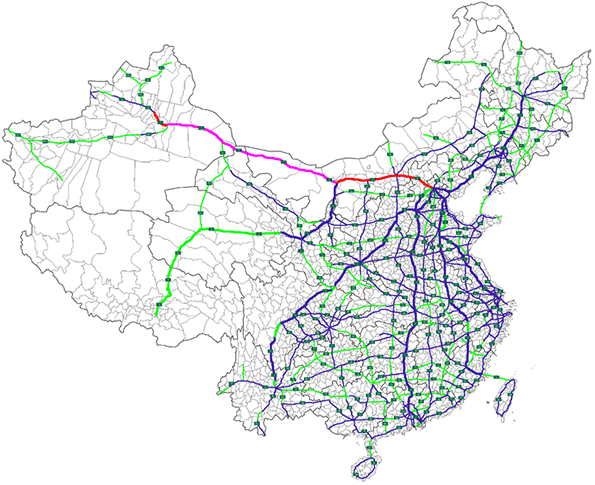
    It seems likely that the US continues to lead, though by only a small margin, in total freeway mileage. However, China is continuing to expand its system at a rapid rate. This is evident in the map below, which uses purple and green to indicate uncompleted freeways, while blue and red indicate open segments. Long stretches remain to be completed to Urumqi, the capital of Xinjiang, and beyond to the border of Kazakhstan in the Pamir Mountains, as well as two long routes to Lhasa, the capital of Tibet. A number of additional routes are also planned in the densely populated eastern third of the nation.


    Map by WikiCommons user Pafun

    Also see:
    China’s Expanding Roadways (February 2012)
    China Expressway System to Exceed US Interstates (January 2011)

  • Big things that were never built in Los Angeles

    One of my lesser historical obsessions has been the grandiose stuff that’s been proposed for the Los Angeles area and never built. Things like the amusement park that Walt Disney proposed for Burbank before he put Anaheim on the map with Disneyland, or the assorted hotels, parks, monorails and highways that were given ink in the newspapers but either fell through or were never that real to begin with. I’ve written before about the sketch on my office wall from a 1913 Los Angeles Times front page envisioning a future downtown of skyscrapers, high-altitude auto bridges and curiously a waterfront. Imagine how different the city would be if, for instance, Valley promoters had gotten their way to plant the original LAX due west of the corner of Balboa and Roscoe. Or if the 1930 plan from Olmsted and Bartholomew for a chain of parks and playgrounds across the city had been accomplished.

    Sam Lubell, the West Coast Editor of the Architect’s Newspaper, and Greg Goldin, the architecture critic at Los Angeles Magazine, have mined the landscape and found some real gems. Lloyd Wright’s incredibly grand 1925 Civic Center for downtown (above.) Or the 1952 master plan for LAX by architects Pereira and Luckman. The plan is to use the research to mount an ambitious exhibition next spring at the A+D Architecture and Design Museum on Wilshire. They have launched a Kickstarter campaign to make it happen, and of course you can help.

    Check out their cool video:

    This piece first appeared at LA Observed.

  • Warnings of an “infrastructure Crisis” are Meeting with Skepticism

    Is the "infrastructure crisis" a myth or a reality? Many  within the transportation community firmly believe that the crisis is real. They point out that many of our roads, bridges and transit systems are approaching the end of their useful life and are badly in need of repair, reconstruction and modernization. They are convinced that without an ambitious program of investment —beyond the billions that already are being spent—the transportation infrastructure will continue to deteriorate, rendering great harm to the nation’s economy. They find it difficult to understand why politicians and the public do not necessarily share the same sense of urgency. They tend to blame themselves for doing a poor job of "educating" the public about the catastrophic consequences of inaction.

    Even though the new two-year transportation bill has barely gone into effect (on October 1), activists already are strategizing  how better, i.e. more convincingly,  to present  the case for higher transportation spending in the next transportation bill.  As an AASHTO spokesman reminded us recently, "it is never too early to consider your strategy for making the case that the United States should continue to invest in its transportation infrastructure." "We can’t afford to relax," echoed Pete Ruane, president of the American Road and Transportation Builders Association (ARTBA). "We’re in a very serious struggle over the future of federal investment in transportation." Similar sentiments have been voiced in various transportation-related meetings over the past several months..   

    But proponents of greater spending ignore the political realities. With mounting deficits and the shadow of a $16 trillion debt hovering over all fiscal decisions, Congress is not about to vastly increase spending on transportation. Concern about deteriorating infrastructure has failed to resonate with the electorate during the election campaign.  Nor did  the presidential condidates care to mention transportation in their recent debate on domestic priorities, despite pleas by stakeholder groups to include infrastructure on the political agenda.

    Infrastructure crisis believers decry this supposed "indifference" or "short-sightedness" on the part of the politicians and the public. But their anger is misplaced. People recognize and acknowledge the need to modernize and expand the nation’s infrastructure.  They simply are not convinced by the "sky is falling" rhetoric employed by the alarmists—dire warnings of collapsing bridges and crumbling roads if  government does not greatly increase spending on infrastructure. 

    As the Washington Post editorialized no too long ago, people see no signs of  "crumbling infrastructure." They trust their own eyes more than they trust the unverified claims of  the experts —and what they see is highways and transit networks that are well maintained and functioning smoothly and reliably most of the time. They suspect that  warnings of catastrophic consequences if spending on infrastructure is not boosted, are overblown, self-serving, and more often than not inspired by liberal advocacy groups, lobbyists and industry spokesmen who have a financial stake in pushing for more federal spending.  As one senior congressional aide confided to us, "I don’t see our constituents lobbying to raise the gas tax in order to spend more money on transportation."

    Moreover, the public is not sure that all of the billions of dollars that the federal government already devotes to  transportation ($114 billion in FY 2012) are spent  wisely, nor that more money will make the transportation system perform any better (e.g. reduce congestion).  They believe that the desire to greatly increase investment in infrastructure must be tempered by the overriding  imperative to get the nation’s fiscal house in order.

    Beyond MAP-21 
    The fiscal and political climate in the next few years will make the job of convincing the skeptical electorate to support higher transportation spending even harder. Funding constraints will continue to make it difficult if not downright impossible for Congress to commit hundreds of billions of federal dollars in a single legislative package, regardless of which party controls the purse strings. Unwilling to raise fuel taxes, Congress is likely to embrace short-term bills as a convenient way out of the dilemma.  Short-term authorizations such as MAP-21 will require only modest transfers from the general fund —especially if states are willing to step in with increased contributions of their own. On the other hand, a six-year bill would require an injection of nearly $90 billion in general revenue.  

    To be sure, some in the stakeholder community will contend that longer-term (i.e. five- or six-year) authorizations are necessary to allow for orderly planning and implementation of capital projects. They will argue that short-term bills will not provide the kind of funding certainty that major public works require. But to the extent that large capital investments still figure on State DOTs’ and transit authorities’ agendas, private capital, tolling, and credit instruments such as TIFIA and state infrastructure banks, will provide adequate alternatives to the funding stability that long-term congressional  authorizations offered in years past.

    The bottom line: regardless of the outcome of the November elections, do not expect a boost in federal transportation spending. Indeed, minor reductions in discretionary programs (TIGER, New Starts) are possible if automatic year-end spending cuts under sequestration are not avoided.

  • Transportation Aborted

    Like most Americans, I was bombarded by sound-bites and blog-bytes surrounding an amendment to an Act of Congress that would require a woman to submit to and review the results of a trans-vaginal ultrasound before receiving an abortion. This amendment was covered ad nauseam by everyone from the Huffington Post to the nightly news on broadcast television. I don’t mind admitting that I’m past the age where this Act of Congress would have an effect on me personally.

    What really bothered me was that no one talked about the core problem of how deranged our political process has become in Washington. The real issue here that impacts all of us is that this amendment was attached to a transportation funding bill – TRANSPORTATION, not a Health Care Bill or a Health Insurance Bill or even an Equal Opportunity Employment Bill but a TRANSPORTATION funding bill.

    All of these journalists are as at fault over the issue as the bunch of Congressmen who tried – once again – to slip one past the balance of powers and our democratic form of government. The guilty parties in Washington DC start with:

    In the House of Representatives, Mr. Fortenberry (NE), Mr. Boren (OK), Mrs. McMorris Rodgers (WA), Mr.Scalise (LA), Mr. Tiberi (OH), Mr. CONAWAY (TX), Mr. Lamborn (CO), Mr. Walberg (MI), and Mr. Lipinski (IL) who introduced  “H.R.1179 — Respect for Rights of Conscience Act of 2011” on March 17, 2011. By the time the bill was attached as an amendment to the highway funding bill, the number of co-sponsors had risen from 8 to 221.

    In the Senate, Mr. Blunt (MO), Mr. Rubio (FL), and Ms. Ayotte (NH)) introduced S. 1467 on August 2, 2011. The cosponsors in the Senate went from 2 to 37.

    That’s a total of 260 elected representatives who will be responsible for the continuing deterioration of highway infrastructure in the United States. The current Federal authorization for funding surface transportation programs ends March 30, 2012.

    The current funding authorization is just the most recent in a long line of temporary extensions that have been strung together since the last 5-year plan expired in 2009. The highway funding bill in question – to which this healthcare amendment is being attached – would authorize funding of $109 billion over 2 years. If nothing is done by March 30, if no action is taken to fund US highway infrastructure, the Department of Transportation (DoT) will have to furlough workers and stop paying contractors, according to Humberto Sanches of Roll Call. Last summer, DoT sent home 4,000 FAA employees and 70,000 private-sector workers because Congress failed to act on funding.

    The process for highway funding is already convoluted and inefficient – watching the current Congress add abortion amendments to the funding bill gives us a peek into how it got that way. In the meantime the United States’ infrastructure is crumbling and the rest of the world is getting ahead of us. No wonder we’re deranged.

  • Obama’s New $50 Billion Infrastructure Stimulus — Old Wine in New Bottles

    President Obama’s new $50 billion infrastructure initiative — part of his $447 billion American Jobs Act (AJA)—offered no surprises. It’s almost an exact replica of his FY 2012 budget request which included a sum of $50 billion for transportation to “jump start” a proposed $556 billion six-year surface transportation reauthorization.

    The rhetoric may have changed — Obama avoided using the terms “stimulus” and “infrastructure” in presenting his AJA initiative to Congress—but the substance of the two initiatives is remarkably similar. Both proposals would fund an identical mix of programs (highways, transit, Amtrak, high-speed rail, aviation and the TIFIA credit program) and both would establish a National Infrastructure Bank.

    The FY 2012 transportation budget request failed to obtain congressional approval for two reasons: (1) the Administration failed to show how the proposed $50 billion program would be paid for; and (2) there was no convincing evidence that the program would promptly create new jobs. Indeed, all evidence pointed in the opposite direction. The $48 billion in Recovery Act funds for transportation had failed to create the millions of jobs promised by the Administration. The money earmarked for highways had been spent largely on short term roadway maintenance-type contracts and had produced only temporary jobs. Nor was there much to show for in terms of an improved condition or performance of the nation’s transportation system. As for the Infrastructure Bank, it is widely believed that at least one or two years could pass before the Bank would become operational and in a position to begin financing large-scale job-creating infrastructure projects.

    The same reasons that led Congress to ignore the Administration’s FY 2012 transportation budget request will likely cause the lawmakers to reject the new transportation initiative. They are skeptical that a fresh infusion of funds will succeeed where the first stimulus failed. Doing the same thing over and over again and expecting different results may not be exacly insanity but it does suggest a certain denial to look facts in the face.

    The President said that “everything in this bill will be paid for” and that he will call on the Joint Deficit Committee to come up with additional deficit reductions necessary to pay for the American Jobs Act. But by proposing to end tax breaks for people making more than $200,000 and for oil and gas companies, the White House is setting itself up again for a fight with the Congress which already once before rejected this approach to “revenue enhancement.” It remains to be seen if the independent congressional committee will do Obama’s bidding. With the President’s approval ratings at an all time low, they just might be emboldened to ignore his plea.

    Note: the NewsBriefs can also be accessed at www.infrastructureUSA.org
    A listing of all recent NewsBriefs can be found at www.innobriefs.com

  • Infrastructure Bank: Losing Favor with the White House?

    Eighteen months ago, on January 20, 2010, a group of influential politicians, accompanied by a large coterie of representatives of the Washington transportation community, gathered at the Capitol to urge Congress and the Obama Administration to create a “National Infrastructure Bank” to help finance infrastructure investments. The speakers included all the well-known advocates of the Bank: Pennsylvania’s Governor Ed Rendell, Senator Chris Dodd (D-CT), Rep. Rosa DeLauro (D-CT), author of an Infrastructure Bank bill (H.R. 2521), former House Majority Leader Dick Gephardt (D-MO) and Felix Rohatyn, the spiritual godfather of the movement. Standing beside them, in a gesture of support and solidarity, was a large group of executives representing the transportation industry, labor unions and advocacy groups.

    For a while, it seemed like their plea would be answered. A proposal for a $30 billion infrastructure bank focused on transportation-related investments was included in the President’s FY 2011 budget proposal unveiled last September. As recently as last month, Mr. Obama was mentioning the Infrastructure Bank as part of his job stimulus plan to be unveiled after Labor Day.

    But today, the idea is on life support. Neither the Senate nor the House have seen fit to include the Bank in their proposed transportation bills. Congressional Democrats and Republicans alike are in agreement that decisionmaking control over major federal investments should not be ceded to a group of “unelected bureaucrats.” Rather than creating a new federal bureaucracy, they think the focus should be placed on expanding federal credit assistance tools already in place, such as the Transportation Infrastructure Finance and Innovation Act (TIFIA) and the Railroad Rehabilitation & Improvement Financing Program (RRIF).

    There are other reasons for congressional skepticism. House Republicans are suspicious that the Obama-proposed Bank is nothing more than a vehicle for more stimulus spending, disguised as “capital investment.” They want the Administration to be more specific about its proposal: how the Bank would be funded, what kind of investments it would fund and how the $30 billion capital would be repaid. “If this is more of the same stimulus spending, we won’t support it,” Kevin Smith, spokesman for House Speaker John Boehner (R-OH) has been quoted as saying.

    House Transportation and Infrastructure Committee chairman John Mica (R-FL) thinks state-level infrastructure banks would be a more appropriate means of financing major transportation projects at the state and local level. Decentralized infrastructure financing would “keep the federal financing bureaucracy at a minimum and maximize states’ financial capabilities,” according to the House transportation reauthorization proposal.

    Senate Democrats, while not necessarily opposed to another fiscal stimulus, want quick results. They fear that a centralized Infrastructure Bank, with its complex governance structure and layers of bureaucratic conditions, requirements and approvals would be far too slow and cumbersome to be an effective job generator. One or two years could pass before large-scale projects appropriate for Bank financing would get evaluated, selected, approved and under construction, one Senate aide told us.

    What is more, there is a lack of agreement on how the proposed Infrastructure Bank should function. The Administration wants a mechanism that would serve several different purposes. In the words of Undersecretary for Transportation Policy Roy Kienitz who testified at a September 21, 2010 hearing of the Senate Banking Committee, “We need a financing institution that can provide a range of financing options— grants for projects that by their nature cannot generate revenue, and loans and loan guarantees for projects that can pay for their construction costs out of a revenue stream. In short, we need the Infrastructure Bank that the President has proposed.”

    But, “banks don’t give out grants, they give out loans. There is already a mechanism for giving out federal transportation grants — it’s called the highway bill,” countered Sen. James Inhofe (R-OK), ranking member of the Senate Environment and Public Works (EPW) Committee.

    If the proposed entity is to be a true bank – as proposed in a recent bill sponsored by Senators John Kerry (D-MA) and Kay Bailey Hutchison (R-TX) and endorsed by the AFL-CIO and the U.S. Chamber of Commerce– its scope would be confined to projects that can repay interest and principal on their loans with a dedicated stream of revenue — in other words, the Bank could finance only income-generating facilities such as toll roads and bridges. By all estimates, such projects will constitute only a small fraction of the overall inventory of transportation improvements needed to be financed in the years ahead, the bulk of which will be reconstruction of existing toll-free Interstate highways. Hence, a true Infrastructure Bank would be of limited help in creating jobs and reviving the economy, critics argue.

    “A national infrastructure bank must garner broad bipartisan support to move forward,” says Michael Likosky, Director of NYU’s Center on Law & Public Finance and author of a recent book, Obama’s Bank:Financing a Durable New Deal. “This means no grants, a multi-sector reach and a realistic idea of what projects will benefit straight away.”

    President Obama was expected to include the infrastructure bank among his recommended stimulus measures when he lays out his new job-creation plan before the congressional deficit reduction committee in early September. But lately, he seems to have put the idea on the back burner and turned his attention to more traditional “shovel-ready” highway investments using existing financing programs. His advisers may have concluded that the Bank will do little to stimulate immediate job creation— and that the proposal will find little support among congressional Democrats and Republicans alike. If so, check off the Infrastructure Bank as an idea whose time had come and gone.

    ~~~~~~~~~~~~~~~~~~~~

    Note: the NewsBriefs can also be accessed at www.infrastructureUSA.org

    A listing of all recent NewsBriefs can be found at www.innobriefs.com