Tag: Inland Empire

  • The Blue-Collar Heroes of the Inland Empire

    The late comedian Rodney Dangerfield (nee Jacob Cohen), whose signature complaint was that he “can’t get no respect,” would have fit right in, in the Inland Empire. The vast expanse east of greater Los Angeles has long been castigated as a sprawling, environmental trash heap by planners and pundits, and its largely blue-collar denizens denigrated by some coast-dwellers, including in Orange County, who fret about “909s” – a reference to the IE’s area code – crowding their beaches.

    The Urban Dictionary typically defines the region as “a great place to live between Los Angeles and Las Vegas if you don’t mind the meth labs, cows and dirt people.” Or, as another entry put it, a collection of “worthless idiots, pure and simple.” Nice.

    In reality, the people who live along the coast should appreciate the “909ers” since they constitute the future – if there is much of one – for Southern California’s middle class. The region has suffered considerably since the Great Recession, in part because of a high concentration of subprime loans taken out on new houses. Yet, for all its problems, the Inland Empire has remained the one place in Southern California where working-class and middle-class people can afford to own a home. With a median multiple (median house price divided by household income) of roughly 3.7, the area is at least 40 percent less expensive than Los Angeles and Orange County, making it the region’s last redoubt for the American dream.

    Without the 909ers, Southern California would be demographically stagnant. From 2000-10, according to the census, San Bernardino and Riverside counties added more than 1 million people, compared with barely 200,000 combined for Los Angeles and Orange counties. And, despite the downturn that impacted the Inland Empire severely and slowed its growth, the area since 2010 has continued to grow more quickly, according to census estimates, than the coastal counties.

    Families & foreign-born

    Perhaps nothing illustrates the appeal of the region better than the influx of the foreign-born. In the past decade, Riverside and San Bernardino counties grew their foreign-born population by more than 300,000. In contrast, Los Angeles and Orange added barely one third as many. The rate of foreign-born growth in the Inland Empire, notes demographer Wendell Cox, was roughly 50 percent, while Los Angeles and Orange counties managed 2.6 percent growth. The region, once largely white, now has a population that’s 40 percent Latino, the single largest ethnic group.

    And then there’s families. As demographer Ali Modarres has pointed out, the populations of Los Angeles, as well as Orange County, are aging rapidly while the numbers of children have dropped. In contrast, families continue to move into the Inland Empire, one reason for its relatively vibrant demography. Over the past decade, while Orange County and Los Angeles experienced a combined loss of 215,000 people under age 14 – among the highest rates in the U.S. of a shrinking population of children – the Inland Empire gained more than 20,000 under-14s.

    For these basic demographic reasons, the Inland Empire remains critical to Southern California’s success. And there are some signs of progress. Unemployment has plummeted from more than 13 percent to 9.6 percent, higher than in Orange County but considerably better than Los Angeles’ 10.2 percent. There are also some signs of growth, as signaled by some new residential development, and interest in the area from overseas investors.

    Coastals call shots

    The long-term outlook, however, remains clouded, in large part, because of state and regional economic policies that undermine the very nature of the predominately blue-collar 909 economy. This reflects in part the domination of the state by the coastal political class, concentrated in the Bay Area but with strong support in many Southern California coastal communities. The Inland Empire, where almost half the population has earned a high school degree or less, compared with a third of residents in Orange County, is particularly dependent on the blue-collar employment undermined by the gentry-oriented direction of state regulatory policy.

    Losses of jobs in these blue-collar fields, notes economist John Husing, have helped swell the ranks of poor people in the area, from roughly 12 percent of the population to 18 percent over the past 20 years. Part of the problem lies in a determination by the state to discourage precisely the kind of single-family-oriented suburban development that has attracted so many to the region. The decline of construction jobs – some 54,000 during the recession – hit the region hard, particularly its heavily immigrant, blue-collar workforce. This sector has made only a slight recovery in recent months. Ironically, the nascent housing recovery could short-circuit further gains by boosting housing prices and squashing any potential longer-term recovery.

    Other state policies – such as cascading electricity prices – also hit the Inland Empire’s once-promising industrial economy. With California electricity prices as much as two times higher than those in rival states, energy-consuming industries are looking further east, beyond state lines.

    Indeed, according to recent economic trends, job growth is now occurring fastest in places like Arizona, Texas, even Nevada, all of which compete directly with the Inland Empire. As the nation has gained a half-million manufacturing jobs since 2010, such jobs have continued to leave the region. Had the regulatory environment been more favorable, notes economist John Husing, the Inland Empire, with industrial space half as expensive that in Los Angeles and Orange, would have been a major beneficiary.

    Finally, there is a major threat to the logistics industry, which has grown rapidly over 20 years, adding 71,900 jobs from 1990-2012, a yearly average of 3,268. The potential threat is posed by the expansion of the Panama Canal, and the resulting expansion of Gulf Coast ports, all of which could reduce these positions dramatically in coming decades. Husing suggests that attempts by the regional Air Quality Management District to slow this industry’s expansion is a “a fundamental attack on the area’s economic health.”

    Keys to rebound

    Can the Inland Empire still make another turnaround, as it did after the previous deep regional recession 20 years ago? Some, such as the Los Angeles Times, see the key to a rebound in boosting transit, something that, despite huge investment, accounts for barely 1.5 percent of the IE’s work trips, even less than the 7 percent in Los Angeles or 3 percent in Orange County.

    This “smart growth” solution remains oddly detached from economic or geographic reality; more transit usage may be preferable in some ways but can only constitute a marginal factor in the near or midterm future. What the Inland Empire needs, more than anything, is an economic environment that spurs middle-class jobs, notably in logistics, manufacturing and construction.

    Equally important, the area needs to focus more on quality-of-life issues that may attract younger, educated workers, increasingly priced out of the coastal areas. This means a commitment to better parks and schools, attractive particularly to families. This approach has helped a few communities, such as Eastvale, near Ontario, become new bastions of the middle class.

    Without a resurgence in the Inland Empire, all of Southern California can expect, at best, to see the area age and lose its last claim to vitality. This should matter to everyone in Southern California whether they live there or not. Without the 909ers, we are not only without the butt of jokes from self-styled sophisticates, we will have lost touch with the very aspirational dynamic that has forged this region throughout its history. It’s time maybe to give them some respect.

    This story originally appeared at The Orange County Register.

    Joel Kotkin is executive editor of NewGeography.com and Distinguished Presidential Fellow in Urban Futures at Chapman University, and a member of the editorial board of the Orange County Register. He is author of The City: A Global History and The Next Hundred Million: America in 2050. His most recent study, The Rise of Postfamilialism, has been widely discussed and distributed internationally. He lives in Los Angeles, CA.

  • Cashing in on So Cal Culture

    Southern California has always been an invented place. Without a major river, a natural port or even remotely adequate water, the region has always thrived on reinventing itself – from cow town to agricultural hub to oil city, Tinsel Town and the “Arsenal of Democracy.”

    Today, the need for the region to reinvent itself yet again has never been greater. Due in large part to regulatory pressures, as well as competitive forces both global and national, many industries that have driven the Southland economy – notably, aerospace, garments and oil – are under assault. A high cost of living, particularly for housing, stymies potential in-migration and motivates industries to look elsewhere to locate or expand.

    As a result, virtually every key Southern California industry has been either stagnating or losing ground to competitors. More important, the area in the past decade has lost much of its appeal as a destination for both immigrants and young people, drying up a huge source of potential innovation.

    To put it in vaudeville terms, Southern California needs a new shtick. We must look to leverage our natural advantages (beyond just our climate) into a new economic paradigm that can withstand competition from the rest of the world and the rest of the country. This opportunity is best seen as the commercialization of culture. These include, as one recent Los Angeles County Economic Development Corp. report stated, “businesses and individuals involved in producing cultural, artistic and design goods and services.”

    This is not largely a matter of museums or concert venues. When it comes to the “fine” arts, Southern California is an increasingly respectable player, but cannot compete on equal footing with London, Paris, New York or Chicago, locales with far older endowments and, arguably, more people with refined artistic tastes. There is also growing competition from cash-rich wannabe cities, from Houston and Dallas to Shanghai, Beijing or Singapore. Fine art has always been for sale to the highest bidder.

    Where Southern California retains a decisive edge is in the popular arts – from casual fashion and industrial design to movies, television and commercials – which could provide the basis for a broad-based economic revival. This requires political and business leadership to shift from their obsession with downtown Los Angeles and dense building projects to a focus on nurturing long-term, sustainable employment.

    This demands that we do everything to maintain the quality of life, largely a matter of our region’s spread-out neighborhoods, that has always been our primary calling card to creative talent. Los Angeles, in particular, boasts by far the largest concentration of artists in the country. Overall, the “creative industries” account, according to a recent Otis Institute study, for roughly 337,000 direct jobs in the Los Angeles-Orange County region. Adding indirect employment, the study estimated these industries employed more than 642,000 people, more than the total employment of the Sacramento area.

    Each of these economic drivers deserves a closer look:

    Fashion

    Over the past quarter century, Los Angeles, with roughly three times as many establishments, has replaced New York as the nation’s garment capital. Most of these companies are small, but, together, the fashion industry across the five-county Southland region employs more than 100,000 people.

    In recent years, apparel manufacturing has been in decline, losing some 40,000 jobs. But there has been growth in such areas as clothing design and merchandising. The region has become the de facto capital for “fast forward” fashion, paced by firms such as Forever 21 Inc., Wet Seal and Papaya. Orange County, capital of the surfwear industry, is home to firms such as Oakley, Volcom, Hurley, Gotcha International, O’Neill, Raj Manufacturing, Mossimo and Stussy.

    These firms, and the businesses serving them, are expected to experience more growth in the coming years, according to the U.S. Bureau of Labor Statistics. Aided by the “onshoring” trend – returning jobs from overseas – and a demand for quicker product turnaround, the Southern California apparel industry seems poised to solidify its hold over the country’s fashions over the coming years.

    Entertainment

    This fashion industry derives much of its success from a link with Hollywood and the rest of the entertainment world. Accounting for more than 40 percent of all creative industry jobs, the entertainment complex is increasingly critical to the region’s resurgence. Much concern has been raised about the future of this key industry, whose growth has slowed, due in part to massive tax incentives from other states and countries.

    Despite this, the industry has been on something of an upswing recently, adding more than 4,600 jobs last year, a gain of 3.7 percent. At 129,700 jobs, employment in the industry is now at its highest level in four years but still tantalizingly below its levels in 2004 (132,200 jobs) and 1999 (146,300 jobs). Growth derives not so much from studio employment but from the ranks of independent contractors, now more than 85,000, well above the prerecession level. Nearly 80 percent of all new entertainment jobs are from the ranks of independent proprietors.

    Digital Arts

    The stabilization, and hopefully resurgence, of the entertainment sector could boost other industries, like digital media, hoping to play off the region’s extraordinary concentration of artists, specialists and story-tellers. Historically, Southern California, in large part due to a relative shortage of venture capital, has been playing catch-up with the Bay Area, and to a lesser extent, Seattle.

    The key to the future is combining other assets besides Hollywood, such as having the largest number of engineers – 70,000 – of any area in the country. Much hope has been placed on the rise of the much-ballyhooed “Silicon Beach” that follows the coastline, largely in Los Angeles, which some people claim is becoming a real competitor to Silicon Valley.

    Yet this is not the first time we have heard this story. Similar growth took place in past digital media waves, only to see reductions as the inevitable cratering takes place during market shake-outs. But employing the strong ties to the Hollywood creative community, there is the real prospect for the region to achieve a critical mass that will allow digital entrepreneurs to remain comfortably here rather than head up to Silicon Valley.

    Industrial Design

    Even as manufacturing employment has declined over time, improving recently to a level of mere stagnation recently, Southern California has maintain a leading position in industrial design. This field is expected to grow, both nationally and in the Southland.

    The area has maintained its leadership as center of automotive design, with studios such as the BMW Design Works, in Ventura, and Mercedes Advanced Design, in Carlsbad, as well as GM’s Advance Design Studio in North Hollywood. The fact that many international firms – for example, Hyundai (Fountain Valley), Kia (Irvine), Honda and Toyota – maintain their North American headquarters in the Southland provides a critical link to the expanding global auto market.

    Primacy in industrial design also extends into other product lines, such as furniture and household furnishings. If this design edge can be combined with automation and the onshoring of jobs, Southern California could enjoy a broad-based resurgence more sustainable than those of more-narrowly based economies, such as in New York or the Bay Area.

    Design of Life

    As we have seen over the past decade, local industries such as entertainment – not to mention fields like fashion, digital and industrial design – are going to be subject to enormous pressure from both home and abroad. China, for example, is building a massive $8.2 billion film studio in a concerted drive to replace Hollywood as the center of the world entertainment industry.

    If we lose our stranglehold on entertainment and other creative industries, there is very little hope for a regional resurgence. We lack the deep digital bench and funding sources of the Bay Area, or New York’s financial industry and its ability to dominate the news media. We can never be as cheap, or business friendly, as our emerging cultural rivals in the South, such as New Orleans, Nashville, Tenn., Austin, Texas, or Dallas, nor can we offer the kind of bargain-basement deals that desperate places, such as Detroit or Las Vegas, might offer to creative types.

    This means we have to focus on preserving and improving those very things – our cultural legacy and a predominately low-rise and flexible-work lifestyle – that differentiates us from far more congested, structured and often far-less pleasant locales like New York – and, even more so, China. In the past, this region has won the “design wars” by being itself, not by trying to create a faux vision that seeks to mimic Manhattan or Shanghai. Ultimately, Southern California can win only by playing the same aces that for generations have led the creative and the questioning to settle in our sun-drenched metropolis.

    Joel Kotkin is executive editor of NewGeography.com and Distinguished Presidential Fellow in Urban Futures at Chapman University, and a member of the editorial board of the Orange County Register. He is author of The City: A Global History and The Next Hundred Million: America in 2050. His most recent study, The Rise of Postfamilialism, has been widely discussed and distributed internationally. He lives in Los Angeles, CA.

    This piece originally appeared at The Orange County Register.

  • California’s Third Brown Era

    Jerry Brown’s no-frills inauguration today as California governor will make headlines, but the meager celebration also marks the restoration of one of the country’s most illustrious political families. Save the Kennedys of Massachusetts no clan has dominated the political life of a major state in modern times than the Browns of California. A member of this old California Irish clan has been in statewide office for most of the past half century; by the end of Jerry Brown’s new term, his third, the family will have inhabited the California chief executive office for a remarkable two full decades since 1958.

    Brown, at 72 the oldest governor in state history, may well determine the final legacy of this remarkable family. His biggest challenge will be to reverse the state’s long-term secular decline — a stark contrast to the heady days of the first Brown era, presided over by paterfamilias Edmund “Pat” Brown.

    Pat Brown was a committed progressive who actually believed in both social and economic progress. He did not focus on re-distributing wealth or expanding bureaucratic controls; his priority was to use government to help generate greater opportunities for Californians.

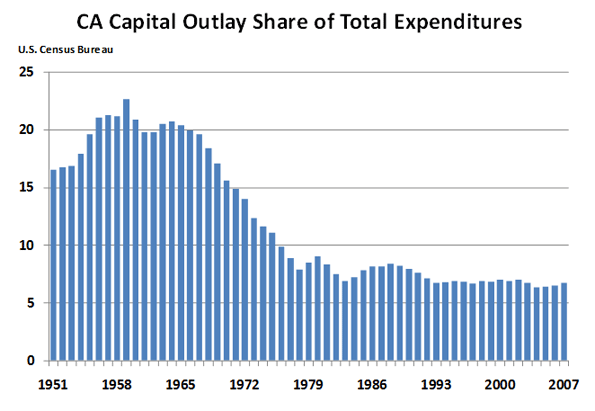
    Under Pat roughly 20% of the state budget was devoted to capital outlays. He expanded wealth creating infrastructure such as freeways and the State Water Project, which created vast expanses of new, highly fertile farmland. He also increased the state’s parklands so that middle-class Californians could enjoy the state’s unmatched natural beauty.

    Pat, as historian Kevin Starr notes, also transformed California into “a mecca for education.” Inexpensive and quality training — from the elite university to the extensive network of community colleges — fostered high-tech industries across the state. Under Pat Brown, California’s share of the nation’s employment rose from some 8% to 10% as its GDP swelled by a similar percent.

    Pat, not surprisingly, remains an iconic figure for many older Californians. What ended his career was not so much his embrace of big government — although its growing scope and cost concerned many voters  – but backlash against the 1964 “free speech” riots at Berkeley and the far deadlier civil unrest in Watts the following year.  Running as the candidate of law and order, as well as fiscal conservatism, Ronald Reagan in 1966 defeated Brown’s bid for a third term.

    Yet so great was the reservoir of affection for the Pat Brown that in 1974 the voters elected his 36-year-old son as Reagan’s successor. As the late Joe Cerrell, a key operative for both Browns, put it: “If he had run as Edmund G. Green, he wouldn’t have bet on his running in the top 14.”

    Jerry Brown turned out to be of a very different political hue than his father. Sometimes he sounded more anti-government even than Reagan. He disdained his father’s traditional focus on   infrastructure spending and instead preached about amore environmentally friendly “era of limits.”  Brown cut the percentage of spending on such capital improvements from roughly 10% of state spending under Reagan to barely 5%, where it remains mired today.

    Arguably Brown’s biggest mistake was signing legislation in 1978 that allowed collective bargaining for public employee unions. This opened the door for a power grab that eventually drove the state toward semi-permanent penury. Brown’s early embrace of environmentalism also set a pattern of state green engineering that, although clearly avant garde , also tipped the state’s competitive edge.

    Brown, however, also showed a pragmatic side.   Although initially opposed to Howard Jarvis’ 1978 Proposition 13 limits on property taxes, he later embraced it  so enthusiastically that the casual voter might have mistaken him for its author. In his second term Brown also evolved into an avid cheerleader for the state’s burgeoning high-tech industry.

    He also had good fortune to govern California at a time when surging Japanese investment, the high tech boom and, perhaps most important of all, the military buildup accelerated by the 1979 Soviet invasion of Afghanistan generated a remarkable economic boom. Between 1976 and 1980 aerospace and electronics-related employment jumped by a third. California’s share of the nation’s GDP, population and jobs rose steadily, while job growth surpassed the national average.

    The third Brown era, sadly, starts with far less favorable prospects. The state’s share of the nation’s economy and employment has been shrinking for at least a decade. Per capita income has fallen in comparison with the national average by nearly 20%. Once the nation’s high tech wunderkind, California’s share of new high-tech jobs has fallen to a fraction of the national average, while other states, notably Texas, Virginia, Utah and Washington have surged ahead.

    Things have been toughest on the state’s working class. Despite an ever-expanding welfare state, California’s 36 million people suffer a rate of poverty at least one-third higher than the national average when adjusted for cost of living.  Unemployment now is higher than any major state outside Michigan.

    Meanwhile, even as state social spending has surged, reminders of the heroic period — from the state system of higher education to the power, water and freeway systems — have fallen into disrepair. The state’s finances are in even worse shape. Under the feckless Arnold Schwarzenegger, state debt jumped from $34 billion to $88 billion. California now spends twice as much on servicing its interest (more than $6 billion annually) than on the University of California.

    Brown himself recently conceded that the state budget deficit may widen to $28 billion over the next 18 months while the state’s Legislative Analyst’s Office predicts that $20 billion deficits are likely to persist at least through 2016. Not surprisingly, once golden California suffers consistently near the worst debt rating of any state. And things are not likely to turn around quickly: State and local tax revenues in the third quarter of last year rose a paltry 0.6% compared with a 5.2 % gain nationwide.

    Brown’s proven taste for austerity could make him far more effective at addressing the state fiscal crisis than the clueless Terminator. His biggest problem on fiscal matters, one close advisor confided, may lie with his own Democrats in the legislature, many of whom are little more than satraps of the public employee interests.

    Brown’s support for the state’s increasingly draconian green polices may prove more problematic.  As Attorney General, Brown played the bully in enforcing radical green measures that seek to limit developments — industrial and residential — suspected of creating greenhouses gases. Brown suggested during the campaign that such policies would help create an estimated 500,000 green jobs, but few outside the environmental lobby take this seriously. Brownsupporter Tom Hayden points out that these jobs can only be created by higher energy prices and considerable tax increases — not exactly the elixir for an already weak economy.

    More troubling still, Brown, the Democratic leadership and their media supporters continue to deny that “progressive” policies have created  ”a hostile business climate.” Until they wake up to the reality of the state’s dire economic situation, little in the way of serious reform can be expected.

    To succeed, Brown must move beyond delusions and rediscover the pro-business pragmatism that characterized his second gubernatorial term. If not, we can expect the final obliteration of Pat Brown’s great  legacy of pro-growth progressivism, in no small part due to the misjudgments of his son and heir.

    Joel Kotkin is executive editor of NewGeography.com and is a distinguished presidential fellow in urban futures at Chapman University, and an adjunct fellow of the Legatum Institute in London. He is author of The City: A Global History. His newest book is The Next Hundred Million: America in 2050, released in February, 2010.
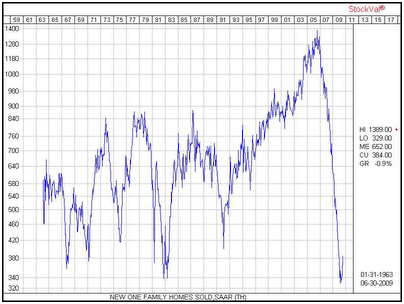
    Photo by Thomas Hawk

  • If California Is Doing So Great, Why Are So Many Leaving?

    Superficially at least, California’s problems are well known. Are they well understood? Apparently not.

    About a year ago Time ran an article, “Why California is Still America’s future,” touting California’s future, a future that includes gold-rush-like prosperity in an environmentally pure little piece of heaven, brought to us by “public-sector foresight.”

    More recently, Brett Arends’ piece at Market Watch, “The Truth About California,” is more of the same. California’s governor elect, Jerry Brown, liked this piece so much that he tweeted a link to it.

    The optimist’s argument about California’s future ultimately hinges on the creativity of the state’s vaunted tech sector, in large part driven by regulation promulgated by an enlightened political class and funded by a powerful venture capital sector.

    No fundamentalist evangelical speaks with more conviction or faith than a California cheerleader expounding on the economic benefits of environmental purity brought about by command and control regulation.

    The more honest cheerleaders acknowledge that California has challenges, including persistent budget problems. Arends denies even the existence of a budget problem, demanding “Er, no, actually. It’s your assertion. You do the math.” Let me help you, Brett. The non-partisan California Legislative Analyst’s Office has done the math. You can find it here. They expect budget shortfalls in excess of $20 billion a year throughout their forecast horizon. This is on annual revenues of less than $100 billion.

    Last week the numbers got even worse, as the Governor-elect, Jerry Brown, acknowledged. The deficit may now be as much as $28 billion this year, and over $20 billion for the foreseeable future. This is more than a nuisance. There’s a reason, after all, why California has among the worst credit ratings of any state.

    Most people outside of California haven’t drank from this vat of the economic equivalent of LSD-laced Kool-Aid. People know that a state is in trouble when it has persistent intractable budget deficits, chronic domestic net out-migration, and 30 percent higher unemployment than the national average. Indeed, California’s joblessness, chronic budget deficits, governors, and credit rating have made the state the butt of jokes worldwide.

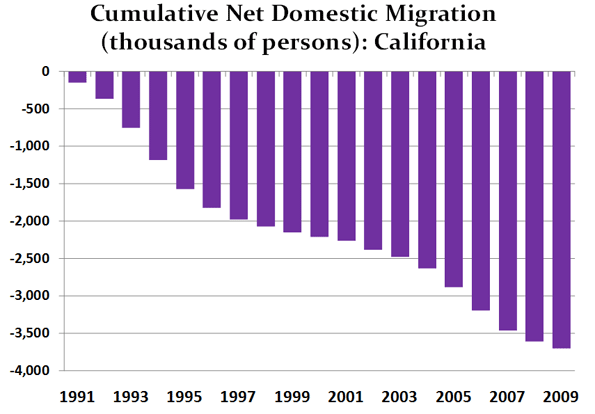
    How bad are things in California? California’s domestic migration has been negative every year since at least 1990. In fact, since 1990, according to the U.S. Census, 3,642,490 people, net, have left California. If they were in one city, it would be the third largest city in America, with a population 800,000 more than Chicago and within 200,000 of Los Angeles’ population.

    We’re seeing a reversal of the depression-era migration from the Dust Bowl to California. While California has seen 3.6 million people leave, Texas has received over 1.4 million domestic migrants. Even Oklahoma and Arkansas have had net-positive domestic migration trends from California.

    Those ultimate canaries in the coal mine, illegal immigrants, recognize California’s problems. Twenty years ago, about half of all United States illegal immigrants went to California. Today, that’s down to about one in four.

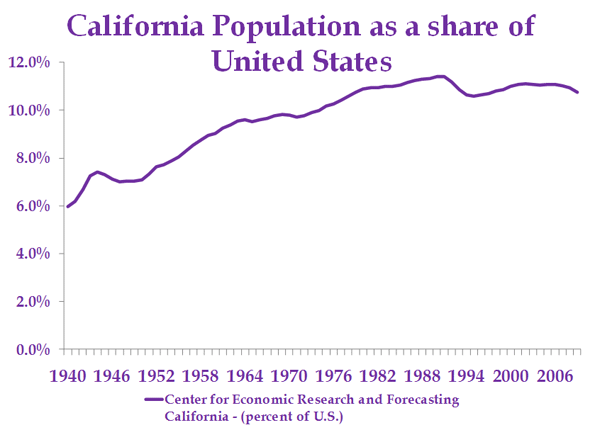
    The result of these migration trends is that California’s share of the United States population has been declining.

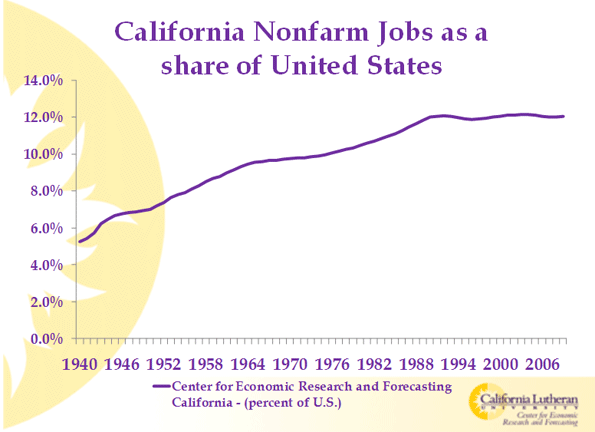
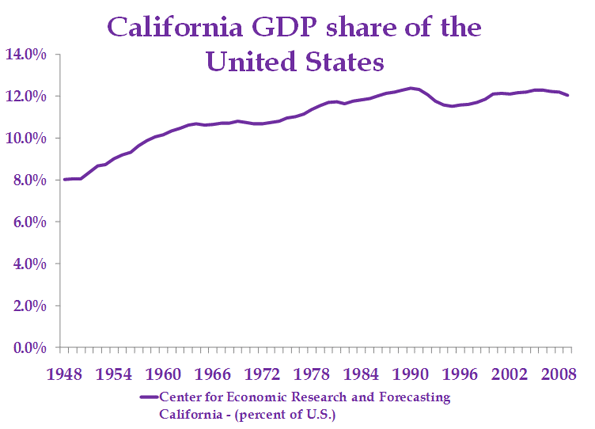
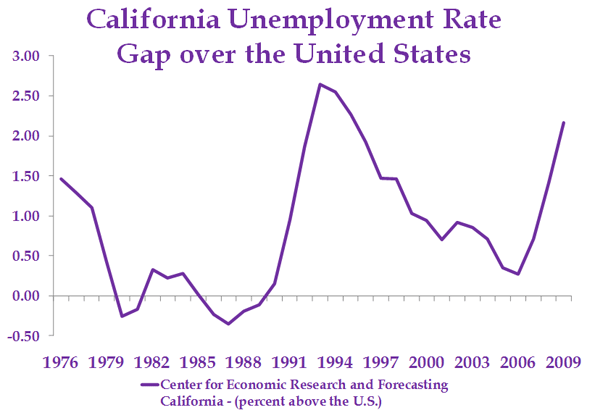
    What do these migrants see that so many of California’s political class do not see? They see a lack of opportunity. California’s share of United States jobs and output has declined since 1990, and its unemployment rate has remained persistently above the United States Average, only approaching the average during the housing boom.

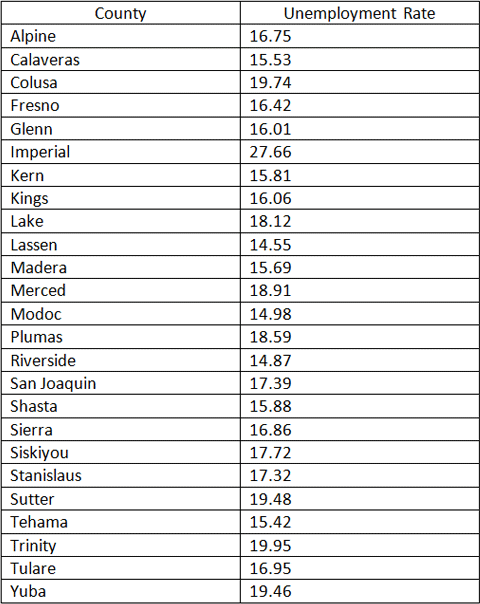
    California’s unemployment is particularly troubling. As of October 2010, only two states, Nevada at 14.2 percent and Michigan at 12.8 percent, had higher unemployment rates than California’s 12.4 percent. California’s unemployment problem is particularly severe in its more rural counties. Twenty-five of California’s 58 counties have unemployment rates higher than Nevada’s:


    These unemployment rates approach depression levels. Some will excuse many of them because they are in agricultural areas, but many assert that low Midwest unemployment rates are due to a booming agricultural sector. Which one is it?

    California’s unemployment problems are not limited to rural and agricultural areas. Most of Riverside County’s population is very urban, yet the County’s unemployment rate is 14.87 percent. On December 7th, the Wall Street Journal listed the unemployment rates for 49 of America’s largest urban regions. California had six of the 19 metro areas with double-digit unemployment. These include such major cities San Diego, San Jose, and Los Angeles.

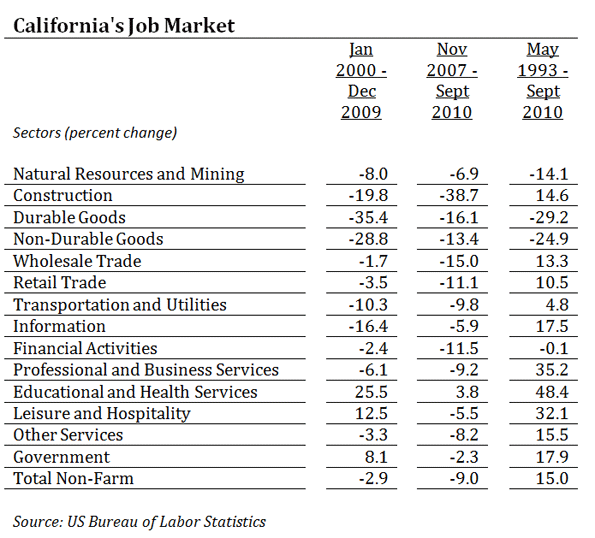
    Just as rural areas are not California’s only depressed areas, agriculture is not California’s only ailing sector. From 2000 to 2009, the only California sectors to gain jobs were government, education and health services, and leisure and hospitality.

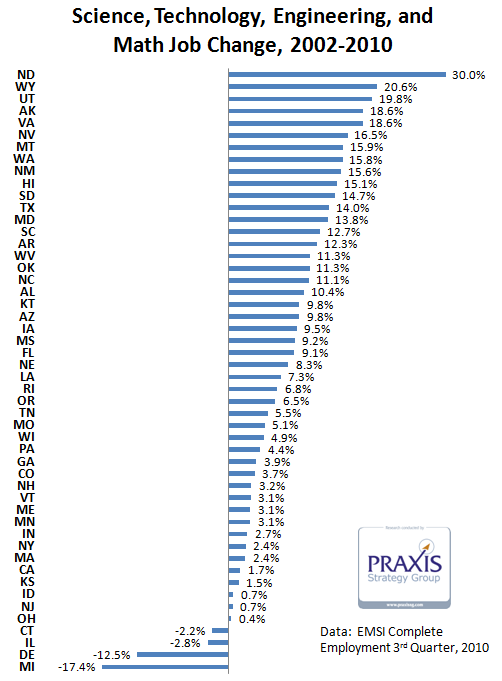
    California’s cheerleaders claim that the state’s future is assured by a vibrant tech sector, but the data do not support that assertion. North Dakota’s Praxis Strategy Group has performed analysis by job skills. They compare Scientific, Technical, Engineering, and Math (STEM) jobs across states. Their analysis shows that California is the Nation’s ninth worst state in creating STEM jobs in post dot-com-bust years. It has produced far fewer new tech jobs than Texas, and far less on average, than the country over the past decade:


    In this respect, California’s precipitous decline is really quite shocking. In just a couple of decades, California has gone from being America’s economic star, a destination for ambitious people from around the world and abundant with opportunity, to home of some of America’s most distressed communities. It has been a man-made, slow motion tragedy perpetuated by a political class that is largely deluded.

    The cheerleader’s faith in command and control regulation and environmental purity is so strong they cannot see anything that contradicts that faith.

    But that faith is misplaced. Joel Kotkin, Zina Klapper, and I performed an extensive review of the economic impacts of one of California’s most important greenhouse gas regulation, AB 32, and found that command and control regulation in general and AB 32 in particular is inefficient, cost jobs, and depress economic activity. California’s Legislative Analyst’s Office agrees, as evidenced by this report.

    More depressing still are the growing ranks of what could be called “the resigned”. They simply have given up. These include a business leadership that is more interested in survival and accommodation than pushing an agenda for growth. Easier to get along here, and expand jobs and opportunities elsewhere, whether in other states or overseas.

    Yet ultimately California’s future is what Californians make of it. No place on Earth has more natural amenities or a more benevolent climate. No place has a location more amenable to prosperity, located between thriving Pacific Rim economies and the entire North American market. No place has more economic potential.

    But unless policy is changed, California’s future is dismal, with the specter of stubbornly high unemployment, limited opportunity, and the continued exodus of the middle class. California’s political class needs first to confront reality before we can hope to avoid a dismal future.

    Bill Watkins is a professor at California Lutheran University and runs the Center for Economic Research and Forecasting, which can be found at clucerf.org.

    Photo by Stuck in Customs

  • California’s Failed Statesmen

    The good news? Like most rock or movie stars, there’s nothing fundamentally wrong with California. It’s still talented, and retains great physical gifts. Our climate, fertility and location remain without parallel. The state remains pre-eminent in a host of critical fields from agriculture to technology, entertainment to Pacific Rim trade.

    California can come back only if it takes a 12-step program to jettison its delusions. This requires, perhaps more than anything, a return to adult supervision. Most legislators, in both parties, appear to be hacks, ideologues and time-servers. This time, when the danger is even greater, we see no such sense of urgency. Instead we have a government that reminds one more of the brutally childish anarchy of William Golding’s 1954 novel “Lord of the Flies.”

    Arnold Schwarzenegger has not turned out to be that supervision. Rather than the “post-partisan” leader hailed by the East Coast press, he has proven to be the political equivalent of the multi-personality Sybil. One day he’s a tough pro-business fiscal conservative; next he’s the Jolly Green Giant who seems determined to push the green agenda to a point of making California ever more uncompetitive.

    Contrast this pathetic performance with what happened after our last giant recession in the early 1990s. At that time, a bipartisan coalition of leaders – Speaker Willie Brown, State Senator John Vasconcellos and Governor Pete Wilson – worked together to address what was perceived as a deep economic crisis. They addressed some key problems and brought the state back from the brink. California recovered smartly between the mid-90s and the new millennium.

    Overall though, things are worse now. California has been flirting for the past year with its highest unemployment rate since the Great Depression. The last time we could blame the end of the Cold War for much of our economic distress; now the problem is a more broadly based, largely self-inflicted secular decline.

    A bloated government is part of the problem: Between 2003 and 2007, California state and local government spending grew 31 percent, even as the state’s population grew just 5 percent. The overall tax burden as a percentage of state income, once middling among the 50 states, has risen to the sixth-highest in the nation, says the Tax Foundation. Even worse, the state is getting ever less benefit from these revenues; since the Pat Brown era the percentage of budget spent on basic infrastructure has dropped from 20 to barely 5 percent.

    Although these taxes are often portrayed as “progressive,” California has continued to become more socially bifurcated. Our ranks of middle-wage earners are dropping faster than the national average even as the numbers of the affluent and poor swell. Overall California’s per capita income, roughly 20 percent above the national average in 1980, now barely stays with the national average. When housing and other costs are factored in, Los Angeles, San Francisco and Fresno rank among the top five major urban areas in America in terms of percentage of people in poverty, according researcher Deborah Reed of the Public Policy Institute of California. Only New York and Washington, D.C. do worse.

    At the root of these problems is an increasing lack of economic competitiveness. An analysis of the economy made for the Manhattan Institute shows California losing its edge in everything from migration, income, jobs and in entertainment industry employment. Tech companies may cluster in Silicon Valley but many are sending their new jobs abroad or to other sites. Recently, several leading Bay Area firms – Twitter, Adobe, eBay, Oracle and Adobe – have established major new operations in the Salt Lake area alone.

    So how do we turn it around? First, let’s find some adults, like former Speaker Robert Hertzberg or GOP financer Gerald Parsky, who know what it is to run a business and comprehend that the economy actually matters, and get them to head up a commission on the economy. Second, our leaders and policy elites must engage the emerging new business leadership of the state, which is increasingly immigrant, Asian and Latino.

    Right now neither party seems focused on the state’s future besides enriching their core constituencies. Lower taxes – the favored strategy of the right – on the already wealthy reflects an understandable desire to preserve one’s asset but is insufficient as a strategy.

    Democrats meanwhile seem determined to defend public sector pensions, Draconian labor, the high-speed rail boondoggle and environmental regulations, no matter what the cost to the economy.

    However contradictory their sound bites, the established parties are each following a script that would assure the next generation of Californians – largely Latino – remain an underclass that will have to move elsewhere to reach their aspirations. The left would do it by killing jobs in such fields as agriculture, manufacturing, construction and warehousing. As Robert Eyler, chairman of the economics department Sonoma State puts it, “the progressives have become the regressives.”

    For their part the GOP would kill the new California by starving it. They have no plan to bolster the basic services – like community colleges, roads, water and power systems – that will allow future working-class Californians to thrive.

    Their interests ignored by the parties, the immigrants and their offspring still represent the very key source of demographic energy and entrepreneurship that can revitalize the state. If you still want to see hopeful stirrings in California, go to places like Plaza Mexico in Lynwood or the new Irvine center recently built by the Diamond Development Group. Appealing to young families and distinct tastes, these retail facilities have thrived as the rest of the state’s overall retail economy has declined.

    More important still are the companies started by immigrant entrepreneurs like John Tu, CEO of Kingston Technology or scores of smaller Asian-owned firms in places like the San Gabriel Valley. Since the 1990s, newcomers have launched roughly one in four Silicon Valley startups.

    Add to this the muscle of the emerging Latino economy, led by food processing companies like the Cardenas Brothers, who now provide Costco with its frozen Mexican food.

    Due to their strong family and cultural ties in California, such ethnic firms appear less likely to move than more Anglo-dominated companies. But if the state keeps eroding public services and adding new regulations, these firms – like their counterparts in Silicon Valley and elsewhere – will place most of their new jobs as well in Utah, Texas or overseas.

    What we have here, in the end, is a massive disconnect between economics and politics. Does anyone in Sacramento talk to or even know about the largely Middle Eastern-led L.A. fashion industry? Is anyone talking to the hip sportswear mavens of Orange County’s own “Velcro valley”? Or what about agriculture, our traditional ace in the hole, which is largely disdained by the state’s intellectual and media class who see in large farms the work of the corporate devil?

    Somehow these productive voices – essential to our comeback – must be placed at the center of the debate. Sacramento’s leaders need to talk not just to lobbyists but to the key job-creators.

    These are the people who, even in hard times, are showing how we can grow an economy based on our natural advantages of climate, ethnic diversity, entrepreneurship and location.

    Ultimately we must make the creation of new jobs a priority that goes beyond formulaic mantras about lower taxes or illusory, state-supported “green jobs.” With a return to growth, California can still address its basic problems and challenges. But first we must corral the ideological hobbyhorses now running wild through Sacramento and make the needs of job-creators the central issue for our policy-makers.

    This article originally appeared in the Orange County Register.

    Joel Kotkin is executive editor of NewGeography.com and is a distinguished presidential fellow in urban futures at Chapman University. He is author of The City: A Global History. His newest book is The Next Hundred Million: America in 2050, released in February, 2010.
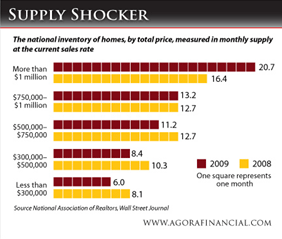
    Photo by Nate Mandos

  • How California Went From Top of the Class to the Bottom

    California was once the world’s leading economy. People came here even during the depression and in the recession after World War II. In bad times, California’s economy provided a safe haven, hope, more opportunity than anywhere else. In good times, California was spectacular. Its economy was vibrant and growing. Opportunity was abundant. Housing was affordable. The state’s schools, K through Ph.D., were the envy of the world. A family could thrive for generations.

    Californians did big things back then. The Golden State built the world’s most productive agricultural sector. It built unprecedented highway systems. It built universities that nurtured technologies that have changed the way people interact and created entire new industries. It built a water system on a scale never before attempted. It built magnificent cities. California had the audacity to build a subway under San Francisco Bay, one of the world’s most active earthquake zones. The Golden State was a fount of opportunities.

    Things are different today.

    Today, California’s economy is not vibrant and growing. Housing is not affordable. There is little opportunity. Inequality is increasing. The state’s schools, including the once-mighty University of California, are declining. The agricultural sector is threatened by water shortages and regulation. Its aging, cracking, highways are unable to handle today’s demands. California’s power system is archaic and expensive. The entire state infrastructure is out of date, in decline, and unable to meet the demands of a 21st century economy.

    Indications of California’s decline are everywhere. California’s share of United States jobs peaked at 11.4 percent in 1990. Today, it is down to 10.9 percent. In this recession, California has been losing jobs at a faster pace than most of the United States. Domestic migration has been negative in 10 of the past 15 years. People are leaving California for places like Texas, places with opportunity and affordable family housing.

    California’s economy is declining. Those of us who live here can all see it. Yet, Californians don’t have the will to make the necessary changes. Like a punch-drunk fighter, sitting helpless in the corner, California is unable to answer the bell for a new round.

    Pat Brown’s California – between 1958 and 1966 – crafted the Master Plan for Higher Education, guaranteeing every Californian the right to a college education, a plan that has served the state very well. That system is threatened by today’s budget crisis and may be on the verge of a long-term secular decline. California was a state where people said yes, a state where businesses could be created, grow, and prosper. Some of these businesses were run by Democrats, others Republicans but all celebrated a culture of growth and achievement.

    Today’s California is a state where building a home requires charrettes with the neighbors, years in the planning department, architects, engineers, and environmental impact studies – we built the transcontinental railroad in three years, faster than a builder can get a building permit in many California communities. People here dream of a green future but plan and build nothing. There’s big talk about the future, but California now turns more and more of our children away from college, and too many of our least advantaged children don’t even make it through high school.

    Once, California was a political model of enlightened government. Now it’s a chaotic place where everyone has a veto on everything; a state where people say no; a state where business is wrapped up in bureaucracy and red tape; a state our children leave, searching for opportunity; a state with more of a past than a future.

    Some things have not changed. California’s physical endowment is still wonderful. The state is blessed with broad oak-studded valleys, incredible deserts, magnificent mountains, hundreds of miles of seashore, and an optimal climate. California’s location on the Pacific Rim situates the state to profit from growing international trade with the dynamic Asian economies. California didn’t change, Californians changed. Californians have forgotten basics that Pat Brown knew instinctively.

    How did California get to this point? How did it move from Pat Brown’s aspirational California to today’s sad-sack version? What did Pat Brown know in 1960 that Californians now forget?

    First thing: Pat Brown knew that quality of life begins with a job, opportunity, and an affordable home. Other Californians in Pat Brown’s time knew that too. His achievements weren’t his alone. They were California’s achievements.

    It seems that California has forgotten the fundamentals of quality of life. Instead, the state has embraced a cynical philosophy of consumption and denial. The state’s affluent citizens celebrate their enjoyment of California’s pleasures while denying access to those less fortunate, denying not only the ticket, but the opportunity to earn the ticket. At best California offers elaborate social services in place of opportunity.

    Today, too many Californians don’t rely on the local economy for their income. For them, quality of life has nothing to do with jobs, opportunity, or affordable homes. Many see the creation of new jobs as bad, something to be avoided. They see no virtue in opportunity. They have theirs, after all. It is their attitude that if someone else needs a job, let them go to Texas; if people are leaving California, so much the better.

    They see someone else’s opportunity as a threat to them. Perhaps the upstarts will want a house, which might obstruct their view. They see economic growth as a zero sum game. Someone wins. Someone loses.

    This type of thinking is unsustainable. Opportunity is not a zero sum game. It may be a cliché, but it is true, that if something is not growing it is dying. Many of the things that make California the place it is are not part of our natural endowment. The Yosemite Valley is part of the state’s natural endowment, but the Ahwahnee Hotel is not. Monterey, Santa Barbara, San Francisco, the wine countries, and California’s many other destinations were made possible and built because of economic growth. Will California add to this impressive list in the 21st century?

    Not likely. Today, we are not even maintaining our infrastructure. Infrastructure investment’s share of California’s budget has declined for decades. In Pat Brown’s day California often spent over 20 percent of its budget on capital items. Today, that number is less than seven percent. It shows.

    Pat Brown also knew that with California’s natural endowment, all he had to do was build the public infrastructure and welcome business, business will come. Too many today act as if they believe that business will come, even without the infrastructure or a welcoming business climate. Indeed, many Californians – particularly in the leadership in Sacramento – seem to think that business will come no matter how difficult or expensive the state makes doing business in California. This is just not true.

    California needs to embrace opportunity and economic growth. It is necessary if California is to achieve its potential. It is necessary if California is to avoid a stagnant future characterized by a bi-modal population of consuming haves and an underclass with little hope or opportunity and few choices, except to leave.

    Bill Watkins is a professor at California Lutheran University and runs the Center for Economic Research and Forecasting, which can be found at clucerf.org.

  • Crash in High-end Real Estate or a Roller Coaster Recession? :

    During the first ten days of October 2008, the Dow Jones dropped 2,399.47 points, losing trillions of investor equity. The Federal Government pushed TARP, a $700 billion bail-out, through Congress to rescue the beleaguered financial institutions. The collapse of the financial system was likened to an earthquake. In reality, what happened was more like a shift of tectonic plates.

    *******************************************

    In September 2009 the Fed proclaimed “The Recession is Over.” President Obama said his Stimulus Package saved the US economy and his international actions have “brought the global economy back from the brink.” Vice-President Biden declared, “The Stimulus Package worked beyond my wildest dreams.” I feel so much better. Living in California, I must have missed these events.

    If the recession is over, why is unemployment in California 12.2%? (Functional unemployment, the real number, is closer to 16%). In decimated areas like the Central Valley, unemployment is at Great Depression levels of 26%. If the economy was saved, why do our homes continue to lose value? And it is not just “our homes” that are impacted. Treasury Secretary Timothy Geithner was forced to rent out his Larchmont, N.Y., home after it failed to sell. President Obama’s Chicago home, purchased for $1.65 million with a $1.3 million jumbo mortgage at the height of the real-estate bubble is now worth less than $1.2 million according to an estimate by Zillow.

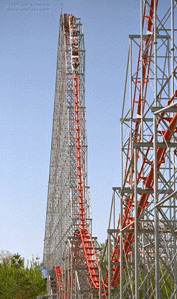
    The recession may be over but Americans are now experiencing The Roller Coaster Recession. Like a roller coaster chugging its way up to the top, home values climbed between 2002 and 2007. Beginning in the fall of 2007, home values declined, first slowly but inexorably until they bottom out and began to climb again. Have we bottomed out? The Atlantic screamed, “Home sales soared 11% in June”.

    Not so fast. Like the cars in a roller coaster, the first cars will begin to climb out while the last cars are still screaming downward at top speed. The Commerce Department reported sales in August rose a tepid .07% in August. What they did not highlight is that new home sales of 429,000 are at historical off the chart low compared to the last 50 years (see chart below).

    Such is the case with the Roller Coaster Recession. In California’s roller coaster ride the first car, The Inland Empire, crested the top in 2007. When pink slips were issued, these homeowners did not have deep pockets to sweat it out. All of their savings had been plowed into their down payment. When values declined, they had no staying power. They were gone in the first wave of foreclosures.

    Meanwhile, the rear car, Coastal California, continued to climb in value seemingly immune to the problems inland. The reason was staying power. The residents of tony Corona Del Mar were able to dump their third car, the Range Rover to keep solvent. When that ran out, Coastal California tapped their savings and finally used their equity lines to maintain their high mortgage payments while they waited for a buyer. But it is 2009 and the buyers have not materialized. More Jumbo Loans are falling behind in their payments. Watch the 60-day delinquency rate on prime Jumbo Loans. According to First American Core Logic, Jumbos in default jumped to 7.4% in May versus 4.9% for conforming loans

    Like our proverbial roller coaster, now it’s the turn for the first cars to rise. As the Inland Empire seems to have bottomed, Coastal California is still racing downward. There are 200 homes for sale between $1.5 and $3 million in ritzy Corona Del Mar. Even with a hefty 25% down payment, a $2 million property will require a $1,500,000 mortgage. Today’s lenders will require proof that the borrower can afford the $7,500 per month mortgage payment. They will demand a W-2 or 2008 tax return showing at least $22,500 per month in income to support a 30% housing expense ratio.

    The reality is there simply are not enough buyers earning $250,000 per year to buy up the 200 homes in Corona Del Mar. The current inventory will take 17 months to sell out but, as the recession continues, more homes are posting For Sale signs each month. Coastal California has not yet seen their bottom and they are still heading down at a rapid pace.

    Our national leaders may proclaim the end of the recession, but Californians have no reason to party. The Stimulus Package that shipped $50 billion to California was a one-time windfall that delayed but did not end California’s structural $26 billion budget deficit.

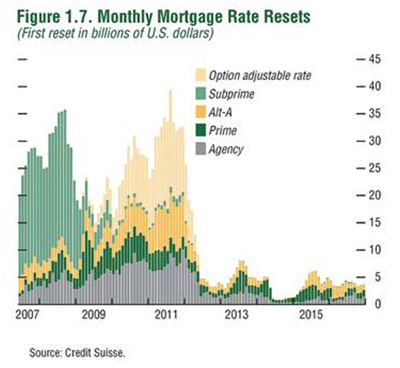
    Add to that the “Mortgage Armageddon” that is scheduled to hit next February. As the sub-prime mortgage defaults subside, the Option ARMS (adjustable rate mortgages) and Prime ARMs will begin to reset in early 2010 (see chart). This is not a working class but primarily a middle and upper-class problem. It is more a coastal than inland crisis; in New York terms, more Larchmont and less exurbia.

    There is a problem, however, with dinging the rich. They are the very folks expected to spend in our consumer-driven economy and invest in new ventures. If they have to re-route more dollars to mortgage payments, they not going to be able to help the economy.

    The Roller Coaster Recession will see more rises and dips before a sustainable recovery comes to California and other high-priced marekts. Those in the first car, like The Inland Empire, have nearly completed their ride. Any remaining dips will be minor in drop and brief in duration. But the genteel folks in the last car, in places like Coastal California, have another precipitous drop in front of them. This may come as a surprise to those believing the headlines that the recession was over. The wild ride for many is hardly over yet.

    ***********************************

    This is the fourth in a series on The Changing Landscape of America. Future articles will discuss real estate, politics, healthcare and other aspects of our economy and our society.

    Robert J. Cristiano PhD is a successful real estate developer and the Real Estate Professional in Residence at Chapman University in Orange, CA.

    PART ONE – THE AUTOMOBILE INDUSTRY (May 2009)
    PART TWO – THE HOME BUILDING INDUSTRY (June 2009)
    PART THREE – THE ENERGY INDUSTRY (July 2009)

  • Purple Politics: Is California Moving to the Center?

    You don’t have to be a genius, or a conservative, to recognize that California’s experiment with ultra-progressive politics has gone terribly wrong. Although much of the country has suffered during the recession, California’s decline has been particularly precipitous–and may have important political consequences.

    Outside Michigan, California now suffers the highest rate of unemployment of all the major states, with a post-World War II record of 12.2%. This statistic does not really touch the depth of the pain being felt, particularly among the middle and working classes, many of whom have become discouraged and are no longer counted in the job market.

    Even worse, there seems little prospect of an immediate recovery. The most recent projections by California Lutheran University suggest that next year the state’s economy will lag well behind the nation’s. Unemployment may peak at close to 14% by late 2010. Retail sales, housing and commercial building permits are not expected to rise until the following year.

    This decline seems likely to slow–or even reverse–the state’s decade-long leftward lurch. Let’s be clear: This is not a red resurgence, just a shift toward a more purplish stance, a hue that is all the more appropriate given the economy’s profound lack of oxygen.

    There is growing disenchantment with the status quo. The percentage of Californians who consider the state “one of the best places” to live, according to a recent Field poll, has plummeted to 40%, from 76% two decades ago. Pessimism about the state’s economy has risen to the highest levels since Field started polling back in 1961.

    Inevitably, this angst has affected political attitudes. Though still lionized by the national media, Gov. Schwarzenegger’s approval ratings have fallen from the mid-50s two years ago into the low 30s. The 12% approval rate for the state legislature, according to a Public Policy Institute of California survey in May, stands at half the pathetic levels recorded by Congress.

    Moreover, voters now favor lower taxes and fewer services by a 49-to-42 margin–as opposed to higher taxes and more services. Support for ultra-green policies aimed to combat global warming has also begun to ebb. For the first time in years, a majority of Californians favors drilling off the coast. Californians might largely support aggressive environmental protections, but not to the extreme of losing their jobs in the process.

    Remarkably, state government seems largely oblivious to these growing grassroots concerns. The legislature continues to pile on ever more intrusive regulations and higher taxes on a beleaguered business sector. Agriculture, industry and small business–the traditional linchpins of the economy–continue to be hammered from Sacramento.

    Agriculture now suffers from massive cutbacks in water supplies, brought about in part by drought, but seriously worsened by the yammerings of powerful environmental interests. Large swaths of the fertile central valley are turning into a set for a 21st-century version of Steinbeck’s Grapes of Wrath.

    At the same time, the state’s industrial base is rapidly losing its foundation. Toyota recently announced it was closing its joint venture plant in Fremont, the last auto assembly operation in the state, shifting production to Canada and Texas. Even the film business has been experiencing a secular decline; feature film production days have fallen by half over the decade, as movie-making exits for other states and Canada.

    Most important, California may be undermining its greatest asset: its diverse, highly creative and adaptive small-business sector. A recent survey by the Small Business and Entrepreneurship Council ranked California’s small-business climate 49th in the nation, behind even New York. Only New Jersey performed worse.

    Regulation plays a critical role in discouraging small-business expansion, a new report from the Governor’s Office of Small Business Advocate suggests. Prepared by researchers from California State University at Sacramento, the report estimates that regulations may be costing the state upward of 3.8 million jobs. California currently has about 14 million jobs, down 1 million since July 2007.

    Ironically, the regulatory noose is now slated to tighten even further as a result of radical measures–from energy to land use–tied to reducing greenhouse gases. Another study, authored by California State University researchers, estimates these new laws could cost an additional million jobs.

    Many in the state’s top policy circles, as well as academics and much of the media, dismiss the notion that regulations could be deepening the recessionary pain. Some of this stems from the delusion–always an important factor in this amazing state–that ultra-green policies will actually solidify California’s 21st-century leadership. Few seem to realize that other states, witnessing the Golden State’s economic meltdown, might not rush to emulate California’s policy agenda.

    Internally, discontent with the current agenda seems particularly strong in the blue-collar, interior regions of the state. Brookings demographer Bill Frey and I have described this area as the “Third California.” In the first part of the decade, this region expanded roughly three times as rapidly as Southern California, while the Bay Area’s population remained stagnant.

    Today the Third California represents roughly 30% of the state’s population, compared with barely 18% for the ultra-blue Bay Area. The most conservative part of the state has skewed somewhat more Democratic in recent elections, largely due to migration from coastal California and an expanding Latino population.

    But the intense economic distress now afflicting the interior counties–where unemployment rates are approaching 20%–may now reverse this process. The ultra-green politics embraced by the Democrats’ two prospective gubernatorial nominees-Attorney General Jerry Brown and San Francisco Mayor Gavin Newsom–may not appeal much to a workforce heavily dependent on greenhouse-gas-emitting industries like farming, manufacturing and construction.

    Eventually, the Democrats may rue their failure to run a pro-business, pro-growth candidate, particularly one with roots in the interior region. This oversight could cost them votes among, say, Latinos, who have been far harder hit by the recession than the more affluent (and overwhelmingly white) coastal progressives epitomized by Brown and Newsom. Along with independents, roughly one-fifth of the electorate, Latinos could prove the critical element in the state’s purplization.

    This, of course, depends on the Republicans developing an attractive pro-growth alternative. In recent years, the party’s emphasis on conservative cultural issues and xenophobic anti-immigrant agitation has hurt the GOP in the increasingly socially liberal and ethnically diverse California.

    Although he has proved a poor chief executive, Gov. Schwarzenegger did at least show such a political approach could work. The recent emergence of three attractive Silicon Valley-based candidates, including former eBay CEO Meg Whitman and State Insurance Commissioner Steve Poizner, as well as the likable libertarian-leaning former congressman Tom Campbell, could score well at the polls.

    This political course-correction should be welcomed not only by Republicans but by California’s moderate Democrats and Independents. However blessed by nature and its entrepreneurial legacy, California needs to move back to the pro-growth center if it hopes to revive both its economy and the aspirations of its people.

    This article originally appeared at Forbes.

    Joel Kotkin is executive editor of NewGeography.com and is a distinguished presidential fellow in urban futures at Chapman University. He is author of The City: A Global History. His next book, The Next Hundred Million: America in 2050, will be published by Penguin Press early next year.

  • The Worst Cities for Job Growth

    One of the saddest tasks in the annual survey of the best places to do business I conduct with Pepperdine University’s Michael Shires is examining the cities at the bottom of the list. Yet even in these nether regions there exists considerable diversity: Some places are likely to come back soon, while others have little immediate hope of moving up. (Please also see “Best Cities For Job Growth” for further analysis.)

    The study is based on job growth in 336 regions – called Metropolitan Statistical Areas by the Bureau of Labor Statistics, which provided the data – across the U.S. Our analysis looked not only at job growth in the last year but also at how employment figures have changed since 1996. This is because we are wary of overemphasizing recent data and strive to give a more complete picture of the potential a region has for job-seekers. (For the complete methodology, click here.)

    First let’s deal with the perennial losers, the sad sacks of the American economy. Mostly cities in the nation’s industrial heartland, these places have ranked toward the bottom of our list for much of the past five years. Eleven of the bottom 16 regions on our list are in two states, Ohio and Michigan. In fact, the Wolverine State alone accounts for the bottom four cities: Jackson, Detroit, Saginaw and Flint.

    Unfortunately, there’s not much in the way of short-term – or perhaps even medium- or long-term – hope for a strong rebound in those places. President Obama seems determined to give the automakers, for whom Michigan is home base, far rougher treatment than what he meted out to ailing companies in the financial sector.

    In addition, new environmental regulations may not help auto production, since it necessitates some carbon-spewing and therefore perhaps unacceptable levels of greenhouse gas emission.

    However, not all of Michigan’s problems stem from Washington or the marketplace. Many of the locations at the bottom of the list remain inhospitable to business. To be sure, housing is cheap – in Detroit, property values are fast plummeting toward zero – but running a business can be surprisingly expensive in these hard-pressed places.

    In fact, according to a recent survey by the Tax Foundation, Ohio has an average tax burden roughly similar to New York, California, Massachusetts and Connecticut. But while the others are comparatively high-income states, Ohio residents no longer enjoy that level of affluence.

    Can these places come back? It is un-American to abandon hope, but there needs to be a radical shift in strategy to focus on creating new middle-class jobs. Some Midwestern cities, like Kalamazoo and Indianapolis, have made some successful efforts to diversify their economies, encouraging start-ups and trying to be business-friendly.

    But those are exceptions. Cleveland, one of our worst big cities, could spark a renaissance by revamping its port and nearby industrial hinterland. Once the world economy improves, it could re-emerge – building on the existing knowledge and skills of its production- and design-savvy population – as a hub for manufacturing and exports.

    But right now, Cleveland does not seem to be pursuing such opportunities. As Purdue’s Ed Morrison has pointed out, local leaders there seem to “confuse real estate development with economic development.”

    So Cleveland will focus on inanities such as convention business and tourism, believing we all fantasize about a week enjoying the sights along Lake Erie. Yet even high-profile buildings like the Rock and Roll Hall of Fame and Museum, completed in 1986, have not transformed a gritty old industrial town into a beacon for the hip and cool.

    Old industrial cities like Cleveland are better off focusing on their locational advantages – access to roads, train lines and water routes – while offering a safe, inexpensive and friendly venue for ambitious young families, immigrants and entrepreneurs.

    Meanwhile, cities with formerly robust economies – like Reno, Nev., Las Vegas, Orlando, Fla., Tampa, Fla., Fort Lauderdale, Fla., West Palm Beach, Fla., Jacksonville, Fla., and Phoenix – are more likely to rebound. These areas topped our list for much of the 2000s; their success was driven first by surging population and job growth and later by escalating housing prices.

    But the collapse of the housing bubble and a drop in large-scale migration from other regions has weakened, often dramatically, these perennial successes. “We could rely on 1,000 people a week moving into the area,” notes one longtime official in central Florida. “These people needed services, houses and bought stuff. Now the growth is a 10th of that.”

    Instead of waiting for the real estate bubble to return, these areas should choose to focus on boosting employment in fields like medical services, business services and light manufacturing. In much of Florida and Nevada, there’s also a need to shift away from a reliance on tourism, an industry that pays poorly on average and is always subject to changes in consumer tastes.

    We can even be cautiously optimistic about some of these former superstars. After all, observes Phoenix-based economist Elliot Pollack, the existing reasons for moving to Arizona, Nevada or Florida – warm weather, relatively low taxes and generally pro-business governments – have not disappeared. “There’s no change in the fundamentals,” he argues. “It’s a transition. It’s ugly, and there’s pain, but it’s still a cycle that will turn.”

    Once the economy stabilizes, Pollack says he expects the flow of people and companies from the Northeast and California to Phoenix and other former hot spots will resume, once again lured by inexpensive real estate, better conditions for business and a generally more up-to-date infrastructure.

    The Problem with California
    So what about California? The economic well-being of many metropolitan areas in the Golden State has been sinking precipitously since 2006. This year, three California regions – Oakland, Sacramento and San Bernardino-Riverside – have sunk down into the bottom 10 on the large cities list. That’s a phenomenon we’ve never seen before – and never expected to see.

    Like other Sun Belt communities, California suffered disproportionately from the housing bubble’s bust, which has devastated both employment in construction-related industries as well as much of the finance sector. But some, like economist Esmael Adibi, director of the Anderson Center for Economic Research at Chapman University, where I teach, think a real estate turnaround may be imminent.

    Among the first to predict the potential for a real estate bubble back in 2005, these days Adibi is more upbeat, pointing to rising sales of single-family homes, particularly at the lower end of the market. California’s inventory of unsold homes is now down to about six months’ worth, a figure well below the national average of 9.6 months.

    It seems not everyone is ready to abandon the Golden State – but still, recovery in California may prove weaker than in surrounding states. One forecaster, Bill Watkins, even predicts unemployment could reach 15% next year, up from about 11% today. California, most likely, will see only an anemic recovery in 2010 even if growth picks up elsewhere.

    Much of the problem lies with the state’s notoriously inept government. The enormous budget deficit will almost certainly lead to tax increases, which will fall mostly on the state’s vaunted high-income entrepreneurial residents. Stimulus funds won’t do much good either, Adibi notes, since “the state is grabbing all of the federal stimulus money” to keep itself afloat.

    A draconian regulatory environment also could dim California’s prospects for growth. Despite double-digit unemployment, the state seems determined not only to raise taxes but also to tighten its regulatory stranglehold.

    This is a stark contrast to what happened in the 1990s during the last deep recession. At that time, leaders from both political parties pulled together to reform the state’s regulatory and tax environment. Almost everyone recognized the need to improve the economic climate.

    But an even deeper recession, it seems, hardly troubles today’s dominant players – public employees, environmental activists and gentry liberals who largely live along the coast. The state has recently passed a draconian Assembly bill aimed to offset global warming by capping greenhouse gas emissions – a measure that seems designed to discourage productive industry.

    “This is becoming a horrible place to produce anything,” says Watkins, who is executive director of the Economic Forecast Project at the University of California, Santa Barbara.

    California’s lawyers, though, might stay busy. Attorney General Jerry Brown has threatened to sue anyone who grows their business in unapproved, environment-threatening ways. To be sure, this promise may have relatively little impact on the more affluent, aging coastal communities – but it could wreak havoc on younger, less tony areas in the state’s interior. Many of the local economies there still rely on resource-dependent industries like oil, manufacturing and agriculture.

    It’s sad because California has the capacity to recover more quickly than the rest of the country if the state moderates its spending and stops regulating itself into oblivion. This current round of legislation is so dangerous precisely because it could eviscerate the heart of the economy by slowing down entrepreneurial growth, the state’s greatest asset.

    Even in hard times, there are people with innovative ideas trying to bring them to market – and not just in Hollywood- and Silicon Valley-based industries but in a broad range of fields, from garments to agriculture, aerospace and processed foods. The desire to increase regulation reflects a peculiar narcissism and arrogance of the state’s ruling elites, who believe the genius of San Francisco’s venture capitalists and Los Angeles’ image-makers alone are enough to spark a powerful recovery.

    This is delusional. True, California still has a lead in everything from farm products to films to high-tech manufacturers. But it has been slowly losing ground – to both other states and overseas competitors. CEOs and top management might stay in the Golden State, but they increasingly send outside its borders all jobs that don’t require access to the local market, genius scientists or talented entertainers.

    “There’s a feeling in California that we will come back, no matter what, because we are California,” Watkins says. “The leadership is swallowing Panglossian Kool-aid. Some very smart people, a beautiful climate and nice beaches is not enough to guarantee a strong recovery.”

    This article originally appeared at Forbes.

    Joel Kotkin is executive editor of NewGeography.com and is a presidential fellow in urban futures at Chapman University. He is author of The City: A Global History and is finishing a book on the American future.

  • The American Suburb Is Bouncing Back

    From the very inception of the current downturn, sprawling places like southeast California’s Inland Empire have been widely portrayed as the heart of darkness. Located on the vast flatlands east of Los Angeles, the region of roughly 3 million people has suffered one of the highest rates of foreclosures and surges in unemployment in the nation.

    Yet now George Guerrero, a top agent at Advantage Real Estate in Chino Hills, says he can see the light, with sales picking up and inventories finally beginning to drop. “There’s been a real surge in sales,” Guerrero says. “The market has come back to where it should be. I think we are ahead of the curve here of the overall recovery.”

    Of course, for the moment, much of this growth is concentrated in foreclosure sales. However, even developers of new properties, such as Brookfield Homes , also report a strong uptick in sales. In his new developments in the Inland Empire, notes Adrian Foley, head of Brookfield’s Los Angeles area office, sales are up 150% since six months ago.

    Although the economy is still hurting, the housing trend has become much more positive. Statewide, existing home sales have jumped 30% over the past year, taking the inventory from an estimated 16.7 months to less than seven months. In Chino Hills, it is down to six months.

    Most encouraging, this activity is taking place exactly where the market was hit hardest in the beginning – in the suburbs and at the lower end of the market, which in the Inland Empire means between $150,00 to $300,000. This could presage the resurgence of the suburbs and the prospects for the middle and working classes once again to purchase their piece of the American dream.

    Nor is this merely a Californian phenomenon. Nationwide, existing home sales – predominately in the suburbs – have been on the rise for the last few months. The strongest growth is occurring in Sunbelt markets in Arizona, Nevada and Florida, as well as in California. These places experienced some of the greatest surges in prices, which forced many buyers to turn to subprime and interest-only loans.

    These loans are largely not available today, Guerrero notes. Instead of financial quackery, lower prices – sometimes as much as 50% below peak – are allowing new buyers to buy affordably. In 2007, Inland Empire median house prices were roughly seven to 10 times the average annual income of potential buyers. Now they are settling close to the historic norm of three times.

    But not everyone will be happy to see life return to the suburban housing tracts. Indeed, for some self-proclaimed urbanists, planners and pundits, this development might seem almost nightmarish.

    Long the Rodney Dangerfield of American geographies, suburbs have never been popular with the country’s intellectuals, academics and planners. The destruction of community, racial segregation, expanding waistlines and a host of environmental sins – from consuming too much gas to helping create global warming – all have been blamed on the suburbs.

    When the mortgage crisis first hit, some urbanists, not surprisingly, were quick to blame the suburbs – instead of Wall Street – for the financial meltdown. With energy prices on the rise, they persuaded themselves and the ever-gullible mainstream media that the long-awaited “back to the city” jubilee was imminent.

    In contrast, the suburbs and exurbs, crowed Brookings’ Chris Leinberger, were soon to become “the new slums.” As the middle classes trudged their way back to Boston and other suitably dense big cities, James Howard Kunstler – the “shock jock” of the new urbanist movement and a leading apostle of the “peak oil” thesis – happily proclaimed, “Let the gloating begin.”

    Yet as George Guerrero could tell them, a dream is not a thing so easily destroyed. The American landscape continues to change, but perhaps not entirely in the ways so eagerly projected by urban boosters and their media claque.

    For one thing, even with the higher energy prices of last year, there seems to be, in fact, no notable shift of population to the urban core. Instead, as demographer Wendell Cox has pointed out, the recession may have slowed migration, but the trend toward the suburbs and sprawling Sunbelt cities has not ended or reversed.

    At the same time, the once-widely ballyhooed market for dense urban living has unraveled. The “gospel of urbanism” may be accepted as such by most of the mainstream press, most notably The New York Times and Atlantic Monthly, but on closer examination the new religion has limited numbers of converts. In many locales – from Massachusetts to Los Angeles – inner-city condominium projects are losing value at least as much or more than suburban single-family houses. In San Diego, for example, condo prices have dropped in some developments by 70% since 2007, twice the decline in the overall market.

    The problem has much to do with timing. In many areas, urban condominium developers continued to build even as the economy soured, largely due to the longer lead times and financing arrangements around such projects. Yet as the prices of houses have dropped many potential condominium dwellers have opted to purchase single-family homes – or are sitting anxiously on the sidelines waiting for prices to drop further.

    As a result, foreclosure rates for condominiums, according to the Federal Deposit Insurace Corp., are on average one-third higher than for single-family residences. You do not have to travel to the outer exurbs to find zones of foreclosures, bankruptcies and the turning of ownership properties to rentals. Towers are either unoccupied or have gone to rental in markets as diverse as Miami, central Atlanta and downtown L.A. Even Chicago, the poster child for urban gentrification, now suffers from abandoned “condo ghost towns.”

    Manhattan, too, which long saw itself as immune to the housing downturn, is now experiencing the most precipitous price decline since 1980. Big urban developers across North America are filing for bankruptcy, including the largest private landowner in downtown Los Angeles, just like suburban builders were last year.

    As someone who lives in – if you consider L.A. a city – and likes cities, I do not greet the urbanization of the housing crisis as an unalloyed positive. Yet one can hope that lower prices and interest rates – as well as the administration’s tax credits for up to $8,000 for first-time buyers – could allow more people to consider an urban option, if that’s what they want.

    However, this will not be where the bulk of the action will take place. Surveys consistently show that between 10% and 20% of people want to live in dense cities. In a country that will gain 100 million people over the next four decades, that’s 20 million, not exactly what you’d call chopped liver.

    But the bulk of growth will continue to be in the ‘burbs. The main reason is simple enough for almost anyone but a planning professor, architect or pundit to comprehend: preference. Virtually every survey reveals that the vast majority of Americans – and around 80% of Californians – prefer single-family homes that generally are affordable only in suburban areas. The fact that jobs have also continued to move inexorably to the periphery – as a newly released Brookings report demonstrates to liberal think tanks’ own undisguised horror – makes living in the ‘burbs even more attractive.

    These trends lead developers like Randall Lewis in Upland, Calif., who has suffered the downturn in the Inland Empire, not to dismiss the suburban future. He takes note of a recent 10% to 20% surge in sales among the 18 projects his company is now working on, all in suburban projects in California and neighboring states.

    “The basics of the suburbs are still there,” Lewis suggests. “Schools are important, but also people like the sense of place. But the basic amenities are children, grandchildren, where people go to church, where their work networks and friends are.”

    Lewis also rightly adds that a somewhat different suburbia will emerge from the crash. It will be a “melting pot,” he suggests, “not just by race, but by ages and lifestyle.” You will see more singles, empty-nesters and retirees as people choose to “age in place” close to where they have settled. There likely will be more smaller-lot, townhouse and other mixed-density developments closer to burgeoning suburban job centers.

    But even as they change, the allure of suburbs – and the single-family house – will not fade and could even grow as they develop more city-like amenities. The fundamental desire to own a place of your own, to possess some private space and a relatively quiet environment has not died. Nor is it likely to without the imposition of a draconian planning regime.

    For right now, it’s all enough to make George Guerrero a born-again optimist. “There’s something healthy just beginning to happen out here,” he says. “This time people with good credit are getting good deals at good prices. It’s a wonderful thing to see.”

    This article originally appeared at Forbes.

    Joel Kotkin is executive editor of NewGeography.com and is a presidential fellow in urban futures at Chapman University. He is author of The City: A Global History and is finishing a book on the American future.