Tag: jobs

  • US House Gives Small Business the Huggem-Muggem

    “In public Congress hugs them, in private they mug them!” So said the late Milt Stewart, one of the architects of the Small Business Innovation Research (SBIR) Program in the 1980s and a renowned advocate for America’s small businesses.

    I first met Milt in 1992 and eagerly joined forces with him and others from business and government to generate more research opportunities for America’s small businesses – then and now, the most potent force for innovation and job creation on the planet.

    Unfortunately, small business continues to get what Fred Patterson, echoing Milt Stewart, calls the “Huggem-Muggem”: lots of lip service but very little productive legislative action that facilitates their creation of jobs.

    Case in point is the current plight of the SBIR program, which has received considerable bi-partisan support in the Congress for more than 25 years. The Senate of the 111th Congress wanted to reauthorize the SBIR but their counterparts in the House leadership played the old “Huggem-Muggem” game.

    The outgoing Chairman of the House Small Business Committee, Nydia Velazquez (D-NY), blocked all efforts to openly debate many Small Business Administration (SBA) initiatives, including the SBIR Program, before her committee. The incoming committee chair, Sam Graves (R-MO), has previously aligned with her to thwart SBIR reauthorization. Their opposition to reauthorization appears to center on the fact that companies which are majority-owned by venture capital firms are now ineligible to apply for SBIR funds.

    The National Small Business Association puts the facts on the line. “Despite the remarkable achievements of SBIR, federal R&D funding is still skewed against small businesses. Today, small R&D companies employ 38 percent of all scientists and engineers in America. This is more than all U.S. universities and more than all large businesses. Furthermore, these small companies produce five times as many patents per dollar as large companies and 20 times as many as universities—and more small-business innovations are commercialized. Yet small companies receive only 4.3 percent of the federal government’s R&D dollars. The SBIR program provides more than half of this amount.”

    If our country is serious about innovation, competitiveness and job creation it makes sense that we put our resources where they have the most impact. Instead, we are served up the same old tired “Huggem-Muggem” game by those who profess to be advocates for small business.

    I’ve said it before, and will say it again- instead of weakening the SBIR program we should be doubling, if not tripling, our country’s investment in the program. At a minimum a $5 billion SBIR program should be put in place. It will give us much more job growth than the Treasury bailouts of domestic banks and, as we now know, foreign banks too. The SBIR program represents both what America wants and needs in these times of economic stress: job growth driven by small business innovation.

    Delore Zimmerman is President of Praxis Strategy Group and publisher of newgeography.com
  • Missing the Point on Jobs: The “More Transit – More Jobs” Report

    The Transit Equity Network has just published a study called More Transit – More Jobs in which it suggests switching 50% of highway funding to transit in 20 metropolitan areas to create an additional 180,000 jobs over the next five years. Their basic thesis is that each kajillion in spending can produce more jobs in transit than in highways. We don’t comment on that, because, frankly, the purpose of transportation spending is neither to create transit jobs nor highway jobs.

    We spend on transit and highways because of benefits that extend beyond any direct employment. And, the extent of those benefits cannot be compared between the two modes. At current rates of spending each billion dollars spent on highways supports about 25 times as much personal mobility as one spent on transit. Beyond that, highway spending supports the movement of more than 1.25 billion ton miles of truck freight, which keeps product prices low and supports our affluent life style. Transit carries 0.0 ton miles of freight. Researchers such as Prud’homme & Chang-Wong and Hartgen & Fields have shown that the type of ubiquitous mobility provided by road systems produce greater economic growth. Moving money out of roads would increase traffic congestion, destroy jobs and increase product prices by slowing down trucks.

    Why, on earth, then would anyone make such a dubious proposal? To paraphrase Bill Clinton, “It’s the ideology, stupid.” As we wrote within the past week, much of transportation spending over the last 25 years has been solidly based in an anti-mobility ideology that has produced virtually nothing in return. Already, transit, which accounts for one percent of national travel and no freight movement, accounts for more than 20% of spending on highways and transit combined. Things would be better if that were raised to 60%?

    If the Transit Equity Network were right (which it is not), then why stop at 50% for transit? Why not take all of the transit and highway money and just employ people to dig holes with shovels and then fill them up again. The only costs would be wages, benefits, shovels and administration. We could save money by not buying concrete, rails, fancy trains or palatial administrative buildings. Another advantage is that the holes would require no longer term operating subsidies.

    So, we need to do more than dump the ideology. We need also to dump the stupidity. Government does not exist for the purpose of government services and transportation programs do not exist for the good of transportation employees or vendors. Each dollar of infrastructure expenditures should be used to facilitate the greatest economic benefit throughout society as a whole, not just among people employed in transit (or highways for that matter).

  • Urban Economies: The Cost of Wasted Time

    Much has been written in recent years about the costs of congestion, with ground breaking research by academics such as Prud’homme & Chang-Wong and Hartgen & Fields showing that the more jobs that can be accessed in a particular period of time, the greater the economic output of a metropolitan area. Greater access to jobs not only improves economic growth, but it also opens greater opportunities for people and households to fulfill their aspirations for a better quality of living.

    Congestion costs are principally the cost of wasted time, which the most recent Texas Transportation Institute (TTI) Annual Mobility Report places at $15.47 per hour. It is important to understand that much of this cost is not because the car is not moving. It is rather because time that could be used more productively is being consumed.

    Steve Polzin of the University of South Florida has raised a related issue that has been virtually absent from urban planning discussions in a Planetizen blog entitled “The Cost of Slow Travel.” Noting that transit travel time is considerably slower than auto travel times, Polzin broadly estimates that slower travel on transit costs the nation $44 billion, which is two-thirds the $66 billion. Polzin does not suggest that this is a final, “take to the bank” lost productivity number, but does suggest attention to the issue.

    Such thinking is long overdue. Wasted time is wasted time. Most wasted time occurs with respect to travel during peak periods, when most people are commuting to or from work. The $66 billion in wasted time by automobile translates into $550 per commuter per year in the United States (Based upon 2007 commuting data from the American Community Survey). The cost of wasted time for transit is 12 times as high, at $6,500 per commuter, using Polzin’s estimate. Of course, as Polzin is quick to point out, these are not final figures. However, they are a starting point for important (and perhaps “inconvenient”) economic research that has been largely kept off the agenda up until now.

  • What Jobs?

    According to the Bureau of Labor Statistics, there were 290,000 more jobs in the US this month than there were last month. Twenty percent of those jobs were added by the federal government. While the federal government added 69,000 new jobs last month, every other level of government – including the post office – cut an average of 2,250 jobs. State governments were hardest hit last month, cutting 5,000 jobs.

    Since April 2009, the federal government has added 119,000 jobs while state and local governments cut 215,000 jobs.

    Compared to April 2009, more than 500,000 jobs have been added in employment services. Another 329,000 jobs were added in the healthcare industry. These must be the “green shoots” that we were so looking forward to last summer because the overall economy lost 1,380,000 jobs in the last year.

    Eighty percent of the jobs increase last month was added in the private sector. Of the jobs created in the private sector, only 22 percent were in goods producing industries; about half of the goods producing jobs added in the last month can be attributed to the bailout of the auto industry. In the last 12 months, the U.S. civilian population increased by 2.1 million persons. The labor force has remained about constant at 154.7 million. The difference – explained in the details of today’s jobs report – is attributable to discouraged workers, involuntary part-time workers, and marginally attached workers.

  • The State of Illinois’ Long Term Decline

    Barack Obama’s home state is in the news but not for positive reasons. Fitch downgraded Illinois debt. At the end of March, according to the Bond Buyer:

    Fitch Ratings late Monday downgraded Illinois’ general obligation rating one notch to A-minus and warned of possible further action by leaving the state’s credit on negative watch ahead of $1.3 billion of short- and long-term GO issuance in three deals over the coming weeks.
    Gov. Pat Quinn had hoped that the General Assembly’s passage last week of pension reforms would stave off any negative rating actions and buy the state some additional time to address a nearly $13 billion budget deficit and liquidity crisis in the current legislative session.

    Fitch isn’t Illinois’ only problem. The Chicago Tribune wrote a devastating editorial concerning Illinois’ economic performance:

    once-thriving Illinois in February had 475,000 fewer jobs than it did in November 2000. Even replacing every one of those jobs wouldn’t fix the sorry state of this state: Factoring in population growth over the last decade, Illinois needs 600,000 new jobs just to get the employment level back to where it was. The cumulative cost to Springfield of those lost jobs: $6 billion in tax revenues through fiscal ’09 and, barring some miracle, $10 billion through fiscal ’11.

    Illinois politicians keep trying to blame job losses on the Great Recession. But this is only the latest bad patch in two decades during which Illinois has lagged the nation at growing jobs. Geoffrey Hewings, head of the U. of I.’s Regional Economics Applications Laboratory, says something else has to explain why Illinois unemployment keeps running well above the national rate: “Our economy looks like the U.S. economy” in terms of its blend of manufacturing, service and other sectors. “Yet since 1990, we’ve underperformed the U.S. in job creation.”

    In fact, for the decade before this recession began, other researchers have pegged Illinois’ job creation rate at 48th in the U.S., ahead of moribund Ohio and Michigan. Can’t blame recession for that.

    Illinois lawmakers spent much of the last 20 years treating private-sector employers as if they were stupid — unable to understand that they and their workers eventually would have to pay for too much state spending, borrowing and promises of future obligations — none more egregious than the now severely underfunded retirement benefits for public employees.

    This kind of editorial might scare away future business expansion in Illinois. It wasn’t easy for the Tribune to write this one because it’s so negative that it even might scare advertisers away. But, the truth can’t be ignored much longer. Special interest groups are thriving, but taxpayers are not. The long time Illinois Speaker of House is more responsible than any individual for Illinois’ persistent financial problems. Illinois declines, but Madigan’s property tax appeals law firm thrives.

  • New Job Market Report from Jobbait Adds New Data

    Mark Hovind over at Jobbait.com released his monthly job market report, and this month he’s expanded it significantly with sector-level data by state and metropolitan area.

    Mark offers the numbers in an easily digestible format organized by state in color coded tables. It’s a great way to get a feel for what’s happening in your region or nationally.

    Mark hopes this will help identify sectors with job prospects, even in regions where overall employment is declining.

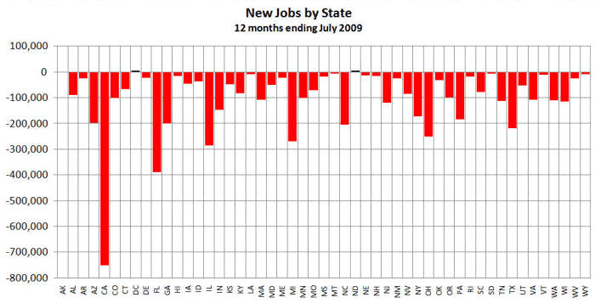
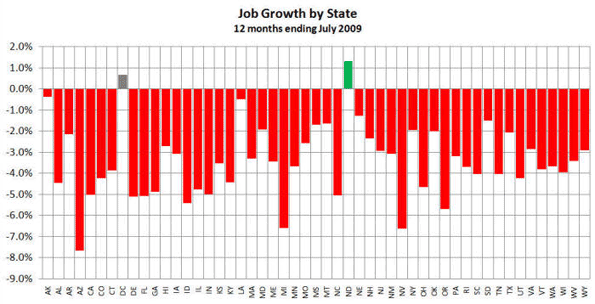
    Looking at total job growth, North Dakota is still the only state showing year-over-year employment growth, followed by Washington, DC.

    Fastest declining states by growth rate are Arizona, Michigan, Nevada and Oregon.

    Fastest declining states by sheer numbers are California, Florida, Illinois, Michigan, Ohio and Texas.

    See Jobbait.com for the full report.