Tag: Land use

  • The Economist Indicts Urban Containment “Fat Cats”

    "Free Exchange" in The Economist has come down strongly on the side of economics in a review of housing affordability.

    According to The Economist, the unusually high cost of housing in San Francisco (and other places) is principally the result of tight land use regulation, which makes it expensive or impossible to build. If "local regulations did not do much to discourage creation of new housing supply, then the market for San Francisco would be pretty competitive." Add to that Vancouver, Sydney, Melbourne, Toronto, Portland and a host of additional metropolitan areas, where urban containment policy has driven house prices well above the 3.0 median multiple indicated by historic market fundamentals.

    The Economist explains the issue in greater detail: "We therefore get highly restrictive building regulations. Tight supply limits mean that the gap between the marginal cost of a unit of San Francisco and the value to the marginal resident of San Francisco (and the market price of the unit) is enormous. That difference is pocketed by the rent-seeking NIMBYs of San Francisco. However altruistic they perceive their mission to be, the result is similar to what you’d get if fat cat industrialists lobbied the government to drive their competition out of business." (Our emphasis).

    Of course urban planning interests have long denied that that rationing land is associated with higher housing prices (read greater poverty and a lower standard of living). Nonetheless urban containment policies not only drive up the price of land, but do so even as they reduce the amount of land used for each new residence, driving prices per square foot of land up as well.

    The Economist notes that unless the direction is changed, housing policy will continue to be "an instrument of oligarchy. Who knows. But however one imagines this playing out, we should be clear about what is happening, and what its effects have been."
  • Why Housing is So Expensive in Metropolitan Washington

    Anyone familiar with housing affordability in the Washington (DC-VA-MD-WV) metropolitan area is aware that prices have risen strongly relative to incomes in the last decade.

    However, a recent Washington Post commentary by Roger K. Lewis both exaggerates the contribution of higher construction costs and misses the principal factor that has driven up the price of housing: more restrictive land-use regulations.

    Lewis compares construction costs in the early 1970s to current costs and finds that they are approximately 6 times as high. However, when the R. S. Means construction cost index for locations in the metropolitan area are adjusted for inflation, the increase is more like 15% (1970 to 2007).

    Lewis also indicates that construction costs have risen faster than the "relatively flat income curve." In contrast, Census Bureau data indicate that median household incomes in the Washington metropolitan area have increased more than 30% since the early 1970s, after adjustment for inflation. House construction costs are the flatter of the two, not incomes.

    While Lewis’ focus is affordable housing, costs in this low income sector are impacted by many of the same factors that drive overall housing affordability (overall house prices relative to incomes).

    Lewis does not consider the huge cost increase in the non-construction costs of housing. In the Washington metropolitan area, we have estimated that the land and the regulatory costs for a new house have been driven to more than 5.5 times the level that would be expected in a normal regulatory environment (see the Demographia Residential Land & Regulation Cost Index). The problem is that the restrictive land-use policies, such as the Montgomery County agricultural reserve, similar regulations in other metropolitan area counties and the large lot building restrictions in Loudoun County have driven the price of land up substantially, and with it, the price of housing. We estimate that more restrictive land use regulations have driven the price of a new house up approximately $75,000.

    Not surprisingly, Washington’s Median Multiple (median house price divided by median household income) remains more than a third above the 3.0 historic norm, at 4.0, even after the burst of the housing bubble. So long as governments in the Washington, DC area continue to strictly ration land for development, higher than necessary costs will continue to plague both housing affordability and affordable housing.

  • $300,000-$400,000 for a Levittowner?

    An article in The Wall Street Journal details the difficulties that were faced by home owners caught in the Goldman Sachs/John Paulson finance scheme (“The Busted Homes Behind a Big Bet“). The article calls the situation a “dizzyingly complex transaction, involving 90 bonds and a 65-page deal sheet. But it all boiled down to whether people … could pay their mortgages.” There is plenty of blame to go around, but surely there were both big winners and big losers is these deals. The big winners were Goldman Sachs and John Paulson. The big losers were the homeowners, though they were not without blame, since they were not forced to take out the excessively large mortgages.

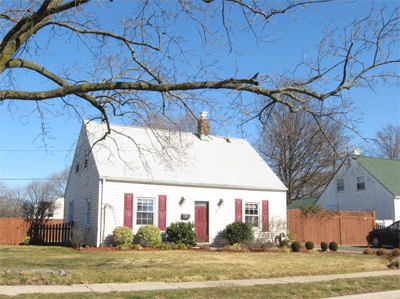
    The striking thing about this story, however, is the photograph of a Levittown style house in Aberdeen township, New Jersey, a distant suburb nearly 40 miles from New York City. The picture in the article cannot be directly linked, and the best view is on an interactive slide show linked to the article. We have provided a photograph of a near somewhat smaller house in Levittown (see photo).

    In 2006, the owner had refinanced the house with a $308,750 loan, indicating a value more than triple that of comparable housing in much of metropolitan America.

    Levittown, of course, was the late 1940s housing development on Long Island that set the stage for the automobile oriented suburban expansion that did so much to create the largest and most affluent middle class in the world. The Levittown houses were very small, starting at about 750 square feet, though many have been expanded. It was not long before suburban housing became larger, eventually rising to the present 2,250 square foot median. The Wall Street Journal’s Aberdeen township house is under 1,500 square feet, according to Zillow and was built in 1953.

    The Wall Street Journal article misses a significant point. How could such a modest (and doubtless comfortable) house have become so valuable that it could justify refinancing for more than $300,000? The answer is simple. During the real estate bubble, house prices in New Jersey exploded. The state’s restrictive land use regulation largely prohibit new housing on the suburban fringe, leaving prices nowhere to go but up and up strongly. Between 2000 and 2006, the median house value in Monmouth County, where Aberdeen Township is located, rose 125% (according to US Bureau of the Census data). 2006 data for Aberdeen township is not readily available.

    By the peak of the bubble, the median value house in Monmouth County was 5.8 times the median household income, up from 3.0 times in 2000. In 2000, prices were even lower in Aberdeen township, at 2.3 times incomes – well within the 3.0 standard that defined housing affordability for at least one-half century.

    While owners were borrowing $300,000 or more on their modest early 1950s houses in Aberdeen township, households were buying brand new houses of the same size for under $120,000 in Dallas-Fort Worth, Atlanta, Houston, Indianapolis and a host of other metropolitan areas where the American Dream had not been outlawed. Expansion of the housing supply was allowed, and prices stayed within historic norms. For example, in Indianapolis, house prices were less than one-half that of Monmouth County, after adjusting for income levels.

    Meanwhile, a judgment of $370,000 has been entered against the owner of the Aberdeen township Levittowner. The auction in late April by the Monmouth County Sheriff for a price that is probably closer to its real value if it had been in a rationally regulated jurisdiction: $100.

  • Drew Carey and John Stossel Tell Cleveland to Learn From Houston

    What started as a humble video segment for Reason TV has mushroomed into a lot of positive PR for Houston (and less than positive for Cleveland).  It started with famous actor and comedian Drew Carey working with the libertarian Reason Foundation on a video series about saving Cleveland, his hometown.  Houston is held up as a “best practice” example for land use regulation.  There are lots of suggestions and positive comparisons to Houston on red tape (minutes 29:20 thru 32), zoning (37:30), and opportunity (47:50). Yours truly has a short cameo at 38:55. (If you want to be able to jump around, the trick is to start playing it, then hit Pause. You’ll see the grey loading indicator continue to download the video. Come back later after it’s fully loaded and you’ll be able to jump to any point you like.)
    After the series was released to the internet and Forbes declared Cleveland the Most Miserable City in America, John Stossel at FOX Business News picked it up.  A friend of mine loaned me a DVD of the 45 minute show (thanks Nolte), but I haven’t been able to find it online.  There are shorter segments about it here and here.  The first one jumps right into talking about Houston 16 seconds in, and the second one jumps into Houston around 40 seconds and 58 seconds in.  The Cleveland newspaper writes about the show here.
    Unfortunately, one of the professors he has on the show to present the other side brings up another one of those Houston myths that just won’t die: that you can build anything next to anything, including a strip club next to a day care center or school.  No, we have narrow nuisance and SOB regulations to prevent that.   We also have private deed restrictions. You don’t have to prescriptively control everything to prevent the worst-case scenarios.
    Then Bill O’Reilly picks up the story in an interview with Stossel (hat tip to Jessie):

    STOSSEL: People go to where the weather is good. We already have…

    O’REILLY: Well, you can’t blame the city for the weather. I mean, look at Chicago. Great city, bad weather. Boston, come on. You can’t blame the city for the weather.
    STOSSEL: You can rank them for that. And you can blame the politicians for saying we’re going to raise taxes to build our wonderful projects, and that’s going to make things better. The cities that prosper like Houston are the cities that have fewer rules and lower taxes.
    O’REILLY: But remember Houston used to be the crime capital? They cleaned that place up pretty well.
    STOSSEL: But Cleveland has 22 zoning categories. Houston has none.
    O’REILLY: Twenty-two zoning categories? Very hard.
    STOSSEL: In Cleveland, to start a business, a politician bragged, “We could get you in there in just 18 months.” In Houston, one day.
    O’REILLY: One day? The problem with no zoning is you can have, you know, the No-Tell Motel right next to you. And…
    STOSSEL: You could. But that rarely happens. And it’s not an ugly city, Houston.
    O’REILLY: No, I didn’t say it was ugly. Who said it was ugly?
    STOSSEL: Lots of people. No zoning. The city planner said it will be ugly. You will have…
    O’REILLY: We have a lot of Houstonians watching “The Factor,” and I love going to Houston. All right. There you are, the Forbes magazine list, and Stossel laying it down.

    We’ve come a long way.  Five or ten years ago, you couldn’t find many people – including libertarians – that were willing to hold Houston up as a land-use model in public because our reputation was so bad.  But now they do, and it’s (slowly) changing our national reputation for the better.

    This post originally appeared at HoustonStrategies.com

  • Australian Treasurer Calls for Reasonable Land Regulation

    Australia’s Treasurer Wayne Swan called for reducing restrictions on building houses, to improve housing affordability. The Treasurer’s comments came amid growing concern about housing cost escalation that has been highlighted by recent reports, including the 6th Annual Demographia International Housing Affordability Survey (which identified Australia as the most expensive nation surveyed).

    Treasurer Swan told the Herald Sun in Melbourne “Unless constraints to the supply side of the market are addressed, our cities will not adapt to meet the needs of a growing population and we will see continued problems of affordability for ordinary Australians.” He continued: “We are not building enough houses and if this continues then we will all be paying increasingly more and more for our housing whether it be in terms of repayments or in terms of rent.”

    Australia’s housing affordability crisis, has been the result of overly restrictive land use policies (called “urban consolidation” or “smart growth”), which by intensively controlling the land supply, raise its price and that of housing. This association between prescriptive land use regulations and the loss of housing affordability has been documented by a number of the world’s most eminent economists, such as Kate Barker, a member of the Monetary Policy Committee of the Bank of England and Donald Brash, former Governor of the Reserve Bank of New Zealand. Brash has said that “the affordability of housing is overwhelmingly a function of just one thing, the extent to which governments place artificial restrictions on the supply of residential land.

    Indicating the “can do” attitude so typical of Australia, the Treasurer said: “We can and must do better than this.”

  • NGVideo: Reviving Plotlands

    Everybody knows we urgently need to build more homes in Britain, but how, when and where will this happen? WORLDbytes interviewed Ian Abley, an architect and manager of Audacity at the plotlands in Dunton, Essex where from the 1920s East End working class couples built cheap homes themselves. Could we do this now? Ian Abley argues we should collectively break the Town & Country Planning law of 1947 which made buying and building on redundant farmland, like the plotlands, illegal.

    More information and related resources are available here.

    This video and its description are derived from original content by WORLDbytes.org with the express permission of their authors. To see the original full-length video, visit this page.