Tag: Las Vegas

  • Las Vegas Lessons, Part II

    A couple weeks ago I wrote some thoughts after a recent visit to Las Vegas. Most of what I wrote about concerned the Strip and downtown areas of the city, without question the two most recognizable and most frequently visited parts of the region. But in a rapidly growing region of nearly 2.2 million people (the Las Vegas Valley held only 273,000 residents in 1970, meaning it has increased its population by 8 times since then), clearly there’s much more to the region than its most iconic and visible parts. Here I’ll offer some thoughts on the broader region, its built environment, its economy, and thoughts on its future.

    First, for those tl;dr readers who won’t click through to read Part I, here’s a quick summary of it:

    • The Strip and Las Vegas are two entirely different entities.
    • Strip is a great pedestrian experience.
    • The Strip is an exclusively private space.
    • Downtown Las Vegas is quite different from the Strip.
    • There are poor linkages between Downtown Las Vegas and the Strip.
    • The north end of the Strip is plagued with high-profile failed projects.

    Again, as someone who’s “part urbanist, part sociologist, and part economist,” I offer some observations and thoughts on the rest of the city and region.

    The balance of the city and region consists of unremarkable suburbia. This is probably evident to anyone who puts any amount of thought into it, but it does bear repeating. Step away from the Strip and downtown, and Las Vegas’s built environment is amazingly consistent: according to the U.S. Census Bureau American Community Survey in 2015, the metro area is about 60% single family detached homes, with about 4,000-6,000 people per square mile throughout. There’s no sudden or even slight gradation in density as one commonly finds in many eastern cities; the city quickly establishes its suburban character and spits it out relentlessly. And, I’ve been struck on this visit and previous ones at how similar Vegas looks to suburbia in other places. Yes, there are newer, upscale areas that stand out (Summerlin comes to mind), but if you replace Vegas’s palm trees with oaks and elms, it looks a lot like suburbia anywhere else in America, except with Spanish tile roofs. Similarly…

    Nothing in the region is old; the region will have to learn the art and skills of redevelopment. Fifteen years ago when I did some consulting work in Las Vegas, I thought it was weird when city officials referred to West Las Vegas, just northwest of downtown, as “historic”. Most of the homes and businesses there were built in the ’50s and through the ’70s, and in my mind they were the kind of structures that were just beginning to establish some character. But when the median year of structure built in the region is 1995 (the same for Chicago’s metro is 1967), you simply won’t find the pre-WWII type of development that is called historic in other places. There will come a time when the structures of the Las Vegas Valley will be viewed as obsolete and inconsistent with modern living (whatever that is), and the region will have to undergo one of the more difficult transitions for municipalities — shifting from easy greenfield development to complex redevelopment.

    Low wage and low skill jobs proliferate in the region. Like the unremarkable nature of the suburban pattern, here’s another conventional observation that bears repeating. As one would expect, the accommodations/food services employment sector dominates in Las Vegas — nearly one-third of all Las Vegas workers work in hospitality. Those have traditionally been low-paying jobs, and that’s true of the region today. Overall, 44% of Vegas workers earn less than $40,000 a year. Contrast that with Austin, a similarly-sized and similarly-fast-growth metro, where only 9% of workers are employed in accommodations/food services, and just 34% of workers earn less than $40,000 a year (and consider that Austin is a college town that has many recent grads, possibly pushing incomes downward). My concern for Vegas in this regard is that there is growing research that suggests that the kind of work automation that decimated much of the Rust Belt’s manufacturing jobs may now enter a phase that targets food services, administration and office support, sales and even retail jobs — precisely the kinds of jobs that many new Las Vegas residents moved there to occupy. Las Vegas workers could be quite vulnerable to the kinds of challenges that reshaped the Rust Belt.

    The Las Vegas Valley is nearing its physical limits. According to Wikipedia, the Las Vegas Valley is a 600 sq. mi. basin surrounded on all sides by mountains. I don’t know the precise delineations between flat and inclined topography, but a look at Google Earth tells me the region is near its limit:
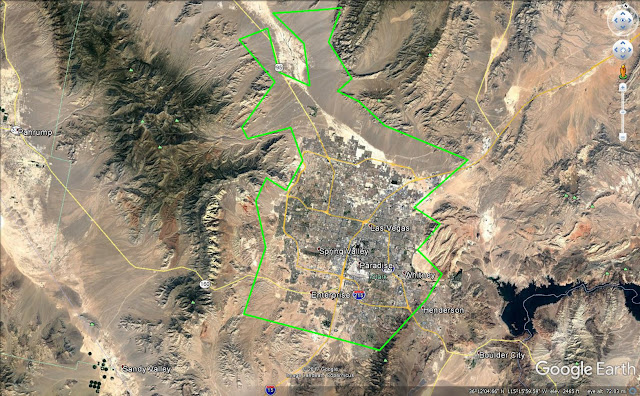
    I could be wrong, but it looks as if Vegas has available land to the north and southwest, and the Valley might be approaching 90% developed. It could be that the region hits the wall (literally) within the next 10 years. What will that mean for a region that is as low-density suburban as this one? Will the Valley’s communities have the ability to shift their focus inward? Time will tell.

    What happens to the region if tourism… changes? Wikipedia’s Atlantic City page has a good explanation for the decline of tourism there after World War II. It connects its decline with the car; prior to the war, people generally traveled to Atlantic City by train and stayed for a week or two. Cars made people more mobile and they made shorter visits. Suburbanization and its creature comforts, like backyards and air conditioning, also took visitors away from AC. The final nail in the coffin was affordable jet service, opening up vacation spots like Miami, Havana, and the Bahamas (and Vegas) in the 50’s and onward. I don’t know what challenge is out there for Vegas now, but what will be crucial to the region’s survival is how it responds.

    What impact will climate change have on a desert resort city? When flying into Las Vegas I couldn’t help but notice the low level of Lake Mead, just southeast of the city. It was clear from the air; bleached rock that had once been under water now exposed. Las Vegas is blessed to have one of the largest reservoirs in the nation at its back door, but could continued drought and increased demand for water undermine everything? The Strip’s casinos tout themselves as leaders in water conservation, but whether their efforts will be enough as conditions worsen is an open question.

    Las Vegas is truly a unique place. It’s a place that seems to serve a certain time and space, and is concerned about now more than its future. But I’m sure if the region squints its eyes and looks, it will see the future is getting closer. It will need to figure out how it will be sustainable as that future approaches.

    This piece originally appeared on The Corner Side Yard.

    Pete Saunders is a Detroit native who has worked as a public and private sector urban planner in the Chicago area for more than twenty years.  He is also the author of “The Corner Side Yard,” an urban planning blog that focuses on the redevelopment and revitalization of Rust Belt cities.

    Photo by Stan Shebs [GFDL, CC BY-SA 3.0 or CC BY-SA 2.5], via Wikimedia Commons

  • Las Vegas: The Once and Future Downtown Project

    There’s been a lot in the news lately about the troubles plaguing Tony Hsieh’s Downtown Project in Las Vegas. The latest is a longish report in the Guardian, which notes:

    Yet by late September of this year, the press – especially the technology press – had begun asking some serious questions, as the Downtown Project suddenly laid off 30 people – 10% of the total it then directly employed. Alongside portentous headlines announcing this “bloodletting” appeared claims that Hsieh had “stepped down” from his position of leadership of the project. A damning open letter from the Downtown Project’s former “director of imagination”, David Gould, called the operation from which he had just resigned “a collage of decadence, greed and missing leadership … There were heroes among us,” he added, “and it is for them that my soul weeps.”

    Technology web site Re/code also ran a seven part series on the Downtown Project, some of it unflattering, including a part focused on a spate of suicides there, and other on about a prominent failed startup.

    I made the obligatory pilgrimage to the Downtown Project in 2013 and wrote up my observations in a three part series, of which you can read part onepart two and part three.

    I noted at the time the audacity of one project trying to completely transform a place like downtown Las Vegas:

    Las Vegas has the single most savagely bleak downtown of any major city I’ve ever visited. The Downtown Project is almost literally starting at zero. There are practically no assets. So anything that the Downtown Project accomplishes needs to be seen against that backdrop. Most of these other cities have been at the downtown redevelopment game for 30+ years, have massive architectural and institutional assets, and have already been the recipients of untold billions in investment, much of it public money.

    I also mentioned that the accolades the project had received in the press were disproportionate to the actual accomplishments to date:

    Honestly, it’s a bit infuriating as a guy who lived in Indy, Louisville, and Providence to see a place where so little has happened garner such massive press and accolades when most other regions the size of Vegas have done more while getting far less attention.

    Indeed, it’s hard to think of a single downtown redevelopment effort that received as much glowing coverage as the Downtown Project. Not even Dan Gilbert’s Detroit efforts received such fawning attention. This is an accomplishment I’m not sure most people fully appreciate. Tony Hsieh was very savvy in using his status as a tier one entrepreneurial superstar, along with a bank of free “crash pad” apartments for visitors, to create buzz and publicity. Other cities should definitely stand up and take notice.

    However, the very success of the project on the PR front primed it for inevitable blowback when problems arose. As the Guardian piece notes, “The story fairly demands an apocalyptic ending.” The higher a star soars in the celebrity firmament, the more knives get drawn when anything disturbs the pristine image. The Guardian reporter also said, based on a very recent trip, that reports of the project’s demise are premature.

    So the Downtown Project has run into turbulence? Film at 11. Startups are hard, risky, trouble fraught endeavors. Tony went through multiple meat grinders in the past, and if you’ve read his book it’s by no means certain that Zappos would even survive. There were many times it could have gone under. Clearly the man has a massive appetite for risk, and the Downtown Project was certainly a risky and ambitious undertaking.

    The initial puffery was overblown. Time will tell if the blowback is as well. Success was always going to be difficult. I noted last year that the project was going against the grain of the DNA of Vegas as a city, was very reliant on “best practices” type solutions vs. the innovative cultural approach of Zappos, and that “curating” a city was inherently dubious. Yet I admire the ambition and believe they’ve done a lot of things right.

    I doubt that the project will ever realize the full, audacious vision that was laid out at the beginning. The commitment of Zappos to its downtown HQ probably prevents a complete flameout. But it may turn out that Tony was unwise to have so heavily promoted the project up front. That has more or less ensured that anything less than perfection will be judged as a failure. He set the bar so high, it is almost impossible to clear. Had there been more modest ambitions, then probably even incremental progress against the backdrop of the disaster zone that was downtown Las Vegas would have been seen as a win. But perhaps in one example of how the Downtown Project did match perfectly with the Vegas DNA, Tony Hsieh elected to pile all his chips on Red 14.

    Full Disclosure: I had previous financial relationships with Downtown Project related entities and stayed for free in one of their crash pads during my stay.

    Aaron M. Renn is an independent writer on urban affairs and the founder of Telestrian, a data analysis and mapping tool. He writes at The Urbanophile, where this piece originally appeared.

    Downtown Project photo by Eddie Codel.

  • Finally, A Vegas Train That Makes Sense

    Las Vegas Railway Express has signed an agreement with the Union Pacific Railroad to operate a conventional speed train from Fullerton, in Orange County to downtown Las Vegas, according to a story by Michelle Rindells of the Associated Press.

    This is not to be confused with the proposed Xpress West (formerly DesertXpress) high-speed rail line which would operate from Victorville to Las Vegas, expecting riders to drive through Los Angeles Basin traffic congestion to get to the station. Further, unlike Xpress West, the Las Vegas Railway Express train would require no financial assistance from taxpayers for its largely leisure travelers. As we indicated previously, our analysis concludes that XpressWest revenues are unlikely to be sufficient to repay a proposed federal loan. This could expose taxpayers to a loss of $5.5 billion or more — approximately 10 times as great as taxpayer losses in the Solyndra federal loan guarantee debacle.

    The Las Vegas Railway Express promoters intend to take the full financial risk, as do most entrepreneurs who start businesses. Moreover, the Las Vegas Railway Express train would operate only when demand is substantial, with all trips between Thursday and Monday. The first trip is tentatively scheduled for New Year’s Eve, 2013.

    Here’s hoping the train is successful and that the owners make at least a competitive return on investment, while providing employees commercially funded (not subsidized) jobs, paying, not consuming taxes and with revenues earned from willing customers, rather than relying on public funding. And just as important, if they fail, taxpayers will not be left holding the bag. That’s how things should work.

  • Could a Las Vegas Train Produce Losses 10 Times More Than Solyndra? (Report Announcement)

    The Reason Foundation has released our "Xpress West" (formerly "DesertXpress") analysis. This high speed rail train would run from Victorville (90 miles from downtown Los Angeles) to Las Vegas. Promoters predict high ridership and profits. They are seeking a subsidized federal loan of more than $5.5 billion, which is within the discretionary authority of the US Department of Transportation to fund.

    Our analysis concludes the following:

    1. There is serious question whether there is a market for Las Vegas travel that would require driving one-third of the way and transferring to the train. If there is no such market, as seems likely from the international experience, ridership could be as low as 97 percent below projections. The reality can be known only after the line is running.

    The balance of the report is based upon the assumption that there is a market for driving to Victorville and boarding a train to Las Vegas.

    2. The ridership and revenue projections (by URS Corporation) are based upon data that is more than 7 years old and predates the Great Financial Crisis. There have been significant downward demand trends in the travel market and Las Vegas tourist market since that time, especially in the share of the market from the Los Angeles Basin. It is inappropriate to use such old data in projecting system performance (Certainly no private company would rely on such old data in a due diligence analysis).

    3. Even after adjusting the obsolete data (which our report does), the ridership projections are implausibly high — at four times the Amtrak Acela ridership between Washington, Baltimore, Philadelphia and New York.

    4. Over 24 years (the forecast period in the project document), we project that expenditures will exceed revenues by between $4 billion and $10 billion. This would mean that there would be insufficient revenues to pay the federal loan. This could result in a taxpayer loss approximately 10 times that of the Solyndra federal loan guarantee.

    5. The free use by the private Xpress West project of the Interstate 15 median could preclude cost effective expansion of this roadway. Even assuming the implausible Xpress West assumptions about the diversion of drivers to the train, the overwhelming majority of growth in the corridor would be on the highway, not on the train. This includes not only the heavy truck traffic, but also car traffic.

    Related: The Las Vegas Monorail

    Wendell Cox was also author of  "Analysis of the Proposed Las Vegas LLC Monorail," which indicated that ridership and revenue projections were extremely optimistic and that the project was likely to fail  financially. Subsequently the project filed bankruptcy and defaulted on bonds. The actual ridership on the Monorail was within the range predicted in "Analysis of the proposed Las Vegas LLC Monorail," and far below the level forecast by project consultant URS Greiner Woodward Clyde.

    Also see this letter from other consultants reviewing the project (Thomas A. Rubin, Jon Twichell Associates, Professor Bernard Malamud  and Wendell Cox).

    The Las Vegas Monorail case is described in the Reason Foundation report.

  • Biggest Boomer Towns

    The boomer generation, spawned (literally) in the aftermath of the Second World War, will continue to shape the American landscape well into the 21st Century. They may be getting older, but these folks are still maintaining their power. Those born in the first ten years of the boomer generation  — between 1945 and 1955 — number 36 million, and they will continue to influence communities and real estate markets across the country, especially as they contemplate life after kids and retirement.

    Much has been written about where “empty nesters” might move as their children move off on their own. One longstanding favorite is the notion that, having jettisoned their children, the boomers will also desert their suburban communities for the bright city lights.

    Unfortunately for developers — some of whom have invested heavily in high-end housing for urbanizing “empty nesters” — the actual data do not support this thesis. Indeed, our analysis of migration by this cohort in the past 10 years shows a 10.3% decline among core city dwellers, a loss of some 1.3 million people over the past decade. For this analysis, Forbes, with the help of demographer Wendell Cox, looked at population numbers from the Census for boomers aged 45 to 54 in 2000 and compared them with the numbers for those ages 55 to 64 in 2010.

    These population changes include reductions due principally to deaths. Census data do not include mortality information. This cohort lost 3.2% of its population over the 10 years. This would only marginally reduce the changes between 2000 and 2010, while the scale of differences between the metropolitan areas would be identical.

    So where are these surviving boomers settling as they enter their likely extended golden years?  The results may surprise urban boosters who have confidently expected them to flock downtown.

    To be sure, a few of the highly affluent — the ones mentioned in the mainstream media — may purchase homes, or pied-à-terres, in places like Manhattan, Chicago’s Gold Coast or San Francisco. But these areas actually have suffered an exodus of boomers over the past decade. In our ranking of the 51 largest metros in the U.S., the urban cores of San Jose, San Francisco, Los Angeles and Chicago scored near the bottom, suffering double-digit percentage losses of boomers. According to the last Census, New York’s urban core, which the Daily News suggested is packed with aspiring seniors, lost 12% of boomers in their mid-50s to mid-60s  — or about 274,000 people.

    Over the past three years  you could blame this loss on the economy, which has postponed retirements brought home many of the boomers’ young, largely unemployed or underemployed children back to the suburban homestead. Or you can credit it to more active lifestyles among boomers who appear to working later than ever. According to a Careerbuilder.com survey, over 60% of workers over 60 indicated they are postponing retirement.

    Yet perhaps something more profound is at work here. An analysis of those who were 55 to 65 in 2000 and 65 to 75 in 2010 reveals an even stronger anti-urban bias, with an over 12% drop in city dwellers. Since these folks are far less likely to have kids at home and more properly retired, this cohort’s behavior suggests that aging boomers are if anything less likely to move to the cities in the next decade.

    Indeed, if boomers do move, notes Sandi Rosenbloom, a noted expert on retirement trends and professor of Planning and Civil Engineering at the University of Arizona, they tend to move to less dense and more affordable regions. The top cities for aging boomers largely parallel those that appealed to the “young and restless” in our earlier survey. The top ten on our list are all affordable, generally low-density Sun Belt metros:

    1. Las Vegas, Nev.
    2. Phoenix, Ariz.
    3. Tampa-St. Petersburg, Fla.
    4. Orlando, Fla.
    5. Riverside-San Bernardino, Calif.
    6. Raleigh, N.C.
    7. Austin, Texas
    8. San Antonio, Texas
    9. Jacksonville, Fla.
    10. Charlotte, N.C.-S.C.

    But according Sandi Rosenbloom, a noted expert on retirement trends and a professor of planning and civil engineering at the University of Arizona, most boomers are staying put, largely in the suburbs they settled in decades ago.  The propensity to move, she points out, starts to drop precipitously as people leave their early 30s. Roughly 1 in 3 people in their 20s move in a given year; by the time they enter their 40s, that figure slides to about 1 in 10. As people age into their 50s and beyond, the percentage drops to roughly 5%, or 1 in 20.

    “The boomers are staying put more than anyone thought,” Rosenbloom says. “People of that generation tend to own their own homes and stay there. The idea that they are moving to the city really comes from the wishful thinking school of planning.”

    The recession has exacerbated this stay-at-home trend. The number of people moving is at its lowest level since the early 1960s. When boomers do decide to move, Rosenbloom notes, they do so largely for prosaic reasons, such as being closer to children or, more important, grandchildren.

    Others succumb to the temptation to cash out expensive housing in metros like New York, Los Angeles, the Bay Area or Boston for less costly residences in Sun Belt locales. Housing in and around these core cities, particularly in attractive neighborhoods, Rosenbloom adds, are simply too expensive for the vast majority of budget-conscious seniors.

    Much of this also has to do with the lifestyle preferences of both boomers and seniors, which appear far different than those put forth by urban pundits. People over 55 that Rosenbloom has interviewed usually express a preference to stay or relocate in places that are less crowded and congested. Furthermore, most are reluctant to give up their cars, and many are less able to walk than drive. This may explain why most retirement communities end up on the urban fringe or farther.

    This trend — which Rosenbloom has also encountered in the U.K., Australia, Canada and New Zealand — is also reflected by the growing shift to smaller towns and cities among both aging boomers and seniors. The “young and restless” may head to suburbs, particularly in the lower-cost Sun Belt cities, but some older Americans appear headed to even less densely populated regions. Over the past decade over 1 million aging boomers and seniors moved to more smaller cities and rural locations from suburban or urban locations.

    What do these trends suggest for the future of our communities and real estate? For one, the big opportunities for selling to aging boomers will remain primarily in the suburbs and some select more rural locations. We also can expect the new senior citizens to move to more affordable places close to their children.

    These findings do provide some long-term hope for the housing market, particularly in suburbs. Leading demographers have been busy predicting a massive drop-off in single-family homes as boomers retire and their children leave. Yet our analysis on the Census reveals that most boomers — as well as those older than them — are staying in the suburbs a lot longer than expected. Many will likely to stay in their homes and old neighborhoods well into their 70s or even 80s, leaving either their home either in an ambulance or to an assisted living facility.

    Developers and planners anxious to service aging boomers should, instead of building downtown towers, address the needs of this generation precisely where they now live and are likely to stay. This could include adding to new residential options in the suburbs to enlivening local shopping districts while boosting senior services in everything from recreation and public safety to health care. As the rock and roll generation heads toward its dotage, both business and communities need to adjust their strategies based not on fantasies but on the realities so clearly evidenced by the Census.

    This piece originally appeared at Forbes.com.

    Joel Kotkin is executive editor of NewGeography.com and is a distinguished presidential fellow in urban futures at Chapman University, and an adjunct fellow of the Legatum Institute in London. He is author of The City: A Global History. His newest book is The Next Hundred Million: America in 2050, released in February, 2010.

  • Las Vegas, Birmingham & Salt Lake City Show Continuing Dispersion to Suburbs

    Census data released in the last week indicates confirms the continuing dispersion of population away from the historical core municipalities (central cities) to the suburbs in the 2000 to 2010 decade. The new figures, for Las Vegas, Birmingham and Salt Lake City indicate that a majority of growth occurred in the suburbs in each metropolitan area and that the dispersion of population to the suburbs was greater in the 2000s in each case than in the 1990s.

    Las Vegas: The Las Vegas metropolitan area continued to grow strongly, adding 41 percent to its population between 2000 and 2010. This, however, represents a more than halving of the growth rate from the 1990s (86 percent). The metropolitan area population in 2010 was 1,951,000, up from 1,376,000 in 2000.

    The core municipality of Las Vegas of grew 22 percent between 2000 and 2010 (from 478,000 to 584,000). The core city of Las Vegas has an overwhelming suburban urban form, having experienced virtually all of its growth in the modern, car oriented era of suburbanization. During the 2000s, the land area of Las Vegas was expanded from 113 square miles to 131.

    The suburbs grew 52 percent between 2000 and 2010. The suburbs attracted 82 percent of the metropolitan population growth, up from 65 percent in the 1990s. The suburbs now account for 70 percent of the Las Vegas metropolitan area population.

    Birmingham: The Birmingham metropolitan area experienced a decline in growth rate from 10 percent in the 1990s to seven percent in the 2000s. The population increased from 1,052,000 to 1,128,000.

    The historical core municipality of Birmingham declined eight percent, from 243,000 to 212,000. This loss of 13 percent is the largest yet recorded for a historical core municipality in a major metropolitan area. Birmingham’s population peaked at 341,000 in 1960. This loss of more than one-third in population between 1960 and 2010 is despite annexations that doubled the size of the city (from 75 to 150 square miles).

    The suburbs gained 13 percent between 2000 and 2010 and captured 140 percent of the metropolitan area’s growth (up from 124 percent in the 1990s). The suburbs now account for 81 percent of the metropolitan population.

    Salt Lake City: In the Salt Lake City metropolitan area growth declined to 16 percent in the 2000s from 26 percent in the 1990s. The population rose from 969,000 to 1,124,000.

    The historical core municipality of Salt Lake City grew three percent (from 182,000 to 186,000). Salt Lake City reached its population peak at 189,000 in 1960. This modest loss occurred while the land area of the city nearly doubled (from 56 square miles to 109).

    The suburbs gained 19 percent between 2000 and 2010. The suburbs attracted 97 percent of the metropolitan population growth, which is up from 89 percent in the 1990s.

  • Cities That Prosper, Cool or Not

    Over the past few years, the raging debate in economic development has been over whether cities should be cool or uncool. Should cities pursue “the creative economy” by going after arts, culture, creative research & development, and innovation? Or should they focus on the bread-and-butter economy: hard infrastructure, traditional industries like manufacturing, and blue-collar jobs?

    Usually a raging debate is an indication that the wrong question is being asked, and that’s the case here. The question is not whether cities must be cool or uncool in order to prosper. Clearly, there are some cities in each camp that prosper, and some cities in each camp that do not. The question is deeper: In both cool and uncool cities, what is the underlying nature of the economy? Does the city simply import money from other places, or does it export goods and services to other places? Because it is this distinction – not cool or uncool – that serves as the dividing line between prosperity that is real and prosperity that is illusory.

    Not long ago, I was interviewing a retired politician in a fast-growing Southern metropolis. Even though he was a good ol’ boy who had never left home, he bore no resentment for the retired Yankees who flooded his town. In fact, he attributed the whole area’s prosperity to them. A retirement community, he said, “is like a high-wage factory. You build 1,000 houses, you have 1,000 households making $90,000 a year. A high-wage factory without the factory.”

    I grew up in a factory town, and this got me thinking about a factory’s huge and multi-faceted contribution to a region’s economy. But is a retirement community really similar?

    In some ways the answer is yes — and that’s a good thing. The most obvious similarity, as my politician friend pointed out, is that the residents live in town, get steady paychecks to spend locally, and become involved in local life. Like factory workers, retirees can support a whole service economy with their local spending.

    But there’s more to a factory-town economy than simply Saturday grocery shopping by the workers. Factories are in the export business, while retirement communities are in the import business. An export economy spins off all kinds of economic benefits that you don’t get from an import economy. A big factory requires lots of suppliers, and tends to stimulate the creation of an economic cluster — a group of businesses that feed off each other and, in time, find new customers outside the region.

    A retirement community creates a cluster of suppliers, too. But this cluster tends to be composed of local service-sector businesses that create low-wage jobs and aren’t interested in repackaging their services for export outside the region — retailers, contractors, landscapers and pool-maintenance companies.

    There’s also a psychological difference. Factory workers are connected to the local economy in a way that retirees are not. If orders fall off, they might get laid off for a while, switch jobs and go to work over at a supplier, sometimes for more money, sometimes for less. But the point is that they have a stake in the regional economy. Factory workers don’t like traffic jams anymore than the rest of us, but they see the value of an expanding economy. They see how growth can be good as well as bad.

    Retirees see no such thing. They are tied to the global economic system in which their investments are based, or else to the economic fortunes of, say, a government pension system in another part of the country. They might want tax revenue to flow into public coffers in New York or Ohio to protect their public pensions, or they might want interest rates to go up so that their incomes rise.

    But they see no benefit in an expanding local economy. If a bunch of factory workers get laid off, the retirees don’t need to worry, in fact, they might actually benefit because local prices might fall. If business is booming and people are employed and labor rates are going up, they don’t have to worry about that, either. They might even be harmed by it, because their incomes are fixed — not tied to the local economy — and prices will go up.

    A retirement community is not the only type of place that operates this way. Tourist towns and bedroom suburbs function pretty much the same way. All are in the business of importing money from somewhere else, rather than exporting goods and services. And the recession has shown, once again, how fragile import-based economies are. A few years ago, Las Vegas was the biggest boomtown in America. Today, it’s become crash city, largely because the two-tier economy tied to tourism — a few wealthy casino owners and managers, a vast number of low-paid hotel service workers — couldn’t sustain the huge increase in home prices that occurred during the housing bubble.

    There’s nothing new in this distinction between import and export economies. Jane Jacobs laid out the thesis magnificently, almost 30 years ago, in Cities and the Wealth of Nations. But it’s become more relevant in the last couple of years, as the cool v. uncool cities debate has heated up.

    The argument that cool cities are involved in fluff, and therefore aren’t creating real economic growth, is based on the perception that cool cities are in the import business. If you build arts centers and sports stadiums and convention centers and subsidize lofts for artists, you’re not really creating any wealth… or so the argument goes. All you’re really doing is drawing people to your city so you can empty their pockets while they are having a good time; the classic import economy.

    That’s true sometimes, but not always. At its best, a creative economy is generating innovations that turn into products that get exported elsewhere, whether those innovations are fashion trends or software applications or biotech breakthroughs. And in many cases, a more plodding blue-collar economy requires fluffy arts stuff to create the quality of life that will attract top people. My grandfather left the Cornell faculty to run the research lab of a rope manufacturing company in my hometown in upstate New York, but I’m pretty sure one of the attractions was a symphony orchestra that my grandmother, a concert pianist, could perform with now and then.

    Similarly, just because a city is a lunch-bucket town doesn’t mean it’s sending goods and services out into the world and truly creating a lot of wealth. Here again, Las Vegas is a great example. Despite the glitz, Vegas is basically a blue-collar town. It’s job-rich, and workers traditionally didn’t need a lot of education or a high skill level to succeed, they just needed drive. Yet, by and large, the jobs created in Vegas aren’t very good. They’re relatively low-wage service jobs, and they come and go depending on the economy. Vegas’ business leaders are accumulating wealth quickly, and maybe eventually it will become an export economy. But for now, like the retirement community in the South that I mentioned, it depends entirely on importing money.

    It’s time to stop talking about whether towns should be cool or uncool. What really matters is what they are producing. If all they’re producing is some kind of experience that induces people to come to town and spend money, it doesn’t matter how cool the town is; it’s probably not sustainable economically. If, on the other hand, the city is creating and exporting something the world needs – whether that product is cool or uncool – it’s a good bet that both the city and its people will do pretty well for a long time.

    Photo by Stuck in Customs/Trey Ratcliff. Prosperity, or just an illusion? Building 43 at Google.

    William Fulton is a principal at Design, Community & Environment (dceplanning.com) and mayor of Ventura, California. This article is adapted from his new book, Romancing the Smokestack: How Cities and States Pursue Prosperity.

  • The Housing Bubble: The Economists Should Have Known

    Paul Krugman got it right. But it should not have taken a Nobel Laureate to note that the emperor’s nakedness with respect to the connection between the housing bubble and more restrictive land use regulation.

    A just published piece by the Federal Reserve Bank of Boston, however, shows that much of the economics fraternity still does not “get it.” In Reasonable People Did Disagree: Optimism and Pessimism About the U.S. Housing Market Before the Crash, Kristopher S. Gerardi, Christopher L. Foote and Paul S. Willen conclude that it was reasonable for economists to have missed the bubble.

    Misconstruing Las Vegas and Phoenix: They fault Krugman for making the bubble/land regulation connection by noting that the “places in the United States where the housing market most resembled a bubble were Phoenix and Las Vegas,” noting that both urban areas have “an abundance of surrounding land on which to accommodate new construction” (Note 1).

    An abundance of land is of little use when it cannot be built upon. This is illustrated by Portland, Oregon, which is surrounded by such an “abundance of land.” Yet over a decade planning authorities have been content to preside over a 60 percent increase in house prices relative to incomes, while severely limiting the land that could have been used to maintain housing affordability. The impact is clearly illustrated by the 90 percent drop in unimproved land value that occurs virtually across the street at Portland’s urban growth boundary.

    Building is largely impossible on the “abundance of land” surrounding Las Vegas and Phoenix. Las Vegas and Phoenix have virtual urban growth boundaries, formed by encircling federal and state lands. These are fairly tight boundaries, especially in view of the huge growth these areas have experienced. There are programs to auction off some of this land to developers and the price escalation during the bubble in the two metropolitan areas shows how a scarcity of land from government ownership produces the same higher prices as an urban growth boundary

    Like Paul Krugman, banker Doug French got it right. In a late 2002 article for the Nevada Policy Research Institute, French noted the huge increases auction prices, characterized the federal government as hording its land and suggested that median house prices could reach $280,000 by the end of the decade. Actually, they reached $320,000 well before that (and then collapsed).

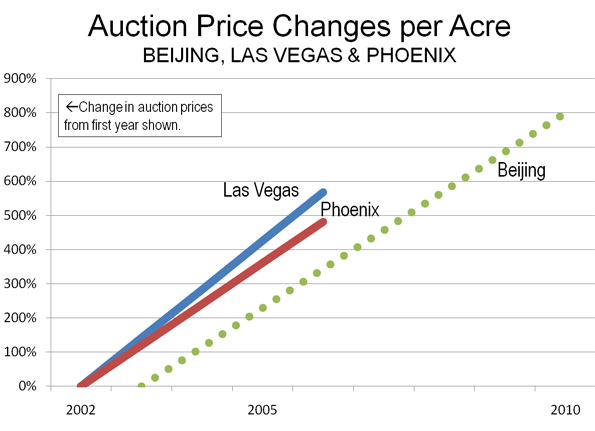
    In Las Vegas, house prices escalated approximately 85% relative to incomes between 2002 and 2006. Coincidentally, over the same period, federal government land auctions prices for urban fringe land rose from a modest $50,000 per acre in 2001-2, to $229,000 in 2003-4 and $284,000 at the peak of the housing bubble (2005-6). Similarly, Phoenix house prices rose nearly as much as Las Vegas, while the rate of increase per acre in Phoenix land auctions rose nearly as much as in Las Vegas.

    In both cases, prices per acre rose at approximately the same annual rate as in Beijing, which some consider to have the world’s largest housing bubble. According to Joseph Gyourko of Wharton, along with Jing Wu and Yongheng Deng Beijing prices rose 800 percent from 2003 to 2008 (Figure). This is true even thought we are not experiencing the epochal shift to big urban areas now going on in China.

    The Issue is Land Supply: The escalation of new house prices during the bubble occurred virtually all in non-construction costs such as the costs of land and any additional regulatory costs. It is not sufficient to look at a large supply of new housing (as the Boston Fed researchers do) and conclude that regulation has not taken its toll. The principal damage done by more restrictive land regulation comes from limiting the supply of land, which drives its price up and thereby the price of houses. In some places where there was substantial building, restrictive land use regulations also skewed the market strongly in favor of sellers. This dampening of supply in the face of demand drove land prices up hugely, even before the speculators descended to drive the prices even higher. Florida and interior California metropolitan areas (such as Sacramento and Riverside-San Bernardino) are examples of this.

    Missing Obvious Signs: There are at least two reasons why much of the economics profession missed the bubble.

    (1) Unlike Paul Krugman, many economists failed to look below the national data. As Krugman showed, there were huge variations in house price trends between the nation’s metropolitan areas. National averages mean little unless there is little variation. Yet most of the economists couldn’t be bothered to look below the national averages.

    (2) Most economists failed to note the huge structural imbalances that had occurred in the distorted housing markets relative to historic norms. Since World War II, the Median Multiple, the median house price divided by the median household income, has been 3.0 or less in most US metropolitan markets. Between 1950 and 2000, the Median Multiple reached as high as 6.1 in a single metropolitan area among today’s 50 largest, in a single year (San Jose in 1990, see Note 2). In 2001, however, two metropolitan areas reached that level, a figure that rose to 9 in 2006 and 2007. The Median Multiple reached unprecedented and stratospheric levels in of 10 or more in Los Angeles, San Francisco, San Diego and San Jose- all of which have very restrictive land use and have had relatively little building. This historical anomaly should have been a very large red flag.

    In contrast, the Median Multiple remained at or below 3.0 in a number of high growth markets, such as Atlanta, Dallas-Fort Worth and Houston and other markets throughout the bubble.. Even with strong housing growth, prices remained affordable where there was less restrictive land use regulation.

    Seeing the Signs: Krugman, for his part, takes a well deserved victory lap in a New York Times blog entitled “Wrong to be Right,” deferring to Yves Smith at nakedcapitalism.com who had this to say about the Federal Reserve Bank of Boston research:

    It is truly astonishing to watch how determined the economics orthodoxy is to defend its inexcusable, economy-wrecking performance in the run up to the financial crisis. Most people who preside over disasters, say from a boating accident or the failure of a venture, spend considerable amounts of time in review of what happened and self-recrimination. Yet policy-making economists have not only seemed constitutionally unable to recognize that their programs resulted in widespread damage, but to add insult to injury, they insist that they really didn’t do anything wrong.

    Maybe we should have known better: beware economists bearing the moment’s conventional wisdom.

    ——

    Note 1: The authors cite work by Albert Saiz of Wharton to suggest an association between geographical constraints and house price increases in metropolitan areas. The Saiz constraint, however, looks at a potential development area 50 kilometers from the metropolitan center (7,850 square kilometers). This seems to be a far too large area to have a material price impact in most metropolitan areas. For example, in Portland, the strongly enforced urban growth boundary (which would have a similar theoretical impact on prices) was associated with virtually no increase in house prices until the developable land inside the boundary fell to less than 100 square kilometers (early 1990s). A far more remote geographical barrier, such as the foothills of Mount Hood, can have no meaningful impact in this environment.

    Note 2: William Fischel of Dartmouth has shown how the implementation of land use controls in California metropolitan areas coincided with the rise of house prices beyond historic national levels. As late as 1970, house prices in California were little different than in the rest of the nation.

    Wendell Cox is a Visiting Professor, Conservatoire National des Arts et Metiers, Paris and the author of “War on the Dream: How Anti-Sprawl Policy Threatens the Quality of Life

    Photograph: $575,000 house in Los Angeles (2006), Photograph by author

  • “James Drain” Hits Cleveland

    The ten story of mural of LeBron James is coming down in Cleveland. This one hurts. James wasn’t just the latest embodiment of Cleveland’s hopes, he was a local kid who, unlike so many, had stayed home in Northeast Ohio. His joining of the Cleveland exodus at a time of severe economic distress prompted Cavaliers owner Dan Gilbert to pen a now infamous open letter to fans:

    As you now know, our former hero, who grew up in the very region that he deserted this evening, is no longer a Cleveland Cavalier…..The good news is that the ownership team and the rest of the hard-working, loyal, and driven staff over here at your hometown Cavaliers have not betrayed you nor NEVER will betray you….This shocking act of disloyalty from our home grown “chosen one” sends the exact opposite lesson of what we would want our children to learn. And “who” we would want them to grow-up to become….

    Forty years of frustration boiled over in that letter. Gilbert is from Detroit, but perhaps that’s why he too shares these feelings so viscerally.

    Cleveland’s “Big Thing Theory”

    In a sense though, Cleveland’s disappointment was inevitable. LeBron James was never going to turn around the city. No one person or one thing can. Unfortunately, Cleveland has continually pinned its hopes on a never-ending cycle of “next big things” to reverse decline. This will never work. As local economic development guru Ed Morrison put it, “Overwhelmingly, the strategy is now driven by individual projects….This leads to the ‘Big Thing Theory’ of economic development: Prosperity results from building one more big thing.”

    These have all failed, now even “King James”. The trend lines haven’t changed, even where the individual projects have done well. But often even that hasn’t happened. For example, the Flats, a once-thriving entertainment district in an old warehouse district, now resembles, as one local comedian put it, a “Scooby Doo ghost town.”

    Combating “James Drain”

    James’ departure also fits the narrative of generalized anxiety around “brain drain” and cities losing their best and brightest of each generation. As lots of people really have left Cleveland, this is understandable. But the real story is much more complex. A look at IRS tax return data shows that in reality Cleveland doesn’t have especially high out-migration. Its metro out-migration rate* in 2008 was 28.02. Miami’s was 40.34 and for even the boomtown of Atlanta it was 38.95. Not only is Cleveland not losing an especially high number of people, you can actually argue it is losing too few. A big part of the problem in Cleveland’s economy is that too many people are stuck there.

    Conversely, a real migration problem is that too few people are moving in. As local attorney Richard Herman noted, “New York City and Chicago, like most major cities, see significant out-migration of their existing residents each year. What is atypical is that Cleveland does not enjoy the energy of new people moving in.” The Cleveland metro in-migration rate was only 22.19. Miami’s was 30.36 and Atlanta’s a robust 51.91.

    Cities need new blood. Cleveland isn’t getting it. Its circulatory system is shut down. Cleveland needs more natives to leave and more newcomers to arrive. Both sides win. Those Cleveland departees will move on to be part of the new energy other cities so desperately need. James is going to get to live the high life he wants in South Beach, but somebody else will be fired up to get the opportunity to play in Cleveland.

    Selling Cleveland

    But that begs the question, what’s going to get more people to move to Cleveland? The fact is, James wasn’t getting the job done, and never would. Nor will amenities like the Cleveland Orchestra or the Rock and Roll Hall of Fame Museum.

    The mistake Cleveland and other Rust Belt cities make is that they are too worried about the likes of LeBron James moving to Miami. For people with the means and the desire to choose a place like South Beach, Cleveland simply can’t compete. And let’s not forget, James snubbed Chicago, New York, and Los Angeles too.

    Rather than trying to take on the Chicagos, Miamis, and New Yorks of this world at their strongest points, Cleveland would be far better served ceding that market and fighting where it can best compete. Believe it or not, not everyone wants to live in a huge global city. There are plenty of people who might choose to live in Cleveland, if the city focused on the basic blocking and tackling of city services, quality of life, and business climate instead of splashy grands projets. As Anthony Bourdain said this week:

    I think that troubled cities often tragically misinterpret what’s coolest about themselves. They scramble for cure-alls, something that will “attract business”, always one convention center, one pedestrian mall or restaurant district away from revival. They miss their biggest, best and probably most marketable asset: their unique and slightly off-center character….Cleveland is one of my favorite cities. I don’t arrive there with a smile on my face every time because of the Cleveland Philharmonic.

    In short, Cleveland needs less South Beach, less Chicago Loop, and more American Splendor. Ultimately, my bet is Cleveland will end up missing Harvey Pekar a lot more than it will any multi-millionaire sports star.

    Shooting the Messenger

    Who is going to get that message out about Cleveland? After that sendoff, it sure won’t be LeBron James. That’s a shame. As Jim Russell has richly illustrated, people make migration – and investment – decisions based on knowledge, not just information. Nobody picks a city to live in by entering reams to statistics into a sixteen tab spreadsheet. They’re more likely to move to be near family, friends, or places they know. That knowledge comes from first hand experience – and trusted recommendations.

    Until the switch flips on Cleveland’s brand, it needs to be out earning that trust of prospective residents. The people who’ve left aren’t Judases, they’re your field sales force – or at least they should be. James could have been a missionary “Witness” for Cleveland in a foreign land. Instead, Cleveland blew an enormous opportunity, and left itself with little more than soured memories and a partially demolished mural as an ephemeral reminder of yet another failed Next Big Thing.

    * Tax return exemptions migrating per 1000 overall tax return exemptions in the base year.

    Aaron M. Renn is an independent writer on urban affairs based in the Midwest. His writings appear at The Urbanophile.

    Photo by alexabboud

  • The Myth of the Back-to-the-City Migration

    Pundits, planners and urban visionaries—citing everything from changing demographics, soaring energy prices, the rise of the so-called “creative class,” and the need to battle global warming—have been predicting for years that America’s love affair with the suburbs will soon be over. Their voices have grown louder since the onset of the housing crisis. Suburban neighborhoods, as the Atlantic magazine put it in March 2008, would morph into “the new slums” as people trek back to dense urban spaces.

    But the great migration back to the city hasn’t occurred. Over the past decade the percentage of Americans living in suburbs and single-family homes has increased. Meanwhile, demographer Wendell Cox’s analysis of census figures show that a much-celebrated rise in the percentage of multifamily housing peaked at 40% of all new housing permits in 2008, and it has since fallen to below 20% of the total, slightly lower than in 2000.

    Housing prices in and around the nation’s urban cores is clear evidence that the back-to-the-city movement is wishful thinking. Despite cheerleading from individuals such as University of Toronto Professor Richard Florida, and Carole Coletta, president of CEOs for Cities and the Urban Land Institute, this movement has crashed in ways that match—and in some cases exceed—the losses suffered in suburban and even exurban locations. Condos in particular are a bellwether: Downtown areas, stuffed with new condos, have suffered some of the worst housing busts in the nation.

    Take Miami, once a poster child for urban revitalization. According to National Association of Realtors data, the median condominium price in the Miami metropolitan area has dropped 75% from its 2007 peak, far worse than 50% decline suffered in the market for single family homes.

    Then there’s Los Angeles. Over the last year, according to the real estate website Zillow.com, single-family home prices in the Los Angeles region have rebounded by a modest 10%. But the downtown condo market has lost over 18% of its value. Many ambitious new projects, like Eli Broad’s grandiose Grand Avenue Development, remain on long-term hold.

    The story in downtown Las Vegas is massive overbuilding and vacancies. The Review Journal recently reported a nearly 21-year supply of unsold condominium units. MGM City Center developer Larry Murren stated this spring that he wished he had built half as many units. Mr. Murren cites a seminar on mixed-use development—a commonplace event in many cities over the past few years—as sparking his overenthusiasm. He’s not the only developer who has admitted being misled.

    Behind the condo bust is a simple error: people’s stated preferences. Virtually every survey of opinion, including a 2004 poll co-sponsored by Smart Growth America, a group dedicated to promoting urban density, found that roughly 13% of Americans prefer to live in an urban environment while 33% prefer suburbs, and another 18% like exurbs. These patterns have been fairly consistent over the last several decades.

    Demographic trends, including an oft-predicted tsunami of Baby Boom “empty nesters” to urban cores, have been misread. True, some wealthy individuals have moved to downtown lofts. But roughly three quarters of retirees in the first bloc of retiring baby boomers are sticking pretty close to the suburbs, where the vast majority now reside. Those that do migrate, notes University of Arizona Urban Planning Professor Sandi Rosenbloom, tend to head further out into the suburban periphery. “Everybody in this business wants to talk about the odd person who moves downtown, but it’s basically a ‘man bites dog story,’” she says. “Most retire in place.”

    Historically, immigrants have helped prop up urban markets. But since 1980 the percentage who settle in urban areas has dropped to 34% from 41%. Some 52% are now living in suburbs, up from 44% 30 years ago. This has turned places such as Bergen County, N.J., Fort Bend County, Texas, and the San Gabriel Valley east of Los Angeles into the ultimate exemplars of multicultural America.

    What about the “millennials”—the generation born after 1983? Research by analysts Morley Winograd and Mike Hais, authors of the ground-breaking “Millennial Makeover,” indicates this group is even more suburban-centric than their boomer parents. Urban areas do exercise great allure to well-educated younger people, particularly in their 20s and early 30s. But what about when they marry and have families, as four in five intend? A recent survey of millennials by Frank Magid and Associates, a major survey research firm, found that although roughly 18% consider the city “an ideal place to live,” some 43% envision the suburbs as their preferred long-term destination.

    Urban centers will continue to represent an important, if comparatively small, part of the rapidly evolving American landscape. With as many as 100 million more Americans by 2050, they could enjoy a growth of somewhere between 10 million and 20 million more people. And in the short run, the collapse of the high-end condo market could provide opportunity for young and unmarried people to move into luxurious urban housing at bargain rates.

    But lower prices, or a shift to rentals, could prove financially devastating for urban developers and their investors, who now may be slow to re-enter the market. And for many cities, the bust could represent a punishing fiscal blow, given the subsidies lavished on many projects during the era of urbanist frenzy.

    The condo bust should provide a cautionary tale for developers, planners and the urban political class, particularly those political “progressives” who favor using regulatory and fiscal tools to promote urban densification. It is simply delusional to try forcing a market beyond proven demand.

    Rather than ignore consumer choice, cities and suburbs need to focus on basic tasks like creating jobs, improving schools, developing cultural amenities and promoting public safety. It is these more mundane steps—not utopian theory or regulatory diktats—that ultimately make successful communities.

    This article originally appeared in the Wall Street Journal.

    Joel Kotkin is executive editor of NewGeography.com and is a distinguished presidential fellow in urban futures at Chapman University. He is author of The City: A Global History. His newest book is The Next Hundred Million: America in 2050, released in Febuary, 2010.

    Photo by miamism