Tag: light rail

  • Problems in the Orange County Grand Jury Light Rail Report

    Earlier this month (May 9, 2016) the Orange County (California) Grand Jury issued a report entitled: “Light Rail: Is Orange County on the Right Track,” which is on the Grand Jury website here. The report largely concludes that it is not and that there is a need for a light rail system in Orange County. On page 7, the 2016 Grand Jury report says: “No Grand Jury has reported on development of light rail systems in Orange County.”

    In fact, there was a previous report, at: http://www.ocgrandjury.org/pdfs/GJLtRail.pdf, which is a 1999 report of the Orange County Grand Jury entitled: “Orange County Transportation Authority and Light Rail Planning.” Both the 1999 and 2016 reports are on the Orange County Grand Jury website as of May 25, 2016. The 1999 report reached fundamentally different conclusions than the 2016 report. Obviously, the 2016 report makes no attempt to reconcile its findings or analysis with the 1999 report.

    Inappropriate Density Comparison

    There are additional problems with the 2016 Grand Jury Report. In making the case for light rail in Orange County, the 2016 Grand Jury put considerable emphasis on the fact that Orange County’s population density is higher than that of Los Angeles County. The reason for Orange County’s population density advantage is the fact that much of Los Angeles County is in the largely undevelopable Transverse Ranges (including the San Gabriel Mountains), with a considerable amount of rural (not urban) desert. The difference is that Orange County’s land area is approximately two-thirds urban, while Los Angeles County’s land area is about one-third urban. This renders the overall density comparison for urban transportation planning meaningless.

    Indeed, the urban density of Los Angeles County is substantially higher than that of Orange County. According to the United States Census Bureau, the population density of the urban areas in Los Angeles County was 6,859 per square mile in 2010, well above Orange County’s 5,738. Los Angeles County’s densest census tract is nearly 2.5 times the density of any census tract in Orange County.

    Transit is About Downtown

    Even so, urban rail ridership bears little relationship to overall urban population density (otherwise the San Jose urban area would be a better environment for rail than the New York urban area). In 2010, San Jose’s density was about 5,820, while New York’s was 5,319 (Los Angeles was 6,999, including the most dense parts of Los Angeles and Orange County and part of San Bernardino County).

    One of the most important keys to transit ridership is the concentration of work destinations in a dense central business district (CBD), to which nearly all high capacity and frequent transit services converge. In the United States, 55 percent of all transit commuting destinations are in the six largest municipalities (such as the city of New York or the city of San Francisco, as opposed to metropolitan areas) with the largest central business districts. This is dominated by New York with about 2,000,000 employees in its CBD. On the other hand, San Jose has one of the smallest central business districts of any major metropolitan area and a correspondingly smaller transit market share than the national average. Orange County, with an urban form far more like San Jose than New York or San Francisco, has little potential to materially increase transit ridership with light rail.

    The record of new urban rail in the United States is less than stellar, evaluated on the most important metric. Generally, new urban rail has resulted in only minor increases in transit’s miniscule market share and in some cases there have been declines.

    In the case of Los Angeles, on which the Grand Jury relies for its conclusion favoring light rail development, three one-half cent sales taxes and spending that has amounted to more than $16 billion on development of new rail lines. Yet, transit ridership has fallen, as reported in the Los Angeles Times (see: “Just How Much has Los Angeles Transit Ridership Fallen”). Former SCRTD (predecessor to the MTA) Chief Financial Officer Thomas A. Rubin has also suggested that the MTA ridership decline may be greater if adjusted for the increased number of transfers that have occurred in the bus-rail system compared to the previous bus system (For example, a person traveling from home to work who starts on a bus, transfers to rail and finished the trip on a bus, counts as three, not one).

    Required Responses:

    The Grand Jury report notes:

    “The California Penal Code Section 933 requires the governing body of any public agency which the Grand Jury has reviewed, and about which it has issued a final report, to comment to the Presiding Judge of the Superior Court on the findings and recommendations pertaining to matters under the control of the governing body. Such comment shall be made no later than 90 days after the Grand Jury publishes its report (filed with the Clerk of the Court).”

    This would apparently require a response by August 9, 2016

    Permission Granted to Cite or Quote this Article or the Linked Documents

    Any respondent is hereby granted permission to cite or quote from this article or the linked documents.
  • Honolulu Rail: It Just Keeps Getting Worse

    There seems to be no end to the difficulties facing Honolulu’s urban rail project. In an editorial, Honolulu’s Civil Beat noted that federal officials fear the project cost may reach $8.1 billion, which is more than 50 percent above the “original estimate” of $5.2 billion. The cost blowout of nearly $3 billion would be far more than state consultants suggested in a 2010 report. That report, by the Infrastructure Management Group (IMG) in conjunction with the Land Use and Economic Management Group of CB Richard Ellis and Thomas A. Rubin estimated a “most likely scenario” in which the rail cost overrun would have been $909 million (Note).

    This is, however, a particular concern to local citizens, since it has been suggested that no rail project has cost more in relation to its population base in US history. If the the project costs $8.1 billion, the IMG et al report estimate will have turned out to be far too conservative, less than one-third the overrun. At $2.9 billion this extra cost is nearly $3,000 for every man, woman and child in Honolulu. It is more than $8,500 per household.

    The Civil Beat editorial is here.

    Note: Thomas A. Rubin’s more recent analysis of rail and transit ridership in Los Angeles is here.

  • Sources for Our “Southern California Stuck in Drive” Story

    Joel Kotkin and I wrote in the Orange County Register that transit work trip market shares in the Los Angeles area had changed little, from 5.9 percent in 1980 to 5.8 percent in 2013. In a response, the Los Angeles Metropolitan Transportation Authority (LACTMTA) noted that we did not cite sources. Fair enough. Our source was the 1980 US Census and the 2013 American Community Survey, a product of the United States Census Bureau. This data shows Los Angeles to rank 10th in transit market share among the 52 major metropolitan areas (over 1,000,000 population), well below its population rank of 2nd.

    Then LACMTA goes on to note "the percentage of daily transit commuters in the Los Angeles region … has stayed steady over the last several decades." That is exactly our point — that transit is not growing as a percentage of travel in the Los Angeles metropolitan area. This, despite expenditures of $15 billion to build rail over the period in constant 2013 dollars (estimated from data on the Thoreau Institute website).

  • Portland Light Rail Revolt Continues

    In a hard fought election campaign, voters in the city of Tigard appear to have narrowly enacted another barrier to light rail expansion in suburban Portland. The Washington County Elections Division reported that with 100 percent of precincts counted, Charter Amendment 34-210 had obtained 51 percent of the vote, compared to 49 percent opposed.

    The Charter Amendment establishes as city policy that no transit high capacity corridor can be developed within the city without first having been approved by a vote of the people. High capacity transit in Portland has virtually always meant light rail.

    In a previous ballot issue, Tigard voters had enacted an ordinance requiring voter approval of any city funding for light rail. Similar measures were enacted in Clackamas County as well as King City in Washington County. Across the Columbia River in Clark County (county seat: Vancouver), voters rejected funding for connecting to the Portland light rail system. After the Clackamas County Commission rushed through a $20 million loan for light rail (just days before the anti-light rail vote), two county commissioners were defeated by candidates opposed to light rail, with a commission majority now in opposition.

    Further, a Columbia River Crossing, which would have included light rail to Vancouver was cancelled after the Washington legislature declined funding. In a surreal aftermath, interests in Oregon seriously proposed virtually forcing the bridge on Washington, fully funding the project itself. A just adjourned session of the Oregon legislature failed to act on the proposal, which now (like Rasputin) appears to be dead.

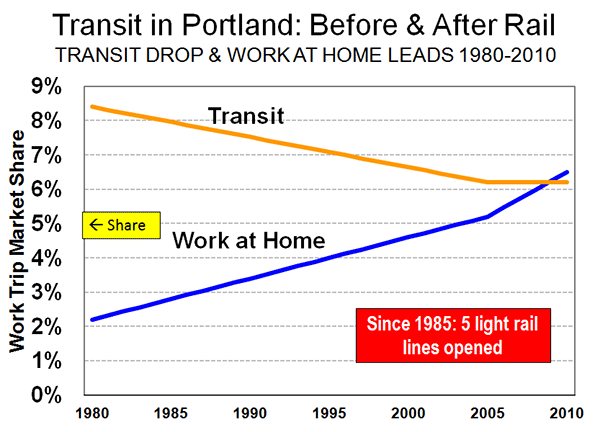
    At the same time, Portland’s transit agency faces financial difficulty and has been seriously criticized in a report by Secretary of State. The agency has more than $1 billion in unfunded liabilities and carries a smaller share of commuters than before the first of its six light rail and commuter rail lines was opened. Moreover, the latest American Community Survey data indicates that 3,000 more people work at home than ride transit (including light rail and commuter rail) to work in the Portland metropolitan area. Before light rail (1980), transit commuters numbered 35,000 more than people working at home. Over the period, transit’s market share has dropped one-quarter.

  • Election: “Stop Portland Creep” Resonates in Suburbs

    Election results from all three of Portland, Oregon’s largest suburban counties indicate a reaction against what has been called "Portland Creep," the expansion of the expansive light rail system without voter approval and the imposition of restrictive densification measures by Metro, the regional land-use agency.

    Portlanders in the three largest Oregon counties (Multnomah, Washington and Clackamas) have previously voted against financing light rail extensions, however the transit agency has found ways to continue the expansion and now operates five lines, with a sixth under construction. While urban rail aficionados tout the success of the Portland system, transit use by commuters has fallen significantly in relative terms from before the opening of the first light rail line. At the same time, working at home, which does not need billions in taxpayer subsidies, has caught up to and passed transit (Figure).

    The electoral events of the past 60 days could severely limit future expansion.

    Clackamas County: Chicanery and its Price

    In a September 2012 election, voters in Clackamas County approved a measure by a 60% – 40% majority requiring that any commitment of funding to rail would require a vote of the people. Perhaps fearing a negative result in the election, the pro-rail Clackamas County commission hastily approved $20 million to support the under construction Portland to Milwaukie (Clackamas County) light rail line.

    Things were to become substantially more difficult for light rail in the November election. In Clackamas County, the two incumbent commissioners on the ballot, both of whom voted for the $20 million bond issue, lost their seats. Voters rewarded their chicanery by replacing them with anti-rail commissioners, leaving the Clackamas County commission with a 3 to 2 anti-rail majority. The Oregonian characterized the election as "a referendum on light rail."

    John Ludlow, who defeated Clackamas County commission chair Charlotte Lehan by a 52% to 48% margin, told The Oregonian:

    "I think the biggest boost my campaign got was when those commissioners agreed to pay that $20 million to TriMet" for Portland-Milwaukie light rail four days before the September election. I think that put Tootie and me over the top." 

    "Tootie" is Tootie Smith, a former state legislator who unseated commissioner Jamie Damon in the same election by a similar margin.

    Washington County, Oregon: Taxpayers Take Control

    Meanwhile, light rail has run into substantial difficulty in suburban Washington County. In September, voters in King City approved a measure to require all light rail funding to be approved by the voters. In the more recent November election, voters in Tigard, the 6th largest city (50,000 population) in the metropolitan area, voted 81%-19% to subject all light rail expenditures to a vote of the people.

    Clark County, Washington: Voters Say No

    Portland’s transit agency also had its eye on expanding light rail service across the state line and the Columbia River to Vancouver, in Clark County, Washington. The plan was to build a new "Interstate Bridge" (Interstate 5) across the river, which would include light rail. The voters of Clark County were asked in a referendum to approve funding for the light rail system and turned it down soundly according to the Columbian, by a 56% – 44% margin.

    But there was more. For some time, citizen activist and business leader David Madore has been working to stop both tolls on the new bridge and light rail service. Madore was elected to the board of commissioners of Clark County at the same time that the light rail referendum was being defeated. Madore, like the two other Clark County commissioners, also hold seats on the transit agency board.

    Tri-Met’s Death Spiral?

    Further, Tri-Met’s dire financial situation could be another barrier to future expansion. As John Charles of the Cascade Policy Institute has shown, Tri-Met’s fringe-benefit bill is astronomically high, at $1.63 for each $1.00 in wages. This is more than five times the average for public employers, according to US Department of Commerce Bureau of Economic Analysis data. Charles refers to Tri-Met as being in a "death spiral" and says that:  

    "The agency is steadily devolving from a transit district to a retirement and health-care center, with unsustainable fringe benefit costs that now far exceed the mere cost of wages."

  • Honolulu Rail Project Legal Problems Mount

    According to the Hawaii Reporter, Honolulu’s rail transit project has lost a major legal test in The Federal Ninth Circuit Court, as Judge Wallace Tashima ruled in  HonoluluTraffic.com v. Federal Transit Administration et al that the city of Honolulu had violated federal environmental law on three counts.

    The plaintiffs included are a coalition of environmental, civic, political and taxpayer interests, including former Governor and mayoral candidate Benjamin Cayetano, University of Hawaii Law professor Randall Roth, Retired Judge Walter Heen, retired businessman and transportation expert Cliff Slater, Dr. Michael Uechi, Hawaii’s Thousand Friends, Outdoor Circle and the Small Business Hawaii Entrepreneurial Education Foundation.

    The plaintiffs and defendants differ strongly on the impact of the ruling, and the defendants are to return to court in December seeking a permanent injunction against the project.

    University of Hawaii Engineering Professor Panos Prevedouros told the Hawaii Reporter that the decision would require environmental planning revisions that could take up to 2 years.

    This setback is in addition to a previous unanimous Hawaii Supreme Court ruling that had already required construction to be suspended and which could delay project for at least a year, according to the Hawaii Reporter. The Supreme Court in Kaleikini v. Yoshioka, ruled that the city of Honolulu failed to comply with the state’s historic preservation and burial protection laws when it did not complete an archeological inventory survey for the 20-mile route before starting construction.

  • Federal Transit Administration Weighs In on Honolulu Mayor’s Race

    The Federal Transit Administration (FTA) has intervened in the Honolulu Mayor’s race against challenger and former Hawaii Governor Ben Cayetano. Governor Cayetano and Mayor Peter Carlisle are locked in a bitter contest that could determine whether the proposed $5.1 billion rail line is built. Mayor Carlisle is a strong supporter of the rail line. Challenger Cayetano has promised to "pull the plug" on the rail system. Recent polls show that the project’s former thin majority support among Honolulu residents has now turned to opposition.

    At a 1:30 p.m. press conference yesterday (March 13), Governor Cayetano released e-mails from the FTA indicating concerns about the rail project. According to Cayetano, "Not only it is apparent that FTA officials share some of our concerns, but it’s also apparent that they warned the city about pending litigation if certain things were not done."

    One of the FTA emails, obtained from the administrative record said “I do not think the FTA should be associated with their lousy practices of public manipulation and we should call them on it.”

    Reflecting a surprising ability to "turn on a dime," FTA quickly responded in an apparent attempt to diffuse Governor Cayetano’s point. According to KITV, "In response to the press conference, a spokesman for the Honolulu Authority for Rapid Transportation issued the following statement on behalf of the FTA:"

    There is no question that this project has overcome early obstacles because of a much improved Federal partnership with the City of Honolulu and State of Hawaii over the last several years. The Federal Transit Administration believes that this project will bring much needed relief from the suffocating congestion on the H-1 Freeway and provide a real transportation alternative for the people of Oahu as gas prices rise.

    Curiously, the FTA’s statement contradicted its own previous position on the traffic impact of the rail line. In its January 2011 "record of decision" for the project, FTA indicated:  "Many commenters [on the Draft EIS] reiterated their concern that the Project will not relieve highway congestion in Honolulu. FTA agrees…" Further, it is unusual for federal agencies to take part in local election campaigns.

    The Honolulu rail project was covered in more detail in a recent newgeography.com commentary, Honolulu’s Money Train.

    Clarification (March 15). The complete quotation above was not used because it was not necessary to the point, which was FTA agreed that highway congestion would not be relieved by rail in its record of decision, but in its statement on Tuesday appears to have reversed that view. We are unaware of any change in the technical documentation that would have justified such a change.

    The complete quotation was "Many commenters [on the Draft EIS] reiterated their concern that the Project will not relieve highway congestion in Honolulu. FTA agrees, but the purpose of the project is to provide an alternative to the use of congested highways for many travelers.” The "provide an alternative" clause was omitted because it was unrelated to the apparent change in position on traffic congestion by FTA.

    "FTA agrees." in the article above, has been changed to "FTA agrees…"

  • The 30th Anniversary of the C-Train in Calgary

    I’ve spent a good chunk of the last few months working on a study of Calgary’s light rail transit (C-Train) system, which was released today by the Frontier Centre for Public Policy.  I’ve had a long standing interest in LRT systems, and spent the summer of 2009 working for the Cascade Policy Institute in Oregon, where we compiled massive amounts of data on their world renowned LRT system as part of an ongoing project.  The data (including actual field research, which proponents of the system haven’t done–they rely on survey data), indicates that ridership is lower, and costs are far higher than proponents believe.

    That firsthand experience (which included riding the train every day), coupled with the empirical literature from light rail systems across North America, shattered my previous conviction that light rail transit can be an economical method of transit.  For the record, I do believe that subways can be profitable in dense urban cores (even the badly managed TTC nearly breaks even), and buses already are profitable in many cases (especially inter-urban bus services, such as Greyhound and Megabus).  Many proponents of LRT believe that it is a happy medium between subways and buses.  If that were the case, it would be profitable.  However, LRT combines the disadvantages of the two: it is slow, inflexible, and expensive.  Numerous studies, in particular an authoritative study by the non-partisan United States Government Accountability Office, have demonstrated that on average, buses are a cheaper, faster, and more flexible than LRT for providing mass transit.

    While I use many different metrics to demonstrate that the costs and benefits of LRT are wildly exaggerated, my favorite is that Calgary spends both the most on transit and the most on roads per-capita.  Given that Calgary’s entire land use and transportation framework for the past several decades has been built around the C-Train, it is hard to call it anything but a failure. The City has cracked down on parking so aggressively to encourage people to ride the train that there are only 0.07 parking spaces per employee in the central business district.  Because of this, Calgary is tied with New York for the highest parking prices on the continent.  But many of those people who would otherwise have parked downtown instead park in the free parking spots provided at C-Train stations.  Not only is free parking horribly inefficient, but this also emphasizes one of the major contradictions of the C-Train: it isn’t getting people out of their cars, and it isn’t helping to curb urban sprawl–two of its primary goals.

    Unsurprisingly, those last two findings proved controversial, though not as controversial as my assertion that the C-Train fails to help the urban poor.  A columnist for the Calgary Herald wrote an angry response to my Herald article that accompanied the story (though doesn’t seem to have read the study).  She attempts to refute my arguments about urban sprawl, and the impact of the C-Train on the poor, while dismissing the study as “a cost-benefit analysis guaranteed to resonate with other right wingers who share the mantra of lower taxes above all else, including over the reality of everyday experience.” I’m not clear on when cost-benefit analysis became a right wing concept, but I’ll let that one go.  I will, however, address her two criticisms in short order.

    The idea that urban transit could worsen sprawl seems odd.  The reason why it does so in Calgary is because the C-Train network is built on a hub and spoke model.  What this means is that transit is concentrated on going from the outskirts, into the city center.  Since LRT is so expensive, and since people need to be ‘collected’ by buses to get to LRT stations, the city has less resources to provide transit circling the core, or travelling east-west.  And if you can’t provide good transit for people who aren’t living along LRT lines, and don’t work along one of the lines, people are just going to keep moving further out (hence the highest road costs in the nation).  Here’s what Calgary Transit’s current planning manager has to say about the C-Train’s impact on sprawl:

    “In one respect, it should allow Calgary to be a more compact city, but what it’s done is it’s actually allowed Calgary to continue to develop outward because it was so easy to get to the LRT and then get other places,” says Neil McKendrick, Calgary Transit’s current planning manager.”

    While that comment is true for those who can afford to live by LRT stations (or to drive to them), it doesn’t apply to the city’s poorest.  As it happens, LRT lines raise the cost of adjacent housing (though for proximate high end housing it lowers the value–hardly a concern for the poor)–by $1045 for every 100 feet closer to a rail station.  This isn’t a terribly complicated concept.  If you spend a massive amount of money on a form of transit that is considered to luxurious, the price of housing goes up. This is exacerbated by the fact that diverting transit resources to those areas makes transit there comparatively better, making it that much more desirable comparatively for people who intend to use transit at all–even as just an occasional amenity, say for going downtown on weekends.  LRT is great for people who can afford to live by the stations, but not so much for anyone else.

    Unfortunately, for many, light rail transit has become a sacred cow.  But if Calgary is ever going to have adequate rapid transit, the City will need to explore more cost effective options.  Buses may not be trendy, but expanding BRT in Calgary would dramatically improve people’s mobility at a reasonable cost. Fortunately, the current Mayor has acknowledged that BRT will have to be part of the solution for making Calgary a transit friendly city.  He also made the wise decision of de-prioritizing the southeast LRT extension (expected to cost $1.2-$1.8 billion). If the Mayor follows up on his promise to make BRT an integral part of Calgary Transit in the short term, the City will not only have far better transit, but it will have a chance to watch the LRT and BRT operating side by side so that the people can decide for themselves whether the billion plus required to build the Southeast LRT is worthwhile.  My bet is on BRT.

    This piece originally appeared at stevelafleur.com

  • The Real Answer to Houston’s Traffic Congestion

    The Houston Chronicle editorial board recently argued that light rail is key to combating Houston’s traffic congestion problems. But if you look at the three cities with worse traffic congestion than Houston – DC, Chicago, and LA – they have much more transit, including tons of light rail in LA. Transit clearly hasn’t solved the problem in these cities. These people aren’t stuck in that traffic because they like it – it’s because the transit doesn’t go where they need to go or isn’t timely. This is especially true with the rise of dispersed job centers in those cities where the trains don’t go or don’t provide good connectivity to the suburbs where people live.  Let’s see, in Houston we have downtown (<7% of jobs), uptown/Galleria, the med center, Greenway, Greenspoint, the Energy Corridor, Ship Channel, and NASA – among others.  If that’s not a dispersed set of job centers poorly suited to rail connectivity, then I don’t know what is.

    It’s absurd to argue a light rail network focused inside the 610 Loop is going to do anything to relieve congestion or provide relief to commuters from the vast suburbs outside the loop.  The solution is not doubling down on our multi-billion dollar LRT network, but instead scaling it back (University line only, IMHO) and instead spending the funds on a radical increase in express bus commuter services connecting all suburbs to all job centers with frequent nonstop 60+ mph transit using high-speed HOV/HOT lanes.  Imagine driving to your local suburban transit center (which might just be a mall parking lot) and finding regular, frequent express buses (of all sizes) serving every major job center in Houston.  These buses could have amenities like wifi and laptop trays.  They might even be run by private operators (with subsidized fares) competing on routes, schedule, reliability, service, and amenities.  And after they get to the job center, they can circulate to get you right to your building – no long walks in heat, cold, or rain.  Finally, all of this is a single-seat service without annoying and time-consuming transfers from bus-to-rail or rail-to-bus (or even rail-to-rail).

    It’s a much more practical solution for a city like Houston, but one that requires innovating ‘outside the box’ as a transit agency rather than parroting the “more rail” mantra that every other transit agency in the country repeats endlessly.

    For more details, see these two previous posts:

    This post originally appeared at Houston Strategies.

  • Brookings Economist Decries Transit Subsidies, Calls For Privatization

    In his new book, Last Exit: Privatization and Deregulation of the U.S. Transportation System, Brookings Institution economist Clifford Winston contends that transit subsidies are largely the result of labor productivity losses, inefficient operations and counterproductive federal regulations.
    Winston finds that transit service is so underutilized, that load factors were at 18 percent for rail and 14 percent for buses in the 1990s, before the Federal transit administration stopped requiring transit agencies to report that information.

    Six Years Severance Pay: Winston cites the fact that dismissed transit employees may be eligible for up to six years severance pay, under requirements of federal law. For example, less costly services that could be provided under contract by private providers could result in the six-year severance payments if transit employees are laid off. No such benefit is available to other workers in the nation and an impediment that discourages cost-effective innovation.

    Costly Rail Systems: The nation’s urban rail systems, which have consumed so much of transit tax funding in recent decades, are the subject of considerable criticism.

    Winston reminds readers of the considerable literature that shows that "the cost of building rail systems are notorious for exceeding expectations, while ridership levels tend to be much lower than anticipated" and that "continuing capital investments are swelling the deficit." At the same time Winston questions transits high subsidy levels for rail transit, for example, noting that the average income of rail transit riders is approximately double that of bus transit riders.

    In particular, Winston criticizes the now under construction Dulles Airport rail line that will become a part of the Washington DC area transit system, noting that the route is not cost-effective. He characterizes cost overruns on the Dulles rail line and on the soon to be under construction Honolulu rail line as "inevitable." (This is despite the fact that both lines have already experienced substantial cost escalation.)

    Indeed, Winston notes that among all of the US rail systems, the subsidies exceed the benefits on all systems except for San Francisco’s BART.

    Public Sector Mismanagement: Winston offers an ominous conclusion. He says that "social desirability is hardly a demanding standard for a public enterprise to meet" and indicates that is that it is rare to find a public service not meeting that standard. However, of transit Winston concludes that "the fact that transit’s performance is questionable … Is indicative of the extent that transit and bus rail services have been mismanaged in the public sector and been compromised by public policy. It is notable that over the quarter century since transit began receiving income from the federal gasoline tax that its share of urban travel has dropped one third.

    Competition as an Answer: Last Exit indicates that transit can produce beneficial results, but makes a compelling case for reform. Winston suggests that transit could be improved by greater involvement of the private sector, following models such as the competitive tendering (competitive contracting) that now accounts for approximately one-half of Denver’s bus system.

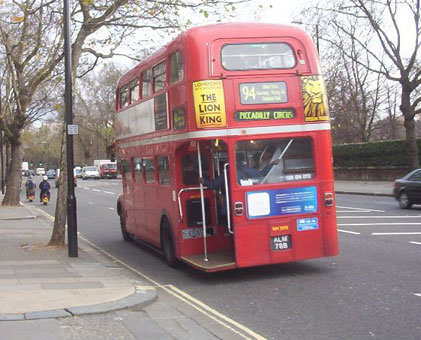
    The international evidence, which Winston does not cite, is even more substantial. This includes the all of the world’s largest bus transit system, in London, the entire Copenhagen bus system, and the entire subway, commuter rail and bus systems of Stockholm. However the ultimate in privatization is Tokyo, the world’s largest urban area, where transit ridership is 1.5 times that of the entire United States. More than two-thirds of all transit ridership is carried by unsubsidized private rail and bus operators.

    Photo: Competitively tendered bus in London (photo by author)