Tag: local government

  • You Can Grow Your Own Way

    A confluence of potent forces is creating an era of localism and decentralization across the planet making local decision-making and action more important than ever before. This is particularly true in the economic realm, where cities and regions must take full advantage of their unique combination of resources, culture, infrastructure, core competencies in industry and agriculture and the skills of entrepreneurs and workers.   

    There is no single formula for success for any place in the 21st century. Your economic strategy may need a shot in the arm (or a kick in the butt), a total remodel or perhaps it needs to be meaningfully modernized.

    The NewGeography Economic Opportunity & Growth Forum is a one-day strategy event that helps leaders, innovators and entrepreneurs develop strategies for grappling with challenges and seizing opportunities that will propel local growth.

    The one-day Forum addresses the basic fundamentals to propel growth including policies that stress essential physical infrastructure, investments in basic and skill-oriented education, and a favorable business environment that facilitates free enterprise and entrepreneurship.

    Joel Kotkin, an internationally recognized authority on economic and social trends and, a founder and Executive Editor of NewGeography.com, begins each forum with a high-level look at consequential trends and circumstances that affect local and regional growth. This is followed by an economic assessment of the local and regional economy and subsequent panel discussions involving key local leaders in business, government, education and the civic sectors.

    Each Forum culminates in afternoon strategy sessions that lead to the identification of priorities where enhanced collaboration is needed and action steps are identified for building support and mobilizing resources and talents to put your city or region on a solid growth trajectory.

    NewGeography anticipates doing only two to three Forums in the remainder of 2017 so contact us at your earliest convenience to get the ball moving. Download this pdf for more information about how to bring the forum to your community. For e-mail inquiries contact Delore Zimmerman at delore@praxissg.com.

  • Six Nova Scotia Municipalities Reject Amalgamation

    For years, some provincial governments in Canada have been either forcing municipal amalgamations or offering incentives for municipalities to merge. This has included municipalities from the largest (Toronto), which was forced into a merger over voter disapproval in 1998 in an advisory election to rural municipalities with fewer than 1,000 in Manitoba, forced to merge by the recently defeated provincial government.

    A heated debate has ensued for decades over the issue. Those who believe amalgamations are beneficial claim that costs will drop along with taxes. They claim amalgamations reduce duplication of services. Those who believe that amalgamations tend to be harmful (in most situations, this writer), note that merging the cost structures and political cultures of even adjacent municipalities is likely to raise costs and taxes and note that the duplication of services claim ignores the fact that municipalities have exclusive service areas that preclude such a result.

    Besides the disagreements over the quantitative evidence, the local opponents invariably rely on their own interest in keeping government close to home, not believing that bigger government routinely produces greater efficiencies.

    The pressure to amalgamate continues in Canada. Recently, six Pictou County, Nova Scotia municipalities began to consider amalgamating. Two dropped out, but the remaining four took advantage of a provincial government program to study amalgamation and then place the question before voters.

    The province offered $27 million for infrastructure costs, operating costs and transitional costs, in the event that the amalgamation took place. On May 28, the voters soundly rejected the amalgamation, by a nearly two to one margin. Residents in New Glasgow supported the amalgamation strongly, residents in Pictou narrowly defeated it, while residents of Stellarton and the municipality of Pictou County opposed the measure by three to one margins. According to The News, only four wards or districts approved the plan out of the 21 in the four municipalities. The Newsarticle includes a detailed chronology of the events leading up to the rejection.

    According to CTV News, The Nova Scotia Utility and Review Board had projected the merger would produce annual savings of $500,000 annually, which pales by comparison to more than 50 times higher provincial offer of $27 million as an incentive to amalgamate. Further, as has been shown in Toronto and elsewhere, higher costs can result, even where substantial savings have been projected.

  • Building the Responsive City

    The Responsive City: Engaging Communities Through Data Smart Governance
    by Stephen Goldsmith and Susan Crawford

    Technology, and especially the use of data and analytics, has been transforming the way cities manage service delivery. Former Indianapolis mayor New York City deputy mayor Steve Goldsmith, and his colleague at Harvard Susan Crawford, recently wrote a book called “The Responsive City” looking at this technology revolution. I recently read the book and posted some thoughts in a review posted at City Journal. Here’s an excerpt:

    The book chronicles more than just technology’s potential; it also highlights what some local governments have already achieved with innovative approaches. After several fires resulted in the deaths of five people, New York City built a system to identify buildings at high fire risk, using predictive models and integrating data from multiple sources. City inspectors are now aggressively targeting those buildings for upgrades. To fight its rat problem, Chicago is using data analytics to predict where rats will gather, instead of waiting for resident complaints. Boston has developed a civic customer-relationship management system, with mobile-device apps, to link residents more easily with city services. Mimicking the way that Yelp collects restaurant reviews, Washington, D.C. uses a website to solicit ratings of city services. Cities around the country are adopting open-data portals.

    Goldsmith and Crawford are candid about the challenges facing their responsive-city vision. Progressive-era reforms designed to eliminate corruption also curtailed government employees’ discretion, leaving them with narrowly defined roles and limited ability to respond effectively to real-world problems. Rigid job descriptions, such as “temporary full-time permanent intermittent police officer,” are common in cities like New York, which has more than 2,000 such classifications. Procurement rules require that detailed specifications be prepared in advance, unlike in the private sector, where technology and other solutions are often developed iteratively. Government’s rigid contracting processes make it tough to respond to findings during development.

    You can click over to City Journal to read the entire thing

    I also sat down with Steve Goldsmith recently to talk about the book, and some of the challenges and pitfalls of this technology-drive approach. If the audio embed doesn’t display for you, click over to listen on Soundcloud.


    This piece originally appeared at The Urbanophile.

  • Will Obamacare Bail Out Cities?

    When Rahm Emanuel was Barack Obama’s Chief of Staff, little did he know he’d be helping craft a law that would help him as the future Mayor of Chicago. Many American cities failed to put away enough money for current and former government workers.  Rahm Emanuel and powerful Democratic Party interest groups would like the federal government to bailout their pensioners. While the unions are less shy about looting federal taxpayers, Emanuel is working hard getting federal help.

    Emanuel needs to cut costs immediately to prevent more downgrades from the bond rating agencies.  One of Emanuel’s creative financial techniques involves the use of Obamacare as way of pushing some financial costs from the city of Chicago budget onto the federal government.  Many retired workers don’t like or want Obamacare.  The Chicago Sun Times reports :

    Chicago’s 30,000 retired city employees are trying to stop Mayor Rahm Emanuel from saving $108.7 million — by phasing out the city’s 55 percent subsidy for retiree health care and foisting Obamacare on them.

    One week after an unprecedented, triple-drop in Chicago’s bond rating, retirees have filed a class-action lawsuit against the city and its four employee pension funds that threatens to make the financial crisis even worse.

    The suit argues that the Illinois Constitution guarantees that municipal pension membership benefits are an “enforceable contractual relationship which may not be diminished or impaired.”

    Chicago’s retired workers aren’t the only individuals unhappy with Obamacare.  IRS workers don’t want Obamacare but likely will find they can’t keep their current health insurance.  All of this is providing massive strains on the Blue Model coalition of government workers and the Democratic Party.  In Chicago, at least retired government workers can know who to blame for their change in health insurance if they lose their lawsuit. Mayor Rahm Emanuel not only was instrumental in getting Obamacare passed but now he’s dumping Obamacare on thousands of workers as Chicago’s Chief Executive.

  • Avoiding Expensive Municipal Mergers

    An article in The Wall Street Journal discussed attempts to merge local governments in Michigan. While efforts such as these gain wide support because of the belief that they will save money, there evidence shows the opposite.

    Government consolidations may seem to make all of the sense in the world academically. In practice, they cost more. There are no economies of scale in larger governments, except for spending interests. Voters have less influence in larger jurisdictions.

    A simple look at the evidence, rather than the theory, indicates this. Our analysis in five states shows it, and the differences are stark. Lower per capita spending and taxation at the local general government level is associated with smaller units of government.

    It is not therefore surprising that in Toronto, Hamilton and Ottawa there have been calls to "demerge" cities forcibly merged in the 1990s. In a debate in Toronto last October with a top transit official (a member of the left leaning National Democratic Party), we agreed on at least one thing — that Toronto’s amalgamation had been a mistake.

    Nor is it surprising that despite huge electoral barriers erected by the Charest government, a number of municipalities voted to demerge from the forcibly enlarged ville de Montreal in the early 2000s.

    For the most part, however, there is no going back. Mergers are forever. So are the higher taxes and higher spending.

    My commentary in Canada’s National Post  dealt with this issue on the 10th anniversary of the Toronto amalgamation.

  • How the Tobacco Companies Should Spend Their Money

    Once again, in the debate over California’s Proposition 29, the tobacco companies seem to have all the money in the world, even though relatively few people smoke nowadays. Under the circumstances, I don’t shed much of a tear for them.

    1. They could put on their packs, in type as large as the health warning, “DISPOSE OF PROPERLY – PUT BUTT BACK IN PACK”. Or, they could include a little plastic bag with each pack, of the kind that we insist dog walkers carry – no one crusades against dogs as a health hazard, and the way we deal with solid dog waste is the way we should deal with cigarette waste. It’s amazing, in a society where so few people supposedly smoke, how much litter is composed of butts. In fact, one reason I took up smoking cigarettes at the advanced age of 59 is precisely that I wanted to be able to practice what I preach, and show that it could be done. A stupid reason for starting smoking? Well, is there an intelligent reason for starting smoking? I don’t think so. I mean, if the beer companies can put on their cans “Dispose of Properly” so can Altria, or whatever it’s called.
    2. They could take back filters and recycle them into something, paying us a penny per filter, like we already do with certain kinds of glass bottles and cans. Surely all those filters can be used for something. And surely the tobacco companies have enough money to be able to support some research on this subject. And, for those who wish to keep the penny in circulation (the Canadians are phasing out theirs, and no coin in common use in Europe is worth that little) here’s a use for it.
    3. Tobacco taxes could be used to support the supplemental health insurance system, for those who have trouble affording health insurance, because their product does burden the health care system. I’m not in favor of a “public option,” necessarily, so I don’t know how it is to be worked out. Maybe an “assigned risk pool” like with auto insurance. Anyhow, tobacco should not be the cash cow for everybody’s favorite cause, as it seems to be now. Cigarette smokers and rich people – not much overlap between the two nowadays – are the “other people” or “not me” whom we feel free to tax heavily.
    4. I never want to go back to the days of indoor smoking, with the possible exception of some bars (not restaurants) in colder or more extreme climates. (I still find the idea of smoking with food, or with anything but water, beer, coffee, or bourbon, disgusting.) The companies could chart and promote “smoking patios,” which are places where you can have your alcoholic drink and smoke at the same time, as people like to do. Amusing to British people are the restrictions on taking one’s drink outside; if you can’t smoke inside, and can’t drink outside, only on these patios do the two universes intersect. Here in my own community, the individual bars are allowed to choose whether their “patios” (which you have to enter from inside, not from the street) allow smoking, or not; some do, some don’t, depending on their clientele.) And, apartment complexes that ban smoking in their apartments could have an outdoor space in the courtyard, where you can also take your drink. It encourages certain people to leave their rooms and their video games and come out into the courtyard or street and be reasonably social. Another reason why I don’t want to return to indoor smoking. Public and street life is encouraged by banning it. The New Urbanists ought to take a note of this. And if people are trained to not drop their butts on the ground, the aesthetic and litter aspects of the vice can be minimized. Smoking cigarettes, given the hazards, is something of an extreme sport; I have no problems with it being mainly an outdoor one.
  • Trials, Tribulations and Middle Class Protest in Christchurch, New Zealand

    It has been a tough year and a half in Christchurch. Christchurch is the largest urban area South Island and second in size in New Zealand only to Auckland. On September 4, 2010, Christchurch was hit by a 7.1 magnitude earthquake, stronger than the 7.0 magnitude earthquake that with its aftershocks killed 300,000 people in Haiti in 2010. To the great fortune of Christchurch, there were no fatalities from the September quake.

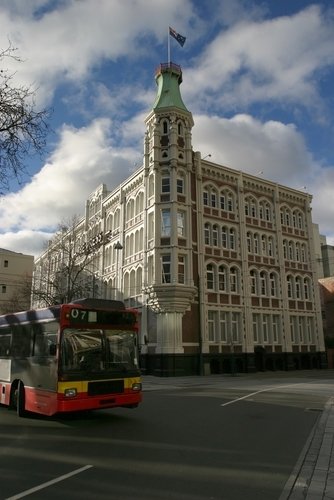
    In Christchurch, the earthquakes just kept coming and the luck ran out. A major aftershock nearly a year ago (February 22, 2011) registered 6.3, but did much more damage to buildings and infrastructure weakened by the September 2010 quake. A total of 184 people lost their lives, with more than one-half of the victims in the Canterbury Television (CTV) building (photo), which collapsed. Many of the victims in the building were foreign students. The area’s tallest building, the 23-story Grand Chancellor Hotel (photo) was condemned and demolition is underway. Another major hotel, the Crowne Plaza, was too damaged to be repaired and will be demolished. A number of heritage buildings were also condemned and have either been demolished or will be, such as the Manchester Courts (photo), built more than 105 years ago and the Christchurch Press building (photos: before and after), which housed the city’s daily newspaper.

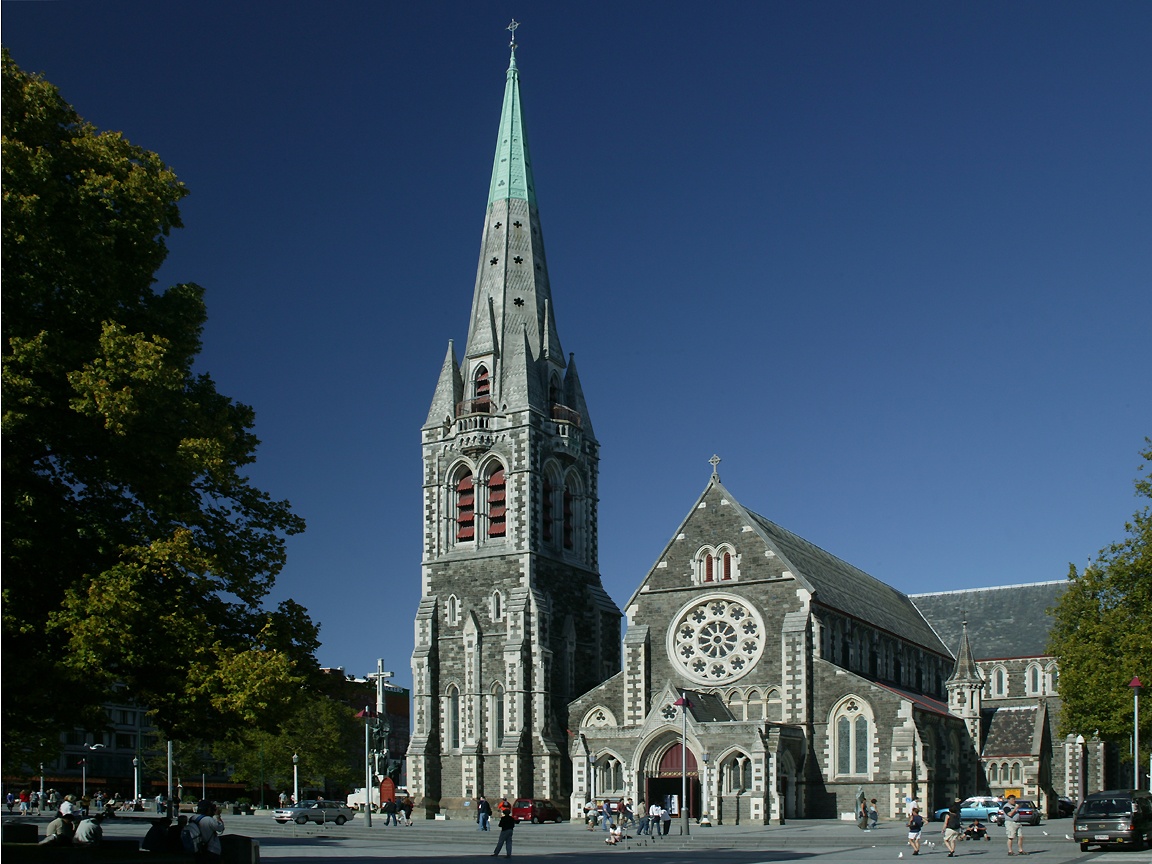
    The city’s fabled Christ Church Cathedral (Anglican/Episcopal) was badly damaged (photos: before and after). The damage was ecumenical, with the Catholic Cathedral of the Blessed Sacrament also suffering serious damage (photos: before and after). Strong aftershocks in June and December of 2011 did additional damage. Much of the central business district was declared a "red zone," off limits except for special permission (red zone map). Finally, the disasters have been a serious enough blow to the nation to cause postponement the 2011 census to 2013.

    For many of the survivors, the earthquakes were just the beginning. In the eastern part of the urban area, toward the Pacific Ocean, streets, houses and commercial buildings were undermined by liquefaction. New Zealand Prime Minister John Key said that 10,000 homes would need to be condemned. Some neighborhoods will not be rebuilt because of potential future liquefaction.

    In the meantime, there has been growing dissatisfaction with the area’s largest municipality (local government authority), the city of Christchurch. Replacement housing consents have been slow in coming and far slower than in neighboring suburban municipalities. This has caused considerable concern for households needing to move and rebuild.

    Then, the city council narrowly approved a 15 percent, $68,000 salary increase ($56,000 US) for the city council chief executive (city manager) Tony Marryatt. The pay raise ignited the unusual phenomenon of an everyday citizen’s protest movement. Marryatt initially defended the pay raise to $540,000 ($450,000 US) claiming he would be paid the market rate. As the debate intensified, Marryatt subsequently decided to decline the pay raise. That was not enough for the protesters, who include homeowners, business owners, members of the clergy and an array of citizens. Protesters demanded that Marryatt resign, that Mayor Bob Parker resign and that the national government schedule new elections.

    For his part, Mayor Parker’s television interview doublespeak characterizing the $68,000 as "not a pay rise" and then mumbling on about "paying the market rate," won him no friends. In the same interview, protest leader, the Reverend Mike Coleman questioned the council executive’s travel for golfing outings to North Island and travel to Australia’s resort Gold Coast. Coleman was particularly critical of Marryatt’s not having interrupted his Gold Coast vacation to return to Christchurch after the December aftershocks.

    On Wednesday, February 1, an estimated 4,000 people (according to the police) gathered in Christchurch at a rally to press their demands. A television report called the "most poignant moment" a speech by firefighter Kelvin Hampton, who told of having to perform a double amputation with "a hacksaw and a knife" above the knee of a victim. Hampton noted the irony that his annual salary was less than the salary increase for the council executive.

    A protest committee released an open letter to Dr. Nick Smith, the Minister for Local Government calling for the national government to:

    • Call for mid-term (unscheduled) elections for city council and mayor
    • "to impress on our council to develop a process that will address the issues around the council holding up the rebuild of Christchurch. This will include how and when to fast-track land-zoning changes, sub-divisions and other consents in an open and transparent way, while ensuring that the suitability of the land and the safety of the buildings is assured."

    The protest committee also called upon Mayor Parker and sitting councilors to "commit to transparency and accountability to the people they were elected to serve in the lead up to new elections."

    TVNZ highlighted the uniqueness of the protest, running a feature on Andrea Cummings, who had never participated in such a protest before. She and her husband run a small business in a hard hit neighborhood
    of east Christchurch. Like Ms. Cummings, most of the attendees had not protested before, though one lady indicated that she had participated in Viet Nam war protests in college.

    Where it goes from here cannot be said. Mayor Parker remains confidently in charge, with the council executive by his side. And, the protesters are determined to keep up the fight. Christchurch may never have seen such a thing before.

  • What to Do About Gang Violence in Salinas California

    Is there any connection between the fact that Salinas has the gang problem that it does, and the fact that Monterey County’s restrictions on the building of housing are very strict? I can see why the inhabitants of the Monterey Peninsula might want to protect the coastal strip. But if they apply their policies to the whole county, it becomes very difficult to build any housing. I saw a proposal 40 years ago from Ralph Nader’s think tank that would encourage the building of Italian style hill towns along the hills along both sides of the South Santa Clara Valley, thus leaving the lowlands along the river for agriculture; such a plan could be applied to the Salinas Valley as well. I don’t have the expertise to draw the connection between restricted housing and the gang situation in Salinas, but surely the situation is worth looking at. What kind of novels would a John Steinbeck write, if he were growing up in Salinas today?

  • Cities Have Outgrown Their Role as Mere Creatures of the Provinces

    The Martin Prosperity Institute recently released the map below, which compares the GDP of several US metropolitan areas to the size of national economies. For instance, the Boston-Cambridge-Quincy metropolitan statistical area (MSA) has a GDP of $311.3 billion dollars. If it were a country, it would be the 40th biggest national economy on earth, ahead of countries such as Denmark ($310.1) and Greece ($303.4). The Houston-Sugar Land-Baytown MSA has a GDP of $378.9 billion, which would make it the 31st biggest national economy, bigger than Austria ($375.5) and Argentina ($368.9). New York-Long Island-Northern New Jersey ($1.28 trillion) isn’t all that far behind Canada ($1.57 trillion).


    While trotting out such comparisons is an interesting exercise, the comparison also gives us some important perspective.  Despite the fact that these cities, as well as many others, produce as much as large countries, they have nowhere near the same fiscal levers at their disposal. Further, they are subservient to higher levels of government. The same problem exists in Canada. The Greater Toronto Area’s economic output ($233.9) is nearly equivalent to Finland’s total GDP ($270.6). Note that this definition is far less expansive than the US metro areas listed above. If the definition were expanded to include the entire Golden Horseshoe, it would be closer to the Size of Norway ($414.3 billion).  Yet the City of Toronto can’t finance a public transit expansion without the two senior levels of government. Calgary ($62.5 billion), roughly the size of Lithuania, couldn’t decide to create a municipal sales tax. Vancouver ($85.5 billion), slightly bigger than Serbia, can’t even decide how to allocate gas tax dollars without a special deal with the federal government.

    The problem isn’t that we have too little government spending, but that revenue collection and spending decisions often happen at the wrong level. Revenue generation and spending should take place as close as possible to the point of delivery. There is no reason why someone in Moose Jaw should pay federal income taxes so that the Federal Government could partner with the province of New Brunswick to build a highway near Moncton. Similarly, there’s no reason why someone in Edmonton should send property tax dollars to the province so that it can pay for a transit expansion in Calgary. Not only is filtering money through multiple layers of bureaucracy inefficient, but it leads to bad decision making. Decisions both on the revenue, and expenditure side need to be made at the lowest level of government possible.

    In order to ensure that cities can meet their infrastructure requirements, provincial governments should gradually devolve spending responsibilities and revenue generating capacities to the municipalities, and the federal government should end the practice of intervening in infrastructure issues altogether. Some municipalities may choose to raise property taxes, others may increase user fees, and still others may experiment with municipal sales taxes. But regardless of how municipalities decide to raise revenue, they are better placed to determine how much revenue is required, and which projects are really essential. More importantly, devolution gives more direct control over decision making to the people that are actually impacted by the decisions. Devolution means more accountability, and more local input. And if tiny Iceland can fund it’s own infrastructure, there’s no reason why Winnipeg or Edmonton couldn’t do the same.

    This piece originally appeared at the Frontier Centre for Public Policy Blog.

    Steve Lafleur is a public policy analyst with the Frontier Center for Public Policy.

  • A More Objective Attitude Toward the Suburbs (Almost)

    It is always encouraging to see greater objectivity in the treatment of the suburbs. In fact, the urban form includes not only the urban core, but also the suburbs and economically connected rural areas and exurban areas that are beyond the urban footprint. This fact has often been missed by some urbanologists who imagine no city extends beyond the view on the foggiest day from a central city office tower.

    William Upski Wimsatt, author of Bomb the Suburbs, has now published an update called Please Don’t Bomb the Suburbs. The title of Wimsatt’s original book, focusing on grafitti and hip-hop culture, has a ring reflective of the irrational and ideological condemnation that has been far too typical of some of the urban planning community.

    Wimsatt cites five myths about suburbs in a Washington Post opinion piece. To be charitable, he gets as many as four of them right. These include his discovery that suburbs are not white middle-class enclaves, that they can be "cool," that they are not necessarily politically conservative, and that suburbanites care about the environment.

    However, Wimsatt still has some distance to go. His last myth suggests that suburbs are not the result of the free market. This general proposition is tenable, for example, given large lot zoning requirements, which have caused many urban areas to consume far more land than they would have if the market had been allowed to operate. The problem with Wimsatt’s free-market analysis is his acceptance of three additional myths.

    Myth 1: Smart Growth Reduced Property Taxes in Portland: Wimsatt cites an analysis indicating that property taxes in Portland dropped between the mid-1980s and the mid-1990s while property taxes in Atlanta increased. He uses this "factoid" to imply that Portland’s more restrictive land use planning regime ("compact development" or "smart growth") is superior to the more liberal Atlanta approach. Wimsatt does not note that during this period the voters of Oregon implemented their own Proposition 13 type property tax reduction (Measure 5), which lowered property taxes even as per capita revenue rose at a greater rate in Oregon than in Georgia. To be fair, Wimsatt cannot be blamed for this oversight, since the Sierra Club source he cited omitted this detail. We refuted a larger analysis by Arthur C. (Chris) Nelson that included this claim 10 years ago, in a paper for the Georgia Public Policy Foundation entitled American Dream Boundaries: Urban Containment and its Consequences.

    Myth 2: Suburban Infrastructure is More Costly: Wimsatt claims that the cost of infrastructure and public services is higher in suburbs than in the urban core. Joshua Utt and I put this myth to rest in research covering all of the reporting municipalities in the US government database, which indicated no such higher costs (The Costs of Sprawl: What the Data Really Show). The claims of higher infrastructure and service costs in the suburbs are largely based on theoretical studies, which invariably suffer from the "length of pipe" fallacy, which fails to take into consideration the substantial differences in the costs of infrastructure construction in already developed areas versus greenfield areas. In fact, labor costs tend to be less in suburban areas. Moreover, much of the cost of suburban development is paid for by home owners, who reimburse developers who have already paid much of the sewer, water and street construction costs. These are not costs to the public or to society, they are costs that buyers voluntarily pay for what they consider to be a better lifestyle. Finally, Core city infrastructure is often obsolete and not able to adequately serve the higher demand that would occur from substantial population increases.

    Myth 3: Consolidating Local Government Saves Money: Wimsatt presumes that consolidation of local governments is a way to reduce public expenditures. He cites the case of towns in New Jersey, which he would prefer to see combined. Despite the fact that ivory tower before-the-fact analysis routinely concludes that larger, consolidated local governments are spend less per capita than smaller governments, the record says exactly the opposite. Our research, using US government, New York, Pennsylvania and Illinois state databases shows a consistent relationship between larger local governments and higher expenditures per capita and higher debt per capita.

    This should not really be so surprising, since larger governments tend to be further from the people and by definition more remote from their control. Where voters are less important, as is the case with larger local governments, special interests fill the vacuum, generally to the detriment of taxpayers.

    With this diluted control by voters, larger governments tend to get into financial difficulty, and a vicious cycle of excessive spending and debt can follow. Often unable to say no to spending interests, they raise taxes. When the electorate loses tolerance for higher taxes, larger governments tend to borrow, which increases expenditures even more. Finally, when they reach high debt levels, it is not unusual for there to be proposals to consolidate these governments with their smaller neighbors, which have been more fiscally prudent. If consolidation is implemented, the new larger local government is granted a new lease on fiscal irresponsibility, and per capita expenditures and debt is likely to rise even higher.

    As if that were not enough, labor contracts and service levels are routinely "harmonized" at the highest cost, since employees will not be forced to take pay or benefit cuts and service levels will generally not be reduced for residents. This was cited by the Toronto Business Alliance after a theoretical $300 million in promised cost savings were transformed into substantially higher spending in the newly consolidated city.

    Welcome: Wimsatt graciously ends his commentary by saying "Everyone with a prejudice against the suburbs will have to get over it. Even me." Welcome, Mr. Wimsatt.