Tag: London

  • Grenfell External Fire Erupts After Flat Fire Extinguished?

    The Daily Telegraph reported (June 20) that:

    "Crews believed they had put out the fire at the London high-rise and were astonished to see flames rising up the side of the building, new reports have claimed."

    "But, soon after, the 24-storey building was consumed by flames in one of Britain’s biggest ever tower block fires that left at least 79 people dead."

    The paper continued that: " Those reports will add weight to claims that it was the cladding on the exterior of Grenfell Tower that caused the fire to spread so rapidly."

    The entire Telegraph article can be read at: http://www.telegraph.co.uk/news/2017/06/20/grenfell-tower-firefighters-put-fridge-blaze-just-leaving-flats/

    The fire’s death toll is now at 79. Newgeography.com covered the fire ("The Grenfell Fire: A Litany of Failures?").

  • The Grenfell High-Rise Fire: A Litany of Failures?

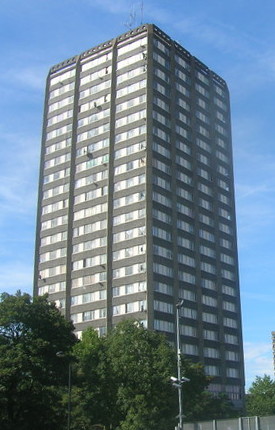
    At this writing, the London (Kensington) Grenfell high-rise fire has taken a confirmed 58 lives, with an unknown number missing and many more sent to hospitals. The 24 story low income housing tower block caught fire on Wednesday, June 14. It was virtually all consumed, as shown in the photograph above.

    There is much to be concerned about here. This building was not owned by any of those private developers who politicians seem to blame for every all that’s wrong with housing in severely unaffordable Britain. The building, now a burned out shell, is owned by the affluent Royal Borough of Kensington and Chelsea (a local government unit within the Greater London Authority).

    This is how the structure appeared before the recent refurbishment (photo by R Sones).

    Government Failure?

    It is not as if the council had not been warned. The Grenfell Action Group has been monitoring problems at Grenfell Tower on behalf of tenants for years. On June 15, they published a blog with links to their previously expressed concerns about fire safety in the building, including one entitled KCTMCO Playing with Fire that details the frustrations of dealing with the Council’s tenant manager. The post, from last November included called the conditions, including the management of the KCTMO (Royal Borough of Kensington and Chelsea Tenant Management Organisation) and the Borough "a recipe for a future major disaster." Of course, that’s how it turned out.

    There is talk of criminal proceedings, and doubtless the private contractor who installed the cladding (exterior building facing) currently thought to have spread the fire quickly will be at greatest risk. However, the installation was procured by the KCTMO, the agent of the RBKC Borough Council, including an approved award to the contractor. Further, all of this was related to a refurbishment of the building, in which the RBKC did not require include installation of sprinklers, which would have "prevented the fire from developing." The Royal Borough of Kensington and Chelsea council is being barraged with criticisms, including from members of Parliament, for its administration of the Grenfell Tower over recent years.

    A Great Planning Disaster?

    Worse, in a larger sense, the Grenfell fire may turn out to be one of the world’s great planning disasters. One headline put it this way: "Report: Grenfell Tower Fire May Have Been Caused By Panelling Installed To Make Rich Neighbors Happy." Only slightly less incendiary was The Independent headline, which read "Grenfell Tower cladding that may have led to fire was chosen to improve appearance of Kensington block of flats."

    According to planning documents obtained by The Independent:

    “Due to its height the tower is visible from the adjacent Avondale Conservation Area to the south and the Ladbroke Conservation Area to the east,” … “The changes to the existing tower will improve its appearance especially when viewed from the surrounding area.”

    The Independent also reported that the planning document made repeated references to the "appearance of the area" and that this was the "justification for the material used on the outside of the building, which has since been claimed to have contributed to the horror." The materials were chosen, according to the planning document "to accord with the development plan (our emphasis added) by ensuring that the character and appearance of the area are preserved and living conditions of those living near the development suitably protected,”

    One expert indicated apparent frustration at the use of flammable cladding materials: "We are still wrapping postwar high-rise buildings in highly flammable materials and leaving them without sprinkler systems installed, then being surprised when they burn down."

    The extent and spread of the fire was unusual for a high rise building. London Fire Commissioner Dany Cotton told The Engineer: “This is an unprecedented situation, with a major fire that has affected all floors of this 24 storey building, from the second floor up. In my 29 years with London Fire Brigade I have never seen a fire of this nature.” According to the Evening Standard: "…flames engulfed the block from the second floor upwards “within seconds”

    Concern in Australia

    While the Grenfell fire’s severity has been attributed to the flammable cladding installed during renovation, similar cladding is being used on new high rise buildings elsewhere. For example, according to The Age the Melbourne Fire Brigade found that the fire at the contemporary LaCrosse building ignited external wall cladding, which quickly spread to the top of the building through the "combustible material located in the wall structure." Two days after the Grenfell fire, The Guardian ("Former fire chief says Melbourne’s Lacrosse Tower still poses risk") reported that the cladding had still not been replaced, though the building has been reoccupied. Peter Rau, a former Melbourne Fire Brigade Chief told The Guardian that "he would not allow his children to live there."

    Australians may have plenty of reason to be concerned. Planning policies throughout Australia have sought to convince households to live in central city high-rises, seeking to entice them from their preferred suburban detached housing. In a June 15 story, The Age ("London tower fire could happen here: Australian buildings cloaked in flammable cladding") reported that Australian buildings are clad in "millions of square meters" of flammable cladding. This is not a new problem. According to The Age building code authorities were advised of the problem seven years ago.

    Tony Recsei, President of Save Our Suburbs in Sydney expressed concern in a  Sydney Morning Herald letter. Referring to the New South Wales government policy that seeks to increase high rise living, Recsei said "But this calamity starkly reveals there can be long-term consequences. It is to be hoped that the Greater Sydney Commission will seriously consider all the implications of its current strategy of imposing density quotas onto local neighborhoods."

    The extent of the concern in Australia is indicated in this video and article from news.com.au.

    New Zealand and the United States

    Even in New Zealand, where officials recently strengthened external materials fire regulations, the government asked local authorities to check buildings constructed before the regulatory reform to see if there are any with combustible cladding.

    According to the Times of London, the cladding used on Grenfell Tower has been illegal in the United States for five years.

    Further Developments in London

    Meanwhile, back in London, there remains considerable anger. London Mayor Sadiq Kahn visited the site on June 16 was questioned and heckled by survivors. On the same day, Prime Minister Theresa May also visited the scene and was criticized for meeting only with emergency services personnel, but not with any residents.

    The fatality count could go much higher. Fears of a building collapse are slowing inspection efforts. Metropolitan Police Commander Stuart Cundy told The Independentthat "he hoped the death toll would not be in “triple figures”.

    No Clean Hands?

    Of course, final assessments will have to await more formal inquiries. But there is plenty of reason to be concerned. Save the fire brigade, which has been roundly praised for its work, including being on the scene within six minutes, there may be no clean hands. Cities, from the days of ancient Rome, have been vulnerable to fiery disasters like this one; policies that encourage densification while failing to provide adequate safety procedures are creating the potential for more such disasters.

    Grenfell fire photo by Natalie Oxford.

    Wendell Cox is principal of Demographia, an international public policy and demographics firm. He is a Senior Fellow of the Center for Opportunity Urbanism (US), Senior Fellow for Housing Affordability and Municipal Policy for the Frontier Centre for Public Policy (Canada), and a member of the Board of Advisors of the Center for Demographics and Policy at Chapman University (California). He is co-author of the "Demographia International Housing Affordability Survey" and author of "Demographia World Urban Areas" and "War on the Dream: How Anti-Sprawl Policy Threatens the Quality of Life." He was appointed to three terms on the Los Angeles County Transportation Commission, where he served with the leading city and county leadership as the only non-elected member. He served as a visiting professor at the Conservatoire National des Arts et Metiers, a national university in Paris.

  • Globalization’s Winner-Take-All Economy

    “If you are a very talented person, you have a choice: You either go to New York or you go to Silicon Valley.”

    This statement by Peter Thiel, the PayPal founder and venture capitalist, unsurprisingly caused a stir, given that he made it in Chicago. Simon Kuper had made a similar observation in the Financial Times when he described how young Dutch up-and-comers had their sights set on London, not Amsterdam. “Many ambitious Dutch people no longer want to join the Dutch elite,” Kuper wrote. “They want to join the global elite.”

    Populist movements in Europe and the United States have fueled talk of social and economic division, of a small class of winners at the top and a far larger group of increasingly disaffected lower-skilled workers at the bottom. This attitude seems to flow through to places as well, with global city winners like London and post-industrial losers like Flint, Mich.

    Because these divides cleave along social class, educational and cultural lines, they are clear and easy to see. But there’s another — less visible — divide cutting across the seemingly monolithic group of the successful. This one separates those who are indisputably winners from those whose success is ambiguous, more qualified and more contingent. This difference is the one between the hedge fund principal, raking in wealth seemingly effortlessly, and the young adult struggling to pay urban rent despite possessing an excellent degree and professional employment. It’s the difference between New York and Cincinnati — or even Chicago.

    The same forces of globalization that  have pulled top Midwest talent into Chicago from below are also acting on the city from above, drawing its talent further up the global city hierarchy. The knowledge economy favors the college degreed over the less educated, but those with the highest and most differentiated skills are most favored, while those whose skills are second tier — less perfectly in tune with the emerging economy — are more vulnerable to competitive pressures.

    It’s easy to see that the Flints of this world have struggled. Less visible are the stresses put on second-tier cities — the Chicagos and Cincinnatis — from a system that is disproportionately giving the greatest rewards to those at the very top of the hierarchy while threatening even the seemingly successful cities with being left behind.

    Economist Richard Florida calls this phenomenon “winner-take-all urbanism.” It’s the superstar athlete or celebrity effect transposed into the urban world. Just as A-list stars earn far more than the merely famous, the top business talent and the top cities are reaping disproportionate riches over the merely prosperous.

    This divide is harder to spot because the people and places involved are often superficially similar. The people in both possess university degrees. They share similar cultural norms, aspirations and politics. The places they live in all have their farm-to-table restaurants, tech startups, artisanal coffee roasters and bicycle commuter infrastructure. As with a sports team, they all wear the same uniform. But some are all-stars while others are role players who are more easily replaced.

    When young workers or artists struggle to find an affordable apartment in a global capital, this isn’t just proof of a failure to deregulate housing development. It’s also a marketplace sending a powerful signal that their position among the winners of society is much more precarious than they might imagine. Most would agree that there are some businesses and people who shouldn’t be in New York or San Francisco. We shouldn’t expect a peanut butter spread of talent and economic activity across the country. The nature of the industries concentrated in these places produces a higher-end specialization. So there will be some economic value line below which it isn’t viable to be there.

    There’s an argument to be made that building more housing to reduce rents can draw the line lower. But that still presumes a line. When aspirational millennials — or even older people like me — can’t afford the current rent, that’s a signal that they are near or below that line. In a time in which rewards seem to be skewed to the top, that should be worrisome to them personally, not just to the poor or working classes.

    Similarly, cities that remain a notch below the top tier should be worried. Chicago’s financial crisis, population loss, violent crime spike and other problems suggest fundamental structural challenges facing the city. And if even Chicago is not fully achieving the global-city status it craves, shouldn’t other cities be worried?

    Yet the leaders of these cities, and the ambiguously successful people who live in them, have tended to identify themselves as among the winners. They haven’t really grappled with the fact that the global economy puts them at risk. It’s not just people in Flint or Youngstown, Ohio, who are being buffeted by globalization. If these people and cities ever came to view themselves as at risk, they could become a powerful voice for reforming the system to be more equitable while retaining its fundamentally open character. They are the exact potential champions for change in a system that badly needs it so that we can broaden the pool of success.

    Unfortunately, those among the ranks of the second-tier successful have instead sided with the global capitals and the global elite to defend the economic status quo, leaving the reform fight to the populists who prefer an overly closed system. They may yet discover to their chagrin that the very system they so vigorously supported will ultimately become their own undoing.

    This piece originally appeared in Governing Magazine.

    Aaron M. Renn is a senior fellow at the Manhattan Institute, a contributing editor of City Journal, and an economic development columnist for Governing magazine. He focuses on ways to help America’s cities thrive in an ever more complex, competitive, globalized, and diverse twenty-first century. During Renn’s 15-year career in management and technology consulting, he was a partner at Accenture and held several technology strategy roles and directed multimillion-dollar global technology implementations. He has contributed to The Guardian, Forbes.com, and numerous other publications. Renn holds a B.S. from Indiana University, where he coauthored an early social-networking platform in 1991.

    Photo: Kevin D. Hartnell (Own work) [CC BY-SA 3.0 or GFDL], via Wikimedia Commons

  • Solidarity, not Division: Understanding London’s East End

    The East End of London has a long history of working-class community. It has been a place of industry, where the river Thames and the river Lea have provided work for many people. The area attracted many immigrants, including workers from Africa since Tudor times, sailors from China, former slaves from America, French Protestants facing religious persecution in the 1600s and Irish weavers working in the textile industries. There have been Jewish communities in the East End for centuries, too. The twentieth century saw an increase in immigrants from the former British colonies, including South Asia, particularly Bangladesh. Not only has it been a place to seek a livelihood, but it has also been a place of refuge.

    One side of my family hails from the East End and North East London, so I have a strong personal connection to this part of London. My ancestors worked in the local industries and on the river. We might not technically be ‘Cockneys’ (in that we weren’t all born within earshot of Bow Bells), but we are Cockney by nature. Family gatherings would include a raucous ‘knees-up’ (dancing and singing) and traditional local fare of jellied eels. We’re a working-class family who have lived in East London for generations.

    So I was interested when I came across a recent short BBC documentary called Last Whites of the East End. I was disturbed by the title, which suggested that white people in the area are somehow endangered – an odd idea and potentially a racist one. This racism was confirmed when I watched the show. The documentary focused on residents of Newham, one of the poorest working-class boroughs in England. The filmmakers interviewed a number of working-class residents about their experiences of living in the East End and the decisions of some of them to leave the area. The majority of the subjects were white, though they also included one man of Bangladeshi background and one man of white and Afro-Caribbean heritage.

    The narration of the documentary presented a racist agenda, describing the neighbourhood as at ‘tipping point’ with the ‘lowest white population in the UK’. It also noted a ‘dwindling cockney community’ who were in danger of disappearing in the face of increased immigration. Some of those interviewed were moving outside of London, to places like Essex, so they could live in areas with larger white populations. Some described themselves as ‘traditional East Enders’ and lamented the loss of the old community. They spoke of local services being shut down and the closure of the local pub. The film presented the interviewees as embodying white racism and a fear of the other, highlighting their reluctance to build bridges due to perceived differences. As one young white woman explained, they wanted to ‘stay with their own’.

    But there were many contradictions in the documentary, too. It included an elderly white woman, who was preparing to leave her home and move out of London, not due to her fear of her Muslim neighbours (as implied by the narration, despite the fact that she was obviously upset to say goodbye to her Somali neighbour), but because she was elderly and alone and wanted to move closer to her daughter. Like many of her neighbours, she had once been a new arrival to the neighbourhood, moving there from the north of England. The two people of colour in the film both spoke of their connections to the local area and their identification as East Enders. Like their white neighbours, they pointed to the changing environment, but I’d suggest that the changes they were criticising were not tied to the latest influx of new immigrants.

    Instead, they are matters of class. Gentrification and austerity are disrupting the lives of the working-class residents of the East End, not immigration. Housing has become too expensive, and government funding cuts are squeezing local schools and health services. Interviewees complained about the closure of a club which wasn’t just a local pub but also a community centre that elderly residents relied on for social events and to reduce isolation. Some white people are leaving, but, as I’ve seen with some friends and family members, that’s for financial reasons. They can purchase bigger properties if they sell their London homes, or they can pay less rent by moving to areas outside of London with smaller populations and less pressure on local services. And of course, not all of those leaving London are white.

    The documentary downplays this part of the story. It also downplays the working-class solidarity that connects residents despite their differences. Residents of the East End share the experience of hardship and struggle, and this shared struggle has a very long history. The East End has a tradition of political radicalism and collective action. East Enders have looked after each other during tough times and shown a united front against hostile external forces. Famously, in 1936, the local community stood up against a group of anti-Semitic fascists who wanted to march through a Jewish area. The confrontation, known as the Battle of Cable Street, was won because the community put their bodies on the line to keep the fascists out. The same community rallied during the Second World War and looked after each other during the bombing raids of the Blitz. More recently, local people have been supporting each other and engaging in collective action in the face of forced evictions as local public housing is sold and redeveloped for private profit.

    If the ‘traditional East End’ is disappearing, that isn’t because some working-class white are moving out of London. Working-class communities are not made up of just white people, and I’ve certainly never known a London that was mono-cultural. Yes, there are racist white working-class people. But the East End of London is a diverse and dynamic place, and always has been. It has also been a place of solidarity and struggle. The filmmakers chose to emphasize division instead of showing how East Enders act collectively, and it cast immigrants as a threat, when the real threats facing this community are austerity and gentrification.

    This piece first appeared at Working-Class Perspectives.

    Photo Credit: Daryl Hutchison, @daryldactyl

  • Working Class British Voters Led the European Union Rejection

    On Thursday night the first results from Britain’s referendum on pulling out of the European Union came in.

    A small clue to the way things were going last night was the vote in the North East.

    People in Newcastle are known locally as ‘takems’ (said with a short a, like tack um); those in Sunderland are called ‘makems’. It means that people in Sunderland make things and people in Newcastle take them. Sunderland is solidly industrial, while Newcastle, also a big industrial centre, is a market town. Newcastle voted to remain, but by the tiniest of margins. Sunderland voted to leave, 60-40. That was when we began to think that – not for the first time – the polls had got it wrong.

    As the night wore on the results came in, defying the pollster’s determination that the people would reject the referendum question and stick with the European Union.

    Of London Boroughs, Barking voted to leave, too. It was historically a ‘white flight’ borough, but today it is thronging with Poles and Africans. It is very working class. Islington, by contrast, was overwhelmingly for stay. Islington has working class wards, though these are mostly demoralised, and the borough deserves its reputation for being dominated by a precociously radical middle class.

    Most of all the vote is a popular reaction against the elite. Their view that the European Union is not for them is right. I have taken students to the Brussels Parliament, which is a bit like visiting the offices of the IMF. The only people that you see hanging around outside and waiting to see someone, are themselves very haut bourgeois. By contrast, if you go to the Palace of Westminster, you will see large crowds of school children, nurses, veterans, and ethnic minorities. Parliament is often very bad in its decisions and its cliquishness, but the people do look to it in a way that they will never look on Brussels. That law making should have passed so silently and sneakily off to the European Commission is not something that ordinary British people approve of, and they are right.

    The British Labour movement protested against the Maastricht Treaty back in 1991 that created the EU, and had already been committed to a position of withdrawing from the preceding EEC. Labour’s heartlands were in agreement. Over time, though, the temptation of the ‘European Social Chapter’, and the trade union leaders’ resentment at the Tories opt-out of that did tempt some labour leaders (though not their members) to support the EU. That in itself is a symptom of the unions’ loss of influence in their own right; they hoped that their European friends would offer them what their own campaigning could not.

    As the Labour Party became more distant, metropolitan and elitist, it sought to re-write the party’s policy to mirror its own concerns, and also to diminish working people’s aspirations for social democratic reform in their favour. They got rid of the socialist clause in the party’s constitution, Clause 4, diminished union leaders’ say so in making party policy, and, symbolically, they changed the party’s position on Europe from withdrawal to positive support. For younger graduates in London who were the party’s activists, that all seemed to make sense, but a chasm was opening up between the party and its working class redoubts in the Midlands and the North of England.

    There are many facets to this disaffection. People are angry about the NHS. Some of the mood of hostility towards Blair’s government was attached to the Iraq War.

    Latterly, the question of immigration became one that the labour voters came to distrust the Labour leadership on. In private the Cabinet did indeed talk about encouraging wide scale immigration, with the ambition of making the Conservative Party unelectable, by creating a ‘multicultural’ country. In a telling moment in the 2010 election Gordon Brown was caught by a radio mike complaining about a voter whom he had been introduced to. ‘That bigoted woman’, he called her. Suddenly everyone could hear the snobbery in his prissy voice. ‘Bigoted’ here was code for common, uneducated, or perhaps even ‘unwashed’.

    The EU issue was initially raised by the United Kingdom Independence Party (UKIP), which is to say the grassroots of the Conservative Party, peeling away from David Cameron’s leadership. UKIP in that way are a mirror image of the disaffection of the Labour vote. In time, UKIP candidates got some support in Labour constituencies. That was a clue that the disaffection of the Labour vote was about to form itself up around the referendum.

    Asked by pollsters why they had voted to leave the EU, some said it was immigration. But more said that it was the question of democracy. This is a word that seems to mean very little to the academics, government officials, constitutional lawyers and politicians, and yet, strangely, means a great deal to those whose access to it is most limited – the greater mass of the British public.

    Depressingly, the sulking metropolitans and ‘opinion formers’ (Ha!) dismissed this revolt of the lower orders as nothing more than race prejudice. But that says more about those that say it than those that it is said of. To them almost every expression of popular sentiment feels like fascism. They see fascism in the support for the English football team, and lurking in the bad tempered rants of ‘white van man’ as he makes his deliveries. An old drunk on a bus says something mean about immigrants and he is pilloried on YouTube and Facebook as the latest sign of incipient fascism.

    What they usually mean is that the common people have spoken, and spoken clumsily, without the tortuous manners of the intersectional left. But by and large the exiters were not angry with migrants so much as they were angry with the established order.

    A tipping point was the publication of a letter on the front page of the Times, signed by leading businessmen demanding ‘remain’. This came hot on the heels of the claims that all economists (the same ones who had told us that there was no danger of an economic meltdown in 2008) were for remain. Before that the leaders of all the major parties lined up to say that remain was the only viable result.

    Elsewhere in Europe we have seen this kind of consensus form up. The last time was around the proposed EU Constitution in 2004/5. As every respectable voice made it plain that the Constitution effectively making the EU into a superstate was needed, the ordinary people revolted. In referenda in France and Denmark it was rejected. The project was in tatters. The very solidity of the establishment behind the EU Constitution was the thing that sunk it. If this shower are for it, thought the mass of the people, then it must be rubbish. So it was with the EU referendum in Britain on 23 June. The solidity of the establishment case for staying was probably what decided the majority to leave.

    The ‘out’ decision leaves many questions. The traders have attacked the pound – well, they had made it clear that they did not like exit, so we can expect them to try to punish the voters. We will weather it, and the economy’s underlying strength will make them come back for sterling later on.  Shame on them.

    It is by no means clear that the vote to leave will lead to an actual ‘exit’. The prolonged process of leaving set out in the EU Treaty is effectively a ‘cooling off’ period, and a confident political leader – perhaps Boris Johnson, the star of the exit campaign – might well be tempted by some reforms. The EU itself will be shaken by the vote, and there are already signs that its leaders are moving away from the Federal structure of the Union in favour of a looser, intergovernmental agreement, that would allow greater sovereignty for its member states. That much is just an obvious attempt to accommodate what is already a groundswell of opposition to the Union that is much wider than Britain, taking in France, Spain, Greece and Portugal.

    One thing is for sure:  the vote shows that very few of the experts, the academics, the media, lawyers and politicians have any insight into the will of the people, or even understand the meaning of the words sovereignty and democracy.

    James Heartfield is author of The European Union and the End of Politics and an historian and political scientist based in London.

    Photo by flickr user Diamond Geezer licensed under Creative Commons.

  • Brexit Will Be Britain’s Fourth of July

    The campaign to take the United Kingdom out of the European Union, widely known as “Brexit,” is potentially on the verge of a huge victory Thursday despite overwhelming opposition in the media and among the corporate and political establishment. The outcome matters not just as an expression of arcane British insularity, but as evidence of a growing rebellion against the ever greater consolidation and concentration of power now occurring across all of Europe, as well as here in the United States.

    In many ways, this rebellion’s antecedents include our own revolution, which sought to overturn a distant, and largely unaccountable, bureaucracy. Like Lord North, George III’s prime minister, today’s Eurocratic elites spoke of obligations and fealty to the wisdom of the central imperium. What shocked the centralizers then, and once again today, was the temerity of the governed to challenge the precepts of their betters.

    None of this suggests that Brexit will win this time around, given the massive odds of overcoming so much concentrated establishment power, and the reaction to the brutal slaying of a prominent, pro-EU Labor MP by a deranged neo-Nazi (is there any other kind?). But the fact that the anti-EU rebels have gotten this far (after the Brexiters had surged ahead, polls now show the country evenly split) suggests a growing desire to overturn hyper-centralization with a return to self-government and local control.

    Given the grisly history of internecine warfare on the old continent , the idea of European integration initially had a certain appealing logic. And indeed the early years of integration promised much: greater prosperity, adherence to democracy and even a guarantee that Europe would retain a powerful voice in the world economy and politics. That promise has faded, as Europe remains locked in what appears a more or less permanent cycle of secular decline and stagnation.

    Over the past decade, the EU has lagged in terms of both growth and innovation even by our mediocre standards. The EU’s poor performance is recognized well beyond Britain’s borders. Today more than 60 per cent of French voters now hold an unfavorable view of the Union while almost half the electorate in Germany, Spain and the Netherlands have also become Euroskeptic, notes a recent Pew study. In all, these countries’ rejection of the “European project” is even greater than in the UK’s.

    Rather than embrace a greater Europe bolstered by millions of newcomers, most Europeans now reject such demographic engineering. This sentiment has been rising, most portentously, among Europe’s diminished youth.

    These sentiments help explain the rise in support for Brexit. Much of Britain’s hard-pressed middle and working classes are disturbed by the current record immigration, much of it from other EU countries, which has occurred despite Prime Minister David Cameron’s repeated promises to reduce its growth.

    To this phenomena, one has to consider the recent EU sanctioned mass migration from the Middle East. This can be seen as not just an economic threat, but one that could undermine the hard-won rights achieved women and gays. The language spoken by the Eurocrats may seem liberal and progressive, but their effects on the ground seem profoundly both illiberal and authoritarian, as societies are forced to adapt to the quasi-medieval codes of the newcomers, notably in such matters as separating men and women in public pools.

    In terms of immigration, populist anger is most powerful in the poorer countries, such as in Eastern Europe, and among the already beleaguered working class in the more prosperous north. Despite Labour’s support for both large scale immigration and the EU, a recent YouGov poll finds the majority of working-class Brits favor leaving.

    This growing opposition also stems from growing resentment of an unaccountable, and often haughty, bureaucracy that seeks to impose regulation on everything from the borders to the schools, planning, environment policy, and, perhaps most insulting of all, laws that control the production and distribution of such critical European products as alcohol and cheese. Climate change regulations imposed from Brussels also threaten to further weaken the middle class, even making car ownership too expensive for most drivers.

    The European and British rebellions have clear parallels here in the United States. If there is any consistent theme to the current Administration, it has been implicit embrace of the European model. This includes the massive expansion both of executive branch regulatory power and a relentless, ever growing assault on the traditional rights of states and local communities to control their own fates.

    President Obama’s use of executive orders, much in the image of the EU bureaucracy, has enhanced federal power into many areas once was the purview of localities, such as public education and transportation, land use and, most absurdly, the regulation of bathroom access. Ultimately, every state, city or town may find—as is already the case in Europe—that their future lies in the hands of distant bureaucracies , in this case HUD, the EPA, and other federal agencies.

    As is increasingly true in Europe, the vaunting of the leviathan does not reflect popular will. According to numerous surveys, Americans now fear their own government more than they do than outside threats. In contrast, some 72 percent of Americans, according to Gallup, trust their local governments more than their state institutions. Even millennials, who maintain liberal positions on issues such as immigration and gay marriage, generally favor of community-based, local solutions to key problems. “Millennials are on a completely different page than most politicians in Washington, DC,” notes pollster John Della Volpe. “This is a more cynical generation when it comes to political institutions.”

    This rebellion against ever increasingly centralized power—what might be called “fashionable fascism”—is just beginning. It does not reside solely on the far right. Many on the left embrace the ideal of localism as a reaction against globalization and domination by large corporations. Grassroots progressives often embrace the idea of purchasing from local merchants and relying on locally produced agricultural products as an environmental win, and a form of resistance to ever-greater centralized big business control.

    Of course, prevailing progressive opinion on both sides of the Atlantic embraces central control, often in the form of favor of a “technocracy” determining energy, economic and land use policies. If the technocrats get their way, we can expect policies aimed at limiting the mundane pleasures of the middle class such as affordable electricity, cheap air travel, cars, and single-family housing.

    One might hope that progressives who favor the concentration of power when their side is in power might rethink matters if central power were invested in the likes of Ted Cruz, Donald Trump, or France’s Marine Le Pen. After all, Vladimir Putin is an elected leader who has shown how power can be in profoundly illiberal ways.

    So let’s hear it for Brexit, or at least the spirit that animates it: a desire to regain control of our lives, families and communities. What we need —- as the British increasingly demand —- is tolerance for diverse forms of expression and governance, allowing people, as much as is feasible, to choose how to live. As even the French, who invented modern centralization, increasingly recognize: vive la difference!

    This piece first appeared at The Daily Beast.

    Joel Kotkin is executive editor of NewGeography.com. He is the Roger Hobbs Distinguished Fellow in Urban Studies at Chapman University and executive director of the Houston-based Center for Opportunity Urbanism. His newest book, The Human City: Urbanism for the rest of us, will be published in April by Agate. He is also author of The New Class ConflictThe City: A Global History, and The Next Hundred Million: America in 2050. He lives in Orange County, CA.

    Photo by Xavier Häpe – http://www.flickr.com/photos/vier/192493917/CC BY 2.0

  • NFL Fantasy Meets EU Brexit

    Will Britain vote before the end of 2017 to stay in the European Union? Or will it leave, launching the much-debated Brexit? As the Lions face the Chiefs this Sunday in London, a perhaps related question is whether London should be awarded a franchise in the National Football League. Many Londoners would love nothing more than for the city to be granted a team, even if that team turns out to be the Jacksonville Jaguars, who are considering whether to become the first NFL exiles. If Britain were to leave the EU but join the NFL, maybe the last act of the American revolution will be a reverse takeover of England.

    Before explaining the English romance for what they call “American football,” let’s briefly review why Britain is getting cold feet about the EU. Keep in mind that the United Kingdom is an EU member more in spirit than on the ground, as Britain kept the pound as its currency, and has yet to embrace the Maastricht treaty on open borders. About all it conceded to the Union on immigration was a relaxation of the quarantine for cats and dogs.

    Britain liked the EU when it meant that Brits could easily buy condos in the south of Spain, or import duty-free claret from Bordeaux. It has had less enthusiasm for providing social services for Polish emigrants or bailing out insolvent Greek banks.

    The chances are good that Britain will be the first major power to bolt from the Union. For the moment, those supporting Brexit span the political spectrum, and include left-wing Labour socialists—angry at Europeans for taking away British jobs—and Tory rebels, for whom the EU is yet another melting-pot being dumped on traditional English values.

    Nor has the Balkanization of British politics helped the European cause. Prime Minister David Cameron, whose Conservatives enjoy an 8 seat majority in the House of Commons (but have 98 seats more than Labour, with many fringe parties taking up the balance), supports staying in Europe with some “fundamental” modifications to the terms of British membership. But if the price of power for Cameron means ditching the Europeans, he might be the first to whisper “wogs out” at the Tory club bar.

    Cameron’s political luck, so far, is that his term in office has coincided with the self-destruction of the Labour party (from 256 seats down to 232) and the near-extinction of the Liberal Democrats, who in the last election went from having 56 seats in the Commons to 8.

    In the 2015 election, Labour also found itself bounced out of Scotland, with its supporters going to the Scottish Nationalists. Then it replaced opposition leader Ed Miliband with Jeremy Corbyn, a dyed-in-the-wool, North London, Tony Benn socialist who dreams of nationalizing industry, and possibly — although not probably — reinstituting 1970s coal miner strikes and BritRail cold pork pies.

    After their electoral losses, the Labour faithful decided to vilify their last prime minister, Tony Blair, now the most unpopular man in British politics, for abandoning socialism in favor of his New Labour concoction, which was the British equivalent of Bill Clinton’s cozy triangulation with House Republicans in the 1990s.

    Labour’s lurch to the far left has put the Tories in position as Britain’s leading national political party. But they cannot find much consensus around centrist, pro-European opinions, as Conservatives have the dichotomous challenge of keeping Scotland and maybe Wales in the United Kingdom while watering down the appeal of nativist, skinhead nationalist parties.

    The most visible European opposition to EU membership comes from the right-wing UK Independence Party (UKIP), although it only has one seat in the Commons. Scottish Nationalists, who went from 6 to 55 seats, for the moment are pro-EU, and a negative vote on Europe might renew the push within Scotland to leave the United Kingdom.

    With the center unable to hold, it is no wonder that London has embraced the National Football League as if it were a wartime support convoy. My younger son and I recently went to Wembley Stadium to watch the New York Jets play the Miami Dolphins, and at the same time see how London views the NFL. We were part of a throng of 83,000 (keep in mind that UKIP’s entire membership is only 47,000), few of whom seemed much concerned about the future of the European charter.

    To be sure, the crowd included diehard Jets and Dolphin fans who flew in for the game. Seated in front of us were three older guys (I could have been one of them) wearing Klecko, Namath, and Maynard jerseys, and no one would mistake them for moonlighting Arsenal fans taking in some American “footie.”

    Many of those in the stands wore American football jerseys from the closet depths. Wembley Stadium was temporarily transformed into a NFL Halloween parade with the likes of Rodgers, Roethlisberger, Montana, Rice, Gastineau, Luck, Romo, Marino, and Peyton Manning astride the stadium ramps.

    I associate British football (okay, soccer) fans with drunken hooliganism, but this sober crowd stood to sing “God Save the Queen,” and it applauded the Dolphin cheerleaders as if they were a road opera company.

    Unlike a European soccer game with all the advertisements jammed into halftime, the Jets and Dolphins “match” took almost four hours to complete.

    During the long afternoon there were booth reviews, thirty-second time outs, injuries, instant replays, concussion protocols, pauses after each quarter, and the two-minute warning, which felt like three-week business trip (“Hey Queen Elizabeth, this Bud’s for you!”).

    So frequent were the official time-outs for beer and car commercials, after a while Wembley had the air of the Universal Studios back lot, and the Jets and Dolphins looked like extras, hired out for a day of filming.

    The Jets beat the Dolphins, although for much of the second half they tried to snatch defeat from the jaws of victory. (It is, after all, the 45th year of their rebuilding program.) Mercifully for Jets fans, the refs littered the “pitch” with penalty flags, and they nullified a Dolphins drive that started one yard from the Jets’ end zone.

    During many time-outs, I wondered why the British might vote out the European Union (and its time-efficient, free-flowing soccer matches), and vote in the NFL, or at least lobby it for a local franchise. In British soccer the clock never stops, not even for injuries, and the game ends in two hours. Neither side has cheerleaders in sequins.

    My guess is that that the London romance with the NFL speaks to UK ambivalence about the continuing embrace of the European Union.

    American football might be, as my British friend Simon Hoggart said, “random violence interrupted by committee meetings,” but unlike the European Union it has clear winners and losers and ends with a Super Bowl, as opposed to a wobbly common currency, milk subsidies, and Greeks on the dole.

    Will London trade EU membership for an NFL franchise? My guess is that it will. During the ill-fated NFL Europe attempt, London had the Monarchs, who could not keep pace with Düsseldorf’s Rhein Fire, and the league folded. This time, among the team names they should consider are the Queens, Kings, Beefeaters, Towers, Guards, and Tussauds. I can’t quite come to terms with the London Jaguars. It sounds like a car dealership.

    Would 83,000 fans have turned up for a Jeremy Corbyn or David Cameron speech on Brexit? I doubt it. Who really knows if Britain wins or loses by being in the European Union? It’s one of those political issues that is impossible to decipher, except on an emotional level.

    Or, as Joe Namath, the legendary New York Jets quarterback and counterculture figure, said of an earlier dilemma, “I don’t know if I prefer Astroturf to grass. I never smoked Astroturf.”

    Matthew Stevenson, a contributing editor of Harper’s Magazine, is the author most recently of Remembering the Twentieth Century Limited, a collection of travel essays, and Whistle-Stopping America. His next book, Reading the Rails, will be published in 2015. He lives in Switzerland.

    Flickr photo by Tony Webster: NFL on Regent Street, London
  • Moving to the London Exurbs and Beyond

    A review of the most recent internal migration (domestic migration) in England and Wales reveals some surprises. The latest data covers the one year ended June 30, 2014. It was published by the Office of National Statistics (ONS) and provides estimates at least down to the local authority area (municipality). In this regard, is positioned along with a number of European nations and the Australian Bureau of statistics well ahead of the US Census Bureau, which provides estimates only to the county level.

    The Regions

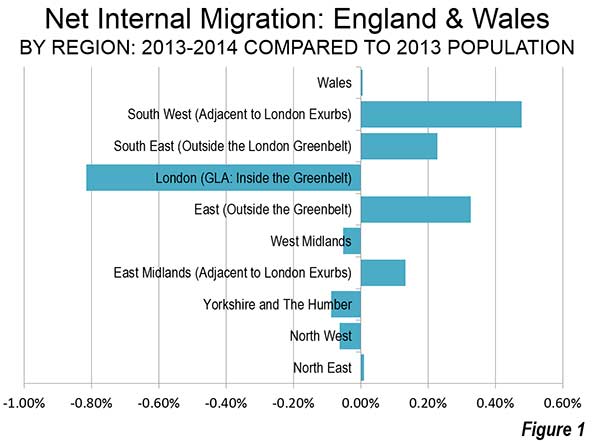
    On a regional level, there was little movement outside the southern half of England. England is divided into nine regions. Three of the northern and middle regions lost modest numbers of internal migrants, ranging from a minus 0.05% (minus 3,000 people) in the West Midlands, which contains England’s second largest city, Birmingham. There was loss of 0.06% (minus 7,100 people) in the North West, where Manchester and Liverpool are located. There was a 0.09% loss (minus 4,700 people) in Yorkshire and the Humber, where Leeds and Sheffield are located (Figure 1).

    The North East, which contains the city of Newcastle, has long been an area of economic hardship and is of danger of becoming "Britains Detroit" according to  The Guardian. Yet the North East experienced a small gain of 0.01% in internal migrants (500 people). The largest gain outside southern England was in the East Midlands, which includes Leicester and Nottingham, attracted a net 0.13 percent in new migrants (6,200 people). Wales (largest city Cardiff) also had a 0.1% gain in internal migrants (200 peopled).

    London (the Greater London Authority) lost by far the largest percentage of its population to internal migration, at minus 0.82 percent, or 68,600 people. This may be particularly surprising because London has recently reached its all-time population peak, having exceeded its pre-World War II 1939 estimated level. Yet virtually all of London’s huge population gain has been from natural growth (births minus deaths) and international migration. In recent years, this growth stems from strong gains in migration from a European Union countries, between which there is virtually unrestricted immigration.

    But Londoners, whether born in Great Britain or those who arrived before 2013, have been moving in large numbers to the exurbs beyond the greenbelt for some time and even farther away. The two large exurban regions have attracted many migrants. The East, which includes such well-known localities as Cambridge, Luton, Milton Keynes and St. Albans added the 0.33 percent to its population through internal migration. The South East, which includes localities like Oxford, Windsor, Dover and the entrance to the Euro tunnel to France added a somewhat smaller 0.23 percent.

    But some Londoners appear to be moving even farther away. The largest growth was in the South West region, which lies at least 70 miles (125 kilometers) from Trafalgar Square in London. The South West is home to such places as Bristol, Bath, Salisbury and Cornwall. The South West added 0.48 percent to its population through.

    London and Environs

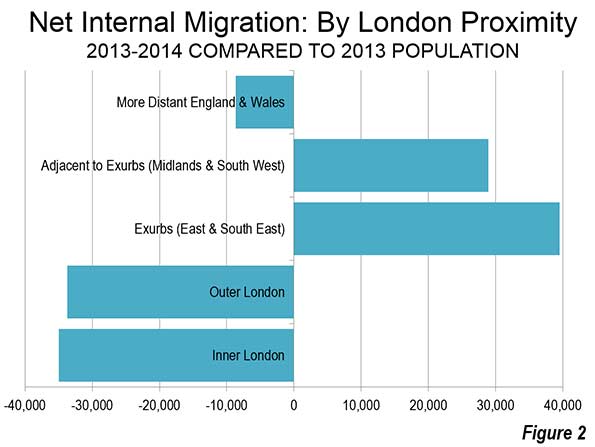
    During 2013-2014, the dominant trend was movement away from London to the exurbs and regions just beyond the exurbs, with a less dominant trend away from the balance of England and Wales. Virtually all the internal migration growth was in the London Exurbs (East and South East) and the adjacent areas, the South West, East Midlands and West Midlands (Figure 2). Nearly all the loss was in London. Inner London, suffered the largest domestic migration loss, at 1.05 percent of its population (minus 35,000). Inner London, at 3.3 million remains well below its population peak of 4.5 million, reached nearly 115 years ago (1901). Outer London, consisting of the large tracts of semidetached and detached housing built in the inter-war years lost a smaller 0.66 percent of its population to internal migration (minus 33,700). Outer London now has a population of approximately 5.1 million, one-half larger than Inner London.

    The Office for National Statistics (ONS) explains that London attracts internal migrants up to age 29. But, the internal outmigration of people 30 and above more than cancels this out. ONS explains:

    "A key factor for people in their 30s and 40s who move out of London could be the cost of housing. Young couples wishing to buy their first house, or a larger one for a growing family, may find prices in London prohibitively expensive and therefore choose to live outside of London."

    ONS adds:

    "Another important reason may be that people with children are more likely to move out of London because of environmental or social factors. For example, they may be seeking somewhere greener and quieter, and may also perceive that a less urban neighbourhood offers a better social and educational environment for children. Moves of adults with children also explains why there is a net outflow of children from London."

    ONS further indicates that there is net migration from London of older citizens, including those over 90 (the highest age category reported upon). These are trends similar to those we have identified in the United States some of which were opposite the conventional wisdom (See: Driving Farther to Qualify in Portland, Urban Core Millennials? A Matter of Perspective, Exodus of the School Children, and Seniors Dispersing Away from the Urban Cores)

    Greatest Gains and Losses

    Even so, London had one local authority area with the greatest internal migration gain: the historic City of London. However, this area, which is the core of the central business district, has few residents. Even after the internal migration gain (1.80 percent), the city still has fewer than 8,000 residents. The other largest gainers in numbers were found in the London exurbs or the South West, with the exception of Fylde, which is located in Lancashire (the North West), adjacent to the resort of Blackpool.

    London had nine of the 10 local authority areas with the greatest internal migration losses (out of 348). The largest loss was in the inner London borough of Newham (minus 2.68%). The one non-London local authority area in the bottom 10 was Pendle, in Lancashire (the North West).

    Metropolitan Areas

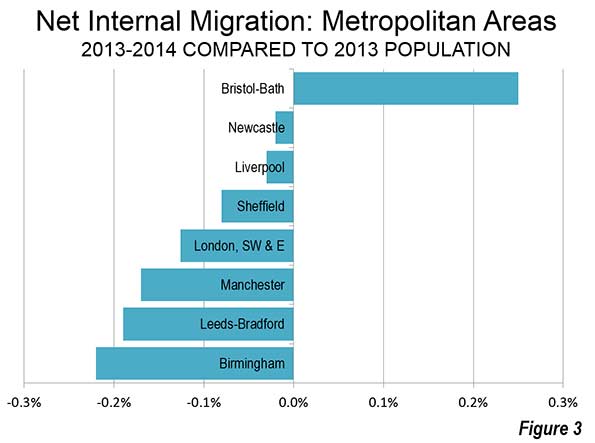
    Only one of the larger metropolitan areas experienced a net internal migration gain. The Bristol – Bath area (ceremonial Avon County), located in the South West gained 0.25 percent (Figure 3).

    Two metropolitan areas that have long experienced serious economic declines suffered only modest losses. Newcastle (Tyne and Wear Metropolitan County) lost only 0.2 percent of its population to internal migration. Liverpool, with a central municipality that dropped from a population of 856,000 in 1931 to 439,000 in 2001 (after which modest growth returned), had an internal migration loss of 0.03 percent. Sheffield (South Yorkshire Metropolitan County) lost 0.08% of its population to net internal migration.

    In view of the relative fortunes of London and Liverpool over the last century, it is especially surprising that the London region, including the exurbs, lost internal migration at a rate four times that of Liverpool (0.13%).

    Manchester (Greater Manchester Metropolitan County) experienced a net internal migration loss of 0.17 percent, and Leeds-Bradford (West Yorkshire Metropolitan County). Birmingham (West Midlands Metropolitan County) have the greatest loss at -0.22 percent.

    More Dispersion

    By far the largest net internal migration numbers are in the south of England, reflecting strong trends of decentralization away from London, to the East and the South East. But, by far the largest recipient of internal migration is the South West, beyond even the exurbs. This is another confirmation of the dispersing pattern of development, as has been observed in virtually all of the world’s megacities.

    ————–

    Note: The United Kingdom does not formally designate metropolitan areas. This article uses metropolitan and former (ceremonial) counties to approximate metropolitan areas.

    Photograph: Local authority of Milton Keynes, Buckinghamshire (South East of England), by author

    Wendell Cox is Chair, Housing Affordability and Municipal Policy for the Frontier Centre for Public Policy (Canada), is a Senior Fellow of the Center for Opportunity Urbanism (US), a member of the Board of Advisors of the Center for Demographics and Policy at Chapman University (California) and principal of Demographia, an international public policy and demographics firm.

    He is co-author of the "Demographia International Housing Affordability Survey" and author of "Demographia World Urban Areas" and "War on the Dream: How Anti-Sprawl Policy Threatens the Quality of Life." He was appointed to three terms on the Los Angeles County Transportation Commission, where he served with the leading city and county leadership as the only non-elected member. He served as a visiting professor at the Conservatoire National des Arts et Metiers, a national university in Paris. 

  • Comparisons: Commuting in London and New York

    The world’s two leading Global Cities, London and New York are, according to most indicators, remarkably similar in their patterns of regional commuting. This is the conclusion from our recent review of commuting in London and commuting in New York. This analysis contrasts the results between the London Area (Greater London Authority, East and Southeast regions) and the New York combined statistical area, which stretches from New York state, to New Jersey, Connecticut and Pennsylvania. (A unique animated graphic illustrates the London commuting pattern, at "undertheraeder.com." The map is here and illustrates the size of the greenbelt in the London area).

    Population and Area

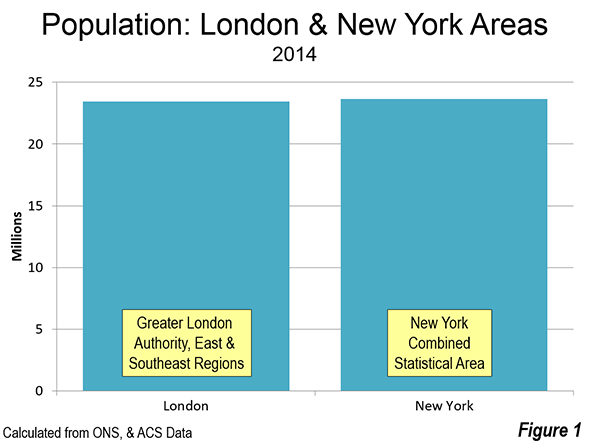
    The London and New York areas had almost identical populations in 2014. New York had 23.663 million residents and London had 23.431 million residents, just one percent less. London, however, is growing more rapidly, adding 1.1 percent per year since the 2011 census, while New York’s increase has been 0.8 percent annually since the 2010 census (Figure 1).

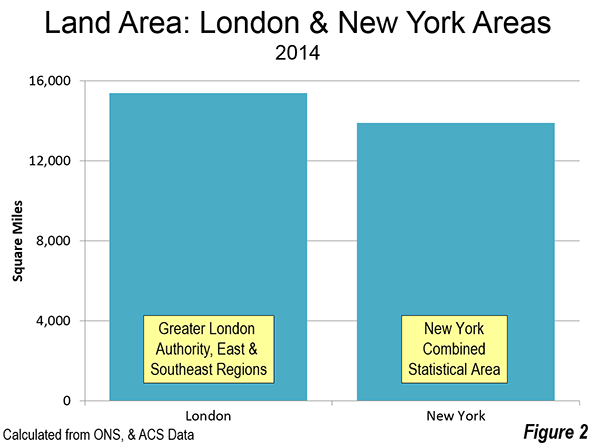
    The land areas are also similar (Figure 2). The London commute shed covers 15,400 square miles (39,800 square kilometers). The New York area is about 10 percent smaller, covering 13,900 square miles (36,000 square kilometers).

    Broadly, the two cities can be divided into similar sectors. Both have among the largest central business districts (downtowns or CBDs) in the world. The two central municipalities, the Greater London Authority and the city of New York both have somewhat over 8 million population. There is a first ring of counties located outside the Greater London Authority and the city of New York. Finally there are outer counties in both areas. The geographic areas are described in the "Geographical Note" below.

    Distribution of Employment

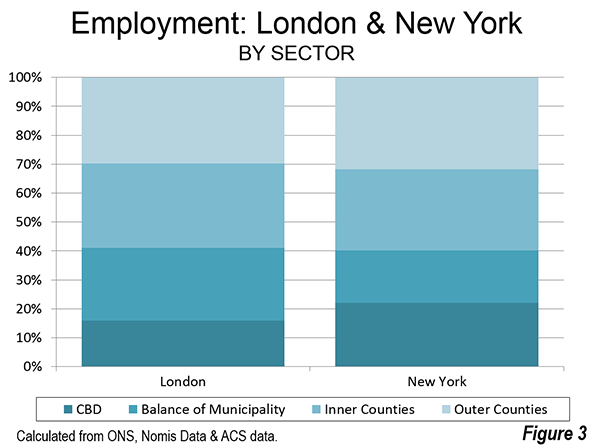
    In the distribution of employment between the two cities is remarkably similar (Figure 3). In each case, the suburban counties account for 60% of employment. In both London and New York, the outer counties have slightly more employment than the inner counties, though in both cases the inner counties and outer counties have approximately 30% of employment.

    This leaves approximately 40% of the employment for the central cities. In New York, 22% of the employment is in Manhattan, which contains the central business district. In London, a somewhat smaller 16% of the employment is in the five local authority areas that include the central business district (Camden, Lambeth, city of London, Southwark and the city of Westminster). The balance of the city of New York — the outer boroughs of the Bronx, Brooklyn, Queens and Staten Island, has just 18% of the area’s employment, while the balance of the Greater London Authority — outer London and the balance of inner London — has 25% of the area’s employment.

    Where People Live and Work

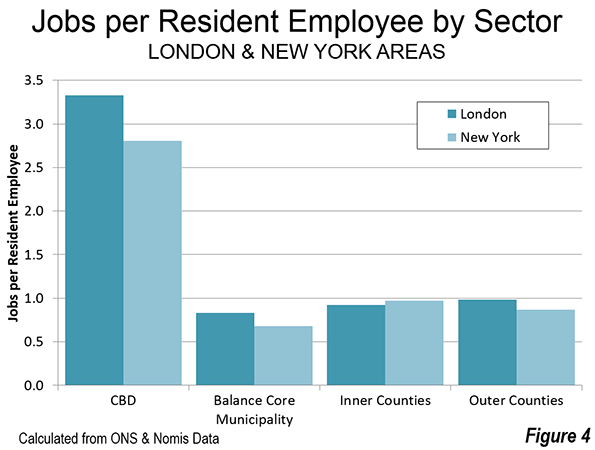
    The distribution of the jobs are relative to resident workers is also similar between London and New York. In both cities, the inner counties and the outer counties have nearly the same number of jobs as resident workers. In the case of London, there are 99 jobs per 100 resident workers in the inner counties and a somewhat smaller 92 in the outer counties. In New York, there are 97 jobs per resident worker in the inner counties and 87 in the outer counties. The largest imbalances in both areas occur in the core municipalities. There are approximately 330 jobs per 100 resident workers in the local authority areas containing London’s central business district. Manhattan, with New York’s central business district has a somewhat smaller 280 jobs per 100 resident workers. Indicating the draw of the central business district for workers living in the balance of both core municipalities, there are only 83 jobs for each 100 workers in the balance of the Greater London Authority and 68 in the balance of the city of New York (Figure 4).

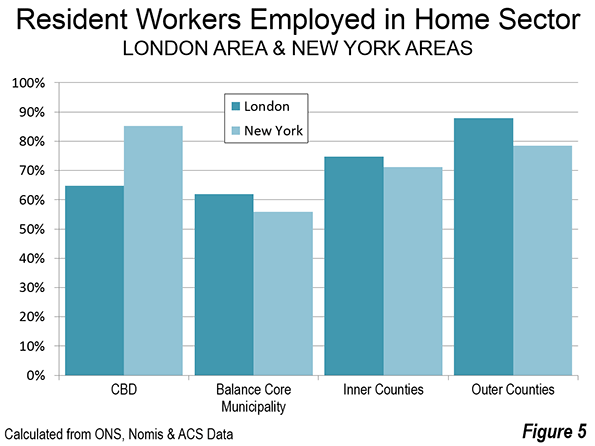
    In the two cities, most resident workers are employed in their home sector, 68% in New York and 67% in London. This is also the case in each of the sectors of the two cities. In New York, the largest percentage of resident workers (85%) is employed in Manhattan, with the central business district. The number is considerably smaller (64%) in the jurisdictions containing London’s central business district. In London, the largest share of resident workers employed in their own sector is 88% in the outer counties. In both cities, the inner counties also have a relatively strong balance of local residents, with 71% working in their home sector in New York and 75% in London. In both cities, the smallest number of resident workers employed in their home sectors are in the balance of the core municipality, 62% in London and 55% in New York (Figure 5).

    Commuting to the Central Business Districts

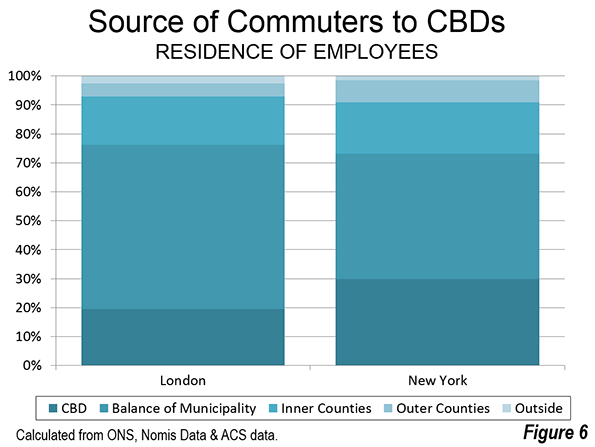
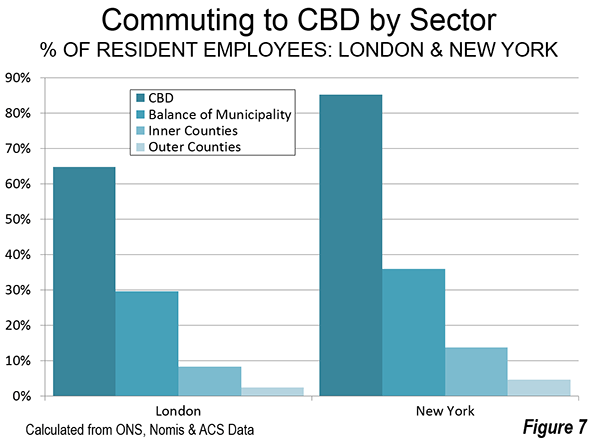
    The data indicates a surprisingly limited draw for the two central business districts. Often media articles and even academics presume that cities are monocentric — that most employees work in the central business district. This isn’t even close to being the case. In fact, the analysis of commuting in the New York and London areas shows that only in the sectors containing the central business districts does the central business district attract most of the resident workers. Even in the relatively jobs-poor balance of the two core municipalities, only 36% in New York and 30% in London work in the jurisdictions containing the CBDs. In the inner counties, the numbers are much smaller. Only 14% of New York inner county resident workers have employment in Manhattan, with an even smaller number, 8% of London’s inner county resident workers commuting to CBD jurisdictions. The numbers are even smaller in the outer counties, where only 4.6% of New Yorkers commute to Manhattan and 2.4% of Londoners commute to the CBD jurisdictions (Figure 6). 

    In both cases, approximately 75% of CBD employees are drawn from the core municipality. In New York, approximately 30% of the central business district employees are from Manhattan, while 43% are from the outer boroughs. In London, 19% of the central business district employees are from the five CBD jurisdictions and 57% are from the balance of the Greater London Authority.

    Manhattan is a somewhat stronger draw to the suburban counties, with 18% of employees from the inner counties and 8% from the outer counties. The London CBD draws 17% of its workers from the inner counties and 5% from the outer counties. Despite the comprehensive suburban rail system in New York and both suburban and national rail system in London, comparatively few workers commute from beyond the outer counties — 2.6% in London in 1.5% and New York (Figure 7).

    How Commuters Travel

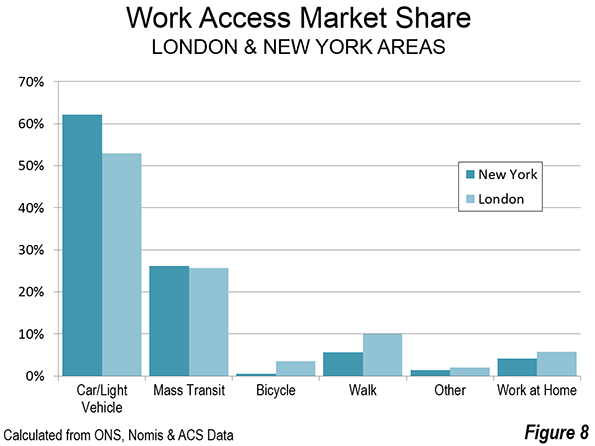
    There are also similarities between the commuting methods in the London and New York areas. In both cases, cars, vans and other light vehicles carry the majority of commuters, 53% in London and 62% in New York (Figure 8). Mass transit carries virtually the same share of commuters in both cities, at 26%. Many more Londoners walk to work the New Yorkers, at 10%, compared to less than 6%. Approximately 5.8% of London workers report working at home, somewhat more than New York’s 4.1% (Since the two nations use different census survey instruments, the data may not be completely comparable).

    Widely Dispersed Global Cities

    Ultimately the key finding is that the world’s two greatest Global Cities are widely dispersed. Despite the strength of their cores, the overwhelming majority of employment is in the suburbs. Only a small percentage of resident employees in the suburban areas work in the central business districts. A majority of resident workers is attracted to the CBDs only from the jurisdictions containing the CBDs themselves.

    —–

    Geographical Note: The geographical sectors are as follows:

    London (Greater London Authority, Southeast England and East England): The central business district is situated in a wide corridor on both sides of the Thames River. It is contained in local authority areas, including the city of London, the city of Westminster and the boroughs of Camden, Southwark and Lambeth. The inner counties border on the metropolitan greenbelt, which surrounds the Greater London Authority. They are Berkshire Buckinghamshire, Essex, Hertfordshire, Kent and Surrey. The outer counties are Cambridgeshire, East Sussex, Hampshire, Isle of Wight, Norfolk, Oxfordshire, Suffolk and West Sussex.

    New York (New York Combined Statistical Area): The area includes 35 counties, in eight metropolitan areas, including New York (NY-NJ-PA), Allentown-Bethlehem (PA-NJ),  Bridgeport-Stamford (CT), East Stroudsburg (PA), Kingston (NY), New Haven (CT), Torrington (CT) and Trenton (NJ). 

    —–

    Wendell Cox is Chair, Housing Affordability and Municipal Policy for the Frontier Centre for Public Policy (Canada), is a Senior Fellow of the Center for Opportunity Urbanism (US), a member of the Board of Advisors of the Center for Demographics and Policy at Chapman University (California) and principal of Demographia, an international public policy and demographics firm.

    He is co-author of the “Demographia International Housing Affordability Survey” and author of “Demographia World Urban Areas” and “War on the Dream: How Anti-Sprawl Policy Threatens the Quality of Life.” He was appointed to three terms on the Los Angeles County Transportation Commission, where he served with the leading city and county leadership as the only non-elected member. He served as a visiting professor at theConservatoire National des Arts et Metiers,a national university in Paris. 

    Photograph: Traffic in Bergen County, New Jersey (a  New York inner suburban county), by author.

  • Commuting in London

    According to the 2011 census, the London commuter shed — defined here as the of London (the Greater London Authority, or GLA) and the East and Southeast regions of England — had a 2013 population of 23.2 million, spread over an area of 15,400 square miles (39,800 square kilometers).

    For this analysis, the area is divided into five parts, including the central business district (CBD), the balance of Inner London, Outer London, the inner counties, which are largely adjacent to London and the outer counties. Counties are largely only ceremonial at this point and used for geographical convenience. In many counties, unitary local authorities have been established that replace part or all of the previous county geographic authority.

    The central business district is situated in a wide corridor on both sides of the Thames River. It is contained in five local authority areas, including the city of London, the city of Westminster and the boroughs of Camden, Southwark and Lambeth. All of central London’s eight largest rail stations are in these five areas, and central business district commuters rely to a substantial degree on its suburban rail system.

    Inner London roughly corresponds to the London County Council area as it existed before creation of the Greater London Council (GLC) in 1965. Outer London includes the boroughs that were added in the establishment of the GLC which was abolished in 1986. A new, London authority (the GLC) was created  in 2000, with a considerably scaled back portfolio of responsibilities, principally transport, police, fire, emergency services and planning. GLA has 33 local authorities, 32 of which are popularly referred to as boroughs, plus the City of London (the one square mile historic core). The local authorities which are responsible for a many local public services, and constituted London’s only local government between 1986 and 2000.

    The inner counties border on the metropolitan greenbelt, which surrounds London (Note). They are Berkshire Buckinghamshire, Essex, Hertfordshire, Kent and Surrey. The outer counties are Cambridgeshire, East Sussex, Hampshire, Isle of Wight, Norfolk, Oxfordshire, Suffolk and West Sussex.

    Distribution of Employment

    As of the 2011 census, the local authority areas containing the central business district had approximately 1.4 million jobs, or approximately 15 percent of the jobs in the London area. The rest of GLA, including the balance of inner London and Outer London has 25 percent of the employment. The outer counties have the largest number of jobs, at 2.7 million, comprising 30 percent of London area employment. The inner counties have nearly as many jobs, at 2.6 million, or 29 percent of employment. Thus, the suburban areas outside the Greenbelt have nearly 60 percent of the London area employment (Figure 1).

    Where People Live and Work

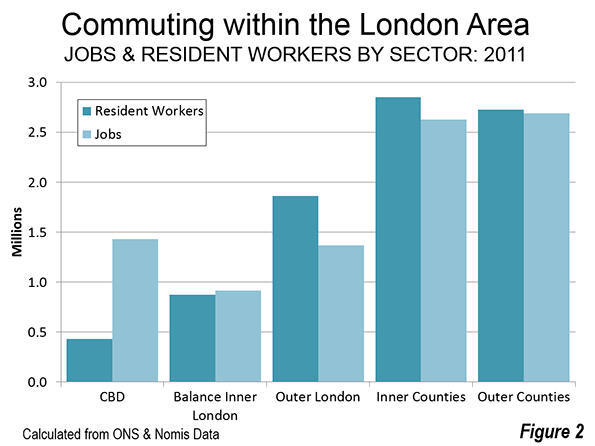
    The local authority areas containing the CBD have the greatest imbalance between resident workers and jobs. There are 3.35 jobs for each resident worker in these areas. The ratio of jobs to resident workers is much closer in the balance of Inner London, with a ratio of 1.04 jobs per employee. The least balanced is Outer London, with only 0.73 jobs per employee. The inner counties have the second highest ratio, at 0.93 jobs per employee. Surprisingly, the outer counties have the ratio closest to 1.00, at 0.99 jobs per employee (Figure 2). This parallels our findings of America’s only city with anything like London’s pedigree, New York.

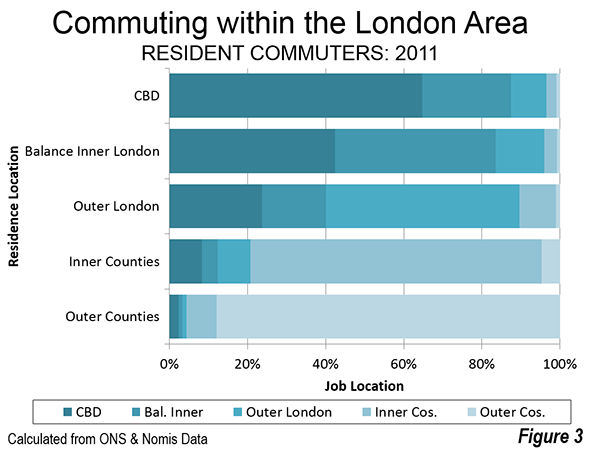
    Most employees work in the sector of their residence. About 65 percent of CBD local authority area residents work in the CBD area (Figure 3). Outside-the-greenbelt commuters work in their own sector to a greater degree. In the outer counties 88 percent work in their home sectors, while 75 percent of inner counties commuters work in their own sectors. The balance of Inner London has the lowest percentage of employees working in their own sectors (41 percent), while Outer London is somewhat higher, at 50 percent.

    Commuting to Central London

    Despite its strong CBD, the London area is anything but monocentric. Approximately 85 percent of London area jobs are outside the central business district. Yet London comparative data from nearly two decades ago placed London’s CBD at fourth largest in the world, trailing Tokyo, New York and slightly behind Osaka. With London’s strong economic growth since that time, London has probably passed Osaka, which has faced more difficult economic times.

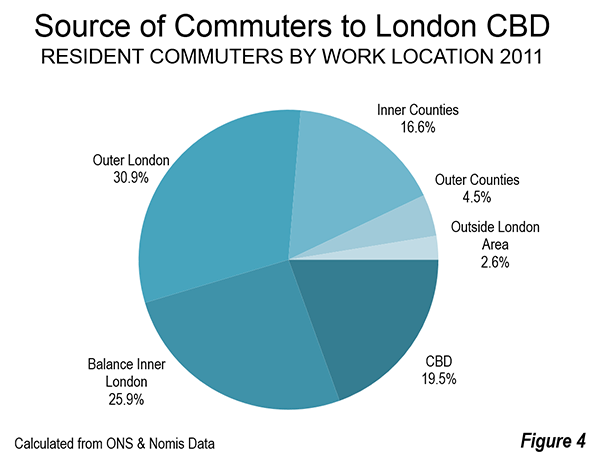
    The overwhelming majority of jobs in the London CBD are filled by GLA residents, with more than 75 percent of commuters living in the balance of Inner London or Outer London (Figure 4). This leaves only a quarter living in the exurban areas beyond the greenbelt. Approximately 17 percent of CBD commuters travel from the inner counties, adjacent to the Greenbelt. Only 5 percent travel from the outer counties. Less than three percent of CBD commuters travel from beyond the London area, which may be surprising given the plentiful higher speed (as opposed to genuine high speed) rail services.

    How Commuters Travel

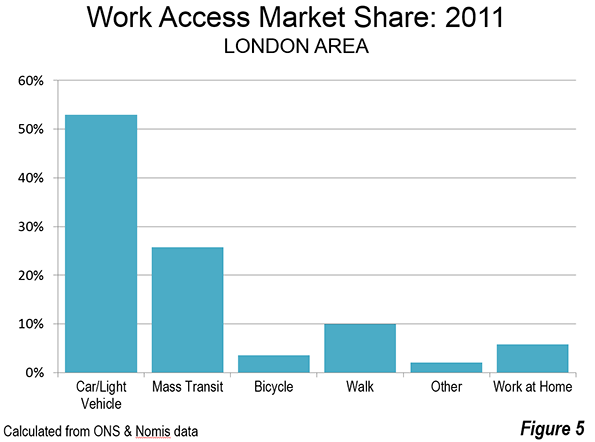
    More than half of Londoners commute to work by car or other light vehicles (including car pools). Transit accounts for about a quarter of commuting, while about 10 percent of commuters walk to work. Approximately six percent usually labor mainly at or from home (Figure 5).

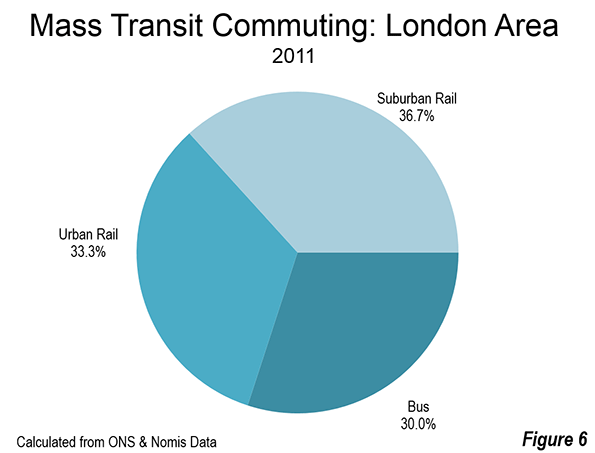
    Among mass transit commuters, suburban rail systems account for the largest share, at 37 percent, underground (metro) and light rail 33 percent and buses 30 percent. Over the past three decades there has been a substantial increase in bus ridership, principally from expanded services financed with savings from competitive tendering (also called competitive contracting) and additional services added later in conjunction with London’s inner congestion pricing zone. Competitive contracting involves use of competitively selected private companies to operate services. London’s "red bus" system — which is fully integrated in its fare, route structure and vehicle livery with its many double deck buses is virtually all operated by the private sector through competitive tendering.

    Minicentric London?

    In some ways, London is one of the world’s most dispersed cities, largely due to the discontinuous development encouraged by the greenbelt. The greenbelt imposes a substantial distance penalty for commuters from the inner and outer counties to the CBD, whether by car or train. This is in considerable contrast to Western Europe’s other megacity, Paris, which is far more compact in its metropolitan development, despite having a considerably weaker CBD. London also demonstrates that the age of the monocentric metropolitan area is largely a thing of the past in high income world cities. With less than one-sixth of metropolitan employment in the CBD, "minicentric" might be a more accurate characterization.

    Note: Housing development is prohibited on the metropolitan greenbelt, which surrounds London (GLA). The metropolitan greenbelt covers three times the land area of the GLA. Virtually all population growth over the past 85 years in the London area has occurred outside the greenbelt. The inner and outer counties have added more than 7 million residents over the since the 1931 census, while London itself has added approximately 500,000 residents.

    The metropolitan is a cornerstone of London’s urban containment policy, which also applies throughout the United Kingdom. Housing development is banned on the greenbelt and the U.K.’s urban containment policy has been associated with a substantial rise in house prices relative to incomes (see: The Barker Review of Housing Supply, the Barker Review of Land Use Planning and The Costs of Smart Growth: A 40 Year Perspective).

    Wendell Cox is Chair, Housing Affordability and Municipal Policy for the Frontier Centre for Public Policy (Canada), is a Senior Fellow of the Center for Opportunity Urbanism (US), a member of the Board of Advisors of the Center for Demographics and Policy at Chapman University (California) and principal of Demographia, an international public policy and demographics firm.

    He is co-author of the "Demographia International Housing Affordability Survey" and author of "Demographia World Urban Areas" and "War on the Dream: How Anti-Sprawl Policy Threatens the Quality of Life." He was appointed to three terms on the Los Angeles County Transportation Commission, where he served with the leading city and county leadership as the only non-elected member. He served as a visiting professor at the Conservatoire National des Arts et Metiers, a national university in Paris. 

    Photo: Traffic in London (by author)