Tag: London

  • The World’s Most Influential Cities

    In the past century, the greatest global cities were generally the largest and centers of the world’s great empires: London, Paris, New York and Tokyo. Today size is not so important: Of the world’s 10 most populous cities, only Tokyo, New York and Beijing are in the top 10 of our ranking of the world’s most important cities. Instead, what matters today is influence.

    To rank the world’s global cities, I worked with urban geographer Ali Modarres, former Accenture analyst Aaron Renn and demographer Wendell Cox. We have attempted to go beyond some of the standard methods of evaluating the global importance of cities, which include assessing the concentration of support services available for multinationals, such as financial and accounting firms, or the size of the overall economy. Efficiency and access to capital and information, we believe, is more critical to being an important global city than number of jobs, and regional GDP is a false measure, since it doesn’t reflect whether the source is domestic or global economic activity.

    In order to quantify cities’ global influence, we looked at eight factors: the amount of foreign direct investment they have attracted; the concentration of corporate headquarters; how many particular business niches they dominate; air connectivity (ease of travel to other global cities); strength of producer services; financial services; technology and media power; and racial diversity. (Click here for a more detailed description of our methodology.) We found those factors particularly important in identifying rising stars that, someday, might challenge the current hegemony of our two top-ranked global cities, London and New York.

    Inertia and smart use of it is a key theme that emerged in our evaluation of the top global cities. No city better exemplifies this than London, which after more than a century of imperial decline still ranks No. 1 in our survey. The United Kingdom may now be a second-rate power, but the City’s unparalleled legacy as a global financial capital still underpins its pre-eminence.

    Ranked first in the world on the Z/Yen Group’s 2013 Global Financial Centres Index, which we used for our list, London not only has a long history as a dominant global financial hub, but its location outside the United States and the eurozone keeps it away from unfriendly regulators. Compared to New York, it is also time-zone advantaged for doing business in Asia, and has the second best global air connections of any city after Dubai, with nonstop flights at least three times a week to 89% of global cities outside of its home region of Europe.

    A preferred domicile for the global rich, London is not only the historic capital of the English language, which contributes to its status as a powerful media hub and major advertising center, but it’s also the birthplace of the cultural, legal and business practices that define global capitalism.London hosts the headquarters of 68 companies on the 2012 Forbes Global 2000 list and is a popular location for the regional HQs of many multinationals. (Our HQ ranking component, in which London ranks third, is based on GaWC’s 2012 Command and Control Index, which factors in company size and financial performance, as well as total number of Forbes Global 2k HQs).

    Beyond these traditional strengths, London has become Europe’s top technology startup center, according to the Startup Genome project. The city has upward of 3,000 tech startup sas well as Google’s largest office outside Silicon Valley.

    nearly four times that of second place Tokyo New York, which comes in a close second in our study (40 points to London’s 42), is home to most of the world’s top investment banks and hedge funds, and the stock trading volume on the city’s exchanges is and more than 10 times that of London.

    Like London, New York is a global leader in media and advertising, the music industry (home to two of the big three labels), and also one of the most important capitals of the fashion and luxury business. With iconic landmarks galore, international visitors spend more money in New York each year than in any other city in the world.

    The Challengers And Those Slowly Fading

    London and New York are clearly the leaders but they are not the hegemonic powers that they were throughout much of the 20thcentury, and their main competitors are now largely from outside Europe. Paris may rank third in our survey, but it is way below New York and London by virtually every critical measure, and the city’s future is not promising given that France, and much of the EU, are mired in relative economic stagnation.

    Rather than a true indication of global reach, Paris’ high ranking is partly the product of the city’s utter domination of the still sizable French economy and the concentration of virtually all the country’s leading companies there (it ranks fifth on GaWC’s Command and Control Index with 60 HQs of Forbes Global 2K companies).

    Elsewhere, Europe boast a veritable archipelago of globally competitive cities — Munich, Rome, Hamburg — but none is large enough, or unique enough, to break into the top 10 in the future. East Asia is likely to place more cities at the top of the list.

    For most of the last century, Tokyo has been Asia’s leading city. It is still the world’s largest city, with the largest overall GDP. In her seminal work on world cities, Saskia Sassen placed it on the same level as London and New York. Tokyo’s limitations resemble those of Paris — its high ranking stems partly from the extreme concentration of domestic companies — and it will be handicapped in the future by a severe demographic crisis, a lack of ethnic diversity and very determined regional rivals.

    China’s Global Cities

    China’s share of the world economy has grown from 5% in 1994 to 14% in 2012.The combined volume of trading on the Shanghai and Shenzhen stock exchanges already exceeds that of Tokyo, and Shenzhen’s volume is approximately three times that of nearby Hong Kong.

    Hong Kong still enjoys greater freedom than the rest of China and remains the largest financial center in the Asia-Pacific region, ranking third in the world after London and New York. The vast majority of the world’s major investment banks, asset managers, and insurance companies maintain their Asia-Pacific headquarters in the former British colony.

    But its preeminence is being threatened by Shanghai, traditionally Hong Kong’s chief rival, and Beijing. We ranked China’s capital eighth, ahead of Shanghai (19th). With the advantage of being the country’s all-powerful political center, Beijing is the headquarters of most large state-owned companies and is home to the country’s elite educational institutions and its most innovative companies.

    But right now the leading global city in East Asia is Singapore, which ranks fourth on our list. With a relatively small population of just over 5 million, Singapore’s basic infrastructure is among the best on the planet. Like Hong Kong, it also benefits from a tradition of British governance and law, one reason the World Bank ranked its business climate the world’s best; China ranked 96th. Singapore’s justice system is ranked 10th in the world in The Rule of Law Index.

    That is all drawing in international business: Singapore places first among global cities in our ranking of foreign direct investment, with a five-year average of 359 greenfield transactions. It’s a favored location in many industries for Asia-Pacific headquarters; a study by the consultancy Roland Berger named Singapore the leading location for European companies to establish an Asia-Pacific HQs.

    Singapore vies with Hong Kong as the financial center of Asia, ranking fourth in the world in that category.

    Global Capital of the Middle East

    Much of what we see in the media about Middle Eastern cities are scenes of destruction and chaos. Yet in a relatively quiet corner of the Arabian Peninsula, Dubai is ascending, ranked seventh on our list. Its globalization strategy hinges largely on its expanding airport, which includes the world’s largest terminal and an even larger airport under construction. It ranks first in the world in our air connectivity ranking, with nonstop flights at least three times a week to 93% of global cities outside of its home region.Its hub location and business-friendly climate have made it a favorite for companies looking to establish a Middle East headquarters or point of presence. As a crossroads of humanity, Dubai is unparalleled among global cities for its diversity: 86% of its residents are foreign born.

    North America

    Our rankings rewarded cities that are both ethnically diverse and, in some cases, dominate a critical industry. This is what we refer to as a “necessary city,” a place one must go to conduct business in a particular field, or to service a particular region of the world.

    This focus on the “necessary” city led to what will no doubt be a controversial result: a 10th place ranking for the San Francisco Bay Area, on the strength of its central role in the tech industry, tied on our list with Los Angeles and Toronto. The Bay Area did not even make the top 20 in the 2014 A.T. Kearney rankings, which placed both Chicago and Los Angeles in the top 10.

    Not long ago Los Angeles, North America’s second-largest metro area, saw itself as a potential rival to New York and a legitimate world city. Hollywood is nearly synonymous with the American entertainment industry and is by far the world’s largest in terms of revenue and influence. Last year the industry enjoyed exports of almost $15 billion.

    But L.A.’s share of entertainment employment is shrinking and its former second industry, aerospace, has declined significantly, losing over 90,000 jobs since the end of the Cold War. Several key companies have decamped from the metro area in recent years — Nissan, Occidental Petroleum, Toyota — for more business-friendly places.

    The situation is arguably worse in Chicago, which ties for 20th. The Windy City first rose to world prominence after overcoming rival St. Louis in the late 19th century. It boasts one of the world’s most diverse economies, but has not developed strong dominance in any industry. Chicago is an also ran in media and technology and, outside of commodities, is no longer a major global financial center.

    The big winner today is the Bay Area, which overwhelmingly dominates the list of technology leaders; not only is the metro area home to a glittering array of tech standouts, companies based elsewhere in the U.S., and in other countries, feel compelled to site operations there. Even a penny pinching retailer like Wal-Mart is growing its Silicon Valley presence.

    Other North American cities with a growing global footprint include 10th ranked Toronto, tied with Los Angeles and Bay Area. Toronto, as the economic capital of Canada, has becomes a focus for international investment into that stable and resource rich country. It is also among the most diverse cities on the planet — 46 % of its population is foreign born.

    Rising Stars

    In North America up and comers include No. 14 Houston, with its domination of the U.S. energy industry, a huge export sector and an increasingly diverse population. The Washington, D.C., metro area ranks 16th, a testament to the capital’s growth as an aerospace and technology center.

    Overseas, other urban centers that could move up in the future include No. 16 Seoul, Shanghai and No. 20 (tie) Abu Dhabi. But outside of Dubai no other cities in our top 20 come from the developing world. The Indian megacities Delhi and Mumbai rank in the low 30s along with Johannesburg in South Africa. In Latin America, the place to watch is No. 23 Sao Paulo. But until these areas can develop adequate infrastructure — from roads, transit and bridges to relatively non-corrupt judicial systems — none can be expected to crack the top 10, or even 20, for at least a decade.

    For the time being, the future of the global city belongs not to the biggest or fastest growing but the most efficient and savvy, and those with a strong historical pedigree. This raises the bar for all cities that wish to break into this elite club.

    No. 1: London

    FDI Transactions (5-Year Avg.): 328
    Forbes Global 2000 HQs: 68<
    Air Connectivity:  89%*
    Global Financial Centres Index Rank: 1

    * The air connectivity score is the percentage of other global cities outside the city’s region (e.g., for London, cities outside of Europe) that can be reached nonstop a minimum of three times per week.

    No. 2: New York

    FDI Transactions (5-Year Avg.): 143
    Forbes Global 2000 HQs: 82
    Air Connectivity:  70%
    GFCI Rank: 2

    No. 3: Paris

    FDI Transactions (5-Year Avg.): 129
    Forbes Global 2000 HQs: 60
    Air Connectivity:  81%
    GFCI Rank: 29

    No. 4: Singapore

    FDI Transactions (5-Year Avg.): 359
    Forbes Global 2000 HQs: N/A
    Air Connectivity:  46%
    GFCI Rank: 4

    No. 5: Tokyo

    FDI Transactions (5-Year Avg.): 83
    Forbes Global 2000 HQs: 154
    Air Connectivity:  59%
    GFCI Rank: 5

    No. 6: Hong Kong

    FDI Transactions (5-Year Avg.): 234
    Forbes Global 2000 HQs: 48
    Air Connectivity:  57%
    GFCI Rank: 3

    No. 7: Dubai

    FDI Transactions (5-Year Avg.): 245
    Forbes Global 2000 HQs: N/A
    Air Connectivity:  93%
    GFCI Rank: 25

    No. 8 (TIE): Beijing

    FDI Transactions (5-Year Avg.): 142
    Forbes Global 2000 HQs: 45
    Air Connectivity:  65%
    GFCI Rank: 59

    No. 8 (TIE): Sydney

    FDI Transactions (5-Year Avg.): 111
    Forbes Global 2000 HQs: 21
    Air Connectivity:  43%
    GFCI Rank: 15

    No. 10 (TIE): Los Angeles

    FDI Transactions (5-Year Avg.): 35
    Forbes Global 2000 HQs: N/A
    Air Connectivity:  46%
    GFCI Rank: N/A

    No. 10 (TIE): San Francisco Bay Area

    FDI Transactions (5-Year Avg.): 49
    Forbes Global 2000 HQs: 17
    Air Connectivity:  38%
    GFCI Rank: 12

    No. 10 (TIE): Toronto

    FDI Transactions (5-Year Avg.): 60
    Forbes Global 2000 HQs: 23
    Air Connectivity:  49%
    GFCI Rank: 11

    Remaining Cities

    City Region Rank

    Zurich

    Europe

    13

    Frankfurt

    Europe

    14

    Houston

    North America

    14

    Amsterdam/Randstad

    Europe

    16

    Seoul

    Asia-Pacific

    16

    Washington Metropolitan Area

    North America

    16

    Shanghai

    Asia-Pacific

    19

    Abu Dhabi

    Middle East

    20

    Chicago

    North America

    20

    Moscow

    Europe

    20

    Boston

    North America

    23

    Brussels

    Europe

    23

    Dallas-Fort Worth

    North America

    23

    Madrid

    Europe

    23

    Melbourne

    Asia-Pacific

    23

    São Paulo

    South America

    23

    Istanbul

    Middle East

    29

    Miami

    North America

    29

    Johannesburg

    Africa

    31

    Kuala Lumpur

    Asia-Pacific

    31

    Mumbai

    Asia-Pacific

    31

    Bangkok

    Asia-Pacific

    34

    Delhi

    Asia-Pacific

    34

    Geneva

    Europe

    34

    Atlanta

    North America

    37

    Berlin

    Europe

    37

    Seattle

    North America

    37

    Tel Aviv

    Middle East

    37

    Mexico City

    North America

    41

    Milan

    Europe

    41

    Montreal

    North America

    41

    Buenos Aires

    South America

    44

    Jakarta

    Asia-Pacific

    44

    Philadelphia

    North America

    44

    Cairo

    Middle East

    47

    Guangzhou

    Asia-Pacific

    47

    Ho Chi Minh City

    Asia-Pacific

    47

    Lagos

    Africa

    47

    Osaka

    Asia-Pacific

    47


    This piece originally appeared at Forbes.

    Joel Kotkin is executive editor of NewGeography.com and Distinguished Presidential Fellow in Urban Futures at Chapman University, and a member of the editorial board of the Orange County Register. His newest book, The New Class Conflict is now available for pre-order atAmazon and Telos Press. He is author of The City: A Global History and The Next Hundred Million: America in 2050. His most recent study, The Rise of Postfamilialism, has been widely discussed and distributed internationally. He lives in Los Angeles, CA.

    Photo: "City of London skyline at dusk" by jikatu – Licensed under Creative Commons Attribution-Share Alike 2.0 via Wikimedia Commons

  • Will London Embrace the Monaco Model?

    London’s goal — admirable for any city of medieval invention — is to drive the private car underground and replace it with a web of mass transit, suburban trains, bike lanes, taxi stands, and walkways. All of those are well calibrated to an urban grid that consists of mews, squares, and quirky side streets with names like Shoulder of Mutton Alley.

    Despite the winds and rains, I recently pedaled all over London and came to the conclusion that it has an excellent chance to get past the automobile era. It could be Europe’s city of tomorrow, one that moves forward with its work/life balance on a human scale. Its future as Europe’s finance center, though, and its real estate forecast, as well as the outlook for its pubs, remain open questions.

    I enrolled in Mayor Boris Johnson’s shared bikes — it took a few credit card swipes — and headed off to the City, London’s financial district, which lies north of London Bridge.

    Will London remain one of the world’s top finance centers? The continuing economic crisis, the threat of the U.K. pulling out of the European Union, Scottish independence, and strict new regulations could all spell doom for its merchant banking.

    The City’s accommodating genius is that while it is as established as the House of Lords or the East India Company, it is, among other things, a go-go offshore financial center — the Cayman Islands with bowler hats.

    Neither continental European nor American nor Asian, London straddles all three markets, funneling money from one part of the globe to another. By comparison, Frankfurt, Paris, Zurich, and Amsterdam are staid regional financial centers. Only New York can give it a run for its money.

    At G8 meetings Prime Minister David Cameron bemoans corporate-shell tax dodging and come-by-chance balance sheets, but when he gets home he might as well don a visor and leather sleeves. London is a casino cashing in the chips of a capital-intensive world.

    During the Crimean crisis, London has been all for economic sanctions, provided, however, that they don’t hurt the City, where Russian oligarchs still get their phone calls returned.

    While I was there, London experienced its wettest January since 1670. But one of the city’s virtues is that it copes well with bad weather. Houses and hotels are short walks to shops and trains. In most London neighborhoods you will pass many restaurants, drug stores, newsstands, and pocket supermarkets. On television, England was sinking; in London, it was business as usual.

    The pleasure of London on a bike is that its very quickly reduced to an overlapping series of small towns, with such well known names as Chelsea, Fulham, Soho, Sloane Square, Lancaster Gate, and Hampstead Heath.

    Fewer pubs were in evidence. I read later that about 1400 have been closing every year around England, victim to archaic licensing laws and restrictive franchising, not to mention the iPhone culture that does not cozy up with a pint to dank interiors with ersatz slot machines and pinball games. Industrial Britain has become a service economy, and the servers prefer bistros, bars, and Pret A Manger.

    A downside to London is that the world’s happy money has made its property market an international savings bank, where apartments routinely sell for $6 million and some hotels (not mine) cost $700 a night.

    Nevertheless, the excellent Tube, buses, commuter trains, and Boris bikes make it easier to stay in less fashionable quarters and connect to the bright lights. London has spent billions on upgrading its railroad stations, which soon will be the iron standard in Europe. By contrast, Moscow is choking on its gridlocked exhaust fumes, Paris prefers tourism to trade, and Berlin still has a hole in its heart.

    When I lived in London in the 1970s, King’s Cross had the air of New York’s Port Authority bus terminal, and St. Pancras appeared only to offer connecting service to The Slough of Despond. The renovated St. Pancras International, where Eurostars depart for Paris, Brussels, Lille, and Avignon, is alive with spoken French, fresh croissants, trendy restaurants, and a five-star hotel. With a soaring glass interior, King’s Cross could be an Asian airline terminal.

    The East End and Canary Wharf still feel like warehouse districts, although now the only cargoes are winking screens in trading rooms. Nevertheless, it is easy to imagine in the next fifty years a second London growing up around the Thames docklands. It has the infrastructure in place — trains, an airport, businesses, nearby housing stock, and open spaces — to support a major city, one part Venice with canals, another part Shanghai with skyscrapers.

    The risks to London’s future are political. Insular Tories could lead Britain out of the European Union, the British pound could become a second-tier currency, and the city’s cost structures could make it only an amusement park for Russian oligarchs and Arab sheiks, not the working or middle classes. Call it the Monaco Model.

    Still, I would bet on London’s sustainability at all levels of a city’s food chain… if only because it is so eccentrically welcoming to bikes, banks, brokers, and bookstores.

    Matthew Stevenson, a contributing editor of Harper’s Magazine, is the author of Remembering the Twentieth Century Limited, a collection of historical travel essays. His new book, Whistle-Stopping America, was recently published.
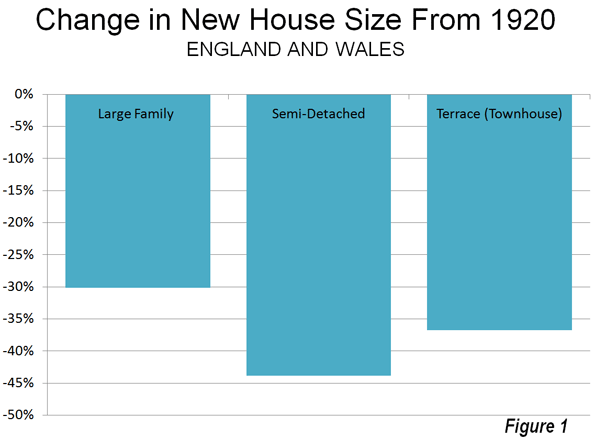
    Photo of King’s Cross by Matthew Stevenson

  • Britain’s Planning Laws: Of Houses, Chickens and Poverty

    Perhaps for the first time in nearly seven decades a serious debate on housing affordability appears to be developing in the United Kingdom. There is no more appropriate location for such an exchange, given that it was the urban containment policies of the Town and Country Planning Act of 1947 that helped drive Britain’s prices through the roof. Further, massive damage has been done in countries where these polices were adopted, such as in Australia and New Zealand (now scurrying to reverse things) as well as metropolitan areas from Vancouver to San Francisco, Dublin, and Seoul.

    A healthy competition has developed between the Conservative-Liberal Democrat coalition and the Labour Party to finally address the problem of the resulting land and housing shortage that has driven prices up so much relative to incomes.

    It probably helps that public opinion seems to be changing. A recent MORI poll found that 57 percent of respondents considered rising house prices to be a bad thing for Britain, compared to only 20 percent who though it a good thing.

    It has been more than a decade since Kate Barker, then a member of the Monetary Policy Committee of the Bank of England (the central bank) was commissioned by the Blair Labor government to examine the issues. Her conclusions were clear. Britain has a serious housing affordability problem and its restrictive land use policies were the cause. These higher housing costs, the largest element or household expenditure have reduced the standard of living and increased poverty beyond what would have occurred if urban containment regulation had not destabilized house prices. The Economist notes that home ownership is falling and that the number of couples with children who are renting has tripled since the late 1990s.

    Planning and Chickens

    This week, The Economist weighed into the debate (Britain’s planning laws: An Englishman’s home):

    "Now that the economy is at last growing again, the burning issue in Britain is the cost of living. Prices have outstripped wages for the past six years. Politicians have duly harried energy companies to cut their bills, and flirted with raising the minimum wage. But the thing that is really out of control is the cost of housing. In the past year wages have risen by 1%; property prices are up by 8.4%. This is merely the latest in a long surge. If since 1971 the price of groceries had risen as steeply as the cost of housing, a chicken would cost £51 ($83)."

    For those of us unfamiliar with the cost of chicken in British hypermarkets, The Daily Mail says it is about £2 ($3). Indeed, even the chicken industry suffers, as planning restrictions  are getting in the way of adding the chicken farms Britain requires.

    Moreover, the high costs cited by The Economist are after the house prices increases that had already occurred by 1970. Even then, before such inflationary pressures were seen elsewhere, Sir Peter Hall characterized soaring land and house prices as the biggest failure of the 1947 Act. Hall had led a major research effort on the subject, which produced a two-volume work, The  Containment of Urban England (See The Costs of Smart Growth Revisited: A 40 Year Perspective).

    From Affordable to Unaffordable

    While the historic relationship between household incomes and house prices (the "median multiple") was under 3.0 across the United Kingdom as late as the 1990s, it has now deteriorated to more than 7.0 inside the London Greenbelt. Unbelievably it has risen to elevated levels even in the less prosperous the north of England. For example, depressed Liverpool has a median multiple over 5.0, which is 60 percent above the maximum historic range and making the metropolitan area "severely unaffordable." Liverpool is probably best compared to Cleveland in the United States for its economic distress.

    The shortage of housing in Britain has become acute. There are additional concerns that the globalization of housing markets has hit London particularly hard and is driving households out of the housing market.

    More Money, Less House

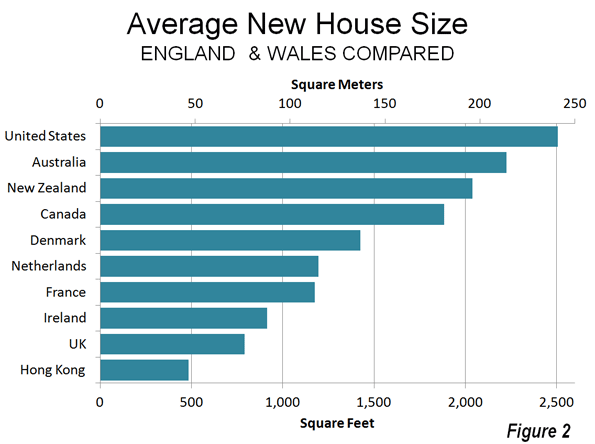
    Through all of this, Briton’s are getting less for their money. Since 1920, the average size of a new large family house has been reduced 30 percent. Semi-detached houses are 44 percent smaller and townhouses (terrace housing) is 37 percent smaller (Figure 1). Britain now has some of the smallest new housing in the world. The average new house in continental Europe is 50% or more larger than in England and Wales. New houses are two to three times as large in Canada, New Zealand, Australia and the United States (Note 1). In some US cities, residents can build "granny flats" which are larger than new houses in Britain. For example, San Diego’s limit for granny flats of 850 square feet exceeds Britain’s average new house size of 818 square feet.

    Paving Over Ohio?

    Of course, those who see urban expansion (the theological term is "sprawl") as ultimate evil imagine an England and Wales being literally paved over by allowing people to live as they prefer. They need not worry.

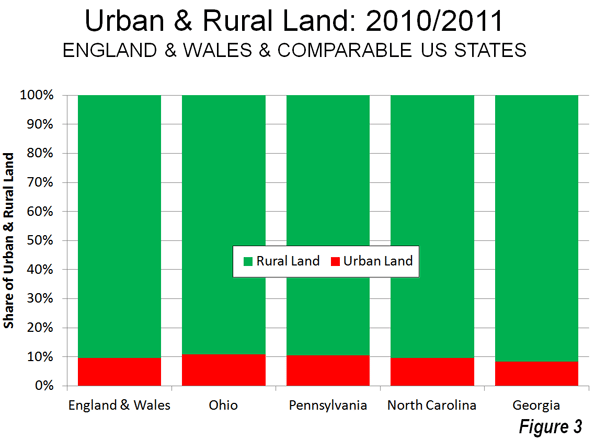
    For example, England and Wales is less crowded than spacious Ohio, with its rolling hills and extensive farmland. According to the 2011 census, only 9.6% of the land in England and Wales is urban, the other 90.4% is rural. In Ohio, on the other hand, 10.8% of the land is urban and only 89.2% of the land is rural. Even the state of Georgia, with the least dense large urban area in the world, Atlanta, has roughly as much rural land (91.7 percent) as England and Wales (Figure 3).

    Every Gram is Sacred?

    Originally, urban containment was justified on social and aesthetic grounds. However, curbing greenhouse gases is now used as the raison d’etre for highly restrictive housing policies. Urban policy in England and Wales and elsewhere has been hijacked by a philosophy that any gram of greenhouse gas that can be reduced must be, regardless of its impact on society, the economy, the standard of living or poverty.

    One of the worst conceivable strategies for reducing greenhouse gas emissions is to waste money on costly and ineffective measures. The Intergovernmental Panel on Climate Change (IPCC) has indicated that sufficient reductions in greenhouse gas emissions can be achieved for a range of from $20 to $50 per ton. Urban containment policy cannot deliver for this price. In contrast, improving automobile fuel efficiency is forecast improve greenhouse gas emissions, even as driving continues to rise with a growing population (see Urban Planning for People). In addition, the higher house prices associated with urban containment policy are well beyond the IPCC range.

    No program can produce substantial greenhouse gas emission reductions that does not focus on higher value strategies. Urban containment has no high value strategies.

    Planning, People and Poverty

    Britain’s land policy competition between the political parties is long overdue. Coalition Communities Secretary Eric Pickles, decries "the way families are trapped in ‘rabbit hutch homes’." The Labour Party opposition has promised that, if elected in 2015, steps will be taken to increase land supply and housing affordability, so that "working people and their children" have the "decent homes they deserve."

    The Economist states the issue squarely:

    "Building on fields in a country that is as crowded as England will always rile some people, however well-designed the system. But the alternative is worse: a nation of renters and rentiers, where only the rich own houses."

    —————–

    Note 1: As Figure 2 indicates, Hong Kong housing is considerably smaller than that of England and Wales. Hong Kong really is the ultimate smart growth or urban containment city. It has the highest urban population density in the high income world. It has the highest share of its commuters using mass transit to get to work. Its traffic congestion is intense. And, predictably, it has the highest house prices relative to incomes yet documented in the high income world.

    We need to be spared the "sun rises in the west" economic studies claiming that somehow the laws of economics, that work so relentlessly to drive up prices where supplies are constrained in other industries (such as petroleum, corn, etc.) have no effect on land and housing.

    Wendell Cox is a Visiting Professor, Conservatoire National des Arts et Metiers, Paris and the author of “War on the Dream: How Anti-Sprawl Policy Threatens the Quality of Life.

    Photo: St. Pancras Station (London), by author

  • The (White) British are Leaving (London)

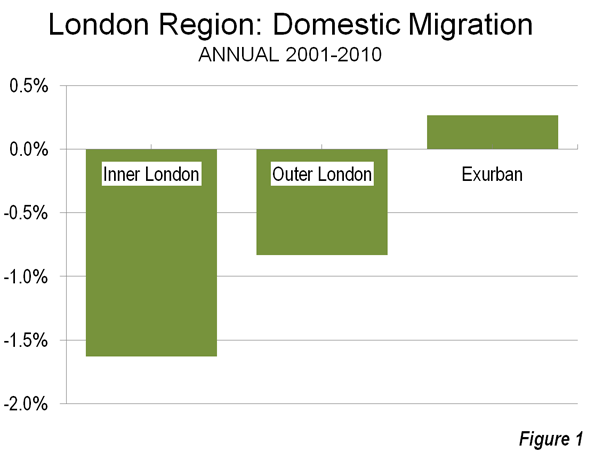
    As reported in The Evolving Urban Form: London, last July the Greater London Authority (GLA), located inside the Green Belt, grew strongly from 2001 to 2011, though remains well below its peak estimated population in 1939. Substantial domestic migration from the core area to the exurbs was a major contributor to their growth during between 2000 and 2010 (Figure 1).

    Obviously, with all that growth and all that domestic out-migration, international migration had to be driving the population growth in the GLA. The British Broadcasting Corportation (BBC) confirms that, reporting that, for the first time "white British" residents of GLA represent a minority of the population. At 45 percent, this population segment is down from 58 percent in 2011.

    Whites, however, remain a majority, with more than 1.3 who do not consider themselves British, according to the 2011 census data. The combined white population is nearly 60 percent of the GLA total. The table below provides the ethnic data as reported by the Office for National Statistics.

    Greater London Authority: Ethnicity
    2011 Census
    All categories: Ethnic group      8,173,941 100.0%
    White: English/Welsh/Scottish/Northern Irish/British      3,669,284 44.9%
    White: Irish         175,974 2.2%
    White: Gypsy or Irish Traveller              8,196 0.1%
    White: Other White      1,033,981 12.6%
    Mixed/multiple ethnic group: White and Black Caribbean         119,425 1.5%
    Mixed/multiple ethnic group: White and Black African            65,479 0.8%
    Mixed/multiple ethnic group: White and Asian         101,500 1.2%
    Mixed/multiple ethnic group: Other Mixed         118,875 1.5%
    Asian/Asian British: Indian         542,857 6.6%
    Asian/Asian British: Pakistani         223,797 2.7%
    Asian/Asian British: Bangladeshi         222,127 2.7%
    Asian/Asian British: Chinese         124,250 1.5%
    Asian/Asian British: Other Asian         398,515 4.9%
    Black/African/Caribbean/Black British: African         573,931 7.0%
    Black/African/Caribbean/Black British: Caribbean         344,597 4.2%
    Black/African/Caribbean/Black British: Other Black         170,112 2.1%
    Other ethnic group: Arab         106,020 1.3%
    Other ethnic group: Any other ethnic group         175,021 2.1%
    Source: Office for National Statistics, United Kingdom
  • The Drive-It-Yourself Taxi: A Smooth Ride?

    Despite a corporate sponsor that paid handsomely for the naming rights, Londoners stubbornly refer to our bikesharing system as ‘Boris Bikes’, in a nod to our colourful Mayor, Boris Johnson. But what will we call our new drive-it-yourself taxis? My suggestion: ‘Boris Cabs’ – and they are now a reality here, thanks to Daimler’s car2go service, if you happen to live in one of three small and separate sections of town. But why did a one-way carsharing system have to limp into London, when more than a dozen other cities have welcomed these arrangements with open arms? In the US, car2go first appeared in Austin, Texas, and since then has moved into Washington, D.C, Miami, Portland Oregon, San Francisco, San Diego, and Seattle. It operates in Canada and, on the Continent, in Paris and Amsterdam, among other locations. So why no splashy launch across England’s Capital, and no images of a smiling Boris cutting a ribbon?

    First, roads in London are balkanised. Our regional transport agency (Transport for London) runs the main arteries, and they provide little on-street parking, the mother’s milk of one-way carsharing. That leaves the local streets in the the domain of the 33 boroughs that are each independent municipalities. Car2go is making a brave attempt to get off the ground here by starting with hundreds of cars (the press release reports 500; in practice,170 are in operation two weeks after the launch) in disconnected sections of town, something it has not resorted to anywhere else. Its standard practice is to strike a city-wide deal with whoever’s in charge of on-street parking, and no single agency fits that bill here. What’s the rush? Well, BMW is hot on their heels with its competing DriveNow system, with staff in London well into the advanced stages of planning.

    Second, there is genuine uncertainty about the impacts”. Will we take drive-it-yourself cabs to work, and avoid the crush on the Tube? It would be a very different experience than traditional carsharing — London is said to be Zipcar’s second-biggest market after NYC — which doesn’t work for the daily commute. In the Zipcar model (soon to be the ‘Zipcar by Avis’ model?) you take a car on a round-trip basis and pay by the hour, like filling a parking meter. The novelty of this new generation of drive-yourself cabs lies in their flexibility: as with a taxi meter, you pay by the minute for just the time it takes you to get from ‘A’ to ‘B’, then drop the car off and forget about it.

    What does this mean for traffic congestion? CO2 emissions? What about the cute blue-and-white Smart Fortwo-model cars now parked in your neighbourhood – will they mean less parking for private car owners? Not bloody likely. The expectation is that, in time, enough private car owners will switch to using the fleet’s cars, meaning that on balance fewer cars will need to be parked. But try explaining this to car2go’s new neighbours who are not familiar with the subtleties and will be the ones dealing with the growing pains as we feel our way forward.

    Transport is a long game, so it will be years until we properly understand the impacts of drive-yourself cabs. My research suggests that likely impacts are:

    1) A much larger market than traditional carsharing (about four times as many subscribers)
    2) A roughly 4% reduction in personal car ownership
    3) About a 1% decrease in car driving vehicle miles travelled (including personal cars, traditional carsharing, and drive-yourself cabs)
    4) About a 1% decrease in the number of public transport journeys

    We can be reasonably certain that some surprising impacts will be revealed during field trials, and if at some future point London’s authorities are not happy with the knock-on effects there’s nothing to stop us from regulating the industry like any other. But for the moment we don’t understand it well enough to do anything other than let the operators experiment and keep tabs on what’s happening.

    We just don’t know what the impacts on traffic levels and CO2 will turn out to be, and, frankly, it’s unfair to – as some suggest – hold the industry to a no-net-traffic/CO2 standard. We don’t do that to Black Cabs or [advance-booking-only] minicabs, or indeed to the automotive or urban transport sectors more broadly. A fairer standard, admittedly more complex to administer, would be to assess whether net value is created after accounting for effects on traffic levels, emissions and more. In other words: get the prices right, just like the economics textbooks say.

    The question that needs thinking through is what would transport in London look like if drive-yourself taxi systems went viral and we came to depend on them. What happens, for instance, when instead of 500 of these cabs there are 50,000, and the necessary communication links go down? How would the transport system work if on-road congestion became replaced by virtual queuing to get access to a car? And what about times when the system is under stress, like when a hurricane is approaching, for instance. Is it OK to just flip the switch off on the whole fleet? Who would make this decision, and what guidelines would they follow?

    If the history of the car in cities has taught us anything, it is that we need to be humble about our ability to forecast the future. So what is the way forward for Boris Cabs in London? Start with a small fleet and short-duration contracts. Be clear on the objectives and flexible on the implementation. Keep our options open. It will be an interesting ride.

    Scott Le Vine, AICP is a research associate in transport systems at Imperial College London and a trustee of the shared-mobility NGO Carplus, which serves as the UK’s carsharing trade body. He authored the recent study Car Rental 2.0: Car club [carsharing] innovations and why they matter.

    Flickr photo: Car 2 Go in the 1700 block of Q Street, NW, Washington DC on Easter Sunday, 8 April 2012 by Elvert Barnes Photography

  • Libor: Is The City of London Fixed?

    Having worked inside banking, do I think that banks colluded to post an artificial London interbank offered rate, otherwise known as Libor? For those not in the brotherhood, that acronym is a compendium of average borrowing prices from sixteen large banks, pronounced either as lee-boar or lie-bore. Before turning to conspiracy theories, let’s review the facts of a scandal that began more than four years ago, and are so murky that I, for one — despite twenty-five years in international banking — have a hard time grasping.

    In 2008, around the time of the September panic, Barclays and perhaps other large banks began obfuscating the true costs of their interbank borrowing, and submitted rates to the “fix” (in all senses of the word) that were less than their actual cost of funds. Why?

    Few creditors wanted to take a chance on leaving their deposits in large European or American banks, especially since so many, such as Lehman, Merrill Lynch, Countrywide, and the UK’s Northern Rock were shuttering their branch windows.

    Only by paying over the market rates could banks like Barclays fund their bloated balance sheets of subprime assets. (Big banks in 2008 were more like pyramid schemes.) If the market got wind of their true borrowing costs, it would have eroded what little confidence was left in the banking system. Barclays and the British government concocted (shall we say colluded?) to post rates to the Libor “fix” that did not reflect the bank’s actual cost of borrowing funds.

    As in Olympic scoring, when setting the Libor the highs and lows are thrown out, leaving the financial world with an approximation of what big banks pay to borrow from each other. When big banks actually trade with each other, however, they have to pay what they agree to with their creditors, not the Libor rates printed in the Wall Street Journal.

    In 2008, Barclays was paying over Libor. The British government was helping it to cover its wobbly funding tracks in the interest of showing the financial world that London banks were solid and creditworthy.

    Before this shell game, there was the another leg of the current scandal. From about 2005 onward, Barclays and others had been posting artificially high interbank borrowing costs, so that borrowers across the world would be paying higher benchmark rates on their loans and derivative contracts, valued in the trillions of dollars.

    The reasons are easy to calculate. Imagine that the world’s big banks can borrow from each other at 2%, but that they secretly agree to establish a Libor benchmark rate of 2.5%. The fifty basis points are pure profit to anyone funding loans at 2%, and then charging a margin on top of 2.5%.

    If true, Libor’s three-card Monte could have drained a reported $22 billion from unwitting borrowers. Nevertheless, while cabalistic traders were feathering their plush-carpeted nests, global regulators were also willing accomplices to the large banks in these rigged markets.

    After the crash, institutions like the Bank of England and the Federal Reserve Bank were desperate to recapitalize the banking system. The presumed results would be to improve the profitability of the banks, and make them less dependent on state funding.

    In fixing Libor, both high and low, Barclays probably thought it was doing the king’s bidding. No wonder its $39-million-a-year Chairman Bob Diamond expected a knighthood rather than a pillory.

    If much of this finagling happened between 2005 and 2008, why are bankers now heading to jail for aiding and abetting their senior managements or the regulators? Why now the moral outrage, Senate hearings, presidential soundbites, indictments, hair shirts, resignations, and headlines that the banks have yet again stolen our money?

    Although in theory banks are credit institutions, at least according to their charters, in reality they are political interest groups that occasionally grant loans.

    Among the oldest arguments in American politics are those that center on whether the US should have national or just state banks, and whether the circulating currency should be tethered to some commodity (gold, silver, toasters) or allowed to float unhinged on world money markets, as they now do (Nixon ended the dollar’s convertibility in 1971).

    Another divisive political argument has been whether banking and money should be beholden to big city interests (for example, robber baron J.P. Morgan) or to agricultural concerns (Andrew Jackson had them in mind). Morgan got rich on deflation when money was tied to gold; the farmers won with inflation because they could repay their loans with cheaper dollars.

    In Europe, the similar divide is between the propertied and working classes. In the Libor scandal, Barclays is synonymous with the remittance men in the House of Lords, living off coupons.

    Now on both continents, the political question is whether the financial system should be geared toward stimulus (cheaper money) or austerity (debt reduction; gold standards). In the US. election, Romney speaks for the hard money men while the Obama administration, like French President François Hollande, believes in fiat money with the revolutionary passions of Marat and Robespierre.

    Because both political blocs have their constituents and henchmen, Libor bankers are walking the plank for constricting the money supply, and spendthrift politicians are being turned out of office, charged with debasing the paper currency.

    Although the fine print of the outrage is obscure, Libor is at the subconscious center of the 2012 election and the future of Europe. No wonder headline writers and prosecutors are rounding up the usual banking suspects.

    The soundbite storyboards are perfect for a prime-time, election-season docudrama, starring greedy bankers, virtuous senators, victimized home owners who were bilked out of billions in a scam hatched in City of London pubs and carried out in corner offices.

    On the campaign trail the President could be heard to imply that plutocratic, Republican supporters of Mitt Romney are hand-in-black-glove with the rate fixers. The message is clear. The reason the world’s economies are in recession is not incompetent economic policies, but collusion between Wall Street and its UK counterpart, the City of London.

    In other words, the banking system has fulfilled its historic political mandate: to give every presidential election “a good, safe menace,” so that nervous voters can cast their ballots to keep the moneychangers away from the temples of democracy, even though they need a billion in soft money to light the altar candles.

    Flickr Photo by Garry Knight – The Dragon from the City of London’s coat of arms, cast as a statue.

    Matthew Stevenson, a contributing editor of Harper’s Magazine, is the author of Remembering the Twentieth Century Limited, a collection of historical travel essays. His next book is Whistle-Stopping America.

  • London’s Olympic Whingers

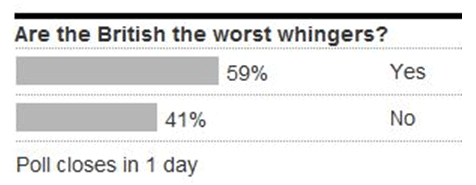
    Busted. “Even in the best of times, whinging, as Britons call the persistent low-grade grousing that is their default response to life’s challenges, is part of the national condition”, Sarah Lyall writes in the New York Times, about Londoners’ failure to embrace the Olympic Spirit. If a British newspaper mocked America there would be a flood of patriotic remonstrance right back at us. But when The Guardian asked its readers whether it was true that Britons were whingers, this is how the poll went:


    There is a lot to complain about with the Olympics. The police have been heavy-handed, pushing around people who have argued with the Olympic hype. The Olympic Park has been forcibly cleared of its official and unofficial tenants.

    Dave Renton, author of Lives; Running, who believes in the Olympics but not in the corporate hype and security that comes with it explains:

    Already the park is enclosed by a sky high fence, topped by razor wires and electronic sensors, with CCTV every few metres and security patrols inside the fence, all to protect the Park from intruders. But in addition the towpath was closed to public access 23 days before the Olympics even began. All across London on the edge of Olympic venues there have been similar restrictions imposed. (see his Olympics-and-other sports blog, http://livesrunning.wordpress.com/)

    Most shockingly, the army has put surface to air missiles on the roofs of local tower blocks, to the outrage of the residents, who see them as a threat against London’s rioting youths rather than any imagined Al Qaida attack. Pointedly, the one estate that has welcomed the installation is the Bow Quarter, a super-rich gated community in the heart of impoverished East London (the site, ironically, of the re-birth of British trade union struggle in the nineteenth century, the Bryant and May match factory).

    There are special Olympic lanes painted on the roads, like those that the old Soviet bureaucracy had for the Zil limousines carrying officials. We are warned that spectators wearing the wrong logo will be barred from the stadium, as will Tibetan flags and any kind of political slogan.

    There is much to complain about, but Sarah Lyall is right: scoffing is the British way. Poor Sebastian Coe, goody-two-shoes of the 1980s track, has a hard job selling the Olympics to the British public. This coming Saturday radicals of the counter Olympics network will meet at noon to protest in Mile End Park.

    Of course Briton’s have not been big on public celebration since they lost that last toe-hold on world domination, as subalterns to the United States in the Cold War. The Falklands War against Argentina (oh, the shame!) was the last that drew out a jingo crowd. Ever since the Berlin Wall came down, we only come out on the streets to object or mourn. That is why the Millennium celebrations drew such a vicious reaction from the intelligentsia here, and why the most recently celebrated Queen’s Jubilee was such a damp squib. By contrast, hundreds of thousands mourned the death of Princess Diana, and perhaps a million marched against the war in Iraq.

    It is not easy to be a British sporting star. Jaded Britons willed Wimbledon tennis finalist Andy Murray to lose with the fervour that in years gone by they would have willed him to win. England’s soccer captain, John Terry, is better known for swearing at Anton Ferdinand than for his defending skills (after a failed prosecution for racial abuse, the press, unwilling to accept the jury’s decision, found him guilty anyway). The mood behind team GB in London right now is markedly downbeat. Londoners’ main interest has been whether they could make any money letting out their homes (no, it turns out, the market was flooded).

    The mood is not helped by the downbeat promotion. Filmmaker Danny Boyle is in charge of the opening ceremony. He says he will not follow the Beijing triumphalism, but instead threatens a mawkish recreation of the English countryside, complete with sheep and even a mob of countercultural festival hippies. On television, Britons follow not the hype, but a mockumentary satire of the hype, Twenty Twelve.

    ******

    The London that Britain will showcase to the world is at a difficult crossroads. It is the centre of the financial services sector, Britain’s most successful export since deregulation in the 1980s, but currently mired in successive crises, most recently the manipulation of the LIBOR rate by Barclays (with the apparent connivance of not only shamed Chief Exec Bob Diamond, but the Governor of the Bank of England, too). There is little doubt that Britain’s economy is dangerously skewed in favour of its financial sector, which buys influence from out-of-touch and cash-hungry politicians. Sadly, the one occasion when the financial sector might have been reined in, the crash of 2008, led to a massive bailout instead. Advice from financiers that the banks were ‘too big to fail’ was accepted with much the same gullibility as advice from the securocrats that Iraq’s weapons of mass destruction could strike London in 15 minutes. In the manner of a naïve maiden aunt, the press and the politicial establishment here were repeatedly surprised that the billions the government gave the bankers went straight into bonuses, instead of being passed on as loans to businesses. Did no one ever tell them that banks are in the business of making money, not giving it away?

    The problem with the banks, in any event, is misunderstood. The febrile financial sector is more symptomatic than causal. It has been fuelled for some years by the surplus capital that British and European industry fails to reinvest in its manufacturing base. Europe’s risk-averse business leaders are reluctant to disturb their cozy relations with each other and government by innovating new processes or products. Where their forebears ploughed profits back into the business, our business leaders prefer to put them in the bank, hunting around for some fantasy of high yield investments that do not entail any relationship more demanding than a phone-call. It is not that bankers steal the cash from business so much as that business that is falling over itself to give it up.

    High on the list of London’s problems is its house-building industry, which has systematically failed to meet the expanding demand for homes. Characteristic of the institutional prejudice against development here, house-building has been stymied by a planning system that restricts building to brownfield sites, and is strangling London’s growth with a ‘green belt’.

    Predictably, the limit on building new houses has forced up prices, and priced poorer Londoners out of central London. According to a study by Tom MacInnes and Peter Kenway for the City Parochial Foundation:

    … more than half (54%) London’s low income population live in Outer London. This is an increase compared to the late 1990s, when London’s low-income population was split equally between Inner and Outer London. Reflecting this relatively bigger population, a larger number of children in low-income households live in Outer London (380,000) than Inner London (270,000). (London’s Poverty Profile, 2009, p 29)

    The impact of high prices on where people live, the gentrification of the inner city, and the exodus of the poor, has been dramatic. For poorer residents to carry on living in London gets more and more difficult. That is particularly so because the rise in rents mirrors the rise in house prices. For too many families living in London means accepting less and less space. Meanwhile, in Caledonian Road, a local developer bought up local shops to convert into flats, and then realised that the cellars could be made into houses, too.

    With some cheek, London’s former Mayor, Ken Livingstone, architect of the London plan that put the dampeners on development is now protesting that ‘rents have soared beyond people’s ability to pay’. But it was Livingstone’s policy, with its mantra of building up, not out, on brownfield, not greenfield land, that created the scarcity of homes that is forcing up prices and rents. All of Livingstone’s solutions are about redistributing the limited housing stock available, without understanding that the real problem is in the realm of production.

    The Olympics, of course, are supposed to have a lsting and positive effect on the London’s housing. But that will not happen unless there is a cultural shift in favour of development that is not engulfed in precautionary regulations and political indecision.

    So let’s hope that Londoners do cheer up before the games start, and enjoy the sight of people giving their all. It ought to be a good antidote to the dog-in-the-manger attitude that is wrecking the prospects of recovery. Londoners have to choose between Olympic spirit, or Olympic whinging.

    Photo by BBC World Service: Homeless Hostel, East London

    James Heartfield’s latest book The Aborigines’ Protection Society: Humanitarian Imperialism in Australia, New Zealand, Fiji, Canada, South Africa, and the Congo, 1836-1909 is published by Columbia University Press, and Hurst Books in the UK.

  • The Evolving Urban Form: London

    The 2011 census results show that London (the Greater London Authority, which is Inner and Outer London) experienced its greatest percentage population growth in more than 100 years (1891 to 1901). London added nearly 1,000,000 new residents since 2001. That growth, however, is not an indication that "people are moving back to the city." On the contrary, National Statistics data indicates that London lost 740,000 domestic migrants between 2001 and 2011. The continuing core net domestic migration losses have been replicated in other major European metropolitan core areas, such as Milan, Vienna, Stockholm and Helsinki.

    Instead as typical in major European core municipalities, the vast majority of the growth in London has come from net international migration. London added 690,000 residents between 2001 and 2010. This pattern has become more prevalent since European Union enlargement, when Eastern Europeans began moving in much larger numbers to the United Kingdom and other richer areas of the old EU-15.
    London first became the world’s largest urban area in the first quarter of the 19th century, displacing Beijing. At that time, London was approaching 1.4 million residents, living in an urban area of approximately 15 square miles. Today, Inner London, the Outer London suburbs and two rings of exurbs spread 10,500 square miles (27,000 square miles), with a population of 20.3 million. Beijing, meanwhile, has grown so fast that it may once again surpass London in the next decade. However, other metropolitan regions are much larger, such as Tokyo and Jakarta.

    Meanwhile, the urban area (the continuous built up area), circumscribed for more than one-half century by the Greenbelt, appears to have a population of 9.5 million, which would place it 27th in population in the world.

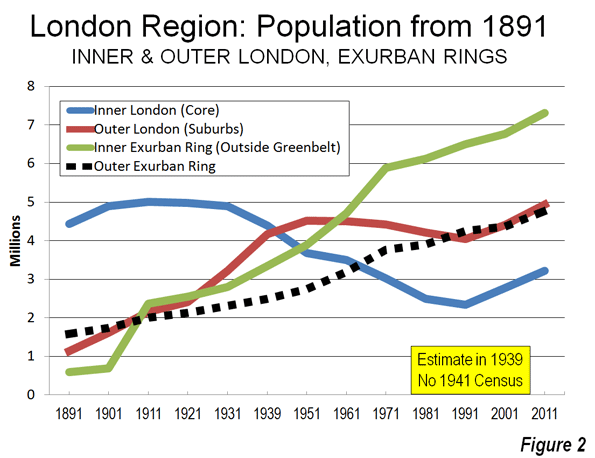
    Over the past century, London has experienced substantial ups and downs in its population and still remains below its 1939 population, even with the large gain over the past decade. Over the same period, Inner London lost millions of its residents and only recently has begun to gain some back, largely due to net international migration gains. Outer London gained in the first half of the 20th century, plateaued and then also gained strongly in the last decade. The exurban areas virtually monopolized growth for most of the post-World War II period (Table) until recently.

    London Region: Population 1891-2011
    Year London Region London (Greater London Authority) Inner London (Historical Core) Outer London (Suburbs) Exurbs (Outside Greenbelt) 1st Exurban Ring (Historical Counties Adjacent to Green Belt) 2nd Exurban Ring
    1891 7,752,000 5,574,000 4,432,000 1,142,000 2,178,000 595,000 1,583,000
    1901 8,931,000 6,507,000 4,898,000 1,609,000 2,424,000 691,000 1,733,000
    1911 11,526,000 7,162,000 5,002,000 2,160,000 4,366,000 2,365,000 2,001,000
    1921 12,071,000 7,386,000 4,978,000 2,408,000 4,684,000 2,553,000 2,131,000
    1931 13,229,000 8,111,000 4,898,000 3,213,000 5,119,000 2,805,000 2,314,000
    1939 8,617,000 4,441,000 4,176,000
    1951 14,832,000 8,193,000 3,680,000 4,513,000 6,635,000 3,891,000 2,744,000
    1961 15,911,000 7,997,094 3,492,881 4,504,213 7,918,000 4,720,000 3,198,000
    1971 17,028,000 7,453,000 3,031,000 4,422,000 9,659,000 5,894,000 3,765,000
    1981 16,644,000 6,713,000 2,498,000 4,215,000 10,035,000 6,127,000 3,908,000
    1991 17,139,000 6,393,000 2,343,000 4,050,000 10,746,000 6,497,000 4,249,000
    2001 18,313,000 7,172,000 2,766,000 4,406,000 11,141,000 6,773,000 4,368,000
    2011 20,256,700 8,164,000 3,222,000 4,942,000 12,092,700 7,318,700 4,774,000
    Sources
    Census except 1939
    Greater London Authority, 1939


    The London Region

    The London region is composed of the Greater London Authority (GLA), which includes Inner London, the historical core municipality, covering approximately the same geographical area as the old London County Council from the 1890s to the 1960s and Outer London, the great suburban expanse consisting of detached and semi-detached housing.

    GLA is surrounded by the Greenbelt, established to contain the expansion of the urban area after World War II, and, at least at first, to decentralize London’s unhealthy and overcrowded conditions. Beyond the Greenbelt are the East of England and the Southeast, which are composed of a first exurban ring of historical county areas, adjacent to the Greenbelt, and a second ring of historical county areas in the East and Southeast, beyond the first ring. Virtually all new urban expansion in the London region was forced into the exurbs by the Greenbelt. As a result, all of the London region’s growth (6 million) since World War II has been outside the Greenbelt (Figure 1).

    Inner London

    Inner London has been a population growth miracle over the past two decades. The 2011 population was 3.2 million, up more than 450,000 from 2001 and nearly 900,000 since 1991. However, the 1991 figure of 2.3 million was more than one-half below the 5,000,000 peak reached in 1911. Even though historical core city losses are typical (where geography is held constant), Inner London’s loss was huge, at more double those sustained in Chicago (since 1950) and Paris (since 1921). The core of Inner London was developed as a walking city and expanded substantially with the coming of transit.  At approximately 26,000 residents per square mile (10,000 per square kilometer), Inner London is less than one-half the density of the ville de Paris and far less dense not only than Manhattan but even less dense than the New York City boroughs of Brooklyn and the Bronx.

    Yet despite the recent increases, inner London’s 2011 population is lower than counted in the 1861 census (yes, 1861) Even  with the population increase Inner London lost 390,000 domestic migrants (Figure 2) to other parts of Great Britain between 2001 and 2010 (the detailed 2011 data is not yet available at this level).

    Tower Hamlets, one of London’s 32 boroughs, is an example of this population roller-coaster. Tower Hamlets is located just to the east of the Tower Bridge in Inner London on the north bank of the Thames. It is home to substantial new development spurred by the rapid growth of the financial services industry both in the "square mile" ("city of London) and Canary Wharf. Tower Hamlets grew to 254,000 in 2011, a nearly 80 percent increase from the 142,000 registered in 1981, less than its 1801 population (Note: London Boroughs). But like Inner London, Tower Hamlets used to be much more populous, reaching a record for a London borough at 597,000 residents in 1901. It then lost more than 75 percent of its population over the next 80 years.  

    Outer London

    Outer London, which was combined into the Greater London Council in 1965 (and the Greater London Authority in 2000) also grew strongly, from 4.4 million to 4.9 million and is now at its peak population. Outer London’s population density is 10,000 per square mile (4,000 per square kilometer), approximately the same as the District of Columbia. Like Inner London, Outer London also lost domestic migrants, with a net 310,000 residents leaving for other parts of the United Kingdom (Figure 2).

    The Greenbelt

    Since World War II, the London urban area (principally composed of Inner and Outer London) has been surrounded by the Greenbelt on which development is not permitted. The Greenbelt ranges from 10 to 20 miles wide (25 to 50 kilometers) and covers more than three times the size of the Greater London Authority. The Greenbelt has been cited, along with related policies, with substantially raising house prices and contributing to London’s longer commutes than Paris, where there is no greenbelt.

    Exurban London

    Despite their more modest growth in the last decade, the exurbs have been effective in attracting net domestic migration. From 2001 to 2011, three was a net inflow of domestic migrants of 320,000 (Figure 2). Much of this appears to be people leaving London. During the last year, more than 50,000 residents of London moved to the exurbs. Net international migration to the exurbs had been fairly small earlier in the decade, but increased substantially in the later years. By 2009-2010, two thirds of the London region’s net international migration was to the exurbs, and only one-third to London.

    First Exurban Ring

    The first exurban ring includes the historical counties that border on the outside of the Greenbelt. These areas added approximately 550,000 residents between 2001 and 2011 and reached a new population peak, at 7.3 million.

    Second Exurban Ring

    The second exurban ring includes the counties of the East of England and the Southeast that are outside the first ring. These areas added more than 400,000 new residents, and reached a new peak population of 4.8 million.

    London and England

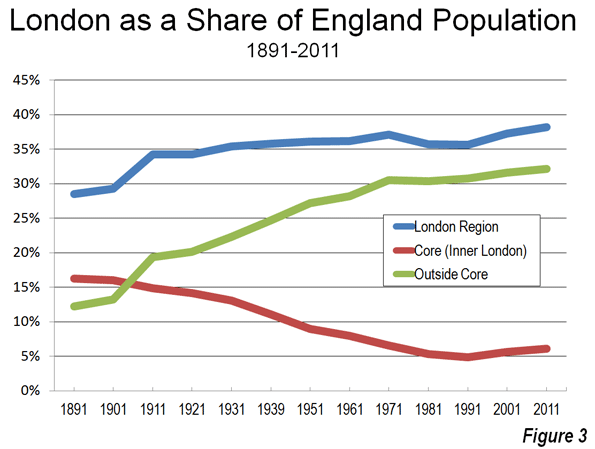
    In contrast to the 1991-2001 decade, the 2001-2011 decade indicated a significant slowdown in the share of England’s population growth in the London region. In the previous decade, all of England’s growth occurred in the greater London region. In the last decade, 50 percent of England’s growth took place around the capital. Overall, the core of London (Inner London) population has steadily fallen relative to the rest of England England’s while the suburbs and exurbs have grown to include one-third of England’s residents (Figure 3). So as Japan is moving to Tokyo, England is still moving to London, but not nearly so fast.

    Wendell Cox is a Visiting Professor, Conservatoire National des Arts et Metiers, Paris and the author of “War on the Dream: How Anti-Sprawl Policy Threatens the Quality of Life.”

    —-

    Note: London Boroughs: The 32 boroughs of London were defined after the creation of the Greater London Council in 1965 (which was abolished in 1986). The Greater London Authority provides data to show the historical population figures for the boroughs, going back to the initial census (1801). The new Greater London Authority was established in 2000, with less power than the previous Greater London Council. The 32 boroughs continue to operate, providing local public services.

    Photograph: London Suburbs (Outer London) by author

  • London Olympics 2012: Let the Games End

    Why does anyone persist with the Greek mythology that the Olympics are an engine of economic development, sportsmanship, or peace on earth? London is spending $15 billion on the hope that it can sell enough tickets to synchronized swimming, and earn enough from television ads, to cover the costs of the 30,000 rent-a-cops and military personnel being deployed in the spirit of Olympic harmony.

    Even though the Games break few economic records, except those for non-performing sovereign debts, governments around the world scramble madly every four years for the right to act as host, as if influence peddling were an Olympic sport.

    The original cost estimate, sold to the British public to convince them to get behind the bid for the 2012 Games, was about $4 billion. Those budget forecasts imagined that, after the event, Olympic sites would be recycled for use as schools, homes for the aged, and handicapped parking, even though earlier Olympic cities have found little use for their table tennis stadiums and aquatic centers.

    In 2005, London beat out Paris (narrowly), New York, Madrid, and Moscow for the right, if not the privilege, to spend billions of dollars (that no one has) on a temporary Olympic village, a badminton complex, and swimming pools suitable for the American relayers to lap swimmers from places like Albania and Costa Rica.

    Those who advocate Olympian edifice dreams include smiling politicians who can dole out sweetheart construction contracts; national sports associations, whose budgets are commensurate with gold-medal production; the International Olympic Committee, which in the past has been something of a Dream Team for backhand payments; and the television networks, which use the Games to fill the dog days of August and to develop various story-lines around medal-gobbling athletes (see Michael Phelps) or mildly voyeuristic content (women’s beach volleyball comes to mind).

    Everyone wins at the Olympics: stadium contractors, strutting central governments, and athletes who place high enough to be crowned with the laurels of corporate sponsorship. Well, everyone except the bondholders, who are left with little more than folded tents when the circus leaves town after three weeks of breathless commentary about women’s weightlifting.

    By chance, I have been to many of the cities that have hosted recent summer Games — Barcelona, Moscow, Beijing, Athens, and Seoul. In nearly each locale the thought crossed my mind that city residents have little more to show for their indebted billions than a few light-rail lines, perhaps an airport facelift, and impractical buildings that can be converted only into minimum-security prisons.

    Beijing still has its iconic Bird’s Nest and Water Cube, although neither stadium is used now for anything more than tourist photography and an aqua park.

    My son Charles and I spent a week driving around Greece after the 2004 Games. As best as we could tell, all Athens got for its now-bad loans were signs pointing the way to the Olympic Sailing Center (we even found these billboards miles from the sea), and a light-rail connection to Piraeus. Weeds covered the infield of the softball stadium.

    Barcelona, the 1992 host, ended up with some new apartment buildings — since the Olympics were played in downtown areas — a few marinas, and of course light-rail. Many cities, however, have successfully put up apartment blocks without staging a field hockey tournament.

    Nor did Moscow get the political bounce it had angled for when it hosted the 1980 summer Olympics. In protest over the Russian invasion of Afghanistan, the United States and many allies refused to send teams, giving the Games the feel of a Warsaw Pact scout jamboree. The paint peeled off the Olympic village faster than some of the times in the marathon. (In London, the US has decided against boycotting its own invasion of Afghanistan.)

    In theory, politics have nothing to do with the Games, although by organizing teams according to countries, the Olympic Committee has ensured that the spectacle is best understood as the continuation of war by other means, including archery and (in 1900) live pigeon shooting.

    When the modern Olympics were revived in 1896, individual athletes paid their own way to Athens to compete as amateurs. Now, nearly all nations field the equivalent of the East German swim team, a squad bred in laboratory test tubes to demonstrate a triumph of the will.

    The reason terrorists have the Games on their hit lists (Munich in 1972 was the worst example) is because the governments that they revile enter the stadiums with such wild displays of flag waving, as though the opening ceremony were a bullfight. At the London Games, security contracts are worth more than gold medals. For example, the British army is deploying surface-to-air missiles near the Olympic Stadium (apparently javelins no longer do the trick), and the FBI, in theory an exclusively domestic US Agency, is sending over about 500 agents, even though it was the Secret Service that won the regional escort trials in Cartagena.

    Does the corporate business of the Olympics negate the achievements of the athletes? Am I so cold-hearted that I cannot admire Joan Benoit Samuelson coming home in 1984 with the gold or Fosbury’s flop? Not at all. I enjoy watching Moldova lose at water polo as much as the next American. At the same time, there is something cartoonish about NBA All-stars dunking over a Latvian small forward.

    Were the decision mine, I would let the Olympics go the way of Nuremberg rallies. The Games strike me as ruinous to city finances and bad for sport. Should not the goal of the Olympic movement be to encourage more players and fewer spectators? Instead, the Games are a celebration of reclining consumerism. At least the athletes get to go through 100,000 condoms in 17 days.

    Nor does any sporting event that requires the protection of thousands of soldiers, surface-to-air missiles, and 24/7 cable coverage strike me as the spiritual heir of the Games first contested in a Greek sanctuary.

    Several school vacations ago, I took my younger daughter to Olympia, located in the western Peloponnese. We were tracking down the ancient wonders of the world, and Olympia once had a huge gold statue of Zeus, until “promoters” stripped it for parts and carted off the gold to Aleppo on donkeys.

    We strolled around the original Olympic stadium, which even today could be built for about $200,000. The “seats” are slopes of grassy lawn, and the field of dreams is covered with dirt. The rest of the Olympic village is a few pine trees and some worn temples, but it’s magical.

    Even during times of conflict, from 700 BC to 400 AD athletes came to Olympia from the contours of the Greek world, and left for home, if successful, only with olive branches in their hair. Along with paying honor to Zeus, the ancient Olympics celebrated athletic achievement, not prime-time nationalism or Coca-Cola. To show modesty, athletes were naked for their competitions. The Games ended only when Christianity moved to wipe out what it viewed as a pagan ritual.

    At the end of three weeks of the London Games, even if the British army has had to shoot off a few of its surface-to-air missiles, TV commentators will pronounce the Games an immortal success, a triumph of Spartan proportions, and an epic not seen since Jason came back with the golden fleece.

    Then, in three years, if not sooner, London will get the $15 billion invoice for its fun summer, and all it will have to show for it will be a few used diving boards and, with luck, some new light-rail. In the words of George Best, the great Northern Irish footballer: “I spent a lot of money on booze, birds and fast cars. The rest I just squandered.”

    Flickr photo by Jesse Scott / twowaystairs – Wenlock, the 2012 Olympic mascot.

    Matthew Stevenson, a contributing editor of Harper’s Magazine, is the author of Remembering the Twentieth Century Limited, a collection of historical travel essays. His next book is Whistle-Stopping America.

  • The Economist on the Costs of London’s Green Belt

    The Economist reminds readers of the economics of housing (or for that matter, oil or any other good or service): constraining the supply of a good or service in demand raises its price. In a 14-page feature on London, The Economist decries the high cost of housing in London. And, for good reason, the 8th Annual Demographia International Housing Affordability Survey showed London to have a median multiple (median house price divided by median household income) 6.9 in the fourth quarter of 2011. This figure, which would be more like 3.0 in a normally functioning market, is exceeded by few other major metropolitan areas, though Hong Kong, Vancouver, Sydney are more unaffordable.

    The Economist noted that:

    … perhaps the biggest constraint on development in London is the Green Belt. Established after the war, it runs (with perforations) all around London, to a depth of up to 50 miles, and bans almost all building on half a million hectares of land around the city.

    Not only has this constraint led to higher house prices, but it has resulted in greater urban expansion and imposed greater costs, in time and money on commuters.

    … it has pushed it into the greater south-east, thus spoiling the countryside across a bigger area. It has also raised the cost of housing and forced workers to travel farther. Commuting costs in London are now higher than in any other rich-world capital.

    One alternative is to relax the Green Belt controls. The Economist points out that allowing development one mile into the Green belt would add one-sixth to the developable area of London. The Economist also notes that "far more than would be needed to make a huge difference to housing availability" and that opening the Green Belt "might not be an environmental disaster."

    The Economist calculates that "the average London worker can buy half an average home." Britain would gain if the interests of those with a stake in a poorer middle class and greater poverty were to finally give way to the general welfare.