Tag: London

  • Gentrification? Brixton’s Angell Town Story

    In the US, urban planners talk about the ‘redevelopment’ of a neighborhood. In the UK, ‘regeneration’ is heard more often. What is the difference, from both the planner and the resident perspective? Are they both synonyms for ‘gentrification’? Angell Town , a UK ‘estate’ in Brixton — it would be called a ‘public housing project’ by Americans — provides a good example of how these questions are answered in practice.

    In theory, meanwhile, the answers are… yes, and no. They overlap quite a bit, but the terms are not the same. In its simplest form, to redevelop is to develop again, which implies doing it over completely. Regeneration most directly means “rebirth or renewal”, implying that the entity remains throughout the process.

    The American Planning Association (APA) defines redevelopment as “public actions that are undertaken to stimulate activity when the private market is not providing sufficient capital and economic activity to achieve the desired level of improvement…. such as direct public investment, capital improvements, enhanced public services, technical assistance, promotion, tax benefits, and other stimuli including planning initiatives such as rezoning.”

    The Royal Town Planning Institute (RTPI) defines regeneration as “a holistic process which aims to reverse the economic, social and physical decline of places where market forces alone will not suffice… balancing community, business, environmental and individual needs… as well as changes to the physical environment.”

    So — redevelopment focuses on monetary investment and physical changes. Regeneration focuses on the existing community and the “social decline” of a place, as well as economic and physical factors. Even further, it aims to “holistically,” address “individual needs.” Of course many redevelopment projects address the community, but because the APA distinctly says that “the private sector may initiate redevelopment projects without any active public involvement beyond the government’s traditional regulatory role,” I would argue that it involves less social investment than regeneration.

    Perhaps the distinct difference between the responsibility to act directly on behalf of existing residents versus the responsibility to investors stems from a large English planning system that is more politicized (and therefore receives more federal funding.)

    While in America, gentrification might be seen as an inevitable side effect of redevelopment, in England it is seen as a sometimes inevitable and therefore tragic side effect of regeneration.

    To illustrate this point, look at a true regeneration project: Angell Town, Brixton, London

    Problem (courtesy of Rudi):

    • Lack of public space for social interaction – derelict communal areas were unused.
    • The garages provided were dark and un-surveyed, and therefore, never used.
    • The estate was perceived as crime ridden, as the multiplicity of bridges and walkways provided ideal escape routes for criminals, often from outside the estate itself.
    • Litter accumulation resulted from removing the bridges (which gave access to the waste removal pick-up points), in an attempt to reduce crime
    • The estate came to epitomize neglect and decline
    • The estate became stigmatized a sink estate.

    Solution – A summary of simple urban design changes:

    • The first main part of the scheme involved re-orientating the existing deck-access housing into a more “normal” street format, based on terraced dwellings which related to the street through individual entrances.
    • Each dwelling was given an individual, recognized identity — surveillance on the street was improved, as windows now faced directly out
    • Terraced housing replaced the monotonous, unsafe corridors of entrances.
    • The pedways, which were perceived as unsafe, were removed so that the houses could be extended to face on to the street.
    • New central grassed areas were defined as focal points for the houses. These areas were separated from the new vehicular perimeter roads by railings, enabling children to play, away from the danger of traffic and dogs.
    • The unused garages on the ground floors were replaced with shops and community facilities, such as a bar, cafe, workshops, and even a recording studio in one area, to provide the previously, much lacked social amenities. This design measure also helped transform dark and bleak spots into animated facades of street level activity.

    Instead of only seeing Angell Town’s problems, the urban designer, planners, and architects looked at them as opportunities to build on the strong community that had lived there for decades. The project improvements didn’t eradicate every trace of the place that had become their home, but committed a large investment to renovate the buildings they could, and design the new ones to compliment the existing ones so well that you had to look hard to tell the difference between the two.

    Members of the community could still see where they came from. In other words, it still felt like home. Most importantly they could look again a little harder and see their bright futures. This might sound like I’m laying it on a little thick, but the success of this regeneration stunned so many, both nationwide and on the European continent, that it provoked intense project documentation. Residents who were interviewed realized what planners so often don’t: they looked to their physical environment to define their identity. With the existing bones of the original Angell Town Estate still in existence, they easily identified the physical improvements to be improvements in themselves.

    This outstanding result came from an intense and time-consuming community consultation process, a term that is distinctly different than public involvement. The lead urban designer was so involved with the community that he actually lived there on the weekends in a flat. While this is rare in any country, it certainly is to be commended.

    Perhaps the most powerful items in Angell Town now are the benches that, poetically, are made from the rubble of demolished parts of the old buildings, caged, with stone seats on top. People can actually sit on the physical representation of what was destroying their community. This was recited by residents often as what made the biggest difference to them. Don’t ever underestimate the power of poeticism!

    I would love you to share you comments on this story. I’ll also suggest: Consider the many similar public housing projects in America that have been completely razed and rebuilt to look like another place. How does it make people feel to have their homes be deemed so worthless that they are torn down and completely replaced, often with architectural rubbish?

    So, what will it be — redevelopment or regeneration?

    Photo: UK Government Web Archive: Angell Town – “Many residents also have private outdoor space.” Building for Life is run by CABE and the Home Builders Federation with Design for Homes.© Commission for Architecture and the Built Environment (CABE)

    A different version of this post appeared on Erin Chantry’s blog, At the Helm of the Public Realm. Chantry is an Urban Designer in the Urban Design and Community Planning Service Team with Tindale-Oliver & Associates

  • London’s Social Cleansing

    Unscrupulous landlords are forcing poorer tenants out of their London homes, freeing them up to rent out to visitors to the Olympics this summer, according to the housing charity Shelter. At the same time, the government’s cap on rent subsidies (Housing Benefits) for those out of work or on low incomes threaten to force less well-off tenants out of the capital. Newham Mayor Sir Robin Wales says that they will have to move people as far afield as Stoke-on-Trent if they are to meet their obligations to house the homeless. Fears of ‘social cleansing’ featured in the Mayoral election where Tory incumbent Boris Johnson made sure to distance himself from his own government’s policy to beat off the challenge from veteran left-winger Ken Livingstone.


    Inner London, outer London (Newham in red); London, Stoke-on-Trent

    Critics of London’s ‘Social Cleansing’ have fixed on the changes to the law regarding housing benefits and the Olympics, but failed to notice that working class Londoners have been being forced out of the nation’s capital for some time now – thanks to the ceaseless rise in house prices. On the London Programme in 2003, I said that without opening up more land to building in the green belt, house prices would spiral out of control, pricing ordinary Londoners out of the capital. Mayor Ken Livingstone slapped me down saying that he would never sanction building on the green belt.

    Today Eva Wiseman, a commissioning editor on the upmarket broadsheet, the Observer, says that she cannot afford to rent in London’s once poorest borough, Tower Hamlets, let alone buy a house. She cites Shelter’s estimate that you would need an income of £67,669 to rent there (average income is £26,244).1

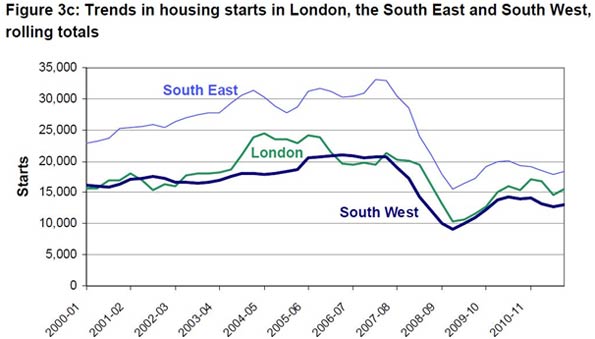
    It is not hard to understand why prices are so steep. Housebuilding in the UK has failed to keep pace with demand. New housing starts are slightly up after the crash, but overall they are woefully short of actual need. The reason is that Britain has among the most stringent laws on building – the ‘planning laws’ – which stop building on the ever-growing ‘green belts’ that surround our cities.

    Given that the working class are the Labour Party’s natural constituency, you might have thought that its years in government (1997-2010) would have seen more homes built for working people. But Labour turned its back on the working classes a long time ago, while keeping its neurotic interest in regulating the economy. The outcome was a re-vamped planning system that put the brakes on home building. This time this was done in the name of the environment, not to protect the Tory Shires from ‘bungaloid sprawl’, as it was originally intended. Housebuilding fell below the bare minimum of 250,000 you would need just to replace the increasingly dilapidated stock.

    When David Cameron’s Conservative-Liberal coalition came to power in 2010, his Communities Minister Eric Pickles and Housing Minister Grant Shapps had promised a large scale liberalisation of the planning laws – and even blamed their predecessors for doing more damage than the Luftwaffe to Britain’s housing stock. But the fine print on Shapps’ new planning law proved as prohibitive as what went before. Even those champions of the Green Belt at the Guardian were moved to editorialise that ‘these convoluted and qualified planning laws will become another aid to the big-money lawyers’. 2

    The Conservative government’s commitment to liberalisation is like its Labour predecessor’s commitment to the working class, theoretical. Home building remains stalled, and prices have not seriously fallen despite the shortage of credit). Governments of all stripes are most committed to orderly regulation of change, and dread the unsupervised activity of their citizens – a prejudice which has only led to chaos.

    The short supply/rising price dilemma is particularly intense in London. A metropolis of nine million creates a fierce competition for prime sites. Even putting aside the super-rich boroughs, like Kensington and Chelsea, where average prices are £1.3 million (roughly $2 million US), the overall London average is £406,000 ($770,000 US) .

    Besides being the most logical place for real estate speculation from around the world, London also has been in the grip of the planning system. It was in London that the Labour mayor took on architect Richard Rogers as an advisor, and committed the capital to a programme of building only on brownfield (already developed) land, ‘building up, not out’. The result is not much building at all, except to pack more four and five storey blocks into what few pockets of green space can be grabbed. His successor Boris Johnson has avoided challenging the Livingstone system, preferring a quiet life to any hint of controversy.

    Rather than face the problem of the absolute shortfall in new homes, most critics have fixated on peripheral issues, such as the number of empty homes (which, despite the attention they receive, are, because of high prices, at an all-time low). Easy credit, too, has been blamed for high prices, which is true, but the shortage of credit has not led to a great fall in prices, because the underlying problem was the absolute shortage of homes. Others have argued that the British are too wedded to the idea that they should own their own homes, and could rent, like the Germans, failing to understand that the availability of homes to rent depends on their being built, and rents tend to move in the same direction as prices, as The Observer’s Eva Wiseman has discovered. London’s Mayors have dedicated much attention to schemes to build ‘affordable homes’ – sometimes reserved for occupations like teachers and firefighters – though these are too few in number to have much impact on prices overall.

    Over time, this means working people are being priced out of central London. Tim Butler, Chris Hamnett and Mark Ramsden’s analysis of London’s employment in the 2001 census shows that outer London and the South East is more working class than inner London. Inner London had more large employers, professionals and managers than outer London and the South East. Outer London had more routine, semi-routine and technical or lower supervisory workers. Inner London did have more unemployed than outer London, and outer London had more self-employed than inner London. This employment profile was new, following changes that took place after fifteen years of economic growth, say Butler and his colleagues, though many have noted the sharper contrasts between wealthy enclaves and impoverished housing estates dogged by underemployment. 3

    These social changes show inner London’s parallel embourgeoisment and deepening social poverty. Of course, those who live in the outer suburbs scoff at the protests from well-heeled social commentators about the prices in inner London as ‘Zone Six snobbery’. Still the changes go some way to explaining why Ken Livingstone was unable to sustain the traditional City Hall machine he built consolidating constituencies among inner London’s poor immigrant and residual working class   communities while Tory Boris Johnson won  over the more working and middle class outer suburbs.

    In his last term Livingstone concentrated on winning over London’s bloated financial service sector more than he did on popular support – but the City of London switched its allegiances to the Tory Johnson, who champions it as an engine of growth. Neither candidate has understood that the skew towards the overheated financial service sector creates a weakness in the London economy, with manufacturing having moved out to the surrounding South East and a growing lack of upwardly mobile jobs for all but the most skilled or privileged.

    The housing benefit cap clearly is a problem for welfare-dependent families who are caught in the poverty trap and cannot earn enough to pay the rent. But the problem of the less well-off being priced out of London began long before the changes in housing benefit rules, or London’s winning the Olympic bid. The city the world will visit this summer increasingly resembles not the social democracy imagined after the Second World War, but increasingly a social bifurcated place increasingly resembling that of Victorian times.

    James Heartfield is the author of Let’s Build: Why we need five million new homes, a director of Audacity.org, and a member of the 250 New Towns Club.

    ————————————–

    A Mile High Tower for London

    One imaginative solution to London’s housing problem was proposed by Ian Abley and Jonathan Schwinge of the 250 New Towns Club. Abley and his colleagues have been pressing for new building in Britain’s green spaces to meet housing need.

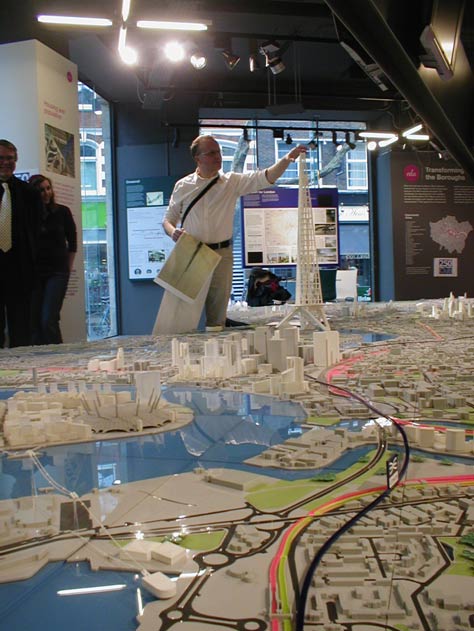
    Taking on the challenge of building up as well as out, Ian unveiled a plan for a tower one mile high for London at the Building Centre, which could house 90,000 people.


    ‘Locked out of the Property Market’, Observer,  6 May 2012

    27 March 2012, http://www.guardian.co.uk/commentisfree/2012/mar/27/planning-builders-charter-lawyers-delight-editorial, and see ‘Coalition of the Unwilling’, New Geography, 1 July 2011, http://www.newgeography.com/content/001966-coalition-unwilling

    Inward and Upward: Marking Out Social Class Change in London, 1981–2001, Urban Studies 45(1) 67–88, January 2008, 72

    London photo by Bigstockphoto.com.

  • Britain Fears a Developer’s Charter

    The UK Government’s Department for Communities and Local Government (DCLG) announced that there were only 127,780 new housing completions last year in Britain. British house building activity is down to levels of after the First World War, when reliable industrial records began, and still falling. In 1921 the British population was nearly back up to 43 million following the slaughter of the First World War. In 2011 the population of England, Wales, and Scotland is approaching 61 million people. By 2031 the British population is expected to be closer to 70 million. With such existing unmet and growing demand for new housing the DCLG, the Government department that runs the Planning System should be busy finding ways to allow developers to build.

    Many feared that the National Planning Policy Framework (NPPF), prepared by the DCLG for an expected release in January 2012 would be a developer’s charter. We wish it was a developer’s charter! The NPPF continues planning policies, supported by all Parliamentary political parties, which continue to frustrate volume housebuilding. Developers have to prove that their proposals for house building are not merely about building useful homes at a profit, but are “sustainable development” when measured against disputable social and environmental criteria. No developer is free to build on their own land without first having to obtain planning approval from an array of third party interests all insisting on their interpretation of the moral idealism of sustainability.

    This makes the NPPF an anti-development charter for all those who oppose house building and population growth. Anyone can claim that more house building and more households are unsustainable in their area, in the effort to stop a project which they don’t approve of.

    The NPPF will do nothing to challenge the power of contemporary anti-development campaigners, who are well known. Anne Power, Lord Richard Rogers and other members of New Labour’s Urban Task Force (UTF) have correctly identified themselves as allied to the “Hands off Our Land” campaign run by The Daily Telegraph, the Conservative supporting newspaper.  The UTF favors a continuing commitment to ‘… reclaiming brownfield sites and re-densifying cities.’ To build only on previously developed land is the green ideal of the UTF and the “Hands off Our Land” campaign.

    We all know where these policies lead. Not to a golden age of regeneration for all, but to lucrative property investment for those with access to sufficient capital and the right connections to steer themselves through the planning system to obtain approvals. The volume of Greenfield land developed declined dramatically under New Labour. The present Conservative led Coalition Government continues the practice of obstructing development on Greenfield land.

    Between 2000 and 2006 the total area of land built on for new housing fell by 23%, with a 42% fall in the annual amount of Greenfield land used. In 2010 76% of all housing was built on previously developed Brownfield land, a slight decrease from the 80% in 2009. Only 2% of housing was built on the Green Belts around major cities and towns. The Green Belt in England covers 13% of the land, or twice the area already developed for housing. Small wonder that the price of the shrinking supply of land with a prospect of being approved for sustainable development remains inflated.

    House building was only increased from the low point of 2001 by increasing the density of development in the cities. Average densities rose from 25 dwellings per hectare (dph) in 2000, to 43 dph by 2010. In London the average density for new housing is much higher, at 115 dph in 2010.

    Densification policies considered sustainable have meant that the majority of the working British public can no longer buy a new house with a garden, in ways that previous generations may have taken for granted. Instead the plan has been to squeeze more new households into less space. UTF supporters and the DCLG imagined they were regenerating cities and saving the planet for all of society. Like traditional Conservatives they mean to keep developers and the population off Britain’s ample supply of otherwise redundant farmland.

    The Daily Telegraph’s campaign, best articulated by the conservative anti-growth philosopher Roger Scruton, is clearly the flip side of the UTF’s densification argument. He is happy as long as the population is kept away from the countryside he loves. ‘Thank God for obstacles to economic growth,’ says Scruton.

    Scruton speaks for the comfortable who already enjoy plenty of space. The Daily Telegraph’s campaign is ultimately concerned that existing housing markets are protected, sustained through the division between Town and Country, and moralised as a concern for environment and heritage. New Labour supporters are more likely to read The Guardian, but its more middle-class readership finds nothing to object to in The Daily Telegraph’s campaign, in order to restrict the “sprawl” of suburbia and halt the imagined damage this will do to the environment and urban communities. The Guardian’s readership formed the bed-rock of New Labour’s support, and back Next Labour. The working class may have deserted Labour, but is depoliticized and passive. The Guardian and The Daily Telegraph – still supposed by many to be at opposite ends of the old-fashioned and defunct ideological spectrum of Left and Right – prove closer than either cares to think.

    Labour Members of Parliament have traditionally feared the “flight to the suburbs” lest they lose voters and the associated tax revenue. The planning system has proved very effective in maintaining the political geography of Britain. Labour politicians negotiate their political dependency on urban containment with a Red-Green stance in urban areas, without threatening the Blue-Green interests of those who want to keep development out of the countryside. All depend on the denial of development rights that date from the 1947 Town and Country Planning Act, and which the NPPF reinforces.

    Meanwhile working class families are squeezed into what little Twentieth Century suburbia is still affordable, competing unsuccessfully with the more affluent for ownership of this increasingly scarce and valued commodity. What new housing is built is at higher density, usually on the least attractive sites. That is land previously occupied by factories, old infrastructure, and utilities, or by council housing estates re-developed at higher densities. Yet even these unpopular sites enter the inflated British housing market, sustained through a chronic lack of house building.

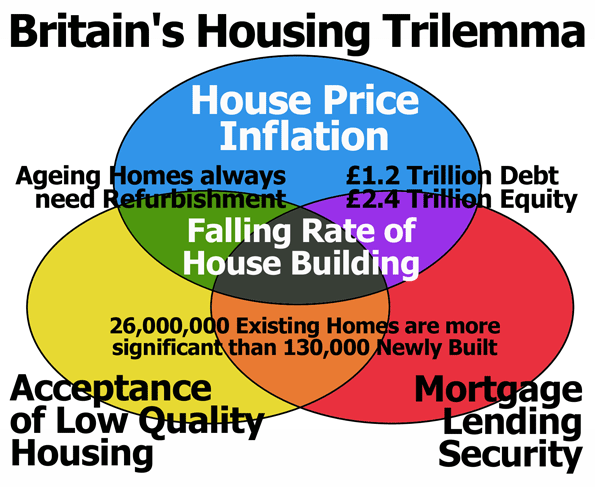
    The working class is caught in a political crusher made manifest through the planning system. The Red-Greens, who may imagine themselves on a new Left, gentrify towns and cities with “sustainable redevelopment”, and the Blue-Greens, who persist with being on the Right, protect their landscape for their exclusive enjoyment. Meanwhile the majority of home owners have come to depend on the inflated and unaffordable housing market. New Labour needed this house price inflation to allow the owner occupying majority to supplement inadequate wages by withdrawing equity from their homes. So does the Coalition. Deliberate or not, The Daily Telegraph’s commitment to building fewer new homes will stabilise what we have called the Housing Trilemma.

    Our current predicament may be thought of as a Trilemma, in which house price inflation supports burdensome mortgage lending and private debt, while households in the owner occupied sector accept low quality housing conditions. High rents shadow private sector housing costs, and private rental housing quality is often of the lowest quality. Many in Britain, including the majority of the home owning middle class, are dependent on the Housing Trilemma remaining stable.

    The planning system serves well in protecting the interests of existing home owners. Behind the NPPF’s moral idealism of sustainability, the immediate instrumental objective is to restrict new housing supply to avoid destabilising housing markets.  Appearing as a moral mission to save the planet from developers, the NPPF and the denial of development rights sustains the Housing Trilemma. Debt is secured, but housing remains unaffordable, quality low, and house building activity is at an all time industrial low. This is not a conspiracy. It is a predicament.

    When Britain’s elites talk about wanting to revive economic growth, they don’t mean a massive surge in new house building or an expansion of infrastructure. What they have in mind is a revival of financial services in The City, subject to uncertainties in the fragmenting Euro Zone, and the maintenance of high housing prices in the hope of more inflation to come. Meanwhile the countryside is kept pristine for the few who can afford access to it as a weekend retreat for the wealthy, including the pro-urban intelligentsia, in all their Red-Green-Blue moral plumage.

    The Coalition could have challenged the Housing Trilemma. Instead they have reinforced it.

    The result is predictable. Planning applications are falling in number and ambition. Only 25,000 new homes were approved in the second quarter of 2011 compared to 32,000 in the second quarter of 2010. This will be read by The Daily Telegraph campaign members as “proof” that there is no demand for development, inverting the causality. Money is being made out of an environmentally sanctioned scarcity rather than through increased productivity and innovation in a sector like house building and the wider construction industry. Britain’s already backward construction industry is further retarded, and it is becoming commonplace for social elites, and not only crazed nationalists, to blame immigration for housing shortages.

    Britain’s economy needs growth, but is unlikely to get it from the house building sector. Britain too needs a dose of political reality while the pro-urban intelligentsia preen their green morality.

    The Coalition cannot afford to confront the political problem of the Housing Trilemma if it is to sustain its fragile political base. Increasingly, only the elderly bother to vote and this equity rich group will be mostly satisfied with modest house price inflation as a hedge against general inflation, while savings in banks attract little return. Meanwhile an influential propertied elite still enjoys sustained house price inflation at the top of the market. They are anxious that environmental and heritage designations operate to enhance the exclusivity and enjoyment of their investments. The unelected charities, agencies and Non-Governmental Organisations that were aligned against the draft of the NPPF in July 2011 represent these elite interests. They may now back the redrafted 2012 NPPF with all its demands for sustainability. Their “Hands off Our Land” campaign has worked for them.

    The NPPF means that house builders face a future in which building on Greenfield land is effectively considered an eco-crime. Only those who can develop Town Centre sites, perhaps as rental housing, or as luxury homes for the equity rich will thrive. Basically Britain is no longer building homes with gardens for sale to young working families on modest incomes.

    If you are in a young working family, or hope to start one, the question is: What are you going to do about the housing predicament you and your friends face?

    We have to face a stark reality. Sadly, there is no contemporary habit of young working families organising to demand housing collectively. Meanwhile the 2011 to 2012 production figures look set to be lower again, and the developmental uncertainties about to be articulated in a redraft of the NPPF in pursuit of sustainable development will further the decline in production.

    Anticipating this feature of Britain’s ratcheting austerity does not make for a Happy New Year. Much depends on what the people of Britain, and particularly the young, do to demand that family houses are built at modest prices in places they want to live together. At present Britain fears a developer’s charter, even though the National Planning Policy Framework is nothing of the sort. Parliament might yet instead be in fear of people demanding cheap land on which to build a better place to live.

    James Stevens is Strategic Planner at the Home Builders Federation, www.hbf.co.uk. Email him at james.stevens@hbf.co.uk. The views expressed are his own and not those of Home Builders Federation. Ian Abley is a site architect and runs the pro-development website audacity, www.audacity.org. Email him at abley@audacity.org. Together they organise the 250 New Towns Club, www.audacity.org/250-New-Towns-index.htm.

  • It’s Not the 1980s in Britain Anymore

    Britain’s public sector workers came out on a one day strike last week over government plans to raid their pension funds. Government ministers did the rounds of television studios denouncing the strikers as mindless militants. Both sides are echoing the class struggles of the Thatcher-era, but the truth is that it’s not the 1980s.

    My children were off school, and like many children, glad of it. Schools are among the more solid parts of the public sector action today, and in London were struck out, though in the country the teachers’ unions have not achieved the 90 per cent shut down they were aiming for. Unlike the last great wave of union opposition to Conservative spending cuts, back in the 1980s, the teachers’ unions were supported by the National Association of Head Teachers.

    At the college where I teach, the lecturers in my department were solidly behind the strike, and boldly leafleted and informed students of their decisions in lectures and circulars. Administrative staff, by contrast, crossed the picket lines.

    Overall the strike is well-supported, but not quite the quantum leap of opposition to the Conservative-Liberal coalition that seemed to be in the air. Those joining the marches were 30,000 in London, and a few thousand in the other major cities, which is many more people than the deracinated petit bourgeois mobilised by the #Occupy camps, but does not compare to the bigger union mobilisations of the 1980s.

    Union activists have tried to paint the coalition (which they call the ‘Con-Dem’ government) as Margaret Thatcher’s Conservative government of the 1980s reborn.  As they see it, some ‘anti-Thatcher’ spirit would give the rank and file more fire in their bellies.

    Prime Minister Cameron and his ministers have been trying to spark up a Thatcherite spirit, too. It is their only blueprint for handling the challenge of the public sector union revolt. They have been going around the studios denouncing mindless trade union militants in the same way that Thatcher’s ministers Cecil Parkinson and Norman Fowler did back then. But they have not done it very convincingly. Most of all they have failed to get the public to blame the state sector for the budget deficit, as Mrs Thatcher by and large did. The public is just not in the mood to turn on any group of workers with that much anger. It is people in power that are distrusted, newspaper editors and politicians. The specific plan to cut pensions and raise the pension age is not accepted, but widely seen as the chancellor robbing from people’s rightfully earned savings. Chancellor Osborne has failed to persuade many people that they need to take his harsh medicine.

    It is perhaps typical of the strident Mrs Thatcher that her ghost is haunting the country even though she is still with us, if a little frail. It is a generational thing – anyone over forty either hated or loved Thatcher and by and large it is the ones who hated her who went on to be opinion formers, whether in TV studios, newspapers or teaching in colleges and schools. The under thirties take their idea of the Thatcher era from those teachers, or from the novels of Jonathan Coe, or most recently from the Meryl Streep film. There is a touch of nostalgia for an age that was a bit more black and white, where the choices were starker.

    Today’s class struggle is by no means as clear. As much as the unions talk up the coalition as a return to Thatcherism there is nothing like the determination to lead an offensive against trade union power in Cameron’s cabinet, which, remember, is a coalition with some sceptical Liberal Democratic partners. What is more, the party he leads got elected on the express promise that it had left the ‘nasty party’ image of the Thatcherite 1980s behind. This was the nice Tory party.

    Cameron’s one distinctive policy, the Big Society, if it were to work, would surely be carried along by the kind of people who are on strike today – who struck me as people with a social conscience, and an interest in their communities. It cannot be comfortable for him that this is the very constituency that he most offends.

    Mrs Thatcher was not so bothered about the Social Workers and Community Activists, generally painting them as a big nuisance. What she was good at was rallying the establishment – the newspaper editors, City financiers, industry managers, senior police chiefs and judges were a formidable establishment ready to face down any rebellious mood among the scruff trade unionists or rioting youth. Mr Cameron, though, does not have any such united establishment on his side. They have all been attacking each other for some time now. Right now, Lord Leveson is enquiring into the scurrilous phone tapping done by Rupert Murdoch’s News International. It is a ghoulish picture of the newspaper magnate that emerges, and not the kind of thing that is likely to persuade him to get behind the Cameron government in the way he was behind Mrs Thatcher’s.

    The left, too, is in a weaker state than it looks. There is a kind of trajectory to events, from the student demonstrations of a year ago, through the summer riots and this autumn’s version of #Occupy Wall Street – a tent city in the gardens of St Paul’s cathedral. The rhythm of these protests – and protest is legitimated emotionally by the events in the Middle East, however different those protests are – give the impression of a rising crescendo. But that is deceptive. The anti-capitalist mood is not deeply rooted. Last week they had an opportunity to make their organisation a bit stronger. But without a concerted assault from the government, the opposition is also a little tentative.

    Overall the country is much more exercised by the throwaway line from TV presenter Jeremy Clarkson, that the strikers ought to be shot – for which he has been roundly condemned – than it has been by the strikes.

    On the night Cameron went around the television studios saying that the strikes proved to be a bit of a damp squib. It is a smart spin to put on things. It conveys that he is not rattled, and that it is all a bit of a fuss about nothing. But it is not true enough for him to get away with it. The unions did not land a big punch, but they had a respectable day. Worse still for Cameron is that it sounds like his own strategy is a bit of a damp squib so far.

    James Heartfield’s latest book The Aborigines’ Protection Society: Humanitarian Imperialism in Australia, New Zealand, Fiji, Canada, South Africa, and the Congo, 1836-1909 is published by Columbia University Press, and Hurst Books in the UK.

    Photo by Flickr user Ben Sutherland

  • Mass Transit: Could Raising Fares Increase Ridership?

    Conventional wisdom dictates that keeping transit fares as low as possible will promote high ridership levels. That isn’t entirely incorrect. Holding all else constant, raising fares would have a negative impact on ridership. But allowing the market to set transit fares, when coupled with a number of key reforms could actually increase transit ridership, even if prices increase. In order to implement these reforms, we would need to purge from our minds the idea that public transit is a welfare service that ought to be virtually free in order to accommodate the poor. Concern about poverty should drive welfare policy, not transit policy. Persistent efforts to keep public transit fares as low as possible are a big part of the reason that public transit ridership in North America has hit record lows. To increase ridership, transit agencies have to convince people who can afford to drive that transit is a better option. Convenience, and not lower prices, is the key.

    There are three basic reasons that private automobiles have virtually crowded out transit. First, private automobiles are inherently more convenient for a large segment of the population. Transit routes are naturally limited to well-traveled corridors, which are often slower because of wait and stop times. On the other hand, you can get into your car and immediately take the most efficient route to your destination.

    The second factor is free roads. While people do pay for roads, they don’t pay for using specific roads at specific times. Gas taxes go into general revenues, and road construction and repair isn’t directly connected to usage. As a result, a large percentage of roads are subsidized by travelers who use a small percentage of highly traveled routes. Similarly, drivers don’t pay more during peak times than non-peak times. They instead pay with their time, by waiting in traffic.

    The third factor is that the market dictates private automobile sales. This is important because automobile companies and dealerships have an incentive to keep prices competitive while selling a high quality product. It also ensures that there are a multitude of different types of automobiles, and differing finance schemes and secondary markets tailored to a range of needs. The private sector is great at marketing things to people; government isn’t.

    While public transit can never be as flexible as private automobiles, some of the automobile’s advantages can be reduced. Road tolls and congestion pricing ought to be implemented where practical. Ironically, offsetting these new fees by reducing the gas tax would actually also be beneficial for transit services. After all, the only reason many impractical roads are built is that they are financed out of general revenue. If roads were primarily financed by those who used them, more funding would go to highly traveled urban roads, and less would go toward subsidizing sprawl.

    Here’s the controversial aspect of the solution: Transit should operate on a for profit basis and its prices should closely reflect market forces — even if it means that transit fares increase.

    Mass transit has one major advantage: where there is sufficient demand, transit is inherently cheaper than private automobile usage because the costs are spread over many people, making the per person cost lower. That’s why most people fly with commercial airlines instead of chartering private jets, for example. But keeping the price too low reduces the ability of transit service to provide more routes. And this is important. While there is a segment of the population who are stuck with public transit no matter how inconvenient it is, most people won’t ditch their cars unless they can get to their destinations relatively quickly. And it may not be economical for a transit system to get them to many of those places for $2.25.

    A flat price structure subsidizes inefficient routes with efficient ones. But what if transit services charged the full cost for less efficient routes? While charging more for less popular routes may seem like it would reduce ridership, it wouldn’t. If people knew that there were many additional routes going to out-of-the-way locations that they don’t ordinarily frequent, they would still positively factor it into their calculation of whether or not they need a car. After all, paying $5 to get to an out of the way destination occasionally is still cheaper than getting a cab, and can often be cheaper than the cost of driving. Transit systems have higher ridership in major centres than in small centres, even when the fares are high. Transit is not only cheaper than driving in dense cities, it’s also equally or more convenient.

    But just allowing prices to fluctuate isn’t enough. For a price system to function properly there needs to be an incentive to keep prices as low as possible. Public monopolies don’t have this incentive. Furthermore, there needs to be competition to ensure high levels of service. The reason that air travel service is so high quality and cheap is because it is private, not public.

    The thought of privately delivered public transit will no doubt turn some people off, especially public sector employees. And simply removing government from the transit business isn’t necessarily the best solution. Instead, municipal transit services should be turned into transit commissions that coordinate and contract for transit from competing companies. Transit companies would bid on routes, and pay the city a fixed cost for the right to service each route based on a competitive auction.

    For less cost efficient routes, a city could even offer a small subsidy per rider, should no transit company enter a bid. Whichever company would be willing to service that route at the lowest subsidy level would win. This would maintain downward pressure on costs. But it would be important that the transit commission use this as a last resort. Otherwise it could undermine the competitive market process by creating the incentive for companies not to bid on many marginal routes until a subsidy was offered.

    Collecting variable rates for trains is simple, but it would be more difficult for buses. One method would be to have buses classified as local, express, or commuter, for instance. Each would charge a different rate. An automated payment system could be installed where riders swiped their cards on the way in and out, as they do on the Washington DC Metro, to calculate the rate.

    Changing the operating and pricing structure wouldn’t alter the way that people use transit services. Transit vehicles would still work on a coordinated schedule, and collect fees from riders as they always have. What would change is that the competing companies would have an incentive to keep operating costs lower, and to provide more routes. They also would have to meet performance guidelines monitored by the city, or face fines. What would change is the philosophy of transit companies. They would be out to make a profit.

    This may seem like a radical departure, but consider that London, England, contracts out its bus service. If one of the world’s busiest cities can co-ordinate a public-private partnership of this magnitude, there is no reason smaller cities couldn’t do the same. The key is to create the right incentives and institutions. The current model of treating transit as a welfare service has failed. It is time to make transit the first choice for commuters, not the last.

    Steve Lafleur is a Policy Analyst with the Frontier Centre for Public Policy.

    Image from BigStockPhoto.com: A metro bus in Madison, Wisconsin.

  • The Economist: The Great High Speed Train Robbery

    The Economist magazine has called on the British government to cancel plans for the HS-2 high-speed rail line that would run from London to Birmingham and Manchester. The Economist said:

    …these days politicians across the developed world hope new rapid trains, which barrel along at over 250mph (400kph), can do the same. But high-speed rail rarely delivers the widespread economic benefits its boosters predict. The British government—the latest to be beguiled by this vision of modernity—should think again

    The government claims the line will cost £32 billion line, however the international experiences suggests a figure more on the order of  £32  and the experience in this corridor itself suggests costs could rise even more (see The High Speed Rail Battle of Britain).

    A principal purpose for the line is to bridge the economic gap between the economic dynamo of Southeast England (including London) and the Midlands and North of the country. This does not convince The Economist:

    China suspended new projects after a fatal collision of two high-speed trains in July; Brazil delayed plans for a rapid Rio de Janeiro-São Paulo link, after lack of interest from construction firms. Yet governments remain susceptible to the idea that such projects can help to diminish regional inequalities and promote growth.

    The Economist doubts this will happen:

    In fact, in most developed economies high-speed railways fail to bridge regional divides and sometimes exacerbate them. Better connections strengthen the advantages of a rich city at the network’s hub: firms in wealthy regions can reach a bigger area, harming the prospects of poorer places. Even in Japan, home to the most commercially successful line, Tokyo continues to grow faster than Osaka. New Spanish rail lines have swelled Madrid’s business population to Seville’s loss. The trend in France has been for headquarters to move up the line to Paris and for fewer overnight stays elsewhere.

    The Economist reminds the government that:

    Britain still has time to ditch this grand infrastructure project—and should. Other countries should also reconsider plans to expand or introduce such lines. A good infrastructure scheme has a long life. But a bad one can derail both the public finances and a country’s development ambitions.

    Finally, The Economist says that there is better use for the money.

    The £32 billion at its disposal might well yield a higher return if it were spent on less glitzy schemes, such as road improvements and intra-city transport initiatives. If the aim is to regenerate “the north”, the current plan might prove a high-speed route in the wrong direction.

  • The U.K. Riots And The Coming Global Class War

    The riots that hit London and other English cities last week have the potential to spread beyond the British Isles. Class rage isn’t unique to England; in fact, it represents part of a growing global class chasm that threatens to undermine capitalism itself.

    The hardening of class divisions    has been building for a generation, first in the West but increasingly in fast-developing countries such as China. The growing chasm between the classes has its roots in globalization, which has taken jobs from blue-collar and now even white-collar employees; technology, which has allowed the fleetest and richest companies and individuals to shift operations at rapid speed to any locale; and the secularization of society, which has undermined the traditional values about work and family that have underpinned grassroots capitalism from its very origins.

    All these factors can be seen in the British riots. Race and police relations played a role, but the rioters included far more than minorities or gangsters. As British historian James Heartfield has suggested, the rioters reflected a broader breakdown in “the British social system,” particularly in “the system of work and reward.”

    In the earlier decades of the 20th century working class youths could look forward to jobs in Britain’s vibrant industrial economy and, later, in the growing public sector largely financed by both the earnings of the City of London and credit. Today the industrial sector has shrunk beyond recognition. The global financial crisis has undermined credit and the government’s ability to pay for the welfare state.

    With meaningful and worthwhile work harder to come by — particularly in the private sector — the prospects for success among Britain working classes have been reduced to largely fantastical careers in entertainment, sport or all too often crime. Meanwhile, Prime Minister David Cameron’s supporters in the City of London may have benefited from financial bailouts arranged by the Bank of England, but opportunities for even modest social uplift for most other people have faded.

    The great British notion of idea of working hard and succeeding through sheer pluck — an idea also embedded in the U.K.’s former colonies, such as the U.S. — has been largely devalued.  Dick Hobbs, a scholar at the London School of Economics, says this demoralization  has particularly affected white Londoners. Many immigrants have thrived doing engineering and construction work as well as in trades providing service to the capital’s affluent elites.

    A native of east London himself, Hobbs  maintains that the industrial ethos, despite its failings, had great advantages. It centered first on production and rewarded both the accumulation of skills. In contrast, by some estimates, the pub and club industry has been post-industrial London’s largest source of private-sector employment growth, a phenomena even more marked in less prosperous regions. “There are parts of London where the pubs are the only economy,” he notes.

    Hobbs claims that the current “pub and club,” with its “violent potential and instrumental physicality,” simply celebrates consumption often to the point of excess. Perhaps it’s no surprise that looting drove the unrest.

    What’s the lesson to be drawn?  The ideologues don’t seem to have the answers. A crackdown on criminals — the favored response of the British right — is necessary but does not address the fundamental problems of joblessness and devalued work. Similarly the left’s favorite panacea, a revival of the welfare state, fails to address the central problem of shrinking opportunities for social advancement.  There are now at least 1 million unemployed young people in the U.K., more than at any time in a generation, while child poverty in inner London, even during the regime of former Mayor “red Ken” Livingstone last decade, stood at 50% and may well be worse now.

    This fundamental class issue is not only present in Britain. There have been numerous outbreaks of street violence across Europe, including in France and Greece. One can expect more in countries like Italy, Spain and Portugal, which will now have to impose the same sort of austerity measures applied by the Cameron government in London.

    And how about the United States? Many of the same forces are at play here. Teen unemployment currently exceeds 20%; in the nation’s capital it stands at over 50%. Particularly vulnerable are expensive cities such as Los Angeles and New York, which have become increasingly bifurcated between rich and poor. Cutbacks in social programs, however necessary, could make things worse, both for the middle class minorities who run such efforts as well as their poor charges.

    A possible harbinger of this dislocation, observes author Walter Russell Mead, may be the recent rise of  random criminality, often racially tinged, taking place in American cities such as Chicago, Milwaukee and Philadelphia.

    Still, with over 14 million unemployed nationwide, prospects are not necessarily great for white working- and middle-class Americans. This pain is broadly felt, particularly by younger workers. According to a Pew Research survey,  almost 2 in 5 Americans aged 18 to 19 are unemployed or out the workforce, the highest percentage in three decades.

    Diminished prospects — what many pundits praise as the “new normal” — now confront a vast proportion of the population. One indication: The expectation of earning more money next year has fallen to the lowest level in 25 years. Wages have been falling not only for non-college graduates but  for those with four-year degree as well.   Over 43% of non-college-educated whites complain they are downwardly mobile.

    Given this, it’s hard to see how class resentment in this country can do anything but grow in the years. Federal Reserve Chairman Ben Bernanke claimed as early as 2007 that he was worried about growing inequality in this country, but his Wall Street and corporate-friendly policies have failed to improve the grassroots economy.

    The prospects for a widening class conflict are clear even in China, where social inequality is now among the world’s worse . Not surprisingly, one survey conducted  the Zhejiang Academy of Social Sciences   found that 96% of respondents “resent the rich.”  While Tea Partiers and leftists in the U.S. decry the colluding capitalism of the Bush-Obama-Bernanke regime, Chinese working and middle classes confront a hegemonic ruling class consisting of public officials and wealthy capitalists. That this takes place under the aegis of a supposedly “Marxist-Leninist regime” is both ironic and obscene.

    This expanding class war creates more intense political conflicts. On the right the Tea Party — as well as rising grassroots European protest parties in such unlikely locales as Finland, Sweden and the Netherlands — grows in large part out of the conviction that the power structure, corporate and government, work together to screw the broad middle class. Left-wing militancy also has a class twist, with progressives increasingly alienated by the gentry politics of the Obama Administration.

    Many conservatives here, as well as abroad, reject the huge role of class.  To them, wealth and poverty still reflect levels of virtue — and societal barriers to upward mobility, just a mild inhibitor. But modern society cannot run according to the individualist credo of Ayn Rand; economic systems, to be credible and socially sustainable, must deliver results to the vast majority of citizens. If capitalism cannot do that expect more outbreaks of violence and greater levels of political alienation — not only in Britain but across most of the world’s leading countries, including the U.S.

    This piece originally appeared at Forbes.com.

    Joel Kotkin is executive editor of NewGeography.com and is a distinguished presidential fellow in urban futures at Chapman University, and an adjunct fellow of the Legatum Institute in London. He is author of The City: A Global History. His newest book is The Next Hundred Million: America in 2050, released in February, 2010.

    Photo by Beacon Radio.

  • Growing a Productive Urban Economy

    Suggestions that we can grow the Auckland, NZ economy by encouraging business into the central business district (CBD) in the interests of innovation do not reflect the weight of experience.  Sure, higher order professions have tended to concentrate there, and become relatively more important as manufacturing, retailing, and distribution have decamped.  And in Auckland, at least, tertiary education has become a major player in the CBD.  University employment has boosted the scientific as well as education sector.

    But much as introductions might be made and ideas swapped over coffee, the real capacity to bring innovation to fruition belongs in the workshops, laboratories, production lines, and sales office of real companies. 

    Obvious as it may seem, we need more – and bigger – businesses to lead the way if Auckland is to grow through innovation and the resulting productivity gains.  This blog is about why this is so and how we might help.

    Firm growth and local linkages

    The argument reflects a long-standing interest in industry, but the principles also apply to things like financial services, software, and design. 

    My most compelling experience is dated.  In the seventies I visited 120 firms in the emergent electronics industry in inner London (the heart of creativity according to the density gurus), outer London, and central Scotland.  What I learnt then still seems relevant today.

    I wanted to know how businesses in different localities grow.  I examined where they made their purchases and where their markets were.  I was particularly interested in how much they depended on the local area to sustain their growth.

    The results were no surprise: the more successful firms depended least on their local area.  As higher value, higher growth firms expanded, though, they did strengthen reliance on their local workforce.  Critical local skills became embedded even as businesses became international in scope.  A commitment to and dependence on an established workforce became a key to maintaining the presence of innovative or high tech firms in an area.  This experience still rings true when we think about firms like Fisher and Paykel, Glidepath, and Rakon in Auckland today.

    Growth firms are nevertheless highly likely to invest away from their home base.  By itself that’s no bad thing.  It may be the beginning of the end, though, if they cannot raise the finance locally.  As the weight of their equity shifts offshore, so their local presence becomes more tenuous.

    The best outcome is probably when innovative and growing firms can be supported locally, generating local jobs, deepening local skills, and building local household and business income even as their business with the rest of the world grows.

    And that’s where we seem to struggle in Auckland, despite some exceptions.  As firms succeed here they often cannot find the resources they need to grow and maintain their local roots. 

    Relocating to grow

    The companies I analysed all those years ago more or less sorted themselves out.  In Inner London there were still a few post-war innovators beavering away.  For the most part these had not grown much.  The real inner London success stories, the firms that had prospered, were largely gone.  They may have kept an office in the city but R & D, production, and distribution had moved elsewhere.

    Elsewhere was outer London, or the new towns, villages, and cities in southeast England.  This included a world-leading electronics belt centered on Reading, an hour from the City of London. 

    A key step in firm growth is the ability to relocate from small start-up premises.  Consequently, localities away from congested inner cities were where the real innovation was taking place.

    The new firm nurseries

    Where do new companies come from in the first instance?  It’s not coffee shops in the CBD and there aren’t too many enduring ideas sketched on beer coasters in inner city pubs.  Some – the exceptions – may be born of enthusiasts working in garages. 

    Most new firms I found in the UK research were outside London.  Many had spun-off established companies.  This suggested one key to innovation: knowledgeable employees leaving firms to do it their way.  Often they spied opportunities in their former employment that the established business could not exploit – new processes or materials, new products or applications, or new markets. 

    In some cases, existing businesses spun off their own new enterprises to exploit new opportunities outside existing operations. 

    The rise of innovative, growth firms in low density areas outside London was hardly surprising.  Space was affordable, whether a start-up factory unit or land or premises for expansion.  Firms could attract staff because the living and commuting was easy.  Compared with London, costs were favourable.  And when they relocated, firms tried to go where key staff could easily follow.

    Later – in the late eighties – I visited the Cambridge Technology Park some 90 minutes north of London.  This was a highly successful centre of innovation and investment.  A low density environment attracted innovative light industry to easily accessed sites on the fringes of a provincial city –itself a university centre – set in an attractive living environment. 

    The dynamics behind Silicon Valley near San Francisco were similar.  Leading edge firms here have continued to spin off imitators and innovators in an area with room to expand and access to great living conditions.  Again, a key university, Stanford, is a contributor to ongoing success and business vitality.

    The ingredients of a dynamic economy

    This, then, is another key to a dynamic economy: the capacity of larger, older firms (and other institutions) to create the seed bed from which the new ones grow and expand in a continuous process of industry evolution – birth, growth, decline, and death. 

    As a variation aside, the process of firm evolution today includes the take over and reconfiguration of the old and tired.  Under-performing businesses are acquired and their assets rationalised, potentially renewing creative energy.  Leaner businesses may result, with new capital, a new sense of direction, and more vigorous management. 

    (Of course, a takeover may also be a financial play, with assets stripped, pumped, and packaged for a share market float, with precious little value added).

    We need the places — and space — where old firms can operate without incurring endlessly increasing costs, growth firms can expand, and new firms come into being.  What we cannot expect to do is conjure new enterprise out of an entrepreneurial vacuum.  And we definitely shouldn’t seek to straitjacket new firms and old within an inner city environment.

    What can we do?

    One reason for Auckland’s under-performance may be that our planning has acted inadvertently against sustained business renewal and growth.  Plans have may have over-focused on the inner city.  Planners have concentrated on how and where we can live and failed to plan for where we might work.  We dragged our feet in the zoning of substantial areas of affordable business land.  As a result, we have pushed up the cost and pushed down the appeal of Auckland as a place for growing firms. 

    One simple thing we could do is make sure that there is plenty of industrial land available.  This should be well connected, preferably removed from the congestion of inner Auckland.  There are a few good opportunities on the books of the council at the moment.  Large parcels at Silverdale, Massey North, Drury, and Pokeno are in various stages of planning, for example.  Bringing these plans to fruition will lift the prospect of Auckland participating in a productivity-led recovery.  Tying the areas together – and to the ports and airport – through the motorway system will provide the connections they need locally and internationally. 

    There are other issues to be addressed.  We could do with a focus in education on the skills, culture, and aptitude to make things happen.  Our universities must continue to connect individually and jointly with diverse vocational needs across the business board.  And let’s continue to explore how to attract capital to invest in expanding firms within the region.

    I am not assuming we can compete with the cheap land and labour of Asia, or match the host of engineers that Asian universities turn out each year.  But when people with the right skills and background do come along, let’s ensure that they encounter an environment that supports entrepreneurship and growth, and not leave them doodling and dreaming in inner city coffee shops.  And let’s do what we can to make sure that leaving town is no longer the mark of a successful firm.

    Phil McDermott is a Director of CityScope Consultants in Auckland, New Zealand, and Adjunct Professor of Regional and Urban Development at Auckland University of Technology.  He works in urban, economic and transport development throughout New Zealand and in Australia, Asia, and the Pacific.  He was formerly Head of the School of Resource and Environmental Planning at Massey University and General Manager of the Centre for Asia Pacific Aviation in Sydney. This piece originally appeared at is blog: Cities Matter.

    Photo by man’s pic

  • The High Speed Rail Battle of Britain

    A high speed rail battle is brewing in Great Britain, not unlike the controversies that have lit up the political switchboard in the United States over the past six months.

    The Department for Transport has announced a plan to build a "Y" shaped high speed rail route that would connect Leeds and Manchester, to Birmingham, with a shared line on to London and London’s Heathrow Airport.

    The government places the construction cost at £32 billion and makes familiar claims that the economic benefits would be 2.6 times the cost.

    These apparently impressive benefits relative to costs are not convincing to George Monbiot, the well-known environmental columnist for The Guardian. He points out that much of the purported benefit is a mere conversion of time savings into currency, which hardly produces "investment grade" projections.

    Monbiot further observes that these monetized time savings benefits largely will not be returned to the taxpayers who pay for the system. This raises a fundamental question. If the time savings benefits are so great to the users, why shouldn’t they pay for the whole system instead of the projected (and perhaps unreliable) 60 percent? Why should taxpayers be required to pay 40 percent (or probably more)?

    As in the United States, the critics get little respect. The Financial Times refers to the Taxpayers Alliance, which opposes the high speed rail program as an "anti-public spending group." In fact, like taxpayers organizations around the world, the Taxpayers Alliance does not oppose public spending but rather opposes wasteful public spending. The Transport Secretary himself, Philip Hammond employs a form of populist character assassination, calling opponents of the high speed rail line "truck importers and climate change deniers," echoing similar sentiments from this side of the Atlantic where promoters would have you believe that anyone who questions high speed rail is best described as an enemy of the people. Demonization should not be used as a substitute for debate.

    In the above referenced article, the Financial Times notes that 69 business people signed a letter favoring the project. FT refers specifically to executives of three companies, including Seimens, without mentioning that the firm is among the world’s biggest builders and promoters of high speed trains.

    Meanwhile, as in the United States, the government and much of the British media have accepted cost, ridership and revenue projections as produced by the consultants as if they were holy writ. Given the experience of Britain on this very corridor, this makes "child-like faith" look like ultimate truth.

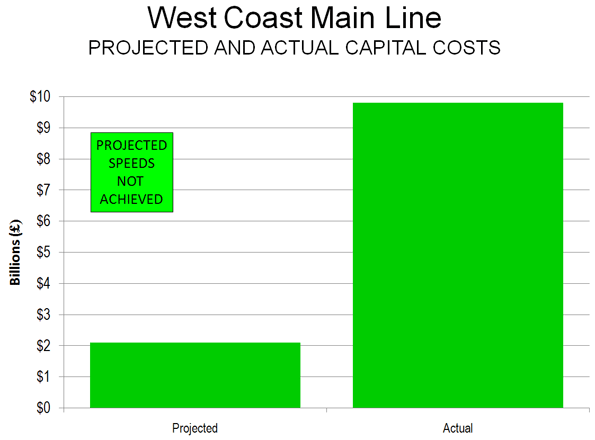
    Much of the proposed high speed rail line would be built parallel to the West Coast Main Line (which runs from London, through Birmingham and Manchester to Glasgow). Nothing short of a dog’s breakfast has been made of West Coast Main Line projects. In the 1980s, the tilting Advanced Passenger Train was developed to increase speeds to 155 miles per hour along the West Coast Main Line. The project was scrapped and all of the expenditure lost. Then there was the West Coast Main Line upgrade in the late 1990s and 2000s, to increase speeds to 140 miles per hour, which was to have cost £2 billion. The trains never exceeded 125 miles per hour, but the costs exceeded projections approached £10 billion instead, a world record cost blowout of Big Dig proportions (Figure).

    This should not be a surprise. The international record of high-speed rail projections is nothing short of horrific.Not only have costs proven far higher, but ridership and revenue have been less than projected. All of this means that taxpayers end up paying more.

    Again, Britain is a prime example. The Eurostar London to Brussels and Paris continues to attract at least 50 percent less ridership originally projected. High speed rail systems in Taiwan and Korea have had similar ridership shortfalls.

    As in Britain, costs have been higher as well. In Korea, the high speed rail line costs rose three times projections. Costs in California have increased 50 percent in two years and doubled over a decade even before the first shovel has been turned (inflation adjusted).  The cost escalation has already equaled the high end of the range predicted by Joe Vranich and me in our Reason Foundation Due Diligence Report on the California system in 2008.  

    If the proposed high speed rail project were simply to miss its cost and revenue targets by the international average (which is far better than the British experience), the benefits to users would fall below £1.00 for each £1.00 of cost. Both the strategic case and the business case for high speed rail would be blown apart. The spectre of cost overruns was a major factor in Governor Scott’s cancellation of the Florida high speed rail project.

    Not surprisingly, there is rising concern about high speed rail in Britain.A group of 21 officials, including former Chancellor of the Exchequer (minister of the treasury, finance and economics) Nigel Lawson, signed a letter to the Daily Telegraph calling the project "an extremely expensive white elephant isn’t what the economy needs. If the government wants to encourage growth there are better ways to get Britain growing and make us more competitive than getting each family to pay over £1,000 for a vanity project we cannot afford." The signatories also included Mark J. Littlewood, Director-General of the Institute of Economic Affairs, one of Great Britain’s leading free-market think tanks.

    Further, as in the United States there is also strong opposition from neighborhood groups concerned about the impact of trains operating at more than 200 miles per hour or faster through their neighborhoods. Eventually, up to 18 trains per hour are projected in each direction. This means that a 1,300 foot long train will pass houses and other adjacent development every one minute and forty seconds.

    There are the usual claims that the high speed rail line will reduce greenhouse gas emissions. However, as in California, the reality dissipates quickly, like steam into the air. Areport prepared for the Department for Transport by Booz Allen Hamilton concluded that the busiest section of the line, from London to Manchester would result in a net increase in greenhouse gas emissions when construction emissions are included (over a 60 year time analysis). Perhaps the intention is to begin reducing greenhouse gas emissions sometime after 2075?

    Monbiot further dismantles the environmental case, looking into the government reports to find that 92% of the passengers would switch to high-speed rail from alternatives that produce lower levels of greenhouse gas emissions (including conventional train, new travel and air).

    In Britain, as opposed to the United States, the proposed high speed rail system would relieve congestion on a passenger rail line. In contrast, US high speed rail lines would be built in corridors where there are few, if any rail passengers, much less passenger rail congestion.

    Even so, there are disagreements in Britain over whether high speed rail is the least costly way to address the problem, or indeed, whether there is a "problem" of sufficient magnitude to justify the public expenditure.

    The huge ridership increases projected may well be "over the top" given Britain’s less than population replacement fertility rate. As in the United States, some question the wisdom of high speed rail subsidies at a time that the government is (or in the case of the United States, should be) committed to an unprecedented austerity program that is falling heavily on middle income people who will not be the principal beneficiaries of high speed rail.

    In the final analysis, the questions will come down to who rides, how far and how fast. Will riders, in this third iteration, ride as fast as promised?  More likely it’s Britain’s beleaguered taxpayers who will be taken for a ride, with costs low-balled and ridership exaggerated as before.

    Revised on 3/22/2011. The original version had inappropritately refered to George Monbiot in the sentence about Transport Secretary Hammond. This was due to an editing error.

    Wendell Cox is a Visiting Professor, Conservatoire National des Arts et Metiers, Paris and the author of “War on the Dream: How Anti-Sprawl Policy Threatens the Quality of Life

    Photo by Jon Curnow

  • Britain’s Housing Crisis: Causes and Solutions

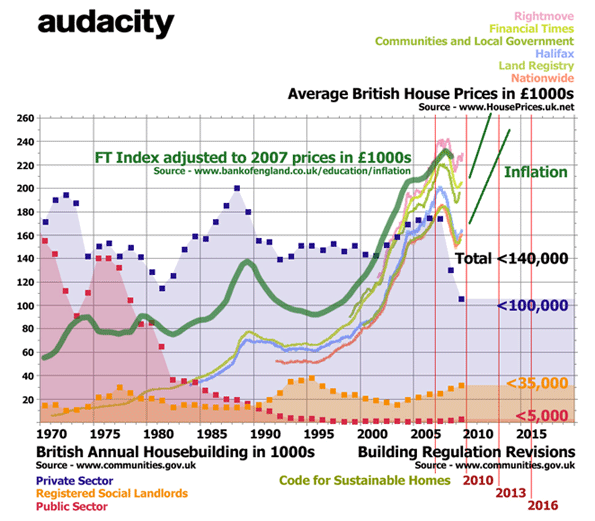
    British house construction has remained at a low level for a decade.   Total new house and flat completions for all tenures last year were 113,670 for England, 17,470 for Scotland, and 6,170 for Wales. Excluding Northern Ireland that is 137,310 for Britain. Under 140,000 homes a year is low for a nation of 60 million.

    We are nearly at the lowest level of housing production since reliable records began in the 1920s. (Note 1)  

    Anyone expecting British house building to pick up soon will be disappointed, even as the housing market inflates into another bubble. Grant Shapps,  the Coalition government’s Housing and Local Government Minister, is also hoping that house price inflation will not return to make the present housing predicament worse.  

    He will be disappointed, too. Shapps wants modest deflation and more houses to be built. However, he is powerless to make that happen while his government sustains the national denial of Freehold development rights that in Britain defines the planning system. By denying landowners the right to build on any land they own, the system works against significant levels of housing production.

    The renewal of house price inflation

    The low level of production all but guarantees renewed house price inflation. According to estate agency Savills, inflation-adjusted house prices grew by 68 per cent in the decade up to 2010, even after the British housing market finished wobbling during the sub-prime mortgage finance crisis. Savills told readers of The Telegraph that house prices will inflate by 40 per cent in real terms over the next decade.  

    Britain’s vast majority of home owners will be relieved. Most people have felt uneasy with financial dependency on the debt and equity in their home. For most British households wages and pensions are insufficient.

    At the root of the problem lies the peculiar nature of Freehold in Britain. The government enjoys an effective national instrument in their effort to protect the housing market. An old innovation of the post-war planning system, this ensures cheap farm land can never come onto the market to allow the building of low cost homes in great volume, sufficient to precipitate a housing market crash worth having. Planning as a denial of development rights works very well to protect the members of the Council of Mortgage Lenders.

    This keeps house building volume low.   Britain’s former volume house builders have begun to make the painful adjustment to work within the Coalition’s planning system. It will not be easy for them.

    The national denial of development rights is sustained, and in many ways the problem is worse under the Conservative-led coalition than under New Labour.

    The house builders have been stripped of New Labour’s national target of 240,000 net additional homes a year, but that was an unmet and inadequate target.   Even more troubled are plans to develop 50 proposed “eco towns” also proposed by Labour, itself a small, even deluded, enterprise that is pathetic compared to development elsewhere in the world.

    Urban expansion and new settlements – whether in Britain or elsewhere – require land. And Britain, contrary to popular belief has land aplenty. The restraints placed on builders can best to described in the words of Sir Peter Hall, as a “Land Fetish”.   

    The planning system also is host to an eco-fetish that the Coalition appears willing to sustain regardless of housing need.

    Inevitably some house builders will have subscribed to the idea that the environment is too precious to allow much land to be developed, but not all.  This leaves no centralised attempt to satisfy the demand for new household formation following from population growth, the needs of immigrants, or to encourage the replacement of the worst housing stock. For greens of the more misanthropic persuasion, opposition to both population and production makes sense. They don’t want humanity to reproduce either biologically or industrially. They don’t want a world that is always about advancing human interests through industry.

    Yet the need for new homes won’t so easily go away.

    A three sided predicament

    This contemporary British housing trilemma will not be easily resolved. The country seems to accept expensive, inadequate housing and mortgage debt as a fact of life.  

    Yet this leaves us with no solution for future needs.

    Something needs to change.  Hugh Pavletich and Wendell Cox publish as Demographia have found – for the seventh year running – increasing unaffordability of British housing.  

    The Solution: 250 New Towns

    The only reasonable solution is to tear down the current planning structure. What we need is an audacious move to build some 250 new towns.

    This movement would try to replicate past successes. In the brief inter-war period, 1918 to 1938, popular owner occupation flourished, with economically struggling farmers keen to sell their Freehold land to house builders.  

    How long will Britain live with low levels of construction, increasingly higher prices and consistently low levels of affordability? The increasing drag of house price inflation on household incomes and the acceptance of poor quality British housing in short supply cannot be sustained indefinitely.  

    How long will Britain sustain housing unaffordability as a financial opportunity, protected by a weak government?  

    The British collective obsession with inflating house prices must end sometime, unless we are to lose all sense of housing primarily as somewhere useful to live.  

    The freedom to build on your own land will deflate the housing market, dramatically in some locations.  Giving all landowners their Freehold right to build will liberate the commercial construction industry from the burden of inflated land prices, allowing disruptive advances in industrial production.  

    If Britain faces the house price inflation projected by Savills in the next 10 years there are many home owners dependent on housing equity who will not object. Neither will the house builders object too much as they build a low number of luxury eco-homes, to the undoubted applause of the architectural press. They may enjoy the praise for their greenness. Farmers might subsist as environmentalists. Greens will be sufficiently deluded to imagine there was some point to all this. The City will make a healthy return.

    The green zealots are conspicuous, and need to be confronted by industrialists with a sense of humanity. Now is no time to let them get away with their anti-humanism.

    Britain certainly is capable of more than is currently being discussed. National housing output had peaked in 1968 at 413,714, more than twice the current rate.

    We have to answer the question: Who will organise to better explain and end the housing predicament in low wage industrial Britain? We are hoping the 250 new towns club can start the ball rolling.

    —-

    Note 1 – Marian Bowley, ‘Table 2, Numbers of Houses Built in England and Wales between January 1, 1919 and March 31, 1939’, in Housing and the State 1919-1944, London, George Allen & Unwin, 1945, p 271

    Ian Abley, Project Manager for audacity, an experienced site Architect, and a Research Engineer at the Centre for Innovative and Collaborative Engineering, Loughborough University. He is co-author of Why is construction so backward? (2004) and co-editor of Manmade Modular Megastructures. (2006) He is planning 250 new British towns.