Tag: London

  • A Leg Up: World’s Largest Cities No Longer Homes of Upward Mobility

    Throughout much of history, cities have served as incubators for upward mobility. A great city, wrote René Descartes in the 17th century, was “an inventory of the possible,” a place where people could lift their families out of poverty and create new futures. In his time, Amsterdam was that city, not just for ambitious Dutch peasants and artisans but for people from all over Europe. Today, many of the world’s largest cities, in both the developed and the developing world, are failing to serve this aspirational function.

    Though leading urban theorists love to celebrate the most rarified parts of the city economy—Saskia Sassen refers to “urban glamour zones” that thrive in what New York Mayor Michael Bloomberg proudly calls the “luxury city”—they tend to forget about working- and middle-class residents. Unfortunately, these urban ideas appear to be contagious, as they’re being applied to the expanding cities of Asia and other developing regions. A recent World Bank report argued that large urban concentrations—the denser, the better—are the most prodigious creators of opportunity and wealth. “To spread out economic growth,” the report claimed, is to discourage it.

    A closer look, however, suggests a more nuanced reality. Cities in the developing world are growing, but largely because they’re the only alternative to poverty and even starvation in the countryside. These cities are not only failing to provide opportunities for upward mobility; they’re producing the class inequalities found in “luxury cities” such as London and New York.

    Once rigidly egalitarian, China now has some of the world’s highest rates of income inequality. The central cores of Beijing and Shanghai employ legions of well-paid European and American architects and planners, but few concern themselves with the camps inhabited by poor, often temporary workers, who constitute roughly one-fifth of the population and live in conditions more reminiscent of a Brazilian favela than an “urban glamour zone.”

    This same stratification is also happening in India. Mumbai, one of the fastest-growing cities, is creating wealth at the top of the economic spectrum but leaving millions of others scrambling for mere subsistence. The New York–based author Suketu Mehta has described his hometown of Mumbai (formerly known as Bombay) as “an urban catastrophe,” an example of the mounting woes of rapidly expanding cities in the developing world. “Bombay is the future of urban civilization on the planet,” he wrote. “God help us.”

    A majority of Mumbai’s population now lives in slums, up from one-sixth in 1971—a statistic that reflects a lack of decent affordable housing, even for those gainfully employed. Congested, overcrowded, and polluted, Mumbai has become a difficult place to live. The life expectancy of a Mumbaikar is now seven years shorter than an average Indian’s, a remarkable statistic in a country still populated by poor villagers with little or no access to health care.

    In spite of World Bank proclamations, the most rapid urban growth in India is actually occurring in smaller, less dense cities, such as Bangalore and Ahmedabad, places with lower living costs and more business friendly governments. This mirrors a trend occurring in the United States. In the last decade, middle-income people have been moving out of our megacities. Between 2000 and 2008, according to the demographer Wendell Cox, regions of more than ten million people suffered a 10 percent rate of net domestic out-migration. (Often the only reason for population growth in these cities was immigration.) The big gainers were cities between 100,000 and 2.5 million residents: the business-friendly Texas cities Dallas, Houston, and San Antonio; Raleigh and Durham, North Carolina, which now form the fastest-growing metro area in the nation; and the heartland cities of Columbus, Indianapolis, Des Moines, Omaha, Sioux Falls, and Fargo.

    One reason for this movement has been the shift of jobs away from the coasts to lower-cost, less dense cities. The fastest growth in middle-income jobs has been concentrated in many of the places listed above: Houston, Dallas, Austin, Raleigh-Durham, and Salt Lake City. This pattern also includes high-tech, science-oriented employment. In contrast, those jobs have been stagnant or shrinking in such cities as New York, Los Angeles, San Francisco, and Chicago.

    As a result, America’s largest cities are increasingly divided into three classes: the affluent, the poor, and the nomadic class of young people who generally come to the city for a relatively brief period and then leave. New York, the aspirational city of my grandparents, now has the smallest share of middle-income families in the nation, according to a recent Brookings Institution study, with Los Angeles and San Francisco not far behind. In 1980 Manhattan, New York’s wealthiest borough, ranked 17th among U.S. counties for social inequality; by 2007 Bloomberg’s “luxury city” was first, with the top fifth earning 52 times the income of the lowest fifth, a disparity roughly comparable to that of Namibia.

    Similar patterns can be found in Europe, despite its countries’ more developed welfare states. The U.K. has witnessed a relentless centralization of urban functions in London, as once proud cities such as Manchester, Liverpool, Glasgow, and Birmingham have continued their long slide into obscurity and irrelevance. The bulk of London’s growth, however, has not taken place in the central core but in what the historian James Heartfield calls “the greater southeast.” This vast “conurbation” stretches from west of Heathrow Airport to the booming coastal city of Brighton, roughly an hour’s train ride from the“ city center.

    As the middle class has decamped, central London has become more stratified. Residents and workers there and in the West End account for some of the most concentrated wealth on the planet. At the same time, prospects for London’s middle class have weakened, with many fleeing to the suburbs or even leaving the country. (Britain remains a large exporter of educated workers to the rest of the world.) The major issue here is the high cost of housing. Even in its poorest neighborhoods, London now ranks as one of the most unaffordable places for middle-income people to buy a home.

    Still, life is much tougher for the city’s poor, many of whom live less than an hour’s walk from the wealthiest neighborhoods. Take a stroll just a mile or two from the Thames and you enter a very different London. It is here where you’ll see why the financial capital of the European Union also has the highest incidence of child poverty in Great Britain (more even than in the beleaguered North East). Thirty-six percent of children in London live in poverty, a figure that rises to more than one-half when the city’s housing costs are factored in.

    The same split has emerged in other countries considered far more open than class stratified Britain. A recent University of Toronto study found that between 1970 and 2001, the portion of middle-income neighborhoods in the city had dropped from two-thirds to one-third; poor districts had more than doubled to 40 percent. By 2020, middle-class neighborhoods could fall to less than 10 percent, with the balance made up of poor and affluent residents.

    Much the same can be seen in continental Europe, a trend greatly exacerbated by the growth of immigration. Unlike Amsterdam in Descartes’s time, Europe’s great cities are failing in their historic mission of incorporating newcomers, as German Chancellor Angela Merkel recently conceded. In Berlin, one fourth of the workforce earns less than 900 euros a month, while 36 percent of children are poor. The city once known as “Red Berlin” has emerged as “the capital of poverty and the ‘working poor’ in Germany,” Emma Bode, a left-wing journalist, wrote in 2008.

    Given these global realities, it might be time for our urban boosters to curb their enthusiasm for the “luxury city” and refocus on how to meet the aspirations of their middle- and working-class residents. If they don’t, lack of opportunity will drive more and more of this crucial aspirational class farther and farther away, mostly to smaller cities and suburbs that still offer “an inventory of the possible.”

    This piece originally appeared in Metropolis Magazine.

    Joel Kotkin is executive editor of NewGeography.com and is a distinguished presidential fellow in urban futures at Chapman University, and an adjunct fellow of the Legatum Institute in London. He is author of The City: A Global History. His newest book is The Next Hundred Million: America in 2050, released in February, 2010.

    Photo by Premshree Pillai

  • Why Affordable Housing Matters

    Economists, planners and the media often focus on the extremes of real estate — the high-end properties or the foreclosed deserts, particularly in the suburban fringe. Yet to a large extent, they ignore what is arguably the most critical issue: affordability.

    This problem is the focus of an important new study by Demographia. The study, which focuses largely on English-speaking countries, looks at the price of housing relative to household income. It essentially benchmarks the number of years of a region’s household income required to purchase a median-priced house.

    Overall, the results are rather dismal in terms of affordability, particularly in what Wharton’s Joe Gyourko dubs “superstar cities.” These places — such as London, New York, Sydney, Toronto and Los Angeles — generally tend to be more expensive than second-tier regions commonly found in the American South and heartland.

    Even with their usually higher incomes, these regions, for the most part, still have a ratio of five years median income to median house price; this is far higher than the historical ratio of three. In some areas the ratios are even more stratospheric. Sydney and Melbourne, for example, have ratios over nine; London, New York, San Jose and Los Angeles approach six or more.

    Urbanists often assume that these high prices — unprecedented in a tepid economy — reflect the greater attractiveness of these regions. This is somewhat true, particularly for parts of London and New York, which can survive high ratios because their markets are less national and middle-income and more tied to the global upper classes.

    In places like Mayfair or New York’s Upper East Side, the buying “public” extends beyond the local market to high-income markets in places like the United Arab Emirates, Moscow, Shanghai, Singapore or Tokyo. Many owners are not full-time residents and consider a home in such places as just another expression of their wealth and privilege.

    Yet such markets are exceptional. In most regions, the vast preponderance of homebuyers are either natives or long-term migrants. Their less glamorous tastes — notably access to affordable single-family dwellings — drives migration  from one region to another. Over the past decade, and even since the crash, this has meant a general trend of migration from high-end, unaffordable markets to less expensive regions. In the U.S., for example, people have been flocking to the South, particularly the large metropolitan areas of Texas.

    One factor driving this migration, the Demographia study reveals, is differing levels of regulation of land use between regions. In many markets advocacy for “smart growth,” with tight restrictions on development on the urban fringe, has tended to drive up prices even in places like Australia, despite the relatively plentiful supply of land near its major cities.

    More recently, “smart growth” has been bolstered by claims, not always well founded, that high-density development is better for the environment, particularly in terms of limiting greenhouse gases. Fighting climate change (aka global warming) has given planning advocates, politicians and their developer allies a new rationale for “cramming” people into more dense housing, even though most surveys show an overwhelming preference for less dense, single-family houses in most major markets across the English-speaking world.

    Limits on the kind of residential living most people prefer inevitably raises prices. As the Demographia study shows, the highest rise in prices relative to incomes generally has taken place in wherever strong growth controls have been imposed by local authorities.

    Perhaps the poster child for “smart growth” has been the U.K. Long before the climate change debate, both of England’s major parties embraced the notion of strict constraints on suburban development — not only in London, but across the country. As a result, even places with weak economies are not as affordable as they should be. Liverpool, Newcastle and the Midlands have affordability rates higher than Toronto, Boston, Miami and Portland — and not much lower than those of New York or Los Angeles.

    But the most remarkable impact of “smart growth” policies has been in Australia, which once had among the most affordable housing prices in the English-speaking world. Houses in Sydney and Melbourne, for example, are now less affordable than in London or San Francisco.  Even secondary markets like Adelaide and Perth are more expensive than Toronto, New York, Los Angeles or Chicago. Most recently these policies have even caught the attention of the OECD, which linked overly regulated housing markets not only to the Great Recession, but to a continued slow economic recovery.

    Compared with the U.K. and Australia, the U.S. housing market is more hopeful, with a host of regions — notably Houston, Dallas, Austin, San Antonio, Phoenix and Kansas City — with affordability rates around three and under. Low prices by themselves, of course, are no guarantor of success; in economically challenged places like Detroit and Cleveland, out-migration and high unemployment have driven prices down.

    But in many, if not most, cases affordability has promoted economic and demographic growth.  Generally speaking, affordable markets tend to draw migrants from overpriced ones, for example to Houston or Austin from Los Angeles or New York.

    Nor is this necessarily a case of “smart” people heading to dense, expensive cities while the less cognitively gifted head to the low-cost regions — as news outlets like The Atlantic have claimed. In fact, the American Community Survey reveals that between 2007 and 2009 college graduates generally gravitated toward lower-cost, less dense markets — such as Austin, Houston and Nashville — than to the highly constrained, denser ones. Overall  growth in affordable markets — with a ratio of three or four — among college graduates was roughly 5%; in the more expensive places , it was barely 3%.

    How could this be, if everyone with an above-a-room-temperature IQ supposedly favors hip, cool, dense cities? Perhaps it’s because of factors often too small or mundane for urban pundits to acknowledge. Most people, particularly as they enter their 30s, aspire to a middle-class lifestyle — and being able to afford a house constitutes a large part of that.

    So what does this tell us about future growth? Clearly affordability matters. Areas that combine strong income and job growth, along with affordable housing, are poised to do best. This will be particularly true once the economy recovers and a new generation of millennial buyers, entering their 30s in huge numbers over the next decade, start their search for a place where they can settle down and start raising families.

    This piece originally appeared in Forbes.

    Joel Kotkin is executive editor of NewGeography.com and is a distinguished presidential fellow in urban futures at Chapman University, and an adjunct fellow of the Legatum Institute in London. He is author of The City: A Global History. His newest book is The Next Hundred Million: America in 2050, released in February, 2010.

    Photo by Je Kemp

  • Coalition of the Unwilling

    This week the UK government announced an ”end to anti-car policies” reversing the guidance to local authorities to dissuade citizens from using their cars in favour of public transport. Charges for parking will be reined in, they promise.

    It should be good news. The comically-named ”traffic calming” schemes put in place by the outgoing government were deeply unpopular. Still, we are getting used to taking our announcements from the new coalition government with a pinch of salt.

    Before the election Housing Minister Grant Shapps backed demands from the Housebuilders’ Federation for a ‘right to build’. That might seem unnecessary, but in Britain the planning laws are so prohibitive that owning land extends no right to build upon it. Instead planning authorities extend permission to build where it meets the terms of the local plan.

    The impact of Britain’s planning laws has always been a problem, but for the last thirteen years the ‘local plan’ has been hi-jacked by anti-growth campaigners from the Campaign to Protect Rural England, the Urban Taskforce and the massed ‘NIMBY’ campaigners of the Tory Shires.

    The new local government minister Eric Pickles explained that the net effect of the planning system’s strangle hold on house building was that ”we’re at rock bottom”: ”1924 was the last time we built this little number of houses”. His Labour predecessor Nick Raynsford had ”done more damage than the Luftwaffe”, said Pickles, exaggerating a little, but making his point (Sunday Times, 12 September 2010).

    So what about the changes? Grant Shapps’s published policy does include the words ”right to build” – but they are heavily hedged about:

    ”provided that [the new homes and buildings] conform to national environmental, architectural, economic and social standards, conform with the local plan, and pay a tariff that compensates the community for loss of amenity and costs of additional infrastructure’ (Open Source Planning, Page 3).

    All of which sounds pretty much as bad as it was before. What right to build, you might ask? Indeed the words ‘right to build’ feature just once in the document, as quoted above, in the executive summary. There is a question mark, too, over who it is that has the right to build. ”Communities”, according to Shapps, and the government have the right, but just how these ”communities” are defined is not clear. More likely they will be the same planning authorities as before. In that case the only developers that get a look in will be the powerful and well-connected like Tesco or Barratt Homes – those who are in a position to meet the municipal fathers’ demands for baksheesh… or ”planning gain” as it is known in the UK.

    Coalitions are new to Britain (apart from one shaky Liberal-Labour government in the seventies). But with neither David Cameron’s Conservative Party, nor the deeply demoralised Labour Party of Gordon Brown winning enough votes to command a majority in the House of Commons, Cameron had to turn to Nick Clegg’s minority Liberal Democrats.

    This arrangement seems to suit Cameron. Cameron became leader on a pledge to lose the ”nasty party” image the Conservatives had after years of office in the 1980s. His method is a mirror image of Tony Blair’s repositioning of the Labour Party as a centre party by distancing it from its socialist roots. First we had a Labour government that was against socialism. Now we have a Conservative-led government that is shy about capitalism.

    Sidelining the old-school Thatcherite, free market Tories in favour of his friends in the public relations, media and volunteer sector, Cameron seems obsessed with changing the party brand.Although this did not work in the election, the advantage of an alliance with the Liberal Democrats means that he can ditch whatever fundamentalist free market doctrines whenever convenient on the grounds that ”coalition government is compromise”.

    The net effect is a government that keeps sounding as if it is going to do something decisive, but then doesn’t.

    The greatest challenge has been the state of the public finances. Britain’s government debts are astonishing: one trillion pounds sterling, or 68.2 per cent of GDP. Since most of the debt was contracted under Labour’s watch, the coalition government has the moral high ground. The Labour coalition says that the cuts announced in the public sector put the recovery in danger because they are too far, too fast. They stand by ”counter-cyclical” spending, but Labour has little mainstream credibility in terms of the country’s finances.

    For the left, though, balancing the capitalists’ books is hardly the issue. They are looking forward to a re-run of the campaign against the Thatcher public spending cuts of the 1980s. The protests and banners all seem to reinforce the idea that the government is indeed planning to rein in public spending, but it is not. As former Tory Minister John Redwood has pointed out, the planned cuts are not even cuts at all, but a limit on spending growth.

    Cameron’s government had to sound tough on public spending, because the bond traders were in fear of Britain’s debt rating being marked down, and the wider impact of a loss of confidence. With both Greece and Ireland’s finances in trouble, the British government needed to promise stability.

    But the same city traders are just as determined that the spending party should carry on, even if the volume is turned down to avoid scaring the neighbours. For years Britain’s ”private sector” has been dependent on extraordinary boosts of government cash. Under the outgoing government’s Private Finance Initiative, public institutions like hospitals and schools were allowed to raise funds by issuing their own bonds, debt that was not reckoned in the official accounts. Then Gordon Brown’s banking bailout found government buying up failing banks like Royal Bank of Scotland.

    Despite their fawning support for austerity Britain’s City traders still expect to be looked after. The Bank of England’s emergency policy to meet the shortage of credit in the economy is called ”quantitative easing”. In practice it means that the government trades government bonds for the banks’ own toxic debts, while bond traders make money on the commission.

    Even the one controversial cut in public spending turns out to be something more like a gift to the banks. The government says that they will let universities charge fees approaching the market rate, and that students will no longer be subsidised. Since those who made the decision all got to go to university for free, the backlash was understandable – the kind of rioting Saturnalia that Britons indulge in from time to time (“off with their heads!“ shouted student rioters when they chanced upon the Prince of Wales’s limousine and mobbed it, while running from the police).

    To moderate the impact of the fees, though, the government has promised to expand the student loans scheme, where the State lends the money, and then recovers it later, through the tax system. For the banks, what could be more perfect? Here is a tranche of debt created overnight, guaranteed by a government that undertakes to recover it on their behalf: More of a subsidy to the City of London than a cut in government spending.

    Though the Conservatives are thought of as ”Thatcher’s Children”, they behave much more like their ”New Labour” predecessors. The tough talk is for show.

    Nowhere is this proto-New Labour approach clearer than on energy policy. Although Energy Minister Chris Huhne has acknowledged that Britain faces severe electricity shortages – he fails to ascribe the problem to its proximate cause, the failure to build enough coal-powered power stations.

    Huhne’s solution, though, will make things worse. Not more coal-powered stations, but a government imposed increase on tariffs for fossil-fuel generated power, and a special allowance for renewable energy. Of course, renewable energy on any normal pricing system would be uneconomic. Britain’s latest windmills even had to be heated up to stop them freezing solid this winter. The net effect of Huhne’s proposal: no fix for the energy shortage, and more expensive electricity.

    These policies have had disastrous, even lethal, results. According to the latest figures, excess winter deaths in the UK are in the region of 25 000, most of them the elderly, often hastened along by fuel poverty. With Huhne’s proposals, those numbers are set to increase, as electricity becomes something of a luxury to the poor.

    At least in this area, the Tories are “conservative”. The tradition of the poor freezing to death in wintertime is being restored, and so too may be the old class system that allows the City to enrich itself as the expense of everyone else, including the taxpayers.

    James Heartfield is the author of Let’s Build: Why we need five million new homes, a director of Audacity.org, and a member of the 250 New Towns Club.

    Photo by Chris Devers

  • Who’s Racist Now? Europe’s Increasing Intolerance

    With the rising tide of terrorist threats across Europe, one can somewhat understandably expect a   surge in Islamophobia across the West. Yet in a contest to see which can be more racist, one would be safer to bet on Europe than on the traditional bogeyman, the United States.

    One clear indicator of how flummoxed Europeans have become about diversity were the remarks last week by German Chancellor Angela Merkel saying that multi-culturalism has “totally failed” in her country, the richest and theoretically  most capable of absorbing immigrants. “We feel tied to Christian values,” the Chancellor said. “Those who don’t accept them don’t have a place here.”

    One can appreciate Merkel’s candor but it does say something the limitations about the continent’s ability, and even willingness, to absorb immigrants. It’s quite a change from the generations-old tendency among Europeans, particularly on the left, to denigrate America as a kind of hot bed for racism.  Yet even before the latest report of potential terrorist attacks in several western European cities, the center of Islamophobia – and related ethnic hatreds – has been shifting inexorably to the European continent.

    Of course, America has always had its bigots, and still does. And of course, Islamists who threaten or commit violence need to be arrested and thrown behind bars. But, to date, neither major political party has been able to make openly white-supremacist politics a successful leading platform. After all, what was the last time anyone took Pat Buchanan , who has made comments similar to those of Merkel, seriously? Despite the brouhaha over the Arizona anti-illegal alien law, only 5% of Americans consider immigration the nation’s most pressing issue, according to a September Gallup poll.

    The situation in Europe is quite different. Openly racist, anti-immigrant and Islamophobic groupings are on the rise, and they are wreaking havoc on once subdued European politics. Traditional mainstream parties are declining, and the new racist parties can be seen in broad daylight in Austria, Switzerland, Denmark, Sweden and the Netherlands, where populist firebrand Geert Wilders has suggested banning the Koran. In Italy the anti-immigrant Northern League is already hugely powerful.

    It is true that as many Europeans as Americans–about half–think immigration is bad for their countries.  The big difference is what Europeans are willing to do about it. Just consider French President Nicholas Sarkozy’s farcical effort this fall to expel the hapless Roma.

    Yet for most Europeans the big issue is not purse-snatching gypsies but fear and loathing toward the expanding presence of Muslims–who are at least three times as numerous in the E.U. as in the U.S.  Over half of Spaniards and Germans, according to Pew, hold negative views of Muslims. So do roughly 40% of the French. In contrast, only 23% of Americans share this sentiment.

    More disturbing, Europe is actually putting these ethnic hostilities into law. An early sign came this winter, when the usually phlegmatic  Swiss voted to prohibit the building of new minarets. More recently a ban on burqas – the admittedly unattractive female body suits favored by some orthodox Muslims – passed in France, home to Europe’s largest Muslim community. The same measure is now being considered in Spain.

    These actions reflect a broad, and deepening, stream of European public opinion. A recent Pew survey found that over 80% of the French support banning the burqa, as do over 70% of Germans and a large majority of Spaniards and British.

    In contrast, nearly two-thirds of Americans find the burqa ban distasteful. Burqas don’t exactly stir admiring glances in the shopping mall, but few Amercians think we need to ban them. The basic ideal of “don’t tread on me” means “don’t tread on them” as well – at least until they start blowing themselves up at Wal-mart.

    This nuance escapes some of our own knee-jerk racial obsessives, like the Atlanta Journal Constitution’s Cynthia Tucker, who equates opposition to a mosque at Ground Zero as proof of a “new McCarthyism”  aimed against Muslims. But you don’t have to be a bigot to have second thoughts about erecting a mosque at the very spot where innocents were slaughtered by radical Islamists.

    Critical here are profound differences between the U.S. and Europe  in  the role played by ethnicity, race and religion. On the continent national culture is precisely that — the product of a long history of a particular ethnic group. Small minorities, such as Jews in Holland or Armenians in France, are tolerated but expected to submerge their ethnic identities. France has many artists and writers who may be Jewish, but you don’t see many French Woody Allens or Larry Davids who exploit their otherness to help define the national culture.

    Muslim attitudes in Europe are not exactly helpful either.  European Muslims often seem more interested in breaking the national mold than adding to its contours.  More than 80% of British Muslims, for example, identify themselves as Muslims first before being British. This is true of nearly 70% of Muslims in Spain or Germany. Similarly, up to 40% of Britain’s Islamic population believe that terrorist attacks on both Americans and their fellow Britons are justified.

    This alienation also reflects an appalling social and economic reality. In European countries immigrants can receive welfare more easily than join the workforce, and their job prospects are confined by education levels that lag those of immigrants in the United States, Canada and Australia. In France unemployment among immigrants–particularly those from Muslim countries–is often at least twice that of the native born; in Britain Muslims are far more likely to be out of the workforce than either Christians or Hindus.

    Partly due to a less generous welfare state, American immigrant workers with lower educations have, for the most part, been more economically active than their nonimmigrant counterparts.  The contrast is even more telling among Muslim immigrants. In America most Muslims are comfortably middle class, with income and education levels above the national average. They are more likely to be satisfied with the state of the country, their own community and their prospects for success than are other Americans—even in the face of the reaction to 9-ll.

    More important still, more than half of Muslims identify themselves as Americans first, a far higher percentage than in the various countries of Western Europe.   More than four in five are registered to vote, a sure sign of civic involvement. Almost three-quarters, according to a Pew study, say they have never been discriminated against–something that is definitely not the case in Europe where a majority, according to Pew, complain of discrimination.

    Over time, these differences between Europe and America may become even more pronounced. America is becoming increasingly diverse, but it is also growing demographically, and Muslims make up a very small part of that. There’s little fear in Anerica of the kind  of  Muslim envelopment that appears to threaten a  rapidly aging, and soon to be depopulating, Europe.

    Of course the U.S. still has its bigoted Islamophobes, just as it has its own small cadre of vicious Islamists. One law of history appears to be that morons will be morons.   But America’s culture seems strong enough to resist the anti-immigrant hysteria emerging throughout Europe. This is one case where  la difference between America and Europe may prove  a very good thing indeed.

    This article originally appeared at Forbes.com.

    Joel Kotkin is executive editor of NewGeography.com and is a distinguished presidential fellow in urban futures at Chapman University. He is author of The City: A Global History. His newest book is The Next Hundred Million: America in 2050, released in February, 2010.

    Photo by World Economic Forum

  • London Special Report: Britain Drifts South – and Why Not?

    The British Broadcasting Corporation wants 1500 of its staff to move to its new ”MediaCity” headquarters in Salford, near Manchester in northwest England. The Corporation, they say with some justification, is too southern, too much part of the metropolitan elite. The move ”addresses concerns that the organisation is not fully representative of the peoples of the UK.”

    On the surface it looks like a good deal. On top of a £5000 payment, they have been offered £350 for each house-hunting journey as well as removal costs, a guaranteed house purchase scheme and and even £3,000 for new carpets and curtains. Other benefits include help securing jobs for spouses or partners jobs in the area and specialist help with children’s schooling. For all that, take up for the scheme has been slow, and the Corporation’s grunts were unhappy to hear that the head of BBC North, Peter Salmon ”is the latest exec to announce that he would rather hack off his own face than move his family anywhere remotely near the north,” as ex-BBC producer Rod Liddle puts it.

    The BBC’s difficulties in persuading its staff of the benefits of the North of England reflects a broader British predicament. Since the 1930s British governments have tried to use grants boost Britain’s depressed regions in the North of England, Wales and Scotland. None of this has stopped the long-term trend of population movement. Demographers Daniel Dorling and Bethan Thomas of Sheffield University point out that outside of London, all major cities are declining in population, and that ”the population of the UK is slowly moving to the South.”

    Dorling and Thomas’s analysis of the 2001 Census drew criticism from regional dignitaries. Bob Kerslake, chief executive of Sheffield City council, and a champion of the lobbying group Core Cities insisted that ”there is already evidence of a turnaround in the last five years and every prospect of things getting better.” Denton and Reddish MP Andrew Bennet, Labour chairman of the Commons local government, housing and planning committee also claimed that ”in the regeneration of cities, the government’s proposals are working well,” while admitting that there were ”horrendous” problems.

    Looking at what Dorling and Thomas say, it is not hard to see why the census should be so problematic for champions of a Northern resurgence.

    At the start of the 21st Century, the human geography of the UK can most simply be summarised as a tale of one metropolis and its provincial hinterland… On each side of the divide there is a great city structure with a central dense urban core, suburbs, parks and a rural fringe. However, to the south these areas are converging as a great metropolis, while to the north is a provincial archipelago of city islands.

    In recent years the decline of the North has at least been mollified by a relatively buoyant economy in contrast to the disaster of de-industrialisation that it was in the 1980s. Yet even still, the divergence is difficult to wish away. Most disturbing, much of the growth taking place in the North owes more to government spending that it does to private initiative. The public spending share in output is 52.6 per cent in the North West, 61.5 per cent in the North East, and 54.9 per cent in Scotland.

    For housing, the importance is clear. With the provinces suffering greater or lesser degrees of depopulation, houses have to be cleared. In 2002 government plans to demolish up to 880,000 homes in northern England and the Midlands were announced. Gateshead, Newcastle, Blackburn, Manchester, Hull, Sheffield, Liverpool, Stoke-on-Trent and Birmingham are all earmarked for substantial demolitions. In Liverpool alone, the council has to cope with 28,000 derelict homes. Long-standing development critic Simon Jenkins bemoaned the plans to knock down 100,000 Victorian terrace houses in the Welsh Streets area of Liverpool as they constitute precisely the “sort of buildings” over which yuppies “would purr” if they were in London.’.

    The contrast between empty homes in the North of the country and the prospect of new building in the South offends people like Green Party’s London leader Darren Johnson who says that it is ”particularly ludicrous to have every single scrap of land in London and the South East being eyed up by developers, when the populations of other regions, such as the North West and the North East, are actually declining.”

    Ros Coward, columnist for the liberal Guardian newspaper, protests that ”In the North-West, vast tracts of urban land lie derelict, while in the South-East … our countryside is under ever-increasing threat.” Uber-architect Richard Rogers takes a similar view, arguing that ”regional balance is critical to achieving a sustainable economy”. This is in the context of bemoaning the ”divided country” of the North and the Midlands with the ”bulk of redundant industrial land” and the South-East’ where the ”greatest pressure for new housing development” is felt.

    Though he is cautious to spell it out, Rogers’s ”regional balance” could only achieved by relocating people up North. No doubt the chaotic workings of the economy do create unplanned waste and blight, but does anyone suggest people should be forced to move up North? Infamously Westminster Council housed its homeless out of borough, paying more outlying regions to take on the social problem. More recently the government imposed resettlement schemes on asylum seekers, forcing them into unwelcoming estates in Glasgow and elsewhere. Surely, everybody understands that in a free society you cannot direct people where to live, like Stalin did the Chechens in 1944 – or do they, particularly if the case can be made on ideological grounds, this time green instead of red.

    It’s undoubtedly true that there is indeed a London-centric bias among British policy makers and media professionals. Deeply rooted in the gentrified boroughs of inner London, opinion-formers often treat the rest of the country with disdain. But it would be a mistake to see the population’s southern drift as the ascendance of the metropolitan chattering classes.

    As important as London is to Britain’s economy, the more interesting area of growth is the south east region around London. The South East has the second highest GDP, and the second highest GDP per head of any region. London has the highest GDP, but it also has more of the very poorest people than the South East.

    This is the heartland of Britain’s middle classes, first in the percentage of the population economically active and the fastest growing demographically. Coastal Brighton, 60 miles from London’s centre, is Britain’s fastest growing town. If the BBC offered its relocation package to move staff to Southampton or Brighton, there would be many more takers.

    We cannot keep holding like Canute and wish away the shifting economic geography of Britain. It is something that has to be worked with. For cities and towns outside of the southeast that can mean some profound challenges. It is not easy to manage a downsizing without it appearing to be a rout.

    But the demolition of old houses ought not to be seen as a disaster, so much as an opportunity. Britain’s ageing housing stock needs renewing. Simon Jenkins presumed to speak up for the “local community” of the Welsh Streets area of Liverpool, but Irene Milson and Mary Huxham of the local tenants and residents association saw things differently:

    Far from it being “wrought” on them, residents in this neighbourhood have been campaigning to be included within the Housing Market Renewal Pathfinders plan for over four years. The decision was supported in a survey of all Welsh Street residents, with a 72 per cent majority in favour of a clearance. … The campaigners, conservationists and critics don’t have to deal with 125-year old properties that are damp, decaying and expensive to heat – let alone with collapsed Victorian sewage systems now over-ridden with rats.

    In principle, there is nothing wrong with the population concentrating itself more densely in one part of the country than another. It is not as if it will tip up and sink. No doubt a perfectly planned society would achieve things less chaotically, but in a democratic society it is better to manage change,rather have planners reshape our society from above.

    James Heartfield is the author of Let’s Build: Why we need five million new homes, a director of Audacity.org, and a member of the 250 New Towns Club.

    Photo by Feuillu

  • London Special Report: The Making of the Hundred Mile City

    (Part I of II.) The writer Ford Madox Ford summarised the inventiveness of the early twentieth century in an essay The Future of London (1909) by lambasting what he called the “tyranny of the past.” “The future,” he argued on the other hand, wages a ceaseless war against the monuments of the past’.

    This debate is alive today in the battle between the emerging metropolitan reality and the nostalgia of the urban past. Ford’s dream was of a Great London ‘… not of seven, but of seventy-million imperially minded people’.

    Unlike urbanist romantics, Ford’s “Great London” presciently considered the capital in relation to its suburbs. He also refused to call them “suburbs”, which he thought derogatory, from the Latin sub urbe, meaning less than the town, and preferring instead the more ambitious fore town: “The fore town of my Great London would be on the one hand, say, Oxford, and on the other, say, Dover.”

    Ford, much like his contemporary H.G. Wells, imagined a London that extended from Winchester, the delightful country around Petersfield, Chichester, all of the coast down to Brighton, Hastings, Dover, all of Essex and round again by way of Cambridge and Oxford. “All south-eastern England,” he wrote, “is just London.”


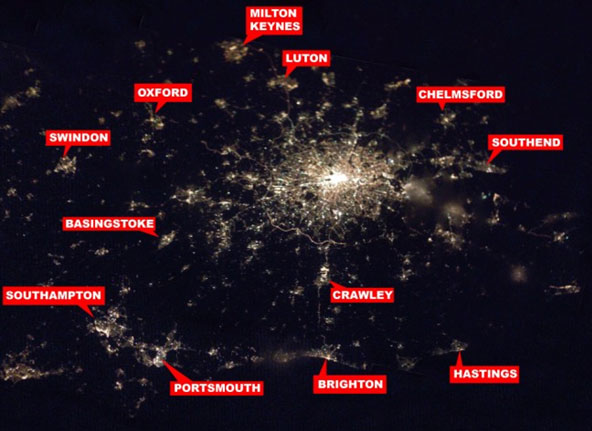
    London and the South East, seen from the night sky, shows the expansion into the South East

    Neither Utopian, nor Dystopian, Ford’s vision proved accurate. Sir Richard Rogers says as much himself, in his Cities for a Small Planet, describing London, some thirty miles wide in 1945, as a commuter belt 200 miles wide stretching from Cambridge to Southampton, and is the largest and most complex urban region in Europe. What delights Ford, appals Rogers.

    Ford was also correct that in failing to embrace change and embrace status of the fore town,. it reduced to the status of suburbs, and many opportunities were lost to create a healthier decentralized metropolis. The elements of Ford’s plan that never got off the drawing board were his proposals to “thin out” central London. Perhaps this had something to do with an eagerness to hang onto the Duke of Westminster’s slum tenements.

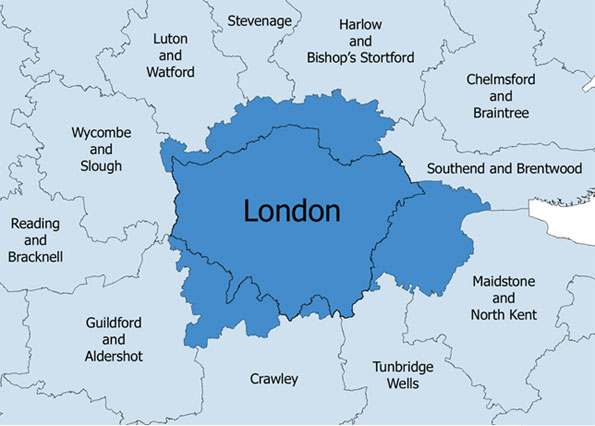
    It is tragic that Ford’s vision was ignored, and the real day-dream, that of a London contained, has continued to dominate policy. As a result, there is no London, as such. The city has lost all definition, as its outer edges have blurred into the dormitory towns around it. Having burst its bounds, there really is no recognisable unit called London that can be parcelled together under one name any more. The green belt cannot contain the sprawling suburbs. London has dissolved as its boundaries expand and become more porous.

    For more than a century, the London of the Londonostalgics has been a fraction of the administrative London. Victorian London outnumbers medieval London by more than six to one. Since 1965 Greater London has incorporated Essex boroughs like Walthamstow and other “railway suburbs”.

    The Londonostalgics jeer at the suburbs. ‘Barret Hutches … ‘Kennels’, ‘Lego Homes’, ‘They come in kits,’ according to Iain Sinclair. But for all that bitter condescension, London’s suburbs are where most of its population now lives. Put another way, they do not live in London at all, but Stevenage, Shepperton, or even Oxford and Brighton, commuting sometimes to work or play in the central heritage zone.

    How did London expand?

    From 1901 to 1950 the County of London’s population fell. In the 1930s the annual rate of decline was quite steady at around eight percent, but between 1938 and 1947 that climbed to 40%, reducing the County to a population of 3,245,000. By 1961 that number had reduced to 3,200,000.

    But these numbers obscure the demographic vitality of London, if viewed broadly. If one includes the many who live in the suburbs, the green belt or the outer country, the population of London has climbed to 10.6 million.

    London’s population changes continued to present a confusing picture. In 1965, Greater London incorporated parts of Essex and Middlesex to take account of the popular movement. But between 1961 and 1981 the population of this new, Greater London fell 15%, a loss of 1,186,000 people. Then in 1984, against everyone’s expectations, the direction of population movement changed again with the outer suburbs growing, and inner London once again growing, albeit modestly, between 1981 and today.

    Year

    Inner London Population

    Greater London Population

    1939

    4,364,457

    8,615,000

    1951

    3,679,390

    8,197,000

    1961

    3,492,879

    7,992,000

    1971

    3,031,935

    7,452,000

    1981

    2,550,100

    6,806,000

    1991

    2,559,300

    6,890,000

    2001

    2,859,400

    7,322,400

    2009

    3,061,000

    7,750,000

    Not only did London’s population change unexpectedly, in the opposite direction planned for in Patrick Abercrombie’s 1944 plan for the region: the outer boroughs expanded at the expense of the inner. The greater growth took place in the belt just beyond Greater London,adding another 2-3 million.

    Long before Lord Rogers sought to promote the city against sprawl, planners were trying to reverse the flow of people from London. Then why is London’s expansion so confusing?

    London’s growth combines two distinct trends. There is an underlying trend towards expansion and dispersion due to shifts in the locus of economic growth and better transport. But in the 1980s there was counter-trend of inward migration (much of it from Bangladesh) and later some gentrification in the inner city.

    The secular expansion and dispersal of London’s population can be seen in the fact that the thinning out of inner London’s population is roughly proportional to the expansion of outer London. From 1940, the same trend is expressed in the decline of Greater London’s population relative to the expansion of the outer suburbs of Surrey, Essex, Middlesex and Hertfordshire. “In each decade, the centres of growth moved a little farther out,” says Stephen Inwood, and this continues to be the pattern.


    London and its commuter belt (the ‘Travel to Work Area’, where three quarters of those working work in London) has a population of 9,294,800

    Transportation is the most important factor in dispersal. A.N. Wilson notes that even in the mid-nineteenth century the breakthrough of elliptic springs led to the “age of the carriage folk”, and that this was in turn spurring a movement out of the centre: even “the Marxes abandoned their cramped flat in Soho and moved to a variety of new-built family houses in Kentish Town on the edges of Hampstead Heath.” * So too did William Morris, in his Pre-Raphaelite phase, move from lodgings in the then run-down Red Lion Square, to Bexleyheath in Kent, where he built his celebrated Red House with Philip Webb in 1859. “He continued to curse the iniquities of railways,” writes his biographer Fiona MacCarthy, “but he was to make good use of Abbey Wood, his local station, only three miles away on the newly opened North Kent line.” * Edward Burne-Jones and Gabriel Dante Rossetti were just some of the medieval revivalists collected from the station in Morris’s specially built carriage.

    Later on, lower rail prices – “workmen tickets” – helped clerks establish themselves in Hackney, Wood Green, Hornsey, Hendon, Willesden, Balham and Camberwell. However, these same railway terminals were also adding to the overcrowding of inner London, as land was found for stations by knocking down working-class slums, or “rookeries” – with the surplus population generally moving to the adjacent neighbourhood. *

    In the early century it was electric trams and underground extensions. Historian Asa Briggs says that the slogan of the North Metropolitan Railway (extended from Baker Street to Harrow in 1880) Live in Metroland!, “showed that it was not so much satisfying existing needs as creating new residential districts.” *

    By the post-war period the South-East went through another expansion, one that was driven by the car, rather than the train, which was losing out to its more versatile rival. In 1951 the M1 to Birmingham opened just as car ownership spread among the middle classes. In 1970 the Westway took the M40 right into central London, and in 1986 the London orbital outer ring-road, the M25 was opened by the Prime Minister Margaret Thatcher.

    Greater car ownership was helping to accelerate the process of suburbanisation, coupled with the policies pursued in the 1980s of promoting home ownership (at the expense of public housing). Tories took pride in winning over “Essex Man” – the psychological construct of the aspirant working class voter. Though between 1981 and 1991 it was Cornwall, Cambridgeshire, Buckinghamshire whose population grew fastest, while those of London, Liverpool and Belfast were all stagnant or falling.

    Planners have tried again and again to restrict the growth of London, from the Abercrombie Plan of 1946 to the Urban Task Force of 1998. But just as they planned for a denser inner core and to limit outward sprawl, Londoners stubbornly have preferred the opposite. Even when they changed the boundary to include more of the suburbs and called it Greater London, the main thrust of growth had already moved further outwards into the commuter belt, and the rest of the South East. In reality, today, Oxford and Brighton, Southend and even Southampton are all part of a vast Southern conurbation. Political leaders have failed to catch up with these changes and even tried to stop them – but the change, as Ford explained, is happening with or without them.

    James Heartfield, of the development think-tank audacity.org spoke, at the Mayor’s ‘Story of London’ event on ‘Is London Growing Too Fast?’ on 5 October 2010.

    Photo: By J. A. Alcaide

  • Strikes and Transit Alternatives in London

    The Wall Street Journal notes that the London Underground (metro or subway) is on strike and that transit riders are having to find alternate ways to get around. This is of course, not good news, and the transit strikes that happen often in places like Paris and periodically in places like Los Angeles and Philadelphia are a serious impediment to transit’s growth (along with spending on extravagant projects and excessive and rising operating costs).

    But London is actually well prepared for this emergency. Unlike Paris, Chicago and New York (where making transit strikes illegal did not prevent one), London’s buses and underground are organized in a manner that provides riders with an alternative.

    The key is competitive tendering (competitive contracting) of bus service. One of the Thatcher government’s most successful reforms was its reorganization of transit in London. It began in 1985, when a small part of the world’s largest public bus system was put out to competitive bid. London Transport retained control of the schedules, fares, logos and bus liveries, so that the now privately operated services were an integral part of the system. Riders did not know the difference between the public and private services, until a few years later when the privately operated services began achieving better service reliability than the public services.

    By 2000, the entire London bus system had been converted to competitive tendering, with multiple contractors providing the service. Costs per mile dropped by 50%, adjusted for inflation, while service was expanded and ridership rose. Regrettably, some of the efficiency gains were lost once Ken Livingstone assumed the mayorality of the new Greater London Council, while Transport for London (the successor to London Transport) failed to pay sufficient attention to retaining economic competitiveness between the contractors. Still, things are far better today than they were 25 years ago.

    This competitively tendered bus system makes it possible for underground riders to get to their destinations by bus, albeit somewhat more slowly.

    Having an alternative is crucial. I recall that in response to a Southern California Rapid Transit District (SCRTD) bus strike (Note), I asked the Torrance and Gardena bus operations to “open their doors” as they traveled through low-income south central Los Angeles on their way to downtown (regulatory restrictions required them to operate in “closed door more” so as not to compete with the services of the larger Southern California Rapid Transit District). It was not long before one of my fellow Los Angeles County Transportation Commission members complained to Mayor Bradley (who had appointed me), which resulted in my withdrawal of the request. My colleague had been more concerned about the good of already well compensated transit employees to a greater extent than south central Los Angeles residents who relied on the buses for their livelihood (granted, this geographic area was outside the electoral constituency of the member).

    It is well to remember the less than sage views of Herbert Morrison, Deputy Prime Minister to Clement Atlee in the United Kingdom in the late 1940s. Morrison, the founder of the publicly operated London Transport opined that conversion of privately operated services to publicly operated services would be more efficient and better serve the public because public employees would be driven by an ethic of public service. While Nobel Laureate James Buchanan and the public choice school of economics put an academic end to such muddled thinking, London Underground’s workers are in the process of providing even more tangible evidence.

    —-

    Note: SCRTD was the operating predecessor to the current Los Angeles County Metropolitan Transportation Association. The board on which I served, the Los Angeles County Transportation Commission was the policy predecessor.

    Photograph by the Author

  • The Future Of America’s Working Class

    Watford, England, sits at the end of a spur on the London tube’s Metropolitan line, a somewhat dreary city of some 80,000 rising amid the pleasant green Hertfordshire countryside. Although not utterly destitute like parts of south or east London, its shabby High Street reflects a now-diminished British dream of class mobility. It also stands as a potential warning to the U.S., where working-class, blue-collar white Americans have been among the biggest losers in the country’s deep, persistent recession.

    As you walk through Watford, midday drinkers linger outside the One Bell pub near the center of town. Many of these might be considered “yobs,” a term applied to youthful, largely white, working-class youths, many of whom work only occasionally or not at all. In the British press yobs are frequently linked to petty crime and violent behavior–including a recent stabbing outside another Watford pub, and soccer-related hooliganism.

    In Britain alcoholism among the disaffected youth has reached epidemic proportions. Britain now suffers among the highest rates of alcohol consumption in the advanced industrial world, and unlike in most countries, boozing is on the upswing.

    Some in the media, particularly on the left, decry unflattering descriptions of Britain’s young white working class as “demonizing a whole generation.” But many others see yobism as the natural product of decades of neglect from the country’s three main political parties.

    In Britain today white, working-class children now seem to do worse in school than immigrants. A 2003 Home Office study found white men more likely to admit breaking the law than racial minorities; they are also more likely to take dangerous drugs. London School of Economics scholar Dick Hobbs, who grew in a hardscabble section of east London, traces yobism in large part to the decline of blue-collar opportunities throughout Britain. “The social capital that was there went [away],” he suggests. “And so did the power of the labor force. People lost their confidence and never got it back.”

    Over the past decade, job gains in Britain, like those in the United States, have been concentrated at the top and bottom of the wage profile. The growth in real earnings for blue-collar professions–industry, warehousing and construction–have generally lagged those of white-collar workers.

    Tony Blair’s “cool Britannia,”epitomized by hedge fund managers, Russian oligarchs and media stars, offered little to the working and middle classes. Despite its proletarian roots, New Labour, as London Mayor Boris Johnson acidly notes, has presided over that which has become the most socially immobile society in Europe.

    This occurred despite a huge expansion of Britain’s welfare state, which now accounts for nearly one-third of government spending. For one thing the expansion of the welfare state apparatus may have done more for high-skilled professionals, who ended up nearly twice as likely to benefit from public employment than the average worker. Nearly one-fifth of young people ages 16 to 24 were out of education, work or training in 1997; after a decade of economic growth that proportion remained the same.

    Some people, such as The Times’ Camilla Cavendish, even blame the expanding welfare state for helping to create an overlooked generation of “useless, jobless men–the social blight of our age.” These males generally do not include immigrants, who by some estimates took more than 70% of the jobs created between 1997 and 2007 in the U.K.

    Immigrants, notes Steve Norris, a former member of Parliament from northeastern London and onetime chairman of the Conservative Party, tend to be more economically active than working-class white Britons, who often fear employment might cut into their benefits. “It is mainly U.K. citizens who sit at home watching daytime television complaining about immigrants doing their jobs,” asserts Norris, a native of Liverpool.

    The results can be seen in places like Watford and throughout large, unfashionable swaths of Essex, south and east London, as well as in perpetually depressed Scotland, the Midlands and north country. Rising housing prices, driven in part by “green” restrictions on new suburban developments, have further depressed the prospects for upward mobility. The gap between the average London house and the ability of a Londoner to afford it now stands among the highest in the advanced world.

    Indeed, according to the most recent survey by demographia.com, it takes nearly 7.1 years at the median income to afford a median family home in greater London. Prices in the inner-ring communities often are even higher. According to estimates by the Centre for Social Justice, unaffordability for first-time London home buyers doubled between 1997 and 2007. This has led to a surge in waiting lists for “social housing”; soon there are expected by to be some 2 million households–5 million people–on the waiting list for such housing.

    With better-paid jobs disappearing and the prospects for home ownership diminished, the traditional culture of hard work has been replaced increasingly by what Dick Hobbs describes as the “violent potential and instrumental physicality.” Urban progress, he notes, has been confused with the apparent vitality of a rollicking night scene: “There are parts of London where the pubs are the only economy.”

    London, notes the LSE’s Tony Travers, is becoming “a First World core surrounded by what seems to be going from a second to a Third World population.” This bifurcation appears to be a reversion back to the class conflicts that initially drove so many to traditionally more mobile societies, such as the U.S., Australia and Canada.

    Over the past decade, according to a survey by IPSOS Mori, the percentage of people who identify with a particular class has grown from 31% to 38%. Looking into the future, IPSOS Mori concludes, “social class may become more rather than less salient to people’s future.”

    Britain’s present situation should represent a warning about America’s future as well. Of course there have always been pockets of white poverty in the U.S., particularly in places like Appalachia, but generally the country has been shaped by a belief in class mobility.

    But the current recession, and the lack of effective political response addressing the working class’ needs, threatens to reverse this trend.

    More recently middle- and working-class family incomes, stagnant since the 1970s, have been further depressed by a downturn that has been particularly brutal to the warehousing, construction and manufacturing economies. White unemployment has now edged to 9%, higher among those with less than a college education. And poverty is actually rising among whites more rapidly than among blacks, according to the left-leaning Economic Policy Institute.

    You can see the repeat here of some of the factors paralleling the development of British yobism: longer-term unemployment; the growing threat of meth labs in hard-hit cities and small towns; and, most particularly, a 20% unemployment rate for workers under age 25. Amazingly barely one in three white teenagers, according to a recent Hamilton College poll, thinks his standard of living will be better than his parents’.

    It’s no surprise then that Democrats are losing support among working-class whites, much like the now-destitute British Labour Party. But the potential yobization of the American working class represents far more than a political issue. It threatens the very essence of what has made the U.S. unique and different from its mother country.

    This article originally appeared in Forbes.com.

    Joel Kotkin is executive editor of NewGeography.com and is a distinguished presidential fellow in urban futures at Chapman University. He is author of The City: A Global History. His newest book is The Next Hundred Million: America in 2050, released in Febuary, 2010.

    Photo by MonkeyBoy69

  • America’s European Dream

    The evolving Greek fiscal tragedy represents more than an isolated case of a particularly poorly run government. It reflects a deeper and potentially irreversible malaise that threatens the entire European continent.

    The issues at the heart of the Greek crisis – huge public debt, slow population growth, expansive welfare system and weakening economic fundamentals – extend to a wider range of European countries, most notably in weaker fringe nations like Portugal, Italy, Ireland, Greece and Spain (the so-called PIIGS). These problems also pervade many E.U. countries still outside the Eurozone in both the Baltic and the Balkans.

    But things are also dicey in some of the core European powers, notably Great Britain, which has soaring debt, high unemployment and very slow growth. Even solvent economies like France, the Netherlands and the continental superpower, Germany, have fallen short of expectations and are expected to experience meager growth for the rest of the year.

    Europe’s poor performance undermines the widespread view held by left-leaning American pundits, policy wonks and academics about Europe’s supposedly superior model. This Euro-philia has a long history, going back at least to the Tories during the Revolution. In better times America usually moves beyond European norms instead of retreating to its cultural mother.

    When the U.S. hits a rough spot, however, there’s a ready chorus urging us to emulate the old continent. During the psychological meltdown that accompanied the Vietnam War, some pundits looked longingly at the relatively peaceful and increasingly affluent Europe as a role model. “There is much to be said for being a Denmark or Sweden, even a Great Britain, France or Italy,” Andrew Hacker said in 1971.

    In the 1980s, as the country struggled to recover its historic competitiveness, numerous pundits suggested adopting European models, notably French and German, to restore our economic standing – a notion widely echoed by Euro-nationalists such as former French President Francois Mitterand’s eminence grise, Jacques Attali.

    Two decades later, with the U.S. reeling from the Great Recession, there’s been a rebirth of euro-mania. Author Parag Khanna, for his part, envisions a “shrunken” America that is lucky to eke out a meager existence between a “triumphant China” and a “retooled Europe.” And Jeremy Rifkin, in his The European Dream, promotes the continent as a morally preferable model – more egalitarian, open and environmentally sensitive – a sentiment recently echoed in my old New America colleague Steven Hill’s Europe’s Promise: Why the European Way Is the Best Hope in an Insecure Age.

    Yet over the past four decades Europe’s core economies – the E.U. 15 – have lagged behind the U.S. in terms of both gross domestic product and job growth. Overall, the E.U. 15’s share of the global GDP has declined to 26% from 35% while the U.S. has held on to its share, now roughly equal to that of its European counterparts. The big winners, of course, have been in East and South Asia.

    Some of this has to do with the difficulties of maintaining an elaborate welfare state. In a productive, efficient and still largely homogeneous country such as the Netherlands or Sweden, an expansive system of social insurance and a vast public sector remains an affordable luxury.

    In contrast, countries like Portugal, Greece and to some extent Spain have tried to create a Scandinavian-style welfare state based on Banana Republic economies. In addition, over-reliance on tourism and real estate speculation has proved no more viable there than in places like Las Vegas or Phoenix.

    Europe’s problems may prove even more profound in the long term. For example, Europe has some of the lowest birthrates in the world. Among 228 countries ranked in terms of birthrate, Europe accounts for 20 of the bottom 28. These include relatively prosperous Germany (No. 226) and Sweden as well as a range of the shaky fringe including Greece, Bosnia, Hungary, Latvia, Italy, Portugal and Spain.

    The shrinking population problem is complicated by the fact that the one growing source of new Europeans consists of Muslim immigrants who generally have not integrated well into continental society. Many European countries – Denmark, the Netherlands and Switzerland, for example – are taking steps to shut their doors, something that may promote harmony and security but could exacerbate the long-term demographic decline.

    With their state-driven economies pledged largely to support a growing population of aging boomers, it’s hard to see what new sources of growth will propel the continent in the coming decades. Overall, according to the European Central Bank, the Eurozone’s growth potential is now roughly half that of the United States.

    Meager economic growth may also be affecting one of Europe’s greatest achievements: its relative egalitarianism. The trend toward greater inequality, earlier evident in the U.S., has now spread to Europe, including such famously “egalitarian” countries as Finland, Norway and Germany, which was the only E.U. country to see wages fall between 2000 and 2008.

    In Berlin, Germany’s largest city, unemployment has remained far higher than the national average, with rates at around 15%. One quarter of the workforce earns less than 900 euros a month. In Berlin, 36% of children are poor, many of them the children of immigrants. “Red Berlin,” with its egalitarian ethos, notes one left-wing activist, has emerged as “the capital of poverty and the working poor in Germany.” [i]

    As in the U.S., the burden of recession has fallen most heavily on younger people. An OECD analysis found that older European workers enjoyed the best gains during the past 30 years, while children and young people fared worse. For E.U. workers under 25 the unemployment rate is well over 20%, slightly higher than that of the U.S. but a remarkable statistic given the far less rapid expansion of the European workforce.

    The situation is particularly dire in Europe’s exposed southern tier. Young people who rioted in Athens in 2008 suffer unemployment rates in excess of 25%. By the end of 2009 unemployment for those under 25 stood at 44% in Spain and 31% in Ireland. Even in Sweden the youth unemployment rate has reached 27%.

    If the pattern of the last decade holds, many of Europe’s most talented young people will end up in the U.S., particularly once the recession comes to an end. By 2004 some 400,000 European Union science and technology graduates were residing in the U.S. Barely one in seven, according to a recent European Commission poll, intends to return. “The U.S. is a sponge that’s happy to soak up talent from across the globe,” observes one Irish scientist.

    Of course, there is still much we can learn from Europe. Besides a sometimes enviable lifestyle, Europeans offer some intriguing health care models and have led the way in efficient fuel economy standards. But overall, profound differences in demographics and cultural traditions suggest that America cannot easily follow a European approach to social organization and planning.

    Indeed as the U.S. and Europe confront the challenge of the rising Asian powers, their approaches likely will have to diverge. To maintain its economy and pay its debts, America will have to focus on creating jobs and opportunities for a growing population. Europeans will struggle with declining workforces, radically skewed demographics and an increasingly burdensome welfare state.

    In the 21st century we will witness not so much a clash of civilizations, but a more subtle parting of the ways. Americans need to choose a path that makes sense for us, not one drawn from an aging society whose future seems unlikely to match its past achievements.


    [i] “Income inequality and poverty rising in most OECD countries,” OECD, Oct. 21, 2008; Nicholas Kulish, “In German Hearts, a Pirate Spreads the Plunger Again,” New York Times, Nov. 6, 2008; Sally McGrane, “Berlin’s Poverty Protect It From Downturn,” Spiegel on line, March 4, 2009; Emma Bode, “Unemployment and poverty on the rise in Berlin,” World Socialist Web Site, Aug. 30, 2008

    This article originally appeared at Forbes.com.

    Joel Kotkin is executive editor of NewGeography.com and is a distinguished presidential fellow in urban futures at Chapman University. He is author of The City: A Global History. His newest book is The Next Hundred Million: America in 2050, released in Febuary, 2010.

    Photo: leucippus @Flickr

  • Migration: Geographies In Conflict

    It’s an interesting puzzle. The “cool cities”, the ones that are supposedly doing the best, the ones with the hottest downtowns, the biggest buzz, leading-edge new companies, smart shops, swank restaurants and hip hotels – the ones that are supposed to be magnets for talent – are often among those with the highest levels of net domestic outmigration. New York City, Los Angeles, San Francisco, Boston, Miami and Chicago – all were big losers in the 2000s. Seattle, Denver, and Minneapolis more or less broke even. Portland is the only proverbially cool city with a regional population over two million that gained any significant number of migrants.

    Those who find this an occasion for a schadenfreude moment attribute it to tax and regulatory climates. Clearly, things like cost of doing business are clearly very important. And indeed this is often under-rated by cool city proponents. And other things equal, people do prefer low tax jurisdictions. Still, is this the only answer, or is there another explanation? Could it be that rather than high costs driving migration, both costs and migration are being driven by other underlying factors?

    Perhaps the root problem is structural change in the economy in the age of globalization. As business became more globalized and more virtualized, this created demand for new types of financial products and producer services – notably in the law, accounting, consultancy, and marketing areas – to help businesses service and control their far flung networks. Unlike many activities, financial and producer services are subject to clustering economics, and have ended up concentrated in a relatively small number of cities around the world.

    These so-called “global cities” serve as control nodes for various global networks and key production sites for these services, along with other specialized niches they long had. In effect, more distributed economic activities requires increasing centralization of select functions, particularly the most highly value-added functions. Yet these activities are not set in stone; for example, areas that were once centers for global business, like Cleveland or Detroit, are fading; others like Houston and Dallas are rising.

    Yet unlike the Texas cities, which retain a strong middle-class and middle-echelon economy, many of the more elite, established urban centers – for example New York and London – increasingly create parallel economies and labor markets in those cities. These cities now generally contain two kinds of people and firms: those who are part of the global city functions and those who are not. Those who are engaged in global city functions operate in a world of very high value-added activities; specialized, niche skill markets; and rising demand conditions. Those skills are not readily acquired outside of global cities. Often, they are sub-specialized to particular places as different global cities specialize in different niches.

    In many cases, these functions have not yet migrated to India or China or often even another global city. This tends to inflate salaries significantly for these specialized, niche skill jobs.

    On the other hand, many people who once thrived in these cities have not benefited from these economic forces. They often are in occupations where labor arbitrage is feasible, and their jobs can either be off-shored, or readily transferred to lower cost locales in the US. This includes manufacturing work, but also important but less specialized white collar occupations like basic accounting, loan officers, corporate IT, and HR. In short, the routine side of the traditional monolithic corporate headquarters and services firm.

    In effect, in these global cities, two economic geographies share the same physical geography – and those economic geographies are in conflict. One set requires catering to high skill, highly paid workers and firms where cost is a secondary concern. The other involves occupations and industries where cost is very much a concern. The occupants of these two geographies have very different public policy priorities. Which of them will win out?

    In a global city, particularly a mature and expensive one, the elite geography wins. It is generating the most money, and with money comes power and influence. Additionally, the high wage workers in these industries are simply able to pay more for real estate and other items. Their mere paychecks are driving up costs in the city they live in. They are re-ordering the city in their own high income image, aided and abetted by a speculative financial fueled housing bubble.

    The prestige of these industries burnishes the civic brand, making them attractive to civic boosters. What’s more, leaders in global cities feel that these are their businesses of their future. For them the attractiveness of concentrating in areas where you think you can create a “wide moat” advantage makes sense.

    This is why cities like Portland, Minneapolis, Denver, and Seattle haven’t fared nearly so badly – they aren’t really full metal global cities and thus, while not always cheap, have remained relatively affordable versus places like San Francisco and New York.

    At the same time it is not easy for these more expensive cities to adopt a low tax, low cost approach. For many reasons, places like San Francisco, New York, and London will never, no matter what they do, be able to match Atlanta, Houston, or Dallas, or even Chicago in a war on costs. That would be a suicide mission. Their logical strategy is to follow the law of comparative advantage, and specialize where you have the best competitive position in the market, and that’s global city functions.

    Many other cities have followed this strategy, but with differing success. Fearing to end up like the next Michigan and Detroit pair, many states and cities have invested heavily to build up urban amenities to cater to the global city firms and their workers: transit systems, showplace public buildings, art and culture events, bike lanes, and beautification. Cost fell by the wayside as a concern, as did investments in priorities of the traditional middle class.

    This explains why, for example, not only have taxes gone up, but things like schools and other basic services have declined so badly in places like California. Traditional primary and secondary education is not important to industries where California is betting its future. Silicon Valley, Hollywood, and biotech draw their workers from the best and brightest of the world. They source globally, not locally. Their labor force is largely educated elsewhere. Basic education and investments in poorer neighborhoods has no ROI for those industries. With the decline of high tech manufacturing in Silicon Valley, even previously critical institutions such as community colleges are no longer as needed.

    The same goes for growth and sprawl. They are playing a game of quality over quantity. They specialize in elite urban areas and elite suburbs or exurbs. For example, San Francisco also has Marin, Palo Alto and Los Altos Hills. New York has, in addition to Manhattan, Greenwich and northern Westchester. The only thing they need size for is sheer scale in certain urban functions, and they already have it. Growth is unnecessary for them and only brings problems.

    It also explains the highly pro-immigration stance of these cities, as a large service class is needed for globalization’s new aristocrats. Immigrants are needed as low cost labor in the burgeoning restaurant and hotel business. In America’s global cities immigrant housekeepers, landscapers, and nannies are common. They may not dress like His Lordship’s butler, but that doesn’t make them any less servants.

    Lastly, it explains why we have seen the same polarizing class pattern so consistently despite broad geographic and socio-political differences between places like Los Angeles, Boston, and Chicago, to say nothing of overseas locales like London. A common global phenomenon probably has a common underlying cause.

    The traditional middle class, feeling the squeeze, is simply moving to where its own kind is king and its own priorities are catered to. In a battle of conflicting economic geographies, the one with higher value added wins, displacing others in what Jane Jacobs termed the “self-destruction of diversity”. First, an attractive environment draws diverse uses, then one becomes economically dominant and, through superior purchasing power, displaces other uses over time. The story ends when that dominant economic activity exhausts itself – the true danger facing global cities, though fortunately they are generally not dependent on just one small niche. It’s basic comparative advantage.

    If you are just an average middle class guy, why live in one of those global cities anyway? Unless you have roots there that you value, take advantage of something you can’t get anywhere else such as by having a passion for world class opera, or are one of globalization’s courtiers – a hanger on like a high end chef, artist, or indie rocker, perhaps – why put up with the high cost and hassles? It makes no sense. You’re better off living in suburban Cincinnati than suburban Chicago.

    And frankly, the folks on the global city side prefer it if you leave anyway. Immigrants are unlikely to start trouble, but a middle class facing an economic squeeze and threat to its way of life might raise a ruckus. That won’t happen if enough of them move to Dallas and rob the rest of critical mass and resulting political clout.

    Many of those leaving are college educated, especially, when they get older, get married, and start having families. A relatively large number of these people could be replaced by a smaller number of elite bankers, biotech PhDs, and celebrity chefs. In that case, both “narratives” could hold simultaneously. One type of talent moves in, while a greater number of a different kind moves out. As with trade generally, this could even be viewed as a win-win in some regard.

    Again, it is easy to blame the costs and public policy. Clearly there is room for improvement in governance such as reigning in out of control civil service pay and pensions in places like California and New York. But what is more pernicious is the rising income gap in America, and the likely outcomes it drives when a city acquires a small elite economic class with incomes that far outstrip the average, and lacks strong economic linkages to the rest of the city other than for personal services. It sets in motion economic logic that undermines the traditional middle class, which then starts leaving, exacerbating the gap.

    For years we worried that a large, stable middle class with a permanent, largely minority underclass constituted an unjust order. As it turns out, the alternatives are sometimes worse. Ultimately some American cities have come to take on the cast of their third world brethren, a perhaps somewhat less extreme version of Mexico City or São Paulo, where vast wealth and glitter exist side by side with the favelas.

    This explains why America’s global cities often feel more kinship with their international peers than with many of the places in their own country. The global cities, which now enjoy something of a political ascendency, are also sundering the American commonwealth. Taking steps to prevent a further widening of the income gap may be the only way to save these cities’ middle class – and maintain the solidarity of the country.

    Aaron M. Renn is an independent writer on urban affairs based in the Midwest. His writings appear at The Urbanophile.