Tag: Los Angeles

  • California Recovery: No, It Is Not East vs. West

    Every now and then, some East Coast based publication sends a reporter out to California to see how the West Coast’s economy is doing.  I think they write these things sitting at a restaurant patio overlooking the Pacific Ocean.  That can be seductive, and lulled into a comfortable sense that all is well with the world, the reporter always gets it wrong. 

    The most recent example is this New York Times article.  The second paragraph summarizes the article:

    Communities all along the state’s coastline have largely bounced back from the recession, some even prospering with high-tech and export businesses growing and tourism coming back. At the same time, communities from just an hour’s drive inland and stretching all the way to the Nevada and Arizona borders struggle with stubbornly high unemployment and a persistent housing crisis. And the same pattern holds the length of the state, from Oregon to the Mexican frontier.

    The next paragraph contains the mandatory quote from California’s favorite economic Pollyanna, Steve Levy:

    “This is really a tale of two economies,” said Stephen Levy, the director of the Center for Continuing Study of the California Economy. “The coastal areas are either booming or at least doing well, and the areas that were devastated still have a long way to go. The places that existed just for housing are not going to come back anytime soon.”

    The article is accompanied by a photo of a couple driving a red Ferrari convertible.  The caption says "Driving through Newport Beach in Orange County. Communities along the coast have largely rebounded from the recession."

    This is all nonsense.

    There are two reasonable measures of recovery, jobs and real estate values.  You can forget the real estate values measure.  Values throughout California are down from pre-recession highs.  They are down a lot.  Only San Francisco and Marin counties, with median home prices down 27.7 percent and 32.3 percent, respectively, have seen net median home price declines of less than 40 percent.  Monterey and Madera counties top the state in median home price declines, in excess of 67 percent.

    So let’s use jobs.  An area has recovered if it has as many jobs today as it had at the beginning of the recession, December 2008. 

    We monitor 37 California MSAs.  Combined they represent about 96 percent of California’s population.  By jobs, only one of California’s larger MSAs has recovered, and that county does not fit the story.  Not only is Kings County not on the ocean, it doesn’t even border or have a naturally occurring year-round piece of water.  Kings County, with 37,700 jobs, has about 900 more jobs than it had at the beginning of the recession.  Still, Kings County’s unemployment rate is 17 percent.  Some recovery!

    Orange County, which the New York Times article cites as largely rebounded, is down 127,800 jobs from its pre-recession high.  That’s an 8.5 percent decline.  Los Angeles County is down 337,000 or 8.1 percent of jobs.  The difference between unemployment rates, 8.0 percent in Orange County versus 12.1 percent in Los Angeles County, reflects different unemployment levels at the beginning of the recession and the high cost of living in Orange County.  Most people can’t afford to be unemployed long in Orange County.  You either find a job, or you leave.

    Here are the Counties that have lost, on net, less than 6 percent of jobs in the recession:


    County/MSA

    Job gain
    or Loss

    percent change

    Unemployment
    Rate

    Imperial

    -100

    -0.2%

    26.7%

    Kings

    900

    2.4%

    17.0%

    Merced

    -2,800

    -4.8%

    20.0%

    Monterey

    -5,600

    -4.3%

    15.3%

    San Diego

    -66,400

    -5.1%

    9.3%

    San Francisco
    San Mateo
    Marin

    -33,600

    -3.4%

    8.0%
    7.3%
    6.6%

    Santa Clara
    San Benito

    -19,900

    -2.1%

    8.8%
    18.3%

    San Luis Obispo

    -5,900

    -5.7%

    8.7%

    Santa Barbara

    -8,200

    -4.7%

    8.9%

    Santa Cruz

    -3,800

    -4.1%

    13.6%

    Solano

    -6,100

    -4.8%

    10.9%


    It’s hard to find real recovery here.  Three of the sub-10-percent-unemployment-rate counties (Marin, San Luis Obispo, and Santa Barbara) are home to the wealthy, those who serve them, and a very small middle class.  They have not had and will never have anything like robust economies.  Think of them as big Leisure Villages for the terminally fashionable.

    That leaves San Diego, San Francisco, San Mateo, and Santa Clara counties as potential vigorous economies.  Let’s look at these regions’ job creation last month.  Unfortunately, the data are only available by MSA.  San Diego County saw job growth of 1,300 jobs in February, an increase of about 0.11 percent.  Santa Clara/San Benito saw job growth of about 4,100, or 0.46 percent.  San Francisco/San Mateo/Marin saw growth of about 7,100 jobs, or 0.74 percent.

    It looks to me like there is a small island of relative prosperity: San Francisco, San Mateo, and Santa Clara Counties, but even these counties have not fully recovered.  This island is indeed on the coast, but it represents just a small fraction of the coastal county population. 

    The idea that there is some sort of Coastal resurgence in California is just absurd.  Certainly, the 593,800 still unemployed in Los Angeles — by far the state’s most populous — are not likely to agree that “The coastal areas are either booming or at least doing well…"

    Bill Watkins is a professor at California Lutheran University and runs the Center for Economic Research and Forecasting, which can be found at clucerf.org.

    California coast photo by BigStockPhoto.com.
  • The House Home Savings Built

    After doing his duty for the Navy in Washington D.C. during World War II, my father returned to Los Angeles, and my parents moved into the Talmadge Apartments between Western and Vermont. They’d been married for 17 years without having any children. So my father informally adopted his two nephews.

    Around 1949, those nephews, who were students at UCLA, threw a party at the apartment. It was apparently a night to remember. The management decided to not renew my father’s lease. Shortly after that, my father’s wife announced, after nearly two decades of a childless marriage, that she was with child. (Full disclosure: that child was none other than this writer.)

    So my dad leased a house facing the Wilshire Country Club in Hancock Park. Then, in 1959, he formed a corporation to buy a nearby Tudor house, hire domestics, and rent the house back to him with domestic services. This was the man who founded the largest savings and loan in America, who in those years probably enabled more Californians to become homeowners than anyone else. But he was technically a renter all his life. Those were the days of the 70-percent and 90-percent top tax brackets, and byzantine legal structures were common.

    In mid-century Los Angeles, anything on Wilshire Boulevard was considered more prestigious than anything on the side streets. On the eastern end near Lafayette Park was the Bullocks Wilshire department store. Several miles west were the Miracle Mile department stores, which had beautiful shop windows facing the boulevard, even though most people entered the stores through portes-cochères in the rear. Many of the major liberal establishment churches—the PCUSA, the United Methodists, St. Basil’s Cathedral, and the Wilshire Boulevard Temple, Rabbi Magnin’s huge reform synagogue—lined the street. The Ambassador Hotel was one of the great hotels of the city. And then there was The Brown Derby Restaurant, which gave us the Cobb Salad.

    My father was originally from Omaha, Nebraska, but he moved west, graduating from the University of Southern California in 1927 and emerging from the Great Depression as a successful insurance underwriter. During the war, he heard talk among the military that Southern California was going to take off, so he bought a one-branch thrift downtown called Home Savings and Loan. Soon, it grew to be a multi-branched empire in four counties: Los Angeles, Orange, San Bernardino, and Riverside.

    Partly to get involved in philanthropy and partly to set up an estate plan, my father set up The Ahmanson Foundation. The idea was that The Ahmanson Foundation, after my father’s death, would inherit and control the for-profit companies. This was a common legal arrangement at the time, offering a way for wealthy families to preserve more of the family fortune. (I recommend the novel God Bless You, Mr. Rosewater, by Kurt Vonnegut, for a sense of how it worked.)

    Apparently, my father wasn’t a full member of the downtown establishment, for he chose to base his business several miles west of the establishment thoroughfares of Flower and Figueroa. He recruited the artist Millard Sheets to design for him a corporate headquarters on the north side of Wilshire Boulevard, between Serrano and Oxford Streets, in the early 1950s. Then he conceived of a fancier project for that site and hired Edward Durell Stone to design it. A model of it was in our house during my later high school years. It featured two buildings next to each other, with concave faces toward a courtyard. A third, taller building was to stand in back. But that part was never built.

    My father died suddenly on June 17, 1968, before ground was broken on the project. Fifteen months later, the U. S. Congress passed, and President Nixon signed, a bill called the Tax Reform Act of 1969. It rendered my father’s estate plan obsolete, for a non-profit foundation could no longer own a controlling interest in a for-profit corporation. Instead of remaining under the control of the The Ahmanson Foundation, Home Savings of America would have to go public. In the meantime, my father’s nephew Robert Ahmanson wound up overseeing construction on the pair of buildings. They were finished in 1973.

    The interest rate spike of the early ’80s was hard on Home Savings of America, and they sold off the Ahmanson Center on Wilshire at that time. Still, Home Savings coasted through the savings and loan crisis of the end of the ’80s, thanks to maintaining the conservative policies that my father had instituted.

    The area changed a lot in these years. After the Watts Riots of 1965, and in the 10 or 15 years after that, the upper and upper-middle classes of Pasadena, San Marino, Arcadia, and Hancock Park relocated en masse to the Newport Beach area in what I call the secessio patriciorum, or the secession of the patricians. Los Angeles Magazine featured an article in 1977 called “The Ripening of Orange County: Is It Stealing the L.A. Dream?” Indeed, a lot of the life seemed to get sucked out of Los Angeles at that time. One consequence of the secessio was that finance and retail and new construction tended to concentrate either downtown or west of central Beverly Hills. That left the Wilshire corridor in between down at the heels.

    Later, that part of Wilshire recovered and reinvented itself. New immigrants from Korea and Latin American countries moved in, and, for many years, such gentrification as took place in the area was done by these immigrants and not so much by white Anglos. After 1990, previously uncool areas like Pasadena, Santa Monica, and parts of downtown began to recover, and the Wilshire district became the heart of Koreatown. I now think of Los Angeles as being similar to San Francisco and Oakland. The West Side up to Hancock Park is like San Francisco, while the parts east of it are like Oakland and the East Bay. London and Berlin have the same sort of east-west-ness.

    Koreatown is a wonderful neighborhood, and the Ahmanson Center is still beautiful. But I can’t help feeling a touch of melancholy that my dad’s vision was never fulfilled. He’d hoped to make that part of Wilshire Boulevard one of the great financial and retail corridors of America. Today, the big players are concentrated downtown or in Beverly Hills and westward.

    If you walk up the Oxford Street side of the Ahmanson Center, you can see a travertine block with a Latin inscription. Translated, it says, “Robertus and Mauritius, two virtuous men, dedicate this stone to themselves.” Robertus is Robert Ahmanson, who supervised the construction of the center. Mauritius is Maurizio Bufalini, owner of a marble quarry in Carrara, Italy. Bufalini was a good friend of our family, and he provided the Italian and Greek marble that decorates the center. Both these men are “late,” as they say in Botswana English, meaning dead. The stone is dusty now, but the words can still be read. I wonder if anybody notices it, or wonders what it means.

    This piece first appeared at Zocalo Public Square.

  • Urban Development: Playing Twister With The California Environmental Quality Act

    When it comes to environmental issues, emotions often trump reasoned argument or sensible reform, especially in California. In Sacramento at our state capitol, real world impacts are abstracted into barbed soundbites. It’s the dialogue of the deaf as environmental advocates rally around our landmark California Environmental Quality Act (CEQA) — and economic interests decry it as “a job killer.” Perhaps the polarization can be put aside to ask about a specific example in the real world. Why does an old K-Mart sit vacant on Ventura’s busiest boulevard despite initial City approval for a Walmart store? All the thunder and lightning surrounding whether a Walmart belongs in Ventura is behind us. A vigorous and contentious debate (and a failed citizen initiative) have rendered the verdict that filling an empty discount retail space with a different discount retailer is a function of the market, not government regulation.

    Nor can we directly blame the stalemate directly on the California Environmental Quality Act (CEQA). What keeps the store empty is not the controversial law itself, but the way it has been twisted like a pretzel into a tool to stop urban developments opposed by well-funded interests. Recently, the Los Angeles Times exposed the ironic way it has even been adapted by developers and big corporations to fend off their competition.

    The California Environmental Quality Act is the toughest state environmental protection statute in the nation. Passed more than 40 years ago in the wake of the first Earth Day (and signed by Governor Ronald Reagan), CEQA has spawned an industry of specialist consultants, attorneys and planners. Its original laudable goals for managing natural resources have been obscured by the hard ball tactics of litigators in our state.

    The vast majority of Californians support sensible environmental protections and are suspicious when business interests lobby to weaken them. They remember oil spills and toxic dumps and slash and burn hillside developments. Yet the case law that has grown up around CEQA is so burdensome that virtually any public or private project can be slowed or killed on bogus grounds that really have nothing whatever to do with protecting our natural environment.

    Yes, the law has protected stands of redwood trees from clear-cutting and sensitive habitat from suburban sprawl. And there are David and Goliath stories: a little band of neighbors stop a mega-developer from flooding their neighborhood with traffic (although this is a long stretch from protecting “natural resources”.) But it is now routine for special interests to hire high-powered law firms to exploit the law for their own economic interests.

    Here in Ventura, lawyers for construction unions combed over the Environmental Impact Report done for the new Community Memorial Hospital project with the goal of seizing on any technical errors or ambiguities. They fired off a thirty page “comment letter” which lays the groundwork for a lawsuit. The goal was certainly not “protecting the environment” — it was to pressure the hospital to use union labor for the construction. They were successful.

    The proposed Walmart at the old K-Mart site is stalled after initial city approval because the company knows that even something as simple as changing the facade on the building could trigger a lawsuit alleging inadequate “environmental review.” So the project sits in limbo while Walmart analyzes its legal options. What Walmart fears is exactly what happened to WinnCo grocery, which did see its proposed new signage and facade challenged by a CEQA lawsuit.

    There are lots of things not to like about development in a city. But that’s why we have planning commissions, public hearings and appeals to elected City Councils, along with detailed rules that must meet stringent legal guidelines for adoption and enforcement. But why have an elaborate land use entitlement and permit review process if it can be superseded by anyone with the resources to file a CEQA lawsuit? Democratic due process goes out the window, replaced by months or years of costly legal maneuvering.

    No sensible person advocates repealing CEQA. But after forty years, it is past time to return to its original, laudable purpose and intent: to protect our natural environment and sustainably manage our natural resources.

    Understandably, environmental advocates are skittish about tinkering with the law. There is precedent, however, for consensus reform. When the League of Conservation Voters pushed a bill to curb greenhouse gas emissions and promote sustainable regional planning, they won the support of both the League of California Cities and the Building Industry Association by incorporating a modest relaxation of onerous CEQA burdens on “infill development.” There’s lots more room for common sense consensus to separate environmental protection from a racket for special interest litigation.

    One of the worst ways to proceed is to pick out individual projects for favorable CEQA treatment. That’s what’s happened on a couple of controversial stadium projects that won legislative relief from the typical CEQA procedural hurdles. Having to lobby Sacramento to pass a special law is a brutally stark example of special interest litigation. Football stadiums are not the only or even the most important projects held hostage by CEQA abuse. Comprehensive reform is long overdue.

    In these economic times, the jobs lost to CEQA abuse aren’t offset by the ones created for CEQA experts and CEQA attorneys. California led the nation in protecting our state’s environment. If we can look past the symbolism that CEQA has assumed to both advocates and detractors, we’ll see that it’s urgent to restore the law’s original purpose and keep it from being hijacked for other agendas. That may be unlikely in today’s polarized political climate. That’s why it is crucial to bypass the soundbites and the symbolic posturing, and remember the real world fallout of failing to reform the way CEQA is administered in the Golden State.

    Rick Cole is city manager of Ventura, California, and recipient of the Municipal Management Association of Southern California’s Excellence in Government Award. He can be reached at RCole@ci.ventura.ca.us

    Photo: The vacant K-Mart in Ventura, California

  • California’s Deficit: The Jerry Brown and ‘Think Long’ Debate

    California has three major problems: persistent high unemployment, persistent deficits, and persistently volatile state revenues. Unfortunately, the only one of these that gets any attention is the persistent deficit. It is even more unfortunate that many of the proposals to reduce the deficits are likely to make all three of the problems worse over the long run.

    Two major proposals to deal with the deficit will shape the coming debate. One is from the newly formed Think Long for California Committee; the other from the governor.

    Governor Jerry Brown’s plan would increase sales taxes, and would increase the tax rate on the portion of anyone’s income that is over $250,000 (the marginal rate). It is a general rule of tax analysis that if you want there to be less of something, tax it. Indeed, this proposal would result in some wealthier people leaving California, and it would accelerate the trend of substituting internet retail purchases for local retail purchases.

    It would also increase California’s tax receipt volatility. California’s tax base is dependent on the income of a relatively small group of wealthy people. It turns out that this income is more volatile than the economy. Increasing top marginal tax rates would only increase the volatility of the state’s revenue.

    So, why would the governor make such a silly proposal? I’ve heard a few reasons.

    • The government is starving and it needs the income now.

    This is nonsense. Combined national, state, and local government spending is now over 35 percent of gross product. This is highest it has ever been, including the peak spending years of World War II.

    We can disagree on the optimal size of government, but to argue that this is a time of scarce government spending is absurd.

    • The wealthy have too much money. We must increase the progressivity of California’s tax code.

    The governor’s proposal will do that. If implemented, the plan will give California the highest marginal tax rates in the United States. The problem is that people with high incomes often have more choices than most of us. They can move. They can reallocate earnings to other states or into less-taxed activities. They can just forego earnings if the return is too low.

    Most analysts agree that California’s tax structure should be broader based. The only way to do that is to make the system less progressive, not more progressive. Increasing taxes on the wealthy may feel good when the law is implemented, but it will eventually lead to lower tax revenues, increased revenue volatility, and slower economic growth.

    • There is nothing else we can do. The political situation does not allow a better fix.

    It never will be easy to implement comprehensive tax reform in California. There are too many groups with too much at stake. However, it is senseless to argue that we should therefore increase the distortions in an already distorted tax code. California has been doing this for years, and it just keeps making things worse. California’s governance is a mess precisely because it is the result of hundreds of ad-hoc decisions.

    California desperately needs comprehensive tax reform, “if not now, when?”

    Which brings us to the proposal by the Think Long for California Committee . The Think Long committee is a subset of California’s political elite. You will recognize many of the names; for a start: Nicolas Berggruen, Eli Broad, Willie Brown, Gray Davis, Condoleeza Rice, Bob Hertzberg, Eric Schmidt, Terry Semel, Laura Tyson, and George Schultz. The proposal has three components:

    Empowering Local Governments and Regions: Here’s what it says about decentralizing decision-making: “While the committee embraces the principles of de-centralization, devolution and realignment of revenues and responsibilities, we have not endeavored to propose precisely how that should be accomplished.”

    That’s a bit like endorsing Mom and apple pie, isn’t it? The committee has not earned itself any honor or credibility by failing to have a proposal for one of the three major components of its plan, the first that it enunciates.

    Improving Accountability: “The Citizens Council For Government Accountability – an independent, impartial and non-partisan body – would be established to develop a vision encompassing long-term goals for California’s future.”

    Only, it is not a citizens group at all. It would be funded by the state, and it would have access to state agencies for support. Nine of the committee’s thirteen members would be appointed by the governor, two of whom could not be registered in either party. The Senate Rules Committee and the Speaker of the Assembly would each appoint two members, one from each major party. The committee would have four non-voting ex-officio members: the director of finance, the state treasurer, the state controller, and the attorney general.

    That sounds to me a lot like just another government agency. Not exactly; this would be a super-committee with broad powers. It would soon be involved in almost every aspect of California’s government. The committee would have subpoena power, and the ability to publish on the election ballot its comments and positions on proposed ballot initiatives and referendums, as well as to place initiatives directly on the ballot.

    Giving the committee the ability to place initiatives directly on the ballot is a nice touch in a document that elsewhere tries to make it more difficult for others to place initiatives on the ballot.

    Restructuring the Tax Code: California’s tax code needs restructuring, no doubt about that. This proposal doesn’t get us to where we need to be, though. It reduces sales tax rates, top marginal income and business tax rates, and deductions from personal income taxes, except for education and health care, and for taxing services.

    In general, these are steps in the right direction. However, exempting education and healthcare is a serious, perhaps fatal, flaw. It amounts to a huge subsidy for those industries, and places an extraordinary burden on the remaining service providers. The exempted industries are big, and exempting them means higher taxes on other service providers.

    Who would actually bear the tax burden? That depends on the elasticities of supply and demand. In general, when demand is less elastic than supply (when the consumer is relatively indifferent to price changes), the consumer bears the tax burden, which is what is desired. However, for many services, it would appear that demand is not that inelastic.

    Consumers can easily reduce the frequency of services such as haircuts, lawn maintenance, and the like. This would shift the burden of the tax from the consumer to the provider, that is, the hairdresser or landscape worker. In many cases, these are very low-income workers, making the tax extraordinarily regressive. California’s tax code needs to be less progressive, but this could be a huge regressive swing, one that would create extreme hardships for some of our least advantaged citizens.

    Economic theory is clear that there are fewer distortions in consumption taxes than in income and capital taxes. However, these models assume that the tax burden is squarely placed on the consumer. It appears that for many services this may be impossible. Perhaps that is why we don’t observe many service taxes.

    It is also the case that, in many services, taxes are avoided by the use of cash transactions. Estimates of the size of the “underground economy” vary, but most economists believe it is significant. A tax on services would likely increase its size dramatically.

    The Think Long proposal is not the solution to California’s challenges. It does, however, represent far more thought than went into the governor’s proposal. It provides a service, in that it provides a starting point for a conversation that California desperately needs.

    Photo by Randy Bayne; California Governor Jerry Brown

    Bill Watkins is a professor at California Lutheran University and runs the Center for Economic Research and Forecasting, which can be found at clucerf.org

  • The Shifting Landscape of Diversity in Metro America

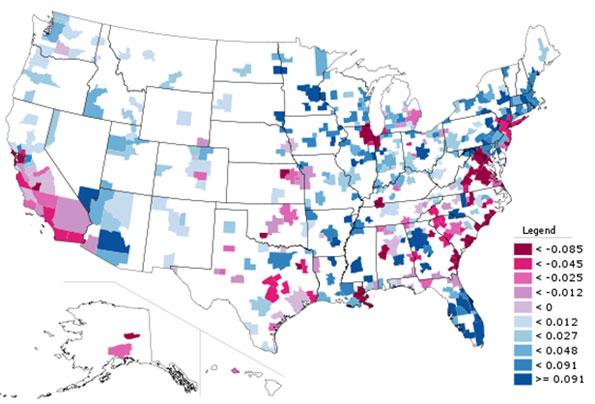
    Census 2010 gave the detail behind what we’ve known for some time: America is becoming an increasingly diverse place.  Not only has the number of minorities simply grown nationally, but the distribution of them among America’s cities has changed. Not all of the growth was evenly spread or did it occur only in traditional ethnic hubs or large, historically diverse cities.

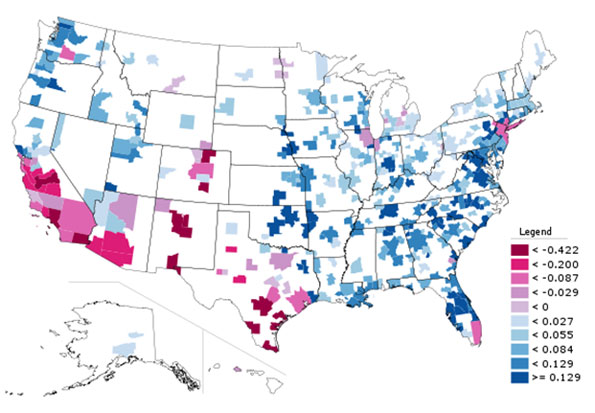
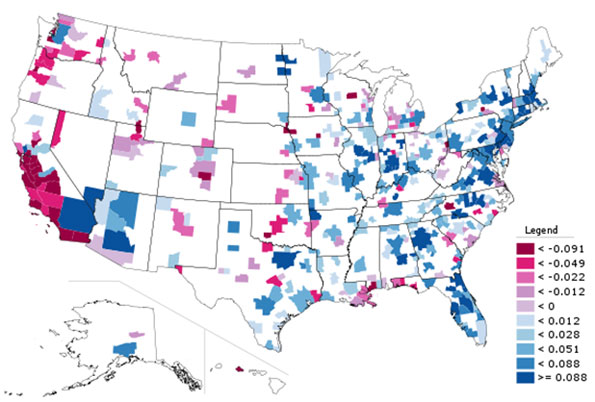
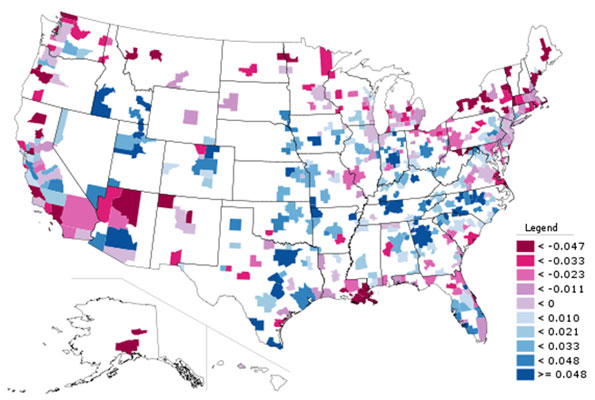
    To illustrate this, I created maps of U.S. metro areas showing their change in location quotient. Location quotient (LQ) measures the concentration of something in a local area relative to its concentration nationally. This is commonly used for identifying economic clusters, such as by comparing the percentage of employment in a particular industry locally vs. its overall national percentage. In a location quotient, a value of 1.0 indicates a concentration exactly equal to the US average, a value greater than 1.0 indicates a concentration greater than the US average, and a value less than 1.0 indicates a concentration less than the US average.

    While commonly used for economic analysis, the math works for many other things. It can be useful to measure how the concentration of particular values changes over time relative to the national average.  In this case, we will examine the change in LQ for various ethnic groups between the 2000 and 2010 censuses for metro areas. Those metro areas with a positive change in LQ grew more concentrated in that ethnic group compared to the US average over the last decade. Those with a negative change in LQ grew less concentrated compared to the nation as a whole, even if they grew total population in that ethnic group.

    To increase concentration level requires growing at a faster percentage than the US as a whole. This is obviously easier for places that start from a low base than those with a high base. In this light, places that have traditionally been ethnic hubs – such as west coast metros for Asians – can grow less concentrated relative to the nation as a whole even if they continue to add a particular ethnic group. Asian population, for example, can grow strongly in California, but at a slower rate than the rest of the country. This is indeed the case as groups like Hispanics and Asians have been de-concentrating from the west coast, and now are showing up in material numbers even in the Heartland.

    Black Population


    Black Only Population, Change in Location Quotient 2000-2010

    The change in Black concentration is particularly revealing. Much has been written about the so-called reversing of the Great Migration. But contrary to media reports, there is no clear monolithic move from North to South. Instead, we see that the outflow has been disproportionately from America’s large tier one metros like New York, Chicago, and Los Angeles. In contrast, Northern cities like Indianapolis, Columbus, and even Minneapolis-St. Paul (home to a large African immigrant community) grew Black population strongly, and actually increased their Black concentrations. Similarly, there were clearly preferred metro destinations in South for Blacks, like Atlanta and Charlotte. Many other Southern metros , particularly those along the Atlantic coast of Georgia and the Carolinas continued to lose their appeal to Blacks, relatively speaking.

    Hispanic Population


    Hispanic Population (of any race), Change in Location Quotient 2000-2010

    Here we see de-concentration clearly in action. The Mexican border regions retained high Hispanic population counts, but they are no longer as dominant as in the past. Places like Nashville, Oklahoma City, and Charlotte particularly stand out for increasing Hispanic population percentage. Again, large traditionally diverse tier one cities like New York and Chicago show declines on this measure as smaller cities are now more in on the diversity game.

    Asian Population


    Asian Only Population, Change in Location Quotient 2000-2010

    Again, we see here that America’s Asian population spread well beyond traditional west coast bastions. There were big increases in Asian population counts, with resulting LQ changes, in places like Atlanta, Indianapolis, Philadelphia, and Boston. Even New York (which now has over one million Asian residents within the city limits alone) and Chicago showed gains among Asians.

    Children (Population Under Age 18)

    As a bonus, here is a look at LQ change for metro areas for people under the age of 18.


    Children (Population Under Age 18), Change in Location Quotient 2000-2010

    Here we see that metros along America’s northern tier now have relatively fewer children than a decade ago, while metros like Denver, Dallas, and Nashville had more. Clearly, some places are increasingly seen as better – and perhaps also more affordable – locations for child rearing than others.  Perhaps unsurprisingly many of the out of favor locales are either expensive, have poor economic prospects, and/or are excessively cold. Not surprisingly, for example, Atlanta, Houston and Florida’s west coast have gained in this demographic while much of the Northeast, particularly upstate New York, have lost out.

    The overall key is while there are certain broad themes that emerge from the recent Census, such as America’s increasing diversity or signs of a reversing of the Great Migration, we need to take a more fine grained view to see which places are in fact benefitting and being hurt by these trends.  What we see here is that traditional large urban bastions of black population and ethnic diversity are no longer the only game in town. Smaller places in the interior and the South are now emerging as diversity magnets in their own right, as well as magnets for families with children. This is the collection of places to watch to look for the next set of great American cities to emerge.

    Aaron M. Renn is an independent writer on urban affairs based in the Midwest. His writings appear at The Urbanophile. Telestrian was used to analyze data and to create maps for this piece.

    Note: The original version of this piece included incorrect charts for the Asian, Hispanic, and child measures.

  • Public Pensions: Reform, Repair, Reboot

    Ill-informed chatter continues to dominate the airwaves when it comes to California public pensions. It’s a big, complex and critical issue for government at all levels in the Golden State. What makes debate so distorted is that public pensions actually differ from agency to agency — and advocates on the issue often talk past each other. Pension critics often point to outrageous abuses as if they were typical. On the other hand, pension defenders often cite current averages that understate long-term costs. All this fuels the typical partisan gridlock that Californians lament yet seem powerless to change in our state.

    Credit Governor Jerry Brown for trying to overcome the polarization. That’s what most California voters want him to do, according to a new Field Poll, one of the leading opinion research firms in California. His 12-point pension package (unveiled in October) is successfully framing the debate — and enjoys encouraging support from voters. I agree with them. While Brown’s plan is far from perfect (as he acknowledged in presenting it as a way to build consensus) it sensibly tackles some of the most challenging areas where reform is needed. Among the key reforms he’s proposed:

    • Increasing the retirement age from 55 to 67 (with a lower age to be spelled out for public safety workers).
    • Replacing the current “defined benefit” pensions with a hybrid program that includes a defined benefit component, but also a 401(k)-like defined contribution component
    • Prohibiting retroactive pension increases.
    • Requiring all employees to contribute at least 50 percent of the cost of their pensions

    These generally follow the surprisingly strong stand taken by the League of California Cities, which was based on recommendations from a committee of City Managers that I served on. Our work was grounded in four core principles:

    1. Public retirement systems are useful in attracting and retaining high-performing public employees to design and deliver vital public services to local communities;
    2. Sustainable and dependable employer-provided defined benefits plans for career employees, supplemented with other retirement options including personal savings, have proven successful over many decades in California;
    3. Public pension costs should be shared by employees and employers (taxpayers) alike; and
    4. Such programs should be portable across all public agencies to sustain a competent cadre of California public servants.

    Our goal was to ensure the public pension system is reformed, instead of destroyed. Our reform package mirrors Brown’s calls for a hybrid system, raising retirement ages and increasing the portion of pension costs borne by employees. We also backed his bid to base retirements on the top three highest years of pay, curbing the abuses that often artificially raise final year salaries to “spike” pension pay-outs.

    Typical of California’s other challenges, the issue faces long odds in the Legislature and uncertain fate at the ballot box. Partisan Democrats are leery of crossing unions by embracing Brown’s package. Partisan Republicans are demanding more far-reaching changes. Brown hopes to bridge the differences to win majority support by drawing on moderates in both parties. “He hasn’t riled up one side or the other,” noted Field Poll director Mark DiCamillo. “He’s managed to strike the middle ground on a very polarizing issue.” Unfortunately, moderates are hard to find in Sacramento.

    That leaves the roll of the dice that comes with ballot initiatives. Since it takes millions to bankroll a successful ballot measure, few sensible measures get far without support from well-heeled interests.

    In the eternal game of chicken that goes on in Sacramento, the Legislature keeps one eye on those special interests. About the only hope for reform is if a majority is worried that failure to act might spur an expensive ballot box war and an even worse outcome.

    This issue might be the exception, however. Public outrage is real. So is the need for reform. In Ventura, we took an early lead on this issue, first with our Compensation Policies Task Force, then union contracts that established a lower benefit and later retirement age for new hires and increased contributions from all employees of at least 4.5% of their pay. But real reform to level the playing field can only come at the State level.

    Before this issue devolves into another ballot box catastrophe that radically oversimplifies the issues to a “yes” or “no” choice on an initiative bankrolled by special interests, legislators in both parties need to come together on sensible reform. The Governor has put such a program on their desks. Reasonable people can differ on the details. But only unreasonable people want all-or-nothing victories. This is an issue that both sides should be willing to compromise on. The only way that will happen is if voters push both parties toward sensible compromise in the year ahead!

    Photo by Randy Bayne

    Rick Cole is city manager of Ventura, California, and recipient of the Municipal Management Association of Southern California’s Excellence in Government Award. He can be reached at RCole@ci.ventura.ca.us

  • California: Codes, Corruption And Consensus

    We Californians like collaboration. Before we do things here, we consult all of the “stakeholders.” We have hearings, studies, reviews, conferences, charrettes, neighborhood meetings, town halls, and who knows what else. Development in some California cities has become such a maze that some people make a fine living guiding developers through the process, helping them through the minefields and identifying the rings that need kissing.

    Here’s an example. This is a (partial?) list of the groups who will have a say on any proposed project in my city, Ventura:

    • City agencies (Planning, Engineering, Flood Control, Traffic, Building & Safety, Utilities, Police, Fire)
    • Historic Preservation Committee
    • Parks and Recreation Committee
    • Design Review Committee
    • Planning Commission
    • City Council
    • School District
    • Neighborhood and Community Councils
    • No-Growth Citizen Groups
    • Chamber of Commerce
    • Ventura Citizens for Hillside Preservation
    • California Department of Fish and Game
    • United States Department of Fish and Wildlife
    • Ventura County Local Agency Formation Committee (discretionary authority regarding annexations)
    • Los Angeles Regional Water Quality Control Board (new MS4 Stormwater Permit issues)
    • Ventura County Environmental Health
    • California Coastal Commission (for some projects within the Coastal Zone)
    • California Native American Heritage Commission and Designated Most Likely Descendant of local tribe
    • United States Army Corps of Engineers
    • Natural Resources Defense Council, Surfrider Foundation, Heal the Bay, other environmental groups
    • And all parties who have requested to be on notice, as well as the general public and other agencies, will be informed of any California Environmental Quality Act (CEQA) document.

    I didn’t pick Ventura because it is the most difficult. It’s not. I think Ventura is pretty typical for a coastal California city, actually.

    The result of having all these stakeholders is that, in many California communities, particularly those in coastal and upscale locations, everyone has a veto on everything. At the beginning of a project the developer faces a huge amount of uncertainty about what the project will look like once it gets past the gauntlet and about the cost of the development process. Add to that uncertainty about who will demand what, how long the approval process will take, market conditions and the regulatory environment when the project is completed, if it is completed.

    This is where the corruption connection comes in.

    In economics, we teach that there are two types of corruption, centralized and decentralized. Decentralized corruption is the more pernicious of the two.

    Think of a city where organized crime has a successful protection racket. This would be centralized corruption. The mob is going to collect from everyone, but it has an incentive not to collect too much. It doesn’t want to draw too much attention to itself or chase the business out of town.

    By contrast, decentralized corruption consists of a bunch of independent gangs, each trying to collect all they can before the next group of thugs comes along. Each gang of thugs will demand and collect too much, and chase the business out of town.

    Of course, if you want to develop a property in California no one will hold a gun to your head and demand money, and everyone is way too polite to call it extortion. Certainly, no group thinks of itself as a mob of corrupt gangsters. Instead, the members think of themselves as stakeholders, and they hold delays, lawsuits, or project denial to your head. The results are the same.

    First, you have to meet everyone, and everyone wants something in return for support, or for refraining from opposition. Groups will demand “mitigation fees,” delays, studies and more studies, and changes in the project. You will meet their demands, or you will be sued, or the project will be denied.

    Time spent on meetings, studies, and negotiations is expensive. The cost of the local “guide,” necessary to get through the local maze, is expensive. The “mitigation fees” are expensive. Delays are expensive. Studies are expensive. Changes in the project are expensive. Lawsuits are expensive. And risk is expensive.

    Eventually, the project is no longer profitable. No wonder California’s unemployment rate is 30 percent above the United States unemployment rate.

    The current climate provides California’s local governments with their best economic development opportunity: Eliminate the legal extortion by guaranteeing a project’s prompt approval if it meets existing general plans, specific plans, zoning, building codes, and adopted design criteria. Any community that did this would see immediate increased economic activity. To steal a phrase from a famous economist, it is the closest thing to a free lunch.

    A city does outreach before it develops its zoning and community design plans. It only adds to the cost of development to require builders to go through the entire process again, fighting the same battles, every time a project is proposed.

    The best thing about this idea is that it has been tried, and it works. The City of San Diego has seen an amazing-for-California energy since its redevelopment agency implemented such a plan several years ago. In the worst economy in 50 years, San Diego has been building and providing commercial and housing projects for all economic levels in its downtown area. It is time for the rest of California to get on with it.

    Bill Watkins is a professor at California Lutheran University and runs the Center for Economic Research and Forecasting, which can be found at clucerf.org

    Photo: Two Tree Hill, Ventura California by Joseph Liao (Chowee).

  • Los Angeles Gets Old

    During the last decade, Los Angeles County grew by about 300,000, an insignificant figure for a region of 9.8 million people. As in the previous decade, the slight increase in population was made possible by an increase in the number of Latinos (10.5%) and non-Hispanic Asians (18%). But overall growth was slowed by a sharp    decline in non-Hispanic white (7.4%) and non-Hispanic African American (8.5%) populations (see Table 1).

    Less recognized, immigration, the demographic fuel that previously fed LA’s economic engine also has slowed down. With little in-migration from other states, we are beginning a new phase in our trajectory: aging together, native and foreign born.

    This is a crucial moment in our history. We could be at the end of the period where Los Angeles thrived as a destination of choice for the working-age population and may simply begin to age, much like our counterparts in the Northeast. Is LA finally out of its “sunbelt” phase and entering its graying era?

    Demographic Changes – An Overview

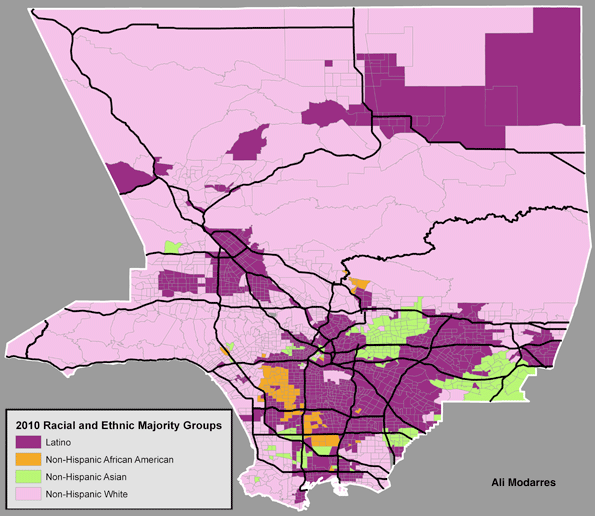
    As Figure 1 illustrates, the geography of race and ethnicity has changed little over the course of the last few decades. Latinos have retained or expanded their majority status in a significant number of neighborhoods. Asian and Asian-American neighborhoods are highly concentrated in an area known as the San Gabriel Valley, while the non-Hispanic white population continues to dominate in areas outside the central city, with the exception of a few tracts in and around the Figueroa corridor (in downtown LA) connected with recent downtown development. Non-Hispanic African Americans have lost their majority status in some South LA neighborhoods where Latinos have come to outnumber them.


    Immigration

    California’s declining immigration can be attributed to a tarnished economic image of the state and its anti-immigrant sociopolitical environment.  This might seem puzzling to many residents of Los Angeles, who live a very immigrant-rich environment.

    First, are immigrants still coming to Los Angeles at the same rate as before)?  

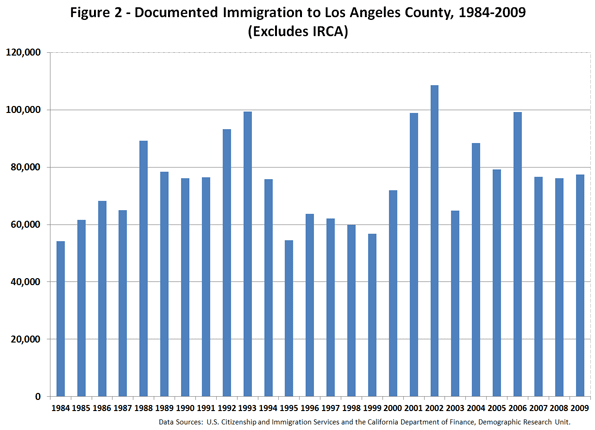
    Figure 2 helps provide the answer to this question, by illustrating the annual immigration patterns to the county. The 2007–2009 period has seen less annual immigration, but the nearly 80,000 immigrants per year is as many or more than those from 1994 to 2000. Comparing the period of 1990–1999 with 2000–2009 illustrates that, during the last ten years, a larger number of immigrants have arrived in the county (718,166 versus 841,325).

    But what seems clear is that if they are arriving in LA, fewer are staying for the long term. This secondary migration can be made visible by comparing the number of immigrants arriving in Los Angeles County with a tabulation of LA’s foreign-born population by year of U.S. entry.

    The 2009 American Community Survey shows that, among the nearly 3.5 million foreign-born residents of the county, 909,692 arrived between 1990 and 1999 and 811,808 between 2000 and 2009 (see Table 2). Comparing these figures with the number of immigrants who arrived in Los Angeles during the same periods from their countries of origin (718,166 in the 1990s and 841,325 in the 2000s) indicates that we attracted more immigrants from the 1990–1999 cohort (a net gain of close to 192,000) and lost members of the 2000–2009 cohort (about 30,000).

    Clearly the county lost its foreign-born population to other regions of the state and the nation. This is somewhat troubling since it reveals that the allure of the region may be waning among the working-age immigrant population. In fact, as Table 2 portrays, Los Angeles has gradually become home to an old-stock immigrant population, where the foreign-born population hails from earlier eras (i.e., the 1980s and the 1990s).

    Does this mean that the foreign-born population is also getting older? The answer to this question is complicated. Based on 2009 American Community Survey (ACS) data, the average age of the foreign-born population in the country is slightly over 44, with 70% of the population falling between the ages of 27 and 62. This suggests that the immigrant population is a bit older than commonly expected.   Also, with fewer than 6% of the foreign-born population being younger than age 18, it is clear that the number of children arriving is significantly less than often assumed.   

    Therefore, it may be crucial to ask a pointed question. Does Los Angeles have the appropriate economic infrastructure to attract new immigrant while keeping more of our working age immigrants?  Considering the economic circumstance of the recent immigrants, the cost of living in Los Angeles, and the current economic and job environment, it should not come as a shock that many are leaving Los Angeles. After all, this is exactly what the native-born population has done throughout the history of the United States: leaving harsh economic conditions for better opportunities in other cities and states.

    Native born

    What about the native born population? 

    Surprisingly, with an average age of slightly over 30 years, the native-born population is younger than its foreign-born counterpart. This becomes clear as we compare the age structure of both groups. Among the working-age population, the foreign-born outnumber the native-born. However, among young and old residents, the native-born population is a larger group. Before jumping to any particular conclusion, we should be reminded that the native-born population includes a large number of individuals whose parents are immigrants. This means that the younger population is multi-racial and multi-ethnic in character. To illustrate this, I provide a detailed analysis of the native-born population in the following paragraphs.

    As Table 3 illustrates, among those 0–19 years old (the first two columns), Latinos outnumber other racial and ethnic groups. This is more pronounced among those 0–9 years old. However, in every age category older than 19, the non-Hispanic white population outnumbers others. Interestingly, it is only among the age 60+ residents that non-Hispanic African Americans outnumber Latinos (124,587 versus 119,676). This information, combined with what appears on Figure 3, suggests our foreign-born population is aging and new immigrants are not arriving fast enough to keep their average age low. But at the same time their children (particularly among Latinos) are clearly a significant portion of the younger and the working-age population. This illustrates that our economy and social structure operate largely based on the dividends from past decades of high immigration. Without a renewed immigration pattern that expands the working-age population, our economic prospects are somewhat dubious.  

    LA’s Demographic Future

    Table 4 provides a brief glimpse to our demographic future. Here we have the average age for the native-born population by race and ethnicity. With an average age of 20.6, native-born Latinos are younger than the non-Hispanic native- born population (at an average of 37.4). In fact, a significant majority of native-born Latinos are under age 40. This is in stark contrast to foreign-born Latinos who are, on an average, in their early 40s. Compared with an average age of 20.6 among native-born Latinos, the age gap between the two groups becomes clear, further highlighting the decline of younger Latino immigrants in Los Angeles.  

    Clearly the demographic path of Los Angeles County has been altered. We are becoming older and more native born. Blaming immigrants, the easy game of the last two decades, can no longer explain our social and economic ills. We need to embrace who we are and what our economy, politics, and collective decision making have brought to our doorsteps. It may be difficult to accept that we are getting older, but our region is losing young people as well. Table 5 contains the last bit of information we need to understand about how we became a region with a graying population.

    Between 2000 and 2010, we lost residents in five age categories: 0–4, 5–9, 10–14, 25–34, and 35–44. This suggests that – as we have seen in other high-cost urban regions – young families are leaving! Among the working-age population, we were able to hang on to those 15–24 and age 45 and older. These individuals are from older families whose young adults (15–24) may or may not choose to stay in the region. With declining immigration and departing younger families, the Los Angeles region is on its way to becoming a much grayer place.

    A Brief Note on Policy Options

    To be sure, there is nothing wrong with aging. It happens to the best of us. However, one needs to plan for it. Los Angeles County can develop policies that benefit a working-age population and its pending retirement needs (or rethink why it has lost its luster to immigrants and the native-born population.

    Unless conditions change, the ambitious children of immigrants will surely behave like other native-born citizens and look to regions where economic prosperity is most likely. High cost of housing, a less than satisfactory educational system, inadequate health services, and an inefficient transportation system might drive the second generation young families to other region.   

    The solution to the growing loss of our productive population does not lie in building more condos and subsidizing iconic places, such as downtown LA.   We need more jobs a burgeoning economy to keep productive people here. This needs to be tied to the integration of immigrants and their children.  Immigrants are not different from those who were born here. They also want the best quality of life they can get: for themselves and their children. If Los Angeles cannot provide that, perhaps other cities and regions can.

    Table 1 – Racial and Ethnic Structure of Los Angeles County, 2000-2010
    Population by Race and Ethnicity 2000 2010 Change 2000-2010 % Changes 2000-2010
      Population Percent Population Percent
    Total 9,519,338 100.0 9,818,605 100.0 299,267 3.1
    Not Hispanic or Latino 5,275,851 55.4 5,130,716 52.3 -145,135 -2.8
    Not Hispanic or Latino; White alone 2,946,145 30.9 2,728,321 27.8 -217,824 -7.4
    Not Hispanic or Latino; Black or African American alone 891,194 9.4 815,086 8.3 -76,108 -8.5
    Not Hispanic or Latino; American Indian and Alaska Native alone 26,141 0.3 18,886 0.2 -7,255 -27.8
    Not Hispanic or Latino; Asian alone 1,123,964 11.8 1,325,671 13.5 201,707 17.9
    Not Hispanic or Latino; Native Hawaiian and Other Pacific Islander alone 24,376 0.3 22,464 0.2 -1,912 -7.8
    Not Hispanic or Latino; Some other race alone 18,859 0.2 25,367 0.3 6,508 34.5
    Not Hispanic or Latino; Two or more races 245,172 2.6 194,921 2.0 -50,251 -20.5
    Hispanic or Latino 4,243,487 44.6 4,687,889 47.7 444,402 10.5
    Hispanic or Latino; White alone 1,676,614 17.6 2,208,178 22.5 531,564 31.7
    Hispanic or Latino; Black or African American alone 25,713 0.3 41,788 0.4 16,075 62.5
    Hispanic or Latino; American Indian and Alaska Native alone 42,330 0.4 53,942 0.5 11,612 27.4
    Hispanic or Latino; Asian alone 10,299 0.1 21,194 0.2 10,895 105.8
    Hispanic or Latino; Native Hawaiian and Other Pacific Islander alone 2,845 0.0 3,630 0.0 785 27.6
    Hispanic or Latino; Some other race alone 2,244,066 23.6 2,115,265 21.5 -128,801 -5.7
    Hispanic or Latino; Two or more races 241,620 2.5 243,792 2.5 2,172 0.9
    Source: U.S. Census Bureau, 2000 and 2010


    Table 2 – Foreign Born Population in Los Angeles County by Decade of Entry in the U.S.
    Decade of entry Population Percent
    Before 1950 24,568 0.7
    1950-1959 67,127 1.9
    1960-1969 182,618 5.2
    1970-1979 569,689 16.3
    1980-1989 934,034 26.7
    1990-1999 909,692 26.0
    2000-2009 811,808 23.2
    Total 3,499,536 100
    Source: U.S. Census Bureau, American Community Survey, 2009 
    Note: Selected Data is from PUMAs 4500 to 6126


    Table 3 – Race and Ethnicity among Native Born Population, by Age – Los Angeles County
    Race and Ethnicity 0 – 9 10-19 20-29
    Non-Hispanic Latino Non-Hispanic Latino Non-Hispanic Latino
    White alone 235,638 433,253 245,522 374,450 299,123 233,629
    African Americans 97,213 4,494 115,954 3,908 116,017 4,569
    Native Americans 2,010 5,093 1,930 5,102 4,179 3,720
    Asian 106,150 2,007 98,866 2,413 76,293 2,094
    Pacific Islander 2,806 150 4,262 479 3,141 155
    Other 3,989 360,581 4,908 317,786 2,830 203,948
    Two ore more  races 44,079 33,447 31,733 30,319 28,443 19,189
    Total 491,885 839,025 503,175 734,457 530,026 467,304
    Race and Ethnicity 30-39 40-49 50-59
    Non-Hispanic Latino Non-Hispanic Latino Non-Hispanic Latino
    White alone 293,983 138,832 348,042 90,154 346,481 57,596
    African Americans 97,312 2,297 116,845 1,065 99,881 816
    Native Americans 2,180 2,557 2,371 1,872 4,205 2,249
    Asian 39,582 1,992 22,476 772 20,151 515
    Pacific Islander 3,740 354 2,149 157 1,556 57
    Other 2,182 103,856 958 53,540 742 36,311
    Two ore more  races 20,435 11,770 13,319 7,022 10,131 4,695
    Total 459,414 261,658 506,160 154,582 483,147 102,239
    Race and Ethnicity 60+ Total Total
    Non-Hispanic Latino Non-Hispanic Latino  
    White alone 522,510 80,945 2,291,299 1,408,859 1,821,615
    African Americans 124,587 1,011 767,809 18,160 342,155
    Native Americans 1,883 1,483 18,758 22,076 22,034
    Asian 32,665 845 396,183 10,638 287,823
    Pacific Islander 2,395 147 20,049 1,499 10,993
    Other 1,029 30,085 16,638 1,106,107 894,042
    Two ore more  races 10,254 5,160 158,394 111,602 187,210
    Total 695,323 119,676 3,669,130 2,678,941 3,565,872
    Source: U.S. Census Bureau, ACS 2009


    Table 4 – Average Age by Race and Ethnicity, Los Angeles County
    Race Latino Non-Hispanic All
    Average Age Population Std. Deviation Average Age Population Std. Deviation Average Age Population Std. Deviation
    White 21.7 1,408,859 18.9 41.2 2,291,299 23.0 33.7 3,700,158 23.5
    African American 23.2 18,160 18.0 36.2 767,809 22.1 35.9 785,969 22.1
    Native American 26.6 22,076 20.0 36.3 18,758 20.1 31.1 40,834 20.6
    Asian 26.9 10,638 19.0 24.2 396,183 20.8 24.2 406,821 20.8
    Pacific Islander 28.5 1,499 18.7 31.2 20,049 19.8 31.0 21,548 19.7
    Other 19.0 1,106,107 16.0 23.5 16,638 18.3 19.1 1,122,745 16.1
    Two or more races 21.2 111,602 17.7 24.7 158,394 19.7 23.2 269,996 19.0
    All 20.6 2,678,941 17.8 37.4 3,669,130 23.2 30.3 6,348,071 22.6
    Source: U.S. Census Bureau, ACS 2009


    Table 5 – Age Composition and Changes from 2000 to 2010, Los Angeles County
    Age 2000 2010 Change % Change
    Under 5 years 737,631 645,793 -91,838 -12.5
    5 to 9 years 802,047 633,690 -168,357 -21.0
    10 to 14 years 723,652 678,845 -44,807 -6.2
    15 to 19 years 683,466 753,630 70,164 10.3
    20 to 24 years 701,837 752,788 50,951 7.3
    25 to 34 years 1,581,722 1,475,731 -105,991 -6.7
    35 to 44 years 1,517,478 1,430,326 -87,152 -5.7
    45 to 54 years 1,148,612 1,368,947 220,335 19.2
    55 to 59 years 389,457 560,920 171,463 44.0
    60 to 64 years 306,763 452,236 145,473 47.4
    65 to 74 years 492,833 568,470 75,637 15.3
    75 to 84 years 324,693 345,603 20,910 6.4
    85 years and over 109,147 151,626 42,479 38.9
    Total 9,519,338 9,818,605 299,267 3.1
    Source: U.S. Census Bureau, 2000 and 2010


    Ali Modarres is an urban geographer at California State University, Los Angeles. This report is based on a longer article appearing in the 2011 edition of the journal of California Politics and Policy.

    Photo by Bigstockphoto.com

  • The Best Cities For Technology Jobs

    During tough economic times, technology is often seen as the one bright spot. In the U.S. this past year technology jobs outpaced the overall rate of new employment nearly four times. But if you’re looking for a tech job, you may want to consider searching outside of Silicon Valley. Though the Valley may still be the big enchilada in terms of venture capital and innovation, it hasn’t consistently generated new tech employment.

    Take, for example, Seattle. Out of the 51 largest metro areas in the U.S., the Valley’s longtime tech rival has emerged as our No. 1 region for high-tech growth, based on long- and short-term job numbers. Built on a base of such tech powerhouses as Microsoft, Amazon and Boeing, Seattle has enjoyed the steadiest and most sustained tech growth over the past decade. It is followed by Baltimore (No. 2), Columbus, Ohio (No. 3), Raleigh, N.C. (No. 4) and Salt Lake City, Utah (No. 5).

    To determine the best cities for high-tech jobs, we looked at the latest high-tech employment data collected by EMSI, an economic modeling firm. The Praxis Strategy Group‘s Mark Schill charted those areas that have gained the most high-tech manufacturing, software and services jobs over the past 10 years, equally weighting the last five years and the last two. We also included measures of concentration of tech employment in order to make sure we were not giving too much credence to relatively insignificant tech regions. Our definition of high tech industries is based on the one used by TechAmerica, the industry’s largest trade association.

    Despite the Valley’s remarkable concentration of tech jobs — roughly six times the national average — it ranked a modest No. 17 in our survey. This relatively low ranking reflects the little known fact that, even with the recent last dot-com craze sparking over 5% growth over the past two years, the Valley remains the “biggest loser” among the nation’s tech regions, surrendering roughly one quarter of its high -tech jobs — about 80,000 — in the past decade. Only New York City (No. 44) lost more tech jobs during that time.

    In contrast to this pattern of volatility, our top performers have managed to gain jobs steadily in the past decade — and have continued to add new ones in the last two years. In addition to our top five, the only other regions to claim overall tech gains in the last 10 years are Jacksonville, Fla. (No. 6), Washington, D.C. (No. 7), San Bernardino-Riverside, Calif. (No. 9), San Diego, Calif. (No. 9), Indianapolis (No. 11) and Orlando, Fla. (No. 24).

    So what accounts for high-tech success, and where will jobs most likely grow in the next decade? Certainly being home to a major research university makes a big difference. Seattle, Columbus, Raleigh and Salt Lake City all boast major educational and research assets.

    But it’s one thing to produce scientists and engineers; it’s another to generate employment for them over the long term. Clearly for the San Jose metropolitan region (which is home to Stanford) and the much-hyped No. 29 San Francisco area (home to the University of California Medical Center) academic excellence has not translated into steady growth in tech jobs. Over the past decade the Bay Area has given up 40,000 jobs, or 19% of its tech workforce, including a loss of nearly 6,000 in software publishing.

    Or look at the Boston region (ranked No. 22), which arguably boasts the most impressive concentration of research universities in the country. The region did add jobs in research and computer programming, but these were not enough to counter huge losses in telecommunications and electronic component manufacturing. Over the past decade, greater Beantown has given up 18% of its tech jobs, or more than 45,000 positions.

    One possible explanation may lie in costs, including very high housing prices, onerous taxes and a draconian regulatory environment. In tech, company headquarters may remain in the Valley, close to other headquarters and venture firms, but new jobs are often sent either out of the country or to more business friendly regions.

    Just look at the flow of jobs from Bay Area-based companies to places like the Salt Lake area. In the past two years Valley companies such as Twitter, Adobe, eBay, Electronic Arts and Oracle have all expanded into Utah. This region has many appealing assets for Bay Area companies and workers. Salt Lake City is easily accessible by air from California, possesses a well- educated workforce, has reasonable housing costs and offers world-class skiing and other outdoor activities.

    Another huge advantage appears to be closeness to the federal government, which expends hundreds of billions on tech products both hardware and software. This explains why Baltimore, primarily its suburbs, and the D.C. metro area have enjoyed steady tech growth and, under most foreseeable scenarios, likely will continue to do so in the coming years. Both regions have seen large gains in technology services industries, particularly programming, systems design, research, and engineering.

    Yet even business climate, while important, may not be enough to drive tech job growth. Texas ranks highly in most business surveys, including our own, but it did not fare so well in this one. Indeed No. 32 Austin, often thought as the most likely candidate for the next Silicon Valley, lost over 19% of its high-tech jobs over the past decade, including more than 17,000 jobs in semiconductor, computer and circuit board manufacturing. No. 18 Houston did far better, although it has also lost 6% of its tech jobs over the same period due to the cutbacks in the engineering service, a big sector there. Even more shocking: No. 46 Dallas, generally a job-creating dynamo, has seen roughly a quarter of its high-tech jobs go away, due primarily to losses in telecommunications carriers and in manufacturing of communications equipment and electronics.

    How about other potential up and comers for the coming decade? Two potentially big and somewhat surprising winners. The first: Detroit. Though the Motor City area lost 20% of its tech jobs in the past decade (ranking 40th on our list), it still boasts one of the nation’s largest concentrations of tech workers, nearly 50% above the national average. In the past two years, the region has experienced a solid 7.7% increase in technology jobs, the second highest rate of any metro area.

    The Motor City region seems to have some real high-tech mojo. According to the website Dice.com, Detroit has led the nation with the fastest growth in technology job offerings since February — at 101%. This can be traced to the rejuvenated auto industry, which is increasingly dependent on high-tech skills. Manufacturing is increasingly prodigious driver of tech jobs; games and dot-coms are not the only path to technical employment growth. This could mean good news for other Rust Belt cities, such as No. 28 Cincinatti or No. 38 Cleveland, as well as our Midwest standout, Columbus, which could benefit from growth sparked by the local natural gas boom.

    Another potential standout is No. 8 New Orleans, whose tech base remains relatively small but has expanded its tech workforce nearly 10% since 2009 — the highest rate of any of the regions studied. With low costs, a friendly business climate and world-class urban amenities, the Crescent City could emerge as a real player, aided by the growing prominence of research and development around Tulane University. There has also been a recent growing presence of the video game industry in the city.

    Looking forward, however, it makes sense to be cautious about where tech is heading. By its nature, this is a protean industry; the mix of jobs and favored locales tend to change. If the current boom in social media continues, for example, the Bay Area could recover more of its lost jobs and further extend its primacy. Similarly a surge in manufacturing and energy-related technology could be a boon to tech in Houston, Dallas as well as New Orleans. But based on both historic and recent trends, the surest best for future growth still stands with our top five winners, led by the rain-drenched, but prospering Seattle region.

    Best Places for High Tech Growth
    Ranking of 2, 5, and 10 year growth, industry concentration, and 5 and 10 year growth momentum
    Rank Metropolitan Area Rank Score
    1 Seattle  82.2
    2 Baltimore 75.7
    3 Columbus 67.9
    4 Raleigh 63.2
    5 Salt Lake City 60.0
    6 Jacksonville 59.2
    7 Washington, DC 58.9
    8 New Orleans 58.8
    9 Riverside-San Bernardino 58.2
    10 San Diego 56.1
    11 Indianapolis 55.9
    12 Buffalo 55.8
    13 San Antonio 54.0
    14 Charlotte 53.5
    15 St. Louis 51.6
    16 Pittsburgh 50.8
    17 San Jose 50.5
    18 Houston 50.2
    19 Hartford 50.0
    20 Nashville 49.6
    21 Providence 49.2
    22 Boston 48.3
    23 Minneapolis-St. Paul 48.3
    24 Orlando 48.1
    25 Portland 48.1
    26 Philadelphia 47.4
    27 Louisville 47.2
    28 Cincinnati 46.6
    29 San Francisco 46.6
    30 Denver 46.4
    31 Richmond 45.6
    32 Austin 45.1
    33 Atlanta 44.6
    34 Virginia Beach-Norfolk-Newport News 42.4
    35 Memphis 42.2
    36 Milwaukee 41.5
    37 Rochester 41.2
    38 Cleveland 40.9
    39 Phoenix 38.5
    40 Detroit 37.7
    41 Tampa 37.5
    42 Miami 33.2
    43 Sacramento 32.1
    44 New York 31.4
    45 Las Vegas 31.2
    46 Dallas-Fort Worth 31.0
    47 Chicago 30.2
    48 Los Angeles 29.5
    49 Oklahoma City 26.7
    50 Birmingham 23.5
    51 Kansas City 21.6
    Rankings measure employment in 45 high technology manufacturing, services, and software industry sectors.

    This piece first appeared at Forbes.com.

    Joel Kotkin is executive editor of NewGeography.com and is a distinguished presidential fellow in urban futures at Chapman University, and an adjunct fellow of the Legatum Institute in London. He is author of The City: A Global History. His newest book is The Next Hundred Million: America in 2050, released in February, 2010.

    Mark Schill of Praxis Strategy Group perfomed the economic analysis for this piece.

    Seattle photo courtesy of BigStockPhoto.com.

  • California’s Jobs Engine Broke Down Well Before the Financial Crisis

    Everybody knows that California’s economy has struggled mightily since the 2008 financial crisis and subsequent recession. The state’s current unemployment rate, 12.1 percent, is a full 3 percentage points above the national rate. Liberal pundits and politicians tend to blame this dismal performance entirely on the Great Recession; as Jerry Brown put it while campaigning (successfully) for governor last year, “I’ve seen recessions. They come, they go. California always comes back.”

    But a study commissioned by City Journal using the National Establishment Time Series database, which has tracked job creation and migration from 1992 through 2008 (so far) in a way that government statistics can’t, reveals the disturbing truth. California’s economy during the second half of that period—2000 through 2008—was far less vibrant and diverse than it had been during the first. Well before the crisis struck, then, the Golden State was setting itself up for a big fall.

    One of the starkest signs of California’s malaise during the first decade of the twenty-first century was its changing job dynamics. Even before the downturn, California had stopped attracting new business investment, whether from within the state or from without.

    Economists usually see business start-ups as the most important long-term source of job growth, and California has long had a reputation for nurturing new companies—most famously, in Silicon Valley. As Chart 1 shows, however, this dynamism utterly vanished in the 2000s. From 1992 to 2000, California saw a net gain of 776,500 jobs from start-ups and closures; that is, the state added that many more jobs from start-ups than it lost to closures. But during the first eight years of the new millennium, California had a net loss of 262,200 jobs from start-ups and closures. The difference between the two periods is an astounding 1 million net jobs.

    Between 2000 and 2008, California also suffered net job losses of 79,600 to the migration of businesses among states—worse than the net 73,800 jobs that it lost from 1992 through 2000. The leading destination was Texas, with Oregon and North Carolina running second and third (see Chart 2). California managed to add jobs only through the expansion of existing businesses, and even that was at a considerably lower rate than before.

    Graph by Alberto Mena

    Graph by Alberto Mena

    Another dark sign, largely unnoticed at the time: California’s major cities became invalids in the 2000s. Los Angeles and the San Francisco Bay Area had been the engines of California’s economic growth for at least a century. Since World War II, the L.A. metropolitan area, which includes Orange County, has added more people than all but two states (apart from California): Florida and Texas. The Bay Area, which includes the San Francisco and the San Jose metro areas, has been the core of American job growth in information technology and financial services, with San Jose’s Silicon Valley serving as the world’s incubator of information-age technology. During the 1992–2000 period, the L.A. and San Francisco Bay areas added more than 1.1 million new jobs—about half the entire state total. But between 2000 and 2008, as Chart 3 indicates, California’s two big metro areas produced fewer than 70,000 new jobs—a nearly 95 percent drop and a mere 6 percent of job creation in the state. This was a collapse of historic proportions.

    Graph by Alberto Mena

    Not only did California in the 2000s suffer anemic job growth; the new jobs paid substantially less than before. Chart 4 reveals the sad reversal. From 2000 to 2008, California had a net job loss of more than 270,000 in industries with an average wage higher than the private-sector state average. That marked a turnaround of nearly 1.2 million net jobs from the 1992–2000 period, when 908,900 net jobs were created in above-average-wage industries. Further, during the earlier period, more than 707,000 net jobs were created in the very highest-wage industries—those paying over 150 percent of the private-sector average.

    Chart 5, which indicates job growth or decline in selected industries, again suggests that a lopsided amount of California’s economic growth in the 2000s was in below-average-wage fields. It included nearly 590,000 net jobs in “administration and support”—clerical and janitorial jobs, for example, as well as positions in temporary-help services, travel agencies, telemarketing and telephone call centers, and so on. The largest losses in the state during the 2000s were in manufacturing, which traditionally provided above-average wages. After adding a net 64,900 manufacturing jobs from 1992 to 2000, California hemorrhaged a net 403,800 from 2000 to 2008. But information jobs also went into negative territory, while professional, scientific, and technical-services employment experienced far lower growth than in the previous decade.

    The chart also shows that California’s growth in the 2000s, such as it was, took place disproportionately in sectors that rode the housing bubble. In fact, 35 percent of the net new jobs in the state were created in construction and real estate. All those jobs have vaporized since 2008, according to Bureau of Labor Statistics data. They are unlikely to come back any time soon.

    These are troubling numbers. Fewer jobs and lower wages do not a robust economy make. A continuation of this trend, even if California’s recession-battered condition improves, would result in a far more unequal economy, shrunken tax revenues, and a likely increase in state public assistance—all at a time when officials are struggling with massive deficits.

    Graph by Alberto Mena

    Graph by Alberto Mena

    A final indicator of California’s growing economic weakness during the 2000–2008 period is that the average size of firms headquartered in the state shrank dramatically. As Chart 6 shows, California had a huge increase over the 1992–2000 period in the number of jobs added by companies employing just a single person or between two and nine people, even as larger firms cut hundreds of thousands of jobs. Many of the single-employee companies may simply be struggling consultancies: if they were doing better, they’d likely have to start hiring at least a few people. While start-ups are indeed crucial to economic growth, small companies are especially vulnerable to economic downturns and often feel the brunt of taxes and regulations more acutely than larger firms do. The awful job numbers for the bigger companies—including a net loss of nearly 450,000 positions for firms with 500 or more employees—suggest the toxicity of California’s business climate. After all, bigger firms have the resources to settle and expand in other locales; in the 2000s, they clearly wanted nothing to do with the Golden State.

    Graph by Alberto Mena

    What is behind California’s shocking decline—its snuffed-out start-ups, unproductive big cities, poorer jobs, and tinier, weaker, or fleeing companies—during the 2000–2008 period? Steven Malanga’s “Cali to Business: Get Out!” identifies the major villains: suffocating regulations, inflated business taxes and fees, a lawsuit-friendly legal environment, and a political class uninterested in business concerns, if not downright hostile to them. One could add to this list the state’s extraordinarily high cost of living, with housing prices particularly onerous, having skyrocketed in the major metropolitan areas before the downturn—thanks, the research suggests, to overzealous land-use regulation.

    One thing is for sure: California will never regain its previous prosperity if it leaves these problems unaddressed. Its profound economic woes aren’t just the result of the Great Recession.

    This piece originally appeared in City Journal. City Journal thanks the Hertog/Simon Fund for Policy Analysis for its generous support of this issue’s California jobs package.

    Wendell Cox is a Visiting Professor, Conservatoire National des Arts et Metiers, Paris and the author of “War on the Dream: How Anti-Sprawl Policy Threatens the Quality of Life

    Photo by Altus via Flickr