Tag: Los Angeles

  • If California Is Doing So Great, Why Are So Many Leaving?

    Superficially at least, California’s problems are well known. Are they well understood? Apparently not.

    About a year ago Time ran an article, “Why California is Still America’s future,” touting California’s future, a future that includes gold-rush-like prosperity in an environmentally pure little piece of heaven, brought to us by “public-sector foresight.”

    More recently, Brett Arends’ piece at Market Watch, “The Truth About California,” is more of the same. California’s governor elect, Jerry Brown, liked this piece so much that he tweeted a link to it.

    The optimist’s argument about California’s future ultimately hinges on the creativity of the state’s vaunted tech sector, in large part driven by regulation promulgated by an enlightened political class and funded by a powerful venture capital sector.

    No fundamentalist evangelical speaks with more conviction or faith than a California cheerleader expounding on the economic benefits of environmental purity brought about by command and control regulation.

    The more honest cheerleaders acknowledge that California has challenges, including persistent budget problems. Arends denies even the existence of a budget problem, demanding “Er, no, actually. It’s your assertion. You do the math.” Let me help you, Brett. The non-partisan California Legislative Analyst’s Office has done the math. You can find it here. They expect budget shortfalls in excess of $20 billion a year throughout their forecast horizon. This is on annual revenues of less than $100 billion.

    Last week the numbers got even worse, as the Governor-elect, Jerry Brown, acknowledged. The deficit may now be as much as $28 billion this year, and over $20 billion for the foreseeable future. This is more than a nuisance. There’s a reason, after all, why California has among the worst credit ratings of any state.

    Most people outside of California haven’t drank from this vat of the economic equivalent of LSD-laced Kool-Aid. People know that a state is in trouble when it has persistent intractable budget deficits, chronic domestic net out-migration, and 30 percent higher unemployment than the national average. Indeed, California’s joblessness, chronic budget deficits, governors, and credit rating have made the state the butt of jokes worldwide.

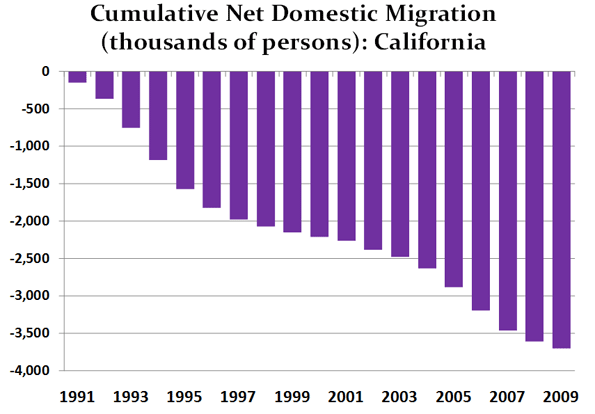
    How bad are things in California? California’s domestic migration has been negative every year since at least 1990. In fact, since 1990, according to the U.S. Census, 3,642,490 people, net, have left California. If they were in one city, it would be the third largest city in America, with a population 800,000 more than Chicago and within 200,000 of Los Angeles’ population.

    We’re seeing a reversal of the depression-era migration from the Dust Bowl to California. While California has seen 3.6 million people leave, Texas has received over 1.4 million domestic migrants. Even Oklahoma and Arkansas have had net-positive domestic migration trends from California.
    Those ultimate canaries in the coal mine, illegal immigrants, recognize California’s problems. Twenty years ago, about half of all United States illegal immigrants went to California. Today, that’s down to about one in four.

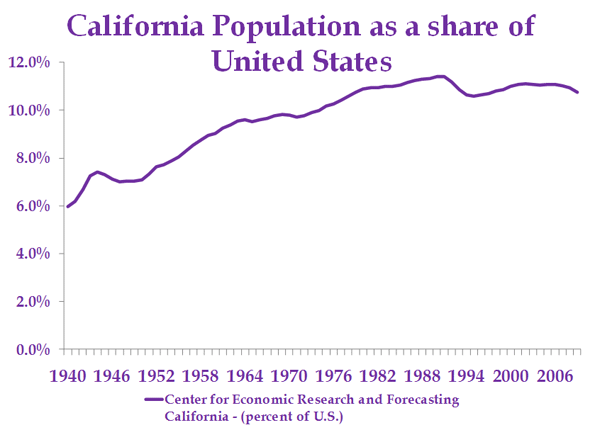
    The result of these migration trends is that California’s share of the United States population has been declining.
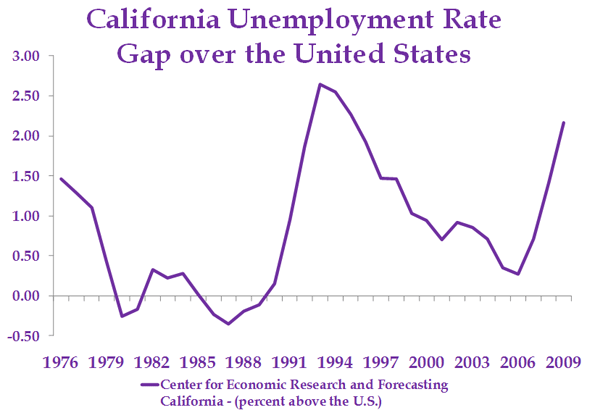
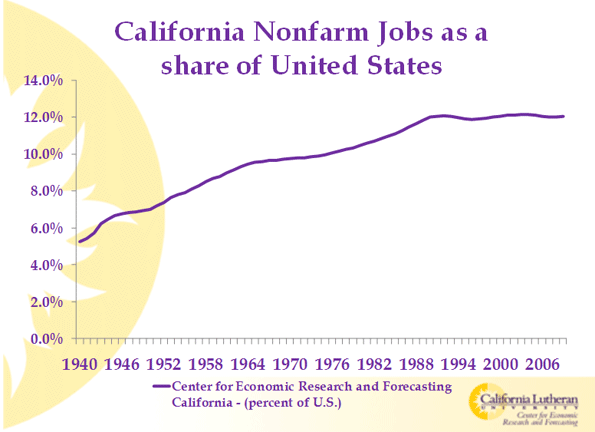
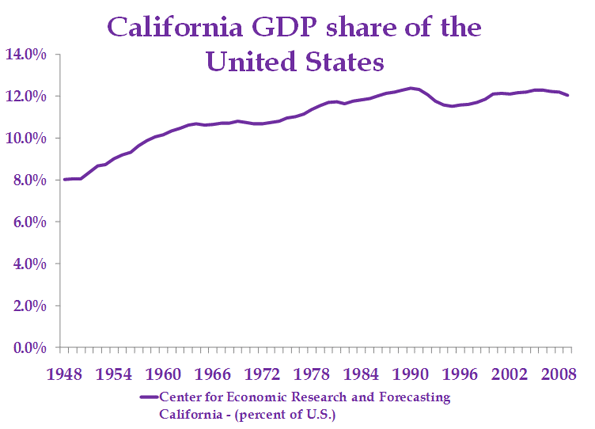
    What do these migrants see that so many of California’s political class do not see? They see a lack of opportunity. California’s share of United States jobs and output has declined since 1990, and its unemployment rate has remained persistently above the United States Average, only approaching the average during the housing boom.
    California’s unemployment is particularly troubling. As of October 2010, only two states, Nevada at 14.2 percent and Michigan at 12.8 percent, had higher unemployment rates than California’s 12.4 percent. California’s unemployment problem is particularly severe in its more rural counties. Twenty-five of California’s 58 counties have unemployment rates higher than Nevada’s:
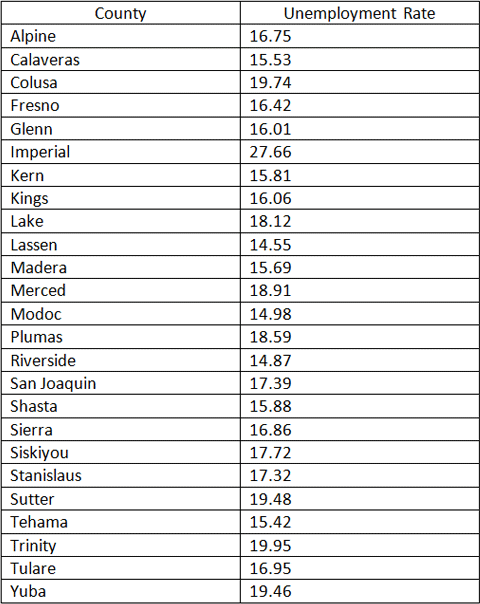


    These unemployment rates approach depression levels. Some will excuse many of them because they are in agricultural areas, but many assert that low Midwest unemployment rates are due to a booming agricultural sector. Which one is it?

    California’s unemployment problems are not limited to rural and agricultural areas. Most of Riverside County’s population is very urban, yet the County’s unemployment rate is 14.87 percent. On December 7th, the Wall Street Journal listed the unemployment rates for 49 of America’s largest urban regions. California had six of the 19 metro areas with double-digit unemployment. These include such major cities San Diego, San Jose, and Los Angeles.

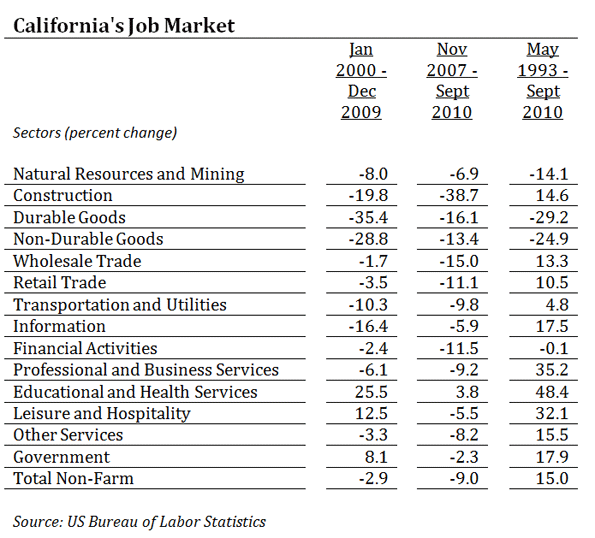
    Just as rural areas are not California’s only depressed areas, agriculture is not California’s only ailing sector. From 2000 to 2009, the only California sectors to gain jobs were government, education and health services, and leisure and hospitality.
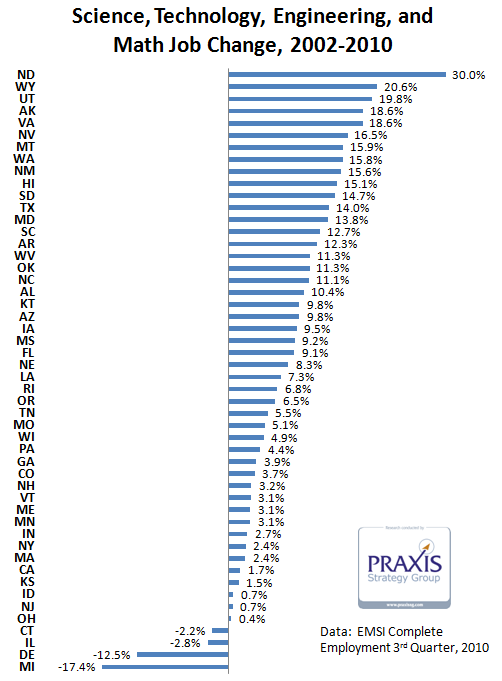
    California’s cheerleaders claim that the state’s future is assured by a vibrant tech sector, but the data do not support that assertion. North Dakota’s Praxis Strategy Group has performed analysis by job skills. They compare Scientific, Technical, Engineering, and Math (STEM) jobs across states. Their analysis shows that California is the Nation’s ninth worst state in creating STEM jobs in post dot-com-bust years. It has produced far fewer new tech jobs than Texas, and far less on average, than the country over the past decade:


    In this respect, California’s precipitous decline is really quite shocking. In just a couple of decades, California has gone from being America’s economic star, a destination for ambitious people from around the world and abundant with opportunity, to home of some of America’s most distressed communities. It has been a man-made, slow motion tragedy perpetuated by a political class that is largely deluded.

    The cheerleader’s faith in command and control regulation and environmental purity is so strong they cannot see anything that contradicts that faith.

    But that faith is misplaced. Joel Kotkin, Zina Klapper, and I performed an extensive review of the economic impacts of one of California’s most important greenhouse gas regulation, AB 32, and found that command and control regulation in general and AB 32 in particular is inefficient, cost jobs, and depress economic activity. California’s Legislative Analyst’s Office agrees, as evidenced by this report.

    More depressing still are the growing ranks of what could be called “the resigned”. They simply have given up. These include a business leadership that is more interested in survival and accommodation than pushing an agenda for growth. Easier to get along here, and expand jobs and opportunities elsewhere, whether in other states or overseas.

    Yet ultimately California’s future is what Californians make of it. No place on Earth has more natural amenities or a more benevolent climate. No place has a location more amenable to prosperity, located between thriving Pacific Rim economies and the entire North American market. No place has more economic potential.

    But unless policy is changed, California’s future is dismal, with the specter of stubbornly high unemployment, limited opportunity, and the continued exodus of the middle class. California’s political class needs first to confront reality before we can hope to avoid a dismal future.

    Bill Watkins is a professor at California Lutheran University and runs the Center for Economic Research and Forecasting, which can be found at clucerf.org.

    Photo by Stuck in Customs

  • Building the Train to Nowhere

    The California High Speed Rail Authority has approved building its first 54 miles in the San Joaquin Valley. A somewhat longer route, 65 miles, has been indicated in a number of press reports, but Authority documents indicate that only 54 miles of high speed rail track will be built. The route would start in Corcoran, and go through Fresno to Borden, a small, unincorporated community south of Madera. All of this would cost $4.15 billion. The route would include two stations, in Fresno and Hanford/Visalia.

    The segment was adopted under pressure by the United States Department of Transportation, which was interested in ensuring that the line would be usable (have “independent utility”) by Amtrak should the high speed rail project be cancelled due to lack of funds. The first section of the California high speed rail line would instead be a somewhat incongruously high-tech Corcoran to Borden spur, or perhaps more accurately stub to the region’s rather sparse conventional rail services.

    There are appear to have been concerns that growing opposition movements in the San Francisco and Los Angeles areas could have delayed construction, which could have put the federal money at risk. The Sacramento Bee’s Dan Walters, perhaps the leading political columnist in the state implied an ulterior motive:

    “You’d have to be terminally naive not to believe that the splashy announcement, made personally by an Obama administration official in Fresno, was to help an embattled local congressman, Democrat Jim Costa, stave off a very stiff Republican challenge.”

    Officials representing communities – many of them with high levels of unemployment – on the segment itself were elated, as any would be at the prospect of a rush of new construction jobs, regardless of what was being built. But, most everywhere else the reaction to the selection largely has been negative. Walters labeled it the “train to nowhere” in a November 29 commentary. State Senator Alan Lowenthal, who chairs the legislative committee overseeing the high speed rail project said that the Authority “could be creating an ‘orphan’ stretch of track, that will never be used by high-speed trains.”

    Richard Tolmach, president of the California Rail Foundation, an intercity rail advocacy organization, told Authority members ” It’s a crazy idea. He went on to say that “You guys are gonna be a laughingstock in Congress.”

    Already, problems are building in the now more decidedly more conservative Congress. California Republican Congressman Jerry Lewis and 27 colleagues have introduced the “American Recovery and Reinvestment Rescission Act,” which would apply unspent stimulus money to the deficit, including $2 billion that has been promised to the California high speed rail line.

    Batteries (and Trains) Not Included: Even after the $4.15 billion has been spent, the Corcoran to Borden rail stub will be incomplete. The Authority’s plan includes only the building of the rail bed and the necessary viaducts. There is no money for trains. There is no money for the electrical infrastructure necessary to power the trains. Trains and electricity infrastructure would add at least 15 percent to the bill, based upon previous California High Speed Rail reports. Thus, when and if completed, the trains and electrification would lift the cost of the Corcoran to Borden high speed rail stub to at least $4.8 billion.

    Bare Bones Stations: The plan calls for building only “basic” stations, with two tracks (one in each direction). That is fine if the line is serving Amtrak and there are only a few trains per day. But the high speed rail plan assumes frequent trains, including some that stop at all stations, some express trains that skip some stations and some express trains running non-stop from the Transbay Terminal in San Francisco to Union Station in Los Angeles. The only place that an express train can pass a slower train is at a station. That means that passing tracks must be built at virtually all stations. The passing tracks (two interior tracks in addition to the two tracks for stopped trains) required in stations are illustrated in this California High Speed Rail illustration (also above).

    The full system, or (perhaps the more likely outcome) a truncated San Jose to Palmdale line (with slower running lines over the commuter rail tracks into San Francisco and Los Angeles), would require passing tracks at the Fresno and Hanford/Visalia stations. Rebuilding these stations would increase the cost above the $4.8 billion, and that’s before the seemingly inevitable cost escalation.

    Indeed, the Corcoran to Borden stub entails a potentially large cost increase compared to previous California High Speed Rail Authority documents. After making all of the necessary adjustments to update the last available segment costs to the cost accounting method (“year of expenditure” dollars), the cost of the Corcoran to Borden stub could be at least 30 percent higher than would have been expected in the present $43 billion San Francisco to Anaheim cost.

    Applied to the entire line, a 30 percent cost escalation could take the price of the San Francisco to Anaheim line to more than $55 billion. Based upon cost ratios released by the Authority in 2008, the later extensions to Sacramento and San Diego would lift the bill to more than staggering $80 billion. Even that does not pay the entire bill, because promises have been made in state legislation for improvements across Altamont pass from Stockton to the East Bay and Oakland.

    Not that coming up with any of this money will be easy, particularly with a more deficit conscious Congress. Congressman John Mica of Florida, who will likely lead the House of Representatives Transportation and Infrastructure Committee has promised a review of all federal high speed rail grants. The Authority expects to obtain funding from local governments in California, a number of which are teetering toward financial insolvency.

    The Authority expects between $10 and $12 billion from private investors. These potential investors will all be aware of the fact that virtually every dollar of private investment in new high-speed rail lines has been lost or required a government bailout. They will not participate without subsidies, which are prohibited by California law. Finally, all these elements of the financing plan will be made even more problematic if the first phase of the project continues to rise from $43 billion to $55 billion.

    Washington analyst C. Kenneth Orski noted that the Corcoran to Borden stub could “become a huge embarrassment for the Administration” and that by its train to nowhere ”casts doubt on the soundness of the entire federal high-speed rail program and its decision-making process.”

    Then, even if California gets to keep the federal money, there are still formidable financial barriers. A likely result is high speed rail in Amtrak mode which probably won’t make much difference to passengers riding the infrequent San Joaquin service. After the Authority action, Bill Bronte, who heads the rail division of the California Department of Transportation said that “The improvements in performance might be less than one would expect.” But that might not bother contractors and consultants who can feast on what might prove to be the most expensive conventional intercity train project in history.

    Wendell Cox is a Visiting Professor, Conservatoire National des Arts et Metiers, Paris and the author of “War on the Dream: How Anti-Sprawl Policy Threatens the Quality of Life

  • Geography of the Election: A New Era of Racial Politics

    Laura Jean Berger worked on the Congressional Campaign of Assemblyman Van Tran. This is her account of the results.

    Energy and free beer flowed through Assemblyman Van Tran’s campaign headquarters, the crowd anxiously building with anticipation each time Fox News reported another House seat for the Republicans. Every major network’s live trucks crowded the parking lot of the converted Blockbuster video store, their cameras trained on a stage set for a victory speech.

    But the crowd would be disappointed tonight. Results had Tran and incumbent Democratic Congresswoman Loretta Sanchez tied early in the evening, but she pulled ahead to a nine-point lead by midnight. And now, almost a week later, the wait is not yet over. While national press has declared Sanchez the winner yet again in central Orange County, California, neither candidate has yet conceded or declared victory.

    So why in California’s 47th district — where most have declared Sanchez the winner–will neither candidate make a declaration? Just ask the Orange County Registrar of Voters: the surprise in the ballot box is that there are still approximately 30,000 votes yet to be tallied, as reported by the Orange County Register. In a race where approximately 66,000 ballots cast have been counted thus far, one third of the vote share remains outstanding.

    The race could go either way at this point because those ballots yet to be counted are record numbers of both vote by mail and provisional ballots. If you’re Loretta Sanchez, you know that provisionals will likely break in your favor due to alleged polling place confusion in heavily Democratic Santa Ana. But if you’re Van Tran, you are hoping that the largest Vietnamese community outside Vietnam all decided to vote absentee this year.

    The Voice of OC asserts that “history has shown that absentee and provisional votes often make big differences in municipal elections involving large numbers of Vietnamese voters.” In this district, it seems that race is playing a substantial role in the election results just as it did during the campaign.

    National media attention descended when Sanchez declared on the Spanish television station Univision that the “Vietnamese and the Republicans” were trying to “take this seat…” and also remarked that Tran was very “anti-immigrant.” Her comments ignited a firestorm because Tran is, in fact, a Vietnamese immigrant himself. Sanchez was accused of bringing racial divisiveness into the campaign and later offered an apology for her comments once prompted.

    While the Vietnamese community in Orange County is certainly cohesive, they are not single-issue voters, as opposed to many Hispanics. OC Weekly columnist Gustavo Arellano stated in an interview with Southern California Public Radio, “All really that matters to the Spanish-language media right now is the question of immigration because that is the biggest question that its readership has…Everything else is secondary.” Since Tran has not defined his views on immigration precisely, he is “largely ignored” by Spanish-language media.

    Vietnamese voters, on the other hand, share the country’s priority on jobs yet also consider how either candidate–Vietnamese or not–would handle policy positions toward Vietnam. Sanchez’s work on House Resolution 334 calling for an end to Vietnam’s political imprisonment of those who supported Saigon and the South greatly helped her relationship with the Vietnamese community, approximately fifteen percent of the district’s residents.

    While that number might not seem like much, it’s important to note that the Vietnamese turn out at much higher percentages than Hispanics. Hao-Nhien Vu, managing editor of the largest Vietnamese newspaper in the US, ascribes civic involvement with the fact that “they went through so much to get here.”

    Yet the racial disparity in Orange County plays into a larger statewide picture. Voters in California supported Proposition 20 on Election Day, which gives the power of redistricting state and federal districts to a citizens’ committee as opposed to state legislators. California’s districts have been compared to “Swiss cheese,” but the district bordering the 47th to the north, the 40th, makes some rather interesting jabs around the edges.

    The Republican (and Vietnamese) stronghold of Garden Grove has been seemingly attacked by a cookie cutter, while one could argue that isolating predominantly Hispanic Anaheim and Santa Ana in the same district lumps too many Democratic votes together. Both parties are to blame for drawing illogical districts to maintain the status quo. But there’s an even greater national issue growing in this Petri dish.

    President Barack Obama’s election was seen by many as an advance in the fight against racial politics in the United States. But in light of Sanchez’s and Tran’s campaigns and supporters, when does cohesiveness cross the line? This district is a prime example of a place where there are more minority residents than whites. Therefore, it’s logical that a minority representative would be easily elected.

    But which minority?

    The answer is different for each voter. Identifying with the electorate has always worked well in politics. Sanchez identifies with the Hispanics while Tran pulls in the Vietnamese. Each has their supporters among Anglos and African-Americans. But even so, the inevitable is that one ethnic group is pitted against the other in a sense, and everyone knows it (and now admits it after Sanchez’ aforementioned Univision comments).

    The good news? The issue of race is now forced onto the table. Now that it’s no longer completely taboo, there’s a hope that different ethnic groups can come together and realize the diverse issues they all face. If this can be done, the voters will undoubtedly select the candidate that can best represent them, and that may not be a candidate with whom they identify based on race.

    However, this can only happen once an interracial dialogue is established. It won’t happen overnight. Members of minority voting blocs will and do integrate into the larger political discussion with time. Only after this is achieved will race become the non-issue that it should be in politics.

    As for California’s 47th Congressional district, the jury is still out for this year. And in 2012, who knows what the Citizens’ Redistricting Committee will change? Hopefully this year is one of the last in which race will play such a deciding role in elections. But that depends on the opening of communication channels between groups. As our country gets more diverse, and complex, we could be witnessing the beginning of a new era of racial politics in America.

    Laura Jean Berger is a senior at Chapman University studying Political Science and Communication Studies. A lifelong resident of Glendale, she is an avid classical pianist and a self-diagnosed political junkie.

    Photo by Neon Tommy

  • The Real OC: Diverse, Dynamic and — Dare I Say — Progressive

    I recently returned to Orange County after a decade’s absence, fully aware that a stereotype of all-white, card-carrying-John Birchers still exists among many who remain unfamiliar with facts on the ground here.

    I never bought that old saw in the first place.

    And now, on a second venture into OC, I’m amazed by how deeply those old stereotypes have been buried under the accumulated accomplishments of everyday folks.

    The truth is that OC can rightfully claim ground as a leader when it comes to all sorts of popular buzzwords that are falsely applied to a lot of so-called cosmopolitan places.

    Start with “diversity,” a sop for all seasons in Los Angeles and other urban centers, where ethnic communities often are treated like so many pawns.

    Then there’s “dynamic,” another adjective that many metropolitan areas seem to think is theirs simply for the taking.

    Dare I add the presumptuous “progressive” to the list of over-used and seldom-earned buzzwords?

    I shall.

    In many ways OC, with its suburban reputation and libertarian leanings, comes closer to living up to the actual meaning of those words compared to many of the so-called cosmopolitan centers that cling to old stereotypes about this place.

    How do I figure?

    Take the campaign between Democratic incumbent Loretta Sanchez and Republican challenger Van Tran for the 47th District seat in the U.S. House of Representatives, an area that includes much of Central County.

    Tran has made Sanchez work hard in her re-election bid, no small feat considering her long incumbency.

    Neither candidate can count on ethnic appeal alone to propel them to the top. Latinos account for about 68% of the population in the district, which helps Sanchez. But voter registration is a different matter. Asians make up a smaller-but-still-significant base for Tran, with about 15% of the district—slightly more than whites. The winner will have to pick up a good chunk of voters outside their respective ethnic bases.

    That makes for a competitive race in a general election.

    And that’s a rarity in too many metropolitan areas.

    Consider Los Angeles, where ethnic communities too readily are factored like so many widgets into the calculus of ethnic politics. Electoral districts are carved up to turn this or that ethnic community into a lock for one political party or another.

    Candidates in these tailored districts typically get in line with power brokers before launching campaigns. There are occasional primary contests. But the differences between candidates in those intraparty affairs are usually so small that any debate is dominated by minute matters rather than any real difference in philosophies or policies.

    That’s stagnation.

    Some so-called cosmopolitan types might look at OC and say that the Sanchez-Tran race is an anomaly because of the challenger’s heritage. The local Vietnamese community ended up in OC after its founders fled a communist government, making it a natural for conservative, Republican politics here. That makes the community an outlier in terms of politics, ethnic or otherwise.

    That might hold up if it weren’t for Phu Nguyen, the Democratic nominee for the 68th District seat in the California Assembly, a territory that stretches from Anaheim to Newport Beach.

    Nguyen and Tran—Democrat and Republican— together belie any notion that the Vietnamese community is an outlier because of over-riding Republican loyalties in the local Vietnamese community.

    Nguyen’s opponent for the Assembly seat, Costa Mesa Mayor Allan Mansoor, points in the same direction as he engages in their high-spirited debate.

    Mansoor is a Republican who springs from Arabic and Finnish stock. The district that he and Nguyen vie to represent takes in parts of Little Saigon and Little Arabia, but does not feature a majority of voters of Vietnamese or Arabic heritage. There’s no big Finnish contingent, either.

    So you have a couple of candidates who can be readily identified by their ethnicities locked in an electoral battle that goes well beyond ethnic politics. They must reach beyond ethnic politics because the district in the heart of OC is too diverse for such narrow appeals.

    I don’t see any saints in the local political lineup. I’m willing to bet that both parties have tried to slice and dice the map to come up with districts that would make cynical use of ethnic communities.

    The point here is that OC attracts the sort of residents who reach beyond the familiar, pushing out here and bumping into one another there. Sure, Little Saigon is the major center of Vietnamese-American life, Santa Ana has an undeniably Latino core, and there is a Little Arabia in Anaheim. Yet those centers function more as cultural touchstones and less as assigned areas for members of those respective ethnic communities.

    The truth is that OC’s population mix is pretty well spread geographically and socioeconomically, with plenty of ambition—political and otherwise—throughout.

    That’s a different sort of diversity compared to what we hear so much about in a lot of so-called cosmopolitan centers.

    Sounds pretty dynamic.

    You might even call it progressive.

    Sullivan is managing editor of the Orange County Business Journal (ocbj.com)

    Photo by vansassa

  • The Urban Bike Tribes of Los Angeles

    A recent Los Angeles Times article chronicled a showdown between drivers and bicyclists, inspired by the installation of bike lanes and — more significantly — the reduction of auto traffic lanes on a San Fernando Valley boulevard. The change was clearly intended to encourage cyclists, but I had to wonder: Which ones? In a city as diverse as Los Angeles, even the bike riders are divided, loosely, into different tribes.

    On a San Andreas Fault tour, on the San Francisco Peninsula skirting Silicon Valley, my friends and I passed large numbers of people riding back and forth on bicycles. They had brought their bicycles up into the Santa Cruz Mountains in the backs of their SUVs, and were riding back and forth, exercising their legs. Most of them were dressed in bicycle helmets, and costumes that looked like a cross between a surfer’s short wetsuit and a ballet tutu. It did not seem to me that this sort of activity was really going to replace the automobile for any serious purpose, and anyway, they were not commuting..

    In my own Orange County “paleo-urbanist” community we have the people of the helmets and ballet tutus, who use the streets. But we also have regular folks, who dress in shorts and often T-shirts. These ordinary adults and children use the sidewalk, not the street. I hear that many parents forbid their kids to ride in the street, especially when the street is Pacific Coast Highway. It is actually, as I understand it, illegal to ride a bicycle on most sidewalks. It is also against the law to drive more than 65 miles per hour on the freeway, to drink alcohol if you’re under 21, or (at least till November) to possess or smoke marijuana. As the young folks like to say, Bwahaha.

    I’ve heard about (I think there was an LA Times story some years ago) what I would like to call Los Midnight Riders – those who ride bicycles to work for economic reasons, not ecological ones, because they A) have jobs that don’t pay enough to support owning a car and B) have jobs with hours or locations that preclude using public transit; it either doesn’t run to where they’re going, or it shuts down long before they can go home. These people are the real bike commuters. They often cannot, alas, afford proper front and rear night lights, which makes them a hazard. And they live in parts of town that may not be the best equipped with bike lanes, bike lanes being a rather bourgeois-bohemian interest.

    I taught myself to ride a bicycle at college when I was 21, not having had much opportunity or daring to learn earlier. There was a campus fad for bike riding at the time, but there were no ballet tutus or anything resembling them – ordinary shorts and the like were the costume for our rides. I felt incredibly self-righteous. For some time afterward I used the bicycle once in a while for local trips. But I did so less and less as time wore on. I still have a bicycle, and still use it occasionally, but bikes need to be kept in working order, and being of a certain age I fear I must confess that yes, yes, I do walk my bike up long or steep hills. I don’t wear a tutu, though when I get off a bike I often understand why other people do: My “privates” have gone to sleep, and when I dismount they begin to wake up with a tingling that is about as different as can be from titillation.

    Will bicycles ever become a transit option for masses of commuters? Office dress and decorum has not yet deteriorated to the point where bicycle commuting will be practical without a locker room. One would arrive at the office a sweaty mess and need to shower and change, I’d think, which could be as much of a hassle as going to a health club, and just as time-consuming.

    About a month from now I will be in Copenhagen. There, bike paths run between the street and the sidewalk, including right in front of hotels. Anyone getting out of a car must keep this in mind, for bicyclists are moving past at very high speeds! They seem to be dressed, for the most part, in long pants, and even in business suits. Not having spent a lot of time meeting with Danish bankers and lawyers, I don’t know whether or not they reek of sweat, or if their offices include huge locker rooms.

    But three factors should be noted: A) Copenhagen is a very flat city, so a cyclist might not work up that much of a sweat, B) The weather is not very warm most of the time, so there’s less opportunity to work up a sweat anyway, and C) They’re Danish. I don’t know if they have different tribes of bicyclists, but they may have a different metabolism.

    Photo by Buz Carter of bicyclists crossing the Seventh Street Bridge in Los Angeles.

    Howard Ahmanson of Fieldstead and Company, a private management firm, has been interested in these issues for many years.

  • Decade of the Telecommute

    The rise in telecommuting is the unmistakable message of the just released 2009 American Community Survey data. The technical term is working at home, however the strong growth in this market is likely driven by telecommuting, as people use information technology and communications technology to perform jobs that used to require being in the office.

    In 2009, 1.7 million more employees worked at home than in 2000. This represents a 31% increases in market share, from 3.3 percent to 4.3 percent of all employment. Transit also rose, from 4.6% to 5.0%, an increase of 9% (Note). Even so, single occupant automobile commuting also rose, from 75.7% to 76.1%, despite the huge increase in gasoline prices. The one means of transport that continued to decline was car pooling, which saw its share decline from 12.1% in 2000 to 10.0% in 2009.

    The increase in working at home was pervasive in scope. The share of employees working at home rose in every major metropolitan area (over 1,000,000 population), with an average increase of 38%. The largest increase was in Charlotte – ironically a metropolitan area with large scale office development in its urban core – with an 88% increase in the work at home market share. In five metropolitan areas, the increase was between 70% and 80% (Richmond, Tampa-St. Petersburg, Raleigh, Jacksonville and Orlando). Only five metropolitan areas experienced market share increases less than 20% (New Orleans, Salt Lake City, Rochester, Buffalo and Oklahoma City). Nonetheless, the rate of increase in the work at home market share exceeded that of transit in 49 of the 52 major metropolitan areas. Transit’s increase was greater only in Washington, Seattle and Nashville (where the transit market share is miniscule).

    The working at home market share increase was also strong outside the major metropolitan areas, rising 23%.

    Working at home is fast closing the gap with transit. In part driven by the surge in energy prices since earlier in the decade, transit experienced its first increase since data was first collected by the Bureau of the Census in 1960. Yet working at home is growing more rapidly, and closing the gap, from 1.7 million fewer workers than transit in 2000 to only 1.0 million fewer in 2009. At the current rate, more people could be working at home than riding transit by 2017. This is already the case in much of the country outside the New York metropolitan area, which represents a remarkable 39 percent of the nation’s transit commuters. Taking New York out of the picture, 31% more people (1.35 million) worked at home than traveled by transit, more than 4 times the 7% difference in 2000 (Table 1, click for additional information).

    Table 1
    Transit & Work at Home Share of Commuting
    Major Metropolitan Areas: 2000 & 2009
      Transit Work at Home
    Metropolitan Area 2000 2009 2000-2009 2000 2009 2000-2009
    New York 27.4% 30.5% 11.4% 2.9% 3.9% 32.6%
    Los Angeles 5.6% 6.2% 11.6% 3.5% 4.8% 35.3%
    Chicago 11.3% 11.5% 2.0% 2.9% 4.0% 37.1%
    Dallas-Fort Worth 1.8% 1.5% -13.3% 3.0% 4.1% 37.0%
    Philadelphia 8.9% 9.3% 3.7% 2.9% 3.9% 35.0%
    Houston 3.2% 2.2% -29.2% 2.5% 3.4% 37.4%
    Miami-West Palm Beach 3.2% 3.5% 9.7% 3.1% 4.5% 48.0%
    Atlanta 3.4% 3.7% 8.7% 3.5% 5.6% 59.9%
    Washington 11.2% 14.1% 26.6% 3.7% 4.5% 22.7%
    Boston 11.2% 12.2% 9.8% 3.3% 4.3% 31.9%
    Detroit 1.7% 1.6% -4.7% 2.2% 3.1% 40.1%
    Phoenix 1.9% 2.3% 17.5% 3.7% 5.3% 44.3%
    San Francisco-Oakland 13.8% 14.6% 6.0% 4.3% 6.0% 40.5%
    Riverside 1.6% 1.8% 9.0% 3.5% 4.6% 32.6%
    Seattle 7.0% 8.7% 25.0% 4.2% 5.1% 23.6%
    Minneapolis-St. Paul 4.4% 4.7% 6.4% 3.8% 4.6% 20.6%
    San Diego 3.3% 3.1% -7.0% 4.4% 6.6% 50.2%
    St. Louis 2.2% 2.5% 14.2% 2.9% 3.5% 22.5%
    Tampa-St. Petersburg 1.3% 1.4% 11.0% 3.1% 5.5% 75.7%
    Baltimore 5.9% 6.2% 5.8% 3.2% 3.9% 23.2%
    Denver 4.4% 4.6% 4.3% 4.6% 6.2% 36.4%
    Pittsburgh 5.9% 5.8% -2.9% 2.5% 3.2% 28.5%
    Portland 6.3% 6.1% -3.0% 4.6% 6.1% 32.9%
    Cincinnati 2.8% 2.4% -13.4% 2.7% 3.8% 40.3%
    Sacramento 2.7% 2.7% 0.8% 4.0% 5.4% 33.1%
    Cleveland 4.1% 3.8% -8.1% 2.7% 3.4% 25.0%
    Orlando 1.6% 1.8% 15.4% 2.9% 4.9% 71.4%
    San Antonio 2.7% 2.3% -12.5% 2.6% 3.4% 29.0%
    Kansas City 1.2% 1.2% 4.6% 3.5% 4.3% 24.7%
    Las Vegas 4.4% 3.2% -26.8% 2.3% 3.3% 45.1%
    San Jose 3.4% 3.1% -9.6% 3.1% 4.5% 44.4%
    Columbus 2.1% 1.4% -35.0% 3.0% 4.1% 36.7%
    Charlotte 1.4% 1.9% 32.2% 2.9% 5.4% 88.1%
    Indianapolis 1.3% 1.0% -22.2% 3.0% 3.7% 24.7%
    Austin 2.5% 2.8% 11.7% 3.6% 5.9% 64.6%
    Norfolk 1.7% 1.4% -17.7% 2.7% 3.4% 27.9%
    Providence 2.4% 2.7% 12.8% 2.2% 3.6% 64.5%
    Nashville 0.8% 1.2% 38.5% 3.2% 4.3% 34.6%
    Milwaukee 4.2% 3.7% -12.5% 2.6% 3.2% 25.3%
    Jacksonville 1.3% 1.2% -9.1% 2.3% 4.0% 73.8%
    Memphis 1.6% 1.5% -8.1% 2.2% 3.1% 41.3%
    Louisville 2.0% 2.4% 20.2% 2.5% 3.1% 22.9%
    Richmond 1.9% 2.0% 6.5% 2.7% 4.7% 76.8%
    Oklahoma City 0.5% 0.4% -13.0% 2.9% 3.1% 4.7%
    Hartford 2.8% 2.8% -1.3% 2.6% 4.0% 53.6%
    New Orleans 5.4% 2.7% -50.3% 2.4% 2.9% 19.2%
    Birmingham 0.7% 0.7% -2.3% 2.1% 2.7% 29.5%
    Salt Lake City 3.3% 3.0% -10.1% 4.0% 4.7% 17.8%
    Raleigh 0.9% 1.0% 10.7% 3.5% 6.0% 74.4%
    Buffalo 3.3% 3.6% 7.9% 2.1% 2.3% 8.3%
    Rochester 2.0% 1.9% -4.3% 2.9% 3.3% 13.7%
    Tucson 2.5% 2.5% 1.8% 3.6% 5.0% 36.3%
    Total 7.5% 8.0% 6.4% 3.2% 4.4% 37.7%
    Other 1.0% 1.2% 12.3% 3.4% 4.2% 23.0%
    National Total 4.6% 5.0% 9.2% 3.3% 4.3% 30.9%
    Major metropolitan areas: Over 1,000,000 population in 2009
    Metropolitan Area definitions as of 2009
    Data from 2000 Census and 2009 American Community Survey

    The rise of working at home is illustrated by the number of major metropolitan areas in which it now leads transit in market share. In 2000, working at home had a larger market share than transit in 28 of the present 52 major metropolitan areas. By 2009, working at home led transit in 38 major metropolitan areas, up 10 from 2000. Between 2000 and 2009, the working at home market share increased nearly 6 times as much as the transit share in the major metropolitan areas (38.4% compared to 6.4%).

    Working at Home Leaps Above Transit In Portland and Elsewhere: Perhaps most surprising is the fact that Portland now has more people working at home than riding transit to work. This is a significant development. Portland is a model “smart growth” having spent at least $5 billion additional on light rail and bus expansions over the last 25 years. Portland was joined by other metropolitan areas Houston, Miami-West Palm Beach, New Orleans and San Jose, all of which have spent heavily on urban rail systems. Working at home also passed transit in Cincinnati, Hartford, Las Vegas, Raleigh and San Antonio (Table 2).

    Table 2
    Work at Home Share Greater than Transit
    Major Metropolitan Areas
    Atlanta Houston Norfolk Sacramento
    Austin Indianapolis Oklahoma City Salt Lake City
    Birmingham Jacksonville Orlando San Antonio
    Charlotte Kansas City Phoenix San Digo
    Cincinnati Las Vegas Portland San Jose
    Columbus Louisville Providence St. Louis
    Dallas-Fort Worth Memphis Raleigh Tampa-St. Petersburg
    Denver Miami-West Palm Beach Richmond Tucson
    Detroit Nashville Riverside
    Hartford New Orleans Rochester
    Indicates working at home passed transit between 2000 and 2009

    Further, the shares are close enough at this point that working at home could surpass n transit in Milwaukee, Cleveland and Minneapolis-St. Paul in the next few years.

    Transit: About New York and Downtown

    As noted above, transit also has gained during this decade. However, the gains have not been pervasive. Out of the 52 major metropolitan areas, transit gained market share in 29 and lost in 23. As usual, transit was a New York story, as the New York metropolitan area saw its transit work trip market share rise from 27.4% to 30.5%. New York accounted for 47% of the increase in transit use, despite representing only 37% in 2000. New York added nearly 500,000 new transit commuters. This is nearly five times the increase in working at home (106,000). Washington also did well, adding 125,000 transit commuters, followed by Los Angeles at 73,000 and Seattle at 41,000.

    Transit’s downtown orientation was evident again. This is illustrated by the fact that more than 90% of the increased use in the major metropolitan areas occurred in those metropolitan areas with the 10 largest downtown areas (New York, Los Angeles, Chicago, Philadelphia, Houston, Atlanta, Washington, Boston, San Francisco and Seattle). Among these, only Houston experienced a decline in transit commuting.

    Implications

    Working at home has been the fastest growing component of commuting for nearly three decades. In 1980, working at home accounted for just 2.3% of commuting, a figure that has nearly doubled to 4.3% in 2009. This has been accomplished with virtually no public investment. Moreover, this seems to have happened without any loss of productivity. Companies like IBM, Jet Blue and many others have switched large numbers of their employees to working at home. These firms, which necessarily seek to provide the best return on their investment for stockholders and owners would not have made these changes if it had interfered with their productivity.

    Over the same period, and despite the recent increases, transit’s market share has fallen from 6.4% of commuting in 1980 to 5.0% in 2009. At the same time, gross spending over the period rose more than $325 billion (inflation and ridership adjusted) from 1980 levels. Inflation adjusted expenditures per passenger mile have more than doubled since that time.

    Given the remarkable rise of telecommuting, its low cost and effectiveness as a means to reduce energy use, perhaps it’s time to apply at least some of our public policy attention to working in cyberspace. It presents a great opportunity, perhaps far greater and far more cost-effective than the current emphasis on new rail transit systems.

    ———-

    Note: Work trip market share reflects transit in its strongest market, trips to and from work. Transit’s overall impact, measured by total roadway and transit travel (passenger miles) is approximately 1%, compared to the national work trip market share of 5%.

    Wendell Cox is a Visiting Professor, Conservatoire National des Arts et Metiers, Paris and the author of “War on the Dream: How Anti-Sprawl Policy Threatens the Quality of Life

    Photograph: DDFic

  • California’s New Grassroots Movement: High-Speed Rail on the Peninsula

    In 2008, California voters approved Proposition 1A to allocate $9.95 billion of the state’s money to a high-speed rail system. Just two years later, many of these same voters are yelling and screaming at the High-Speed Rail Authority to revise their plans. Why have Californians turned against this project so quickly?

    Initially High Speed Rail seemed like a wise investment. The California High-Speed Rail Authority posts a video on its website of President Obama outlining the benefits of high-speed rail systems. However, by now this video seems a bit dated. In this April 2009 speech, Obama claims that not only would high-speed reduce travel time and emissions, but it would also decrease gridlock and save or create 150,000 jobs. It would be faster, cheaper, and easier. As if that were not enough to convince you, he goes on to say that the project is “on schedule and under budget.”

    Yet today, the California’s high-speed rail system has stalled. Citizens and state officials alike have lost faith in the rail authority to competently plan, fund, and build a rail line from San Francisco to Los Angeles. The project’s developers continue to scramble to secure funding.

    Not surprisingly, the cost of HSR in California has soared well above initial projections. Estimated costs for the first phase alone have risen from $30.7 billion in 2008 to $42.6 billion, adding over $10 billion to the original total of $45 billion. This is a problem. Though it received $9.95 billion in bonds through Proposition 1A, the California Rail Authority still must depend heavily on private business to foot a significant, and likely growing, portion of the bill. California treasurer Bill Lockyer has doubts that the rail authority will be able to sell the deal – due in part to a lack of consistent estimates in ridership or cost – to either potential bond-buyers or California consumers.

    Perhaps an even more serious problem has been caused by the hastiness with which California’s HSR is being developed. There often has been little consideration for local public opinion.

    A case in point lies on the Peninsula just south of San Francisco. The rail authority is hurrying to build on the Peninsula so that it can qualify for federal funding. But they have run into a flurry of complaints from city governments and citizens. Though it initially proposed building a trench system, essentially a shallow box for the train that would be covered at street crossings, it backed off on the idea in an August 6 application for federal monetary support. Instead, the Authority plans to run the line mainly on aerial structures to save money for later construction. “If the trench solution is selected,” it claims, “then less infrastructure could be implemented.” Since then it has switched to erecting aerial structures in Burlingame as well.

    Many cities along the Peninsula have rebelled over these abrupt adjustments. One of the primary arguments for high-speed rail has been to help the environment, but qualms about aerial structures are also rooted in environmental concerns. Menlo Park, Atherton, and later Palo Alto filed a lawsuit against the rail authority in 2008 in a partnership with four environmental groups, complaining that the authority did not conduct a thorough environmental review of the trench system before scrapping the idea. Judges in Sacramento are currently reviewing the authority’s plan to use the southern Pacheco Pass entrance from Merced, which the plaintiffs claim is less ecologically friendly. Decisions like these do not fit with California state environmental laws that require agencies to study several alternatives before approving a project.

    This lawsuit only made minor gains in addressing the cities’ complaints. While a Sacramento judge required the rail authority to make some concessions in the 2009 ruling, it sided with them on most of the issues, mainly because the state’s responsibility in this project remains unclear. However, recent developments over aerial structures have stimulated a tsunami of lawsuit threats. In one editorial, Martin Engel, a transportation commissioner for Menlo Park and opponent of California’s high-speed rail, rallies the Bay Area using a mob mentality: “Those towns that have refused to join the PCC out of fear of Atherton, Menlo Park and Palo Alto’s penchant for lawsuits, now have to re-assess their reluctance. Lawsuits are the only genuine legal negotiating tools at our disposal.”

    But, in reality, lawsuits are not the only weapons in the Peninsula’s arsenal. Democratic Assemblyman Jerry Hill of San Mateo has threatened to put high-speed rail back on the ballot if costs start to surpass initial estimates. This puts enormous pressure on the California Rail Authority since every day delayed means a rise in costs. If it does not secure the support of Peninsula cities soon, these extra expenses will push costs over the estimate and push the project back to the voters.

    San Mateo and Burlingame, though not involved in Atherton and Menlo Park’s original lawsuit, have just as much cause to complain. Almost one-third of the track crossings on the Peninsula would be in both cities. Building will certainly disrupt the businesses in the cities’ respective downtowns, many of which have flourished with locally owned boutiques and restaurants. Burlingame, “The City of Trees,” prides itself on the natural beauty of its neighborhoods. Cement walls carrying clamorous trains will undoubtedly disrupt this bucolic reality. If high-speed rail is put back on the ballot, it is likely that these cities will vote it down.

    Communities, not just city governments, are coming together to stop high-speed rail. The Community Coalition on High Speed Rail in Palo Alto, for example, is holding a presentation about the rail authority’s use of eminent domain in this project. The proposed elevated rail structure would displace residents, some permanently, and would lower the value of surrounding homes because of the elevated noise and traffic. The Coalition has been very active throughout the summer and will continue to fight for Peninsula residents.

    The already dire situation with Caltrain, the Peninsula’s current rail system, should provide a warning for city officials about the viability of high-speed rail. It has cut costs recently because of decreased ridership, which now averages 2,000 fewer riders per weekday compared to 2009, a 5% drop. Train stops have already been eliminated from Tamien in San Jose down to Gilroy. Caltrain’s experience has hardly shown the viability of expanded rail service.

    To some, high-speed rail epitomizes a new era of California infrastructure innovation. Yet a less sanguine reality is seeping in. Project costs continue to rise even as ridership estimates decline. The resulting increase in ticket prices creates even less of an incentive to choose rail over air travel. Even worse, the California Rail Authority is beginning to alienate potential riders from the Peninsula down to Los Angeles, many of whom could conceive of more useful ways to employ the state’s slender resources.

    Kirsten Moore is an undergraduate student at Chapman University and native of the Bay Area. She is a double major in history and screenwriting, focusing primarily on US social history.

    Photo of high speed rail station groundbreaking by mayorgavinnewsom

  • California’s Failed Statesmen

    The good news? Like most rock or movie stars, there’s nothing fundamentally wrong with California. It’s still talented, and retains great physical gifts. Our climate, fertility and location remain without parallel. The state remains pre-eminent in a host of critical fields from agriculture to technology, entertainment to Pacific Rim trade.

    California can come back only if it takes a 12-step program to jettison its delusions. This requires, perhaps more than anything, a return to adult supervision. Most legislators, in both parties, appear to be hacks, ideologues and time-servers. This time, when the danger is even greater, we see no such sense of urgency. Instead we have a government that reminds one more of the brutally childish anarchy of William Golding’s 1954 novel “Lord of the Flies.”

    Arnold Schwarzenegger has not turned out to be that supervision. Rather than the “post-partisan” leader hailed by the East Coast press, he has proven to be the political equivalent of the multi-personality Sybil. One day he’s a tough pro-business fiscal conservative; next he’s the Jolly Green Giant who seems determined to push the green agenda to a point of making California ever more uncompetitive.

    Contrast this pathetic performance with what happened after our last giant recession in the early 1990s. At that time, a bipartisan coalition of leaders – Speaker Willie Brown, State Senator John Vasconcellos and Governor Pete Wilson – worked together to address what was perceived as a deep economic crisis. They addressed some key problems and brought the state back from the brink. California recovered smartly between the mid-90s and the new millennium.

    Overall though, things are worse now. California has been flirting for the past year with its highest unemployment rate since the Great Depression. The last time we could blame the end of the Cold War for much of our economic distress; now the problem is a more broadly based, largely self-inflicted secular decline.

    A bloated government is part of the problem: Between 2003 and 2007, California state and local government spending grew 31 percent, even as the state’s population grew just 5 percent. The overall tax burden as a percentage of state income, once middling among the 50 states, has risen to the sixth-highest in the nation, says the Tax Foundation. Even worse, the state is getting ever less benefit from these revenues; since the Pat Brown era the percentage of budget spent on basic infrastructure has dropped from 20 to barely 5 percent.

    Although these taxes are often portrayed as “progressive,” California has continued to become more socially bifurcated. Our ranks of middle-wage earners are dropping faster than the national average even as the numbers of the affluent and poor swell. Overall California’s per capita income, roughly 20 percent above the national average in 1980, now barely stays with the national average. When housing and other costs are factored in, Los Angeles, San Francisco and Fresno rank among the top five major urban areas in America in terms of percentage of people in poverty, according researcher Deborah Reed of the Public Policy Institute of California. Only New York and Washington, D.C. do worse.

    At the root of these problems is an increasing lack of economic competitiveness. An analysis of the economy made for the Manhattan Institute shows California losing its edge in everything from migration, income, jobs and in entertainment industry employment. Tech companies may cluster in Silicon Valley but many are sending their new jobs abroad or to other sites. Recently, several leading Bay Area firms – Twitter, Adobe, eBay, Oracle and Adobe – have established major new operations in the Salt Lake area alone.

    So how do we turn it around? First, let’s find some adults, like former Speaker Robert Hertzberg or GOP financer Gerald Parsky, who know what it is to run a business and comprehend that the economy actually matters, and get them to head up a commission on the economy. Second, our leaders and policy elites must engage the emerging new business leadership of the state, which is increasingly immigrant, Asian and Latino.

    Right now neither party seems focused on the state’s future besides enriching their core constituencies. Lower taxes – the favored strategy of the right – on the already wealthy reflects an understandable desire to preserve one’s asset but is insufficient as a strategy.

    Democrats meanwhile seem determined to defend public sector pensions, Draconian labor, the high-speed rail boondoggle and environmental regulations, no matter what the cost to the economy.

    However contradictory their sound bites, the established parties are each following a script that would assure the next generation of Californians – largely Latino – remain an underclass that will have to move elsewhere to reach their aspirations. The left would do it by killing jobs in such fields as agriculture, manufacturing, construction and warehousing. As Robert Eyler, chairman of the economics department Sonoma State puts it, “the progressives have become the regressives.”

    For their part the GOP would kill the new California by starving it. They have no plan to bolster the basic services – like community colleges, roads, water and power systems – that will allow future working-class Californians to thrive.

    Their interests ignored by the parties, the immigrants and their offspring still represent the very key source of demographic energy and entrepreneurship that can revitalize the state. If you still want to see hopeful stirrings in California, go to places like Plaza Mexico in Lynwood or the new Irvine center recently built by the Diamond Development Group. Appealing to young families and distinct tastes, these retail facilities have thrived as the rest of the state’s overall retail economy has declined.

    More important still are the companies started by immigrant entrepreneurs like John Tu, CEO of Kingston Technology or scores of smaller Asian-owned firms in places like the San Gabriel Valley. Since the 1990s, newcomers have launched roughly one in four Silicon Valley startups.

    Add to this the muscle of the emerging Latino economy, led by food processing companies like the Cardenas Brothers, who now provide Costco with its frozen Mexican food.

    Due to their strong family and cultural ties in California, such ethnic firms appear less likely to move than more Anglo-dominated companies. But if the state keeps eroding public services and adding new regulations, these firms – like their counterparts in Silicon Valley and elsewhere – will place most of their new jobs as well in Utah, Texas or overseas.

    What we have here, in the end, is a massive disconnect between economics and politics. Does anyone in Sacramento talk to or even know about the largely Middle Eastern-led L.A. fashion industry? Is anyone talking to the hip sportswear mavens of Orange County’s own “Velcro valley”? Or what about agriculture, our traditional ace in the hole, which is largely disdained by the state’s intellectual and media class who see in large farms the work of the corporate devil?

    Somehow these productive voices – essential to our comeback – must be placed at the center of the debate. Sacramento’s leaders need to talk not just to lobbyists but to the key job-creators.

    These are the people who, even in hard times, are showing how we can grow an economy based on our natural advantages of climate, ethnic diversity, entrepreneurship and location.

    Ultimately we must make the creation of new jobs a priority that goes beyond formulaic mantras about lower taxes or illusory, state-supported “green jobs.” With a return to growth, California can still address its basic problems and challenges. But first we must corral the ideological hobbyhorses now running wild through Sacramento and make the needs of job-creators the central issue for our policy-makers.

    This article originally appeared in the Orange County Register.

    Joel Kotkin is executive editor of NewGeography.com and is a distinguished presidential fellow in urban futures at Chapman University. He is author of The City: A Global History. His newest book is The Next Hundred Million: America in 2050, released in February, 2010.

    Photo by Nate Mandos

  • Suburbia Evolved: Glendale Then and Now

    The classic picture of suburbia is that of white picket fences, the family Chevy in the driveway, and Mom in an apron beckoning her children to abandon the baseball and glove for a home-cooked dinner. Of course, there is nothing wrong with this picture, per se. Nothing wrong except for the fact that it is now becoming more of the exception than the rule among American suburban communities, memorialized best in cultural artifacts like reruns of “Leave It to Beaver.”

    Over the past sixty years, the idealization of this traditional, Rockwell-esque habitat has slowly eroded, leaving only structural-skeletal remains of that old community – the single-family houses, the neighborhood streets, the shopping malls.

    In southern California these remains exist where one might least expect them: eight miles from downtown Los Angeles. The town is Glendale, California, and it’s not what you would imagine, both currently and throughout its history. It is here where you see the fusion of the new suburbia; a new blended reality, part suburb, part city.

    Glendale started out as a farming community, much like the rest of Los Angeles, writes Juliet M. Arroyo in her book Early Glendale. However, it experienced an economic boom in the ’20s with neighboring LA, becoming a bedroom community in the utmost sense of the term. Yet as the town grew, more people lived but also worked in Glendale, creating a relatively independent suburb.
    This independence differentiated it from its neighbors in both lifestyle and demographics. By the time the Civil Rights Movement was beginning its upswing in the late ’50s and early ’60s, some strong and distasteful local reaction resulted. “I heard legends of Nazi factions camped out on the streets leading into [Glendale], oh yes. They made their presence known on Colorado Boulevard, where they had a sort of pseudo-headquarters across from the landmark Bob’s Big Boy restaurant, ” recalls a forty-seven year resident. This intimidation created a de facto boundary between the urban and suburban.

    Over time such extreme behaviors diminished here as they did in much of the rest of the country. Yet even until the early 1990s, Glendale remained a predominantly WASP middle class community, a Republican stronghold in the House of Representatives, maintaining a picture of that comfortable American lifestyle, complete with 75 year-old camphor trees lining side streets.

    Demographic changes in the ’90s played a substantial role in transforming this traditional town that had remained static for so long. A major increase in Hispanics and Asians, but chiefly peoples of the former Soviet Union – Armenians in particular – have risen to take central stage in Glendale’s recent history.

    After the dissolution of the USSR, many Armenians sought refuge in the United States, and a prominent section of their population made their way to Glendale. With three foreign cultures now robustly represented (Armenians, Russian-Armenians, and Iranian-Armenians), the city was transformed. The city’s Armenian population surged, noted the Daily News, by 65 percent between 1990 and 2000, with more than one in four of Glendale’s residents now claiming Armenian descent.

    A new set of challenges emerged with this change. The immigrant groups impacted the community economically, as lower incomes and more people per housing unit (apartments, houses) lowered tax revenues, while increasing demands on public services like the school district. During this time, many of the older residents began to move to Orange County and the Santa Clarita Valley, northwest of the city, following children and grandchildren to areas offering a lower price per square foot. In many cases, they were replaced a third type of resident: the urban commuter.

    Los Angeles had always been nearby, of course, but remained a somewhat distant, urbanized neighbor. Glendale saw low turnover rates in its housing market as original owners held onto their properties. “They liked the community, and didn’t want to leave,” claims longtime Glendale real estate agent Phyllis Cotton. She recalls that the mid-1990s saw a boom in home sales and prices. An attractive feature unique to this market is the existence of “character homes” as opposed to the “cookie-cutters” found in housing tracts in the suburbs further removed from LA. The intrinsic value of these unique homes built in the ’30s is due to the fact that they were usually well-maintained (often sold by the original owner), and situated just minutes from the job markets of Los Angeles and Burbank.

    The local market’s boom attracted a more affluent resident. The neighborhoods where these character homes existed now had three primary types of residents: the remaining original owners or their offspring, immigrant families making their way up the economic ladder, and young(er) professionals looking for a slower paced, more suburban quality of life.

    Yet as the town comes into its own in the 21st century, it offers a lifestyle that is almost anything but quiet and relaxed. Today, Glendale is becoming increasingly reminiscent of an urban center itself than the tranquil suburb it once was. Brand Boulevard, one of its main streets, is lined with local hotspots such as the historic Alex Theater, Porto’s Bakery with its patio chock-full of patrons from all over Los Angeles, as well as the newly minted Americana at Brand. This development is a multi-use property of trendy stores, upscale restaurants, and luxury apartment and condominium residences. With dancing fountains similar to those at the Bellagio in Las Vegas (though admittedly on a much smaller scale), the Americana relates more to the more diverse, younger, affluent population than the profile of Glendale’s original residents.

    Today there is room for just about every type of person in the new Glendale – those seeking both a more urban experience and the more traditional suburban one. “Buyers and sellers are still confident in this market,” asserts Phyllis Cotton, previously introduced above. Homes are retaining their values better than those in other suburbs of Los Angeles. Also, the city’s website reports higher test scores, higher per capita incomes, and lower crime rates than all of its closest neighbors – Burbank, Pasadena, and Los Angeles proper.

    Still, recent growth and its proximity to Los Angeles leads to one important question: when will the line between urban and suburban become so blurred that the two become indistinguishable? If Glendale is the case study, it may be impossible to tell. What we are seeing is something new: an urbanized suburb that offers the diversity and tempo of the big city alongside good schools, safe streets, and single-family homes on relatively large lots. But this transformation may not yet be complete. The challenge for the future may be maintaining Glendale’s character despite the growing urban influence.

    Laura Jean Berger is a senior at Chapman University studying Political Science and Communication Studies. A lifelong resident of Glendale, she is an avid classical pianist and a self-diagnosed political junkie.

    Photo by Renee Silverman

  • Time to Hate Those HOAs (again).

    The foreclosure crisis has been devastating for millions of Americans, but it has also impacted many still working as before and holding on to their homes. Even a couple of empty dwellings on a street can very quickly deteriorate and become a negative presence in the neighborhood, at the least driving down prices further, sometimes attracting crime. Untended pools can allow pests to breed. Many animals have been abandoned and shelters report overflowing traffic. The resulting impacts on local governments have been particularly visible, as property tax assessments have fallen and revenues have also gone south.

    Less obvious is the impacts on home owner associations [HOAs], whose revenues have also taken a hit, albeit for rather different reasons. For the most part, HOA dues are not a function of the value of the home but rather the need to cover the costs of maintaining the common interests of the association: landscaping, security and so forth. These tend to be fixed, even if the values of the homes collapse, and may even rise if dwellings are empty and untended.

    Many HOAs, especially in the newer metropolitan areas like Phoenix and Las Vegas where foreclosures have been most concentrated, have taken a beating because the number of households paying into the association has been depleted, quite badly in some instances. The problem seems, from press reports, to cover the economic spectrum. Low-income first-time buyers may stop paying their dues as an economy measure, while more affluent owners are more likely to have pulled cash from their home and are walking away from their debts. There are also thousands of empty homes that were purchased as investments at the height of the boom and may have never even been occupied.

    The foreclosure debacle is now old news, but the HOA situation is receiving attention because association boards are now aggressively trying to recoup their debts, even from those who have walked away from their mortgages. The debt, they argue, is attached to the individual, not to the dwelling, and is being turned over to collection agencies. Now, this is hardly a novelty. Municipalities have been turning household utility debts over to third parties for years, often with some success, and without a murmur of protest. So why is it different if HOAs do it?

    The answer is that HOAs are extremely unpopular with two vocal constituencies. The first is the academic community, and its hostility is part of the professional opprobrium that is heaped on gated communities, privatization and pretty much anything connected with suburban development. Interestingly, while the design aspects of gated communities have caught the attention of planners and urbanists, relatively few have focused on the dimension of governance. Those that have written on the topic have tended to be critical of private clubs that are seen to exist at the expense of the municipal collective. For what its worth, I don’t think I’ve ever known of an academic colleague who lived in an HOA, in contrast to the bulk of my students, who live in one or grew up there.

    The second constituency is more rowdy. Academics just disdain HOAs, but this group is committed to exposing them as a vast conspiracy to subvert the American way of life. This may sound like another version of contemporary “Teamania” but it is has been around for at least the past decade, during which time I’ve been monitoring Internet posts and the like. To this group, any restriction on personal freedom — from the color of one’s drapes or exterior paintwork through the display of the national flag — is clearly anathema.

    Early this year, my research on neighborliness in HOAs was covered in the local paper, and by the end of the day there were dozens of online posts. In response to the basic finding — that there is little fundamental difference between HOA and traditional neighborhoods — we received a torrent of angry responses. With a single exception, they all dismissed the findings out of hand, using an example of someone’s experience (rarely their own) to prove the point, at least to their satisfaction. One reader even tracked down my email address in order to demand an assurance that no public funds were used to promote this nonsense.

    Like much in contemporary American politics, this leaves me confused. I don’t understand why an exclusive residential association, freely entered into, with explicit rules that are presented at the outset, offering services-for-cash, is un-American. After all, this is in contrast to a municipality that levies taxes for services from which one cannot opt out (if one has no children in the schools, for instance) and which may not be available to all (such as public transport), and which could easily be seen as a redistributive institution, an example of that socialism we keep hearing so much about.

    For the record, I am happy to pay my property taxes for services I don’t receive — its just part of the social contract. Nor do I live in an HOA. But I can understand why our research indicates that most people who live in them do prefer them (and, for example, often move from one HOA to another). Rather than displaying the angst of those who seem to get nervous if anyone tries to step on their toes, these residents embrace belonging to a small polity in which they have a voice. And we should remember that rules, like fences, make good neighbors. As these neighborhoods become more diverse, traditional and non-traditional households alike can find reassurance in the behavioral conformity demanded of neighbors by an HOA.

    This brings us back to the recent stories about management boards ‘hounding’ those who have not paid their dues. Similar accounts have shown up for years, and the thrust is always the same: punitive, out-of-control boards attack those already in financial distress. There is clearly a lot of the latter to go round, but it’s hard to see why HOAs are much different than any other organization that is looking at a handful of bad debts. Are the HOAs the victims here? Absolutely not. Many embraced the housing bubble, and permitted speculators to buy in, even though they had no intention of living in the properties. At the height of the madness, up to one third of all housing transactions in Phoenix were initiated by out-of-state buyers who drove up home prices precipitately, and eventually caused the median house price to double. This has since corrected. All CC&Rs (the rules of the HOA) that I have seen dictate however that the purchaser must live in the property and that rental units are not permissible. So, like all the other players, the HOA boards liked the price increases so much that they ignored their own rules and looked the other way, a lapse for which they are now paying the price.

    Still, it would be a mistake compounding a mistake to climb on the anti-HOA bandwagon, now joined by the ACLU, which has recently joined the fray over a fight about a homeowner’s right to fly the Gadsden flag (motto: “Don’t step on me”). Libertarians should recognize that no-one has ever been forced to live in an association and that whipping up the wrath of state legislatures to control HOAs is a bad idea: it encourages even more government intervention, and it messes with the neighborhood, a form of governance that the vast majority rightly supports, even in HOAs.

    Andrew Kirby has written about HOAs on several occasions, including the 2003 edited volume “Spaces of Hate”. He most recently wrote about ‘The Suburban Question’ on this site in February.

    Photo by monkiemag