Tag: Los Angeles

  • Las Vegas: The World’s Convening City?

    Conventional wisdom, and in many cases wishful thinking, among many urbanists holds that America’s sunbelt cities are done. Yet in reality, as they rise from the current deep recession, their re-ascendance will shock some, but will testify to the remarkable resiliency of this emerging urban form.

    Origins: Bright Light City

    The epicenter of the sunbelt rebound will be Las Vegas. The desert city has taken a unique road to a world city status. Most places get there by being financial, trade or manufacturing hubs, or can have a concentration of all three in the case of the biggest and most connected world cities. In contrast Las Vegas has achieved world city status via one key sector: entertainment.

    Just about no one saw Las Vegas coming as a world city. Even in the late 20th century few would predict that the region could ever get to 1 million residents, let alone reach two million. In 1970 Jerome Pickard, a demographer working at the ULI—the Urban Land Institute in Washington, DC, projected U.S. metropolitan area populations to the year 2000. These estimates were nearly perfect, but for one major exception—he missed Las Vegas.

    Las Vegas at the time seemed like, to make a bad pun, a one trick town. Its main industry, gambling (or “gaming” in local parlance), was pretty much unique to Nevada. Sure, the city already had landmark hotels and the famous “Strip” was by then iconic enough to influence American architectural theory, but the idea of an overgrown honky-tonk town as a true world city seemed a stretch.

    A generation later, what changed? To start, gambling began to spread throughout the U.S. and indeed the world. First, Atlantic City, NJ, allowed gaming in the late 1970s and soon the floodgates opened. Soon people could gamble on riverboats in the Mississippi and off the Gulf Coast. Then a Supreme Court ruling allowed Native Americans to build and operate casinos—and they did just about everywhere.

    Every time gaming expanded, analysts predicted the demise of Las Vegas. Yet history has shown that the widespread diffusion of gambling only induced a bigger appetite. In this socio-cultural-legal-lifestyle transition, Las Vegas became the epicenter of gaming. Many people who gambled in a nearby Indian reservation were really just warming up for Las Vegas.

    The gaming industry in Las Vegas also matured in two key ways, offering a host of complimentary activities to go along with gambling. The first was the Las Vegas tie into Hollywood and live entertainment. By the 1980s, Las Vegas became one of the world’s largest venues for entertainment, surpassing even Broadway in New York. The city then began to add function after function related to tourism—food, shopping, and perhaps most importantly of all: conventions.

    Las Vegas’s rise also was directly tied to infrastructure. Completed in the 1930s, Hoover dam provided Las Vegas with ample power and water. The other major improvement was a new highway to Los Angeles, which led to Vegas’s discovery by Hollywood figures.

    At the same time, a series of complimentary economic drivers transformed the city over several decades. The casino and entertainment complex constructed in Las Vegas by 1970 soon engendered a proliferation of airline connections and convention business. The city had enough business to warrant non-stop links to just about every other major city in the U.S. The scale of tourism worked to keep landing fees among the lowest of any major American city. In 2008, McCarran Airport ranked 15th in the world for passenger traffic, with 44,074,707 passengers passing through the terminal, and 6th in airplane “movements,” which includes take offs and landings.

    The other advantage Las Vegas possesses is lots of hotel rooms. In fact, nine of the top ten largest hotels in the world can be found on the Las Vegas Strip (which technically lies outside the city proper in unincorporated Clark County, NV). The presence of so many hotel rooms facilitated the emergence of the nation’s largest convention business.

    The city is also a leading center of producer services specific to gaming. Las Vegas is to gaming what Houston is to energy, the command and control center in a booming global business. Like Houston, whose initial energy business growth came from nearby oil wells, Las Vegas’s initial advantage derived from being home to the first large-scale gaming industry. Many overlook the fact that the U.S. is a service exporting powerhouse, with almost a half trillion dollars in overseas sales last year. In fact the U.S. captures over 14 percent of total world service trade, which performed much better in the current recession than did goods trade. Las Vegas is now grabbing a bigger share of these exports.

    As gaming spread, Las Vegas firms that specialize in building and managing mega-resort and entertainment complexes often built, designed, or consulted on new gambling centers from Atlantic City in New Jersey to Macau in China (which recently passed Las Vegas in total gambling revenue). In the current recession, as gaming revenue plummeted in Las Vegas, properties in much of the rest of the world kept performing, especially China. This geographic diversification strengthened the bottom line for such Las Vegas-based companies as MGM-Mirage and Wynn and sustained the local firms that export gaming services.

    To consolidate its gaming and entertainment gains, Southern Nevada must still diversify its industrial mix to reach a multi-dimensional world city status as say Los Angeles. Fortunately Las Vegas has the capacity to further leverage its core industry. At the same time some other key sectors look promising, especially data storage and transmission, and alternative energy technology such as solar and geothermal.

    Finally, Las Vegas is working to improve its transportation links to nearby Southern California and the Sun Corridor complex of Phoenix and Tucson. These regions are increasingly integrated with one another. Las Vegas’s inclusion in the larger Southwestern U.S megaregion should further connect it to the global economy and lift its status as a world city in full.

    The Convening City

    Ultimately, the Las Vegas case for world city status lies in its role as the globe’s leading convening space. There are more face-to-face exchanges in Las Vegas during a major convention than key financial exchanges in New York or London. Las Vegas, on any given week, may comprise the world’s most expert cluster in a particular industry.

    The convening role that Las Vegas plays in the world economy comprises perhaps the biggest opportunity for additional diversification, especially given the way business is evolving in sectors such as business services. These gatherings provide a means of overcoming coordination and incentive problems in uncertain environments. It becomes an environment to create a critical “buzz” around a company, product or industry.

    Most Las Vegas conventions are really about deal making. Conventions also are used for industry education, vendor networking, competitor insights, networking with prospects, hosting an exhibit, and seeing customers. Another dimension to building trust in Las Vegas lies in the fact that it is very much an adult place. It is a wide open, non-moralizing, libertarian place where grownups get to have fun. Las Vegas is a place where you can, and maybe even should, mix business with pleasure.

    To move forward, Las Vegas needs to tweak its branding in a way that signals its dual personalities as a play hard and work hard city. This shift is already under way. The Las Vegas Convention and Visitors Authority now use the tagline “Only Vegas” and an omnibus identity for the city. Their website has two links: one aimed at business community: VegasMeansBusiness.com with the tagline: “Close the deal and make new opportunities.” and one for tourists: VisitLasVegas.com which uses the tagline: “What happens in Vegas, Stays in Vegas.”

    So far Las Vegas has not leveraged its role as convening place to create something on par with the New York Stock Exchange or the Chicago Board of Trade. However, the convention business can be used as the basis of what may become a permanent trade show.

    A harbinger of this future potential for Las Vegas can be seen in its new giant furniture mart, the World Market Center. This grew out of the city’s role in hosting the largest furniture/home wear convention every year. Las Vegas has developed a year round trade show capacity in furnishing with big annual events. This city is now poised to be a leading design center. Architectural and industrial design firms will follow. In this way, Las Vegas could emerge as the Milan of the U.S., where design leads to industrial spin offs.

    Las Vegas can expand this model to host permanent trade shows in a multiple fields from home entertainment and biotechnology to alternative energy. Rather than become a new ghost town, as some urbanists imagine, the city in fact has a bright future, one that will continue to befuddle its many critics while enriching the opportunities of its citizens.

    Robert E. Lang, Ph.D. is one of America’s most respect urban analysts. He is director of both Brooking Mountain West and the Lincy Institute and is a professor of Sociology at the University of Nevada, Las Vegas.

    Photo: by Roadsidepictures

  • Leading a Los Angeles Renaissance

    Surprisingly, despite the real challenges Los Angeles faces today, the city is out in front of many of its urban competitors in transforming its capacity to provide a safe place to raise and properly educate children, exactly the criteria Millennials use in deciding where to settle down and start a family. It is the kind of challenge that cities around the country must meet if they wish to thrive in the coming decade.

    LA’s biggest win in this respect derives from the political courage of former Mayor James Hahn. It was Hahn who appointed Bill Bratton as police chief, who then deployed his COMPSTAT process for continuously reducing crime. During his tenure as the city’s Police Commissioner under both Mayor Hahn and his successor, Antonio Villaraigosa, Bratton achieved the same improvement in LA as he did previously in New York,– in a city with many of the same societal problems but about one-fourth the police resources and a much larger area to patrol. Even as unemployment soared in 2009 during the Great Recession to 12.3 percent in Los Angeles County, the city saw a 17 percent drop in homicides, an 8 percent reduction in property crime and a 10 percent drop in violent crime. This is a first great step in restoring Los Angeles, once the destination for families, back to its historic promise. Today, Angelinos feel safer than they have in decades.

    COMPSTAT is above all a vehicle for changing bureaucratic cultures. In his initial dialogue with the brass of the New York Police Department (NYPD) Bratton told his management team that he planned on holding them accountable for the crime reductions he had promised Mayor Rudy Giuliani.

    Citing the FBI’s national crime reports, they responded by telling Bratton that since crime “is largely a societal problem which is beyond the control of the police,” it was completely unfair to hold them accountable for reducing it. Since the police department was not responsible for the city’s economic vitality, its housing stock, its school system, and certainly not its racial and ethnic tensions, all of which were the root causes of crime, the managers felt it was unreasonable to expect them to actually reduce crime.

    When Bratton asked them what they could be held accountable for, the leadership replied that they were prepared to accept responsibility for the “perception of crime in New York City” and that their existing tactics of high profile drug busts, neighborhood sweeps, and the like were effective ways to manage that perception. Bratton adamantly refused to accept this definition of accountability from his team and went about creating a system that placed accountability for crime reduction on the NYPD’s leadership, something that also worked its way down through the ranks of every precinct in the city and into the fabric of the department’s culture.

    This fully captures the type of cultural change that every part of any city’s bureaucracy must undergo to become a Millennial city.

    During Mayor Hahn’s tenure in Los Angeles, for example, he expanded the COMPSTAT process to all departments in order to hold General Managers accountable for their performance under a program called “CITISTATS.” Some departments, such as Street Services, Sanitation, and Street Lighting, are still using the lessons learned in that experience to continuously improve the cost and quality of their services.

    But Los Angeles’s recovery has often been blocked by the City Council which has proven reluctant to cede its traditional right to intervene in department operations and to direct resources to specific projects or programs in their Councilmanic districts regardless of the overall city’s needs. When Villaraigosa ascended to the Mayor’s office he removed the potential irritant to his relationship with the Council by disbanding CITISTATS. That decision has deprived Los Angeles of key insights that could have been used to help deal with its current budget challenges.

    It also removed one of the more promising vehicles for Neighborhood Councils to hold city bureaucrats accountable for the services they deliver. The Councils, although far from perfect, remain one of the city’s best hopes for fulfilling Millennials’ desire for direct, locally-oriented involvement.

    In contrast, Mayor Villaraigosa’s determination to hold the Los Angeles Unified School District (LAUSD) accountable for the performance of its students has begun to pay dividends. Recently the board voted 6-1 to adopt a policy mandating competitive bids eventually be issued for the management of all 250 “demonstrably failing schools” as defined by federal education law. The parent revolution that spurred this new approach would not have been successful without the support of LAUSD board members that the Mayor had helped to elect.

    Including parents armed with new information on student performance in the process of reforming LAUSD’s schools promises to produce schools that deliver superior results at lower costs and to create a new, decentralized, parent-controlled, educational decision-making system that will be especially attractive to Millennials and their parents.

    Now that the Great Recession has brought single family housing back to affordable levels in many parts of Los Angeles, the building blocks of safer streets and better schools give the metropolitan area an opportunity to establish an environment that can attract large numbers of Millennials just as they enter young adulthood. To take advantage of this opportunity, however, all members of the city’s leadership will need to learn one more Millennial lesson.

    Unlike the Baby Boomers running the Los Angeles City Hall today, Millennials aren’t interested in confrontation and debilitating debates focused on making sure one side wins and the other loses. They want what business people term “win-win” solutions that take into account everyone’s needs and produce outcomes that benefit the group or community as a whole. Los Angeles, a city built on the expectations of the last civic GI Generation that came to LA in the 1940s, must realign itself to the tastes of the emerging next civic generation, the Millennials.

    Finding such solutions, given the many challenges LA faces, will not be easy. LA continues to be run by Boomer politicians, like those in Congress, who know how to play up divisive issues, but haven’t demonstrated an ability to get results.

    But if today’s leaders in cities like Los Angeles aren’t up to the task, it won’t be long before a new generation of leaders who have grown up believing in such an approach will emerge to take their place. As Ryan Munoz, a politically active high school senior put it, “With all the technology at our disposal, our approach is different. We can be less partisan, less confrontational and work better together.”

    Rachel Lester, who at 15 years old just won election as the youngest member of any Los Angeles Neighborhood Council by campaigning with her Facebook friends, captured the potential power of the generation. “When a few teenagers do something, a lot of teenagers do something.” When cities develop leaders as great as America’s newest civic generation, the Millennials, those cities will once again take their rightful place in the pantheon of America’s most desired places to live. Los Angeles would be an ideal place to start that movement.

    Morley Winograd and Michael D. Hais are fellows of the New Democrat Network and the New Policy Institute and co-authors of Millennial Makeover: MySpace, YouTube, and the Future of American Politics (Rutgers University Press: 2008), named one of the 10 favorite books by the New York Times in 2008. Morley Winograd served as a consultant to Mayor Hahn on the implementation of the CITISTAT process.

    Photo by Lucas Janin

  • The War For Jobs, Part II: Teamwork On The Frontlines

    So if we are in a new war — this one for business and job growth — what role does local government play?

    It would be a mistake to over-emphasize the role of government, especially at the local level. Despite the claims of politicians from both parties about how many jobs their policies “created,” governments don’t create jobs, at least not in the private sector. Ventura, for example, is estimated to generate about seven to eight billion dollars in annual economic activity. The sales and profitability of thousands of individual businesses are only marginally impacted by what goes on at City Hall, no matter what cheerleaders or critics might claim.

    Still, local government can obviously contribute to a healthier economic climate — and it can certainly get in the way of one.

    There are four broad areas where our impact (good and bad) is greatest: services and infrastructure; taxation; regulation; and encouragement.

    When local Chambers of Commerce advocate for “business-friendly” policies, they usually underplay the most important function of local government: providing vital services (from policing to clean water) and key infrastructure (from roads to sewer pipes). That’s the core function of government, and the more cost-effectively local government does that, the better it is for local business.

    Yet it’s taxation, regulation and “encouragement” that advocates and critics focus on, and argue over endlessly. Important questions. But there is a catalytic spark when encouraging business starts with two simple words: teamwork and focus.

    That’s where we in Ventura are putting our energy to grow business and high value, high wage jobs.

    We’ve put together a team to focus on the business sectors that will drive economic recovery. Alex Schneider directs our successful Ventura Ventures Technology Center. With thirteen start-up high tech businesses, it’s the tangible outcome of our intense focus on new economy business development. On the first of May, Joey Briglio returns to work on green business development. We are transferring Eric Wallner from the Community Services Department to capitalize on his expertise in growing our visitor and creative business sector.

    These new assignments complete the team that also includes Economic Development Manager Sid White and Ventura Business Ombudsman Alex Herrera. White concentrates on Downtown Redevelopment, real estate, Auto Center redevelopment, general business assistance/loan programs, and ongoing work with County Economic Development organizations. Herrera provides personal access and follow-through for local businesses of all sizes. All are assigned to the Community Development Department under Director Jeff Lambert. As City Manager, I’m taking a hands-on approach to working directly with all of them on our new business strategy.

    This is our team. This is our focus.

    Past battles over land use gave Ventura a reputation for being “anti-business.” We can argue ‘til the cows come home whether this was fair or not. But why re-fight those battles? We’re in a new war and our goal is to change our reputation by winning the battles ahead.

    Almost nobody in Ventura wants to pave the city with oversized real estate overdevelopment. Almost everybody wants robust business growth to generate local jobs, enhance the range of private goods and services available to local residents, and to augment revenue to support public services. When 200 Ventura business and community leaders assembled last May for our Economic Summit, what emerged was a community consensus that is as wide as it is deep: focus on growing our own businesses, especially green ones — and increasingly, every business is turning greener.

    In all the buzz about ‘green jobs’ in the energy sector, it’s important to focus on ‘clean tech’ innovation in every field. Our own Patagonia is a blue-chip model for the green future. In recent years, top executives from Walmart, GE and other global giants have visited Patagonia’s downtown Ventura headquarters to study their rigorous focus on reducing waste and shifting to more sustainable supply chains. Is Patagonia a pioneer in renewable forms of energy? No, they make outdoor clothes. Their local workforce exemplifies the opportunity America – and even high-cost coastal California – still has to lead the world in producing globally-competitive quality products and services.

    It was a theme hammered home by Mayor Bill Fulton in his State of the City speech this year:

    “We are fortunate to be located close to two major economic engines… that constantly spin off startup businesses in the high-tech and biotech centers: UC Santa Barbara to our north and Amgen to our south.

    In the past two years, Ventura has made a major effort — unlike any other city in this region — to connect with these institutions, with startup entrepreneurs, and with venture capitalists, to encourage spin-off businesses to locate and grow here in Ventura. And it’s working. Today — for the first time — we are part of the high-tech/biotech business ecosystem.

    “This is a time of great change and uncertainty in our society. Old ways of doing things are falling by the wayside quickly, and new ways are emerging rapidly. Such times can be frightening, but they are also pregnant with great possibilities. We in Ventura are very determined and well positioned to take advantage of those opportunities in order to reinforce Ventura as a great place to live and work.”

    For a city committed to living within our means, we are focusing our team on earning a reputation that Ventura is serious about winning the new war for jobs. We hope to be a pioneer in forging strategy and tactics that will set the standard for other cities in California tackling the urgent task of reinventing the California dream. Reinvigorating the seventh largest economy on the planet will be based on victory in the war on jobs.

    This article is part two of a two-part series by Rick Cole on the war for jobs.

    Flckr photo of Ventura at night by Wink

    Rick Cole is city manager of Ventura, California, and 2009 recipient of the Municipal Management Association of Southern California’s Excellence in Government Award. He can be reached at RCole@ci.ventura.ca.us

  • The War For Jobs Trumps The War For Sales Tax Dollars: Part I

    At the beginning of every war, generals always try to fight the last one. Experienced professionals are often the last to realize the times and terrain have changed.

    Since the passage of Proposition 13 — the 1978 ‘taxpayer revolt’ against California property taxes — most California cities have focused on generating sales tax. Property tax, which had been the traditional backbone of local revenue, was slashed by 60%, sparking an intense Darwinian struggle between cities for sales tax market share. During the nineties, the cities along the 101 Corridor in Ventura County competed intensely in the “mall wars” over which cities would get auto dealers and major retailers. The City of Ventura won some and lost some, but during the last consumer boom we were still number two in the County in sales tax per capita, after Thousand Oaks.

    This intercity competition spawned redevelopment megadeals, tax sharing agreements and fawning over chain stores and “big boxes.” “Public-private partnerships” was the name given to deals cut with favored developers and retailers. Some cities won the lottery (Camarillo declared its strawberry fields next to the freeway “blighted” in order to grab redevelopment funding to build its successful outlet center), and some lost (Oxnard’s planned 600,000 square foot “Riverpark Collection” sits vacant and forlorn, and the city’s downtown theater and restaurant development scrapes along with continuing city subsidies).

    With the steep drop in sales tax revenue across California, cities are tempted to try that much harder to grab a bigger slice of a shrinking pie. That’s why a major retailer that pays low wages to mainly part-time employees stills gets more attention and help from cities than a similar size manufacturer or company headquarters paying top salaries. That’s why cities review detailed reports on their top 100 retailers every quarter and don’t even keep lists of their top 100 employers.

    But that is fighting the last war. In the debt-fueled boom that crashed in 2007, 70% of every dollar was going to consumer spending, as consumers tapped their credit cards and home equity loans. To cash in on that spending spree, developers could continue to build new shopping centers and auto malls.

    Now all that has changed. Consumers not only have less income and credit, they are saddled with more debt. Even a recovery in consumer buying power might not translate into needing more stores, as the Internet changes the way people live, shop and entertain themselves. Retail square footage will be slashed as inventory is digitized (think e-books) or as consumers take advantage of an electronic market that offers infinitely more variety than any store (think Zappos Shoes and More.)

    Today’s sharp drop in sales tax is an economic Pearl Harbor. The next war has already begun. Cities will need to fight, not for more stores, but for high wage private sector jobs that can directly compete in the brutal global economy. There are two basic ways to do that: provide value through local advantage, or provide world-class quality.

    Local advantage is not easy. Local retailers and service businesses still compete with corporate giants by adapting to serve a local clientele. Our downtown is primarily made up of these niche companies, serving local customers and clients. But economies of scale continue to favor bigger players.

    World-class quality is even harder. “Buy American” is a nice slogan, but most Americans pay no attention to labels on their underwear or their autos. To sustain high wage jobs, companies located here must overcome the cost disadvantage of operating in coastal California by providing products or services that are worth the premium.

    Patagonia, the outdoor specialty clothing powerhouse, is a high profile success story for competing in the world economy. Although they do nearly $400 million in annual sales, most of the company’s actual work (manufacturing, shipping, back office functions and retailing) takes place elsewhere. But its highest-value headquarters function remains in Ventura, providing 200 high quality, high wage jobs. Their unique passion for a green supply chain landed them on the cover of Fortune as “The Coolest Company on the Planet.”

    Can cities be as effective at growing these kinds of companies as they have been at luring Walmarts and Lexus dealers?

    Ventura is a test case. Our Ventura Ventures Technology Center and quest for Google Fiber are innovative experiments. We are “incubating” thirteen tiny start-ups – and fostering what Lottay CEO Harry Lin, an experienced high tech entrepreneur, calls a “technology ecosystem” of connected players in the new company game.

    If we succeed in our efforts to promote new and expanded “world class quality” companies and the high wage, high value jobs they produce, will that help pay the bills for city services? Isn’t a new Walmart still a better bet?

    The answer is not clear-cut. A new Walmart will provide some tangible real revenue, particularly if it diverts Ventura residents from driving to Oxnard to shop at their Walmart. But if Walmart primarily takes customers away from our two Targets and our other retail outlets, there’s little actual gain in revenue. And the point is, in a shrinking retail market (lower incomes, lower spending, more diversion to the Internet), there isn’t much opportunity to keep adding new stores, especially in a competitive market where Oxnard is trying to fill up the brand new center they have sitting vacant. To refill our recent sales tax declines, we’d need the net sales tax of about ten new Walmarts, or their equivalent. For obvious reasons, that can’t happen and won’t. It still makes sense to “buy local” where a penny on every dollar stays home to fund city services. But we can’t build enough stores to restore a prosperous economy or the community services we’ve had to slash.

    So while Ventura’s entrepreneurial emphasis on high wage jobs may be experimental, at least we are fighting the right war. It will be a while before we know whether we are winning. But fighting the last war is a sure loser. Even if the economy “recovers,” it will be years before the region’s retail space is filled — if ever. The best thing we can do to create a healthy retail environment is to generate new wealth in our region through robust business and job growth.

    In the early years following Proposition 13, some cities led the way toward retail development in the war for sales tax dollars. Today, Ventura is adopting new tactics and weapons in the war for jobs. That may seem like a new and untested strategy. It is. Yet in a changing world, there is great opportunity to rebuild local prosperity on a new and stronger foundation.

    This article is part one of a two-part series by Rick Cole on the new war for jobs.

    Flckr photo of Ventura by ah zut

    Rick Cole is city manager of Ventura, California, and 2009 recipient of the Municipal Management Association of Southern California’s Excellence in Government Award. He can be reached at RCole@ci.ventura.ca.us

  • The Great Deconstruction – First in a New Series

    History imparts labels on moments of great significance; The Civil War, The Great Depression, World War II. We are entering such an epoch. The coming transformation of America and the world may be known as The Great Deconstruction. Credit restrictions will force spending cuts and a re-prioritization of interests. Our world will be dramatically changed. There will be winners and losers. This series will explore the winners and losers of The Great Deconstruction.

    ***

    The phrase, The Great Depression, was coined by British economist Lionel Robbins in a 1934 book of the same name. Its unexpected onset followed years of speculative growth during which economist Irving Fisher famously proclaimed, “Stock prices have reached what looks like a permanently high plateau.” The depression can be traced to the stock market crash of Black Tuesday, October 29, 1929, when stocks lost $14 billion in a single day. During the Great Depression that, followed, unemployment soared to 25%, a drought turned the farm belt into a dust bowl and international trade plummeted by two-thirds. The worldwide slump did not end until the advent of World War II.

    A similar, albeit less catastrophic, stock market collapse occurred in 2008. Following the speculative rise of a housing bubble, trillions of dollars in home equity and stock value were wiped out and 15 million Americans were left looking for work. Paul Krugman, columnist for the New York Times, labeled the worst downturn in nearly a century, The Great Recession. The Dow fell from a peak of 14,093 in October of 2007 to 6,626 in March of 2009. While Wall Street recovered half of its losses thanks to TARP, an $800 billion financial rescue package for the banks, Main Street has lagged behind. Home equity fell by $5.9 trillion. Housing starts plummeted from 2,075,000 in 2005 to 306,000 in 2009 decimating the construction industry. Foreclosure notices went out to 2.8 million homeowners in 2009 and 4,000,000 are projected for 2010. Eight million jobs have been lost and despite an $800 billion stimulus package, unemployment remains at 9.7%. Under-employment, the real jobless number, has reached 17%. Diversion of agricultural water to protect an endangered species in California and a severe drought has brought bread lines to the famously fertile Imperial Valley.

    Like the Great Depression before it, this recession will leave permanent scars on the people. The depression experience made our parents forever frugal. The Greatest Generation became savers, amassing trillions in home equity, stocks and savings accounts. In contrast, their spoiled and coddled children, the Baby Boomers, became the generation of instant gratification. Easy credit and home equity credit lines meant flat screen TVs, vacations, jewelry and jet-skis could be acquired instantly and paid for later. The Baby Boomers entered Congress, the state house and local government with the same attitude: buy now and pay later. Their largesse was fueled by a bubble mentality. Even though the Dot-Com Bubble burst in the late 90s, it was followed by the Housing Bubble of the 00s and a seemingly endless stream of revenue. A spending frenzy ensued with equity rich homeowners offered home equity lines of credit and credit cards with $100,000 limits.

    It wasn’t just consumers who went wild. In many states, such as California, so did the Legislature. In 1999, California rewarded its public employees with generous pensions (SB 400) that allowed retirement at age 50 with 90% of salary – for life. The California Legislative Analyst’s Office estimated the cost of SB 400 at $400 million per year. In 2009, the actual cost was $3 billion. The pension drain contributed to the $20 billion state deficit that California now faces. A Stanford Institute for Economic Policy Research report estimates California’s unfunded pension obligation at $500 billion.

    Cities in California matched SB 400, as did counties and municipal agencies, and it led to similar economic results. On April 6th, the City of Los Angeles announced furloughs for public employees, a 40% pay cut, effective immediately to help plug a $500 million deficit. Vallejo, a small city of 120,000 that generously paid its City Manager $600,000 per year and its firemen, $175,000, was forced to file for Chapter 9 Municipal Bankruptcy once the Great Recession dried up their honey pot.

    The problem has consumed municipal government across the nation. The Center on Budget and Policy Priorities recently estimated budget deficits for cities and counties would reach $200 billion this year. Detroit, with a $300 million deficit, has proposed leveling and returning huge sections of the decaying city to farmland.

    At the Federal level, the Obama Administration projects deficits of $1 trillion per year as far as the eye can see. The unfunded obligations for Social Security and Medicare are a staggering $107 trillion. Congressional Budget Office Director Douglas Elmendorf said, “U.S. fiscal policy is unsustainable, and unsustainable to an extent that it can’t be solved through minor changes. It’s a matter of arithmetic.”

    Elmendorf said fixing the problem will require fundamental changes and government would need to make changes in the large programs, Medicare, Medicaid and Social Security and the tax code, to get the deficit under control.

    When the Credit Card is Denied …

    Such deficits simply cannot be ignored. There will be an intervention. It may come from outside if China, Japan and the Saudis stop buying our debt. It could come from our children who may object to being forced to repay debt they did not spend. It will more likely come from our parents, The Greatest Generation, in the form of a credit intervention. Our parents may intervene, like they did back in the 60s when the Boomers experimented with sex, drugs and rock n roll. When some of us lost control, it was our parents who intervened and straightened us out. They may be forced to intervene once again. this time at the ballot box in November 2010. The Greatest Generation may send the politicians packing, impose order where chaos has reigned, and cut up the credit cards used by their spoiled and coddled Baby Boomer children. Have you noticed who attends the Tea Party rallies? They are retired, educated, tax paying middle class Americans – they look a lot like our parents.

    Deconstruction will take many forms and will encompass all that we know. Private industry has already shed 8 million jobs. The firing of private employees was low hanging fruit. Once untouchable social programs will be forced to disappear. Sacred cows will be slaughtered. Pet programs will be defunded. Even the military may have to learn to live with less. Further changes imposed will cut deep, reaching the union protected public employees and their constitutionally protected pensions. Just as General Motors was forced to abandon its venerable Pontiac brand along with Saturn, Saab and Hummer, unions will lose many of the benefits they obtained the last ten years. There will have to be changes to Medicare, Medicaid and even Social Security.

    We learned something from the health care fiasco. If we treat seniors, our parents, fairly and honestly, they will make the sacrifice. They were upset with the unfairness of the Cornhusker Kickback and the Louisiana Purchase. They became furious when Cadillac health care plans of union members received different treatment than theirs. Treated fairly, our parents will be part of the solution.

    Fifteen million Americans are looking for work. The jobs will not return soon. Thirty-three states have deficits that must be resolved by law. It will not happen without major sacrifice and draconian job lay-offs of public employees at the national, state, and local levels. The furloughs in Los Angeles only portend things to come. The Great Deconstruction has already begun.

    ***************************************

    The Great Deconstruction is a series written exclusively for New Geography. Future articles will address the impact of The Great Deconstruction at the national, state, county and local levels.

    Robert J Cristiano PhD is the Real Estate Professional in Residence at Chapman University and Director of Special Projects at the Hoag Center for Real Estate & Finance. He has been a successful real estate developer in Newport Beach California for twenty-nine years.

  • Power in Los Angeles: The High Price of Going Green

    Greece and Los Angeles are up against a financial wall. Los Angeles had its bond rating cut on April 7. Greece managed to hold out until April 9. Greece has endured public employee strikes as it has attempted to reign in bloated public payrolls. Los Angeles Mayor Antonio Villaraigosa drew the ire of the city’s unions and city council opposition in proposing two-day a week furloughs for city employees.

    A Bankrupt Los Angeles?

    Most recently, the context of discussions has been an expected $73 million payment to the city from the Los Angeles Department of Water and Power (DWP). Mayor Villaraigosa raised the possibility of a city bankruptcy if the payment was not received.

    The Mayor attempted to encourage the city council to approve an electricity rate increase, which was sought by DWP. In support of the rate increase, Villaraigosa submitted a report to the city council saying that “Council rejection of the DWP board’s action [to increase rates] would be the most immediate and direct route to bankruptcy the city could pursue.”

    DWP Interim General Manager S. David Freeman added such action would lead the “utility would think twice about sending” the money o to the city. Despite these warning, the city council then rejected the proposed rate increase.

    The Price of Renewable Energy

    For its part, DWP says that that the rate increase is necessary to cover the costs of investing in renewable energy sources, as required by state and federal regulations. They cited a Mayoral directive to increase generation from renewable sources (solar and wind). Right now the bulk of Los Angeles’ power comes from fossil fuels, much of it from coal-fired plants outside the state.

    Switching from this relatively inexpensive energy is proving very expensive. Indeed, the rejected rate increase is just the first of four planned hikes. The result, if all four increases are ultimately granted by the city council, would be to increase residential electricity bills up to 28% and commercial electricity bills up to 22%.

    How Much Will the People Pay?

    There is a much larger story here than the immediate financial difficulties faced by the city of Los Angeles. It is clear that council members are concerned about the impact of rate increases on their constituents. It is a particularly challenging for consumers in the city of Los Angeles. Unemployment is high, with Los Angeles County consistently above the national average The city, with its higher concentration of poverty, is likely to be somewhat higher. Many households are having difficulty paying their inflated mortgages and hardly in the position less more for electricity. The city has more than its share of poverty. And, finally, the city’s lack of business competitiveness is so legendary that it repeatedly ranks near or in the Kosmont “cost of doing business” surveys.

    This larger story is likely to be played out in communities around the nation, as politicians, such as the President, who expect and perhaps even would favor that electricity bills “skyrocket.” One would think rising expenses in any critical sector are a “non-starter” in the presently hobbled economy. It will be interesting to see what eventually gives in Los Angeles those who advocate for consumers (including some on the city council) , or those, including the DWP and its unions, who wish to add additional costs to the budgets of those already in distress. In the longer run, this will not be sustainable, in Los Angeles or anywhere else, because the public appetite for higher prices is not unlimited.

    But the behavior of DWP is a matter of curiosity, regardless of how or why the city of Los Angeles reached its present financial embarrassment.

    What if it Were Southern California Edison?

    As is indicated from its name, DWP is a publicly owned utility, owned by the city of Los Angeles. Its rate increases are subject to approval by the city council. DWP appears intent on withholding payment from the city because its proposed rate increase have not been approved. Imagine, if instead, the city of Los Angeles were served by a private but publicly regulated electricity utility, such as Southern California Edison (SCE). Imagine further that the California Public Utilities Commission denied a rate increase and that, in response, SCE announced that it “would think twice” about sending some or all of its taxes to the state in response. When DWP officials undertake such a strategy, there is apparently no legal sanction. The legal sanctions against SCE would be manifold. It is a paradox that a publicly owned utility can be less subject to restraint than one that is, in essence, owned by the taxpayers.

    Who is in Charge?

    But there is an even more curious situation. The Los Angeles Department of Water and Power is, in fact, an agency completely under the control of the city of Los Angeles. The Mayor and the city council represent the sum total of the policy authority over the city of Los Angeles and all of its commissions, departments and other instrumentalities. The DWP board of directors is appointed by the Mayor and must be confirmed by the city council.

    Regardless of the Mayor’s authority to remove DWP board members, he has considerable persuasive political power, which could be used to encourage a more cooperative attitude on the part of the DWP. This was proven in 1984, when predecessor Mayor Tom Bradley asked for (Note 1), and received, the resignations of all 150 city commissioners, as well as his two appointees to the Southern California Rapid Transit District.

    Mayor Bradley then announced a practice that required new appointees to submit an undated letter of resignation upon appointment, to ease removal should it be necessary. This became a bi-partisan practice, also followed by Bradley’s successor, Mayor Richard Riordan (Note 2).

    The Crisis Passes

    Within the last couple of days, the immediate crisis appears to have passed, but the fundamental problems wil continue to fester. The city has found $30 million, the result of higher property tax collections. The Mayor is now asking DWP to pay $20 million, instead of $73 million. However, as Mayor Bradley showed, the Mayor can do much more than “ask.”

    The Mayor’s two-day furlough plan for city workers now has been shelved. Ray Ciranna, the city’s Acting Administrative Officer told the Los Angeles Times that: “We are still in a budget crisis, but we will end the year paying all of our bills.” Things, however, may not be so rosy for residents facing stiff electricity rate hikes tied to the inordinate costs of renewable energy. Many of them already face financial distress every bit as serious as the city’s was just a few days ago. This is one Hollywood movie that, sad to say, we may see repeated in other locations around the country as cities, localities and citizens try to cope with the high costs of draconian “green” energy policies.


    Note 1: The author was, at the time, a Tom Bradley appointee to the Los Angeles County Transportation Commission. He was not included in the Mayor’s call for resignations.

    Note 2: While elective offices in the city of Los Angeles are non-partisan, Bradley was a Democrat and Riordan was a Republican.

    Photo: John Ferraro Department of Water & Power Building (City Council President Ferraro was the first chairman of the Los Angeles County Transportation Commission, whose meetings were normally held in the DWP board room).

    Wendell Cox is a Visiting Professor, Conservatoire National des Arts et Metiers, Paris. He was born in Los Angeles and was appointed to three terms on the Los Angeles County Transportation Commission by Mayor Tom Bradley. He is the author of “War on the Dream: How Anti-Sprawl Policy Threatens the Quality of Life.

  • Transit in Los Angeles

    Los Angeles officials hope to convince Congress take the unprecedented step of having the US Treasury to front money for building the area’s planned 30 year transit expansions in 10 years instead. The money would be paid back from a one-half cent sales tax (Measure R), passed by the voters in 2008. That referendum required 35% of the new tax money to be spent on building 12 rail and exclusive busway transit lines.

    Measure R was not the first instance of Los Angeles officials committing to spend 35% of a new one-half cent sales tax on new transit lines.

    Proposition a: the Start of it All

    In 1980, County Supervisor and Los Angeles County Transportation Commission (LACTC) chairman Kenneth Hahn, whose district included low-income south Los Angeles, made a last-minute proposal (Note 1) to place a half-cent sales tax on the ballot to lower bus fares to $0.50. No funding would have been provided for rail.

    Chairman Hahn’s proposal was amended twice and adopted by LACTC (Note 2). The first amendment provided funding to municipalities to start or expand their own transit services. The second amendment (which I spontaneously introduced), dedicated 35% of the money to building a rail system (My seconder, Supervisor Baxter Ward, required excluding busways). A 10 corridor map was drawn during the meeting (see Rail Rapid Transit System above). LACTC (Note 2) approved the program, which was adopted by the voters as Proposition A in November of 1980.

    Results: The Proposition A programs met with varying levels of success (and failure):

    Bus Fare Reduction: The bus fare was reduced for three years. As a result, transit ridership at the Southern California Rapid Transit District (SCRTD), the principal bus operator, rose 40%, to its modern peak, in perhaps the largest major system ridership increase in modern history. The program was also cost effective, with a cost per new passenger of $0.56 (2008$), a small fraction of virtually any new rail system built in the United States in recent decades. Fares were raised in 1985 and one-third of the bus ridership disappeared.

    Municipal Transit Services: The more efficient municipal bus operators (such as Santa Monica, Long Beach, Gardena, Montebello and others) used the new money to expand their services and ridership. Other jurisdictions established new local services, usually provided more cost-effectively by private operators under competitive contracts (costs average 40% less per hour).

    Rail Program: As it turned out, LACTC grossly over-promised on the its rail system. By 1990, only four lines were either completed or under construction but there was no money for the rest. Another half cent tax was approved by the voters to finish the job. By 2008, six lines were completed or under construction, still short of the 1980 promise. During the interim, two new exclusive busways had also been added to the system. The 2008 referendum, Measure R, would finish the job, and more, by building 12 new rail or exclusive bus lines.

    Nonetheless, approximately 300,000 people ride the metro and light rail trains of the Los Angeles County Metropolitan Transit Authority (formerly the Southern California Rapid Transit District) every day. Some MTA officials have even suggested that this decade’s modest growth in Los Angeles traffic congestion has resulted from people giving up their cars to ride the rail lines.

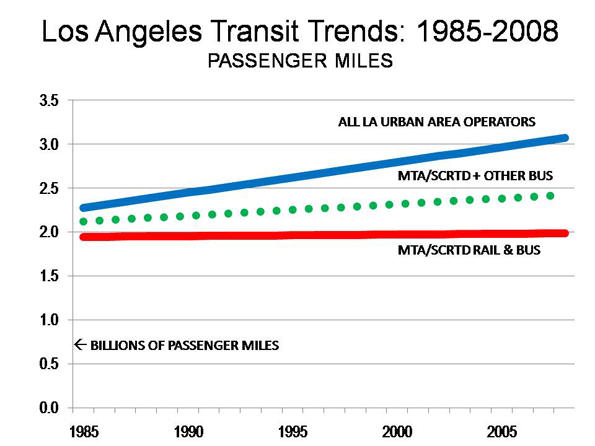
    The Results: The reality is quite different. Even when gasoline prices peaked at nearly $5.00 per gallon in 2008, total MTA bus and rail ridership was 5% below 1985 levels, indicating that for each new rail rider; at least one former bus rider had abandoned transit. Daily bus ridership dropped more than 300,000 (Table 1).

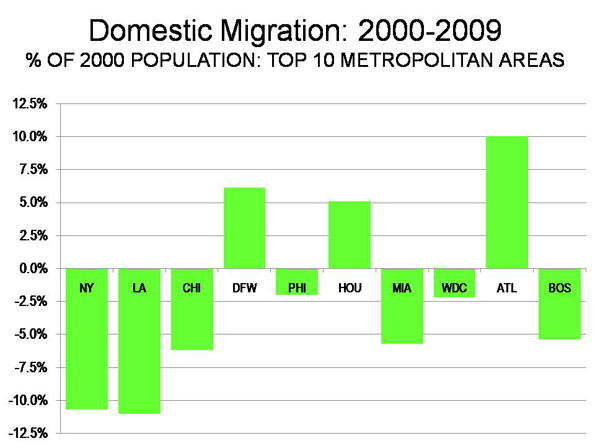
    Moreover, traffic congestion growth slowed during this decade Los Angeles not due to a shift to transit (there wasn’t one), but because of its anemic population growth, with Los Angeles County adding only one-quarter the number of new residents during the 2000s as had been forecast. The Los Angeles metropolitan area (including Orange County) also had the highest rate of domestic outmigration in the nation from 2000 to 2009, losing at a rate one-third greater than Detroit. Employment in Los Angeles County was at the same level in 2008 as in 2000.

    Table 1
    MTA/SCRTD Ridership, Costs and Fare Recovery: 1985-2008
      1985 2008 Change
    Unlinked Trips (Millions)             497          474 -5%
    Passenger Miles (Millions)          1,947      1,989 2%
    Operating & Annualized Capital Costs (Millions)  $      1,077  $  1,775 65%
    Cost per Passenger Mile  $        0.55  $    0.89 61%
       Bus: Cost per Passenger Mile  $        0.55  $    0.77 38%
       Light Rail: Cost per Passenger Mile  $    0.85
       Metro: Cost per Passenger Mile  $    1.81
    Fare Ratio 23% 19% -19%
       Bus: Fare Ratio 23% 25% 5%
       Light Rail: Fare Ratio 11%
       Metro: Fare Ratio 8%
    Bus capital costs estimated using national ratio from APTA Transit Fact Book
    Rail capital costs estimated from mid-year of project construction (discounted at 7% over 30 years)

    The Costs: Rail systems are often promoted for their “cost-effectiveness.” However, these claims always exclude the cost of capital (building the system and buying the vehicles). Capital costs are far higher for rail systems than for buses. Los Angeles is no exception. It is estimated that SCRTD/MTA annual capital and operating costs rose 65% from 1985 to 2008, adjusted for inflation, in large measure due to the rail services. Bus riders pay double or triple the fares in relation to costs as rail riders (Table 1).

    With Other Bus Operators: Ridership Up, Market Share Down:

    Los Angeles is somewhat unique as a metropolitan area in having a large number of transit operators. So, even as the MTA/SCRTD system grew, the other bus systems expanded more rapidly. This was made possible by their more cost-effective operation and, especially among the newer systems, the use of competitive contracting (contracts with private operators) to reduce costs even more. In 2008, for example, more than 35% of the county’s bus service was provided by operators other than MTA. Approximately 85% of the added transit usage (passenger miles) from 1985 to 2008 was from the bus services of these other operators.

    Overall transit ridership increased in the Los Angeles urban area, with the new five-county Metrolink commuter rail system contributing substantially to the increase as well. The neighboring Orange County Bus system doubled its ridership, while rejecting rail (Figure). Even so, transit’s market share in the Los Angeles urban area declined nearly 10% from 1985 to 2008 (Table 2).

    Table 2
    LOS ANGELES URBAN AREA ROADWAY & TRANSIT DATA
      1985 2008 Change
    Annual Roadway Passenger Miles    114,590   168,219 47%
    Annual Transit Passenger Miles         2,279       3,071 35%
    Roadway & Transt Passenger Miles    116,869   171,290 47%
    Transit Market Share 2.0% 1.8% -8%
     
    Freeway Lane Miles         5,310       6,992 32%
    Vehicle Miles per Freeway Lane Mile       13,487     15,037 11%
    Average Congestion Delay (Peak Period) 27% 49% 81%
    Los Angeles urban area includes Mission Viejo urban area.
    Metrolink commuter rail system: 75% of passenger miles estimated in Los Angeles urban area.
    Annual passenger miles in millions

    Prospects: The Next 30 Years

    Los Angeles has again committed to a major expansion of transit service, despite the fact that the Metro and light rail lines have done little more than siphon ridership from buses. There is little to suggest that the future will be any more successful than the past.

    • MTA, like LACTC before it appears to have over-promised on transit expansion. 35% of a half-cent sales tax is no more likely to finance a 12 line expansion today than a 35% share could fund an 11 line expansion in the 1980s and 1990s.
    • Nonetheless, new transit lines will be built. These Measure R expansions are likely, however, to be no more successful in reducing traffic congestion than the earlier rail expansions.

    Further, funding the Measure R rail system is likely to be more challenging. The original Proposition A was followed by decades of growth, which generated rising tax revenues. Now, however, both LA’s population and employment growth have ground to a standstill. The rosy revenue forecasts are not likely to be achieved, which should be a matter for concern among not only local officials, but to the federal taxpayers being asked for a hefty advance.


    Notes

    1. LACTC had held hearings on a proposed ballot initiative, but a consensus had developed that no referendum would be placed on the ballot in 1980. Chairman Hahn surprisingly called a special meeting of LACTC just before the deadline for submitting a measure to the ballot.

    2. LACTC was the principal transportation (transit and highways) policy body in Los Angeles County from 1977 to 1993. By state law, the commission included the mayor of Los Angeles, the five county supervisors (county commissioners), the major of Long Beach, two elected officials from smaller cities, and two additional appointments by the mayor of Los Angeles. Mayor Tom Bradley routinely appointed a city council member to LACTC and a private citizen (three times the author of this article). In 1992, LACTC and SCRTD merged into the Los Angeles County Metropolitan Transportation Authority (MTA), which has a similarly composed board of directors.

    Illustration: 1980 Proposition A Rail Map (Los Angeles County Transportation Commission)

    Wendell Cox is a Visiting Professor, Conservatoire National des Arts et Metiers, Paris. He was born in Los Angeles and was appointed to three terms on the Los Angeles County Transportation Commission by Mayor Tom Bradley. He is the author of “War on the Dream: How Anti-Sprawl Policy Threatens the Quality of Life.

  • SPECIAL REPORT: Metropolitan Area Migration Mirrors Housing Affordability

    On schedule, the annual ritual occurred last week in which the Census Bureau releases population and migration estimates and the press announces that people are no longer moving to the Sun Belt. The coverage by The Wall Street Journal was typical of the media bias, with a headline “Sun Belt Loses its Shine.” In fact, the story is more complicated – and more revealing about future trends.

    Domestic Migration Tracks Housing Affordability: There have been changes in domestic migration (people moving from one part of the country to another) trends in the last few years, but the principal association is with housing affordability.

    Severe and Not-Severe Bubble Markets: Overall, the major metropolitan markets with severe housing bubbles (a Median Multiple rising to at least 4.5, see note) lost nearly 3.2 million domestic migrants (all of these markets have restrictive land use regulation, such as smart growth or growth management) from 2000 to 2009. However, not all markets with severe housing bubbles lost domestic migrants. “Safety valve” bubble markets drew migration from the extreme bubble markets of coastal California, Miami and the Northeast. These “safety valve” markets (including Phoenix, Las Vegas, Portland, Seattle, Riverside-San Bernardino, Orlando, Tucson and Tampa-St. Petersburg), gained a net 2.2 million from 2000 to 2009, while the other bubble markets lost 5.3 million domestic migrants from 2000 to 2009 (See Table below, metropolitan area details in Demographia US Metropolitan Areas Table 8). At the same time, the markets that did not experience a severe housing bubble (those in which the Median Multiple did not reach 4.5) gained a net 1.5 million domestic migrants.

    The burst of the housing bubble explains the changes in domestic migration trends. Housing affordability has improved markedly in the extreme bubble markets, so that there was less incentive to move. Then there was the housing bust-induced Great Recession, which also slowed migration since people had more trouble selling their homes or finding anew job. As a result, the migration to the “safety valve” markets and to the smaller markets dropped substantially.

    • During 2009, the “safety valve” markets gained only 51,000 net domestic migrants, one-fifth of the annual average from 2000 to 2008.
    • At the same time, the other severe housing bubble markets lost 236,000 domestic migrants in 2009, compared to the average loss of 638,000 from 2000 to 2008.
    • Areas outside the major metropolitan areas also experienced a significant drop in domestic migration, dropping from an annual average of 203,000 between 2000 and 2008 to 23,000 in 2009.
    • The major metropolitan markets that did not experience a severe housing bubble gained 161,000 domestic migrants in 2009, little changed from the 169,000 average from 2000 to 2008. These markets are concentrated in the South and Midwest. Indianapolis, Kansas City, Nashville, Louisville and Columbus as well as the Texas metropolitan areas continued their positive migration trends.
    Domestic Migration by Severity of the Housing Bubble
    Metropolitan Areas over 1,000,000 Population
    2000-2008
    Metropolitan Areas 2000-2009 2009 2000-2008 Average
    Withouth Severe Housing Bubbles     1,509,870         160,514      168,670
    With Severe Housing Bubbles    (3,161,514)        (184,486)     (372,129)
       Not "Safety Valve" Markets    (5,347,211)        (235,838)     (638,922)
       "Safety Valve" Markets     2,185,697           51,352      266,793
    Outside Largest Metropolitan Areas     1,651,644           23,972      203,459
    Severe housing bubbles: Housing costs rose to a Median Multiple of 4.5 or more (50% above the historic norm of 3.0). 
    Median Multiple: Median House Price/Median Household Income
    "Safety Valve" refers to markets with severe housing bubbles that received substantial migration from more expensive markets (coastal California, Miami and the Northeast). These markets include Las Vegas, Phoenix, Riverside-San Bernardino, Sacramento, Portland, Seattle, Orlando, Tucson and Tampa-St. Petersburg.

    Moreover, the Census Bureau revised its previous domestic migration figures for 2000 to 2008 to add more than 110,000 from the markets without severe housing bubbles, while taking away more than 150,000 domestic migrants from the markets with severe housing bubbles. This adjustment alone rivals the 2009 domestic migration loss of 183,000 in these markets

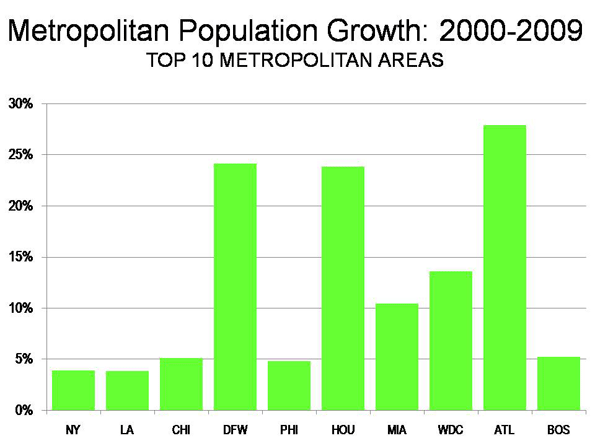
    Population Growth: The Top 10 Metropolitan Areas: Sun Belt metropolitan areas continued to experience the greatest population growth. Between 2000 and 2009, the fastest growing metropolitan areas were Atlanta, Dallas-Fort Worth and Houston, In 2009, Washington, DC was added to the list (Details in Demographia US Metropolitan Areas, Table 2).

    New York: The New York metropolitan area remains the nation’s largest, now reaching a population of over 19 million. More than 700,000 new residents have been added since 2000. However, New York’s population growth has been the second slowest of the 10 largest metropolitan areas since 2000 (Figure 1). Moreover, New York’s net domestic out-migration has been huge. New York has lost 1,960,000 domestic migrants, which is more people than live in the boroughs of The Bronx and Richmond combined. Overall, 10.7% of the New York metropolitan area’s 2000 population left the metropolitan area between 2000 and 2009. More than 1,200,000 of this domestic migration was from the city of New York. Between 2008 and 2009, New York’s net domestic out-migration slowed from the minus 1.32% 2000-2008 annual rate to minus 0.58%., reflecting the smaller migration figures that have been typical of the Great Recession.

    Los Angeles: For decades, Los Angeles has been one of the world’s fastest growing metropolitan areas. Growth had ebbed somewhat by the 1990s, when Los Angeles added 1.1 million people. The California Department of Finance had projected that Los Angeles would add another 1.35 million people between 2000 and 2010. Yet, the Los Angeles growth rate fell drastically. From 2000 to 2009, Los Angeles added barely one-third the projected amount (476,000) and grew only 3.8%. Unbelievably, fast growing Los Angeles became the slowest growing metropolitan area among the 10 largest. In 2009, Los Angeles had 12.9 million people. Los Angeles lost 1.365 million domestic migrants, which is of 11.0% of its 2000 population, and the most severe outmigration among the top 10 metropolitan areas (Figure 2).

    Chicago: Chicago continues to be the nation’s third largest metropolitan area, at 9.6 million population, a position it has held since being displaced by Los Angeles in 1960. Chicago has experienced decades of slow growth and continues to grow less than the national average, at 5.1% between 2000 and 2009 (the national average was 8.8%). Yet, Chicago grew faster than both New York and Los Angeles. Chicago also lost a large number of domestic migrants (561,000), though at a much lower rate than New York and Chicago (6.2%). Even so, Chicago is growing fast enough that it could exceed 10 million population in little more than a decade, by the 2020 census.

    Dallas-Fort Worth: Dallas-Fort Worth has emerged as the nation’s fourth largest metropolitan area, at 6.4 million, having added 1,250,000 since 2000. In 2000, Dallas-Fort Worth ranked fifth, with 500,000 fewer people than Philadelphia, which it now leads by nearly 500,000. Dallas-Fort Worth added more population than any metropolitan area in the nation between 2008 and 2009 and has been the fastest growing of the 10 top metropolitan areas since 2006. As a result, Dallas-Fort Worth has replaced Atlanta as the high-income world’s fastest growing metropolitan area with more than 5,000,000 population. Dallas-Fort Worth added a net 317,000 domestic migrants between 2000 and 2009.

    Philadelphia: Philadelphia is the nation’s fifth largest metropolitan area, at just below 6,000,000 population. Like Chicago, Philadelphia has had decades of slow growth, yet has grown faster in this decade than both New York and Los Angeles (4.8%). Philadelphia has lost a net 115,000 domestic migrants since 2000, for a loss rate of 2.2%, well below that of New York, Los Angeles and Chicago.

    Houston: Houston ranks sixth, with 5.9 million people and is giving Dallas-Fort Worth a “run for its money.” Like Dallas-Fort Worth, Houston has added more than 1,000,000 people since 2000. Over the same period, Houston has passed Miami and Washington (DC) in population. Houston has added a net 244,000 domestic migrants since 2000, and added 50,000 in 2008-2009, the largest number in the country. Like Dallas-Fort Worth, Houston accelerated its annual domestic migration growth rate in 2008-2009. At the current growth rate, Houston seems likely to pass Philadelphia in population shortly after the 2010 census.

    Miami: Miami (stretching from Miami through Fort Lauderdale to West Palm Beach) is the seventh largest metropolitan area, with 5.6 million people. Miami has added more than 500,000 people, for a growth rate of 10.4%. However, Miami has suffered substantial domestic migration losses, at 287,000, a loss rate of, 5.7% relative to its 2000 population.

    Washington (DC): Washington recaptured 8th place, moving ahead of Atlanta, which had temporarily replaced it. Washington’s population is 5.5 million and added 655,000 between 2000 and 2009, for a growth rate of 13.6%. However, Washington lost a net 110,000 domestic migrants, 2.2% of its 2000 population. That trend was reversed in 2008-2009, when a net 18,000 domestic migrants moved to Washington, perhaps reflecting the increased concentration of economic power in the nation’s capital.

    Atlanta: Atlanta is the real surprise this year. For more than 30 years, Atlanta has had strong growth, however, this year it slowed. Atlanta is the 9th largest metropolitan area in the nation, at 5.5 million. Since 2000, Atlanta has added 1.2 million people, though added only 90,000 last year. Atlanta has added a net 429,000 domestic migrants since 2000, though the rate slowed to only 17,000 in 2008-2009.

    Boston: Boston is the nation’s 10th largest metropolitan area, with 4.6 million people. During the 2000s, Boston has added nearly 200,000, growing by 4.2%. Yet, Boston has also experienced a net domestic migration loss of 236,000, or 5.4% of its 2000 population. In 2008-2009, Boston, like Washington, reversed its domestic migration losses, adding 7,000.

    Trends by Size of Metropolitan Area: As throughout the decade, the slowest growing areas of the nation have been metropolitan areas over 10,000,000 population (New York and Los Angeles), which grew 3.9% and non-metropolitan areas, which grew 2.6% during the decade Metropolitan areas that had between 2.5 and 5.0 million population in 2000 boasted the biggest jump (these include fast growing Houston and Atlanta, which are now more than 5 million), at 13.4% for the decade. All of the other size classifications grew between 8.9% and 11.3% over the decade (see Demographia US Metropolitan Areas, Table 1). Metropolitan areas that began the decade with between 5,000,000 and 10,000,000 population gained 10.0%. Those with 250,000 to 500,000 grew 10.4%, those with 500,000 to 1,000,000 grew 10.2% and the smallest metropolitan areas, those from 50,000 to 250,000 grew 8.9%

    Metropolitan areas over 1,000,000 population lost 2.19 million domestic migrants during the decade, but smaller metropolitan areas added 2.24 million domestic migrants. Non-metropolitan areas lost 50,000 domestic migrants. In 2009, the smaller metropolitan areas gained 125,000 domestic migrants, while the larger metropolitan areas lost 30,000. Non-metropolitan areas lost more than 90,000 domestic migrants. As noted above, these smaller figures for 2009 reflect the more stable housing market and the extent to which the Great Recession has reduced geographic mobility (See Demographia US Metropolitan Areas, Tables 1 and 3).


    Note: The Median Multiple is the median house price divided by the median household income. The historic standard has been 3.0.

    Photograph: Dallas

    Wendell Cox is a Visiting Professor, Conservatoire National des Arts et Metiers, Paris. He was born in Los Angeles and was appointed to three terms on the Los Angeles County Transportation Commission by Mayor Tom Bradley. He is the author of “War on the Dream: How Anti-Sprawl Policy Threatens the Quality of Life.

  • Forced March To The Cities

    California is in trouble: Unemployment is over 13%, the state is broke and hundreds of thousands of people, many of them middle-class families, are streaming for the exits. But to some politicians, like Sen. Alan Lowenthal, the real challenge for California “progressives” is not to fix the economy but to reengineer the way people live.

    In Lowenthal’s case the clarion call is to take steps to ban free parking. This way, the Long Beach Democrat reasons, Californians would have to give up their cars and either take the bus or walk to their local shops. “Free parking has significant social, economic and environmental costs,” Lowenthal told the Los Angeles Times. “It increases congestion and greenhouse gas emissions.”

    Scarily, his proposal actually passed the State Senate.

    One would hope that the mania for changing how people live and work could be dismissed as just local Californian lunacy. Yet across the country, and within the Obama Administration, there is a growing predilection to endorse policies that steer the bulk of new development into our already most-crowded urban areas.

    One influential document called “Moving Cooler”, cooked up by the Environmental Protection Agency, the Urban Land Institute, the Environmental Defense Fund, Natural Resources Defense Council, the Environmental Protection Agency and others, lays out a strategy that would essentially force the vast majority of new development into dense city cores.

    Over the next 40 years this could result in something like 60 million to 80 million people being crammed into existing central cities. These policies work hard to make suburban life as miserable as possible by shifting infrastructure spending to dense areas. One proposal, “Moving Cooler,” outdoes even Lowenthal by calling for charges of upwards of $400 for people to park in front of their own houses.

    The ostensible justification for this policy lies in the dynamics of slowing climate change. Forcing people to live in dense cities, the reasoning goes, would make people give up all those free parking opportunities and and even their private vehicles, which would reduce their dreaded “carbon imprint.”

    Yet there are a few little problems with this “cramming” policy. Its environmental implications are far from assured. According to some recent studies in Australia, the carbon footprint of high-rise urban residents is higher than that of medium- and low-density suburban homes, due to such things as the cost of heating common areas, including parking garages, and the highly consumptive lifestyles of more affluent urbanites.

    Moreover, it appears that even those who live in dense places may be loath to give up their cars. Over 90% of all jobs in American metropolitan regions are located outside the central business districts, which tend to be the only places well suited for mass transit.

    Indeed, despite the massive expansion of transit systems in the past 30 years, the percentage of people taking public transportation in major metropolitan regions has dropped from roughly 8% to closer to 5%. Even in Portland, Ore.–the mecca for new wave transit consciousness–the share of people using transit to get to work is now considerably less than it was in 1980. In recent months overall transit ridership nationwide has actually dropped.

    These realities suggest that densification of most cities–with the exceptions of New York, Washington and perhaps a few others–cannot be supported by transit. Furthermore, drivers in dense cities will be confronted with not less congestion, but more, which will likely also boost pollution. The most congested cities in the country tend to be the densest, such as Los Angeles, Sen. Lowenthal’s bailiwick, which is in an unenviable first place.

    Then there is the little issue of people’s preferences. Urban boosters have been correct in saying that until recently there have been too few opportunities for middle-class residents to live in and around city cores. But over the past decade many cities have gone for broke with dense condo and rental housing and have produced far more product, often at very high cost, than the market can reasonably bear.

    Initially, when the mortgage crisis broke, the density advocates built much of their case on the fact that the biggest hits took place in suburban areas, particularly on the fringe. Yet as suburban construction ended, cities continued building high-density urban housing–sometimes encouraged by city subsidies. As a result, in the last two years massive foreclosures have plagued many cities, and many condominiums have been converted to rentals. This is true in bubble towns like Las Vegas and Miami; “smart-growth” bastions like Portland and Seattle; and even relatively sane places such as Kansas City, Mo. All these places have a massive amount of high-density condos that are either vacant or converted into lower-cost rentals.

    Take Portland. The city’s condo prices are down 30% from their original list price. The 177-unit Encore, one of the fanciest new towers, has closed sales on 12 of its units as of March, while another goes to auction. Meanwhile in New York half-completed structures dot Brooklyn’s once-thriving Williamsburg neighborhood, while the massive Stuyvesant Town apartment complex in Manhattan teeters at the edge of bankruptcy.

    Finally, it is unlikely that cities would be able to accommodate the massive growth promoted by urban boosters, land speculators and policy mavens. Aaron Renn, who writes the influential Urbanophile blog, says that most American cities today struggle to maintain their current infrastructure. They also have limited options to zone land for high-density construction, due in part to grassroots opposition to existing residential neighborhoods. Overall they would be hard-pressed to accommodate much more than 10% of their region’s growth, much less 50% or 60%.

    Given these realities, and the depth of the current recession, one might think that governments would focus more on basics like jobs and fixing the infrastructure–in suburbs as well as cities–than reengineering how people live. Yet it is increasingly clear that for many “progressives” the real agenda is not enabling people to achieve their dreams–especially in the form of a suburban single-family house. It is, instead, forcing them to live in what is viewed as more ecologically and socially preferable density.

    In the next few months we may see more of the kind of hyperregulation proposed by the likes of Sen. Lowenthal. It is entirely possible that a hoary coalition of HUD, Department of Transportation and EPA bureaucrats could start trying to restrict future housing development along the lines suggested in “Moving Cooler.”

    Yet over time one has to wonder about the political efficacy of this approach. Right now Americans are focused primarily on simply economic growth–and perhaps a touch less on the intellectual niceties of the “smart” form. In addition they are increasingly skeptical about climate change, which serves as the primary raison d’etre behind the new regulatory schema.

    Given the zealousness of the density advocates, perhaps the only thing that will slow, and even reverse, this process will be the political equivalent of a sharp slap across the face. Unless the ruling party begins to reacquaint itself with the preferences and aspirations of the vast majority of Americans, they may find themselves experiencing repeats of their recent humiliating defeat–manufactured largely in the Boston suburbs–in true-blue Massachusetts.

    Americans–suburban or urban–may resist a return to unbridled and extreme Republicanism, whether on social issues or in economic policy. But forced to choose between Neanderthals, who at least might leave them alone in their daily lives, and higher-order intellects determined to reengineer their lives, they might end up supporting bipeds lower down the evolutionary chain, at least until the progressive vanguard regains a grip on common sense.

    This article originally appeared at Forbes.com.

    Joel Kotkin is executive editor of NewGeography.com and is a distinguished presidential fellow in urban futures at Chapman University. He is author of The City: A Global History. His newest book is The Next Hundred Million: America in 2050, released in Febuary, 2010.

    Photo: Creativity+ Timothy K Hamilton

  • The Myth of the Strong Center

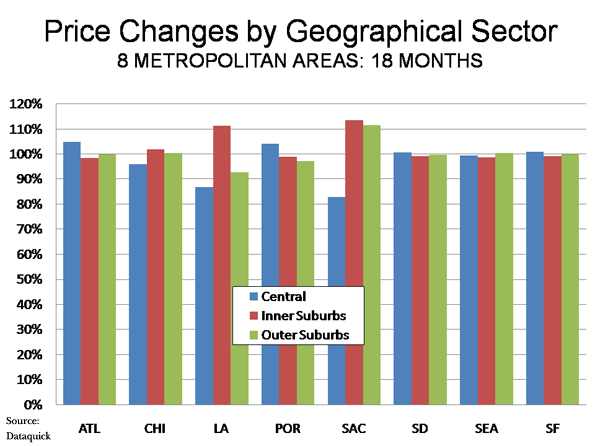
    At the height of the foreclosure crisis the problems experienced by some so-called “sprawl” markets, like Phoenix and San-Bernardino-Riverside, led some observers to see the largest price declines as largely confined to outer ring suburbs. Some analysts who had long been predicting (even hoping for) the demise of the suburbs skipped right over analysis to concoct theories not supported by the data. The mythology was further enhanced by the notion – never proved – that high gas prices were forcing home buyers closer to the urban core.

    Yet a summary of the trends over the past 18 months show only minor disparities between geographies within leading urban regions. Overall house prices escalated similarly in virtually all areas within the same metropolitan areas and the price drops appear to have also been similar. This is in contrast to a theory that suggests that huge price drops occurred in the outer suburbs while central city prices held up well.

    Summary of 18 Month Subarea Price Declines: This is indicated by a review of 8 metropolitan areas: Los Angeles, the San Francisco Bay Area, San Diego, Sacramento, Atlanta, Chicago, Portland and Seattle (see end note), for which subarea data is readily available (see table). On average, central area median house prices (all houses, including condominiums), fell 3% in relation to the overall metropolitan area average. Inner suburban areas experienced a 3% gain relative to metropolitan area prices, while outer suburban areas changed at the metropolitan area average. In actual price reduction terms, core areas declined 28.8%, inner suburban areas declined 25.7%, and outer suburban areas declined 27.1%. The overall average metropolitan area decline was 27.2%. There was, however, considerable variation in the figures by metropolitan area (see figure below).

    MEDIAN HOUSE PRICE CHANGES BY GEOGRAPHICAL SECTOR
    8 Metroplitan Areas
    CALIFORNIA MARKETS Central Inner Suburbs Outer Suburbs Overall
    Los Angeles -45.3% -30.0% -41.5% -37.1%
    San Francisco Bay -38.0% -39.1% -38.6% -38.6%
    San Diego -36.5% -37.4% -37.0% -36.9%
    Sacramento -53.6% -36.3% -37.5% -44.0%
    OTHER MARKETS
    Atlanta -11.6% -17.0% -15.8% -15.8%
    Chicago -21.0% -16.3% -17.5% -17.8%
    Portland -10.0% -14.5% -15.7% -13.5%
    Seattle -14.2% -14.7% -13.2% -13.7%
    AVERAGE -28.8% -25.7% -27.1% -27.2%
    Estimated from Data Quick information
    California Markets: July 2008 to January 2010
    Other Markets: 2008-2nd Quarter to 2009-4th Quarter

    Where Central Area Losses were Greatest: Over the past 18 months, central areas posted the largest losses in three of the areas. Further, in each of these areas, the smallest price drops were experienced in the inner suburbs.

    • Sacramento had the steepest central area relative price decline. Central area prices declined 37% relative to inner suburban prices, where the smallest losses occurred. The central area price loss averaged 53.6%, compared to the overall metropolitan area loss of 44.0%. The inner suburbs experienced the smallest loss, at 36.3%.
    • Los Angeles also had a steep central area relative price decline. Central area prices declined 45.3%, compared to the overall metropolitan area loss of 37.1%. The inner suburbs experienced the smallest loss, at 30.0% while outer suburbs lost 41.5%.
    • Chicago’s greatest losses also occurred in the central area, but were of a much smaller magnitude. Central area prices declined 21.0%, compared to the overall metropolitan area loss of 17.8%. The inner suburbs experienced the smallest loss, at 16.3%. The outer suburbs lost 17.5%.

    Where Suburban Losses were the Greatest: In two areas, the central area price losses were the least, Atlanta and Portland. Yet, the magnitude of these losses was modest. It is interesting to note that the metropolitan areas with the smallest relative losses in the central areas pursued radically different policies with respect to development. Portland’s “smart growth” policies favor central development at the expense of suburban development, while Atlanta’s more liberal policies do not attempt to steer development to the core.

    • Atlanta’s greatest price declines occurred in the inner suburbs, which experienced a loss of 17.0%, slightly more than that of the outer suburbs (15.8%). In comparison, the central area price drop was the least, at 11.6%, The metropolitan area loss was 15.8%.
    • Portland’s greatest price declines occurred in the outer suburbs which experienced a 15.7% loss, compared to the inner suburbs, at 14.5. The lowest decline was in the central area at 10.0%. The metropolitan area loss was 13.5%.

    Little Difference in Some Markets: There was little difference in the price declines among geographic sectors in three of the metropolitan areas. In the San Francisco Bay area, San Diego and Seattle, the differences between central, inner suburban and outer suburban price declines were all within a 2% range.

    Core Condominium Market Crisis

    However, core area markets where condominiums predominate indicate substantial difficulties in some of the metropolitan areas. These markets are generally only a small part of central cities, principally around downtown areas or major centers. For example, in the Portland area, the core condominium areas ring the downtown area and include the Pearl District and the South Waterfront District. The central area, which encompasses the entire city of Portland, however, is much larger and has a much larger share of detached housing.

    Demand has been so weak in the core condominium markets that substantial price reductions have occurred and a number of buildings have been forced to sell units at auction. Other buildings have given up altogether on selling and have rented condominiums. Some of the price drops, especially in Atlanta, Portland and Seattle are far greater than occurred overall in the respective metropolitan markets. The condominium implosion has not received nearly the level of attention in the national or local media that was accorded the housing bubble and collapse itself.

    Portland: A local television station video indicates that Portland’s condominium market is in crisis. A report in The Oregonian indicates that the downtown area has a “glut” of condominiums and that February sales prices averaged 30% below list. A luxury new 15-story building in the Pearl District (The Wyatt) is now being leased instead. Units at The Atwater in the South Waterfront district were auctioned, with minimum bid prices more than 50% lower than list. The John Ross, also in the South Waterfront District, is Portland’s largest condominium project and will be auctioning its units. Minimum bid prices average 70% below the previous top list prices. The smallest units have a minimum bid price of $110,000. By comparison, over the past year, the median house price in the Portland metropolitan area has dropped approximately 10%.

    Atlanta: Atlanta has a “vast oversupply” of condominiums. The uptown (including Atlantic Station) and Buckhead markets of Atlanta appear to be experiencing some of the worst market conditions in the nation. The prestigious Mansion on Peachtree, a combination hotel and condominium development, was unable to sell 75% of its residences and was recently sold in foreclosure at approximately $0.30 on the dollar. The winning auction bids at The Aqua condominium in Uptown averaged 50% below the last asking price. In Atlantic Station, units at The Element were auctioned at substantial discounts. Among conventional sales, condominium price reductions of up to 40% have been reported. One building has offered discounts of $100,000 per bedroom. Some new buildings have been converted to rentals, while planned projects have been placed upon hold.

    Seattle: Things are little better in Seattle. The overbuilt downtown area condominium market has experienced a median price decline of 35% over the past year. Units at The Gallery in tony Belltown were auctioned off at minimum prices 50% below the last list prices (which had already been discounted). Units at The Brix, on Capitol Hill, attracted bids at auction averaging 30% below previous list prices. Later this month, unsold units at 5th & Madison will be auctioned, at minimum prices below 50% of previous list. For comparison, median house prices in the Seattle metropolitan area declined 6% over the past year.

    Chicago: The downtown area of Chicago has been among the most vibrant condominium markets for more than a decade. However, in 2009, condominium sales fell to the lowest level since 1997. At current sales rates, the downtown area has a supply of more than five years, with annual sales of less than 600 and more than 3,000 units available or under construction.

    Los Angeles: Few markets have seen as many condominium buildings planned as downtown Los Angeles, and few have seen so many put on hold. A recent issue of the Los Angeles Downtown News lists approximately 50 downtown condominium projects. More than three-quarters of the projects have been scaled back, have had construction slowed or are on “hold.” The market has been so weak that a number of developers have taken losses by auctioning condominium units that they have not been able to sell conventionally.

    San Diego: The downtown San Diego condominium is substantially overbuilt. Developers have leased units that were to have been sold and there is virtually no construction of new units.

    Rental Conversions: Even these grim reports, however, may mask an even bigger problem. It is estimated that more than 20,000 condominiums units are completed or nearly completed, but are not listed for sale in Miami. In what is by far the nation’s strongest condominium market, Manhattan, more than 6,000 condominium units are completed or nearly completed, but not listed for sale.

    In core cities, few issues have been as divisive as the conversion of rental units to condominiums. But, now the opposite is now occurring – condominiums are being converted into apartments for rent: This is trend that undermines markets in a way that cannot be measured by median prices, since it replaces generally high-paying condo owners for generally less flush renters. This puts those who bought at higher prices in these markets at a particular disadvantage.

    Conclusion: Overall, contrary to the mythology developed early in the bubble, suburbs and even exurbs have generally performed about as well as closer in markets. The big imponderable will be the future of the core condominium market, which is experiencing significant financial reverses largely ignored by the national media.


    Note: As used in this article, the Los Angeles metropolitan area is the Los Angeles-Riverside Combined Statistical Area, the San Francisco area is the San Francisco-San Jose Combined Statistical Area and all other metropolitan areas are the corresponding metropolitan statistical areas. http://demographia.com/db-prdistr2010.pdf>Subareas defined.

    Photograph: Condominium construction, Atlanta, weekend of the Lehman Brothers collapse.

    Wendell Cox is a Visiting Professor, Conservatoire National des Arts et Metiers, Paris. He was born in Los Angeles and was appointed to three terms on the Los Angeles County Transportation Commission by Mayor Tom Bradley. He is the author of “War on the Dream: How Anti-Sprawl Policy Threatens the Quality of Life.