Tag: Los Angeles

  • New Traffic Scorecard Reinforces Density-Traffic Congestion Nexus

    Inrix, an industry provider of traffic information, has just published its third annual Traffic Scorecard, which ranks the nation’s 100 largest metropolitan areas based upon the intensity of their peak hour traffic congestion in 2009. The results provide further evidence of the association between higher urban population densities and more intense traffic congestion.

    Los Angeles, Again: Not surprisingly, Los Angeles is again the most congested metropolitan area over 1,000,000 population. In Los Angeles, roadway travel takes nearly 34.7% more in peak periods than when there is no congestion. This means that a trip that would take 30 minutes without congestion would take, on average 40.5 minutes during peak periods.

    The principal measure used by Inrix is the Travel Time Index, which was developed by the Texas Transportation Institute (TTI), for its congestion reports that started in 1982. TTI’s latest Urban Mobility Report is for 2007. The Inrix measures are developed from actual GPS vehicle readings. This information is also provided to TTI to assist in preparation of its annual Urban Mobility Report.

    Measuring Delay: In the new edition, Inrix switches from using the Travel Time Index to what it calls the Travel Time Tax. The difference between the two measures is that the Travel Time Tax measures the percentage of delay, such as 35% in Los Angeles, while the Travel Time Index would state the figure as 1.35. The new method is preferable because differences in traffic congestion are more readily apparent. . For example, a metropolitan area having a Travel Time Tax of 15% would have 50% worse traffic congestion than a metropolitan area having a Travel Time Tax of 10%. This large difference is not as obvious when comparing the Travel Time Index values of 1.15 and 1.10. The “Travel Time Tax” parlance, however, is less than optimal and this article will use “average congestion delay” instead.

    Ranking the Metropolitan Areas: The average congestion delay in Los Angeles was much worse than in the other largest metropolitan areas, just as its core urban area density is well above that of anywhere else in the US, including New York (where far less dense suburbs more than negate the density advantage in the core city). It also doesn’t help that a number of planned freeways were cancelled in Los Angeles over the last 50 years.

    Among the large metropolitan areas, Washington, DC had the second worst Average congestion delay, at 22.4%, followed by San Francisco, at 21.5%, Austin at 20.7% and New York at 19.7%. Austin may seem to have placed surprisingly high, however this was the nation’s last large metropolitan area to open a full freeway to freeway interchange and has only recently begun to develop a comprehensive freeway system, through the addition of toll roads. Austin’s late roadway development is the result of two factors. Austin was too small in 1956 to receive a beltway under the interstate highway system and an anti-freeway movement delayed construction for decades.

    Inrix also develops an average congestion delay for the worst commuting hour. Los Angeles also has the most congested worst hour, with an average congestion delay of 69%. Austin ranked second worst at 55%, while San Francisco was third at 46%, Washington, DC fourth at 45% and New York fifth at 44%.

    Honolulu: Almost as Bad as Los Angeles: Smaller metropolitan areas also exhibited intense traffic congestion. Honolulu had an average congestion delay nearly as bad as Los Angeles, at 32.4% and a worst hour average congestion delay of 64%. The core urban area of Honolulu has the highest density of any metropolitan area between 500,000 and 1,000,000 population. New York exurb Bridgeport-Stamford had a worst hour average congestion delay of 63%, with a peak period average congestion delay of 18.0%.

    Inrix: Density and Traffic Congestion: Virtually all of the congestion and most of the analyzed road mileage is in the urban areas, rather than in the rural areas that make up the balance of the metropolitan areas. The metropolitan areas with more dense urban areas tend to have worse traffic congestion, as the table below indicates.

      • Metropolitan areas with core urban densities (see Note 1) of more than 4,000 per square mile had peak period average congestion delays of 18.4%, which is more than three times that of metropolitan areas with core urban densities of less than 2,000 (5.9%).

      • Metropolitan areas with core urban densities of more than 4,000 per square mile had worst peak hour average congestion delays of 37.5%, which is nearly 2.4 times that of metropolitan areas with core urban densities of less than 2,000 (15.9%).

    These relationships are similar to those indicated in the Texas Transportation Institute data for 2007.

    Traffic Congestion & Urban Density in the United States: 2009
    Core Urban Area Density (2000) Peak Period Average Congestion Delay: 2009 Compared to Least Dense Category Worst Hour Average Congestion Delay: 2009 Compared to Least Dense Category
    Over 4,000 18.4% 3.26 37.5% 2.36
    3,000-3,999 10.0% 1.76 22.3% 1.41
    2,000-2,999 7.3% 1.30 17.7% 1.12
    Under 2,000 5.6% 1.00 15.9% 1.00
    Density: Population per square mile
    Travel Time Tax: Additional travel time required due to traffic congestion
    2000 population density is the latest reliable data
    Calculated from INRIX & 2000 Census data

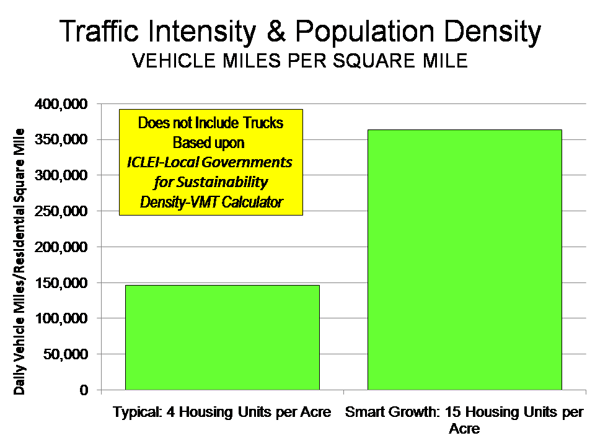
    Sierra Club Data Also Shows Nexus: Moreover, the association between higher densities and greater traffic congestion is indicated by the ICLEI-Local Governments for Sustainability Density-VMT Calculator, which is based upon Sierra Club research. According to the Calculator, under the “smart growth” scenario, residential housing would be 15 units per acre, as opposed to its “business as usual” scenario at a typical density of four housing units per acre. The density of traffic (vehicle miles per square mile) under the higher density “smart growth” strategy would be 2.5 times as high as under the “business as usual” scenario (Figure).
    The Inevitable Comparisons: Invariably, analysts (smart growth advocates and me) like to point out relationships between Portland, with its “smart growth” policies and Atlanta, the least dense major urban area in the world. The Inrix data shows Portland to have an average peak hour delay of 12.2%, which is 15% worse than Atlanta (10.6%). Portland is nearly twice as dense as Atlanta, while Atlanta’s traffic congestion is made worse by one of the most decrepit freeway and arterial systems in the nation.

    A National Vision: Inrix has also developed a monthly national congestion delay factor. Inrix notes that traffic congestion had been improving as driving declined due to the Great Recession. However, Inrix refers to reduction in driving as “lucky,” and notes that without a “national vision” that “includes addressing congestion as a national priority,” greater traffic congestion will result.

    There is indeed good reason to address traffic congestion. As David Hartgen and M. David Fields have shown, there is a strong relationship between the higher levels of mobility that occur with less congestion and greater economic growth. Obviously that relationship extends to higher urban densities, which are associated with economically counter-productive levels of traffic congestion.

    But there is more than jobs and the economy. More intense traffic congestion produces more intense air pollution as well as more greenhouse gas emissions. It is well to remember that public health was the rationale for air pollution regulation. Air pollution’s negative impacts are so local that they are measured in the quality of life of individual people, especially those in close proximity to unnecessarily overcrowded roads. It is ironic that the higher density promoted by smart growth advocates exposes urban residents to more intense air pollution.


    Note 1: 2000 core urban area (urbanized area) population densities are used in this analysis because there is no later reliable information. The next reliable urban area density data will be a product of the 2010 census. The Federal Highway Administration (FHWA) produces later urban area density figures, many of which are substantially inconsistent with those of the United States Bureau of the Census, which is the primary source of such information. For example, as late as 2005, FHWA reported the Houston urban area to have 1.3 million fewer people than the Bureau of the Census, while reporting a land area nearly 250 square miles larger than the census had measured. Of course, this is a physical impossibility. The result was that Houston’s density was overstated by 45%.

    Note 2: Inrix also ranks metropolitan areas using an “overall congestion” measure, which is simply all congestion added up. As a result, the overall congestion measure is heavily weighted by population. This is illustrated by comparing Los Angeles and Honolulu. These metropolitan areas have very similar average congestion delays, as noted above. This means that drivers encounter similar traffic delays during peak in Los Angeles and Honolulu. However, Honolulu’s overall congestion measure is 95% less than that of Los Angeles, principally driven by the fact that Honolulu’s population is 93% less. As such, the overall congestion measure is of little relevance to people in their day to day commute or as a comparative measure of the intensity of congestion between areas.

    Photograph: Los Angeles City Hall.

    Wendell Cox is a Visiting Professor, Conservatoire National des Arts et Metiers, Paris. He was born in Los Angeles and was appointed to three terms on the Los Angeles County Transportation Commission by Mayor Tom Bradley. He is the author of “War on the Dream: How Anti-Sprawl Policy Threatens the Quality of Life.
  • Reducing Traffic Congestion and Improving Travel Options in Los Angeles

    While traffic congestion plagues many cities, Los Angeles stands apart. The Texas Transportation Institute tracks congestion statistics for U.S. metropolitan areas on an annual basis, and Los Angeles routinely ranks first for both total and per-capita congestion delays. Considering the value of wasted time and fuel, TTI estimates the annual cost of traffic congestion in greater Los Angeles at close to $10 billion.

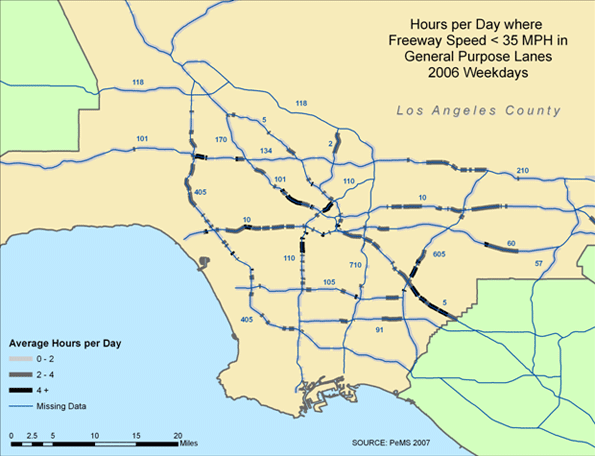
    The map in Figure 1, based on 2006 Caltrans sensor data, illustrates the weekday pattern of traffic congestion on the LA freeway network. Congestion is pervasive throughout much of the county; most freeways have segments on which traffic averages less than 35 mph at least two hours per day, and many bottlenecks are congested at least four hours per day.

    Figure 1. Traffic Conditions on the LA Freeway Network

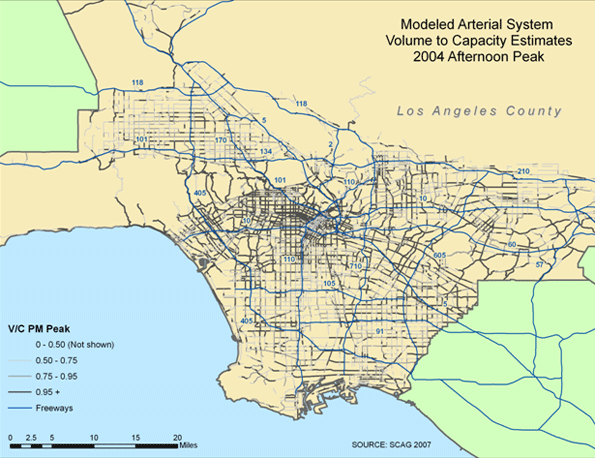
    Conditions on the surface streets are not much better. The map in Figure 2, based on 2004 volume-to-capacity (V/C) estimates from SCAG, depicts the pattern of afternoon traffic congestion on the county’s largest arterials. Here again it is evident that traffic congestion is broadly dispersed, yet the pattern is particularly intense between downtown Los Angeles and the Westside.

    Figure 2. Traffic Conditions on LA Surface Streets

    With the recent run-up in fuel prices followed by a severe recession, total travel in Los Angeles has declined over the past two years, and congestion has correspondingly eased. Yet if past trends hold, this reprieve is likely to be fleeting. Should the region’s economy and population grow in the coming decades, as some forecasts predict, the probable outcome is even more vehicle travel and in turn more intense congestion.

    Controversial Solutions for a Daunting Problem
    Researchers at the RAND Corporation were asked to recommend strategies capable of reducing LA traffic within five years or less (the short timeframe rules out land-use reforms along with major infrastructure investments). The resulting report, Moving Los Angeles: Short-Term Policy Options for Improving Transportation, offers recommendations at once controversial and likely inescapable. To achieve lasting traffic relief, it will be necessary to manage the demand for travel through pricing reforms (e.g., congestion tolls) that increase the cost of driving and parking in the busiest corridors and areas during peak travel hours. Other measures—better transit service, ridesharing programs, traffic signal synchronization, and the like—can complement pricing, but are not on their own sufficient to stem current and projected future traffic congestion.

    Few Strategies Offer Much Promise
    Just why should this be so? Consider, first, that traffic congestion results from an imbalance between the supply of roads and peak-hour automotive travel. In fact, congestion can be viewed as a solution (though an unpleasant one) to this imbalance; when demand exceeds supply, congestion makes us wait our turn for available road space to balance the equation. Over the past several decades, the gap between supply and demand has widened considerably; population growth, economic expansion, and rising incomes have fueled the demand for more vehicle travel, while road construction has stagnated. We have therefore been relying, more and more, on congestion to resolve this imbalance.

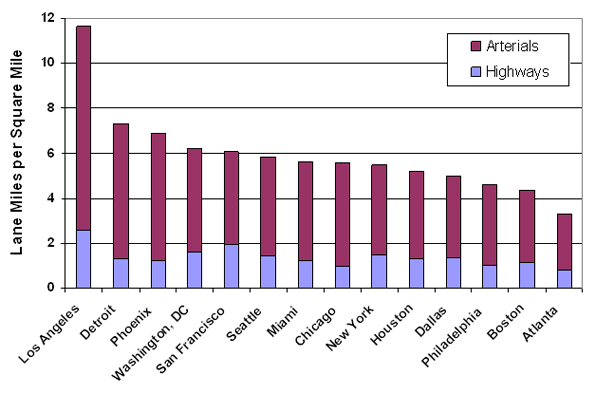
    One response would be to build or expand more roads to accommodate additional vehicle travel. Setting aside policy concerns related to greenhouse gas emissions and energy security, the prospects for “building our way out of congestion” are limited. To begin with, there simply isn’t much space to build new roads in Los Angeles, particularly in the most densely developed urban areas. As shown in Figure 3, the density of the road network in the greater Los Angeles region, measured in lane miles per square mile, is already far greater than in any other large metropolitan area in the country.

    Figure 3. Road Network Density in Major Metropolitan Areas

    We also lack the resources to engage in an extensive road building spree. In recent decades, federal and state elected officials have failed to increase fuel taxes enough to offset the effects of inflation and improved fuel economy, thus hobbling the major source of funding for road construction and repairs.

    Even if we could expand the road network, though, the benefits would be limited by a phenomenon described as “triple convergence.” Congestion has been a problem for years, and many individuals deliberately alter their travel patterns to avoid severe traffic. When an investment in road capacity reduces peak-hour congestion, many will conclude that they no longer need to go out of their way to avoid congestion delays and will thus “converge” on the improvement from (a) other times, (b) other routes, or (c) other modes of travel. The net effect is that the initial traffic-reduction benefits will usually not last over time. This is why we often see, for instance, that the improved traffic flow resulting from a new freeway lane does not last for more than a couple of years.

    If supply-side remedies do not create sustainable reductions in traffic, it becomes necessary to examine ways of reducing peak-hour travel demand. Commonly employed options include improved transit service, voluntary ridesharing programs, flexible work hours, and telecommuting. Unfortunately, the congestion-reduction benefits of these strategies are likewise undermined by triple convergence. If a new subway line induces some peak-hour drivers to switch to transit, other drivers will soon converge on more freely flowing roads to take their place. Indeed, the effects of triple convergence explain why traffic congestion has grown steadily worse despite considerable state and local investment in a broad range of congestion-reduction strategies.

    Only Pricing Strategies Promise Sustainable Reductions in Traffic Congestion
    This brings us to the rationale for pricing strategies. Among the many possible options for reducing traffic congestion, only pricing resist the effects of triple convergence. By increasing the cost of driving or parking in the busiest areas or corridors during the busiest times of day, pricing measures manage the demand for peak-hour travel, in turn reducing congestion. Once traffic flow improves, the prices remain in place, thus deterring excessive convergence on the newly freed capacity.

    Pricing strategies offer two additional benefits. First, pricing generates revenue to support needed transportation investments. And in comparison to sales taxes, a common option for raising local transportation revenue, pricing has been shown to reduce the relative tax burden on lower income groups (though wealthier individuals consume more taxable goods than their less-affluent counterparts, to an even greater extent they (a) drive more, (b) are more likely to travel during peak hours, and (c) are more likely to pay peak-hour tolls rather than alter their travel choices). Second, pricing enables more efficient use of the road capacity that we already have, because roads on which traffic flows smoothly (at roughly 40 mph or higher) can carry far more vehicles per lane per hour than roads snarled in stop-and-go congestion. Paradoxically, then, we see that the introduction of pricing enables roads to accommodate more peak-hour trips. It is therefore useful to think of pricing as a means of managing peak-hour travel demand rather than reducing it.

    Pricing Strategies Will Be Particularly Valuable in Los Angeles
    Pricing holds promise for most major cities, but the case in Los Angeles is especially compelling. To understand why, it is necessary to consider the interactions between population density and travel behavior, factors that help to explain the severity of LA traffic.

    Contrary to its reputation for sprawl, Los Angeles is quite densely populated when viewed at the regional scale. Downtown Los Angeles isn’t as dense as, say, Manhattan or central Chicago, but the suburbs surrounding Los Angeles are much denser than the typical suburb, leading to high aggregate density on a regional basis.

    As population density increases, individuals tend to drive less on a per-capita basis. Trip origins and destinations are closer together, leading to shorter car trips, and in dense neighborhoods people can rely on alternatives such as walking, biking, or transit for a larger share of trips. Yet this can be overwhelmed by the fact that there are also more drivers competing for the same road space within a given area, thus intensifying traffic congestion. The net effect is that greater population density tends to exacerbate congestion—think downtown Manhattan.

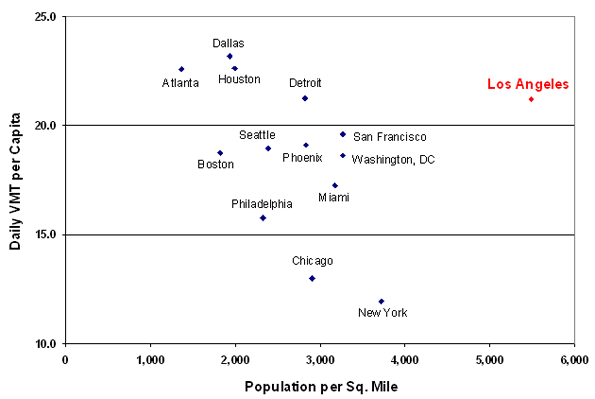
    LA traffic congestion is further exacerbated by the fact that Angelinos do not curtail their driving as much as one would expect in response to higher population density. Figure 4 compares per-capita vehicle miles of travel (VMT) and population density for the 14 largest metropolitan regions in the country.

    Figure 4. Population Density vs. Per-Capita VMT for the 14 Largest U.S. Metropolitan Regions

    Looking across the different regions, there is a fairly consistent relationship in which per-capita VMT declines with regional density. Los Angeles, though, bucks this trend. The only other metropolitan regions with higher per-capita VMT (Atlanta, Dallas, Houston, and Detroit) are all much less dense than Los Angeles. For regions in which the level of density approaches that of Los Angeles (San Francisco, Washington D.C., and New York), per-capita VMT is much lower.

    In short, we see a confluence of three density-related factors that combine to explain the severity of congestion in Los Angeles: (1) congestion is likely to rise with increased population density; (2) Los Angeles is much denser than its peers at the regional level; and (3) Los Angeles exhibits a surprisingly high level of per-capita VMT relative to its density. The third of these underscores the importance of pricing strategies as a means of managing the demand for automotive travel in Los Angeles.

    In the end only pricing strategies promise sustainable reductions in traffic congestion. Other measures – including improvements in alternative transportation modes – can be beneficial, but none will be nearly as effective as pricing. This recommendation will no doubt stir controversy, but pricing offers the only realistic prospects for managing peak-hour travel demand in the most traffic-choked of American metropolises.

    Dr. Paul Sorensen is an operations researcher at the RAND Corporation, wherehe serves as Associate Director of the Transportation, Space, and Technology program. Dr. Sorensen has published peer-reviewed studies in the areas of geographic information analysis, location optimization modeling, emergency response logistics, and transportation finance policy, and he also holds aU.S. patent on a methodology for forecasting the demand for ambulance services. Dr. Sorensen received a BA in computer science from Dartmouth College, an MA in urban planning from UCLA, and a PhD in geography from UCSB.

  • New Geography Top Stories of 2009

    As we bring to a close our first full calendar year at NewGeography.com, we thought readers may be interested in which articles out of more than 350 published enjoyed the widest readership. It’s been a solid year of growth for the site; visits to the site over the past six months have more than tripled over last year and subscribers have increased by a factor of six. The list of popular articles is based both on.readership online and via RSS.

    15. Joel Kotkin’s piece, Numbers Don’t Support Migration Exodus to “Cool Cities”, makes the case that places considered “cool” by many in media and economic development circles are actually losing net migrants to other U.S. regions. In almost every case, he argues, your local resources are better spent focused on skills upgrades for your local residents or hard and soft infrastructure upgrades for industries already successful in your region. This article originally appeared on Forbes.com

    14. The British Labour Party is no example for American Progressives. Legatum Institute Senior Fellow Ryan Streeter’s piece just in time for the 4th of July, View from the UK: The Progressive’s Dilemma, dissects Britain’s high social spending, increasing debt load. Streeter contends that the UK is danger of mortgaging its future.

    13. Breaking down Obama’s first year and looking forward. In two equally popular pieces from this fall, Joel Kotkin outlines a five point plan to improve Obama’s presidency (Obama Still Can Save His Presidency which originally appeared in Forbes.com. In the second piece he takes encouragement from signs that the President may be retuning his policy back towards America – “a big, amazingly diverse country with an expanding population” – and away from the “Scandinavian Consensus” model (Is Obama Separating from His Scandinavian Muse?) . This article originally appeared on Politico.com.

    12. State of the economy June 2009. Susanne Trimbath says it may be a while before the average citizen will actually see tangible improvements in the economy. As is often the case, Susanne’s predictions have turned out so far to be all too accurate.

    11. Questioning the stimulus plan. In February’sStimulus Plan Caters to the Privileged Public Sector, Joel Kotkin calls the stimulus plan “a massive bailout and expansion of the public-sector workforce as well as quasi-government workers in fields like health and education” yet “as little as 5% of the money is going toward making the country more productive in the longer run – toward such things as new roads, bridges, improved rail and significant new electrical generation.” This article originally appeared in Forbes.com

    10. Is California’s economic malaise leaking into Oregon? After years of strong migration flows of former Californians heading to Oregon, Joel Kotkin and California Lutheran University economist Bill Watkins point out that the state’s oppressive tax policies and red tape may be leaking into Oregon as well in California Disease: Oregon at Risk of Economic Malady. The article originally appeared in The Portland Oregonian.

    9. Tracking housing decline. Wendell Cox broke down the comparative national housing market in two widely read pieces. In the first he points out that the downturn can be broken into two phases, one mirroring the explosive growth in many overvalued markets, and another second phase were markets are declining across the board: Housing Downturn Moves Into Phase II. In the second, Wendell uses his median multiple calculation for the 49 largest metropolitan regions to show that prices in many place still have much farther to fall to reach historic norms: Housing Downturn Update: We May Have Reached Bottom, But Not Everywhere.

    8. Public debt is looming. Susanne Trimbath lists public debt levels of the most highly leveraged sovereign nations and explains why this debt and the credit default swaps purchased against it could create a looming public catastrophe: The Next Global Financial Crisis: Public Debt.

    7. Washington, DC is flourishing in the recession. NYU Professor and urban commentator Mitchell Moss explains how Washington is the one city benefiting from the government stimulus. He argues this is stimulating the DC economy, from increased lobbyist activity to web designers benefiting from the government’s new interest in digital communications: Washington, DC: The Real Winner in this Recession.

    6. Californa’s Decline. Three equally widely read pieces track the drastic shift in California from economic vibrancy to stagnancy: Kotkin’s “Death of the California Dream which ran first in Newsweek and The Decline of Los Angeles from February on Forbes.com. The third piece by economist Bill Watkins examines California’s domestic migration net losses using an old coal mining metaphor: In California, the Canary is Dead.

    5. Housing Affordability Rankings. The most read housing piece this year was Wendell Cox’s release of his annual housing affordability rankings based on median multiple calculations (ratio of median housing price to median household income in a given market). “Housing Prices Will Continue to Fall, Especially in California” lists median multiple calculations for each metropolitan region in the U.S. of more than 1,000,000 population.

    4. Detroit as a model for urban renewal. In a widely linked piece across the blogosphere, Aaron Renn points out that the decline in Detroit could be a platform for residents to get creative with urban re-development. This piece is full of stunning imagery of formerly dense neighborhoods now full of greenspace that sent me on a two hour Google Earth binge exploring the area. Detroit: Urban Laboratory and the New American Frontier.

    3. ”Alternative” Geography. New Geography publisher Delore Zimmerman’s run down of odd and quirky maps that redefine borders of the U.S. proved very popular on social bookmarking sites. “Borderline Reality”: “Sometimes maps can inspire and motivate us by helping to more fully understand the geography of our economic and demographic challenges and opportunities. Perhaps most importantly thematic maps tell a story about places.”

    2. Portland isn’t a model for every community. Easily our most widely discussed, shared, and linked piece this year was Aaron Renn’s “The White City.” The piece sparked a fair amount of criticism with some looking to poke holes in the racial breakdowns and others taking the piece as an affront to liberal politics instead of an examination of urban planning policy. Many of the most vehement critics failed to address the central point of the piece: Portland is a unique place with a unique disposition and composition, yet it is held up by many community leaders in other regions as the ultimate in public policy. Instead of holding up Portland as a model, cities and regions need to do a better job of looking at themselves and defining policy based upon local community identity. Be who you are.

    1. Best Cities Rankings. Overall, our most read content at New Geography this year was the Best Cities Rankings, released in April with Forbes. Our rankings are purposefully focused just on a combination of measures of one metric, employment change. We leave out all of the more qualitative measures thinking that all contribute to the output of a shifting employment landscape.

    Where are the Best Cities for Job Growth? (Summary Piece)
    2009 How We Pick the Best Cities for Job Growth
    All Cities Rankings – 2009 New Geography Best Cities for Job Growth

    It’s been a good year at New Geography, one of steady growth and, we believe, increased influence. We welcome your comments, participation, and submissions. Thanks for reading.

  • How California Went From Top of the Class to the Bottom

    California was once the world’s leading economy. People came here even during the depression and in the recession after World War II. In bad times, California’s economy provided a safe haven, hope, more opportunity than anywhere else. In good times, California was spectacular. Its economy was vibrant and growing. Opportunity was abundant. Housing was affordable. The state’s schools, K through Ph.D., were the envy of the world. A family could thrive for generations.

    Californians did big things back then. The Golden State built the world’s most productive agricultural sector. It built unprecedented highway systems. It built universities that nurtured technologies that have changed the way people interact and created entire new industries. It built a water system on a scale never before attempted. It built magnificent cities. California had the audacity to build a subway under San Francisco Bay, one of the world’s most active earthquake zones. The Golden State was a fount of opportunities.

    Things are different today.

    Today, California’s economy is not vibrant and growing. Housing is not affordable. There is little opportunity. Inequality is increasing. The state’s schools, including the once-mighty University of California, are declining. The agricultural sector is threatened by water shortages and regulation. Its aging, cracking, highways are unable to handle today’s demands. California’s power system is archaic and expensive. The entire state infrastructure is out of date, in decline, and unable to meet the demands of a 21st century economy.

    Indications of California’s decline are everywhere. California’s share of United States jobs peaked at 11.4 percent in 1990. Today, it is down to 10.9 percent. In this recession, California has been losing jobs at a faster pace than most of the United States. Domestic migration has been negative in 10 of the past 15 years. People are leaving California for places like Texas, places with opportunity and affordable family housing.

    California’s economy is declining. Those of us who live here can all see it. Yet, Californians don’t have the will to make the necessary changes. Like a punch-drunk fighter, sitting helpless in the corner, California is unable to answer the bell for a new round.

    Pat Brown’s California – between 1958 and 1966 – crafted the Master Plan for Higher Education, guaranteeing every Californian the right to a college education, a plan that has served the state very well. That system is threatened by today’s budget crisis and may be on the verge of a long-term secular decline. California was a state where people said yes, a state where businesses could be created, grow, and prosper. Some of these businesses were run by Democrats, others Republicans but all celebrated a culture of growth and achievement.

    Today’s California is a state where building a home requires charrettes with the neighbors, years in the planning department, architects, engineers, and environmental impact studies – we built the transcontinental railroad in three years, faster than a builder can get a building permit in many California communities. People here dream of a green future but plan and build nothing. There’s big talk about the future, but California now turns more and more of our children away from college, and too many of our least advantaged children don’t even make it through high school.

    Once, California was a political model of enlightened government. Now it’s a chaotic place where everyone has a veto on everything; a state where people say no; a state where business is wrapped up in bureaucracy and red tape; a state our children leave, searching for opportunity; a state with more of a past than a future.

    Some things have not changed. California’s physical endowment is still wonderful. The state is blessed with broad oak-studded valleys, incredible deserts, magnificent mountains, hundreds of miles of seashore, and an optimal climate. California’s location on the Pacific Rim situates the state to profit from growing international trade with the dynamic Asian economies. California didn’t change, Californians changed. Californians have forgotten basics that Pat Brown knew instinctively.

    How did California get to this point? How did it move from Pat Brown’s aspirational California to today’s sad-sack version? What did Pat Brown know in 1960 that Californians now forget?

    First thing: Pat Brown knew that quality of life begins with a job, opportunity, and an affordable home. Other Californians in Pat Brown’s time knew that too. His achievements weren’t his alone. They were California’s achievements.

    It seems that California has forgotten the fundamentals of quality of life. Instead, the state has embraced a cynical philosophy of consumption and denial. The state’s affluent citizens celebrate their enjoyment of California’s pleasures while denying access to those less fortunate, denying not only the ticket, but the opportunity to earn the ticket. At best California offers elaborate social services in place of opportunity.

    Today, too many Californians don’t rely on the local economy for their income. For them, quality of life has nothing to do with jobs, opportunity, or affordable homes. Many see the creation of new jobs as bad, something to be avoided. They see no virtue in opportunity. They have theirs, after all. It is their attitude that if someone else needs a job, let them go to Texas; if people are leaving California, so much the better.

    They see someone else’s opportunity as a threat to them. Perhaps the upstarts will want a house, which might obstruct their view. They see economic growth as a zero sum game. Someone wins. Someone loses.

    This type of thinking is unsustainable. Opportunity is not a zero sum game. It may be a cliché, but it is true, that if something is not growing it is dying. Many of the things that make California the place it is are not part of our natural endowment. The Yosemite Valley is part of the state’s natural endowment, but the Ahwahnee Hotel is not. Monterey, Santa Barbara, San Francisco, the wine countries, and California’s many other destinations were made possible and built because of economic growth. Will California add to this impressive list in the 21st century?

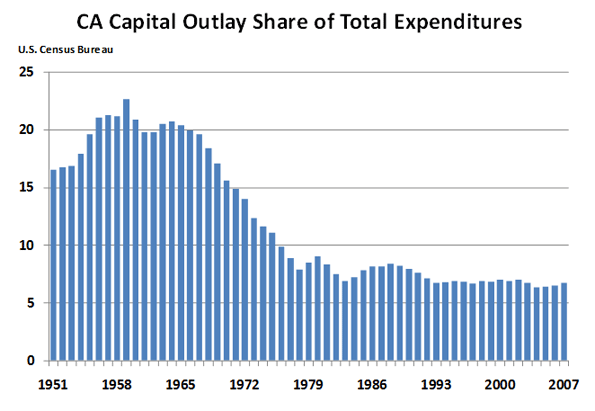
    Not likely. Today, we are not even maintaining our infrastructure. Infrastructure investment’s share of California’s budget has declined for decades. In Pat Brown’s day California often spent over 20 percent of its budget on capital items. Today, that number is less than seven percent. It shows.

    Pat Brown also knew that with California’s natural endowment, all he had to do was build the public infrastructure and welcome business, business will come. Too many today act as if they believe that business will come, even without the infrastructure or a welcoming business climate. Indeed, many Californians – particularly in the leadership in Sacramento – seem to think that business will come no matter how difficult or expensive the state makes doing business in California. This is just not true.

    California needs to embrace opportunity and economic growth. It is necessary if California is to achieve its potential. It is necessary if California is to avoid a stagnant future characterized by a bi-modal population of consuming haves and an underclass with little hope or opportunity and few choices, except to leave.

    Bill Watkins is a professor at California Lutheran University and runs the Center for Economic Research and Forecasting, which can be found at clucerf.org.

  • Memo to Big City Pols: Voters’ Suspicions on Influence Peddling Is Far Cry From Stupidity

    A significant clue on why the City of Los Angeles is facing budget deficits of hundreds of million annually for the foreseeable future can be found in the relationship between elected officials and AEG, the company that’s controlled by Denver-based multi-billionaire Philip Anschutz.

    AEG owns the Staples Center and the adjacent L.A. Live, which includes shops and restaurants to go with one nice hotel and another luxurious establishment that will be topped by high-priced condominiums when completed.

    AEG has a prime a seat on a gravy train of benefits ladled out by our city and state governments. Those hotels came with a tax break that is expected to amount to tens of millions of dollars over coming years. The city also provided attractive terms on a $70 million loan for the project. State legislators have passed laws that appear to many rational observers to have been crafted specifically to steer tens of millions of dollars worth of benefits to AEG.

    Some politicians like to say that AEG is deserving of such largesse because it has brought development and jobs to the city’s center. That’s appreciated, but let’s not forget that AEG is a private enterprise that’s in the business of making money. The company had to develop some land and hire some workers to make money on its plans Downtown. It would be nice to see the company’s investment earn a tidy profit, but there’s no case for sainthood in any of the business plan.

    Meanwhile, AEG has been a patron saint of sorts when it comes to local politics, giving hundreds of thousands of dollars to various candidates and campaigns. The company even pitched in with $137,000 – the largest of all contributors – to a ballot measure that extended term limits for members of the City Council.

    Do you see some possible connection there? Is there a chance that some corporate executives have used money to gain influence over public officials?

    Ask around and you’ll find that most everyday, working voters see a connection – or at least the possibility of one.

    And here’s where we get to the explanation on the hundreds of millions of dollars in budget deficits: It seems that members of the political class don’t ask around – and they don’t think regular folks are smart enough to call elected officials to account.

    What else to make of recent comments by 9th District City Councilmember Jan Perry, who represents most of Downtown. Perry has looked like AEG’s personal body guard during the recent fan dance over suggestions that the company should pay some re-imbursement for public services dedicated to the memorial service for Michael Jackson earlier this year, a tab that came to approximately $3.2 million. Some say that AEG should pay up because the company benefited from the spectacle surrounding the singer’s death by selling rights to film footage from his final days, when he used the Staples Center for preparations on what was to be a global tour.

    Perry recently took the opportunity of the flap to dismiss concerns that AEG uses political donations to exercise undue influence over city officials.

    “AEG doesn’t own the place,” said Perry, referring to City Hall in a recent story in the Los Angeles Times. “I think that’s a really stupid way to think.”

    Perry got away with an old political trick there, putting over-the-top words in the mouths of any mere taxpayers who might have questions about the relationship between AEG and elected officials. She ramped up the charges in a pre-emptive logical fallacy that dismisses anyone with suspicions of influence peddling as unworthy of an opinion on the matter.

    Perry must think that anyone outside of City Hall is stupid, indeed. Stupid enough to fall for that verbal twist. Stupid enough to think that there’s nothing to any suspicions unless it can be proved that AEG actually holds a mortgage on City Hall.

    The people are not stupid, though. Voters know that influence peddling is a shadowy business, and that big corporations and the executives who run them are careful about the legalities and perceptions that come with the flexing of their political muscles.

    You’d think a politician with Perry’s experience would be just as careful about calling voters stupid. After all, they’re smart enough to pay for all of those breaks for AEG – not to mention her salary.

    Jerry Sullivan is the Editor & Publisher of the Los Angeles Garment & Citizen, a weekly community newspaper that covers Downtown Los Angeles and surrounding districts (www.garmentandcitizen.com)

    Photo:

  • When Granny Comes Marching Home Again… Multi-Generational Housing

    During the first ten days of October 2008, the Dow Jones dropped 2,399.47 points, losing 22.11% of its value and trillions of investor equity. The Federal Government pushed a $700 billion bail-out through Congress to rescue the beleaguered financial institutions. The collapse of the financial system in the fall of 2008 was likened to an earthquake. In reality, what happened was more like a shift of tectonic plates.

    *******************************************

    The driveway tells the story. The traditional two-story 2,200 square foot suburban home has a two-car attached garage. Today’s multi-generational families fill the garage, the driveway and often also occupy the curb in front of the home. The economic crisis that is transforming America is also changing the way we live. The outcome will change the way America views its housing needs for the balance of the 21st Century.

    As is often the case, we can more clearly see the future by looking into our past. That is because time and time again America has reverted to its roots when confronted with a challenge. The root of the American family is the home. A century ago, America was an agrarian nation. Most Americans grew up on the farm or in a small town often tied to agriculture. A century ago, our census was 92,000,000, less than one-third of today’s population. Los Angeles was a city of 319,000. Cleveland was the fifth largest city with 560,000. The tenth largest city in 1910 was Buffalo NY with 423,000 souls.

    A century ago, parents, children, grown children, and grandparents lived together in America’s homes. In 1910, the vast majority of kids did not go off to college. They stayed home and worked the farm. Mom certainly did not drive and usually she did not work outside the home. Grandma – who then as now usually outlived grandpa – did not go off to an active senior housing project or nursing home at age 55. With the average life expectancy at just 49 years, there was little market for such facilities. A young Grandma lived in the family home and helped with the cooking, the sewing and the child rearing.

    Along the way, we fought in two world wars, America industrialized and the great Middle Class exploded. Our children went off to college and did not return. Our cities exploded. By the end of the century, Los Angeles grew to 3,700,000. The tenth largest city was Detroit with 1,000,000. Children were expected to leave the home shortly after high school and never come back, except to visit.

    Big changes occurred on the other end of the demographic curve. As life expectancy grew to 75. Grandma had her choice of active senior living, congregate care or a skilled nursing facility when she hit 70 and slowed down.

    The expectations of greater family dispersion – with young people leaving home early and grandparents on their own – drove much of real estate thinking at the end of the 20th Century. With empty-nesters and young people both heading back to the city, urban planners were focusing on high-rise apartments and condominiums in dense urban areas. Many eagerly anticipated the death of the suburbs since the number of young families declined. Across the country, and even in suburban areas like the City of Irvine, CA brilliant urban planners began rezoning industrial land into high density housing. The face of America was thought to be changing in predictable ways.

    Then, along came 2008 and the economic crisis. The plates under our feet began to shift. The mass migration to dense urban living evaporated as people stayed put and speculating in condos lost all economic logic. The shiny new urban corridor in Irvine now lined with high rise housing sits empty, with many units vacant and foreclosed. In nearby Santa Ana, twin 25-story residential towers sit eerily vacant with not a single unit sold or occupied. Central Park, a giant new urban project in Irvine that boasted dense high-rise, townhouse and mid-rise units, sits vacant behind green security fences.

    Where did the buyers go? Many young people moved back home with their parents when their high paying jobs in real estate or mortgage brokerage disappeared. With their jobs and income gone, they sought refuge in the safety of their childhood homes. Their parents ended any speculation of selling and down-sizing when their children returned. With job creation non-existent, they do not plan on leaving anytime soon. In one recent Pew study, 13 percent of parents with grown children reported one of their adult offspring had moved back home in the past year. Roughly half of the population 18 to 24 still lives with their parents.

    This stay-at-home trend predates even the recession. According to the U.S. Census Bureau, the national relocation rate in 2008 was the lowest since the agency started tracking the data in 1948. The rate was 11.9 percent in 2008, a decline from 13.2 percent in 2007. The 2008 figure represents 35.2 million people, which is the smallest number of residents to move since 1962. The number was 38.7 million in 2007.

    What about Grandma and, increasingly, even Grandpa? Our parents, thanks to the miracle of modern medicine, are living longer than ever. If she has reached age 65, she can expect to live another 20 years. Unfortunately, her retirement account and savings plan may not. Many Americans are living well into their 90s and we will see the first wave of centurions in our lifetime. No one expected this to happen and we are unprepared for it. Grandma will not be able to afford the $3,000 to $4,000 a month expense of a quality retirement facility – for 20 years.

    This changing dynamic will alter movement of Americans, which has now been slowing down for a generation. In 1970, nearly 20 percent of Americans changed their place of residence every year. But by 2004, that figure had dropped to 14 percent, the lowest level since 1950. The tough economy and aging demographics will slow migration down even more. Mom and Dad will not find it easy to take that new position in another city with the kids at home and now Grandma, and even Grandpa, too.

    This will have profound impact on the kind of housing Americans will want. Homebuilders may find lower demand for single family houses as America doubles up but it will be the much ballyhooed drive to urbanize America with dense high-rise units that is most in danger.

    Extended families will want larger – not smaller – houses. They may not be able to afford McMansions, but conventional suburban houses will be changed to meet the demands of extended families. Granny flats, consisting of self contained ground floor units, will be in demand as the baby boomer generation moves into retirement. Smaller single floor homes called Casitas will need to be mixed into planned developments so that the Grandparents can live closer to the children.

    City staff and urban planners, already grappling with a mandate to accommodate global warming and carbon footprints, will have to rethink existing zoning rules which have not yet responded to the new reality. This reality will be driven by aging demographics, diminished capital and the shifting plates of our economy. The baby boomer “bubble” that is now beginning to retire is a well established fact. Lesser known is the impact of the financial crisis on young workers who simply have been priced out of the housing market. Along the pricier coasts and Northeastern cities, they will need the down payment from their parents – who in exchange will live with their kids – to purchase their own home.

    The kids have already come home. Like the financial downturn, they will not be leaving anytime soon. Grandma is next in line. When she comes home, the circle will be complete, with consequences few in the real estate industry have yet to contemplate seriously.

    **********************************
    This is the sixth in a series on The Changing Landscape of America. Future articles will discuss real estate, politics, and other aspects of our economy and our society.

    Robert J. Cristiano PhD is a successful real estate developer and the Real Estate Professional in Residence at Chapman University in Orange, CA.

    PART ONE – THE AUTOMOBILE INDUSTRY (May 2009)
    PART TWO – THE HOME BUILDING INDUSTRY (June 2009)
    PART THREE – THE ENERGY INDUSTRY (July 2009)
    PART FOUR – THE ROLLER COASTER RECESSION (September 2009)
    PART FIVE – THE STATE OF COMMERCIAL REAL ESTATE (October 2009)

  • Migration: Geographies In Conflict

    It’s an interesting puzzle. The “cool cities”, the ones that are supposedly doing the best, the ones with the hottest downtowns, the biggest buzz, leading-edge new companies, smart shops, swank restaurants and hip hotels – the ones that are supposed to be magnets for talent – are often among those with the highest levels of net domestic outmigration. New York City, Los Angeles, San Francisco, Boston, Miami and Chicago – all were big losers in the 2000s. Seattle, Denver, and Minneapolis more or less broke even. Portland is the only proverbially cool city with a regional population over two million that gained any significant number of migrants.

    Those who find this an occasion for a schadenfreude moment attribute it to tax and regulatory climates. Clearly, things like cost of doing business are clearly very important. And indeed this is often under-rated by cool city proponents. And other things equal, people do prefer low tax jurisdictions. Still, is this the only answer, or is there another explanation? Could it be that rather than high costs driving migration, both costs and migration are being driven by other underlying factors?

    Perhaps the root problem is structural change in the economy in the age of globalization. As business became more globalized and more virtualized, this created demand for new types of financial products and producer services – notably in the law, accounting, consultancy, and marketing areas – to help businesses service and control their far flung networks. Unlike many activities, financial and producer services are subject to clustering economics, and have ended up concentrated in a relatively small number of cities around the world.

    These so-called “global cities” serve as control nodes for various global networks and key production sites for these services, along with other specialized niches they long had. In effect, more distributed economic activities requires increasing centralization of select functions, particularly the most highly value-added functions. Yet these activities are not set in stone; for example, areas that were once centers for global business, like Cleveland or Detroit, are fading; others like Houston and Dallas are rising.

    Yet unlike the Texas cities, which retain a strong middle-class and middle-echelon economy, many of the more elite, established urban centers – for example New York and London – increasingly create parallel economies and labor markets in those cities. These cities now generally contain two kinds of people and firms: those who are part of the global city functions and those who are not. Those who are engaged in global city functions operate in a world of very high value-added activities; specialized, niche skill markets; and rising demand conditions. Those skills are not readily acquired outside of global cities. Often, they are sub-specialized to particular places as different global cities specialize in different niches.

    In many cases, these functions have not yet migrated to India or China or often even another global city. This tends to inflate salaries significantly for these specialized, niche skill jobs.

    On the other hand, many people who once thrived in these cities have not benefited from these economic forces. They often are in occupations where labor arbitrage is feasible, and their jobs can either be off-shored, or readily transferred to lower cost locales in the US. This includes manufacturing work, but also important but less specialized white collar occupations like basic accounting, loan officers, corporate IT, and HR. In short, the routine side of the traditional monolithic corporate headquarters and services firm.

    In effect, in these global cities, two economic geographies share the same physical geography – and those economic geographies are in conflict. One set requires catering to high skill, highly paid workers and firms where cost is a secondary concern. The other involves occupations and industries where cost is very much a concern. The occupants of these two geographies have very different public policy priorities. Which of them will win out?

    In a global city, particularly a mature and expensive one, the elite geography wins. It is generating the most money, and with money comes power and influence. Additionally, the high wage workers in these industries are simply able to pay more for real estate and other items. Their mere paychecks are driving up costs in the city they live in. They are re-ordering the city in their own high income image, aided and abetted by a speculative financial fueled housing bubble.

    The prestige of these industries burnishes the civic brand, making them attractive to civic boosters. What’s more, leaders in global cities feel that these are their businesses of their future. For them the attractiveness of concentrating in areas where you think you can create a “wide moat” advantage makes sense.

    This is why cities like Portland, Minneapolis, Denver, and Seattle haven’t fared nearly so badly – they aren’t really full metal global cities and thus, while not always cheap, have remained relatively affordable versus places like San Francisco and New York.

    At the same time it is not easy for these more expensive cities to adopt a low tax, low cost approach. For many reasons, places like San Francisco, New York, and London will never, no matter what they do, be able to match Atlanta, Houston, or Dallas, or even Chicago in a war on costs. That would be a suicide mission. Their logical strategy is to follow the law of comparative advantage, and specialize where you have the best competitive position in the market, and that’s global city functions.

    Many other cities have followed this strategy, but with differing success. Fearing to end up like the next Michigan and Detroit pair, many states and cities have invested heavily to build up urban amenities to cater to the global city firms and their workers: transit systems, showplace public buildings, art and culture events, bike lanes, and beautification. Cost fell by the wayside as a concern, as did investments in priorities of the traditional middle class.

    This explains why, for example, not only have taxes gone up, but things like schools and other basic services have declined so badly in places like California. Traditional primary and secondary education is not important to industries where California is betting its future. Silicon Valley, Hollywood, and biotech draw their workers from the best and brightest of the world. They source globally, not locally. Their labor force is largely educated elsewhere. Basic education and investments in poorer neighborhoods has no ROI for those industries. With the decline of high tech manufacturing in Silicon Valley, even previously critical institutions such as community colleges are no longer as needed.

    The same goes for growth and sprawl. They are playing a game of quality over quantity. They specialize in elite urban areas and elite suburbs or exurbs. For example, San Francisco also has Marin, Palo Alto and Los Altos Hills. New York has, in addition to Manhattan, Greenwich and northern Westchester. The only thing they need size for is sheer scale in certain urban functions, and they already have it. Growth is unnecessary for them and only brings problems.

    It also explains the highly pro-immigration stance of these cities, as a large service class is needed for globalization’s new aristocrats. Immigrants are needed as low cost labor in the burgeoning restaurant and hotel business. In America’s global cities immigrant housekeepers, landscapers, and nannies are common. They may not dress like His Lordship’s butler, but that doesn’t make them any less servants.

    Lastly, it explains why we have seen the same polarizing class pattern so consistently despite broad geographic and socio-political differences between places like Los Angeles, Boston, and Chicago, to say nothing of overseas locales like London. A common global phenomenon probably has a common underlying cause.

    The traditional middle class, feeling the squeeze, is simply moving to where its own kind is king and its own priorities are catered to. In a battle of conflicting economic geographies, the one with higher value added wins, displacing others in what Jane Jacobs termed the “self-destruction of diversity”. First, an attractive environment draws diverse uses, then one becomes economically dominant and, through superior purchasing power, displaces other uses over time. The story ends when that dominant economic activity exhausts itself – the true danger facing global cities, though fortunately they are generally not dependent on just one small niche. It’s basic comparative advantage.

    If you are just an average middle class guy, why live in one of those global cities anyway? Unless you have roots there that you value, take advantage of something you can’t get anywhere else such as by having a passion for world class opera, or are one of globalization’s courtiers – a hanger on like a high end chef, artist, or indie rocker, perhaps – why put up with the high cost and hassles? It makes no sense. You’re better off living in suburban Cincinnati than suburban Chicago.

    And frankly, the folks on the global city side prefer it if you leave anyway. Immigrants are unlikely to start trouble, but a middle class facing an economic squeeze and threat to its way of life might raise a ruckus. That won’t happen if enough of them move to Dallas and rob the rest of critical mass and resulting political clout.

    Many of those leaving are college educated, especially, when they get older, get married, and start having families. A relatively large number of these people could be replaced by a smaller number of elite bankers, biotech PhDs, and celebrity chefs. In that case, both “narratives” could hold simultaneously. One type of talent moves in, while a greater number of a different kind moves out. As with trade generally, this could even be viewed as a win-win in some regard.

    Again, it is easy to blame the costs and public policy. Clearly there is room for improvement in governance such as reigning in out of control civil service pay and pensions in places like California and New York. But what is more pernicious is the rising income gap in America, and the likely outcomes it drives when a city acquires a small elite economic class with incomes that far outstrip the average, and lacks strong economic linkages to the rest of the city other than for personal services. It sets in motion economic logic that undermines the traditional middle class, which then starts leaving, exacerbating the gap.

    For years we worried that a large, stable middle class with a permanent, largely minority underclass constituted an unjust order. As it turns out, the alternatives are sometimes worse. Ultimately some American cities have come to take on the cast of their third world brethren, a perhaps somewhat less extreme version of Mexico City or São Paulo, where vast wealth and glitter exist side by side with the favelas.

    This explains why America’s global cities often feel more kinship with their international peers than with many of the places in their own country. The global cities, which now enjoy something of a political ascendency, are also sundering the American commonwealth. Taking steps to prevent a further widening of the income gap may be the only way to save these cities’ middle class – and maintain the solidarity of the country.

    Aaron M. Renn is an independent writer on urban affairs based in the Midwest. His writings appear at The Urbanophile.

  • Think Globally, Regulate Locally

    It was during a recent tour of a sun-baked Los Angeles schoolyard that theories on state regulations developed by the latest Nobel Prize-winning economist came into focus. The Da Vinci Design Charter School is an oasis in an asphalt desert. Opened this year by the appropriately named Matt Wunder, the school draws 9th and 10th graders from some of the most difficult and dangerous learning environments in the country, and introduces them to a demanding, creative atmosphere.

    The school is located just south of Los Angeles Airport. Wunder is taking advantage of the area’s proliferation of aerospace companies, and is building relationships with the likes of Boeing and Northrop Grumman, which offer financial and educational assistance. This is not the standard thinking one finds in the mammoth Los Angeles Unified School District.

    As we walked the playground we came upon two dirt-spewing holes in the blacktop, spaced about 50-feet apart. We discovered an actual human being with a shovel digging what looked like the beginnings of a mine shaft. The reason?

    California State regulations, as established by the California Architects Board, require all basketball hoops on public school campuses to be cemented into 50-inch deep holes. That’s four-feet-two inches for a basketball hoop!

    Now I am sure some scientifically sound earthquake testing at a California university found that such precautions are necessary if we are ever struck with a 9.9-Richter scale disaster. Of course, if such a thing happened we would have bigger problems than basketball rims keeling over. But a larger point became clear: In a school where creative leadership is making life-long impacts on the lives of children, the “long arm” of Sacramento has reached into the very soil, regulating how deep to dig ditches for recreational equipment. In so doing the State not only increases “construction” costs, but also incurs our disenchantment, as we consider a government that “trusts” local decision-making on curriculum, but not on hole digging.

    The theories of Elinor Ostrom, one of this year’s two Nobel Prize-winners in economics, tie in here with stunning irony. Ostrom, a political scientist at Indiana University, won the prize for her historical and economic analysis concerning the “tragedy of the commons”: the theory that, without some form of regulation, when people fish or farm “common” (non-private) property they will tend to abuse the privilege and hurt all interests in the end.

    A major underpinning of this theory is how these rule sets are most effectively developed. Ostrom found, in studies dating back centuries, that local parties –- sometimes non-governmental ones — almost always determine the best regulations, based on deliberated self-interest as opposed to centralized (and, often, distant) institutions.

    As Vernon Smith, a past economics Nobel laureate himself, recently commented on Ostrom’s work, “A fatal source of disintegration is the inappropriate application of uninformed external authority, including intervention to prevent application of efficacious rules to political favorites.” As rule-making becomes more removed from the actual location of execution, there’s a loss of “local knowledge” regarding conditions. And “interests” that tend to gather around centralized institutions have a disproportionate influence on legislation.

    At a recent conference on sustainable planning at Pepperdine University, I sat in on a discussion of “natural resource management” and heard a relevant story of competing, predominantly left-leaning interests. In one corner were the “green” energy folks who had attempted to build a massive solar “farm” in the Mojave Desert. In the same, uh, other corner, were the defenders of the desert tortoise. Not wanting to get anyone in trouble, I will just say that officials from several State and Federal departments were present to talk about how, once again, centralized decision-making had sunk an impressive project.

    Apparently, when alerted to the possibility of frying turtles under the heat of these huge solar mirrors, local park authorities provided a proposal to mitigate the loss of these reptiles through a variety of measures from fencing along the highways to moving the turtles to non-developed areas. This was not good enough for State decision-makers who, from the exalted heights of Sacramento, determined that the only legitimate course of conservation would be to land-swap the entire 8,000+-acre land parcel for another similar and suitable section for these animals. As one local official recounted, “If the goal of the policy is to save tortoises, we had that plan, which also kept the solar project alive. But the goal of the policy was to do a land exchange, which is stopping the project, and not doing all that much better for the tortoises.”

    My point in raising these two of what could be thousands of examples of overreach by the administrative state is not to dismiss government’s central and important role in advising, and, at points, regulating the actions of citizens in areas ranging from public safety to sustainable planning. Rather, it’s to demonstrate what happens when policy goals are subsumed by prescriptive policy created at levels (such as Sacramento in a state the size of California) which cannot possibly allow for unique local conditions. The goal is not just child safety, or saving tortoises, but to accomplish these in a certain way that may, in fact, prevent these greater benefits to the public good.

    This style of governance exasperates the well-intentioned in both the private and public sector, as it prevents the liberty necessary for creative and customized policy-making. This common sense approach to policy-making is, apparently, what they give out Nobel Prizes for these days.

    It was Alexis De Tocqueville who most famously realized that the genius in American governance was decentralized administration , an aspect directly contrary to the European bureaucratic experience. In words that could have appeared in Professor Ostrom’s classic, Governing the Commons, De Tocqueville wrote over 150 years ago, “When the central administration claims to replace completely the free cooperation of those primarily interested, it deceives itself or wants to deceive you. A central power, however enlightened… cannot gather to itself alone all the details of the life of a great people.”

    Let us not be so deceived.

    Pete Peterson is Executive Director of Common Sense California, a multi-partisan non-profit organization that supports civic engagement in local/regional decision-making. His views here are not meant to represent CSC. Pete also teaches a course on civic participation at Pepperdine University’s School of Public Policy.

  • California: The Housing Bubble Returns?

    To read the periodic house price reports out of California, it would be easy to form the impression that house prices are continuing to decline. Most press reports highlight the fact that house prices are lower this year than they were at the same time last year. This masks the reality of robust house price increases that have been underway for nearly half a year. The state may have forfeited seven years of artificially induced house price escalation in just two years but has recovered about one-fifth of it since March.

    California Housing Market Since 2000: In 2000, the average median house price among California markets with more than 1,000,000 population was $291,000. The Median Multiple (median house price divided by median household income) was 4.5, making houses in California approximately 50% more costly relative to incomes than in the rest of the nation.

    According to the California Association of Realtors, the average median price peaked at $644,000 between 2005 and 2007, depending upon the particular market. This nearly 140% price increase translated into a more than doubling of the Median Multiple, to 9.2.

    Median prices fell rapidly from the peak, dropping at their low point to an average of $315,000. The average Median Multiple fell to 4.4, slightly below the 2000 level, but still well above the national level. All markets reached their low points in the first part of 2009.

    It is at this point that the business press lost track of what was going on. Of course, year on year price declines continued, but only because the price declines had been so severe early 2008. Since the bottoming out of house prices, there have been strong gains. As of September, the average median house price among the major metropolitan areas was $383,000, a nearly 20% increase from the low point. Moreover, in dollar terms, median house prices recovered nearly 20% of their loss from the peak to the low point.

    Major California Markets: Median House Prices: 2000 to Present
    Metropolitan Area (MSA) 2000 Peak Low Point 2009/09 Loss: Peak to Low Pt Change from Low-Pt
    Los Angeles: Los Ang. County  $ 215,900  $ 605,300  $  295,100  $  351,700 -51.2% 19.2%
    Los Angeles: Orange County  $ 316,200  $ 747,300  $  423,100  $  496,800 -43.4% 17.4%
    Riverside-San Bernardino  $ 144,000  $ 415,200  $  156,800  $  172,400 -62.2% 9.9%
    Sacramento  $ 172,000  $ 394,500  $  167,300  $  184,200 -57.6% 10.1%
    San Diego  $ 231,000  $ 622,400  $  321,000  $  386,100 -48.4% 20.3%
    San Francisco  $ 508,000  $ 853,900  $  399,000  $  536,100 -53.3% 34.3%
    San Jose  $ 448,000  $ 868,400  $  445,000  $  553,000 -48.8% 24.3%
    Average  $ 290,700  $ 643,800  $  315,300  $  382,900 -52.1% 19.4%
    Exhibit: Median Multiple            4.5            9.2            4.4            5.2
    Above Historic Norm (3.0) 50% 208% 46% 73%
    Derived from California Association of Realtors and National Association of Realtors data
    Note: California Association of Realtors divides the Los Angeles MSA into Los Angeles and Orange counties

    Profligate Lending: It is critical to note that the inflated house prices that existed two to three years ago were wholly artificial. Prices had been driven up by the special and hopefully never to be repeated conditions of profligate lending, which increased demand.

    California: Regulating Away Housing Affordability: But the increase in demand alone would not have been enough to produce the unprecedented house price increases had public officials and voters not established a veritable mish-mash of housing supply regulations. The house price increases were driven ever higher by these severe land use restrictions, which prevented housing markets state from meeting demand.

    Supply restrictions, which go under various names, such as compact development, urban containment and “smart growth,” have been a feature of California housing for some time. Examples of such policies are urban growth boundaries, building moratoria and expensive development impact fees which disproportionately tax new homes for the expanded community infrastructure a rising population requires.

    As more loose lending practices increased the demand for home ownership, the inability (and unwillingness) of the state’s land use regulations prevented the housing supply from increasing in a corresponding manner. With demand for housing far outstripping supply, prices had nowhere to go but up. The result was short term house price escalation that may have never occurred before in a first-world nation.

    Contrast with Healthy Housing Supply Markets: There was a stark contrast with house price increases in the liberally regulated markets around the nation. For example, in Atlanta, Dallas-Fort Worth and Houston, house prices remained near or below the historic Median Multiple norm of 3.0, as the supply vent was allowed to operate. This is despite the fact that there was a strong underlying increase in demand for home ownership (measured by domestic migration) in these and other liberally regulated markets. In the California markets, on the other hand, there was overall negative underlying demand, with significant domestic out-migration. Of course, speculation ran rampant in California, as could be expected in any market where asset values are responding to a severe shortage of supply relative to demand.

    By the 1990s, Dartmouth’s William Fischel had associated California’s high house prices relative to the nation with the intensity of its land use regulation. In 1970, as the more severe regulations were beginning, house prices in California were at approximately the same level relative to incomes as in metropolitan areas in the rest of the nation.

    California’s disproportionate losses are illustrated by the fact that its major metropolitan areas have less than twice as many total owned houses as those in Texas (Dallas-Fort Worth, Houston, San Antonio and Austin), yet experienced gross value losses 85 times as great as the Texas metropolitan areas by Meltdown Monday (September 15, 2008, when Lehman Brothers failed).

    Recent Price Increase Rate Exceeds the Bubble: While widely unnoticed, the post-bottom median house price has increased 20%. In six months or less, the average median price increase among California metropolitan areas exceeded the annual price increase for all of the bubble years except one, which was 22% in 2004. The 2009 price increase rate, annualized, is nearly double that. As a result, despite the widely reported bubble collapse, California’s housing affordability now is worsening relative to the rest of the nation. The prospect could be for further inflation of the bubble, with the passage of Senate Bill 375, which is likely to lead to even more intensive land use restrictions, on the false premise that higher densities will materially reduce greenhouse emissions. As governments increasingly force development to occur only where it prefers, the property owning winners can extract much higher prices than would occur if there were more competition.

    This of course will mean that the more dense housing units built will be even more expensive, even as the market is prohibited from supplying the larger detached homes that households overwhelmingly prefer. All this will make California less competitive, something the increasingly uncompetitive Golden State could do without.

    Another View: The recent price escalation, however, may be illusory. The widely read California real estate blog, Dr. Housing Bubble suggests that the first wave of “sub-prime” loan failures that constituted the bubble burst could be followed by a second wave over the next few years, driven by “option arm” mortgage resets. The Doctor notes that these loans are concentrated in California and other ground zero states (Florida, Arizona and Nevada), unlike the previous wave, which was more evenly spread around the nation.

    In the End: Regulation Will Lose the Day: Thus, the “jury is still out.” The bubble may be re-inflating in California, or another bust could be on the horizon. However, in a state that has given new meaning to regulatory excess, the longer run prospects call for artificially higher housing prices, unaffordable to much of the state’s middle class. This means that California will continue to become an ever-more bifurcated state, between an aging, largely affluent coastal homeowning population and, well, just about everyone else.

    Photograph: Los Angeles (Porter Ranch in the San Fernando Valley)

    Wendell Cox is a Visiting Professor, Conservatoire National des Arts et Metiers, Paris. He was born in Los Angeles and was appointed to three terms on the Los Angeles County Transportation Commission by Mayor Tom Bradley. He is the author of “War on the Dream: How Anti-Sprawl Policy Threatens the Quality of Life.
  • Long Beach Freeway Saga

    The Los Angeles Times reports progress toward completion of the Long Beach Freeway (I-710) gap between Valley Boulevard in East Los Angeles and Pasadena, with a geologic study finding a tunnel alignment to be feasible. Real progress is overdue. My great aunt and great uncle were forced out of their house in the early 1960s in South Pasadena by the California Highway Department, in anticipation of building the freeway. I suspect the house is still there.

    For nearly one-half century, South Pasadena residents have opposed building the “Meridian” route that would have dissected the city. They were not against the freeway per se, but rather preferred the “Westerly” route, which would have skirted the city. The state had selected the Meridian route. In the middle 1980s, while a member of the Los Angeles County Transportation Commission, I served on a special route selection committee chaired by former county supervisor Peter F. Schabarum. Under our legislative authority, we also selected the Meridian route. Nothing came of it.

    It is to be hoped that serious efforts to close the gap will be underway soon.