Tag: Los Angeles

  • Property Owners Pay for City’s Dysfunction Under L.A.’s New Graffiti Ordinance

    Graffiti is a bane of urban life, a form of vandalism that demoralizes entire neighborhoods and invites worse crime.

    Graffiti is an art form and an outlet for expression amid the jumble and obvious strains of urban life.

    You’ll hear arguments from both of those viewpoints, depending on who you talk to about graffiti.

    The Garment & Citizen is of the firm opinion that anyone is free to consider graffiti an art form – but all should be mindful that such status doesn’t give anyone the right to express themselves by painting, etching or otherwise tagging someone else’s property. Pablo Picasso himself would not have had any right to create his “Guernica” on the side of someone else’s building, as far as we’re concerned.

    It would have been a loss to the world, of course, if Picasso had gone through life with no canvass for his genius. The world needs Picassos, and it’s important to remember that such talent sometimes grows on tough corners.

    It would be an ideal situation if we had a school system that could consistently engage such talented individuals…and parents with the time to nurture youngsters inclined toward art…and an overall outlook as a society that values art as something more than a commodity to be marketed.

    We’re lacking to some degree or another on each of those counts.

    Consider what goes on before some kid decides to emblazon graffiti on someone else’s property.

    First, there’s been some breakdown in the family unit. Sometimes it’s a parent or parents who don’t care enough to warn their children off such behavior. Other times they are too busy trying to feed and clothe their kids, leaving little time to teach them right from wrong.

    You can bet that many cases also involve a school that has failed to engage and educate the youngster.

    There’s probably a lack of after-school resources, too, leaving kids to find camaraderie with mischief makers while their parents are still working.

    All of these factors come into play on graffiti in our city. They all point to the dysfunction that has found a cozy spot in Los Angeles for decades.

    We live in a city where the minimum wage is $8 an hour, which will bring $320 for a 40-hour week – hardly enough for rent. Is it any wonder that folks at the bottom end of the pay scale might have to spend more time working and fewer hours on their child’s upbringing?

    Everyone knows that the drop-out rates at Los Angeles Unified School District (LAUSD) campuses are sky high in general, and higher still as you move down the socio-economic ladder. Yet not much ever changes when it comes to expectations of how well the organization teaches our children.

    Then there’s the Los Angeles Police Department (LAPD), which recently came close to a roster of 10,000 officers, the highest mark in the agency’s history. Compare that to other major cities in the U.S. and you’ll see that we still don’t have enough cops. We have never had enough cops. And now there’s talk of trimming staffing levels for LAPD because the city is short on money.

    These are the pillars of the dysfunction that we have lived with for years in Los Angeles. How does a city go so far down a path of ignoring all these problems and allowing the ground for graffiti vandals to grow so fertile?

    Look no further than City Hall. That’s where members of the City Council recently passed an ordinance that will require any new commercial or residential buildings to include anti-graffiti coatings on the structures. The only exception comes if a property owner signs a lifetime contract to remove any graffiti within a week.

    There you have it – this problem rolls downhill. Failure upon failure leads to the doors of property owners. They must, under the ordinance, join city officials in giving up on any thoughts about directly addressing graffiti vandalism. They must, our elected officials say, pay good money to prepare to be vandalized.

    The new ordinance is one way to raise revenue, but it also raises a white flag of surrender – a de facto confirmation that our elected officials lack the governmental skill and political will to face up to graffiti vandals and address the various factors behind the crime.

    That’s a dictionary definition of dysfunction – and it passed the Los Angeles City Council unanimously.

    Jerry Sullivan is the Editor & Publisher of the Los Angeles Garment & Citizen, a weekly community newspaper that covers Downtown Los Angeles and surrounding districts (www.garmentandcitizen.com)

  • The Limits of Transit: Costly Dead-End

    The proposed Chicago Transit Authority (CTA) fare increase and service cuts for next year are indicative of transit’s recurring budgetary problems, and not only in Chicago but nationwide. But in the Windy City, these moves have elicited an understandably negative public reaction since the city of Chicago depends on transit about as much as any city besides New York.

    CTA, like other transit agencies around the nation routinely, claim that fare increases and service cuts are necessary due to under-funding. Transit budget crises seem to come as often as Presidents day in many places and more often than February 29 (every four years) virtually everywhere.

    If under-funding were the primary problem, then an examination of historic trends would indicate that the money available to transit had declined (after adjusting for inflation) relative to ridership. But in nearly all cases, including both the CTA and the national data, this is far from the truth.

    Cost Escalation at CTA: Despite its storied history as one of the nation’s premier transit agencies, CTA has suffered heavy ridership losses since its modern peak in 1979. A principal reason for this decline was a series of devastating fare increases that would not have been necessary if costs had been maintained within inflation. In 2007, CTA spent 13% more (inflation adjusted) to run its buses and trains than in 1979. That would be fine if ridership had risen 13% (or more), since then both riders and taxpayers could feel that they had obtained value for money. However, ridership dropped by more than 2 percent. If CTA had kept its costs per passenger within inflation, it would have at least $400 million more each year, and would have no need to consider fare increases or service reductions.

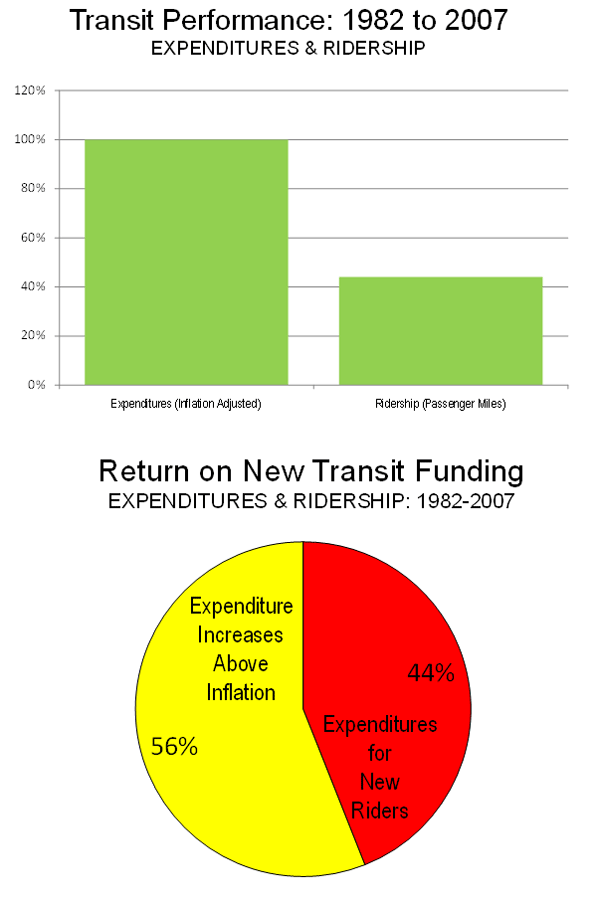
    National Transit Cost Escalation: Between 1982 (the last year before the federal gas dedicated gas tax for transit) and 2007, national transit ridership (passenger miles) rose 44% percent. At the same time, transit expenditures, adjusted for inflation, rose 100%. This means that each new inflation adjusted $1.00 for transit delivered $0.44 in new value (additional ridership). If transit had kept expenditures growth within inflation, there would have been in excess of $13 billion in 2007 (See Note).

    In contrast, the price (or cost) of most products and services rise about with the rate of inflation or slightly more or less. Over the same period of time, automobile and airline costs per passenger mile have declined, producing more than $1.00 in value for each new inflation adjusted dollar. Food costs have declined 3 percent relative to inflation, energy costs have declined 2 percent relative to inflation and housing costs have risen 1 percent relative to inflation.

    Transit’s Intractable Fiscal Problem: Transit is incapable of producing ridership increases that coincide with its funding increases because of its structure. Transit is a monopoly, and an unregulated monopoly incapable of managing itself effectively. Private monopolies, such as electric utilities, are routinely regulated. Economic theory generally holds that monopolies are to be avoided, because of their power to violate the interests of consumers by passing on higher than necessary prices and substandard service. No responsible government would think of granting a monopoly to a private company without exercising regulatory control to ensure that the company does abuse its position of power.

    Before the wide availability of subsidies to transit, there were private companies, which could not raise fares or cut service without regulatory review and approval. It was not the best possible system, but it was designed to principally serve consumers. But government is different. There are no commissions set up to regulate government monopolies, like transit.

    Competitive Incentives: The antidote to monopoly is competition, and transit costs cannot be controlled without it. There is a successful model. Transit agencies can competitively bid and competitively contract bus routes for limited periods of time, requiring firms to supply services they specify. The public agency continues to draw the routes, establish the timetables and set the fares. In a number of cases, competitive contracting has lowered costs and reduced the rate of cost increase.

    In Los Angeles, our efforts led to carving a new transit district (Foothill Transit) out of the old public monopoly (the Southern California Rapid Transit District). Other services were transferred from the public monopoly to be administered by the city of Los Angeles. In each case, the transferred services were competitively contracted, and evaluation reports put the savings at more than 40%. Similar results have been achieved in Denver and San Diego, where approximately 50% of bus services are now competitively contracted. In Denver, the competitive contracting program was established by state legislation, while in San Diego, local officials introduced the program to gain control of rapidly escalating costs. More than a decade ago, my report for the Metropolitan Transit Association showed that substantial savings could be achieved at CTA through competitive contracting without requiring employee layoffs or give-backs.

    Competitive contracting has even spread to commuter rail systems, such as in San Diego, Dallas-Fort Worth, Miami, Boston and Los Angeles. However, for all of these savings, competitive contracting accounts for only a small share of transit services in the United States.

    The Antithesis of Cost Effectiveness: There remains strong resistance by the special interests that control transit, from the managers to the employees to vendors. Within a couple of years, the California legislature caved to lobbying from transit interests, including the transit unions, and outlawed the kinds of cost reducing reforms that had created Foothill Transit. This is despite the fact that not a single penny in wages or benefits had been taken away from a single transit worker.

    Perhaps the most brazen case was when the Denver transit agency approached the state legislature in the early 1990s seeking repeal of the competitive contracting bill, claiming that it was costing the agency more than if the services were provided by its own employees. It later was revealed that the analysis had compared the internal costs of operations with the competitively contracted costs of operations and capital (buses and facilities). It was even worse than that. The cost of the competitively contracted buses was amortized at a rate more than double the normal accounting standard. After this misleading initiative, the legislature expanded the competitive contracting requirement.

    The resistance of monopoly transit interests to competitive contracting is understandable. People and organizations generally tend to look out for their own interests first and unregulated monopolies can do so with a vengeance. Without the countervailing force of competition (or, less effectively, regulation) their financial demands prevail over the interests of the riders and taxpayers, without whom there would be no reason for transit to exist.

    One result is that when major transit expansions are chosen, the approaches that cost the most per passenger are often selected. The classic case is the selection of rail technologies over bus technologies, which are usually far more cost-effective given the modest transit volumes in the United States. Instead we often choose rail systems that cost more on an annual basis than it would cost to lease each new transit customer a car in perpetuity. Sometimes the cost equals that of an economy car, other times it could be a Lexus.

    Another contributing factor has been transit wages and benefits, both for managers and operating employees. These have risen far faster than in competitive markets, whether unionized or not. Other costs have risen as well, from capital costs to the costs of administration. The present monopoly situation effectively establishes a public policy objective of maximizing transit costs per passenger. The focus should be on maximizing ridership by minimizing expenditures per passenger.

    Internal Reforms Do Not Survive: There is always the potential for internal reform. One of the most sweeping of such programs was implemented by Chicago’s Mayor Jane Byrne in the early 1980s. She forced major cost reductions at CTA. However, after she left, costs resumed their upward trend. It is difficult, if not impossible, to sustain the political will to control transit costs without the incentives of competition.

    Overseas: Perhaps surprisingly, the conversion to competition has been widespread overseas. Virtually all of the world’s largest public bus systems take this approach. Transport for London (formerly London Transport) is competitively bid. Between 1985 and 2000, the costs per mile of service declined more than one-half, adjusted for inflation. Much the same has occurred in Socialist Scandinavia. All Copenhagen bus service is competitively bid. Stockholm not only bid its bus service, but also saved money by competitively bidding its metro (subway) system. Commuter rail lines are being competitively bid in Germany, as are entire bus systems in Adelaide and Perth in Australia. In all of these cases, the public has gained by lower costs, expanded services and generally lower fares than would have otherwise been the case. In the United States, however, the surviving public monopoly structure skims more than half of the new money off the top, leaving less than half for the riders and taxpayers.

    Why This is Important: All of this is relevant because there is a sense that transit will play a much larger role in the future. Virtually none of the analysis exhibits any understanding of the dynamics that rule transit expenditures. For example, the contentious Moving Cooler presumes that transit expenditures will rise within the inflation rate and, as a result, expects romantically unachievable increases in ridership.

    This is wishful thinking of the worst kind. Congress, the state and the nation’s transit agencies have studiously avoided any sort of analysis that would compare transit costs to inflation. They cannot be relied upon to set things right since they will not confront the special interests that control transit.

    Instead, American transit agencies spend more without a corresponding increase in ridership. New money made available to transit loses value like the depreciating currency of a hyper-inflating economy. Washington, state governments and local governments can throw a lot more money at transit. They seem incapable however of producing a corresponding increase in ridership.


    Note: National expenditures calculated from the governments database of the United States Bureau of the Census. Ridership from the American Public Transportation Association. Chicago ridership and operating cost data from the American Public Transportation Association and the US Department of Transportation Federal Transit Administration National Transit Database. Financial data adjusted to 2007$ using the Consumer Price Index.


    Wendell Cox was appointed to three terms by Mayor Tom Bradley to represent the city of Los Angeles on the Los Angeles County Transportation Commission (LACTC), which was the principal transit and highway policy body in the nation’s largest county. As the only LACTC member who was not an elected official, he chaired the Service Coordination Committee, which established the procedures that led to the establishment of Foothill Transit. He also chaired two American Public Transit Association national committees (Governing Boards and Policy & Planning).

  • The White City

    Among the media, academia and within planning circles, there’s a generally standing answer to the question of what cities are the best, the most progressive and best role models for small and mid-sized cities. The standard list includes Portland, Seattle, Austin, Minneapolis, and Denver. In particular, Portland is held up as a paradigm, with its urban growth boundary, extensive transit system, excellent cycling culture, and a pro-density policy. These cities are frequently contrasted with those of the Rust Belt and South, which are found wanting, often even by locals, as “cool” urban places.

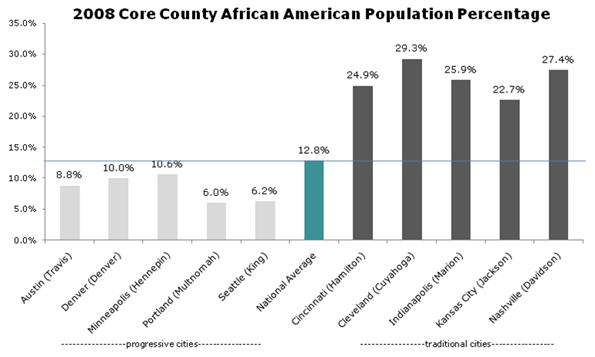
    But look closely at these exemplars and a curious fact emerges. If you take away the dominant Tier One cities like New York, Chicago and Los Angeles you will find that the “progressive” cities aren’t red or blue, but another color entirely: white.

    In fact, not one of these “progressive” cities even reaches the national average for African American percentage population in its core county. Perhaps not progressiveness but whiteness is the defining characteristic of the group.

    The progressive paragon of Portland is the whitest on the list, with an African American population less than half the national average. It is America’s ultimate White City. The contrast with other, supposedly less advanced cities is stark.

    It is not just a regional thing, either. Even look just within the state of Texas, where Austin is held up as a bastion of right thinking urbanism next to sprawlvilles like Dallas-Ft. Worth and Houston.

    Again, we see that Austin is far whiter than either Dallas-Ft. Worth or Houston.

    This raises troubling questions about these cities. Why is it that progressivism in smaller metros is so often associated with low numbers of African Americans? Can you have a progressive city properly so-called with only a disproportionate handful of African Americans in it? In addition, why has no one called these cities on it?

    As the college educated flock to these progressive El Dorados, many factors are cited as reasons: transit systems, density, bike lanes, walkable communities, robust art and cultural scenes. But another way to look at it is simply as White Flight writ large. Why move to the suburbs of your stodgy Midwest city to escape African Americans and get criticized for it when you can move to Portland and actually be praised as progressive, urban and hip? Many of the policies of Portland are not that dissimilar from those of upscale suburbs in their effects. Urban growth boundaries and other mechanisms raise land prices and render housing less affordable exactly the same as large lot zoning and building codes that mandate brick and other expensive materials do. They both contribute to reducing housing affordability for historically disadvantaged communities. Just like the most exclusive suburbs.

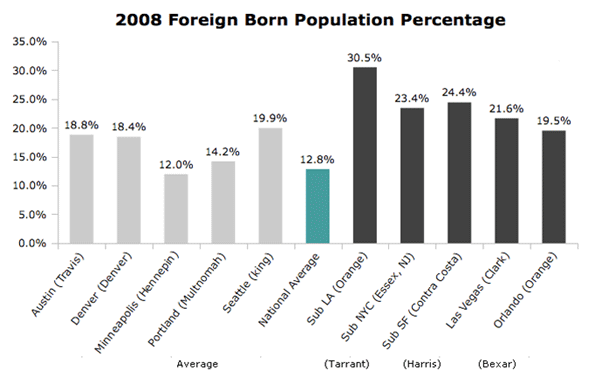
    This lack of racial diversity helps explain why urban boosters focus increasingly on international immigration as a diversity measure. Minneapolis, Portland and Austin do have more foreign born than African Americans, and do better than Rust Belt cities on that metric, but that’s a low hurdle to jump. They lack the diversity of a Miami, Houston, Los Angeles or a host of other unheralded towns from the Texas border to Las Vegas and Orlando. They even have far fewer foreign born residents than many suburban counties of America’s major cities.

    The relative lack of diversity in places like Portland raises some tough questions the perennially PC urban boosters might not want to answer. For example, how can a city define itself as diverse or progressive while lacking in African Americans, the traditional sine qua non of diversity, and often in immigrants as well?

    Imagine a large corporation with a workforce whose African American percentage far lagged its industry peers, sans any apparent concern, and without a credible action plan to remediate it. Would such a corporation be viewed as a progressive firm and employer? The answer is obvious. Yet the same situation in major cities yields a different answer. Curious.

    In fact, lack of ethnic diversity may have much to do with what allows these places to be “progressive”. It’s easy to have Scandinavian policies if you have Scandinavian demographics. Minneapolis-St. Paul, of course, is notable in its Scandinavian heritage; Seattle and Portland received much of their initial migrants from the northern tier of America, which has always been heavily Germanic and Scandinavian.

    In comparison to the great cities of the Rust Belt, the Northeast, California and Texas, these cities have relatively homogenous populations. Lack of diversity in culture makes it far easier to implement “progressive” policies that cater to populations with similar values; much the same can be seen in such celebrated urban model cultures in the Netherlands and Scandinavia. Their relative wealth also leads to a natural adoption of the default strategy of the upscale suburb: the nicest stuff for the people with the most money. It is much more difficult when you have more racially and economically diverse populations with different needs, interests, and desires to reconcile.

    In contrast, the starker part of racial history in America has been one of the defining elements of the history of the cities of the Northeast, Midwest, and South. Slavery and Jim Crow led to the Great Migration to the industrial North, which broke the old ethnic machine urban consensus there. Civil rights struggles, fair housing, affirmative action, school integration and busing, riots, red lining, block busting, public housing, the emergence of black political leaders – especially mayors – prompted white flight and the associated disinvestment, leading to the decline of urban schools and neighborhoods.

    There’s a long, depressing history here.

    In Texas, California, and south Florida a somewhat similar, if less stark, pattern has occurred with largely Latino immigration. This can be seen in the evolution of Miami, Los Angeles, and increasingly Houston, San Antonio and Dallas. Just like African-Americans, Latino immigrants also are disproportionately poor and often have different site priorities and sensibilities than upscale whites.

    This may explain why most of the smaller cities of the Midwest and South have not proven amenable to replicating the policies of Portland. Most Midwest advocates of, for example, rail transit, have tried to simply transplant the Portland solution to their city without thinking about the local context in terms of system goals and design, and how to sell it. Civic leaders in city after city duly make their pilgrimage to Denver or Portland to check out shiny new transit systems, but the resulting videos of smiling yuppies and happy hipsters are not likely to impress anyone over at the local NAACP or in the barrios.

    We are seeing this script played out in Cincinnati presently, where an odd coalition of African Americans and anti-tax Republicans has formed to try to stop a streetcar system. Streetcar advocates imported Portland’s solution and arguments to Cincinnati without thinking hard enough to make the case for how it would benefit the whole community.

    That’s not to let these other cities off the hook. Most of them have let their urban cores decay. Almost without exception, they have done nothing to engage with their African American populations. If people really believe what they say about diversity being a source of strength, why not act like it? I believe that cities that start taking their African American and other minority communities seriously, seeing them as a pillar of civic growth, will reap big dividends and distinguish themselves in the marketplace.

    This trail has been blazed not by the “progressive” paragons but by places like Atlanta, Dallas and Houston. Atlanta, long known as one of America’s premier African American cities, has boomed to become the capital of the New South. It should come as no surprise that good for African Americans has meant good for whites too. Similarly, Houston took in tens of thousands of mostly poor and overwhelmingly African American refugees from Hurricane Katrina. Houston, a booming metro and emerging world city, rolled out the welcome mat for them – and for Latinos, Asians and other newcomers. They see these people as possessing talent worth having.

    This history and resulting political dynamic could not be more different from what happened in Portland and its “progressive” brethren. These cities have never been black, and may never be predominately Latino. Perhaps they cannot be blamed for this but they certainly should not be self-congratulatory about it or feel superior about the urban policies a lack of diversity has enabled.

    Aaron M. Renn is an independent writer on urban affairs based in the Midwest. His writings appear at The Urbanophile.

  • Go to Middle America, Young Men & Women

    A few weeks ago, Eamon Moynihan reviewed economic research on cost of living by state in a newgeography.com article. The results may seem surprising, given that some of the states with the highest median incomes rated far lower once prices were taken into consideration. The dynamic extends to the nation’s 51 metropolitan areas with more than 1,000,000 population (See Table).

    There is a general perception that the most affluent metropolitan areas are on the east coast and the west coast. Indeed, 8 of the 10 metropolitan areas with the highest nominal per capita income in 2006 were on the two coasts. These included San Francisco, San Jose and Seattle on the west coast and Washington, Boston, New York, Hartford and Philadelphia on the east coast. Middle-America is represented by Denver and Minneapolis-St. Paul. However, as anyone who has lived on the coasts and Middle America knows, a dollar in New York or San Francisco does not buy nearly as much as a dollar in Dallas-Fort Worth or Cincinnati.

    Per Capita Income: Purchasing Power Parity
    US Metropolitan Areas over 1,000,000 Population
        2006 Per Capita Income  
    Rank Metroplitan Area Purchasing Power Adjusted Nominal Nominal Rank
    1 San Francisco $46,287 $57,747 1
    2 Washington $45,178 $51,868 3
    3 Denver $44,798 $44,691 8
    4 Minneapolis-St. Paul $44,326 $44,237 9
    5 Houston $42,815 $43,174 11
    6 Boston $42,571 $50,542 4
    7 Pittsburgh $41,716 $38,550 20
    8 St. Louis $41,613 $37,652 27
    9 Milwaukee $41,572 $39,536 19
    10 Baltimore $41,451 $43,026 12
    11 Seattle $41,448 $45,369 6
    12 Kansas City $41,329 $37,566 28
    13 Hartford $41,104 $44,835 7
    14 New Orleans $40,935 $40,211 16
    15 Philadelphia $40,725 $43,364 10
    16 Dallas-Fort Worth $40,643 $39,924 17
    17 Cleveland $39,997 $37,406 30
    18 Indianapolis $39,843 $37,735 26
    19 Chicago $39,752 $41,591 14
    20 Richmond $39,282 $38,233 22
    21 New York $39,201 $49,789 5
    22 Birmingham $39,057 $37,331 31
    23 Cincinnati $38,691 $36,650 36
    24 Nashville $38,680 $37,758 25
    25 Detroit $38,670 $38,119 24
    26 Charlotte $38,632 $38,164 23
    27 Miami $38,555 $40,737 15
    28 San Jose $38,505 $55,020 2
    29 Jacksonville $38,413 $37,519 29
    30 Louisville $38,262 $36,000 41
    31 Oklahoma City $38,156 $35,637 42
    32 Las Vegas $37,691 $38,281 21
    33 Salt Lake City $37,381 $35,145 45
    34 San Diego $37,358 $42,801 13
    35 Rochester $37,066 $36,179 38
    36 Columbus $37,058 $36,110 39
    37 Atlanta $36,691 $36,060 40
    38 Memphis $36,501 $35,470 44
    39 Tampa-St. Petersburg $36,260 $35,541 43
    40 Portland $36,131 $36,845 35
    41 Buffalo $36,091 $33,803 48
    42 Norfolk (Virginia Beach metropolitan area) $35,418 $34,858 46
    43 Raleigh $35,087 $37,221 32
    44 San Antonio $34,913 $32,810 50
    45 Providence $34,690 $37,040 34
    46 Austin $33,832 $36,328 37
    47 Phoenix $33,809 $34,215 47
    48 Sacramento $32,750 $37,078 33
    49 Los Angeles $32,544 $39,880 18
    50 Orlando $32,095 $33,092 49
    51 Riverside-San Bernardino $25,840 $27,936 51
    Source:        
    http://www.bea.gov/scb/pdf/2008/11%20November/1108_spotlight_parities.pdf

    Purchasing Power Parity: Things change rather dramatically when purchasing power is factored in. Some years ago, international economic organizations, such as the Organization for Economic Cooperation and Development, the World Bank and the International Monetary Fund began using costs of living by nation to compare national economic performance, rather than currency exchange rate. This practice, called “purchasing power parity” is based upon the recognition that there may be substantial differences in the cost of living between nations.

    This can be illustrated by comparing Switzerland and the United States. For years, Switzerland has had a higher per capita GDP than the United States on an exchange rate basis. Switzerland’s gross domestic product per capita was $53,300 in 2006, nearly 30% above that of the United States ($42,000). However price levels in Switzerland are so high that incomes do not go nearly as far as the exchange rate would suggest. Once adjusted for purchasing power parity, the Swiss GDP per capita in 2006 drops to $39,000, well below that of the United States. Much of the difference has to do with regulation. The more liberal economy of the United States produces a lower cost economy than in Switzerland, or for that matter most of Western Europe. The US economic advantage would be even greater measured on a household basis, since US households include nearly 10% more members (generally children) than those in Western Europe.

    The same concept was applied by the Department of Commerce Bureau of Economic Analysis researchers in their review of purchasing power parities between US metropolitan areas in 2006. When purchasing power is factored in, five of the top metropolitan areas in nominal per capita income (not adjusted for purchasing power) drop out and are replaced by other metropolitan areas rarely thought of as among the nation’s most affluent.

    Among the three west coast nominal leaders, San Francisco remains as #1, in both nominal and purchasing power adjusted per capita income. Seattle dropped from 6th to 11th position. However, the real surprise is San Jose, which dropped from 2nd position to 28th.

    The east coast regions ranked among the top 10 metropolitan areas in nominal income also were decimated by their high costs, with only Washington (which rose from 3rd to 2nd) and Boston (which fell from 4th to 6th) remaining. New York fell from 5th to 21st, Hartford from 7th to 13th and Philadelphia from 10th to 16th.

    The two non-coastal metropolitan areas in the nominal top 10 remain, with Denver rising from to 3rd and Minneapolis-St. Paul rising from 9th to 4th.

    It can be argued that Middle-America replaced the five metropolitan areas dropping out of the top ten. Houston, long one of the most disparaged metropolitan areas among urbanists, occupies the 5th position (compared to its 11th ranking in the nominal list). Three of the new entrants are confirmed members of the Rust Belt: Pittsburgh (7th), St. Louis (8th) and Milwaukee (9th). Finally, there is a new east coast entrant, blue-collar Baltimore (10th).

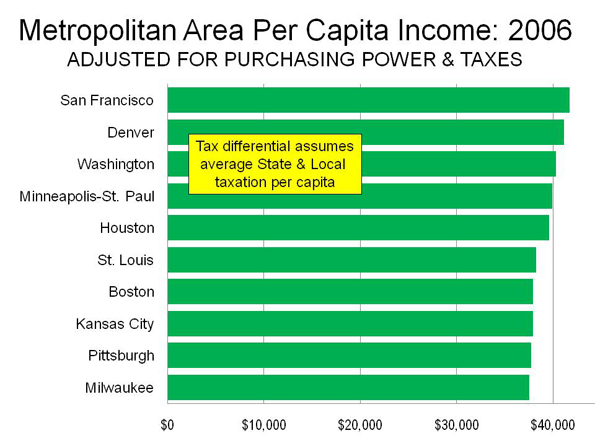
    The Impact of Taxes: But that is just the beginning. Taxes also diminish the purchasing power of households. Unfortunately, there is virtually no readily available information on state and local taxation by metropolitan area. There is, however state and local government taxation data at the state level. If it is assumed that this data is representative of metropolitan differences (weighted proportionately by state in multi-state metropolitan areas), there would be changes in rank among the top 10. Denver would displace Washington in the number two position, closing more than one-half the gap with San Francisco. Even more surprisingly, St. Louis would move ahead of both Boston and Pittsburgh to rank 6th. Kansas City would leap over #11 Seattle, Baltimore, Milwaukee and Pittsburgh to rank 8th, trailing #7 Boston by $25, not much more than the price of a Red Sox standing room ticket. Pittsburgh would occupy the #9 position and Milwaukee #10 (See Figure).

    More than Housing: The largest differences in purchasing power stem from housing, with east coast and west coast metropolitan areas having generally higher housing costs. As a result of the housing bust and the larger house price drops in those areas, purchasing power adjusted incomes could recover relative to those of Middle America. However, the high cost of living on the east and west coasts extend to more than housing prices. Generally, according to proprietary (and for sale) ACCRA cost of living data, the west coast and east coast metropolitan areas have higher costs of living even without housing. These differences are largely in grocery costs, which probably reflects the anti-big box store planning regulations and politics that exist in many of these areas. Grocery costs in the more affluent middle-American metropolitan areas tend to be lower.

    Other Surprises: Outside the top 10 most affluent metropolitan areas, there are other surprises. Urban planning favorite Portland ranks 40th, just above Buffalo. Rust Belt Cleveland ranks 17th, a few positions above New York. Kansas City, with its highly decentralized civic architecture, ranks 12th, just behind Seattle. Indianapolis (17th) is more affluent than Chicago (18th) and both are more affluent than New York.

    Five of the bottom 10 metropolitan areas are in the south, including Virginia Beach, Raleigh, Austin, San Antonio and Orlando. But perhaps the biggest surprise of all is that four of the five lowest ranking metropolitan areas are in the southwest: Phoenix (47th), Sacramento (48th), Los Angeles (49th) and Riverside-San Bernardino (51st).

    The Dominance of Middle America: But among the 10 most affluent metropolitan areas in the nation, six or seven may be counted as Middle-America (depending on how Baltimore is classified). Only three are from the original group that supplies 8 of the top metropolitan areas when purchasing power is not considered.


    Related articles:
    Gross Domestic Product per Capita, PPP: World Metropolitan Regions
    Gross Domestic Product per Capita, PPP: China Metropolitan Regions

    Photograph: Pittsburgh

    Wendell Cox is a Visiting Professor, Conservatoire National des Arts et Metiers, Paris. He was born in Los Angeles and was appointed to three terms on the Los Angeles County Transportation Commission by Mayor Tom Bradley. He is the author of “War on the Dream: How Anti-Sprawl Policy Threatens the Quality of Life.

  • Purple Politics: Is California Moving to the Center?

    You don’t have to be a genius, or a conservative, to recognize that California’s experiment with ultra-progressive politics has gone terribly wrong. Although much of the country has suffered during the recession, California’s decline has been particularly precipitous–and may have important political consequences.

    Outside Michigan, California now suffers the highest rate of unemployment of all the major states, with a post-World War II record of 12.2%. This statistic does not really touch the depth of the pain being felt, particularly among the middle and working classes, many of whom have become discouraged and are no longer counted in the job market.

    Even worse, there seems little prospect of an immediate recovery. The most recent projections by California Lutheran University suggest that next year the state’s economy will lag well behind the nation’s. Unemployment may peak at close to 14% by late 2010. Retail sales, housing and commercial building permits are not expected to rise until the following year.

    This decline seems likely to slow–or even reverse–the state’s decade-long leftward lurch. Let’s be clear: This is not a red resurgence, just a shift toward a more purplish stance, a hue that is all the more appropriate given the economy’s profound lack of oxygen.

    There is growing disenchantment with the status quo. The percentage of Californians who consider the state “one of the best places” to live, according to a recent Field poll, has plummeted to 40%, from 76% two decades ago. Pessimism about the state’s economy has risen to the highest levels since Field started polling back in 1961.

    Inevitably, this angst has affected political attitudes. Though still lionized by the national media, Gov. Schwarzenegger’s approval ratings have fallen from the mid-50s two years ago into the low 30s. The 12% approval rate for the state legislature, according to a Public Policy Institute of California survey in May, stands at half the pathetic levels recorded by Congress.

    Moreover, voters now favor lower taxes and fewer services by a 49-to-42 margin–as opposed to higher taxes and more services. Support for ultra-green policies aimed to combat global warming has also begun to ebb. For the first time in years, a majority of Californians favors drilling off the coast. Californians might largely support aggressive environmental protections, but not to the extreme of losing their jobs in the process.

    Remarkably, state government seems largely oblivious to these growing grassroots concerns. The legislature continues to pile on ever more intrusive regulations and higher taxes on a beleaguered business sector. Agriculture, industry and small business–the traditional linchpins of the economy–continue to be hammered from Sacramento.

    Agriculture now suffers from massive cutbacks in water supplies, brought about in part by drought, but seriously worsened by the yammerings of powerful environmental interests. Large swaths of the fertile central valley are turning into a set for a 21st-century version of Steinbeck’s Grapes of Wrath.

    At the same time, the state’s industrial base is rapidly losing its foundation. Toyota recently announced it was closing its joint venture plant in Fremont, the last auto assembly operation in the state, shifting production to Canada and Texas. Even the film business has been experiencing a secular decline; feature film production days have fallen by half over the decade, as movie-making exits for other states and Canada.

    Most important, California may be undermining its greatest asset: its diverse, highly creative and adaptive small-business sector. A recent survey by the Small Business and Entrepreneurship Council ranked California’s small-business climate 49th in the nation, behind even New York. Only New Jersey performed worse.

    Regulation plays a critical role in discouraging small-business expansion, a new report from the Governor’s Office of Small Business Advocate suggests. Prepared by researchers from California State University at Sacramento, the report estimates that regulations may be costing the state upward of 3.8 million jobs. California currently has about 14 million jobs, down 1 million since July 2007.

    Ironically, the regulatory noose is now slated to tighten even further as a result of radical measures–from energy to land use–tied to reducing greenhouse gases. Another study, authored by California State University researchers, estimates these new laws could cost an additional million jobs.

    Many in the state’s top policy circles, as well as academics and much of the media, dismiss the notion that regulations could be deepening the recessionary pain. Some of this stems from the delusion–always an important factor in this amazing state–that ultra-green policies will actually solidify California’s 21st-century leadership. Few seem to realize that other states, witnessing the Golden State’s economic meltdown, might not rush to emulate California’s policy agenda.

    Internally, discontent with the current agenda seems particularly strong in the blue-collar, interior regions of the state. Brookings demographer Bill Frey and I have described this area as the “Third California.” In the first part of the decade, this region expanded roughly three times as rapidly as Southern California, while the Bay Area’s population remained stagnant.

    Today the Third California represents roughly 30% of the state’s population, compared with barely 18% for the ultra-blue Bay Area. The most conservative part of the state has skewed somewhat more Democratic in recent elections, largely due to migration from coastal California and an expanding Latino population.

    But the intense economic distress now afflicting the interior counties–where unemployment rates are approaching 20%–may now reverse this process. The ultra-green politics embraced by the Democrats’ two prospective gubernatorial nominees-Attorney General Jerry Brown and San Francisco Mayor Gavin Newsom–may not appeal much to a workforce heavily dependent on greenhouse-gas-emitting industries like farming, manufacturing and construction.

    Eventually, the Democrats may rue their failure to run a pro-business, pro-growth candidate, particularly one with roots in the interior region. This oversight could cost them votes among, say, Latinos, who have been far harder hit by the recession than the more affluent (and overwhelmingly white) coastal progressives epitomized by Brown and Newsom. Along with independents, roughly one-fifth of the electorate, Latinos could prove the critical element in the state’s purplization.

    This, of course, depends on the Republicans developing an attractive pro-growth alternative. In recent years, the party’s emphasis on conservative cultural issues and xenophobic anti-immigrant agitation has hurt the GOP in the increasingly socially liberal and ethnically diverse California.

    Although he has proved a poor chief executive, Gov. Schwarzenegger did at least show such a political approach could work. The recent emergence of three attractive Silicon Valley-based candidates, including former eBay CEO Meg Whitman and State Insurance Commissioner Steve Poizner, as well as the likable libertarian-leaning former congressman Tom Campbell, could score well at the polls.

    This political course-correction should be welcomed not only by Republicans but by California’s moderate Democrats and Independents. However blessed by nature and its entrepreneurial legacy, California needs to move back to the pro-growth center if it hopes to revive both its economy and the aspirations of its people.

    This article originally appeared at Forbes.

    Joel Kotkin is executive editor of NewGeography.com and is a distinguished presidential fellow in urban futures at Chapman University. He is author of The City: A Global History. His next book, The Next Hundred Million: America in 2050, will be published by Penguin Press early next year.

  • Baseball Goes For Broke

    Other than the banking business, is there an industry more dependent on government handouts, sweetheart tax breaks, and accounting gimmicks than major league baseball?

    What other than a baseball depletion allowance explains the economics of a team like the New York Yankees, which is paying Alex Rodriguez $275 million over ten years while building a new $1.3 billion stadium and charging front row season tickets holders $800,000 for a box of four seats?

    If the rules of baseball included free enterprise, the Yankees would be playing on a diamond in Central Park, and skyboxes (which would not be deductible business expenses) would be limited to nearby apartment buildings.

    What accounts for all the growth in baseball economics — the salaries, the extortionate ticket prices, the new stadiums — is that the game varies little from some nineteenth century oligopoly trust, not unlike J.P. Morgan’s railroads or Andrew Carnegie’s steel mills.

    Let’s start with the basics: Since 1922, baseball has enjoyed anti-trust exemption, which means that league owners (best understood as robber barons) cannot move teams about willy-nilly. At the same time, the law makes it nearly impossible for competitors to establish rival competing franchises.

    The Yankees coughed up $1.3 billion for their new Yankee Stadium (of which local and state government are in for about $520 million) with the knowledge that neither the Royals nor the Pirates are allowed to move their home games to the Bronx or Brooklyn.

    The reason state and municipal governments — not just in New York, but all over the country — put taxpayer money into stadium white elephants is because voters identify more passionately with their professional teams than they do with their local politicians. Imagine the vote in New York if the choice was between Derek Jeter and Governor David Patterson?

    Just because modern baseball is fixed with more precision than the 1919 World Series was does not mean that the game (or at least a number of its teams) will not someday go bankrupt.

    Anti-trust exemptions, Tammany Hall municipal bond financings, and incestuous cable franchise awards may explain why teams like the New York Mets feel that they can spend $12 million a year on pitcher Oliver Perez. But it does not mean that they will be able to cover their obligations when the economy goes O-for-August (as once happened to Darryl Strawberry).

    To best understand baseball economics, think of the sport as similar to the investment banking business: a few large market firms (that have monopoly pricing power and cozy government relations) and then a lot of boutique establishments betting the franchise on some out-of-the-money option (Milton Bradley, Alfonso Soriano, and Alex Rios come to mind). The 2009 payroll for the Yankees is $201 million; for the Florida Marlins, it’s $36 million.

    To close the gap between rich and poor teams, municipalities from Philadelphia ($173 million) to Seattle ($392 million) have subsidized new stadiums, on the hope that sky-boxed, sellout crowds will allow team owners, usually mayoral pals, to pay for free agents. In turn, winning teams are to do for the local economy what the stimulus money may fail to achieve, namely, provide faith in the political system and interest cover for outstanding municipal bonds.

    Keep in mind that the baseball season is shorter than that for gladiolas. Many teams are out of the playoffs by July 4th, which means that the big, revenue-paying crowds must be attracted in the first three months of the season…when Kansas City fans still believe that they have a chance. Not long ago a double header between the Reds and Pirates started and ended with about seventy-five, yes that’s 75, fans in the stadium.

    Is it any wonder that the players union and many team managements, the Yankees included, turned a blind eye to steroids in order to pump up their products? In banking, executives went into sub-prime, hedge funds, and pyramid schemes to cover their bonuses. In baseball, the clear and the cream explain how the owners figured they would be able to afford the likes of Manny Ramirez.

    No one quite knows the precise debt figures of major league baseball, but the liability side of the balance sheet looks something like this: the league itself funds money-losing teams with a revolving line of credit, drawn against anticipated television rights. That’s like borrowing against next year’s equity in a house that has yet to be built.

    As for team debts, some franchises backload free agent contracts in order to defer liabilities until a new general manager may be on the job or the team has won a wild card game. Plus many teams have huge debts on new stadiums and skyrocketing payrolls. Even the Detroit Tigers, who play in a ghost town, run up $115 million per year.

    By my calculations, the Tigers would have to attract an average of about 40,000 fans per game, paying $35 a ticket, just to break even. In 2008, they averaged 25,000 fans a game, and I bet a lot of the unemployed autoworkers who attended didn’t pay $35 a ticket. Some of the debt service for the new Detroit stadium needs to be covered with casino money from an Indian reservation. (Pete Rose’s problem was that he played in casinos but did not own one.)

    To be sure, the plug figures in major league baseball’s finances are the local and national television contracts, not to mention the intramural luxury tax that has rich teams helping out the poor. National television revenue amounts to about $400 million per year, much of which is shared with the teams. That’s another attraction of anti-trust exemption; it limits supply. Why share the pie with, say, a hundred owners?

    Total revenue in the sport is about $6 billion, or an average of $200 million per major league team. Overall, baseball economics would work only if fans were prepared to spend $200 per game on warm beer and cold hot dogs, and renew cable television subscriptions to get games that have little meaning after July.

    The model is also predicated on the assumption that corporations can write off $800,000 in season ticket subscriptions, that the Internet does not blow away TV ads, and that Mariners fans will show up in September to watch their $99 million team wallow 10 games out of first place.

    If I had to bet on an MLB franchise going broke, my action would be on the Mets, who after all play in the House That Sub-prime Built, “Citi Field.”

    Not only did the owners, the Wilpon family, bet the ranch with Bernie Madoff, but they also spent $850 million on the new ballpark, and $25 million (over four years) on the likes of second baseman Luis Castillo. Attendance is down about 20 percent from 2008, and that’s before the team collapsed in the standings or bankrupt ex-Met Lenny Dykstra started sleeping in his car.

    Of course, baseball is no more exposed to the vagaries of the free market than is the banking business. Federally-funded banks, for example, can discount government-granted cable contracts, and pump money into the sport. Or a city like Washington can bailout another failing franchise, as it did with the Expos, and tax dollars can build a second $611 million stadium near the Potomac.

    Anti-trust exempted owners can even mothball a few teams (as they tried to do to the Twins a few years back), and boost the revenue share in that manner. Think of Commissioner Bud Selig’s office as a variant on the Texas Railroad Commission.

    Nevertheless, financial failure is nothing for baseball to dread. The only reason the Yankees could acquire Babe Ruth from the Red Sox in 1919 is because the Boston owner needed cash to invest in the Broadway show, “No, No, Nanette.” Maybe if they are squeezed, the Wilpons can swap Oliver Perez for some of their Madoff paper? At the very least they could get behind the sure hit, “Bye, Bye, Bernie.”

    Matthew Stevenson was born in New York, but has lived in Switzerland since 1991. He is the author of, among other books, Letters of Transit: Essays on Travel, History, Politics, and Family Life Abroad. His most recent book is An April Across America. In addition to their availability on Amazon, they can be ordered at Odysseus Books, or located toll-free at 1-800-345-6665. He may be contacted at matthewstevenson@sunrise.ch.

  • California Golden Dreams

    California may yet be a civilization that is too young to have produced its Thucydides or Edward Gibbon, but if it has, the leading candidate would be Kevin Starr. His eight-part “Dream” series on the evolution of the Golden State stands alone as the basic comprehensive work on California. Nothing else comes remotely close.

    His most recent volume, “Golden Dreams: California in an Age of Abundance, 1950-1963,” covers what might be seen as the state’s true Golden Age. To be sure, there is some intriguing history before—the evolution of Hollywood in the 1920s, the reaction to the Depression and the fevered buildup during the Second World War—but this was California’s great moment, its Periclean peak or Augustan age.

    “It was a time of growth and abundance,” Starr writes in his preface, and provides the numbers to prove it. In 1950, California was home to 10.7 million, making it a large state to be sure, but hardly a dominant one. By the early 1960s, the population passed 16 million, slipping by New York state in population.

    Yet it was not a mere matter of numbers that made California so appealing or important. It was the idea of California as not only a part of America, but also something more. To millions in America and around the world, California grew to mean opportunity, sunshine and innovation.

    The state’s business elite, for example, did not identify with the button-down hierarchy that sat atop teeming New York, and its second-tier competitors like Chicago. The leaders of Los Angeles would never consider it a second city, but simply a different, and generally, better one. There was no need for the excessive Manhattan penis envy that led Chicago to keep trying to build higher buildings than Gotham.

    In a different way, San Francisco’s top executives also did not crave that their city be New York—it was always more beautiful, nuttier, freer and more creative than Gotham. What they shared with their downstate rivals was a sense of superiority over the old part of the country. If anything, they felt a mixture of contempt—particularly the conservatives—and condescension about an older, decaying society that fixated on tradition, order and breeding.

    “California,” Cyril Magnin, scion of one of San Francisco’s great families, told me back in the late 1970s, “has recaptured what America once had—the spirit of pioneering. People in business out here are creative; they’re willing to take risks.”

    Geography also plays a role here. Leaders in California, starting at least by the turn of the last century, looked out across the Pacific and saw themselves as part of an emerging shift from Europe to Asia, a process that continues and will dominate the rest of this century. This connection, suggested Pete Hannaford, a public relations executive and partner of Ronald Reagan’s Svengali, Michael Deaver, took on an almost Spenglerian inevitability. “Out here there’s a sense of being where the action is,” Hannaford believed, “with Japan and the Pacific.”

    Starr captures these attitudes, which already had become deeply entrenched by the late 1950s and early 1960s. There was, as he writes, “a conviction that California was the best place to seek and attain a better American life.” However, it was more than money or power. It was about the quality of life. Success in California was not a matter of living by the rules, sheltered in a dark Manhattan apartment, but about the seduction of the physical world. In California, Starr writes, “Eros vanquished Thanatos.”

    Yet Starr’s book is not merely about the rich, the powerful, and even the culturally influential. He finds his primary muse not in the Bohemian realms of San Francisco or the mansions of Beverly Hills, but in that most democratic of everyman’s places, the San Fernando Valley, the place author Kevin Roderick aptly dubbed “America’s Suburb.”

    To see long excerpts from “Golden Dreams,” click here.

    “The Valley” lies over the Santa Monica Mountains from the Los Angeles Basin. As late as the 1930s, it was largely an arid district of ranches, citrus orchards and chicken farms. The area’s postwar expansion was rapid, even by California standards. Between 1945 and 1950 alone, the Valley’s population more than doubled to nearly 500,000. By 1960, it had doubled again.

    This growth was far more than the mindless bedroom sprawl often depicted by aesthetes and urban intellectuals. People in the Valley did not depend largely on the old part of Los Angeles the way, for example, Long Island lived off Manhattan. Most of the Valley’s growth was homegrown—driven by local industry such as aerospace, entertainment, electronics and until the 1960s automobiles.

    Even today, the Valley has very much its own economy and sense of separation from Los Angeles. However, more important, the Valley was, first, a middle-class phenomenon. A cosmopolitan of the first order, Starr manages to chronicle California’s artistic and literary elites, but does not see in them the essence of the state’s appeal. Instead, he explores the everyday wonders of the Valley’s families, single-family homes and swimming pools—6,000 permitted in one year, between 1959 and 1960!

    As a Valley resident myself, I can still see the basic imprint of that culture, what Starr calls its “way of life.” Compared to the tony Westside and hardscrabble east and southside of Los Angeles, the Valley has remained a relatively safe “child-oriented” society, with a big emphasis on restaurants, malls, ball fields, churches and synagogues.

    The single-family tracts, of course, have changed hands, and the majority of the owners have changed. The primarily WASP and second-generation Eastern European Jews are still there, but they have steadily been augmented, and sometimes outnumbered, by others—Armenians, Orthodox Jews, Israelis, Persians, Thais, Chinese, Mexicans, Salvadorans, African-Americans and at least 10 groups I somehow will neglect and no doubt offend.

    Yet the essential way of life forged in the 1950s and 1960s has remained a constant, and that remains the source of California’s attraction. Of course, it is no longer just a “Valley” phenomenon. As California has grown, there are many such places, outside San Diego, in Orange County, the Inland Empire, outside Sacramento, Fresno and scores of other towns. Almost all have the same imprint—an auto-dominated culture, dispersed workplaces, pools and a culture of aspiration.

    In the ensuing decades, perhaps to be covered in Starr’s next book, this archetype evolved mightily. The San Gabriel Valley, once a plain vanilla suburban appendage, has morphed into the country’s largest Asian suburbia, complete with a shopping center jokingly referred to as “the Great Mall of China.” The often-monotonous housing tracts between San Jose and Palo Alto, on the San Francisco Peninsula, also attracted hundreds of thousands of Asians but also produced something equally astounding—the Silicon Valley, the world’s leading center for technology.

    These suburban developments long ago surpassed in importance the urban roots of California metropolises. A serious corporate center during the time covered by Starr’s volume, San Francisco has devolved in a ultra-politically correct, hip and cool urban Disneyland for Silicon Valley, providing good restaurants and housing for those still too young to crave a house on the Peninsula. The San Gabriel Chinatown long ago replaced the older one in downtown Los Angeles as the center of Asian culture and cuisine.

    These places grew before the current malaise infected the state. As Starr points out, California based its ascendancy on two seemingly contradictory principles: entrepreneurship and activist government. Under Gov. Earl Warren, but also Goodwin Knight and finally Pat Brown, the state made a commitment both to basic infrastructure—energy, water, roads, schools, parks—and expanding its economy.

    By the early 1960s, this system was hitting on all cylinders. New roads, power plants and water systems opened lands for development for farms, subdivisions, factories. Ever expanding and improving schools produced a work force capable of performing higher-end tasks, and capable of earning higher wages. New parks preserved at least some of the landscape, and gave families a place to recreate.

    For Pat Brown, arguably the greatest governor in American history, this was all part of California’s “destiny.” Starr describes Brown’s California as “a modernist commonwealth, a triumph of engineering, a megastate committed to growth as its first premise.” Yet within this great modernist project was also stirring opposition, on both left and right, that would soon place this Golden Age at its end.

    Many of the objections were legitimate. The Sierra Club and its many spinoffs rightfully saw the Brown development machine as threatening California’s landscape, wildlife and, in important ways, the appeal of its way of life. More careful controls on growth clearly were needed. The battle over the nature of those controls continues to this day.

    Some more angry voices, then as now, targeted the very existence of suburbia, the dominant form of the state’s growth, and eventually sought its eradication. This struggle goes on to this day with a religious fervor, led, ironically, by the former and perhaps future governor, Jerry Brown, currently attorney general and leading Torquemada of the greens.

    Minorities also began to stir amid the celebrations of the 1950s and early 1960s. Woefully underrepresented in the halls of power and the corridors of business, Asians and Latinos remained largely passive politically. However, by the early 1960s acceptance of exclusion was giving way to more assertive attitudes. Ultimately the massive immigration that swelled both their numbers in the 1970s and beyond would ensure these groups far more influence both on the politics and in the economy of the state.

    Yet it was the African-American who would really upset the balance of the golden era. Never discriminated against as in the South, black Californians felt the lash of a thousand, often-informal exclusions. As the civil rights movement grew, with it less deferential attitudes, particularly toward the police, a powder keg was building. In 1964, the first year after the era chronicled in “Golden Dreams,” Watts blew up, shattering the comfortable assumptions of a progressive, post-racial state.

    Finally, as Starr reports, there was mounting thunder on the right. The business elite and the middle class were financing the ever-expanding California state. They saw their money go to the poor, to minorities and state employees. Particularly annoying were the university students, many of whom were in open revolt against the state, in the mind of much of the public that had nurtured them.

    By the early 1960s many of these latter Californians also were angry, but their rage would express itself not in riots, but at the ballot box, ushering in the age of Ronald Reagan. The period that follows “Golden Dreams” emerges as one of conflicting visions, between greens, students and minorities, on the one hand, and largely suburban middle-class workers and business owners on the other.

    These two groups would battle over the next generation, with the advantage oscillating over time. Today the heirs of the protesters—greens, minority activists and former ’60s radicals—hold the political advantage, although the state they dominate has fallen on parlous times.

    In retrospect, the golden era before these conflicts does indeed seem like a high point. The question now is whether California, down on its luck, will find a way to rebound, much as imperial Rome did after the demise of the Julian dynasty, or fall, like Athens, into ever more squalid decline. Does the state have a bright “destiny” ahead or only more ruin?

    This, of course, will be the basis for another historical epoch. Let us hope Kevin Starr be around to chronicle it for the rest of us.

    This piece originally appeared at Truthdig.com

    Golden Dreams: California in an Age of Abundance, 1950-1963 at Amazon.com.

    Joel Kotkin is executive editor of NewGeography.com and is a distinguished presidential fellow in urban futures at Chapman University. He is author of The City: A Global History. His next book, The Next Hundred Million: America in 2050, will be published by Penguin Press early next year.
  • Cap And Trade And The Smog Market Ripoff

    Now that Senators have reconvened from summer hiatus, one of their first tasks will be to contemplate the greenhouse-gas cap-and-trade carbon market that President Obama would like to institute to blunt global warming. Their necks better be limber. Partisans of Keynesian, market-based regulations will undoubtedly point to the Midwest’s federally run “acid rain” program to reduce harmful power-plant emissions as proof that giving industry profit incentives in cleaning up their operations can be successful. Regulation skeptics will wave that example off dismissively, urging Senators to swivel their heads for a look across the Atlantic, where the European Union’s Emissions Trading System has registered lousy results.

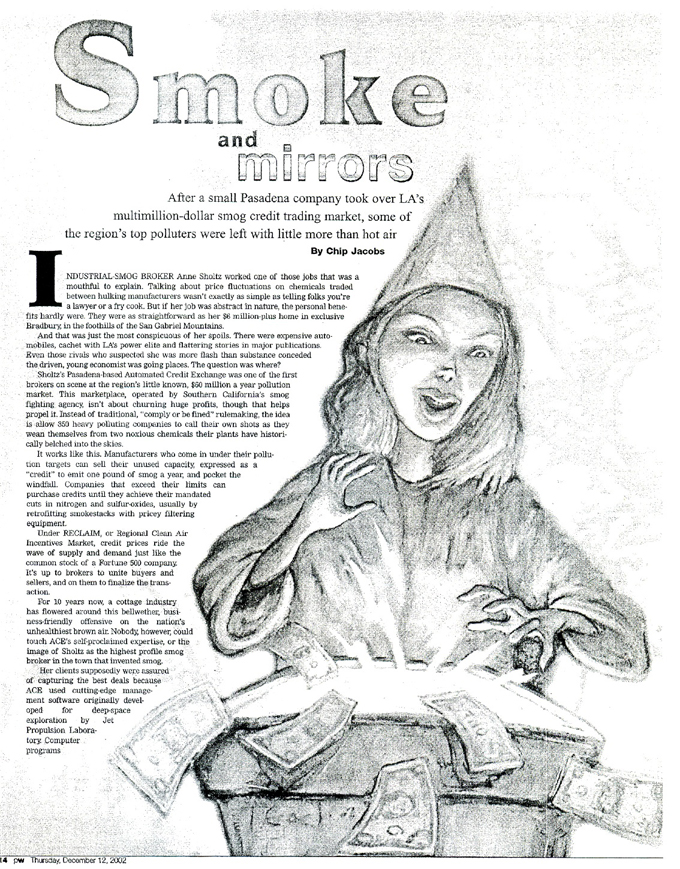
    Whatever those markets do or don’t foreshadow, if the American Clean Energy and Security Act of 2009 and its mandated cap-and-trade become law, a glimpse of an unintended — and unsavory — future may reside in the tale of the inscrutable businesswoman from smog-bound Southern California who scammed the area’s pollution exchange…twice (see my site, www.chipjacobs.com, for the newest revelations of a second scam). Rather than a tale of a dreamer’s demise, Anne Sholtz’s story is a bracing reminder that to create a market, no matter its aim, is also to inspire a class of people determined to game it.

    If Wall Street traders can commodify sub-prime mortgages with impunity, and the Enrons of the world can manipulate energy markets like a pinball machine, imagine a future when tradeable permits for carbon dioxide and other heat-trapping gases are auctioned and swapped over the public’s head. A Heritage Foundation economist expects the action to hit $5.7 trillion in value, and many experts say it all adds up to an irresistible buffet for chicanery.

    Few in Washington ever heard of Sholtz, 44, before last spring, when the former Caltech economist was sentenced in federal court to a year of home-detention and five years of probation for defrauding the nation’s first air pollution cap-and-trade market. Sholtz was cozy with the RECLAIM program and the bureaucrats who run it at the South Coast Air Quality Management District (AQMD). That’s because in the early-1990s she had helped design the concept as an adviser.

    Her know-how proved dangerous. Between November 2000 and April 2001, Sholtz tried fooling one of her clients, a New York-based energy trader, into believing she could complete a fat, multimillion-dollar deal with what is now ExxonMobil Corp. when in fact she could not. Stringing executives at the client company along until she could reactivate a transaction, she emailed and faxed falsified sales documents, including phony invoices.

    Pleasant, brainy and ever-hustling, Anne Sholtz was not somebody folks expected to see handcuffed. Her 2004-arrest by EPA agents on white-collar fraud charges shocked and mystified local environmental circles. She and her companies, Automated Credit Exchange and EonXchange, had boasted a heavyweight list of clients and financial partners, and had worked with the Dutch government on an emissions test-market. As one of California’s rising green-entrepreneurs, Sholtz was a niche-celebrity with access to powerful politicians and regulators, and a hillside mansion, fine cars and whatnot to show for her ingenuity.

    For our purposes, the reasons she’d risk all that matters less than the fact she was able to do so undetected. (You can read the entire expose here.) And that Obama’s proposed carbon market would look a lot like L.A.’s now 15-year-old smog bazaar. RECLAIM sets progressively lower emissions’ limits for roughly 330 of the Southland’s largest oil refineries, power plants and other manufacturers, and allocates credits calculated for each one. Companies that install new particle-trapping equipment or develop cleaner operations in other ways to reduce oxides of nitrogen and sulfur can sell their unused credits to peers who may exceed their allotment. Since 1994, there have been about $1 billion in trades, which brokers help negotiate, and about 40-million pounds of smog chemicals transacted.

    AQMD contends that, after a languid start, its regimen has achieved its emission-cutting goals. At first, an over-allocation of credits to ease industry into the new system simply encouraged many companies to delay purchasing greener equipment. (Using the same logic, the current Obama-backed energy bill, sponsored by House Democrats Henry Waxman of California and Edward Markey of Massachusetts, would initially give away an eye-popping 85 percent of greenhouse-gas credits to cushion carbon-dependent states. This means dramatic emission reductions likely won’t happen for years.)

    RECLAIM added another bold move to Southern California’s environmental pedigree, a change that industry actually wanted. But in developing such an open-ended, boutique market officials essentially flaunted their gullibility to cheaters, scammers and profiteers. It took AQMD several years to learn of Sholtz’s deceit, and only then after nine of her clients complained about being cheated.

    A year before that, in 2001, the air district had been blindsided by California’s electricity crisis, and the subsequent order by then-Gov. Gray Davis that power-plants run nonstop to prevent rolling brownouts. Speculators from Texas to New York with no industrial operations in the South Coast basin hoarded RECLAIM credits they knew utilities needed, later reselling them at huge markups. The market teetered near meltdown, and district brass had to yank power companies from the market.

    Ironically, one reason AQMD officials were oblivious to Sholtz’s actions was because they’d nixed her very own recommendation during RECLAIM’s design phase to stamp each credit with identifying marks, somewhat akin to a bar code. Loose trade-reporting requirements added more vulnerability. As California’s experience makes clear, building an incorruptible greenhouse-gas market may not be just formidable, it may be impossible, because the money and opportunities for deception are so tantalizing.

    This May, two Republican congressmen skeptical of Obama’s cap-and-trade plan, Joe Barton of Texas and Greg Walden of Oregon demanded extensive answers from the EPA about the Sholtz case. Why, they asked, were so many case documents still sealed by the Justice Department? How could this have happened on regulators’ watch, and what does it portend for a greenhouse-gas market?

    On their heels, AQMD executive officer Barry Wallerstein defended his market as virtually bulletproof to further criminality, while the EPA downplayed the matter as an isolated case. Those declarations occurred before documents emerged showing that Sholtz had told prosecutors during her 2005 settlement plea about “rampant” violations and graft by AQMD executives administering the market.

    All of which is to say Senators should look straight forward with furrowed, “prove-it” brows when fellow members and environmental glitterati pronounce that a greenhouse gas market will operate cleanly because really smart people with nifty technology will be policing it. As the Waxman-Markey legislation stands, the Federal Energy Regulatory Commission, the EPA, and perhaps several more agencies will be patrolling for fraud, speculation, price manipulation and so-forth. Other enforcement details are hazy.

    Chip Jacobs is the co-author, with William J. Kelly, of Smogtown: The Lung-Burning History of Pollution in Los Angeles. Jacobs can be reached at chip@chipjacobs.com

  • Hard Times In The High Desert

    The High Desert region north and east of Los Angeles sits 3,000 feet above sea level. A rough, often starkly beautiful region of scrubby trees, wide vistas and brooding brown mountains, the region seems like a perfect setting for an old Western shoot ’em up.

    Today, it’s the stage for a different kind of battle, one that involves a struggle over preserving the American dream. For years, the towns of the High Desert–places like Victorville, Adelanto, Hesperia, Barstow and Apple Valley–have lured thousands of working- and middle-class Californians looking for affordable homes.

    Now, like other exurbs in the U.S., the area suffers from sky-high foreclosure and unemployment rates. Rather than elicit sympathy, however, these hardships have delighted a growing chorus of planners, environmentalists and urbanists who believe that such far outer-ring communities are doomed to becoming America’s “next slums.”

    Such dismal future prospects have gained an air of plausibility with devastating speed. For much of the past century, the High Desert was a rough-hewn region of small farms and mines, its economy largely dependent on military bases.

    But since the 1980s, the area has flourished, adding over 120,000 people in the first seven years of the decade. Most people came because of housing costs–as much as a third less than those closer to the coast. Today the largely middle and working class population stands at over 350,000.

    You don’t hear much good about people in places like the High Desert. Like many exurbanites, they do not fit the hip categories of “knowledge workers” or “creative class.” They work with their hands–in construction, driving trucks, in factories and mines–or run small retail businesses. In the High Desert, 60% of residents have never attended college. Many commute over the 4,100-foot Cajon Pass to blue- and pink-collar jobs as far as Los Angeles, more than an hour and a half away.

    “This is one of those places where the women have more tattoos than the men,” joked one long-time resident over drinks at Chateau Chang, a well-appointed local hangout owned by Chinese immigrants.

    For many, the rapid decline of housing prices since 2007 has been devastating. Newcomers bought homes at the top of the market, when median prices scaled over $300,000. Some did so with adjustable-rate mortgages. Today, the median price is closer to $100,000, leaving a large percentage of homes underwater.

    The real estate collapse has also hurt employment. Construction, warehousing and manufacturing–linchpins of the local economy–all have been pummeled by the recession. Unemployment now stands over 16%.

    Similarly bleak conditions plague exurbs throughout the country–from central Florida to the outskirts of Phoenix, Las Vegas, Sacramento and scores of other onetime boomtowns. Shuttered factories, empty stores and abandoned lots contribute to an often depressing landscape.

    These reverses have led some pundits to assert it’s time to let such places die–and the sooner the better. Greensheet Grist recently held a competition about what to do with dying suburbs that included ideas such as turning them into farms, bio-fuel generators and water treatment plants.

    Such post-apocalyptic views are popular with architects, planners and environmentalists, as well as in the mainstream media. But these people never liked conventional suburbs much; many considered exurbs atrocities whose residents indulged in unspeakable acts of overconsumption.

    Yet what about the residents of these places–and the many who likely would care to join them? The fact is exurbs are popular: Between 2000 and 2007, 3 million Americans moved to exurbs, and while the recession has slowed this growth, it has not stopped it. Indeed, now that housing prices have fallen, home sales have skyrocketed in some areas. In the High Desert, for example, existing-home sales more than tripled in the past year, to the highest level ever.

    Most demographic estimates suggest this exurban population growth will continue; the High Desert is expected to receive another 200,000 residents by 2025. The key driving force, notes Redlands, Calif.-based economist John Husing, remains the deep-seated desire to own a small piece of ground and enjoy some privacy and a middle-class way of life that is no longer affordable closer to the urban center.

    For most exurbanites, moving back to the city–the preferred option of planners and urban boosters–is not an attractive option. These people could never afford a charming townhouse in Portland’s Pearl District or a loft in New York’s SoHo. For them, the “urban option” means the prospect of a dreary blocky apartment complex in a noisy, crowded, less-than-genteel section of Los Angeles or another large city.

    This preference should not be confused with racism, as is sometimes alleged. Like many exurbs, the High Desert has become increasingly multi-racial. Over half of the 23,000 students at the sprawling Victor Valley College, for example, are minorities–nearly 30% are Hispanic. Cruise the shopping center, and you are as likely to find a family-owned Mexican, Vietnamese or Korean restaurant as you would a hamburger chain or pizza shop.

    To my mind, harboring ill will toward the aspirations of exurbanites is hardly “progressive,” at least from a social democratic point of view. Yet many on the so-called left feel that what is generally considered upward mobility needs to be curbed so that the hoi polloi can better live according to the prescriptions of their more enlightened, usually higher-educated and more affluent “betters.”

    In contrast, a more humane, and fundamentally democratic, approach would be to find ways to help these communities thrive. The first step: local job creation. Even without the excessive prices associated with “peak oil” theories, gas prices and car expenses do place a considerable burden on many exurbanites. Developing more economic opportunities closer to these communities would relieve this financial burden, while also cutting energy consumption.

    Experience shows that suburbs that develop their own economies have suffered far less from the recession than those that depend on long-distance commuters. Ontario, a suburb 40 miles east of Los Angeles where I have worked as a consultant, for example, has developed a strong airport, industrial and office economy and a thriving locally based retail sector. Average commutes there are roughly parallel to those in neighborhoods close to downtown Los Angeles.

    Although hit hard by the recession, Ontario suffers a foreclosure rate that is one-third of the High Desert’s. It continues to attract businesses from Los Angeles and the rest of the world by offering a more enterprise-friendly environment and a well-maintained infrastructure.

    Places like Ontario could provide something of a role model for places like the High Desert, notes local real estate investor Joe Brady. Like many other local leaders, he recognizes that basic job creation–not real estate speculation–holds the key to the region’s future.

    But it’s not all doom and gloom for the High Desert. Some prospective new industrial investment has come to the area. And Husing believes the High Desert will play an expanding role as a warehouse area for products shipped from the massive Los Angeles port complex. The converted former George Air Force Base, now the Southern California Logistics Airport, has created 2,500 jobs and could generate another 35,000 within the decade.

    Yet creating many more jobs in the High Desert will not be easy. Though most local cities are pro-business, business consultant Larry Kosmont notes they are still saddled with regulations imposed by the state of California. These could discourage business attraction and development.

    There’s a bit of an irony here. Local job growth would save energy and cut emissions by reducing commutes and making these communities more environmentally sustainable. But some coastal “progressives” may discourage new industrial or warehouse facilities for emitting too much greenhouse-gas.

    In the end, only fostering a strong locally based economy can make these places economically viable. Whatever their aesthetic and design problems, exurbs will continue to appeal to millions of Americans searching for what they define as a better way of life. That alone should make them intrinsically valuable, and definitively worth saving.

    This article originally appeared at Forbes.

    Joel Kotkin is executive editor of NewGeography.com and is a distinguished presidential fellow in urban futures at Chapman University. He is author of The City: A Global History. His next book, The Next Hundred Million: America in 2050, will be published by Penguin Press early next year.
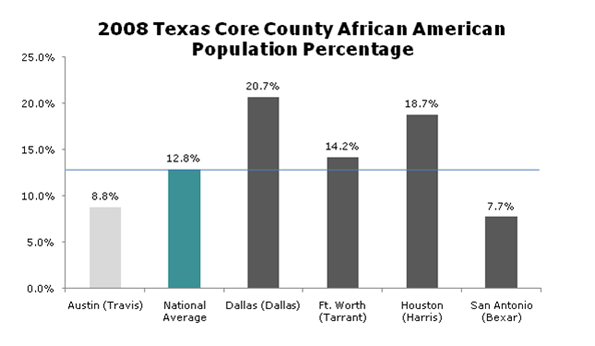
  • Warning on Road to Recovery: Beware of dumbdowntown.com

    Big cities will eventually get through the recession.

    How much help they’ll get from the design-obsessed bloggers who are so anxious to shape urban life is open to question.

    Consider the blogosphere in Los Angeles, which bubbled with reports of decapitated chickens turning up all around town earlier this year.

    Some bloggers speculated that chickens were being killed in rituals of the Santeria cult, which has roots in Latin America. The speculation seemed on the way to becoming an urban legend.

    The Garment & Citizen suggested that the bloggers buzzing around the story—a bunch that was mostly European/American —might be leaping to some wayward conclusions.

    The blogosphere railed against the Garment & Citizen, claiming that we had played the “race card” by even suggesting that some white bloggers might be too quick to attribute exotica to folks a few shades darker.

    Then the story died, an urban legend stopped cold. Whoever had been killing the chickens and leaving their headless carcasses in public places had apparently left town quite suddenly.

    Or could it be that the whole matter had been made up by bloggers who figured that a bizarre and bloody tale with shadowy suspects would be just the thing to drive traffic to their echo chamber?

    There’s no telling when it comes to the blogosphere.

    That’s precisely our point.

    We don’t spend a lot of time looking at blogs, but we generally get word when one of them is railing against the sort of well-reasoned reporting and analysis that readers expect from the Garment & Citizen.

    That’s what happened after we noted last year’s closure of a Rite-Aid at 7th and Los Angeles streets as a sign that the red-hot run of Downtown development had ended. It wasn’t a tough call, by the way, given economic indicators at the time.

    Yet A number of those who blog Downtown twisted themselves in knots over that one, claiming a greater understanding while denying that the closure had anything to do with the souring economy—which soon crashed, by the way.

    Another piece in the Garment & Citizen sometime later mentioned the deterioration of the retail landscape on Broadway.

    Downtown bloggers got all bunched up over that one, too, going on about the many committee meetings held by members of the Bringing Back Broadway Initiative.

    Awhile later came word that the owners of Clifton’s Cafeteria on the 600 block of Broadway plan to sell the building as they fight to keep the place in business. A key to their struggles, according to reports, is the high vacancy rate for retail along the street. Fewer stores mean fewer customers coming to Broadway—and fewer diners stopping for a bite at Clifton’s, a bellwether for the thoroughfare.

    There’s no telling whether local bloggers bark so loud about any point of view that diverges from their own because they lack reporting and analytical skills. It could be that some function as boosters who see the truth as optional when it comes to promotional pitches.

    Keep that in mind if the Downtown blogosphere reaches you with talk about how some art galleries in the area of 5th and Main streets are closing because their landlord is ditching them in favor of higher-paying tenants. That outlook would seem to prop up the notion of a hot market for retail, as though there’s a waiting list of businesses willing to pay a premium for ground-floor space at 5th and Main despite the recession.

    That just doesn’t sound right, based on a street-level view of current conditions.

    Whatever is going on, watch out for bloggers who seem bent on telling a story about Downtown and the rest of our city that doesn’t match the facts on the ground.

    The truth is that the economy remains very slow, the real estate market is a long way from full recovery, and it will be more than a few months before the local job market perks up.

    It’s also true that our city, state and nation will eventually recover. Times are tough, but there are plenty of folks committed to getting through this downturn (see related photo and caption, “No Quit,” and Local Hero, both home page). They’ll need the accurate information and reasoned analysis—the truth, in other words—to chart a course to better days.

    So look for signs of progress and silver linings, which are the building blocks of momentum and economic recovery.

    Just beware of those who would show you nothing else.

    Jerry Sullivan is the Editor & Publisher of the Los Angeles Garment & Citizen, a weekly community newspaper that covers Downtown Los Angeles and surrounding districts (www.garmentandcitizen.com)