Tag: Los Angeles

  • Agglomeration in Los Angeles

    The Economy of Cities

    Cities have been called “engines of growth”.  What does that mean?

    Fly over a major city and what do you see? Not well defined centers and sub-centers. More likely, an amazing complexity. We argue that what is actually down there, but hard to actually see, is a large number of superimposed and spatially realized supply chains.

    In big cities like Los Angeles, we are well served by large numbers of people (mostly strangers) arranged in complex and usually unfathomable supply chains Their incredible (and hidden) complexity is not a problem.  Shopping is simple; we look at prices and the reputations of sellers and products.  Markets illustrate the stark contrast between how much we get vs how little we have to know.

    Market competition also means a scramble for new ideas. The best performing firms form new ideas first. There are supply chains for things and supply chains for ideas. The latter are harder to identify but clearly essential. New ideas come before new things. Mokyr (2002) notes that we are all on the lookout for useful knowledge.

    Managers are charged with the challenge of deciding what to make vs what to buy.  But the choices require a decision of what to buy where? What is available where?

    Cities are engines of growth because the settlement patterns that evolve (survive) are ones that provide good access – to things we may want to buy and to ideas we may want to hear about and learn about.

    What Kind of City?

    The question here is what kind of city is most congenial to the kind of network formation required for all this to work?

    Urban economists and geographers once described the evolution and spread of cities as an evolution from “pedestrian city” to “streetcar city” to “automobile city” (Mueller, 2004).  But this has been elaborated and updated. Baldwin (2016) describes how economic geography changed as various advances lowered trading costs and communications costs. He separates face-to-face costs from communications costs; the former are the constraint to a “flat world”. The partition recognizes the special nature of tacit information exchange. We do many things electronically but we still travel to meetings, near and far.

    This has led some to assume that dense, traditional cities possess intrinsic advantages. Although some of these are relevant, evidence is that different urban forms can also function successfully.  

    Cities can achieve efficiencies in different ways. Delivering goods or ideas can occur via many modes or media. Possibilities, costs and choices change as technologies evolve, e.g. transactions costs, location choice and urban form evolve. All this suggests that evolving and adapting cities — of differing forms— constitute an essential part of durable economic growth. Just as price discovery is a market process, so is supply chain formation — and chains’ spatial arrangements.

    What matters more than form is the ability to allow the market to function. Economic efficiencies cannot be achieved top-down; top-down involvement must maintain a light touch. Rules should be simple and clear. Approvals that are complex and politicized must be clarified and simplified. There might also be a balance whereby landowner’s rights are not swamped by neighbors’ rights to stop (politicize) development.

    We all have many chains in our lives; we participate in many supply chains as buyers and as sellers. This includes going to work, where we sell our labor. All of us choose (compete for) locations in light of these many interests. This suggests that we are eager to find and secure locations that facilitate our performance in the many supply chains we are involved in. This defines how   we get the cities we have.

    Boundaries and Geography

    Drawing boundaries is never simple. Where does the city or region begin and end? The same is true for important features within cities. What constitutes or defines the center, the downtown, the major sub-centers? Where do “suburbia and “exurbia” begin and end? And what happens beyond these centers, sub-centers, clusters and agglomerations?

    Economists who study cities often describe them via just one number, the (average) density. How can that be adequate?  Cities are complex and distinguished by their peculiar locational arrangements. Most studies of city success rely on simple metropolitan area average densities for the simple reason that these are easily found. Yet it is a leap to describe large and complex places via one single number. Consider that Los Angeles — which does not achieve almost anywhere the densities common to Manhattan or San Francisco —  has been the densest urbanized area in the U.S. since approximately the mid- 1980s. The factoid illustrates the problem of relying on just one number. 

    Map 1 of the location San Francisco Bay Area software firms illustrates the complexities. Does the Bay Area’s overall population density – considerably less than that of Los Angeles, much less than Manhattan – signify anything? Where does the  Silicon Valley a “cluster” or an “agglomeration” begin and where does it end?  Were the map a three-dimensional density surface, there would be peaks as well as low-rise hills. Which ones are sub-centers or clusters?
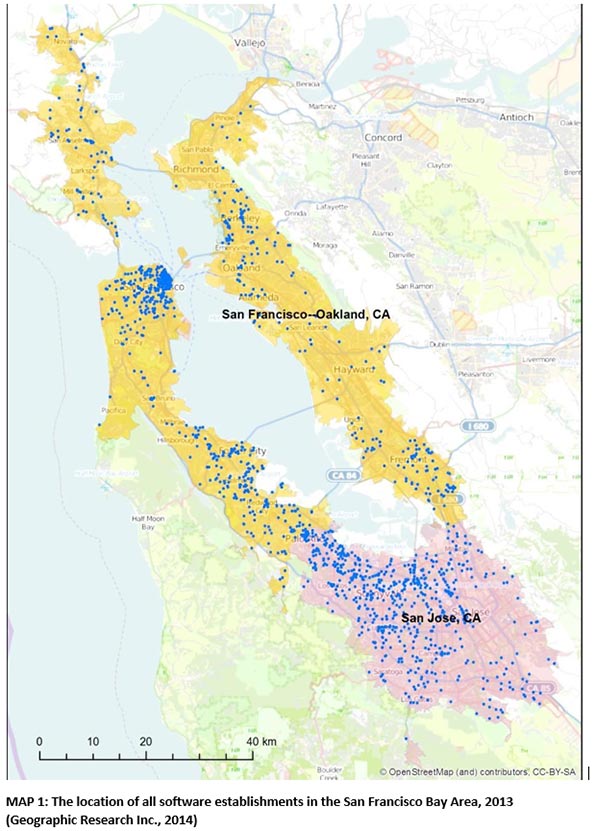
    The standard labels fall short. Settlement patterns are complex — and emergent. Being near or far from “the action” can be many things. It also involves many possible trade-offs. Less expensive homes for workers? Better schools? Less commuting? Any industry includes many players who will avail themselves of many choices along the ranges of many possible trade-offs.

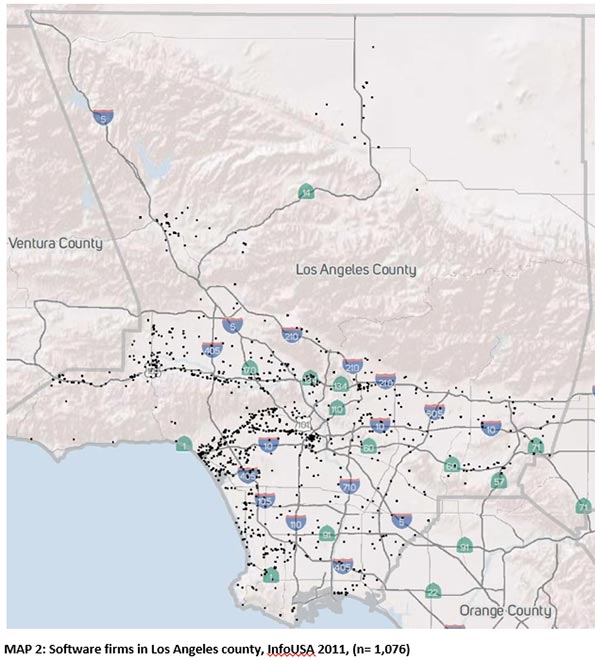
    Map 2 plots locations of software firms in Los Angeles County. The same variety of arrangements and the same questions apply. But both of our maps show that the spread of software firms is always lumpy, but is also dispersed widely.
    Here is one example, from a large literature, of the challenges. Bumsoo Lee (2007) applied several centers identification strategies to the study of employment in major U.S. metropolitan areas. According to one such method, MSAs of more than 3 million inhabitants had roughly 7 percent of jobs in the central business district, 15 percent in the various sub-centers and the remaining 78 percent “dispersed”, outside of any identified center.  

    What L.A. Data Tell Us

    Data on production functions are widely available. Geographically detailed data on the locations of firms are becoming available. In a recent study of Los Angeles, we used two data sources. The first was InfoUSA 2011 with data on businesses in 6,395 census block groups in Los Angeles County. The InfoUSA data indicate business locations with number of employees by NAICS (2007) industrial sector. These were aggregated to create the sectors we wanted to study such as Software and Biotech.  

    We tabulated Los Angeles area co-locations of firms. Employment and firms were spatially aggregated by Census Block Group. The aggregated jobs and firms are divided by the size (acres) of the Census Block Group to calculate employment and firm densities. The median-size Census Block Group in L.A. County is 79 acres. These data were useful for, among other things, calculating pair-wise co-location coefficients. These became dependent variables in multiple regression tests.

    The second data source is US IMPLAN input-output 2013, originally with 536 sectors which were also aggregated to the industrial sectors we were interested in. The technological coefficients, proportions of sector-to-sector purchases, were the independent variables used to test their effects on the observed co-locations of firms. 

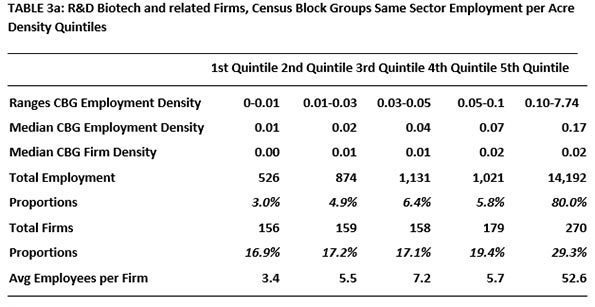
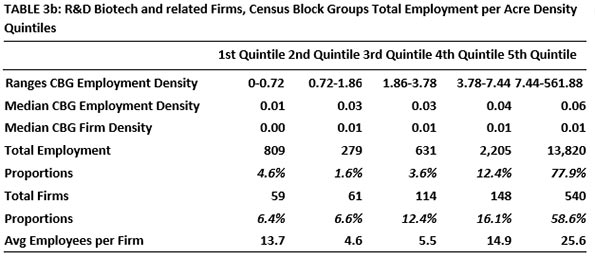
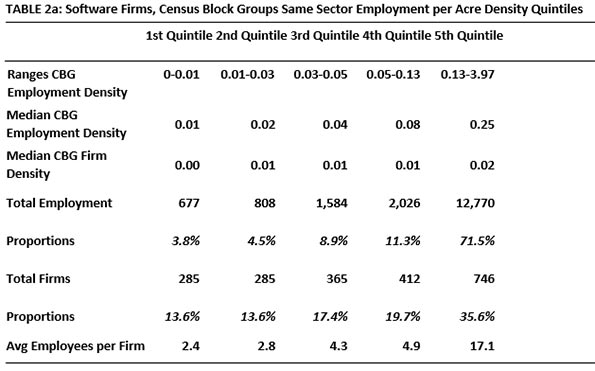
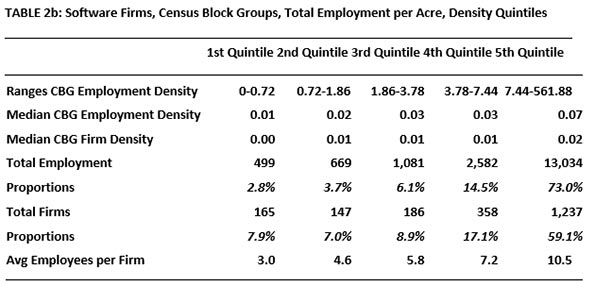
    What kind of spatial arrangements do we see? To avoid the problem of identifying centers and subcenters – and leaving out all the other places, people and jobs — we computed density quintiles. Looking at the number of firms and their sizes in each density quintile, we found that they might or might not be arranged in compact geographic clusters. That’s what our two maps suggest.

    Table 1 summarizes our findings on firm location in the two densest quintiles. For the large sectors, three kinds of densities were tabulated: for all firms of the sector, for all firms in all sectors and for all firms in all sectors except the sector being studied.
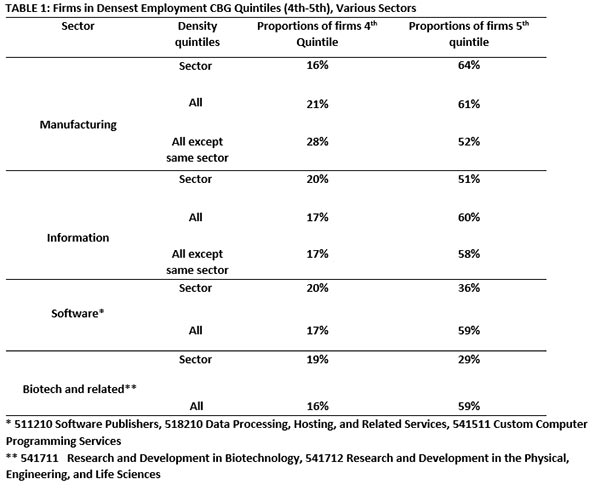
    The two subsectors studied here, Software and Biotech, are prominent in the modern world and unique enough to merit their own categories. They employ about the same number of people in LA County. But these two sectors differ in important ways. Software firms have service as well as research functions. Biotech is more weighted toward the research side. In addition, biotech is the more regulated of the two, most significantly subject to Federal Drug Administration vetting and ruling. “The estimated average pre-tax industry cost per new prescription drug approval (inclusive of failures and capital costs) is: $2,558 million.” (DiMasi, et al 2014). All this suggests greater risk and generally larger firm sizes.

    When it comes to total industry clusters, medium-sized Biotech firms are in the least dense areas; this cannot be said of Software firms. As in the story of the more aggregated sectors, clustering (with same sector firms as well as with others) is apparent. But there are prominent exceptions. Scooping up ideas can be initiated remotely.   Some firms are able to do less up-close interacting and complementing it with the virtual alternative. The blends vary.

    Large proportions of Software and Biotech firms choose the dense quintiles in similar proportions. These agglomerate even though economizing on shipping is not their big concern. As expected, more of the larger Biotech firms are less likely to seek clusters.  

    Firm size differences are also interesting. The largest Software firms (by number of workers) prefer the highest density quintile, whether densities refer to all firms or just same-sector firms. It is not the same for Biotech firms, where many of the medium-sized firms prefer the lowest density quintile, as defined for sectors of all firms. In this sector, that size may be good for internal R and D and information gathering and creation.

    Does density matter? By all means but it is complex. Even for firms in sectors that deal more in information than physical product, nearby densities (of same-sector and well as other-sector) do affect location choice. An interest in establishing networks by which ideas can be shared can explain this. Idea sharing is complex and still requires some degree of nearness. Over 50 years ago, Mel Webber wrote about “Community without Propinquity” (1963). This was years before there was an internet but Webber deserves credit for calling our attention to the fact that we seek and form a variety of very complex links that help explain our locational preferences.

    Peter Gordon is Emeritus Professor, USC Price School of Public Policy. His current research addresses how the nature of cities impacts economic growth prospects. John Cho is Associate Regional Planner at the Southern California Association of Governments. His interests involve transportation networks and their effects on regional development.
    REFERENCES

    Baldwin, Richard (2016) The Great Convergence. Cambridge, MA: Belknap.

    DiMasi, Joseph A. and Henry G. Grabowski and Ronald W. Hansen (2014) Innovation in the Pharmaceutical Industry: New Estimates of R&D Costs. Boston: Tufts Center for the Study of Drug Development, Tufts University.

    Lee, B. (2007). "Edge" or "edgeless" cities? Urban spatial structure in U.S. metropolitan areas, 1980 to 2000. Journal of Regional Science, 47(3), 479-515.

    Mokyr, Joel (2007) “The Market for Ideas and the Origins of Economic Growth in Eighteenth Century Europe” Tijdschrift Voor Sociale en Economische Geshiedenis, 4.

    Muller, Peter O. (2004) “Transportation and Urban Form: Stages in the Spatial Evolution of the American Metropolis” in S. Hanson (ed.) The Geography of Urban Transportation (3rd ed.) Guilford Press.

    Webber, M.M. (1963) “Order in Webber Diversity: Community without Propinquity” in Cities and Space, Lowdon Wingo (ed.) Baltimore: Johns Hopkins University Press.
  • Today’s Orange County: Not Right Wing—and Kinda Hip

    What comes to mind when you think about Orange County? Probably, images of lascivious housewives and blonde surfers. And certainly, at least if you know your political history, crazed right-wing activists, riding around with anti-UN slogans on their bumpers in this county that served as a crucial birthplace of modern movement conservatism in the 1950s.

    Yet today, Orange County—or the OC, as locals call it—is becoming a very different place. Today close to half the population of this 3-million person region south of Los Angeles are minorities, primarily Latino and Asian, and the county’s future belongs largely to them.

    These days you color the OC both ethnically diverse and politically purplish. The Republican share of the electorate has dropped from 55 percent in 1990 to under 40 percent today. Two of the seven people who represent the area in Congress are Latino, and a third is of Middle Eastern descent. Four of the 10 people the county sends to Sacramento are minorities, three Asians and one Hispanic. Asians, now 20 percent of the local population, represent the majority on the county Board of Supervisors. In 2012 Mitt Romney took the county with 53 percent of the vote; this year it may be far closer than that.

    The cultural landscape is also changing. What was historically a land of hamburger dives (we still have some) and little Mexican restaurants (we have many) is now home to some of Southern California’s best restaurants—including two on the top 30 list ofLos Angeles Times food critic Jonathan Gold. The OC is also home to one of the country’s leading venues for new plays, South Coast Repertory. Alongside the ubiquitous malls have arisen some of the nation’s most innovative urban environments, some of them revived small town main streets, from Santa Ana’s 4th Street Market to Orange to Laguna Beach and Fullerton.

    When urbanists talk about the future, they usually imagine an environment of dense buildings, connected by train transit and highly centralized workplaces. Yet the bulk of all the nation’s economic and population growth takes place in “post-suburbia,” a term first applied to the OC. Post-suburbia, noted two urban scholars in 1991, reflects a “decentralized, multi-centered area” that puts “into question the mainstream urbanist’s concept of central-city dominance.”

    This new geography of urbanity—far more than the much-discussed recovery of the urban core—dominates our metropolitan life; since 2000 over 80 percent of all metropolitan area jobs and population have remained outside the urban core. Post-suburbia predominates among our most demographically and economically vital regions, including STEM-intensive regions such as Silicon Valley, the northern reaches of Dallas, the western suburbs of Houston, Johnson County west of Kansas City or virtually anything around Raleigh or Austin. Orange County’s STEM sector (PDF) has expanded at twice the rate of L.A. County, despite all the considerable hype about the emergence of “Silicon Beach.”

    Post-suburbia was not designed to be a traditional commuter suburb, where people pile onto trains or the highways to get “downtown.” The vast majority of OC people work in the plethora of county worksites, and many others, particularly from the Inland Empire to the east, drive into the area for work.

    What places like the OC sell is both work and quality of life. The area ranks 10th out of 3,111 counties in the U.S. for natural amenities, and even outpaces Los Angeles among cities for best recreation. The roads are less congested, and there’s more open space. Urban Los Angeles has 9.4 acres of parks and recreation areas per 1,000 residents; Irvine has 37 acres per 1,000 residents, meaning that over 20 percent of the city’s land is dedicated to parks, five times the national average. No wonder the Irvine city motto is “Another Day in Paradise.”

    All changes are not for the better, of course, and one of the chief problems in today’s OC is the cost of housing. Irvine is a city of 236,000 people that was once a classic Anglo suburb and is now 40 percent Asian and less than half white. Housing, once distinctly middle class, now averages near $800,000, in large part due to purchases by Chinese investors. According to the real-estate information firm DataQuick, the 25 most common last names of homebuyers last year were Chen, Lee, and Wang.

    The landscape has also changed, with massive rows of multi-family houses crowding the wide boulevards of the city, clogging traffic and making “paradise” a little less bucolic. Since 2000, Orange County’s prices have increased 3.5 times that of incomes, one of the highest rates of increase in the country. The middle class who came to experience a Disneyland urban existence now finds the county largely beyond their means.

    These price increases have benefited many older property owners, particularly along the strip near the Pacific Ocean—now among the most expensive places to live in the country—but have sent rents soaring as well. Santa Ana, right next door to Irvine, is home now to much of the county’sgrowing homeless population, now estimated at 15,000, in large part reflecting rents increasingly out of reach to the working poor. If one full-time worker rents a two-bedroom apartment in Orange County they can expect to spend over 40 percent of their income (PDF) on rent.

    High prices are making the OC increasingly unaffordable for young families. Despite the assertions by density advocates, most millennials remain deeply interested in home ownership and generally move to places they can afford a house, which is usually somewhere else. This is one reason why Orange County, once an epicenter of youth culture, is going grey—and quickly.

    Orange County’s old folks feel little reason to move, short of being carried out feet first. The OC’s perfect weather, coupled with Proposition 13 protections, keeps seniors in their homes long after their offspring have left. With grey ponytails common even among surfers, the OC by 2040 is on track to be the oldest major county in California.

    The big hope may be the aging of millennials who by 2018 will on average be over 30. With safe cities and exceptional schools, the OC is a great place for “grownup millennials” looking to raise a family. Kina De Santis, CMO of the Orange County-based tech startup Motormood, calls it “very family oriented,” and Lee Decker, CMO at IGNITE Agency praises it for having the right environment for those with families who still want to focus on their startups, explaining, “As I prepare to get married to my kick ass and ridiculously supportive fiancé, I’m deciding to firmly root myself here in OC.” 

    In a famous scene from the play Hamilton, the future treasury secretary and his friend, Marquis de Lafayette, celebrate America’s revolutionary victory with the words—“immigrants, we get the job done.” As the OC evolves in the coming decades, the fast-growing foreign born population, and their offspring, will play the leading roles.

    In 1970, 80 percent of OC residents were non-Hispanic white. Many feared new immigrants, with the OC Grand Jury—a body of 19 to 23 members impaneled for one year to investigate and report on both criminal and civil matters within the county—in 1993 calling for a three-year ban on all immigration. Since 2000, the area’s Latino growth rate has been roughly 50 percent greater than Los Angeles’s. By 2014, the non-Hispanic white population dropped to 43 percent of the population, while the Hispanic share rose to 35.3 percent.

    The growth of the Asian population has been, if anything, more dramatic. One critical turning point was the arrival of the Vietnamese after the 1975 fall of Saigon, which turned Westminster from a sleepy town to one of the largest settlements of Vietnamese outside the mother country. More recently, Koreans and ethnic Chinese have arrived in significant numbers.

    Since 2000, Orange County’s Asian population has been growing at roughly 3 percent annually, roughly 50 percent faster than Los Angeles County. The OC’s rate is roughly equal to that of such Asian migration centers as Santa Clara, San Francisco, and New York. Overall, Orange County is the nation’s fourth most heavily Asian county over 1 million, at roughly 20 percent.

    Although they differ in appearance from the old OC denizens, these new OC residents are attracted by many of the same things that brought earlier immigrants to the area—single family homes, parks, and good public schools. They have created a dazzling series of ethnic “villages” from the heavilyVietnamese band from Westminster to Garden Grove, to the expanding “Little Korea” in the same area, the “Little Arabia in Anaheim and the El Centro Cultural de Mexico, located in Santa Ana.

    These newcomers and their kids are reshaping the OC’s culture, which plays a huge part in the area’s economy, employing well over 50,000 people; overall, the county lags only New York and Los Angeles in terms of the role of creative industries. In the past much of this was tied to the surfer culture, most notably serving as the fashion capital of the surf wear world—known to some Boomer adepts as “Velcro valley,” built around surf wear icons Hurley, Quicksilver, and O’Neill. The creative sector is adding jobs across a range of other industries such as architecture and interior design. Orange County is increasingly proving itself capable to draw the talent and support the lifestyle to compete with other creative powerhouses such as Los Angeles and New York.

    Immigrants provide much of the impetus. Much of the best food in Orange County is produced by newcomers and their children. The immigrant reshaping of the OC also is reflected in the bustling ethnic shopping malls that dot the county, packed with shops selling groceries, clothing, travel packages, and videos to the increasingly diverse population. Even more important is the growing cross-fertilization of ethnic styles and tastes. Urban amenities such as locally owned restaurants, bars, and retail shops at Huntington Beach’s Pacific City, keep things interesting as people are increasingly looking to spend their money on regionally tuned experiences (PDF), rather than typical suburban chains.

    Perhaps the most influential figure here is Shaheen Sadeghi, a Persian-American and former CEO of the surf wear line Quicksilver. Sadeghi’s company has taken a dozen sites, many of them deserted industrial and warehouse spaces, and converted them into exciting urban spaces. Perhaps his most impressive is the Packing House in Anaheim, a gigantic food court located in a former fruit-packing facility, which teems with ethnic food vendors.

    Critically, Sadeghi’s vision goes well beyond the usual urbanist dreamscape of a culture dominated by hip singles and childless couples. He wants to appeal to families, just in an updated way. “The international community tends to be more family oriented,” he notes, “on the weekend at the Packing House you’ll see a family from Asia putting all the tables and chairs together.”

    Building this new vision for OC will not be easy, he realizes, given the regulatory vise exercised by California regulators on small business. Yet he sees the area’s decentralization—epitomized by the county’s 34 separate cities—as providing consumers with greater diversity and choice. “Each city has its own identity, brand, and culture,” he suggests. “It’s like there’s more cookies in the cookie jar.”

    Sadeghi is bringing the old OC model to the future, proving that post-suburban “sprawl” can coexist with diversity and culture. Like the visionaries who created Disneyland, Irvine and other earlier iconic expressions of the county’s past, innovators like Sadeghi are willing to buck models, urban or otherwise, in pursuit of a unique sensibility. The OC should not aspire to become another Brooklyn, he suggests, but exploit all its natural advantages, as well as its efflorescent diversity to reinvent itself. “After all,” he says with an inner reassurance those of us who live here tend to have, “we still have a couple of things no one else has—ocean and good weather. And they aren’t going away.”

    Joel Kotkin is executive editor of NewGeography.com. He is the Roger Hobbs Distinguished Fellow in Urban Studies at Chapman University and executive director of the Houston-based Center for Opportunity Urbanism. His newest book, The Human City: Urbanism for the rest of us, will be published in April by Agate. He is also author of The New Class ConflictThe City: A Global History, and The Next Hundred Million: America in 2050. He lives in Orange County, CA.

  • How to Make Post-Suburbanism Work

    Are you ready to become a “real” city yet, Southern California? Being “truly livable,” our betters suggest, means being “infatuated” with spending more billions of dollars on outdated streetcars (trolleys) and other rail lines, packing people into ever small spaces and looking toward downtown Los Angeles as our regional center.

    Our cognitive elites dislike the very idea that Los Angeles, as Dorothy Parker once supposedly described, has long been “72 suburbs in search of a city.” Yet, Southern California, as I discuss in a new Chapman University report, has from its early emergence grown around a “post-suburban” model of dynamic, smaller clusters. This urban form has become common in many major metropolitan areas as automobiles have replaced transit as the primary means of getting around.

    This model worked here brilliantly for most of the last half century — until planners, real estate speculators and California bureaucrats decided that we needed to emulate New York City and other older monocentric core cities. Like the provincials they consistently prove themselves to be, our leaders have generally complied.

    So, after nearly 15 years spent in pushing this direction, what have we accomplished? A transit system that barely serves as many people as it did before we started building trains, housing prices among the highest in the nation, super-high poverty rates and a population that continues to seek to go somewhere else, including some 1.6 million net domestic migrants who have left the L.A. and Orange County area since 2000.

    The density mirage

    Some see densification as necessary to meet the demands of an expanding population. Yet, both L.A. and O.C.’s populations are growing slower than both the state and national average. Nor has the pro-density regime relieved any of the pressure on housing and rent. For one thing, high-density housing is far more expensive on a per-square-foot basis, either for townhouses or detached housing. It can only accommodate the poor at the cost of massive subsidies.

    The drive to re-engineer our post-suburban form assumes that downtown Los Angeles can become like the more historic central business districts of New York, Chicago and San Francisco. These CBDs have from nearly double to 10 times the employment levels as downtown L.A. Suffice it to say, downtowns in New York, Chicago and San Francisco have retained regional significance, as others, including Los Angles, have declined in relative influence, with little growth in their share of regional employment. Even the most generous definition of downtown Los Angeles encompasses considerably less than 5 percent of the metropolitan area’s employment, and that share has not grown appreciably since 2000. All the net job growth has been in newer suburbs and exurbs.

    Fundamentally, in “post suburban” regions like southern California, the “sell” is a different one than in places like New York. It is based on a largely suburban quality of life. This does not mean we need to lag economically. Many of the most successful high-tech regions — notably, Silicon Valley; Austin, Texas; Raleigh-Durham, N.C., and the northern reaches of Dallas —– are largely suburban and less dense than the L.A. area. Certainly, densification policies so far have not turned Los Angeles County into a high-tech haven. The county suffers from below-average tech employment, while more suburban Orange County remains 20 percent above average. The fastest increases, albeit from a low base, are occurring in the Inland Empire.

    Read the entire piece at The Orange County Register.

    Joel Kotkin is executive editor of NewGeography.com. He is the Roger Hobbs Distinguished Fellow in Urban Studies at Chapman University and executive director of the Houston-based Center for Opportunity Urbanism. His newest book, The Human City: Urbanism for the rest of us, will be published in April by Agate. He is also author of The New Class ConflictThe City: A Global History, and The Next Hundred Million: America in 2050. He lives in Orange County, CA.

    Photo by Thomas Pintaric (Pintaric) [GFDL or CC-BY-SA-3.0], via Wikimedia Commons

  • OC Model: A Vision for Orange County’s Future

    This is the introduction to a new report on Orange County published by the Chapman University Center for Demographics and Policy titled, "OC Model: A Vision for Orange County’s Future." Read the full report (pdf) here.

    Blessed by a great climate and a highly skilled workforce, Orange County should be at the forefront of creating high wage jobs. The fact that it is not should be a worrying sign to the area’s business, academic, political and media leaders. Despite some signs of recovery in OC, long-term trends, such as a dependence on asset inflation and low wage employment, seem fundamentally incompatible with sustainable and enduring growth in the County.

    To be sure, asset inflation benefits established property owners, and those who work in the real estate sector, but the surge in property prices and an ever increasing number of touristic venues does not provide enough of a viable base for coming generations. Given the area’s high costs — which can at best be mollified — the area’s prosperity depends on building up its cadre of well-paying high value jobs in promising fields as professional business services, technology and design-oriented cultural industries.

    The good news: the county retains some strength in all these fields. But many long-term trends, as we will demonstrate below, are not encouraging. Once one of the nation’s most powerful high-end economies, the county is in danger of losing momentum to other markets.

    Reversing this trend will require a more holistic assessment of current realities. It also requires a strong, coherent strategy targeted to high-wage growth sectors. Instead of the current obsession with real estate and tourism projects, the County needs to focus more on what professional business services, technology, finance and science-based companies need in order to succeed.

    This necessitates a conscious effort, led by the business community, to develop a strategic direction for Orange County. There are a number of models to choose from, ranging from the most successful, Silicon Valley to greater Boston to the North Carolina Research Triangle, and many more. In each case, the growth from established university research centers — Stanford, MIT, Harvard, as well as the University of North Carolina, Duke and North Carolina state — extended from the university’s base to its periphery. This strong cooperation among universities, government and the private sector is critical to the emerging tech and business service corridor developing between the Texas cities of Austin and San Antonio.

    Read the full report (pdf) here.

  • Is Peter Thiel Right About Chicago?

    Peter Thiel recently made one of his trademark provocative statements by saying, “If you are a very talented person, you have a choice: You either go to New York or you go to Silicon Valley.”

    The problem for Thiel was that he said this while speaking at an event in Chicago. No surprise, it didn’t go over well. An enquiring questioner wanted to know, “Who comes to Chicago if first-rate people go to New York or Silicon Valley?”

    Thiel sputtered a bit and suggested he was employing hyperbole, but said “It’s an extremely important question, and it’s the type of question that we don’t ask enough,” though admitting he isn’t sure “exactly what Chicago should be doing right now.”

    After being initially reported by the Chicago Tribune, the story was picked up by Vanity FairChicagoist, and Crain’s. A blogger named John Carpenter posted a sharp retort at Forbes.

    Having lived nearly 20 years in Chicago and now two in New York, I’ve had a few observations about the differences between the two cities that I’ve resisted posting because it would inevitably be seen as taking a cheap shot at a city I chose to leave. But given the hook of Thiel’s comments, I decided to take the plunge.

    Is Thiel right? Factually speaking, no. Obviously there are first-rate people in places other than San Francisco or New York. Given its size, history, status, etc. Chicago has a number of them.

    But Thiel is highlighting something real with uncomfortable implications for the Windy City.

    Cities of Ambition

    Let’s rephrase Thiel slightly and we’ll get a stronger statement: if you’re a person with global-scale ambition, you move to either New York or Silicon Valley.

    There’s a lot of truth to this version of the statement. Think about the egos and the ambition of the people in Silicon Valley. People like Thiel (Paypal, Palantir, others), Mark Zuckerberg (Facebook), and Travis Kalanick (Uber) practically define Silicon Valley. In New York, think about the incredible ambition of a Michael Bloomberg or a Donald Trump – two radically different people to be sure, but both extremely ambitious.

    How many of these kinds of people live anywhere in the US outside those two cities? A few. You can think of Bill Gates (Microsoft) and Jeff Bezos (Amazon) in Seattle. Or Elon Musk (Tesla, Space X, et. al) who lives in LA. But there aren’t many. It’s telling that Mark Zuckerberg started at Harvard and moved to the Valley. It’s similar for Mark Andreesen (Netscape) and many others before them.

    The bottom line is that the ambition level in Silicon Valley and New York is simply off the charts. That kind of ambition is not what you find in Chicago (or pretty much anywhere else). It can exist from time to time – think Barack Obama – but is a big anomaly.

    If you are someone who is dreaming big – really big – it helps to be in an environment where other people are dreaming big. That means NYC or SF.

    America’s New Upper Class Elite

    Charles Murray’s book Coming Apart charted the rise of a new upper class, an elite – the people who really call or influence the shots in American business, politics, culture, etc – that increasingly lives in self-segregated bubbles of others just like them.

    These bubbles of the American elite are heavily concentrated in four coastal cities:

    [I]t is difficult to hold a nationally influential job in politics, public policy, finance, business, academia, information technology, or the media and not live in the areas surrounding New York, Washington, Los Angeles, or San Francisco. In a few cases, it can be done by living in Boston, Chicago, Atlanta, Seattle, Dallas, or Houston—and Bentonville, Arkansas—but not many other places.

    Murray here puts Chicago in a special class; it’s one of the handful of cities outside the Big Four where it’s possible to be part of the national elite. That’s not nothing. But clearly there’s a big gap in there.

    Murray undertook a variety of quantitative analyses to try to sleuth out the geography of the new elite. One of them was to look at where the graduates of elite schools lived, particularly the Big Three of Harvard, Princeton, and Yale (HPY). Here is what he found:

    As mature adults, fully a quarter of the HPY graduates were living in New York City or its surrounding suburbs. Another quarter lived in just three additional metropolitan areas: Boston (10 percent), Washington (8 percent), and San Francisco (7 percent). Relative to the size of their populations, the Los Angeles and Chicago areas got few HPY graduates—just 5 percent and 3 percent, respectively. Except for the Philadelphia and Seattle areas, no other metropolitan area got more than 1 percent.

    There’s an East Coast bias to these schools as we might expect, but New York has over eight times as many HPY grads as Chicago. San Francisco has over two times as many, and notably has more than much larger Los Angeles. This is pretty remarkable given that the region’s focus is technology, not exactly what comes to mind when you think HPY (although Gates and Zuckerberg tell a different tale, even if not actually graduates).

    So Murray’s research also foots to Thiel’s observation in a generalized sense.

    Personal Observations

    I had four of my own previous observations.  First a pre-observation: I never noticed any difference between the caliber of Accenture people in Chicago vs. New York. (It generally seemed to me that in the consulting space, the talent level of Accenture employees was pretty consistent across geographies). Obviously I had a network that included a lot of Accenture type corporate people in Chicago, whereas in New York my network is more skewed to policy, media, finance, and startups (though includes quite a few Accenture people too).  These network differences obviously shape my personal experiences, but my observations are consistent with Murray and with some others who lived in both cities and with whom I’ve compared notes.

    With that, my observations are:

    1. New York has a higher horsepower rating. Growing up in Laconia, I was a straight-A student and valedictorian of my high school without studying. Similarly, I was simply smarter than most people in college. As I moved up in life, the competition got tougher, obviously, but even at Accenture I basically just had more horsepower to throw at problems than most. (You may recall that I was also somewhat lazy during this period). In New York, that’s just not true. I am constantly around people who are at least as smart as I am, if not smarter. You can’t just think you can get ahead here by throwing more MIPS at the problem than the next guy, because he’s just as good as you or more so.
    2. New Yorkers have incredibly vast and wide-ranging knowledge. That famous New Yorker cover portrays NYC as an incredibly provincial place. And it is. But I continue to be astonished about how much New Yorkers know about what’s going, not just around the world but across the country. A couple years before moving there I was visiting the city and had dinner with Fred Siegel in Brooklyn. When I mentioned Indianapolis, he proceeded to provide a number of extremely accurate and insightful comments about the city. I was taken aback. What were the odds he would know anything about Indianapolis? I’ve since come to see that kind of encyclopedic knowledge as commonplace. People in NYC are connected to networks and have their fingers on the pulse of what is going on all over the country and the world. I’ve similarly ceased to be amazed every time I run into someone with a vast array of cultural knowledge. People here are just like that. This is a world away from the much less connected and more limited expanse of knowledge in Chicago.
    3. Chicago is Big Ten, New York is the Ivy League. The numbers above illustrate this well. Chicago is dominated by Big Ten grads and Notre Damers. New York has a vast seat of Ivy League and other elite school grades.  This is well attested above, so no more on that.
    4. New Yorkers are connected to the highest levels of politics, business, media, and culture. This is almost a truism, but it’s remarkable when you actually experience it. This is where the sausage is made. (I suspect one can get a similar feeling in DC, or in SF for tech, or Houston for energy). A friend of mine who was also a long time Chicago area resident that now lives in Philadelphia observed, “Chicago doesn’t know they’re not in the game. They’re in a game, but they’re not in the game.”

    None of these is probably news in a sense. They were things I could have probably told you before. But intellectual awareness of truth is one thing, visceral experience of it is another.

    The Draw of New York and San Francisco

    Now, none of this is to say one must live in NYC. I love it, but when I was two years into living in Chicago, I loved that city even more.  Some people have a transformational experience in college as they are exposed to new experiences, ideas, people, etc. That wasn’t the case for me. But I did have that in Chicago. Moving to Chicago was personally transformational for me in a way that moving to New York was not. (Of course, I was much younger then too). And there are lots of places in America that I think I could enjoy living in. Let’s not invest too much in NYC and SF.

    On the other hand, let’s not invest too little either. It’s clear that Greater Greater New York, and the Bay Area, are uniquely dominant and have a unique draw. It’s the same with London in Europe. (No surprise that the top overseas expansion destination for Chicago based firms is London. Boeing has 2,000 people in London – four times as many as at its Chicago HQ – and plans to double that. Where do you think the top intercontinental investment location for London firms is?)

    If you want to get a sense of this, just read Ted Gioia’s piece in the latest City Journal abouthow New York became the capital of jazz, displacing New Orleans and Chicago, and beating back a midcentury challenge from LA.  And Michael Agovino’s piece in the Village Voice, “Almost Famous, Almost Broke: How Does a Jazz Musician Make It in New York Now?”  As Gioia puts it,

    Jazz has gone global. Just like your job, your mortgage, and the cost of gas at the pump, the music now responds to global forces. As a jazz critic, I now need to pay attention to the talent coming out of New Zealand, Indonesia, Lebanon, Chile, and other places previously outside my purview. Almost every major city on the planet now has homegrown talent worthy of a worldwide audience.

    Yet one thing hasn’t changed on the jazz scene: New York still sits on top of the heap. Great jazz artists often don’t come from Manhattan, but they struggle to build a reputation and gain career traction if they don’t come to Manhattan. The recent sensation over Indonesian jazz prodigy Joey Alexander is a case in point. At age eight, this formidable youngster had already caught the attention of jazz icon Herbie Hancock, and at nine, he beat out 43 musicians (of all ages) from 17 countries to win a prestigious European competition. A year later, Alexander’s parents moved to New York, realizing that even the greatest prodigy in jazz needed what only that city could offer.

    And as Joel Kotkin, who frequently speaks to audiences full of civic leaders around the country, told me, “No matter where I go, invariably the richest guy in the room has a kid in either New York or San Francisco.”

    Chicago: The Semi-Elite City

    This problematic status of Chicago as “semi-elite” is really at the root of many of its problems. It’s something I’ve talked about before, such as by noting its global city functions are weaker, and resultantly it spins off far less wealth and tax revenue. Or my notion that it’s the duck-billed platypus of cities.

    This isn’t unique to Chicago. It affects other cities like Amsterdam. Simon Kuper of the Financial Times wrote a column on the rise of the global capital about how young up and comers in the Netherlands had their sights set on London, not Amsterdam. As he put it, “Many ambitious Dutch people no longer want to join the Dutch elite. They want to join the global elite.”

    As with Thiel, I don’t have the answer to this problem, but he’s absolutely right that it’s one that’s too seldom asked, but which needs to be squarely faced. Studying and comparing notes with these other cities like Amsterdam and how they are coping with this problem might be a good start.

    In the meantime, to end on a positive note, I do think there are fields where one could unquestionably have top level talent and ambition, and move to Chicago in search of success.  I would include aspiring comedians, chefs, architects, and indie rockers in this list. There may be others. Protecting and building on these while finding a strategic response may be another good place to start.

    Aaron M. Renn is a senior fellow at the Manhattan Institute, a contributing editor of City Journal, and an economic development columnist for Governing magazine. He focuses on ways to help America’s cities thrive in an ever more complex, competitive, globalized, and diverse twenty-first century. During Renn’s 15-year career in management and technology consulting, he was a partner at Accenture and held several technology strategy roles and directed multimillion-dollar global technology implementations. He has contributed to The Guardian, Forbes.com, and numerous other publications. Renn holds a B.S. from Indiana University, where he coauthored an early social-networking platform in 1991.

    Photo Credit: Berlin, Germany, March 19, 2014. Hy! Summit – Image by Dan Taylor. www.heisenbergmedia.com

  • California: The Economics of Delusion

    In Sacramento, and much of the media, California is enjoying a “comeback” that puts a lie to the argument that regulations and high taxes actually matter. The hero of this recovery, Gov. Jerry Brown, in Bill Maher’s assessment, “took a broken state and fixed it.”

    Yet, if you look at the long-term employment trends, housing affordability, inequality and the state’s long-term fiscal health, the comeback seems far less miraculous. Silicon Valley flacks may insist that the “landscape now has been altered,” so prosperity is now permanent, but this view is both not sustainable and deeply flawed.

    Jobs: The long view

    Since 2010, California has begun to generate jobs at a rate somewhat faster than the nation, but this still has just barely made up for the deep recession in 2007. The celebratory notion that true-blue California is outperforming red states like Texas is valid only in a very short-term perspective. Indeed, even since 2010, the job growth in Austin and Dallas has been higher than that in the Bay Area, while Los Angeles has lagged well behind.

    If you go back to 2000, the gap is even more marked. Between 2000 and 2015, Austin has increased its jobs by 50 percent, while Raleigh, Houston, San Antonio, Dallas, Nashville, Orlando, Charlotte, Phoenix and Salt Lake City – all in lower-tax, regulation-light states – have seen job growth of 24 percent or above. In contrast, since 2000, Los Angeles and San Francisco expanded jobs by barely 10 percent. San Jose, the home of Silicon Valley, has seen only a 6 percent expansion over that period.

    Regional concentration

    As Chapman University economist and forecaster Jim Doti recently suggested, the California boom is exceedingly concentrated in one region. “It’s not a California miracle, but really should be called a Silicon Valley miracle,” Doti noted in his latest forecast. “The rest of the state really isn’t doing well.”

    Read the entire piece at The Orange County Register.

    Joel Kotkin is executive editor of NewGeography.com. He is the Roger Hobbs Distinguished Fellow in Urban Studies at Chapman University and executive director of the Houston-based Center for Opportunity Urbanism. His newest book, The Human City: Urbanism for the rest of us, will be published in April by Agate. He is also author of The New Class ConflictThe City: A Global History, and The Next Hundred Million: America in 2050. He lives in Orange County, CA.

    Bill Watkins is a professor at California Lutheran University and runs the Center for Economic Research and Forecasting, which can be found at clucerf.org.

  • Expo Line Expansion Fails to Stem L.A. Transit Loss

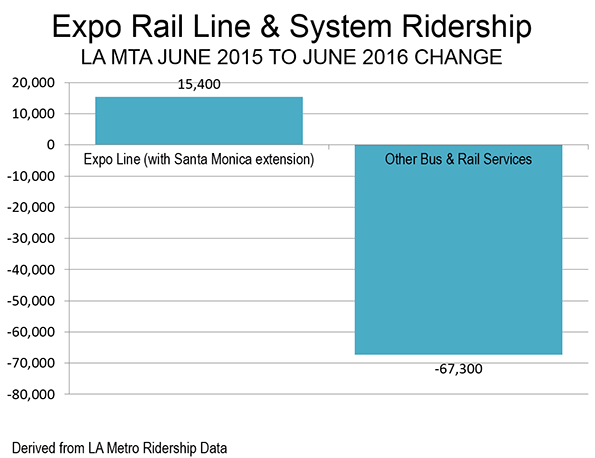
    The long awaited and highly touted Santa Monica extension brought an approximately 50 percent increase in ridership of the Los Angeles Expo light rail line between June 2016 and June 2015. The extension opened in mid May 2016. In its first full month of operation, June 2016, the line carried approximately 45,900 weekday boardings (Note), up from 30,600 in June 2015, according to Los Angeles Metropolitan Transportation Authority (MTA) ridership statistics.

    However MTA ridership continued to decline, with a 51,900 loss overall. Bus and rail services other than the Expo line experienced a reduction of 67,300 boardings (Figure).

    Between June 2015 and June 2016, rail boardings rose 30,500, while bus boardings declined 82,400. In other words there was a loss of 2.7 bus riders for every new rail rider over the past year. Los Angeles transit riders have considerably lower median earnings than in the cities with higher ridership, and lower than the major metropolitan average (see the analysis by former Southern California Rapid Transit District Chief Financial Officer Tom Rubin and "Just How Much has Los Angeles Transit Ridership Fallen?" and ) here and here).

    Note: A passenger is counted as a boarding each time a transit vehicle is entered. Thus, if more than one transit vehicle is required to make a trip, there can be multiple boardings between the trip origin and destination. Because the addition of rail services, as in Los Angeles, can result in forcing bus riders to transfer because their services can be truncated at rail stations, the use of boardings as an indicator of ridership can result in exaggeration, as the number of boardings per passenger trip is increased. This may have produced a decline of as much as 30 percent in actual passenger trips since 1985, as a number of rail lines have been opened in Los Angeles. 

  • SF Vs LA: Different Strokes In Urban Development

    Book Review: “The Rise and Fall of Urban Economies: Lessons from San Francisco and Los Angeles.” Michael Storper, Thomas Kemeny, Naji P. Makarem and Taner Osman; Stanford University Press, 2015.

    How and why do places differ in their pace of economic development? Why do some flourish while others lag? These are among the most profound questions in economics and related fields. Are explanations found in geography, culture, institutions, or fortune?

    In “The Rise and Fall of Urban Economies: Lessons from San Francisco and Los Angeles,” Michael Storper, Thomas Kemeny, Naji P. Makarem and Taner Osman consider these questions for two great cities. Storper, Kemeny, Makarem and Osman (hereafter SKMO) direct their attention to the Los Angeles and San Francisco “extended metropolitan regions” — the Census Bureau’s Consolidated Statistical Areas (CSAs) — in the post-1970 years. SKMO claim to have a plausible story about LA/SF divergence, which they do a fine job of presenting in this clearly written and well documented volume.

    Both areas were established centers in high-amenity coastal California settings with similar levels of economic success in base-year 1970. But their fortunes have diverged ever since, with San Francisco taking a significant lead.

    What happened?

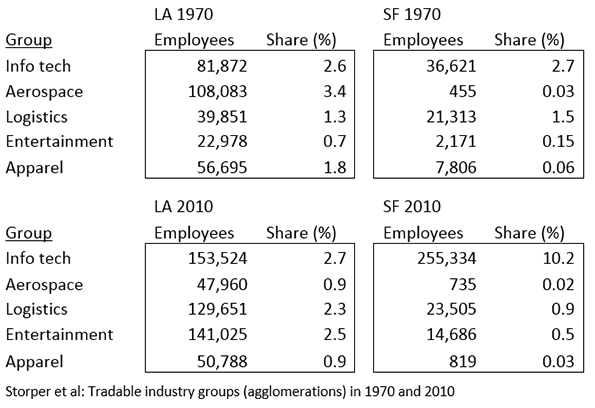
    Much of SKMO’s story springs from employment trends summarized in their table, below, which shows jobs data by major sector for their beginning and ending years for each region. Looking at employment shares, both areas had a similarly sized IT sector in 1970, but the Bay Area’s grew spectacularly while LA’s stayed about where it was. LA was specialized in aerospace and defense but, as is well known, that sector declined as the Cold War ended. Both geographic areas started almost equally in share of logistics jobs, but SF’s specialization in that sector subsided, while LA’s grew. LA’s lead in entertainment grew. Both areas lost jobs in apparel, but this hit LA harder, as the region had been more specialized in that sector.

    The LA area was long recognized for its leadership in the entertainment industry, just as the San Francisco area was for its leadership in tech. Yet “Hollywood” has been emulated in many places, including India, South Korea, China, and several European countries, while Silicon Valley’s would-be emulators, though numerous, have been far less auspicious.

    The post-1970s success of the SF region owes much to Silicon Valley, and SKMO note that, on average, SF’s tech sector salaries were higher than those in LA’s entertainment sector. Lots has been written about the unique culture of innovation and entrepreneurialism found in The Valley. There are real and aspiring ‘techno-hubs” practically all over the world. But the Holy Grail — to identify and bottle some kind of formula to spawn another Silicon culture — has not been discovered.

    SKMO note various Silicon Valley pre-1970s events: how the electronics industry had its roots in radio hobbyists, and the 1960s convergence of hippies and techies. The authors identify eleven historical “critical turning points.” Some are private business choices (“Hollywood’s creation of a new project-based organizational structure in the 1950s and 1960s”); some are more in the realm of public policy (“Los Angeles’ Alameda Corridor Project in the 1980s and 1990s”). Others (Steve Jobs liked The Whole Earth Catalog) also make the list, but without any clear direction for today’s planners.

    The authors devote a chapter to what local governments in each of the two regions spent and prioritized. Bay Area government spending was greater in the 1990s, as well as in the first decade of the 2000s. While Bay Area public transit spending was much greater, SKMO admit that both areas suffer bad traffic congestion, and back away from concluding the extra Bay Area public spending had payoffs. They end up concluding that we simply do not know enough about the programs that were funded to make strong statements about how spending might have (or should have) been re-allocated among programs.

    The key chapter of the book addresses what the authors call ‘Beliefs and Worldviews in Economic Development’: “We will see … how the Los Angeles Economic Roundtable and Chamber of Commerce generated very different narratives from those of the Bay Area Council and Joint Venture Silicon Valley… Bay Area leadership has had a more focused and time-consistent perception of its regional economy as a new knowledge economy. Greater Los Angeles leadership beliefs and worldviews have been inconsistent over time, with fleeting conceptions of the New Economy subsequently crowded out by the perception of Greater Los Angeles mainly as a gateway to international trade and logistics and specialized manufacturing.”

    We have to be careful here. The sequence of events is significant: Did important policy choices pre-date the good (SF) or the bad (LA) events the authors document? The unique entrepreneurial and innovative culture bred in Silicon Valley has no discernible starting date. Did the view of Bay Area elites of a new knowledge economy lead the way, or simply acknowledge facts on the ground?

    In their study of LA and SF, SKMO say little about how both areas have failed to reign in housing costs. By failing to contain the rising costs of most households’ single largest expenditure, both regions have failed. Labor markets cannot do their job when many people’s location choices are restricted. In all of their talk of the best regional development strategy, this essential one is not touched on in the study.

    But, caveats aside, “The Rise and Fall of Urban Economies” is data-rich, wide-ranging and provocative. Anyone interested in the American West’s two premier cities should read this important book.

    Peter Gordon is an Emeritus Professor, Price School of Public Policy at the University of Southern California. He now teaches each summer at Zhejian University in Hangzhou, China, and is currently at work on a book that explores how modern cities contribute to economic growth. He blogs at petergordonsblog.com.

  • Can Southland be a ‘New York by the Pacific’?

    Throughout the recession and the decidedly uneven recovery, Southern California has tended to lag behind, particularly in comparison to the Bay Area and other booming regions outside the state. Once the creator of a dispersed, multipolar urban model – “the original in the Xerox machine” as one observer suggested – this region seems to have lost confidence in itself, and its sense of direction.

    In response, some people, notably Los Angeles Mayor Eric Garcetti, favor creating a future in historical reverse, marching back toward becoming a more conventional, central core and transit-dominated region – a kind of New York by the Pacific. Eastern media breathlessly envision our region transforming itself from “car-addicted, polluted and lacking in public transit” into a model of new-urbanist excellence.

    Here’s a basic problem. Their L.A. of the future – the one that wins plaudits from places like GQ magazine – essentially negates the region’s traditional appeal, offering the middle and even working classes, a suburban-like lifestyle in one of the world’s great global cities.

    Vive la difference

    UCLA’s Michael Storper correctly notes how far the Southland has fallen behind its traditional in-state rival, the San Francisco Bay Area. Storper correctly traces much of this gap to the domination of the Los Angeles tech sector by aerospace firms and the fact that this area also had a broad base of nontech-oriented manufacturing.

    Can we become a second San Francisco? Regions, like people, do not easily transform themselves into something else. For one thing, the Los Angeles area’s diverse industrial legacy tended to attract a larger share of historically poorer blacks and Hispanics than the Bay Area, whose population is 33 percent black and Hispanic. In contrast, 55 percent of the five-county Southland area’s population has either Hispanic or African American backgrounds, according to data from the 2014 American Community Survey.

    Read the entire piece at The Orange County Register.

    Joel Kotkin is executive editor of NewGeography.com. He is the Roger Hobbs Distinguished Fellow in Urban Studies at Chapman University and executive director of the Houston-based Center for Opportunity Urbanism. His newest book, The Human City: Urbanism for the rest of us, will be published in April by Agate. He is also author of The New Class ConflictThe City: A Global History, and The Next Hundred Million: America in 2050. He lives in Orange County, CA.

  • What Price Urban Density?

    We regularly hear the argument that living in a compact city is more affordable than living in one that is more spread out. But what does the data actually show about the cost of housing in compact cities, and the cost of transport in these dense places? The relationship between those two expenses and the compactness of a city could tell us much about which kinds of places are most affordable, since those two costs together dominate household budgets.

    Advocates of denser urban environments have developed an index to measure the effects of a range of aspects of city living, such as vehicle miles traveled, traffic safety, congestion, the cost of housing, the cost of transportation, and health outcomes, among many other issues. The index takes into account several metrics, such as density, street accessibility and the mix of land uses.

    The index was conceived with the intent to study presumed negatives of city growth, and to make such growth “smarter.” Since the impulse to create it was advocacy-driven, it may lack objectivity. Notwithstanding this potential bias, and lacking alternative data, we used it as the default measure for our analyses, and consider our work a chance to test the validity and reliability of the index.

    First, we looked at housing costs. Casual and investigative observers seem to agree that housing costs do rise with city compactness. A recent report on the effects of compactness determined that housing costs increased by 1.1% for every 10-point increase in the compactness index. Other researchers have come to similar conclusions, using only population density as an indicator.

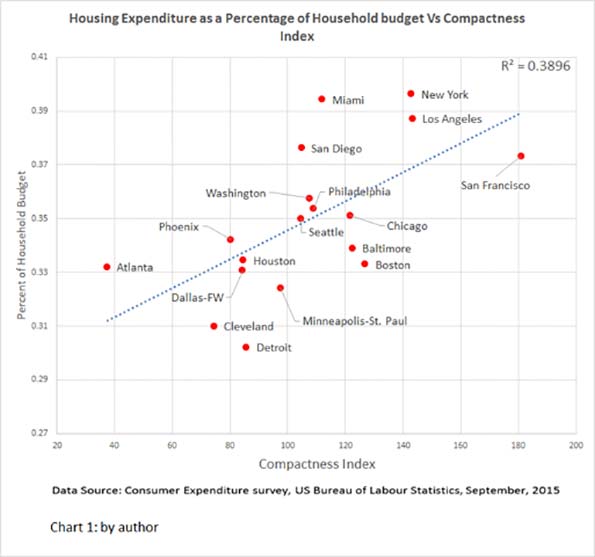
    Chart 1, which plots data from the 2015 Consumer Expenditure Survey, confirms this general agreement on the correlation between compactness and housing costs. But questions arise from the sharp differences between pairs of cities.

    For example, Boston and Atlanta residents use the same percentage of their budgets — 33% — for housing. Yet Boston’s compactness index is at least 90 points higher: 37.4 for Atlanta, vs 126.9 for Boston. According to Smart Growth theory, that difference should bring housing expenditures for Bostonians to 43%, about the same level that is experienced by New Yorkers.

    In another comparison, Boston and Miami differ little in compactness: 126.9 vs 112. Yet these two cities differ substantially in the percentage of household budget residents devote to housing costs – 33% vs 39%.

    Clearly, in both these examples and in the chart above, compactness is but one of many factors and, perhaps, not the dominant one in the relationship between a city’s housing costs and its compactness. Others need to be identified, quantified and incorporated. The trend, however, is indisputable: Greater compactness increases housing costs.

    Do transportation costs follow the same trend?

    According to theory, cities that are more compact offer more transport options, particularly public transit systems, some of which, like subways, outperform all other modes for time — especially work commute time — and provide travel options that are more affordable. Walking and biking may also be alternate means of mobility that help hold down household transport expenditures in compact cities. The association between density and high non-auto share of trips has already been demonstrated.

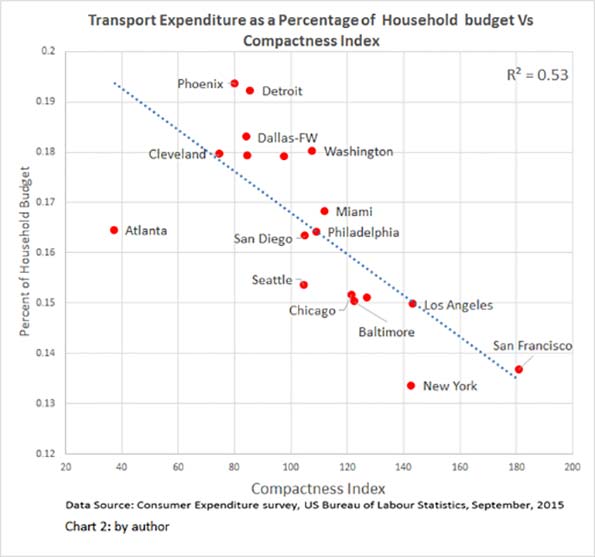
    Consumer Expenditure Survey data from 2015, when plotted, confirms this assumption. Chart 2 shows a decreasing proportion of the household budget being used for transportation as a city’s compactness index increases.

    However, as with housing costs, a close look at the differences between paired cities raises questions. Atlanta and Philadelphia share the same percentage of household budget expenditure on transport, 16%. Yet they differ by 70 points on the compactness index, 37.4 vs 109.05. Meanwhile, Washington and Seattle register an almost identical compactness index — 107.6 vs 104.6 — but the latter, contradicting theory, has transportation costs that are 3 percentage points lower, even though it lacks a subway. Both these cases demonstrate that the current model for measuring the impact of compactness needs fundamental refinements to improve its predictive value.

    So far, the data show two countervailing trends: Housing costs rise with compactness, while transportation costs fall. This finding leaves the question of whether more compact cities are more affordable to live in, at least with respect to these two expenditures that consume about half of a household’s budget.

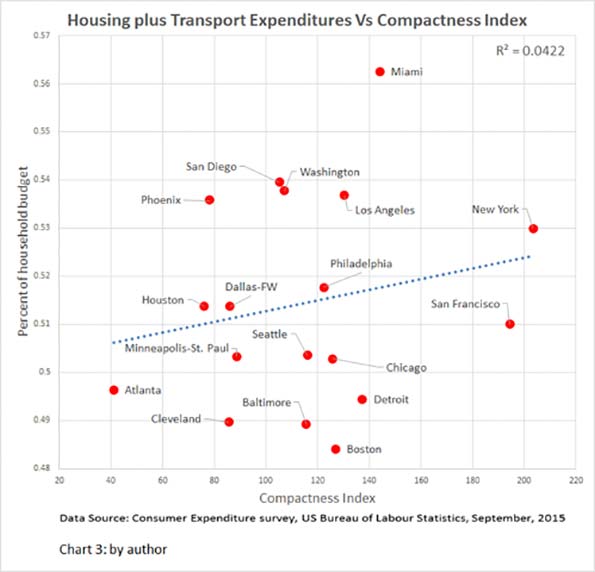
    Using the same data from the CES for the 18 cities, we plotted the results of combining the two expenditures, as a percentage of the household budget.

    Chart 3 shows an inverse, albeit weak, association of compactness with combined household expenditures of housing and transportation. It clearly does not indicate that more compact cities are more affordable for the average household. Upon a closer look the chart reveals some instructive surprises.

    First, Atlanta appears among a group of five most affordable cities, even though it has by far the lowest compactness index (40.9) of all eighteen cities in the CES survey. According to traded wisdom, its transport costs, being almost entirely based on automobile travel, should overwhelm its housing expenditures.

    Contradicting theory, Atlanta posts next to lowest average housing cost ($16,316/year), and also one but lowest transportation costs ($8,086/year). When considering that average income in Atlanta is on a par with that in Los Angeles ($69,821 vs $69,118), and that its compactness index is 80 points lower than LA’s, its comparative affordability challenges current thinking about compactness and its effects.

    Second, four cities hover around the same point of the index (#110), yet they cover almost the entire gamut of budget percentage expenditure (49% to 54%) for combined housing-plus-transport costs. The same is true for five cities aligning around the #130 of the index.

    It’s apparent that current theory falls short of adequately explaining field data. A city planner would find little comfort in knowing that a fourfold range of compactness can be equated with the same level of affordability, or that the same level of compactness can be associated with a wide range of combined transportation and housing expenditures. If anything, these results suggest that, because average housing expenses are double those of transportation, a yet-to-be-determined density ceiling might be an effective means of increasing a city’s affordability.

    The CES data is only a snapshot in time that may reflect transient conditions, such as gasoline prices, local inflated real estate markets, congestion levels that affect gas consumption, effectiveness and reach of public transit and so on. Variability in these factors will always affect the average transport and housing expenditures. A predictive model should be robust enough to handle such fluctuations, if it is to have practical value.

    Yes, greater compactness is associated with higher housing costs and lower transportation costs. But, contrary to unsubstantiated assertions, when these are combined, the result is less — not more — overall affordability.

    Fanis Grammenos heads Urban Pattern Associates (UPA), a planning consultancy. UPA researches and promotes sustainable planning practices including the implementation of the Fused Grid, a new urban network model. He is a regular columnist for the Canadian Home Builder magazine, and author of Remaking the City Street Grid: A model for urban and suburban development. Reach him at fanis.grammenos at gmail.com.

    Flickr photo by Tim Bartel of a San Francisco neighborhood