Tag: Los Angeles

  • Special Report: Infill in US Urban Areas

    One of the favored strategies of current urban planning is “infill” development. This is development that occurs within the existing urban footprint, as opposed that taking place on the fringe of the urban footprint (suburbanization). For the first time, the United States Bureau of the Census is producing data that readily reveals infill, as measured by population growth, in the nation’s urban areas.

    2000 Urban Footprint Populations

    The new 2007 estimates relate to urban areas or urban footprints as defined in 2000 and are produced by the American Community Survey program of the Bureau of the Census. Urban areas are the continuous urbanization that one would observe as the lights of a “city” on a clear night from an airplane. It is the extent of development from one side of the urban form to the other. Further, urban areas are not metropolitan areas, which are always larger and are defined by work trip travel patterns. Metropolitan areas always include adjacent rural areas, while urban areas never do.

    The Process of Infill

    Although embraced with often religious passion within the urban planning community, infill is neither good nor bad in terms of social or environmental impact. Infill always increases population densities and that means more traffic. If road capacity is increased sufficiently, traffic congestion can be kept at previous levels. If on the other hand, nothing is done, traffic congestion is likely to increase along with population. This means slower traffic and more stop and go operations, which inevitably increases the intensity of air pollution with the potential to cancel out any reductions in greenhouse gas emissions (GHG) that might occur if average car trip lengths decline. Similar difficulties can occur with respect to other infrastructure systems, such as sewer and water. Expanding roads, sewer and water systems in already developed areas can be far more expensive than new systems on greenfield sites. Regrettably, boosters of infill routinely ignore these issues.

    But infill has been going on for years, along with suburbanization, both in the United States and in other first world nations. This is indicated by the general densification trend that occurred in US urban areas between 1990 and 2000 and the longer term densification trends that occurred in a number of southwestern urban areas, such as Los Angeles, San Jose, Riverside-San Bernardino, Phoenix, Dallas-Fort Worth and Las Vegas. All these traditionally “sprawling” areas have, in fact, been densifying since 1960 or before. Since 2000, 33 of the nation’s 37 urban areas with a population exceeding 1,000,000 population experienced population infill to their 2000 urban footprints.

    Infill in Traditionally Regulated Markets (More Responsive Markets)

    Infill is a natural consequence of the traditional post-World War II land use regulation, which tends towards accommodating both demographic growth and market forces. This has been replaced by more prescriptive (often called “smart growth”) land use regulation in some urban areas. Under traditional regulation, suburban development followed a “leap frog” process, moving ever further out. This is roundly condemned in today’s planning literature and among leading academics and policy makers.

    Leap frog development occurs where urban development skips over empty land and creates a less continuous urban fabric. Land is developed based upon the interplay between sellers and buyers. Due to fewer planning restrictions, no seller can be sure that their land will be purchased since there is always plenty of land that buyers can otherwise purchase. This keeps land prices down. In the more responsive markets, it is typical for land and site infrastructure costs to be 20 percent of the total price land and house price.

    Infill occurs as land that has been “leaped” over is subsequently purchased for development. Again, because buyers have plenty of choices, prices of the infill land remains low, so that land and infrastructure costs remain relatively affordable in relationship to the overall new house purchase price.

    The result is an urban area that is generally continuous, though with a transitional “ragged edge.” The ragged edge enabled the broad expansion of home ownership that occurred in the decades following World War II by keeping house prices low.

    Infill in More Prescriptive Markets (Smart Growth)

    The infill process is quite dramatically different in more prescriptive markets. Infill might be mandated as a percentage of total development or by severely limiting the development allowed to occur closer to the urban fringe. Sellers of land on which development is permitted have disproportionate power to charge higher prices because the planning regime seriously limits the availability of alternative sites for buyers. This, of course, flows through to house prices. The share of land and site infrastructure can rise to two-thirds of the house and land cost. The urban area may have a “clearer” edge, but at a significant loss in housing affordability.

    Infill Trends in the 2000s

    The new infill estimates indicate that American urban areas continue to densify. Between 2000 and 2007, the 33 of the 37 urban areas of more than 1,000,000 population experienced densification in their 2000 urban footprints. The average population infill increase was 5.6 percent (See Table the following table).

    Population Infill in 2000 Urban Footprints
    2000-2007
      Population Change: 2000 Urban Footprint Population Density of 2000 Urban Footprint in 2007  
    Urban Area 2000 Census 2007 Estimate Change % Rank Rank
    Riverside–San Bernardino, CA       1,506,816      1,800,117     293,301 19.5% 1         4,110 8
    Atlanta, GA       3,499,840      4,118,485     618,645 17.7% 2         2,100 36
    Austin, TX         901,920      1,051,962     150,042 16.6% 3         3,308 17
    Las Vegas, NV       1,314,357      1,518,835     204,478 15.6% 4         5,311 5
    Houston, TX       3,822,509      4,370,475     547,966 14.3% 5         3,377 16
    Portland, OR–WA       1,583,138      1,779,705     196,567 12.4% 6         3,755 12
    Phoenix, AZ       2,907,049      3,254,634     347,585 12.0% 7         4,078 9
    Dallas–Fort Worth, TX       4,145,659      4,549,281     403,622 9.7% 8         3,236 18
    Orlando, FL       1,157,431      1,267,976     110,545 9.6% 9         2,799 24
    San Antonio, TX       1,327,554      1,440,794     113,240 8.5% 10         3,540 14
    Tampa–St. Petersburg, FL       2,062,339      2,209,067     146,728 7.1% 11         2,754 25
    Sacramento, CA       1,393,498      1,488,647       95,149 6.8% 12         4,034 10
    Seattle, WA       2,712,205      2,896,844     184,639 6.8% 13         3,040 21
    Miami, FL       4,919,036      5,243,679     324,643 6.6% 14         4,703 6
    Washington, DC–VA–MD       3,933,920      4,174,187     240,267 6.1% 15         3,611 13
    Denver, CO       1,984,887      2,087,803     102,916 5.2% 16         4,192 7
    Indianapolis, IN       1,218,919      1,278,687       59,768 4.9% 17         2,316 34
    Columbus, OH       1,133,193      1,175,132       41,939 3.7% 18         2,960 22
    Kansas City, MO–KS       1,361,744      1,408,900       47,156 3.5% 19         2,413 31
    Virginia Beach, VA       1,394,439      1,442,494       48,055 3.4% 20         2,742 26
    San Jose, CA       1,538,312      1,588,544       50,232 3.3% 21         6,110 2
    Los Angeles, CA     11,789,487    12,171,625     382,138 3.2% 22         7,302 1
    Cincinnati, OH–KY–IN       1,503,262      1,546,730       43,468 2.9% 23         2,305 35
    Baltimore, MD       2,076,354      2,133,371       57,017 2.7% 24         3,128 19
    San Diego, CA       2,674,436      2,747,620       73,184 2.7% 25         3,514 15
    New York, NY–NJ–CT     17,799,861    18,223,567     423,706 2.4% 26         5,440 4
    Minneapolis–St. Paul, MN       2,388,593      2,438,359       49,766 2.1% 27         2,727 27
    Chicago, IL–IN       8,307,904      8,467,804     159,900 1.9% 28         3,992 11
    St. Louis, MO–IL       2,077,662      2,103,040       25,378 1.2% 29         2,540 30
    Milwaukee, WI       1,308,913      1,324,365       15,452 1.2% 30         2,719 28
    Boston, MA–NH–RI       4,032,484      4,077,659       45,175 1.1% 31         2,350 33
    Providence, RI–MA       1,174,548      1,183,622        9,074 0.8% 32         2,353 32
    Philadelphia, PA–NJ–DE–MD       5,149,079      5,178,918       29,839 0.6% 33         2,880 23
    San Francisco, CA       3,228,605      3,214,137      (14,468) -0.4% 34         6,099 3
    Detroit, MI       3,903,377      3,831,575      (71,802) -1.8% 35         3,041 20
    Pittsburgh, PA       1,753,136      1,687,509      (65,627) -3.7% 36         1,981 37
    Cleveland, OH       1,786,647      1,705,917      (80,730) -4.5% 37         2,641 29
    Total  116,773,113  122,182,066  5,408,953 5.6%
    Data from US Bureau of the Census

    Riverside-San Bernardino, long castigated as a “sprawl” market, had the largest population infill, at 19.5 percent. Atlanta ranked number two, at 17.7 percent. This is a real surprise, since Atlanta was the least dense major urban area in the world in 2000, ranked second in 2000s infill. As a result, it is likely that Pittsburgh- often held up as a model of urban regeneration – is now the world’s least dense major urban area. On the other hand, if Atlanta’s infill rate continues, its 2000 urban footprint will be more dense than that of Boston by 2015.

    Austin ranked third, adding 16.6 percent population to its 2000 urban footprint. Las Vegas ranked fourth, with a 15.6 percent increase in its 2000 urban footprint. The density of Las Vegas is increasing so rapidly that by the 2010 census its 2000 urban footprint will be more dense than the 2000 New York urban footprint, should the current rates continue.

    Perhaps most surprising of all is that Houston ranked fifth, added 14.3 percent to its 2000 urban footprint. This may surprise those who have denounced Houston’s largely deregulated regulatory environment, both in the city and in unincorporated county areas in the suburbs. Yet overall Houston’s infill exceeded that of smart growth model Portland. The Rose City stood at sixth, adding 12.4 percent to its 2000 urban footprint.

    Perhaps equally surprising, Portland remains less dense than average for a western urban area. Its 2000 urban footprint density trailing Los Angeles, San Jose, San Francisco, Las Vegas, Denver, Riverside-San Bernardino, Phoenix and Sacramento, while leading only San Diego and Seattle.

    The top ten were rounded out by Phoenix (7th), Dallas-Fort Worth (8th), Orlando (9th) and San Antonio (10th). It is worth noting that like Houston, the unincorporated suburbs of Austin, Dallas-Fort Worth and San Antonio have largely deregulated land use regulation, yet these urban areas ranked high in infill.

    Interestingly some of the greatest infill growth also took place in the fastest growing, traditionally “sprawling” cities. Atlanta also had the largest numeric increase in the population of its 2000 urban footprint, at more than 600,000. Houston was a close second, at nearly 550,000.
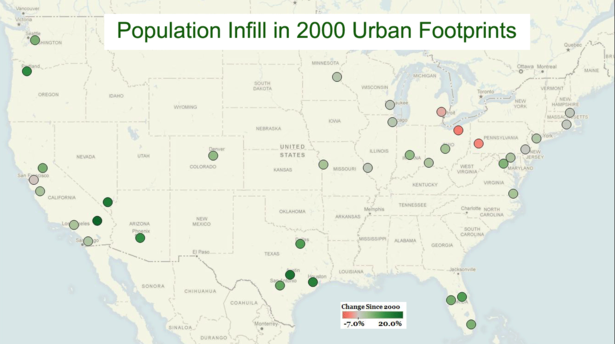
    In contrast, population losses since 2000 in the urban footprints of Cleveland, Pittsburgh, Detroit and San Francisco, means these urban areas experienced no population infill. San Francisco’s loss enabled San Jose to move into second position nationally after Los Angeles in the population density of its 2000 urban footprint.

    How the Core Cities Fared

    The core cities (municipalities) attracted, on average, their population share. Approximately 30 percent of the infill growth occurred inside the core cities. Even this figure may be a bit high, due to the impacts of annexation

    All of the infill in Philadelphia, Baltimore, Chicago, Providence and Minneapolis-St. Paul occurred outside the core cities. The city of Portland attracted barely 10 percent of its urban area infill, despite highly publicized (and subsidized) infill projects such as the Pearl District. Core cities attracted the largest share of infill growth in such diverse cities as San Antonio, San Jose, Columbus, Phoenix and New York.

    Note: Additional information available at http://www.demographia.com/db-uzafoot2007.pdf

    Wendell Cox is a Visiting Professor, Conservatoire National des Arts et Metiers, Paris. He was born in Los Angeles and was appointed to three terms on the Los Angeles County Transportation Commission by Mayor Tom Bradley. He is the author of “War on the Dream: How Anti-Sprawl Policy Threatens the Quality of Life.

  • Stimulus Alert Stretches From the Center of L.A. to Suburban Atlanta

    The hundreds of millions of dollars in federal stimulus money are working their way through various systems, en route to a city near you.

    Give President Barack Obama credit for acting boldly to pump the funds into the economy – or take him to task for printing up money on the cuff.

    Either way, the time has come to shift your focus from Washington, D.C., and onto State Houses and City Halls throughout our land.

    You’ll need to keep an eye on your local government officials because our civic culture has grown corrupt, and it’s a cancer that’s widespread. Politicians still don’t quite understand that this is now an open secret – although they’ve at least begun to stir in the wake of the recent and resounding “no” that California voters gave to the latest request for a bailout of a sick system of government.

    Meanwhile, the stimulus money is beginning to flow as pundits slice and dice the results from the Golden State, and the federal funds offer the potential to allow local governments to ignore the clear message from voters who are fed up with corruption and waste. Consider that most local governments across the nation have enjoyed a long run of a strong economy with only a few, brief interruptions over the past 25 years. They’re out of shape, all balled up with bad habits. The stimulus money could serve to finance another year or two of bad behavior if the people don’t watch local government like hawks. And another year or two of bad habits will be too much for all of us.

    Any doubts that these bad habits exist can be dispelled by taking a look at a recent deal that had city officials in Los Angeles ready to spend $5.6 million for a small parcel of land to be turned into a park on the 400 block of S. Spring Street. They eventually cut the offer to $5.1 million – a savings of $500,000 that came only after ongoing coverage by the Los Angeles Garment & Citizen – a weekly community newspaper that covers the Downtown area of the city and surrounding districts – shed light on a number of questionable factors in the deal.

    Those questionable factors indicate that it’s time for everyone who is not a city official – the people, in other words – to take a second look at the situation. The recent coverage amounted to more than stories about a park, or even the price of the land. The stories pointed to systemic corruption in the process that city officials use in spending large sums of the public’s money.

    There are no individuals to single out here – not at this point, anyway. No one got caught with a hand in the cookie jar. That’s the main problem – the corruption of our civic culture is pervasive to the point that it’s tough to catch anyone with their hand in the cookie jar. We don’t even keep our cookies in a jar in Los Angeles anymore – they’re left out around City Hall for the taking by politicians and special interests.

    New rules and ethical standards are needed in Los Angeles – and it’s a safe bet that the same is in order for cities across the country. A good place to start would be a new rule to ensure that taxpayers never again see city officials offer to pay millions of dollars based on an appraisal commissioned on behalf of the seller of a piece of land—the very process originally used in the park deal in Los Angeles. There should be some standard that requires city officials to conduct their own appraisals on major purchases. Many cities have such expertise among their employees. If not, it is surely worth a few thousand dollars to hire an appraiser to work for the city’s interests on deals where a 0.1% savings would cover such extra costs, as was the case on the park land.

    The Garment & Citizen’s recent reporting also shed light on the fact that bureaucrats in City Hall currently have great leeway in such matters. Sometimes they order their own appraisal on land purchases—and sometimes they don’t. The decision seems to be left entirely to the discretion of unelected bureaucrats.

    The problem here is basic because the current set-up begs for abuse. Bureaucrats are human beings, after all, and subject to all of the problems and temptations that life brings. It’s also well known that the career bureaucrats in Los Angeles are subject to political pressure from any number of sources. That includes the 15 members of the Los Angeles City Council, who operate their districts much like personal fiefdoms. The City Council members tend to stay out of one another’s business in a pretense of some sort of legislative courtesy. What they’re really doing is withholding their best efforts at internal oversight, a failure that has helped send the people on a sorrowful journey from engaged participants in our democracy to cynics who don’t even bother to vote.

    The lack of standards on appraisals is only one of the problems that cropped up on the recent park deal. There are many more specific to real estate dealings – and you can just imagine how many additional pitfalls can be found in the way the city purchases motor vehicles, or paper products, or telecommunications services. And so on, and so on.
    It’s enough to make you wonder how many city deals could be trimmed by a half-million here or a couple of million there?

    We’re guessing plenty – and that tightening up on these sweetheart deals would go a long way toward solving the current budget crunch while maintaining many of the jobs and services that might be cut to close a looming $500 million deficit in the city’s budget in Los Angeles.

    You can bet there are plenty of similar savings to be had in State Houses and City Halls across the nation, too. Indicators abound in Gwinnett County, Georgia, just outside of Atlanta. Taxpayers in Gwinnett who want to avoid getting fleeced will apparently have to go a step further than a clear standard on appraisals for land deals. That seems to be the only lesson to take from a recent report in the Atlanta Journal-Constitution, which found that elected officials in Gwinnett County commissioned their own appraisal on a piece of land and still voted to pay twice the price.

    Some of the county commissioners in Gwinnett said that they approved the higher price because land appraisals are “all over the board” these days.

    Commissioner Mike Beaudreau opposed the deal, saying that the wide range of appraisals indicated that the matter should be given more study. He stood alone in his opposition, and the people of Gwinnett County are now set up to pay twice the appraised value for the land.

    So here’s the key question to consider: Will stimulus money paper over such deals in State Houses, County Commissions, and City Halls throughout our land?

    Only the people can say for certain.

    Jerry Sullivan is the Editor & Publisher of the Los Angeles Garment & Citizen, a weekly community newspaper that covers Downtown Los Angeles and surrounding districts (www.garmentandcitizen.com)

  • Can California Make A Comeback?

    These are times that thrill some easterners’ souls. However bad things might be on Wall Street or Beacon Hill, there’s nothing more pleasing to Atlantic America than the whiff of devastation on the other coast.

    And to be sure, you can make a strong case that the California dream is all but dead. The state is effectively bankrupt, its political leadership discredited and the economy, with some exceptions, doing considerably worse than most anyplace outside Michigan. By next year, suggests forecaster Bill Watkins, unemployment could nudge up towards an almost Depression-like 15%.

    Despite all this, I am not ready to write off the Golden State. For one thing, I’ve seen this movie before. The first time was in the mid 1970s. The end of the Vietnam War devastated the state’s then powerful defense industry, leaving large swaths of unemployment and generating the first talk about the state’s long-term decline.

    An even scarier remake came out in the 1990s. Everything was going wrong, from the collapse of the Soviet Union and the unexpected deflating of Japan to a nearly Pharaonic set of plagues, ranging from earthquakes and fires to the awful Los Angeles riots of 1992.

    Yet each time California came roaring back, having reformed itself and discovered new ways to create wealth. In the wake of the early ’70s decline came the first full flowering of Silicon Valley as well as other tech regions, from the west San Fernando Valley to Orange and San Diego counties. Much of the spark for this explosion of growth came from those formerly employed in the defense and space sectors.

    The ’90s recovery was even more remarkable. Amazingly, the politicians actually were part of the solution. Aware the state’s economy was crashing, the state’s top pols–Assembly Speaker Willie Brown, Sen. John Vasconcellos, Gov. Pete Wilson–made a concerted effort to reform the state’s regulatory regime and otherwise welcomed businesses.

    The private sector responded. High-tech, Hollywood, international trade, fashion, agriculture and a growing immigrant entrepreneurial culture all generated jobs and restored the state’s faded luster.

    These sectors still exist and still excel even under difficult conditions. The problem this time is that the political class seems clueless how to meet the challenge.

    Politics have not always been a curse to California. In the 1950s and 1960s, the Golden State’s growth stemmed in large part from what historian Kevin Starr describes as “a sense of mission” on the part of leaders in both parties. Starr chronicles this period in his forthcoming book, Golden Dreams: California in an Age of Abundance, 1950-1963.

    Under figures like Earl Warren, Goodwin Knight and Pat Brown, Starr notes, California “assembled the infrastructure for a great commonwealth.” Their legacy–the great University system, the California Water Project, the freeways and state park system–still undergirds what’s left of the state economy.

    Perhaps the best thing about these investments was that they helped the middle class. Sure, nasty growers, missile makers and rapacious developers all made out like bandits–which is why many of them also backed Pat Brown. But the ’50s and ’60s also ushered in a remarkable period of widespread prosperity.

    Millions of working- and middle-class people gained good-paying jobs, and could send their children to what was widely seen as the world’s best public university system. People who grew up in New York tenements or dusty Midwest farm towns now could enjoy a suburban lifestyle complete with single-family homes, cars, swimming pools and drive-through hamburger stands.

    “This was an epic success story for the middle class,” historian Starr notes. It’s one reason why, when people ask me about my politics, I proudly identify myself as a Pat Brown Democrat.

    That’s why California’s current decline is so bothersome. A state that once was home to a huge aspirational middle class has become increasingly bifurcated between a sizable overclass, clustered largely near the coast, and a growing poverty population.

    Over the past 40 years California’s official poverty rate grew from 9% to nearly 13% in 2007, before the recession. Three of its counties–Monterey, San Francisco and Los Angeles–boast large populations of the über rich but, adjusted for cost of living, also suffer some of the highest percentages of impoverished households in the nation.

    Most worrisome has been the decline of the middle–the increasingly diverse ranks of homeowners, small business people and professionals. The middle has been heading out of state for much of the past decade. Politically, they have proven no match for the power of the wealthy trustfunders of the left, the powerful public employee union as well as a small, but determined right wing.

    The good news is that the middle class shows signs of stirring. The nearly two-to-one rejection of the governor’s budget compromise reflected a groundswell of anger toward both the Terminator and his allies in the legislature.

    Simply put, California voters sense we need something more than an artful quick fix built to please the various Sacramento interest groups. Required now is a more sweeping revolutionary change that takes power away from the state’s most powerful lobby, the public employees, whose one desired reform would be ending the two-thirds rule for approval of new taxes and budgets.

    Middle-class Californians are asking, with justification, why we should be increasing taxes–we’re ranked sixth-highest in the nationto pay for gold-plated state employee pensions as well as an ever-expanding social welfare program. Although state spending has grown at an adjusted 26% per capita over the past 10 years, it is hard to discern any improvement in roads, schools or much of anything else.

    As an opening gambit, the right’s solution–strict limits on state spending–makes perfect sense. However, long-lasting reform needs to be about more than preserving property and low taxes. To appeal to the state’s increasingly minority population, as well as the younger generation, a reform movement also has to be about economic growth and jobs.

    Not surprisingly, local leaders of the “tea party” movement gained some profile from last week’s vote. Yet the right, which has exhibited strong nativist tendencies, is not likely to win over an increasingly diverse state.

    In my mind, California’s revival depends on three key things. First, the lobbyist-dominated Sacramento cabal needs to be shattered, perhaps turning the legislature into a part-time body, as proposed by one group. Perhaps the cleverest plan has come from Robert Hertzberg, a former Speaker of the Assembly who heads up the reformist California Forward group.

    Hertzberg proposes a radical decentralization of power to the state’s various regions, as well as cities and even boroughs in urban areas like Los Angeles. This would break the power of the Sacramento system by devolving tax and spending authority to local governments.

    Secondly, California needs to develop a long-term economic growth strategy. Over the past decade, California’s growth has become ever more bubblicious, dependent first on the dot-com bubble and then one in housing. The basic economy–manufacturing, business services, agriculture, energy–has been either ignored or overly regulated. Not surprisingly, we could see 20% unemployment, or worse, in places like Salinas and Fresno by next year.

    Third, both political reform and an economic strategy aimed at restoring upward mobility depends on a revival of middle-class politics in this state. It would include building an alliance between the more reasoned tea partiers and saner elements of the progressive community.

    The new alliance would not be red or blue, liberal or conservative, but would represent what historian Starr calls “the party of California.” At last there could be a political home for Californians who are angry as hell but still not yet ready to give up on the most intriguing, attractive and potentially productive of all the states.

    This article originally appeared at Forbes.

    Joel Kotkin is executive editor of NewGeography.com and is a presidential fellow in urban futures at Chapman University. He is author of The City: A Global History and is finishing a book on the American future.
  • California Meltdown: When in doubt, Blame the Voters!

    By rejecting the complex Sacramento budget settlement, Californians have brought about an earthquake of national significance as has not been seen since the passage of Proposition 13 over thirty years ago. Once again, California voters handed politicians something they fear more than anything else, constraints on the ability to raise taxes and raid revenues for their pet interests.

    Some, like long time Los Angeles Times statehouse reporter George Skelton thinks it’s the voters’ fault, as he suggested in his recent op-ed. The problem, we are told, lies with voters. The state’s massive fiscal crisis, which I and others warned was coming, was apparently unforecastable to California politicians and their enablers, like Skelton.

    Blame the voters will become a large part of the national and local media spin. It is not the first time. Consider Proposition 13. The problems that led up to Prop 13 were years in the making, and they were well understood. Inflation and rising home prices were increasing taxes beyond what citizens were prepared to pay. Sacramento tried several times to address the problem, but then as now, politicians couldn’t make hard decisions. The entrenched interests, notably the public employee unions, would not hear of anything that might shrink state revenues.

    Contrary to some versions of history, Proposition 13 was not backed by oil companies, land developers and other business interests. In fact, most opposed it.

    Proposition 13 backers were outmanned, outspent and certainly without much media support. The measure was passed because after years of incompetence in Sacramento, California voters, like Medieval peasants, grabbed their pitchforks and torches and stormed the castle. They passed Prop 13.

    Some interpret this story as showing voter ignorance and fickleness. I interpret it as showing that California voters are patient, but only to a point. Once they have reached a certain point, California voters take matters into their own hands. The results are invariably far more onerous for the state than if the political class had effectively faced the issue. Part of the reason for this is because the voters have fewer tools available to them. Legislatures and governors may have scalpels, voters have only axes.

    Gray Davis was the victim of a similar uprising. He took the fall for a government that had failed. Arnold was going to be different. He would be the Governator. He won election promising mortal combat with special interests. In 2005, he tried to change things but was outmaneuvered by his union-backed opponents. After losing round one, he became Gray Davis but without his predecessor’s grasp of the essentials of government. As the Sacramento Bee’s Dan Walters has pointed out, hubris and ignorance make a deadly combination.

    Now, we have a budget crisis, and California voters are unwilling to give Sacramento a pass. Why?

    Maybe they don’t think they are getting value for their increased investment in government. California spent about $2,173 per resident (2000 dollars) in the 1997-1988 budget. The 2007-2008 budget spends about $2,738 (2000 dollars) per resident. That represents a 26 percent increase in real (inflation adjusted) per-capita spending in ten years.

    What have California voters purchased with their 26 percent increase in government spending? Are the roads 26 percent better? Are schools 26 percent better? What is 26 percent better?

    That is Sacramento’s problem. It is very hard to identify what good that this increase in spending has purchased. If it has been a good investment, why haven’t California’s leaders convinced the voters?

    Maybe you can make a case that we are 26 percent better off; maybe not. I don’t know, but then I haven’t seen a strong effort to make the case. Instead, we get predictions of doom. We’ll cut back on teachers. We’ll let prisoners out of jail. Skelton says “And, oh yes, the elderly poor, blind and disabled – welfare moms and children’s healthcare? They’ll take the biggest hits, as usual.”

    The problem with predictions of doom is that they don’t ring true, or they sound as if the political leaders will punish voters for forcing the leaders to face a budget constraint. Voters can remember 1997-1998. California had teachers. Prisoners were in jail. Healthcare was provided for those with the least resources. If California had these essential services then, and the State is spending 26 percent more now, why cut those essential services now?

    That is the question the California’s leaders have to answer soon. Today Sacramento faces a crisis. The governor and the legislature will have to deal with a real binding budget constraint, and how they choose to deal with that constraint will make a huge difference. They could show leadership. They could make difficult choices. They could stand up to the special interests that will spare no effort to punish them.

    They may not. They may try to punish voters by cutting essential services. They may try even more Enron-style accounting tricks. They may sell assets or use federal money to push the problem to future legislators and governors. They may make poor choices. They may avoid cutting entitlements and public employee pensions, the real source of the state’s fiscal distress.

    We are heading towards a convulsion, not only here in California but in a host of high-tax, high-regulation states now controlled by their own employees. This includes New York, Illinois, and New Jersey for starters. In the age of Obama, with its celebration of bigger government, this suggests perhaps a whiff of a counter-revolution.

    Bill Watkins, Ph.D. is the Executive Director of the Economic Forecast Project at the University of California, Santa Barbara. He is also a former economist at the Board of Governors of the Federal Reserve System in Washington D.C. in the Monetary Affairs Division.

  • Lenny Mills to Urban America: Clock Is Ticking for Ranks of ‘New Homeless’

    I always do my best to make time for Lenny Mills because he’s earned that sort of consideration.

    Mills is the fellow who wrote several pieces under the banner of his trademark “7 Rules” outline, where he applies the tricks he learned as a telemarketer to analyses of real estate development, politics, and other matters.

    Mills did an especially fine job on the “7 Rules of Downtown Gentrification,” which appeared in the Garment & Citizen’s issue of April 21, 2006. He laid out a number of reasons – seven, to be exact –to consider the possibility that the residential real estate boom ringing through Downtown Los Angeles back then would eventually turn into a busted bubble.

    Events have certainly borne out Mills’ prediction, so he brought credibility with him on his latest visit to my office.

    Mills waved a recent copy of USA Today at me, saying that he’s worried about the sort of folks who were featured in a recent front-page story in the national publication, a piece that described the circumstances of some of “the new homeless.” These are individuals who worked steadily their whole lives before hitting the skids and losing their homes in the current economic downturn. It’s a trend that has become familiar these days, with homeless encampments cropping up in all sorts of places, including Los Angeles.

    Mills has some added credibility when he speaks about homelessness – he spent a number of years living on the streets. He knows what it means to go through life with a weather-beaten face, watching opportunities slip away for lack of a telephone number to leave behind when seeking work.

    Mills has a place to live now, but he remains determined to inject his warnings about the new homeless into the public debate. The clock it ticking, he says, and the deterioration that comes with life on the streets will make it harder and harder for folks to climb back into mainstream lives. Once the wardrobe starts to fray, he says, the odds against getting back on track grow longer. Once the teeth start to go, he adds, homeless individuals can just about write off any return to the life they once knew. Each bit of deterioration makes it tougher for the homeless individuals – and more likely that they will become permanent burdens to the rest of us in one way or the other.

    Mills is remarkable in a number of ways, including the ability he mustered to retain his social skills during his time on the streets – something that many individuals quickly lose. I disagree with him on some things, but I can’t fault his ability to make fine use of the language to get his points across.

    Mills used such skill during our recent talk, driving home a couple of points about the new homeless: Our society has a narrow window of opportunity to pay for programs to reverse the trend – and a failure to act soon will mean far greater costs in terms of human lives and the public purse.

    Mills can spout chapter and verse on what he sees as the causes of the increases in homelessness over the past 40 years. He can cite demographic trends, economic patterns, and public policies to make a compelling case that a lot of folks were swept into life on the streets by causes beyond their control. He firmly believes that we as a society could have prevented most of the homelessness we have seen over the years had we not lacked the will to do so.

    I wouldn’t describe Mills as a fun guy. He’s a valuable fellow, though, because he’s willing to tell you what you’d rather not hear – and he’s capable of doing so in reasoned tones.

    Give Mills his due for hitting upon something of vital importance now. It’s clear that all the talk we’ve heard about addressing the old homelessness has led to no great progress over the course of decades. What did that latest Blue-Ribbon Public-Private Committee to End Homelessness Forever accomplish besides a photo opportunity, anyway?

    Someone wake the Blue Ribbon brigade and fire all of them.

    We have a whole new homeless problem – and we’re in desperate need of new ideas.

    Jerry Sullivan is the Editor & Publisher of the Los Angeles Garment & Citizen, a weekly community newspaper that covers Downtown Los Angeles and surrounding districts (www.garmentandcitizen.com)

  • In California, the Canary is Dead

    Canaries were used in early coal mines to detect deadly gases, such as methane and carbon monoxide. If the bird was happy and singing, the miners were safe. If the bird died, the air was not safe, and the miners left. The bird served as an early warning system.

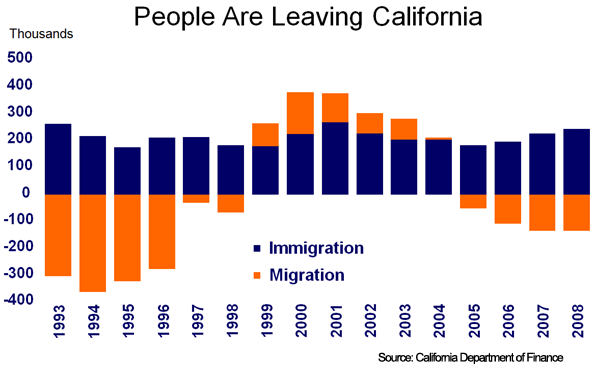
    Domestic migration trends play a similar early warning system for states. California’s dynamism was always reflected by its ability to attract newcomers to the state. But today California’s canary is dead.

    Here’s the logic. If net domestic migration is positive, the state’s economy is reasonably sound. Economic growth, taxes, housing, and amenities are strong enough to keep people where they are and attract others. If net domestic migration is negative, it usually means that lack of economic growth, taxes, quality of life, and housing have deteriorated sufficiently to drive people away. This happens despite the inevitable pain of leaving the security and comfort of family, friends, and familiar surroundings.

    California has been a destination for migrating workers and families since 1849. They came form every state and from around the world. Often the migrants faced tremendous challenges and hardship. Illegal immigrants from Mexico and other developing countries still must leap over such barriers. Often, California’s migrants came in waves. The 1850s, 1930s, and 1950s all saw huge surges tied to huge events – the Gold Rush, the Depression and the post-war boom. But even between these waves, California consistently experienced a steady inflow of new immigrants.

    Immigration has been good for California. The new residents brought ambition, skills, and a willingness to take risks. They found a state with abundant natural resources, from oil to rich soil and ample, if sometimes distant water resources. Together with the people already there, they created an economic powerhouse. They built cities with amenities that rival any other. They fed much of the nation and large numbers overseas. They did this while persevering much of California’s unique endowment: the vast coastline, the Sierra Nevada, and the deserts.

    California, with 12 percent of the United States population, became the world’s sixth largest economy while managing to maintain the aura of paradise at the same time. Opportunity and housing were abundant. California was a great place to have a career and raise a family.

    Most recently, though, this has begun to change. California is no longer a preferred destination, at least for domestic migrants. The state’s economy is limping along considerably worse than that of the nation. Opportunity is limited. Housing is relatively expensive, even after the dramatic deflation of the past two years, except for some very hard-hit and generally less attractive inland areas. Taxes are high and increasing. Regulation is onerous and becoming more so. Many California communities are outright hostile to business.

    Consequently, net domestic migration has been negative for 10 of the past fifteen years. International migration to California remains positive, but that reflects more on the weakness of the economies and the attraction of existing ethnic networks than the intrinsic superiority of California. This represents a sea change: anyone predicting it fifteen years ago would have been laughed out of the room.

    What happened?

    California’s economy was badly hit by the 1990s recession. The State’s aerospace and defense sectors were especially decimated. Middle-class families moved out by the hundreds of thousands.

    The 1990s out migration caused some soul searching in California. There was lots of talk, and a little action on making the State more competitive. Then came the technology and real estate booms. Domestic migration turned positive. The half-hearted efforts to make California more competitive faded as policy makers were lulled into complacency by the strength of California’s resurgence.

    But the problems that bedeviled the state in the 1990s – high housing prices and taxes, cascading regulations and a deteriorated infrastructure – had only been obscured by the boom. By 2005 migration began to turn negative, largely as soaring housing prices discouraged newcomers and encourage many residents to cash out and move to less expensive places. California had priced itself, and the dream, out of competitiveness. Since then, California has seen four consecutive years of increasingly negative domestic migration. The recent net outflow numbers have been smaller than in the 1990s, but it may be because other tradidional California migrant destination economies – like Oregon, Washington, Nevada and Arizona – have become less competitive as well.

    Today, many argue that California will bounce back, but they can’t identify the reason. What sector will lead the resurgence? They seem to think economic growth will come with the sunshine, beaches, and mountains. There was plenty of sunshine in the 80 years between the founding of the first mission and the gold rush, and not much happened. Similarly, the differences between California cities and neighboring Mexican cities show clearly that successful economies need more than good looks and nice climate.

    It’s hard right now to assume California’s future will include the same predominance in technological innovation. Agriculture is running out of water, in large part due to environmental lawsuits, and the state no longer seems willing to invest in new water projects. Even the entertainment industry is increasingly looking outside of California for growth. You have to ask: what does California offer that will overcome the State’s high costs, regulatory environment, and antipathy to business?

    That is the short term. The long term doesn’t look very good either. The public universities, a major source of innovation over the past two decades, are facing increasingly severe budget challenges. It is unlikely that they will be able to maintain their status even as other states – Texas, Colorado, New Mexico – eye further expansion. Even more ominous are gains in countries, such as China and India, who have long sent their best and brightest to the Golden State.

    All this suggests a relative decline in California’s long-term prospects. What should we do? Part of California’s problem is its political process. The state’s chronic inability to do much of anything reinforces stasis. As Dan Walters says, “everyone has a veto on everything.”

    But even improving the political process may not be enough. Much of Coastal California is dominated by rich, aging, baby boomers. The residents of this increasingly geriatric ghetto often don’t worry much about economic opportunity. They may have the money and votes to guarantee that growth does not impinge on their lifestyles. Unless these conditions change, it will be unlikely to see a renewal of strong domestic migration to California in the coming years.

    Bill Watkins, Ph.D. is the Executive Director of the Economic Forecast Project at the University of California, Santa Barbara. He is also a former economist at the Board of Governors of the Federal Reserve System in Washington D.C. in the Monetary Affairs Division.

  • LA is as Safe as 1956, Fact or Political Spin?

    In the weeks leading up to the tepid re-election of Los Angeles Mayor Antonio Villaraigosa last month, Bill Bratton, the statistics-driven chief of the Los Angeles Police Department, appeared on TV in a political advertisement paid for by the Villaraigosa campaign. He cited a seemingly amazing figure about this city’s livability.

    “Crime is down to levels of the 1950s,” said a confident-looking Bratton, who wore a black jacket and dark tie as he sat in an office conference room with downtown views.

    Flashing across the screen as he delivered the line with his heavy Boston accent was a Los Angeles Daily News headline from early 2008 borrowed by the Villaraigosa campaign to further emphasize the chief’s claim. It read in bold, black letters: “Safest streets since ’56.”

    On March 2, 24 hours before Election Day, Villaraigosa and Bratton teamed up again. This time, they appeared together at a morning press conference at the Police Academy in Elysian Park, where a statement from the Mayor’s Office made the rounds and trumpeted a “citywide crime-rate drop to the lowest level since 1956, the total number of homicides fall[ing] to a 38-year low. Gang homicides were down more than 24 percent in 2008.”

    The 1956 number was simply incredible — Los Angeles had time-warped back more than 50 years to the era of the Beat Generation, Elvis Presley and Howdy Doody, when serious crime was still so titillating that murder trials featuring unknown faces were followed like big celebrity events. It wasn’t the first time Bratton made the claim — the chief had also made the bold comparison in 2006 and again in 2008, lugging it out to warn voters that the low crime rate could be jeopardized if they didn’t pass the City Council’s telephone-utility-tax referendum, a phone tax that Villaraigosa and Bratton said was needed for the hiring of more cops.

    The press barely challenged the notion that Los Angeles has somehow been transported back five decades, and some instead focused on Bratton’s widely criticized political endorsement of the mayor — an unsettling and, many people believe, unethical move for a hired hand like a chief of police to engage in. One of the first to criticize Bratton’s claim was long-shot mayoral candidate Walter Moore. Moore couldn’t wrap his mind around the idea that Los Angeles is now as safe as the year that the L.A. Angels played baseball at a now-destroyed civic landmark — the beautiful old Wrigley Field in then-quiet, then-tidy South-Central Los Angeles.

    “I’ve talked to people who grew up here in the 1950s,” Moore argued to nodding heads during a February debate between several mayoral candidates, held in the hilly, suburbanlike community of Sunland-Tujunga (sans Villaraigosa). “And believe me, nobody in L.A. remembers crime in the 1950s being like it is today.”

    Moore isn’t the only one who finds it fishy, and just plain strange, to attempt to paint the city as similar to a time when 2.3 million residents lived in a far more suburban and far less dense metropolis, one in which residents often did not bother to lock their doors.

    “It’s a silly comparison,” Malcolm Klein, professor emeritus of sociology at USC and a gang-crime expert, says bluntly. An author of numerous books on gang crime, Klein says that when Bratton starts publicly comparing crime levels of the 1950s to today, “You’re not listening to a chief of police, you’re listening to a politician.”

    Read the extended version of this piece at LAWeekly.com

  • The Worst Cities for Job Growth

    One of the saddest tasks in the annual survey of the best places to do business I conduct with Pepperdine University’s Michael Shires is examining the cities at the bottom of the list. Yet even in these nether regions there exists considerable diversity: Some places are likely to come back soon, while others have little immediate hope of moving up. (Please also see “Best Cities For Job Growth” for further analysis.)

    The study is based on job growth in 336 regions – called Metropolitan Statistical Areas by the Bureau of Labor Statistics, which provided the data – across the U.S. Our analysis looked not only at job growth in the last year but also at how employment figures have changed since 1996. This is because we are wary of overemphasizing recent data and strive to give a more complete picture of the potential a region has for job-seekers. (For the complete methodology, click here.)

    First let’s deal with the perennial losers, the sad sacks of the American economy. Mostly cities in the nation’s industrial heartland, these places have ranked toward the bottom of our list for much of the past five years. Eleven of the bottom 16 regions on our list are in two states, Ohio and Michigan. In fact, the Wolverine State alone accounts for the bottom four cities: Jackson, Detroit, Saginaw and Flint.

    Unfortunately, there’s not much in the way of short-term – or perhaps even medium- or long-term – hope for a strong rebound in those places. President Obama seems determined to give the automakers, for whom Michigan is home base, far rougher treatment than what he meted out to ailing companies in the financial sector.

    In addition, new environmental regulations may not help auto production, since it necessitates some carbon-spewing and therefore perhaps unacceptable levels of greenhouse gas emission.

    However, not all of Michigan’s problems stem from Washington or the marketplace. Many of the locations at the bottom of the list remain inhospitable to business. To be sure, housing is cheap – in Detroit, property values are fast plummeting toward zero – but running a business can be surprisingly expensive in these hard-pressed places.

    In fact, according to a recent survey by the Tax Foundation, Ohio has an average tax burden roughly similar to New York, California, Massachusetts and Connecticut. But while the others are comparatively high-income states, Ohio residents no longer enjoy that level of affluence.

    Can these places come back? It is un-American to abandon hope, but there needs to be a radical shift in strategy to focus on creating new middle-class jobs. Some Midwestern cities, like Kalamazoo and Indianapolis, have made some successful efforts to diversify their economies, encouraging start-ups and trying to be business-friendly.

    But those are exceptions. Cleveland, one of our worst big cities, could spark a renaissance by revamping its port and nearby industrial hinterland. Once the world economy improves, it could re-emerge – building on the existing knowledge and skills of its production- and design-savvy population – as a hub for manufacturing and exports.

    But right now, Cleveland does not seem to be pursuing such opportunities. As Purdue’s Ed Morrison has pointed out, local leaders there seem to “confuse real estate development with economic development.”

    So Cleveland will focus on inanities such as convention business and tourism, believing we all fantasize about a week enjoying the sights along Lake Erie. Yet even high-profile buildings like the Rock and Roll Hall of Fame and Museum, completed in 1986, have not transformed a gritty old industrial town into a beacon for the hip and cool.

    Old industrial cities like Cleveland are better off focusing on their locational advantages – access to roads, train lines and water routes – while offering a safe, inexpensive and friendly venue for ambitious young families, immigrants and entrepreneurs.

    Meanwhile, cities with formerly robust economies – like Reno, Nev., Las Vegas, Orlando, Fla., Tampa, Fla., Fort Lauderdale, Fla., West Palm Beach, Fla., Jacksonville, Fla., and Phoenix – are more likely to rebound. These areas topped our list for much of the 2000s; their success was driven first by surging population and job growth and later by escalating housing prices.

    But the collapse of the housing bubble and a drop in large-scale migration from other regions has weakened, often dramatically, these perennial successes. “We could rely on 1,000 people a week moving into the area,” notes one longtime official in central Florida. “These people needed services, houses and bought stuff. Now the growth is a 10th of that.”

    Instead of waiting for the real estate bubble to return, these areas should choose to focus on boosting employment in fields like medical services, business services and light manufacturing. In much of Florida and Nevada, there’s also a need to shift away from a reliance on tourism, an industry that pays poorly on average and is always subject to changes in consumer tastes.

    We can even be cautiously optimistic about some of these former superstars. After all, observes Phoenix-based economist Elliot Pollack, the existing reasons for moving to Arizona, Nevada or Florida – warm weather, relatively low taxes and generally pro-business governments – have not disappeared. “There’s no change in the fundamentals,” he argues. “It’s a transition. It’s ugly, and there’s pain, but it’s still a cycle that will turn.”

    Once the economy stabilizes, Pollack says he expects the flow of people and companies from the Northeast and California to Phoenix and other former hot spots will resume, once again lured by inexpensive real estate, better conditions for business and a generally more up-to-date infrastructure.

    The Problem with California
    So what about California? The economic well-being of many metropolitan areas in the Golden State has been sinking precipitously since 2006. This year, three California regions – Oakland, Sacramento and San Bernardino-Riverside – have sunk down into the bottom 10 on the large cities list. That’s a phenomenon we’ve never seen before – and never expected to see.

    Like other Sun Belt communities, California suffered disproportionately from the housing bubble’s bust, which has devastated both employment in construction-related industries as well as much of the finance sector. But some, like economist Esmael Adibi, director of the Anderson Center for Economic Research at Chapman University, where I teach, think a real estate turnaround may be imminent.

    Among the first to predict the potential for a real estate bubble back in 2005, these days Adibi is more upbeat, pointing to rising sales of single-family homes, particularly at the lower end of the market. California’s inventory of unsold homes is now down to about six months’ worth, a figure well below the national average of 9.6 months.

    It seems not everyone is ready to abandon the Golden State – but still, recovery in California may prove weaker than in surrounding states. One forecaster, Bill Watkins, even predicts unemployment could reach 15% next year, up from about 11% today. California, most likely, will see only an anemic recovery in 2010 even if growth picks up elsewhere.

    Much of the problem lies with the state’s notoriously inept government. The enormous budget deficit will almost certainly lead to tax increases, which will fall mostly on the state’s vaunted high-income entrepreneurial residents. Stimulus funds won’t do much good either, Adibi notes, since “the state is grabbing all of the federal stimulus money” to keep itself afloat.

    A draconian regulatory environment also could dim California’s prospects for growth. Despite double-digit unemployment, the state seems determined not only to raise taxes but also to tighten its regulatory stranglehold.

    This is a stark contrast to what happened in the 1990s during the last deep recession. At that time, leaders from both political parties pulled together to reform the state’s regulatory and tax environment. Almost everyone recognized the need to improve the economic climate.

    But an even deeper recession, it seems, hardly troubles today’s dominant players – public employees, environmental activists and gentry liberals who largely live along the coast. The state has recently passed a draconian Assembly bill aimed to offset global warming by capping greenhouse gas emissions – a measure that seems designed to discourage productive industry.

    “This is becoming a horrible place to produce anything,” says Watkins, who is executive director of the Economic Forecast Project at the University of California, Santa Barbara.

    California’s lawyers, though, might stay busy. Attorney General Jerry Brown has threatened to sue anyone who grows their business in unapproved, environment-threatening ways. To be sure, this promise may have relatively little impact on the more affluent, aging coastal communities – but it could wreak havoc on younger, less tony areas in the state’s interior. Many of the local economies there still rely on resource-dependent industries like oil, manufacturing and agriculture.

    It’s sad because California has the capacity to recover more quickly than the rest of the country if the state moderates its spending and stops regulating itself into oblivion. This current round of legislation is so dangerous precisely because it could eviscerate the heart of the economy by slowing down entrepreneurial growth, the state’s greatest asset.

    Even in hard times, there are people with innovative ideas trying to bring them to market – and not just in Hollywood- and Silicon Valley-based industries but in a broad range of fields, from garments to agriculture, aerospace and processed foods. The desire to increase regulation reflects a peculiar narcissism and arrogance of the state’s ruling elites, who believe the genius of San Francisco’s venture capitalists and Los Angeles’ image-makers alone are enough to spark a powerful recovery.

    This is delusional. True, California still has a lead in everything from farm products to films to high-tech manufacturers. But it has been slowly losing ground – to both other states and overseas competitors. CEOs and top management might stay in the Golden State, but they increasingly send outside its borders all jobs that don’t require access to the local market, genius scientists or talented entertainers.

    “There’s a feeling in California that we will come back, no matter what, because we are California,” Watkins says. “The leadership is swallowing Panglossian Kool-aid. Some very smart people, a beautiful climate and nice beaches is not enough to guarantee a strong recovery.”

    This article originally appeared at Forbes.

    Joel Kotkin is executive editor of NewGeography.com and is a presidential fellow in urban futures at Chapman University. He is author of The City: A Global History and is finishing a book on the American future.

  • LA Tax

    Residents in Los Angeles with home-based business received letters from the Office of Finance that said, “The following amounts are due and payable immediately: $4,363.81.”

    People who work as independent contractors and had failed to register their businesses with the city’s tax and permit division by Feb. 28 received the letters in March.

    The city calculated the number by estimating $200,000 in gross income for each business over the last three years – the annual average for city business taxes – added interest and late penalties and arrived at the $4,000-plus number.

    The letters arrived at a time when many laid-off employees are working as independent contractors themselves. To add fuel to the fire, many who received the letters might have generated income less than the total amount of the tax.

    Though the city has denied that the letters were any kind of “scare tactic,” the program stems from a 2002 push to identify unregistered businesses using records “disclosed to the city by the California Franchise Tax Board.” The program has added almost 100,000 businesses to the tax roll and generated $107 million in revenue.

    This issue has a particular sting at the moment, particularly given LA’s 10% plus unemployment rates.

  • City of Los Angeles Hits the Bottle

    While San Francisco Mayor Gavin Newsom was recently chided for his water bottle usage, the city of Los Angeles hasn’t been much better.

    It was recently reported that the city of LA spent $184,736 on bottled water in 2008, “despite a mayoral directive that it should not be provided at the city’s expense.”

    City officials are encouraged to use coolers or pitchers of tap water for special events, and those that wish to drink bottled water “can do so at their own expense,” said City Controller Laura Chick.

    Despite a 2005 memo for Mayor Antonio Villaraigosa stating that city funds were not to be used on bottled water, certain city departments continued to spend funds on the plastic bottles.

    The biggest spenders were found to be Public Works ($69,696), Los Angeles World Airports ($31,429), Los Angeles Police Department ($19,708), General Services ($19,508), Transportation ($14,595), and Harbor ($11,993).

    The Department of Water and Power cut their spending down from $31,160 in 2004/05 to $3,419 in 2008, while the departments of Community Development, Commission on Children Youth and Families, Fire, Housing, Library, Neighborhood Empowerment, and Personnel ceased purchases altogether.

    Although spending has been reduced, public employees continue to expect the city to foot the bill for their bottled water. Such blatant non-compliance is hard to swallow.