Tag: Los Angeles

  • Battle of the Upstarts: Houston vs. San Francisco Bay

    “Human happiness,” the Greek historian Herodotus once observed, “does not abide long in one place.” In its 240 years or so of existence, the United States has experienced similar ebbs and flows, with Boston replaced as the nation’s commercial capital first by Philadelphia and then by New York. The 19th century saw the rise of frontier settlements—Cincinnati, Pittsburgh, Cleveland, and finally Chicago—that also sought out the post position. In the mid 20th century, formerly obscure Los Angeles emerged as New York’s most potent rival.

    Today we are seeing yet another shuffling of the deck among American regions. New York remains the country’s preeminent city, but its most powerful rivals are likely to be neither Chicago nor Los Angeles, but rather two regions rarely listed in the hierarchy of influential regions: the San Francisco Bay Area and Houston.

    Making of a new pecking order

    The Bay Area does not rank among the 20 top global cities in most studies, such as the 2014 A.T. Kearney listings. In the respected rankings of the London-based Globalization and World Cities Network, the Bay Area stood below not only Chicago, which is considered an “alpha” global city, but also such places as Toronto and Mexico City.

    Yet such rankings vastly underestimate the power now being wielded by the San Francisco region. As the headquarters for the largest concentration of cutting edge tech firms in the world, the Bay Area increasingly shapes the operations of companies from manufacturing and marketing to retail and media. And given that roughly half the nation’s venture capital is still being lavished on area start-ups, it is not surprising that Silicon Valley ranks number one in the world as a place to launch tech ventures, according to the Startup Genome.

    Tech dominance, according to a recent study on global cities conducted by my firm NewGeography, explains why the San Francisco Bay Area nudges out much larger Los Angeles for bragging rights on America’s Pacific Rim. Technology leaders, including Intel, Apple, Oracle, Google, and Facebook, are based in Silicon Valley, while Asian global tech firms such as Samsung also have North American headquarters there. Top technology firms from other cities often have their key R&D functions in the Bay Area. Even a frugal firm like Wal-Mart is enlarging its Silicon Valley presence.

    The current social media bubble will surely pop, but as Michael S. Malone and others have noted, the Bay Area’s preeminence will likely continue, fueled by its unique concentration of engineers, entrepreneurs, and risk capital. As a lure for the ambitious, Silicon Valley and San Francisco are replacing Wall Street. Google alone has 1,200 employees who formerly worked for large U.S. investment banks, and migration from the Big Apple to California is now at its highest level since 2006.

    Much of the appeal of the Bay Area is a result of happy coincidence of history and geography. The Bay Area—where I went to school and got my start in journalism, and where parts of my family have resided since the ’50s—has been blessed with excellent higher education and is centered around what is arguably America’s most beautiful city. Good weather, beautiful vistas, and access to nature have made the Bay Area a natural lure for people who can afford to live wherever they want.

    The Energy Capital

    Houston, where I have been working as a consultant, hardly qualifies as one of the most physically attractive or temperate cities. San Francisco may well have been, as Neil Morgan suggested a half century ago, “the Narcissus of the West,” but Houston, in most accounts, has been widely disparaged as hot, steamy, ugly and featureless. Yet despite this, its ascendency is no less compelling than that of the Bay Area.

    Houston’s trump card, like the Bay Area’s, resides in its control of one strategic industry, in this case energy. The majority of traded foreign oil majors, such as London-based Shell and British Petroleum, have their U.S. headquarters in Houston, and even companies based elsewhere boast a significant Houston presence. For example, Exxon, although it has its headquarters in Dallas-Fort Worth, is opening a massive Houston campus that will be home to 10,000 employees. Additionally, a majority of the world’s largest oil services companies, such as Baker Hughes, Schlumberger, and FMC Technologies, are based in Houston.

    Altogether, more than 5,000 energy-related companies call Houston home. The city employs three times more people in energy than its second place rival, Dallas-Ft. Worth, and more than the next five cities combined. This growth is likely to accelerate because foreign companies, notably from Germany, have begun buying up energy firms in the area, including Siemens’s recent $7.6 billion dollar purchase of the Dresser Rand Group, an energy equipment firm.

     Houston has added more than 10 percent more jobs since 2008, almost twice the increase in the Bay Area. Since 2000 Houston’s employment figures have shot up 32 percent, while the Bay Area has grown by barely 4 percent. And it’s not just energy that’s driving things—Houston is now the nation’s largest export port and boasts the world’s largest medical center. It has also become, by some measurements, the most ethnically diverse (PDF) region in the country. In the last decade, for example, Houston increased its foreign-born population by 400,000, second only to New York and well ahead of much larger Los Angeles.

    The big losers: LA and Chicago—but also New York

    In the past century New York and Los Angeles have dominated American media. This is being severely undermined by the Bay Area’s digital economy. Since 2001, notes Mark Schill at Praxis Strategy (where I am a senior fellow), book, periodical, and newspaper publishing—all traditionally concentrated in the New York area—have lost some 250,000 jobs, while Internet publishing and portals generated some 70,000 new positions, many of them in the Bay Area or Seattle.

    Google and Yahoo are already among the largest media companies in the world. (Yahoo now refers to itself as a digital media company rather than a technology company). With the ubiquity of its iTunes platform, Apple exercises ever greater control over consumer distribution of entertainment products such as music and video; Netflix, Hulu, and YouTube could become the studios of the future. This could shift global media decision-making from its familiar New York-Los Angeles axis to the Bay Area.

    This is particularly bad news for Los Angeles, whose grip on the entertainment industry was weakening even before Silicon Valley’s rise. Since 2004, LA’sentertainment industry lost roughly 11 percent of its jobs, as production shifted to Canada, Louisiana, and other locales.

    The decline in media employment comes on the heels of a rapid industrial decline—the area has lost more than 90,000 aerospace jobs since the end of the Cold War. The situation is so dismal that a report issued by many of the region’s top business and political leaders concluded that the city “is barely treading water while the rest of the world is moving forward.”

    Chicago’s situation is arguably even worse, but it is more threatened by Houston, which has already passed the Windy City in numbers of corporate headquarters. Since 2010, when U.S. industry began recovering, Houston manufacturing employment expanded by more than 17 percent, compared to flat growth in Chicago.

    “Houston is the Chicago of this era—like the old Chicago,” remarks David Peebles, who runs the Texas office of Odebrecht, a $45 billion engineering firm based in Brazil. “In the ’60s you had to go to Chicago, Cleveland, and Detroit. Now Houston is the place for new industry.”

    With its industrial base eroding, Chicago is no longer a strategic hub for any key industry. Outside of trading commodities, it also no longer serves as a major global financial center. Regional population growth has been meager over the past decade, and the city’s own pension issues may be worse than Detroit’s.

    Chicago retains its brilliant skyline, great cultural institutions, powerful political influence, and a strong business community. But its days of America’s number two city are long gone, and, as we enter the mid-2000s, it is falling behind not only Los Angeles and New York but the two rising Texas cities, Houston and Dallas, both expected to pass the “city of big shoulders” in population by mid-century, or earlier.

    Engineering the Future

    In the coming decades, New York will remain the nation’s top global city, due to its remarkable urban legacy, the power of Wall Street, and the entrenched traditional media. But its Achilles heel is a lack of the engineering power necessary to address key challenges such as the digitization of industry, energy efficiency or climate change. New York is profoundly weak in engineering talent (PDF)—ranking 78th out of 85 metropolitan areas in engineers per capita.

    In contrast, the Bay Area represents the epitome of engineering power, with the San Jose area boasting the largest per capita concentration of engineers of any major metropolitan area. The Bay Area’s power to develop new technologies and its almost unfathomable wealth will continue to undermine traditional institutions, from Hollywood and Wall Street to business services, tourism, automotive, and even aerospace industries.

    Far less appreciated, Houston, rather than being a southern city of duller wits, actually ranks second in engineers per capita. If the Bay Area is master of the digital economy, Houston ranks as the technological leader of the material one; it is the capital for the energy-driven revival of U.S. industry, not only in Texas but throughout the old industrial heartland. Revealingly, Houston actually has seen far more rapid growth in both college educated and millennial population since 2000 than the Bay Area, as well as New York, Chicago, and Los Angeles.

    Rival Approaches to Urbanism

    The Bay Area, for all its vaunted progressivism, increasingly resembles a “gated community” whose high prices repel most potential newcomers, particularly families. Already by far the nation’s least affordable city—only 14 percent of current residents can possibly afford to buy a home—it represents a growth model that is by definition exclusive, almost a throwback to medieval forms where the rich clustered inside the city gates.

    High housing prices, notes economist Jed Kolko, account for the fact that, despite the boom, population growth in the Bay Area remains well below national averages. From 2000 to 2013, the region lost approximately 550,000 domestic migrants. Despite sizable immigration, the regional population growth rate has fallen below the national average.

    In contrast, Houston is among the fastest growing regions in the country, with rapid increases both in domestic migrants and newcomers from abroad. This stems from both lower housing prices and a growth model that is far more amenable to higher paid blue collar and middle management positions. Since 2000, Houston’s population has grown by 30 percent compared, three times that of the Bay Area.

    Ironically, Houston’s growth has been more egalitarian than that of the notionally super-progressive San Francisco region. A recent Brookings report found that income inequality has increased most rapidly in what is probably the most left-leaning big city in America, where the wages of the poorest 20 percent of all households have actually declined amid the dot com billions.

    This inequality has a distinct racial element. The Bay Area gap between white residents (who dominate the tech economy) and minorities is among the highest in the nation while, during the boom, income has fallen for Hispanics and African-Americans, according to Joint Venture Silicon Valley.

    This racial divergence is far less pronounced in Houston, while the growth of poverty since 2000 has been slower, increasing at one third the rate of New York and San Francisco, and half that of Los Angeles. The Texas city may lack the great views of San Francisco, but Houston has turned out to be a better city for middle class minorities. Homeownership among African Americans stands at 42 percent and for Latinos at more than 53 percent; this compares to 32 and 37 percent in the Bay Area.

    Perhaps the biggest differences can be seen in families. Of the nation’s 52 largest metropolitan areas, the Bay Area has the lowest percentage, 11.5 percent, of people ages 5 to 14. In Houston, 23 percent of the population fits this age category. In particular San Francisco is notoriously inhospitable to families, with the lowest percentage of kids of any major city.

    The two regions also reflect very different urban forms. The Bay Area’s leadership has opted to favor dense “in fill” growth and sought to restrict suburbandevelopment. Houston has taken a different tack. As its population has expanded, so too has the metropolitan area. This includes the development of many planned communities that appeal to middle class families and many immigrants. In 2013, Houston alone had more housing starts than the entire state of California.

    But it would be wrong to dismiss Houston’s model as merely “sprawl.” Instead it is better seen as simply expansive. In fact, arguably no inner ring in the country has seen more rapid growth, with high-rise, mid-rise and townhouse development in many long neglected districts. The increase in high-density housing tracts (more than 5,000 per square mile) since 2000 has been almost ten times higher than the Bay Area.

    The Political Battle for the Future

    Increasingly America’s future will be determined by these two cities, with the issue of addressing climate change at the fore. Much of the Bay Area’s leadership—led by the likes of Google Chairman Eric Schmidt and investor Tom Steyer—have all but declared war on the oil and gas industry. Several colleges and universities in the region, including Stanford, have shed their energy holdings, and Silicon Valley has nurtured movements such as Bill McKibben’s 350.org that seek to revoke the “social license” of big oil, a tactic used previously against the tobacco companies and firms that did business in apartheid South Africa.

    The elites of Silicon Valley and San Francisco are not just interested in saving the earth; they wish to profit from a change in the nation’s energy economy. Google, Sun Microsystems founder Vinod Khosla, and top venture capitalists such as John Doerr have bolstered their already ultra-thick wallets by capitalizing on “green energy” subsidies and outright grants from various levels of government. Given these investments, it’s easier to understand the Valley’s support for draconian climate change legislation, complete with attempts to demonize “Texas oil.” (One won’t see such populist zeal on , say, increasing capital gains rates.)

    The Valley’s hostility to fossil fuel energy, and its jihad to destroy an entire industry, is only barely recognized in Houston. I also have never heard anyone there suggest that Silicon Valley should be closed down as a danger to the planet (or at least a threat to the attention span of younger Americans). Houstonians, particularly in the energy industry, generally lack media savvy, which is one reason why energy is widely rated as the country’s least popular industry. Also missing, thankfully, is the sense of entitlement and self-congratulation one finds in the Bay Area. But once the intention to devastate the oil and gas industry is better understood, expect the energy capital to square off against the tech center, generating what may be the regional battle royal of our era.

    This piece originally appeared at The Daily Beast.

    Joel Kotkin is executive editor of NewGeography.com and Roger Hobbs Distinguished Fellow in Urban Studies at Chapman University, and a member of the editorial board of the Orange County Register. His newest book, The New Class Conflict is now available at Amazon and Telos Press. He is author of The City: A Global History and The Next Hundred Million: America in 2050. His most recent study, The Rise of Postfamilialism, has been widely discussed and distributed internationally. He lives in Los Angeles, CA.

    Photos courtesy of University of Texas Health Science Center at Houston Office of Communications and Vincent Bloch.
  • Southern California Becoming Less Family-Friendly

    The British Talmudic scholar Abraham Cohen noted that, throughout history, children were thought of as “a precious loan from God to be guarded with loving and fateful care.” Yet, increasingly and, particularly, here in Southern California, we are rejecting this loan, and abandoning our role as parents.

    This, of course, is a process seen around the high-income world, and even in some developing countries. But, here in America, some regions are moving in this post-familial direction faster than others, and, sadly, Southern California, for the most part, is leading the trend.

    Historically, Southern California, as a lure first for domestic migrants and, later, for foreign immigrants, has been an incubator of families. As recently as 2000, the proportion of population ages 5-14 in Los Angeles and Orange counties stood at 16 percent, the sixth-highest level among the nation’s 52 largest metropolitan areas. Thirteen years later, that proportion had dropped to 12.8 percent, ranking 33rd. The area experienced a 20 percent drop in its share of youngsters, the largest decline among U.S. metro areas.

    Of course, not everywhere in Southern California has experienced such a precipitous shift. The Inland Empire, which stands apart in census data, remains a relative bastion of familialism, with 15.3 percent of the population between ages 5-14. Yet even the Inland Empire is slipping somewhat, from having the highest percentage of children to a ranking of fourth, and experiencing a 17 percent decline in children’s share of the population, the fourth-largest percentage drop in the nation.

    If we try to focus even more closely, the patterns of decline, and the few bright spots, become more clear. Using 2010 U.S. Census data for specific regions (more up-to-date numbers are not yet available at the local level), it’s clear where much of this loss is concentrated.

    The most precipitous declines have been in the inner city, notably Central Los Angeles, which experienced a net loss of 87,000 youngsters from 2000-10. Although their rate of loss was not as severe as in the core, other, once family-rich parts of the region – the San Fernando and San Gabriel valleys, Santa Ana/Anaheim, Long Beach and Whittier-Southeast Los Angeles County – all posted double-digit percentage drops in children.

    Only a few areas of Southern California experienced growth in the number of children. Much of the growth was in the vast, outer suburbs and exurbs – places such as the Victor Valley, San Bernardino, Perris-Temecula, Santa Clarita-Antelope Valley and Riverside-Moreno Valley, as well as decidedly more upscale Irvine-South Orange County.

    In a sense, these numbers tell several stories. To be sure, high housing prices seem to have a direct impact on family formation, pushing people further out to the periphery or, in some cases, out of the region entirely. Overall, according to recent analysis of census data, high-cost areas tend to repel families; almost all the most expensive areas in the country, such as the Bay Area, New York and Boston, have all experienced strong drops in numbers of children.

    This has resulted, as demographer Ali Modarres has demonstrated, in a gradual emptying out of families from the poor, but still expensive, inner core of Los Angeles. These areas tend to be heavily immigrant, and once were seen as the generators of a new generation of Angelenos. Now, however, as Modarres suggests, these areas are also “getting old,” with grandparents remaining but the new generation headed to other locales within or beyond the region. This process, he notes, has been accelerated by a decline in immigration to the region, particularly among Latinos, who long settled in these areas.

    Housing prices are not the only determinant. Prices are even higher in the Bay Area, which has seen a falling number of children, but not as severe as in Los Angeles.

    One likely explanation is the Southland’s relatively weak economy, which continues to create jobs sluggishly, and an unemployment rate, particularly in Los Angeles County, well above the state and national averages. High prices repel families, but this is particularly true in a region generating relatively little economic opportunity.

    There are other factors, particularly for middle-class families, who tend to have more choice where to locate. One seems to be education. For example, Irvine-South Orange County does well in this regard, but its housing costs are beyond the budgets of most other than upper-middle-income households, which tend to be Asian or non-Hispanic white. Irvine has a national reputation for excellent schools, a major lure to families who wish to avoid the expense of private education.

    For some in Southern California, particularly those pushing high-density and rental housing, these shifts may be considered a boon. After all, households with children, even more than most people, tend to prefer single-family homes and tend to embrace the notion of ownership. Single people are more likely to choose – by preference or because of cost – rental properties. The vision of Southern California as primarily dominated by high-density rentals correlates with requirements of state law and plans of the Southern California Association of Governments.

    At the same time, the economic languor of this region may make many of these bold designs untenable. People without decent – or any – employment do not make ideal tenants any more than they constitute potential homeowners. Given the high costs of high-density construction, this suggests that many units will be rentable only by aging former homeowners or by several families sharing a unit.

    Sadly, the decline in homeownership and the single-family housing market may contribute long term to the region’s continued relative economic eclipse. Single-family home construction is among the most reliable contributors to local economic growth and job creation. In contrast, each multifamily unit constructed contributes 60 percent less to the GDP.

    More important still, the loss of families presages a future that we can already see in many European and east Asian countries. There is the development of an aging, inner core, made up largely of retirees, both poor and affluent, sprinkled among areas dominated by young, mostly childless, people. Over time, this leads to a less-dynamic region, as the workforce and consumer base shrinks, and politics shift emphasis from economic growth to redistribution. Meanwhile, many of the poor and working-class families are forced out toward the furthest periphery, often far from employment and relatives.

    Can this process be reversed? Certainly a stronger economy, with more middle-wage jobs, might encourage people to have families, and give them the incentive, as well as the wherewithal, to buy a house. It would provide parents, and potential parents, with the notion that they can create a new generation with reasonable economic prospects.

    The other key factor is a radical reordering of our education systems. It is clear from the data that areas with good schools, such as Irvine, continue to attract families, even at very high housing price points. If middle-class families feel they can access a decent public education in the older, settled areas, such as the San Fernando Valley, L.A.’s Westside or North Orange County, they might be more willing to put down roots in these places, which would help create the greater stability generally associated with families, especially homeowners.

    Sadly, political leadership in most of Southern California and Sacramento seems blissfully unaware of these trends, or the potential danger to the area’s economic, as well as its demographic, vitality. Perhaps a region dominated by aging populations, and fewer families, by nature tends to look backward and neglect the kind of infrastructure investment, including in education, that families and business require.

    A resurgent hipster economy may not require much economic growth, or changes in the political system, but the region’s families need a thorough reversal in course if this region hopes to retain its appeal as an incubator of future generations.

    This piece originally appeared at The Orange County Register.

    Joel Kotkin is executive editor of NewGeography.com and Distinguished Presidential Fellow in Urban Futures at Chapman University, and a member of the editorial board of the Orange County Register. His newest book, The New Class Conflict is now available at Amazon and Telos Press. He is author of The City: A Global History and The Next Hundred Million: America in 2050. His most recent study, The Rise of Postfamilialism, has been widely discussed and distributed internationally. He lives in Los Angeles, CA.

    Baby photo by Bigstock.

  • L.A. Hanging on as a Top Global City

    For more than a century, Southern Californians have dreamed of their region becoming host to a great global city. At the turn of the 20th century Henry Huntington, who built much of the area’s first mass-transit system, proclaimed that “Los Angeles is destined to become the most important city in the world.”

    Of course, builders of other cities – St. Louis, New Orleans, Chicago and even Cincinnati, Ohio – have made similar predictions. But L.A.’s claim, unlike the others, had a significant resonance. Not only was the region growing rapidly throughout the previous century, and now stands as North America’s second-largest population center, but it dominated a host of fields, notably entertainment and aerospace, and was highly influential in energy, fashion and manufacturing.

    But it was a connection to the Pacific Rim that made L.A.’s ascendency so global. This is something that Midwest rivals, such as Chicago, never enjoyed. By the 1980s, when I was writing my first book, “California Inc.,” faith in Southern California’s global ascendency was commonplace among its business leadership, who almost universally saw the city as rising above New York, London and Tokyo to become the new center of a Pacific-centered world economy.

    This notion, and the region’s huge economy, has sustained its status among global cities. The 2014 A.T. Kearney global cities index ranked Los Angeles sixth, behind New York, London, Paris, Tokyo and Hong Kong.

    However, a new study of global cities, just released by the Singapore Civil Service College and Chapman University, shifted ranking criteria away from the size of economies or number of business producer service firms and concentrated, instead, on unique factors such as industry domination, diversity and global connectivity.

    Hooray for Hollywood

    The good news: Los Angeles ranks 10th among global cities, using our new measurement. But L.A.’s also clearly not gaining ground on the top two global cities, New York and London, and now ranks below such rising competitors as Beijing and Dubai. L.A. also only shares 10th place, with its primary rival, the San Francisco Bay Area, as well as Toronto.

    What is keeping Los Angeles in the top 10? For the most part, the Hollywood connection makes Southern California a “necessary” place for global business. Hollywood is nearly synonymous with the American entertainment industry and is by far the world’s largest in terms of revenue and influence. Last year, the industry enjoyed exports of almost $15 billion. Every major global movie studio is located in Los Angeles.

    Yet this industry – growing both nationally and internationally – is also increasinglydispersing. Indeed, this region’s share of film and television production has been plummeting in recent years, according to the California Film Commission, largely the result of films and TV moving to Canada, Louisiana and other less-expensive locales.

    This is troubling. Before 1980, Southern California’s global emergence rested on more than merely being “Tinsel Town.” It was once the hub of the global aerospace industry, but this former linchpin has declined as both industry headquarters and production have moved away. More than 90,000 aerospace jobs have left Southern California since the end of the Cold War, about 25 years ago.

    The region also retains a foothold as the U.S. base in the global auto sector, particularly for design and marketing, for some Asian carmakers. However, Nissan, a few years back, relocated its U.S. headquarters to Nashville, Tenn., and Honda moved some of its top executives to Ohio in order to be nearer to its manufacturing plants.

    More devastating is the departure this year from Torrance of the U.S. headquarters for Toyota, the world’s largest automobile firm and a consistent technological innovator.

    Still, the picture is not totally bleak: Southern California remains the base for North American operations of the two fast-rising Korean firms, Hyundai and Kia, both in Orange County.

    One bright spot is technology. Somewhat surprisingly, the Startup Genome project ranked Los Angeles as having the second strongest startup ecosystem in the United States, ahead of Seattle, Boston and New York. The entrepreneurial spirit is still here, although there’s a lack of capital and support from government or nonprofits, elements seen in other regions.

    Overall, Southern California has been losing ground to other regions on employment. This was acknowledged even by a recent commission made up of many of the region’s top business and political leaders, which concluded that the region “is barely treading water while the rest of the world is moving forward.”

    And some of these competitors are thriving on what used to be key Southern California industries. Los Angeles was once a center of the energy industry, with several major oil companies – Arco, Union Oil, Getty Oil and Occidental – anchored here. Today, all these firms have either disappeared or moved away. The big winner: Houston, No. 14 on our list, which now dominates energy in the same way L.A. once dominated aerospace and entertainment. Altogether, more than 5,000 energy-related companies call Houston home.

    A more profound challenge comes from the Bay Area, which shares with Southern California both a Pacific Rim location and a pleasant climate. If Hollywood is synonymous with the global entertainment industry, Silicon Valley connotes the same for technology. It is home to companies that overwhelmingly dominate the list of technology leaders, including Intel, Apple, Oracle, Google and Facebook. Many firms, including some from Asia, come with an idea and, as one Malaysian entrepreneur put it, “source in Asia, incubate in the U.S.”

    The Bay Area hosts the North American headquarters of such global tech firms as Samsung and Nokia. Top technology firms in other cities often have their key R&D functions in the Bay Area. Even a penny-pinching firm like Wal-Mart is growing its Silicon Valley presence.

    Though Silicon Valley firms are growing their employment base in places like Salt Lake City and Austin, Texas, the Bay Area retains its dominance and control over the industry. This is similar to how the financial industry remains heavily centralized in New York despite the migration of many jobs elsewhere.

    As it shifts emphasis more to media, the Bay Area’s tech sector increasingly threatens L.A.-oriented industries such as advertising and entertainment. Google and Yahoo already are ranked among the world’s largest media companies. (Yahoo refers to itself as a digital media company, rather than a technology company.) With the ubiquity of its iTunes platform, Apple exercises ever-greater control over consumer distribution of entertainment products like music and video; Netflix, Hulu and YouTube could become the movie and television studios of the future. This could shift global media decision-making from its familiar New York-Los Angeles axis to one centered on the Bay Area.

    In the future, our region may face powerful competition from Washington, D.C., which has all but stolen the aerospace crown from Southern California. Further down the road, we may also face a challenge from Washington state. Never before a serious competitor, Seattle, with a strong technology sector and name-brand retailers such as Costco, Starbucks and Nordstrom, is growing its global footprint as Southern California’s appears to be shrinking. Its twin ports, Tacoma and Seattle, could present a long-term challenge to the still-dominant ports of Long Beach and Los Angeles.

    What should be done to retain and improve Southern California’s global status? Does anyone still care? The entrepreneurs and promotors who built this region would probably support new infrastructure and regulatory reforms that might bolster the industrial, entertainment and trade sectors.

    Sadly, it is dubious that the city’s current leadership – focused on trying to build a faux New York or an Ecotopia amid economic decline – even understands the nature of the challenge.

    But adopting solutions from the 20th century will not be enough. Los Angeles’ greatest resource – its diverse, motivated population – has to be allowed to flourish as part of our globalization strategy. Our entrepreneurial ties to Vietnam, China, Mexico, the former Soviet Union and other places could prove critical to restoring our international status.

    Great global cities, we need to remember, are created by the people who live there. What we need to do, more than anything, is show that Southern Californians can play a part in reigniting the momentum that once made this region the emerging superstar on the global stage.

    This piece originally appeared at The Orange County Register.

    Joel Kotkin is executive editor of NewGeography.com and Distinguished Presidential Fellow in Urban Futures at Chapman University, and a member of the editorial board of the Orange County Register. His newest book, The New Class Conflict is now available at Amazon and Telos Press. He is author of The City: A Global History and The Next Hundred Million: America in 2050. His most recent study, The Rise of Postfamilialism, has been widely discussed and distributed internationally. He lives in Los Angeles, CA.

  • The World’s Most Influential Cities

    In the past century, the greatest global cities were generally the largest and centers of the world’s great empires: London, Paris, New York and Tokyo. Today size is not so important: Of the world’s 10 most populous cities, only Tokyo, New York and Beijing are in the top 10 of our ranking of the world’s most important cities. Instead, what matters today is influence.

    To rank the world’s global cities, I worked with urban geographer Ali Modarres, former Accenture analyst Aaron Renn and demographer Wendell Cox. We have attempted to go beyond some of the standard methods of evaluating the global importance of cities, which include assessing the concentration of support services available for multinationals, such as financial and accounting firms, or the size of the overall economy. Efficiency and access to capital and information, we believe, is more critical to being an important global city than number of jobs, and regional GDP is a false measure, since it doesn’t reflect whether the source is domestic or global economic activity.

    In order to quantify cities’ global influence, we looked at eight factors: the amount of foreign direct investment they have attracted; the concentration of corporate headquarters; how many particular business niches they dominate; air connectivity (ease of travel to other global cities); strength of producer services; financial services; technology and media power; and racial diversity. (Click here for a more detailed description of our methodology.) We found those factors particularly important in identifying rising stars that, someday, might challenge the current hegemony of our two top-ranked global cities, London and New York.

    Inertia and smart use of it is a key theme that emerged in our evaluation of the top global cities. No city better exemplifies this than London, which after more than a century of imperial decline still ranks No. 1 in our survey. The United Kingdom may now be a second-rate power, but the City’s unparalleled legacy as a global financial capital still underpins its pre-eminence.

    Ranked first in the world on the Z/Yen Group’s 2013 Global Financial Centres Index, which we used for our list, London not only has a long history as a dominant global financial hub, but its location outside the United States and the eurozone keeps it away from unfriendly regulators. Compared to New York, it is also time-zone advantaged for doing business in Asia, and has the second best global air connections of any city after Dubai, with nonstop flights at least three times a week to 89% of global cities outside of its home region of Europe.

    A preferred domicile for the global rich, London is not only the historic capital of the English language, which contributes to its status as a powerful media hub and major advertising center, but it’s also the birthplace of the cultural, legal and business practices that define global capitalism.London hosts the headquarters of 68 companies on the 2012 Forbes Global 2000 list and is a popular location for the regional HQs of many multinationals. (Our HQ ranking component, in which London ranks third, is based on GaWC’s 2012 Command and Control Index, which factors in company size and financial performance, as well as total number of Forbes Global 2k HQs).

    Beyond these traditional strengths, London has become Europe’s top technology startup center, according to the Startup Genome project. The city has upward of 3,000 tech startup sas well as Google’s largest office outside Silicon Valley.

    nearly four times that of second place Tokyo New York, which comes in a close second in our study (40 points to London’s 42), is home to most of the world’s top investment banks and hedge funds, and the stock trading volume on the city’s exchanges is and more than 10 times that of London.

    Like London, New York is a global leader in media and advertising, the music industry (home to two of the big three labels), and also one of the most important capitals of the fashion and luxury business. With iconic landmarks galore, international visitors spend more money in New York each year than in any other city in the world.

    The Challengers And Those Slowly Fading

    London and New York are clearly the leaders but they are not the hegemonic powers that they were throughout much of the 20thcentury, and their main competitors are now largely from outside Europe. Paris may rank third in our survey, but it is way below New York and London by virtually every critical measure, and the city’s future is not promising given that France, and much of the EU, are mired in relative economic stagnation.

    Rather than a true indication of global reach, Paris’ high ranking is partly the product of the city’s utter domination of the still sizable French economy and the concentration of virtually all the country’s leading companies there (it ranks fifth on GaWC’s Command and Control Index with 60 HQs of Forbes Global 2K companies).

    Elsewhere, Europe boast a veritable archipelago of globally competitive cities — Munich, Rome, Hamburg — but none is large enough, or unique enough, to break into the top 10 in the future. East Asia is likely to place more cities at the top of the list.

    For most of the last century, Tokyo has been Asia’s leading city. It is still the world’s largest city, with the largest overall GDP. In her seminal work on world cities, Saskia Sassen placed it on the same level as London and New York. Tokyo’s limitations resemble those of Paris — its high ranking stems partly from the extreme concentration of domestic companies — and it will be handicapped in the future by a severe demographic crisis, a lack of ethnic diversity and very determined regional rivals.

    China’s Global Cities

    China’s share of the world economy has grown from 5% in 1994 to 14% in 2012.The combined volume of trading on the Shanghai and Shenzhen stock exchanges already exceeds that of Tokyo, and Shenzhen’s volume is approximately three times that of nearby Hong Kong.

    Hong Kong still enjoys greater freedom than the rest of China and remains the largest financial center in the Asia-Pacific region, ranking third in the world after London and New York. The vast majority of the world’s major investment banks, asset managers, and insurance companies maintain their Asia-Pacific headquarters in the former British colony.

    But its preeminence is being threatened by Shanghai, traditionally Hong Kong’s chief rival, and Beijing. We ranked China’s capital eighth, ahead of Shanghai (19th). With the advantage of being the country’s all-powerful political center, Beijing is the headquarters of most large state-owned companies and is home to the country’s elite educational institutions and its most innovative companies.

    But right now the leading global city in East Asia is Singapore, which ranks fourth on our list. With a relatively small population of just over 5 million, Singapore’s basic infrastructure is among the best on the planet. Like Hong Kong, it also benefits from a tradition of British governance and law, one reason the World Bank ranked its business climate the world’s best; China ranked 96th. Singapore’s justice system is ranked 10th in the world in The Rule of Law Index.

    That is all drawing in international business: Singapore places first among global cities in our ranking of foreign direct investment, with a five-year average of 359 greenfield transactions. It’s a favored location in many industries for Asia-Pacific headquarters; a study by the consultancy Roland Berger named Singapore the leading location for European companies to establish an Asia-Pacific HQs.

    Singapore vies with Hong Kong as the financial center of Asia, ranking fourth in the world in that category.

    Global Capital of the Middle East

    Much of what we see in the media about Middle Eastern cities are scenes of destruction and chaos. Yet in a relatively quiet corner of the Arabian Peninsula, Dubai is ascending, ranked seventh on our list. Its globalization strategy hinges largely on its expanding airport, which includes the world’s largest terminal and an even larger airport under construction. It ranks first in the world in our air connectivity ranking, with nonstop flights at least three times a week to 93% of global cities outside of its home region.Its hub location and business-friendly climate have made it a favorite for companies looking to establish a Middle East headquarters or point of presence. As a crossroads of humanity, Dubai is unparalleled among global cities for its diversity: 86% of its residents are foreign born.

    North America

    Our rankings rewarded cities that are both ethnically diverse and, in some cases, dominate a critical industry. This is what we refer to as a “necessary city,” a place one must go to conduct business in a particular field, or to service a particular region of the world.

    This focus on the “necessary” city led to what will no doubt be a controversial result: a 10th place ranking for the San Francisco Bay Area, on the strength of its central role in the tech industry, tied on our list with Los Angeles and Toronto. The Bay Area did not even make the top 20 in the 2014 A.T. Kearney rankings, which placed both Chicago and Los Angeles in the top 10.

    Not long ago Los Angeles, North America’s second-largest metro area, saw itself as a potential rival to New York and a legitimate world city. Hollywood is nearly synonymous with the American entertainment industry and is by far the world’s largest in terms of revenue and influence. Last year the industry enjoyed exports of almost $15 billion.

    But L.A.’s share of entertainment employment is shrinking and its former second industry, aerospace, has declined significantly, losing over 90,000 jobs since the end of the Cold War. Several key companies have decamped from the metro area in recent years — Nissan, Occidental Petroleum, Toyota — for more business-friendly places.

    The situation is arguably worse in Chicago, which ties for 20th. The Windy City first rose to world prominence after overcoming rival St. Louis in the late 19th century. It boasts one of the world’s most diverse economies, but has not developed strong dominance in any industry. Chicago is an also ran in media and technology and, outside of commodities, is no longer a major global financial center.

    The big winner today is the Bay Area, which overwhelmingly dominates the list of technology leaders; not only is the metro area home to a glittering array of tech standouts, companies based elsewhere in the U.S., and in other countries, feel compelled to site operations there. Even a penny pinching retailer like Wal-Mart is growing its Silicon Valley presence.

    Other North American cities with a growing global footprint include 10th ranked Toronto, tied with Los Angeles and Bay Area. Toronto, as the economic capital of Canada, has becomes a focus for international investment into that stable and resource rich country. It is also among the most diverse cities on the planet — 46 % of its population is foreign born.

    Rising Stars

    In North America up and comers include No. 14 Houston, with its domination of the U.S. energy industry, a huge export sector and an increasingly diverse population. The Washington, D.C., metro area ranks 16th, a testament to the capital’s growth as an aerospace and technology center.

    Overseas, other urban centers that could move up in the future include No. 16 Seoul, Shanghai and No. 20 (tie) Abu Dhabi. But outside of Dubai no other cities in our top 20 come from the developing world. The Indian megacities Delhi and Mumbai rank in the low 30s along with Johannesburg in South Africa. In Latin America, the place to watch is No. 23 Sao Paulo. But until these areas can develop adequate infrastructure — from roads, transit and bridges to relatively non-corrupt judicial systems — none can be expected to crack the top 10, or even 20, for at least a decade.

    For the time being, the future of the global city belongs not to the biggest or fastest growing but the most efficient and savvy, and those with a strong historical pedigree. This raises the bar for all cities that wish to break into this elite club.

    No. 1: London

    FDI Transactions (5-Year Avg.): 328
    Forbes Global 2000 HQs: 68<
    Air Connectivity:  89%*
    Global Financial Centres Index Rank: 1

    * The air connectivity score is the percentage of other global cities outside the city’s region (e.g., for London, cities outside of Europe) that can be reached nonstop a minimum of three times per week.

    No. 2: New York

    FDI Transactions (5-Year Avg.): 143
    Forbes Global 2000 HQs: 82
    Air Connectivity:  70%
    GFCI Rank: 2

    No. 3: Paris

    FDI Transactions (5-Year Avg.): 129
    Forbes Global 2000 HQs: 60
    Air Connectivity:  81%
    GFCI Rank: 29

    No. 4: Singapore

    FDI Transactions (5-Year Avg.): 359
    Forbes Global 2000 HQs: N/A
    Air Connectivity:  46%
    GFCI Rank: 4

    No. 5: Tokyo

    FDI Transactions (5-Year Avg.): 83
    Forbes Global 2000 HQs: 154
    Air Connectivity:  59%
    GFCI Rank: 5

    No. 6: Hong Kong

    FDI Transactions (5-Year Avg.): 234
    Forbes Global 2000 HQs: 48
    Air Connectivity:  57%
    GFCI Rank: 3

    No. 7: Dubai

    FDI Transactions (5-Year Avg.): 245
    Forbes Global 2000 HQs: N/A
    Air Connectivity:  93%
    GFCI Rank: 25

    No. 8 (TIE): Beijing

    FDI Transactions (5-Year Avg.): 142
    Forbes Global 2000 HQs: 45
    Air Connectivity:  65%
    GFCI Rank: 59

    No. 8 (TIE): Sydney

    FDI Transactions (5-Year Avg.): 111
    Forbes Global 2000 HQs: 21
    Air Connectivity:  43%
    GFCI Rank: 15

    No. 10 (TIE): Los Angeles

    FDI Transactions (5-Year Avg.): 35
    Forbes Global 2000 HQs: N/A
    Air Connectivity:  46%
    GFCI Rank: N/A

    No. 10 (TIE): San Francisco Bay Area

    FDI Transactions (5-Year Avg.): 49
    Forbes Global 2000 HQs: 17
    Air Connectivity:  38%
    GFCI Rank: 12

    No. 10 (TIE): Toronto

    FDI Transactions (5-Year Avg.): 60
    Forbes Global 2000 HQs: 23
    Air Connectivity:  49%
    GFCI Rank: 11

    Remaining Cities

    City Region Rank

    Zurich

    Europe

    13

    Frankfurt

    Europe

    14

    Houston

    North America

    14

    Amsterdam/Randstad

    Europe

    16

    Seoul

    Asia-Pacific

    16

    Washington Metropolitan Area

    North America

    16

    Shanghai

    Asia-Pacific

    19

    Abu Dhabi

    Middle East

    20

    Chicago

    North America

    20

    Moscow

    Europe

    20

    Boston

    North America

    23

    Brussels

    Europe

    23

    Dallas-Fort Worth

    North America

    23

    Madrid

    Europe

    23

    Melbourne

    Asia-Pacific

    23

    São Paulo

    South America

    23

    Istanbul

    Middle East

    29

    Miami

    North America

    29

    Johannesburg

    Africa

    31

    Kuala Lumpur

    Asia-Pacific

    31

    Mumbai

    Asia-Pacific

    31

    Bangkok

    Asia-Pacific

    34

    Delhi

    Asia-Pacific

    34

    Geneva

    Europe

    34

    Atlanta

    North America

    37

    Berlin

    Europe

    37

    Seattle

    North America

    37

    Tel Aviv

    Middle East

    37

    Mexico City

    North America

    41

    Milan

    Europe

    41

    Montreal

    North America

    41

    Buenos Aires

    South America

    44

    Jakarta

    Asia-Pacific

    44

    Philadelphia

    North America

    44

    Cairo

    Middle East

    47

    Guangzhou

    Asia-Pacific

    47

    Ho Chi Minh City

    Asia-Pacific

    47

    Lagos

    Africa

    47

    Osaka

    Asia-Pacific

    47


    This piece originally appeared at Forbes.

    Joel Kotkin is executive editor of NewGeography.com and Distinguished Presidential Fellow in Urban Futures at Chapman University, and a member of the editorial board of the Orange County Register. His newest book, The New Class Conflict is now available for pre-order atAmazon and Telos Press. He is author of The City: A Global History and The Next Hundred Million: America in 2050. His most recent study, The Rise of Postfamilialism, has been widely discussed and distributed internationally. He lives in Los Angeles, CA.

    Photo: "City of London skyline at dusk" by jikatu – Licensed under Creative Commons Attribution-Share Alike 2.0 via Wikimedia Commons

  • California Drought: How To Share An Emergency

    California has big troubles. It hasn’t rained for two years. Our reservoirs are almost depleted. Our aquifers are being overdrawn. Forecasts for next winter’s rain, which were optimistic not long ago, have become increasingly pessimistic.

    Of course, everybody knows California is in a drought. So, California is doing things. We have education programs. We have shaming apps and neighbors reporting on neighbors. We have fines for water wasters. We have Water Cops. We have the Lawn Dude.

    Still, Californians underestimate the drought’s total cost.

    The drought’s environmental costs are especially underappreciated. It is an environmental disaster. When water gets tight, fish, birds, and other wildlife suffer. We see increasing numbers of confrontations between snakes and predators, like mountain lions and bears, and people. Animals l ose most of these confrontations. In some areas, we are losing entire riparian and wetland ecosystems.

    Ocean water is intruding into coastal groundwater basins. Nitrate and sulfate levels in drinking water are rising, and in some areas exceed levels permitted by public health standards.

    Even the land is changing. Persistent aquifer overdrafts are causing land to sink. Infrastructure and buildings, breaking under the strain of sinking land, will need to be rebuilt or repaired. All these factors increase the costs of the drought. Worse, once an aquifer is collapsed, it can never be restored. Our storage capacity is permanently reduced. Persistent aquifer overdrafts may even increase the frequency of earthquakes.

    Over-drafting of aquifers needs to stop. Riparian and wetland habitats need to be maintained. The price that water users pay should reflect all costs.

    California’s current response is increasing the drought’s costs. Education programs are expensive. So are water cops and the systems to prosecute and punish profligate water users. And yet, water usage has not significantly decreased.

    Some costs are immeasurable. A society with water cops driving around looking for people watering their lawns, where neighbors shame each other on social media or report neighbors to authorities, starts to look oppressive. The mutual trust necessary for an efficient and well-ordered society starts to erode.

    The damage could be far less. Nixon made the OPEC oil shocks worse by capping prices and using coercive government tools to reduce demand. This is exactly what California is doing with water. Demand exceeds supply. The price to users is too low.

    It would be simpler to let water prices rise to a market-clearing price. This would quickly reduce aquifer overdrafts, while leaving sufficient water to support ecosystems and the species they support. It would also mean that most Californians would see prices increase a lot.

    This proposal tends to drive people crazy, yet we allocate few resources the way we allocate water.

    Consider that life-giving resource, coffee. Between January and April of 2014, coffee bean prices increased 72 percent on global markets. The United States retail price rose about 33 percent. The price increases reflected a drought in Brazil. Coffee consumers did not need to have detailed information about South American weather patterns. The price provided all they needed to know.

    Consider gasoline, too. In a market where powerful cartels manipulate global supplies, the price of gasoline conveys detailed signals about the state of global supply. Whether a large refinery in California is temporarily shuttered, or political unrest roils a Middle East oil producer, consumers can stay abreast of changing conditions by observing price changes at the pump.

    Why not with water?

    Many people object on fairness grounds, arguing that water is a necessity, and market prices would deny that necessity to poor people. Others object on legal grounds, arguing that our water prices are a complex result of history, legal precedent, and sometimes contradictory laws. Still others object to leaving some water for animals and plants while people suffer.

    The fairness argument is easy to dismiss. The price that matters is the price of the last gallon sold. We could easily give everyone some minimum allocation of water for free (or nearly-free) and then charge a market-clearing price for everything beyond that.

    Voilà! Problem solved. No oppressive government measures.

    This system is employed in Tucson, Arizona. There, steep block pricing has allowed the city to allocate scarce water to vitally important uses. One need only compare an image of Tucson homes to one of Phoenix homes to see the strategy’s effectiveness. In Phoenix, where flat-rate pricing is used, you occasionally see residential landscaping a Seattle home owner would envy. In Tucson, it’s all cactus and rock gardens.

    The argument against leaving water for plants and animals relies on the concept that people are more important than other living things. We don’t need to debate that. It’s only important in a situation where human life is at stake, and California’s water situation is not a threat to mankind. Twenty-first century America is fabulously wealthy. Leaving some water for the critters may cost us, but we can pay it and still have a standard of living that most of mankind throughout history would have envied.

    The legal objection is also easy to challenge. Fortunately for all of us, California’s water laws weren’t brought down from Mount Sinai by Moses, and, like the Commandments, they are routinely violated. Most of California’s water law, with the exception of transfer and resale legislation, is pretty good. The problem is that it isn’t being enforced.

    Assertion of the existing laws can improve the situation. Only 23 of California’s approximately 400 groundwater basins have undergone “adjudication”. Generally, adjudicated basins are models of efficient allocation. Water prices in these jurisdictions are connected to supply and demand and are also, predictably, significantly higher than in non-adjudicated basins.

    There are two important issues with California’s water laws that need to be addressed. One relates to owners of agricultural land; they are entitled to “reasonable and beneficial use” of water under the land. This is called an “overlying right.” Unfortunately, they’re not allowed to sell or transfer the water to other users. This needs to change.

    Another is that the California Environmental Quality Act, the Endangered Species Act, and the State Water Resources Control Board prevent the building of the infrastructure that’s required to move water. About 75 percent of California’s supply of water originates north of Sacramento, while 75 percent of California’s demand for water originates south of Sacramento. Water needs to move, and the California State Water Project is insufficient to allow local and regional transfers. Northern Colorado and parts of Oregon provide examples of regions that effectively transfer water between users.

    Asserting California’s existing water laws and changing inefficient parts of those laws are revolutionary ideas, and a first-order political challenge. To do so would require leadership and courage, two characteristics that are almost non-existent in American political leadership. It’s worth the effort. It would fundamentally improve California’s future.

    Unfortunately, it could take five to ten years, a time frame not conducive to managing today’s emergency. Californians need to understand that we have a crisis, and we need to act now.

    Matthew Fienup teaches graduate econometrics and works for the Center for Economic Research and Forecasting at California Lutheran University, where he specializes in applied econometric analysis and the economics of land use. He is currently working on his PhD at the Bren School of Environmental Science and Management at the University of California Santa Barbara. He holds a Masters Degree in Economics from UCSB. Bill Watkins is a professor at California Lutheran University and runs the Center for Economic Research and Forecasting, which can be found at clucerf.org

    Flickr photo by M. Dolly, California Garden: “Hacking out the lawn and replacing it with drought tolerant and native plants… Best decision ever! Shown here: Abutilon palmeri – Indian Mallow, and Salvia mellifera – Black Sage.”

  • Don’t be so Dense About Housing

    Southern California faces a crisis of confidence. A region that once imagined itself as a new model of urbanity – what the early 20th century minister and writer Dana Bartlett called “the better city” – is increasingly being told that, to succeed, it must abandon its old model and become something more akin to dense Eastern cities, or to Portland or San Francisco.

    This has touched off a “density craze,” in which developers and regulators work overtime to create a future dramatically different from the region’s past. This kind of social engineering appeals to many pundits, planners and developers, but may scare the dickens out of many residents. They may also be concerned that the political class, rather than investing in improving our neighborhoods, seems determined to use our dollars to subsidize densification and support vanity projects, like a new Downtown Los Angeles football stadium. At same time, policymakers seek to all but ban suburban building, a misguided and extraordinarily costly extension of their climate-change agenda.

    This effort works against the region’s basic DNA. Our Downtown, for all its promotion, is not a dominant business or cultural center. It accounts for barely 1/10th the share of regional employment that Manhattan – at more than 20 percent – provides for its region and less than one-sixth the share of regional jobs accounted for by San Francisco, less than one-third that of much-maligned, spread-out Houston.

    Some people contend that, by investing heavily in mass transit, we can re-engineer our region towards a more-19th century model, which Los Angeles, as a 20th century city, never had. Some, like economics and political blogger Matt Yglesias, suggest Los Angeles’ $8 billion-plus investment in rail is making it the “the next great transit city.”

    Well, after 30 years of relentless spending on subways and light rail, the share of transit commuters in the region (comprising Los Angeles and Orange counties, the Inland Empire and Ventura County) is about where it was in 1980 – roughly 5 percent – compared with greater New York’s 27 percent or Chicago’s 11 percent.

    Village people

    Transit has limited effect in Southern California because this region functions best as a network of “villages,” some more urban than others, connected primarily by freeways and an enviable arterial street system. Inside our villages, we can find the human scale and comfort that can be so elusive in a megacity. This arrangement allows many Southern Californians to live in a quiet neighborhood that also is within one of the world’s most diverse – and important – cities.

    These villages span all the vast diversity of Southern California. Some areas, like Downtown Los Angeles, increasingly appeal to young professionals who seek a version of dense urban living. They share a universe with cohorts found in many older cities: young hipsters, a small sample of empty nesters and a sizable population of homeless who live on the edges of the gentrification zone.

    But Downtown hardly provides a template for the rest of the region. Mostly we live in lower-density villages, many of which – in the San Gabriel Valley, East Los Angeles, Santa Ana, Westminster and L.A.’s Leimart Park, for example – reflect largely ethnic cultures with deeply established roots.

    Even newer areas, like Irvine – which still ranks among America’s fastest-growing cities – are now majority Asian and Latino. Irvine’s appeal is largely the much- dissed suburban virtues of clean streets, good parks and excellent schools.

    Some areas are almost insanely eclectic. My neighborhood in the San Fernando Valley – sometimes referred to as Valley Village or Valley Glen – includes many people in the film and television business, but is increasingly dominated by Orthodox Jews, Armenians and Israelis. In summer, barely clad acting folk pass Orthodox haredim dressed in impossibly warm black suits and hats.

    Walk one direction from my house, and you run into Armenian businesses, including alavash bakery and several kabob restaurants. Walk the other direction, and you enter akashrut world, with signs in both English and Hebrew; you even can get panhandled by an odd Jewish beggar, something you encounter in Israel and parts of Brooklyn but not too often in California.

    Outdoor living

    What holds these neighborhoods together is a desire for a particular quality of life, usually associated with the single-family home. These, along with modestly sized garden apartments, long have been the primary choice of Southern Californians. Such housing facilitates enjoying this region’s arguably greatest asset: its weather. Residents value a place for backyard barbecues, swimming pools, small soccer pitches for the kids and an element of seclusion.

    Unable to afford the pricier L.A. or O.C. neighborhoods, many Southern Californians, to the consternation of the urban planners and some developers, head for a newer village on the regional periphery. Indeed, more than 99 percent of the region’s growth has taken place far from central L.A. For every yuppie who moves Downtown, or into now-fashionable closer-in neighborhoods, a hundred or more move out to Rancho Cucamonga, Valencia, Mission Viejo or scores of other outlying communities.

    This article first appeared in the Orange County Register.

    Joel Kotkin is executive editor of NewGeography.com and Distinguished Presidential Fellow in Urban Futures at Chapman University, and a member of the editorial board of the Orange County Register. He is author of The City: A Global History and The Next Hundred Million: America in 2050. His most recent study, The Rise of Postfamilialism, has been widely discussed and distributed internationally. He lives in Los Angeles, CA.

  • The California Economy: A Strength Vs Weakness Breakdown

    Part two of a two-part report. Read part 1.

    The problem with analyzing California’s economy — or with assessing its vigor — is that there is not one California economy. Instead, we have a group of regions that will see completely different economic outcomes. Then, those outcomes will be averaged, and that average of regional outcomes is California’s economy. It is possible, even likely, that no region will see the average outcome, just as we rarely see average rainfall in California.

    California’s Silicon Valley region continues to be a source of innovation, economic vigor, and wealth creation. But the Silicon Valley, named because silicon is the primary component of computer chips, no longer produces any chips. The demands for venture capital are also changing, with the demand for cash falling because new products often take the form of apps instead of something that is manufactured. This type of investing doesn’t need the infrastructure that the Silicon Valley provides. Increasingly, other communities such as Boston, Northern Virginia, and Houston are becoming centers of technological innovation.

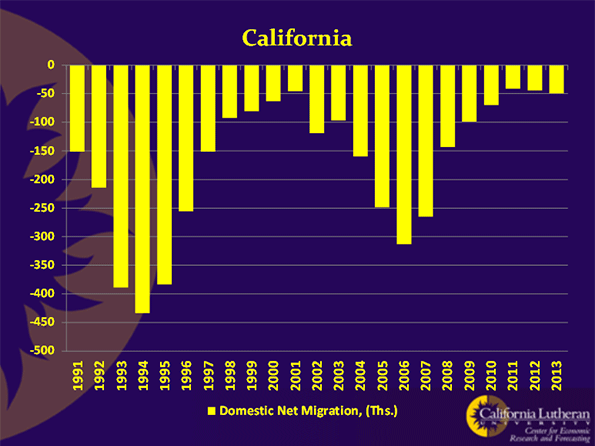
    Workers recognize the changes. They may not know the reasons, but they know the impacts, and they are voting with their feet. Domestic migration — migration between states, — is a good measure of how workers see opportunity. California’s domestic migration, in a dramatic reversal of a 150-year trend, has now been negative for over 20 consecutive years. That is, for over 20 years more people have left California for other states than have come to California from other states. Workers simply haven’t seen opportunity in California. How can this be? Why would people be leaving when jobs are being created in the Silicon Valley?

    The Silicon Valley jobs are rather specific. They require higher skill sets than most workers possess. One consequence is that the Silicon Valley’s prosperity hasn’t helped California’s other workers much. We are left with a situation where California’s tech firms search worldwide for workers, while California workers search for work.

    It didn’t have to be this way. High housing prices and environmental regulations, a result of state policies, have driven away the jobs that could be performed by typical California workers. Those jobs are now in Oregon, Texas, or China.

    A short distance away, in California’s Great Central Valley, there is poverty as persistent, deep, and widespread as anyplace in the United States. A recent report shows that California has three of the 20 fastest growing US cities in terms of jobs. It has four in the bottom 20.

    For a while, at least, the differences between California’s fastest growing regions and its slowest (or declining) areas will grow. In general, coastal areas will see more rapid economic growth than inland ones. Even within these broad regions, there will great heterogeneity. Bakersfield, boosted by a booming oil sector, will see stronger growth than Stockton. San Jose, with its thriving tech sector, will see far more growth than Santa Barbara or Monterey. Furthermore, the best performer among California’s inland cities will probably see faster growth than the slowest growing coastal city.

    On average, California’s economic growth will be far below its potential. In most of the state it will be disappointingly low to dismal, as California’s economy is held back by well-meaning but seriously flawed regulations. At the same time, a few super-performing cities may see spectacular growth, at least for a few years.

    Eventually, even California’s most vibrant economies will slow, gradually strangled by the lack of affordable housing and of an infrastructure necessary to move people from affordable housing to their jobs. People are willing to drive very long distances daily in pursuit of the twin goals of income security and the American dream of a home in the suburbs. The traffic on Highway 14 between Palmdale and Los Angeles reminds us of this twice every working day. But, they need roads, and affordable housing within commuting distance.

    Different growth rates and different levels of economic vitality will exacerbate the vast gulf that exists between California’s wealthiest communities and its poorest. Inequality will increase as California’s fabulously wealthy become ever wealthier, and California’s poor suffer in surprising silence, living on whatever aid we give them, denied the hope and the basic dignity that comes from a job.

    Domestic outmigration will increase, but the people who leave won’t be California’s poorest. Instead, young middle-class people will lead the exodus, as they move to wherever opportunity is more abundant. This, of course, will further increase California’s inequality and decrease its economic vitality.

    We will also see an increase in consumption communities. Already, many of California’s coastal communities are reflexively averse to any new activity that actually creates value, opting instead to become ever more exclusive playgrounds for the very rich. These communities will see rising home prices as they restrict new units, and will see rising demand, a result of ever greater concentrations of wealth worldwide and the unmatched amenities available in Coastal California.

    By contrast, some inland areas will see declining home values and eventually declining populations, as the lack of opportunity drives potential home buyers to places like Phoenix and Houston.

    For many of us, this is a depressing forecast, and it is fair to ask whether or not it is inevitable. It isn’t. Few things are. At a statewide level, I hope that representatives of California’s large and growing minority communities demand policies that support the opportunity that previous generations of Californians enjoyed. Absent such demands, California’s policies are unlikely to change.

    At a local level, cities would do well to eliminate all policies that contribute to economic stagnation. When a business is making locational decisions, it reviews lists of positive and negatives for the candidate communities. No place has only positives, and few places have only negatives. California cities are endowed with one huge positive: California is a wonderful place to live. That’s not enough, though. A city would do well to minimize the list of negatives.

    For businesses, an aggressive minimum wage is a negative, as it raises costs. Uncertainty and delay in a city’s response to an economic proposal increases the risk and costs of proposals. It’s a negative. So is unaffordable housing, as it increases wage demands and makes it harder for businesses to recruit top talent. The best way for a city to encourage the supply of affordable housing is to allow new-home development.

    Finally, areas of economic blight increase crime, raise city costs, reduce city revenues, and are unattractive to businesses considering moving to or expanding in an area. Cities need to be flexible in responses to proposals for these areas. Our work at CERF convinces us that we will need less commercial space in the future. Therefore, almost any proposal for dealing with these areas is preferable to inflexible adherence to existing zoning or plans.

    California cities are constrained by California policy. That doesn’t mean that California cities are without tools for economic development. Almost any California city — no matter which region it is in — is a better place to live than almost any city in, say, Texas. If that can be leveraged by minimized costs, flexibility, and creativity in adapting to the needs of job-creating businesses, a California city, even today, can assist businesses creating opportunity for its citizens

    This is the second part of a two-part report. Bill Watkins is a professor at California Lutheran University and runs the Center for Economic Research and Forecasting, which can be found at clucerf.org

    Flickr photo by Aude Lising: The Central California Coast, viewed from the Pacific Coast Highway — one of California’s unmatched amenities.

  • The California Economy: When Vigor and Frailty Collide

    Part one of a two-part report

    California is a place of extremes. It has beaches, mountains, valleys and deserts. It has glaciers and, just a few miles away, hot, dry deserts. Some years it doesn’t rain. Some years it rains all winter. Those extremes are part of what makes California the attractive place that it is, and, west of the high mountains, California is mostly an extremely comfortable place to live.

    Today, we have some new extremes. Some of our coastal communities are as wealthy as any in the world. At the other extreme, we have some of America’s poorest communities. San Bernardino, for example, has America’s second-highest poverty rate for cities with population over 200,000.

    From the beginning, we’ve had the fabulously wealthy. For the first 140 years after gold was found, California was a place where people could find, or, more correctly, build, success. The new part is the poverty. It used to be that the poor were mostly newcomers, people who hadn’t yet had time to show that they had what it takes. Today, our poverty is dominated by families who have been here a long time. While San Bernardino certainly has some newcomers, it is mostly a city of native Californians.

    The change became visible in the early 1990s. Many analysts will tell you that the change was caused by the collapse of the Soviet Union and the resulting peace dividend, which led to a dramatic downsizing of America’s defense sector, once a major component of California’s economy.

    I believe the way to think about this is that the downsizing of the defense sector exposed the weaknesses in California’s economy, as opposed to causing them. Sure, the downsizing had an economic impact. California lost hundreds of thousands of jobs. But the defense sector eventually bounced back and again became a source of good jobs. The problem is that it bounced back someplace else. It didn’t come back in California. In fact, it continues to decline in California.

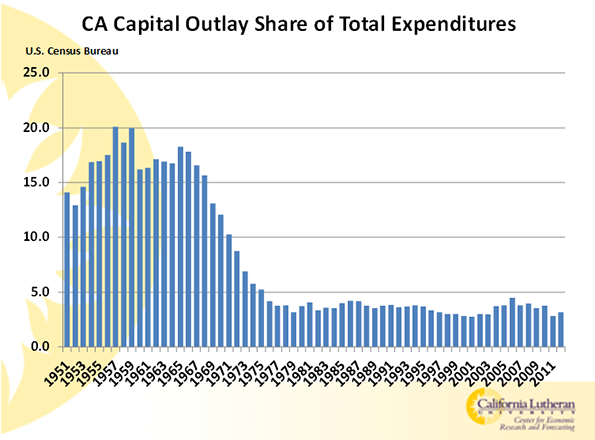
    The decline in California’s economic opportunities began way before the 1990s. As the 1960s progressed, Californians, or at the least the ones making decisions, changed their priorities. California’s spending for infrastructure had once consumed between 15 and 20 percent of the State’s budget. It precipitously fell to five percent or below.

    In the ’50s and early ’60s, governors Goodwin Knight and Pat Brown presided over a fabulous investment boom in universities, highways, water projects and the like. None of their successors has even attempted anything on that scale. The profound prosperity that accompanied and followed California’s investment boom hid the impacts of subsequent policy changes for decades.

    The decline in public capital spending wasn’t the cause of our changed priorities. It was the change in priorities that caused the change in spending. It is as if we decided that we were wealthy enough, and that future spending would be on social and environmental programs. If we weren’t looking for economic growth, why invest?

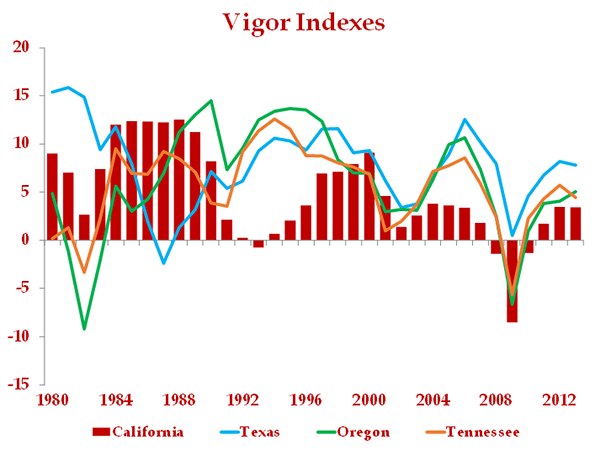
    At California Lutheran University’s Center for Economic Research and Forecasting, we’ve created a vigor index. It’s composed of net in-migration, job creation, and new housing permits, each equally weighted. It is quite sensitive to changes in economic opportunity. For example, in 2000, North Dakota had the nation’s lowest score, 0.9, and Nevada led the nation with a score of 24.1. By 2013, North Dakota led the country with a score of 20.0, while Nevada had seen its index value fall to only 6.4.

    In the following chart, we show California’s index (red bars) compared to that of Texas, Oregon, and Tennessee, from 1980 through 2013.

    California is apparently different than the comparison states. The Tennessee, Oregon, and Texas indexes have behaved more similarly to each other than to California since the late 1980s. Texas’ index behaved uniquely in the early 1980s, because of its dependency on oil and the long-term decline in oil prices that occurred during the 1980s.

    California appears to be different than the other states throughout the period, but the nature of the difference has changed. Prior to the late 1980s, California tended to outperform the others. For example, its score didn’t decline nearly as much as the others during the early 1980s recession. Given California’s resource endowment, we think this is natural.

    Since 1990, though, California’s vigor index has generally remained below those of Texas, Tennessee, and Oregon. Indeed, since 1990, California’s score has rarely exceeded the score of any of the comparison states, and it has never led them all.

    The index also shows that California’s investment in infrastructure during the 1950s and 1960s helped drive economic opportunity for two decades. It took two decades without any investment before we saw the consequences of the decision to not invest.

    Recently, California has seen budget surpluses and faster job growth than the average American state. The forces for the status quo now claim that this confirms the wisdom of their policies. They are wrong.

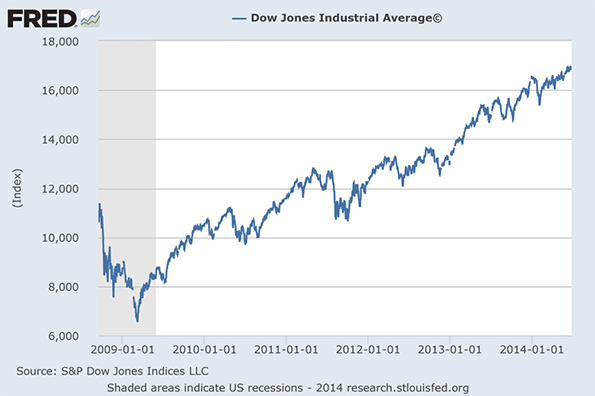
    California’s budget surpluses are a product of a temporary tax, and an incredible bull market in equities. Our dependence on a highly progressive income tax means that California’s fiscal condition swings on the fortunes of a small group of wealthy individuals.

    Equity markets have been amazing over the past few years. The Dow has increased by over 10,000 since it bottomed out on March 9, 2009, and it appears to be divorced from economic activity. It increases on good news and bad, propelled by an unprecedented monetary expansion. Right now, California’s largest taxpayers are reaping huge profits in the stock markets, and California is reaping huge windfalls in its tax revenues.

    Someday, the market gains will cease, or worse reverse. Someday, too, the temporary tax will expire. California’s surpluses will wash away like sand on a beach. The state will face a new crisis, a result of a progressive tax structure where revenues swing on paper profits and losses, not on economic activity.
    As for our job gains being better than the average state’s, California should not be average.

    Employment should be far higher than it is. Even the weak job growth we’ve seen is largely a legacy of a previous age. California has the world’s best venture capital infrastructure, partly because of the investment previous generations of Californians made in the university system. It is also, in part, a result of chance.

    An amazing period of innovation was initiated in Coastal California by a few incredibly talented individuals, who were funded by a few far-sighted capitalists. It was one of those rare coincidences that happen from time to time and change the world. The eventual result was the Silicon Valley and economic powerhouses such as Intel, HP, Apple, Yahoo, Google, Facebook, Twitter, and many more.

    Another result was the creation of a private, capitalist, vibrant infrastructure. It takes time and vast sums of money before a new idea generates profits. Product design is just the first step. An organization needs to be created to produce and sell the product. Factories need to be designed. Marketing plans need to be put in place.

    No inventor or entrepreneur can be expected to have all of the necessary skills or money to turn an idea into a profitable firm. So, an infrastructure appeared. The Silicon Valley’s world-leading venture capital markets and the support structure to enable the fabulous innovation and economic value created there was not the result of any government program or initiative. It was the spontaneous result of lots of people driven to innovate and profit from those innovations. It was capitalism at its very best.

    California’s Silicon Valley became the place for talented young people to turn great ideas into reality. It was also the place to go if you had money and wished to invest in vibrant, risky new technologies, or if you knew how to design factories, how to market products, how to build organizations, or how to finance rapid growth. The infrastructure that arose is supporting California today. This amazing capitalist engine of jobs, innovation and wealth is the source of most of California’s economic vigor. But it is a legacy that will eventually slip away, unless California changes its priorities.

    This is the first part of a two-part report. Bill Watkins is a professor at California Lutheran University and runs the Center for Economic Research and Forecasting, which can be found at clucerf.org.

    Flickr photo by mlhradio. A California extreme: Mountains on The Trona-Wildrose Road, at the edge of the Panamint Valley. One of the most remote deserts in North America, in one of the most remote corners of California; the salt flats of Panamint Valley to the west, and Death Valley to the east.

  • Sterling, the Clippers, and $2B of Monopoly Money

    Is there a more crooked roulette wheel than the one that spins around in the circles of professional sports? I ask in the context of the punishment meted out to Donald Sterling, the in-limbo owner of the Los Angeles Clippers, who, for his commentaries about race in America, was banned from the league and might be “forced” to sell his team for $2 billion, about $1.5 billion more than it was worth before his girlfriend taped their tawdry talks.

    On paper, let alone on the basketball court, the Clippers should be close to worthless—an inept franchise that has yet to win a championship in the 44 years of its existence, which began in Buffalo.

    The magic of pro sports accounting, thanks to antitrust exemption from the US Congress, is that all team owners enjoy the perquisites of monopoly money, which entitles even the racist Sterling to billion-dollar pay days.

    It makes sense that Sterling’s wife is trying to sell the Clippers to Steve Ballmer, the former CEO of Microsoft, who ought to know a thing or two about oligopoly.

    Ballmer’s bet is that the NBA’s cartel pricing will allow the team more revenue sharing from television, while paying less to the players, so that instead of paying 133 times earnings for a team earning about $15 million a year, he can reduce his paid premium to, say, 40 times earnings if the Clippers start earning $50 million annually.

    Should the team acquisition simply be a rich man’s hobby, he can console himself for his losses by sitting court-side in Los Angeles with various starlets, although $2 billion is a lot to pay for a matchmaking subscription.

    Nor is Ballmer alone among executives in celebrating the un-level playing fields of monopoly. The owners of major league teams in football and basketball have long understood that the points on the scoreboards are incidental to their business of collecting money, paid out by the cable television industry (another oligopoly), and from treating the workers as if they were (high-end) strip miners.

    To be sure, many athletes in professional sports earn multimillion-dollar salaries. But they are paid as a coefficient of their ability to draw television ratings. Few other businesses in a country theoretically devoted to free enterprise are allowed to allot franchises as though they were noble fiefs, and to treat workers as indentured servants.

    Even now, it takes years for baseball and football players to become free agents, and leagues impose salary caps, in theory to equalize competition, although in practice to save money.

    If the movie or insurance businesses conducted a draft of prospective employees, Congress would cry foul and enforce an open and free labor market.

    Not only can the professional leagues allocate talent as if at a slave auction, but they enjoy the further subsidy that colleges and universities (in basketball and football) operate their minor leagues at no cost to the professional owners.

    On average, big-time universities earn about $50 to $100 million a year on their sports programs—much of that from basketball and football—but then become indignant when players, such as those at Northwestern University, suggest forming a union or ask for long-term healthcare benefits when they leave school programs with permanent injuries. Aren’t worthless degrees in something like social media enough reward?

    Best of all, few of the operating costs are passed on to the beneficiaries, the peers of Donald Sterling, who unwrap their golden tickets even if their teams are losing or they are degrading the fan base.

    With so much monopoly money to spread around among relatively few pro teams, owners can throw multimillion dollar, multiyear contracts blindly at athletes, who often look more like lottery winners than stars.

    In the last two years, for example, the bloated New York Yankees have lavished C.C. Sabathia, Mark Teixeira, Alex Rodriquez, Derek Jeter, Curtis Granderson, and others more than $100 million a year, even though they have played in only a fraction of the games, or poorly.

    During the last off-season, the Yankees committed another half a billion dollars to new free agents, including catcher Brian McCann, who as I write is batting an anemic .226.

    In 2013 the iconic team reported a loss of $9.1 million, although Forbes listed the worth of the franchise at $2.5 billion, with annual revenues of $431 million. A closer look at the numbers, however, suggests the Yankees are a cable network (jointly owned with FOX) with a team, not the other way around.

    Only monopoly economics allows the dimwitted Yankees to stay in business. Thanks to deductible ticket purchases by spendthrift corporate clients, the average seat at Yankee Stadium runs about $50, although the good seats cost over $200. The price of a monthly cable sports package in New York, at least for those that want a Yankees TV fix, can be another $1000 a year.

    Were pro sports in the interest of the community and worthy of an antitrust exemption, anyone with a video camera could broadcast the games as a news event. Instead, the games are the property of the major league cartels, whose officials, acting as though they were OPEC magnates, allocate the product.

    As if the pro sports honey pot needed anymore sweeteners, think, too, how easily many owners have extorted new stadiums from their home markets, in exchange only for agreeing to keep the team in the city. Or they skip town as soon as they’re promised millions elsewhere.

    According to several studies, some $17 billion in tax-exempt public funding has gone into stadium construction in recent years, another reason it’s impossible to lose as a team owner.

    For the fans, the new $1.5 billion Yankee Stadium feels the same as the old one. But owners lobby for new, tax-subsidized ballparks, especially in the NFL, so they can increase the number of skyboxes; that money drops straight to the owner’s bottom line, avoiding the pools of revenue sharing.

    Are there risks to owning these golden franchises? Pro football leagues will be hit with endless class-action lawsuits, until they can indemnify all current and past players with long-term disability in exchange for their primetime tackles and concussions. But I doubt these lawsuits will turn the NFL into flag football.

    Another threat to pro sports could come from an end to monopoly pricing in the cable television industry. Once every phone and iPad is a handheld TV, will customers really pay Time-Warner $90 every month for 500 channels? Will there be networks with enough subscribers to pay billions to the major leagues? Will audiences continue to watch baseball on television if the stadiums are empty, as many are now?

    Of course the best response to loutish team owners—among whom I suspect Donald Sterling is par for the course—would be to end the antitrust exemption and let the teams compete with other, newer teams and leagues. Why must pro sports be a regulated industry? Are they the equivalent of nuclear power?

    Why can’t even small and medium-sized cities have teams? The community-owned Packers have flourished in Green Bay, and the United States is a country of Green Bays. As in European soccer, the major leagues could simply be the most successful teams, with the poor performers each year getting relegated to lesser divisions. The University of Alabama would move up, and the Jacksonville Jaguars would go down.

    By those standards, the Los Angeles Clippers would long ago have been demoted to the California league, and their owner, one Donald Sterling, would not today be looking forward to a $2 billion check.

    Matthew Stevenson, a contributing editor of Harper’s Magazine, is the author of Remembering the Twentieth Century Limited, a collection of historical travel essays. His new book, Whistle-Stopping America, was recently published.
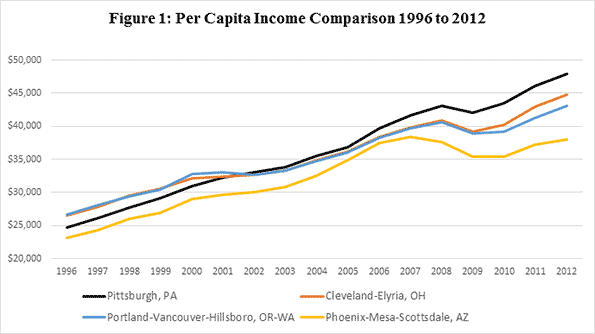
    Flickr photo by David Jones: The Los Angeles Staples Center on a good night for the Clippers; they beat the Miami Heat 111-105.

  • The Ugly City Beautiful: A Policy Analysis

    When it comes to the future, Detroit and San Francisco act as poles in the continuum of American consciousness. Detroit is dead and will continue dying. San Francisco is the region sipping heartily from the fountain of youth. Such trajectories, according to experts, will go on indefinitely.

    Harvard economist Ed Glaeser has a grim outlook for the Rust Belt. “[P]eople and firms are leaving Buffalo for the Sunbelt because the Sunbelt is a warmer, more pleasant, and more productive area to live,” he writes in City Journal.

    Glaeser echoes this sentiment in a recent interview with International Business Times, saying “[s]mart people want to be around other smart people”, and the Rust Belt has a long slog ahead given that “post-industrial city migration is dominated by people moving to warmer climes”.

    But is this true? Is there a “brain drain” from the Rust Belt to the Sun Belt and Coasts? In a word: no. But Rust Belt leaders have bought this narrative hook line and sinker, and the subsequent hand-wringing has led to wasteful public investment.

    “Michigan’s cities must retain and attract more people, including young knowledge workers, to its cities by making them attractive, vibrant, and diverse places,” reads a 2003 memo from the National Governor’s Association about Michigan’s “Cool Cities” campaign.

    But the campaign struggled. “Government can’t mandate cool,” reflected Karen Gagnon, the former Cool Cities director. “As soon as government says something is cool, it’s not.”

    What’s worse, “cooling you city” with talent attraction expenditures can exacerbate economic disparities on the ground. Cities, like Chicago, are increasingly becoming bifurcated cities based on faulty assumptions that “trickle down urbanism” works. That said, the challenge of the day—for not only Rust Belt cities, but all cities—is not “brain drain”, but “brain waste”. Those cities who can best rebuild middle class communities tied to emerging markets will be the future of investment, like they were in the past.

    Through Rust-Colored Glasses

    When a people fall from grace, the sentiment of decline tends to stick. The Rust Belt’s demise is cemented. Meanwhile, the future is elsewhere. Like toward the sun. For instance, from 2000 to 2010, the Sun Belt metros of Houston, Dallas, Atlanta, Riverside, Las Vegas, Miami, Orlando, and Phoenix experienced the largest population growth. The biggest losers? It’s a “who’s who” of Rust Belt metros, led by Detroit, Cleveland, Pittsburgh, and Buffalo.

    America is a country governed by growth: big cars, big belt buckles, big houses, and big populations. Shrinkage is weakness. It is a sign of place failure. The problem here is that population growth is an ineffective, broad-brush measure when trying to understand regional underlying dynamics. A new study by Jessie Poon and Wei Yin in the journal Geography Compass called “Human Capital: A Comparison of Rustbelt and Sunbelt Cities” details exactly that.

    In it, the authors compare human capital levels between the Sunbelt metros in California (including San Francisco and L.A.), Nevada, New Mexico, and Arizona with Rust Belt metros in Michigan, Ohio, Indiana, Pennsylvania, and upstate New York. When it comes to share of population with a college degree, the authors find that the Rust Belt is experiencing a brain gain equal to their Sun Belt peers from 1980 to 2010. Poon and Wei also found that skill ratios of immigrants is higher in the Rust Belt than Sunbelt. The authors note that despite population decline, the Rust Belt continues “to be important sites of human capital accumulation”.

    The study coincides with recent work out of the Center for Population Dynamics that shows Greater Cleveland’s number of 25- to 34-year olds with a bachelor’s or higher increased by 23% from 2006 to 2012, as well as Pittsburgh economist Chris Briem’s work that shows the metros of Pittsburgh, Detroit, and Cleveland rank 1st,, 6th, 7th in the country respectively when it comes to the number of young adults in the labor force with a graduate or professional degree.

    Beyond human capital, the Rust Belt continues to produce and export wealth at a massive pace. The “Chi-Pitts” mega-region, which mirrors the Rust Belt boundaries with the addition of Minneapolis, generates $2.3 billion in economic output, second only to the “Bos-Wash” mega-region that makes up the Northeast Corridor.

    Also, using IRS migration data from the 2009-2010 period, a team of researchers led by Michal Migurski showed that Los Angeles County, New York County, and Cook County sent the most people and money to the rest of the United States. Detroit’s Wayne County was fourth. Cleveland’s Cuyahoga County was 9th, one spot ahead of San Francisco County. Speaking to Esquire, which published the work in a visual called “Where Does the Money Go”, Migurski explains the findings:

    "We realized that if you look at the biggest ‘losers,’ essentially what you’re looking at are the biggest cities in the U.S.," Migurski says. One of those losers: New York County, which lost $1,306,548,000 and 15,100 people. "But does that actually mean New York is a big loser?" Migurski asks. "One of our ideas was that, you’re not a loser if you’re losing money. You’re an exporter." The sort of exporter, he says, that boosts the rest of the U.S. economy. Traditional Sun Belt retirement areas comprise the gainers; areas like South Florida and Southern California in particular, create what Migurski calls "money sinks."

    Still, the notion of “loser” for Wayne and Cuyahoga County sticks, despite evidence to the contrary. But why? Why the constant “poor post-industrial people” sentiment, if not a low-grade captivation that comes with “ruin porn” rubbernecking?

    Well, if an ideal exists—you know, the experts beckon: be the “new” city, the “hot” city, the “creative” city—then a study in contrasts is necessary. The Rust Belt, with its connotations of smoke stacks and demographic decline, fits the bill.

    “[Richard] Florida suggests that Rustbelt cities’ high concentration of less creative blue-collar workers also produces unhappy residents,”Poon and Wei conclude in their Rust Belt/Sun Belt study. “We suggest that such a doom and gloom picture of urban and regional development for the uncool industrial Rustbelt needs to be tempered with a trend of brain gain that is growing across cities in the region.”

    But for this tempering to happen a clearer understanding of the importance of accumulating human capital needs to be ascertained. More exactly: Is it to put your city to work, or to “live-work-play”?

    Build it and they will…what?

    In his 1921 work Economy and Society, social scientist Max Weber details a city’s raison d’etre. Cities can be producer cities, wherein importance is derived from industries that demand national and international trade. Think Detroit and cars. Additionally, cities are consumer cities, in which growth is tied to how much is spent consuming goods and services in the local economy. Think eating, drinking, and buying houses.

    The cities that are the most economically robust have wealth generated from global production, which in turn enables local consumption. San Francisco’s tech economy drives it real estate market and artisanal toast scene. That is, if the question was “What came first, the farm-to-table chicken or the egghead?” The answer is “the egghead”, hands down.

    But this logic—i.e., in order to go to a restaurant, you need a job, and your job prospects are tied to the viability of your region’s global industries—is often turned on its head in economic development. Here, the goal is growth, no matter the rhyme or reason.

    “Like in many Sun Belt cities,” writes a Seattle Times columnist and Sun Belt expat, “Phoenix’s economic plan devolved into merely adding people, no matter the enormous long-term costs”. The columnist goes on to note that while the population has boomed, the city lags on most measures, such as per capita income (see Figure 1 below).

    Moreover, the Phoenixes of the world exist partly because of retired Baby Boomers and the disposable income that comes with it. The Sun Belt feeds off the legacy of production in the Northeast and Midwest. Other cities, like Portland, are fed by a not dissimilar dynamic. But it’s not the retired who come, rather the pre-retired.

    “The Portland metro area’s young college-educated white men are slackers when it comes to logging hours on the job,” lead’s a piece in the Oregonian about a study conducted last year, “and that’s one reason people here collectively earn $2.8 billion less a year than the national average.” Figure 1 demonstrates Portland’s sluggish income gains compared to Rust Belt peers Pittsburgh and Cleveland.

    Similarly, in a paper circulated by the Federal Reserve Bank of Atlanta, the author analyzed the top 86 “brain gain” metros in the nation to determine whether or not a region’s increase in human capital was paying off in terms of per capita income, labor force participation, poverty rate, and unemployment. The author found Portland was one of twelve metros that experienced zero economic outcomes. Pittsburgh scored 4 for 4. The authors suggest that talent attraction and retention—when untethered to production capacity—“may be largely inefficient, a kind of traditional economic development ‘buffalo hunting’”.

    Portland is perhaps America’s consummate lifestyle city. No doubt, the city has experienced a significant brain gain over the last decade. Portland is a talent attraction model. But it is not a talent producing or refining model. Rather, Portland is producing a scene that is run by the consumption of the scene’s aesthetic. Writes one young worker who left:

    “I can’t stay too long because I know if I stayed a day too long in Portland, I’d suddenly be happy to embrace the slow pace of the city and stop working… I’d end up getting sleeping real late every day, drink some coffee, maybe write some poetry on my porch (or not), and then find a part time job selling cigars like I had in college.”

    The lesson is that accumulating talent is not enough. There has to be something for the talent to do, or a context that fosters “doing”. It is also a warning for cities investing in the lifestyle game. Spending on creative class amenities ensures nothing. Creating a field of dreams won’t pay the bills. But it will run up the tab.

    The Ugly City Beautiful

    In 1998, the Chicago Sun-Times ran a piece called “Building the City Beautiful”. “The mayor of the city of Chicago, Richard M. Daley, is a big admirer of Martha Stewart,” it begins, before describing Daley’s plans to begin the "Martha Stewart-izing" of Chicago. The article goes on to quote a University of Illinois at Chicago professor who said Chicago is turning from a producer city to a consumer city. "The producer city was the industrial city — the smoke and the noise and the industrial jobs,” noted the professor. “The consumer city is the city of Starbucks, boutiques and so forth.”

    The professor was only partly right. By the 1990s, Chicago was indeed becoming brainier. But its emerging knowledge economy was an outgrowth of its “big shouldered” manufacturing base. Columbia University professor Saskia Sassen recently noted that pundits overlook this when examining the city’s transformation, with the bias being that “Chicago had to overcome its agro-industrial past, [and] that its economic history put it at a disadvantage”. Notes Sassen:

    [I]n my research I found that its past was not a disadvantage. In fact, it was one key source of its competitive advantage. The particular specialized corporate services that had to be developed to handle the needs of its agro-industrial regional economy gave Chicago a key component of its current specialized advantage in the global economy.

    Similar economic transformations from legacy cost to legacy asset are found throughout the whole of the Rust Belt. Pittsburgh, for instance, no longer provides the muscle for steel making, but it does act as the “brain center” for the world’s steel frame. How this came about is detailed in the article “Pittsburgh’s evolving steel legacy and the steel technology cluster”.

    With the arrival of the new economy also came “new economy” tastes. Sassen noted that when she arrived in to study in Chicago in the 90s she was greeted by “old lofts transformed into beautiful restaurants catering to a whole new type of high-income worker—hip, excited, alive.”

    In other words, local consumption patterns began setting up around the emergent worker demand. Going was the Italian Beef and arriving was pickled beets. This demand also impacted housing, with the attraction to urban living setting the stage for gentrification. This, in a nutshell, is the dynamic driving the transformation of urban neighborhoods nationwide: a new economy demands new workers which in turn demand a new kind of lifestyle. The problem, though, is that leaders have the causality backward, or that creating a new lifestyle will incur new worker supply and then poof: new industries. But as we see with Portland, it is not that easy. The industrial DNA and social history of your city matters more than the cosmetics atop the topography.

    Still, from a policy and strategy standpoint, it is easier just to make your city “cool”. And that’s exactly what Chicago has been doing at a significant pace. In a recent piece entitled “Well-healed in the Windy City”, author Aaron Renn details Mayor Rahm Emanuel’s policy of using tax-increment financing (TIF) to create geographic “winners” and “losers” across Chicagoland. “The true purpose of Chicago’s TIF districts—which now take in about $500 million per year,” writes Renn, “appears to be tending to high-end residents, businesses, and tourists, while insulating them from the poorer segments of the city.”

    The strategy was spelled out explicitly by Mayor Emanuel during a recent ribbon cutting for a bike path in Chicago’s Loop. Said Emanuel: “I expect not only to take all of their [Seattle and Portland’s] bikers but I also want all the jobs that come with this, all the economic growth that comes with this, all the opportunities of the future that come with this.”

    Notwithstanding the faulty logic in the strategy—e.g., if Portland lacks the jobs for its residents, how can it supply jobs for Chicagoans—the real problem is the costs associated with such bifurcated investment. In West and South Chicago, the byproducts of the City Beautiful approach are downright ugly. But they are not unexpected. They are the long-documented economic and social effects of concentrated poverty and segregation. Continues Renn:

    Safety levels in Chicago can no longer be plotted on a single bell-shaped curve for the entire city. Today, that curve is split into two—one distribution for the wealthy neighborhoods and one for the poor ones. A lack of resources is part of the problem: the police department is understaffed… While the city budget is tight, failing to increase police strength during a murder epidemic is a profound statement of civic priorities.

    Urban priorities flow from a perception of what is at stake. For long, the push for human capital accumulation has pitted city versus city amidst the backdrop of an urban popularity contest in which the “winner” is assured nothing outside of popularity. But victory in the vanity game is fleeting. The young and the restless are exactly that, and many people who come to New York or San Francisco, or for that matter Portland, leave as they get older and seek out affordable places to raise a family. What remains on the ground is the reality of brain waste. Without the prioritization of equitable, integrated middle-class neighborhoods a city’s progress will be always be disparate, if not illusory. Talent attraction is but part of a redevelopment process. So is talent refinement for those arriving and talent production for those in place. After all, neighborhoods are factories of human capital. Building people, not places, is what a successful city is all about.

    But to know this is to “know thyself”. The Rust Belt has been dying for some time now, so say the experts. The region has absorbed the projections, and given that desperate times call for desperate measures investment has been wasted. “[Creative class theory] is bad because it distracts from what’s important,” says Sean Stafford, author of Why the Garden Club Couldn’t Save Youngstown.

    Regaining focus entails removing the rust-colored glasses. Rust Belt leaders will see there are assets to work with, not to mention feel the freedom that comes with no longer being a study in contrast for those touting a future that really isn’t.

    Richey Piiparinen is Senior Research Associate at the Center for Population Dynamics at the Maxine Goodman Levin College of Urban Affairs at Cleveland State University. The Center for Population Dynamics at Cleveland State University’s Maxine Goodman Levin College of Urban Affairs aims to help partner organizations competitively position the region for economic and community development. It will do so through the lens of migration, applied demography, and culture.

    Lead photo courtesy of bctz Cleveland